D
           et Ba
              er si
                m c F
                 in
                    in act
                      g    or
                        Pa s
                           y In
                             R
Presented to:                  at
                                  es
Sir Ahmed Tasman Pasha

Presented By:    Sana Rao Roll no.09-29
Determining pay rates
    • Employee compensation

    • How to formulate plans for paying employees

       – Time based wages or salary
       – Performance based pay

    • Pay plans

       – Legal
       – Union company policy
       – An equity
Determining Pay Rates

• Employee compensation
 All forms of pay or rewards going to
 employees and arising from their
 employment.
Basic Factors in Determining
        Pay Rates


                    Employee
                  Compensation


    Direct Financial        Indirect Financial
       Payments                 Payments
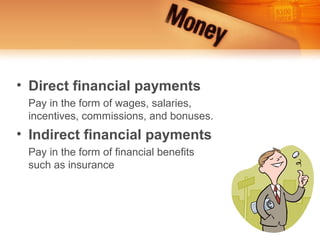
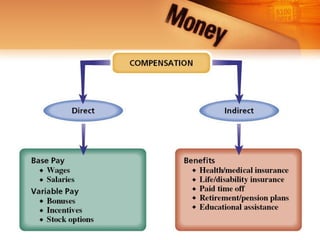
• Direct financial payments
 Pay in the form of wages, salaries,
 incentives, commissions, and bonuses.
• Indirect financial payments
 Pay in the form of financial benefits
 such as insurance
Determining Pay Rates
 • Direct financial payments
   – base on two factor


      • Pay for Time

      • Pay for Performance
Determining Pay Rates
• Pay for time:
  – Blue collar and clerical workers get hourly
    or daily wages,
  – And others, like managers paid by the week,
    month or week.
  – Time pay is still the foundation of most
    employer’s pay plans.
Determining Pay Rates
• Pay for performance:

  – It ties compensation to the amount of
    production the worker turns out.
  – For example
     • Piecework
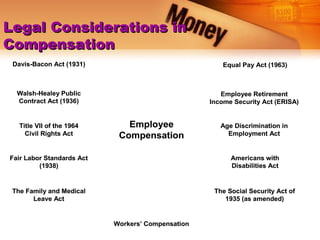
Legal Considerations in
Compensation
 Davis-Bacon Act (1931)                                Equal Pay Act (1963)


  Walsh-Healey Public                                 Employee Retirement
  Contract Act (1936)                              Income Security Act (ERISA)


   Title VII of the 1964      Employee                Age Discrimination in
     Civil Rights Act       Compensation                Employment Act


Fair Labor Standards Act                                 Americans with
         (1938)                                          Disabilities Act


 The Family and Medical                             The Social Security Act of
       Leave Act                                       1935 (as amended)


                           Workers’ Compensation
• Davis-Bacon Act (1931)
  – A law that sets wage rates for laborers employed by
    contractors working for the federal government.
• Walsh-Healey Public Contract Act
  (1936)
   – A law that requires minimum wage and
     working conditions for employees working
     on any government contract amounting to
     more than $10,000.
• Title VII of the 1964 Civil Rights
  Act
  – This act makes it unlawful for employers to
    discriminate against any individual with
    respect to hiring, compensation, terms,
    conditions, or privileges of employment
    because of race, color, religion, sex, or
    national origin.
• Fair Labor Standards Act (1938)

   – This act provides for minimum wages, maximum
     hours, overtime pay for nonexempt employees after
     40 hours worked per week, and child labor
     protection.
   – The law has been amended many times and covers
     most employees.
   – It covers majority of worker engaged in
       • Production and sale of goods for interstate and
         foreign commerce
Some feature of FLSA
• Exempt Employees
  – Employees to whom employers are not required to
    pay overtime under the Fair Labor Standards Act.
     • Executives, administrators, professional (learned or
       creative) employees, computer employees, outside sales
       persons
• Non-exempt Employees
  – Employees who must be paid overtime under the
    Fair Labor Standards Act.
     • Hourly
     • Salaried non-exempt
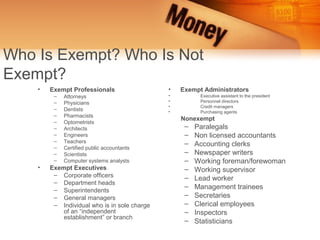
Who Is Exempt? Who Is Not
Exempt?
    •   Exempt Professionals                  •   Exempt Administrators
         –   Attorneys                        •         Executive assistant to the president
         –   Physicians                       •         Personnel directors
                                              •         Credit managers
         –   Dentists                         •         Purchasing agents
         –   Pharmacists
         –
                                                  Nonexempt
             Optometrists
         –   Architects                            –   Paralegals
         –   Engineers                             –   Non licensed accountants
         –   Teachers                              –   Accounting clerks
         –   Certified public accountants
         –   Scientists                            –   Newspaper writers
         –   Computer systems analysts             –   Working foreman/forewoman
    •   Exempt Executives                          –   Working supervisor
         – Corporate officers                      –   Lead worker
         – Department heads
         – Superintendents
                                                   –   Management trainees
         – General managers                        –   Secretaries
         – Individual who is in sole charge        –   Clerical employees
            of an “independent                     –   Inspectors
            establishment” or branch
                                                   –   Statisticians
Overview of
Compensation Laws
• The Equal Pay Act
  – Passed as an amendment to the FLSA in 1963
  – Prohibits sex discrimination in pay
  – Unequal pay is allowed for equal work under
    circumstances that are based on differences in:
     •   Seniority
     •   Productivity
     •   Merit
     •   Any factor other than sex
Overview of Compensation Laws
(cont’d)
• Employee Retirement Income Security Act
  (ERISA)
   – The law that provides government protection of
     pensions for all employees with company pension
     plans. It also regulates vesting rights.
   – vesting rights:
      • Employees who leave before retirement may
        claim compensation from the pension plan
• The Age Discrimination in Employment Act
   – Prohibits age discrimination against employees who
     are 40 years of age and older in all aspects of
     employment, including compensation.
• The Age Discrimination in
  Employment Act
  – Prohibits age discrimination against
    employees who are 40 years of age and
    older in all aspects of employment,
    including compensation.
Other legislation affecting compensation

  • The Americans with Disabilities
    Act
     – Prohibits discrimination against qualified
       persons with disabilities in all aspects of
       employment, including compensation .
The Family and Medical Leave Act

• Entitles eligible employees, both men and women, to
  take up to 12 weeks of unpaid, job-protected leave for
  the birth of a child or for the care of a child, spouse, or
  parent.
Compensation Policy Issues
• Workers’ compensation
  – Designed to provide financial protection for individuals
    injured on the job
  – Compensation is provided for:
      • Medical expenses
      • Lost wages from the time of injury until their return to
        the job
      • Death, dismemberment, or permanent disability
  – Payouts have more than tripled in the past 20 years.
      • Much of this increase is due to fraud.
  – The fastest growing category of workers’ compensation
    claims is mental stress.
Corporate Policies, Competitive Strategy,
and Compensation
   • Aligned reward strategy
      – The employer’s basic task is to create a
        bundle of rewards—a total reward
        package—specifically aimed at eliciting
        the employee behaviors the firm needs
        to support and achieve its competitive
        strategy.
– The HR or compensation manager will
  write the policies in conjunction with top
  management, in a manner such that the
  policies are consistent with the firm’s
  strategic aims.
Compensation Policy Issues
•   Pay for performance
•   Pay for seniority
•   The pay cycle
•   Salary increases and promotions
•   Overtime and shift pay
•   Probationary pay
•   Paid and unpaid leaves
•   Paid holidays
•   Salary compression
•   Geographic costs of living differences
Compensation Policy Issues
(cont’d)
  • Salary compression
   – A salary inequity problem, generally
     caused by inflation, resulting in longer-
     term employees in a position earning
     less than workers entering the firm
     today.
• Geography
  – Employers handle cost-of-living
    differentials way.
  – One is to give the transferred person a
    nonrecurring payment.
  – Other pay differential in several ways.
• IBM example.
• It dominated its industry into the 1980s.
• But by 1990s, it was failing to exploit new
  technologies and losing touch with its
  customers.
• Its board hired Louis Gerstein as CEO.
• Its first strategic aim was to transform IBM
  from a sluggish giant to a lean winner.
IBM example
 To change this situation, Gerstner’s team made
  four main change sin what become the firm's
  new strategic compensation plan.
• The Market place Rule:
   – The company switched from its pervious
     single salary structure to new different
     salary structure and merit budget for
     different job families.
• Fewer job, evaluated differently, in
  broadband:

  – Second, IBM scraped its point factor job
    evaluation system and its 24 traditional
    salary grade.
• Mangers manage:
  – Manger rank employees on a variety of
    factors (such as critical skills and
    results).

  – Manager decide which factors are used
    and weights they are given.
• Big stack for stockholders:
  – Every no executive employee’s cash
    compensation consisted of base salary.
  – There was no concept of pay for
    performance.

     • A top-rated employee receives two-and-
       one-half times the award of an employee
       within the lowest ranking.
Equity and Its Impact on
Pay Rates
• Equity theory
  – Formulated by J. Stacy Adams
  – People form equity beliefs based on two
    factors:
     • Inputs (I)
        – Refer to the perceptions that people have
          concerning what they contribute to the job (e.g.,
          skill and effort)
• Outputs (O)
   – Refer to the perceptions that
     people have regarding the returns
     they get (e.g., pay) for the work
     they perform
Equity and Its Impact on Pay
Rates

• The equity theory of motivation
  – States that if a person perceives an
    inequity, the person will be motivated to
    reduce or eliminate the tension and
    perceived inequity.
• Inequity
  – Occurs when the ratio of outputs to
    inputs is perceived to be unequal
  – When employees’ O/I ratios are less
    than that of their referent others, they
    feel they are being underpaid.
  – When employees’ O/I ratios are greater,
    they feel they are being overpaid.
• Equity
  – Occurs when the ratio of outputs to
    inputs is perceived to be equal
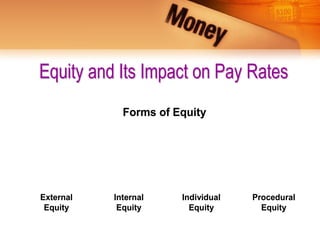
Equity and Its Impact on Pay Rates
             Forms of Equity


External   Internal    Individual   Procedural
 Equity     Equity       Equity       Equity
Forms of Equity
• External equity
  – How a job’s pay rate in one company
    compares to the job’s pay rate in other
    companies.
• Internal equity
  – How fair the job’s pay rate is, when
    compared to other jobs within the same
    company
• Individual equity
  – How fair an individual’s pay as
    compared with what his or her co-
    workers are earning for the same or
    very similar jobs within the company.
• Procedural equity
  – The perceived fairness of the process
    and procedures to make decisions
    regarding the allocation of pay.
• Impact of equity perceptions on
  employee behavior
   – Responses to feeling underpaid:
     • Decrease inputs
     • Escape the situation
– Responses to feeling overpaid:
  • Just as satisfying as equity
  • Somewhat dissatisfying, but not nearly as
    dissatisfying as underpayment
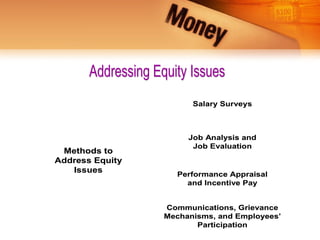
Addressing Equity Issues
                          Salary Surveys


                         Job Analysis and
                          Job Evaluation
 Methods to
Address Equity
   Issues
                      Performance Appraisal
                        and Incentive Pay


                    Communications, Grievance
                    Mechanisms, and Employees’
                           Participation
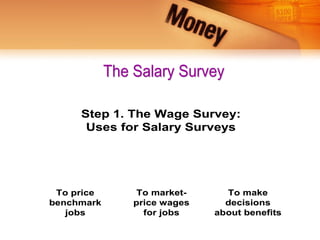
The Salary Survey

     Step 1. The Wage Survey:
      Uses for Salary Surveys


 To price        To market-     To make
benchmark       price wages     decisions
   jobs           for jobs    about benefits
Compensation2

Compensation2

  • 1.
    D et Ba er si m c F in in act g or Pa s y In R Presented to: at es Sir Ahmed Tasman Pasha Presented By: Sana Rao Roll no.09-29
  • 2.
    Determining pay rates • Employee compensation • How to formulate plans for paying employees – Time based wages or salary – Performance based pay • Pay plans – Legal – Union company policy – An equity
  • 3.
    Determining Pay Rates •Employee compensation All forms of pay or rewards going to employees and arising from their employment.
  • 4.
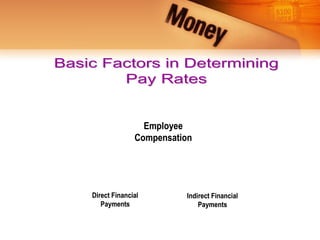
    Basic Factors inDetermining Pay Rates Employee Compensation Direct Financial Indirect Financial Payments Payments
  • 5.
    • Direct financialpayments Pay in the form of wages, salaries, incentives, commissions, and bonuses. • Indirect financial payments Pay in the form of financial benefits such as insurance
  • 7.
    Determining Pay Rates • Direct financial payments – base on two factor • Pay for Time • Pay for Performance
  • 8.
    Determining Pay Rates •Pay for time: – Blue collar and clerical workers get hourly or daily wages, – And others, like managers paid by the week, month or week. – Time pay is still the foundation of most employer’s pay plans.
  • 9.
    Determining Pay Rates •Pay for performance: – It ties compensation to the amount of production the worker turns out. – For example • Piecework
  • 10.
    Legal Considerations in Compensation Davis-Bacon Act (1931) Equal Pay Act (1963) Walsh-Healey Public Employee Retirement Contract Act (1936) Income Security Act (ERISA) Title VII of the 1964 Employee Age Discrimination in Civil Rights Act Compensation Employment Act Fair Labor Standards Act Americans with (1938) Disabilities Act The Family and Medical The Social Security Act of Leave Act 1935 (as amended) Workers’ Compensation
  • 11.
    • Davis-Bacon Act(1931) – A law that sets wage rates for laborers employed by contractors working for the federal government. • Walsh-Healey Public Contract Act (1936) – A law that requires minimum wage and working conditions for employees working on any government contract amounting to more than $10,000.
  • 12.
    • Title VIIof the 1964 Civil Rights Act – This act makes it unlawful for employers to discriminate against any individual with respect to hiring, compensation, terms, conditions, or privileges of employment because of race, color, religion, sex, or national origin.
  • 13.
    • Fair LaborStandards Act (1938) – This act provides for minimum wages, maximum hours, overtime pay for nonexempt employees after 40 hours worked per week, and child labor protection. – The law has been amended many times and covers most employees. – It covers majority of worker engaged in • Production and sale of goods for interstate and foreign commerce
  • 14.
    Some feature ofFLSA • Exempt Employees – Employees to whom employers are not required to pay overtime under the Fair Labor Standards Act. • Executives, administrators, professional (learned or creative) employees, computer employees, outside sales persons • Non-exempt Employees – Employees who must be paid overtime under the Fair Labor Standards Act. • Hourly • Salaried non-exempt
  • 15.
    Who Is Exempt?Who Is Not Exempt? • Exempt Professionals • Exempt Administrators – Attorneys • Executive assistant to the president – Physicians • Personnel directors • Credit managers – Dentists • Purchasing agents – Pharmacists – Nonexempt Optometrists – Architects – Paralegals – Engineers – Non licensed accountants – Teachers – Accounting clerks – Certified public accountants – Scientists – Newspaper writers – Computer systems analysts – Working foreman/forewoman • Exempt Executives – Working supervisor – Corporate officers – Lead worker – Department heads – Superintendents – Management trainees – General managers – Secretaries – Individual who is in sole charge – Clerical employees of an “independent – Inspectors establishment” or branch – Statisticians
  • 16.
    Overview of Compensation Laws •The Equal Pay Act – Passed as an amendment to the FLSA in 1963 – Prohibits sex discrimination in pay – Unequal pay is allowed for equal work under circumstances that are based on differences in: • Seniority • Productivity • Merit • Any factor other than sex
  • 17.
    Overview of CompensationLaws (cont’d) • Employee Retirement Income Security Act (ERISA) – The law that provides government protection of pensions for all employees with company pension plans. It also regulates vesting rights. – vesting rights: • Employees who leave before retirement may claim compensation from the pension plan • The Age Discrimination in Employment Act – Prohibits age discrimination against employees who are 40 years of age and older in all aspects of employment, including compensation.
  • 18.
    • The AgeDiscrimination in Employment Act – Prohibits age discrimination against employees who are 40 years of age and older in all aspects of employment, including compensation.
  • 19.
    Other legislation affectingcompensation • The Americans with Disabilities Act – Prohibits discrimination against qualified persons with disabilities in all aspects of employment, including compensation .
  • 20.
    The Family andMedical Leave Act • Entitles eligible employees, both men and women, to take up to 12 weeks of unpaid, job-protected leave for the birth of a child or for the care of a child, spouse, or parent.
  • 21.
    Compensation Policy Issues •Workers’ compensation – Designed to provide financial protection for individuals injured on the job – Compensation is provided for: • Medical expenses • Lost wages from the time of injury until their return to the job • Death, dismemberment, or permanent disability – Payouts have more than tripled in the past 20 years. • Much of this increase is due to fraud. – The fastest growing category of workers’ compensation claims is mental stress.
  • 22.
    Corporate Policies, CompetitiveStrategy, and Compensation • Aligned reward strategy – The employer’s basic task is to create a bundle of rewards—a total reward package—specifically aimed at eliciting the employee behaviors the firm needs to support and achieve its competitive strategy.
  • 23.
    – The HRor compensation manager will write the policies in conjunction with top management, in a manner such that the policies are consistent with the firm’s strategic aims.
  • 24.
    Compensation Policy Issues • Pay for performance • Pay for seniority • The pay cycle • Salary increases and promotions • Overtime and shift pay • Probationary pay • Paid and unpaid leaves • Paid holidays • Salary compression • Geographic costs of living differences
  • 25.
    Compensation Policy Issues (cont’d) • Salary compression – A salary inequity problem, generally caused by inflation, resulting in longer- term employees in a position earning less than workers entering the firm today.
  • 26.
    • Geography – Employers handle cost-of-living differentials way. – One is to give the transferred person a nonrecurring payment. – Other pay differential in several ways.
  • 27.
    • IBM example. •It dominated its industry into the 1980s. • But by 1990s, it was failing to exploit new technologies and losing touch with its customers. • Its board hired Louis Gerstein as CEO. • Its first strategic aim was to transform IBM from a sluggish giant to a lean winner.
  • 28.
    IBM example  Tochange this situation, Gerstner’s team made four main change sin what become the firm's new strategic compensation plan. • The Market place Rule: – The company switched from its pervious single salary structure to new different salary structure and merit budget for different job families.
  • 29.
    • Fewer job,evaluated differently, in broadband: – Second, IBM scraped its point factor job evaluation system and its 24 traditional salary grade.
  • 30.
    • Mangers manage: – Manger rank employees on a variety of factors (such as critical skills and results). – Manager decide which factors are used and weights they are given.
  • 31.
    • Big stackfor stockholders: – Every no executive employee’s cash compensation consisted of base salary. – There was no concept of pay for performance. • A top-rated employee receives two-and- one-half times the award of an employee within the lowest ranking.
  • 32.
    Equity and ItsImpact on Pay Rates • Equity theory – Formulated by J. Stacy Adams – People form equity beliefs based on two factors: • Inputs (I) – Refer to the perceptions that people have concerning what they contribute to the job (e.g., skill and effort)
  • 33.
    • Outputs (O) – Refer to the perceptions that people have regarding the returns they get (e.g., pay) for the work they perform
  • 34.
    Equity and ItsImpact on Pay Rates • The equity theory of motivation – States that if a person perceives an inequity, the person will be motivated to reduce or eliminate the tension and perceived inequity.
  • 35.
    • Inequity – Occurs when the ratio of outputs to inputs is perceived to be unequal – When employees’ O/I ratios are less than that of their referent others, they feel they are being underpaid. – When employees’ O/I ratios are greater, they feel they are being overpaid. • Equity – Occurs when the ratio of outputs to inputs is perceived to be equal
  • 36.
    Equity and ItsImpact on Pay Rates Forms of Equity External Internal Individual Procedural Equity Equity Equity Equity
  • 37.
    Forms of Equity •External equity – How a job’s pay rate in one company compares to the job’s pay rate in other companies. • Internal equity – How fair the job’s pay rate is, when compared to other jobs within the same company
  • 38.
    • Individual equity – How fair an individual’s pay as compared with what his or her co- workers are earning for the same or very similar jobs within the company. • Procedural equity – The perceived fairness of the process and procedures to make decisions regarding the allocation of pay.
  • 39.
    • Impact ofequity perceptions on employee behavior – Responses to feeling underpaid: • Decrease inputs • Escape the situation
  • 40.
    – Responses tofeeling overpaid: • Just as satisfying as equity • Somewhat dissatisfying, but not nearly as dissatisfying as underpayment
  • 41.
    Addressing Equity Issues Salary Surveys Job Analysis and Job Evaluation Methods to Address Equity Issues Performance Appraisal and Incentive Pay Communications, Grievance Mechanisms, and Employees’ Participation
  • 42.
    The Salary Survey Step 1. The Wage Survey: Uses for Salary Surveys To price To market- To make benchmark price wages decisions jobs for jobs about benefits