NIA RENNIX
SEPTEMBER 22, 2015
EATING WISELY
What’s behind our food choices?
Two very different mechanisms
induce us to seek food….
What’s behind our food choices?
Hunger- is a basic biological urge to eat that occurs
when your body senses that we need food.
In Contrast….
Appetite- is a psychological desire to eat that is
stimulated by the sight, smell, or thought of food.
What’s behind our food choices?
In general hunger is prompted by internal signals
and appetite is triggered by aspects of our
environment.
The Role of Sensory Data
Food stimulates our senses. Food that looks appealing,
prepared nicely with different shapes and colors
appeal to our sense of sight.
Coffee aromas and baked bread can be powerful
stimulants!!
The Role of Sensory Data
 Olfaction- our sense of smell, plays a key role in the
stimulation of appetite and satiety.
Much of our ability to taste foods comes from our
sense of smell.
Mouthfeel- the tactile sensation of food in the
mouth; derived from a particular food.
The Role of Sensory Data
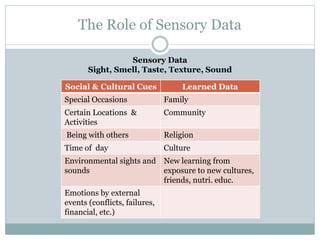
Social & Cultural Cues Learned Data
Special Occasions Family
Certain Locations &
Activities
Community
Being with others Religion
Time of day Culture
Environmental sights and
sounds
New learning from
exposure to new cultures,
friends, nutri. educ.
Emotions by external
events (conflicts, failures,
financial, etc.)
Sensory Data
Sight, Smell, Taste, Texture, Sound
What are some social, cultural, and
emotional cues we face everyday around
food?
What kinds of events can stimulate our
appetite?
The Role of Learning
 We can learn to enjoy new food at any point in our
lives.
 We can also learn to dislike foods once enjoyed. For
example, conditioned taste aversion to foods can
occur as a result of illness, even if there is no
relationship between the foods and the illness (ie
food poisoning ).
Disorders Related to Specific Foods
 Food Intolerance- is a cluster of GI symptoms
(gas, pain, and diarrhea) that occur following the
consumption of a particular food.
 An intolerance happens when the body does not
produce enough of the enzymes it needs to break
down certain food components.
Common Food Intolerance
 Lactose Intolerance- which the cells lining the
wall of the intestine do not produce sufficient
amounts of the enzyme lactase to digest foods
containing the milk sugar lactose.
Lactose intolerance is NOT a milk allergy!
Milk allergy affects the immune system. Lactose
intolerance is limited to the GI tract (symptoms:
bloating, gas, cramps, nasuea, etc.)
Common Food Intolerance
 Lactase enzyme activity usually decreases after 2
years of age.
 About 70% of the adult population loses some ability
to digest lactose as they age.
 Lactose Intolerance is more common in Native
Americans, Asians, Hispanics, & African Americans.
Lactose Intolerance
 Not everyone who is Lactose Intolerant experience
the same symptoms. The extent of symptoms vary
from person to person.
If you can’t drink milk, how will you get
enough calcium for bone growth?
Lactose Intolerance Tests
 In adults, is a hydrogen breath test-a patient
drinks a lactose rich beverage. The breath is then
analyzed at regular intervals to measure the amount
of hydrogen. Undigested lactose produces high levels
of hydrogen, which means a person is lactose
intolerant.
 In children, a stool sample is used and tested for
lactose.
Food Allergies
 Food Allergy- is a hypersensitivity reaction of the
immune system to a particular component in a food.
The reaction causes the immune cells to release
chemicals that cause either limited or systemic
inflammation.
5% of infants and young children and 2% of adults
experience food allergies.
Food Allergies are less common than food
intolerances, but a lot more serious.
Food Allergies
Aprox. 30, 000 consumers require emergency
department treatment and 150 Americans die
each year because of allergic reactions to
foods.
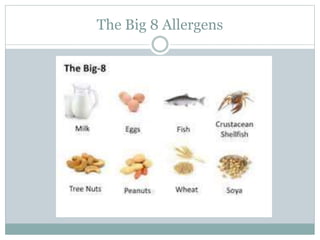
The Big 8 Allergens
Food Allergy Test
1. Scratch test (most common)
2. Blood test
Celiac Disease
 Celiac Disease- also known as celiac sprue, is a
disease that severely damages the lining of the small
intestine and interferes with the absorption of
nutrients.
 It is an autoimmune disease, meaning that the
body’s own immune system causes the destruction.
 Genetic plays a role- it is linked to specific gene
markers. It is also considered a genetic disorder.
Celiac Disease
 Celiac disease occurs in 1 of 133 Americans
 People with Celiac disease are put on a gluten free
diet. Gluten is found in wheat, barley, rye, and
triticale (hybrid between wheat and rye).
 When people with this disease continue to eat gluten
containing foods, their immune system triggers an
inflammatory response that erodes the villi of the
small intestine. Overtime, this could cause
malabsorption (unable to absorb certain nutrients)
and eventually malnutrition.
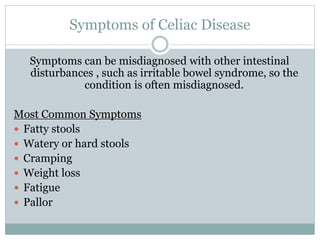
Symptoms of Celiac Disease
Symptoms can be misdiagnosed with other intestinal
disturbances , such as irritable bowel syndrome, so the
condition is often misdiagnosed.
Most Common Symptoms
 Fatty stools
 Watery or hard stools
 Cramping
 Weight loss
 Fatigue
 Pallor
Celiac Disease
There is no cure for celiac disease.
Treatment is with a special diet that excludes
all forms of wheat barely, rye, and triticale.
Allergy Clip
Maryland Restaurant
https://www.youtube.com/watch?v=r3hxOyPXmAo

Eating Wisely- Food Choices

  • 1.
    NIA RENNIX SEPTEMBER 22,2015 EATING WISELY
  • 2.
    What’s behind ourfood choices? Two very different mechanisms induce us to seek food….
  • 3.
    What’s behind ourfood choices? Hunger- is a basic biological urge to eat that occurs when your body senses that we need food. In Contrast…. Appetite- is a psychological desire to eat that is stimulated by the sight, smell, or thought of food.
  • 4.
    What’s behind ourfood choices? In general hunger is prompted by internal signals and appetite is triggered by aspects of our environment.
  • 5.
    The Role ofSensory Data Food stimulates our senses. Food that looks appealing, prepared nicely with different shapes and colors appeal to our sense of sight. Coffee aromas and baked bread can be powerful stimulants!!
  • 6.
    The Role ofSensory Data  Olfaction- our sense of smell, plays a key role in the stimulation of appetite and satiety. Much of our ability to taste foods comes from our sense of smell. Mouthfeel- the tactile sensation of food in the mouth; derived from a particular food.
  • 7.
    The Role ofSensory Data Social & Cultural Cues Learned Data Special Occasions Family Certain Locations & Activities Community Being with others Religion Time of day Culture Environmental sights and sounds New learning from exposure to new cultures, friends, nutri. educ. Emotions by external events (conflicts, failures, financial, etc.) Sensory Data Sight, Smell, Taste, Texture, Sound
  • 8.
    What are somesocial, cultural, and emotional cues we face everyday around food? What kinds of events can stimulate our appetite?
  • 9.
    The Role ofLearning  We can learn to enjoy new food at any point in our lives.  We can also learn to dislike foods once enjoyed. For example, conditioned taste aversion to foods can occur as a result of illness, even if there is no relationship between the foods and the illness (ie food poisoning ).
  • 10.
    Disorders Related toSpecific Foods  Food Intolerance- is a cluster of GI symptoms (gas, pain, and diarrhea) that occur following the consumption of a particular food.  An intolerance happens when the body does not produce enough of the enzymes it needs to break down certain food components.
  • 11.
    Common Food Intolerance Lactose Intolerance- which the cells lining the wall of the intestine do not produce sufficient amounts of the enzyme lactase to digest foods containing the milk sugar lactose. Lactose intolerance is NOT a milk allergy! Milk allergy affects the immune system. Lactose intolerance is limited to the GI tract (symptoms: bloating, gas, cramps, nasuea, etc.)
  • 12.
    Common Food Intolerance Lactase enzyme activity usually decreases after 2 years of age.  About 70% of the adult population loses some ability to digest lactose as they age.  Lactose Intolerance is more common in Native Americans, Asians, Hispanics, & African Americans.
  • 13.
    Lactose Intolerance  Noteveryone who is Lactose Intolerant experience the same symptoms. The extent of symptoms vary from person to person. If you can’t drink milk, how will you get enough calcium for bone growth?
  • 14.
    Lactose Intolerance Tests In adults, is a hydrogen breath test-a patient drinks a lactose rich beverage. The breath is then analyzed at regular intervals to measure the amount of hydrogen. Undigested lactose produces high levels of hydrogen, which means a person is lactose intolerant.  In children, a stool sample is used and tested for lactose.
  • 15.
    Food Allergies  FoodAllergy- is a hypersensitivity reaction of the immune system to a particular component in a food. The reaction causes the immune cells to release chemicals that cause either limited or systemic inflammation. 5% of infants and young children and 2% of adults experience food allergies. Food Allergies are less common than food intolerances, but a lot more serious.
  • 16.
    Food Allergies Aprox. 30,000 consumers require emergency department treatment and 150 Americans die each year because of allergic reactions to foods.
  • 17.
    The Big 8Allergens
  • 18.
    Food Allergy Test 1.Scratch test (most common) 2. Blood test
  • 19.
    Celiac Disease  CeliacDisease- also known as celiac sprue, is a disease that severely damages the lining of the small intestine and interferes with the absorption of nutrients.  It is an autoimmune disease, meaning that the body’s own immune system causes the destruction.  Genetic plays a role- it is linked to specific gene markers. It is also considered a genetic disorder.
  • 20.
    Celiac Disease  Celiacdisease occurs in 1 of 133 Americans  People with Celiac disease are put on a gluten free diet. Gluten is found in wheat, barley, rye, and triticale (hybrid between wheat and rye).  When people with this disease continue to eat gluten containing foods, their immune system triggers an inflammatory response that erodes the villi of the small intestine. Overtime, this could cause malabsorption (unable to absorb certain nutrients) and eventually malnutrition.
  • 21.
    Symptoms of CeliacDisease Symptoms can be misdiagnosed with other intestinal disturbances , such as irritable bowel syndrome, so the condition is often misdiagnosed. Most Common Symptoms  Fatty stools  Watery or hard stools  Cramping  Weight loss  Fatigue  Pallor
  • 22.
    Celiac Disease There isno cure for celiac disease. Treatment is with a special diet that excludes all forms of wheat barely, rye, and triticale.
  • 23.