Does the Media Play a Role in Teen Eating Disorders?  By Cayla Fulton
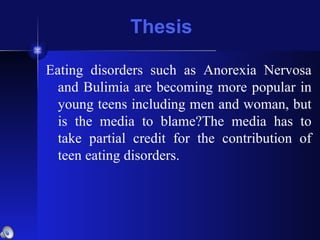
Thesis Eating disorders such as Anorexia Nervosa and Bulimia are becoming more popular in young teens including men and woman, but is the media to blame?The media has to take partial credit for the contribution of teen eating disorders.
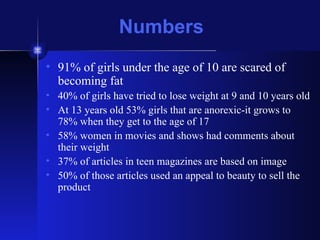
Numbers 91% of girls under the age of 10 are scared of becoming fat 40% of girls have tried to lose weight at 9 and 10 years old At 13 years old 53% girls that are anorexic-it grows to 78% when they get to the age of 17 58% women in movies and shows had comments about their weight 37% of articles in teen magazines are based on image 50% of those articles used an appeal to beauty to sell the product
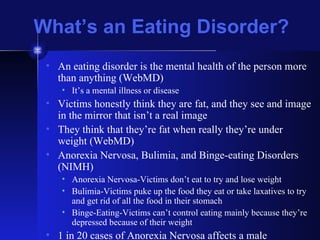
What’s an Eating Disorder? An eating disorder is the mental health of the person more than anything (WebMD) It’s a mental illness or disease Victims honestly think they are fat, and they see and image in the mirror that isn’t a real image They think that they’re fat when really they’re under weight (WebMD) Anorexia Nervosa, Bulimia, and Binge-eating Disorders (NIMH) Anorexia Nervosa-Victims don’t eat to try and lose weight Bulimia-Victims puke up the food they eat or take laxatives to try and get rid of all the food in their stomach Binge-Eating-Victims can’t control eating mainly because they’re depressed because of their weight 1 in 20 cases of Anorexia Nervosa affects a male
Childhood Young children are taught from an early stage that looks are important Our society is based around what people look like Our society is teaching young children that looks are important Looks are important in our society but they shouldn’t be It’s hard for parents to teach their child that looks don’t matter “ How can we tell our children that it’s inside that counts, when the media continuously contradicts this message.”(“The Media”)
Educated Children should be educated more They should start learning about how their bodies change in different ways either before or around puberty This might help children know that they all aren’t going to look the same They should be taught what is healthy to eat and that they should have exercise in their life They need more education on puberty and the way that their bodies are going to change
What Role Does Television Play? Television plays a huge role in teen eating disorders Role models such as Miley Cyrus, Paris Hilton, Lindsey Lohan, and Hilary Duff Helps play a role by putting super skinny and tiny girls in TV shows that mainly younger girls watch Muscular men are also put in shows which makes boys think that’s how they need to look This sends out the message on the way teens “should” look
Television con’t Advertisements - Why is there super skinny women and men advertising for a clothing ad? They aren’t realistic to have a skinny model, for a food commercial Sending mixed messages  Telling teens to buy diet pills to loose weight and then have a commercial telling them to buy junk food
Models Models set the tone of what is right and what is okay for someone to look A lot of teens look up to models as a role model Models are the on everything and they are the face of what is pretty and what is the way your “supposed” look like There needs to be more plus sized models out there so that girls who aren’t a size zero don’t feel as awkward in their skin
Models con’t There aren’t as many plus sized models as skinny models or below weight Model agencies have been hiring anorexic models Average Model=5’11 and 120 Average Female in the US=5’4 and 140 Italy - Have to be above a certain weight to be a model
Magazines Magazines show skinny models Latest bathing suit trends in the summer-Magazines show bathing suit ads with skinny models, there needs to be more plus sized models for these ads so bigger girls know what they would possibly look like in the bathing suits Weight loss ads-They say what people need to look like Beauty/looks based-They tell the reader that they need to buy their product to look beautiful
A False Image Most models in magazines and billboards are  airbrushed Isn’t who the model really is This is showing the people looking at them a false image People may think that, that is how they actually look but in reality it isn’t the way they look (“The Media”)
Internet Even though it might seem as though the internet doesn’t contribute to eating disorders…..it does. Online dating sites-Shows beautiful and tiny girls which might discourage some people Weight loss ads-Show weight loss ads that tell you unrealistic weight loss transformations Myspace-Has tiny girls who post pictures of themselves
Movies Mostly skinny women or muscular men who play in movies Sometimes doesn’t fit the character Skinny moms with four children isn’t realistic Most people don’t look like that Not realistic
Which celebrities have had eating disorders? Amy Winehouse Ashlee Simpson Audrey Hepburn Britney Spears Bruce Vilanch Elton John Elvis Presley Janet Jackson Oprah Winfrey Paula Abdul Joan Rivers Kate Winslet Keira Knightley Kirsten Dunst Lindsey Lohan Mariah Carey Mary-Kate Olsen Nicole Richie Paris Hilton Richard Simmons And way more…
Billboards/Highway Signs Some billboards portray models and skinny actresses or work out ads Contradicting Diet ads Food ads They way you “should” look One shows and ad for Dunkin’ Donuts and then the next is one for a diet ad
Mixed Messages Young teens are being sent mixed messages McDonalds is telling you to buy their latest hamburger on one sign and then the next sign is telling you a certain way you need to look
Barbie Barbie is one of the first role models in a young child’s life Her body isn’t realistic No one can have Barbie’s body (Something-Fishy) Too top heavy for her back and waist Back problems Isn’t enough room in her stomach for all he bowels Eventually die from malnutrition
G.I. Joe Many young boys play with G.I. Joe dolls which portrays a muscular army body G.I. Joe is a role model for young boys especially those who are into army and camo stuff His body might lead boys into think they need that body to get girls which could lead into steroid Bigorexia-A disorder where you muscles never get big enough
40’s Icon Marilyn Monroe was a 70’s icon She did movies and modeled She would be today put in the category with plus size models She was a considered normal sized in the 70’s Models are getting thinner and thinner She was a size 14 and today most models are a size 0
Marilyn Monroe 40's Icon
Today's Idols
Diet Ads Diet ads show non realistic bodies that people can get using their product Saying which is the way to look and that it’ll make us happier What is beautiful and what isn’t 36 ads in a magazine are diet and beauty ads 40 million dollars a year are spent on diet pills in the US
Beauty Ads 70% of ads in magazines are based around the latest clothes and make-up Based mainly on beauty Make young girls believe that that is the way they need to look They as well control what we consider beauty
Trying to help Dove - Campaign for Real Beauty Started in 2004 What is real beauty? Different look at beauty Dove’s “Mission” “ To make more women feel beautiful every day by widening stereotypical views of beauty” Tyra Banks-Helping girls make better decicions Nike-Trying to make women more confident
What Should be Done We should transformer what a “pretty” body is or what “beauty” means in our society We should put more “healthy” bodies on runways or television The diet industry needs to be cut down a lot Keep the dieting things that work and get rid of those that don’t work Educate children at an earlier age about puberty and the changes that their body is going to go through in schools
Work Cited AllSands. &quot;Media Influence On Eating Disorders.&quot;  AllSands . 19 Dec. 2008 <http://allsands.com/  Health/Advice/mediaeatingdis_zmw_gn.htm>. The Center Foundation. &quot;Caring Online.&quot;  Caring Online . 19 Dec. 2008 <http://caringonline.com/  eatdis/celebrities_e.html>. &quot;Dove.&quot;  Campaign For Real Beauty . 19 Dec. 2008 <http://www.dove.us/#/CFRB/  arti_cfrb.aspx[cp-documentid=7049726]/>. &quot;Eating Disorders.&quot;  National Mental Health Information Center . Apr. 2003. United States Department  of Health and Human Services. 19 Dec. 2008 <http://mentalhealth.samhsa.gov/publications/  allpubs/ken98-0047/default.asp>.  &quot;Eating Disorders.&quot;  NIMH:National Institute of Mental Health . 26 June 2008. National Institutes of  Health. 19 Dec. 2008 <http://www.nimh.nih.gov/health/publications/eating-disorders/  complete-publication.shtml>. Goldenring, John M. &quot;Bulimia Nervosa Health Center.&quot;  WebMD . 19 Dec. 2008. 19 Dec. 2008  <http://www.webmd.com/mental-health/bulimia-nervosa/  understanding-eating-disorders-teens?page=2>.  &quot;How does the media affect body images in teens?&quot;  About . 1 Dec. 2008  <http://parentingteens.about.com/od/bodyimage/f/media_bodyimage.htm>. KTCS Television.  &quot;Eating Disorders:The Medias Influence.&quot;  PBS . 19 Dec. 2008 <http://www.pbs.org/  perfectillusions/eatingdisorders/preventing_media.html>. &quot;The Media.&quot;  Something-Fishy . 1 Dec. 2008 <http://www.something-fishy.org/cultural/  themedia.php>.  &quot;Media Influence Eating Disorders.&quot;  The University Record . 22 Oct. 1997. 19 Dec. 2008  <http://www.ur.umich.edu/9798/Oct22_97/media.htm>.  Nemours Foundation. &quot;Eating Disorders.&quot;  Kids Health . Dec. 2008. Nemours Foundation. 19 Dec. 2008  <http://kidshealth.org/parent/emotions/feelings/eating_disorders.html>.  Washington State Department of Health. &quot;Body Image and Nutrition.&quot;  Teen Health and the Media . 2003.  1 Dec. 2008 <http://depts.washington.edu/thmedia/view.cgi?section=bodyimage>. - - -. &quot;Body Image and Nutrition.&quot;  Teen Health and the Media . 2003. 1 Dec. 2008  <http://depts.washington.edu/thmedia/view.cgi?section=bodyimage&page=fastfacts >.

Eating Disorders And The Media2

  • 1.
    Does the MediaPlay a Role in Teen Eating Disorders? By Cayla Fulton
  • 2.
    Thesis Eating disorderssuch as Anorexia Nervosa and Bulimia are becoming more popular in young teens including men and woman, but is the media to blame?The media has to take partial credit for the contribution of teen eating disorders.
  • 3.
    Numbers 91% ofgirls under the age of 10 are scared of becoming fat 40% of girls have tried to lose weight at 9 and 10 years old At 13 years old 53% girls that are anorexic-it grows to 78% when they get to the age of 17 58% women in movies and shows had comments about their weight 37% of articles in teen magazines are based on image 50% of those articles used an appeal to beauty to sell the product
  • 4.
    What’s an EatingDisorder? An eating disorder is the mental health of the person more than anything (WebMD) It’s a mental illness or disease Victims honestly think they are fat, and they see and image in the mirror that isn’t a real image They think that they’re fat when really they’re under weight (WebMD) Anorexia Nervosa, Bulimia, and Binge-eating Disorders (NIMH) Anorexia Nervosa-Victims don’t eat to try and lose weight Bulimia-Victims puke up the food they eat or take laxatives to try and get rid of all the food in their stomach Binge-Eating-Victims can’t control eating mainly because they’re depressed because of their weight 1 in 20 cases of Anorexia Nervosa affects a male
  • 5.
    Childhood Young childrenare taught from an early stage that looks are important Our society is based around what people look like Our society is teaching young children that looks are important Looks are important in our society but they shouldn’t be It’s hard for parents to teach their child that looks don’t matter “ How can we tell our children that it’s inside that counts, when the media continuously contradicts this message.”(“The Media”)
  • 6.
    Educated Children shouldbe educated more They should start learning about how their bodies change in different ways either before or around puberty This might help children know that they all aren’t going to look the same They should be taught what is healthy to eat and that they should have exercise in their life They need more education on puberty and the way that their bodies are going to change
  • 7.
    What Role DoesTelevision Play? Television plays a huge role in teen eating disorders Role models such as Miley Cyrus, Paris Hilton, Lindsey Lohan, and Hilary Duff Helps play a role by putting super skinny and tiny girls in TV shows that mainly younger girls watch Muscular men are also put in shows which makes boys think that’s how they need to look This sends out the message on the way teens “should” look
  • 8.
    Television con’t Advertisements- Why is there super skinny women and men advertising for a clothing ad? They aren’t realistic to have a skinny model, for a food commercial Sending mixed messages Telling teens to buy diet pills to loose weight and then have a commercial telling them to buy junk food
  • 9.
    Models Models setthe tone of what is right and what is okay for someone to look A lot of teens look up to models as a role model Models are the on everything and they are the face of what is pretty and what is the way your “supposed” look like There needs to be more plus sized models out there so that girls who aren’t a size zero don’t feel as awkward in their skin
  • 10.
    Models con’t Therearen’t as many plus sized models as skinny models or below weight Model agencies have been hiring anorexic models Average Model=5’11 and 120 Average Female in the US=5’4 and 140 Italy - Have to be above a certain weight to be a model
  • 11.
    Magazines Magazines showskinny models Latest bathing suit trends in the summer-Magazines show bathing suit ads with skinny models, there needs to be more plus sized models for these ads so bigger girls know what they would possibly look like in the bathing suits Weight loss ads-They say what people need to look like Beauty/looks based-They tell the reader that they need to buy their product to look beautiful
  • 12.
    A False ImageMost models in magazines and billboards are airbrushed Isn’t who the model really is This is showing the people looking at them a false image People may think that, that is how they actually look but in reality it isn’t the way they look (“The Media”)
  • 13.
    Internet Even thoughit might seem as though the internet doesn’t contribute to eating disorders…..it does. Online dating sites-Shows beautiful and tiny girls which might discourage some people Weight loss ads-Show weight loss ads that tell you unrealistic weight loss transformations Myspace-Has tiny girls who post pictures of themselves
  • 14.
    Movies Mostly skinnywomen or muscular men who play in movies Sometimes doesn’t fit the character Skinny moms with four children isn’t realistic Most people don’t look like that Not realistic
  • 15.
    Which celebrities havehad eating disorders? Amy Winehouse Ashlee Simpson Audrey Hepburn Britney Spears Bruce Vilanch Elton John Elvis Presley Janet Jackson Oprah Winfrey Paula Abdul Joan Rivers Kate Winslet Keira Knightley Kirsten Dunst Lindsey Lohan Mariah Carey Mary-Kate Olsen Nicole Richie Paris Hilton Richard Simmons And way more…
  • 16.
    Billboards/Highway Signs Somebillboards portray models and skinny actresses or work out ads Contradicting Diet ads Food ads They way you “should” look One shows and ad for Dunkin’ Donuts and then the next is one for a diet ad
  • 17.
    Mixed Messages Youngteens are being sent mixed messages McDonalds is telling you to buy their latest hamburger on one sign and then the next sign is telling you a certain way you need to look
  • 18.
    Barbie Barbie isone of the first role models in a young child’s life Her body isn’t realistic No one can have Barbie’s body (Something-Fishy) Too top heavy for her back and waist Back problems Isn’t enough room in her stomach for all he bowels Eventually die from malnutrition
  • 19.
    G.I. Joe Manyyoung boys play with G.I. Joe dolls which portrays a muscular army body G.I. Joe is a role model for young boys especially those who are into army and camo stuff His body might lead boys into think they need that body to get girls which could lead into steroid Bigorexia-A disorder where you muscles never get big enough
  • 20.
    40’s Icon MarilynMonroe was a 70’s icon She did movies and modeled She would be today put in the category with plus size models She was a considered normal sized in the 70’s Models are getting thinner and thinner She was a size 14 and today most models are a size 0
  • 21.
  • 22.
  • 23.
    Diet Ads Dietads show non realistic bodies that people can get using their product Saying which is the way to look and that it’ll make us happier What is beautiful and what isn’t 36 ads in a magazine are diet and beauty ads 40 million dollars a year are spent on diet pills in the US
  • 24.
    Beauty Ads 70%of ads in magazines are based around the latest clothes and make-up Based mainly on beauty Make young girls believe that that is the way they need to look They as well control what we consider beauty
  • 25.
    Trying to helpDove - Campaign for Real Beauty Started in 2004 What is real beauty? Different look at beauty Dove’s “Mission” “ To make more women feel beautiful every day by widening stereotypical views of beauty” Tyra Banks-Helping girls make better decicions Nike-Trying to make women more confident
  • 26.
    What Should beDone We should transformer what a “pretty” body is or what “beauty” means in our society We should put more “healthy” bodies on runways or television The diet industry needs to be cut down a lot Keep the dieting things that work and get rid of those that don’t work Educate children at an earlier age about puberty and the changes that their body is going to go through in schools
  • 27.
    Work Cited AllSands.&quot;Media Influence On Eating Disorders.&quot; AllSands . 19 Dec. 2008 <http://allsands.com/ Health/Advice/mediaeatingdis_zmw_gn.htm>. The Center Foundation. &quot;Caring Online.&quot; Caring Online . 19 Dec. 2008 <http://caringonline.com/ eatdis/celebrities_e.html>. &quot;Dove.&quot; Campaign For Real Beauty . 19 Dec. 2008 <http://www.dove.us/#/CFRB/ arti_cfrb.aspx[cp-documentid=7049726]/>. &quot;Eating Disorders.&quot; National Mental Health Information Center . Apr. 2003. United States Department of Health and Human Services. 19 Dec. 2008 <http://mentalhealth.samhsa.gov/publications/ allpubs/ken98-0047/default.asp>. &quot;Eating Disorders.&quot; NIMH:National Institute of Mental Health . 26 June 2008. National Institutes of Health. 19 Dec. 2008 <http://www.nimh.nih.gov/health/publications/eating-disorders/ complete-publication.shtml>. Goldenring, John M. &quot;Bulimia Nervosa Health Center.&quot; WebMD . 19 Dec. 2008. 19 Dec. 2008 <http://www.webmd.com/mental-health/bulimia-nervosa/ understanding-eating-disorders-teens?page=2>. &quot;How does the media affect body images in teens?&quot; About . 1 Dec. 2008 <http://parentingteens.about.com/od/bodyimage/f/media_bodyimage.htm>. KTCS Television. &quot;Eating Disorders:The Medias Influence.&quot; PBS . 19 Dec. 2008 <http://www.pbs.org/ perfectillusions/eatingdisorders/preventing_media.html>. &quot;The Media.&quot; Something-Fishy . 1 Dec. 2008 <http://www.something-fishy.org/cultural/ themedia.php>. &quot;Media Influence Eating Disorders.&quot; The University Record . 22 Oct. 1997. 19 Dec. 2008 <http://www.ur.umich.edu/9798/Oct22_97/media.htm>. Nemours Foundation. &quot;Eating Disorders.&quot; Kids Health . Dec. 2008. Nemours Foundation. 19 Dec. 2008 <http://kidshealth.org/parent/emotions/feelings/eating_disorders.html>. Washington State Department of Health. &quot;Body Image and Nutrition.&quot; Teen Health and the Media . 2003. 1 Dec. 2008 <http://depts.washington.edu/thmedia/view.cgi?section=bodyimage>. - - -. &quot;Body Image and Nutrition.&quot; Teen Health and the Media . 2003. 1 Dec. 2008 <http://depts.washington.edu/thmedia/view.cgi?section=bodyimage&page=fastfacts >.