 At the end of the lesson, students are
expected to:
 At the end of this lesson, the learners will be
able to:
 1. Define the concept of a system;
 2. Recognize the Earth as a system composed
of subsystems; and
 3. Discuss the historical development of the
concept of Earth System.
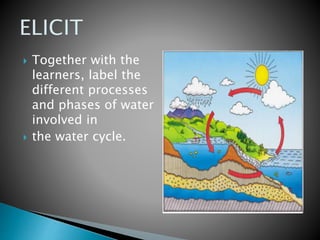
 Together with the
learners, label the
different processes
and phases of water
involved in
 the water cycle.
-What do you know regarding El Niño?
-it starts with the unusual warming
of the central Pacific Ocean
accompanied by the weakening of
the trade winds. The warming of
the central Pacific Ocean results to
an eastward shift of the low
pressure area (away from the Indo
Pacific).
 Each group will be assigned to 4 groups
named:
◦ Group 1-LITHOSPHERE
◦ Group 2-ATMOSPHERE
◦ Group 3-HYDROSPHERE
◦ Group 4-BIOSPHERE
 Each group must present their
work
REPORTING
Give the government as an example.
Inquire about the three branches of the
government (executive, judiciary, and
legislative). Explain that these three
branches are independent and have
their respective mandates or functions.
A government can only succeed if all
three branches are able to perform their
respective functions.
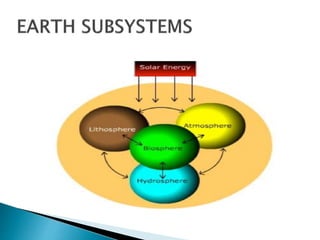
 The arrows in the diagram indicate the
 interaction among the components.
 • A closed system is a system in which
 there is only an exchange of heat or
 energy and no exchange of matter.
 One of the first scientist to push for a more
integrated or holistic approach in the
understanding of the universe (and by
extension the Earth) was Friedrich Wilhelm
Heinrich
 Alexander von Humboldt. He considered the
universe as one interacting entity.
 The term "biosphere" was popularized by
Vladimir Vernadsky (1863-1945), a Russian
-Ukranian scientist who hypothesized that
life is a geological force that shapes the
Earth.
 1. Using the illustration diagram
identify how energy and mass is
exchanged among the
subsystems. Maybe use different
types of line .boxes to
differentiate between matter /
materials and energy?
 2. Use arrows to indicate
interaction between components.
1. James Lovelock used the "Daisy
World Model" to illustrate how the
biosphere is capable of regulating
its environment.
2. Ask the students to research
and write a two page report (50 to
100 words, with illustrations) on
the "Daisy World Model" of James
Lovelock
EARTH SUBSYSTEMS-DEMO.pptx

EARTH SUBSYSTEMS-DEMO.pptx

  • 2.
     At theend of the lesson, students are expected to:  At the end of this lesson, the learners will be able to:  1. Define the concept of a system;  2. Recognize the Earth as a system composed of subsystems; and  3. Discuss the historical development of the concept of Earth System.
  • 3.
     Together withthe learners, label the different processes and phases of water involved in  the water cycle.
  • 4.
    -What do youknow regarding El Niño? -it starts with the unusual warming of the central Pacific Ocean accompanied by the weakening of the trade winds. The warming of the central Pacific Ocean results to an eastward shift of the low pressure area (away from the Indo Pacific).
  • 6.
     Each groupwill be assigned to 4 groups named: ◦ Group 1-LITHOSPHERE ◦ Group 2-ATMOSPHERE ◦ Group 3-HYDROSPHERE ◦ Group 4-BIOSPHERE  Each group must present their work
  • 7.
  • 9.
    Give the governmentas an example. Inquire about the three branches of the government (executive, judiciary, and legislative). Explain that these three branches are independent and have their respective mandates or functions. A government can only succeed if all three branches are able to perform their respective functions.
  • 10.
     The arrowsin the diagram indicate the  interaction among the components.  • A closed system is a system in which  there is only an exchange of heat or  energy and no exchange of matter.
  • 11.
     One ofthe first scientist to push for a more integrated or holistic approach in the understanding of the universe (and by extension the Earth) was Friedrich Wilhelm Heinrich  Alexander von Humboldt. He considered the universe as one interacting entity.  The term "biosphere" was popularized by Vladimir Vernadsky (1863-1945), a Russian -Ukranian scientist who hypothesized that life is a geological force that shapes the Earth.
  • 12.
     1. Usingthe illustration diagram identify how energy and mass is exchanged among the subsystems. Maybe use different types of line .boxes to differentiate between matter / materials and energy?  2. Use arrows to indicate interaction between components.
  • 13.
    1. James Lovelockused the "Daisy World Model" to illustrate how the biosphere is capable of regulating its environment. 2. Ask the students to research and write a two page report (50 to 100 words, with illustrations) on the "Daisy World Model" of James Lovelock