1
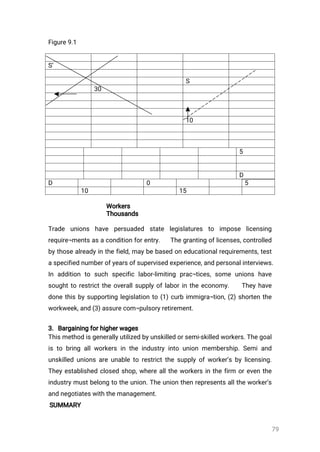
KENYATTAUNIVERSITY
INSTITUTEOFOPENDISTANCE&e-LEARNING
INCOLLABORATIONWITH
SCHOOLOFECONOMICS
DEPARTMENT:APPLIEDECONOMICS
UNITCODE:EAE304
UNITNAME:LABOURECONOMICS
WRITTENBY:
Dr.JamesN.Maingi
2
Copyright©KenyattaUniversity,2016
AllRightsReserved
PublishedBy:
KENYATTAUNIVERSITYPRESS
3
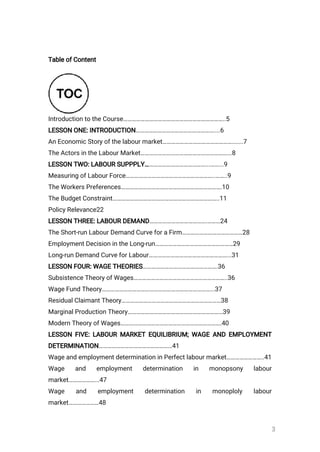
TableofContent
IntroductiontotheCourse……………………………………………………………..5
LESSONONE:INTRODUCTION………………………………………………....6
AnEconomicStoryofthelabourmarket………………………………………….......7
TheActorsintheLabourMarket……………………………………………………...8
LESSONTWO:LABOURSUPPPLY……………………………………...……...9
MeasuringofLabourForce……………………………………………………..……..9
TheWorkersPreferences…………………………………………………………….10
TheBudgetConstraint………………………………………………………………..11
PolicyRelevance22
LESSONTHREE:LABOURDEMAND………………………………….………24
TheShort-runLabourDemandCurveforaFirm……………………………………28
EmploymentDecisionintheLong-run………………………………………………29
Long-runDemandCurveforLabour………………………………………………...31
LESSONFOUR:WAGETHEORIES…………………………………………….36
SubsistenceTheoryofWages………………………………………………………..36
WageFundTheory…………………………………………………………………...37
ResidualClaimantTheory……………………………………………………………38
MarginalProductionTheory…………………………………………………………39
ModernTheoryofWages…………………………………………………………….40
LESSON FIVE:LABOURMARKETEQUILIBRIUM;WAGEANDEMPLOYMENT
DETERMINATION……………………………………………41
WageandemploymentdeterminationinPerfectlabourmarket……………………..41
Wage and employment determination in monopsony labour
market………………...47
Wage and employment determination in monoploly labour
market…………………48
4
Wage and employment determination in a bilateral labour
market………………….49
MinimumWageModel………………………………………………………………50
LESSONSIX:LABOURMARKETDISCRIMINATION…………………….53
CausesofWageDiscrimination………………………………………………….......53
TheNeoclassicalTasteModel……………………………………………………….54
LabourMarketSegmentationApproach……………………………………………..57
FavourableEffectsofEliminationDiscrimination…………………………………..60
LESSONSEVEN:WAGEDIFFERNTIALS……………………………………..62
CompensationWageDifferential64
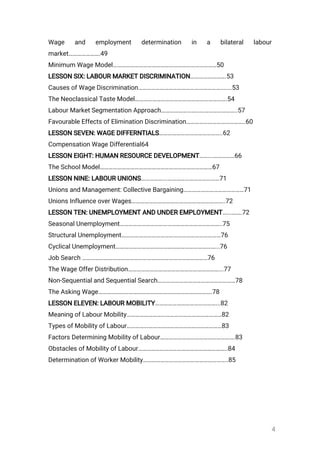
LESSONEIGHT:HUMANRESOURCEDEVELOPMENT……...……………66
TheSchoolModel……………………………………………………………………67
LESSONNINE:LABOURUNIONS……………...………………………………71
UnionsandManagement:CollectiveBargaining……………………………………71
UnionsInfluenceoverWages………………………………………………………..72
LESSONTEN:UNEMPLOYMENTANDUNDEREMPLOYMENT…...…….72
SeasonalUnemployment……………………………………………………………..75
StructuralUnemployment……………………………………………………………76
CyclicalUnemployment……………………………………………………………...76
JobSearch……………………………………………………………………………76
TheWageOfferDistribution………………………………………………………...77
Non-SequentialandSequentialSearch………………………………………………78
TheAskingWage…………………………………………………………………….78
LESSONELEVEN:LABOURMOBILITY……………………………………...82
MeaningofLabourMobility…………………………………………………………82
TypesofMobilityofLabour…………………………………………………………83
FactorsDeterminingMobilityofLabour…………………………………………….83
ObstaclesofMobilityofLabour……………………………………………………..84
DeterminationofWorkerMobility…………………………………………………..85
5
INTRODUCTIONOFTHECOURSE
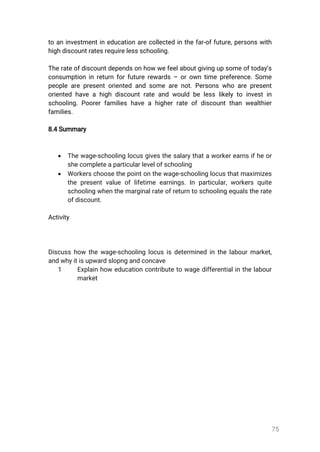
Thestudyoflaboureconomicsembracesmanyareasofinterest.Theymay
begroupedintothreebroadcategories.Thesearelabourmarketanalysis,
labourmarketproblemsandpoliciesandunionandmanagement:collective
bargaining.
Employersandworkersbuyandselllabourservicesinalabourmarket.
Becausethelabourservicesareusuallydifficulttoquantify,theyaretypically
measuredbynumberofworkers,hoursoflabourtimeorquantityofgoods
and/orservicesproduced.Youcangainunderstandingofthelabourmarket
byexaminingthesefundamentalfeatures:
 Supplyofanddemandforlabour
 Wagedeterminationandemployment
 Labour-marketimperfections
LEARNINGOUTCOMES
Thegoalofthiscourseistoenhancethecapacityoflearners
 Discuss the theories,concepts,policies and theirapplication in
analyzinglabourmarketsissues
 Undertakeevaluationoflabourmarketprogramsandpolicies
 Contributetoevidenced-basedpolicydiscourse.
6
Lessonone
INTRODUCTION
1.0Introduction
Mostofuswillallocateasubstantialfractionofourtimetothelabourmarket.
Whatwedointhelabourmarkethelpsdetermineourwealth,thetypesof
goodswecanaffordtoconsume,whom weassociatewith,wherewegofor
vacation,whichschoolsourchildrenattend,andeventhetypeofpersonswho
findusattractive.Asaresult,wearealleagertolearnhowthelabourmarket
works.Laboureconomicsstudieshowlabourmarketswork.
1.1LessonObjectives
Bytheendofthelessonthelearnershouldbeableto:
1.Discussthepolicyissuesexaminedbymodernlaboureconomics
2.Describetheeconomicstoryofthelabormarket
3.Explaintheroleofeachactorinthelabourmarket
1.2PolicyIssuesExaminedByLabourEconomics
Theinterestinlabourmarketsarisenotonlyfrom ourpersonalinvolvement
butalso becausemanysocialpolicyissuesconcern thelabourmarket
experiences ofparticulargroups ofworkers orvarious aspects ofthe
7
employmentrelationship between workers and firms.The policyissues
examinedbymodernlaboureconomicsinclude:
1)Whatis the impactofimmigration on the wage and employment
appointmentsofnative–bornworkers?
2)Dominimumwagesincreaseunemploymentrateoflessskilledworkers?
3)Whatistheimpactofoccupationalsafetyand health regulatorson
employmentandearnings?
4)Aregovernmentsubsidiesofinvestmentsinhumancapitalaneffective
waytoimproveaneconomicwell-beingofdisadvantagedworkers?
5)Whatistheimpactoftheaffirmativeactionprogram ontheearningsof
minoritiesandonthenumberofminoritiesthatfirmshire?
6)Whatistheimpactofunionsbothontheirmembersandontherestofthe
economy?
7)Dogenerousunemploymentinsurancebenefitslengthenthedurationof
unemployment?
8)Whyistheunemploymentratemuchhigherinlessdevelopedeconomies
thanindevelopedeconomies?
Theabovelistofsocial-economicissuesillustratewhythestudyoflabour
marketsisimportantandinteresting.Laboureconomicshelpsusunderstand
andaddressmanyofthesocialandeconomicproblemsfacingthemodern
societies.
1.3AnEconomicStoryofthelabourMarket
Laboureconomistsassignmotivestothevariousactorsinthelabourmarket
forexample,weview workersfortryingtofindthebestpossiblejoband
assumethatfirmsaretryingtomakemoney.Workersandfirmstherefore
enterthelabourmarketwithdifferentobjectives.Workersaretryingtosell
theirlabouratthehighestpriceandfirmsaretryingtobuylabouratthe
lowestprice.
Thetypesofeconomicexchangethatcanoccurbetweenworkersandfirms
arelimitedbythesetofgroundrulesthatthegovernmenthasenactedto
regulatetransactionsin thelabourmarket.Changesin theserulesand
regulations would obviouslylead to differentoutcomes.Forexample a
minimum wagelaw prohibitsexchangethatpayslessthanaparticular
amountperhourworked;occupationalsafetyregulationsforbidfirmsfrom
8
offeringworkingconditionsthataredeemedtooriskytotheworkers’health.
Thestudyoflaboureconomicshelpsunderstandandpredicthow some
labourmarketoutcomesaremorelikelytobeobservedthanothers.Weneed
factand theory ofwhy workers and firms pursue some employment
relationshipsandavoidothers.Wepredicttheimpactonthelabourmarketof
changes in the governmentpolicies orchanges in the demographic
compositionofthelabourforce.Weneedtounderstandwhicheconomicand
socialfactorgenerateacertainlevelofemploymentandwhy.
1.4Theactorsinthelabourmarket
There are three main actors in the labourmarket:workers,firms and
government.Workersdecideswhethertoworkornot,how manyhoursto
work,whichskillstoacquire,whentoquitajob,whichoccupationtoenter,
whethertojoinalabourunionandhow muchefforttoallocatetothejob.
Eachofthesedecisionsismotivatedbythedesirestooptimize,tochoosethe
bestavailableoptionfrom thevariouschoices.Therefore,workerswillalways
actinwaysthatmaximizetheirwell-being.Addingupthedecisionsofmillions
ofworkersgeneratestheeconomy’slaboursupply,notonlyintermsofthe
quantitybutalsoqualityofskillsavailabletotheemployers.Aswewillsee
manytimes,personswhowanttomaximizetheirwell-beingtendtosupply
moretimeandmoreefforttothoseactivitiesthathaveahigherpayoff.The
laboursupplycurvethereforeisupwardsloping.
Thefirm isthesecondactorinthelabourmarket.Firm mustdecidehow
manyandwhichtypesofworkerstohireandfire,thelengthoftheworkweek,
andhow muchcapitaltoemploy.Thefirm willalwaysaim atmaximizing
profits.Thefirm willmaximizeitsprofitsbymakingtheproductiondecisions-
andhencethehiringandfiringdecisions-thatbestservethefirm’interest.In
effect,thefirmsdemandforlabourisaderiveddemand.
Thegovernmentisthethirdactorinthelabourmarket.Itcanimposetaxeson
aworker’searnings,subsidizethetrainingofaparticularcategoryofworkers,
andincreasethesupplyofaparticularcategoryofworkersbyencouraging
theirimmigrationfromabroadanddesignpoliciesandregulationsthatgovern
theoperationsofthelabourmarkets.Alltheabovewillchangetheequilibrium
thatwilleventuallybeattainedinthelabourmarket.Governmentregulations,
therefore,setthegroundrulesthatguideexchangeinthelabourmarket.
1.5Summary
9
 Thethreeactorsinthelaboureconomicsaretheindividuals,firmsand
thepolicyinstitutionssuchasthegovernmentandtradeunions.
Activity
Statethepoliciesexaminedbythemodernlaboureconomics
10
LessonTwo
LABOURSUPPLY
2.0Introduction
Thischapterdevelopstheframeworkthateconomistsusetostudylabour
supplydecisions.In this framework,individuals seekto maximize their
wellbeingbyconsuminggoodsandleisure.Goodshavetobepurchasedin
themarketplace.
Themodeloflabour-leisurechoicesisolatesthepersonswagerateand
incomeasthekeyeconomicvariablesthatguidetheallocationoftime
betweenthelabourmarketandleisureactivity.Inthischapter,weusethe
frameworktoanalyzestaticlaboursupplydecisions,thedecisionsthataffect
aperson’slaboursupplyatapointintime.
Themarketforlabour,likethemarketforanycommodity,isaffectedby
supplyanddemandforces.Butthereareanumberofdifferentconceptsof
laboursupplyandoflabourdemandthatmustbeidentifiedbeforeyoucan
understandthelabourmarket.
2.1LessonObjectives
Bytheendofthelessonthelearnershouldbeableto:
1.Definelabourandlabourforce
2.Determinehowindividuals/householdsallocatetimebetweenworkand
11
leisure
3.Derivelaboursupplycurve
Beforeanalyzingthefactorsthatdeterminewages,ithelpstobeginwith
somedefinitions.
2.2MeasuringtheLabourForce
1 Labor:as defined in economics,means allper¬sonalservices,
includingtheactivitiesofwageworkers,professionalpeople,andindependent
businesspeople.Thus,"laborers"areworkersofanysort,whethertheyreceive
compensationintheform ofhourlywagesorintheform ofannualsala¬ries,
bonuses,orcommissions.
2 LaborForceThisconceptoflaborsupplyissimplytheemployable
population.Itisdefinedformea¬surementpurposesasallpeople16years
ofageorolderwhoareemployedplusallthosewhoareun¬employedbut
activelyseekingwork.LetEbethenumberofpersonsconsideredtobe
employed,andUthenumberofpersonsconsideredtobeunemployed.A
personparticipatesinthelabourforceifheorsheiseitheremployedor
unemployedandisactivelylookingforwork.Thesizeofthelabourforce(LF)
isgivenby:
LF=E+U
3 Labor-force Participation Rate This is the proportion ofthe total
population(P),orofoneormoresubgroupsofthepopulation,thatisinthe
laborforce.Subgroupsareclassifiedbyrace,sex,age,maritalstatus,and
otherdemographiccharacteris¬tics.
Labourforceparticipationrate=LF/P
2.3TheWorker’sPreferences
Theframeworkthateconomiststypicallyusetoanalyzelaboursupplyis
calledtheneoclassicalmodeloflabour–leisurechoice.Themodelisolates
thefactorsthatdeterminewhetheraparticularpersonworkandifso,how
manyhourshe/shechoosestowork.
Therepresentativepersoninourmodelreceivessatisfactionfrom consuming
goods(C)andfromconsumptionofleisure(L).
12
2.3.1Utilityandindifferencecurves
Thefactthatindividualstogetsatisfactionfrom consuminggoodsand
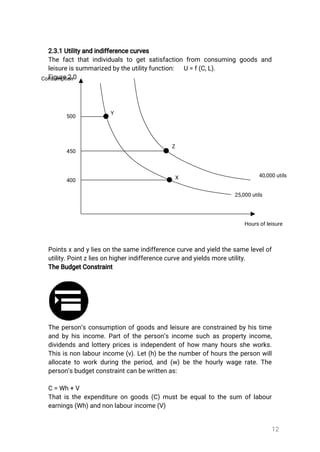
leisureissummarizedbytheutilityfunction: U=f(C,L).
Figure2.0
Pointsxandyliesonthesameindifferencecurveandyieldthesamelevelof
utility.Pointzliesonhigherindifferencecurveandyieldsmoreutility.
TheBudgetConstraint
Theperson’sconsumptionofgoodsandleisureareconstrainedbyhistime
andbyhisincome.Partoftheperson’sincomesuchaspropertyincome,
dividendsandlotterypricesisindependentofhow manyhourssheworks.
Thisisnonlabourincome(v).Let(h)bethenumberofhoursthepersonwill
allocatetoworkduringtheperiod,and(w)bethehourlywagerate.The
person’sbudgetconstraintcanbewrittenas:
C=Wh+V
Thatistheexpenditureongoods(C)mustbeequaltothesum oflabour
earnings(Wh)andnonlabourincome(V)
40,000utils
25,000utils
X
Z
Y
Hoursofleisure
Consumption
500
450
400
13
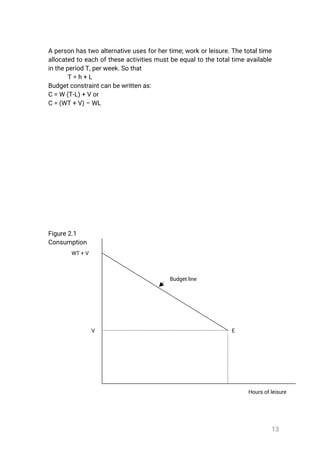
Apersonhastwoalternativeusesforhertime;workorleisure.Thetotaltime
allocatedtoeachoftheseactivitiesmustbeequaltothetotaltimeavailable
intheperiodT,perweek.Sothat
T=h+L
Budgetconstraintcanbewrittenas:
C=W(T-L)+Vor
C=(WT+V)–WL
Figure2.1
Consumption
Hoursofleisure
EV
Budgetline
WT+V
14
PointEindicatesthatifthepersondecidesnottoworkatallanddevotesT
hourstoleisureactivitiesshecanstillpurchaseVworthofconsumption
goods.PointEistheendowmentpoint.Ifthepersoniswillingtogiveupone
hourofleisure,shecanthenmoveupthebudgetlineandpurchasean
additionalW worthofgoods.Theworkermovesupthebudgetlineasshe
tradesoffanhourofleisureforadditionalconsumption.Theslopeofthe
budgetlineiswagerate.
2.3.2TheHours-of-WorkDecision
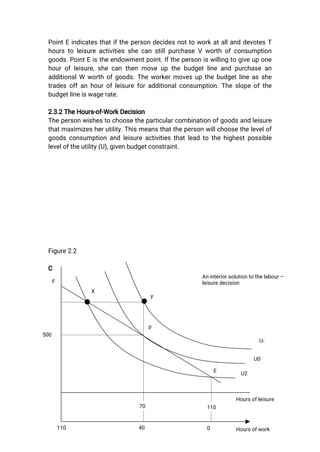
Thepersonwishestochoosetheparticularcombinationofgoodsandleisure
thatmaximizesherutility.Thismeansthatthepersonwillchoosethelevelof
goodsconsumptionandleisureactivitiesthatleadtothehighestpossible
leveloftheutility(U),givenbudgetconstraint.
Figure2.2
C
X
70 110
Hoursofwork
Hoursofleisure
E
U2
U0
U1
y
p
F
500
110 40 0
Aninteriorsolutiontothelabour–
leisuredecision
15
PointPgivestheoptimalbundleofconsumptiongoodsandhoursofleisure
chosenbytheutility-maximizingworker.AtpointP indifferencecurveis
tangencyofthebudgetline.Atthissolutionworkerconsumes70hoursof
leisureperweekandwork40hrsandconsumes500worthofgoodsweekly.
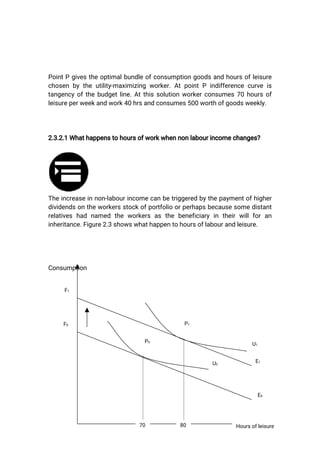
2.3.2.1Whathappenstohoursofworkwhennonlabourincomechanges?
Theincreaseinnon-labourincomecanbetriggeredbythepaymentofhigher
dividendsontheworkersstockofportfolioorperhapsbecausesomedistant
relativeshad named theworkersasthebeneficiaryin theirwillforan
inheritance.Figure2.3showswhathappentohoursoflabourandleisure.
Consumption
F1
F0
70 80 Hoursofleisure
E0
U0
E1
U1
P0
P1
16
TheincreaseinnonlabourweeklyshiftstheendowmentpointtoE1 sothat
thenewbudgetlineisgivenbyF1E1.Becausetheworkerswagerateisbeing
heldconstant,theslopeofthebudgetlineoriginatingatpointF1isthesame
astheslopeofthebudgetlineatpointE0.Theworkerwillmovefrom pointP0
toP1.Ifleisureisanormalgoodmeaningthattheworkerwillconsumemore
ofitasincomeincreasesthenhoursofworkfalls.
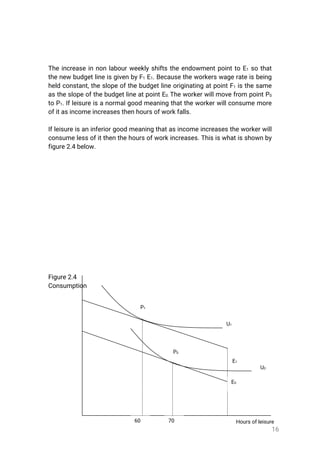
Ifleisureisaninferiorgoodmeaningthatasincomeincreasestheworkerwill
consumelessofitthenthehoursofworkincreases.Thisiswhatisshownby
figure2.4below.
Figure2.4
Consumption
P1
P0
E0
E1
U0
U1
60 70 Hoursofleisure
17
Theimpactofthechangeinnonlabourincome(holdingwageconstant)on
thenumbersofhoursworkediscalledanincomeeffect
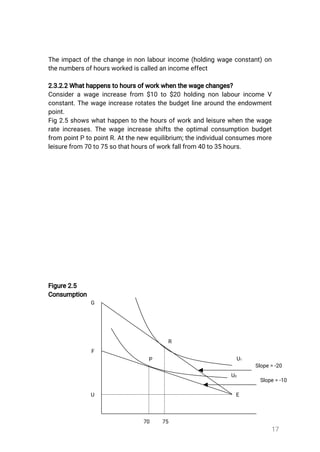
2.3.2.2Whathappenstohoursofworkwhenthewagechanges?
Considerawageincreasefrom $10to$20holdingnonlabourincomeV
constant.Thewageincreaserotatesthebudgetlinearoundtheendowment
point.
Fig2.5showswhathappentothehoursofworkandleisurewhenthewage
rateincreases.Thewageincreaseshiftstheoptimalconsumptionbudget
from pointPtopointR.Atthenewequilibrium;theindividualconsumesmore
leisurefrom70to75sothathoursofworkfallfrom40to35hours.
Figure2.5
Consumption
70 75
U
F
G
P
R
E
U0
U1
Slope=-10
Slope=-20
18
HoursofLeisure
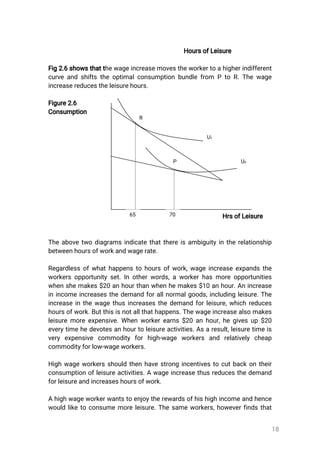
Fig2.6showsthatthewageincreasemovestheworkertoahigherindifferent
curveandshiftstheoptimalconsumptionbundlefrom PtoR.Thewage
increasereducestheleisurehours.
Figure2.6
Consumption
HrsofLeisure
Theabovetwodiagramsindicatethatthereisambiguityintherelationship
betweenhoursofworkandwagerate.
Regardlessofwhathappenstohoursofwork,wageincreaseexpandsthe
workersopportunityset.Inotherwords,aworkerhasmoreopportunities
whenshemakes$20anhourthanwhenhemakes$10anhour.Anincrease
inincomeincreasesthedemandforallnormalgoods,includingleisure.The
increaseinthewagethusincreasesthedemandforleisure,whichreduces
hoursofwork.Butthisisnotallthathappens.Thewageincreasealsomakes
leisuremoreexpensive.Whenworkerearns$20anhour,hegivesup$20
everytimehedevotesanhourtoleisureactivities.Asaresult,leisuretimeis
very expensive commodity forhigh-wage workers and relatively cheap
commodityforlow-wageworkers.
Highwageworkersshouldthenhavestrongincentivestocutbackontheir
consumptionofleisureactivities.Awageincreasethusreducesthedemand
forleisureandincreaseshoursofwork.
Ahighwageworkerwantstoenjoytherewardsofhishighincomeandhence
wouldliketoconsumemoreleisure.Thesameworkers,howeverfindsthat
R
U1
U0P
65 70
19
leisureisveryexpensiveandthatshesimplycannotaffordtotaketimeoff
from work.Thesetwoconflictingforcesareillustratedbelow.Figure2.7and
figure2.8show thedecompositionoftheimpactofawagechangeinto
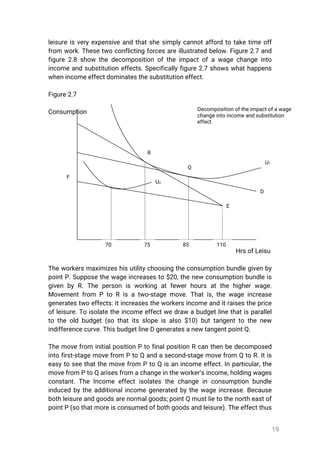
incomeandsubstitutioneffects.Specificallyfigure2.7showswhathappens
whenincomeeffectdominatesthesubstitutioneffect.
Figure2.7
Consumption
HrsofLeisu
Theworkersmaximizeshisutilitychoosingtheconsumptionbundlegivenby
pointP.Supposethewageincreasesto$20,thenewconsumptionbundleis
givenbyR.Thepersonisworking atfewerhoursatthehigherwage.
Movementfrom PtoRisatwo-stagemove.Thatis,thewageincrease
generatestwoeffects:itincreasestheworkersincomeanditraisestheprice
ofleisure.Toisolatetheincomeeffectwedrawabudgetlinethatisparallel
totheoldbudget(sothatitsslopeisalso$10)buttangenttothenew
indifferencecurve.ThisbudgetlineDgeneratesanewtangentpointQ.
Themovefrom initialpositionPtofinalpositionRcanthenbedecomposed
intofirst-stagemovefrom PtoQandasecond-stagemovefrom QtoR.Itis
easytoseethatthemovefrom PtoQisanincomeeffect.Inparticular,the
movefromPtoQarisesfromachangeintheworker’sincome,holdingwages
constant.TheIncomeeffectisolatesthechangeinconsumptionbundle
inducedbytheadditionalincomegeneratedbythewageincrease.Because
bothleisureandgoodsarenormalgoods;pointQmustlietothenortheastof
pointP(sothatmoreisconsumedofbothgoodsandleisure).Theeffectthus
R
Q
D
F
U0
U1
E
70 75 85 110
Decompositionoftheimpactofawage
changeintoincomeandsubstitution
effect
20
increasesthedemandforleisure(form 70to85hrs)andreduceshoursof
workby15hrs.
Thesecond-stagemovefrom Q toR iscalledthesubstitutioneffect.It
illustrateswhathappenstotheworkersconsumptionbundledasthewages
increasesholdingutilityconstant.BymovingalonganIndifferencecurvethe
worker’sutilityisheldfixed.Thesubstitutioneffectthusisolatestheimpact
oftheincreaseinthepriceoftheleisureonhoursofworkholdingincome
constant.
Themovefrom QtoRgeneratesasubstitutionawayfrom leisuretimeand
towardsconsumptionofothergoods.Inotherwords,asthewagerises,the
workersdevotelesstimetoexpensiveleisureactivities(from 85to75hrs)
and increaseinconsumptionofgoods.Throughthesubstitutioneffect,
therefore,thewageincreasereducesthedemandforleisureandincreases
hoursofworkby10hrs.Thesubstitutioneffectimpliesthat,anincreasein
thewagerate,holdingincomeconstant,andincreaseshoursofwork.
Thedecreaseinhoursofworkgeneratedbytheincomeeffect(15hrs)
exceedstheincreaseinhoursofworkassociatedwiththesubstitutioneffect
(10hrs).Thestrongerincomeeffectthusleadstoanegativerelationship
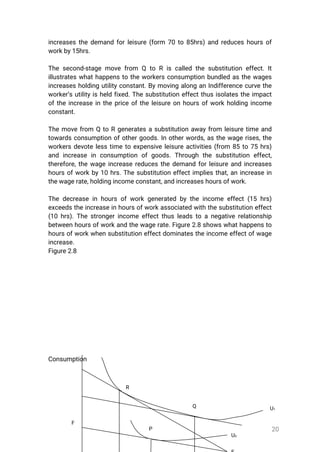
betweenhoursofworkandthewagerate.Figure2.8showswhathappensto
hoursofworkwhensubstitutioneffectdominatestheincomeeffectofwage
increase.
Figure2.8
Consumption
F
U1
R
Q
U0
P
21
HrsofLeisure
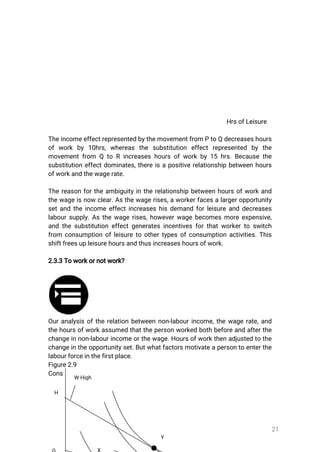
TheincomeeffectrepresentedbythemovementfromPtoQdecreaseshours
ofwork by 10hrs,whereas the substitution effectrepresented by the
movementfrom Q toRincreaseshoursofworkby15hrs.Becausethe
substitutioneffectdominates,thereisapositiverelationshipbetweenhours
ofworkandthewagerate.
Thereasonfortheambiguityintherelationshipbetweenhoursofworkand
thewageisnowclear.Asthewagerises,aworkerfacesalargeropportunity
setandtheincomeeffectincreaseshisdemandforleisureanddecreases
laboursupply.Asthewagerises,howeverwagebecomesmoreexpensive,
andthesubstitutioneffectgeneratesincentivesforthatworkertoswitch
from consumptionofleisuretoothertypesofconsumptionactivities.This
shiftfreesupleisurehoursandthusincreaseshoursofwork.
2.3.3Toworkornotwork?
Ouranalysisoftherelationbetweennon-labourincome,thewagerate,and
thehoursofworkassumedthatthepersonworkedbothbeforeandafterthe
changeinnon-labourincomeorthewage.Hoursofworkthenadjustedtothe
changeintheopportunityset.Butwhatfactorsmotivateapersontoenterthe
labourforceinthefirstplace.
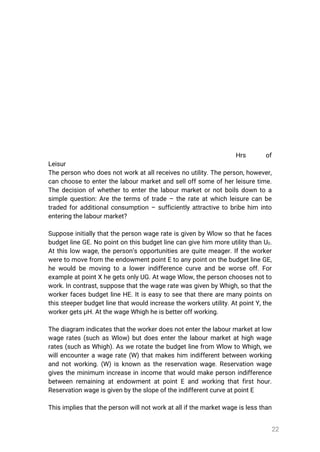
Figure2.9
Cons
WHigh
X
Y
H
22
Hrs of
Leisur
Thepersonwhodoesnotworkatallreceivesnoutility.Theperson,however,
canchoosetoenterthelabourmarketandselloffsomeofherleisuretime.
Thedecisionofwhethertoenterthelabourmarketornotboilsdowntoa
simplequestion:Arethetermsoftrade–therateatwhichleisurecanbe
tradedforadditionalconsumption–sufficientlyattractivetobribehim into
enteringthelabourmarket?
SupposeinitiallythatthepersonwagerateisgivenbyWlowsothathefaces
budgetlineGE.Nopointonthisbudgetlinecangivehim moreutilitythanU0.
Atthislowwage,theperson’sopportunitiesarequitemeager.Iftheworker
weretomovefrom theendowmentpointEtoanypointonthebudgetlineGE,
hewouldbemovingtoalowerindifferencecurveandbeworseoff.For
exampleatpointXhegetsonlyUG.AtwageWlow,thepersonchoosesnotto
work.Incontrast,supposethatthewageratewasgivenbyWhigh,sothatthe
workerfacesbudgetlineHE.Itiseasytoseethattherearemanypointson
thissteeperbudgetlinethatwouldincreasetheworkersutility.AtpointY,the
workergetsμH.AtthewageWhighheisbetteroffworking.
Thediagramindicatesthattheworkerdoesnotenterthelabourmarketatlow
wagerates(suchasWlow)butdoesenterthelabourmarketathighwage
rates(suchasWhigh).Aswerotatethebudgetlinefrom WlowtoWhigh,we
willencounterawagerate(W)thatmakeshim indifferentbetweenworking
andnotworking.(W)isknownasthereservationwage.Reservationwage
givestheminimum increaseinincomethatwouldmakepersonindifference
betweenremainingatendowmentatpointEandworkingthatfirsthour.
ReservationwageisgivenbytheslopeoftheindifferentcurveatpointE
Thisimpliesthatthepersonwillnotworkatallifthemarketwageislessthan
23
thereservationwage,andthepersonwillenterthelabourmarketifthemarket
wageexceedsthereservationwage.Thedecisiontoworkthereforeisbased
oncomparisonofthemarketwage,whichindicateshowmuchtheemployers
arewillingtopayforanhour,andthereservationwage,whichindicateshow
muchtheworkerrequirestobebribedintoworkingthatfirsthour.
2.4TheLabourSupplyCurveforaWorker
Therelationbetweenhourofworkandthewagerateiscalledthelabour
supplycurve.Ittracesouttherelationshipbetweenthewagerateandhours
ofwork.
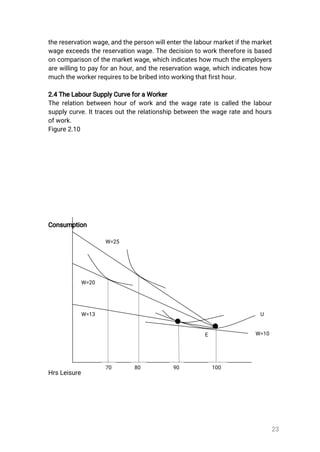
Figure2.10
Consumption
HrsLeisure
W=13
E
W=25
W=20
W=10
U
10070 80 90
24
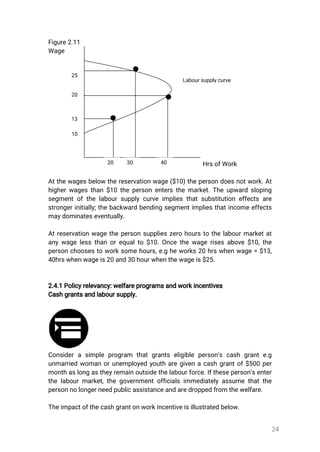
Figure2.11
Wage
HrsofWork
Atthewagesbelowthereservationwage($10)thepersondoesnotwork.At
higherwagesthan$10thepersonentersthemarket.Theupwardsloping
segmentofthelaboursupplycurveimpliesthatsubstitutioneffectsare
strongerinitially;thebackwardbendingsegmentimpliesthatincomeeffects
maydominateseventually.
Atreservationwagethepersonsupplieszerohourstothelabourmarketat
anywagelessthanorequalto$10.Oncethewagerisesabove$10,the
personchoosestoworksomehours,e.gheworks20hrswhenwage=$13,
40hrswhenwageis20and30hourwhenthewageis$25.
2.4.1Policyrelevancy:welfareprogramsandworkincentives
Cashgrantsandlaboursupply.
Considerasimpleprogram thatgrantseligibleperson’scash grante.g
unmarriedwomanorunemployedyoutharegivenacashgrantof$500per
monthaslongastheyremainoutsidethelabourforce.Iftheseperson’senter
thelabourmarket,thegovernmentofficialsimmediatelyassumethatthe
personnolongerneedpublicassistanceandaredroppedfromthewelfare.
Theimpactofthecashgrantonworkincentiveisillustratedbelow.
10
25
13
20
20 30 40
Laboursupplycurve
25
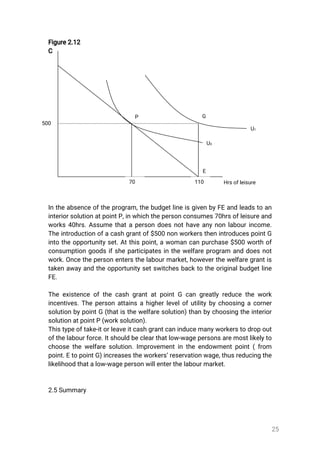
Figure2.12
C
Intheabsenceoftheprogram,thebudgetlineisgivenbyFEandleadstoan
interiorsolutionatpointP,inwhichthepersonconsumes70hrsofleisureand
works40hrs.Assumethatapersondoesnothaveanynonlabourincome.
Theintroductionofacashgrantof$500nonworkersthenintroducespointG
intotheopportunityset.Atthispoint,awomancanpurchase$500worthof
consumptiongoodsifsheparticipatesinthewelfareprogram anddoesnot
work.Oncethepersonentersthelabourmarket,howeverthewelfaregrantis
takenawayandtheopportunitysetswitchesbacktotheoriginalbudgetline
FE.
TheexistenceofthecashgrantatpointG cangreatlyreducethework
incentives.Thepersonattainsahigherlevelofutilitybychoosingacorner
solutionbypointG(thatisthewelfaresolution)thanbychoosingtheinterior
solutionatpointP(worksolution).
Thistypeoftake-itorleaveitcashgrantcaninducemanyworkerstodropout
ofthelabourforce.Itshouldbeclearthatlow-wagepersonsaremostlikelyto
choosethewelfaresolution.Improvementintheendowmentpoint(from
point.EtopointG)increasestheworkers’reservationwage,thusreducingthe
likelihoodthatalow-wagepersonwillenterthelabourmarket.
2.5Summary
70
U0
E
110
U1
P G
500
Hrsofleisure
26
 Thereservationwageisthewagethatmakesapersionindeffent
betweenworkingandnotworking.Apersonentersthelabourmarket
whenthemarketwagerateexceedsthereservationwage.
 Utility – maximization workers allocate theirtime so thatthe
last$spentonleisureactivityyieldsthesameutilityasthelast$spent
ongoods.
 Anincreaseinnonlabourincomereduceshoursofworkofworker.
 Theparticipationrateofmarriedwomeninthelaborforcehas
increasedsubstantiallyinrecentdec¬ades.
 Thesupplycurveoflabortoaparticularoccupationismoreelasticin
thelongrunthanintheshortrunbecausepeoplehavetimetotrain
fornewoccupations
 Theexistenceofabackward-bendinglaborsupplycurvetellsyouthat
peopleallocatetheirlimitedtimebetweenworkandleisure(i.e.,
non-work).
Activity
1 Wecandemonstratethatawelfareprogram thatincludesacashgrant
andataxonlabourearningsmustreducelaboursupply.
2 Whathappenstothereservationwageifnonlabourincomeincreases
andwhy?
3 Whateconomicfactorsdeterminewhetherapersonparticipateinthe
labourforce?
27
LESSONTHREE
LABOURDEMAND
3.0Introduction
Labourmarketoutcomes,dependsnotonlyonthewillingnessofworkersto
supplytheirtimetoworkactivities,butalsoonthewillingnessoffirmstohire
thoseworkers.Wenowturn,thereforetoadiscussionofthedemandsideof
thelabourmarket.Ouranalysisoflabourdemandbeginsbyrecognizingthat
firmsdonothireworkerssimplybecauseemployerswanttosee“bodies”
28
fillinginvariouspositionsinthefirm.Rather,firmshireworkersbecause
consumerswanttopurchaseavarietyofgoodsandservicesproducedbythe
worker.Thefirm’slabourdemand-justlikethefirm’sdemandforotherinputs
intheproductionprocess,suchasland,buildingsandmachines-isaderived
demandfromthewantsanddesiresofconsumers.
3.1LessonObjectives
Objectives
Bytheendofthelessonthelearnershouldbeableto:
1.Derivetheproductionfunction
2.Derivedemandcurveforlabourforafirmintheshort-run
3.Derivedemandcurveforlabourforafirminthelong-run
4.Isolatesubstitutionandincomeeffectofawagechange
3.2TheProductionfunction
Itdescribesthetechnologythatthefirm usestoproducegoodsandservices.
Assumethattherearetwofactorsofproduction(twoinputsintheproduction
process).i.enumberofemployeeshourshiredbythefirm(E)andcapital(K)
Q=F(E,K). Q=firmsoutput.Theproductionfunctionspecifieshowmuch
outputisproducedbyanycombinationoflabourandcapital.Thedefinitionof
thelabourinputmakestwoassumptionsthatareveryrestrictiveandthatare
worthnoting.Thenumberofemployee-hoursEisgivenbytheproductofthe
numberofworkershiredtimestheaveragenumberofhoursworkedper
person.Theproductionfunctionalsoassumesthatdifferenttypesofworkers
cansomehowbeaggregatedintoasingleinputthatwecalllabour.
3.2.1MarginalProductandAverageProduct
Themostimportantconceptassociatedwiththeproductionfunctionisthat
ofmarginalproduct.TheMarginalproductoflabour(MPE)isdefinedasthe
changeinoutputresultingfrom havinganadditionalworker,holdingconstant
thequantitiesofallotherinputs.Similarly,themarginalproductofcapital
29
(MPk)isdefinedasthechangeinoutputresultingfrom aoneunitincreasein
thecapitalstock,holdingconstantthequantitiesofallotherinputs.We
assumethatthemarginalproductsofbothlabourandcapitalarepositive
numbers,sothathiringeithermoreworkersorcapitalleadstomoreoutput.
Wecanalsodefineaverageproductoflabour(Ape)astheamountofoutput
producedbyatypicalworker.
Ape=Q/E
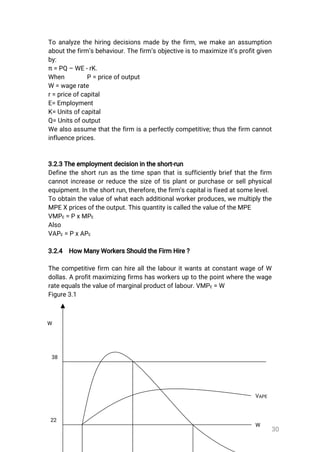
Totalproductcurvegivestherelationshipbetweenoutputandthenumberof
workershiredinthefirm holdingcapitalfixed.Themarginalproductcurve
givestheoutputproducedbyeachadditionalworkerandtheaverageproduct
curvegivestheoutputperworker.
3.2.2Profitmaximization
A
B
C
80 4 Units
oflabor
(L)
Total
Output
(Q)
ΔQ
ΔL
3
Figure3.0:GraphsofProductionFunction
120
6
8
36
v
UnitsofLabor
(L)
MP,AP
10 4 8 MPL
3
2
APL
TPL
d
e
6
1
9
f
Panela
Total
Production
function
Panelb
Averageand
Marginal
Product
function
30
Toanalyzethehiringdecisionsmadebythefirm,wemakeanassumption
aboutthefirm’sbehaviour.Thefirm’sobjectiveistomaximizeit’sprofitgiven
by:
π=PQ–WE-rK.
When P=priceofoutput
W=wagerate
r=priceofcapital
E=Employment
K=Unitsofcapital
Q=Unitsofoutput
Wealsoassumethatthefirm isaperfectlycompetitive;thusthefirm cannot
influenceprices.
3.2.3Theemploymentdecisionintheshort-run
Definetheshortrunasthetimespanthatissufficientlybriefthatthefirm
cannotincreaseorreducethesizeoftisplantorpurchaseorsellphysical
equipment.Intheshortrun,therefore,thefirm’scapitalisfixedatsomelevel.
Toobtainthevalueofwhateachadditionalworkerproduces,wemultiplythe
MPEXpricesoftheoutput.ThisquantityiscalledthevalueoftheMPE
VMPE=PxMPE
Also
VAPE=PxAPE
3.2.4 HowManyWorkersShouldtheFirmHire?
Thecompetitivefirm canhireallthelabouritwantsatconstantwageofW
dollas.Aprofitmaximizingfirmshasworkersuptothepointwherethewage
rateequalsthevalueofmarginalproductoflabour.VMPE=W
Figure3.1
W
W
22
38
VAPE
31
Supposethewageinthelabourmarketis$22thenthefirm shouldhire8
workers.Atthislevelofemployment,theVMPE=W andVMPEisdeclining.
Theintuitionforthisresultisthatsupposethefirm decidestohireonlysix
workerse.g7worker,wouldgetmoreadditionalrevenuesthanitwouldpay
outtothatworker(26$and22$).Aprofitmaximizingfirmwillwanttoexpand
andhiremorelabour.Ifthefirm weretohiremorethaneightworkers,the
VMPEwouldbelowerthanthecostoftheline.From aprofitmaximizingpoint
ofview,itisnotworthhavingmorethaneightworkers.
NB.ThewagewouldequaltheVMPEifthefirm hiredjustoneworker.Atthat
point,however,theVMPE isupwardsloping;hiringjustoneworkerdoesnot
maximizeprofits.Ifthefirm hiredanotherworker,the2
nd
workerhiredwould
contributeevenmoretothefirm’srevenuethanthefirstworker.
Thisargumentshowswhythelaw ofdiminishingreturnsplayssuchan
importantroleinourtheoryifVMPE keptrisingthefirm wouldmaximize
profitsbyexpandingindefinitely.
Ifthecompetitivewagewereveryhighsuchas$38,thefirm wouldhire4
workerswhereVMPE=W.HowevertheVAPE(32)wouldlessthanthewage.
Becausetheper-workercontributiontothefirmislessthanthewage,thefirm
losesmoreandleavesthemarket.TheonlypointsontheVMPEcurvethatare
relevantforthe firm’s hiring decision are the once thatlie on the
download-sloping portion ofthecurvebelow thepointwheretheVAPE
intersectstheVMPEcurve.
3.3Theshort-runlabourdemandscurveforafirm.
32
Thedemandcurvetellsuswhathappenstothefirm’semploymentasthe
wagechangesholdingcapitalconstant.
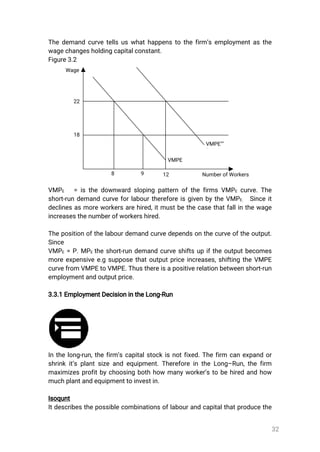
Figure3.2
VMPE =isthedownwardslopingpatternofthefirmsVMPE curve.The
short-rundemandcurveforlabourthereforeisgivenbytheVMPE. Sinceit
declinesasmoreworkersarehired,itmustbethecasethatfallinthewage
increasesthenumberofworkershired.
Thepositionofthelabourdemandcurvedependsonthecurveoftheoutput.
Since
VMPE =P.MPEtheshort-rundemandcurveshiftsupiftheoutputbecomes
moreexpensivee.gsupposethatoutputpriceincreases,shiftingtheVMPE
curvefromVMPEtoVMPE.Thusthereisapositiverelationbetweenshort-run
employmentandoutputprice.
3.3.1EmploymentDecisionintheLong-Run
Inthelong-run,thefirm’scapitalstockisnotfixed.Thefirm canexpandor
shrinkit’splantsizeandequipment.ThereforeintheLong–Run,thefirm
maximizesprofitbychoosingbothhowmanyworker’stobehiredandhow
muchplantandequipmenttoinvestin.
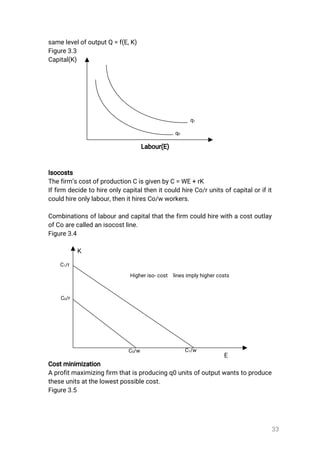
Isoqunt
Itdescribesthepossiblecombinationsoflabourandcapitalthatproducethe
NumberofWorkers
VMPE’’’
’’
VMPE
1298
18
22
Wage
33
samelevelofoutputQ=f(E,K)
Figure3.3
Capital(K)
Labour(E)
Isocosts
Thefirm’scostofproductionCisgivenbyC=WE+rK
Iffirm decidetohireonlycapitalthenitcouldhireCo/runitsofcapitalorifit
couldhireonlylabour,thenithiresCo/wworkers.
Combinationsoflabourandcapitalthatthefirm couldhirewithacostoutlay
ofCoarecalledanisocostline.
Figure3.4
K
E
Costminimization
Aprofitmaximizingfirmthatisproducingq0unitsofoutputwantstoproduce
theseunitsatthelowestpossiblecost.
Figure3.5
q0
q1
C1/wC0/w
C0/r
C1/r
Higheriso-cost linesimplyhighercosts
34
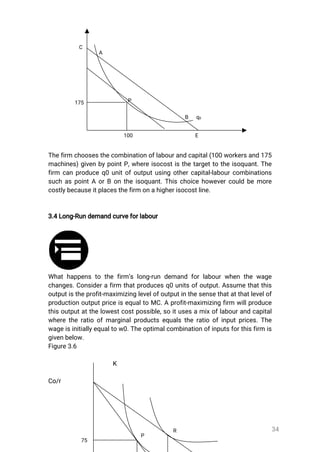
Thefirmchoosesthecombinationoflabourandcapital(100workersand175
machines)givenbypointP,whereisocostisthetargettotheisoquant.The
firm canproduceq0unitofoutputusingothercapital-labourcombinations
suchaspointAorBontheisoquant.Thischoicehowevercouldbemore
costlybecauseitplacesthefirmonahigherisocostline.
3.4Long-Rundemandcurveforlabour
Whathappenstothefirm’slong-rundemandforlabourwhenthewage
changes.Considerafirm thatproducesq0unitsofoutput.Assumethatthis
outputistheprofit-maximizinglevelofoutputinthesensethatatthatlevelof
productionoutputpriceisequaltoMC.Aprofit-maximizingfirm willproduce
thisoutputatthelowestcostpossible,soitusesamixoflabourandcapital
wheretheratioofmarginalproductsequalstheratioofinputprices.The
wageisinitiallyequaltow0.Theoptimalcombinationofinputsforthisfirmis
givenbelow.
Figure3.6
K
Co/r
q0B
P
A
E100
175
C
75
R
P
35
E
SupposethemarketwagefallstoW1,how willthefirm respond?Thefirm
wouldmovefrom pointPtopointR.Thewagereductionincreasesthefirm
employmentfrom 25to40workersandincreasesoutputtoq1units.The
declineinthewagewilltypicallycutthemarginalcostofproducingthefirm’s
output.Wethenexpectthatthedropinthewagewouldencouragethefirm to
expandproduction.
Figure3.7
Price
BecausetheMCCurvedropsfrom MCOtoMC1,thewagecutencouragethe
P
Output200100
Mc1
Mc0
36
firmstoproduce200unitsofoutputratherthan100units.
Thereforethefirmwilljumptoahigherisoquantasshownbelow.
Figure3.8
Capital
Thetotalcostofproducing200unitsofoutputneednottobesameasthe
costofproducingonly100units.Asaresultthenewiso-costlineneednot
originatefromthesamepointintheverticalaxisastheoldiso-costline.
Theemploymentwillincreasefrom 25to50,workers.Thefirm willalways
hiremoreworkerswhenthewagefalls.ThepositioningofRalsoimpliesthat
thefirm willusemorecapital.Thisneednotalwaysbethecase.Ingeneral,a
wagecutcaneitherincreaseordecreasetheamountofcapitaldemanded.
Figure3.9
Wage
E
100
200
Employment25 50
P
R
DLR
5025
W1
W0
Long-rundemandcurve
37
3.5Substitutionandscaleeffect
Thewagecutreducesthepriceoflabourrelativetothatofcapital.The
declineinthewageencouragesthefirm toreadjustitsinputmixsothatitis
morelabourintensive.Inaddition,thewagecutreducestheMCofproduction
andencouragesthefirm toexpand.Asthefirm expands,itwanttohiremore
workers.
Figure3.10
Capital
ThefirmisinitiallyatpointP,whereitfacesawageequaltoWO,produces100
unitsofoutputandhires25workers.WhenthewagefallstoW1,thefirm
movestopointR,producing200unitsofoutputandhiring50workers.
Themovefrom PtoRisoftwostages.Inthefirststage,thefirm takes
advantageofthelowerpriceoflabourbyexpandingproduction.Inthesecond
stage,thefirm takesadvantageofthewagechangebyrearrangingitsmixof
inputs(i.e.byswitchingfromcapitaltolabour),whileholdingoutputconstant.
Toconductthisdecomposition,weintroduceanew isocostlineDD.DD is
tangenttothenewisoquant(q=200),butparalleltotheisocostthatthefirm
facedbeforethewagereduction.ThetangencypointisgivenbyQ.
ThemovefromPtoQisthescaleeffect.Scaleeffectindicateswhathappens
tothedemandforthefirm’sinputsasthefirmexpandsproduction.Aslongas
capitalandlabourarenormalinputsthescaleeffectincreasesboththefirm’s
employment(from25to40workers)andcapitalstock.
Inadditiontoexpandingitsscale,thewagecutencouragesthefirm toadopt
adifferentmethodofproduction,onethatismorelabourintensivetotake
Employment504025
D
200
100
D
R
Q
P
C0/r
C1/r
38
advantageofthenow-cheaperlabour.Thesubstitutioneffectindicateswhat
happenstothefirm’semploymentasthewagechanges,holdingoutput
constantandisgivenbythemovefrom QtoR.Holdingoutputconstantat
200units,thefirm adoptamorelabour-intensiveinputmixsubstitutingaway
from capitaland toward labour.Substituting effectraises the firm’s
employmentfrom 40 to 50 workers.NB:The substitution effectmust
decreasethefirm’sdemandforcapital.
Boththesubstitutionandscaleeffectinducethefirm tohiremoreworkersas
wagefalls.
Theabovediagram indicatesthatthefirm hiresmorecapitalwhenwagefalls,
sothatthescaleeffect(whichincreasesthedemandforcapital)outweighs
thesubstitutioneffect(whichreducesthedemandforcapital).Thefirmwould
uselesscapitalifthesubstitutioneffectdominatedthescaleeffect.
3.6Summary
 Intheshort-run,aprofitmaximizingfirm hireworkersuptothepoint
wherethewageequalsthevalueofmarginalproductoflabour
 Inthelong-run,aprofitmaximizingfirmhireseachinputuptothepoint
wherethepriceoftheinputsequalsthevalueofmarginalproductof
theinput.Thisconditionimpliesthattheoptimalinputmixisonein
whichtheratioofmarginalproductoflabourandcapitalequalsthe
ratioofinputprices.
Activity
1 Whyistheshort-rundemandcurvedownwardsloping?
2 Whatmixofinputsshouldbeusedtoproduceagivenlevelof
output?
39
LESSONFOUR
WAGETHEORIES
4.0Introduction
Wagesarethepricepaidfortheuseoflabor.Theyareusuallyexpressedas
timerates,suchasacertainamountperhour,day,orweek.Theyarealso
40
expressed as piece rates,such as a certain amountperunitofwork
performedorProductproduced.
4.1LessonObjectives
Bytheendofthelessonthelearnershouldbeableto:
1.Explainthevarioustheoriesofwages
4.2THEORIESOFWAGES
Differenttheorieshavebeenputforwardfrom timetotimetoexplainhow
wagesaredetermined.Earlyeconomistsattemptingtoexplainhowlabours
share ofthe community’s wealth should be determined,proposed the
followingtheories.
4.2.1 Subsistencetheoryofwages:
Thisisalsocalledtheironorbrazenlawofwages.Accordingtothistheory,
labourpowerisacommoditywhosepriceisdeterminedbythecostof
productioni.e.theminimumsubsistenceexpensesrequiredforthesupportof
theworkerandhis/herfamilyinorderthatcontinoussupplyoflabouris
maintained. Theproponentsofthistheoryarguedthatwagestendtosettle
attheleveljustsufficienttomaintaintheworkerandhisfamilyataminimum
subsistencelevel.Ifatanytimewagesexceededthislevel,itissaidthat
workerswouldbeencouragedtomarry;theirnumberswouldincreaseuntil
thelargersupplyoflabourbringsdownthewagestothesubsistencelevelas
aresultofcompetitionbetweenworkersforjobs.Ifontheotherhandwages
slippedbelow thesubsistencelevel,therewouldbereductioninpopulation
throughdiscouragedmarriagesanddeathsduetoundernourishmentleading
toashortageinthesupplyoflabour.Thistendencywillcontinuetooperate
untilwagesareraisedtoreachtheminimumsubsistencelevel. Accordingto
thistheory,therefore,wagescannotfallbelow orriseabovetheminimum
subsistencelevel.
41
Criticisms
I. BasedonMalthusianTheoryofpopulation:Thesaidtheoryisbasedonthe
Malthusian theory population which incidentally has a number of
shortcomings.
II. Empiricallywrong:criticsmaintainthatthetheoryisnotonlyempirically
wrongbutalsohistoricallyincorrect. Experiencesshowsthatarisein
wagesisnotalwaysaccompaniedbyincreaseinpopulation,ratheritis
followedbyadeclineintherateofpopulationgrowth.
III. Thetheoryisunabletoexplaincausesofwagedifferentials: Thelabour
marketischaracterizedbywagerateheterogeneity.Ifwageweretobe
equaltothesubsistencelevel,thewageswouldinmostcasebeuniform.
IV. One-sided Theory: Thistheoryapproachesthepopulation ofwage
determinationfrom thesideofsupplyandcompletelyignoresthedemand
side. Itisthereforeunbalanced.
V. Thetheorydisregardofproductivity: accordingtothistheory,wagerate
forallworkerstendtobeequaltotheminimum subsistencelevel.Butit
doesn’thavetobesobecauseworkersdifferintheirlevelofproduction.
4.2.2 WageFundTheory:
Accordingtothistheory,wagesaredeterminedatanygiventimebytheratio
betweenthetotalsupplyoflabourandthewagefundwhichconsistthatpart
ofcirculatingcapitalwhichissetasidebytheentrepreneursforthepurchase
oftheservicesoflabour.Thusaccordingtothistheory,wagescanonly
increaseeitherwhenwagefundincreasesortheworkforcegoesdown. The
theoryarguesthatthewagefundcanbeincreasedbysavingwhichisnot
underthe controlofworkers.This implies thatifworkers wantan
improvementintheirwages,theirnumbersshouldbereduced.
Criticisms
I. Unscientific:Thetheoryhasbeendisregardedongroundsthatitisnot
scientificsinceitrestsupontheideaofafixedfund. Wagesarepaidout
ofafirm’sincomeandnotoutofafixedfundsetapartbyentrepreneurs
forpurposeofpurchasingservicesoflabour.
II. Differencesinwages:Thistheorycannotexplaintheexistenceofwage
differentialsamongworkers.Criticsmaintainthatifwagesarenotpaid
42
outofafixedfundandthewageratedependsuponthenumberofworkers
inemployment,thenitfollowsthatwageratemustbeuniform throughout
thecountry. Thisisnotthecase.
III. Homogeneityoflabour: Thetheoryrestsuponhomogeneityoflabour
whenworkershavedifferentlevelsofefficiencyandproductivity.
IV. IgnorestheinfluenceofTradeUnions:Inmostworld,tradeunionsareable
toeffectarisewagelevelsbyeitherrestrictingthesupplyorincreasing
productivity. The wage fund theory is incomplete to explain the
phenomenon.
V. Ignoresproductivity. Themaindefectofthetheoryisthatitcompletely
ignorestheeffectofproductivityonwages. Productivityisamajorfactor
forwagecompensations.
4.2.3 Residualclaimanttheory.
ThistheorywasdevelopedbyanAmericanEconomistFrancisA.Walker.
Thetheorystatesthatworkersshouldbepaidafterallotherinputsof
productionhavebeenpaid.Capitalispaidtheinterest,landownersarepaid
theirrentandbusinessownersarepaidtheirprofits.Whatremainsiswhat
goestoworkersaswages.Thetheorymaintainsthatwagesareequaltothe
wholeproductminuspaymentstotheotherfactorsofproduction.Thetheory
regardsworkersastheresidualclaimantoftheproductoftheindustry. The
theoryholdsouttoworkersapossibilityofincreasingtheirwagesandthus
improvingtheirlotiftheyworkedhard.
43
Criticisms
I. Entrepreneuristheresidualclaimant: Thetheorydonotexplainwhy
labourshouldberegardedastheresidualclaimanttotheproductofthe
individualwheninrealsenseitistheentrepreneurandnottheworkerwho
istheresidualclaimant.
II. Onesidetheory.Thetheoryconcentratesonthedemandsidetothe
completeneglectofthesupplyside.
III. Determinationofrents,interestandprofits. Theproponentsofthetheory
didnotexplainhowthepaymenttotheotherfactorsofproductionwasto
bearrivedat.
4.2.4MARGINALPRODUCTIONTHEORY
Thistheorystatesthatthepriceofafactorisdeterminedbyitsmarginal
productivity.Thewagesinacompetitivemarkettendtobeequaltothe
marginalproductoflabour. Marginalproductivityisanadditiontototal
productivityresultingfromtheemploymentofanadditionalunitoflabour.The
theoryassetsthatnoworkerunderconditionsofperfectcompetitioncan
expecttoreceivewagesabovetheabovethevalueofitsmarginalproductof
labourareequalisreached.Inacompetitivemarket,payingfactorsof
production according to theirmarginalproductivity means an efficient
allocationoffactorsofproductioninaproductiveprocess.Wagerateisequal
tothevalueofmarginalproductivityoflabour.
Criticisms
I. Thetheoryassumesthatallunitsoflabourarenothomogenous,sothat
anyworkerisasproductiveastheotherfactor.Thisisnotfivesince
workershavedifferentattributes.
II. Itassumesthattheamountoflabourusedintheproductioncanbe
continuously varied. This may notbe always true and in the
circumstancestheuseoflabourcannotbepusheduptothepointwhenits
marginalproductivitybecomesequaltowagerate.
III. Assumesperfectmobilityoflabourwhichisnotrealistic.
IV. Theoryisvalidonlyunderperfectcompetitionwhichdoesnotexist. It
breaksdowninreallife.
44
V. Thetheoryimpliesthatemploymentcanbeincreasedbyreducingwages
sothatmorelabourisemployedsoastomakewagesequaltomarginal
production.Theargumentisfallacioustakingintoaccountdownward
wagerigidityandmaynotapplyinthecaseofthenationaleconomy.Total
employmentinacountrydependsoneffectiveoraggregateddemand
whichexplainstheeconomy’sproductiveandabsorptivecapacities.
4.2.5ModernTheoryofWages
Accordingtothistheory,wagesaredeterminedbytheinteractionofthe
forcesofdemandandsupplyinthelabourmarketatanygiventime..Thisis
alsocalledthemarkettheoryofwagesorthedemandandsupplytheory.
Themajordisadvantageofthistheoryisthatlabourmarketisnotperfect
since itis characterized by monopoly,monopsony,bilateralmonopoly
conditions, trade unions, employer’s associations and government
interventionwhichcreateimperfectioninthemarket.
Summary
 Therearevarioustheoriesofwages
Activity
45
Explainthemoderntheoryofwagedetermination
LESSONFIVE
LABOURMARKETEQUILIBRIUM:WAGEANDEMPLOYMENT
DETERMINATION
5.0Introduction
Thischapteranalysesthepropertiesofequilibrium inaperfectlycompetitive
labourmarket.Wewillseethatifmarketsarecompetitiveandiffirmsand
workersarefreetoenterandleavethesemarkets,theequilibrium allocation
ofworkerstofirmsisefficient;thesortingofworkerstofirmsmaximizesthe
totalgainthatworkersandfirmsaccumulatebytradingwitheachother.
Wewillalso analyzethepropertiesoflabourmarketequilibrium under
alternativemarketstructures,suchasmonopsonies(wherethereisonlyone
buyeroflabour),monopolies(wherethereisonlyoneselleroftheoutput)
andbilateralwherethereisonebuyeroflabourandoneselleroftheoutput.
5.1LessonObjectives
Bytheendofthelessonthelearnershouldbeableto:
1.Determinetheequilibriumwageandemploymentin
 Perfectlabormarkets
 Imperfectlabormarkets
 MonopsonyLabourMarket
 Monopolylabourmarkets
 Bilateralmonopolylabourmarkets
2.Explaintheminimumwage
5.2Wage-DeterminationModels
46
How arewagesdeterminedinthemarketatanygiventime?Theanswer
dependsonthetypeofmarketmodelthatisassumedtoexistinaparticular
situation.Thereareseveralpossibilities.
5.2.1WageandEmploymentDeterminationinPerfectLabourMarkets
Itischaracterizedby;ManyBuyers,ManySellers,perfectknowledgeforboth
workersandthefirms,perfectmobilityofworkers,minimum government
intervention,homogeneousworkersandidenticaljobs.Conventionally,the
demandforandsupplyoflabourarefunctionsofwages(W/p).Equilibrium in
thecompetitivelabourmarketisdeterminedbytheforcesofdemandand
supply.Itrequiresthataggregatedemandforlabourbeequaltotheaggregate
supply. ThusNd=Ns=Ld=Ls.WhreNdistheaggregatedemandforlabour,
Nsistheaggregatesupplyoflabour,LdisthedemandcurveforlabourandLs
isthesupplycurveoflabour
Figure5.0
RealWage
N*
Unitsof labour
Itisassumedthattheaggregatelabourdemandandsupplyfunctionsare
suchthattheyproduceuniqueequilibriumatE*. Theequilibriumisexpected
tobestablebecausearealwagerateabovetheequilibrium W/Pwillgenerate
excesssupplyandforagivenpricelevel,themoneywagewillbebiddownas
workerscompleteforjobs. Thiswillincreaselabourdemandandreduce
laboursupply. ThisadjustmentwillcontinueuntilE*isrestored. Therefore
thedirectcompetitionbetweenworkerstheirwillingnesstotoleratewage
reductionswillensurethatE*isstable.
E*
Nd(
w
/p)=Ns(
w
/p)
w
/p
w
/p
Ld(
w
/p)
Ls(
w
/p)
47
Stabilityinthismodelrequiresthatadjustmentintherealwagesoccur
throughadjustmentsinthemoneywageforagivenprice.
Labourmarketsdonotoftenoperateundercompetitiveconditionsbecauseof
certainfeaturesthatpreventmoneywagesfrom beingflexible.Thefeatures
resultinrigiditiesinmoneywagesmakingittofailtoadjustfreelytoeliminate
excessdemandorexcesssupplyoflabourinstantly. Thesefeaturesare:-
(a)Institutionalrigidities
(b)Misperceptionsaboutchangesinwagesandprice.
(c)Difficultiescausedbyuncertaintiesandformationofexpectations.
(d)Governmentregulations
(e)Contracts
(f)Efficientlywagetheory
(g)Caseofinsidersandoutsiders:
Institutionalrigidities
a)Unionexplanation
Thisoccursbecauseunionssuccessfullyresistanyattemptbyfirmsto
reducewagesorundercuteachotherinmoneywages. Theyresistany
attemptbyfirmsto encourage the process. The unionsdo however
welcomewageincreases. Hencethereisdownwardmoneyrigidity.
Theinitialmoneywageemploymentequilibrium isat(Wo,No). Themoney
wageWo isregardedbyworkerscollectivelyasrepresentingaminimum
standardoflivingwhichmustbeprotectedatallcosts. Forequilibriumtobe
attained,adownwardadjustmentofwageswouldberequired. However
downward pressureonwagesisresisted and disequilibrium willpersist
indefinitely.
(ii)Efficientlywagetheory. Accordingtothistheory,firmsmayprefertoset
wagesabovecompetitivelevelsbecausetheyarguethathighwageswould
motivateworkerstoimproveproductivity. Withsuchwages,employees
wouldearneconomicrentswiththecurrentemployer,athingwhichtheywill
strivetomaintainbyimprovingproductivityandloyaltysoastoreduce
chancesoflayoffs. Ifallfirmsfinditprofitabletopaywagesthatarehigher
thanthecompetitivelevel,thelevelofemploymentwillfallbelowcompetitive
levels.High unemploymentrates lowerprobability thatan unemployed
48
individualwillfindajob. Sothethreatofunemploymentinduceshigher
effortsonthepartoftheemployed.
iii) Caseofinsidersandoutsiders: Whenallfirmsareisolatedfrom labour
marketcompetitiontheunemployed(outsiders)arenotregardedasperfect
substitutesfortheexisting employees(insiders). Insidersareexisting
employees,whosepositionisprotectedbyexistenceofsignificantlabour
marketadjustmentcostssuchastraining,hiringandfiringcosts.Outsidersof
whounemployedarethemostimportantcanonlyexertanindirectpressure
onthewageandjobsecurityofinsidersbecausetheyarepreventedfordirect
competitionbytheinsiders.Insiderswillhaveundergoneonthejobtraining
withtheemployerandthisgivesthem advantageovertheoutsiders. Firms
willhaveabargainingnichetosecurehigherwages.Theoutsiderscannot
thereforebiddowntheinsiderswageinordertosecureemployment.
(IV)Misperceptionsaboutchangesinwagesandprices
Inreallife,economicagentsmayattachgreatersignificancetonominal
wagesthatrealwages. Thismaybeduetoperceptionormoneyillusion.
Completemoneyillusiononthepartofworkersinvolveconsideringmoney
wagesastheimportantindicatorofwell-being.Allpricemovementsare
thereforeignored. Oneexplanationforthisirrationalbehavioristhatisifthe
economyhavehadlongperiodsofpricestabilityworkerswillbecomfortable
withthecurrentmoneywages. Whenpricesstarttofluctuateworkerswho
arenotusedtoitwillpersistwiththeirhabitofignoringthepricechanges
sincetheywillregardthem asbeingrelative.Thusanincreaseinpricewillbe
presumedtobeoffsetelsewherebysimilarpricereductiononothergoodsas
regardedastemporaryhenceignore.
When priceinstabilitycontinuesforalong time,moneyillusion willbe
consideredtobeirrationalandworkerswillrecognizetheeffectchangesin
priceontheirrealwages.
(V)Theroleofexpectations
Inthiscase,wenotetheexistenceofincompleteinformationwhichgenerates
theneedforformationofexpectationsbyeconomicagents. Itisconsidered
thatfirmsknowthepriceforcertainandareabletomakeinformedjudgment
overfutureprices.Workershoweverguessesabouttheexpectedpricelevel
byrelyingontheirpastmistakestoimproveontheirforecastaboutfuture
pricelevels. Sotheremaybedifficultyincalculatingrealwagesbecauseof
uncertainitityaboutfuturepricelevels.
49
Governmentmay intervene in labourmarketthrough minimum wage
regulationsothatthereisawagefloorbelowwhichfirmsarenotallowedto
pay.Ifthewagefloorisabovethecompetitivemarketlevel,thenitwouldpose
rigidity.
5.3.2WageandEmploymentDeterminationinImperfectLabourMarkets
Theforegoingmodelofwageandemploymentdeterminationdisclosesa
greatdealaboutsupply-and-demandforcesinthelabormarket.Butthe
modelisidealizations,orsimplifications,ofreal¬ity.Intherealworld,the
labormarketcontainsmanycomplexitiesandimperfections.Asaresult
actualwageandemploymentlevelsmaydifferfrom whatthemodelpredict.
Whataresomeofthemainsourcesoflabor-marketimperfections?
1.WorkerHeterogeneity
Mostworkersdonotsellhomogeneousunitsatlaborasthelabor-market
modelsassume.Thisisbecausepeopledifferinbothnaturalendowment
andintheskillsandexperiencestheyhavetooffer.Someworkersdevote
extrayearstoschoolingandtospecializedtraining.Inreturntheyearnhigher
lifetimeincomesthanthosewho nevermakethesacrificesneededto
improvetheirqualifications.Theseeffortsatjobpreparationandtrainingare
called"humancapitalinvestment."Ithelpsex¬plainsomeofthevariationsin
wageandemploy¬mentlevelsthatexistinreal-worldlabormarkets.
2.ImperfectKnowledge
Neitherworkers noremployers have complete in¬formation aboutjob
opportunitiesandjobseekers.Consequently,bothsearch.
(i)WorkerJob SearchThosewho areseeking em¬ploymentweighthe
benefitsoflookingforworkagainstitscosts.Thechiefbenefitsarethe
addi¬tional,orperhapsbetter,jobopeningsthatmaybediscoveredfrom
furthersearch.Themaincostsarethesumoftwotypes:
1.Thedirectexpenses(suchastravelingcostsandthecostsofmeals
awayfromhome)thatarein¬curredinlookingforemployment.
2.Theopportunitycostoflostincomefromquittingajobinordertolookfor
work,orfromnottakingjobsthatareavailable.
Asthejobsearchcontinues,desirablenewopen¬ingsbecomehardertofind.
Discouragementbeginstosetinasthemarginalbenefitoffurthersearch
declines while the marginalcostrises.When marginalbenefitequals
marginalcost,fur¬thersearchisnolongeradvantageous.Atthatpointthe
workerstopslookingandacceptsemploy¬ment.
50
(ii) EmployerJob Search Employers adjustto limited labor-market
information quite differentlyfrom workers.Two types ofmanagement
policieshelpexplainwhy.
First,thereisatrade-offbetweenwagecostsandsearchcosts.Otherthings
remainingthesame,firmsthatpayabove-averagewageratessoonbe¬come
widelyknown.Thesefirmsfindthattheycanattractworkersmoreeasilyand
spendlessonrecruitmentthanfirmsthatpaybelow-averagewages.Thisis
onereasonwhywageandemploy¬mentlevelsinactuallabormarketsmay
varysignif¬icantlyfromwhattheoreticallabor-marketmodelspredict.
Second,manycompaniesfollow apolicyofpro¬motionfrom within.Such
firms place a minimum dependence on outside recruitment,preferring
in¬steadtocreatetheirowninternallabormarkets.Eachfirm'sinternal
market contains its own rules governing job movement within the
organization.Totheextentthatcompaniesrelyonsuchmarkets,theylimit
theabilityofworkerstomovefrom onefirm toanother.Thisimpedesworker
mobilityandthereforereducestheefficiencyofexternallabormarkets..
3.SegmentedLaborMarkets
Athirdsourceofimperfectionthattendstoreducetheefficiencyoflabor
marketsliesinthestructureofthesemarkets.Insteadofbeingintegratedinto
aunifiedwholeasthetheoreticalmodelsassume,real-worldlabormarkets
appeartobesegmented.Eachmarkethasitsowncharacteristicsthathelp
determinewageand/oremploymentlevels.Twotypesthatareespecially
relevanttodayarethejob-competitionmarketandduallabormarket.Both
types,proposedbyvariouslaborexperts,arehy¬potheses.Theyattemptto
explainfurtherhowsomemodernlabormarketsoperate.
(i)Job-competitionMarketThisisalabormarketinwhichthenumberand
types ofjobs are determined mainlybyprevailing technology.Workers
com¬petewitheachothertofillparticularjobopeningsassociatedwith
existing plantand equipment.(A factory,forexample,needsaspecific
numberofop¬erators,maintenance people,supervisors,etc.to run its
machines.)Wagesforthesejobsareestab¬lishedlargelybyinstitutionaland
legislativecondi¬tions.Theseincludeindustrycustom,union-man¬agement
contracts,andminimum-wagelaws.Marketforcesplayarelativelyminorrole
inaffect¬ingwages.Thefunctionofjob-competitionmar¬kets,therefore,isto
allocateworkerstoagivennumberofvacanciesatprevailing,relativelyfixed,
wagerates.
(ii) DualLaborMarketThisisactuallytwodistinctmarkets.Oneisa
primarylabormarket,inwhichjobsarecharacterizedbyrelativelyhighwages,
51
fa¬vorableworkingconditions,andemploymentsta¬bility.Theotherisa
secondarylabormarket,inwhichjobs,whentheyareavailable,payrelatively
low wages,providepoorworkingconditions,andarehighlyunstable.Both
white-collarworkers and blue-collarworkers,manyofwhom are union
members,accountformostoftheparticipantsintheprimarymarket.In
contrast,thecompetitively"disadvantaged"—theunskilled,theundereducated,
andthevictimsofracialprejudice—arecon¬finedtothesecondarymarket.
Imperfectlabourmarketismadeupofmonopsony,monopolyandbilateral
labourmarketasexplainedbelow.
5.3.3WageandEmploymentDeterminationInaMonopsonyLabourMarket:
OneBuyer,ManySellers
Amonopsonyisamarketstructureconsistingofasinglebuyerandmany
sellersofagoodorservice.Hence,itmaybethoughtofasa"buyer's
monop¬oly." Anexam¬plewouldbeafirm thatisthesoleemployerina
companytown,ashasbeenthecaseinmanyminingcommunities.Similarly,
insomefarm areasasin¬glefood-processingplantdominatesemployment
formanymilesaround.Itcanalsorepresentthefederationofemployers.
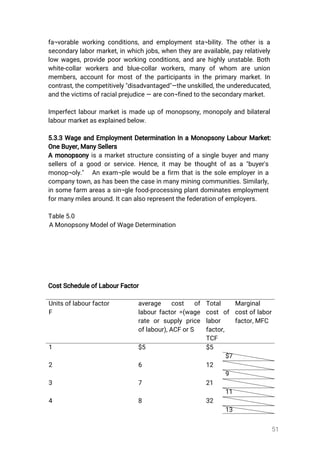
Table5.0
AMonopsonyModelofWageDetermination
CostScheduleofLabourFactor
Unitsoflabourfactor
F
average cost of
labourfactor=(wage
rate orsupplyprice
oflabour),ACForS
Total
costof
labor
factor,
TCF
Marginal
costoflabor
factor,MFC
1 $5 $5
$7
2 6 12
9
3 7 21
11
4 8 32
13
52
5 9 45
Figure5.3
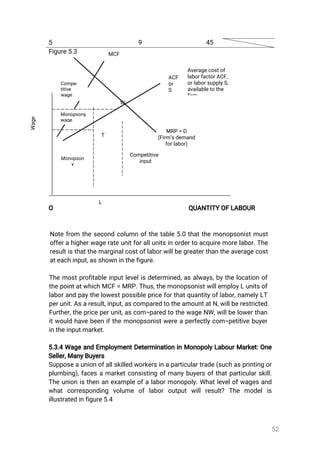
O QUANTITYOFLABOUR
Notefrom thesecondcolumnofthetable5.0thatthemonopsonistmust
offerahigherwagerateunitforallunitsinordertoacquiremorelabor.The
resultisthatthemarginalcostoflaborwillbegreaterthantheaveragecost
ateachinput,asshowninthefigure.
Themostprofitableinputlevelisdetermined,asalways,bythelocationof
thepointatwhichMCF=MRP.Thus,themonopsonistwillemployLunitsof
laborandpaythelowestpossiblepriceforthatquantityoflabor,namelyLT
perunit.Asaresult,input,ascomparedtotheamountatN,willberestricted.
Further,thepriceperunit,ascom¬paredtothewageNW,willbelowerthan
itwouldhavebeenifthemonopsonistwereaperfectlycom¬petitivebuyer
intheinputmarket.
5.3.4WageandEmploymentDeterminationinMonopolyLabourMarket:One
Seller,ManyBuyers
Supposeaunionofallskilledworkersinaparticulartrade(suchasprintingor
plumbing),facesamarketconsistingofmanybuyersofthatparticularskill.
Theunionisthenanexampleofalabormonopoly.Whatlevelofwagesand
whatcorresponding volume oflaboroutputwillresult? The modelis
illustratedinfigure5.4
Wage
MCF
ACF
or
S
Averagecostof
laborfactorACF,
orlaborsupplyS,
availabletothe
firm
MRP=D
(Firm’sdemand
forlabor)
Competitive
input
Monopsony
wage
Compe-
titive
wage
W
T
Monopson
y
L
N
53
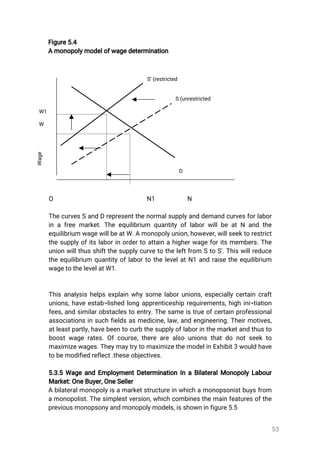
Figure5.4
Amonopolymodelofwagedetermination
O N1 N
ThecurvesSandDrepresentthenormalsupplyanddemandcurvesforlabor
inafreemarket.Theequilibrium quantityoflaborwillbeatN andthe
equilibriumwagewillbeatW.Amonopolyunion,however,willseektorestrict
thesupplyofitslaborinordertoattainahigherwageforitsmembers.The
unionwillthusshiftthesupplycurvetotheleftfrom StoS'.Thiswillreduce
theequilibrium quantityoflabortothelevelatN1andraisetheequilibrium
wagetothelevelatW1.
Thisanalysishelpsexplainwhysomelaborunions,especiallycertaincraft
unions,haveestab¬lishedlongapprenticeshiprequirements,highini¬tiation
fees,andsimilarobstaclestoentry.Thesameistrueofcertainprofessional
associationsinsuchfieldsasmedicine,law,andengineering.Theirmotives,
atleastpartly,havebeentocurbthesupplyoflaborinthemarketandthusto
boostwagerates.Ofcourse,therearealsounionsthatdonotseekto
maximizewages.TheymaytrytomaximizethemodelinExhibit3wouldhave
tobemodifiedreflect.theseobjectives.
5.3.5WageandEmploymentDeterminationInaBilateralMonopolyLabour
Market:OneBuyer,OneSeller
Abilateralmonopolyisamarketstructureinwhichamonopsonistbuysfrom
amonopolist.Thesimplestversion,whichcombinesthemainfeaturesofthe
previousmonopsonyandmonopolymodels,isshowninfigure5.5
Wage
W1
W
S’(restricted
supply)
S(unrestricted
supply)
D
54
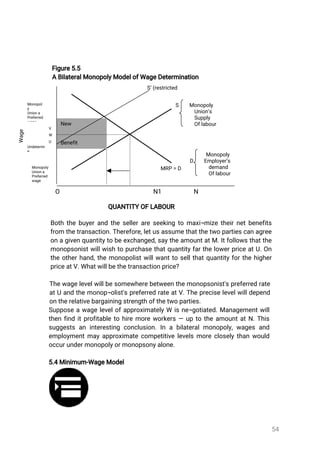
Figure5.5
ABilateralMonopolyModelofWageDetermination
O N1 N
QUANTITYOFLABOUR
Boththebuyerandthesellerareseekingtomaxi¬mizetheirnetbenefits
fromthetransaction.Therefore,letusassumethatthetwopartiescanagree
onagivenquantitytobeexchanged,saytheamountatM.Itfollowsthatthe
monopsonistwillwishtopurchasethatquantityfarthelowerpriceatU.On
theotherhand,themonopolistwillwanttosellthatquantityforthehigher
priceatV.Whatwillbethetransactionprice?
Thewagelevelwillbesomewherebetweenthemonopsonist'spreferredrate
atUandthemonop¬olist'spreferredrateatV.Thepreciselevelwilldepend
ontherelativebargainingstrengthofthetwoparties.
SupposeawagelevelofapproximatelyW isne¬gotiated.Managementwill
thenfinditprofitabletohiremoreworkers— uptotheamountatN.This
suggestsaninterestingconclusion.Inabilateralmonopoly,wagesand
employmentmayapproximatecompetitivelevelsmorecloselythanwould
occurundermonopolyormonopsonyalone.
5.4Minimum-WageModel
Wage
Monopol
y
Uniona
Preferred
wage
S’(restricted
supply)
S Monopoly
Union’s
Supply
Oflabour
MRP=D
Monopoly
D Employer’s
demand
Oflabour
Monopoly
Uniona
Preferred
wage
Undeterminat
e
New
Benefit
V
W
U
55
Unionsarenottheonlygroupsinsocietythatcanaffectwagesand
employment.Governmentcantoo.Oneofthewaysitcandothisisby
imposingaminimumwage.
Theobjectivesofsuchlegislationare:
1.Topreventfirmsfrom payingsubstandardwageswhenlabor-market
conditionsenablethemtodoso.
2.Toestablishawagefloorrepresentingsomemin¬imallevelofliving.
3.Toincreasepurchasingpowerbyraisingthein¬comesoflow-wage
workers.
Analyzing the Effects ofMinimum Wages Whatare the economic
consequencesofminimum wages?Someoftheanswersarenotcertain
be¬causeminimum wageshavemanyeffectsandim¬plications.Youcan
gainsomeappreciationofthesebyexaminingthemodelsinExhibit7.
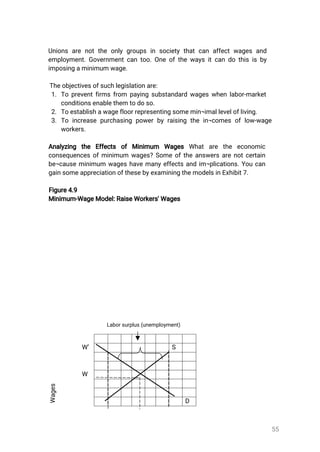
Figure4.9
Minimum-WageModel:RaiseWorkers'Wages
Wages
W’ S
W
D
Laborsurplus(unemployment)
56
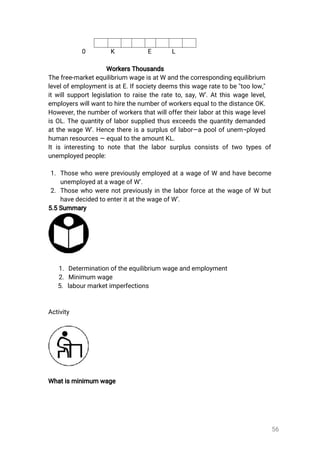
0 K E L
WorkersThousands
Thefree-marketequilibriumwageisatWandthecorrespondingequilibrium
levelofemploymentisatE.Ifsocietydeemsthiswageratetobe"toolow,"
itwillsupportlegislationtoraisetherateto,say,W’.Atthiswagelevel,
employerswillwanttohirethenumberofworkersequaltothedistanceOK.
However,thenumberofworkersthatwilloffertheirlaboratthiswagelevel
isOL.Thequantityoflaborsuppliedthusexceedsthequantitydemanded
atthewageW’.Hencethereisasurplusoflabor—apoolofunem¬ployed
humanresources—equaltotheamountKL.
Itisinterestingtonotethatthelaborsurplusconsistsoftwotypesof
unemployedpeople:
1.ThosewhowerepreviouslyemployedatawageofW andhavebecome
unemployedatawageofW’.
2.ThosewhowerenotpreviouslyinthelaborforceatthewageofW but
havedecidedtoenteritatthewageofW’.
5.5Summary
1.Determinationoftheequilibriumwageandemployment
2.Minimumwage
5.labourmarketimperfections
Activity
Whatisminimumwage
57
LESSONSIX
LABOURMARKETDISCRIMINATION
6.0Introduction
We will demonstrate that differences in earnings and employment
opportunitiesmayariseevenamongequallyskilledworkersemployedinthe
samejobsimplybecauseoftheworkersrace,gender,nationalorigin,sexual
orientation,orotherseeminglyirrelevantcharacteristics
These differences are often attributed to labourmarketdiscrimination.
Discrimination occurs when participants in the marketplace take into
accountsuchfactorsasraceandsexwhenmakingeconomicdecisions
Thereisagreatvarietyofoccupationswhichwomenhavebeguntoclaim as
fieldsforindividualeffortfrom whichnointelligent,refinedmanwhoviews
thingsastheyreallyarewouldseektoexcludethem.
Womenarealongwayfrom jobequalitywithmen.Despitesubstan¬tial
progress,variousstudiesshowthatwomenoftenearnconsiderablylessthan
meninthesameoccupationalcategory.
Much the same is true of certain minority groups.Blacks,Asians,
homosexuals,andmem¬bersofothergroupshavelongbeenvictimsof
discriminationinemployment.Letuslookatsomeoftheeffectsofjob
discrimination,andsomeofthe'effectsthatwouldoccurifitwereeliminated.
6.1LessonObjectives
58
Bytheendofthelessonthelearnershouldbeableto:
1.Explainthecausesofwagediscrimination
2.Explaintheoreticalmodelsofwagediscrimination
3.Discusstheeffectsofeliminatingdiscrimination
6.2Whatarethecausesofwagediscrimination?
The economic analysis ofdiscrimination is based on the premise that
significantwageandemploymentdifferencespersistbetweengroupsinthe
labourforcethatarenotjustifiedbydifferenceinproductivityandhuman
capitalinvestment.labourmarketdiscriminationisthereforeanddoexist
whenworkerswithidenticalproductivecapabilitiesreceivedifferentrewards
fortheireffort.Employmentdiscriminationiswhenblackpeopleforexample
bear a disproportionate burden of unemployment. Occupational
discriminationoccurswhenfemales,forexample,arerestrictedfrom entering
certainoccupations,and/orcrowdedintoothers,despiteequalcapabilities
betweenthemandmales.
6.3Theoreticalmodelsofwagediscrimination
Attheoreticallevel,there are two main schools ofeconomic thought
regardingdiscriminations. Oneistheneoclassicaltheorystemmingfromthe
World ofBecker(1957)whichisbased onthenotionthatprejudiceis
expressedindiscriminatorytastesonthepartofemployers,workersand
consumer.The alternative is the segmented labourmarketapproach
(two-marketmodel),which can trace its heritage back to theory of
non-competinggroupsintheworkofMill(1885).
6.3.1The NeoclassicalTasteModel
Themoderneconomicanalysisofdiscriminationinthelabourmarketis
foundeduponseminalworkofAmericanEconomistBecker(1957). Becker
integrated the conceptofdiscrimination with mainstream neoclassical
59
microeconomicanalysisbysuggestingthatonegrouphasa“taste”for
discriminatingagainstanothergroupandthatthistastewasafactorinto
utilityfunction.Heidentifiedanumberofgroupsthatcouldbeascribedtoa
tastefordiscrimination:workers,employersandconsumers. However,most
oftheneoclassicalanalysisofdiscriminationhascentredontheemployeras
theagentofdiscrimination. Accordingly,weshallsettheneoclassical
employertastemodel.
In the standard neoclassicaltheory,we assume thatfirms are profit
maximizers.Inotherwordstheirutilityisafunctionofprofit.U=f(π)and
workers’utilityisafunctionofwageincomesandleisure U =F(W,L).
Discrimination is introduced by allowing firms to have “a taste for
discrimination. Inthistheoryitisarguedthatemployershaveatasteoffor
discrimination in the sense thattheirutility is adversely affected by
employmentof,andwagespaidto,thegroupbeingdiscriminatedagainst,in
thiscaseweassumefemales(F). Althoughthemonetarycostofemploying
malesandfemalesaregivenbytheirwages,Wm andWfrespectively,the
disutilityexperiencedfromhiringwomenaffectsthenetcostsuchthat
WF=WF(1+d)
Wheredisthediscriminationcoefficient. Ifanemployerfavourswomen
workers,dwillassumeanegativevalue.Ifthefirm iscompletelyindifferent
betweenmalesandfemale;whenitcomestohiringworkers,d=0.Yetifan
employerdiscriminatesagainstwomenthendwillbepositive.
Asfirmsemploymoreandmorefemaleworkers,uptoamaximum of100%,
theyrequiremoreprofittocompensatethemfortheassociateddisutility.
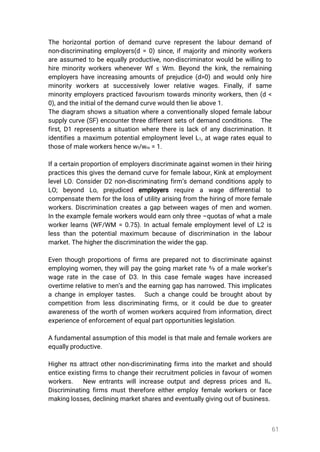
Figure6.0
D1
SF
1.0
0.75
0.66
Wageratio
Wf/Wm
60
O L0 L3 L2
L1 Employment
D2
D3
61
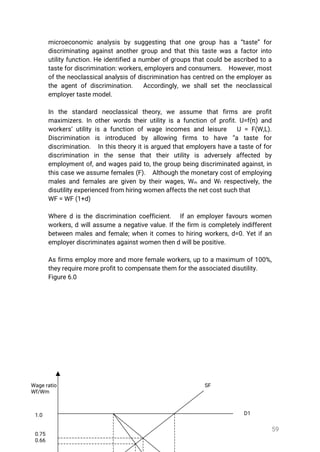
Thehorizontalportionofdemandcurverepresentthelabourdemandof
non-discriminatingemployers(d=0)since,ifmajorityandminorityworkers
areassumedtobeequallyproductive,non-discriminatorwouldbewillingto
hireminorityworkerswheneverWf≤Wm.Beyondthekink,theremaining
employershaveincreasingamountsofprejudice(d>0)andwouldonlyhire
minorityworkers atsuccessivelylowerrelative wages.Finally,ifsame
minorityemployerspracticedfavourism towardsminorityworkers,then(d<
0),andtheinitialofthedemandcurvewouldthenlieabove1.
Thediagram showsasituationwhereaconventionallyslopedfemalelabour
supplycurve(SF)encounterthreedifferentsetsofdemandconditions. The
first,D1representsasituationwherethereislackofanydiscrimination.It
identifiesamaximum potentialemploymentlevelL1,atwageratesequalto
thoseofmaleworkershencewf/wm =1.
Ifacertainproportionofemployersdiscriminateagainstwomenintheirhiring
practicesthisgivesthedemandcurveforfemalelabour,Kinkatemployment
levelLO.ConsiderD2non-discriminatingfirm’sdemandconditionsapplyto
LO;beyond Lo,prejudiced employers require a wage differentialto
compensatethem forthelossofutilityarisingfrom thehiringofmorefemale
workers.Discriminationcreatesagapbetweenwagesofmenandwomen.
Intheexamplefemaleworkerswouldearnonlythree–quotasofwhatamale
workerlearns(WF/WM =0.75).InactualfemaleemploymentlevelofL2is
lessthanthepotentialmaximum becauseofdiscriminationinthelabour
market.Thehigherthediscriminationthewiderthegap.
Eventhoughproportionsoffirmsarepreparednottodiscriminateagainst
employingwomen,theywillpaythegoingmarketrate⅔ ofamaleworker’s
wagerateinthecaseofD3.Inthiscasefemalewageshaveincreased
overtimerelativetomen’sandtheearninggaphasnarrowed.Thisimplicates
achangeinemployertastes. Suchachangecouldbebroughtaboutby
competitionfrom lessdiscriminatingfirms,oritcouldbeduetogreater
awarenessoftheworthofwomenworkersacquiredfrom information,direct
experienceofenforcementofequalpartopportunitieslegislation.
Afundamentalassumptionofthismodelisthatmaleandfemaleworkersare
equallyproductive.
Higherπsattractothernon-discriminatingfirmsintothemarketandshould
enticeexistingfirmstochangetheirrecruitmentpoliciesinfavourofwomen
workers. New entrantswillincreaseoutputanddepresspricesandIIs.
Discriminatingfirmsmustthereforeeitheremployfemaleworkersorface
makinglosses,decliningmarketsharesandeventuallygivingoutofbusiness.
62
New entrantsandalteredhiringpoliciesincreasethedemandforfemale
workers,ashiftfrom D3toD2.Thisincreasesfemaleemploymentandraise
women’swageratesrelativetothoseofmen. Thesexearningsgapnarrows
ascompetitiveforcestendthelabourmarkettowardstheequalityWf=Wm.
Discriminationcanonlyexistintheshortrunifthecompetitivemechanism
failstooperateeffectivelyasinthecaseoflabourmarketimperfections.
Conditionunderwhichdiscriminationcanpersisteveninthelongrun:-
 Iffirmspossessadegreeofmarketpowerinanoligopolisticmarket
structures.
 IffirmsdonotaimatmaximizingIIs,discriminationcouldbetoleratedasa
drainonIIs.
 Theerosionofdiscriminationcompetitioncouldbealengthyaincomplete
processbecauseoftheadjustment(hiringandfiring)costsassociated
withreplacingmalewithfemaleworkerstotakeadvantageofthefactthat
Wm >Wf.
 Prospectsofreducingdiscriminationmaywellvaryoverthebusiness
cyclei.e.recessionandboom.
 Anotheraspectofsexdiscriminationisbaseduponwhatisperceivedto
bewomen’sstrategicweaknessinthelabourmarket,theircomparative
immobility.
6.3.2LabourMarketSegmentationApproach
Thistheorymaintainsthateconomyshouldmoveawayfrom theconceptof
thecompetitivelabourmarketandviewthemarketasbeingsplitintoavariety
ofconstituentparts,whichinteractsimperfectlywitheachothertoonlyavery
limitedextent. Variantsofthesegmentedmarketapproachinclude;thedual
labourmarkethypothesiswhichidentifiesprimaryandsecondarysectorsof
employment;thejobcrowdinghypothesiswhichidentifiespredominantly
maleandmainlyfemaleoccupationinthecaseofsexdiscrimination;andthe
insider–outsidertheorywhichsplitsthelabourmarketintothosewhowork
orareunemployedunionisedandthosewhoareunemployedorwhoare
non-unionisedworkers.
63
6.3.3Duallabourmarkethypothesis(Two-MarketModel)
Inthistheory,itisconsideredthatthelabourmarketissegmentedinto
primaryandsecondarysectors. Jobsintheprimarymarketorsections
deemedtopossessservicesofthefollowingcharacteristics;-
 Highwages
 Goodworkingconditions
 Employmentstability
 Chancesofadvancement
 Equityand dueprocessin theadministration ofworkers,job in the
secondarymarket,incontrast,tendtohavelowwagesandfringebenefits.
 Poorworkingconditions.
 Highlabourturnover
Little chances of advancement and often arbitrary and conspicuous
suspension. Theduallabourmarkethypothesiswouldsuggestthatmale
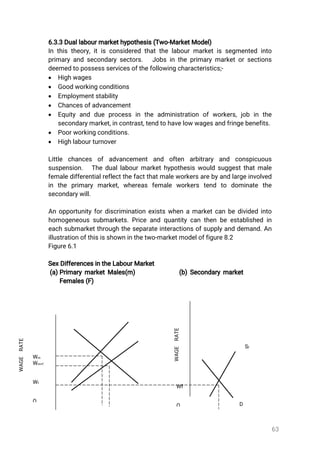
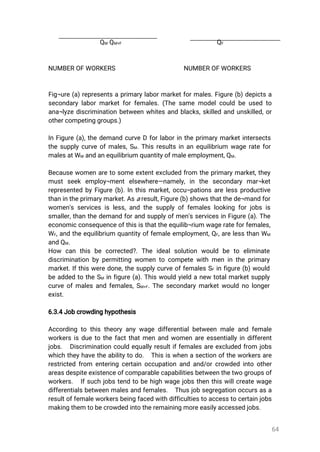
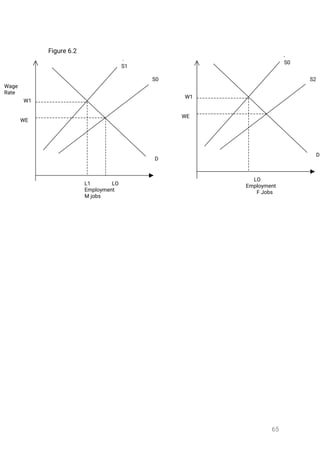
femaledifferentialreflectthefactthatmaleworkersarebyandlargeinvolved
in the primary market,whereas female workers tend to dominate the
secondarywill.
Anopportunityfordiscriminationexistswhenamarketcanbedividedinto
homogeneoussubmarkets.Priceandquantitycanthenbeestablishedin
eachsubmarketthroughtheseparateinteractionsofsupplyanddemand.An
illustrationofthisisshowninthetwo-marketmodeloffigure8.2
Figure6.1
SexDifferencesintheLabourMarket
(a)PrimarymarketMales(m) (b)Secondarymarket
Females(F)
WAGERATE
Wm
Wm+f
Wf
O
Wf
O
WAGERATE
Sf
D
64
QM QM+F QF
NUMBEROFWORKERS NUMBEROFWORKERS
Fig¬ure(a)representsaprimarylabormarketformales.Figure(b)depictsa
secondarylabormarketforfemales.(Thesamemodelcouldbeusedto
ana¬lyzediscriminationbetweenwhitesandblacks,skilledandunskilled,or
othercompetinggroups.)
InFigure(a),thedemandcurveDforlaborintheprimarymarketintersects
thesupplycurveofmales,SM.Thisresultsinanequilibrium wageratefor
malesatWM andanequilibriumquantityofmaleemployment,QM.
Becausewomenaretosomeextentexcludedfrom theprimarymarket,they
mustseek employ¬mentelsewhere—namely,in the secondary mar¬ket
representedbyFigure(b).Inthismarket,occu¬pationsarelessproductive
thanintheprimarymarket.Asaresult,Figure(b)showsthatthede¬mandfor
women'sservicesisless,andthesupplyoffemaleslookingforjobsis
smaller,thanthedemandforandsupplyofmen'sservicesinFigure(a).The
economicconsequenceofthisisthattheequilib¬riumwagerateforfemales,
WF,andtheequilibrium quantityoffemaleemployment,QF,arelessthanWM
andQM.
How can thisbe corrected?.The idealsolution would be to eliminate
discriminationbypermittingwomentocompetewithmenintheprimary
market.Ifthisweredone,thesupplycurveoffemalesSFinfigure(b)would
beaddedtotheSM infigure(a).Thiswouldyieldanewtotalmarketsupply
curveofmalesandfemales,SM+F.Thesecondarymarketwouldnolonger
exist.
6.3.4Jobcrowdinghypothesis
Accordingtothistheoryanywagedifferentialbetweenmaleandfemale
workersisduetothefactthatmenandwomenareessentiallyindifferent
jobs. Discriminationcouldequallyresultiffemalesareexcludedfrom jobs
whichtheyhavetheabilitytodo. Thisiswhenasectionoftheworkersare
restrictedfrom enteringcertainoccupationandand/orcrowdedintoother
areasdespiteexistenceofcomparablecapabilitiesbetweenthetwogroupsof
workers. Ifsuchjobstendtobehighwagejobsthenthiswillcreatewage
differentialsbetweenmalesandfemales. Thusjobsegregationoccursasa
resultoffemaleworkersbeingfacedwithdifficultiestoaccesstocertainjobs
makingthemtobecrowdedintotheremainingmoreeasilyaccessedjobs.
65
Figure6.2
D
W1
WE
LO
Employment
FJobs
D
W1
WE
L1 LO
Employment
Mjobs
Wage
Rate
S1
S0
S0
S2
66
Inacompetitivemarketsituation,theinteractionbetweentheoriesofdemand
andsupplywillleadtoidenticalequilibrium wageinbothmarketsWE. When
discriminationintermsofentrycriteriasetsin,thepotentialnumberoffemale
workersinpotentialmalejobsgodownshiftingthesupplycurveupwardsto
S1.ThewagerategoesuptoW1andemploymentlevelreducestoL1.The
femaleworkersrelocatestotheeasilyaccessedjobsinfemaledominated
labourmarketsandincreasessupplytoS2. WagerateisW2onhiringwomen.
Theentrycriteriamaytaketheform oflengthytrainingoranemployment
historywhichexcludesaccessto adisproportionatenumberofwomen.
Womenaretherebycrowdedintotheremainingmoreeasilyaccessiblejobs.
6.4FavorableEffectsofEliminatingDiscrimination
Asyoucanseefrom Figure(a),theeliminationofdiscriminationwouldhave
severalmajoreffects.
First,totalemploymentwouldberaisedfrom thelevelatQM tothelevelat
QM+F.Thiswouldalsoleadtoincreasedproductionbecausewomenwouldbe
employedinmoreproductivejobsthanbefore.Consequently,societywould
benefitbyreceivingalargervolumeofoutput.
Second,the equilibrium wage of females would increase,and the
equilibrium wageofmaleswoulddecrease,tothelevelatWM+F.Further,the
in¬crease in wages received bywomen would more than offsetthe
decreaseinwagesreceivedbymen.Society,therefore,wouldexperiencea
netmone¬tarygain.
Theincreasedwagesreceivedbywomenwouldnotcomefrom thereduced
wagesreceivedbymen.Itwouldcomefrom thegaininproductivityandthe
ad¬ditionaloutputthatwouldresultfromtheeliminationofdiscrimination.
6.5Summary
1 Therearevariouscoursesofwagediscriminationinthelabour
markets
2 Therearethreetheoriesthathavebeenadvancedtoexplainhow
wagediscriminationaffectthelabourmarkets
67
Activity
1 Whatisthediscriminationcoefficient?
2 Discuss the implications of employer discrimination for the
employmentdecisionsofthefirmfortheprofitabilityofthefirm.
68
LESSONSEVEN
WAGEDIFFERENTIALS
7.0Introduction
Wagesareequalinalllabourmarketsifworkersarehomogeneous,alljobs
are identicalin terms ofnon-monetary advantages and disadvantages,
marketsareperfectlycompletivethereisperfectknowledgeandperfect
mobilityoflabour.However,workers are nothomogenous because of
differenceinnaturalability,skillsandtraining.Somepeopledonothavethe
physicalrequirementorthenaturalabilityrequiredforparticularjobs.Jobsdo
notofferidenticalnon-monetaryadvantagesanddisadvantages.Somejobs
meanworkinginpleasantconditionswithconvenienthoursofworkfor
example university professorwhile others require working in dirty and
unpleasantconditionssuchascoalminers.Theremaybelackofinformation
bybothemployersandworkersandthereislackofmobilityofworkersdueto
distance,familytiesandrestrictionsputbythetradeunions.Becauseofthe
abovereasonssomeworkersreceivelowwages,othersreceivesmodestbut
higherwages,whileyetothersarepaidveryhighwages.Thisisreferredtoas
wagedifferentials.
Wagedifferentialsamongworkerscanbeanalyzedonthebasisofmany
differentcharacteristicssuch asoccupation,industry,geographicalarea,
genderand race.Ofthese differentdimensions ofthe wage structure,
occupationaldifferentialsareoneofthemostimportantbecausetheycapture
theinfluenceofseveraloftheprincipaldeterminantsofearningsinthelabour
market.Chiefamong thesearedifferencesamong workersin levelsof
education and training and differencesamong jobsin termsofvarious
noneconomicattributessuchasstatus,prestige,andthequalityofworking
conditions.
7.1LessonObjectives
Bytheendofthelessonthelearnershouldbeableto:
Explainthecompensatingwagedifferentials
7.2CompensatingWageDifferentials
Occupationsdifferonefrom anotherintermsofmanycharacteristics,such
aseducationandtrainingrequired,thepleasantnessorunpleasantnessofthe
work,thestatusandprestigeinwhichtheoccupationisheld,theprobability
ofsuccessinthatlineofwork,andthelevelofwagesintheoccupation.
Adam smith’s greatestinsightwas to realize thatpeople choose an
69
occupationbasednotonthewagealone,butonthewholepackageof
attributes,bothnegativeandpositive.Smithpostulatedthateachworker
comparesthetotaloftheadvantagesanddisadvantagesofeachoccupation,
andchoosestheoneyieldingthehighestlevelofnetadvantages.Sincesome
occupationsaremoredesirablethanothersifwagerateswereequal,workers
wouldcrowdintothedesirableoccupationsandshuntheundesirableones.
AsSmithdeduced,therefore,forequilibrium tooccurinthelabourmarket,the
wageratemustriseintheundesirableoccupationsandfallinthedesirable
occupationsuntilthetotaladvantagesand disadvantagesareequalized
acrossoccupations.Differencesinratesofpayamongoccupationsthus
representcompensatingwagedifferencesinthesensethattheyequalizethe
netattributesofeachoccupation.
In equilibrium,occupationalwage difference willexistbecause ofthe
followingreasons:-
A JobAttributes
Manyfactorsaffecttheattractivenessofoneoccupationrelativetoanother.
Adam Smith referred to these considerations as the agreeableness or
disagreeablenessoftheoccupations.Someoccupationshaveveryagreeable
featuressuchashighsocialstatusflexibleworkinghours,orroom for
considerableautonomyandcreativity.Examplesaredoctors,professors,and
singers.Other occupations have very disagreeable features such as
unpleasantworkingconditions,monotonousortediouswork,orlow social
status.Examplesincludebutchery,assembly-lineworkerandjanitor.While
these factors do notdirectly affectthe monetary return derived from
employmentinanoccupation,theydoneverthelesshaveastronginfluence
onitsrelativeattractivenesstopeople.
To illustrate the effectofjob attributes on wage differentials,assume
occupationsAandBareidenticalineveryaspectexceptthatoccupationB
involvesworkthatisoflowsocialprestige.IfthewagesinoccupationAandB
wereequal,everyonewouldseekemploymentinoccupationAandwould
refusetoconsiderworkinoccupationB.Toachieveequilibrium inthelabour
market,thewagemustriseinoccupationBrelativetoAuntilitisjusthigh
enoughtocompensateforthenegativeattributeoflowprestige.
B Differencesinthecostsofacquiringskills.Occupationsdifferinthe
amountofmoneythatindividuals spend in orderto acquire the skills
necessarytoenteranoccupation. Thefactthatanoccupationrequiresa
higherhumancapitalinvestmentwillresultinworkersrequiringawage
premiuminordertobeinducedtoenterthatoccupation.
70
C Differencesininternalratesoftimepreference.Peopledifferintheir
internalratesoftimepreference. Becauseofthis,theequilibrium wagelevel
willdependonthestateofdemandandthisaffectsthesizeofthepremium
tobepaid.
D Differencesintypesofjob.Somejobsarehighlyskilledwhileothers
arelessskilled.Highlyskilledjobswillrequirehighpaywhilelessskilledjobs
willdemandlowwage
E Occupationalvariabilityofearnings;twooccupationsmayhavethe
sameaverageannualwagebutdifferinthevariabilityofearningswithinthe
occupation. Apersonwhochoosestheprofessionwithhighwagevariability
issubjectedtoaconsiderableriskbecauseofnotbeingabletodetermine
withcertaintyhowhe/shewillfacetheriskofunemployment.
F TheRisk
Supposethereonlytwotypesofjobsinlabourmarket.Somejobsoffera
completelysafeenvironment,andtheprobabilityofinjuryinthesejobsis
equaltozero.Otherjobsofferaninherentlyriskyenvironmentandthe
probabilityofinjuryinthesejobsisequaltoone.Wewillassumethatthe
workerhascompleteinformationabouttherisklevelassociatedwith
everyjob.Inotherwords,theworkerknowswhetherheorsheisemployed
inasafejoborariskyjob.
Workerscareaboutwhethertheyworkinariskyjoborsafejob.Andthey
alsocareaboutthewage(w)theyearnonthejob.Wecanthewritethe
workersutilityfunctionas
Utility=f(w,riskofinjuryonthejob)
Theonlywaytopersuadetheworkertomovetheriskierjobandholdhis
utilityconstantisbyincreasinghiswage.
G Typeoflabourmarket.Amarketdominatedbytradeunionsoftenearn
more thatsimilarpeople who selltheirlabourservices in more
non-unionizedhence,competitivemarkets
Workerswhoselltheirlabourservicesin
H Otherreasons
 Wagesvarieswithage
 Wagesvarieswithyearsonthejob
 Wagesvarieswithsexandrace
 Wagesvarieswithage
71
 Wagesvarieswiththelevelofeducation
7.3Summary
Thecompensatingwagedifferentialcanaffectthewagelateinthelabour
market.RiskIanimportantelementinthelabourmarketanditaffectthe
wagerateandthelevelofemployment.
Activ
LESSONEIGHT
HUMAN-RESOURCEDEVELOPMENT
8.0Introduction
Thetheoryofcompensating differentialssuggeststhatwageswillvary
among workerbecausejobsaredifferent.Wageswillalso varyamong
workersbecauseworkersaredifferent.Peoplebringintothelabourmarketa
uniquesetofabilitiesandacquiredskillsorhumancapital.Thischapter
discusseshow we choose the particularsetofskillsthatwe offerto
employersandhow ourchoicesaffecttheevolutionofearningsoverthe
workinglife.
Weacquiremostofourhumancapitalinschoolandinformalandinformal
on-the-jobtrainingprograms.Theskillsweacquireinschoolsmakesupan
increasinglyimportantcomponentofourstockofknowledge.
Thechapteranalyseswhysomeworkersobtainalotofschoolingandother
workersdropoutatanearlyage.Workerswhoinsistinschoolingarewilling
togiveupearningstodayinreturnforhigherearningsinthefuture.
Thischapterexaminestheimpactofdifferencesinsetofworker’sabilities
72
andacquiredskillsorhumancapitalonthedeterminationofwagesand
employment.
8.1LessonObjectives
Bytheendofthelessonthelearnershouldbeableto:
1.Discusstheschoolingmodel
2.Explainwhatdeterminesthedecisiontogoforfurtherstudiesornot
usingthePresentvalueofage–earningsprofiles
Adam SmithinTheWealthofNations(1776)observed,investmentinhuman
re¬sourcesyieldsbenefitstotheindividualaswellastothenation.Thatis,it
yieldsprivateaswellassocialreturns.Thesereturnsarebasedonabilities
andskillsthatareobtainedfromacquisitionofknowl¬edge.
Formaleducation,ofcourse,isonlyonemethodofimprovingpeople's
knowledgeandskills.Othermethodsconsistofvariouskindsofjobtraining
andworkexperienceprograms.Allofthem togetherconstitutewhatmaybe
calledhumanresourcepol¬icies.Thesemaybedefinedasdeliberateefforts
undertaken in the private and public sectors to de¬velop and use the
capacitiesofhumanbeingsasactualorpotentialmembersofthelaborforce.
8.2TheSchoolModel
Someworkersobtainalotofschoolingandotherworkersdropoutatanearly
age.Workerswhoinsistinschoolingarewillingtogiveupearningstodayin
returnforhigherearningsinthefuture.
Wedonotstopaccumulatingskillsandknowledgethedaywefinallyleave
school.Instead,wecontinuetoaddourhumancapitalstockthroughoutmuch
ofourworkinglives.Hereweanalyzehowworkerschooseparticularpartfor
theirpost-schoolinvestmentsandinvestigatehow thesechoicesinfluence
theevolutionofearningsoverthelifecycle.
Weassumethattheworkerchoosesthelevelofhumancapitalinvestments
thatmaximizesthepresentvalueoflifetimeearnings.
Presentvalue(p.v)ofpaymentofyincomeisgivenby
p.v.=y/(1+r)
73
wherer=rateofinterest/discount.
Assumethatworkersacquiretheeducationlevelthatmaximizesthepresent
valueoflifetimeearnings.Educationandotherformsoftrainingarevalued
onlybecausetheyincreaseearnings.
Thediagram belowillustratestheeconomictrade-offinvolvedintheworkers
decision.Itshowstheage-earningsprofilei.e.thewagepathoverthelife
cycle)associatedwitheachalternative.
Figure8.0
Uponenteringthelabourmarket,highschoolgraduatesearnswHsannually
untilretirementageat65.ifthepersonchoosestoattendcollege,hegivesup
wHsinlabourearningsandincursdirectcostofHtocovertuition,booksand
fees.Aftergraduation,heearnsWc0lannuallyuntilretirement.
Thediagram indicatesthataworkerfacestwodifferenttypesofcostsifhe
goestocollege.Ayearspentincollegeisayearspentoutofthelabourforce.
Thisistheopportunitycostofgoingtoschool.ItisgivenbywHs.Thestudent
alsohasout-of-pocketexpensesofitfortuition,books,andavarietyofother
fees.Employerswhowishtoattractahighereducated(andpresumablymove
productive)workforcewillhavetoofferhigherwages,sothatWc0l>wHs.The
high wage paid to worker’s with,more schooling is a compensating
differentialthatcompensateworkersfortheirtrainingcosts.
22
0
WHs
WCOL
W
H
18 65 Age
74
8.3Presentvalueofage–earningsprofiles
PVoftheearningsstreamiftheworkergetsonlyahighschooleducationis
P.VHs=WHs + WHs + WHs +….. +WHs
(1+r) (1+r) (1+r)
n
TheP.Voftheearningsstreamiftheworkergetsacollegediplomais
P.Vcol=-H–H– H - H +Wcol+Wcol+Wcol+-Wcol
(1+r) (1+r)
2
(1+r)
3
(1+r)
4
(1+r) (1+r)
5
(1+r)
6
Directcostofattendingcollege TheCollegeearningstream
A person’s schooling decision maximizes the PV oflifetime earnings.
ThereforetheworkerattendscollegeifthePVoflifetimeearningswhenhe
getsacollegeeducationexceedsthePVoflifetimeearningswhenhegets
onlyahighschooldiploma.
Pvc06>PvHs
Egnumericalexample
Supposeaworkerlivestwoperiodsandchoosesfrom twoschooloptions,he
canchoosenottoattendschoolatallinwhichcasehewouldearn20,000in
eachperiod.
P.v0=20,000+20,000
(1+r)
Hecanalsochoosetoattendschoolinthefirstperiod,incur5,000worthof
directschoolingcostsandenterthelabourmarketinthesecondperiod
earning47,500
P.v=-5,000+47,500
(1+r)
Supposer=5%
Pv0=39,048 Pv1=40,238
Theworkerchoosestoattendschool.
NB.Ifr=15%
Pv0=37,391 Pv1=36,304
Theworkerswouldnotgotoschool
Fromtheabove,therateofinterestplaysacrucialroleindeterminingwhether
apersonchoosestogotoschool.Thehighertherthelessthelivelyaworker
willinvestineducation.Thisisbecauseaworkerwhohasahighdiscountrate
attachesaverylowvaluetofutureearningopportunities.Becausethereturn
75
toaninvestmentineducationarecollectedinthefar-offuture,personswith
highdiscountratesrequirelessschooling.
Therateofdiscountdependsonhowwefeelaboutgivingupsomeoftoday’s
consumptioninreturnforfuturerewards–orowntimepreference.Some
peoplearepresentorientedandsomearenot.Personswhoarepresent
orientedhaveahighdiscountrateandwouldbelesslikelytoinvestin
schooling.Poorerfamilieshaveahigherrateofdiscountthanwealthier
families.
8.4Summary
 Thewage-schoolinglocusgivesthesalarythataworkerearnsifheor
shecompleteaparticularlevelofschooling
 Workerschoosethepointonthewage-schoolinglocusthatmaximizes
thepresentvalueoflifetimeearnings.Inparticular,workersquite
schoolingwhenthemarginalrateofreturntoschoolingequalstherate
ofdiscount.
Activity
Discusshow thewage-schoolinglocusisdeterminedinthelabourmarket,
andwhyitisupwardslopngandconcave
1 Explainhoweducationcontributetowagedifferentialinthelabour
market
76
LESSONNINE
LABOURUNIONS
9.0Introduction
Tradeunionmaybeabletosecurehighwages,betterworkingconditions,
protectworkersfrom arbitrarytreatmentbymanagementand other
economicgainsforitsmembers.
9.1LessonObjectives
Bytheendofthelessonthelearnershouldbeableto:
1.Explaincollectivebargaining
2.Explainhowunioninfluenceswagesinthelabourmarket
9.2UnionsandManagement:CollectiveBargaining
Whatisaunion?Itmaybedefinedasanorgani¬zationofworkersthatseeks
togainadegreeofmo¬nopolypowerinthesaleofitsservices.Inthiswayit
maybeabletosecurehigherwages,betterwork¬ingconditions,protection
from arbitrarytreatmentbymanagement,andothereconomicgainsforits
members.
77
Thechiefobjectiveofunionsisthustoenhancethestatusofworkers.That
goalislargelyachievedthroughcollectivebargaining.Thisisaprocessof
negotiationbetweenrepresentativesofacompany'smanagementanda
union.Thepurposeistoarriveatasetofmutuallyacceptablewagesand
workingconditionsforemployees.
9.3UnionsInfluenceoverWages
Alabouruniondoesnottrytomaximizewagesbecausethenonlyafew
workerswouldbehired.Italsodoesnotencouragefirmstohireasmany
workersaspossible,becausethewageratewouldthenbeveryloworzero.
Instead,ageneralobjectiveofalabourunionmaybetoincreasethewageof
unionmembers.
Wagesaredeterminedbyforcesofsupplyanddemand.Thus,foraunionto
modifywages,itmustinsomewaysmodifyorchangethemarketforlabour.
Therearethreegeneralmethodsbywhichthiscanbedone.
1.Increasethedemandforlabour
Thiswillresultinmanyworkersbeinghiredatanincreasedwage.Thisisthe
mostdifficultbecauseingeneralunionshavelittleinfluenceoverthedemand
forfinalproducts.
Unionssupportlawsforprotectivetariffsorquotasonimportsandhave
lobbiedagainstfreetradeagreement.
Increasingtheproductivityoflabourwillalsoincreasethedemandforlabour.
Unionspromoteimprovedworkingconditions,shortenedworkweeks,and
employeeeducation.
DemandExpansionModel:Increasethe
DemandforLabor
Throughfeatherbeddingorothermake-workprac¬tices,anorganizedgroup
ofworkersmaysucceedinshiftingthedemandcurveforitslabortotheright.
TheshiftfromDtoD'increasestheequilibriumquan¬tityoflaborfrom20,000
workersto26,000,andtheequilibriumwageratefrom$10perhourto$13.
Figure9.0
WAGES
(hourly)
$20
S
78
15
10
D’
D 0
10 20 30 40
Workers(thousands)
Themodelillustrateswhathappenswhenaunion,seekstoincreasethe
demandforitsmembers.Thatis,theuniontriestoshiftthedemandcurveto
theright,whichwouldresultinhigherequilibriumwagesandemployment.
Theshiftindemandisbroughtaboutbytheuseoffeatherbeddingtechniques.
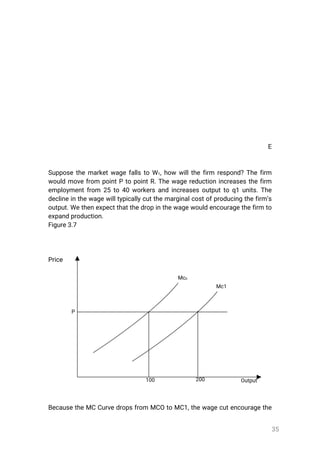
Theseare"make-work"rulesorpracticesdesignedbyunionstore¬strict
outputbyartificiallyincreasingtheamountoflabororlabortimeemployedon
aparticularjob.Forexample,atvarioustimsinthepast:-ThePainters'Union
limitedthewidthofbrushesandthesizeofrollers.
2.Reducethesupplyoflabour.
Unionsaremoresuccessfulwiththismethod.Skilledunionscancontrol
supplybycontrollingentryintothetradingorrequiringthattheemployees
haveacertificateorlicensebearingwitnessofsuccessfulcompletionofthe
program.
Supply-LimitationModel:DecreasetheSupplyofLabor
Anorganizedgroupofworkers,suchasacraftunion,maybeabletoreduce
thenumberofpeopleenteringoccupation.Thegroupwilltherebyshiftits
supplycurveoflabortotheleftfrom S toS'.Theequilibrium levelof
employmentwillthus decline from 10,0(30 workers to 7,000,and the
equilibriumwageratewillrisefrom$20perhourto$26.
79
Figure9.1
S’
S
30
10
5
D
D 0 5
10 15
Workers
Thousands
Trade unions have persuaded state legislatures to impose licensing
require¬mentsasaconditionforentry. Thegrantingoflicenses,controlled
bythosealreadyinthefield,maybebasedoneducationalrequirements,test
aspecifiednumberofyearsofsupervisedexperience,andpersonalinterviews.
In addition to such specificlabor-limiting prac¬tices,someunionshave
soughttorestricttheoverallsupplyoflaborintheeconomy. Theyhave
donethisbysupportinglegislationto(1)curbimmigra¬tion,(2)shortenthe
workweek,and(3)assurecom¬pulsoryretirement.
3.Bargainingforhigherwages
Thismethodisgenerallyutilizedbyunskilledorsemi-skilledworkers.Thegoal
istobringallworkersintheindustryintounionmembership.Semiand
unskilledunionsareunabletorestrictthesupplyofworker’sbylicensing.
Theyestablishedclosedshop,wherealltheworkersinthefirm oreventhe
industrymustbelongtotheunion.Theunionthenrepresentsalltheworker’s
andnegotiateswiththemanagement.
SUMMARY
80
Unionshaveemployeddifferentmethodsforenhanc¬ingtheirpositioninthe
labormarket.Themethodsin¬clude:
a.Increasingthedemandforlabor.Thisraisesbothwagesand
employment.
b.Decreasingthesupplyoflabor.Thisraiseswagesanddecreases
employment.
Activity
Explainhow tradeunioninfluencewagesandemploymrntinthelabour
market
LESSONTEN
UNEMPOYMENTANDUNDER-EMPLOYMENT
10.0Introduction
Unemploymentiswherepeoplewhohaveabilityandwillingtoworkcannot
findjob.Workersareunemployedformanyreasons.Atanytimeforexample,
manypersonsareinbetweenjobs.Theyhaveeitherjustquitorbeenlaidoff,
ortheyhavejustenteredthelabourmarket.Ittakestimetolearnaboutand
locateavailablejobopportunities.
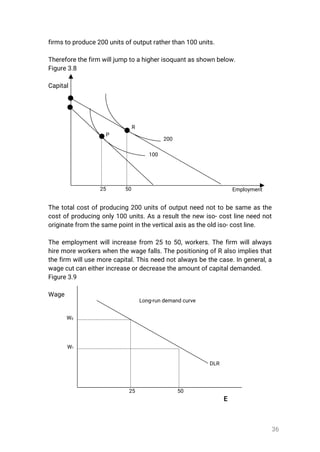
10.1LessonObjectives
81
Bytheendofthelessonthelearnershouldbeableto:
1 Explainthevarioustypesofunemployment
2 Definetheaskingwage
3 Explainhowasingwageisdetermined
10.2TypesofUnemployment
Thelabourmarketisinconstantinflux.Someworkersquittheirjobs,other
workersarelaidoff.Somefirmsarecuttingback,othersareexpanding.New
workersenterthemarketaftercompletingtheireducationandotherworkers
re-enterafterspendingsometimeinthenon-marketsector.Atanytime
therefore,manyworkersareinbetweenjobs.Ifworkerslookingforjobsand
firmslookingforworkerscouldfindeachotherimmediately,therewouldbe
nounemployment.Frictionalunemploymentarisesbecausebothworkersand
firmsneedtimetolocateeachotherandtodigesttheinformationaboutthe
valueofthejobmatch.
Policy:providingworkerwithinformationaboutjobopeningsandproviding
firswithinformationaboutunemployedworkers.
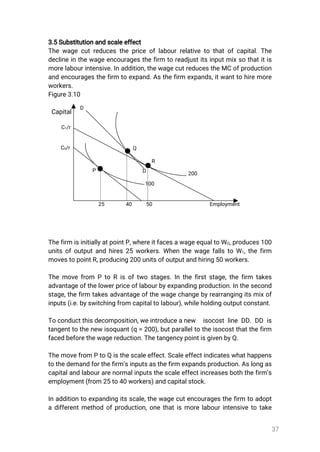
Seasonalunemployment
Workersinboththegarmentandtheautoindustriesarelaidoffregularly
becausenewmodelsareintroduced.
Structuralunemployment
Itariseswherepersonslookingforworkcannotfitthejobsavailable.Atany
time,somesectorsoftheeconomyaregrowing and othersectorsare
declining.Ifskills were perfectly transferable across sectors,the laid
off-workerscouldquicklymovetothegrowingsectors.Skills,howevermight
be specific to the workers job orindustry,and laid-offworkers lack
qualificationsneededintheexpandingsector.Asaresult,theunemployment
spellsofthedisplacedworkersmightlastforalongtimebecausetheymust
retooltheirskills.Structuralunemploymentthus arises because ofa
mismatchbetweentheskillsthatfirmsaredemanding.
Theproblem isskills;theunemployedarestuckwithhumancapitalthatisno
longeruseful.Policyto reduce this type ofunemploymentis thatthe
governmentwouldhavetoprovidetrainingprogramsthatwouldinfectthe
82
displacedworkerswiththetypesofskillsthatarenowindemand.
CyclicalUnemployment.
Theremaybeanimbalancebetweenthenumberofworkerslookingforjobs
andthenumberofjobsavailableevenifskillswereperfectlyportableacross
sectors.Thisimbalancemayarisebecausee.g.theeconomyhasmovedinto
arecession.Firmsnow requireasmallerworkforcetosatisfythesmaller
consumerdemandandemployerslayoffmanyworkersgeneratingcyclical
unemployment.Thereisanexcesssupplyofworkersandthemarketdoesnot
clearbecause the wage is sticky and can notadjustdownward.The
union-mandatedwageincreasesorgovernment-imposedminimum wages
introducerigidwagesintothelabourmarketandpreventthemarketfrom
clearing.
Toreducethistypeofunemployment,thegovernmentwillhavetostimulate
aggregatedemandandre-establishmarketequilibriumatthestickywage.
JobSearch
Manytheoriesclaim toexplainwhyunemploymentexistsandpersistsin
competitivemarket.Wewouldobservefrictionalunemploymentevenifthere
werenofundamentalimbalancebetweenthesupplyanddemandforworkers.
Becausedifferentfirmsofferdifferentjobopportunitiesandbecauseworkers
areunawareofwherethebestjobsarelocated,ittakestimetofindthe
availableopportunities.
Anygivenworkercanchoosefrom amongmanydifferentjoboffers,and
differentfirms make differentoffers to the same worker.These wage
differentialsforthesametypeofworkencourageunemployedworkertoshop
arounduntilhe/shefindsasuperiorjoboffer.Becauseittakestimetolearn
aboutthe opportunities provided bydifferentemployers,such activities
pro-longthedurationoftheunemploymentspell.Theworker,however,is
willingtoendurealongerunemploymentspellbecauseitmightleadtoa
higherpayingjob.Ineffect,suchunemploymentisaform ofhumancapital
investment;theworkerisinvestingininformationaboutthelabourmarket.
Thewageofferdistribution
Tosimplifytheanalysis,weassumethatonlyunemployedworkersconduct
suchactivities,althoughworkersmightkeeponsearchingforabetterjob
evenaftertheyacceptaparticularjoboffer.Thewageofferdistributiongives
the frequency distribution describing the various offers available to a
particularunemployedworkerinthelabourmarket.
Figure10.0
Frequency
83
Asdrawn,theworkercanendupinajobpayinganywherefrom $5to$25per
hour.Assumethatunemployedworkerknowstheshapeofthewageoffer
distribution.Inotherwords,heknowsthatthereisahighprobabilitythathis
searchactivitieswilllocateajobpayingbetween$8and$22perhourandthat
thereisasmallprobabilitythathemightendupwithajobpayinglessthan$8
formorethan$22perhour.
Ifsearchactivitieswerefree,theworkerwouldkeeponknockingfromdoorto
dooruntilhefinallyhitthefirm thatpaidthe$25wage.Searchactivities,
however,arecostly.Hecouldhavebeenworkingatalower-payingjob.The
workerseconomictrade-ofisthatthelongerhesearches,themorelikelyhe
willgetahighwageoffer,thelongerhesearches,howeverthemoreitcosts
tofindthatjob.
Non-sequentialandsequentialsearch
Whenshouldtheworkerstopsearchingandsettleforthejobofferathand?
Therearetwoapproachestoansweringthisquestion.Eachapproachgivesa
stoppingruletellingtheworkerwhentoendhissearchactivity.Theworker
84
couldfollow astrategyofnon-sequentialsearchwheretheworkerdecides
beforehebeginshissearchthathewillrandomlyvisitsaytwentyfirmsinthe
labourmarketandacceptthejobthatpaysthehighestwage(whichwillnot
necessarilybethejobpaying$25).Thissearchstrategyisnotoptimal.
Supposethatonhisfirsttry,theworkerjusthappenstohitthefirm thatpays
$25.Anon-sequentialsearchstrategywouldforcethisworkertovisitanother
19firmsknowingverywellthathecouldneverdobetter.
Itdoesnotmakesense,therefore,fortheworkertocommithimselftoa
predeterminednumberofsearchesregardlessofwhathappenswhileheis
searching.
Sequentialsearchiswherebeforetheworkersetsoutonthesearchprocess,
hedecideswhichjoboffersheiswillingtoaccept.E.g.hemightdecidethat
heisnotwillingtoworkforlessthan$12.Ifthewageofferexceeds$12,he
willacceptthejob,stopsearchingandendtheunemploymentspell.Ifthe
wageofferislessthan$12,hewillrejectthejobofferandstartthesearch
processoveragain.i.e.visitanewfirm,comparethenewwageoffertohis
designedwageandsoon.Thesequentialsearchstrategyimpliesthatifa
workerisluckyenoughandfindthe$25jobonthefirsttry,hewillimmediately
recognizethatheisluckyandstopthesearchprocess.
10.3Theaskingwage
Theaskingwageisthethresholdwagethatdeterminesiftheunemployed
workeracceptsorrejectstheincomingjoboffers.Thereisaclearlink
betweenaworker’saskingwageandthelengthofunemploymentspellsthe
workerwillexperience.
Workerswhohavelowaskingwagewillfindacceptablejobsveryquicklyand
theunemploymentspellwillbeshort.Workerswithhighaskingwagewilltake
alongertimetofindanacceptablejobandtheunemploymentspellwillbe
verylong.
Theunemploymentspellwilllastlonger;thelargeristheaskingwage.
10.3.1Howworkerdetermineshisaskingwage.
Considerthe wage offerdistribution given above.Suppose unemployed
85
workergoesoutandsamplesaparticularjobatrandom.Bypurechance,he
happenstovisitthefirm thatpaysthelowestwagepossible$5.Hemust
decidewhethertoacceptorrejectthisofferbycomparingtheexpectedgains
from additionalsearch.(byhow muchwouldthewageofferincrease?)with
thecostofthesearch.Iftheofferathandis$5,thegainstosearchingone
moretimeareveryhigh.Ifthenextvisitgiveshim $10,theincentiveto
continuesearchingwillagaindependpartlyonthemarginalgainfrom one
more search.Given the wage offerdistribution,there is stilla good
chance-thatadditionalsearchwillgenerateahigherwageoffer.Themarginal
gaintothisadditionalsearchhoweverisnotashighaswhenthewageoffer
wasonly$5.Afterallthereisachancethatifhesearchesonemoretime,he
mighthitafirmofferinglessthan$10.
Supposetheworkerdecidestotryhisluckonemoretime,thistimehehitsthe
jackpot,gettingawageofferof$25.Atthispoint,themarginalgainfrom
furthersearchiszero.Theworkercannotgetahigherwageoffer.
Themarginalgainsfromsearchareloweriftheworkerhasagoodwageoffer
athand.Asaresult,themarginalrevenuecurve(iemarginalgainfrom one
additionalsearch)isdownwardsloping.
Theaskingwageisalsodeterminedbythemarginalcostofsearching.There
aretwotypesofsearchcost
(a)Directcostsofsearch,includingtransportationcostsandcostsof
preparingresumesandtimetaken
(b)Opportunitycostofrejectingtheoffergiven.Themarginalcostof
searchishighiftheworkerhasagoodwageofferathand.Therefore
theMCisupwardsloping.TheinteractionoftheMCcurveandtheMR
givestheaskingwageorW
Figure10.1
mr
mc
86
Considerwhathappensiftheworkergetsawageofferofonly$10whichis
lessthantheaskingwageW.TheMRfrom searchexceedstheMC,andthe
workerwouldcontinuesearching.Ifthewageofferathandwas$20(above
theaskingwage),theworkershouldacceptthejobbecausetheexpected
benefitsfrom additionalsearcharelowerthantheMCofsearch.Theasking
wagethereforemakestheworkerindifferentbetweencontinuingandending
hissearchactivities
DeterminantsoftheAskingwage
Workersaskingwagewillrespondtochangesinthebenefitsandcostsof
searchactivities.Thebenefitsfrom searcharecollectedinthefuture,sothey
dependonthe;
1 workersdiscountrates.Workerswithhighdiscountratesarepresent
orientedandhenceperceivethefuturebenefitsfromsearchtobelow.
WorkerswhohavehighdiscountrateshavelowerMRcurves(ShiftingtheMR
curvetotherightandhencewillhaveloweraskingwages.Becausethese
workersdonothavethepatiencetowaituntilabetteroffercomesalong,they
acceptlowerwageoffersandhaveshortunemploymentspells.
2 Theunemploymentinsurance(UI)systemwhichcompensatesworkers
whoareunemployedandwhoareactivelyengaginginsearchactivities.
Supposethattheworkerhasawageofferathandof$400andqualifiesforUI
of$200,theworkerisonlygivenupto$200byrejectingthejoboffer.TheUI
benefitsthereforereducetheMCofsearch.
AreductionintheMCofsearchshiftsthemarginalcostcurvetotheleft
raisingtheaskingwage.TheUIsystem thereforehasthreeimportanteffects
onthelabourmarket:
1Itleadstolongerunemploymentspells
2Itincreasestheunemploymentrate
3Itleadstohigherpostunemploymentwages
Insummarythesearchmodelhastwokeypredictionsaboutthelengthof
unemploymentspell:Unemploymentspellswilllastlongerwhenthecostof
searchingfalls:andunemploymentspellswilllastlongerwhenthebenefits
fromsearchingrise.
10.4Summary
87
 Therearevarioustypesofunemploymentthatcanbefoundinan
economy
 Askingwageisthewagewherethemarginalcostofjobsearchis
equaltothemarginalbenefitofjobsearch
Activity
Distinguishbetweenstructuralandfrictionalunemployment
LESSONELEVEN
LABOURMOBILITY
11.0Introduction
88
Workersarealwaysinmotion.Theymovefrom onejobtoonother,orfrom
onegeographicalregiontoanotherorfromoneemployertoanother
11.1LessonObjectives
Bytheendofthislessonthelearnershouldbeableto:
1 Definethetermlabourmobility
2 Explainthevariousformsoflabourmobility
3 Explainthedeterminantsoflabourmobility
11.2MeaningofLabourMobility
Itmeans"thecapacityandabilityoflabourtomovefromoneplacetoanother
orfrom oneoccupationtoanotherorfrom onejobtoanotherorfrom one
industrytoanother."Itistheextenttowhichtheworkersareableorwillingto
movebetweendifferentjobs,occupations,andgeographicalareas.Itiscalled
horizontalmobilityifitdoesnotresultinachangeintheworker'sgradingor
status,andverticalmobilityifitdoes.Skilledworkershavelowoccupational
mobilitybuthighgeographicalmobility;low-skilledorunskilledworkershave
highdegreesofbothtypesofmobility.Lowlabor-mobilitycausesstructural
unemployment,andgovernmentstrytoavoiditbyworkerretrainingschemes
andbyencouragingestablishmentofnewindustriesintheaffectedareas.
11.3Typesofmobilityoflabour
89
Mobilityoflabourisoffollowingtypes.
1.GeographicalMobility-Whenalabourermovesfrom oneregionto
another,withintheboundariesofanationorfrom onenationto
anotheriscalledgeographicalmobilityoflabour.
2.OccupationalMobility-Movementoflabourersfromonejobtoanother
isoccupationalmobility.ThisisinadditionclassifiedintoHorizontal
and verticalnobilities.Horizontalmobility means movement in
occupationbyalabourerfrom onegradetothedifferentjobinthe
samegrade.Whereasverticalmobilitydenotes,upgradationofjobs
andstatusfrom lowertohigherfrom oneoccupationtoanotheris
calledverticalmobility.
3.Mobilityamidstindustries-Movementoflabourersfrom oneindustry
toanotherwithoutchangingtheoccupationisknownasindustrial
mobility.
11.4FactorsDeterminingmobilityoflabour
1.Education and Training -Themobilityoflabourisbased on the
knowledgeandskill.Themoreofknowledge,thechanceofmovement
amplifies.
90
2.OutlookorUrge-Theoutlookorurgeofworkersto risein life
determinestheirmobility.Iftheyareoptimistandbroadminded,they
willmovetootherjobsandplaces.Differencesinlanguage,habits,
religion,andcastewillnotbeanobstacleintheirmobility.
3.SocialSet-up-Themobilityoflabouralsodependsuponthesocial
setup.Asocietydominatedcastesystem andjointfamilysystem lacks
inmobilityoflabour.Butinthecaseswheretheconvictionsdonot
existhasmobility.
4.Means of Transport - Sophisticated modes of transport and
communicationencouragemobilityoflabour.Incaseofemergency,
communicationwiththeirfamiliesorthroughaviationfacilitiesonecan
meetoutthesituation.
5.AgriculturalDevelopment-Atthetimesofvacation,intheeventof
agriculturaldevelopment,labourmovesfrom highpopulatedareatoa
lowerpopulace.
6.PeaceandSecurity-Themobilityoflabouralsobasedtoahugeextent
tothelawandorderinthenation.Intheevent,ifthepropertiesofthe
populacearenotsafe,theywillnottendtomovefrom theircurrent
placetoanotherplaceandtoanycorrespondingoccupation.
ObstaclesofMobilityofLabour
Thereareseveralfactorswhich encumbermobilityoflabour.Theyare
changesinweather,religiousconviction,casteandcreed,behaviourand
mannerisms,traditionsandconvictions,mothertongues,likingsandchoices
etc.Theotherfactorsareuneducated,lackofknowledge,indebtedness,
91
affectiontowealthandland,deficiency,economicbackwardness,lackof
modesoftransportation,communicatingskillsandcertainlyredundancy.
MeritsofMobilityofLabour
Toaugmentproductiveefficiency,themobilityoflabourhelpsaton.Whistthe
workersearningcapacityalsoraiseswhentheyarepreparedtoshiftfrom
placestobetterplaces.Theygethighpaidjobsleavinglow paidwork.It
resolvesthecomplexityofredundancywhentheworkersmovefrom placeto
place.Alsofiscaldevelopmenthappenswhenunemployedshiftstopublic
workslikeconstructionofdams,buildingroadsandcanalsetc.Thusit
amplifiesproduction,employmentandearnings.
Determinantsofworkermobility
Workersmoveiftheexpectedpresentvalueofthenetbenefitsispositive
Benefitsandcostsofmobility
 Psychiccostsandbenefitsareincludedaswellasdirectcostsand
benefits.
• costsandbenefitsinclude:
– friendshipswithco-workersandmembersofthecommunity,
– familyties,
– workingenvironment,
– non-pecuniaryjobbenefits,and
– Characteristicsofgeographicallocations.
Factorsaffectingthemobilitydecision
• Individualsaremorelikelytomovewhen:
– thedifferenceinwagesorsalariesislarge,
– theworkerisunhappyinhisorhercurrentjoborlocation,
– thedirectcostassociatedwithmovingislow,and
– Benefitswillberealizedoveralongertimeperiod(T).
Geographicmobility
• Morestronglyaffectedbythe“pull”from thedestinationthanbythe
“push”fromtheoriginallocation.
92
• Youngworkersaremorelikelytomove.
• Marriedworkersarelesslikelytomove.
• Mostmovesarewithincountyandstateboundaries.
• Chainmigrationisacommonphenomenonininternationalmigration.
Skills,incomedistribution,andmigration
• whenforeigncountrieshavealowerdegreeofincomeinequality:
– thereturntohumancapitalislikelytobehigherintheU.S.,
– EncouragingskilledindividualstoemigratetotheU.S.
• Whenthereisahigherdegreeofincomeinequalityinforeigncountries,
lowskilledindividualsaremorelikelytoemigratetotheU.S.
• Inrecentdecades,immigrantstotheU.S.havebeenlessskilledthanin
thepast.
Returnstomigration
• Householdsgenerallyreceiveanincreaseinincomeasaresultof
immigration.
• Wivesoftenexperienceadeclineinincomeasaresultofimmigration.
• Immigrantsgenerallyreceiveaninitialincomethatisbelow thatof
domesticworkers.
• Immigrantsexperienceamorerapidincreaseinearningsthanfor
domesticworkers.
• Rateofgrowthofimmigrantincomehasbeenlowerinrecentdecades.
Returnmigration
• Asubstantialshareofimmigrationinvolvesreturnmigration.
• thismaybeaplannedreturnafteraperiodoftimeworkingina
high-wagearea,or
• Itmaybetheresultofunrealizedexpectations.
Immigrationandemployment
• Immigrationincreaseslaborsupplyinsomelabormarkets.
• Immigrationraiseslabordemandinalllabormarkets.
• Domesticemployment(andwages)willriseinthoselabormarketsin
whichlabordemandrisesbymorethanlaborsupply.
• Domesticemployment(andwages)willfallinthoselabormarketsin
whichlaborsupplyrisesbymorethanlabordemand.
Overalleffectsofimmigrationoneconomy
• Immigrantlaborlowersthecostofgoods,benefitingconsumers.
• Immigrantspaymoreintaxesthantheyconsumeinpublicservices
(thisisespeciallytrueforillegalimmigrants).
• Immigrantsbringtheirhumancapitalwiththemwhentheyimmigrate.
• Empirically,immigrationappearstohavelittle,ifany,effectonthe
wageratesoremploymentprospectsofdomesticworkers.
Employeeturnoverandjobmatching
93
• Employeeturnoveristheresultofjobquitsandlayoffs.
• Workerswillengageinavoluntaryquitonlyiftheexpectedbenefits
outweightheexpectedcosts.
• Economicefficiencymayimproveasaresultofjobquitsandlayoffs.
Determinantsofturnover
• Workerswhoreceivealowerwagearemorelikelytoquit.
• Firmsthatofferlowerwageshavehigherquitrates.
• Womenhavehigherquitrates.
• Jobquitsincreaseduringexpansionsandfallduringrecessions.
• Layoffsriseduringrecessionsandfallduringexpansions.
• Workersarelesslikelytoquitwhenthecostofquittingishigher.
Workermobilityandmonopsony
• Whentherearenocostsofmobility,thelawofonepricewouldapplyin
labormarkets.
• Workers shiftfrom job to job untilthe wage rate is the same
everywhereforworkerswithagivenmixofskillsandabilities.
• Mobilitycosts,however,givefirmssomedegreeofmonopsonypower
inlabormarkets.
11.5Summary
 Labourmobilityisthemovementoflabouracrossthelabourmarkets
 Therearevariuousformsoflabourmobility
 Therearevariousfactorsthatdeterminelabourmobilityinaneconomy
Activity
Explainthefactorsthatdeterminethelabourmobility
FurtherReadings
94
1.Addison,J.TandW.S.Siebert(1979).THEMARKETFORLABOUR.AN
ANALYTICALTREATMENT.SANTAMONICA,CALIFORNIA:GOODYEAR
PUBLISHINGCOMPANY,INC
2.PierreCahuc,StéphaneCarcillo,AndréZylberberg,William McCuaig.
(2014)LABOURECONOMICS2ndEd.MITPress. 
2. Smith,S.W(1994).LabourEconomics,Routledge:London
3. McConnell,C.RandS.L.Brue(1995).ContemporaryLabourEconomics,
FourthEdition.Singapore:McGraw-HillInc.
4. Bosworth,D.DawkinsandT.Stromback(1996).TheEconomicsofthe
LabourMarket,England and Singapore:Addison WesleyLongman
Limited.
5. Hardwick,P.B.KhanandJ.Langmead(19996).Anintroductionto
ModernEconomics,FourthEdition.EdinburgeandSingapore:Addison
WesleyLomgmanLimited.
6. J.BorjasLabourEconomics.ThirdEditionMcGraw-HillRIrwin.

Eae 304