Encoded Archival Context: An Overview Encodes information about creators of archival documents in a standardized format Provides information about and links to related documents and entities Designed to support and extend Encoded Archival Description (EAD) standard Implemented as an XML-compatible document type definition January 31, 2008
History Based on the Toronto Tenets, an early outline of requirements developed at a conference held in Toronto, Canada in March 2001 Proposed as an implementation of the ISAAR (CPF) (International Standard for Archival Authority Record for Corporate Bodies, Persons, and Families) Though rapid at first, development has since fallen off in the US. Work on the project has continued primarily in Europe and Australia. EAC standards are currently still in the beta testing stage. January 31, 2008
How Does It Work? EAC is an XML-based document type definition that uses a standardized set of tags similar to EAD. Each EAC record is made of two major components: EAC Header – metadata about the record itself Context Description – information about a single creator entity These components are nested within two <eac> tags which indicate the beginning and end of the record. January 31, 2008
EAC Header Provides metadata about the record Nested within two <eacheader> tags Required sub-elements: <eacid> - contains a unique ID for the record <mainhist> - outlines the record’s maintenance history Optional sub-elements identify standards used within the record, including languages, sources, rules and vocabularies January 31, 2008
Context Description Provides information about a single creator entity Nested within two <condesc> tags Only one required sub-element: <identity> - provides information about the official name or names of the entity Can contain additional optional sub-elements, including dates and places associated with certain names Optional sub-elements can be used to outline relationships to resources, activities, and other entities, or to provide additional descriptive information. <desc> - contains descriptive information about the entity using sub-elements of both controlled and prose formats January 31, 2008
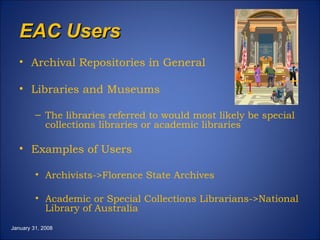
EAC Users Archival Repositories in General Libraries and Museums The libraries referred to would most likely be special collections libraries or academic libraries Examples of Users Archivists->Florence State Archives Academic or Special Collections Librarians->National Library of Australia January 31, 2008
EAC Practical Application Provides the opportunity for researchers to spend less time searching Daniel Pitti- Creator description facilitates both access to and interpretation of records Alexander Thurman- Allowing archivists to encode information about the creators and context of creation of archival materials, and to make that information available to users as an independent resource separate from individual finding aids Contextual information allows repositories to share records instead of duplicating efforts. Reflects separate but linked bibliographic and contextual descriptions. January 31, 2008
Future Development Problem on identifying future development EAC is only developed within the last 4 years Ongoing initiative within the international archival community Future development known or guessed is based on its current functionality. People Australia Project- “ EAC current functionality has the ability to be extended” “ it is possible to combine elements and attributes to extend the scope and detail of the schema to support People Australia and potentially other services reliant on people or organizational data” People Australia Project- “ EAC current functionality has the ability to be extended” “ it is possible to combine elements and attributes to extend the scope and detail of the schema to support People Australia and potentially other services reliant on people or organizational data” January 31, 2008
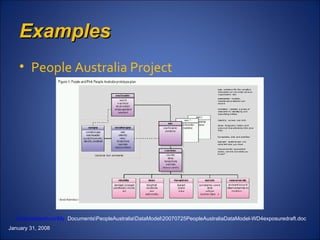
Examples People Australia Project \\frodo\bdewhurs\My   Documents\PeopleAustralia\DataModel\20070725PeopleAustraliaDataModel-WD4exposuredraft.doc January 31, 2008
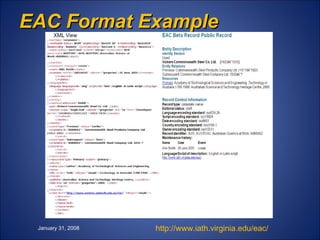
EAC Format Example http://www.iath.virginia.edu/eac/ January 31, 2008

Eac Presentation

  • 1.
    Encoded Archival Context:An Overview Encodes information about creators of archival documents in a standardized format Provides information about and links to related documents and entities Designed to support and extend Encoded Archival Description (EAD) standard Implemented as an XML-compatible document type definition January 31, 2008
  • 2.
    History Based onthe Toronto Tenets, an early outline of requirements developed at a conference held in Toronto, Canada in March 2001 Proposed as an implementation of the ISAAR (CPF) (International Standard for Archival Authority Record for Corporate Bodies, Persons, and Families) Though rapid at first, development has since fallen off in the US. Work on the project has continued primarily in Europe and Australia. EAC standards are currently still in the beta testing stage. January 31, 2008
  • 3.
    How Does ItWork? EAC is an XML-based document type definition that uses a standardized set of tags similar to EAD. Each EAC record is made of two major components: EAC Header – metadata about the record itself Context Description – information about a single creator entity These components are nested within two <eac> tags which indicate the beginning and end of the record. January 31, 2008
  • 4.
    EAC Header Providesmetadata about the record Nested within two <eacheader> tags Required sub-elements: <eacid> - contains a unique ID for the record <mainhist> - outlines the record’s maintenance history Optional sub-elements identify standards used within the record, including languages, sources, rules and vocabularies January 31, 2008
  • 5.
    Context Description Providesinformation about a single creator entity Nested within two <condesc> tags Only one required sub-element: <identity> - provides information about the official name or names of the entity Can contain additional optional sub-elements, including dates and places associated with certain names Optional sub-elements can be used to outline relationships to resources, activities, and other entities, or to provide additional descriptive information. <desc> - contains descriptive information about the entity using sub-elements of both controlled and prose formats January 31, 2008
  • 6.
    EAC Users ArchivalRepositories in General Libraries and Museums The libraries referred to would most likely be special collections libraries or academic libraries Examples of Users Archivists->Florence State Archives Academic or Special Collections Librarians->National Library of Australia January 31, 2008
  • 7.
    EAC Practical ApplicationProvides the opportunity for researchers to spend less time searching Daniel Pitti- Creator description facilitates both access to and interpretation of records Alexander Thurman- Allowing archivists to encode information about the creators and context of creation of archival materials, and to make that information available to users as an independent resource separate from individual finding aids Contextual information allows repositories to share records instead of duplicating efforts. Reflects separate but linked bibliographic and contextual descriptions. January 31, 2008
  • 8.
    Future Development Problemon identifying future development EAC is only developed within the last 4 years Ongoing initiative within the international archival community Future development known or guessed is based on its current functionality. People Australia Project- “ EAC current functionality has the ability to be extended” “ it is possible to combine elements and attributes to extend the scope and detail of the schema to support People Australia and potentially other services reliant on people or organizational data” People Australia Project- “ EAC current functionality has the ability to be extended” “ it is possible to combine elements and attributes to extend the scope and detail of the schema to support People Australia and potentially other services reliant on people or organizational data” January 31, 2008
  • 9.
    Examples People AustraliaProject \\frodo\bdewhurs\My Documents\PeopleAustralia\DataModel\20070725PeopleAustraliaDataModel-WD4exposuredraft.doc January 31, 2008
  • 10.
    EAC Format Examplehttp://www.iath.virginia.edu/eac/ January 31, 2008