IOSR Journal of Engineering (IOSRJEN) www.iosrjen.org
ISSN (e): 2250-3021, ISSN (p): 2278-8719
Vol. 05, Issue 02 (February. 2015), ||V4|| PP 24-27
International organization of Scientific Research 24 | P a g e
Electronic prescribing Design (E- prescribing)
Omer Mohamed Adam Adlan1
, Abdelrasoul Jabar Alzubaidi2
Sudan University of science and Technology- Engineering College- Electronics Department
Abstract: E-prescribing is the use of a computerized system to enter and generate a prescription rather than
writing it on paper. As many of the medical errors are medication errors, e-prescribing can help in reduction of
these errors by appropriately offering timely decision support capabilities, actively detect errors such as drug-
drug interactions and drugs that is known to stimulate hypersensitivity reactions for an individual by making use
of her/his electronic health record, Also the use of automated prescribing mechanism will lead to preventing the
use of unacceptable abbreviations as a potential source of medication errors. This paper introduces a
computerized design linking the physician with the pharmacy over a secure network for implementing the e-
prescribing. An algorithm is build to ease the dispensing of medications , avoiding medication dispensing errors
and for providing safety to the patient .
Keywords: E-prescribing ,medication ,computerized system , dispensing ,automated prescribing pharmacist
I. INTRODUCTION
Electronic prescribing systems, which by the use of clinical decision support systems have made a
significant change in the way the service is provided. Electronic prescribing has major benefits for providers and
patients. Providers will benefit from decision support tools to assist them in prescribing medications and a
decrease in the number of phone calls from pharmacies requesting clarification. Patients will receive lower
costs, increased safety, and greater efficiency.
In addition, e-prescribing improves patients safety and satisfaction by providing legible prescriptions.
Many medication errors are a result of illegible handwriting, unclear abbreviations and unclear or ambiguous
orders. This results in increased call backs to provider offices for clarification and faster prescription fulfillment.
One study estimates that pharmacists make 150 million calls a year to physicians to clarify prescriptions.
Electronic prescribing can also help reduce medication spending by providing information on generic or other
low-cost alternatives .
It was estimated that ePrescribing could save big amounts of money for the healthcare systems by
sending the prescription electronically to the pharmacy, detecting medication duplication in prescription when
different doctors prescribe the same medication and alerting prescribers to a cheaper generic alternatives. The
other money may be saved indirectly through decreasing prescription error and subsequently additional
intervention and visits cost.
Studies suggest that by using electronic prescription national savings could be very high, mainly due to
Adverse Drug Events (ADE) prevention and better utilization of drugs, guided by the system . Some of the key
benefits of electronic prescription
1. Sending prescriptions electronically eliminates the problems associated with illegible handwriting: This
leads to reduction in medical errors as well as number of phone calls between the pharmacy and
physician.
2. Avoiding ADE: Prescription systems can check for internal inconsistencies such as excessive dosage or
for conflicts with the patient’s known allergies. They can also prevent drug to drug interaction.
3. Automatic Refill: Since the prescription is already present in the system, the doctor has to go online and
approve the refill.
Currently there are two messaging standards that support ePrescribing functions:
1. NCPDP SCRIPT Standard: SCRIPT is a standard created to facilitate the electronic transfer of
prescription data between pharmacies and prescribers in real time. A pharmacy or a clinic can initiate
communication. Pharmacy Initiated Messages can be refill requests, renewal authorizations, change
requests, filled notifications or responses to cancel the request. Physician Initiated Messages can be new
prescriptions, responses to a refill request, response to a change request, cancellation request messages. A
prescription sent using the SCRIPT standard consists of header, physician, patient, drug and trailer data
segments.
Electronic prescribing Design (E- prescribing)
International organization of Scientific Research 25 | P a g e
2. HL7 version 3 Standard: Health Level Seven (HL7) is commonly used to communicate medication orders
within a hospital and with clinical pharmacies within an enterprise.
II. METHODOLOGY
Constant developments in Technology make the dispensing of prescription medications safer, more
accurate , hand free , electronic and more efficient .This paper is concerned with electronic prescribing system .
The system design includes; computers , modems , wired or wireless network connection links , and building a
software for data exchange in the network.
The physician office will require a Windows system to run the required communication software, and
network access to send electronic prescriptions. The Pharmacy may have a software application depending on
the level of the system. In a typical electronic prescription system, the physician office and the pharmacies
enrolled are connected by a special network. The physician makes a diagnosis and enters the medication data
into the electronic prescription systems. A criteria check, such as the formulary compliance and drug to drug
interaction, is performed before the prescription gets to the pharmacist. The pharmacy receives this prescription
through a software application. The pharmacist then conducts a claims check of subscriber eligibility and
determines whether the drug is on the formulary .
III. SYSTEM LAYOUT
The aim of the hardware and software design is to conduct e-prescribing operation between the
physician and the pharmacy. The electronic devices required to construct the system include a personnel
computers, modems , and Teamviewer software for remote control. The block diagram of the hardware
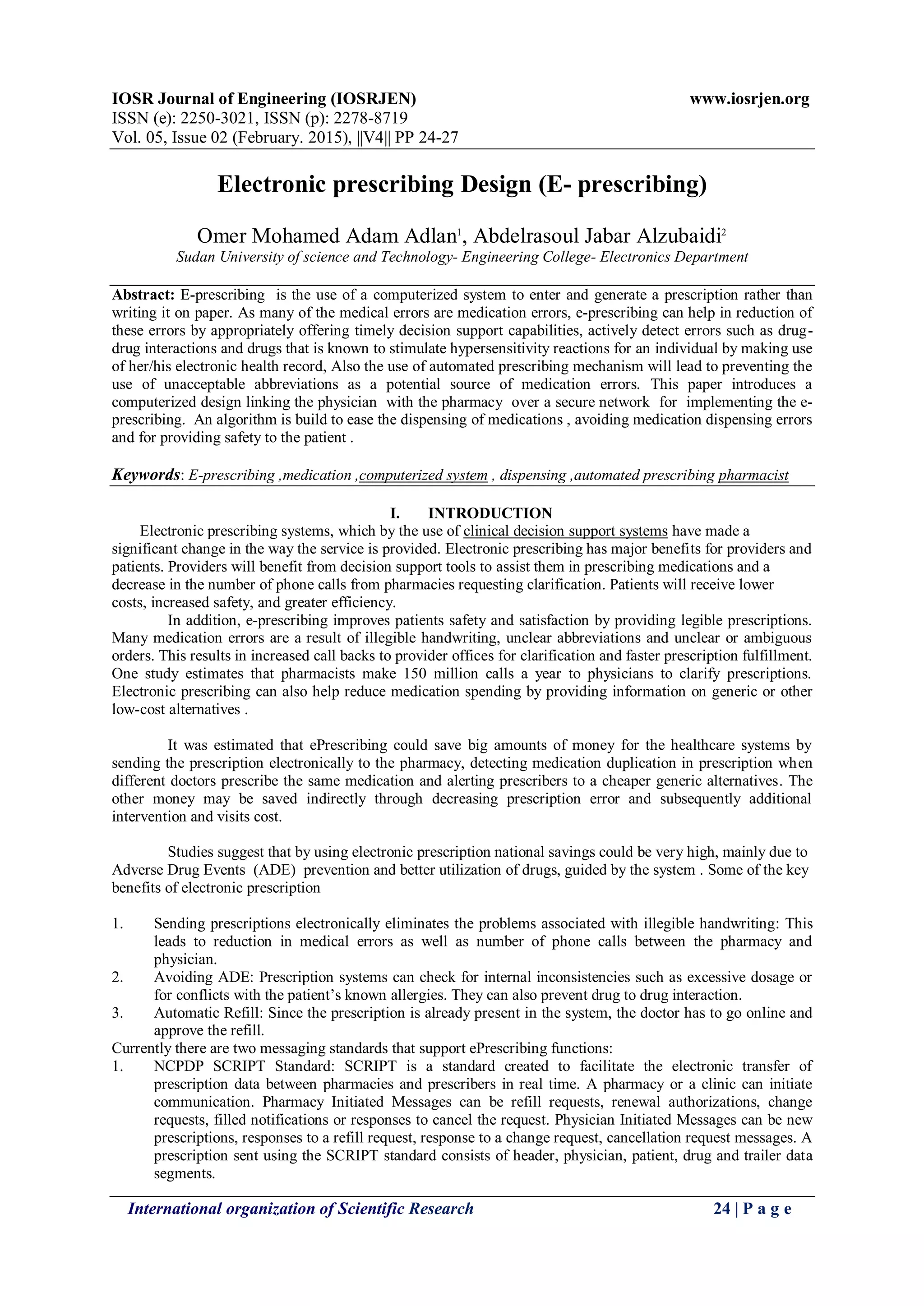
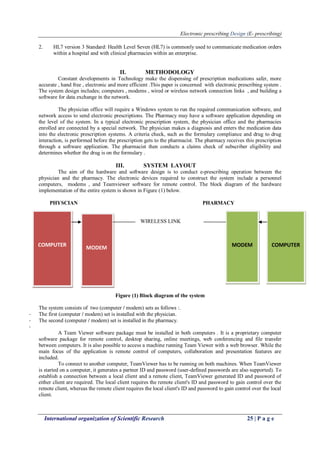
implementation of the entire system is shown in Figure (1) below.
PHYSCIAN PHARMACY
WIRELESS LINK
Figure (1) Block diagram of the system
The system consists of two (computer / modem) sets as follows :.
- The first (computer / modem) set is installed with the physician.
- The second (computer / modem) set is installed in the pharmacy.
-
A Team Viewer software package must be installed in both computers . It is a proprietary computer
software package for remote control, desktop sharing, online meetings, web conferencing and file transfer
between computers. It is also possible to access a machine running Team Viewer with a web browser. While the
main focus of the application is remote control of computers, collaboration and presentation features are
included.
To connect to another computer, TeamViewer has to be running on both machines. When TeamViewer
is started on a computer, it generates a partner ID and password (user-defined passwords are also supported). To
establish a connection between a local client and a remote client, TeamViewer generated ID and password of
either client are required. The local client requires the remote client's ID and password to gain control over the
remote client, whereas the remote client requires the local client's ID and password to gain control over the local
client.
COMPUTER MODEM MODEM COMPUTER
Electronic prescribing Design (E- prescribing)
International organization of Scientific Research 26 | P a g e
To start an online meeting, the presenter gives the Meeting ID to the participants. They join the meeting by
using the TeamViewer full version and entering the Meeting ID. It is also possible to schedule a meeting in
advance.
The modems are used to establish an internet connection in both computers .The internet connection is
essential in both computers so that both computers acquire an ID .Hence the physician computer can access the
computer in the pharmacy to convey the medical prescription.
IV. PROGRAMMING
Turbo C ++ programming language is used to program the computer in the pharmacy. The structure of
the program contains a screen design . The task of the physician is to access the pharmacy computer and fill the
screen with the details of the medication prescribed to the patient. The algorithm for the screen design for the
computer in the pharmacy is as follows:
Start
Patient data :
… Fill the name of the patient (or medical code number of the patient).
… Fill the gender of the patient (M / F).
… Fill the age of the patient.
Medication data :
… Fill the name of the medication.
… Fill the dose of the medication.
Date and time of prescription :
… Capture the (date , day, hour , minute) from the computer.
… Display the captured date and time of prescription on the screen of the computer.
End
V. RESULTS
Equation (1) gives the total time taken from the physician to perform an electronic prescription for a patient .
T e-prescribing = T access pharmacy computer + T screen fill…………………….. (1)
Where ;
T e-prescribing = total time for the electronic prescribing (seconds).
T access pharmacy computer = time duration to access the pharmacy computer using TeamViewer
package (seconds).
T screen fill = time duration taken by the physician to fill the screen (seconds).
Consider the approximated duration for (T screen fill = 30 seconds) , and the (T access pharmacy computer = 10 seconds )
by the TeamViewer package . Now implementing equation (1) , we get the resultant time (T e-prescribing ) for
one patient is:
T e-prescribing = 30 second + 10 second = 40 second.
In addition to the short duration of time taken for serving one patient, the e- prescribing offers accurate giving
medication to the patient .
It is evident that the manual prescribing procedure is time consuming and lacks accuracy compared to the e-
prescribing procedure.
VI. CONCLUSION
The current system of prescribing and dispensing medications has widespread problems with safety and
efficiency. Yet drug therapy is an integral component of many ambulatory treatment regimens recommended for
chronic and acute medical conditions. To the patient the prescriptive process seems quite simple. They are given
a written prescription, take it to the pharmacy, receive and consume the medications.. Converting the prescribing
process from paper to an electronic process is referred as e- prescribing (eRx). The paper focused on the
electronic technology implemented to accomplish the e- prescribing for offering the best service to the patient..
Electronic prescribing Design (E- prescribing)
International organization of Scientific Research 27 | P a g e
REFERENCES
[1]. Anderson, Jr., H., Stubstad, J., Hardy, M. (2011). Valid Prescription, Electronic Prescriptions,
When is a Signature Required (?) and What is a Qualifying Signature?
[2]. True eRx – “All Electrons, All the Time”. (n.d.) E-prescribing. American College of
Rheumatology.
[3]. E-Prescribing: Electronic Prescribing of Controlled Substances. (2012). American College of
Rheumatology.
[4]. Electronic Prescriptions for Controlled Substances Clarification (2011). DEA’s Office of
Diversion Control, Notices 2011.
[5]. Lim, S., Groom, T., Elson, M., Caplan, R. (2011). California ePrescribing Gap Analysis. Cal
eCONNECT, Inc. 14.
[6]. Thomas CP., Kim M., et al (2011). Prescribers’ expectations and barriers to electronic
prescribing of controlled substances. J Am Med Inform Assoc. 2011 Sep 21.
[7]. Vivian, J. (2010). Electronic Controlled Substances Prescriptions. US Pharm. 2010;35(7):65-
68.
[8]. Wacker, R. (2012). E-prescribing in CA: why aren’t we there yet. California Healthcare
Foundation.
[9]. Whittemore, K.(2012). Sure scripts Report: Majority of Physicians Meeting Stage 1
Meaningful Use E-Prescribing Measure Today, Many Already Meeting Proposed Stage 2
Measure.

E5242427

  • 1.
    IOSR Journal ofEngineering (IOSRJEN) www.iosrjen.org ISSN (e): 2250-3021, ISSN (p): 2278-8719 Vol. 05, Issue 02 (February. 2015), ||V4|| PP 24-27 International organization of Scientific Research 24 | P a g e Electronic prescribing Design (E- prescribing) Omer Mohamed Adam Adlan1 , Abdelrasoul Jabar Alzubaidi2 Sudan University of science and Technology- Engineering College- Electronics Department Abstract: E-prescribing is the use of a computerized system to enter and generate a prescription rather than writing it on paper. As many of the medical errors are medication errors, e-prescribing can help in reduction of these errors by appropriately offering timely decision support capabilities, actively detect errors such as drug- drug interactions and drugs that is known to stimulate hypersensitivity reactions for an individual by making use of her/his electronic health record, Also the use of automated prescribing mechanism will lead to preventing the use of unacceptable abbreviations as a potential source of medication errors. This paper introduces a computerized design linking the physician with the pharmacy over a secure network for implementing the e- prescribing. An algorithm is build to ease the dispensing of medications , avoiding medication dispensing errors and for providing safety to the patient . Keywords: E-prescribing ,medication ,computerized system , dispensing ,automated prescribing pharmacist I. INTRODUCTION Electronic prescribing systems, which by the use of clinical decision support systems have made a significant change in the way the service is provided. Electronic prescribing has major benefits for providers and patients. Providers will benefit from decision support tools to assist them in prescribing medications and a decrease in the number of phone calls from pharmacies requesting clarification. Patients will receive lower costs, increased safety, and greater efficiency. In addition, e-prescribing improves patients safety and satisfaction by providing legible prescriptions. Many medication errors are a result of illegible handwriting, unclear abbreviations and unclear or ambiguous orders. This results in increased call backs to provider offices for clarification and faster prescription fulfillment. One study estimates that pharmacists make 150 million calls a year to physicians to clarify prescriptions. Electronic prescribing can also help reduce medication spending by providing information on generic or other low-cost alternatives . It was estimated that ePrescribing could save big amounts of money for the healthcare systems by sending the prescription electronically to the pharmacy, detecting medication duplication in prescription when different doctors prescribe the same medication and alerting prescribers to a cheaper generic alternatives. The other money may be saved indirectly through decreasing prescription error and subsequently additional intervention and visits cost. Studies suggest that by using electronic prescription national savings could be very high, mainly due to Adverse Drug Events (ADE) prevention and better utilization of drugs, guided by the system . Some of the key benefits of electronic prescription 1. Sending prescriptions electronically eliminates the problems associated with illegible handwriting: This leads to reduction in medical errors as well as number of phone calls between the pharmacy and physician. 2. Avoiding ADE: Prescription systems can check for internal inconsistencies such as excessive dosage or for conflicts with the patient’s known allergies. They can also prevent drug to drug interaction. 3. Automatic Refill: Since the prescription is already present in the system, the doctor has to go online and approve the refill. Currently there are two messaging standards that support ePrescribing functions: 1. NCPDP SCRIPT Standard: SCRIPT is a standard created to facilitate the electronic transfer of prescription data between pharmacies and prescribers in real time. A pharmacy or a clinic can initiate communication. Pharmacy Initiated Messages can be refill requests, renewal authorizations, change requests, filled notifications or responses to cancel the request. Physician Initiated Messages can be new prescriptions, responses to a refill request, response to a change request, cancellation request messages. A prescription sent using the SCRIPT standard consists of header, physician, patient, drug and trailer data segments.
  • 2.
    Electronic prescribing Design(E- prescribing) International organization of Scientific Research 25 | P a g e 2. HL7 version 3 Standard: Health Level Seven (HL7) is commonly used to communicate medication orders within a hospital and with clinical pharmacies within an enterprise. II. METHODOLOGY Constant developments in Technology make the dispensing of prescription medications safer, more accurate , hand free , electronic and more efficient .This paper is concerned with electronic prescribing system . The system design includes; computers , modems , wired or wireless network connection links , and building a software for data exchange in the network. The physician office will require a Windows system to run the required communication software, and network access to send electronic prescriptions. The Pharmacy may have a software application depending on the level of the system. In a typical electronic prescription system, the physician office and the pharmacies enrolled are connected by a special network. The physician makes a diagnosis and enters the medication data into the electronic prescription systems. A criteria check, such as the formulary compliance and drug to drug interaction, is performed before the prescription gets to the pharmacist. The pharmacy receives this prescription through a software application. The pharmacist then conducts a claims check of subscriber eligibility and determines whether the drug is on the formulary . III. SYSTEM LAYOUT The aim of the hardware and software design is to conduct e-prescribing operation between the physician and the pharmacy. The electronic devices required to construct the system include a personnel computers, modems , and Teamviewer software for remote control. The block diagram of the hardware implementation of the entire system is shown in Figure (1) below. PHYSCIAN PHARMACY WIRELESS LINK Figure (1) Block diagram of the system The system consists of two (computer / modem) sets as follows :. - The first (computer / modem) set is installed with the physician. - The second (computer / modem) set is installed in the pharmacy. - A Team Viewer software package must be installed in both computers . It is a proprietary computer software package for remote control, desktop sharing, online meetings, web conferencing and file transfer between computers. It is also possible to access a machine running Team Viewer with a web browser. While the main focus of the application is remote control of computers, collaboration and presentation features are included. To connect to another computer, TeamViewer has to be running on both machines. When TeamViewer is started on a computer, it generates a partner ID and password (user-defined passwords are also supported). To establish a connection between a local client and a remote client, TeamViewer generated ID and password of either client are required. The local client requires the remote client's ID and password to gain control over the remote client, whereas the remote client requires the local client's ID and password to gain control over the local client. COMPUTER MODEM MODEM COMPUTER
  • 3.
    Electronic prescribing Design(E- prescribing) International organization of Scientific Research 26 | P a g e To start an online meeting, the presenter gives the Meeting ID to the participants. They join the meeting by using the TeamViewer full version and entering the Meeting ID. It is also possible to schedule a meeting in advance. The modems are used to establish an internet connection in both computers .The internet connection is essential in both computers so that both computers acquire an ID .Hence the physician computer can access the computer in the pharmacy to convey the medical prescription. IV. PROGRAMMING Turbo C ++ programming language is used to program the computer in the pharmacy. The structure of the program contains a screen design . The task of the physician is to access the pharmacy computer and fill the screen with the details of the medication prescribed to the patient. The algorithm for the screen design for the computer in the pharmacy is as follows: Start Patient data : … Fill the name of the patient (or medical code number of the patient). … Fill the gender of the patient (M / F). … Fill the age of the patient. Medication data : … Fill the name of the medication. … Fill the dose of the medication. Date and time of prescription : … Capture the (date , day, hour , minute) from the computer. … Display the captured date and time of prescription on the screen of the computer. End V. RESULTS Equation (1) gives the total time taken from the physician to perform an electronic prescription for a patient . T e-prescribing = T access pharmacy computer + T screen fill…………………….. (1) Where ; T e-prescribing = total time for the electronic prescribing (seconds). T access pharmacy computer = time duration to access the pharmacy computer using TeamViewer package (seconds). T screen fill = time duration taken by the physician to fill the screen (seconds). Consider the approximated duration for (T screen fill = 30 seconds) , and the (T access pharmacy computer = 10 seconds ) by the TeamViewer package . Now implementing equation (1) , we get the resultant time (T e-prescribing ) for one patient is: T e-prescribing = 30 second + 10 second = 40 second. In addition to the short duration of time taken for serving one patient, the e- prescribing offers accurate giving medication to the patient . It is evident that the manual prescribing procedure is time consuming and lacks accuracy compared to the e- prescribing procedure. VI. CONCLUSION The current system of prescribing and dispensing medications has widespread problems with safety and efficiency. Yet drug therapy is an integral component of many ambulatory treatment regimens recommended for chronic and acute medical conditions. To the patient the prescriptive process seems quite simple. They are given a written prescription, take it to the pharmacy, receive and consume the medications.. Converting the prescribing process from paper to an electronic process is referred as e- prescribing (eRx). The paper focused on the electronic technology implemented to accomplish the e- prescribing for offering the best service to the patient..
  • 4.
    Electronic prescribing Design(E- prescribing) International organization of Scientific Research 27 | P a g e REFERENCES [1]. Anderson, Jr., H., Stubstad, J., Hardy, M. (2011). Valid Prescription, Electronic Prescriptions, When is a Signature Required (?) and What is a Qualifying Signature? [2]. True eRx – “All Electrons, All the Time”. (n.d.) E-prescribing. American College of Rheumatology. [3]. E-Prescribing: Electronic Prescribing of Controlled Substances. (2012). American College of Rheumatology. [4]. Electronic Prescriptions for Controlled Substances Clarification (2011). DEA’s Office of Diversion Control, Notices 2011. [5]. Lim, S., Groom, T., Elson, M., Caplan, R. (2011). California ePrescribing Gap Analysis. Cal eCONNECT, Inc. 14. [6]. Thomas CP., Kim M., et al (2011). Prescribers’ expectations and barriers to electronic prescribing of controlled substances. J Am Med Inform Assoc. 2011 Sep 21. [7]. Vivian, J. (2010). Electronic Controlled Substances Prescriptions. US Pharm. 2010;35(7):65- 68. [8]. Wacker, R. (2012). E-prescribing in CA: why aren’t we there yet. California Healthcare Foundation. [9]. Whittemore, K.(2012). Sure scripts Report: Majority of Physicians Meeting Stage 1 Meaningful Use E-Prescribing Measure Today, Many Already Meeting Proposed Stage 2 Measure.