The International Journal Of Engineering And Science (IJES)
|| Volume || 4 || Issue || 2 || Pages || PP.27-31 || 2015 ||
ISSN (e): 2319 – 1813 ISSN (p): 2319 – 1805
www.theijes.com The IJES Page 27
Mixture Experiment Models for Predicting the Compressive
Strength and Water Absorption of Sand-Quarry Dust Blocks
C. U. Anya1
, N. N. Osadebe2
1
Federal University of Technology, Owerri, Nigeria
2
University of Nigeria, Nsukka
--------------------------------------------------------------ABSTRACT---------------------------------------------------------
Partial replacement of sand with quarry dust in sandcrete block production is gaining grounds in Nigeria.
Much effort and resources are spent in conducting trial tests to determine the mix proportions to achieve
desired properties of the blocks. In this work, mixture experiment models for predicting the compressive
strength and water absorption of sand-quarry dust blocks to meet the Nigerian Industrial standard minimum
requirements for machine vibrated load bearing sandcrete blocks were formulated using augmented Scheffe’s
{4, 2} simplex lattice design. The models were tested for lack of fit and were found adequate. The compressive
strength model can predict strength ranging from 2.74 to 5.22Nmm-2
while the water absorption model can
predict water absorption ranging from 3.21 to 7.84%. The use of the models can help in determining mixes that
meet the minimum compressive strength requirement as well the maximum water absorption of the blocks.
Keywords: Compressive strength, Water absorption, Mixture experiment models, Sand-Quarry dust blocks,
Augmented Scheffe’s simplex lattice design.
---------------------------------------------------------------------------------------------------------------------------------------
Date of Submission: 19 January, 2015 Date Accepted: 05 February, 2015
--------------------------------------------------------------------------------------------------------------------------------------
I. INTRODUCTION
Sand-quarry dust blocks are produced by partially replacing river sand with quarry dust in the
production of sandcrete blocks. Sandcrete blocks which are obtained by mixing river sand, Ordinary Portland
cement and water in appropriate proportions are the major units for wall construction in modern day Nigeria.
Sandcrete differs from concrete by the non-inclusion of coarse aggregate in the mix and from cement-sand
mortar by its zero slump. Sandcrete is often referred to as a zero slump concrete. The need for the partial
replacement of sand with quarry dust has arisen from two major considerations namely: (i) to reduce the need
for the use of river sand, thus preventing environmental degradation arising from excessive sand mining and (ii)
to provide additional use for quarry dust, a waste product of rock quarrying process which, if left to accumulate
in large volumes, is hazardous to the environment.
Works by Oyekan and Kamiyo, (2008) and Anya (2015) show that the inclusion of quarry dust in the
production of sandcrete blocks improved the compressive strength and water absorption properties of the blocks.
It is now common practice by some block producers in Nigeria to partially replace sand with quarry dust in
sandcrete block production. Such producers are confronted with the problem of proportioning the constituents to
meet the desired properties of the blocks, notably the compressive strength and water absorption, as there are no
existing models for predicting the structural properties of sand-quarry dust blocks. Much effort and resources
are spent in conducting trial tests to determine the mix proportions to achieve a desired value of compressive
strength and water absorption. There is therefore the need to develop models that can predict the structural
characteristics of sand-quarry dust mixes, especially the compressive strength of sand-quarry dust blocks. Such
models can also be used to study the component interactions through the use of Cox or Piepel response trace
plots. In this work, mixture experiment models for predicting the compressive strength and water absorption of
sand-quarry dust blocks were developed using Scheffe’s augmented simplex lattice design.
II. MIXTURE EXPERIMENTS AND SCHEFFE’S CANONICAL EQUATION
A mixture experiment is one in which the response is assumed to be dependent on the relative
proportions of the constituent materials and not on their total amount (Cornell, 2001). For such experiments,
there are two basic requirements that must be satisfied namely; the sum of the proportions of the constituents
must add up to one and none of the constituents will have a negative value.
Many mixture experiment model forms exist of which one of the most popular is Scheffe’s simplex lattice
design. Scheffe (1958) obtained the so called canonical form of the polynomial equation for such designs, which
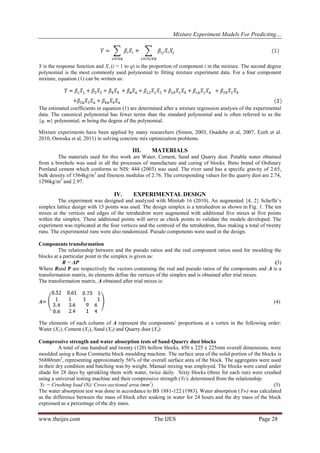
for a second degree polynomial is given as:
Mixture Experiment Models For Predicting…
www.theijes.com The IJES Page 28
Y is the response function and Xi (i = 1 to q) is the proportion of component i in the mixture. The second degree
polynomial is the most commonly used polynomial to fitting mixture experiment data. For a four component
mixture, equation (1) can be written as:
The estimated coefficients in equation (1) are determined after a mixture regression analysis of the experimental
data. The canonical polynomial has fewer terms than the standard polynomial and is often referred to as the
{q, m} polynomial; m being the degree of the polynomial.
Mixture experiments have been applied by many researchers (Simon, 2003, Osadebe et al, 2007, Ezeh et al.
2010, Onwuka et al, 2011) in solving concrete mix optimization problems.
III. MATERIALS
The materials used for this work are Water, Cement, Sand and Quarry dust. Potable water obtained
from a borehole was used in all the processes of manufacture and curing of blocks. Ibeto brand of Ordinary
Portland cement which conforms to NIS: 444 (2003) was used. The river sand has a specific gravity of 2.65,
bulk density of 1564kg/m3
and fineness modulus of 2.76. The corresponding values for the quarry dust are 2.74,
1296kg/m3
and 2.97.
IV. EXPERIMENTAL DESIGN
The experiment was designed and analyzed with Minitab 16 (2010). An augmented {4, 2} Scheffe’s
simplex lattice design with 15 points was used. The design simplex is a tetrahedron as shown in Fig. 1. The ten
mixes at the vertices and edges of the tetrahedron were augmented with additional five mixes at five points
within the simplex. These additional points will serve as check points to validate the models developed. The
experiment was replicated at the four vertices and the centroid of the tetrahedron, thus making a total of twenty
runs. The experimental runs were also randomized. Pseudo components were used in the design.
Components transformation
The relationship between and the pseudo ratios and the real component ratios used for moulding the
blocks at a particular point in the simplex is given as:
R = AP (3)
Where Rand P are respectively the vectors containing the real and pseudo ratios of the components and A is a
transformation matrix, its elements define the vertices of the simplex and is obtained after trial mixes.
The transformation matrix, A obtained after trial mixes is:
A (4)
The elements of each column of A represent the components’ proportions at a vertex in the following order:
Water (X1), Cement (X2), Sand (X3) and Quarry dust (X4)
Compressive strength and water absorption tests of Sand-Quarry dust blocks
A total of one hundred and twenty (120) hollow blocks, 450 x 225 x 225mm overall dimensions, were
moulded using a Rosa Commetta block moulding machine. The surface area of the solid portion of the blocks is
56880mm2
, representing approximately 56% of the overall surface area of the block. The aggregates were used
in their dry condition and batching was by weight. Manual mixing was employed. The blocks were cured under
shade for 28 days by sprinkling them with water, twice daily. Sixty blocks (three for each run) were crushed
using a universal testing machine and their compressive strength (Yc), determined from the relationship:
Yc = Crushing load (N)/ Cross-sectional area (mm2
) (5)
The water absorption test was done in accordance to BS 1881-122 (1983). Water absorption (Yw) was calculated
as the difference between the mass of block after soaking in water for 24 hours and the dry mass of the block
expressed as a percentage of the dry mass.
Mixture Experiment Models For Predicting…
www.theijes.com The IJES Page 29
V. RESULTS
Table 1 shows the pseudo components and the results of the compressive strength and water absorption
tests.
Model equation for compressive strength
The second degree model of Eq. (2) was fitted to the data set of the 20 compressive test results at 95%
confidence limit (α= 0.05) using Minitab 16 (2010). The parameter estimates of the coefficients and the analysis
of variance tables are respectively shown in Tables 2 and 3 while the normal probability plot of the residuals is
shown in Fig. 2.The model equation for compressive strength is therefore:
Yc = 4.5540X1 + 5.2167X2 + 2.7694X3 + 2.9256X4 - 0.1162X1X2 - 2.3200X1X3
- 2.1427X1X4- 2.4238X2X3 - 2.2465X2X4 + 1.1097X3X4 (6)
The p-value for lack of fit of 0.259 is greater than the value of α (0.05). The normal probability plot of Fig.2also
shows that the residuals fall reasonably close to the reference line. The conclusion, therefore, is that Eq. (6) is
adequate for predicting the 28th
day compressive strength of sand-quarry dust blocks. The other statistics (which
have their usual meanings) in Table 3 lend credence to the adequacy of the model.
Model equation for Water absorption
A similar analysis gave the model equation for Water absorption as:
Yw = 4.1596X1 + 3.2061X2 + 7.8445X3 + 7.2282X4 - 0.3602X1X2 + 3.701X1X3
+3.1090X1X4 + 2.1090X2X3 + 1.1317X2X4 - 2.7580X3X4 (7)
The p-value for lack of fit is 0.898 which is greater than 0.05, indicating the adequacy of the model for
predicting the water absorption of the blocks,
Response trace plot.
The Piepel response trace plot for both the compressive strength and water absorption models are
shown in Fig.3.
VI. DISCUSSION OF RESULTS
(a) Model coefficients
It is seen from Eq. (6) that 2 > 1> 4> 3 indicating that cement contributes most to the strength
followed by water, quarry dust and sand in that order. There is a binary synergistic effect in the interaction
between sand and quarry dust as given by the positive value of 34. This means that the contribution of the fine
aggregates is greater when they are combined than when each is used alone. This goes further to buttress the
earlier observation that the inclusion of quarry dust improved the compressive strength of the blocks. For the
water absorption model, 3> 4> 1> 2 indicating that sand is the greatest contributor with quarry dust, water
and cement following in that other. There is antagonistic synergy between sand and quarry dust, indicating that
water absorption is reduced when the two aggregates are combined than when each is used alone.
(b) Maximum and minimum predictable model values.
The values of compressive strength predictable with the compressive strength model was found to
range from 2.74 to 5.22 Nmm-2.
The corresponding values for the water absorption model is 3.21 to 7.84%.
(c) Piepel Response Trace Plots (Components interactions)
As the proportion of cement in the mixture increases (and the other mixture components decrease), the
compressive strength increases rapidly. As the cement proportion decreases (and the other components
increase), the compressive strength decreases. As the proportion of water increases, and the other components
decrease, the compressive strength increases and as the water proportion decreases while the others decrease the
strength decreases. The water content is almost optimum. As the proportion of sand decreases, and the other
components increase, the compressive strength increases moderately. As the sand proportion increases, and the
other components decrease, the compressive strength decreases. The quarry dust behaved in a similar manner as
sand.
VII. CONCLUSION AND RECOMMENDATION
Models for predicting the compressive strength and water absorption of sand-quarry dust blocks were
developed in this work. The models can be used to predict the compressive strength of blocks ranging from 2.74
to 5.22Nmm-2
and water absorption of 3. 21 to 7.84%. The use of these models will greatly help Nigerian block
producers to meet the Nigerian Industrial Standard, (NIS) : 87 (2004) recommended values of 3.45Nmm-2
and
6% for compressive strength and water absorption of machine vibrated load bearing sandcrete blocks
respectively.
Mixture Experiment Models For Predicting…
www.theijes.com The IJES Page 30
Table 1 Compressive strength and Water absorption tests results
Run
Order
Std
Order
Pseudo ratios Response
Water
(X1)
Cement
(X2)
Sand
(X3)
Quarry
dust
(X4)
Yc (Nmm-2
) Yw ( % )
1 1 1 0 0 0 4.49 4.06
2 7 0 0.5 0 0.5 3.50 5.48
3 12 0.625 0.125 0.125 0.125 3.67 5.41
4 11 0.25 0.25 0.25 0.25 3.34 6.14
5 20 0.25 0.25 0.25 0.25 3.40 6.00
6 15 0.125 0.125 0.125 0.625 3.19 6.53
7 8 0 0 1 0 2.80 7.71
8 9 0 0 0.5 0.5 3.07 6.86
9 18 0 0 1 0 2.72 8.00
10 14 0.125 0.125 0.625 0.125 3.04 6.95
11 6 0 0.5 0.5 0 3.39 6.02
12 16 1 0 0 0 4.65 4.26
13 19 0 0 0 1 2.98 7.13
14 17 0 1 0 0 5.19 3.24
15 4 0.5 0 0 0.5 3.20 6.50
16 10 0 0 0 1 2.84 7.36
17 3 0.5 0 0.5 0 3.09 6.80
18 5 0 1 0 0 5.27 3.16
19 2 0.5 0.5 0 0 4.91 3.54
20 13 0.125 0.625 0.125 0.125 4.01 4.78
Mixture Experiment Models For Predicting…
www.theijes.com The IJES Page 31
0.80.60.40.20.0-0.2
5.5
5.0
4.5
4.0
3.5
3.0
deviation fromreference blend in pseudocomponent
FittedCompressivestrength
Water 0.25
Cement 0.25
Sand 0.25
Quarry dust 0.25
0.20.10.0-0.1-0.2
99
95
90
80
70
60
50
40
30
20
10
5
1
Residuals
Percent
Mean -3.87884E-16
StDev 0.06791
N 20
AD 0.130
P-Value 0.978
Normal - 95% CI
Fig. 1: Augmented {4, 2} Scheffe’s Fig.2 Normal probability plot for
simplex lattice showing the points and run order compressive strength
0.80.60.40.20.0-0.2
8
7
6
5
4
3
deviation fromreference blend in pseudocomponent
FittedWaterabsorption
Water 0.25
Cement 0.25
Sand 0.25
Quarry dust 0.25
(a) Compressive strength (b) Water absorption
Fig.3 Piepel response trace plots (Pseudo components)
VIII. ACKNOWLEGEMENT
We are grateful to Mr Ifeanyi Diogu of ACI Blocks, Owerri, Nigeria who gave us free use of the Rosa
Commetta block moulding machine used for this work.
REFERENCES
[1]. Anya, C. U. (2015) Models for Predicting the Structural Characteristics of Sand-Quarry dust Blocks. Unpublished Ph.D. Thesis.
Department of Civil Engineering, University of Nigeria, Nsukka
[2]. British Standard Institution, (1983). BS 1881-122. Testing concrete. Method for determining of Water absorption. London
[3]. Cornell, J., (2002). Experiments with Mixtures: Designs, Models and the Analysis of Mixture Data. 3ed. John Wiley and Sons
Inc. New York.
[4]. Ezeh, J.C., Ibearugbulem, O. M., Anya, U. C, (2010). Optimization of aggregate composition of laterite/sand hollow block using
Scheffe’s simplex method. International Journal of Engineering, 4(4), 471 - 478
[5] Minitab Inc. (2010). Minitab Statistical Software Release 16 Minitab Inc. State College Pennsylvania
[6] Nigeria Industrial Standards (2003) NIS 444: Quality standard for Ordinary Portland cement. Standard Organization of Nigeria,
Lagos
[7] Nigerian Industrial Standards (2004) .NIS 87: Standards for Sandcrete blocks. Standard Organization of Nigeria (SON), Lagos
[8] Onwuka, D. O., Okere, C. E., Arimanwa, J. I. and Onwuka, S. U., (2011). Prediction of concrete mix ratios using modified
regression theory. Computational. Method in Civil Engineering. Vol. 2, No 1. pp 95 – 107.
[9] Oyekan, G. L. and Kamiyo, O. M (2008). Effects of Granite Fines on the Structural and Hygrothermal Properties of Sandcrete
Blocks. Journal of Engineering and Applied Sciences 3 (9), 735 - 741.
[10] Osadebe, N. N., Mbajiorgu, C. C. and Nwakonobi, T. U. (2007): An optimization model development for laterized concrete mix
proportioning in building constructions. Nigerian Journal of Technology, Vol. 26 (1), 37- 46
[11] Scheffe, H., (1958): Experiments with mixtures. Journal of Royal Statistical Society, Series B. Vol. 20, No 2, pp 344 -360.
[12] Simon, M. J. (2003). Concrete Mixture Optimization Using Statistical Methods: Final Report. FHWA Office of Infrastructure
Research and Development, 6300.

Mixture Experiment Models for Predicting the Compressive Strength and Water Absorption of Sand-Quarry Dust Blocks

  • 1.
    The International JournalOf Engineering And Science (IJES) || Volume || 4 || Issue || 2 || Pages || PP.27-31 || 2015 || ISSN (e): 2319 – 1813 ISSN (p): 2319 – 1805 www.theijes.com The IJES Page 27 Mixture Experiment Models for Predicting the Compressive Strength and Water Absorption of Sand-Quarry Dust Blocks C. U. Anya1 , N. N. Osadebe2 1 Federal University of Technology, Owerri, Nigeria 2 University of Nigeria, Nsukka --------------------------------------------------------------ABSTRACT--------------------------------------------------------- Partial replacement of sand with quarry dust in sandcrete block production is gaining grounds in Nigeria. Much effort and resources are spent in conducting trial tests to determine the mix proportions to achieve desired properties of the blocks. In this work, mixture experiment models for predicting the compressive strength and water absorption of sand-quarry dust blocks to meet the Nigerian Industrial standard minimum requirements for machine vibrated load bearing sandcrete blocks were formulated using augmented Scheffe’s {4, 2} simplex lattice design. The models were tested for lack of fit and were found adequate. The compressive strength model can predict strength ranging from 2.74 to 5.22Nmm-2 while the water absorption model can predict water absorption ranging from 3.21 to 7.84%. The use of the models can help in determining mixes that meet the minimum compressive strength requirement as well the maximum water absorption of the blocks. Keywords: Compressive strength, Water absorption, Mixture experiment models, Sand-Quarry dust blocks, Augmented Scheffe’s simplex lattice design. --------------------------------------------------------------------------------------------------------------------------------------- Date of Submission: 19 January, 2015 Date Accepted: 05 February, 2015 -------------------------------------------------------------------------------------------------------------------------------------- I. INTRODUCTION Sand-quarry dust blocks are produced by partially replacing river sand with quarry dust in the production of sandcrete blocks. Sandcrete blocks which are obtained by mixing river sand, Ordinary Portland cement and water in appropriate proportions are the major units for wall construction in modern day Nigeria. Sandcrete differs from concrete by the non-inclusion of coarse aggregate in the mix and from cement-sand mortar by its zero slump. Sandcrete is often referred to as a zero slump concrete. The need for the partial replacement of sand with quarry dust has arisen from two major considerations namely: (i) to reduce the need for the use of river sand, thus preventing environmental degradation arising from excessive sand mining and (ii) to provide additional use for quarry dust, a waste product of rock quarrying process which, if left to accumulate in large volumes, is hazardous to the environment. Works by Oyekan and Kamiyo, (2008) and Anya (2015) show that the inclusion of quarry dust in the production of sandcrete blocks improved the compressive strength and water absorption properties of the blocks. It is now common practice by some block producers in Nigeria to partially replace sand with quarry dust in sandcrete block production. Such producers are confronted with the problem of proportioning the constituents to meet the desired properties of the blocks, notably the compressive strength and water absorption, as there are no existing models for predicting the structural properties of sand-quarry dust blocks. Much effort and resources are spent in conducting trial tests to determine the mix proportions to achieve a desired value of compressive strength and water absorption. There is therefore the need to develop models that can predict the structural characteristics of sand-quarry dust mixes, especially the compressive strength of sand-quarry dust blocks. Such models can also be used to study the component interactions through the use of Cox or Piepel response trace plots. In this work, mixture experiment models for predicting the compressive strength and water absorption of sand-quarry dust blocks were developed using Scheffe’s augmented simplex lattice design. II. MIXTURE EXPERIMENTS AND SCHEFFE’S CANONICAL EQUATION A mixture experiment is one in which the response is assumed to be dependent on the relative proportions of the constituent materials and not on their total amount (Cornell, 2001). For such experiments, there are two basic requirements that must be satisfied namely; the sum of the proportions of the constituents must add up to one and none of the constituents will have a negative value. Many mixture experiment model forms exist of which one of the most popular is Scheffe’s simplex lattice design. Scheffe (1958) obtained the so called canonical form of the polynomial equation for such designs, which for a second degree polynomial is given as:
  • 2.
    Mixture Experiment ModelsFor Predicting… www.theijes.com The IJES Page 28 Y is the response function and Xi (i = 1 to q) is the proportion of component i in the mixture. The second degree polynomial is the most commonly used polynomial to fitting mixture experiment data. For a four component mixture, equation (1) can be written as: The estimated coefficients in equation (1) are determined after a mixture regression analysis of the experimental data. The canonical polynomial has fewer terms than the standard polynomial and is often referred to as the {q, m} polynomial; m being the degree of the polynomial. Mixture experiments have been applied by many researchers (Simon, 2003, Osadebe et al, 2007, Ezeh et al. 2010, Onwuka et al, 2011) in solving concrete mix optimization problems. III. MATERIALS The materials used for this work are Water, Cement, Sand and Quarry dust. Potable water obtained from a borehole was used in all the processes of manufacture and curing of blocks. Ibeto brand of Ordinary Portland cement which conforms to NIS: 444 (2003) was used. The river sand has a specific gravity of 2.65, bulk density of 1564kg/m3 and fineness modulus of 2.76. The corresponding values for the quarry dust are 2.74, 1296kg/m3 and 2.97. IV. EXPERIMENTAL DESIGN The experiment was designed and analyzed with Minitab 16 (2010). An augmented {4, 2} Scheffe’s simplex lattice design with 15 points was used. The design simplex is a tetrahedron as shown in Fig. 1. The ten mixes at the vertices and edges of the tetrahedron were augmented with additional five mixes at five points within the simplex. These additional points will serve as check points to validate the models developed. The experiment was replicated at the four vertices and the centroid of the tetrahedron, thus making a total of twenty runs. The experimental runs were also randomized. Pseudo components were used in the design. Components transformation The relationship between and the pseudo ratios and the real component ratios used for moulding the blocks at a particular point in the simplex is given as: R = AP (3) Where Rand P are respectively the vectors containing the real and pseudo ratios of the components and A is a transformation matrix, its elements define the vertices of the simplex and is obtained after trial mixes. The transformation matrix, A obtained after trial mixes is: A (4) The elements of each column of A represent the components’ proportions at a vertex in the following order: Water (X1), Cement (X2), Sand (X3) and Quarry dust (X4) Compressive strength and water absorption tests of Sand-Quarry dust blocks A total of one hundred and twenty (120) hollow blocks, 450 x 225 x 225mm overall dimensions, were moulded using a Rosa Commetta block moulding machine. The surface area of the solid portion of the blocks is 56880mm2 , representing approximately 56% of the overall surface area of the block. The aggregates were used in their dry condition and batching was by weight. Manual mixing was employed. The blocks were cured under shade for 28 days by sprinkling them with water, twice daily. Sixty blocks (three for each run) were crushed using a universal testing machine and their compressive strength (Yc), determined from the relationship: Yc = Crushing load (N)/ Cross-sectional area (mm2 ) (5) The water absorption test was done in accordance to BS 1881-122 (1983). Water absorption (Yw) was calculated as the difference between the mass of block after soaking in water for 24 hours and the dry mass of the block expressed as a percentage of the dry mass.
  • 3.
    Mixture Experiment ModelsFor Predicting… www.theijes.com The IJES Page 29 V. RESULTS Table 1 shows the pseudo components and the results of the compressive strength and water absorption tests. Model equation for compressive strength The second degree model of Eq. (2) was fitted to the data set of the 20 compressive test results at 95% confidence limit (α= 0.05) using Minitab 16 (2010). The parameter estimates of the coefficients and the analysis of variance tables are respectively shown in Tables 2 and 3 while the normal probability plot of the residuals is shown in Fig. 2.The model equation for compressive strength is therefore: Yc = 4.5540X1 + 5.2167X2 + 2.7694X3 + 2.9256X4 - 0.1162X1X2 - 2.3200X1X3 - 2.1427X1X4- 2.4238X2X3 - 2.2465X2X4 + 1.1097X3X4 (6) The p-value for lack of fit of 0.259 is greater than the value of α (0.05). The normal probability plot of Fig.2also shows that the residuals fall reasonably close to the reference line. The conclusion, therefore, is that Eq. (6) is adequate for predicting the 28th day compressive strength of sand-quarry dust blocks. The other statistics (which have their usual meanings) in Table 3 lend credence to the adequacy of the model. Model equation for Water absorption A similar analysis gave the model equation for Water absorption as: Yw = 4.1596X1 + 3.2061X2 + 7.8445X3 + 7.2282X4 - 0.3602X1X2 + 3.701X1X3 +3.1090X1X4 + 2.1090X2X3 + 1.1317X2X4 - 2.7580X3X4 (7) The p-value for lack of fit is 0.898 which is greater than 0.05, indicating the adequacy of the model for predicting the water absorption of the blocks, Response trace plot. The Piepel response trace plot for both the compressive strength and water absorption models are shown in Fig.3. VI. DISCUSSION OF RESULTS (a) Model coefficients It is seen from Eq. (6) that 2 > 1> 4> 3 indicating that cement contributes most to the strength followed by water, quarry dust and sand in that order. There is a binary synergistic effect in the interaction between sand and quarry dust as given by the positive value of 34. This means that the contribution of the fine aggregates is greater when they are combined than when each is used alone. This goes further to buttress the earlier observation that the inclusion of quarry dust improved the compressive strength of the blocks. For the water absorption model, 3> 4> 1> 2 indicating that sand is the greatest contributor with quarry dust, water and cement following in that other. There is antagonistic synergy between sand and quarry dust, indicating that water absorption is reduced when the two aggregates are combined than when each is used alone. (b) Maximum and minimum predictable model values. The values of compressive strength predictable with the compressive strength model was found to range from 2.74 to 5.22 Nmm-2. The corresponding values for the water absorption model is 3.21 to 7.84%. (c) Piepel Response Trace Plots (Components interactions) As the proportion of cement in the mixture increases (and the other mixture components decrease), the compressive strength increases rapidly. As the cement proportion decreases (and the other components increase), the compressive strength decreases. As the proportion of water increases, and the other components decrease, the compressive strength increases and as the water proportion decreases while the others decrease the strength decreases. The water content is almost optimum. As the proportion of sand decreases, and the other components increase, the compressive strength increases moderately. As the sand proportion increases, and the other components decrease, the compressive strength decreases. The quarry dust behaved in a similar manner as sand. VII. CONCLUSION AND RECOMMENDATION Models for predicting the compressive strength and water absorption of sand-quarry dust blocks were developed in this work. The models can be used to predict the compressive strength of blocks ranging from 2.74 to 5.22Nmm-2 and water absorption of 3. 21 to 7.84%. The use of these models will greatly help Nigerian block producers to meet the Nigerian Industrial Standard, (NIS) : 87 (2004) recommended values of 3.45Nmm-2 and 6% for compressive strength and water absorption of machine vibrated load bearing sandcrete blocks respectively.
  • 4.
    Mixture Experiment ModelsFor Predicting… www.theijes.com The IJES Page 30 Table 1 Compressive strength and Water absorption tests results Run Order Std Order Pseudo ratios Response Water (X1) Cement (X2) Sand (X3) Quarry dust (X4) Yc (Nmm-2 ) Yw ( % ) 1 1 1 0 0 0 4.49 4.06 2 7 0 0.5 0 0.5 3.50 5.48 3 12 0.625 0.125 0.125 0.125 3.67 5.41 4 11 0.25 0.25 0.25 0.25 3.34 6.14 5 20 0.25 0.25 0.25 0.25 3.40 6.00 6 15 0.125 0.125 0.125 0.625 3.19 6.53 7 8 0 0 1 0 2.80 7.71 8 9 0 0 0.5 0.5 3.07 6.86 9 18 0 0 1 0 2.72 8.00 10 14 0.125 0.125 0.625 0.125 3.04 6.95 11 6 0 0.5 0.5 0 3.39 6.02 12 16 1 0 0 0 4.65 4.26 13 19 0 0 0 1 2.98 7.13 14 17 0 1 0 0 5.19 3.24 15 4 0.5 0 0 0.5 3.20 6.50 16 10 0 0 0 1 2.84 7.36 17 3 0.5 0 0.5 0 3.09 6.80 18 5 0 1 0 0 5.27 3.16 19 2 0.5 0.5 0 0 4.91 3.54 20 13 0.125 0.625 0.125 0.125 4.01 4.78
  • 5.
    Mixture Experiment ModelsFor Predicting… www.theijes.com The IJES Page 31 0.80.60.40.20.0-0.2 5.5 5.0 4.5 4.0 3.5 3.0 deviation fromreference blend in pseudocomponent FittedCompressivestrength Water 0.25 Cement 0.25 Sand 0.25 Quarry dust 0.25 0.20.10.0-0.1-0.2 99 95 90 80 70 60 50 40 30 20 10 5 1 Residuals Percent Mean -3.87884E-16 StDev 0.06791 N 20 AD 0.130 P-Value 0.978 Normal - 95% CI Fig. 1: Augmented {4, 2} Scheffe’s Fig.2 Normal probability plot for simplex lattice showing the points and run order compressive strength 0.80.60.40.20.0-0.2 8 7 6 5 4 3 deviation fromreference blend in pseudocomponent FittedWaterabsorption Water 0.25 Cement 0.25 Sand 0.25 Quarry dust 0.25 (a) Compressive strength (b) Water absorption Fig.3 Piepel response trace plots (Pseudo components) VIII. ACKNOWLEGEMENT We are grateful to Mr Ifeanyi Diogu of ACI Blocks, Owerri, Nigeria who gave us free use of the Rosa Commetta block moulding machine used for this work. REFERENCES [1]. Anya, C. U. (2015) Models for Predicting the Structural Characteristics of Sand-Quarry dust Blocks. Unpublished Ph.D. Thesis. Department of Civil Engineering, University of Nigeria, Nsukka [2]. British Standard Institution, (1983). BS 1881-122. Testing concrete. Method for determining of Water absorption. London [3]. Cornell, J., (2002). Experiments with Mixtures: Designs, Models and the Analysis of Mixture Data. 3ed. John Wiley and Sons Inc. New York. [4]. Ezeh, J.C., Ibearugbulem, O. M., Anya, U. C, (2010). Optimization of aggregate composition of laterite/sand hollow block using Scheffe’s simplex method. International Journal of Engineering, 4(4), 471 - 478 [5] Minitab Inc. (2010). Minitab Statistical Software Release 16 Minitab Inc. State College Pennsylvania [6] Nigeria Industrial Standards (2003) NIS 444: Quality standard for Ordinary Portland cement. Standard Organization of Nigeria, Lagos [7] Nigerian Industrial Standards (2004) .NIS 87: Standards for Sandcrete blocks. Standard Organization of Nigeria (SON), Lagos [8] Onwuka, D. O., Okere, C. E., Arimanwa, J. I. and Onwuka, S. U., (2011). Prediction of concrete mix ratios using modified regression theory. Computational. Method in Civil Engineering. Vol. 2, No 1. pp 95 – 107. [9] Oyekan, G. L. and Kamiyo, O. M (2008). Effects of Granite Fines on the Structural and Hygrothermal Properties of Sandcrete Blocks. Journal of Engineering and Applied Sciences 3 (9), 735 - 741. [10] Osadebe, N. N., Mbajiorgu, C. C. and Nwakonobi, T. U. (2007): An optimization model development for laterized concrete mix proportioning in building constructions. Nigerian Journal of Technology, Vol. 26 (1), 37- 46 [11] Scheffe, H., (1958): Experiments with mixtures. Journal of Royal Statistical Society, Series B. Vol. 20, No 2, pp 344 -360. [12] Simon, M. J. (2003). Concrete Mixture Optimization Using Statistical Methods: Final Report. FHWA Office of Infrastructure Research and Development, 6300.