A8N-E


Motherboard
E1911
     First Edition
     January 2005


     Copyright © 2005 ASUSTeK COMPUTER INC. All Rights Reserved.
     No part of this manual, including the products and software described in it, may be reproduced,
     transmitted, transcribed, stored in a retrieval system, or translated into any language in any form
     or by any means, except documentation kept by the purchaser for backup purposes, without the
     express written permission of ASUSTeK COMPUTER INC. (“ASUS”).
     Product warranty or service will not be extended if: (1) the product is repaired, modified or
     altered, unless such repair, modification of alteration is authorized in writing by ASUS; or (2)
     the serial number of the product is defaced or missing.
     ASUS PROVIDES THIS MANUAL “AS IS” WITHOUT WARRANTY OF ANY KIND, EITHER
     EXPRESS OR IMPLIED, INCLUDING BUT NOT LIMITED TO THE IMPLIED WARRANTIES
     OR CONDITIONS OF MERCHANTABILITY OR FITNESS FOR A PARTICULAR PURPOSE.
     IN NO EVENT SHALL ASUS, ITS DIRECTORS, OFFICERS, EMPLOYEES OR AGENTS BE
     LIABLE FOR ANY INDIRECT, SPECIAL, INCIDENTAL, OR CONSEQUENTIAL DAMAGES
     (INCLUDING DAMAGES FOR LOSS OF PROFITS, LOSS OF BUSINESS, LOSS OF USE
     OR DATA, INTERRUPTION OF BUSINESS AND THE LIKE), EVEN IF ASUS HAS BEEN
     ADVISED OF THE POSSIBILITY OF SUCH DAMAGES ARISING FROM ANY DEFECT OR
     ERROR IN THIS MANUAL OR PRODUCT.
     SPECIFICATIONS AND INFORMATION CONTAINED IN THIS MANUAL ARE FURNISHED
     FOR INFORMATIONAL USE ONLY, AND ARE SUBJECT TO CHANGE AT ANY TIME
     WITHOUT NOTICE, AND SHOULD NOT BE CONSTRUED AS A COMMITMENT BY ASUS.
     ASUS ASSUMES NO RESPONSIBILITY OR LIABILITY FOR ANY ERRORS OR
     INACCURACIES THAT MAY APPEAR IN THIS MANUAL, INCLUDING THE PRODUCTS
     AND SOFTWARE DESCRIBED IN IT.
     Products and corporate names appearing in this manual may or may not be registered
     trademarks or copyrights of their respective companies, and are used only for identification or
     explanation and to the owners’ benefit, without intent to infringe.


ii
Contents

 Notices ............................................................................................... vii
 Safety information ............................................................................ viii
 About this guide ................................................................................. ix
            How this guide is organized .................................................... ix
            Where to find more information .............................................. ix
            Conventions used in this guide ................................................ x
 Typography .......................................................................................... x
 A8N-E specifications summary ........................................................... xi

 Chapter 1: Product introduction
 1.1        Welcome! .............................................................................. 1-2
 1.2        Package contents ................................................................. 1-2
 1.3        Special features .................................................................... 1-3
            1.3.1        Product highlights ................................................... 1-3
            1.3.2        ASUS Proactive features ........................................ 1-5
            1.3.3        Innovative ASUS features ....................................... 1-6
 1.4        Before you proceed .............................................................. 1-7
 1.5        Motherboard overview .......................................................... 1-8
            1.5.1        Placement direction ................................................ 1-8
            1.5.2        Screw holes ............................................................ 1-8
            1.5.3        Motherboard layout ................................................ 1-9
 1.6        Central Processing Unit (CPU) ............................................ 1-10
            1.6.1        Overview ............................................................... 1-10
            1.6.2        Installling the CPU ................................................. 1-10
            1.6.3        Installing the heatsink and fan .............................. 1-12
 1.7        System memory ................................................................. 1-15
            1.7.1        Overview ............................................................... 1-15
            1.7.2        Memory Configurations ......................................... 1-15
            1.7.3        Installing a DIMM ................................................... 1-17
            1.7.4        Removing a DIMM ................................................. 1-17
 1.8        Expansion slots ................................................................... 1-18
            1.8.1        Installing an expansion card .................................. 1-18
            1.8.2        Configuring an expansion card .............................. 1-18
            1.8.3        Interrupt assignments .......................................... 1-19
            1.8.4        PCI slots ................................................................ 1-20


                                                                                                               iii
Contents

             1.8.5       PCI Express x16 slot ............................................. 1-20
             1.8.6       PCI Express x1 slot ............................................... 1-20
      1.9    Jumpers .............................................................................. 1-21
      1.10   Connectors ......................................................................... 1-22
             1.10.1 Rear panel connectors .......................................... 1-22
             1.10.2 Internal connectors ............................................... 1-24

      Chapter 2: BIOS setup
      2.1    Managing and updating your BIOS ........................................ 2-2
             2.1.1       Creating a bootable floppy disk .............................. 2-2
             2.1.2       Updating the BIOS .................................................. 2-3
             2.1.3       Saving the current BIOS file .................................... 2-5
             2.1.4       ASUS CrashFree BIOS 2 utility ................................ 2-6
             2.1.5       ASUS EZ Flash utility .............................................. 2-8
             2.1.6       ASUS Update utility ................................................ 2-9
      2.2    BIOS setup program ........................................................... 2-12
             2.2.1       BIOS menu screen ................................................. 2-13
             2.2.2       Menu bar ............................................................... 2-13
             2.2.3       Legend bar ........................................................... 2-14
             2.2.4       Menu items ........................................................... 2-14
             2.2.5       Sub-menu items ................................................... 2-14
             2.2.6       Configuration fields .............................................. 2-14
             2.2.8       General help .......................................................... 2-15
             2.2.7       Pop-up window ..................................................... 2-15
      2.3    Main menu .......................................................................... 2-16
             2.3.1       System Time ......................................................... 2-16
             2.3.2       System Date ......................................................... 2-16
             2.3.3       Language .............................................................. 2-16
             2.3.4       Legacy Diskette A ................................................ 2-16
             2.3.5       Primary and Secondary IDE Master/Slave ............. 2-17
             2.3.6       First, Second, Third, Fourth SATA Master ............ 2-19
             2.3.7       HDD SMART Monitoring ........................................ 2-20
             2.3.8       Installed Memory .................................................. 2-20
      2.4    Advanced menu .................................................................. 2-21
             2.4.1       CPU Configuration ................................................. 2-21


iv
Contents

       2.4.2       PCIPnP ................................................................... 2-23
       2.4.3       Onboard Devices Configuration ............................ 2-24
       2.4.4       JumperFree Configuration .................................... 2-28
       2.4.5       LAN Cable Status ................................................. 2-30
       2.4.6       PEG Link Mode ...................................................... 2-30
       2.4.7       Instant Music ........................................................ 2-31
 2.5   Power menu ........................................................................ 2-32
       2.5.1       ACPI Suspend Type ............................................... 2-32
       2.5.2       ACPI APIC Support ................................................ 2-32
       2.5.3       APM Configuration ................................................ 2-33
       2.5.4       Hardware Monitor ................................................. 2-35
 2.6   Boot menu .......................................................................... 2-36
       2.6.1       Boot Device Priority .............................................. 2-36
       2.6.2       Removable Drives ................................................. 2-37
       2.6.3       Hard Disk Drives ................................................... 2-37
       2.6.4       CDROM Drives ....................................................... 2-37
       2.6.5       Boot Settings Configuration ................................. 2-38
       2.6.6       Security ................................................................ 2-39
 2.7   Exit menu ........................................................................... 2-41

 Chapter 3: Software support
 3.1   Installing an operating system ............................................. 3-2
 3.2   Support CD information ........................................................ 3-2
       3.2.1       Running the support CD ......................................... 3-2
       3.2.2       Drivers menu .......................................................... 3-3
       3.2.3       Utilities menu .......................................................... 3-4
       3.2.4       Manuals menu ......................................................... 3-6
       3.2.5       ASUS Contact information ...................................... 3-7
       3.2.6       Other information ................................................... 3-7
 3.3   Software information ........................................................... 3-9
       3.3.1       ASUS MyLogo2™ .................................................... 3-9
       3.3.3       AI NET 2 ............................................................... 3-11
                   Using the Virtual Cable Tester™ ........................... 3-11
       3.3.4       Audio configurations ............................................ 3-12
       3.3.5       Using the NVIDIA® Firewall™ ................................. 3-18


                                                                                                     v
Contents

      3.4   RAID configurations ............................................................ 3-21
            3.4.1      Installing hard disks .............................................. 3-22
            3.4.2      NVIDIA® RAID configurations ............................... 3-23
      3.5   Creating a RAID driver disk ................................................. 3-30
      3.6   Cool ‘n’ Quiet!™ Technology ............................................... 3-31
            3.6.1      Enabling Cool ‘n’ Quiet!™ Technology ................... 3-31
            3.6.2      Launching the Cool ‘n’ Quiet!™ software .............. 3-32


vi
Notices

Federal Communications Commission Statement
This device complies with Part 15 of the FCC Rules. Operation is subject to
the following two conditions:
• This device may not cause harmful interference, and
• This device must accept any interference received including interference
  that may cause undesired operation.
This equipment has been tested and found to comply with the limits for a
Class B digital device, pursuant to Part 15 of the FCC Rules. These limits are
designed to provide reasonable protection against harmful interference in a
residential installation. This equipment generates, uses and can radiate radio
frequency energy and, if not installed and used in accordance with
manufacturer’s instructions, may cause harmful interference to radio
communications. However, there is no guarantee that interference will not
occur in a particular installation. If this equipment does cause harmful
interference to radio or television reception, which can be determined by
turning the equipment off and on, the user is encouraged to try to correct
the interference by one or more of the following measures:
• Reorient or relocate the receiving antenna.
• Increase the separation between the equipment and receiver.
• Connect the equipment to an outlet on a circuit different from that to
  which the receiver is connected.
• Consult the dealer or an experienced radio/TV technician for help.

           The use of shielded cables for connection of the monitor to the graphics
           card is required to assure compliance with FCC regulations. Changes or
           modifications to this unit not expressly approved by the party
           responsible for compliance could void the user’s authority to operate
           this equipment.


Canadian Department of Communications Statement
This digital apparatus does not exceed the Class B limits for radio noise
emissions from digital apparatus set out in the Radio Interference
Regulations of the Canadian Department of Communications.
This class B digital apparatus complies with Canadian
ICES-003.


                                                                                      vii
Safety information

       Electrical safety

       • To prevent electrical shock hazard, disconnect the power cable from the
         electrical outlet before relocating the system.
       • When adding or removing devices to or from the system, ensure that the
         power cables for the devices are unplugged before the signal cables are
         connected. If possible, disconnect all power cables from the existing
         system before you add a device.
       • Before connecting or removing signal cables from the motherboard,
         ensure that all power cables are unplugged.
       • Seek professional assistance before using an adapter or extension cord.
         These devices could interrupt the grounding circuit.
       • Make sure that your power supply is set to the correct voltage in your
         area. If you are not sure about the voltage of the electrical outlet you are
         using, contact your local power company.
       • If the power supply is broken, do not try to fix it by yourself. Contact a
         qualified service technician or your retailer.


       Operation safety
       • Before installing the motherboard and adding devices on it, carefully read
         all the manuals that came with the package.
       • Before using the product, make sure all cables are correctly connected
         and the power cables are not damaged. If you detect any damage,
         contact your dealer immediately.
       • To avoid short circuits, keep paper clips, screws, and staples away from
         connectors, slots, sockets and circuitry.
       • Avoid dust, humidity, and temperature extremes. Do not place the
         product in any area where it may become wet.
       • Place the product on a stable surface.
       • If you encounter technical problems with the product, contact a qualified
         service technician or your retailer.


viii
About this guide

This user guide contains the information you need when installing and
configuring the motherboard.

How this guide is organized
This manual contains the following parts:
•    Chapter 1: Product introduction
     This chapter describes the features of the motherboard and the new
     technology it supports. It also lists the hardware setup procedures
     that you have to perform when installing system components. It
     includes description of the jumpers and connectors on the
     motherboard.
•    Chapter 2: BIOS setup
     This chapter tells how to change system settings through the BIOS
     Setup menus. Detailed descriptions of the BIOS parameters are also
     provided.
•    Chapter 3: Software support
     This chapter describes the contents of the support CD that comes
     with the motherboard package.


Where to find more information
Refer to the following sources for additional information and for product
and software updates.
1.   ASUS websites
     The ASUS website provides updated information on ASUS hardware
     and software products. Refer to the ASUS contact information.
2.   Optional documentation
     Your product package may include optional documentation, such as
     warranty flyers, that may have been added by your dealer. These
     documents are not part of the standard package.


                                                                            ix
Conventions used in this guide
    To make sure that you perform certain tasks properly, take note of the
    following symbols used throughout this manual.

                 D A N G E R / W A R N I N G : Information to prevent injury to yourself
                 when trying to complete a task.

                 C A U T I O N : Information to prevent damage to the components
                 when trying to complete a task.

                 I M P O R T A N T : Instructions that you MUST follow to complete a
                 task.
                 N O T E : Tips and additional information to help you complete a
                 task.


    Typography
       Bold text                      Indicates a menu or an item to select
       Italics                        Used to emphasize a word or a phrase
       <Key>                          Keys enclosed in the less-than and greater-than sign means
                                      that you must press the enclosed key

                                      Example: <Enter> means that you must press the Enter or
                                      Return key
       <Key1+Key2+Key3>               If you must press two or more keys simultaneously, the
                                      key names are linked with a plus sign (+)

                                      Example: <Ctrl+Alt+D>

       Command                        Means that you must type the command exactly as shown,
                                      then supply the required item or value enclosed in
                                      brackets
                                      Example: At the DOS prompt, type the command line:
                                               awdflash A8NE.ROM


x
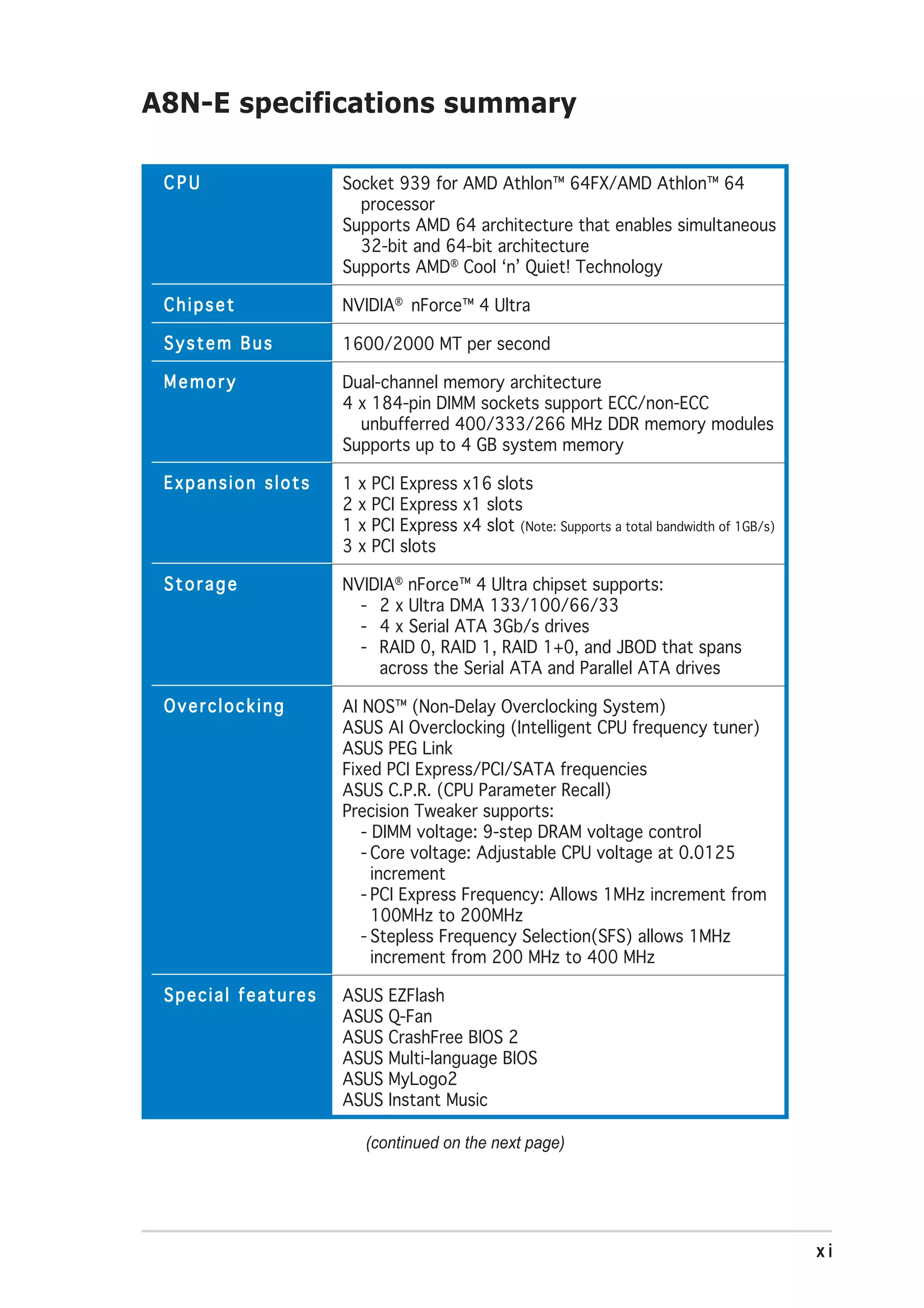
A8N-E specifications summary

 CPU                Socket 939 for AMD Athlon™ 64FX/AMD Athlon™ 64
                      processor
                    Supports AMD 64 architecture that enables simultaneous
                      32-bit and 64-bit architecture
                    Supports AMD® Cool ‘n’ Quiet! Technology

 Chipset            NVIDIA® nForce™ 4 Ultra

 System Bus         1600/2000 MT per second

 Memory             Dual-channel memory architecture
                    4 x 184-pin DIMM sockets support ECC/non-ECC
                      unbufferred 400/333/266 MHz DDR memory modules
                    Supports up to 4 GB system memory

 Expansion slots    1 x PCI Express x16 slots
                    2 x PCI Express x1 slots
                    1 x PCI Express x4 slot (Note: Supports a total bandwidth of 1GB/s)
                    3 x PCI slots

 Storage            NVIDIA® nForce™ 4 Ultra chipset supports:
                      - 2 x Ultra DMA 133/100/66/33
                      - 4 x Serial ATA 3Gb/s drives
                      - RAID 0, RAID 1, RAID 1+0, and JBOD that spans
                        across the Serial ATA and Parallel ATA drives

 Overclocking       AI NOS™ (Non-Delay Overclocking System)
                    ASUS AI Overclocking (Intelligent CPU frequency tuner)
                    ASUS PEG Link
                    Fixed PCI Express/PCI/SATA frequencies
                    ASUS C.P.R. (CPU Parameter Recall)
                    Precision Tweaker supports:
                       - DIMM voltage: 9-step DRAM voltage control
                       - Core voltage: Adjustable CPU voltage at 0.0125
                         increment
                       - PCI Express Frequency: Allows 1MHz increment from
                         100MHz to 200MHz
                       - Stepless Frequency Selection(SFS) allows 1MHz
                         increment from 200 MHz to 400 MHz

 Special features   ASUS EZFlash
                    ASUS Q-Fan
                    ASUS CrashFree BIOS 2
                    ASUS Multi-language BIOS
                    ASUS MyLogo2
                    ASUS Instant Music

                       (continued on the next page)


                                                                                          xi
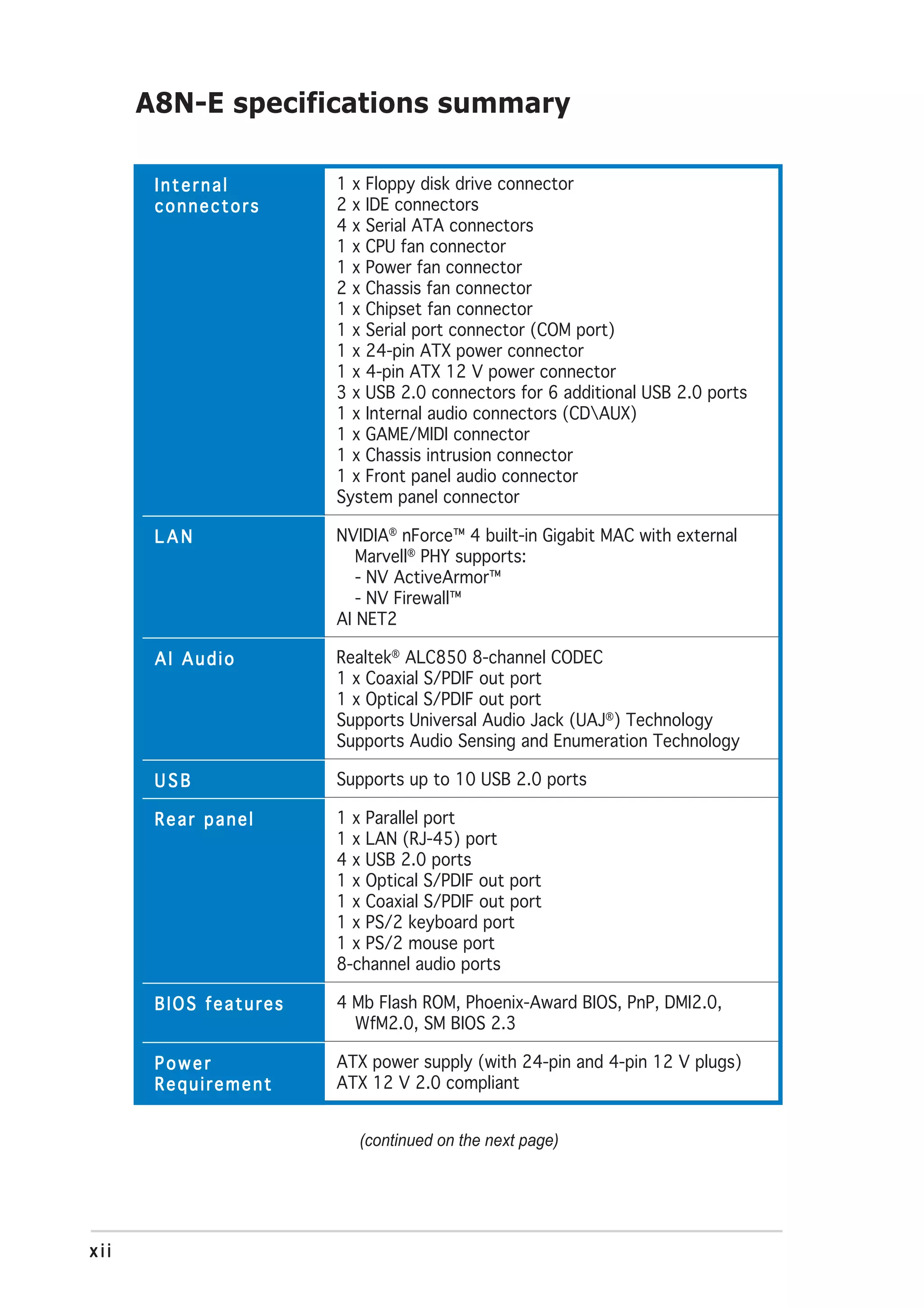
A8N-E specifications summary

       Internal        1 x Floppy disk drive connector
       connectors      2 x IDE connectors
                       4 x Serial ATA connectors
                       1 x CPU fan connector
                       1 x Power fan connector
                       2 x Chassis fan connector
                       1 x Chipset fan connector
                       1 x Serial port connector (COM port)
                       1 x 24-pin ATX power connector
                       1 x 4-pin ATX 12 V power connector
                       3 x USB 2.0 connectors for 6 additional USB 2.0 ports
                       1 x Internal audio connectors (CDAUX)
                       1 x GAME/MIDI connector
                       1 x Chassis intrusion connector
                       1 x Front panel audio connector
                       System panel connector

       LAN             NVIDIA® nForce™ 4 built-in Gigabit MAC with external
                          Marvell® PHY supports:
                          - NV ActiveArmor™
                          - NV Firewall™
                       AI NET2

       AI Audio        Realtek® ALC850 8-channel CODEC
                       1 x Coaxial S/PDIF out port
                       1 x Optical S/PDIF out port
                       Supports Universal Audio Jack (UAJ®) Technology
                       Supports Audio Sensing and Enumeration Technology

       USB             Supports up to 10 USB 2.0 ports

       Rear panel      1 x Parallel port
                       1 x LAN (RJ-45) port
                       4 x USB 2.0 ports
                       1 x Optical S/PDIF out port
                       1 x Coaxial S/PDIF out port
                       1 x PS/2 keyboard port
                       1 x PS/2 mouse port
                       8-channel audio ports

       BIOS features   4 Mb Flash ROM, Phoenix-Award BIOS, PnP, DMI2.0,
                         WfM2.0, SM BIOS 2.3

       Power           ATX power supply (with 24-pin and 4-pin 12 V plugs)
       Requirement     ATX 12 V 2.0 compliant


                          (continued on the next page)


xii
A8N-E specifications summary

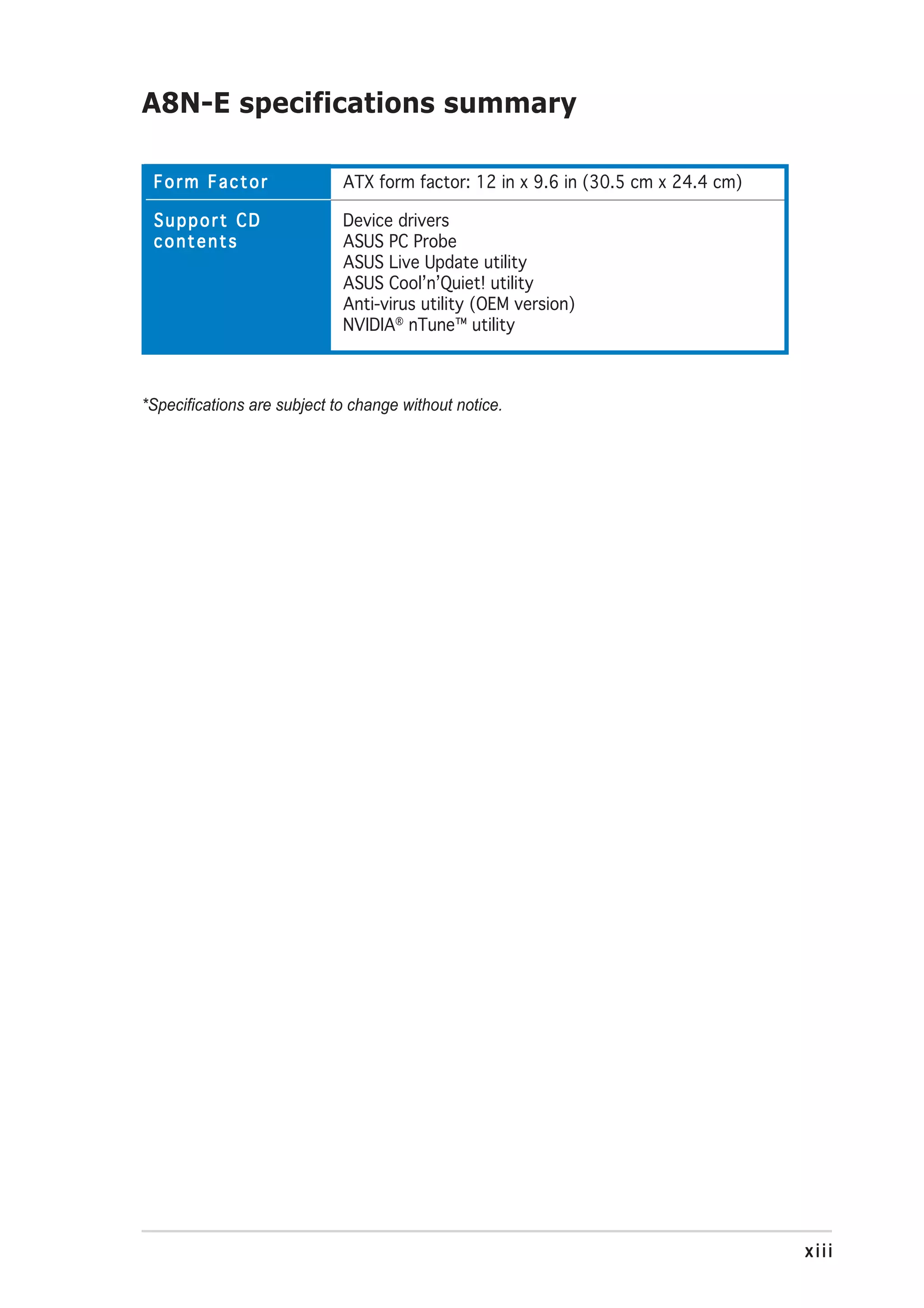
 Form Factor                 ATX form factor: 12 in x 9.6 in (30.5 cm x 24.4 cm)

 Support CD                  Device drivers
 contents                    ASUS PC Probe
                             ASUS Live Update utility
                             ASUS Cool’n’Quiet! utility
                             Anti-virus utility (OEM version)
                             NVIDIA® nTune™ utility


*Specifications are subject to change without notice.


                                                                                   xiii
xiv
This chapter describes the motherboard


                                         1
features and the new technologies
it supports.


                                       Product
                                  introduction


ASUS A8N-E                                       1-1
1.1          Welcome!
      T h a n k y o u f o r b u y i n g a n A S U S® A 8 N - E m o t h e r b o a r d !
      The motherboard delivers a host of new features and latest technologies,
      making it another standout in the long line of ASUS quality motherboards!
      Before you start installing the motherboard, and hardware devices on it,
      check the items in your package with the list below.


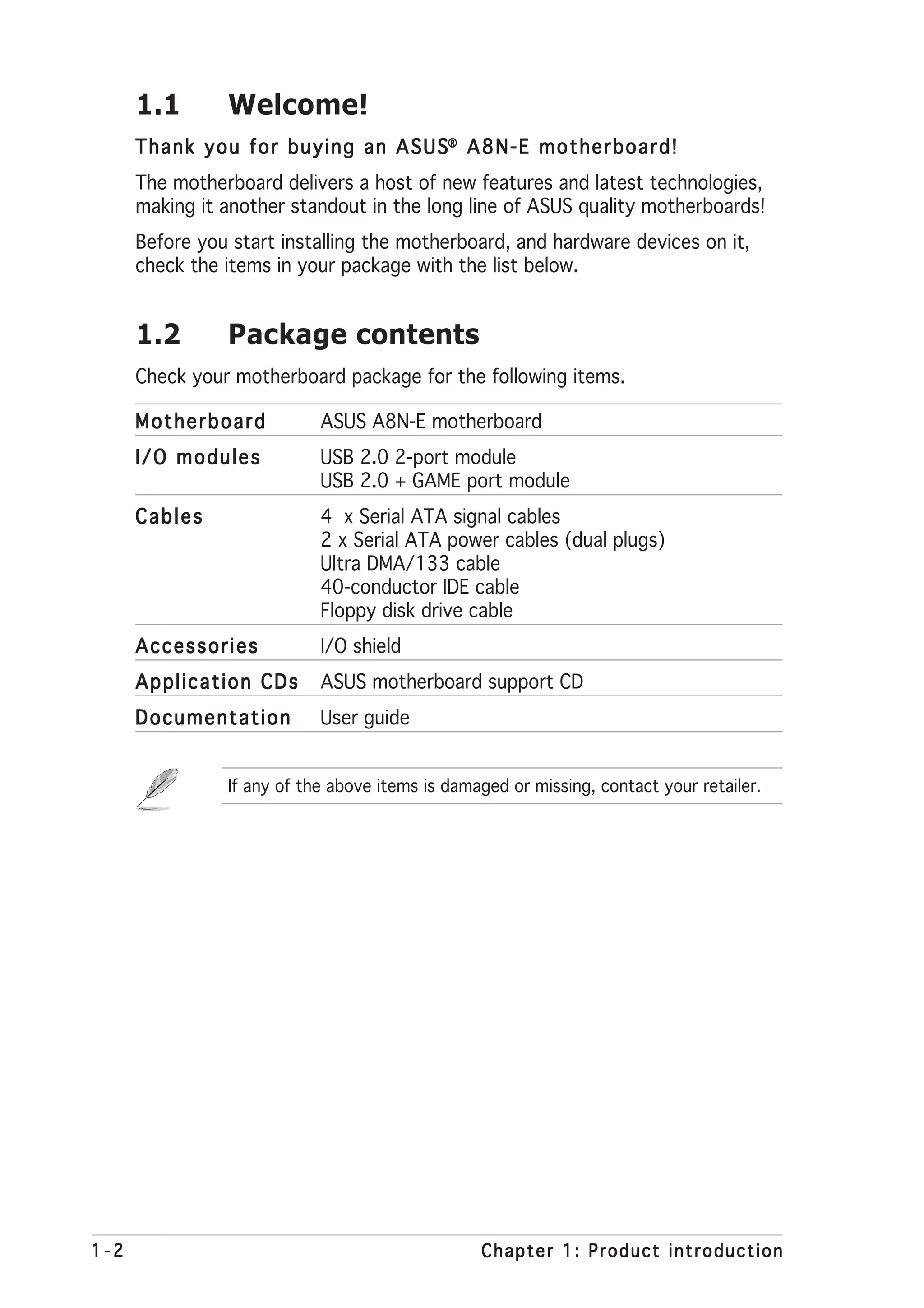
      1.2          Package contents
      Check your motherboard package for the following items.

      Motherboard                ASUS A8N-E motherboard
      I/O modules                USB 2.0 2-port module
                                 USB 2.0 + GAME port module
      Cables                     4 x Serial ATA signal cables
                                 2 x Serial ATA power cables (dual plugs)
                                 Ultra DMA/133 cable
                                 40-conductor IDE cable
                                 Floppy disk drive cable
      Accessories                I/O shield
      Application CDs            ASUS motherboard support CD
      Documentation              User guide


                   If any of the above items is damaged or missing, contact your retailer.


1-2                                                      Chapter 1: Product introduction
1.3       Special features
1.3.1     Product highlights


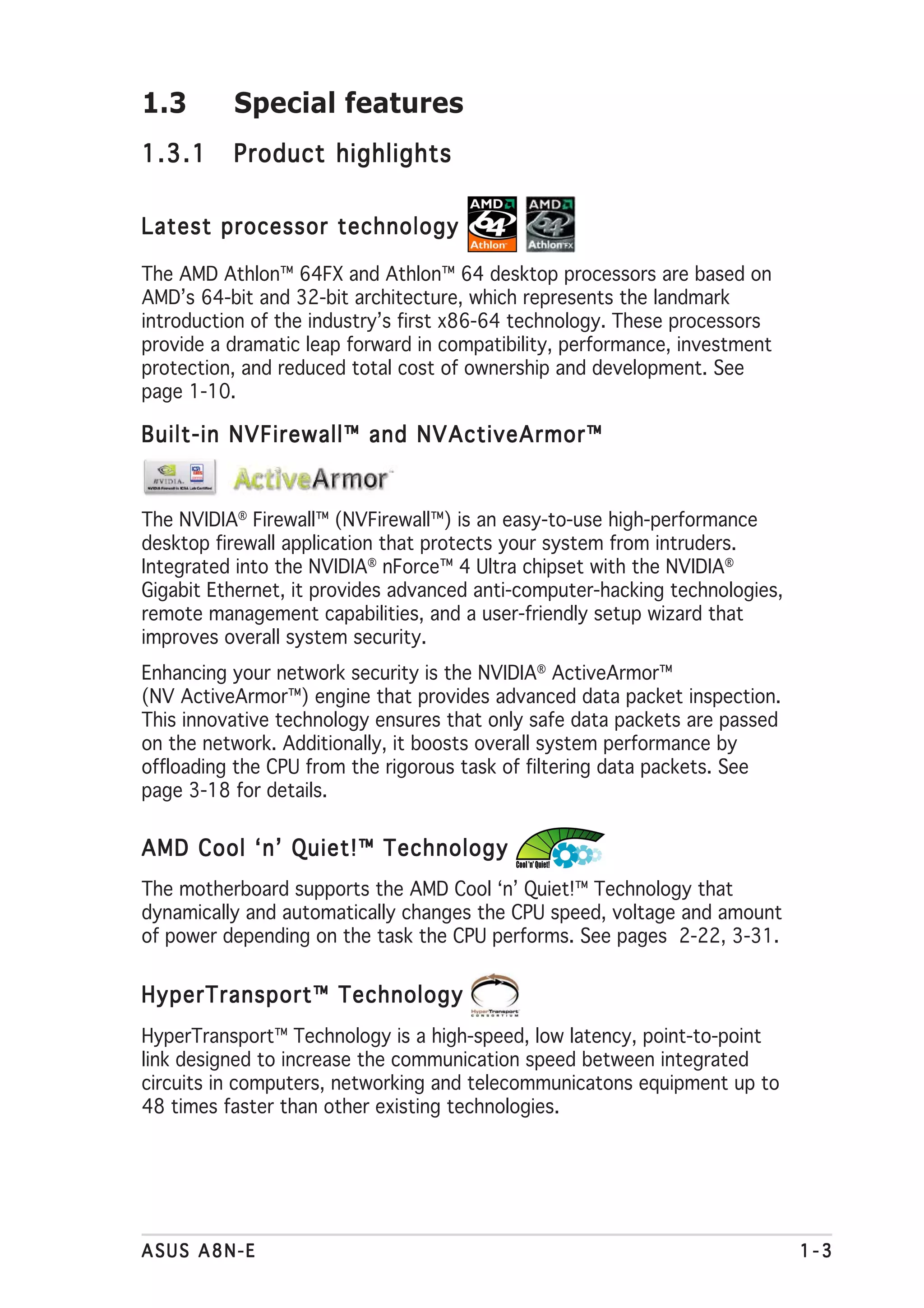
Latest processor technology

The AMD Athlon™ 64FX and Athlon™ 64 desktop processors are based on
AMD’s 64-bit and 32-bit architecture, which represents the landmark
introduction of the industry’s first x86-64 technology. These processors
provide a dramatic leap forward in compatibility, performance, investment
protection, and reduced total cost of ownership and development. See
page 1-10.

Built-in NVFirewall™ and NVActiveArmor™


The NVIDIA® Firewall™ (NVFirewall™) is an easy-to-use high-performance
desktop firewall application that protects your system from intruders.
Integrated into the NVIDIA® nForce™ 4 Ultra chipset with the NVIDIA®
Gigabit Ethernet, it provides advanced anti-computer-hacking technologies,
remote management capabilities, and a user-friendly setup wizard that
improves overall system security.
Enhancing your network security is the NVIDIA® ActiveArmor™
(NV ActiveArmor™) engine that provides advanced data packet inspection.
This innovative technology ensures that only safe data packets are passed
on the network. Additionally, it boosts overall system performance by
offloading the CPU from the rigorous task of filtering data packets. See
page 3-18 for details.


AMD Cool ‘n’ Quiet!™ Technology
The motherboard supports the AMD Cool ‘n’ Quiet!™ Technology that
dynamically and automatically changes the CPU speed, voltage and amount
of power depending on the task the CPU performs. See pages 2-22, 3-31.


HyperTransport™ Technology
HyperTransport™ Technology is a high-speed, low latency, point-to-point
link designed to increase the communication speed between integrated
circuits in computers, networking and telecommunicatons equipment up to
48 times faster than other existing technologies.


ASUS A8N-E                                                                   1-3
Dual Channel DDR memory support
      Employing the Double Data Rate (DDR) memory technology, the
      motherboard supports up to 4GB of system memory using DDR400/333/
      266 DIMMs. The ultra-fast 400MHz memory bus delivers the required
      bandwidth for the latest 3D graphics, multimedia, and Internet applications.
      See page 1-15.


      Serial ATA 3Gb/s technology
      The motherboard supports the next-generation Serial ATA 3Gb/s
      technology through the Serial ATA interfaces and the NVIDIA® nForce™ 4
      Ultra chipset. The SATA 3Gb/s specification provides twice the bandwidth
      of the current Serial ATA products. Additionally, Serial ATA allows thinner,
      more flexible cables with lower pin count, and reduced voltage requirement.
      See pages 1-25.

      RAID solution
      The NVIDIA® nForce™ 4 Ultra RAID controller onboard provides the
      motherboard with RAID 0, RAID 1, RAID 1+0 and JBOD configuration for
      four SATA and two PATA connectors. See page 3-21 for details.

      PCI Express™ interface
      The motherboard fully supports PCI Express, the latest I/O interconnect
      technology that speeds up the PCI bus. PCI Express features point-to-point
      serial interconnections between devices and allows higher clockspeeds by
      carrying data in packets. This high speed interface is software compatible with
      existing PCI specifications. See page 1-20 for details.

      S/PDIF digital sound ready
      The motherboard supports the S/PDIF Out function through the S/PDIF
      interfaces on the rear panel. The S/PDIF technology turns your computer into
      a high-end entertainment system with digital connectivity to powerful audio
      and speaker systems. See page 1-23 for details.


      USB 2.0 technology
      The motherboard implements the Universal Serial Bus (USB) 2.0
      specification, dramatically increasing the connection speed from the
      12 Mbps bandwidth on USB 1.1 to a fast 480 Mbps on USB 2.0. USB 2.0 is
      backward compatible with USB 1.1. See page 1-23 and 1-27 for details.


1-4                                             Chapter 1: Product introduction
Temperature, fan, and voltage monitoring
The CPU temperature is monitored by the ASIC (integrated in the Winbond
Super I/O) to prevent overheating and damage. The system fan rotations
per minute (RPM) is monitored for timely failure detection. The ASIC
monitors the voltage levels to ensure stable supply of current for critical
components. See section “2.5.4 Hardware Monitor” on page 2-35.


1.3.2     ASUS Proactive features

AI NOS™ (Non-Delay Overclocking System)
ASUS Non-delay Overclocking System™ (NOS) is a technology that
auto-detects the CPU loading and dynamically overclocks the CPU speed
only when needed. See page 2-28 for details.


Precision Tweaker
Designed for overclocking aficionados, this feature allows you to fine tune
the CPU and memory voltage and gradually increase the Front Side Bus
(FSB) and PCI Express frequency to achieve maximum system performance.

PEG Link mode
This feature allows you to adjust the PCI Express graphics frequency
according to your system configuration for optimized graphics
performance.


AI NET 2
AI NET 2 is a BIOS-based diagnostic tool that detects and reports Ethernet
cable faults and shorts. With this utility, you can easily monitor the
condition of the Ethernet cable(s) connected to the LAN (RJ-45) port(s).
During the bootup process, AI NET 2 immediately diagnoses the LAN
cable(s) and reports shorts and faults up to 100 meters at 1 meter
accuracy. See pages 2-30 and 3-11 for details.

AI Audio technology
The motherboard supports 8-channel audio through the onboard ALC850
CODEC with 16-bit DAC, a stereo 16-bit ADC, and an AC97 2.3 compatible
multi-channel audio designed for PC multimedia systems. It also provides
Jack-Sensing function, S/PDIF out support, interrupt capability and includes
the Realtek® proprietary UAJ® (Universal Audio Jack) technology. See pages
1-22, 1-23 and 3-12 for details.


ASUS A8N-E                                                                     1-5
1.3.3     Innovative ASUS features

      CrashFree BIOS 2
      This feature allows you to restore the original BIOS data from the support CD
      in case when the BIOS codes and data are corrupted. This protection
      eliminates the need to buy a replacement ROM chip. See details on page 2-5.


      ASUS Q-Fan technology
      The ASUS Q-Fan technology smartly adjusts the fan speeds according to
      the system loading to ensure quiet, cool, and efficient operation. See page
      2-35 for details.

      ASUS Multi-language BIOS
      The multi-language BIOS allows you to select the language of your choice
      from the available options. The localized BIOS menus allow you to configure
      easier and faster. See page 2-16 for details.

      ASUS MyLogo2™
      This new feature present in the motherboard allows you to personalize and
      add style to your system with customizable boot logos. See page 3-9 for
      details.


      ASUS Instant Lite
      This unique feature allows you to playback audio files even without booting
      the system to Windows. Just press the ASUS Instant Music Lite special
      function keys and enjoy the music! See pages 2-31.


1-6                                            Chapter 1: Product introduction
1.4       Before you proceed
Take note of the following precautions before you install motherboard
components or change any motherboard settings.

          •        Unplug the power cord from the wall socket before touching any
                   component.
          •        Use a grounded wrist strap or touch a safely grounded object or to
                   a metal object, such as the power supply case, before handling
                   components to avoid damaging them due to static electricity
          •        Hold components by the edges to avoid touching the ICs on them.
          •        Whenever you uninstall any component, place it on a grounded
                   antistatic pad or in the bag that came with the component.
          •        Before you install or remove any component, ensure
                   that the ATX power supply is switched off or the
                   p o w e r c o r d i s d e t a c h e d f r o m t h e p o w e r s u p p l y . Failure
                   to do so may cause severe damage to the motherboard, peripherals,
                   and/or components.


Onboard LEDs
    The motherboard comes with a green standby power LED that lights
    up to indicate that the system is ON, in sleep mode, or in soft-off
    mode. This is a reminder that you should shut down the system and
    unplug the power cable before removing or plugging in any
    motherboard component.


           A8N-E
                                                    SB_PWR
                   ®


                                               ON                OFF
                                             Standby           Powered
      A8N-E Onboard LED                       Power              Off


ASUS A8N-E                                                                                               1-7
1.5        Motherboard overview
      Before you install the motherboard, study the configuration of your chassis
      to ensure that the motherboard fits into it.

                 Make sure to unplug the power cord before installing or removing the
                 motherboard. Failure to do so can cause you physical injury and damage
                 motherboard components.


      1.5.1      Placement direction
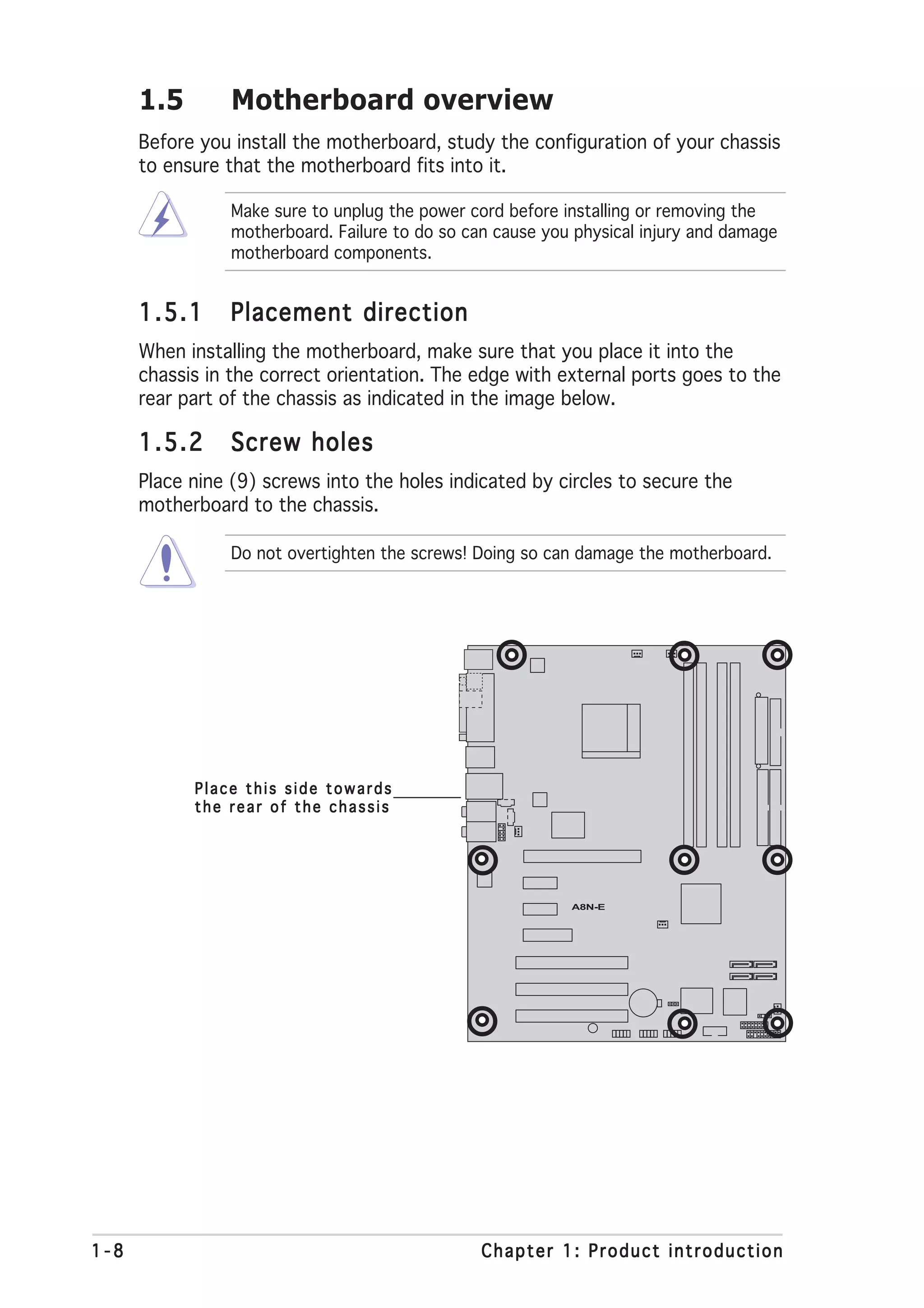
      When installing the motherboard, make sure that you place it into the
      chassis in the correct orientation. The edge with external ports goes to the
      rear part of the chassis as indicated in the image below.

      1.5.2      Screw holes
      Place nine (9) screws into the holes indicated by circles to secure the
      motherboard to the chassis.

                 Do not overtighten the screws! Doing so can damage the motherboard.


            Place this side towards
            the rear of the chassis


                                                            A8N-E


1-8                                              Chapter 1: Product introduction
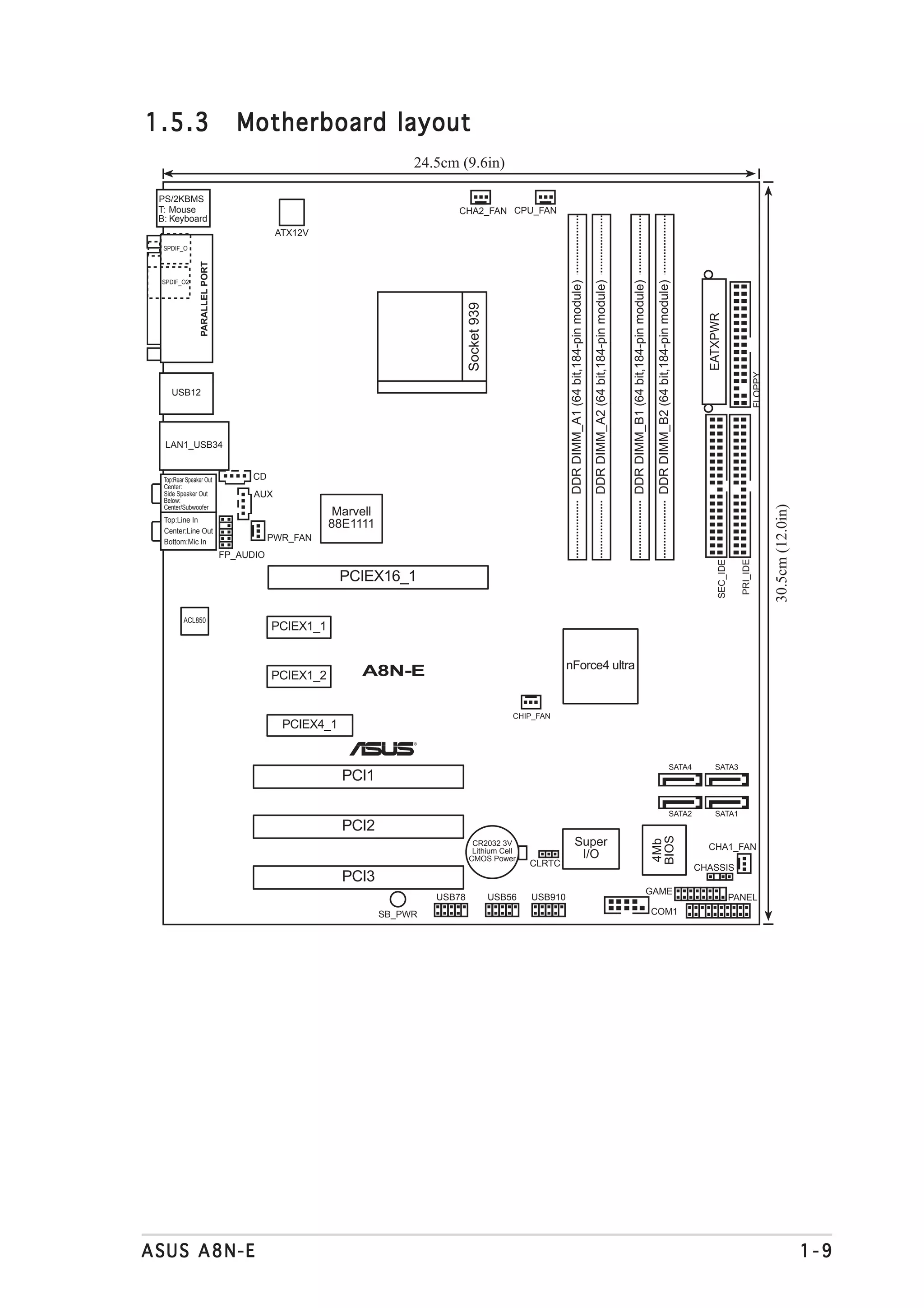
1.5.3                               Motherboard layout
                                                                       24.5cm (9.6in)

 PS/2KBMS
 T: Mouse                                                                     CHA2_FAN CPU_FAN
 B: Keyboard
                                             ATX12V
  SPDIF_O
                 PARALLEL PORT


 SPDIF_O2


                                                                                                                  DDR DIMM_A1 (64 bit,184-pin module)
                                                                                                                                                        DDR DIMM_A2 (64 bit,184-pin module)


                                                                                                                                                                                              DDR DIMM_B1 (64 bit,184-pin module)
                                                                                                                                                                                                                                     DDR DIMM_B2 (64 bit,184-pin module)
                                                                                   Socket 939


                                                                                                                                                                                                                                                                             EATXPWR


                                                                                                                                                                                                                                                                                                        FLOPPY
     USB12


  LAN1_USB34


  Top:Rear Speaker Out                CD
  Center:
  Side Speaker Out                     AUX
  Below:


                                                                                                                                                                                                                                                                                                                 30.5cm (12.0in)
  Center/Subwoofer
                                                        Marvell
  Top:Line In
  Center:Line Out
                                                       88E1111
  Bottom:Mic In                             PWR_FAN
                                 FP_AUDIO


                                                                                                                                                                                                                                                                                              PRI_IDE
                                                                                                                                                                                                                                                                                  SEC_IDE
                                                         PCIEX16_1

          ACL850
                                            PCIEX1_1


                                                                                                                 nForce4 ultra
                                            PCIEX1_2        A8N-E

                                                                                                    CHIP_FAN
                                              PCIEX4_1
                                                                       ®


                                                                                                                                                                                                                                                                  SATA4         SATA3
                                                         PCI1

                                                                                                                                                                                                                                                                  SATA2         SATA1
                                                         PCI2
                                                                                                                                                                                                                                    BIOS


                                                                                                                          Super
                                                                                                                                                                                                                                    4Mb


                                                                                    CR2032 3V
                                                                                    Lithium Cell                                                                                                                                                                             CHA1_FAN
                                                                                   CMOS Power                              I/O
                                                                                                        CLRTC                                                                                                                                                              CHASSIS
                                                         PCI3
                                                                                                                                                                                                                               GAME
                                                                           USB78                USB56   USB910                                                                                                                                                                              PANEL
                                                                  SB_PWR                                                                                                                                                            COM1


ASUS A8N-E                                                                                                                                                                                                                                                                                                                         1-9
1.6       Central Processing Unit (CPU)
       1.6.1     Overview
       The motherboard comes with a surface mount 939-pin Zero Insertion Force
       (ZIF) socket designed for the AMD Athlon™ 64FX, AMD Athlon 64™ or AMD
       Sempron™ processor.
       The 128-bit-wide data paths of these processors can run applications
       faster than processors with only 32-bit or 64-bit wide data paths.

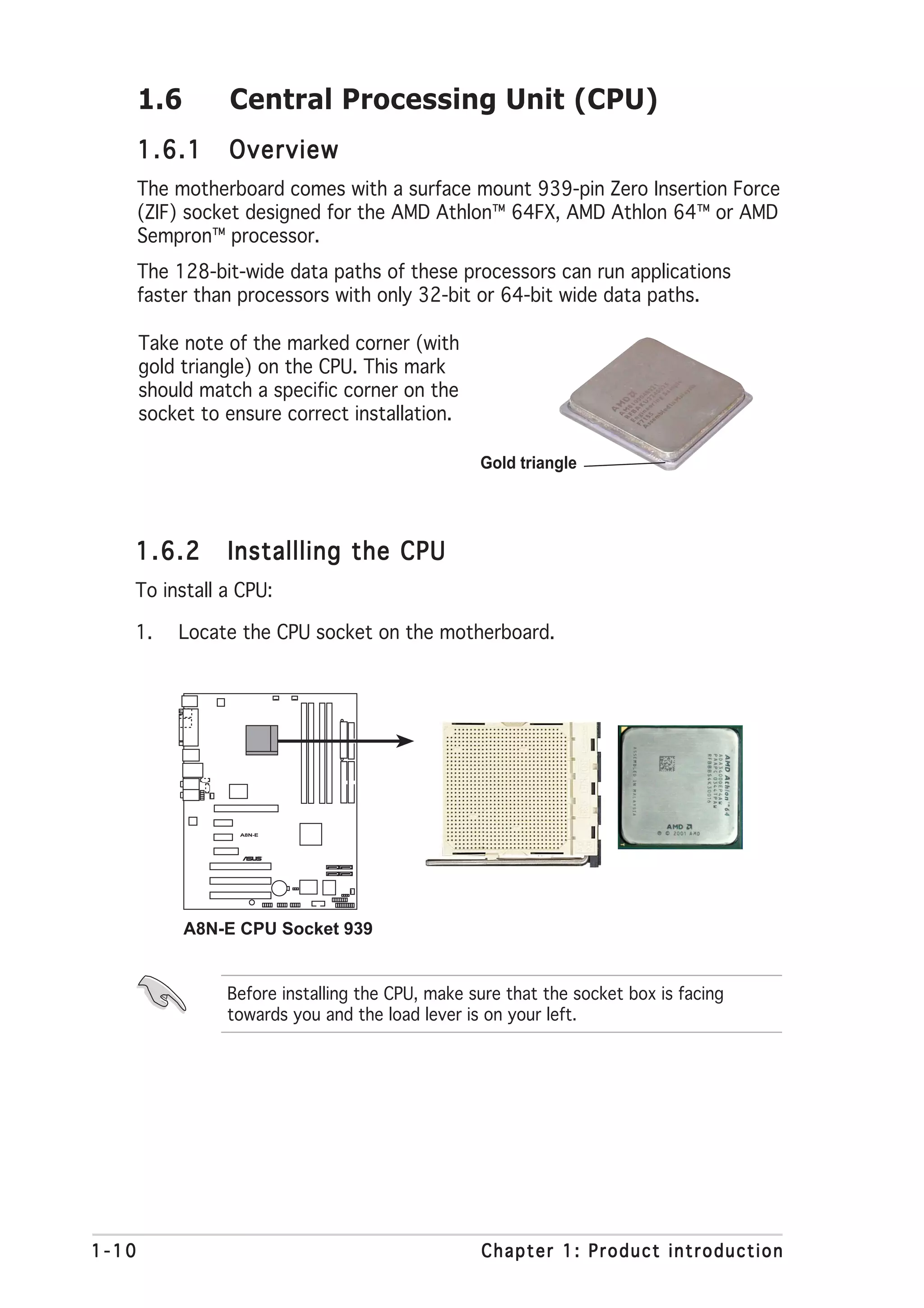
       Take note of the marked corner (with
       gold triangle) on the CPU. This mark
       should match a specific corner on the
       socket to ensure correct installation.

                                                  Gold triangle


   1.6.2         Installling the CPU
   To install a CPU:

   1.      Locate the CPU socket on the motherboard.


                   A8N-E


                           ®


             A8N-E CPU Socket 939


                 Before installing the CPU, make sure that the socket box is facing
                 towards you and the load lever is on your left.


1-10                                              Chapter 1: Product introduction
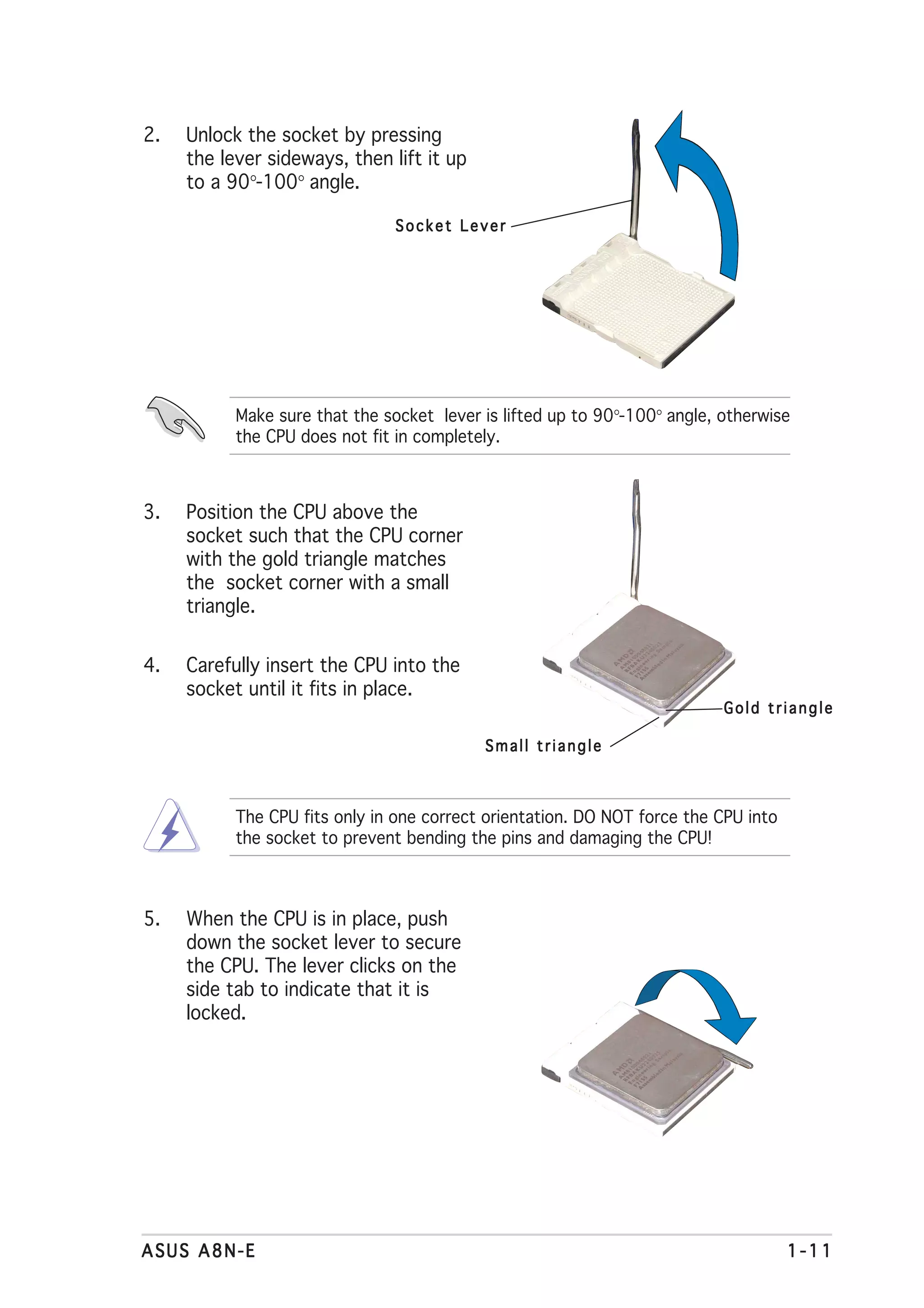
2.   Unlock the socket by pressing
     the lever sideways, then lift it up
     to a 90°-100° angle.

                               Socket Lever


           Make sure that the socket lever is lifted up to 90°-100° angle, otherwise
           the CPU does not fit in completely.


3.   Position the CPU above the
     socket such that the CPU corner
     with the gold triangle matches
     the socket corner with a small
     triangle.


4.   Carefully insert the CPU into the
     socket until it fits in place.
                                                                           Gold triangle

                                           Small triangle


           The CPU fits only in one correct orientation. DO NOT force the CPU into
           the socket to prevent bending the pins and damaging the CPU!


5.   When the CPU is in place, push
     down the socket lever to secure
     the CPU. The lever clicks on the
     side tab to indicate that it is
     locked.


ASUS A8N-E                                                                           1-11
1.6.3        Installing the heatsink and fan
       The AMD Athlon™ 64FX or AMD Athlon 64™ processor require a specially
       designed heatsink and fan assembly to ensure optimum thermal condition
       and performance.

                    Make sure that you use only qualified heatsink and fan assembly.


       Follow these steps to install the CPU heatsink and fan.

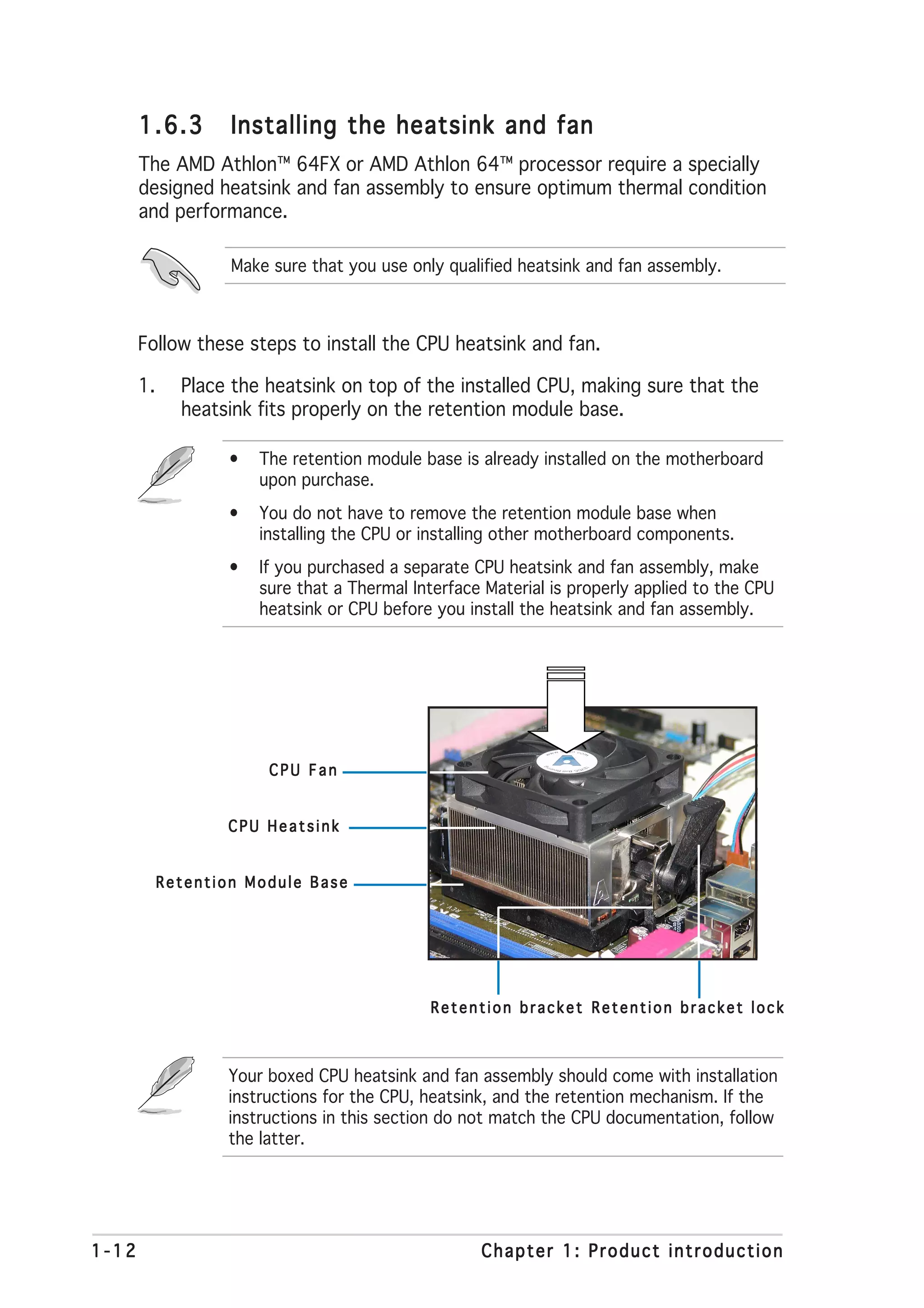
       1.     Place the heatsink on top of the installed CPU, making sure that the
              heatsink fits properly on the retention module base.

                   •   The retention module base is already installed on the motherboard
                       upon purchase.
                   •   You do not have to remove the retention module base when
                       installing the CPU or installing other motherboard components.
                   •   If you purchased a separate CPU heatsink and fan assembly, make
                       sure that a Thermal Interface Material is properly applied to the CPU
                       heatsink or CPU before you install the heatsink and fan assembly.


                        CPU Fan


                   CPU Heatsink


            Retention Module Base


                                              Retention bracket Retention bracket lock


                   Your boxed CPU heatsink and fan assembly should come with installation
                   instructions for the CPU, heatsink, and the retention mechanism. If the
                   instructions in this section do not match the CPU documentation, follow
                   the latter.


1-12                                                Chapter 1: Product introduction
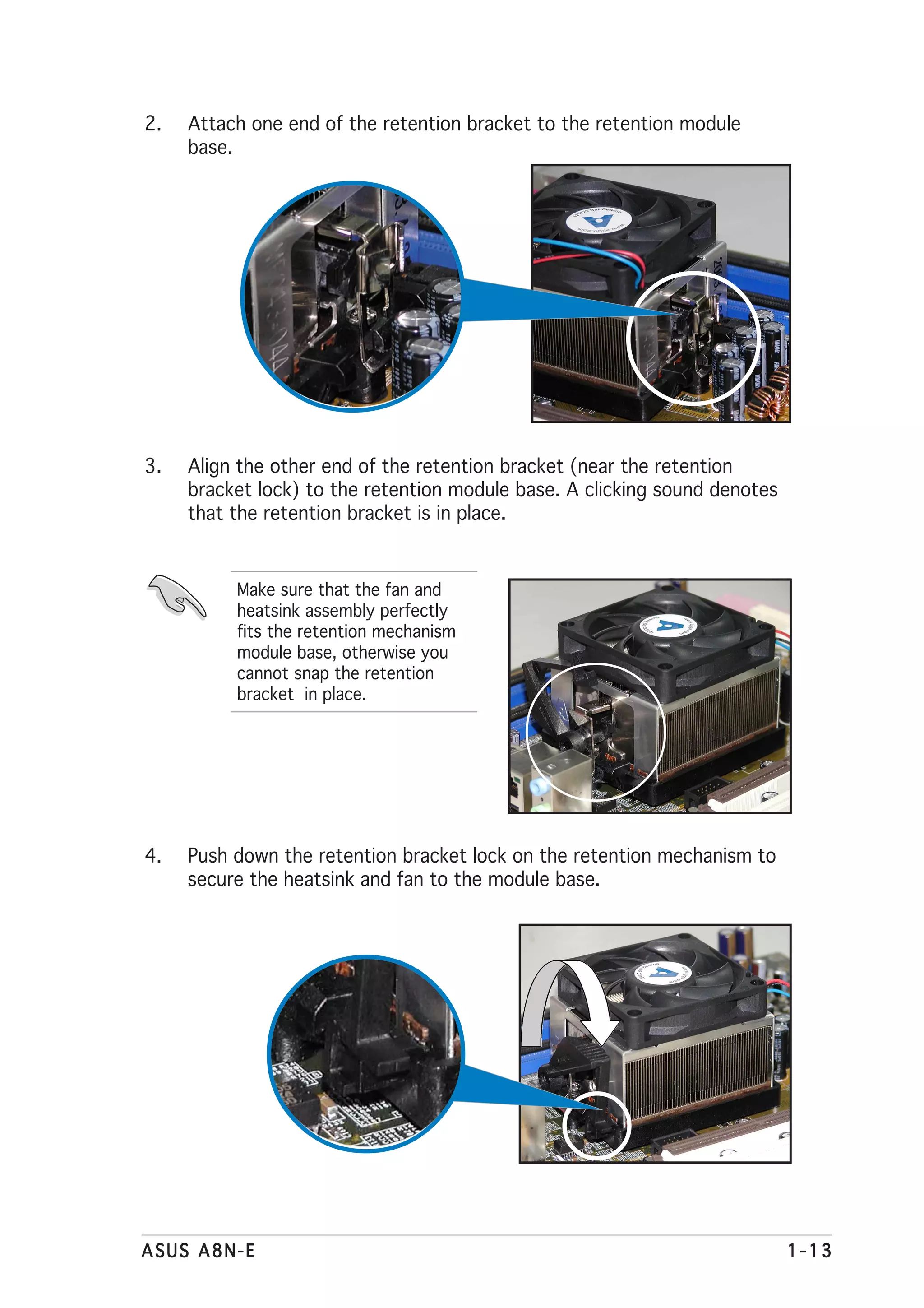
2.   Attach one end of the retention bracket to the retention module
     base.


3.   Align the other end of the retention bracket (near the retention
     bracket lock) to the retention module base. A clicking sound denotes
     that the retention bracket is in place.


          Make sure that the fan and
          heatsink assembly perfectly
          fits the retention mechanism
          module base, otherwise you
          cannot snap the retention
          bracket in place.


4.   Push down the retention bracket lock on the retention mechanism to
     secure the heatsink and fan to the module base.


ASUS A8N-E                                                                  1-13
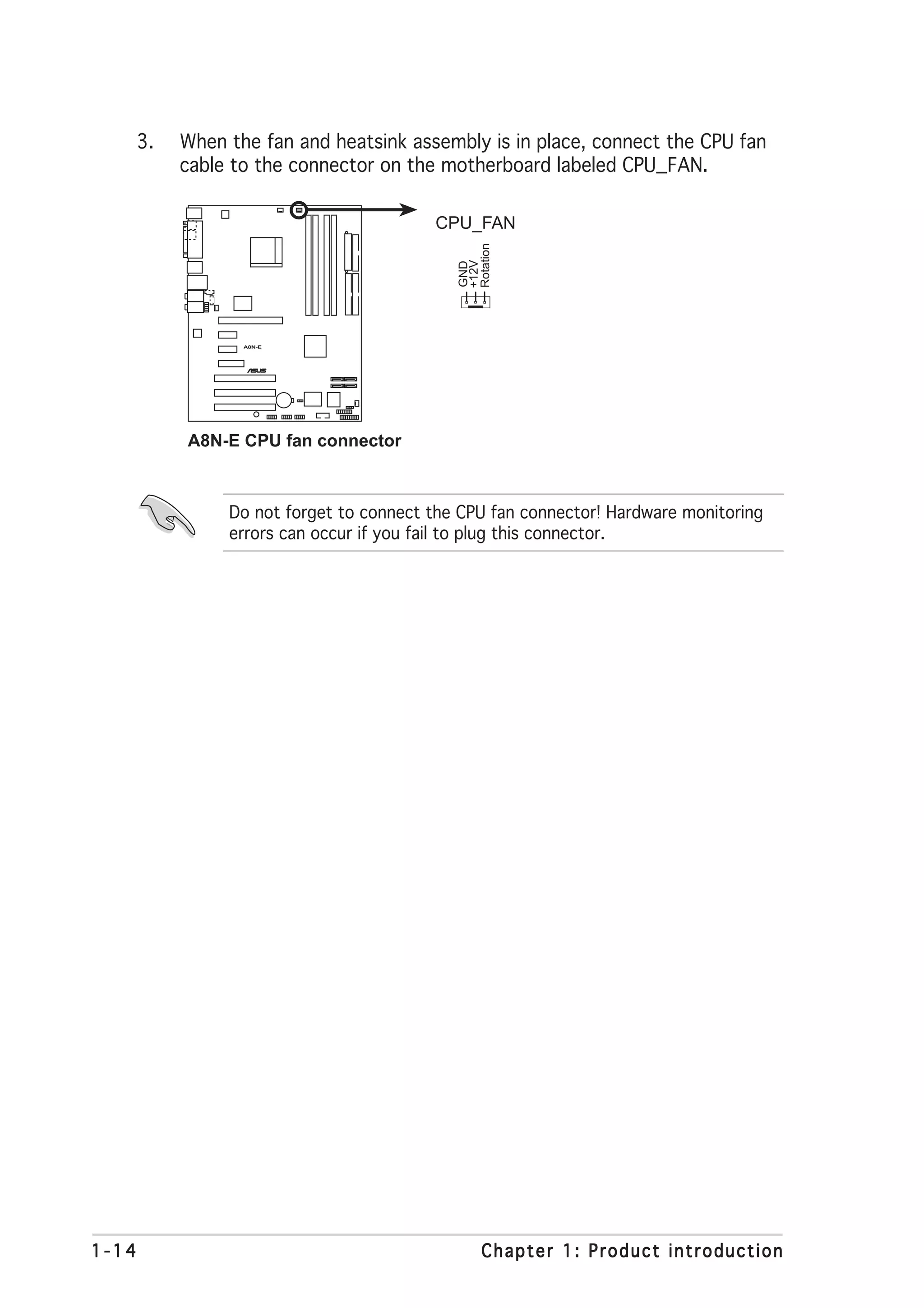
3.   When the fan and heatsink assembly is in place, connect the CPU fan
            cable to the connector on the motherboard labeled CPU_FAN.

                                          CPU_FAN


                                             Rotation
                                             +12V
                                             GND
                   A8N-E


                           ®


            A8N-E CPU fan connector


                 Do not forget to connect the CPU fan connector! Hardware monitoring
                 errors can occur if you fail to plug this connector.


1-14                                              Chapter 1: Product introduction
1.7        System memory
1.7.1      Overview
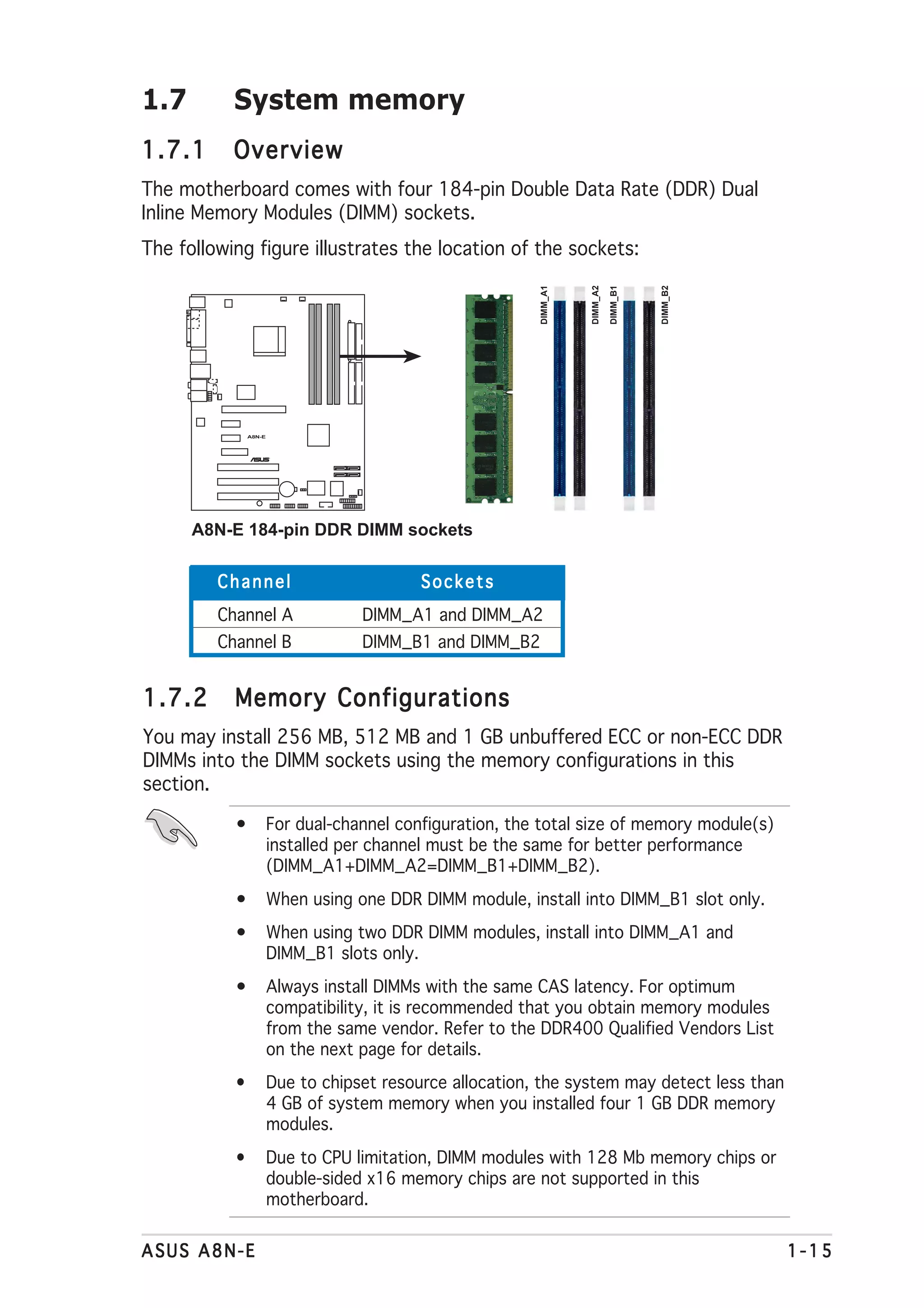
The motherboard comes with four 184-pin Double Data Rate (DDR) Dual
Inline Memory Modules (DIMM) sockets.
The following figure illustrates the location of the sockets:


                                                                                        DIMM_B2
                                                                    DIMM_A2

                                                                              DIMM_B1
                                                          DIMM_A1
               A8N-E


                       ®


      A8N-E 184-pin DDR DIMM sockets


         Channel                           Sockets
         Channel A                 DIMM_A1 and DIMM_A2
         Channel B                 DIMM_B1 and DIMM_B2


1.7.2      Memory Configurations
You may install 256 MB, 512 MB and 1 GB unbuffered ECC or non-ECC DDR
DIMMs into the DIMM sockets using the memory configurations in this
section.

           •           For dual-channel configuration, the total size of memory module(s)
                       installed per channel must be the same for better performance
                       (DIMM_A1+DIMM_A2=DIMM_B1+DIMM_B2).
           •           When using one DDR DIMM module, install into DIMM_B1 slot only.
           •           When using two DDR DIMM modules, install into DIMM_A1 and
                       DIMM_B1 slots only.
           •           Always install DIMMs with the same CAS latency. For optimum
                       compatibility, it is recommended that you obtain memory modules
                       from the same vendor. Refer to the DDR400 Qualified Vendors List
                       on the next page for details.
           •           Due to chipset resource allocation, the system may detect less than
                       4 GB of system memory when you installed four 1 GB DDR memory
                       modules.
           •           Due to CPU limitation, DIMM modules with 128 Mb memory chips or
                       double-sided x16 memory chips are not supported in this
                       motherboard.

ASUS A8N-E                                                                                        1-15
DDR400 Qualified Vendors List

                                                                                             DIMM support
       Size     Vendor          Model              Brand         Side(s)    Component           A  B   C
       256MB    KINGSTON   KVR400X64C3A/256       Hynix            SS      HY5DU56822BT-D43       •   •   •
       512MB    KINGSTON   KVR400X64C3A/512       Hynix            DS      HY5DU56822BT-D43       •   •   •
       256MB    KINGSTON   KVR400X72C3A/256       Mosel            SS      V58C2256804SAT5(ECC)   •   •   •
       512MB    KINGSTON   KVR400X72C3A/512       Mosel            DS      V58C2256804SAT5(ECC)   •       •
       256MB    KINGSTON   KVR400X64C3A/256       Infineon         SS      HYB25D256800BT-5B      •   •   •
       512MB    KINGSTON   KVR400X64C3A/512       Infineon         DS      HYB25D256809BT-5B      •   •
       256MB    KINGSTON   KVR400X64C3A/256       KINGSTON         SS      D3208DL2T-5            •   •   •
       512MB    KINGSTON   KVR400X64C3A/512       KINGSTON         DS      D328DIB-50             •   •   •
       1024MB   KINGSTON   HYB25D512800BE-5B      N/A              DS      KVR400X64C3A/1G        •   •   •
       256MB    SAMSUNG    M381L3223ETM-CCC       SAMSUNG          SS      K4H560838E-TCCC(ECC)   •   •   •
       512MB    SAMSUNG    M381L6423ETM-CCC       SAMSUNG          DS      K4H560838E-TCCC(ECC)           •
       256MB    SAMSUNG    M368L3223ETM-CCC       SAMSUNG          SS      K4H560838E-TCCC        •   •   •
       256MB    SAMSUNG    M368L3223FTN-CCC       SAMSUNG          SS      K4H560838F-TCCC        •   •   •
       512MB    SAMSUNG    M368L6423FTN-CCC       SAMSUNG          DS      K4H560838F-TCCC        •   •   •
       512MB    SAMSUNG    M368L6523BTM-CCC       SAMSUNG          SS      K4H510838B-TCCC        •   •   •
       256MB    MICRON     MT8VDDT3264AG-40BCB    MICRON           SS      MT46V32M8TG-5BC        •   •   •
       512MB    MICRON     MT16VDDT6464AG-40BCB   MICRON           DS      MT46V32M8TG-5BC        •   •   •
       256MB    Infineon   HYS64D32300HU-5-C      Infineon         SS      HYB25D256800CE-5C      •   •   •
       512MB    Infineon   HYS64D64320HU-5-C      Infineon         DS      HYB25D256800CE-5C      •   •   •
       256MB    CORSAIR    CMX256A-3200C2PT       Winbond          SS      W942508BH-5            •   •   •
       512MB    CORSAIR    VS512MB400             VALUE seLecT     DS      VS32M8-5               •       •
       1024MB   CORSAIR    TWINX2048-3200C2       N/A              DS      N/A                    •   •
       256MB    Hynix      HYMD232645D8J-D43      Hynix            SS      HY5DU56822DT-D43       •   •   •
       512MB    Hynix      HYMD264646D8J-D43      Hynix            DS      HY5DU56822DT-D43       •   •   •


   S i d e ( s ) : S S - Single-Sided             D S - Double-Sided
   DIMM Support:
   A - supports one module inserted into either the blue slots, in a Single-channel
       memory configuration.
   B - supports on pair of modules inserted into either the blue slots or the black slots
       as one pair of Dual-channel memory configuration.
   C - support for 4 modules inserted into the blue and black slots as two pairs of
       Dual-channel memory configuration.


                   Visit the ASUS website (www.asus.com) for the latest DDR 400 Qualified
                   Vendors List.


1-16                                                   Chapter 1: Product introduction
1.7.3      Installing a DIMM

           Make sure to unplug the power supply before adding or removing DIMMs
           or other system components. Failure to do so may cause severe damage
           to both the motherboard and the components.

                                                                        2
1.   Unlock a DIMM socket by                                   DDR DIMM notch
     pressing the retaining clips
     outward.
                                                                                1
2.   Align a DIMM on the socket such
     that the notch on the DIMM
     matches the break on the
     socket.                                   1


                                                          Unlocked retaining clip


          A DDR DIMM is keyed with a notch so that it fits in only one direction.
          DO NOT force a DIMM into a socket to avoid damaging the DIMM.


3.   Firmly insert the DIMM into the
     socket until the retaining clips
     snap back in place and the DIMM
     is properly seated.


                                          Locked Retaining Clip

1.7.4      Removing a DIMM
                                                                    2
Follow these steps to remove a DIMM.

1.   Simultaneously press the                                                   1
     retaining clips outward to unlock
     the DIMM.
                                              1         DDR DIMM notch

           Support the DIMM lightly with your fingers when pressing the retaining
           clips. The DIMM might get damaged when it flips out with extra force.


2.   Remove the DIMM from the socket.


ASUS A8N-E                                                                          1-17
1.8       Expansion slots
       In the future, you may need to install expansion cards. The following
       sub-sections describe the slots and the expansion cards that they support.

                 Make sure to unplug the power cord before adding or removing
                 expansion cards. Failure to do so may cause you physical injury and
                 damage motherboard components.


                 We recommended to install the memory modules first before installing a
                 PCI Express x16 card.


   1.8.1         Installing an expansion card
   To install an expansion card:

   1.      Before installing the expansion card, read the documentation that
           came with it and make the necessary hardware settings for the card.
   2.      Remove the system unit cover (if your motherboard is already
           installed in a chassis).
   3.      Remove the bracket opposite the slot that you intend to use. Keep
           the screw for later use.
   4.      Align the card connector with the slot and press firmly until the card is
           completely seated on the slot.
   5.      Secure the card to the chassis with the screw you removed earlier.
   6.      Replace the system cover.

   1.8.2         Configuring an expansion card
   After installing the expansion card, configure the it by adjusting the
   software settings.

   1.      Turn on the system and change the necessary BIOS settings, if any.
           See Chapter 2 for information on BIOS setup.
   2.      Assign an IRQ to the card. Refer to the tables on the next page.
   3.      Install the software drivers for the expansion card.


1-18                                              Chapter 1: Product introduction
1.8.3       Interrupt assignments
Standard interrupt assignments
    IRQ          Priority           Standard Function
    0               1               System Timer
    1               2               Keyboard Controller
    2                –              Re-direct to IRQ#9
    4               12              Communications Port (COM1)*
    5               13              IRQ holder for PCI steering*
    6               14              Floppy Disk Controller
    7               15              Printer Port (LPT1)*
    8               3               System CMOS/Real Time Clock
    9               4               IRQ holder for PCI steering*
    10              5               IRQ holder for PCI steering*
    11              6               IRQ holder for PCI steering*
    12              7               PS/2 Compatible Mouse Port*
    13              8               Numeric Data Processor
    14              9               Primary IDE Channel
    15              10              Secondary IDE Channel

* These IRQs are usually available for ISA or PCI devices.

IRQ assignments for this motherboard
                                A     B       C      D      E      F   G      H
 PCI slot 1                   shared   —      —      —      —      —   —      —
 PCI slot 2                     —    shared   —      —      —      —   —      —
 PCI slot 3                     —      —    shared   —      —      —   —      —
 Onboard USB 1.0 controller   shared   —      —      —      —      —   —      —
 Onboard USB 2.0 controller   shared   —      —      —      —      —   —      —
 Onboard LAN1                 shared   —      —      —      —      —   —      —


            When using PCI cards on shared slots, ensure that the drivers support
            “Share IRQ” or that the cards do not need IRQ assignments. Otherwise,
            conflicts will arise between the two PCI groups, making the system
            unstable and the card inoperable.


1.8.4       PCI slots
The PCI slots support cards such as a
LAN card, SCSI card, USB card, and
other cards that comply with PCI
specifications. The figure shows a
LAN card installed on a PCI slot.


ASUS A8N-E                                                                          1-19
1.8.5      PCI Express x16 slot
   This motherboard supports PCI
   Express x16 graphic cards that
   comply with the PCI Express
   specifications. The following figure
   shows a graphics card installed on
   the PCI Express x16 slot.


              In Normal mode, only the PCI Express blue slot can be used for PCI
              Express x16 graphics cards. The PCI Express black slot functions as a PCI
              Express x1 slot.


   1.8.6      PCI Express x1 slot
   This motherboard supports PCI
   Express x1 network cards, SCSI cards
   and other cards that comply with the
   PCI Express specifications. The figure
   shows a network card installed on the
   PCI Express x1 slot.


   1.8.7      Universal PCIe slot (PCI Express x4 slot)
   This motherboard provides a PCI
   Express x4 slot that can support PCI
   Express x1, x4, x8, or x16 cards. This
   ASUS proprietary slot allows you to
   use additional PCI Express cards
   (e.g. graphics card) for twice the
   speed of a PCI Express x1 slot.

              The Universal PCIe slot
              supports a total bandwidth of
              1GB/s.


1-20                                           Chapter 1: Product introduction
1.9        Jumpers
1.   Clear RTC RAM (CLRTC)
     This jumper allows you to clear the Real Time Clock (RTC) RAM in
     CMOS. You can clear the CMOS memory of date, time, and system
     setup parameters by erasing the CMOS RTC RAM data. The onboard
     button cell battery powers the RAM data in CMOS, which include
     system setup information such as system passwords.
To erase the RTC RAM:

1.   Turn OFF the computer and unplug the power cord.
2.   Remove the onboard battery.
3.   Move the jumper cap from pins 1-2 (default) to pins 2-3. Keep the
     cap on pins 2-3 for about 5~10 seconds, then move the cap back to
     pins 1-2.
4.   Re-install the battery.
5.   Plug the power cord and turn ON the computer.
6.   Hold down the <Del> key during the boot process and enter BIOS
     setup to re-enter data.

           Except when clearing the RTC RAM, never remove the cap on CLRTC
           jumper default position. Removing the cap will cause system boot failure!


                                               CLRTC
             A8N-E


                                         1 2            2 3
                     ®


                                         Normal     Clear CMOS
                                        (Default)

      A8N-E Clear RTC RAM


           You do not need to clear the RTC when the system hangs due to
           overclocking. For system failure due to overclocking, use the C.P.R. (CPU
           Parameter Recall) feature. Shut down and reboot the system so the BIOS
           can automatically reset parameter settings to default values.


ASUS A8N-E                                                                         1-21
1.10            Connectors
   1.10.1 Rear panel connectors

         1                          2                               3       4       5

                                                                                                   6

                                                                                                   7

                                                                                                   8

        14           13     12                            11         10         9
   1.   P S / 2 m o u s e p o r t ( g r e e n ) . This port is for a PS/2 mouse.
   2.   P a r a l l e l p o r t . This 25-pin port connects a parallel printer, a scanner,
        or other devices.
   3.   L A N ( R J - 4 5 ) p o r t . Supported by the NVIDIA® nForce™ 4 Gigabit
        MAC with external Marvell® PHY, this port allows Gigabit connection to
        a Local Area Network (LAN) through a network hub. Refer to the table
        below for the LAN port LED indications.

        LAN port LED indications
                                                                                    ACT/LINK SPEED
                   ACT/LINK LED                       SPEED LED                       LED     LED

             Status       Description      Status       Description
             OFF          No link          OFF          10 Mbps connection
             GREEN        Linked           ORANGE       100 Mbps connection             LAN port
             BLINKING     Data activity    GREEN        1 Gbps connection


   4.   R e a r S p e a k e r O u t p o r t ( g r a y ) . This port connects the rear
        speakers on a 4-channel, 6-channel, or 8-channel audio configuration.
   5.   S i d e S p e a k e r O u t p o r t ( b l a c k ) . This port connects the side
        speakers in an 8-channel audio configuration.
   6.   L i n e I n p o r t ( l i g h t b l u e ) . This port connects the tape, CD, DVD
        player, or other audio sources.
   7.   L i n e O u t p o r t ( l i m e ) . This port connects a headphone or a
        speaker. In 4-channel, 6-channel, and 8-channel configuration, the
        function of this port becomes Front Speaker Out.
   8.   M i c r o p h o n e p o r t ( p i n k ) . This port connects a microphone.
   9.   C e n t e r / S u b w o o f e r p o r t ( y e l l o w o r a n g e ) . This port connects
        the center/subwoofer speakers.


1-22                                                 Chapter 1: Product introduction
Refer to the audio configuration table below for the function of the
                audio ports in 2, 4, 6, or 8-channel configuration.


Audio 2, 4, 6, or 8-channel configuration
         Port       Headset        4-channel            6-channel          8-channel
                    2-channel
 Light Blue           Line In         Line In             Line In             Line In
 Lime                Line Out    Front Speaker Out   Front Speaker Out   Front Speaker Out
 Pink                  Mic In         Mic In              Mic In              Mic In
 Gray                    •       Rear Speaker Out    Rear Speaker Out    Rear Speaker Out
 Black                   •              •                   •            Side Speaker Out
 Yellow Orange           •              •            Center/Subwoofer    Center/Subwoofer


1 0 . U S B 2 . 0 p o r t s 3 a n d 4 . These two 4-pin Universal Serial Bus
      (USB) ports are available for connecting USB 2.0 devices.
1 1 . U S B 2 . 0 p o r t s 1 a n d 2 . These two 4-pin Universal Serial Bus
      (USB) ports are available for connecting USB 2.0 devices.
1 2 . O p t i c a l S / P D I F O u t p o r t This port connects an external audio
                                            t.
      output device via an optical S/PDIF cable.
1 3 . C o a x i a l S / P D I F O u t p o r t . This port connects an external audio
      output device via a coaxial S/PDIF cable.
1 4 . P S / 2 k e y b o a r d p o r t ( p u r p l e ) . This port is for a PS/2 keyboard.


ASUS A8N-E                                                                                   1-23
1.10.2 Internal connectors
   1.   Floppy disk drive connector (34-1 pin FLOPPY)
        This connector is for the provided floppy disk drive (FDD) signal cable.
        Insert one end of the cable to this connector, then connect the other
        end to the signal connector at the back of the floppy disk drive.

               The Pin 5 on the connector is removed to prevent incorrect cable
               connection when using an FDD cable with a covered Pin 5.


                                                     FLOPPY
                                                     NOTE: Orient the red markings on
                                                     the floppy ribbon cable to PIN 1.

                A8N-E


                            ®


                                              PIN 1


         A8N-E Floppy disk drive connector

   2.   IDE connectors (40-1 pin PRI_IDE, SEC_IDE)
        These connectors are for Ultra DMA 133/100/66 signal cables. The
        Ultra DMA 133/100/66 signal cable has three connectors: a blue
        connector for the primary IDE connector on the motherboard, a black
        connector for an Ultra DMA 133/100/66 IDE slave device (optical
        drive/hard disk drive), and a gray connector for an Ultra DMA 133/
        100/66 IDE master device (hard disk drive). If you install two hard disk
        drives, you must configure the second drive as a slave device by setting
        its jumper accordingly. Refer to the hard disk documentation for the
        jumper settings.

           •   The Pin 20 on the IDE connector is removed to match the covered hole
               on the Ultra DMA cable connector. This prevents incorrect insertion
               when you connect the IDE cable.
           •   Use the 80-conductor IDE cable for UltraDMA133/100/66 IDE devices.
                                           SEC_IDE


                                                              PRI_IDE


                A8N-E


                                                                        NOTE: Orient the red markings
                                                                        (usually zigzag) on the IDE
                        ®


                                                                        ribbon cable to PIN 1.

                                                      PIN 1

        A8N-E IDE connectors

1-24                                                 Chapter 1: Product introduction
3.   Serial ATA connectors
     (7-pin SATA1, SATA2, SATA3, SATA4)
     Supported by the NVIDIA® nForce™ 4 Ultra chipset, these connectors
     are for the Serial ATA signal cables for Serial ATA hard disk drives that
     allows up to 3Gb/s of data transfer rate.
     If you installed Serial ATA hard disk drives, you can create a RAID 0,
     RAID 1, RAID 1+0, or JBOD configuration that span across the Parallel
     ATA drives. Refer to Chapter 5 for details on how to set up RAID
     configurations.

           These connectors are set to S A T A by default. In SATA mode, you can
           connect Serial ATA boot or data hard disk drives to these connectors. If
           you intent to create a Serial ATA RAID set using these connectors,
           enable the RAID function of each port from the N V R A I D
           C o n f i g u r a t i o n sub-menu item in the BIOS. See section “2.4.3 Onboard
           Devices Configuration” on pages 2-24 and 2-25 for details.


                                                        RSATA_RXN4


                                                                     RSATA_RXN3
                                                        RSATA_RXP4


                                                                     RSATA_RXP3
                                                        RSATA_TXN4


                                                                     RSATA_TXN3
                                                        RSATA_TXP4


                                                                     RSATA_TXP3
                                                        GND


                                                        GND


                                                        GND


                                                                     GND


                                                                     GND


                                                                     GND
                                               SATA4                              SATA3
                                                        RSATA_RXN2


                                                                     RSATA_RXN1
                                                        RSATA_RXP2


                                                                     RSATA_RXP1
                                                        RSATA_TXN2


                                                                     RSATA_TXN1
                                                        RSATA_TXP2


                                                                     RSATA_TXP1


              A8N-E


                      ®
                                                        GND


                                                        GND


                                                        GND


                                                                     GND


                                                                     GND


                                                                     GND


                                               SATA2                              SATA1
     A8N-E SATA connectors


          Important notes on Serial ATA
          •           The actual data transfer rate depends on the speed of Serial ATA
                      hard disks installed.
          •           See Appendix for instructions on how to install the Serial ATA
                      extension module.


ASUS A8N-E                                                                                1-25
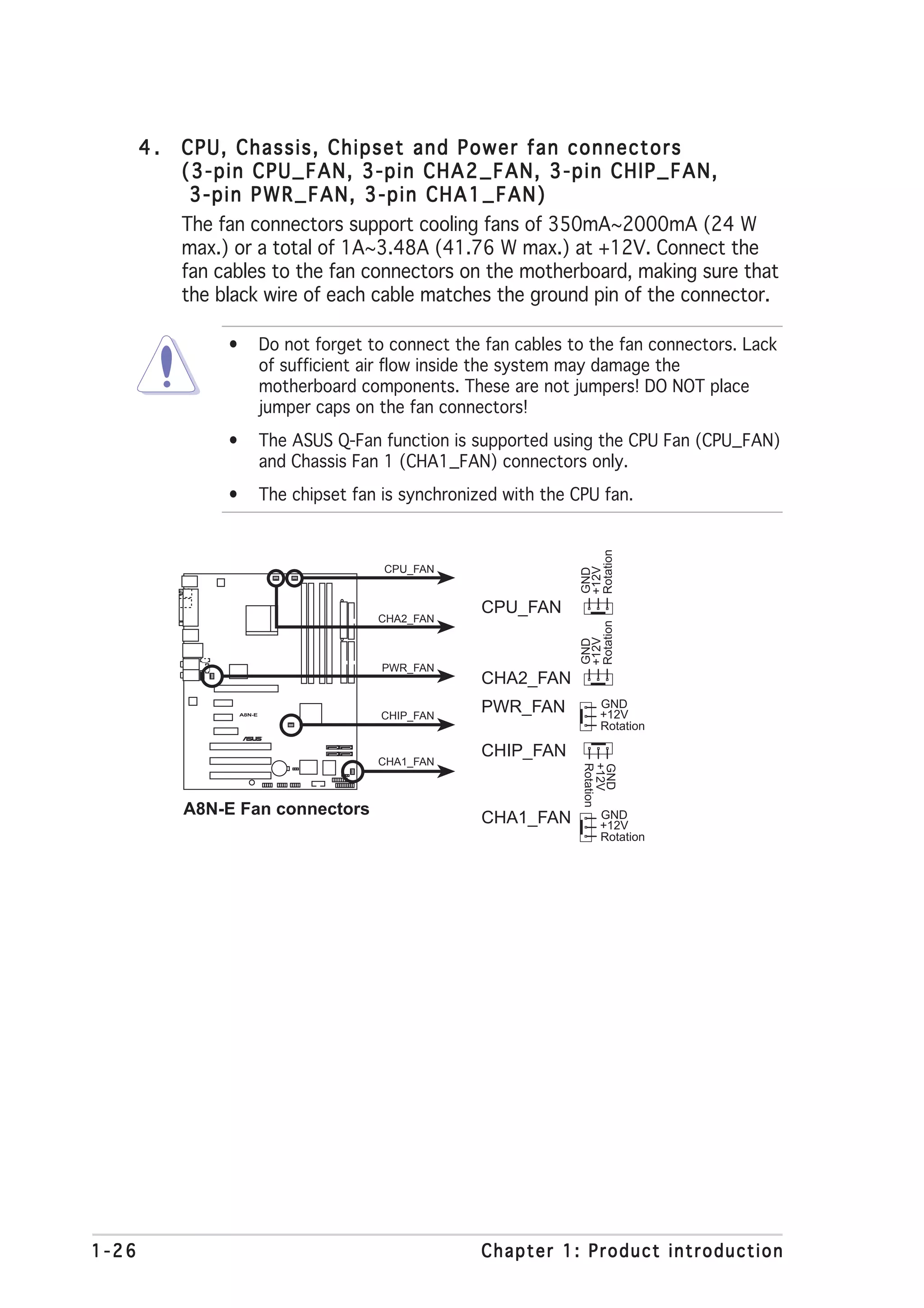
4.   CPU, Chassis, Chipset and Power fan connectors
            (3-pin CPU_FAN, 3-pin CHA2_FAN, 3-pin CHIP_FAN,
             3-pin PWR_FAN, 3-pin CHA1_FAN)
            The fan connectors support cooling fans of 350mA~2000mA (24 W
            max.) or a total of 1A~3.48A (41.76 W max.) at +12V. Connect the
            fan cables to the fan connectors on the motherboard, making sure that
            the black wire of each cable matches the ground pin of the connector.

                 •           Do not forget to connect the fan cables to the fan connectors. Lack
                             of sufficient air flow inside the system may damage the
                             motherboard components. These are not jumpers! DO NOT place
                             jumper caps on the fan connectors!
                 •           The ASUS Q-Fan function is supported using the CPU Fan (CPU_FAN)
                             and Chassis Fan 1 (CHA1_FAN) connectors only.
                 •           The chipset fan is synchronized with the CPU fan.


                                                                       Rotation
                                             CPU_FAN

                                                                       +12V
                                                                       GND
                                                          CPU_FAN
                                            CHA2_FAN
                                                                       Rotation
                                                                       +12V
                                                                       GND


                                             PWR_FAN
                                                          CHA2_FAN
                                                          PWR_FAN          GND
                     A8N-E
                                             CHIP_FAN                      +12V
                                                                           Rotation
                             ®


                                                          CHIP_FAN
                                            CHA1_FAN
                                                                       +12V
                                                                       Rotation
                                                                       GND


            A8N-E Fan connectors                          CHA1_FAN         GND
                                                                           +12V
                                                                           Rotation


1-26                                                      Chapter 1: Product introduction
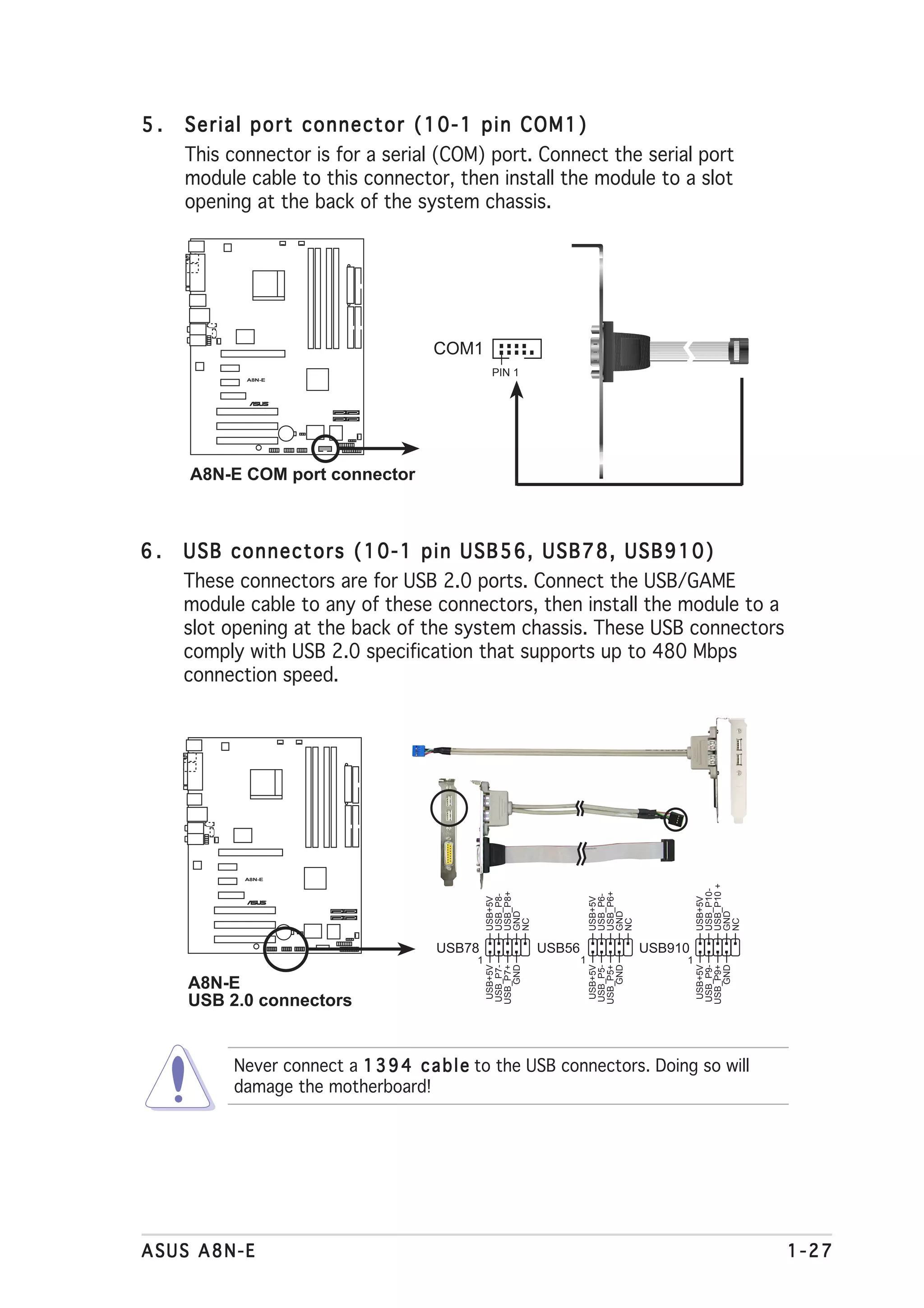
5.   Serial port connector (10-1 pin COM1)
     This connector is for a serial (COM) port. Connect the serial port
     module cable to this connector, then install the module to a slot
     opening at the back of the system chassis.


                                     COM1
                                                PIN 1
            A8N-E


                        ®


     A8N-E COM port connector


6.   USB connectors (10-1 pin USB56, USB78, USB910)
     These connectors are for USB 2.0 ports. Connect the USB/GAME
     module cable to any of these connectors, then install the module to a
     slot opening at the back of the system chassis. These USB connectors
     comply with USB 2.0 specification that supports up to 480 Mbps
     connection speed.


            A8N-E
                                                                                        USB_P10 +
                                                                                        USB_P10-
                                                                     USB_P6+
                                               USB_P8+


                                                                     USB_P6-
                                               USB_P8-


                                                                     USB+5V
                                               USB+5V


                                                                                        USB+5V


                    ®
                                                                     GND
                                               GND


                                                                                        GND
                                                                     NC
                                               NC


                                                                                        NC


                                     USB78               USB56                 USB910
                                           1                     1                  1
                                                                                         USB+5V
                                                                                        USB_P9-
                                                                                        USB_P9+
                                                                                           GND
                                                USB+5V
                                               USB_P7-
                                               USB_P7+
                                                  GND


                                                                      USB+5V
                                                                     USB_P5-
                                                                     USB_P5+
                                                                        GND


     A8N-E
     USB 2.0 connectors


          Never connect a 1 3 9 4 c a b l e to the USB connectors. Doing so will
          damage the motherboard!


ASUS A8N-E                                                                                          1-27
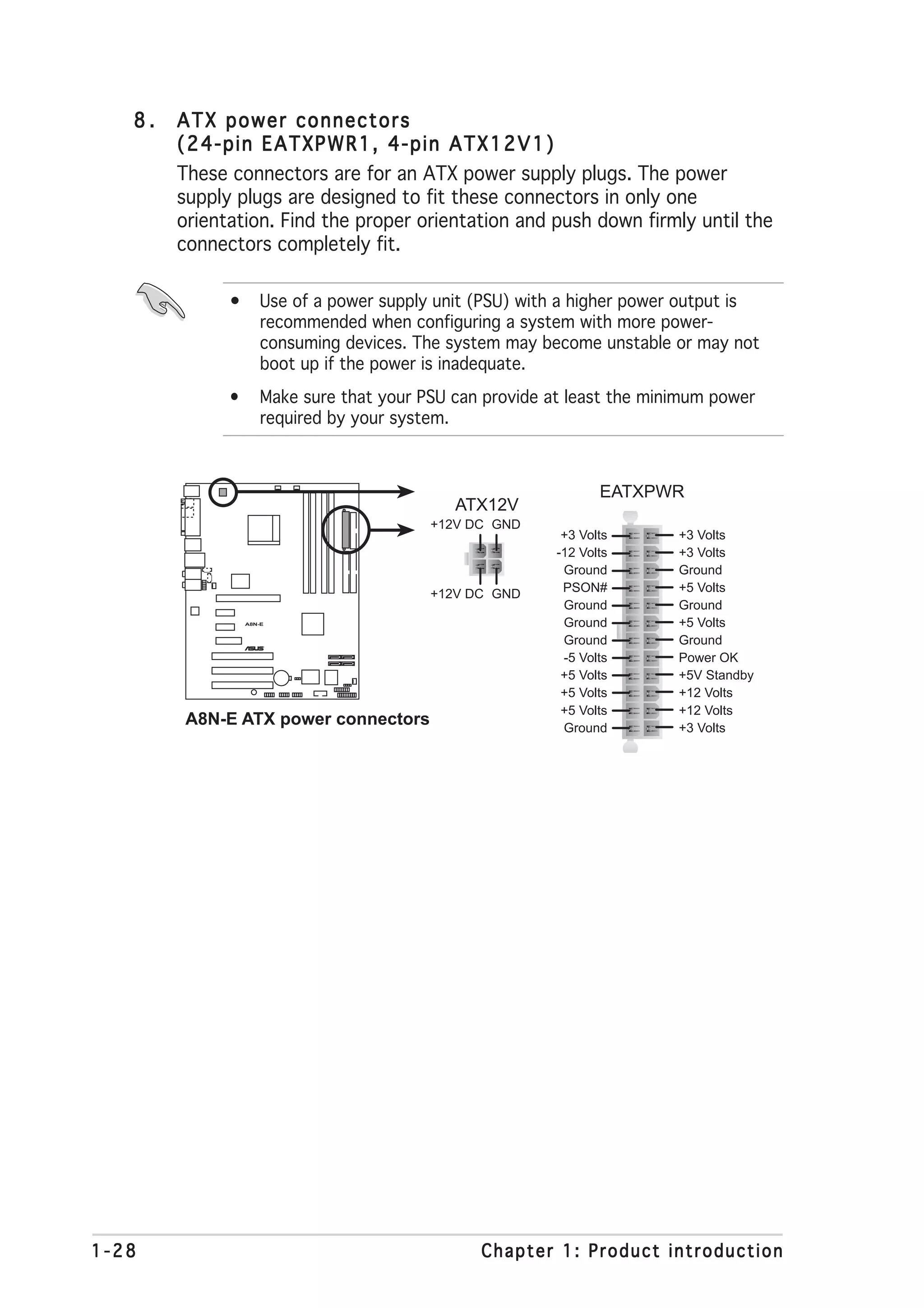
8.   ATX power connectors
        (24-pin EATXPWR1, 4-pin ATX12V1)
        These connectors are for an ATX power supply plugs. The power
        supply plugs are designed to fit these connectors in only one
        orientation. Find the proper orientation and push down firmly until the
        connectors completely fit.

              •       Use of a power supply unit (PSU) with a higher power output is
                      recommended when configuring a system with more power-
                      consuming devices. The system may become unstable or may not
                      boot up if the power is inadequate.
              •       Make sure that your PSU can provide at least the minimum power
                      required by your system.


                                                                  EATXPWR
                                              ATX12V
                                           +12V DC GND
                                                            +3 Volts      +3 Volts
                                                           -12 Volts      +3 Volts
                                                            Ground        Ground
                                           +12V DC GND      PSON#         +5 Volts
                                                            Ground        Ground
                  A8N-E                                     Ground        +5 Volts
                          ®
                                                            Ground        Ground
                                                            -5 Volts      Power OK
                                                            +5 Volts      +5V Standby
                                                            +5 Volts      +12 Volts
                                                            +5 Volts      +12 Volts
         A8N-E ATX power connectors                         Ground        +3 Volts


1-28                                             Chapter 1: Product introduction
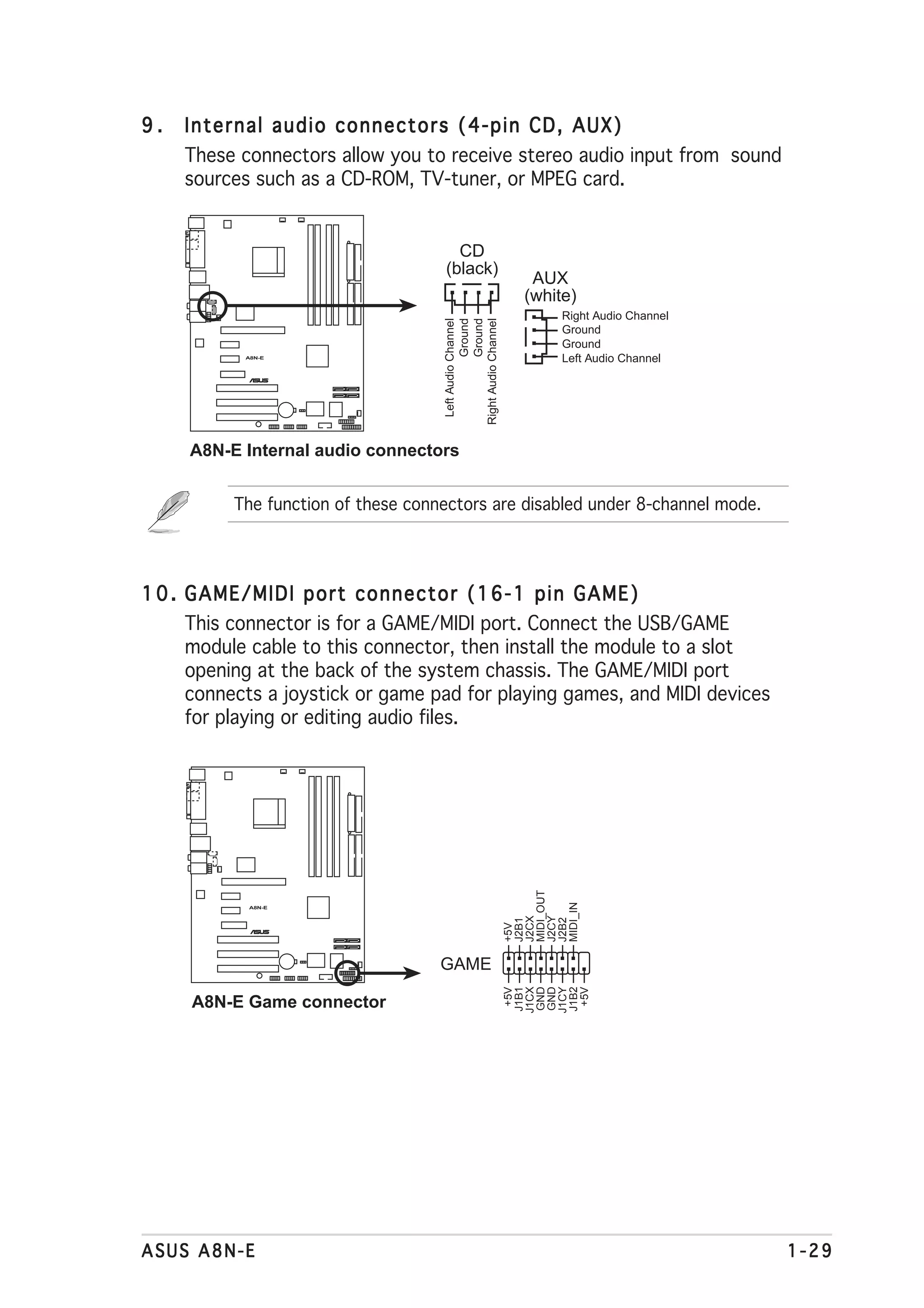
9.   Internal audio connectors (4-pin CD, AUX)
     These connectors allow you to receive stereo audio input from sound
     sources such as a CD-ROM, TV-tuner, or MPEG card.


                                      CD
                                    (black)
                                                             AUX
                                                            (white)
                                                                 Right Audio Channel


                                     Left Audio Channel
                                                 Ground
                                                 Ground
                                    Right Audio Channel
                                                                 Ground
                                                                 Ground
            A8N-E
                                                                 Left Audio Channel
                    ®


     A8N-E Internal audio connectors


          The function of these connectors are disabled under 8-channel mode.


1 0 . GAME/MIDI port connector (16-1 pin GAME)
      This connector is for a GAME/MIDI port. Connect the USB/GAME
      module cable to this connector, then install the module to a slot
      opening at the back of the system chassis. The GAME/MIDI port
      connects a joystick or game pad for playing games, and MIDI devices
      for playing or editing audio files.
                                                          MIDI_OUT


                                                          MIDI_IN


            A8N-E
                                                          J2CX

                                                          J2CY
                                                          J2B1


                                                          J2B2
                                                          +5V


                        ®


                                    GAME
                                                          J1B1
                                                          J1CX
                                                          GND
                                                          GND
                                                          J1CY
                                                          J1B2
                                                           +5V


                                                           +5V


     A8N-E Game connector


ASUS A8N-E                                                                             1-29
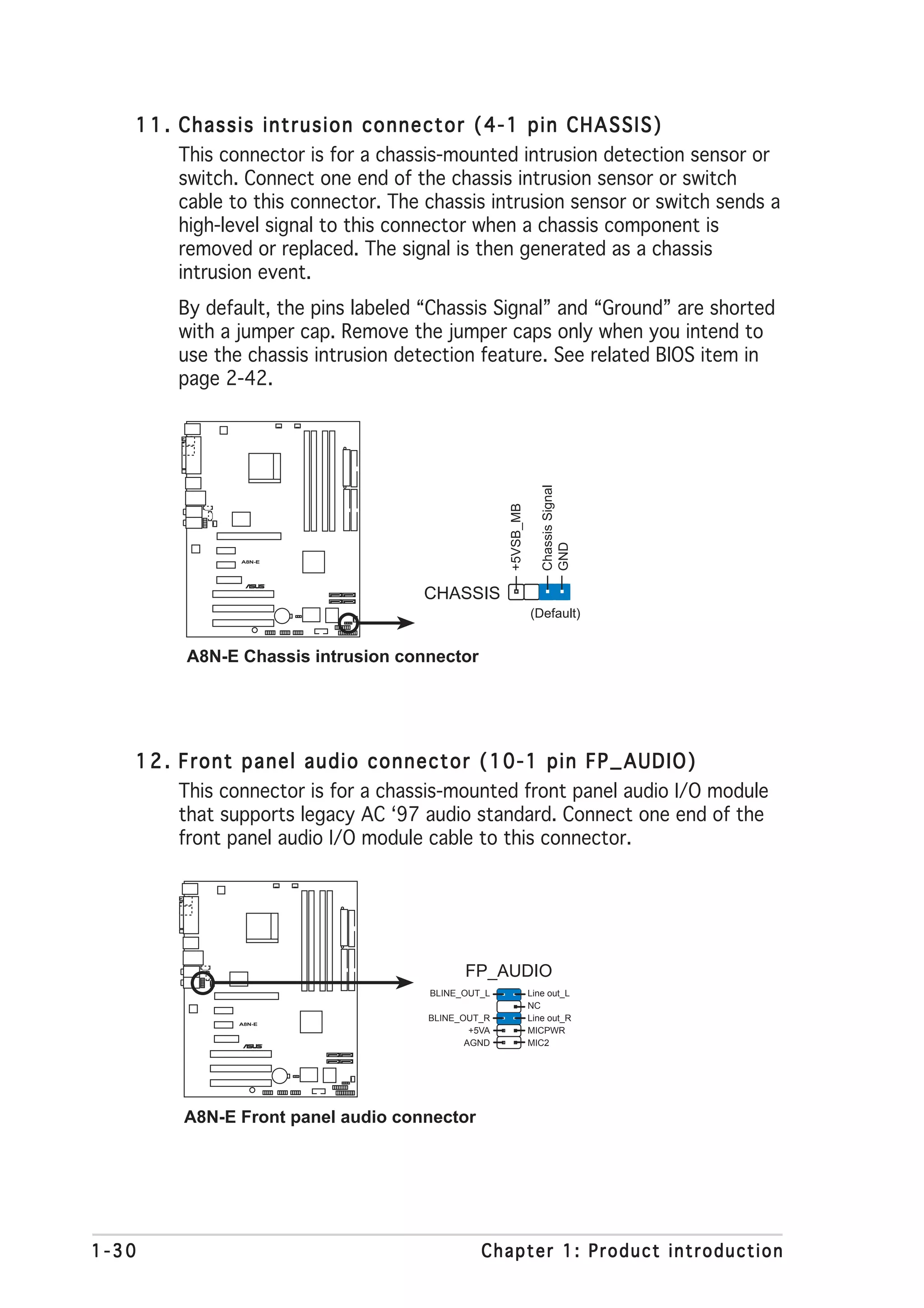
1 1 . Chassis intrusion connector (4-1 pin CHASSIS)
         This connector is for a chassis-mounted intrusion detection sensor or
         switch. Connect one end of the chassis intrusion sensor or switch
         cable to this connector. The chassis intrusion sensor or switch sends a
         high-level signal to this connector when a chassis component is
         removed or replaced. The signal is then generated as a chassis
         intrusion event.
        By default, the pins labeled “Chassis Signal” and “Ground” are shorted
        with a jumper cap. Remove the jumper caps only when you intend to
        use the chassis intrusion detection feature. See related BIOS item in
        page 2-42.


                                                                   Chassis Signal
                                                     +5VSB_MB


               A8N-E
                                                                   GND
                           ®


                                     CHASSIS
                                                                (Default)


         A8N-E Chassis intrusion connector


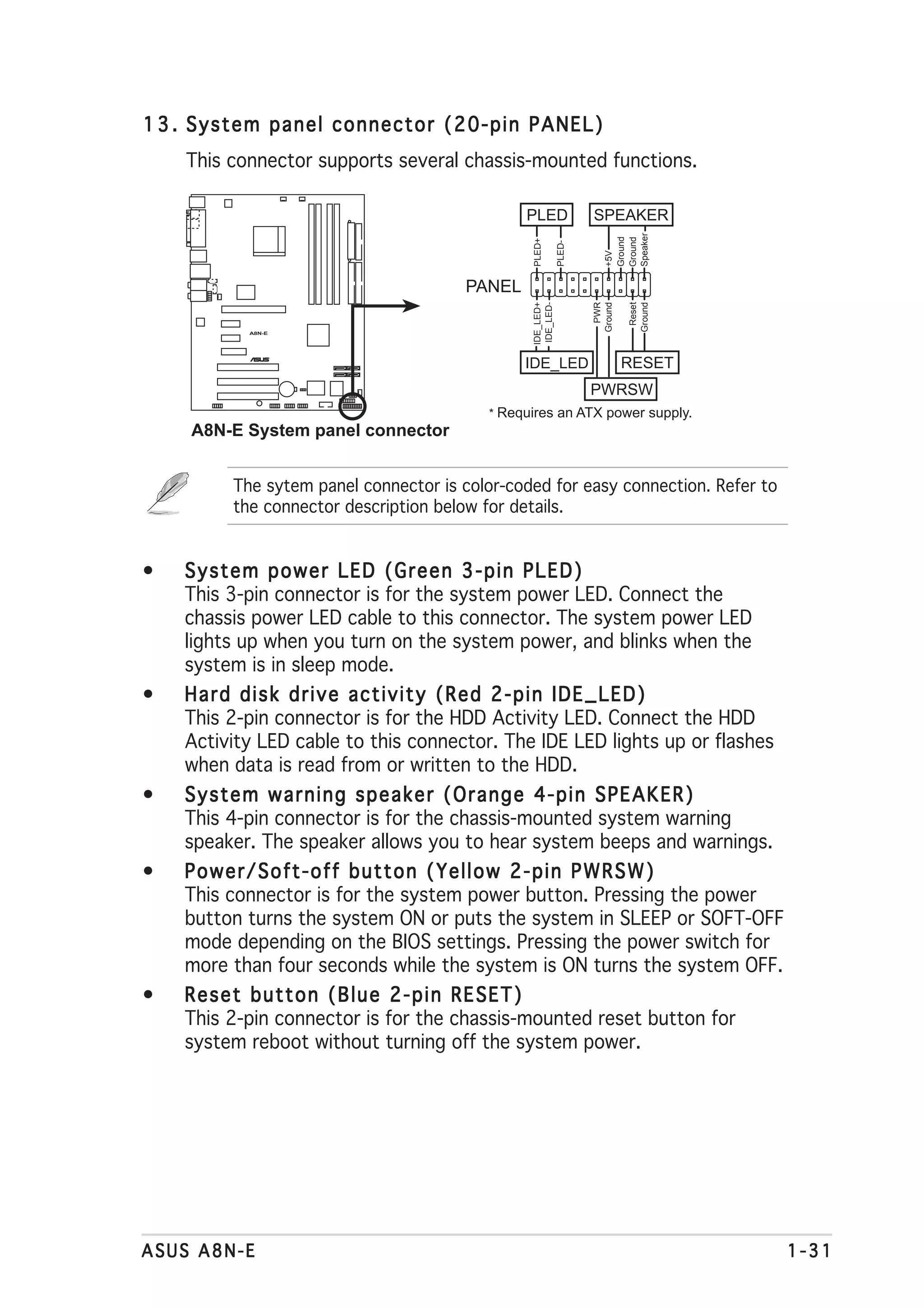
   1 2 . Front panel audio connector (10-1 pin FP_AUDIO)
         This connector is for a chassis-mounted front panel audio I/O module
         that supports legacy AC ‘97 audio standard. Connect one end of the
         front panel audio I/O module cable to this connector.


                                             FP_AUDIO
                                      BLINE_OUT_L               Line out_L
                                                                NC
                                      BLINE_OUT_R               Line out_R
               A8N-E
                                              +5VA              MICPWR
                       ®
                                             AGND               MIC2


        A8N-E Front panel audio connector


1-30                                            Chapter 1: Product introduction
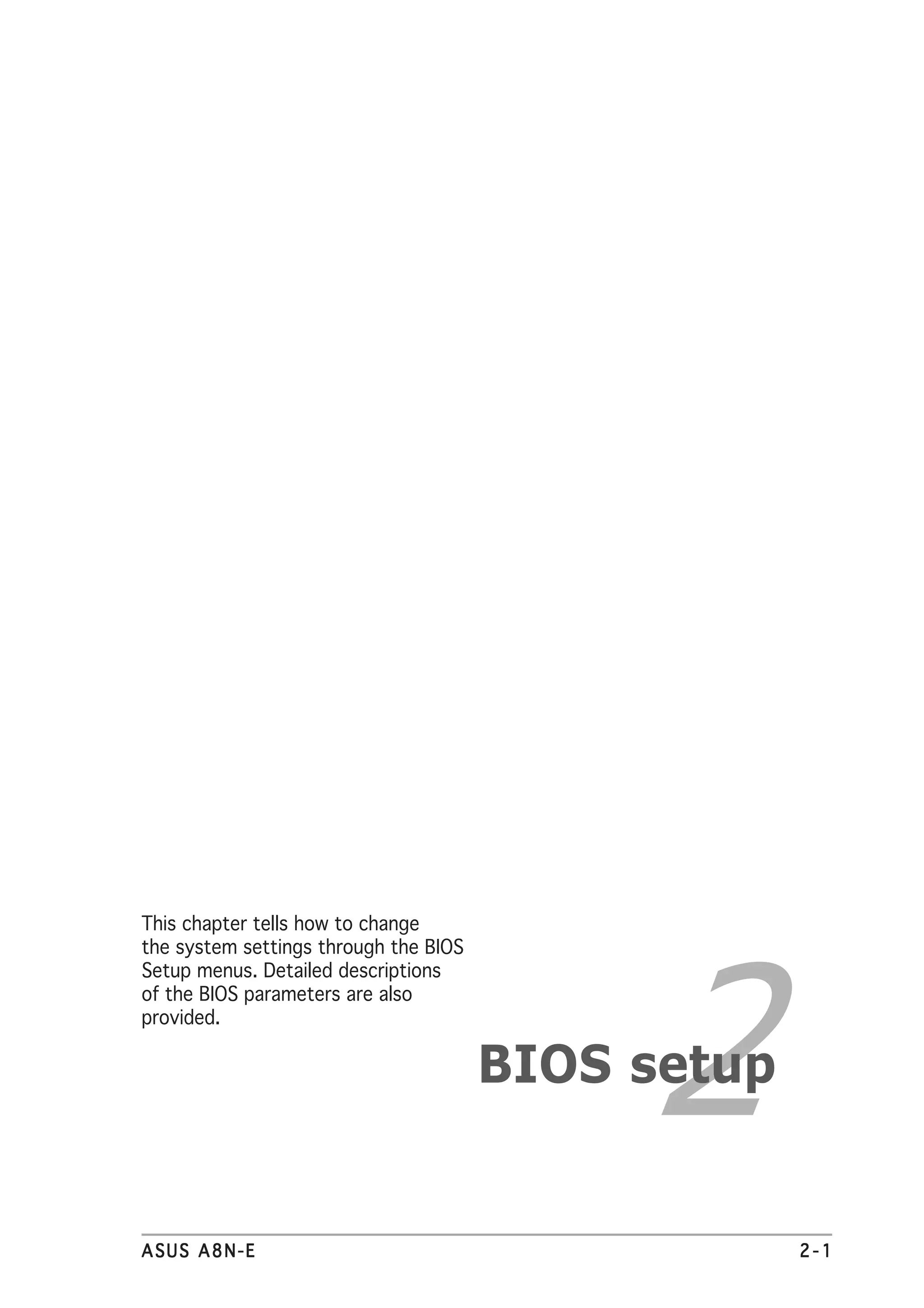
1 3 . System panel connector (20-pin PANEL)
    This connector supports several chassis-mounted functions.

                                              PLED                 SPEAKER


                                                                      Speaker
                                                                      Ground
                                                                      Ground
                                               PLED+

                                                           PLED-


                                                                      +5V
                                      PANEL


                                               IDE_LED+
                                                IDE_LED-


                                                                     PWR
                                                                   Ground

                                                                             Reset
                                                                            Ground
           A8N-E


                                              IDE_LED                       RESET
                   ®


                                                                   PWRSW
                                         * Requires an ATX power supply.
    A8N-E System panel connector


         The sytem panel connector is color-coded for easy connection. Refer to
         the connector description below for details.


•   System power LED (Green 3-pin PLED)
    This 3-pin connector is for the system power LED. Connect the
    chassis power LED cable to this connector. The system power LED
    lights up when you turn on the system power, and blinks when the
    system is in sleep mode.
•   Hard disk drive activity (Red 2-pin IDE_LED)
    This 2-pin connector is for the HDD Activity LED. Connect the HDD
    Activity LED cable to this connector. The IDE LED lights up or flashes
    when data is read from or written to the HDD.
•   System warning speaker (Orange 4-pin SPEAKER)
    This 4-pin connector is for the chassis-mounted system warning
    speaker. The speaker allows you to hear system beeps and warnings.
•   Power/Soft-off button (Yellow 2-pin PWRSW)
    This connector is for the system power button. Pressing the power
    button turns the system ON or puts the system in SLEEP or SOFT-OFF
    mode depending on the BIOS settings. Pressing the power switch for
    more than four seconds while the system is ON turns the system OFF.
•   Reset button (Blue 2-pin RESET)
    This 2-pin connector is for the chassis-mounted reset button for
    system reboot without turning off the system power.


ASUS A8N-E                                                                           1-31
1-32   Chapter 1: Product introduction
This chapter tells how to change
the system settings through the BIOS


                                             2
Setup menus. Detailed descriptions
of the BIOS parameters are also
provided.

                                       BIOS setup


ASUS A8N-E                                          2-1
2.1        Managing and updating your BIOS
      The following utilities allow you to manage and update the motherboard
      Basic Input/Output System (BIOS) setup.

      1.   A w a r d B I O S F l a s h U t i l i t y (Updates the BIOS in DOS mode using a
           bootable floppy disk.)
      2.   A S U S C r a s h F r e e B I O S 2 (Updates the BIOS using a bootable
           floppy disk or the motherboard support CD when the BIOS file fails or
           gets corrupted.)
      3.   A S U S E Z F l a s h (Updates the BIOS in DOS using a floppy disk or the
           motherboard support CD.)
      4.   A S U S U p d a t e (Updates the BIOS in Windows® environment.)
      Refer to the corresponding sections for details on these utilities.

                 Save a copy of the original motherboard BIOS file to a bootable floppy
                 disk in case you need to restore the BIOS in the future. Copy the original
                 motherboard BIOS using the ASUS Update or AwardBIOS Flash utilities.


      2.1.1      Creating a bootable floppy disk
      1.   Do either one of the following to create a bootable floppy disk.
           DOS environment

           a. Insert a 1.44MB floppy disk into the drive.
           b. At the DOS prompt, type format A:/S then press <Enter>.
           Windows® XP environment

           a. Insert a 1.44 MB floppy disk to the floppy disk drive.
           b. Click S t a r t from the Windows® desktop, then select M y
              Computer       r.
           c. Select the 3 1/2 Floppy Drive icon.
           d. Click F i l e from the menu, then select F o r m a t A F o r m a t 3 1 / 2
                                                                 t.
              F l o p p y D i s k window appears.
           e. Select C r e a t e a n M S - D O S s t a r t u p d i s k from the format
              options field, then click S t a r t
                                                t.
           Windows® 2000 environment

           To create a set of boot disks for Windows® 2000:
           a. Insert a formatted, high density 1.44 MB floppy disk into the drive.
           b. Insert the Windows® 2000 CD to the optical drive.


2-2                                                             Chapter 2: BIOS setup
c. Click S t a r t then select R u n
                      t,                n.
     d. From the Open field, type
         D:bootdiskmakeboot a:
         assuming that D: is your optical drive.
     e. Press <Enter>, then follow screen instructions to continue.

2.   Copy the original or the latest motherboard BIOS file to the bootable
     floppy disk.


2.1.2      Updating the BIOS
The Basic Input/Output System (BIOS) can be updated using the
AwardBIOS Flash Utility. Follow these instructions to update the BIOS using
this utility.

1. Download the latest BIOS file from the ASUS web site. Rename the file
    to A 8 N - E . B I N and save it to a floppy disk.

           Save only the updated BIOS file in the floppy disk to avoid loading the
           wrong BIOS file.

2.   Copy the AwardBIOS Flash Utility (awdflash.exe) from the Software
     folder of the support CD to the floppy disk with the latest BIOS file.
3.   Boot the system in DOS mode using the bootable floppy disk you
     created earlier.
4.   When the A : > appears, replace the bootable floppy disk with the
     floppy disk containing the new BIOS file and the Award BIOS Flash
     Utility.
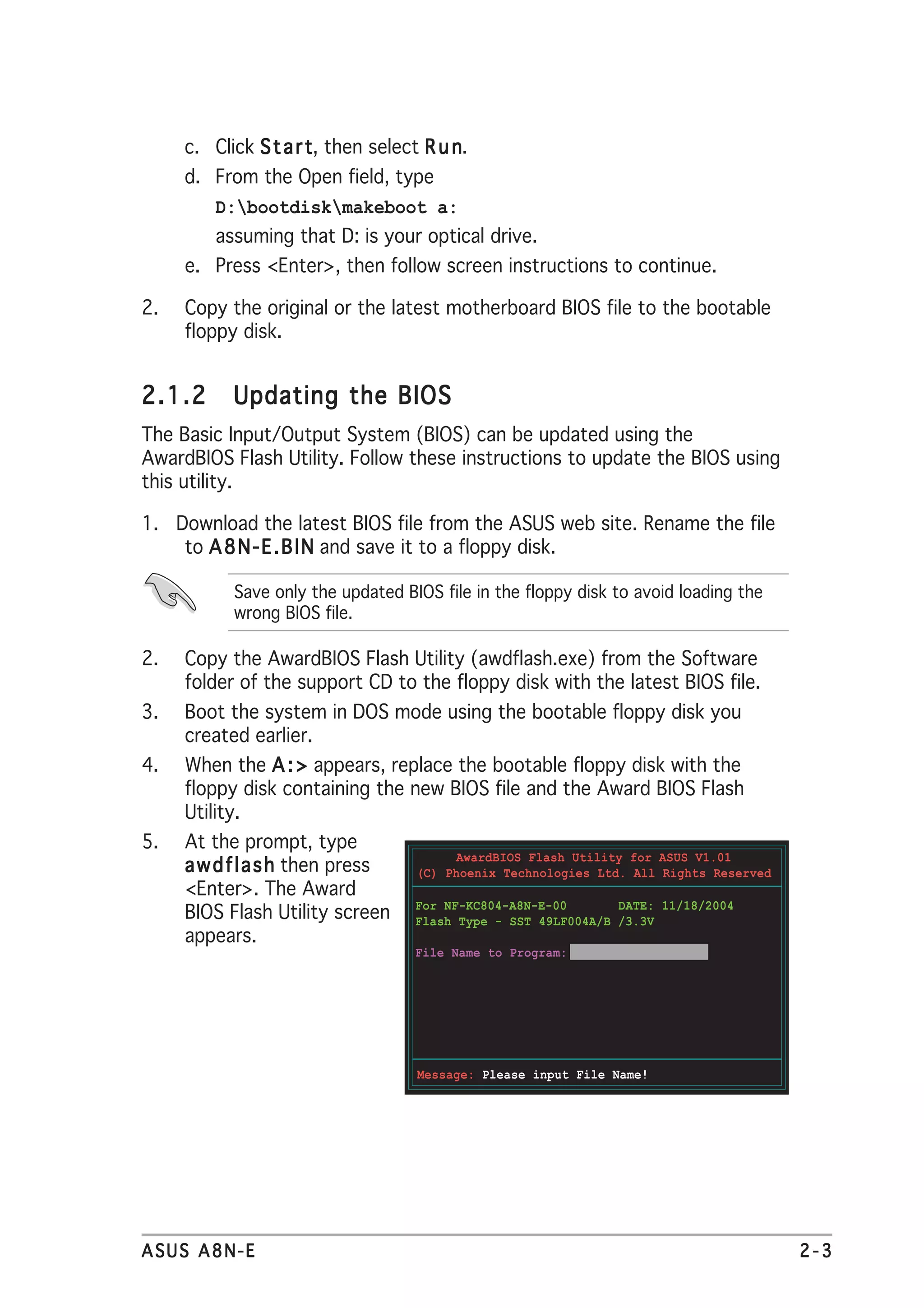
5.   At the prompt, type
                                        AwardBIOS Flash Utility for ASUS V1.01
     a w d f l a s h then press    (C) Phoenix Technologies Ltd. All Rights Reserved
     <Enter>. The Award
                                   For NF-KC804-A8N-E-00       DATE: 11/18/2004
     BIOS Flash Utility screen     Flash Type - SST 49LF004A/B /3.3V
     appears.
                                   File Name to Program:


                                   Message: Please input File Name!


ASUS A8N-E                                                                             2-3
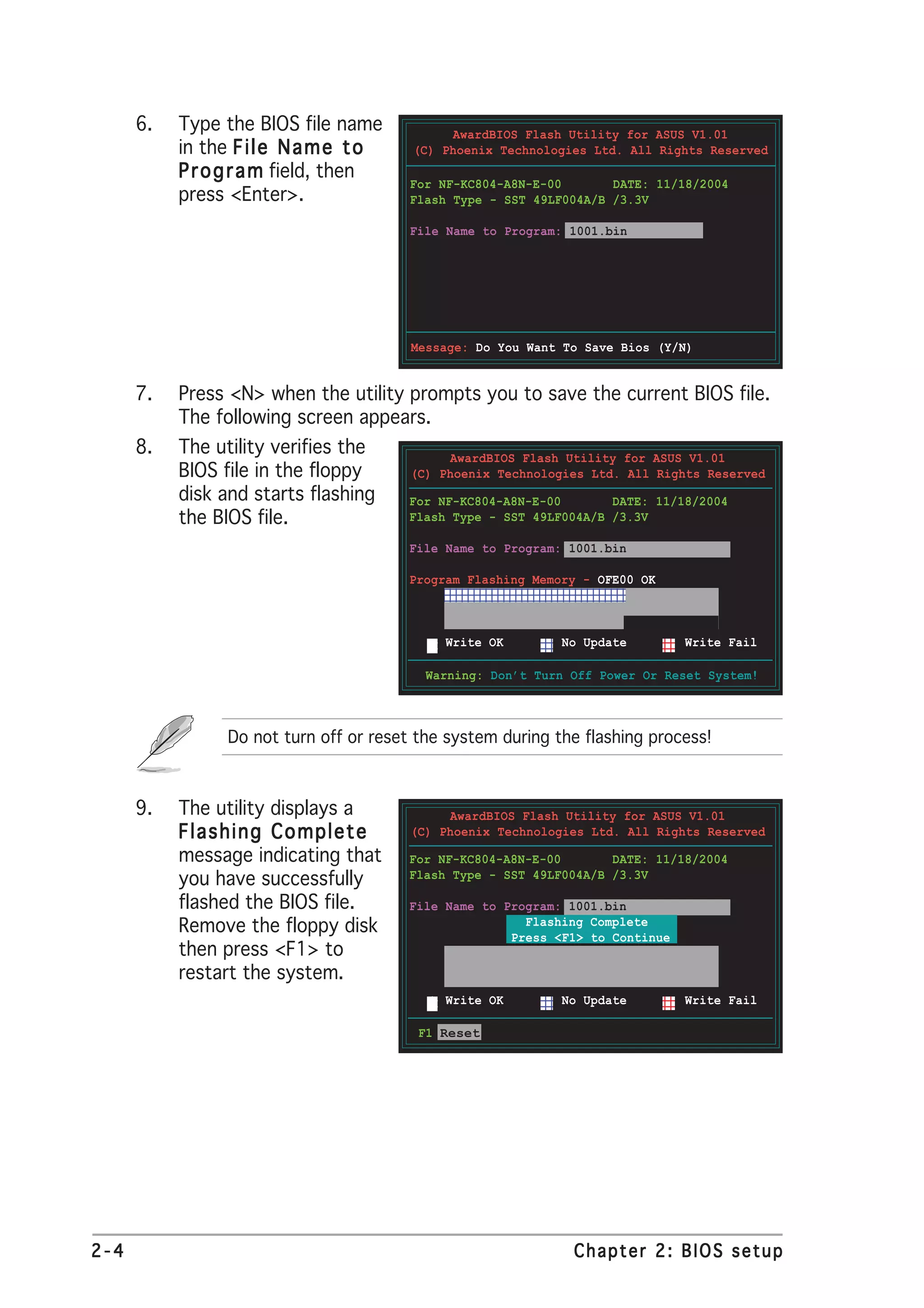
6.   Type the BIOS file name            AwardBIOS Flash Utility for ASUS V1.01
           in the F i l e N a m e t o    (C) Phoenix Technologies Ltd. All Rights Reserved
           P r o g r a m field, then
                                         For NF-KC804-A8N-E-00       DATE: 11/18/2004
           press <Enter>.                Flash Type - SST 49LF004A/B /3.3V

                                         File Name to Program: 1001.bin


                                         Message: Do You Want To Save Bios (Y/N)


      7.   Press <N> when the utility prompts you to save the current BIOS file.
           The following screen appears.
      8.   The utility verifies the           AwardBIOS Flash Utility for ASUS V1.01
           BIOS file in the floppy       (C) Phoenix Technologies Ltd. All Rights Reserved
           disk and starts flashing      For NF-KC804-A8N-E-00       DATE: 11/18/2004
           the BIOS file.                Flash Type - SST 49LF004A/B /3.3V

                                         File Name to Program: 1001.bin

                                         Program Flashing Memory - OFE00 OK
                                                1098765432109876543210987654321
                                                1098765432109876543210987654321
                                                1098765432109876543210987654321


                                          321
                                          321                  321
                                                               321                321
                                                                                  321
                                          321
                                          321   Write OK       321
                                                               321   No Update    321
                                                                                  321   Write Fail

                                           Warning: Don’t Turn Off Power Or Reset System!


                 Do not turn off or reset the system during the flashing process!


      9.   The utility displays a             AwardBIOS Flash Utility for ASUS V1.01
           Flashing Complete             (C) Phoenix Technologies Ltd. All Rights Reserved

           message indicating that       For NF-KC804-A8N-E-00       DATE: 11/18/2004
           you have successfully         Flash Type - SST 49LF004A/B /3.3V

           flashed the BIOS file.        File Name to Program: 1001.bin
           Remove the floppy disk                        Flashing Complete
                                                       Press <F1> to Continue
           then press <F1> to
           restart the system.
                                          321
                                          321                  321
                                                               321                321
                                                                                  321
                                          321
                                          321   Write OK       321
                                                               321   No Update    321
                                                                                  321   Write Fail

                                          F1 Reset


2-4                                                                   Chapter 2: BIOS setup
2.1.3      Saving the current BIOS file
You can use the AwardBIOS Flash Utility to save the current BIOS file. You
can load the current BIOS file when the BIOS file gets corrupted during the
flashing process.

           Make sure that the floppy disk has enough disk space to save the file.


To save the current BIOS file using the AwardBIOS Flash Utility:

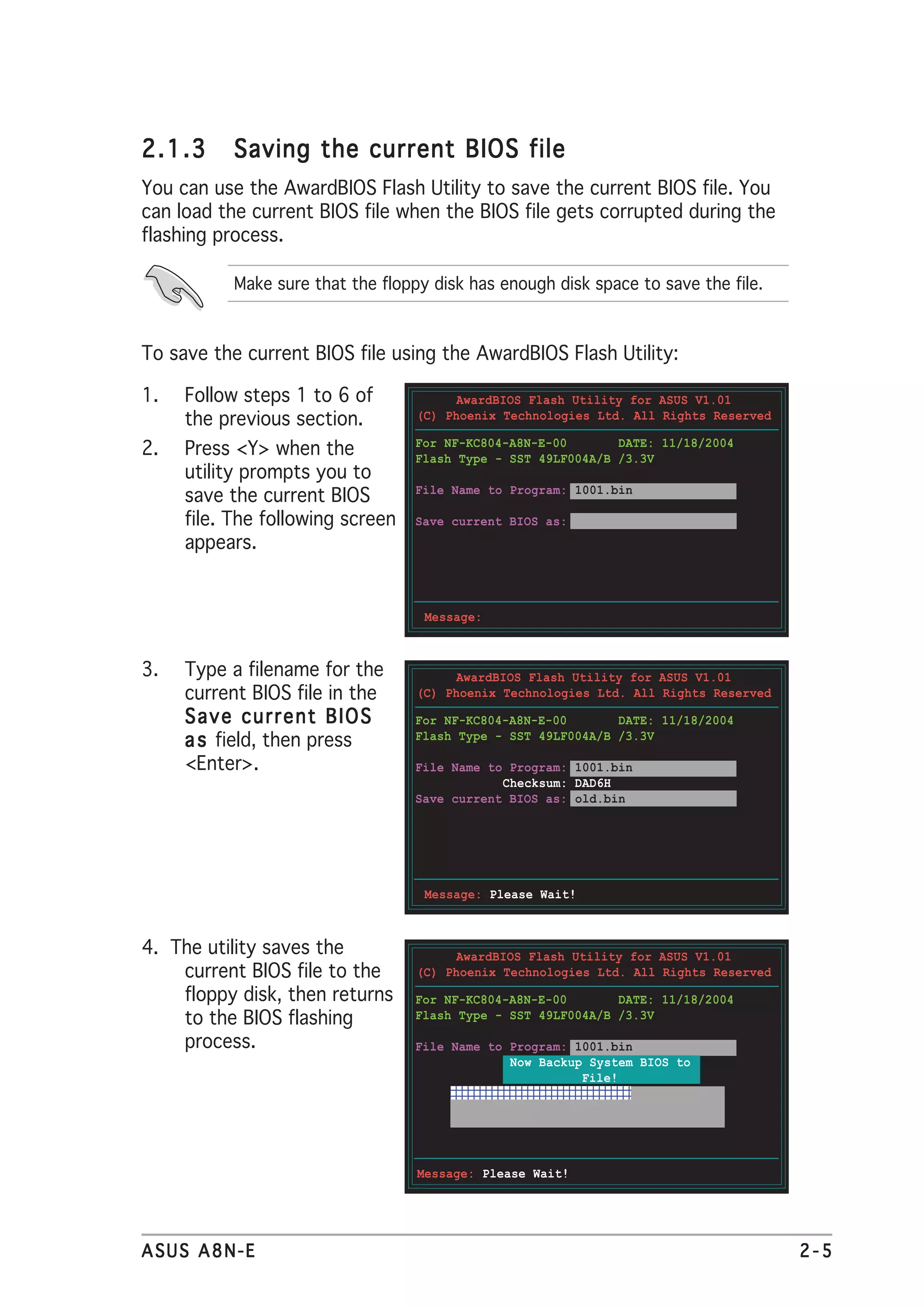
1.   Follow steps 1 to 6 of             AwardBIOS Flash Utility for ASUS V1.01
     the previous section.         (C) Phoenix Technologies Ltd. All Rights Reserved

                                  For NF-KC804-A8N-E-00       DATE: 11/18/2004
2.   Press <Y> when the           Flash Type - SST 49LF004A/B /3.3V
     utility prompts you to
                                  File Name to Program: 1001.bin
     save the current BIOS
     file. The following screen   Save current BIOS as:
     appears.


                                    Message:


3.   Type a filename for the            AwardBIOS Flash Utility for ASUS V1.01
     current BIOS file in the      (C) Phoenix Technologies Ltd. All Rights Reserved

     Save current BIOS            For NF-KC804-A8N-E-00       DATE: 11/18/2004
     a s field, then press        Flash Type - SST 49LF004A/B /3.3V

     <Enter>.                     File Name to Program: 1001.bin
                                              Checksum: DAD6H
                                  Save current BIOS as: old.bin


                                    Message: Please Wait!


4. The utility saves the                AwardBIOS Flash Utility for ASUS V1.01
    current BIOS file to the       (C) Phoenix Technologies Ltd. All Rights Reserved
    floppy disk, then returns     For NF-KC804-A8N-E-00       DATE: 11/18/2004
    to the BIOS flashing          Flash Type - SST 49LF004A/B /3.3V

    process.                      File Name to Program: 1001.bin
                                               Now Backup System BIOS to
                                                         File!
                                       1098765432109876543210987654321
                                       109876543210987654321098765432
                                       1098765432109876543210987654321
                                       10987654321098765432109876543211


                                   Message: Please Wait!


ASUS A8N-E                                                                             2-5
2.1.4      ASUS CrashFree BIOS 2 utility
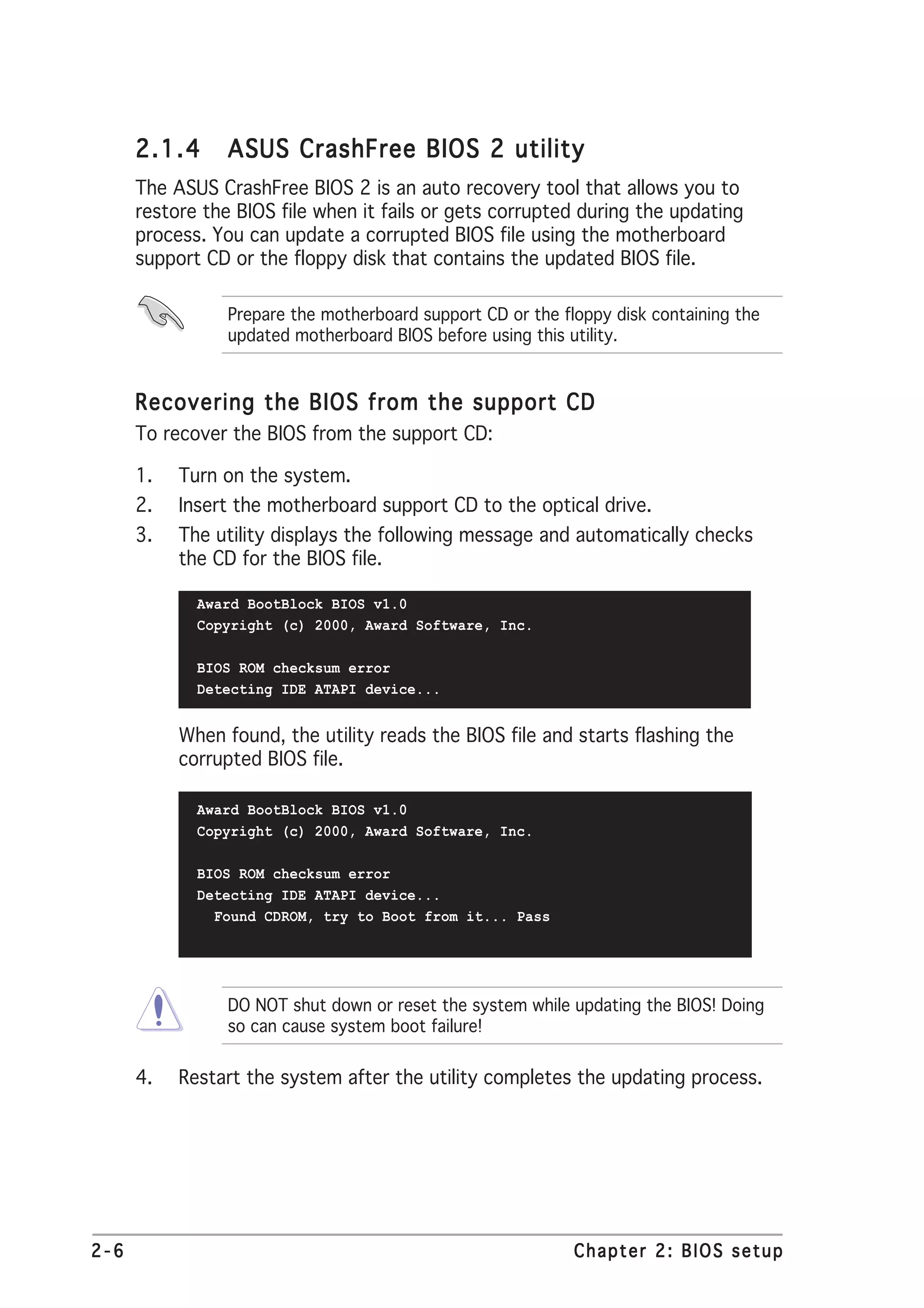
      The ASUS CrashFree BIOS 2 is an auto recovery tool that allows you to
      restore the BIOS file when it fails or gets corrupted during the updating
      process. You can update a corrupted BIOS file using the motherboard
      support CD or the floppy disk that contains the updated BIOS file.

                 Prepare the motherboard support CD or the floppy disk containing the
                 updated motherboard BIOS before using this utility.


      Recovering the BIOS from the support CD
      To recover the BIOS from the support CD:

      1.   Turn on the system.
      2.   Insert the motherboard support CD to the optical drive.
      3.   The utility displays the following message and automatically checks
           the CD for the BIOS file.

             Award BootBlock BIOS v1.0
             Copyright (c) 2000, Award Software, Inc.

             BIOS ROM checksum error
             Detecting IDE ATAPI device...


           When found, the utility reads the BIOS file and starts flashing the
           corrupted BIOS file.

             Award BootBlock BIOS v1.0
             Copyright (c) 2000, Award Software, Inc.

             BIOS ROM checksum error
             Detecting IDE ATAPI device...
               Found CDROM, try to Boot from it... Pass


                 DO NOT shut down or reset the system while updating the BIOS! Doing
                 so can cause system boot failure!

      4.   Restart the system after the utility completes the updating process.


2-6                                                          Chapter 2: BIOS setup
Recovering the BIOS from a floppy disk
To recover the BIOS from the support CD:

1.   Remove any CD from the optical drive, then turn on the system.
2.   Insert the floppy disk with the original or updated BIOS file to the
     floppy disk drive.
3.   The utility displays the following message and automatically checks
     the floppy disk for the original or updated BIOS file.

       Award BootBlock BIOS v1.0
       Copyright (c) 2000, Award Software, Inc.

       BIOS ROM checksum error
       Detecting IDE ATAPI device...


     When no CD is found, the utility automatically checks the floppy drive
     for the original or updated BIOS file. The utility then updates the
     corrupted BIOS file.

       Award BootBlock BIOS v1.0
       Copyright (c) 2000, Award Software, Inc.

       BIOS ROM checksum error
       Detecting IDE ATAPI device...
         Found CDROM, try to Boot from it... Fail

       Detecting floppy drive A media...


           DO NOT shut down or reset the system while updating the BIOS! Doing
           so can cause system boot failure!

4.   Restart the system after the utility completes the updating process.

           The recovered BIOS may not be the latest BIOS version for this
           motherboard. Visit the ASUS website (www.asus.com) to download the
           latest BIOS file.


ASUS A8N-E                                                                       2-7
2.1.5     ASUS EZ Flash utility
      The ASUS EZ Flash feature allows you to update the BIOS without having to
      go through the long process of booting from a floppy disk and using a
      DOS-based utility. The EZ Flash utility is built-in the BIOS chip so it is
      accessible by pressing <Alt> + <F2> during the Power-On Self Tests
      (POST).
      To update the BIOS using EZ Flash:

      1.   Visit the ASUS website (www.asus.com) to download the latest BIOS
           file for the motherboard.
      2.   Save the BIOS file to a floppy disk, then restart the system.
      3.   Press <Alt> + <F2> during POST to display the following.

             Insert Disk then press Enter or ESC to continue POST


      4.   Insert the floppy disk           AwardBIOS Flash Utility for ASUS V1.01
           that contains the BIOS      (C) Phoenix Technologies Ltd. All Rights Reserved

           file to the floppy disk    For NF-KC804-A8N-E-00       DATE: 11/18/2004
           drive then press           Flash Type - SST 49LF004A/B /3.3V
           <Enter>. The following     File Name to Program:
           screen appears.


                                       Message: Please wait...


      5.   When the correct BIOS file is found, EZ Flash performs the BIOS
           update process and automatically reboots the system when done.

                Do not shutdown or reset the system while updating the BIOS to
                prevent system boot failure!


2-8                                                           Chapter 2: BIOS setup
2.1.6       ASUS Update utility
The ASUS Update is a utility that allows you to manage, save, and update
the motherboard BIOS in Windows® environment. The ASUS Update utility
allows you to:
     • Save the current BIOS file
     • Download the latest BIOS file from the Internet
     • Update the BIOS from an updated BIOS file
     • Update the BIOS directly from the Internet, and
     • View the BIOS version information.
This utility is available in the support CD that comes with the motherboard
package.

            ASUS Update requires an Internet connection either through a network
            or an Internet Service Provider (ISP).


Installing ASUS Update
To install ASUS Update:

1.    Place the support CD in the optical drive. The D r i v e r s menu appears.
2.    Click the U t i l i t i e s tab, then click I n s t a l l A S U S U p d a t e
      V X . X X . X X See page 3-3 for the U t i l i t i e s screen menu.
                    X.
3.    The ASUS Update utility is copied to your system.

            Quit all Windows® applications before you update the BIOS using this
            utility.


ASUS A8N-E                                                                            2-9
Updating the BIOS through the Internet
   To update the BIOS through the Internet:

   1.   Launch the ASUS Update utility from the Windows® desktop by clicking
        S t a r t > P r o g r a m s > A S U S > A S U S U p d a t e > A S U S U p d a t e The
                                                                                        e.
        ASUS Update main window appears.


   2.   Select U p d a t e B I O S f r o m       3.    Select the ASUS FTP site
        t h e I n t e r n e t option from the          nearest you to avoid network
        drop-down menu, then click                     traffic, or click A u t o S e l e c t
                                                                                           t.
        Next  t.                                       Click N e x t
                                                                   t.


2-10                                                           Chapter 2: BIOS setup
4.   From the FTP site, select the
     BIOS version that you wish to
     download. Click Next.
5.   Follow the screen instructions to
     complete the update process.

            The ASUS Update utility is
            capable of updating itself
            through the Internet. Always
            update the utility to avail all
            its features.
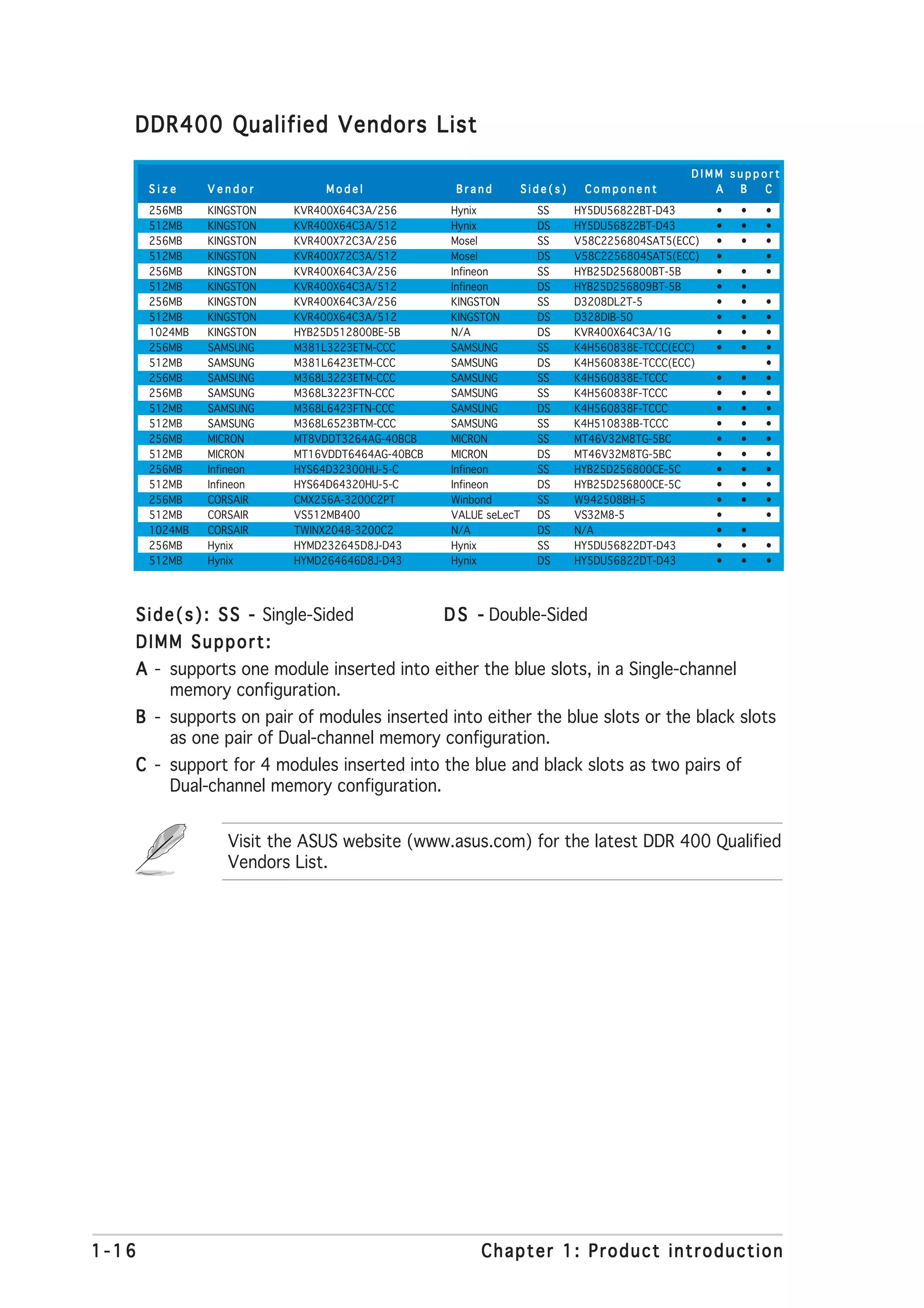


Updating the BIOS through a BIOS file
To update the BIOS through a BIOS file:

1.   Launch the ASUS Update utility from the Windows® desktop by
     clicking S t a r t > P r o g r a m s > A S U S > A S U S U p d a t e >
     A S U S U p d a t e The ASUS Update main window appears.
                       e.
2.   Select U p d a t e B I O S f r o m a
     f i l e option from the drop-down
     menu, then click N e x t   t.


3.   Locate the BIOS file from the
     O p e n window, then click S a v e
                                      e.
4.   Follow the screen instructions to
     complete the update process.


ASUS A8N-E                                                                    2-11
2.2       BIOS setup program
   This motherboard supports a programmable Low-Pin Count (LPC) chip that
   you can update using the provided utility described in section “2.1
   Managing and updating your BIOS.”
   Use the BIOS Setup program when you are installing a motherboard,
   reconfiguring your system, or prompted to “Run Setup”. This section
   explains how to configure your system using this utility.
   Even if you are not prompted to use the Setup program, you can change
   the configuration of your computer in the future. For example, you can
   enable the security password feature or change the power management
   settings. This requires you to reconfigure your system using the BIOS
   Setup program so that the computer can recognize these changes and
   record them in the CMOS RAM of the LPC chip.
   The LPC chip on the motherboard stores the Setup utility. When you start
   up the computer, the system provides you with the opportunity to run this
   program. Press <Del> during the Power-On Self-Test (POST) to enter the
   Setup utility; otherwise, POST continues with its test routines.
   If you wish to enter Setup after POST, restart the system by pressing
   <Ctrl+Alt+Delete>, or by pressing the reset button on the system chassis.
   You can also restart by turning the system off and then back on. Do this
   last option only if the first two failed.
   The Setup program is designed to make it as easy to use as possible. Being
   a menu-driven program, it lets you scroll through the various sub-menus
   and make your selections from the available options using the navigation
   keys.


             •   The default BIOS settings for this motherboard apply for most
                 conditions to ensure optimum performance. If the system becomes
                 unstable after changing any BIOS settings, load the default settings
                 to ensure system compatibility and stability. Select the L o a d
                 D e f a u l t S e t t i n g s item under the Exit Menu. See section “2.7 Exit
                 Menu.”
             •   The BIOS setup screens shown in this section are for reference
                 purposes only, and may not exactly match what you see on your
                 screen.
             •   Visit the ASUS website (www.asus.com) to download the latest BIOS
                 file for this motherboard and .


2-12                                                            Chapter 2: BIOS setup
2.2.1         BIOS menu screen
  Menu items Menu bar                Configuration fields          General help

                           Phoenix-Award BIOS CMOS Setup Utility
   Main   Advanced     Power   Boot   Exit

    System Time                      15 : 30 : 36                      Select Menu
    System Date                      Wed, Nov 5 2004
    Language                            [English]                Item Specific Help
    Legacy Diskette A:                  [1.44M, 3.5 in.]         Change the day, month,
                                                                 year and century.
    Primary IDE Master                  [ST321122A]
    Primary IDE Slave                   [ASUS CDS520/A]
    Secondary IDE Master                [None]
    Secondary IDE Slave                 [None]
    First SATA Master                   [None]
    Second SATA Slave                   [None]
    Third SATA Master                   [None]
    Fourth SATA Slave                   [None]
    HDD SMART Monitoring                [Disabled]

    Installed Memory                      256MB

  F1:Help         ↑↓ : Select Item        -/+: Change Value              F5: Setup Defaults
  ESC: Exit       →←: Select Menu       Enter: Select Sub-menu          F10: Save and Exit


          Sub-menu items                                                Legend bar


2.2.2         Menu bar
The menu bar on top of the screen has the following main items:

Main              For changing the basic system configuration
Advanced          For changing the advanced system settings
Power             For changing the advanced power management (APM)
                  configuration
Boot              For changing the system boot configuration
Exit              For selecting the exit options and loading default settings

To select an item on the menu bar, press the right or left arrow key on the
keyboard until the desired item is highlighted.


              •   The BIOS setup screens shown in this chapter are for reference
                  purposes only, and may not exactly match what you see on your
                  screen.
              •   Visit the ASUS website (www.asus.com) to download the latest BIOS
                  information.


ASUS A8N-E                                                                                    2-13
2.2.3        Legend bar
   At the bottom of the Setup screen is a legend bar. The keys in the legend
   bar allow you to navigate through the various setup menus. The following
   table lists the keys found in the legend bar with their corresponding
   functions.
   Navigation Key                  Function
       <F1>                        Displays the General Help screen
       <F5>                        Loads setup default values
   <Esc>                           Exits the BIOS setup or returns to the main menu
                                   from a sub-menu
   Left or Right arrow             Selects the menu item to the left or right
   Up or Down arrow                Moves the highlight up or down between fields
   P a g e D o w n o r – ( m i n u s ) Scrolls backward through the values for the
                                       highlighted field
   Page Up or + (plus)             Scrolls forward through the values for the highlighted
                                   field
   <Enter>                         Brings up a selection menu for the highlighted field
   <F10>                           Saves changes and exit


   2.2.4        Menu items
   The highlighted item on the menu bar displays the specific items for that
   menu. For example, selecting M a i n shows the Main menu items.
   The other items (Advanced, Power, Boot, and Exit) on the menu bar have
   their respective menu items.

   2.2.5        Sub-menu items
   A solid triangle before each item on any menu screen means that the iteam
   has a sub-menu. To display the sub-menu, select the item and press
   <Enter>.

   2.2.6        Configuration fields
   These fields show the values for the menu items. If an item is
   user-configurable, you can change the value of the field opposite the item.
   You cannot select an item that is not user-configurable.
   A configurable field is enclosed in brackets, and is highlighted when
   selected. To change the value of a field, select it then press <Enter> to
   display a list of options. Refer to “2.2.7 Pop-up window.”


2-14                                                             Chapter 2: BIOS setup
2.2.7         Pop-up window
Select a menu item then press <Enter> to display a pop-up window with
the configuration options for that item.

                          Phoenix-Award BIOS CMOS Setup Utility
   Main   Advanced    Power   Boot   Exit

    System Time                      15 : 30 : 36                      Select Menu
    System Date                      Wed, Nov 5 2004
    Language                            [English]                Item Specific Help
    Legacy Diskette A:               [1.44M, 3.5 in.]            Specifies the capacity
                         Legacy Diskette A:                      and physical size of
    Primary IDE Master               [ST321122A]                 diskette drive A.
    Primary IDE Slave    Disabled           ..... [ ]
                                     [ASUS CDS520/A]
    Secondary IDE Master 360K , 5.25 in.
                                     [None] ..... [ ]
    Secondary IDE Slave 1.2M , 5.25 in.
                                     [None] ..... [ ]
    First SATA Master    720K , 3.5 in.
                                     [None] ..... [ ]
    Second SATA Slave    1.44M, 3.5 in.
                                     [None] ..... [ ]
    Third SATA Master    2.88M, 3.5 in.
                                     [None] ..... [ ]
    Fourth SATA Slave                [None]
    HDD SMART Monitoring             [Disabled]
                          ↑↓ :Move ENTER:Accept ESC:Abort
    Installed Memory                    256MB

  F1:Help         ↑↓ : Select Item        -/+: Change Value              F5: Setup Defaults
  ESC: Exit       →←: Select Menu       Enter: Select Sub-menu          F10: Save and Exit


                                      Pop-up menu


2.2.8         General help
At the top right corner of the menu screen is a brief description of the
selected item.


ASUS A8N-E                                                                                    2-15
2.3             Main menu
   When you enter the BIOS Setup program, the Main menu screen appears,
   giving you an overview of the basic system information.

                   Refer to section “2.2.1 BIOS menu screen” for information on the menu
                   screen items and how to navigate through them.


                                Phoenix-Award BIOS CMOS Setup Utility
        Main   Advanced     Power   Boot   Exit

         System Time                      15 : 30 : 36                      Select Menu
         System Date                      Wed, Nov 5 2004
         Language                            [English]                Item Specific Help
         Legacy Diskette A:                  [1.44M, 3.5 in.]         Change the day, month,
                                                                      year and century.
         Primary IDE Master                  [ST321122A]
         Primary IDE Slave                   [ASUS CDS520/A]
         Secondary IDE Master                [None]
         Secondary IDE Slave                 [None]
         First SATA Master                   [None]
         Second SATA Slave                   [None]
         Third SATA Master                   [None]
         Fourth SATA Slave                   [None]
         HDD SMART Monitoring                [Disabled]

         Installed Memory                      256MB

       F1:Help         ↑↓ : Select Item        -/+: Change Value              F5: Setup Defaults
       ESC: Exit       →←: Select Menu       Enter: Select Sub-menu          F10: Save and Exit


   2.3.1           System Time [xx:xx:xxxx]
   Allows you to set the system time.

   2.3.2           System Date [Day xx/xx/xxxx]
   Allows you to set the system date.

   2.3.3           Language [English]
   Allows you to choose the BIOS language version from the options.
   Configuration options: [Français] [German] [English]

   2.3.4           Legacy Diskette A [1.44M, 3.5 in.]
   Sets the type of floppy drive installed. Configuration options: [Disabled]
   [360K, 5.25 in.] [1.2M , 5.25 in.] [720K , 3.5 in.] [1.44M, 3.5 in.]
   [2.88M, 3.5 in.]


2-16                                                                  Chapter 2: BIOS setup
2.3.5          Primary and Secondary IDE Master/Slave
While entering Setup, the BIOS automatically detects the presence of IDE
devices. There is a separate sub-menu for each IDE device. Select a device
item then press <Enter> to display the IDE device information.

                         Phoenix-Award BIOS CMOS Setup Utility
   Main

                    Primary IDE Master                             Select Menu
    PIO Mode                        [Auto]                   Item Specific Help
    UDMA Mode                       [Auto]
                                                             Press [Enter] to
    Primary IDE Master              [Auto]                   select
    Access Mode                     [Auto]
    UDMA Mode                       [Auto]

    Capacity                        13579 MB
    Cylinder                        26310
    Head                               16
    Sector                             63
    Transfer Mode                    UDMA 4


  F1:Help        ↑↓ : Select Item     -/+: Change Value              F5: Setup Defaults
  ESC: Exit      →←: Select Menu    Enter: Select Sub-menu          F10: Save and Exit


The BIOS automatically detects the values opposite the dimmed items
(Capacity, Cylinder, Head, Sector and Transfer Mode). These values are not
user-configurable. These items show N/A if no IDE device is installed in the
system.

PIO Mode
Sets the PIO mode for the IDE device.
Configuration options: [Auto] [Mode 0] [Mode 1] [Mode 2] [Mode 3]
[Mode 4]

UDMA Mode
Disables or sets the UDMA mode. Configuration options: [Disabled] [Auto]

IDE Primary Master/Slave [Auto]; IDE Secondary Master/
Slave [Auto]
Select [Auto] to automatically detect an IDE hard disk drive. If automatic
detection is successful, the BIOS automatically fills in the correct values for
the remaining fields on this sub-menu. If the hard disk was already
formatted on a previous system, the setup BIOS may detect incorrect
parameters. Select [Manual] to manually enter the IDE hard disk drive
parameters. If no drive is installed select [None].
Configuration options: [None] [Auto] [Manual]


ASUS A8N-E                                                                                2-17
Access Mode [Auto]
   The default [Auto] allows automatic detection of an IDE hard disk drive.
   Select [CHS] for this item if you set the IDE Primary Master/Slave to
   [Manual]. Configuration options: [CHS] [LBA] [Large] [Auto]

              Before attempting to configure a hard disk drive, make sure you have
              the correct configuration information supplied by the drive
              manufacturer. Incorrect settings may cause the system to fail to
              recognize the installed hard disk.

   Capacity
   Displays the auto-detected hard disk capacity. This item is not
   configurable.

   Cylinder
   Shows the number of the hard disk cylinders. This item is not configurable.

   Head
   Shows the number of the hard disk read/write heads. This item is not
   configurable.

   Sector
   Shows the number of sectors per track. This item is not configurable.

   Transfer Mode
   Shows the Transfer mode. This item is not configurable.

              After entering the IDE hard disk drive information into BIOS, use a disk
              utility, such as FDISK, to partition and format new IDE hard disk drives.
              This is necessary so that you can write or read data from the hard disk.
              Make sure to set the partition of the Primary IDE hard disk drives to
              active.


2-18                                                        Chapter 2: BIOS setup
2.3.6          First, Second, Third, Fourth SATA Master
While entering Setup, the BIOS automatically detects the presence of Serial
ATA devices. There is a separate sub-menu for each SATA device. Select a
device item then press <Enter> to display the SATA device information.

                           Phoenix-Award BIOS CMOS Setup Utility
   Main

                      Primary IDE Master                             Select Menu
    Extended Drive                    [Auto]                   Item Specific Help
    Access Mode                       [Auto]
                                                               Press [Enter] to
    Capacity                          xxxxx MB                 select
    Cylinder                          xxxxx
    Head                                 xx
    Precomp                              xx
    Landing Zone                         xx
    Sector                               xx


  F1:Help          ↑↓ : Select Item     -/+: Change Value              F5: Setup Defaults
  ESC: Exit        →←: Select Menu    Enter: Select Sub-menu          F10: Save and Exit


The BIOS automatically detects the values opposite the dimmed items
(Capacity, Cylinder, Head, Precomp, Landing Zone and Sector). These
values are not user-configurable. These items show 0 if no SATA device is
installed in the system.

Extended Drive
Selects the type of fixed disk connected to the system.
Configuration options: [None] [Auto]

Access Mode
Sets the sector addressing mode. Configuration options: [Large] [Auto]

               Before attempting to configure a hard disk drive, make sure you have
               the correct configuration information supplied by the drive
               manufacturer. Incorrect settings may cause the system to fail to
               recognize the installed hard disk.


Capacity
Displays the auto-detected hard disk capacity. This item is not
configurable.

Cylinder
Shows the number of the hard disk cylinders. This item is not configurable.


ASUS A8N-E                                                                                  2-19
Head
   Shows the number of the hard disk read/write heads. This item is not
   configurable.

   Precomp
   Shows the number of precomp per track. This item is not configurable.

   Landing Zone
   Shows the number of landing zone per track. This item is not configurable.

   Sector
   Shows the number of sectors per track. This item is not configurable.


                 After entering the IDE hard disk drive information into BIOS, use a disk
                 utility, such as FDISK, to partition and format new IDE hard disk drives.
                 This is necessary so that you can write or read data from the hard disk.
                 Make sure to set the partition of the Primary IDE hard disk drives to
                 active.


       2.3.7     HDD SMART Monitoring
       Allows you to enable or disable the HDD Self-Monitoring Analysis and
       Reporting Technology (SMART) feature.
       Configuration options: [Disabled] [Enabled]

       2.3.8     Installed Memory
       Shows the size of installed memory.


2-20                                                           Chapter 2: BIOS setup
2.4           Advanced menu
The Advanced menu items allow you to change the settings for the CPU
and other system devices.

              Take caution when changing the settings of the Advanced menu items.
              Incorrect field values can cause the system to malfunction.

                          Phoenix-Award BIOS CMOS Setup Utility
   Main   Advanced    Power   Boot   Exit

   CPU Configuration                                                Select Menu
   PCIPnP
   Onboard Device Configuration                               Item Specific Help
   JumperFree Configuration
   LAN Cable Status                                           Press Enter to Set
   PEG Link Mode
   Instant Music


  F1:Help        ↑↓ : Select Item      -/+: Change Value              F5: Setup Defaults
  ESC: Exit      →←: Select Menu     Enter: Select Sub-menu          F10: Save and Exit


2.4.1         CPU Configuration
                          Phoenix-Award BIOS CMOS Setup Utility
          Advanced

                       CPU Configuration                            Select Menu
    CPU Type         AMD Athlon(tm) 64 FX-55 Processor        Item Specific Help
    CPU Speed        3400MHz
    Cache RAM        512K                                     DRAM timing and
    DRAM Configuration                                        control
    Hyper Transport Frequency             [Auto]
    AMD K8 Cool’n’Quiet control           [Auto]


DRAM Configuration
The items in this sub-menu show the DRAM-related information
auto-detected by the BIOS.
                          Phoenix-Award BIOS CMOS Setup Utility
          Advanced

                       DRAM Configuration                           Select Menu
    Max Memclock (MHz)               [Auto]                   Item Specific Help
    1T/2T Memory Timing              [Auto]
    CAS# latency (Tcl)               [Auto]                   Place an artificial
    RAS# to CAS# delay (Trcd)        [Auto]                   memory clock limit on
    Min RAS# active time (Tras)      [Auto]
    Row precharge Time (Trp)         [Auto]                   the system. Memory is
    Master ECC Enabled               [Disabled]               prevented from
                                                              running faster than
                                                              this frequency.


ASUS A8N-E                                                                                 2-21
Max Memclock (MHz) [Auto]
            Sets the maximum operating memory clock.
            Configuration options: [Auto] [DDR200] [DDR266] [DDR333]
            [DDR400] [DDR400] [DDR433] [DDR466] [DDR500] [DDR533]
            [DDR550] [DDR600]

            1T/2T Memory Timing [Auto]
            Sets the memory timing. Configuration options: [Auto] [1T] [2T]

            CAS# latency (Tcl) [Auto]
            Sets the CAS# latency.
            Configuration options: [Auto] [2.0] [2.5] [3.0]

            RAS# to CAS# delay (Trcd) [Auto]
            Sets the RAS# to CAS# delay to Rd/Wr command on the same bank.
            Configuration options: [Auto] [2] [3] [4] [5] [6] [7]

            Min RAS# active time (Tras) [Auto]
            Sets the minimum RAS# active time.
            Configuration options: [Auto] [5] [6] [7] [8] [9] [10] [11] [12] [13]
            [14] [15]

            Row precharge Time (Trp) [Auto]
            Sets the Row precharge time. Precharge to Active or Auto-Refresh of
            the same bank. Configuration options: [Auto] [2] [3] [4] [5] [6]

            Master ECC Enable [Disabled]
            Enables or disables the master ECC function.
            Configuration options: [Disabled] [Enabled]

   Hyper Transport Frequency [Auto]
       Sets the Hyper Transport frequency.
       Configuration options: [Auto] [1x] [2x] [3x] [4x] [5x] [Auto]

   AMD K8 Cool’n’Quiet control [Auto]
       Enables or disables the AMD Cool ‘n’ Quiet! technology.
       Configuration options: [Disabled] [Enabled]


2-22                                                       Chapter 2: BIOS setup
2.4.2       PCIPnP
                            Phoenix-Award BIOS CMOS Setup Utility
           Advanced

                      Frequency/Voltage control                      Select Menu
    Plug & Play O/S                    [No]                    Item Specific Help
    Init Display First                 [PCI Slot]
    Resources Controlled By            [Auto]
  x IRQ Resources

    PCI/VGA Palette Snoop                 [Disabled]


Plug & Play O/S [No]
When set to [No], the BIOS configures all the devices in the system. When
set to [Yes] and if you install a Plug and Play operating system, the
operating system configures the Plug and Play devices not required for
boot. Configuration options: [No] [Yes]

Resources Controlled By [Auto]
When set to [Auto], the BIOS automatically configures all the boot and
Plug and Play compatible devices. Set to [Manual] if you want to assign the
IRQ DMA and memory base address fields.
Configuration options: [Auto] [Manual]

            When the item Resources Controlled By is set to [Auto], the item IRQ
            Resources is grayed out and not user-configurable. Refer to the section
            “IRQ Resources” for information on how to enable this item.


IRQ Resources
This sub-menu is activated only when the R e s o u r c e s C o n t r o l l e d B y
item is set to Manual.
                            Phoenix-Award BIOS CMOS Setup Utility
          Advanced

                          IRQ Resources                              Select Menu
    IRQ-3 assigned to                  [PCI   Device]          Item Specific Help
    IRQ-4 assigned to                  [PCI   Device]
    IRQ-5 assigned to                  [PCI   Device]          Legacy ISA for devices
    IRQ-7 assigned to                  [PCI   Device]          compliant with the
    IRQ-9 assigned to                  [PCI   Device]
    IRQ-10 assigned to                 [PCI   Device]          original PC AT bus
    IRQ-11 assigned to                 [PCI   Device]          specification, PCI/ISA
    IRQ-12 assigned to                 [PCI   Device]          PnP for devices
    IRQ-14 assigned to                 [PCI   Device]          compliant with the
    IRQ-15 assigned to                 [PCI   Device]


     IRQ-xx assigned to
     When set to [PCI Device], the specific IRQ is free for use of PCI/PnP
     devices. When set to [Reserved], the IRQ is reserved for legacy ISA
     devices. Configuration options: [PCI Device] [Reserved]

ASUS A8N-E                                                                              2-23
PCI/VGA Palette Snoop [Disabled]
       When set to [Enabled], the pallete snooping feature informs the PCI
       devices that an ISA graphics device is installed in the system so that the
       latter can function correctly. Configuration options: [Disabled] [Enabled]


   2.4.3             Onboard Devices Configuration
                                   Phoenix-Award BIOS CMOS Setup Utility
                 Advanced

                       Onboard Device Configuration                           Select Menu
           IDE Function Setup                                          Item Specific Help
           NVRAID Configuration
           USB Configuration
           Onboard NV LAN                     [Enabled]
           Onboard LAN Boot ROM               [Disabled]
           AC97 Audio                         [Enabled]
           Serial Port1 Address               [3F8/IRQ4]
           Parallel Port Address              [378/IRQ7]
           Parallel Port Mode                 [ECP+EPP]
           ECP MOde Use DMA                   [3]
           Game Port Address                  [201]
           Midi Port Address                  [Disabled]
         x Midi Port IRQ                       10


         F1:Help       ↑↓ : Select Item         -/+: Change Value               F5: Setup Defaults
         ESC: Exit     →←: Select Menu        Enter: Select Sub-menu           F10: Save and Exit


   IDE Function Setup
       This sub-menu contains IDE function-related items. Select an item then
       press <Enter> to edit.

                                   Phoenix-Award BIOS CMOS Setup Utility
                 Advanced

                       Onboard Device Configuration                           Select Menu

           OnChip IDE Channel0                [Enabled]                 Item Specific Help
           OnChip IDE Channel1                [Enabled]
           IDE DMA transfer access            [Enabled]
           Serial Port 1, 2                   [Enabled]
           SATA DMA transfer                  [Enabled]
           Serial Port 3, 4                   [Enabled]
           SATA2 DMA transfer                 [Enabled]
           IDE Prefetch Mode                  [Enabled]


   OnChip IDE Channel0 [Enabled]
       Allows you to enable or disable the onchip IDE channel 0 controller .
       Configuration options: [Disabled] [Enabled]

   OnChip IDE Channel1 [Enabled]
       Allows you to enable or disable the onchip IDE channel 1 controller .
       Configuration options: [Disabled] [Enabled]


2-24                                                                   Chapter 2: BIOS setup
IDE DMA transfer access [Enabled]
Allows you to enable or disable the IDE DMA transfer access.
Configuration options: [Disabled] [Enabled]

Serial Port 1, 2 [Enabled]
Allows you to enable or disable the SATA 1 and 2 ports.
Configuration options: [Disabled] [Enabled]

SATA DMA access [Enabled]
Allows you to enable or disable the SATA DMA transfer access.
Configuration options: [Disabled] [Enabled]

Serial Port 3, 4 [Enabled]
Allows you to enable or disable the SATA 3 and 4 ports.
Configuration options: [Disabled] [Enabled]

SATA2 DMA transfer [Enabled]
Allows you to enable or disable the SATA2 DMA transfer access.
Configuration options: [Disabled] [Enabled]

IDE Prefetch Mode [Enabled]
Allows you to enable or disable the IDE prefetch mode.
Configuration options: [Disabled] [Enabled]

NVRAID Configuration
This sub-menu contains NVRAID function-related items. Select an item then
press <Enter> to edit.

                           Phoenix-Award BIOS CMOS Setup Utility
            Advanced

                       NVRAID Configuration                         Select Menu

      RAID Enabled                     [Disabled]             Item Specific Help
  x   IDE Primary Master RAID           Disabled
  x   IDE Primary Slave RAID            Disabled
  x   IDE Secondary Master RAID         Disabled
  x   IDE Secondary Slave RAID          Disabled
  x   First SATA Master RAID            Disabled
  x   Second SATA Master RAID           Disabled
  x   Third SATA Master RAID            Disabled
  x   Fourth SATA Master RAID           Disabled


RAID Enabled [Disabled]
Enables or disables the onboard RAID controller. When Enabled, the
succeeding items becomes user-configurable.
Configuration options: [Enabled] [Disabled]


ASUS A8N-E                                                                         2-25
IDE Primary, Secondary Master/Slave RAID [Disabled]
       Enables or disables the RAID function of the primary or secondary master
       or slave IDE. Configuration options: [Enabled] [Disabled]

   First, Second, Third, Fourth SATA Master RAID [Disabled]
       Enables or disables the RAID function of the first, second, third or fourth
       SATA master drive. Configuration options: [Enabled] [Disabled]


       USB Configuration
       The items in this menu allows you to change the USB-related features.
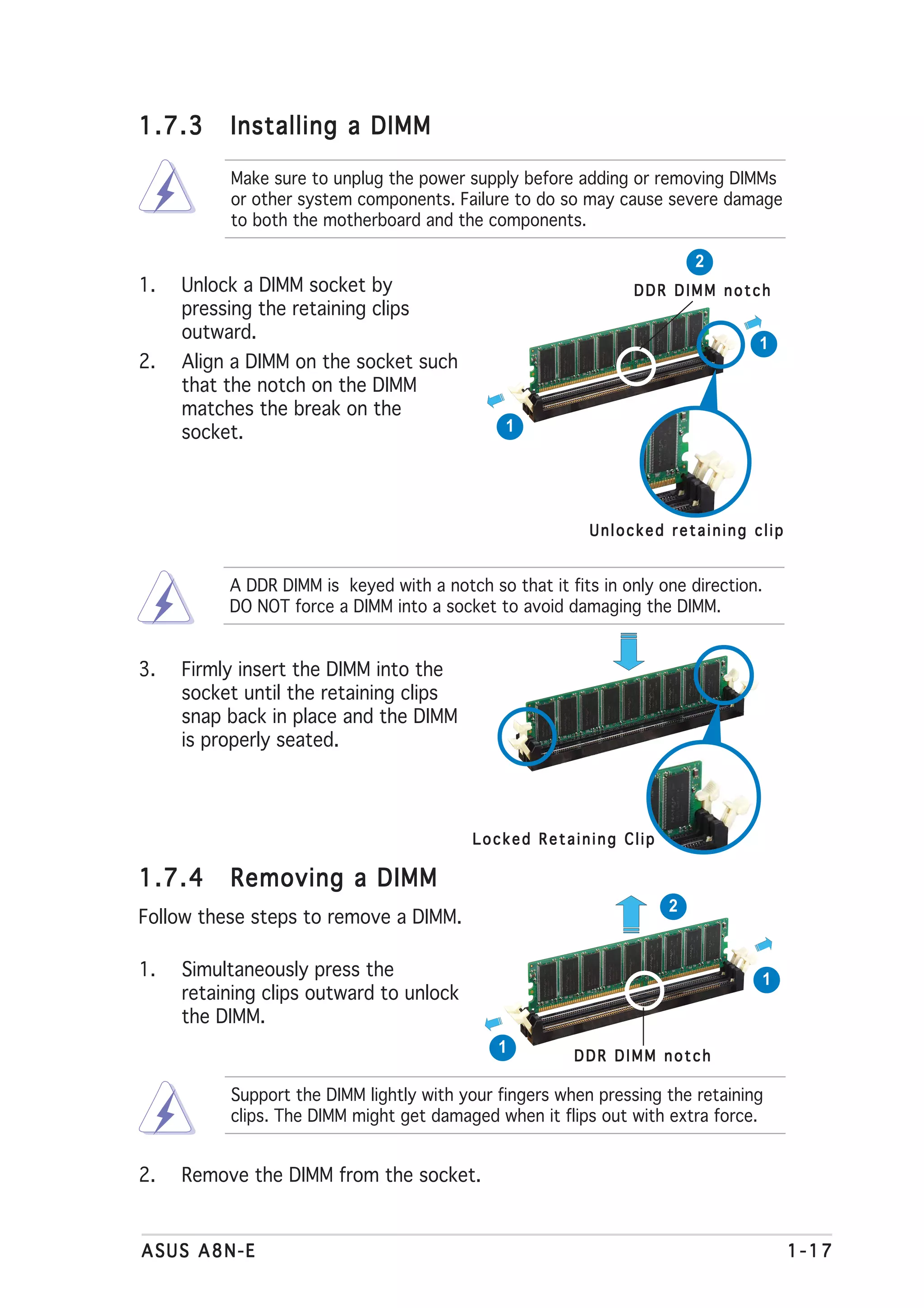
       Select an item then press <Enter> to display the configuration options.

                                   Phoenix-Award BIOS CMOS Setup Utility
                 Advanced

                                USB Configuration                           Select Menu
           USB Controller                     [Enabled]               Item Specific Help
           USB2.0 Controller                  [Enabled]
           USB Legacy support                 [Enabled]


   USB Controller [Enabled]
       Allows you to enable or disable the onchip USB controller.
       Configuration options: [Disabled] [Enabled]

   USB 2.0 Controller [Enabled]
       Allows you to enable or disable the USB 2.0 controller.
       Configuration options: [Disabled] [Enabled]

   USB Legacy Support [Enabled]
       Allows you to enable or disable support for USB devices on legacy
       operating systems (OS). Configuration options: [Disabled] [Enabled]


   Onboard NV LAN [Enabled]
       Enables or disables the onboard NVIDIA® Gigabit LAN controller.
       Configuration options: [Enabled] [Disabled]

   OnBoard LAN Boot ROM [Disabled]
       Allows you to enable or disable the onboard LAN boot ROM.
       Configuration options: [Disabled] [Enabled]

   AC97 Audio [Enabled]
       Allows you to disable or enabled the onboard AC97 audio controller.
       Configuration options: [Disabled] [Enabled]

2-26                                                                 Chapter 2: BIOS setup
Serial Port1 Address [3F8/IRQ4]
Allows you to select the Serial Port1 base address.
Configuration options: [Disabled] [3F8/IRQ4] [3E8/IRQ4] [2E8/IRQ3]

Parallel Port Address [378/IRQ7]
Allows you to select the Parallel Port base addresses.
Configuration options: [Disabled] [378/IRQ7] [278/IRQ5] [3BC/IRQ7]

Parallel Port Mode [ECP+EPP]
Allows you to select the Parallel Port mode.
Configuration options: [Normal] [Bi-directional] [EPP] [ECP]

ECP Mode Use DMA [3]
Allows selection of ECP Mode. Configuration options: [1] [3]

Game Port Address [201]
Allows you to select the Game Port address or to disable the port.
Configuration options: [Disabled] [201] [209]

Midi Port Address [Disabled]
Allows you to select the Game Port address or to disable the port.
Configuration options: [Disabled] [330] [300]

Midi Port IRQ [10]
Allows you to set the Midi port IRQ address. Configuration options: [5] [10]


ASUS A8N-E                                                                 2-27
2.4.4         JumperFree Configuration
                                    Phoenix-Award BIOS CMOS Setup Utility
                   Advanced

                              JumperFree Configuration                       Select Menu
             Overclock Profile                  [Auto]                 Item Specific Help
         x   Overclock Options                   Disable
         x   N.O.S. Option                       Disable
         x   CPU Frequency                       200.00
         x   PCI Express Clock                   100Mhz
         x   DDR Voltage                         Auto
         x   CPU Multiplier                      Auto
         x   CPU Voltage                         Auto


   Overclock Profile [Auto]
       Allows selection of CPU overclocking options to achieve desired CPU
       internal frequency. Select either one of the preset overclocking
       configuration options:

   Manual                                   Allows you to individually set overclocking
                                            parameters.
   Auto                                     Loads the optimal settings for the system.
   Standard                                 Loads the standard settings for the system.
   AI Overclock                             Loads overclocking profiles with optimal
                                            parameters for stability when overclocking.
   AI N.O.S.                                The ASUS AI Non-delay Overclocking System
                                            feature intelligently determines the system
                                            load and automatically boost the performance
                                            for the most demanding tasks.


                     The following items are user-configurable only when the Overclock
                     Profile item is set to [Manual].


   CPU Frequency [XXX] (value is auto-detected)
       Indicates the frequency sent by the clock generator to the system bus and
       PCI bus. The bus frequency (external frequency) multiplied by the bus
       multiple equals the CPU speed. The value of this item is auto-detected by
       BIOS. The values range from 200 to 400. Refer to the following table for
       the correct Front Side Bus and CPU External Frequency settings.

                     Selecting a very high CPU frequency may cause the system to become
                     unstable! If this happens, revert to the default setting.


2-28                                                                  Chapter 2: BIOS setup
PCI Express Clock [100MHz]
Allows you to set the PCI Express clock. Key-in a decimal value between
100-200 MHz. Configuration options: [100Mhz] [101Mhz~[145Mhz]

DDR Voltage [Auto]
Sets the operating DDR voltage. Configuration options: [Auto] [2.60V]
[2.65V] [2.70V] [2.75V] [2.80V] [2.85V] [2.90V] [2.95V] [3.00V]

CPU Multiplier [Auto]
Sets the operating CPU multiplier. The configuration options vary
depending on the type of CPU installed. Configuration options: [Auto] [x4]
[x4.5] [x5] [x5.5] [x6] [x6.5] [x7] [x7.5] [x7.5] [x8] [x8.5] [x9] [x9.5]
[x10] [x10.5] [x11] [x11.5] [x12] [x12.5] [x13] [x13.5] [x14] [x14.5]
[x15] [x15.5] [x16] [x16.5] [x17] [x17.5] [x18] [x18.5] [x19] [x19.5]
[x20]

CPU Voltage [Auto]
Sets the operating CPU voltage. Configuration options: [Auto]
[1.650V] [1.6375V] [1.625V] [1.6125V] [1.600V] [1.5875V]
[1.575V] [1.5625V] [1.550V] [1.5375V] [1.525V] [1.5125V]
[1.500V] [1.4875V] [1.475V] [1.4625V] [1.450V] [1.4375V]
[1.425V] [1.4125V] [1.400V] [1.3875V] [1.375V] [1.3625V]
[1.350V] [1.3375V] [1.325V] [1.3125V] [1.300V] [1.2875V]
[1.275V] [1.2625V] [1.250V] [1.2375V] [1.225V] [1.2125V]
[1.200V] [1.1875V] [1.175V] [1.1625V] [1.150V] [1.1375V]
[1.125V] [1.1125V] [1.100V] [1.0875V] [1.075V] [1.0625V]
[1.050V] [1.0375V] [1.025V] [1.0125V] [1.000V] [0.9875V]
[0.975V] [0.9625V] [0.950V] [0.9375V] [0.925V] [0.9125V]
[0.900V] [0.8875V] [0.875V] [0.8625V] [0.850V] [0.8375V]
[0.825V] [0.8125V] [0.800V]


          The following item is user-configurable only when the AI Overclocking
          item is set to [AI Overclock].


Overclock Options [Disable]
Allows you to set the oveclocking options.
Configuration options: [Disable] [Overclock 3%] [Overclock 5%]
[Overclock 8%] [Overclock 10%]


ASUS A8N-E                                                                        2-29
The following item is user-configurable only when the AI Overclocking
                   item is set to [AI N.O.S.].


       N.O.S. Option [Disable]
       Sets the Non-Delay Overclocking System mode.
       Configuration options: [Disable] [Overclock 3%] [Overclock 5%]
       [Overclock 8%] [Overclock 10%]


       2.4.5       LAN Cable Status
       The items in this menu displays the status of the Local Area Network
       (LAN) cable.

                                   Phoenix-Award BIOS CMOS Setup Utility
                  Advanced

                             JumperFree Configuration                       Select Menu
           POST Check LAN Cable                [Disabled]             Item Specific Help
           Pair                                Status       Length
           1-2                                 Open         N/A
           3-6                                 Open         N/A
           4-5                                 Open         N/A
           7-8                                 Open         N/A


   POST Check LAN cable [Disabled]
       Enables or disables checking of the LAN cable during the Power-On
       Self-Test (POST). Configuration options: [Disabled] [Enabled]


       2.4.6       PEG Link Mode
                                   Phoenix-Award BIOS CMOS Setup Utility
                  Advanced

                             JumperFree Configuration                       Select Menu
           PEG Link Mode                       [Auto]                 Item Specific Help
           PEG Root Control                    [Auto]
           PEG Buffer Length                   [Auto]


   PEG Link Mode [Disabled]
       Allows you to enhance the performance of your PCI Express graphics card.
       Configuration options: [Auto] [Slow] [Normal] [Fast] [Faster]

   PEG Root Control [Auto]
       Allows you to enable or disable the PCI Express graphics root control.
       Configuration options: [Auto] [Enabled] [Disabled]


2-30                                                                 Chapter 2: BIOS setup
PEG Buffer Length [Auto]
Allows you to set the PCI Express graphics buffer length.
Configuration options: [Auto] [Long] [Short]


2.4.7       Instant Music
                           Phoenix-Award BIOS CMOS Setup Utility
          Advanced

                     JumperFree Configuration                       Select Menu
    Instant Music                      [Disabled]             Item Specific Help
  x Instant Music CD-ROM Drive          Primary Master
                                                              If enabled, power up
                                                              by PS/2 keyboard
                                                              function will be
                                                              disabled.


Instant Music [Disabled]
Allows you to enable or disable the ASUS Instant Music feature.
Configuration options: [Disabled] [Enabled]

            Enabling Instant Music automatically disables the PS/2 keyboard power
            up feature.

Instant Music CD-ROM Drive [Primary Master]
Allows you to select the CD-ROM drive that you wish to use for the Instant
Music CD playback. Configuration options: [Primary Master] [Primary Slave]
[Secondary Master] [Secondary Slave]


ASUS A8N-E                                                                           2-31
2.5           Power menu
       The Power menu items allow you to change the settings for the Advanced
       Configuration and Power Interface (ACPI) and the Advanced Power
       Management (APM). Select an item then press <Enter> to display the
       configuration options.

                                   Phoenix-Award BIOS CMOS Setup Utility
          Main   Advanced      Power   Boot   Exit

           ACPI Suspend Type                  [S1&S3]                         Select Menu
           ACPI APIC support                  [Enabled]
           APM Configuration                                            Item Specific Help
           Hardware Monitor
                                                                        Select the ACPI state
                                                                        used for System
                                                                        Suspend.


         F1:Help       ↑↓ : Select Item         -/+: Change Value               F5: Setup Defaults
         ESC: Exit     →←: Select Menu        Enter: Select Sub-menu           F10: Save and Exit


       2.5.1         ACPI Suspend Type [S1&S3]
       Allows you to select the Advanced Configuration and Power Interface
       (ACPI) state to be used for system suspend.
       Configuration options: [S1 (POS)] [S3(STR)] [S1&S3]

       2.5.2         ACPI APIC Support [Enabled]
       Allows you to enable or disable the Advanced Configuration and Power
       Interface (ACPI) support in the Application-Specific Integrated Circuit
       (ASIC). When set to Enabled, the ACPI APIC table pointer is included in the
       RSDT pointer list. Configuration options: [Disabled] [Enabled]


2-32                                                                   Chapter 2: BIOS setup
2.5.3         APM Configuration

                          Phoenix-Award BIOS CMOS Setup Utility
                      Power

                       APM Configuration                               Select Menu
    Restore on AC Power Loss             [Disabled]              Item Specific Help
    PWR Button < 4 secs                  [Instant Off]
    Power On By PCI Devices              [Disabled]
    Power On By External Modems          [Disabled]              Press [ENTER] to
    Power-On by RTC Alarm                [Disabled]              select whether or not
  x Date (of Month)                        0                     to restart the system
  x Resume Time (hh:mm:ss)           0 : 0 : 0                   after AC power loss.
    Power Up By PS/2 Mouse               [Disabled]
    Power Up By PS/2 Keyboard            [Disabled]


  F1:Help         ↑↓ : Select Item        -/+: Change Value              F5: Setup Defaults
  ESC: Exit       →←: Select Menu       Enter: Select Sub-menu          F10: Save and Exit


Restore on AC Power Loss [Disabled]
Allows you to enable or disable the Restore on AC Power Loss function.
Configuration options: [Disabled] [Enabled]

PWR Button < 4 secs [Instant-Off]
Allows you to set the event after the power button is pressed for more
than 4 seconds. Configuration options: [Suspend] [Instant-Off]

Power On By PCI Devices [Disabled]
When set to [Enabled], this parameter allows you to turn on the system
through a PCI LAN or modem card. This feature requires an ATX power
supply that provides at least 1A on the +5VSB lead.
Configuration options: [Disabled] [Enabled]

Power On By External Modems [Disabled]
This allows either settings of [Enabled] or [Disabled] for powering up the
computer when the external modem receives a call while the computer is in
Soft-off mode. Configuration options: [Disabled] [Enabled]

              The computer cannot receive or transmit data until the computer and
              applications are fully running. Thus, connection cannot be made on the
              first try. Turning an external modem off and then back on while the
              computer is off causes an initialization string that turns the system
              power on.


ASUS A8N-E                                                                                    2-33
Power On By RTC Alarm [Disabled]
       Allows you to enable or disable RTC to generate a wake event. When this
       item is set to Enabled, the items Date of Month Alarm and Time (hh:mm:ss)
       Alarm items become user-configurable with set values.
       Configuration options: [Disabled] [Enabled]

   Day of Month Alarm [Disabled]
       To set the date of alarm, highlight this item and press <Enter> to display
       the Day of Month Alarm pop-up menu. Key-in a value within the specified
       range then press <Enter>. Configuration options: [Min=0] [Max=31]

   Time (hh:mm:ss) Alarm [Disabled]
       To set the time of alarm:

       1.   Highlight this item and press <Enter> to display a pop-up menu for the
            hour field.
       2.   Key-in a value (Min=0, Max=23), then press <Enter>.
       3.   Press <TAB> to move to the minutes field then press <Enter>.
       4.   Key-in a minute value (Min=0, Max=59), then press <Enter>.
       5.   Press <TAB> to move to the seconds field then press <Enter>.
       6.   Key-in a value (Min=0, Max=59), then press <Enter>.


   Power Up By PS/2 Mouse [Disabled]
       When set to [Enabled], this parameter allows you to use the PS/2 mouse
       to turn on the system. This feature requires an ATX power supply that
       provides at least 1A on the +5VSB lead.
       Configuration options: [Disabled] [Enabled]

   Power On By PS/2 Keyboard [Disabled]
       Allows you to disable the Power On by PS/2 keyboard function or set
       specific keys on the PS/2 keyboard to turn on the system. This feature
       requires an ATX power supply that provides at least 1A on the +5VSB lead.
       Configuration options: [Disabled] [Space Bar] [Ctrl-ESC] [Power Key]


2-34                                                      Chapter 2: BIOS setup
2.5.4         Hardware Monitor
The items in this sub-menu displays the hardware monitor values
automatically detected by the BIOS. It also allows you to change CPU Q-Fan
feature-related parameters. Select an item then press <Enter> to display
the configuration options.

                           Phoenix-Award BIOS CMOS Setup Utility
                       Power

                        Hardware Monitor                             Select Menu
    Q-Fan Controller                  [Disabled]               Item Specific Help
    Vcore Voltage                         1.50V
    3.3V Voltage                          3.31V
    5V Voltage                            4.94V                Press [Enter] to
    12V Voltage                          11.26V                enable or disable

    CPU Temperature                         48ºC
    M/B Temperature                         38ºC
    CPU FAN Speed                      4962 RPM
    CHA1 FAN Speed                         0 RPM
    CHIP FAN Speed                     5443 RPM
  x CPU Target Temperature            72ºC


  F1:Help       ↑↓ : Select Item        -/+: Change Value              F5: Setup Defaults
  ESC: Exit     →←: Select Menu       Enter: Select Sub-menu          F10: Save and Exit


Q-Fan Controller [Disabled]
Allows you to enable or disable the Q-Fan controller.
Configuration options: [Disabled] [Enabled]

VCORE Voltage, +12V Voltage, 3.3V Voltage, 5VCC
Voltage
The onboard hardware monitor automatically detects the voltage output
through the onboard voltage regulators. These items are not
user-configurable.

CPU Temperature, M/B Temperature
The onboard hardware monitor automatically detects and displays the
motherboard and CPU temperatures. These items are not user-configurable.

CPU Fan Speed
CHA1 Fan Speed
CHIP Fan Speed
The onboard hardware monitor automatically detects and displays the
Chassis, CPU, and Chip fan speeds in rotations per minute (RPM). If the fan
is not connected to the motherboard, the field shows 0. These items are
not user-configurable.


ASUS A8N-E                                                                                  2-35
CPU Target Temperature
       Allows you to set the temperature threshold before the CPU fan rotates at
       full speed. Configuration options: [51ºC] [54ºC] [57ºC] [60ºC] [63ºC]
       [66ºC] [69ºC] [72ºC] [75ºC] [78ºC] [81ºC]


   2.6               Boot menu
   The Boot menu items allow you to change the system boot options. Select
   an item then press <Enter> to display the sub-menu.

                                     Phoenix-Award BIOS CMOS Setup Utility
          Main     Advanced      Power   Boot   Exit

          Boot Device Priority                                                  Select Menu
          Removable Drives
          Hard Disk Drives                                                Item Specific Help
          CDROM Drives
          Boot Settings Configuration
          Security


         F1:Help           ↑↓ : Select Item       -/+: Change Value               F5: Setup Defaults
         ESC: Exit         →←: Select Menu      Enter: Select Sub-menu           F10: Save and Exit


       2.6.1            Boot Device Priority
                                     Phoenix-Award BIOS CMOS Setup Utility
                                 Power

                                 Boot Device Priority                           Select Menu
           1st   Boot   Device                   [Removable]              Item Specific Help
           2nd   Boot   Device                   [Hard Disk]
           3rd   Boot   Device                   [CDROM]
           4th   Boot   Device                   [Disabled]               Select your boot
                                                                          device priority


   1st ~ xxth Boot Device [Removable]
       These items specify the boot device priority sequence from the available
       devices. The number of device items that appears on the screen depends
       on the number of devices installed in the system.
       Configuration options: [Removable] [Hard Disk] [CDROM] [Legacy LAN]
       [Disabled]


2-36                                                                     Chapter 2: BIOS setup
2.6.2       Removable Drives
                         Phoenix-Award BIOS CMOS Setup Utility
                             Boot

                       Removable Drives                           Select Menu
    1. Floppy Disks                                         Item Specific Help


1. Floppy Disks
Allows you to assign a removable drive attached to the system.


2.6.3       Hard Disk Drives
                         Phoenix-Award BIOS CMOS Setup Utility
                             Boot

                      Hard Disk Drives                            Select Menu
    1. 1st Master: XXXXXXXXX                                Item Specific Help
    2. Bootable Add-in Cards


1. 1st Master: XXXXXXXXX
Allows you to assign hard disk drives attached to the system.


2.6.4      CDROM Drives
                         Phoenix-Award BIOS CMOS Setup Utility
                             Boot

                        CDROM Drives                              Select Menu
    1. 1st Slave: XXXXXXXXX                                 Item Specific Help


1. 1st Slave: XXXXXXXXX
Allows you to assign optical drives attached to the system.


ASUS A8N-E                                                                       2-37
2.6.5             Boot Settings Configuration
                                    Phoenix-Award BIOS CMOS Setup Utility
                                        Boot

                           Boot Settings Configuration                                Select Menu
           Case Open Warning                      [Enabled]                   Item Specific Help
           Quick Boot                             [Enabled]
           Boot Up Floppy Seek                    [Enabled]
           Bootup Num-Lock                        [On]                        Press [Enter] to
           Typematic Rate Setting                 [Disabled]                  enable or disable.
         x Typematic Rate (Chars/Sec)              6
         x Typematic Delay (Msec)                  250
           OS Select For DRAM > 64MB              [Non-OS2]
           Full Screen LOGO                       [Enabled]
           Halt On                                [All Errors]


         F1:Help          ↑↓ : Select Item          -/+: Change Value                   F5: Setup Defaults
         ESC: Exit        →←: Select Menu         Enter: Select Sub-menu               F10: Save and Exit

   Case Open Warning [Enabled]
       Enables or disables the chassis open status feature. Setting to Enabled,
       clears the chassis open status. Refer to section “2.7 Internal connectors”
       for setting details. Configuration options: [Disabled] [Enabled]

   Quick Boot [Enabled]
       Allows you to enable or disable the system quick boot feature. When
       Enabled, the system skips certain tests while booting.
       Configuration options: [Disabled] [Enabled]

   Boot Up Floppy Seek [Enabled]
       Enables or disables the chassis open status feature. Setting to Enabled,
       clears the chassis open status. Configuration options: [Disabled] [Enabled]

   Bootup Num-Lock [On]
       Allows you to select the power-on state for the NumLock.
       Configuration options: [Off] [On]

   Typematic Rate Setting [Disabled]
   Allows you to set the keystroke rate. Enable this item to configure the
   T y p e m a t i c R a t e ( C h a r s / S e c ) and the T y p e m a t i c D e l a y ( M s e c )
                                                                                                 ).
   Configuration options: [Disabled] [Enabled]

                     The items T y p e m a t i c R a t e ( C h a r s / S e c ) and T y p e m a t i c D e l a y
                     ( M s e c ) becomes user-configurable only when the item Typematic Rate
                     Setting is enabled.


2-38                                                                         Chapter 2: BIOS setup
Typematic Rate (Chars/Sec) [6]
Allows you to select the rate at which a character repeats when you hold a
key. Configuration options: [6] [8] [10] [12] [15] [20] [24] [30]

Typematic Delay (Msec) [250]
Allows you to set the delay before keystrokes begin to repeat.
Configuration options: [250] [500] [750] [1000]

OS Select for DRAM > 64MB [Non-OS2]
Set this item to OS2 only when you are running on an OS/2 operating
system with an installed RAM of greater than 64 KB.
Configuration options: [Non-OS2] [OS2]

Full Screen LOGO [Enabled]
Allows you to enable or disable the full screen logo display feature.
Configuration options: [Disabled] [Enabled]

            •    Make sure that the above item is set to [Enabled] if you want to use
                 the ASUS MyLogo2™ feature.
            •    See section “3.3.1 ASUS MyLogo2™” for details.


Halt On [All Errors]
Allows you to error report type.
Configuration options: [All Errors] [No Errors] [All, But Keyboard]
[All, But Diskette] [All, But Disk/Key]


2.6.6       Security
                           Phoenix-Award BIOS CMOS Setup Utility
                               Boot

                  Boot Settings Configuration                       Select Menu
     Supervisor Password              Clear                   Item Specific Help
     User Password                    Clear
     Password Check                   [Setup]


Supervisor Password
User Password
These fields allow you to set passwords:
To set a password:

1.   Select an item then press <Enter>.
2.   Type in a password using a combination of a maximum of eight (8)
     alpha-numeric characters, then press <Enter>.

ASUS A8N-E                                                                              2-39
3.   When prompted, confirm the password by typing the exact characters
            again, then press <Enter>. The password field setting is changed to
            Set.


       To clear the password:
       1.   Select the password field and press <Enter> twice. The following
            message appears:

              PASSWORD DISABLED !!!
              Press any key to continue...


       2.   Press any key to continue. The password field setting is changed to
            Clear.
            A note about passwords
            The Supervisor password is required to enter the BIOS Setup program
            preventing unauthorized access. The User password is required to
            boot the system preventing unauthorized use.
            Forgot your password?
            If you forget your password, you can clear it by erasing the CMOS Real
            Time Clock (RTC) RAM. The RAM data containing the password
            information is powered by the onboard button cell battery. If you need
            to erase the CMOS RAM, refer to section “2.6 Jumpers” for
            instructions.

       Password Check
       This field requires you to enter the password before entering the BIOS
       setup or the system. Select [Setup] to require the password before
       entering the BIOS Setup. Select [System] to require the password before
       entering the system. Configuration options: [Setup] [System]


2-40                                                     Chapter 2: BIOS setup
2.7           Exit menu
The Exit menu items allow you to load the optimal or failsafe default values
for the BIOS items, and save or discard your changes to the BIOS items.

                          Phoenix-Award BIOS CMOS Setup Utility
   Main   Advanced    Power   Boot   Exit

    Exit & Save Changes                                             Select Menu
    Exit & Discard Changes
    Load Setup Default                                        Item Specific Help
    Discard Changes
                                                              This option save data
                                                              to CMOS and exiting
                                                              the setup menu.


  F1:Help         ↑↓ : Select Item     -/+: Change Value              F5: Setup Defaults
  ESC: Exit       →←: Select Menu    Enter: Select Sub-menu          F10: Save and Exit


              Pressing <Esc> does not immediately exit this menu. Select one of the
              options from this menu or <F10> from the legend bar to exit.


Exit & Save Changes
Once you are finished making your selections, choose this option from the
Exit menu to ensure the values you selected are saved to the CMOS RAM.
An onboard backup battery sustains the CMOS RAM so it stays on even
when the PC is turned off. When you select this option, a confirmation
window appears. Select Y e s to save changes and exit.

               If you attempt to exit the Setup program without saving your changes,
              the program prompts you with a message asking if you want to save
              your changes before exiting. Press <Enter> to save the changes while
              exiting.


Exit & Discard Changes
Select this option only if you do not want to save the changes that you
made to the Setup program. If you made changes to fields other than
System Date, System Time, and Password, the BIOS asks for a confirmation
before exiting.


ASUS A8N-E                                                                                 2-41
Load Setup Defaults
       This option allows you to load the default values for each of the
       parameters on the Setup menus. When you select this option or if you
       press <F5>, a confirmation window appears. Select Y e s to load default
       values. Select E x i t & S a v e C h a n g e s or make other changes before
       saving the values to the non-volatile RAM.

   Discard Changes
       This option allows you to discard the selections you made and restore the
       previously saved values. After selecting this option, a confirmation appears.
       Select Y e s to discard any changes and load the previously saved values.


2-42                                                        Chapter 2: BIOS setup
3
This chapter describes the contents
of the support CD that comes with
the motherboard package.

                                      Software
                                       support


ASUS A8N-E                                       3-1
3.1        Installing an operating system
      This motherboard supports Windows® 2000/XP operating systems (OS).
      Always install the latest OS version and corresponding updates to maximize
      the features of your hardware.
                 •     Motherboard settings and hardware options vary. Use the setup
                       procedures presented in this chapter for reference only. Refer to
                       your OS documentation for detailed information.
                 •     Make sure that you install Windows® 2000 Service Pack 4 or the
                       Windows® XP Service Pack 2 or later versions before installing the
                       drivers for better compatibility and system stability.


      3.2        Support CD information
      The support CD that came with the motherboard package contains the
      drivers, software applications, and utilities that you can install to avail all
      motherboard features.
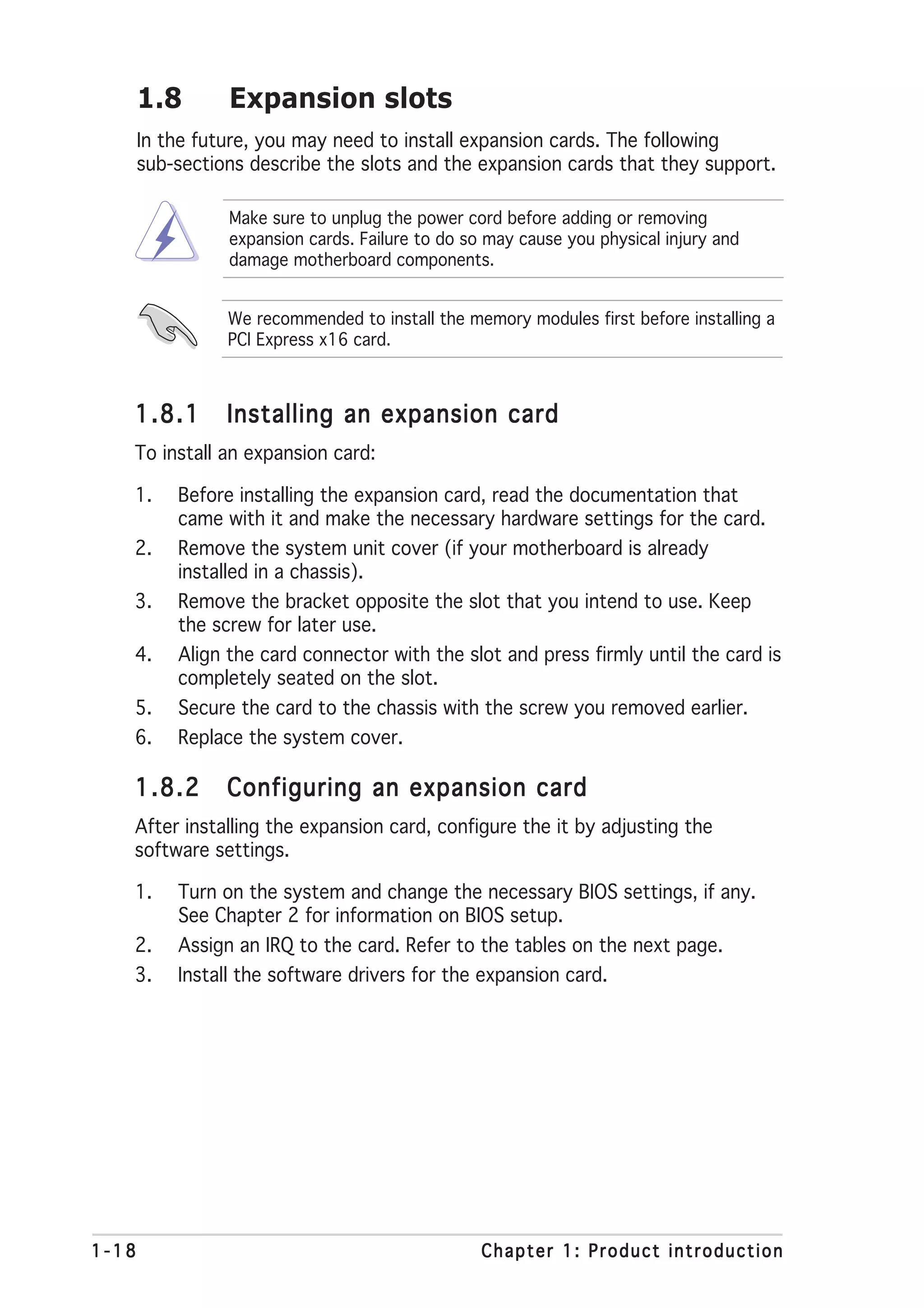
                 The contents of the support CD are subject to change at any time
                 without notice. Visit the ASUS website(www.asus.com) for updates.


      3.2.1      Running the support CD
      Place the support CD to the optical drive. The CD automatically displays the
      D r i v e r s menu if Autorun is enabled in your computer.


                                                                         Click an icon to
                                                                         display support
                                                                         CD/motherboard
                                                                         information


                     Click an item to install


                  If A u t o r u n is NOT enabled in your computer, browse the contents of
                  the support CD to locate the file ASSETUP.EXE from the BIN folder.
                  Double-click the A S S E T U P . E X E to run the CD.


3-2                                                     Chapter 3: Software support
3.2.2      Drivers menu
The drivers menu shows the available device drivers if the system detects
installed devices. Install the necessary drivers to activate the devices.


Nvidia Chipset Driver Program
Installs the NVIDIA® Chipset drivers for the NVIDIA® nForce™ 4 Ultra
chipset.

Make NVIDIA RAID Driver Disk
Creates the NVIDIA® driver disk for Serial ATA and RAID features.
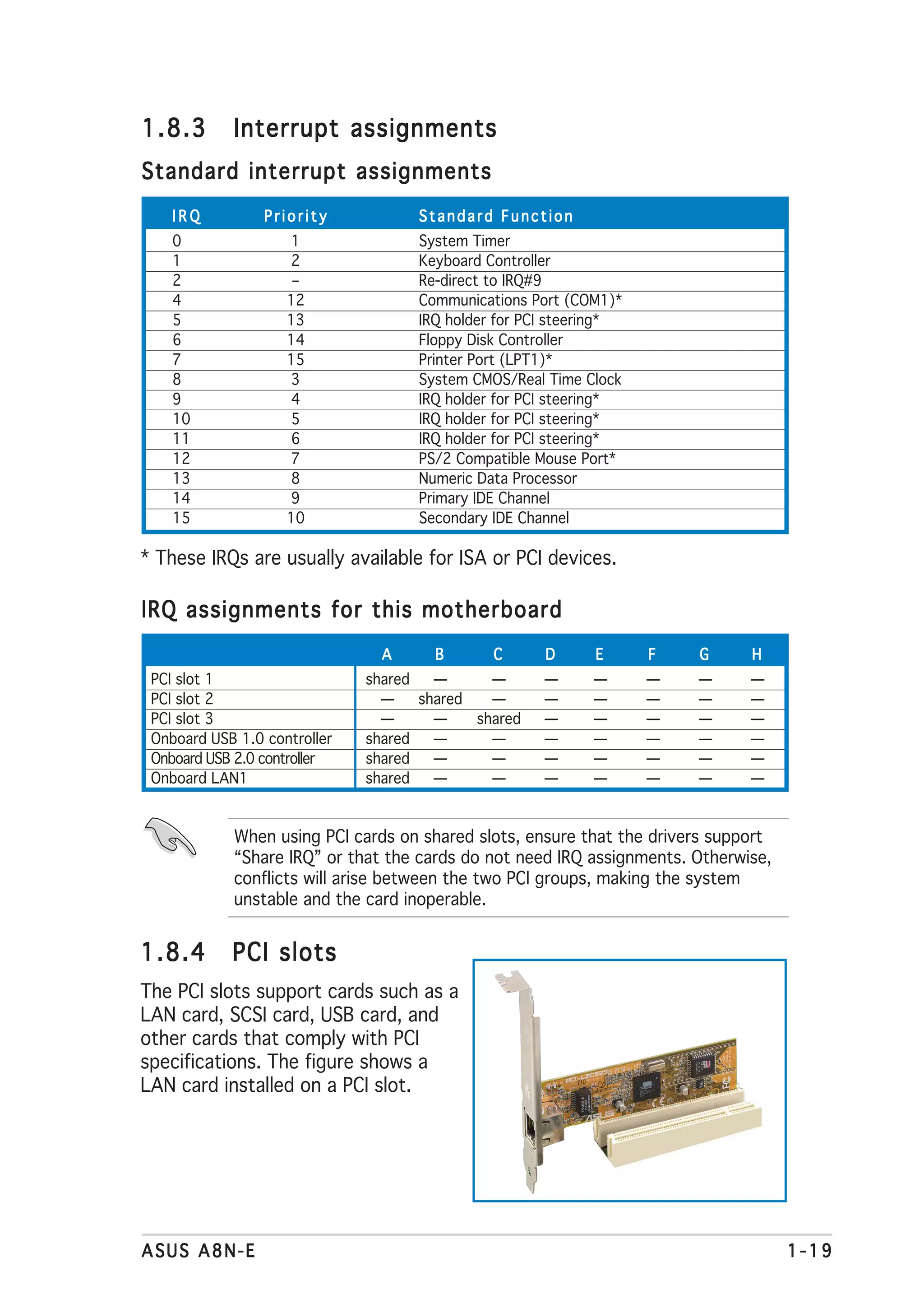
Realtek ALC850 Driver
Installs the Realtek® ALC850 audio controller and application.

AMD Cool’n’Quiet Driver
Installs the AMD Cool ‘n’ Quiet! Technology drivers.

USB 2.0 Driver
Installs the Universal Serial Bus 2.0 (USB 2.0) driver.


           The screen display and drivers option may not be the same for different
           operating system versions.


ASUS A8N-E                                                                           3-3
3.2.3     Utilities menu
      The Utilities menu shows the applications and other software that the
      motherboard supports.


      NVIDIA Chipset nTune Utility
      Installs the NVIDIA® nTune™ utility that allows easy and safe system tuning
      for optimum performance.

      ASUS PC Probe
      This smart utility monitors the fan speed, CPU temperature, and system
      voltages, and alerts you of any detected problems. This utility helps you
      keep your computer in healthy operating condition.

      ASUS Update
      Allows you to download the latest version of the BIOS from the ASUS
      website.

                Before using the ASUS Update, make sure that you have an Internet
                connection so you can connect to the ASUS website.


      ASUS AI Booster
      The ASUS AI Booster application allows you to overclock the CPU speed in a
      Windows® environment.


3-4                                                Chapter 3: Software support
Microsoft DirectX
Installs the Microsoft® DirectX 9.0 driver. The Microsoft DirectX® 9.0 is a
multimedia technology that enhances computer graphics and sound.
DirectX® improves the multimedia features of you computer so you can
enjoy watching TV and movies, capturing videos, or playing games in your
computer. Visit the Microsoft website (www.microsoft.com) for updates.

Anti-virus Utility
The anti-virus application detects and protects your computer from viruses
that destroys data.

ADOBE Acrobat Reader
Installs the Adobe® Acrobat® Reader that allows you to open, view, and
print documents in Portable Document Format (PDF).

ASUS Screen Saver
Bring life to your computer screen by installing the ASUS screen saver.

ASUS AMD Cool ‘n’ Quiet Software
Installs the AMD® Cool ‘n’ Quiet! software.


ASUS A8N-E                                                                    3-5
3.2.4     Manuals menu
      The Manuals menu contains a list of supplementary user manuals. Click an
      item to open the folder of the user manual.

                •   Most user manual files are in Portable Document Format (PDF).
                    Install the Adobe® Acrobat® Reader from the U t i l i t i e s m e n u
                    before opening a user manual file.
                •   Some user manuals listed in this menu may not be applicable for this
                    motherboard model.


      NVIDIA Firewall Administrator’s Guide
      Allows you to open the NVIDIA® ForceWare Networking and Firewall
      Administrator’s Guide.

      NVIDIA RAID User’s Guide
      Allows you to open the NVIDIA® RAID User’s Guide.

      NVIDIA nTune Manual
      Allows you to open the NVIDIA® nTune™ user’s manual.


3-6                                                     Chapter 3: Software support
3.2.5      ASUS Contact information
Click the C o n t a c t tab to display the ASUS contact information. You can
also find this information on the inside front cover of this user guide.


3.2.6      Other information
The icons on the top right corner of the screen give additional information
on the motherboard and the contents of the support CD. Click an icon to
display the specified information.

Motherboard Info
Displays the general specifications of the motherboard.


ASUS A8N-E                                                                     3-7
Browse this CD
      Displays the support CD contents in graphical format.


      Technical support Form
      Displays the ASUS Technical Support Request Form that you have to fill out
      when requesting technical support.


3-8                                              Chapter 3: Software support
3.3        Software information
Most of the applications in the support CD have wizards that will
conveniently guide you through the installation. View the online help or
readme file that came with the software application for more information.

3.3.1      ASUS MyLogo2™
The ASUS MyLogo2™ utility lets you customize the boot logo. The boot
logo is the image that appears on screen during the Power-On Self-Tests
(POST). The ASUS MyLogo2™ is automatically installed when you install the
A S U S U p d a t e utility from the support CD. See section “3.2.3 Utilities
menu” for details.

           •   Before using the ASUS MyLogo2™, use the Award BIOS Flash utility
               to make a copy of your original BIOS file, or obtain the latest BIOS
               version from the ASUS website. See section “2.1.2 Updating the
               BIOS”.
           •   Make sure that the BIOS item F u l l S c r e e n L o g o is set to
               [Enabled] if you wish to use ASUS MyLogo2. See section “2.6.2
               Boot Settings Configuration”.
           •   You can create your own boot logo image in GIF, JPG, or BMP file
               formats.


To launch the ASUS MyLogo2™:

1.   Launch the ASUS Update utility. Refer to section “2.1.5 ASUS Update
     utility” for details.
2.                                                                  t.
     Select O p t i o n s from the drop down menu, then click N e x t
3.   Check the option L a u n c h M y L o g o t o r e p l a c e s y s t e m b o o t
     l o g o b e f o r e f l a s h i n g B I O S then click N e x t
                                               S,                 t.
4.   Select U p d a t e B I O S f r o m a f i l e from the drop down menu, then
     click N e x tt.
5.   When prompted, locate the new
     BIOS file, then click N e x t The  t.
     ASUS MyLogo2 window appears.
6.   From the left window pane, select
     the folder that contains the image
     you intend to use as your boot
     logo.


ASUS A8N-E                                                                            3-9
7.   When the logo images appear on
        the right window pane, select an
        image to enlarge by clicking on it.


   8.   Adjust the boot image to your
        desired size by selecting a value
        on the R a t i o box.


   9.   When the screen returns to the ASUS Update utility, flash the original
        BIOS to load the new boot logo.
   10. After flashing the BIOS, restart the computer to display the new boot
       logo during POST.


3-10                                           Chapter 3: Software support
3.3.3     AI NET 2
The Marvell® Virtual Cable Tester™ (VCT) is a cable diagnostic utility that
reports LAN cable faults and shorts using the Time Domain Reflectometry
(TDR) technology. The VCT detects and reports open and shorted cables,
impedance mismatches, pair swaps, pair polarity problems, and pair skew
problems of up to 100 meters at one meter accuracy.
The VCT feature reduces networking and support costs through a highly
manageable and controlled network system. This utility can be incorporated
in the network systems sofware for ideal field support as well as
development diagnostics.

Using the Virtual Cable Tester™
To use the the Marvell® Virtual Cable Tester™ utility:

1.   Launch the VCT utility from the Windows® desktop by clicking
     Start > All Programs > Marvell > Virtual Cable Tester        r.
2.   Click V i r t u a l C a b l e
     T e s t e r from the menu
     to display the screen
     below.


3.   Click the R u n button to perform a cable test.


           •   The VCT only runs on systems with Windows® XP or Windows® 2000
               operating systems.
           •   The R u n button on the Virtual Cable Tester™ main window is
               disabled if no problem is detected on the LAN cable(s) connected to
               the LAN port(s).
           •   If you want the system to check the LAN cable before entering the
               OS, enable the P O S T C h e c k L A N c a b l e item in the BIOS. See
               section “2.4.5 LAN Cable Status” for details.


ASUS A8N-E                                                                              3-11
3.3.4        Audio configurations
   The Realtek® ALC850 AC ‘97 audio CODEC provides 8-channel audio
   capability to deliver the ultimate audio experience on your PC. The software
   provides Jack-Sensing function (Line-In, Line-Out, Mic-In), S/PDIF out
   support and interrupt capability. The ALC850 also includes the Realtek®
   proprietary UAJ® (Universal Audio Jack) technology for three ports (Line-In,
   Line-Out and Mic-In), eliminating cable connection errors and giving users
   plug and play convenience.
   Follow the installation wizard to install the R e a l t e k A L C 8 5 0 A u d i o
   D r i v e r a n d A p p l i c a t i o n from the support CD that came with the
   motherboard package.
   If the Realtek audio software is correctly installed, you will find the
   SoundEffect icon on the taskbar.
   From the taskbar, double-click on the
   S o u n d E f f e c t icon to display the R e a l t e k
   A u d i o C o n t r o l P a n e ll.                            Realtek SoundEffect icon


                The Jack-sensing and UAJ® technology features are supported on the
                Line-In, Line-Out, and Mic jacks only.


   Sound Effect options
   The Realtek® ALC850 Audio CODEC allows you to set your listening
   environment, adjust the equalizer, set the karaoke, or select
   pre-programmed equalizer settings for your listening pleasure.


3-12                                                         Chapter 3: Software support
To set the sound effect options:

1.   From the Realtek Audio Control Panel, click the S o u n d E f f e c t
     button.
2.   Click the shortcut buttons to change the acoustic environment, adjust
     the equalizer, or set the karaoke to your desired settings.
3.   The audio settings take effect immediately after you click on the
     buttons.
4.   Click the Exit (X ) button on the upper-right hand corner of the window
                     X
     to exit.


S/PDIF option
The Sony/Philips Digital Interface (S/PDIF) options allows you to change
your S/PDIF output settings.
To set the S/PDIF options:

1.   From the Realtek Audio Control Panel, click the S P D I F button.
2.   Click the option buttons to change your S/PDIF out settings.
3.                   X
     Click the Exit (X ) button on the upper-right hand corner of the window
     to exit.


ASUS A8N-E                                                                   3-13
Speaker Configuration
   This option allows you to set your speaker configuration.
   To set the speaker configuration:

   1.   From the Realtek Audio Control Panel, click the S p e a k e r
        C o n f i g u r a t i o n button.
   2.   Select from the combo list box your current speaker setup, then click
        A u t o T e s t to test your settings.
   3.   Click the U A J A u t o m a t i c button to enable or disable the Universal
        Audio Jack(UAJ®) technology feature.
   4.   Click the Exit (X ) button on the upper-right hand corner of the window
                        X
        to exit.


3-14                                             Chapter 3: Software support
AI Audio feature
The AI Audio feature works through the connector sensing option that
allows you to check if your audio devices are connected properly.
To start the connector sensing:

1.   From the Realtek Audio Control Panel, click the C o n n e c t o r S e n s i n g
     button.
2.   Click the B r a c k e t button to display connected audio devices.
3.   Click the O p t i o n button to change sensing options.
4.   Click the S t a r t button to start connection sensing. A progress bar
     displays current connector sensing status.

           Make sure to exit all audio applications before starting this function.


5.   When finished, the utility prompts the Realtek® EZ-connection dialog
     box showing your current audio connections. The text at the bottom
     of the box explains your audio connection status. An X mark denotes
     an incorrect connection.


ASUS A8N-E                                                                             3-15
6.   If there are detected problems, make sure that your audio cables are
        connected to the proper audio jack and repeat connector sensing.
   7.   Click the X button to exit EZ-connection dialog box.
   8.   Click the Exit (X ) button on the upper-right hand corner of the window
                        X
        to exit audio control panel.
   HRTF Demo
   This option shows a demo of the Head-Related Transfer Functions (HRTF).
   To start the HRTF demo:

   1.   From the Realtek Audio Control Panel, click the H R T F D e m o button.
   2.   Click the option buttons to change the sound, moving path or EAX
        settings.
   3.   Click the P l a y button to start or the S t o p button to stop.
   4.   Click the Exit (X ) button on the upper-right hand corner of the window
                        X
        to exit.


3-16                                            Chapter 3: Software support
General settings
This option shows the audio settings and allows you to change the
language setting or toggle the SoundEffect icon display on the Windows
taskbar.
To display the general settings:

1.   From the Realtek Audio Control Panel, click the G e n e r a l button.
2.   Click the option button to enable or disable the icon display on the
     Windows taskbar.
3.   Click the L a n g u a g e combo list box to change language display.
4.   Click the Exit (X ) button on the upper-right hand corner of the window
                     X
     to exit.


Rear panel audio ports function variation
The functions of the Line Out (lime), Line In (blue), Mic (pink), Rear
Speaker Out (gray), Side Speaker Out (black), and Center/Subwoofer
(yellow orange) ports on the rear panel change when you select the
4-channel, 6-channel or 8-channel audio configuration. See the 8, 6, 4 or
2-channel speaker configuration on page 1-23.


ASUS A8N-E                                                                   3-17
3.3.5       Using the NVIDIA® Firewall™
   The motherboard supports the NVIDIA® Firewall™ (NVFirewall™) application
   that protects your computer from intruders. The NVFirewall™ is classified
   as a personal firewall or desktop firewall that works at the device level to
   protect your system from malicious computer code by controlling the
   connections to and from your computer and alerting you for attempted
   intrusions. The following sections describe how to use the NVIDIA®
   Firewall™.

   Launching the NVFirewall™ summary
   After you install the NVFirewall™ application from the motherboard support
   CD, it is automatically activated with a M e d i u m security profile as its
   default setting. The setup summary of NVFirewall™ is displayed in the
   summary menu.
   To launch the NVFirewall™ summary menu:

   1.   Click the N V I D I A® F i r e w a l l ™ i c o n from
        the Windows® taskbar.

                                                                N V I D I A® F i r e w a l l ™ i c o n


   2.   Double-click the icon to display
        the NVFirewall™ Summary
        menu.

        Click to select firewall profile
        Click to view profile details

        Click to view the firewall log

        Click to view the firewall stats


3-18                                                     Chapter 3: Software support
Setting security profiles
The NVFirewall™ application allows several security profiles to match your
system security needs. The following describes the NVFirewall™ security
profiles:

•    L o w - allows safe incoming connections and deny those that are
     known to be dangerous connections. This profile also enables some
     anti-hacking features.
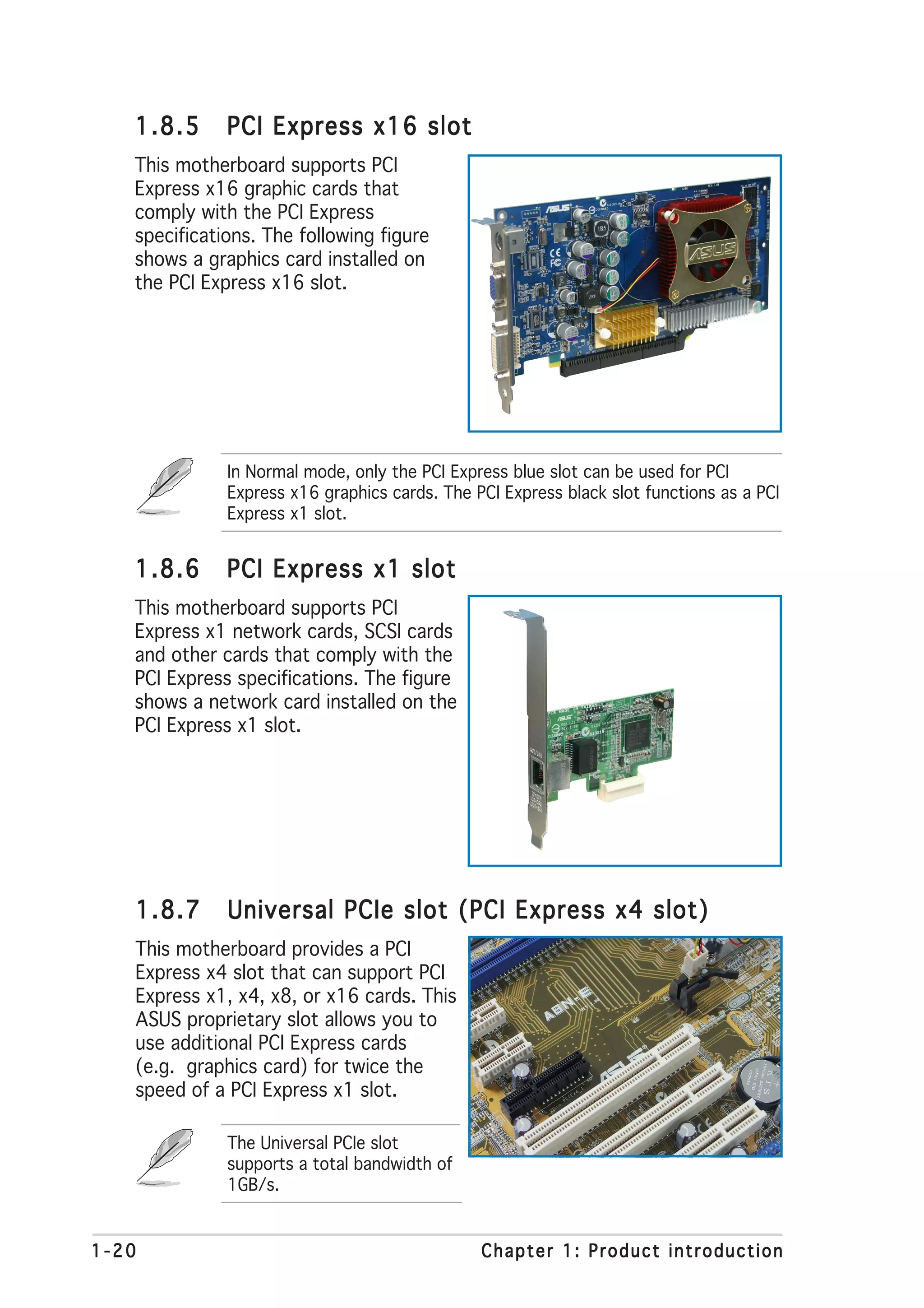
•    M e d i u m - blocks most incoming connections. Incoming connections
     to some ports must be set to allow file transfers using some online
     messaging applications. This profile also enables some anti-hacking
     features.
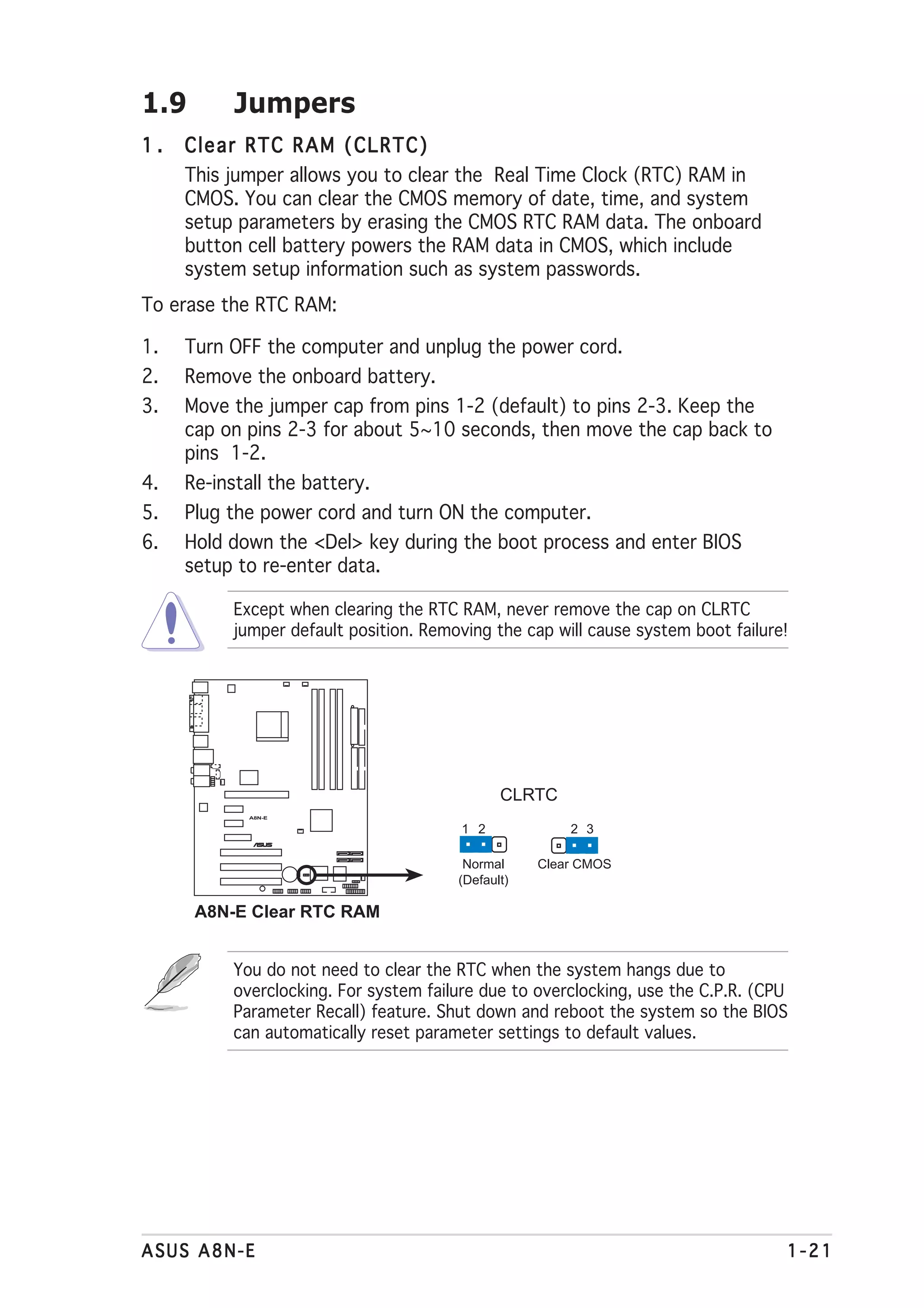
•    H i g h - allows the least traffic through. Only outbound connections
     are allowed. This profile also includes the “stealth mode’ feature that
     makes your system invisible to intruders. This also enables some
     anti-hacking features.
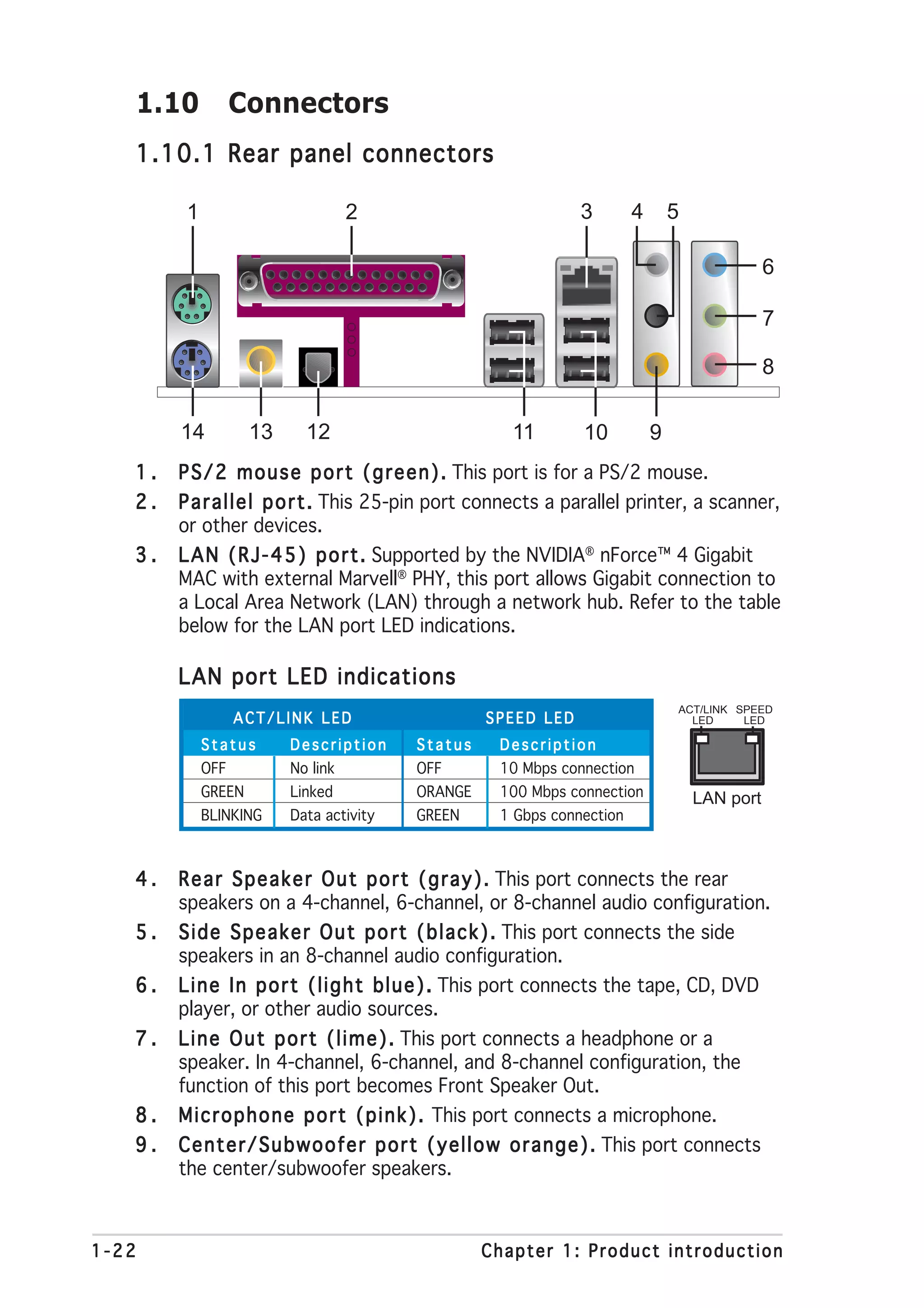
•    L o c k d o w n - blocks all incoming and outgoing connections.
•    A n t i - h a c k i n g o n l y - this profile enables all anti-hacking features but
     disables the firewall. This security profile is useful if you want to use a
     third-party firewall application.
•    C u s t o m 1 , 2 , 3 - these are reserved for customized profiles.
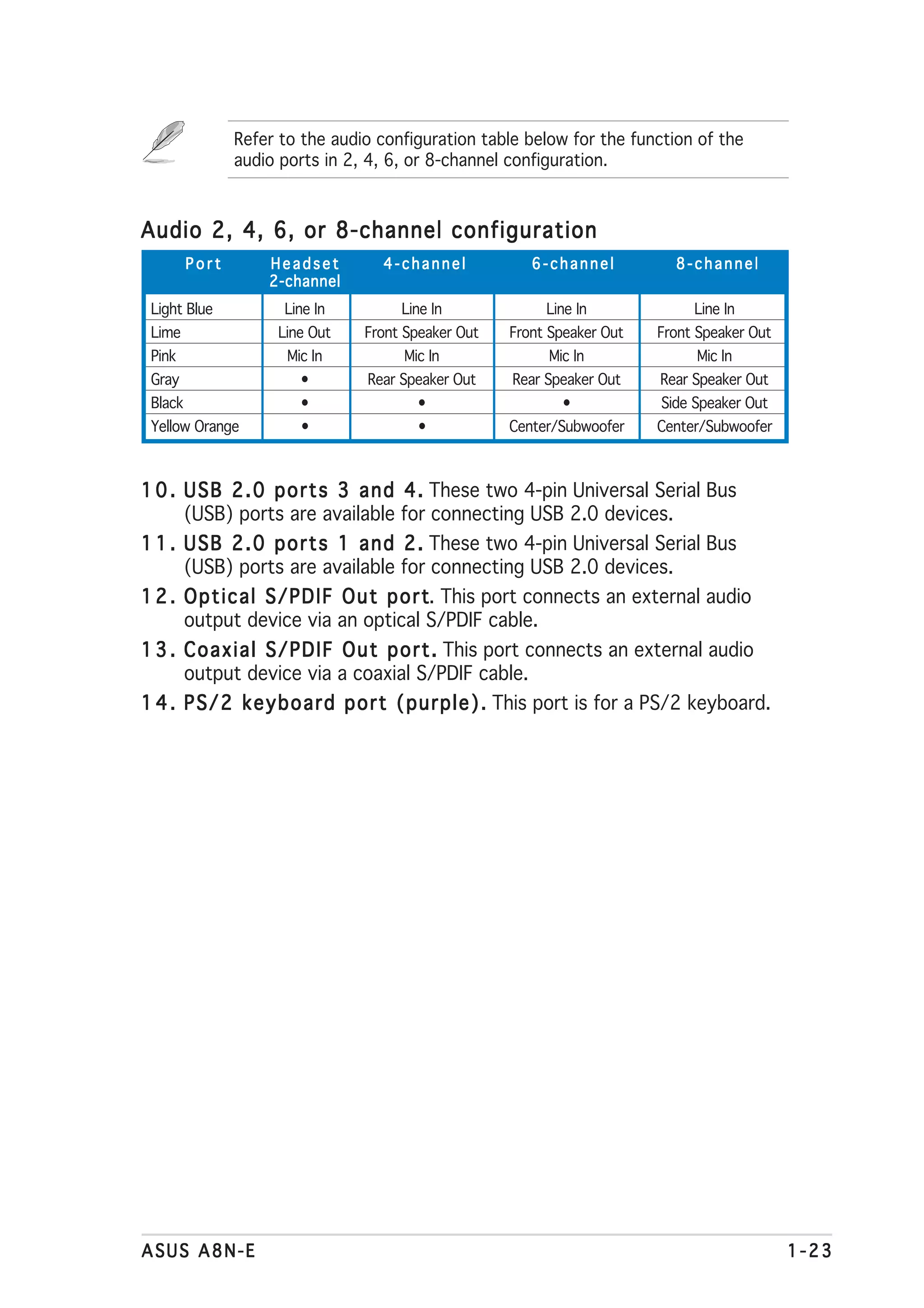
•    O f f - deactivates the firewall.

To set a security profile:

1.   From the NVFirewall™ summary
     menu, click the C u r r e n t
     F i r e w a l l P r o f i l e combo list
     box then select a security profile.
     The following confirmation box
     appears.
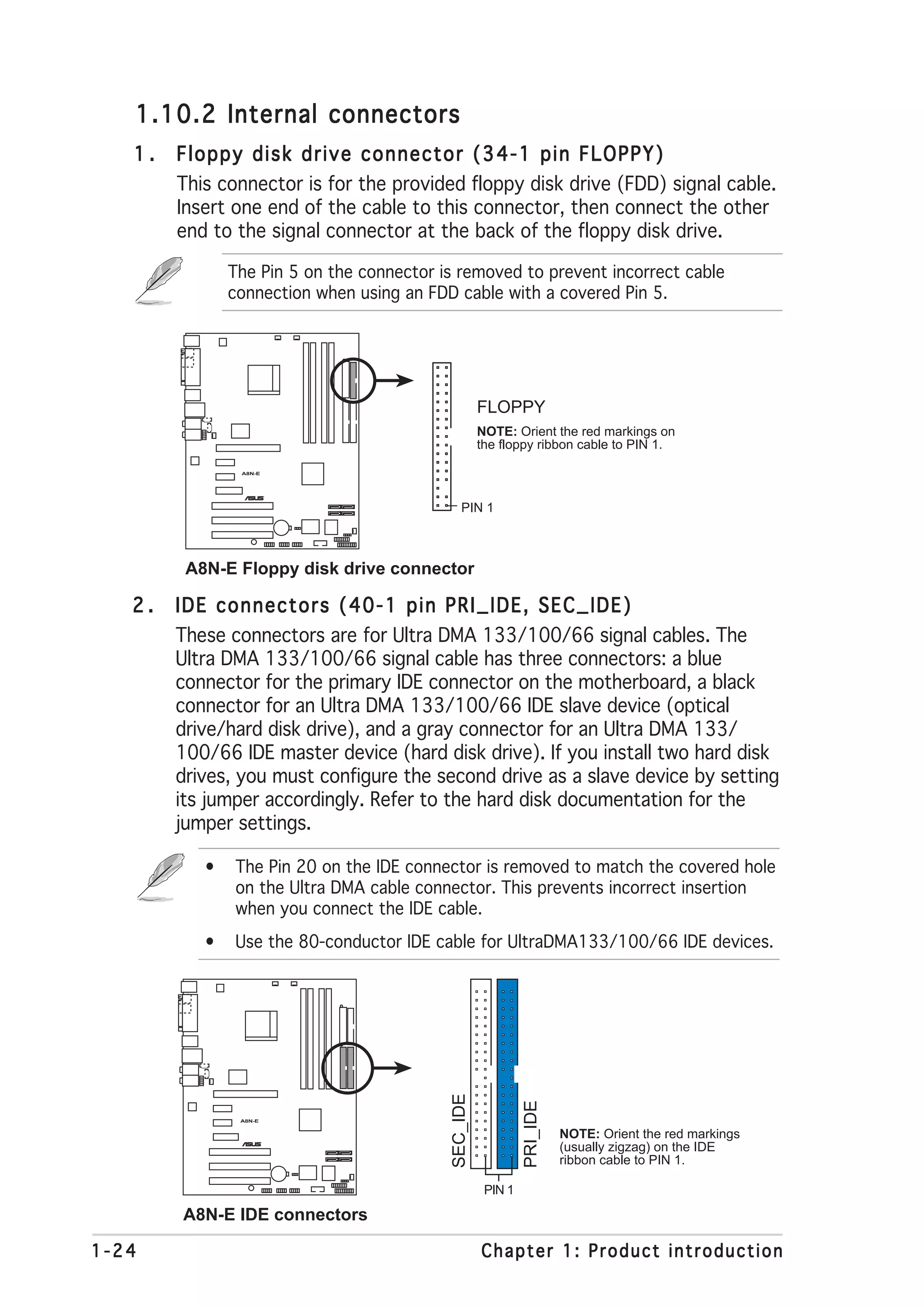


2.   Click C h a n g e P r o f i l e to apply
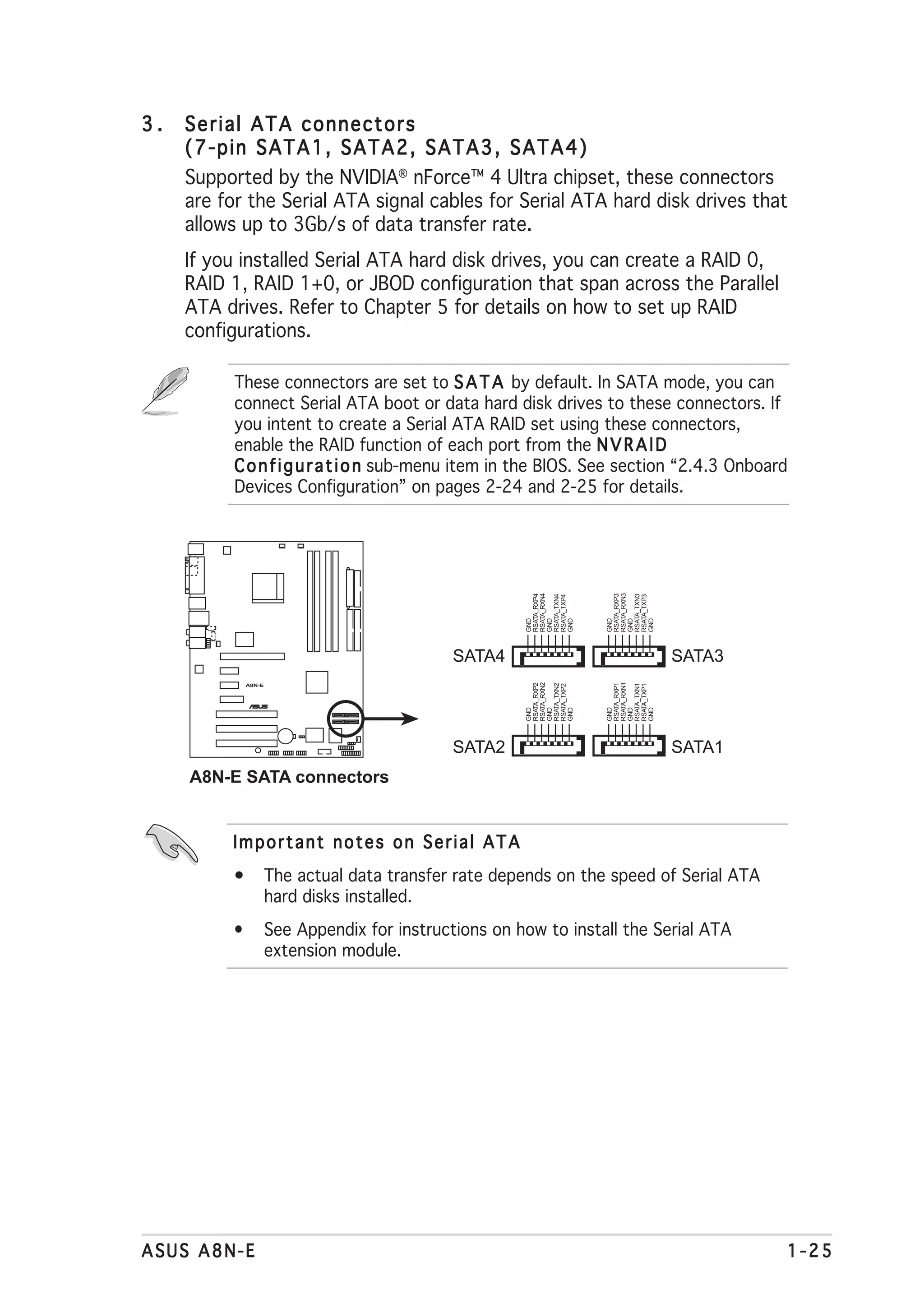
     settings or D o n ’ t C h a n g e
     P r o f i l e to return to previous
     menu.


ASUS A8N-E                                                                              3-19
Turning the NVFirewall™ off

               Take caution when using this option, your computer becomes vulnerable
               to viruses, hackers or intruders after you turn off the firewall.


   To turn off the NVFirewall:

   1.   From the NVIDIA Firewall
        summary menu, click the
        Current Firewall Profile
        combo list box then select O f f
                                       f.
        The following confirmation box
        appears.


   2.   Click T u r n F i r e w a l l O F F
                                          F.


3-20                                              Chapter 3: Software support
3.4        RAID configurations
The motherboard comes with the NVIDIA® nForce™ 4 Ultra southbridge
RAID controller that allow you to configure IDE and Serial ATA hard disk
drives as RAID sets. The motherboard supports the following RAID
configurations.
R A I D 0 (Data striping) optimizes two identical hard disk drives to read and
write data in parallel, interleaved stacks. Two hard disks perform the same
work as a single drive but at a sustained data transfer rate, double that of
a single disk alone, thus improving data access and storage. Use of two
new identical hard disk drives is required for this setup.
R A I D 1 (Data mirroring) copies and maintains an identical image of data
from one drive to a second drive. If one drive fails, the disk array
management software directs all applications to the surviving drive as it
contains a complete copy of the data in the other drive. This RAID
configuration provides data protection and increases fault tolerance to the
entire system. Use two new drives or use an existing drive and a new drive
for this setup. The new drive must be of the same size or larger than the
existing drive.
R A I D 0 + 1 is data striping and data mirroring combined without parity
(redundancy data) having to be calculated and written. With the RAID 0+1
configuration you get all the benefits of both RAID 0 and RAID 1
configurations. Use four new hard disk drives or use an existing drive and
three new drives for this setup.
J B O D (Spanning) stands for J u s t a B u n c h o f D i s k s and refers to hard
disk drives that are not yet configured as a RAID set. This configuration
stores the same data redundantly on multiple disks that appear as a single
disk on the operating system. Spanning does not deliver any advantage
over using separate disks independently and does not provide fault
tolerance or other RAID performance benefits.

           If you want to boot the system from a hard disk drive included in a RAID
           set, copy first the RAID driver from the support CD to a floppy disk
           before you install an operating system to a selected hard disk drive.
           Refer to section “3.5 Creating a RAID driver disk” for details.


ASUS A8N-E                                                                            3-21
3.4.1      Installing hard disks
   The motherboard supports Ultra DMA /133/100/66 and Serial ATA hard
   disk drives. For optimal performance, install identical drives of the same
   model and capacity when creating a disk array.

   Installing Parallel ATA hard disks
   To install IDE hard disks for a RAID configuration:

   1.   Set the jumpers of each hard disk as Master/Master or Slave/Slave.
   2.   Install the hard disks into the drive bays.
   3.   Connect the HDD signal cables.
   4.   Connect a 4-pin power cable to the power connector on each drive.

   Installing Serial ATA (SATA) hard disks
   To install the SATA hard disks for a RAID configuration:

   1.   Install the SATA hard disks into the drive bays.
   2.   Connect the SATA signal cables.
   3.   Connect a SATA power cable to the power connector on each drive.

              Refer to the RAID controllers user manual in the motherboard support
              CD for detailed information on RAID configurations. See section “3.2.4
              Manuals menu”.


3-22                                               Chapter 3: Software support
3.4.2       NVIDIA® RAID configurations
The motherboard includes a high performance IDE RAID controller
integrated in the NVIDIA® nForce 4 Ultra southbridge chipset. It supports
RAID 0, RAID 1, RAID 1+0, and JBOD with four independent Serial ATA
channels.

Setting the BIOS RAID items
After installing the hard disk drives, make sure to set the necessary RAID
items in the BIOS before setting your RAID configuration.
To set the BIOS RAID items:

1.   Boot the system and press <Del> during the Power-On Self-Test
     (POST) to enter the BIOS Setup Utility.
2.   From the A d v a n c e d > O n b o a r d D e v i c e s C o n f i g u r a t i o n >
     N V R A I D C o n f i g u r a t i o n menu item in the BIOS set the R A I D
     E n a b l e d item to Enabled. The succeeding items become
     user-configurable.
3.   Select and enable the IDE or SATA drive(s) that you want to configure
     as RAID. See section “2.4.3 Onboard Devices Configuration” for
     details.
4.   Save your changes and Exit Setup.

            For detailed descriptions on the NVIDIA® RAID configuration, refer to
            the “NVIDIA® RAID User’s Manual” found in your motherboard support
            CD.


ASUS A8N-E                                                                                3-23
Entering the NVIDIA® RAID utility
   To enter the NVIDIA® RAID utility:

   1.   Boot up your computer.
   2.   During POST, press <F10> to display the main menu of the utility.


             The RAID BIOS setup screens shown in this section are for reference
             only, and may not exactly match the items on your screen.


                               NVIDIA RAID Utility Oct 5 2004
                                    - Define a New Array -

            RAID Mode: Striping                         Striping Block:     Optimal

            Free Disks                                  Array Disks
            Loc    Disk Model Name                      Loc    Disk Model Name

            1.0.M   XXXXXXXXXXXXXXXXXX
            1.1.M   XXXXXXXXXXXXXXXXXX       [→] Add
            2.0.M   XXXXXXXXXXXXXXXXXX
            2.1.M   XXXXXXXXXXXXXXXXXX


                                              [←] Del


             [F6] Back   [F7] Finish     [TAB] Navigate   [↑↓] Select     [ENTER] Popup


   At the bottom of the screen are the navigation keys. These keys allow you
   to move through and select menu options.


   Creating a RAID Volume
   To create a RAID volume:

   1.   From the NVIDIA® RAID utility Define a New Array menu, select R A I D
        M o d e then press <Enter>. The following submenu appears.
        Use the up or down arrow keys to        Mirroring
        select a RAID mode then press           Striping
        <Enter>.                                Stripe Mirroring
                                                          Spanning


3-24                                                      Chapter 3: Software support
2.   Press <TAB> select the Striping               8K   ↑
     Block then press <Enter>. The                 16K
                                                   32K
     following submenu appears:                    64K
                                                   128K
                                                   Optim↓


     If you selected Striping or Stripe Mirroring, use the up or down arrow
     keys to select the stripe size for your RAID 0 array then press
     <Enter>.The available values range from 8 KB to 128 KB. The default
     selection is 128 KB. The strip value should be chosen based on the
     planned drive usage.
        • 8 /16 KB - low disk usage
        • 64 KB - typical disk usage
        • 128 KB - performance disk usage

          T I P : For server systems, use of a lower array block size is
          recommended. For multimedia computer systems used mainly for audio
          and video editing, a higher array block size is recommended for optimum
          performance.


3.` Press <TAB> to select the Free Disks area. Use the left or right arrow
    keys to assign the array disks.
4.   Press <F7> to create RAID set. The following message box appears.


                                  Clear disk data?


                                 [Y] YES     [N]


5.   Press <Y> to clear the selected disks or <N> to proceed without
     clearing the disks. The following screen appears.

          Take caution in using this option. All data on the RAID drives will be lost!


ASUS A8N-E                                                                               3-25
NVIDIA RAID Utility Oct 5 2004
                                                  - Array List -

                            Boot     Id    Status       Vendor     Array Model Name
                            No       4     Healthy      NVIDIA     MIRROR    XXX.XXG


              [Ctrl-X]Exit         [↑↓]Select       [B]Set Boot   [N]New Array   [ENTER]Detail


        A new set of navigation keys is displayed on the bottom of the
        screen.
   6.   Press <Ctrl+X> to save settings and exit.


   Rebuilding a RAID array
   To rebuild a RAID array:
   1.   From the Array List menu, use the up or down arrow keys to select a
        RAID array then press <Enter>. The RAID Array details appear.


                                     Array 1 : NVIDIA MIRROR XXX.XXG
                                             - Array Detail -

               RAID Mode: Mirroring
               Striping Width: 1                         Striping Block: 64K

               Adapt    Channel      M/S         Index     Disk Model Name             Capacity
               2        1            Master      0         XXXXXXXXXXXXXXXXX           XXX.XXGB
               1        0            Master      1         XXXXXXXXXXXXXXXXX           XXX.XXGB


                       [R] Rebuild         [D] Delete    [C] Clear Disk     [ENTER] Return


3-26                                                              Chapter 3: Software support
A new set of navigation keys is displayed on the bottom of the
     screen.
2.   Press <R> to rebuild a RAID array. The following screen appears.


                             Array 1 : NVIDIA MIRROR XXX.XXG
                               - Select Disk Inside Array -

           RAID Mode: Mirroring
           Striping Width: 1                    Striping Block: 64K

           Adapt   Channel   M/S        Index     Disk Model Name     Capacity
           2       1         Master     0         XXXXXXXXXXXXXXXXX   XXX.XXGB
           1       0         Master     1         XXXXXXXXXXXXXXXXX   XXX.XXGB


                             [↑↓] Select [F6] Back      [F7] Finish


3.   Use the up or down arrow keys to select a RAID array to rebuild, then
     press <F7>. The following confirmation message appears.


                                        Rebuild array?


                                   [ENTER] OK    [ESC] Cancel


4.   Press <Enter> to start rebuilding array or press <Esc> to cancel.
5.   After the rebuild process, the Array list menu appears.


ASUS A8N-E                                                                       3-27
Deleting a RAID array
   To delete a RAID array:
   1.   From the Array List menu, use the up or down arrow keys to select a
        RAID array then press <Enter>. The RAID Array details appear.


                                 Array 1 : NVIDIA MIRROR XXX.XXG
                                         - Array Detail -

              RAID Mode: Mirroring
              Striping Width: 1                    Striping Block: 64K

              Adapt    Channel   M/S       Index     Disk Model Name          Capacity
              2        1         Master    0         XXXXXXXXXXXXXXXXX        XXX.XXGB
              1        0         Master    1         XXXXXXXXXXXXXXXXX        XXX.XXGB


                      [R] Rebuild   [D] Delete     [C] Clear Disk   [ENTER] Return


        A new set of navigation keys is displayed on the bottom of the
        screen.
   2.   Press <D> to delete a RAID array. The following confirmation message
        appears.

                                          Delete this array?


                                           [Y] YES    [N] No


   3.   Press <Y> to delete array or press <N> to cancel.

             Take caution in using this option. All data on the RAID drives will be lost!


   4.   If you selected Yes, the Define a New Array menu appears.


3-28                                                      Chapter 3: Software support
Clearing a disk data
To clear disk data:
1.   From the Array List menu, use the up or down arrow keys to select a
     RAID array then press <Enter>. The RAID Array details appear.


                               Array 1 : NVIDIA MIRROR XXX.XXG
                                       - Array Detail -

            RAID Mode: Mirroring
            Striping Width: 1                     Striping Block: 64K

            Adapt    Channel   M/S        Index     Disk Model Name          Capacity
            2        1         Master     0         XXXXXXXXXXXXXXXXX        XXX.XXGB
            1        0         Master     1         XXXXXXXXXXXXXXXXX        XXX.XXGB


                    [R] Rebuild   [D] Delete      [C] Clear Disk   [ENTER] Return


     A new set of navigation keys is displayed on the bottom of the
     screen.
2.   Press <C> to clear disk. The following confirmation message appears.

                                        Clear disk data?


                                        [Y] YES       [N]


5.   Press <Y> to clear the disk data or press <N> to cancel.


           Take caution in using this option. All data on the RAID drives will be lost!


ASUS A8N-E                                                                                3-29
3.5          Creating a RAID driver disk
   A floppy disk with the RAID driver is required when installing Windows®
   2000/XP operating system on a hard disk drive that is included in a RAID
   set.
   To create a RAID driver disk:

   1.   Place the motherboard support CD into the CD-ROM drive.
   2.   When the D r i v e r s menu appears, click M a k e N V I D I A R A I D D r i v e r
        to create an NVIDIA® RAID driver disk.
        Or
        Browse the contents of the support CD and locate go to
         D r i v e r s  C h i p s e t  W I N X P _ 2 K  D r i v e r _ D i s k for the
        NVIDIA® RAID driver disk utility.

                Refer to section “3.2.2 Drivers menu” for details.


   4.   Insert floppy disk to floppy disk drive.
   5.   Follow succeeding screen information to complete process.
   6.   Write-protect the floppy disk to avoid computer virus infection.

   To install the RAID driver:

   1.   During the OS installation, the system prompts you to press the F6
        key to install third-party SCSI or RAID driver.
   2.   Press <F6> then insert the floppy disk with RAID driver into the floppy
        disk drive.
   3.   Follow the succeeding screen instructions to complete the installation.


3-30                                                            Chapter 3: Software support
3.6         Cool ‘n’ Quiet!™ Technology
The motherboard supports the AMD Cool ‘n’ Quiet!™ Technology that
dynamically and automatically change the CPU speed, voltage, and amount
of power depending on the task the CPU performs.

3.6.1       Enabling Cool ‘n’ Quiet!™ Technology
To enable Cool ‘n’ Quiet!™ Technology:

1.   Turn on the system and enter BIOS by pressing the <Del> key during
     the Power-On Self-Tests (POST).
2.   In the A d v a n c e d > C P U C o n f i g u r a t i o n > A M D C P U C o o l &
     Q u i e t C o n f i g u r a t i o n menu, select the item C o o l N ’ Q u i e t and set
     it to E n a b l e d See section “2.4 Advanced Menu” in the user guide.
                       d.
3.   In the P o w e r menu, select the item A C P I 2 . 0 S u p p o r t and set it
     to Y e s See section “2.5 Power Menu” in the user guide.
              s.
4.   Save your changes and exit BIOS Setup.
5.   Reboot your computer and set your Power Option Properties
     depending on your operating system.


Windows® 2000/XP
1.   From the Windows® 2000/XP operating system, click the S t a r t
     button. Select S e t t i n g s then C o n t r o l P a n e ll.
                                  s,
2.   Make sure the Control Panel is set to Classic View.
3.   Double-click the D i s p l a y icon in
     the Control Panel then select the
     S c r e e n S a v e r tab.
4.   Click the P o w e r . . . button. The
     following dialog box appears.
5.   From the P o w e r s c h e m e s
     combo list box, select M i n i m a l
     Power Management            t.
6.   Click O K to effect settings.


            Make sure to install the Cool ‘n’ Quiet!™ driver and application before
            using this feature.


ASUS A8N-E                                                                                     3-31
3.6.2      Launching the Cool ‘n’ Quiet!™ software
   The motherboard support CD includes the Cool ‘n’ Quiet!™ software that
   enables you to view your system’s real-time CPU Frequency and voltage.

              Make sure to install the Cool ‘n’ Quiet!™ software from the motherboard
              support CD. Refer to section “3.2.3 Utilities menu”, for details.


   To launch the Cool ‘n’ Quiet!™ program:

   1.   If you are using Windows® 2000, click the S t a r t button. Select
        Programs > ASUS > Cool & Quiet > Cool & Quiet.
   2.   If you are using Windows® XP, click the S t a r t button. Select A l l
        Programs > ASUS > Cool & Quiet > Cool & Quiet.
   3.   The Cool ‘n’ Quiet!™ technology screen appears and displays the
        current CPU Frequency and CPU Voltage.


3-32                                               Chapter 3: Software support

E1911 a8n e

  • 1.
  • 2.
    E1911 First Edition January 2005 Copyright © 2005 ASUSTeK COMPUTER INC. All Rights Reserved. No part of this manual, including the products and software described in it, may be reproduced, transmitted, transcribed, stored in a retrieval system, or translated into any language in any form or by any means, except documentation kept by the purchaser for backup purposes, without the express written permission of ASUSTeK COMPUTER INC. (“ASUS”). Product warranty or service will not be extended if: (1) the product is repaired, modified or altered, unless such repair, modification of alteration is authorized in writing by ASUS; or (2) the serial number of the product is defaced or missing. ASUS PROVIDES THIS MANUAL “AS IS” WITHOUT WARRANTY OF ANY KIND, EITHER EXPRESS OR IMPLIED, INCLUDING BUT NOT LIMITED TO THE IMPLIED WARRANTIES OR CONDITIONS OF MERCHANTABILITY OR FITNESS FOR A PARTICULAR PURPOSE. IN NO EVENT SHALL ASUS, ITS DIRECTORS, OFFICERS, EMPLOYEES OR AGENTS BE LIABLE FOR ANY INDIRECT, SPECIAL, INCIDENTAL, OR CONSEQUENTIAL DAMAGES (INCLUDING DAMAGES FOR LOSS OF PROFITS, LOSS OF BUSINESS, LOSS OF USE OR DATA, INTERRUPTION OF BUSINESS AND THE LIKE), EVEN IF ASUS HAS BEEN ADVISED OF THE POSSIBILITY OF SUCH DAMAGES ARISING FROM ANY DEFECT OR ERROR IN THIS MANUAL OR PRODUCT. SPECIFICATIONS AND INFORMATION CONTAINED IN THIS MANUAL ARE FURNISHED FOR INFORMATIONAL USE ONLY, AND ARE SUBJECT TO CHANGE AT ANY TIME WITHOUT NOTICE, AND SHOULD NOT BE CONSTRUED AS A COMMITMENT BY ASUS. ASUS ASSUMES NO RESPONSIBILITY OR LIABILITY FOR ANY ERRORS OR INACCURACIES THAT MAY APPEAR IN THIS MANUAL, INCLUDING THE PRODUCTS AND SOFTWARE DESCRIBED IN IT. Products and corporate names appearing in this manual may or may not be registered trademarks or copyrights of their respective companies, and are used only for identification or explanation and to the owners’ benefit, without intent to infringe. ii
  • 3.
    Contents Notices ...............................................................................................vii Safety information ............................................................................ viii About this guide ................................................................................. ix How this guide is organized .................................................... ix Where to find more information .............................................. ix Conventions used in this guide ................................................ x Typography .......................................................................................... x A8N-E specifications summary ........................................................... xi Chapter 1: Product introduction 1.1 Welcome! .............................................................................. 1-2 1.2 Package contents ................................................................. 1-2 1.3 Special features .................................................................... 1-3 1.3.1 Product highlights ................................................... 1-3 1.3.2 ASUS Proactive features ........................................ 1-5 1.3.3 Innovative ASUS features ....................................... 1-6 1.4 Before you proceed .............................................................. 1-7 1.5 Motherboard overview .......................................................... 1-8 1.5.1 Placement direction ................................................ 1-8 1.5.2 Screw holes ............................................................ 1-8 1.5.3 Motherboard layout ................................................ 1-9 1.6 Central Processing Unit (CPU) ............................................ 1-10 1.6.1 Overview ............................................................... 1-10 1.6.2 Installling the CPU ................................................. 1-10 1.6.3 Installing the heatsink and fan .............................. 1-12 1.7 System memory ................................................................. 1-15 1.7.1 Overview ............................................................... 1-15 1.7.2 Memory Configurations ......................................... 1-15 1.7.3 Installing a DIMM ................................................... 1-17 1.7.4 Removing a DIMM ................................................. 1-17 1.8 Expansion slots ................................................................... 1-18 1.8.1 Installing an expansion card .................................. 1-18 1.8.2 Configuring an expansion card .............................. 1-18 1.8.3 Interrupt assignments .......................................... 1-19 1.8.4 PCI slots ................................................................ 1-20 iii
  • 4.
    Contents 1.8.5 PCI Express x16 slot ............................................. 1-20 1.8.6 PCI Express x1 slot ............................................... 1-20 1.9 Jumpers .............................................................................. 1-21 1.10 Connectors ......................................................................... 1-22 1.10.1 Rear panel connectors .......................................... 1-22 1.10.2 Internal connectors ............................................... 1-24 Chapter 2: BIOS setup 2.1 Managing and updating your BIOS ........................................ 2-2 2.1.1 Creating a bootable floppy disk .............................. 2-2 2.1.2 Updating the BIOS .................................................. 2-3 2.1.3 Saving the current BIOS file .................................... 2-5 2.1.4 ASUS CrashFree BIOS 2 utility ................................ 2-6 2.1.5 ASUS EZ Flash utility .............................................. 2-8 2.1.6 ASUS Update utility ................................................ 2-9 2.2 BIOS setup program ........................................................... 2-12 2.2.1 BIOS menu screen ................................................. 2-13 2.2.2 Menu bar ............................................................... 2-13 2.2.3 Legend bar ........................................................... 2-14 2.2.4 Menu items ........................................................... 2-14 2.2.5 Sub-menu items ................................................... 2-14 2.2.6 Configuration fields .............................................. 2-14 2.2.8 General help .......................................................... 2-15 2.2.7 Pop-up window ..................................................... 2-15 2.3 Main menu .......................................................................... 2-16 2.3.1 System Time ......................................................... 2-16 2.3.2 System Date ......................................................... 2-16 2.3.3 Language .............................................................. 2-16 2.3.4 Legacy Diskette A ................................................ 2-16 2.3.5 Primary and Secondary IDE Master/Slave ............. 2-17 2.3.6 First, Second, Third, Fourth SATA Master ............ 2-19 2.3.7 HDD SMART Monitoring ........................................ 2-20 2.3.8 Installed Memory .................................................. 2-20 2.4 Advanced menu .................................................................. 2-21 2.4.1 CPU Configuration ................................................. 2-21 iv
  • 5.
    Contents 2.4.2 PCIPnP ................................................................... 2-23 2.4.3 Onboard Devices Configuration ............................ 2-24 2.4.4 JumperFree Configuration .................................... 2-28 2.4.5 LAN Cable Status ................................................. 2-30 2.4.6 PEG Link Mode ...................................................... 2-30 2.4.7 Instant Music ........................................................ 2-31 2.5 Power menu ........................................................................ 2-32 2.5.1 ACPI Suspend Type ............................................... 2-32 2.5.2 ACPI APIC Support ................................................ 2-32 2.5.3 APM Configuration ................................................ 2-33 2.5.4 Hardware Monitor ................................................. 2-35 2.6 Boot menu .......................................................................... 2-36 2.6.1 Boot Device Priority .............................................. 2-36 2.6.2 Removable Drives ................................................. 2-37 2.6.3 Hard Disk Drives ................................................... 2-37 2.6.4 CDROM Drives ....................................................... 2-37 2.6.5 Boot Settings Configuration ................................. 2-38 2.6.6 Security ................................................................ 2-39 2.7 Exit menu ........................................................................... 2-41 Chapter 3: Software support 3.1 Installing an operating system ............................................. 3-2 3.2 Support CD information ........................................................ 3-2 3.2.1 Running the support CD ......................................... 3-2 3.2.2 Drivers menu .......................................................... 3-3 3.2.3 Utilities menu .......................................................... 3-4 3.2.4 Manuals menu ......................................................... 3-6 3.2.5 ASUS Contact information ...................................... 3-7 3.2.6 Other information ................................................... 3-7 3.3 Software information ........................................................... 3-9 3.3.1 ASUS MyLogo2™ .................................................... 3-9 3.3.3 AI NET 2 ............................................................... 3-11 Using the Virtual Cable Tester™ ........................... 3-11 3.3.4 Audio configurations ............................................ 3-12 3.3.5 Using the NVIDIA® Firewall™ ................................. 3-18 v
  • 6.
    Contents 3.4 RAID configurations ............................................................ 3-21 3.4.1 Installing hard disks .............................................. 3-22 3.4.2 NVIDIA® RAID configurations ............................... 3-23 3.5 Creating a RAID driver disk ................................................. 3-30 3.6 Cool ‘n’ Quiet!™ Technology ............................................... 3-31 3.6.1 Enabling Cool ‘n’ Quiet!™ Technology ................... 3-31 3.6.2 Launching the Cool ‘n’ Quiet!™ software .............. 3-32 vi
  • 7.
    Notices Federal Communications CommissionStatement This device complies with Part 15 of the FCC Rules. Operation is subject to the following two conditions: • This device may not cause harmful interference, and • This device must accept any interference received including interference that may cause undesired operation. This equipment has been tested and found to comply with the limits for a Class B digital device, pursuant to Part 15 of the FCC Rules. These limits are designed to provide reasonable protection against harmful interference in a residential installation. This equipment generates, uses and can radiate radio frequency energy and, if not installed and used in accordance with manufacturer’s instructions, may cause harmful interference to radio communications. However, there is no guarantee that interference will not occur in a particular installation. If this equipment does cause harmful interference to radio or television reception, which can be determined by turning the equipment off and on, the user is encouraged to try to correct the interference by one or more of the following measures: • Reorient or relocate the receiving antenna. • Increase the separation between the equipment and receiver. • Connect the equipment to an outlet on a circuit different from that to which the receiver is connected. • Consult the dealer or an experienced radio/TV technician for help. The use of shielded cables for connection of the monitor to the graphics card is required to assure compliance with FCC regulations. Changes or modifications to this unit not expressly approved by the party responsible for compliance could void the user’s authority to operate this equipment. Canadian Department of Communications Statement This digital apparatus does not exceed the Class B limits for radio noise emissions from digital apparatus set out in the Radio Interference Regulations of the Canadian Department of Communications. This class B digital apparatus complies with Canadian ICES-003. vii
  • 8.
    Safety information Electrical safety • To prevent electrical shock hazard, disconnect the power cable from the electrical outlet before relocating the system. • When adding or removing devices to or from the system, ensure that the power cables for the devices are unplugged before the signal cables are connected. If possible, disconnect all power cables from the existing system before you add a device. • Before connecting or removing signal cables from the motherboard, ensure that all power cables are unplugged. • Seek professional assistance before using an adapter or extension cord. These devices could interrupt the grounding circuit. • Make sure that your power supply is set to the correct voltage in your area. If you are not sure about the voltage of the electrical outlet you are using, contact your local power company. • If the power supply is broken, do not try to fix it by yourself. Contact a qualified service technician or your retailer. Operation safety • Before installing the motherboard and adding devices on it, carefully read all the manuals that came with the package. • Before using the product, make sure all cables are correctly connected and the power cables are not damaged. If you detect any damage, contact your dealer immediately. • To avoid short circuits, keep paper clips, screws, and staples away from connectors, slots, sockets and circuitry. • Avoid dust, humidity, and temperature extremes. Do not place the product in any area where it may become wet. • Place the product on a stable surface. • If you encounter technical problems with the product, contact a qualified service technician or your retailer. viii
  • 9.
    About this guide Thisuser guide contains the information you need when installing and configuring the motherboard. How this guide is organized This manual contains the following parts: • Chapter 1: Product introduction This chapter describes the features of the motherboard and the new technology it supports. It also lists the hardware setup procedures that you have to perform when installing system components. It includes description of the jumpers and connectors on the motherboard. • Chapter 2: BIOS setup This chapter tells how to change system settings through the BIOS Setup menus. Detailed descriptions of the BIOS parameters are also provided. • Chapter 3: Software support This chapter describes the contents of the support CD that comes with the motherboard package. Where to find more information Refer to the following sources for additional information and for product and software updates. 1. ASUS websites The ASUS website provides updated information on ASUS hardware and software products. Refer to the ASUS contact information. 2. Optional documentation Your product package may include optional documentation, such as warranty flyers, that may have been added by your dealer. These documents are not part of the standard package. ix
  • 10.
    Conventions used inthis guide To make sure that you perform certain tasks properly, take note of the following symbols used throughout this manual. D A N G E R / W A R N I N G : Information to prevent injury to yourself when trying to complete a task. C A U T I O N : Information to prevent damage to the components when trying to complete a task. I M P O R T A N T : Instructions that you MUST follow to complete a task. N O T E : Tips and additional information to help you complete a task. Typography Bold text Indicates a menu or an item to select Italics Used to emphasize a word or a phrase <Key> Keys enclosed in the less-than and greater-than sign means that you must press the enclosed key Example: <Enter> means that you must press the Enter or Return key <Key1+Key2+Key3> If you must press two or more keys simultaneously, the key names are linked with a plus sign (+) Example: <Ctrl+Alt+D> Command Means that you must type the command exactly as shown, then supply the required item or value enclosed in brackets Example: At the DOS prompt, type the command line: awdflash A8NE.ROM x
  • 11.
    A8N-E specifications summary CPU Socket 939 for AMD Athlon™ 64FX/AMD Athlon™ 64 processor Supports AMD 64 architecture that enables simultaneous 32-bit and 64-bit architecture Supports AMD® Cool ‘n’ Quiet! Technology Chipset NVIDIA® nForce™ 4 Ultra System Bus 1600/2000 MT per second Memory Dual-channel memory architecture 4 x 184-pin DIMM sockets support ECC/non-ECC unbufferred 400/333/266 MHz DDR memory modules Supports up to 4 GB system memory Expansion slots 1 x PCI Express x16 slots 2 x PCI Express x1 slots 1 x PCI Express x4 slot (Note: Supports a total bandwidth of 1GB/s) 3 x PCI slots Storage NVIDIA® nForce™ 4 Ultra chipset supports: - 2 x Ultra DMA 133/100/66/33 - 4 x Serial ATA 3Gb/s drives - RAID 0, RAID 1, RAID 1+0, and JBOD that spans across the Serial ATA and Parallel ATA drives Overclocking AI NOS™ (Non-Delay Overclocking System) ASUS AI Overclocking (Intelligent CPU frequency tuner) ASUS PEG Link Fixed PCI Express/PCI/SATA frequencies ASUS C.P.R. (CPU Parameter Recall) Precision Tweaker supports: - DIMM voltage: 9-step DRAM voltage control - Core voltage: Adjustable CPU voltage at 0.0125 increment - PCI Express Frequency: Allows 1MHz increment from 100MHz to 200MHz - Stepless Frequency Selection(SFS) allows 1MHz increment from 200 MHz to 400 MHz Special features ASUS EZFlash ASUS Q-Fan ASUS CrashFree BIOS 2 ASUS Multi-language BIOS ASUS MyLogo2 ASUS Instant Music (continued on the next page) xi
  • 12.
    A8N-E specifications summary Internal 1 x Floppy disk drive connector connectors 2 x IDE connectors 4 x Serial ATA connectors 1 x CPU fan connector 1 x Power fan connector 2 x Chassis fan connector 1 x Chipset fan connector 1 x Serial port connector (COM port) 1 x 24-pin ATX power connector 1 x 4-pin ATX 12 V power connector 3 x USB 2.0 connectors for 6 additional USB 2.0 ports 1 x Internal audio connectors (CDAUX) 1 x GAME/MIDI connector 1 x Chassis intrusion connector 1 x Front panel audio connector System panel connector LAN NVIDIA® nForce™ 4 built-in Gigabit MAC with external Marvell® PHY supports: - NV ActiveArmor™ - NV Firewall™ AI NET2 AI Audio Realtek® ALC850 8-channel CODEC 1 x Coaxial S/PDIF out port 1 x Optical S/PDIF out port Supports Universal Audio Jack (UAJ®) Technology Supports Audio Sensing and Enumeration Technology USB Supports up to 10 USB 2.0 ports Rear panel 1 x Parallel port 1 x LAN (RJ-45) port 4 x USB 2.0 ports 1 x Optical S/PDIF out port 1 x Coaxial S/PDIF out port 1 x PS/2 keyboard port 1 x PS/2 mouse port 8-channel audio ports BIOS features 4 Mb Flash ROM, Phoenix-Award BIOS, PnP, DMI2.0, WfM2.0, SM BIOS 2.3 Power ATX power supply (with 24-pin and 4-pin 12 V plugs) Requirement ATX 12 V 2.0 compliant (continued on the next page) xii
  • 13.
    A8N-E specifications summary Form Factor ATX form factor: 12 in x 9.6 in (30.5 cm x 24.4 cm) Support CD Device drivers contents ASUS PC Probe ASUS Live Update utility ASUS Cool’n’Quiet! utility Anti-virus utility (OEM version) NVIDIA® nTune™ utility *Specifications are subject to change without notice. xiii
  • 14.
  • 15.
    This chapter describesthe motherboard 1 features and the new technologies it supports. Product introduction ASUS A8N-E 1-1
  • 16.
    1.1 Welcome! T h a n k y o u f o r b u y i n g a n A S U S® A 8 N - E m o t h e r b o a r d ! The motherboard delivers a host of new features and latest technologies, making it another standout in the long line of ASUS quality motherboards! Before you start installing the motherboard, and hardware devices on it, check the items in your package with the list below. 1.2 Package contents Check your motherboard package for the following items. Motherboard ASUS A8N-E motherboard I/O modules USB 2.0 2-port module USB 2.0 + GAME port module Cables 4 x Serial ATA signal cables 2 x Serial ATA power cables (dual plugs) Ultra DMA/133 cable 40-conductor IDE cable Floppy disk drive cable Accessories I/O shield Application CDs ASUS motherboard support CD Documentation User guide If any of the above items is damaged or missing, contact your retailer. 1-2 Chapter 1: Product introduction
  • 17.
    1.3 Special features 1.3.1 Product highlights Latest processor technology The AMD Athlon™ 64FX and Athlon™ 64 desktop processors are based on AMD’s 64-bit and 32-bit architecture, which represents the landmark introduction of the industry’s first x86-64 technology. These processors provide a dramatic leap forward in compatibility, performance, investment protection, and reduced total cost of ownership and development. See page 1-10. Built-in NVFirewall™ and NVActiveArmor™ The NVIDIA® Firewall™ (NVFirewall™) is an easy-to-use high-performance desktop firewall application that protects your system from intruders. Integrated into the NVIDIA® nForce™ 4 Ultra chipset with the NVIDIA® Gigabit Ethernet, it provides advanced anti-computer-hacking technologies, remote management capabilities, and a user-friendly setup wizard that improves overall system security. Enhancing your network security is the NVIDIA® ActiveArmor™ (NV ActiveArmor™) engine that provides advanced data packet inspection. This innovative technology ensures that only safe data packets are passed on the network. Additionally, it boosts overall system performance by offloading the CPU from the rigorous task of filtering data packets. See page 3-18 for details. AMD Cool ‘n’ Quiet!™ Technology The motherboard supports the AMD Cool ‘n’ Quiet!™ Technology that dynamically and automatically changes the CPU speed, voltage and amount of power depending on the task the CPU performs. See pages 2-22, 3-31. HyperTransport™ Technology HyperTransport™ Technology is a high-speed, low latency, point-to-point link designed to increase the communication speed between integrated circuits in computers, networking and telecommunicatons equipment up to 48 times faster than other existing technologies. ASUS A8N-E 1-3
  • 18.
    Dual Channel DDRmemory support Employing the Double Data Rate (DDR) memory technology, the motherboard supports up to 4GB of system memory using DDR400/333/ 266 DIMMs. The ultra-fast 400MHz memory bus delivers the required bandwidth for the latest 3D graphics, multimedia, and Internet applications. See page 1-15. Serial ATA 3Gb/s technology The motherboard supports the next-generation Serial ATA 3Gb/s technology through the Serial ATA interfaces and the NVIDIA® nForce™ 4 Ultra chipset. The SATA 3Gb/s specification provides twice the bandwidth of the current Serial ATA products. Additionally, Serial ATA allows thinner, more flexible cables with lower pin count, and reduced voltage requirement. See pages 1-25. RAID solution The NVIDIA® nForce™ 4 Ultra RAID controller onboard provides the motherboard with RAID 0, RAID 1, RAID 1+0 and JBOD configuration for four SATA and two PATA connectors. See page 3-21 for details. PCI Express™ interface The motherboard fully supports PCI Express, the latest I/O interconnect technology that speeds up the PCI bus. PCI Express features point-to-point serial interconnections between devices and allows higher clockspeeds by carrying data in packets. This high speed interface is software compatible with existing PCI specifications. See page 1-20 for details. S/PDIF digital sound ready The motherboard supports the S/PDIF Out function through the S/PDIF interfaces on the rear panel. The S/PDIF technology turns your computer into a high-end entertainment system with digital connectivity to powerful audio and speaker systems. See page 1-23 for details. USB 2.0 technology The motherboard implements the Universal Serial Bus (USB) 2.0 specification, dramatically increasing the connection speed from the 12 Mbps bandwidth on USB 1.1 to a fast 480 Mbps on USB 2.0. USB 2.0 is backward compatible with USB 1.1. See page 1-23 and 1-27 for details. 1-4 Chapter 1: Product introduction
  • 19.
    Temperature, fan, andvoltage monitoring The CPU temperature is monitored by the ASIC (integrated in the Winbond Super I/O) to prevent overheating and damage. The system fan rotations per minute (RPM) is monitored for timely failure detection. The ASIC monitors the voltage levels to ensure stable supply of current for critical components. See section “2.5.4 Hardware Monitor” on page 2-35. 1.3.2 ASUS Proactive features AI NOS™ (Non-Delay Overclocking System) ASUS Non-delay Overclocking System™ (NOS) is a technology that auto-detects the CPU loading and dynamically overclocks the CPU speed only when needed. See page 2-28 for details. Precision Tweaker Designed for overclocking aficionados, this feature allows you to fine tune the CPU and memory voltage and gradually increase the Front Side Bus (FSB) and PCI Express frequency to achieve maximum system performance. PEG Link mode This feature allows you to adjust the PCI Express graphics frequency according to your system configuration for optimized graphics performance. AI NET 2 AI NET 2 is a BIOS-based diagnostic tool that detects and reports Ethernet cable faults and shorts. With this utility, you can easily monitor the condition of the Ethernet cable(s) connected to the LAN (RJ-45) port(s). During the bootup process, AI NET 2 immediately diagnoses the LAN cable(s) and reports shorts and faults up to 100 meters at 1 meter accuracy. See pages 2-30 and 3-11 for details. AI Audio technology The motherboard supports 8-channel audio through the onboard ALC850 CODEC with 16-bit DAC, a stereo 16-bit ADC, and an AC97 2.3 compatible multi-channel audio designed for PC multimedia systems. It also provides Jack-Sensing function, S/PDIF out support, interrupt capability and includes the Realtek® proprietary UAJ® (Universal Audio Jack) technology. See pages 1-22, 1-23 and 3-12 for details. ASUS A8N-E 1-5
  • 20.
    1.3.3 Innovative ASUS features CrashFree BIOS 2 This feature allows you to restore the original BIOS data from the support CD in case when the BIOS codes and data are corrupted. This protection eliminates the need to buy a replacement ROM chip. See details on page 2-5. ASUS Q-Fan technology The ASUS Q-Fan technology smartly adjusts the fan speeds according to the system loading to ensure quiet, cool, and efficient operation. See page 2-35 for details. ASUS Multi-language BIOS The multi-language BIOS allows you to select the language of your choice from the available options. The localized BIOS menus allow you to configure easier and faster. See page 2-16 for details. ASUS MyLogo2™ This new feature present in the motherboard allows you to personalize and add style to your system with customizable boot logos. See page 3-9 for details. ASUS Instant Lite This unique feature allows you to playback audio files even without booting the system to Windows. Just press the ASUS Instant Music Lite special function keys and enjoy the music! See pages 2-31. 1-6 Chapter 1: Product introduction
  • 21.
    1.4 Before you proceed Take note of the following precautions before you install motherboard components or change any motherboard settings. • Unplug the power cord from the wall socket before touching any component. • Use a grounded wrist strap or touch a safely grounded object or to a metal object, such as the power supply case, before handling components to avoid damaging them due to static electricity • Hold components by the edges to avoid touching the ICs on them. • Whenever you uninstall any component, place it on a grounded antistatic pad or in the bag that came with the component. • Before you install or remove any component, ensure that the ATX power supply is switched off or the p o w e r c o r d i s d e t a c h e d f r o m t h e p o w e r s u p p l y . Failure to do so may cause severe damage to the motherboard, peripherals, and/or components. Onboard LEDs The motherboard comes with a green standby power LED that lights up to indicate that the system is ON, in sleep mode, or in soft-off mode. This is a reminder that you should shut down the system and unplug the power cable before removing or plugging in any motherboard component. A8N-E SB_PWR ® ON OFF Standby Powered A8N-E Onboard LED Power Off ASUS A8N-E 1-7
  • 22.
    1.5 Motherboard overview Before you install the motherboard, study the configuration of your chassis to ensure that the motherboard fits into it. Make sure to unplug the power cord before installing or removing the motherboard. Failure to do so can cause you physical injury and damage motherboard components. 1.5.1 Placement direction When installing the motherboard, make sure that you place it into the chassis in the correct orientation. The edge with external ports goes to the rear part of the chassis as indicated in the image below. 1.5.2 Screw holes Place nine (9) screws into the holes indicated by circles to secure the motherboard to the chassis. Do not overtighten the screws! Doing so can damage the motherboard. Place this side towards the rear of the chassis A8N-E 1-8 Chapter 1: Product introduction
  • 23.
    1.5.3 Motherboard layout 24.5cm (9.6in) PS/2KBMS T: Mouse CHA2_FAN CPU_FAN B: Keyboard ATX12V SPDIF_O PARALLEL PORT SPDIF_O2 DDR DIMM_A1 (64 bit,184-pin module) DDR DIMM_A2 (64 bit,184-pin module) DDR DIMM_B1 (64 bit,184-pin module) DDR DIMM_B2 (64 bit,184-pin module) Socket 939 EATXPWR FLOPPY USB12 LAN1_USB34 Top:Rear Speaker Out CD Center: Side Speaker Out AUX Below: 30.5cm (12.0in) Center/Subwoofer Marvell Top:Line In Center:Line Out 88E1111 Bottom:Mic In PWR_FAN FP_AUDIO PRI_IDE SEC_IDE PCIEX16_1 ACL850 PCIEX1_1 nForce4 ultra PCIEX1_2 A8N-E CHIP_FAN PCIEX4_1 ® SATA4 SATA3 PCI1 SATA2 SATA1 PCI2 BIOS Super 4Mb CR2032 3V Lithium Cell CHA1_FAN CMOS Power I/O CLRTC CHASSIS PCI3 GAME USB78 USB56 USB910 PANEL SB_PWR COM1 ASUS A8N-E 1-9
  • 24.
    1.6 Central Processing Unit (CPU) 1.6.1 Overview The motherboard comes with a surface mount 939-pin Zero Insertion Force (ZIF) socket designed for the AMD Athlon™ 64FX, AMD Athlon 64™ or AMD Sempron™ processor. The 128-bit-wide data paths of these processors can run applications faster than processors with only 32-bit or 64-bit wide data paths. Take note of the marked corner (with gold triangle) on the CPU. This mark should match a specific corner on the socket to ensure correct installation. Gold triangle 1.6.2 Installling the CPU To install a CPU: 1. Locate the CPU socket on the motherboard. A8N-E ® A8N-E CPU Socket 939 Before installing the CPU, make sure that the socket box is facing towards you and the load lever is on your left. 1-10 Chapter 1: Product introduction
  • 25.
    2. Unlock the socket by pressing the lever sideways, then lift it up to a 90°-100° angle. Socket Lever Make sure that the socket lever is lifted up to 90°-100° angle, otherwise the CPU does not fit in completely. 3. Position the CPU above the socket such that the CPU corner with the gold triangle matches the socket corner with a small triangle. 4. Carefully insert the CPU into the socket until it fits in place. Gold triangle Small triangle The CPU fits only in one correct orientation. DO NOT force the CPU into the socket to prevent bending the pins and damaging the CPU! 5. When the CPU is in place, push down the socket lever to secure the CPU. The lever clicks on the side tab to indicate that it is locked. ASUS A8N-E 1-11
  • 26.
    1.6.3 Installing the heatsink and fan The AMD Athlon™ 64FX or AMD Athlon 64™ processor require a specially designed heatsink and fan assembly to ensure optimum thermal condition and performance. Make sure that you use only qualified heatsink and fan assembly. Follow these steps to install the CPU heatsink and fan. 1. Place the heatsink on top of the installed CPU, making sure that the heatsink fits properly on the retention module base. • The retention module base is already installed on the motherboard upon purchase. • You do not have to remove the retention module base when installing the CPU or installing other motherboard components. • If you purchased a separate CPU heatsink and fan assembly, make sure that a Thermal Interface Material is properly applied to the CPU heatsink or CPU before you install the heatsink and fan assembly. CPU Fan CPU Heatsink Retention Module Base Retention bracket Retention bracket lock Your boxed CPU heatsink and fan assembly should come with installation instructions for the CPU, heatsink, and the retention mechanism. If the instructions in this section do not match the CPU documentation, follow the latter. 1-12 Chapter 1: Product introduction
  • 27.
    2. Attach one end of the retention bracket to the retention module base. 3. Align the other end of the retention bracket (near the retention bracket lock) to the retention module base. A clicking sound denotes that the retention bracket is in place. Make sure that the fan and heatsink assembly perfectly fits the retention mechanism module base, otherwise you cannot snap the retention bracket in place. 4. Push down the retention bracket lock on the retention mechanism to secure the heatsink and fan to the module base. ASUS A8N-E 1-13
  • 28.
    3. When the fan and heatsink assembly is in place, connect the CPU fan cable to the connector on the motherboard labeled CPU_FAN. CPU_FAN Rotation +12V GND A8N-E ® A8N-E CPU fan connector Do not forget to connect the CPU fan connector! Hardware monitoring errors can occur if you fail to plug this connector. 1-14 Chapter 1: Product introduction
  • 29.
    1.7 System memory 1.7.1 Overview The motherboard comes with four 184-pin Double Data Rate (DDR) Dual Inline Memory Modules (DIMM) sockets. The following figure illustrates the location of the sockets: DIMM_B2 DIMM_A2 DIMM_B1 DIMM_A1 A8N-E ® A8N-E 184-pin DDR DIMM sockets Channel Sockets Channel A DIMM_A1 and DIMM_A2 Channel B DIMM_B1 and DIMM_B2 1.7.2 Memory Configurations You may install 256 MB, 512 MB and 1 GB unbuffered ECC or non-ECC DDR DIMMs into the DIMM sockets using the memory configurations in this section. • For dual-channel configuration, the total size of memory module(s) installed per channel must be the same for better performance (DIMM_A1+DIMM_A2=DIMM_B1+DIMM_B2). • When using one DDR DIMM module, install into DIMM_B1 slot only. • When using two DDR DIMM modules, install into DIMM_A1 and DIMM_B1 slots only. • Always install DIMMs with the same CAS latency. For optimum compatibility, it is recommended that you obtain memory modules from the same vendor. Refer to the DDR400 Qualified Vendors List on the next page for details. • Due to chipset resource allocation, the system may detect less than 4 GB of system memory when you installed four 1 GB DDR memory modules. • Due to CPU limitation, DIMM modules with 128 Mb memory chips or double-sided x16 memory chips are not supported in this motherboard. ASUS A8N-E 1-15
  • 30.
    DDR400 Qualified VendorsList DIMM support Size Vendor Model Brand Side(s) Component A B C 256MB KINGSTON KVR400X64C3A/256 Hynix SS HY5DU56822BT-D43 • • • 512MB KINGSTON KVR400X64C3A/512 Hynix DS HY5DU56822BT-D43 • • • 256MB KINGSTON KVR400X72C3A/256 Mosel SS V58C2256804SAT5(ECC) • • • 512MB KINGSTON KVR400X72C3A/512 Mosel DS V58C2256804SAT5(ECC) • • 256MB KINGSTON KVR400X64C3A/256 Infineon SS HYB25D256800BT-5B • • • 512MB KINGSTON KVR400X64C3A/512 Infineon DS HYB25D256809BT-5B • • 256MB KINGSTON KVR400X64C3A/256 KINGSTON SS D3208DL2T-5 • • • 512MB KINGSTON KVR400X64C3A/512 KINGSTON DS D328DIB-50 • • • 1024MB KINGSTON HYB25D512800BE-5B N/A DS KVR400X64C3A/1G • • • 256MB SAMSUNG M381L3223ETM-CCC SAMSUNG SS K4H560838E-TCCC(ECC) • • • 512MB SAMSUNG M381L6423ETM-CCC SAMSUNG DS K4H560838E-TCCC(ECC) • 256MB SAMSUNG M368L3223ETM-CCC SAMSUNG SS K4H560838E-TCCC • • • 256MB SAMSUNG M368L3223FTN-CCC SAMSUNG SS K4H560838F-TCCC • • • 512MB SAMSUNG M368L6423FTN-CCC SAMSUNG DS K4H560838F-TCCC • • • 512MB SAMSUNG M368L6523BTM-CCC SAMSUNG SS K4H510838B-TCCC • • • 256MB MICRON MT8VDDT3264AG-40BCB MICRON SS MT46V32M8TG-5BC • • • 512MB MICRON MT16VDDT6464AG-40BCB MICRON DS MT46V32M8TG-5BC • • • 256MB Infineon HYS64D32300HU-5-C Infineon SS HYB25D256800CE-5C • • • 512MB Infineon HYS64D64320HU-5-C Infineon DS HYB25D256800CE-5C • • • 256MB CORSAIR CMX256A-3200C2PT Winbond SS W942508BH-5 • • • 512MB CORSAIR VS512MB400 VALUE seLecT DS VS32M8-5 • • 1024MB CORSAIR TWINX2048-3200C2 N/A DS N/A • • 256MB Hynix HYMD232645D8J-D43 Hynix SS HY5DU56822DT-D43 • • • 512MB Hynix HYMD264646D8J-D43 Hynix DS HY5DU56822DT-D43 • • • S i d e ( s ) : S S - Single-Sided D S - Double-Sided DIMM Support: A - supports one module inserted into either the blue slots, in a Single-channel memory configuration. B - supports on pair of modules inserted into either the blue slots or the black slots as one pair of Dual-channel memory configuration. C - support for 4 modules inserted into the blue and black slots as two pairs of Dual-channel memory configuration. Visit the ASUS website (www.asus.com) for the latest DDR 400 Qualified Vendors List. 1-16 Chapter 1: Product introduction
  • 31.
    1.7.3 Installing a DIMM Make sure to unplug the power supply before adding or removing DIMMs or other system components. Failure to do so may cause severe damage to both the motherboard and the components. 2 1. Unlock a DIMM socket by DDR DIMM notch pressing the retaining clips outward. 1 2. Align a DIMM on the socket such that the notch on the DIMM matches the break on the socket. 1 Unlocked retaining clip A DDR DIMM is keyed with a notch so that it fits in only one direction. DO NOT force a DIMM into a socket to avoid damaging the DIMM. 3. Firmly insert the DIMM into the socket until the retaining clips snap back in place and the DIMM is properly seated. Locked Retaining Clip 1.7.4 Removing a DIMM 2 Follow these steps to remove a DIMM. 1. Simultaneously press the 1 retaining clips outward to unlock the DIMM. 1 DDR DIMM notch Support the DIMM lightly with your fingers when pressing the retaining clips. The DIMM might get damaged when it flips out with extra force. 2. Remove the DIMM from the socket. ASUS A8N-E 1-17
  • 32.
    1.8 Expansion slots In the future, you may need to install expansion cards. The following sub-sections describe the slots and the expansion cards that they support. Make sure to unplug the power cord before adding or removing expansion cards. Failure to do so may cause you physical injury and damage motherboard components. We recommended to install the memory modules first before installing a PCI Express x16 card. 1.8.1 Installing an expansion card To install an expansion card: 1. Before installing the expansion card, read the documentation that came with it and make the necessary hardware settings for the card. 2. Remove the system unit cover (if your motherboard is already installed in a chassis). 3. Remove the bracket opposite the slot that you intend to use. Keep the screw for later use. 4. Align the card connector with the slot and press firmly until the card is completely seated on the slot. 5. Secure the card to the chassis with the screw you removed earlier. 6. Replace the system cover. 1.8.2 Configuring an expansion card After installing the expansion card, configure the it by adjusting the software settings. 1. Turn on the system and change the necessary BIOS settings, if any. See Chapter 2 for information on BIOS setup. 2. Assign an IRQ to the card. Refer to the tables on the next page. 3. Install the software drivers for the expansion card. 1-18 Chapter 1: Product introduction
  • 33.
    1.8.3 Interrupt assignments Standard interrupt assignments IRQ Priority Standard Function 0 1 System Timer 1 2 Keyboard Controller 2 – Re-direct to IRQ#9 4 12 Communications Port (COM1)* 5 13 IRQ holder for PCI steering* 6 14 Floppy Disk Controller 7 15 Printer Port (LPT1)* 8 3 System CMOS/Real Time Clock 9 4 IRQ holder for PCI steering* 10 5 IRQ holder for PCI steering* 11 6 IRQ holder for PCI steering* 12 7 PS/2 Compatible Mouse Port* 13 8 Numeric Data Processor 14 9 Primary IDE Channel 15 10 Secondary IDE Channel * These IRQs are usually available for ISA or PCI devices. IRQ assignments for this motherboard A B C D E F G H PCI slot 1 shared — — — — — — — PCI slot 2 — shared — — — — — — PCI slot 3 — — shared — — — — — Onboard USB 1.0 controller shared — — — — — — — Onboard USB 2.0 controller shared — — — — — — — Onboard LAN1 shared — — — — — — — When using PCI cards on shared slots, ensure that the drivers support “Share IRQ” or that the cards do not need IRQ assignments. Otherwise, conflicts will arise between the two PCI groups, making the system unstable and the card inoperable. 1.8.4 PCI slots The PCI slots support cards such as a LAN card, SCSI card, USB card, and other cards that comply with PCI specifications. The figure shows a LAN card installed on a PCI slot. ASUS A8N-E 1-19
  • 34.
    1.8.5 PCI Express x16 slot This motherboard supports PCI Express x16 graphic cards that comply with the PCI Express specifications. The following figure shows a graphics card installed on the PCI Express x16 slot. In Normal mode, only the PCI Express blue slot can be used for PCI Express x16 graphics cards. The PCI Express black slot functions as a PCI Express x1 slot. 1.8.6 PCI Express x1 slot This motherboard supports PCI Express x1 network cards, SCSI cards and other cards that comply with the PCI Express specifications. The figure shows a network card installed on the PCI Express x1 slot. 1.8.7 Universal PCIe slot (PCI Express x4 slot) This motherboard provides a PCI Express x4 slot that can support PCI Express x1, x4, x8, or x16 cards. This ASUS proprietary slot allows you to use additional PCI Express cards (e.g. graphics card) for twice the speed of a PCI Express x1 slot. The Universal PCIe slot supports a total bandwidth of 1GB/s. 1-20 Chapter 1: Product introduction
  • 35.
    1.9 Jumpers 1. Clear RTC RAM (CLRTC) This jumper allows you to clear the Real Time Clock (RTC) RAM in CMOS. You can clear the CMOS memory of date, time, and system setup parameters by erasing the CMOS RTC RAM data. The onboard button cell battery powers the RAM data in CMOS, which include system setup information such as system passwords. To erase the RTC RAM: 1. Turn OFF the computer and unplug the power cord. 2. Remove the onboard battery. 3. Move the jumper cap from pins 1-2 (default) to pins 2-3. Keep the cap on pins 2-3 for about 5~10 seconds, then move the cap back to pins 1-2. 4. Re-install the battery. 5. Plug the power cord and turn ON the computer. 6. Hold down the <Del> key during the boot process and enter BIOS setup to re-enter data. Except when clearing the RTC RAM, never remove the cap on CLRTC jumper default position. Removing the cap will cause system boot failure! CLRTC A8N-E 1 2 2 3 ® Normal Clear CMOS (Default) A8N-E Clear RTC RAM You do not need to clear the RTC when the system hangs due to overclocking. For system failure due to overclocking, use the C.P.R. (CPU Parameter Recall) feature. Shut down and reboot the system so the BIOS can automatically reset parameter settings to default values. ASUS A8N-E 1-21
  • 36.
    1.10 Connectors 1.10.1 Rear panel connectors 1 2 3 4 5 6 7 8 14 13 12 11 10 9 1. P S / 2 m o u s e p o r t ( g r e e n ) . This port is for a PS/2 mouse. 2. P a r a l l e l p o r t . This 25-pin port connects a parallel printer, a scanner, or other devices. 3. L A N ( R J - 4 5 ) p o r t . Supported by the NVIDIA® nForce™ 4 Gigabit MAC with external Marvell® PHY, this port allows Gigabit connection to a Local Area Network (LAN) through a network hub. Refer to the table below for the LAN port LED indications. LAN port LED indications ACT/LINK SPEED ACT/LINK LED SPEED LED LED LED Status Description Status Description OFF No link OFF 10 Mbps connection GREEN Linked ORANGE 100 Mbps connection LAN port BLINKING Data activity GREEN 1 Gbps connection 4. R e a r S p e a k e r O u t p o r t ( g r a y ) . This port connects the rear speakers on a 4-channel, 6-channel, or 8-channel audio configuration. 5. S i d e S p e a k e r O u t p o r t ( b l a c k ) . This port connects the side speakers in an 8-channel audio configuration. 6. L i n e I n p o r t ( l i g h t b l u e ) . This port connects the tape, CD, DVD player, or other audio sources. 7. L i n e O u t p o r t ( l i m e ) . This port connects a headphone or a speaker. In 4-channel, 6-channel, and 8-channel configuration, the function of this port becomes Front Speaker Out. 8. M i c r o p h o n e p o r t ( p i n k ) . This port connects a microphone. 9. C e n t e r / S u b w o o f e r p o r t ( y e l l o w o r a n g e ) . This port connects the center/subwoofer speakers. 1-22 Chapter 1: Product introduction
  • 37.
    Refer to theaudio configuration table below for the function of the audio ports in 2, 4, 6, or 8-channel configuration. Audio 2, 4, 6, or 8-channel configuration Port Headset 4-channel 6-channel 8-channel 2-channel Light Blue Line In Line In Line In Line In Lime Line Out Front Speaker Out Front Speaker Out Front Speaker Out Pink Mic In Mic In Mic In Mic In Gray • Rear Speaker Out Rear Speaker Out Rear Speaker Out Black • • • Side Speaker Out Yellow Orange • • Center/Subwoofer Center/Subwoofer 1 0 . U S B 2 . 0 p o r t s 3 a n d 4 . These two 4-pin Universal Serial Bus (USB) ports are available for connecting USB 2.0 devices. 1 1 . U S B 2 . 0 p o r t s 1 a n d 2 . These two 4-pin Universal Serial Bus (USB) ports are available for connecting USB 2.0 devices. 1 2 . O p t i c a l S / P D I F O u t p o r t This port connects an external audio t. output device via an optical S/PDIF cable. 1 3 . C o a x i a l S / P D I F O u t p o r t . This port connects an external audio output device via a coaxial S/PDIF cable. 1 4 . P S / 2 k e y b o a r d p o r t ( p u r p l e ) . This port is for a PS/2 keyboard. ASUS A8N-E 1-23
  • 38.
    1.10.2 Internal connectors 1. Floppy disk drive connector (34-1 pin FLOPPY) This connector is for the provided floppy disk drive (FDD) signal cable. Insert one end of the cable to this connector, then connect the other end to the signal connector at the back of the floppy disk drive. The Pin 5 on the connector is removed to prevent incorrect cable connection when using an FDD cable with a covered Pin 5. FLOPPY NOTE: Orient the red markings on the floppy ribbon cable to PIN 1. A8N-E ® PIN 1 A8N-E Floppy disk drive connector 2. IDE connectors (40-1 pin PRI_IDE, SEC_IDE) These connectors are for Ultra DMA 133/100/66 signal cables. The Ultra DMA 133/100/66 signal cable has three connectors: a blue connector for the primary IDE connector on the motherboard, a black connector for an Ultra DMA 133/100/66 IDE slave device (optical drive/hard disk drive), and a gray connector for an Ultra DMA 133/ 100/66 IDE master device (hard disk drive). If you install two hard disk drives, you must configure the second drive as a slave device by setting its jumper accordingly. Refer to the hard disk documentation for the jumper settings. • The Pin 20 on the IDE connector is removed to match the covered hole on the Ultra DMA cable connector. This prevents incorrect insertion when you connect the IDE cable. • Use the 80-conductor IDE cable for UltraDMA133/100/66 IDE devices. SEC_IDE PRI_IDE A8N-E NOTE: Orient the red markings (usually zigzag) on the IDE ® ribbon cable to PIN 1. PIN 1 A8N-E IDE connectors 1-24 Chapter 1: Product introduction
  • 39.
    3. Serial ATA connectors (7-pin SATA1, SATA2, SATA3, SATA4) Supported by the NVIDIA® nForce™ 4 Ultra chipset, these connectors are for the Serial ATA signal cables for Serial ATA hard disk drives that allows up to 3Gb/s of data transfer rate. If you installed Serial ATA hard disk drives, you can create a RAID 0, RAID 1, RAID 1+0, or JBOD configuration that span across the Parallel ATA drives. Refer to Chapter 5 for details on how to set up RAID configurations. These connectors are set to S A T A by default. In SATA mode, you can connect Serial ATA boot or data hard disk drives to these connectors. If you intent to create a Serial ATA RAID set using these connectors, enable the RAID function of each port from the N V R A I D C o n f i g u r a t i o n sub-menu item in the BIOS. See section “2.4.3 Onboard Devices Configuration” on pages 2-24 and 2-25 for details. RSATA_RXN4 RSATA_RXN3 RSATA_RXP4 RSATA_RXP3 RSATA_TXN4 RSATA_TXN3 RSATA_TXP4 RSATA_TXP3 GND GND GND GND GND GND SATA4 SATA3 RSATA_RXN2 RSATA_RXN1 RSATA_RXP2 RSATA_RXP1 RSATA_TXN2 RSATA_TXN1 RSATA_TXP2 RSATA_TXP1 A8N-E ® GND GND GND GND GND GND SATA2 SATA1 A8N-E SATA connectors Important notes on Serial ATA • The actual data transfer rate depends on the speed of Serial ATA hard disks installed. • See Appendix for instructions on how to install the Serial ATA extension module. ASUS A8N-E 1-25
  • 40.
    4. CPU, Chassis, Chipset and Power fan connectors (3-pin CPU_FAN, 3-pin CHA2_FAN, 3-pin CHIP_FAN, 3-pin PWR_FAN, 3-pin CHA1_FAN) The fan connectors support cooling fans of 350mA~2000mA (24 W max.) or a total of 1A~3.48A (41.76 W max.) at +12V. Connect the fan cables to the fan connectors on the motherboard, making sure that the black wire of each cable matches the ground pin of the connector. • Do not forget to connect the fan cables to the fan connectors. Lack of sufficient air flow inside the system may damage the motherboard components. These are not jumpers! DO NOT place jumper caps on the fan connectors! • The ASUS Q-Fan function is supported using the CPU Fan (CPU_FAN) and Chassis Fan 1 (CHA1_FAN) connectors only. • The chipset fan is synchronized with the CPU fan. Rotation CPU_FAN +12V GND CPU_FAN CHA2_FAN Rotation +12V GND PWR_FAN CHA2_FAN PWR_FAN GND A8N-E CHIP_FAN +12V Rotation ® CHIP_FAN CHA1_FAN +12V Rotation GND A8N-E Fan connectors CHA1_FAN GND +12V Rotation 1-26 Chapter 1: Product introduction
  • 41.
    5. Serial port connector (10-1 pin COM1) This connector is for a serial (COM) port. Connect the serial port module cable to this connector, then install the module to a slot opening at the back of the system chassis. COM1 PIN 1 A8N-E ® A8N-E COM port connector 6. USB connectors (10-1 pin USB56, USB78, USB910) These connectors are for USB 2.0 ports. Connect the USB/GAME module cable to any of these connectors, then install the module to a slot opening at the back of the system chassis. These USB connectors comply with USB 2.0 specification that supports up to 480 Mbps connection speed. A8N-E USB_P10 + USB_P10- USB_P6+ USB_P8+ USB_P6- USB_P8- USB+5V USB+5V USB+5V ® GND GND GND NC NC NC USB78 USB56 USB910 1 1 1 USB+5V USB_P9- USB_P9+ GND USB+5V USB_P7- USB_P7+ GND USB+5V USB_P5- USB_P5+ GND A8N-E USB 2.0 connectors Never connect a 1 3 9 4 c a b l e to the USB connectors. Doing so will damage the motherboard! ASUS A8N-E 1-27
  • 42.
    8. ATX power connectors (24-pin EATXPWR1, 4-pin ATX12V1) These connectors are for an ATX power supply plugs. The power supply plugs are designed to fit these connectors in only one orientation. Find the proper orientation and push down firmly until the connectors completely fit. • Use of a power supply unit (PSU) with a higher power output is recommended when configuring a system with more power- consuming devices. The system may become unstable or may not boot up if the power is inadequate. • Make sure that your PSU can provide at least the minimum power required by your system. EATXPWR ATX12V +12V DC GND +3 Volts +3 Volts -12 Volts +3 Volts Ground Ground +12V DC GND PSON# +5 Volts Ground Ground A8N-E Ground +5 Volts ® Ground Ground -5 Volts Power OK +5 Volts +5V Standby +5 Volts +12 Volts +5 Volts +12 Volts A8N-E ATX power connectors Ground +3 Volts 1-28 Chapter 1: Product introduction
  • 43.
    9. Internal audio connectors (4-pin CD, AUX) These connectors allow you to receive stereo audio input from sound sources such as a CD-ROM, TV-tuner, or MPEG card. CD (black) AUX (white) Right Audio Channel Left Audio Channel Ground Ground Right Audio Channel Ground Ground A8N-E Left Audio Channel ® A8N-E Internal audio connectors The function of these connectors are disabled under 8-channel mode. 1 0 . GAME/MIDI port connector (16-1 pin GAME) This connector is for a GAME/MIDI port. Connect the USB/GAME module cable to this connector, then install the module to a slot opening at the back of the system chassis. The GAME/MIDI port connects a joystick or game pad for playing games, and MIDI devices for playing or editing audio files. MIDI_OUT MIDI_IN A8N-E J2CX J2CY J2B1 J2B2 +5V ® GAME J1B1 J1CX GND GND J1CY J1B2 +5V +5V A8N-E Game connector ASUS A8N-E 1-29
  • 44.
    1 1 .Chassis intrusion connector (4-1 pin CHASSIS) This connector is for a chassis-mounted intrusion detection sensor or switch. Connect one end of the chassis intrusion sensor or switch cable to this connector. The chassis intrusion sensor or switch sends a high-level signal to this connector when a chassis component is removed or replaced. The signal is then generated as a chassis intrusion event. By default, the pins labeled “Chassis Signal” and “Ground” are shorted with a jumper cap. Remove the jumper caps only when you intend to use the chassis intrusion detection feature. See related BIOS item in page 2-42. Chassis Signal +5VSB_MB A8N-E GND ® CHASSIS (Default) A8N-E Chassis intrusion connector 1 2 . Front panel audio connector (10-1 pin FP_AUDIO) This connector is for a chassis-mounted front panel audio I/O module that supports legacy AC ‘97 audio standard. Connect one end of the front panel audio I/O module cable to this connector. FP_AUDIO BLINE_OUT_L Line out_L NC BLINE_OUT_R Line out_R A8N-E +5VA MICPWR ® AGND MIC2 A8N-E Front panel audio connector 1-30 Chapter 1: Product introduction
  • 45.
    1 3 .System panel connector (20-pin PANEL) This connector supports several chassis-mounted functions. PLED SPEAKER Speaker Ground Ground PLED+ PLED- +5V PANEL IDE_LED+ IDE_LED- PWR Ground Reset Ground A8N-E IDE_LED RESET ® PWRSW * Requires an ATX power supply. A8N-E System panel connector The sytem panel connector is color-coded for easy connection. Refer to the connector description below for details. • System power LED (Green 3-pin PLED) This 3-pin connector is for the system power LED. Connect the chassis power LED cable to this connector. The system power LED lights up when you turn on the system power, and blinks when the system is in sleep mode. • Hard disk drive activity (Red 2-pin IDE_LED) This 2-pin connector is for the HDD Activity LED. Connect the HDD Activity LED cable to this connector. The IDE LED lights up or flashes when data is read from or written to the HDD. • System warning speaker (Orange 4-pin SPEAKER) This 4-pin connector is for the chassis-mounted system warning speaker. The speaker allows you to hear system beeps and warnings. • Power/Soft-off button (Yellow 2-pin PWRSW) This connector is for the system power button. Pressing the power button turns the system ON or puts the system in SLEEP or SOFT-OFF mode depending on the BIOS settings. Pressing the power switch for more than four seconds while the system is ON turns the system OFF. • Reset button (Blue 2-pin RESET) This 2-pin connector is for the chassis-mounted reset button for system reboot without turning off the system power. ASUS A8N-E 1-31
  • 46.
    1-32 Chapter 1: Product introduction
  • 47.
    This chapter tellshow to change the system settings through the BIOS 2 Setup menus. Detailed descriptions of the BIOS parameters are also provided. BIOS setup ASUS A8N-E 2-1
  • 48.
    2.1 Managing and updating your BIOS The following utilities allow you to manage and update the motherboard Basic Input/Output System (BIOS) setup. 1. A w a r d B I O S F l a s h U t i l i t y (Updates the BIOS in DOS mode using a bootable floppy disk.) 2. A S U S C r a s h F r e e B I O S 2 (Updates the BIOS using a bootable floppy disk or the motherboard support CD when the BIOS file fails or gets corrupted.) 3. A S U S E Z F l a s h (Updates the BIOS in DOS using a floppy disk or the motherboard support CD.) 4. A S U S U p d a t e (Updates the BIOS in Windows® environment.) Refer to the corresponding sections for details on these utilities. Save a copy of the original motherboard BIOS file to a bootable floppy disk in case you need to restore the BIOS in the future. Copy the original motherboard BIOS using the ASUS Update or AwardBIOS Flash utilities. 2.1.1 Creating a bootable floppy disk 1. Do either one of the following to create a bootable floppy disk. DOS environment a. Insert a 1.44MB floppy disk into the drive. b. At the DOS prompt, type format A:/S then press <Enter>. Windows® XP environment a. Insert a 1.44 MB floppy disk to the floppy disk drive. b. Click S t a r t from the Windows® desktop, then select M y Computer r. c. Select the 3 1/2 Floppy Drive icon. d. Click F i l e from the menu, then select F o r m a t A F o r m a t 3 1 / 2 t. F l o p p y D i s k window appears. e. Select C r e a t e a n M S - D O S s t a r t u p d i s k from the format options field, then click S t a r t t. Windows® 2000 environment To create a set of boot disks for Windows® 2000: a. Insert a formatted, high density 1.44 MB floppy disk into the drive. b. Insert the Windows® 2000 CD to the optical drive. 2-2 Chapter 2: BIOS setup
  • 49.
    c. Click St a r t then select R u n t, n. d. From the Open field, type D:bootdiskmakeboot a: assuming that D: is your optical drive. e. Press <Enter>, then follow screen instructions to continue. 2. Copy the original or the latest motherboard BIOS file to the bootable floppy disk. 2.1.2 Updating the BIOS The Basic Input/Output System (BIOS) can be updated using the AwardBIOS Flash Utility. Follow these instructions to update the BIOS using this utility. 1. Download the latest BIOS file from the ASUS web site. Rename the file to A 8 N - E . B I N and save it to a floppy disk. Save only the updated BIOS file in the floppy disk to avoid loading the wrong BIOS file. 2. Copy the AwardBIOS Flash Utility (awdflash.exe) from the Software folder of the support CD to the floppy disk with the latest BIOS file. 3. Boot the system in DOS mode using the bootable floppy disk you created earlier. 4. When the A : > appears, replace the bootable floppy disk with the floppy disk containing the new BIOS file and the Award BIOS Flash Utility. 5. At the prompt, type AwardBIOS Flash Utility for ASUS V1.01 a w d f l a s h then press (C) Phoenix Technologies Ltd. All Rights Reserved <Enter>. The Award For NF-KC804-A8N-E-00 DATE: 11/18/2004 BIOS Flash Utility screen Flash Type - SST 49LF004A/B /3.3V appears. File Name to Program: Message: Please input File Name! ASUS A8N-E 2-3
  • 50.
    6. Type the BIOS file name AwardBIOS Flash Utility for ASUS V1.01 in the F i l e N a m e t o (C) Phoenix Technologies Ltd. All Rights Reserved P r o g r a m field, then For NF-KC804-A8N-E-00 DATE: 11/18/2004 press <Enter>. Flash Type - SST 49LF004A/B /3.3V File Name to Program: 1001.bin Message: Do You Want To Save Bios (Y/N) 7. Press <N> when the utility prompts you to save the current BIOS file. The following screen appears. 8. The utility verifies the AwardBIOS Flash Utility for ASUS V1.01 BIOS file in the floppy (C) Phoenix Technologies Ltd. All Rights Reserved disk and starts flashing For NF-KC804-A8N-E-00 DATE: 11/18/2004 the BIOS file. Flash Type - SST 49LF004A/B /3.3V File Name to Program: 1001.bin Program Flashing Memory - OFE00 OK 1098765432109876543210987654321 1098765432109876543210987654321 1098765432109876543210987654321 321 321 321 321 321 321 321 321 Write OK 321 321 No Update 321 321 Write Fail Warning: Don’t Turn Off Power Or Reset System! Do not turn off or reset the system during the flashing process! 9. The utility displays a AwardBIOS Flash Utility for ASUS V1.01 Flashing Complete (C) Phoenix Technologies Ltd. All Rights Reserved message indicating that For NF-KC804-A8N-E-00 DATE: 11/18/2004 you have successfully Flash Type - SST 49LF004A/B /3.3V flashed the BIOS file. File Name to Program: 1001.bin Remove the floppy disk Flashing Complete Press <F1> to Continue then press <F1> to restart the system. 321 321 321 321 321 321 321 321 Write OK 321 321 No Update 321 321 Write Fail F1 Reset 2-4 Chapter 2: BIOS setup
  • 51.
    2.1.3 Saving the current BIOS file You can use the AwardBIOS Flash Utility to save the current BIOS file. You can load the current BIOS file when the BIOS file gets corrupted during the flashing process. Make sure that the floppy disk has enough disk space to save the file. To save the current BIOS file using the AwardBIOS Flash Utility: 1. Follow steps 1 to 6 of AwardBIOS Flash Utility for ASUS V1.01 the previous section. (C) Phoenix Technologies Ltd. All Rights Reserved For NF-KC804-A8N-E-00 DATE: 11/18/2004 2. Press <Y> when the Flash Type - SST 49LF004A/B /3.3V utility prompts you to File Name to Program: 1001.bin save the current BIOS file. The following screen Save current BIOS as: appears. Message: 3. Type a filename for the AwardBIOS Flash Utility for ASUS V1.01 current BIOS file in the (C) Phoenix Technologies Ltd. All Rights Reserved Save current BIOS For NF-KC804-A8N-E-00 DATE: 11/18/2004 a s field, then press Flash Type - SST 49LF004A/B /3.3V <Enter>. File Name to Program: 1001.bin Checksum: DAD6H Save current BIOS as: old.bin Message: Please Wait! 4. The utility saves the AwardBIOS Flash Utility for ASUS V1.01 current BIOS file to the (C) Phoenix Technologies Ltd. All Rights Reserved floppy disk, then returns For NF-KC804-A8N-E-00 DATE: 11/18/2004 to the BIOS flashing Flash Type - SST 49LF004A/B /3.3V process. File Name to Program: 1001.bin Now Backup System BIOS to File! 1098765432109876543210987654321 109876543210987654321098765432 1098765432109876543210987654321 10987654321098765432109876543211 Message: Please Wait! ASUS A8N-E 2-5
  • 52.
    2.1.4 ASUS CrashFree BIOS 2 utility The ASUS CrashFree BIOS 2 is an auto recovery tool that allows you to restore the BIOS file when it fails or gets corrupted during the updating process. You can update a corrupted BIOS file using the motherboard support CD or the floppy disk that contains the updated BIOS file. Prepare the motherboard support CD or the floppy disk containing the updated motherboard BIOS before using this utility. Recovering the BIOS from the support CD To recover the BIOS from the support CD: 1. Turn on the system. 2. Insert the motherboard support CD to the optical drive. 3. The utility displays the following message and automatically checks the CD for the BIOS file. Award BootBlock BIOS v1.0 Copyright (c) 2000, Award Software, Inc. BIOS ROM checksum error Detecting IDE ATAPI device... When found, the utility reads the BIOS file and starts flashing the corrupted BIOS file. Award BootBlock BIOS v1.0 Copyright (c) 2000, Award Software, Inc. BIOS ROM checksum error Detecting IDE ATAPI device... Found CDROM, try to Boot from it... Pass DO NOT shut down or reset the system while updating the BIOS! Doing so can cause system boot failure! 4. Restart the system after the utility completes the updating process. 2-6 Chapter 2: BIOS setup
  • 53.
    Recovering the BIOSfrom a floppy disk To recover the BIOS from the support CD: 1. Remove any CD from the optical drive, then turn on the system. 2. Insert the floppy disk with the original or updated BIOS file to the floppy disk drive. 3. The utility displays the following message and automatically checks the floppy disk for the original or updated BIOS file. Award BootBlock BIOS v1.0 Copyright (c) 2000, Award Software, Inc. BIOS ROM checksum error Detecting IDE ATAPI device... When no CD is found, the utility automatically checks the floppy drive for the original or updated BIOS file. The utility then updates the corrupted BIOS file. Award BootBlock BIOS v1.0 Copyright (c) 2000, Award Software, Inc. BIOS ROM checksum error Detecting IDE ATAPI device... Found CDROM, try to Boot from it... Fail Detecting floppy drive A media... DO NOT shut down or reset the system while updating the BIOS! Doing so can cause system boot failure! 4. Restart the system after the utility completes the updating process. The recovered BIOS may not be the latest BIOS version for this motherboard. Visit the ASUS website (www.asus.com) to download the latest BIOS file. ASUS A8N-E 2-7
  • 54.
    2.1.5 ASUS EZ Flash utility The ASUS EZ Flash feature allows you to update the BIOS without having to go through the long process of booting from a floppy disk and using a DOS-based utility. The EZ Flash utility is built-in the BIOS chip so it is accessible by pressing <Alt> + <F2> during the Power-On Self Tests (POST). To update the BIOS using EZ Flash: 1. Visit the ASUS website (www.asus.com) to download the latest BIOS file for the motherboard. 2. Save the BIOS file to a floppy disk, then restart the system. 3. Press <Alt> + <F2> during POST to display the following. Insert Disk then press Enter or ESC to continue POST 4. Insert the floppy disk AwardBIOS Flash Utility for ASUS V1.01 that contains the BIOS (C) Phoenix Technologies Ltd. All Rights Reserved file to the floppy disk For NF-KC804-A8N-E-00 DATE: 11/18/2004 drive then press Flash Type - SST 49LF004A/B /3.3V <Enter>. The following File Name to Program: screen appears. Message: Please wait... 5. When the correct BIOS file is found, EZ Flash performs the BIOS update process and automatically reboots the system when done. Do not shutdown or reset the system while updating the BIOS to prevent system boot failure! 2-8 Chapter 2: BIOS setup
  • 55.
    2.1.6 ASUS Update utility The ASUS Update is a utility that allows you to manage, save, and update the motherboard BIOS in Windows® environment. The ASUS Update utility allows you to: • Save the current BIOS file • Download the latest BIOS file from the Internet • Update the BIOS from an updated BIOS file • Update the BIOS directly from the Internet, and • View the BIOS version information. This utility is available in the support CD that comes with the motherboard package. ASUS Update requires an Internet connection either through a network or an Internet Service Provider (ISP). Installing ASUS Update To install ASUS Update: 1. Place the support CD in the optical drive. The D r i v e r s menu appears. 2. Click the U t i l i t i e s tab, then click I n s t a l l A S U S U p d a t e V X . X X . X X See page 3-3 for the U t i l i t i e s screen menu. X. 3. The ASUS Update utility is copied to your system. Quit all Windows® applications before you update the BIOS using this utility. ASUS A8N-E 2-9
  • 56.
    Updating the BIOSthrough the Internet To update the BIOS through the Internet: 1. Launch the ASUS Update utility from the Windows® desktop by clicking S t a r t > P r o g r a m s > A S U S > A S U S U p d a t e > A S U S U p d a t e The e. ASUS Update main window appears. 2. Select U p d a t e B I O S f r o m 3. Select the ASUS FTP site t h e I n t e r n e t option from the nearest you to avoid network drop-down menu, then click traffic, or click A u t o S e l e c t t. Next t. Click N e x t t. 2-10 Chapter 2: BIOS setup
  • 57.
    4. From the FTP site, select the BIOS version that you wish to download. Click Next. 5. Follow the screen instructions to complete the update process. The ASUS Update utility is capable of updating itself through the Internet. Always update the utility to avail all its features. Updating the BIOS through a BIOS file To update the BIOS through a BIOS file: 1. Launch the ASUS Update utility from the Windows® desktop by clicking S t a r t > P r o g r a m s > A S U S > A S U S U p d a t e > A S U S U p d a t e The ASUS Update main window appears. e. 2. Select U p d a t e B I O S f r o m a f i l e option from the drop-down menu, then click N e x t t. 3. Locate the BIOS file from the O p e n window, then click S a v e e. 4. Follow the screen instructions to complete the update process. ASUS A8N-E 2-11
  • 58.
    2.2 BIOS setup program This motherboard supports a programmable Low-Pin Count (LPC) chip that you can update using the provided utility described in section “2.1 Managing and updating your BIOS.” Use the BIOS Setup program when you are installing a motherboard, reconfiguring your system, or prompted to “Run Setup”. This section explains how to configure your system using this utility. Even if you are not prompted to use the Setup program, you can change the configuration of your computer in the future. For example, you can enable the security password feature or change the power management settings. This requires you to reconfigure your system using the BIOS Setup program so that the computer can recognize these changes and record them in the CMOS RAM of the LPC chip. The LPC chip on the motherboard stores the Setup utility. When you start up the computer, the system provides you with the opportunity to run this program. Press <Del> during the Power-On Self-Test (POST) to enter the Setup utility; otherwise, POST continues with its test routines. If you wish to enter Setup after POST, restart the system by pressing <Ctrl+Alt+Delete>, or by pressing the reset button on the system chassis. You can also restart by turning the system off and then back on. Do this last option only if the first two failed. The Setup program is designed to make it as easy to use as possible. Being a menu-driven program, it lets you scroll through the various sub-menus and make your selections from the available options using the navigation keys. • The default BIOS settings for this motherboard apply for most conditions to ensure optimum performance. If the system becomes unstable after changing any BIOS settings, load the default settings to ensure system compatibility and stability. Select the L o a d D e f a u l t S e t t i n g s item under the Exit Menu. See section “2.7 Exit Menu.” • The BIOS setup screens shown in this section are for reference purposes only, and may not exactly match what you see on your screen. • Visit the ASUS website (www.asus.com) to download the latest BIOS file for this motherboard and . 2-12 Chapter 2: BIOS setup
  • 59.
    2.2.1 BIOS menu screen Menu items Menu bar Configuration fields General help Phoenix-Award BIOS CMOS Setup Utility Main Advanced Power Boot Exit System Time 15 : 30 : 36 Select Menu System Date Wed, Nov 5 2004 Language [English] Item Specific Help Legacy Diskette A: [1.44M, 3.5 in.] Change the day, month, year and century. Primary IDE Master [ST321122A] Primary IDE Slave [ASUS CDS520/A] Secondary IDE Master [None] Secondary IDE Slave [None] First SATA Master [None] Second SATA Slave [None] Third SATA Master [None] Fourth SATA Slave [None] HDD SMART Monitoring [Disabled] Installed Memory 256MB F1:Help ↑↓ : Select Item -/+: Change Value F5: Setup Defaults ESC: Exit →←: Select Menu Enter: Select Sub-menu F10: Save and Exit Sub-menu items Legend bar 2.2.2 Menu bar The menu bar on top of the screen has the following main items: Main For changing the basic system configuration Advanced For changing the advanced system settings Power For changing the advanced power management (APM) configuration Boot For changing the system boot configuration Exit For selecting the exit options and loading default settings To select an item on the menu bar, press the right or left arrow key on the keyboard until the desired item is highlighted. • The BIOS setup screens shown in this chapter are for reference purposes only, and may not exactly match what you see on your screen. • Visit the ASUS website (www.asus.com) to download the latest BIOS information. ASUS A8N-E 2-13
  • 60.
    2.2.3 Legend bar At the bottom of the Setup screen is a legend bar. The keys in the legend bar allow you to navigate through the various setup menus. The following table lists the keys found in the legend bar with their corresponding functions. Navigation Key Function <F1> Displays the General Help screen <F5> Loads setup default values <Esc> Exits the BIOS setup or returns to the main menu from a sub-menu Left or Right arrow Selects the menu item to the left or right Up or Down arrow Moves the highlight up or down between fields P a g e D o w n o r – ( m i n u s ) Scrolls backward through the values for the highlighted field Page Up or + (plus) Scrolls forward through the values for the highlighted field <Enter> Brings up a selection menu for the highlighted field <F10> Saves changes and exit 2.2.4 Menu items The highlighted item on the menu bar displays the specific items for that menu. For example, selecting M a i n shows the Main menu items. The other items (Advanced, Power, Boot, and Exit) on the menu bar have their respective menu items. 2.2.5 Sub-menu items A solid triangle before each item on any menu screen means that the iteam has a sub-menu. To display the sub-menu, select the item and press <Enter>. 2.2.6 Configuration fields These fields show the values for the menu items. If an item is user-configurable, you can change the value of the field opposite the item. You cannot select an item that is not user-configurable. A configurable field is enclosed in brackets, and is highlighted when selected. To change the value of a field, select it then press <Enter> to display a list of options. Refer to “2.2.7 Pop-up window.” 2-14 Chapter 2: BIOS setup
  • 61.
    2.2.7 Pop-up window Select a menu item then press <Enter> to display a pop-up window with the configuration options for that item. Phoenix-Award BIOS CMOS Setup Utility Main Advanced Power Boot Exit System Time 15 : 30 : 36 Select Menu System Date Wed, Nov 5 2004 Language [English] Item Specific Help Legacy Diskette A: [1.44M, 3.5 in.] Specifies the capacity Legacy Diskette A: and physical size of Primary IDE Master [ST321122A] diskette drive A. Primary IDE Slave Disabled ..... [ ] [ASUS CDS520/A] Secondary IDE Master 360K , 5.25 in. [None] ..... [ ] Secondary IDE Slave 1.2M , 5.25 in. [None] ..... [ ] First SATA Master 720K , 3.5 in. [None] ..... [ ] Second SATA Slave 1.44M, 3.5 in. [None] ..... [ ] Third SATA Master 2.88M, 3.5 in. [None] ..... [ ] Fourth SATA Slave [None] HDD SMART Monitoring [Disabled] ↑↓ :Move ENTER:Accept ESC:Abort Installed Memory 256MB F1:Help ↑↓ : Select Item -/+: Change Value F5: Setup Defaults ESC: Exit →←: Select Menu Enter: Select Sub-menu F10: Save and Exit Pop-up menu 2.2.8 General help At the top right corner of the menu screen is a brief description of the selected item. ASUS A8N-E 2-15
  • 62.
    2.3 Main menu When you enter the BIOS Setup program, the Main menu screen appears, giving you an overview of the basic system information. Refer to section “2.2.1 BIOS menu screen” for information on the menu screen items and how to navigate through them. Phoenix-Award BIOS CMOS Setup Utility Main Advanced Power Boot Exit System Time 15 : 30 : 36 Select Menu System Date Wed, Nov 5 2004 Language [English] Item Specific Help Legacy Diskette A: [1.44M, 3.5 in.] Change the day, month, year and century. Primary IDE Master [ST321122A] Primary IDE Slave [ASUS CDS520/A] Secondary IDE Master [None] Secondary IDE Slave [None] First SATA Master [None] Second SATA Slave [None] Third SATA Master [None] Fourth SATA Slave [None] HDD SMART Monitoring [Disabled] Installed Memory 256MB F1:Help ↑↓ : Select Item -/+: Change Value F5: Setup Defaults ESC: Exit →←: Select Menu Enter: Select Sub-menu F10: Save and Exit 2.3.1 System Time [xx:xx:xxxx] Allows you to set the system time. 2.3.2 System Date [Day xx/xx/xxxx] Allows you to set the system date. 2.3.3 Language [English] Allows you to choose the BIOS language version from the options. Configuration options: [Français] [German] [English] 2.3.4 Legacy Diskette A [1.44M, 3.5 in.] Sets the type of floppy drive installed. Configuration options: [Disabled] [360K, 5.25 in.] [1.2M , 5.25 in.] [720K , 3.5 in.] [1.44M, 3.5 in.] [2.88M, 3.5 in.] 2-16 Chapter 2: BIOS setup
  • 63.
    2.3.5 Primary and Secondary IDE Master/Slave While entering Setup, the BIOS automatically detects the presence of IDE devices. There is a separate sub-menu for each IDE device. Select a device item then press <Enter> to display the IDE device information. Phoenix-Award BIOS CMOS Setup Utility Main Primary IDE Master Select Menu PIO Mode [Auto] Item Specific Help UDMA Mode [Auto] Press [Enter] to Primary IDE Master [Auto] select Access Mode [Auto] UDMA Mode [Auto] Capacity 13579 MB Cylinder 26310 Head 16 Sector 63 Transfer Mode UDMA 4 F1:Help ↑↓ : Select Item -/+: Change Value F5: Setup Defaults ESC: Exit →←: Select Menu Enter: Select Sub-menu F10: Save and Exit The BIOS automatically detects the values opposite the dimmed items (Capacity, Cylinder, Head, Sector and Transfer Mode). These values are not user-configurable. These items show N/A if no IDE device is installed in the system. PIO Mode Sets the PIO mode for the IDE device. Configuration options: [Auto] [Mode 0] [Mode 1] [Mode 2] [Mode 3] [Mode 4] UDMA Mode Disables or sets the UDMA mode. Configuration options: [Disabled] [Auto] IDE Primary Master/Slave [Auto]; IDE Secondary Master/ Slave [Auto] Select [Auto] to automatically detect an IDE hard disk drive. If automatic detection is successful, the BIOS automatically fills in the correct values for the remaining fields on this sub-menu. If the hard disk was already formatted on a previous system, the setup BIOS may detect incorrect parameters. Select [Manual] to manually enter the IDE hard disk drive parameters. If no drive is installed select [None]. Configuration options: [None] [Auto] [Manual] ASUS A8N-E 2-17
  • 64.
    Access Mode [Auto] The default [Auto] allows automatic detection of an IDE hard disk drive. Select [CHS] for this item if you set the IDE Primary Master/Slave to [Manual]. Configuration options: [CHS] [LBA] [Large] [Auto] Before attempting to configure a hard disk drive, make sure you have the correct configuration information supplied by the drive manufacturer. Incorrect settings may cause the system to fail to recognize the installed hard disk. Capacity Displays the auto-detected hard disk capacity. This item is not configurable. Cylinder Shows the number of the hard disk cylinders. This item is not configurable. Head Shows the number of the hard disk read/write heads. This item is not configurable. Sector Shows the number of sectors per track. This item is not configurable. Transfer Mode Shows the Transfer mode. This item is not configurable. After entering the IDE hard disk drive information into BIOS, use a disk utility, such as FDISK, to partition and format new IDE hard disk drives. This is necessary so that you can write or read data from the hard disk. Make sure to set the partition of the Primary IDE hard disk drives to active. 2-18 Chapter 2: BIOS setup
  • 65.
    2.3.6 First, Second, Third, Fourth SATA Master While entering Setup, the BIOS automatically detects the presence of Serial ATA devices. There is a separate sub-menu for each SATA device. Select a device item then press <Enter> to display the SATA device information. Phoenix-Award BIOS CMOS Setup Utility Main Primary IDE Master Select Menu Extended Drive [Auto] Item Specific Help Access Mode [Auto] Press [Enter] to Capacity xxxxx MB select Cylinder xxxxx Head xx Precomp xx Landing Zone xx Sector xx F1:Help ↑↓ : Select Item -/+: Change Value F5: Setup Defaults ESC: Exit →←: Select Menu Enter: Select Sub-menu F10: Save and Exit The BIOS automatically detects the values opposite the dimmed items (Capacity, Cylinder, Head, Precomp, Landing Zone and Sector). These values are not user-configurable. These items show 0 if no SATA device is installed in the system. Extended Drive Selects the type of fixed disk connected to the system. Configuration options: [None] [Auto] Access Mode Sets the sector addressing mode. Configuration options: [Large] [Auto] Before attempting to configure a hard disk drive, make sure you have the correct configuration information supplied by the drive manufacturer. Incorrect settings may cause the system to fail to recognize the installed hard disk. Capacity Displays the auto-detected hard disk capacity. This item is not configurable. Cylinder Shows the number of the hard disk cylinders. This item is not configurable. ASUS A8N-E 2-19
  • 66.
    Head Shows the number of the hard disk read/write heads. This item is not configurable. Precomp Shows the number of precomp per track. This item is not configurable. Landing Zone Shows the number of landing zone per track. This item is not configurable. Sector Shows the number of sectors per track. This item is not configurable. After entering the IDE hard disk drive information into BIOS, use a disk utility, such as FDISK, to partition and format new IDE hard disk drives. This is necessary so that you can write or read data from the hard disk. Make sure to set the partition of the Primary IDE hard disk drives to active. 2.3.7 HDD SMART Monitoring Allows you to enable or disable the HDD Self-Monitoring Analysis and Reporting Technology (SMART) feature. Configuration options: [Disabled] [Enabled] 2.3.8 Installed Memory Shows the size of installed memory. 2-20 Chapter 2: BIOS setup
  • 67.
    2.4 Advanced menu The Advanced menu items allow you to change the settings for the CPU and other system devices. Take caution when changing the settings of the Advanced menu items. Incorrect field values can cause the system to malfunction. Phoenix-Award BIOS CMOS Setup Utility Main Advanced Power Boot Exit CPU Configuration Select Menu PCIPnP Onboard Device Configuration Item Specific Help JumperFree Configuration LAN Cable Status Press Enter to Set PEG Link Mode Instant Music F1:Help ↑↓ : Select Item -/+: Change Value F5: Setup Defaults ESC: Exit →←: Select Menu Enter: Select Sub-menu F10: Save and Exit 2.4.1 CPU Configuration Phoenix-Award BIOS CMOS Setup Utility Advanced CPU Configuration Select Menu CPU Type AMD Athlon(tm) 64 FX-55 Processor Item Specific Help CPU Speed 3400MHz Cache RAM 512K DRAM timing and DRAM Configuration control Hyper Transport Frequency [Auto] AMD K8 Cool’n’Quiet control [Auto] DRAM Configuration The items in this sub-menu show the DRAM-related information auto-detected by the BIOS. Phoenix-Award BIOS CMOS Setup Utility Advanced DRAM Configuration Select Menu Max Memclock (MHz) [Auto] Item Specific Help 1T/2T Memory Timing [Auto] CAS# latency (Tcl) [Auto] Place an artificial RAS# to CAS# delay (Trcd) [Auto] memory clock limit on Min RAS# active time (Tras) [Auto] Row precharge Time (Trp) [Auto] the system. Memory is Master ECC Enabled [Disabled] prevented from running faster than this frequency. ASUS A8N-E 2-21
  • 68.
    Max Memclock (MHz)[Auto] Sets the maximum operating memory clock. Configuration options: [Auto] [DDR200] [DDR266] [DDR333] [DDR400] [DDR400] [DDR433] [DDR466] [DDR500] [DDR533] [DDR550] [DDR600] 1T/2T Memory Timing [Auto] Sets the memory timing. Configuration options: [Auto] [1T] [2T] CAS# latency (Tcl) [Auto] Sets the CAS# latency. Configuration options: [Auto] [2.0] [2.5] [3.0] RAS# to CAS# delay (Trcd) [Auto] Sets the RAS# to CAS# delay to Rd/Wr command on the same bank. Configuration options: [Auto] [2] [3] [4] [5] [6] [7] Min RAS# active time (Tras) [Auto] Sets the minimum RAS# active time. Configuration options: [Auto] [5] [6] [7] [8] [9] [10] [11] [12] [13] [14] [15] Row precharge Time (Trp) [Auto] Sets the Row precharge time. Precharge to Active or Auto-Refresh of the same bank. Configuration options: [Auto] [2] [3] [4] [5] [6] Master ECC Enable [Disabled] Enables or disables the master ECC function. Configuration options: [Disabled] [Enabled] Hyper Transport Frequency [Auto] Sets the Hyper Transport frequency. Configuration options: [Auto] [1x] [2x] [3x] [4x] [5x] [Auto] AMD K8 Cool’n’Quiet control [Auto] Enables or disables the AMD Cool ‘n’ Quiet! technology. Configuration options: [Disabled] [Enabled] 2-22 Chapter 2: BIOS setup
  • 69.
    2.4.2 PCIPnP Phoenix-Award BIOS CMOS Setup Utility Advanced Frequency/Voltage control Select Menu Plug & Play O/S [No] Item Specific Help Init Display First [PCI Slot] Resources Controlled By [Auto] x IRQ Resources PCI/VGA Palette Snoop [Disabled] Plug & Play O/S [No] When set to [No], the BIOS configures all the devices in the system. When set to [Yes] and if you install a Plug and Play operating system, the operating system configures the Plug and Play devices not required for boot. Configuration options: [No] [Yes] Resources Controlled By [Auto] When set to [Auto], the BIOS automatically configures all the boot and Plug and Play compatible devices. Set to [Manual] if you want to assign the IRQ DMA and memory base address fields. Configuration options: [Auto] [Manual] When the item Resources Controlled By is set to [Auto], the item IRQ Resources is grayed out and not user-configurable. Refer to the section “IRQ Resources” for information on how to enable this item. IRQ Resources This sub-menu is activated only when the R e s o u r c e s C o n t r o l l e d B y item is set to Manual. Phoenix-Award BIOS CMOS Setup Utility Advanced IRQ Resources Select Menu IRQ-3 assigned to [PCI Device] Item Specific Help IRQ-4 assigned to [PCI Device] IRQ-5 assigned to [PCI Device] Legacy ISA for devices IRQ-7 assigned to [PCI Device] compliant with the IRQ-9 assigned to [PCI Device] IRQ-10 assigned to [PCI Device] original PC AT bus IRQ-11 assigned to [PCI Device] specification, PCI/ISA IRQ-12 assigned to [PCI Device] PnP for devices IRQ-14 assigned to [PCI Device] compliant with the IRQ-15 assigned to [PCI Device] IRQ-xx assigned to When set to [PCI Device], the specific IRQ is free for use of PCI/PnP devices. When set to [Reserved], the IRQ is reserved for legacy ISA devices. Configuration options: [PCI Device] [Reserved] ASUS A8N-E 2-23
  • 70.
    PCI/VGA Palette Snoop[Disabled] When set to [Enabled], the pallete snooping feature informs the PCI devices that an ISA graphics device is installed in the system so that the latter can function correctly. Configuration options: [Disabled] [Enabled] 2.4.3 Onboard Devices Configuration Phoenix-Award BIOS CMOS Setup Utility Advanced Onboard Device Configuration Select Menu IDE Function Setup Item Specific Help NVRAID Configuration USB Configuration Onboard NV LAN [Enabled] Onboard LAN Boot ROM [Disabled] AC97 Audio [Enabled] Serial Port1 Address [3F8/IRQ4] Parallel Port Address [378/IRQ7] Parallel Port Mode [ECP+EPP] ECP MOde Use DMA [3] Game Port Address [201] Midi Port Address [Disabled] x Midi Port IRQ 10 F1:Help ↑↓ : Select Item -/+: Change Value F5: Setup Defaults ESC: Exit →←: Select Menu Enter: Select Sub-menu F10: Save and Exit IDE Function Setup This sub-menu contains IDE function-related items. Select an item then press <Enter> to edit. Phoenix-Award BIOS CMOS Setup Utility Advanced Onboard Device Configuration Select Menu OnChip IDE Channel0 [Enabled] Item Specific Help OnChip IDE Channel1 [Enabled] IDE DMA transfer access [Enabled] Serial Port 1, 2 [Enabled] SATA DMA transfer [Enabled] Serial Port 3, 4 [Enabled] SATA2 DMA transfer [Enabled] IDE Prefetch Mode [Enabled] OnChip IDE Channel0 [Enabled] Allows you to enable or disable the onchip IDE channel 0 controller . Configuration options: [Disabled] [Enabled] OnChip IDE Channel1 [Enabled] Allows you to enable or disable the onchip IDE channel 1 controller . Configuration options: [Disabled] [Enabled] 2-24 Chapter 2: BIOS setup
  • 71.
    IDE DMA transferaccess [Enabled] Allows you to enable or disable the IDE DMA transfer access. Configuration options: [Disabled] [Enabled] Serial Port 1, 2 [Enabled] Allows you to enable or disable the SATA 1 and 2 ports. Configuration options: [Disabled] [Enabled] SATA DMA access [Enabled] Allows you to enable or disable the SATA DMA transfer access. Configuration options: [Disabled] [Enabled] Serial Port 3, 4 [Enabled] Allows you to enable or disable the SATA 3 and 4 ports. Configuration options: [Disabled] [Enabled] SATA2 DMA transfer [Enabled] Allows you to enable or disable the SATA2 DMA transfer access. Configuration options: [Disabled] [Enabled] IDE Prefetch Mode [Enabled] Allows you to enable or disable the IDE prefetch mode. Configuration options: [Disabled] [Enabled] NVRAID Configuration This sub-menu contains NVRAID function-related items. Select an item then press <Enter> to edit. Phoenix-Award BIOS CMOS Setup Utility Advanced NVRAID Configuration Select Menu RAID Enabled [Disabled] Item Specific Help x IDE Primary Master RAID Disabled x IDE Primary Slave RAID Disabled x IDE Secondary Master RAID Disabled x IDE Secondary Slave RAID Disabled x First SATA Master RAID Disabled x Second SATA Master RAID Disabled x Third SATA Master RAID Disabled x Fourth SATA Master RAID Disabled RAID Enabled [Disabled] Enables or disables the onboard RAID controller. When Enabled, the succeeding items becomes user-configurable. Configuration options: [Enabled] [Disabled] ASUS A8N-E 2-25
  • 72.
    IDE Primary, SecondaryMaster/Slave RAID [Disabled] Enables or disables the RAID function of the primary or secondary master or slave IDE. Configuration options: [Enabled] [Disabled] First, Second, Third, Fourth SATA Master RAID [Disabled] Enables or disables the RAID function of the first, second, third or fourth SATA master drive. Configuration options: [Enabled] [Disabled] USB Configuration The items in this menu allows you to change the USB-related features. Select an item then press <Enter> to display the configuration options. Phoenix-Award BIOS CMOS Setup Utility Advanced USB Configuration Select Menu USB Controller [Enabled] Item Specific Help USB2.0 Controller [Enabled] USB Legacy support [Enabled] USB Controller [Enabled] Allows you to enable or disable the onchip USB controller. Configuration options: [Disabled] [Enabled] USB 2.0 Controller [Enabled] Allows you to enable or disable the USB 2.0 controller. Configuration options: [Disabled] [Enabled] USB Legacy Support [Enabled] Allows you to enable or disable support for USB devices on legacy operating systems (OS). Configuration options: [Disabled] [Enabled] Onboard NV LAN [Enabled] Enables or disables the onboard NVIDIA® Gigabit LAN controller. Configuration options: [Enabled] [Disabled] OnBoard LAN Boot ROM [Disabled] Allows you to enable or disable the onboard LAN boot ROM. Configuration options: [Disabled] [Enabled] AC97 Audio [Enabled] Allows you to disable or enabled the onboard AC97 audio controller. Configuration options: [Disabled] [Enabled] 2-26 Chapter 2: BIOS setup
  • 73.
    Serial Port1 Address[3F8/IRQ4] Allows you to select the Serial Port1 base address. Configuration options: [Disabled] [3F8/IRQ4] [3E8/IRQ4] [2E8/IRQ3] Parallel Port Address [378/IRQ7] Allows you to select the Parallel Port base addresses. Configuration options: [Disabled] [378/IRQ7] [278/IRQ5] [3BC/IRQ7] Parallel Port Mode [ECP+EPP] Allows you to select the Parallel Port mode. Configuration options: [Normal] [Bi-directional] [EPP] [ECP] ECP Mode Use DMA [3] Allows selection of ECP Mode. Configuration options: [1] [3] Game Port Address [201] Allows you to select the Game Port address or to disable the port. Configuration options: [Disabled] [201] [209] Midi Port Address [Disabled] Allows you to select the Game Port address or to disable the port. Configuration options: [Disabled] [330] [300] Midi Port IRQ [10] Allows you to set the Midi port IRQ address. Configuration options: [5] [10] ASUS A8N-E 2-27
  • 74.
    2.4.4 JumperFree Configuration Phoenix-Award BIOS CMOS Setup Utility Advanced JumperFree Configuration Select Menu Overclock Profile [Auto] Item Specific Help x Overclock Options Disable x N.O.S. Option Disable x CPU Frequency 200.00 x PCI Express Clock 100Mhz x DDR Voltage Auto x CPU Multiplier Auto x CPU Voltage Auto Overclock Profile [Auto] Allows selection of CPU overclocking options to achieve desired CPU internal frequency. Select either one of the preset overclocking configuration options: Manual Allows you to individually set overclocking parameters. Auto Loads the optimal settings for the system. Standard Loads the standard settings for the system. AI Overclock Loads overclocking profiles with optimal parameters for stability when overclocking. AI N.O.S. The ASUS AI Non-delay Overclocking System feature intelligently determines the system load and automatically boost the performance for the most demanding tasks. The following items are user-configurable only when the Overclock Profile item is set to [Manual]. CPU Frequency [XXX] (value is auto-detected) Indicates the frequency sent by the clock generator to the system bus and PCI bus. The bus frequency (external frequency) multiplied by the bus multiple equals the CPU speed. The value of this item is auto-detected by BIOS. The values range from 200 to 400. Refer to the following table for the correct Front Side Bus and CPU External Frequency settings. Selecting a very high CPU frequency may cause the system to become unstable! If this happens, revert to the default setting. 2-28 Chapter 2: BIOS setup
  • 75.
    PCI Express Clock[100MHz] Allows you to set the PCI Express clock. Key-in a decimal value between 100-200 MHz. Configuration options: [100Mhz] [101Mhz~[145Mhz] DDR Voltage [Auto] Sets the operating DDR voltage. Configuration options: [Auto] [2.60V] [2.65V] [2.70V] [2.75V] [2.80V] [2.85V] [2.90V] [2.95V] [3.00V] CPU Multiplier [Auto] Sets the operating CPU multiplier. The configuration options vary depending on the type of CPU installed. Configuration options: [Auto] [x4] [x4.5] [x5] [x5.5] [x6] [x6.5] [x7] [x7.5] [x7.5] [x8] [x8.5] [x9] [x9.5] [x10] [x10.5] [x11] [x11.5] [x12] [x12.5] [x13] [x13.5] [x14] [x14.5] [x15] [x15.5] [x16] [x16.5] [x17] [x17.5] [x18] [x18.5] [x19] [x19.5] [x20] CPU Voltage [Auto] Sets the operating CPU voltage. Configuration options: [Auto] [1.650V] [1.6375V] [1.625V] [1.6125V] [1.600V] [1.5875V] [1.575V] [1.5625V] [1.550V] [1.5375V] [1.525V] [1.5125V] [1.500V] [1.4875V] [1.475V] [1.4625V] [1.450V] [1.4375V] [1.425V] [1.4125V] [1.400V] [1.3875V] [1.375V] [1.3625V] [1.350V] [1.3375V] [1.325V] [1.3125V] [1.300V] [1.2875V] [1.275V] [1.2625V] [1.250V] [1.2375V] [1.225V] [1.2125V] [1.200V] [1.1875V] [1.175V] [1.1625V] [1.150V] [1.1375V] [1.125V] [1.1125V] [1.100V] [1.0875V] [1.075V] [1.0625V] [1.050V] [1.0375V] [1.025V] [1.0125V] [1.000V] [0.9875V] [0.975V] [0.9625V] [0.950V] [0.9375V] [0.925V] [0.9125V] [0.900V] [0.8875V] [0.875V] [0.8625V] [0.850V] [0.8375V] [0.825V] [0.8125V] [0.800V] The following item is user-configurable only when the AI Overclocking item is set to [AI Overclock]. Overclock Options [Disable] Allows you to set the oveclocking options. Configuration options: [Disable] [Overclock 3%] [Overclock 5%] [Overclock 8%] [Overclock 10%] ASUS A8N-E 2-29
  • 76.
    The following itemis user-configurable only when the AI Overclocking item is set to [AI N.O.S.]. N.O.S. Option [Disable] Sets the Non-Delay Overclocking System mode. Configuration options: [Disable] [Overclock 3%] [Overclock 5%] [Overclock 8%] [Overclock 10%] 2.4.5 LAN Cable Status The items in this menu displays the status of the Local Area Network (LAN) cable. Phoenix-Award BIOS CMOS Setup Utility Advanced JumperFree Configuration Select Menu POST Check LAN Cable [Disabled] Item Specific Help Pair Status Length 1-2 Open N/A 3-6 Open N/A 4-5 Open N/A 7-8 Open N/A POST Check LAN cable [Disabled] Enables or disables checking of the LAN cable during the Power-On Self-Test (POST). Configuration options: [Disabled] [Enabled] 2.4.6 PEG Link Mode Phoenix-Award BIOS CMOS Setup Utility Advanced JumperFree Configuration Select Menu PEG Link Mode [Auto] Item Specific Help PEG Root Control [Auto] PEG Buffer Length [Auto] PEG Link Mode [Disabled] Allows you to enhance the performance of your PCI Express graphics card. Configuration options: [Auto] [Slow] [Normal] [Fast] [Faster] PEG Root Control [Auto] Allows you to enable or disable the PCI Express graphics root control. Configuration options: [Auto] [Enabled] [Disabled] 2-30 Chapter 2: BIOS setup
  • 77.
    PEG Buffer Length[Auto] Allows you to set the PCI Express graphics buffer length. Configuration options: [Auto] [Long] [Short] 2.4.7 Instant Music Phoenix-Award BIOS CMOS Setup Utility Advanced JumperFree Configuration Select Menu Instant Music [Disabled] Item Specific Help x Instant Music CD-ROM Drive Primary Master If enabled, power up by PS/2 keyboard function will be disabled. Instant Music [Disabled] Allows you to enable or disable the ASUS Instant Music feature. Configuration options: [Disabled] [Enabled] Enabling Instant Music automatically disables the PS/2 keyboard power up feature. Instant Music CD-ROM Drive [Primary Master] Allows you to select the CD-ROM drive that you wish to use for the Instant Music CD playback. Configuration options: [Primary Master] [Primary Slave] [Secondary Master] [Secondary Slave] ASUS A8N-E 2-31
  • 78.
    2.5 Power menu The Power menu items allow you to change the settings for the Advanced Configuration and Power Interface (ACPI) and the Advanced Power Management (APM). Select an item then press <Enter> to display the configuration options. Phoenix-Award BIOS CMOS Setup Utility Main Advanced Power Boot Exit ACPI Suspend Type [S1&S3] Select Menu ACPI APIC support [Enabled] APM Configuration Item Specific Help Hardware Monitor Select the ACPI state used for System Suspend. F1:Help ↑↓ : Select Item -/+: Change Value F5: Setup Defaults ESC: Exit →←: Select Menu Enter: Select Sub-menu F10: Save and Exit 2.5.1 ACPI Suspend Type [S1&S3] Allows you to select the Advanced Configuration and Power Interface (ACPI) state to be used for system suspend. Configuration options: [S1 (POS)] [S3(STR)] [S1&S3] 2.5.2 ACPI APIC Support [Enabled] Allows you to enable or disable the Advanced Configuration and Power Interface (ACPI) support in the Application-Specific Integrated Circuit (ASIC). When set to Enabled, the ACPI APIC table pointer is included in the RSDT pointer list. Configuration options: [Disabled] [Enabled] 2-32 Chapter 2: BIOS setup
  • 79.
    2.5.3 APM Configuration Phoenix-Award BIOS CMOS Setup Utility Power APM Configuration Select Menu Restore on AC Power Loss [Disabled] Item Specific Help PWR Button < 4 secs [Instant Off] Power On By PCI Devices [Disabled] Power On By External Modems [Disabled] Press [ENTER] to Power-On by RTC Alarm [Disabled] select whether or not x Date (of Month) 0 to restart the system x Resume Time (hh:mm:ss) 0 : 0 : 0 after AC power loss. Power Up By PS/2 Mouse [Disabled] Power Up By PS/2 Keyboard [Disabled] F1:Help ↑↓ : Select Item -/+: Change Value F5: Setup Defaults ESC: Exit →←: Select Menu Enter: Select Sub-menu F10: Save and Exit Restore on AC Power Loss [Disabled] Allows you to enable or disable the Restore on AC Power Loss function. Configuration options: [Disabled] [Enabled] PWR Button < 4 secs [Instant-Off] Allows you to set the event after the power button is pressed for more than 4 seconds. Configuration options: [Suspend] [Instant-Off] Power On By PCI Devices [Disabled] When set to [Enabled], this parameter allows you to turn on the system through a PCI LAN or modem card. This feature requires an ATX power supply that provides at least 1A on the +5VSB lead. Configuration options: [Disabled] [Enabled] Power On By External Modems [Disabled] This allows either settings of [Enabled] or [Disabled] for powering up the computer when the external modem receives a call while the computer is in Soft-off mode. Configuration options: [Disabled] [Enabled] The computer cannot receive or transmit data until the computer and applications are fully running. Thus, connection cannot be made on the first try. Turning an external modem off and then back on while the computer is off causes an initialization string that turns the system power on. ASUS A8N-E 2-33
  • 80.
    Power On ByRTC Alarm [Disabled] Allows you to enable or disable RTC to generate a wake event. When this item is set to Enabled, the items Date of Month Alarm and Time (hh:mm:ss) Alarm items become user-configurable with set values. Configuration options: [Disabled] [Enabled] Day of Month Alarm [Disabled] To set the date of alarm, highlight this item and press <Enter> to display the Day of Month Alarm pop-up menu. Key-in a value within the specified range then press <Enter>. Configuration options: [Min=0] [Max=31] Time (hh:mm:ss) Alarm [Disabled] To set the time of alarm: 1. Highlight this item and press <Enter> to display a pop-up menu for the hour field. 2. Key-in a value (Min=0, Max=23), then press <Enter>. 3. Press <TAB> to move to the minutes field then press <Enter>. 4. Key-in a minute value (Min=0, Max=59), then press <Enter>. 5. Press <TAB> to move to the seconds field then press <Enter>. 6. Key-in a value (Min=0, Max=59), then press <Enter>. Power Up By PS/2 Mouse [Disabled] When set to [Enabled], this parameter allows you to use the PS/2 mouse to turn on the system. This feature requires an ATX power supply that provides at least 1A on the +5VSB lead. Configuration options: [Disabled] [Enabled] Power On By PS/2 Keyboard [Disabled] Allows you to disable the Power On by PS/2 keyboard function or set specific keys on the PS/2 keyboard to turn on the system. This feature requires an ATX power supply that provides at least 1A on the +5VSB lead. Configuration options: [Disabled] [Space Bar] [Ctrl-ESC] [Power Key] 2-34 Chapter 2: BIOS setup
  • 81.
    2.5.4 Hardware Monitor The items in this sub-menu displays the hardware monitor values automatically detected by the BIOS. It also allows you to change CPU Q-Fan feature-related parameters. Select an item then press <Enter> to display the configuration options. Phoenix-Award BIOS CMOS Setup Utility Power Hardware Monitor Select Menu Q-Fan Controller [Disabled] Item Specific Help Vcore Voltage 1.50V 3.3V Voltage 3.31V 5V Voltage 4.94V Press [Enter] to 12V Voltage 11.26V enable or disable CPU Temperature 48ºC M/B Temperature 38ºC CPU FAN Speed 4962 RPM CHA1 FAN Speed 0 RPM CHIP FAN Speed 5443 RPM x CPU Target Temperature 72ºC F1:Help ↑↓ : Select Item -/+: Change Value F5: Setup Defaults ESC: Exit →←: Select Menu Enter: Select Sub-menu F10: Save and Exit Q-Fan Controller [Disabled] Allows you to enable or disable the Q-Fan controller. Configuration options: [Disabled] [Enabled] VCORE Voltage, +12V Voltage, 3.3V Voltage, 5VCC Voltage The onboard hardware monitor automatically detects the voltage output through the onboard voltage regulators. These items are not user-configurable. CPU Temperature, M/B Temperature The onboard hardware monitor automatically detects and displays the motherboard and CPU temperatures. These items are not user-configurable. CPU Fan Speed CHA1 Fan Speed CHIP Fan Speed The onboard hardware monitor automatically detects and displays the Chassis, CPU, and Chip fan speeds in rotations per minute (RPM). If the fan is not connected to the motherboard, the field shows 0. These items are not user-configurable. ASUS A8N-E 2-35
  • 82.
    CPU Target Temperature Allows you to set the temperature threshold before the CPU fan rotates at full speed. Configuration options: [51ºC] [54ºC] [57ºC] [60ºC] [63ºC] [66ºC] [69ºC] [72ºC] [75ºC] [78ºC] [81ºC] 2.6 Boot menu The Boot menu items allow you to change the system boot options. Select an item then press <Enter> to display the sub-menu. Phoenix-Award BIOS CMOS Setup Utility Main Advanced Power Boot Exit Boot Device Priority Select Menu Removable Drives Hard Disk Drives Item Specific Help CDROM Drives Boot Settings Configuration Security F1:Help ↑↓ : Select Item -/+: Change Value F5: Setup Defaults ESC: Exit →←: Select Menu Enter: Select Sub-menu F10: Save and Exit 2.6.1 Boot Device Priority Phoenix-Award BIOS CMOS Setup Utility Power Boot Device Priority Select Menu 1st Boot Device [Removable] Item Specific Help 2nd Boot Device [Hard Disk] 3rd Boot Device [CDROM] 4th Boot Device [Disabled] Select your boot device priority 1st ~ xxth Boot Device [Removable] These items specify the boot device priority sequence from the available devices. The number of device items that appears on the screen depends on the number of devices installed in the system. Configuration options: [Removable] [Hard Disk] [CDROM] [Legacy LAN] [Disabled] 2-36 Chapter 2: BIOS setup
  • 83.
    2.6.2 Removable Drives Phoenix-Award BIOS CMOS Setup Utility Boot Removable Drives Select Menu 1. Floppy Disks Item Specific Help 1. Floppy Disks Allows you to assign a removable drive attached to the system. 2.6.3 Hard Disk Drives Phoenix-Award BIOS CMOS Setup Utility Boot Hard Disk Drives Select Menu 1. 1st Master: XXXXXXXXX Item Specific Help 2. Bootable Add-in Cards 1. 1st Master: XXXXXXXXX Allows you to assign hard disk drives attached to the system. 2.6.4 CDROM Drives Phoenix-Award BIOS CMOS Setup Utility Boot CDROM Drives Select Menu 1. 1st Slave: XXXXXXXXX Item Specific Help 1. 1st Slave: XXXXXXXXX Allows you to assign optical drives attached to the system. ASUS A8N-E 2-37
  • 84.
    2.6.5 Boot Settings Configuration Phoenix-Award BIOS CMOS Setup Utility Boot Boot Settings Configuration Select Menu Case Open Warning [Enabled] Item Specific Help Quick Boot [Enabled] Boot Up Floppy Seek [Enabled] Bootup Num-Lock [On] Press [Enter] to Typematic Rate Setting [Disabled] enable or disable. x Typematic Rate (Chars/Sec) 6 x Typematic Delay (Msec) 250 OS Select For DRAM > 64MB [Non-OS2] Full Screen LOGO [Enabled] Halt On [All Errors] F1:Help ↑↓ : Select Item -/+: Change Value F5: Setup Defaults ESC: Exit →←: Select Menu Enter: Select Sub-menu F10: Save and Exit Case Open Warning [Enabled] Enables or disables the chassis open status feature. Setting to Enabled, clears the chassis open status. Refer to section “2.7 Internal connectors” for setting details. Configuration options: [Disabled] [Enabled] Quick Boot [Enabled] Allows you to enable or disable the system quick boot feature. When Enabled, the system skips certain tests while booting. Configuration options: [Disabled] [Enabled] Boot Up Floppy Seek [Enabled] Enables or disables the chassis open status feature. Setting to Enabled, clears the chassis open status. Configuration options: [Disabled] [Enabled] Bootup Num-Lock [On] Allows you to select the power-on state for the NumLock. Configuration options: [Off] [On] Typematic Rate Setting [Disabled] Allows you to set the keystroke rate. Enable this item to configure the T y p e m a t i c R a t e ( C h a r s / S e c ) and the T y p e m a t i c D e l a y ( M s e c ) ). Configuration options: [Disabled] [Enabled] The items T y p e m a t i c R a t e ( C h a r s / S e c ) and T y p e m a t i c D e l a y ( M s e c ) becomes user-configurable only when the item Typematic Rate Setting is enabled. 2-38 Chapter 2: BIOS setup
  • 85.
    Typematic Rate (Chars/Sec)[6] Allows you to select the rate at which a character repeats when you hold a key. Configuration options: [6] [8] [10] [12] [15] [20] [24] [30] Typematic Delay (Msec) [250] Allows you to set the delay before keystrokes begin to repeat. Configuration options: [250] [500] [750] [1000] OS Select for DRAM > 64MB [Non-OS2] Set this item to OS2 only when you are running on an OS/2 operating system with an installed RAM of greater than 64 KB. Configuration options: [Non-OS2] [OS2] Full Screen LOGO [Enabled] Allows you to enable or disable the full screen logo display feature. Configuration options: [Disabled] [Enabled] • Make sure that the above item is set to [Enabled] if you want to use the ASUS MyLogo2™ feature. • See section “3.3.1 ASUS MyLogo2™” for details. Halt On [All Errors] Allows you to error report type. Configuration options: [All Errors] [No Errors] [All, But Keyboard] [All, But Diskette] [All, But Disk/Key] 2.6.6 Security Phoenix-Award BIOS CMOS Setup Utility Boot Boot Settings Configuration Select Menu Supervisor Password Clear Item Specific Help User Password Clear Password Check [Setup] Supervisor Password User Password These fields allow you to set passwords: To set a password: 1. Select an item then press <Enter>. 2. Type in a password using a combination of a maximum of eight (8) alpha-numeric characters, then press <Enter>. ASUS A8N-E 2-39
  • 86.
    3. When prompted, confirm the password by typing the exact characters again, then press <Enter>. The password field setting is changed to Set. To clear the password: 1. Select the password field and press <Enter> twice. The following message appears: PASSWORD DISABLED !!! Press any key to continue... 2. Press any key to continue. The password field setting is changed to Clear. A note about passwords The Supervisor password is required to enter the BIOS Setup program preventing unauthorized access. The User password is required to boot the system preventing unauthorized use. Forgot your password? If you forget your password, you can clear it by erasing the CMOS Real Time Clock (RTC) RAM. The RAM data containing the password information is powered by the onboard button cell battery. If you need to erase the CMOS RAM, refer to section “2.6 Jumpers” for instructions. Password Check This field requires you to enter the password before entering the BIOS setup or the system. Select [Setup] to require the password before entering the BIOS Setup. Select [System] to require the password before entering the system. Configuration options: [Setup] [System] 2-40 Chapter 2: BIOS setup
  • 87.
    2.7 Exit menu The Exit menu items allow you to load the optimal or failsafe default values for the BIOS items, and save or discard your changes to the BIOS items. Phoenix-Award BIOS CMOS Setup Utility Main Advanced Power Boot Exit Exit & Save Changes Select Menu Exit & Discard Changes Load Setup Default Item Specific Help Discard Changes This option save data to CMOS and exiting the setup menu. F1:Help ↑↓ : Select Item -/+: Change Value F5: Setup Defaults ESC: Exit →←: Select Menu Enter: Select Sub-menu F10: Save and Exit Pressing <Esc> does not immediately exit this menu. Select one of the options from this menu or <F10> from the legend bar to exit. Exit & Save Changes Once you are finished making your selections, choose this option from the Exit menu to ensure the values you selected are saved to the CMOS RAM. An onboard backup battery sustains the CMOS RAM so it stays on even when the PC is turned off. When you select this option, a confirmation window appears. Select Y e s to save changes and exit. If you attempt to exit the Setup program without saving your changes, the program prompts you with a message asking if you want to save your changes before exiting. Press <Enter> to save the changes while exiting. Exit & Discard Changes Select this option only if you do not want to save the changes that you made to the Setup program. If you made changes to fields other than System Date, System Time, and Password, the BIOS asks for a confirmation before exiting. ASUS A8N-E 2-41
  • 88.
    Load Setup Defaults This option allows you to load the default values for each of the parameters on the Setup menus. When you select this option or if you press <F5>, a confirmation window appears. Select Y e s to load default values. Select E x i t & S a v e C h a n g e s or make other changes before saving the values to the non-volatile RAM. Discard Changes This option allows you to discard the selections you made and restore the previously saved values. After selecting this option, a confirmation appears. Select Y e s to discard any changes and load the previously saved values. 2-42 Chapter 2: BIOS setup
  • 89.
    3 This chapter describesthe contents of the support CD that comes with the motherboard package. Software support ASUS A8N-E 3-1
  • 90.
    3.1 Installing an operating system This motherboard supports Windows® 2000/XP operating systems (OS). Always install the latest OS version and corresponding updates to maximize the features of your hardware. • Motherboard settings and hardware options vary. Use the setup procedures presented in this chapter for reference only. Refer to your OS documentation for detailed information. • Make sure that you install Windows® 2000 Service Pack 4 or the Windows® XP Service Pack 2 or later versions before installing the drivers for better compatibility and system stability. 3.2 Support CD information The support CD that came with the motherboard package contains the drivers, software applications, and utilities that you can install to avail all motherboard features. The contents of the support CD are subject to change at any time without notice. Visit the ASUS website(www.asus.com) for updates. 3.2.1 Running the support CD Place the support CD to the optical drive. The CD automatically displays the D r i v e r s menu if Autorun is enabled in your computer. Click an icon to display support CD/motherboard information Click an item to install If A u t o r u n is NOT enabled in your computer, browse the contents of the support CD to locate the file ASSETUP.EXE from the BIN folder. Double-click the A S S E T U P . E X E to run the CD. 3-2 Chapter 3: Software support
  • 91.
    3.2.2 Drivers menu The drivers menu shows the available device drivers if the system detects installed devices. Install the necessary drivers to activate the devices. Nvidia Chipset Driver Program Installs the NVIDIA® Chipset drivers for the NVIDIA® nForce™ 4 Ultra chipset. Make NVIDIA RAID Driver Disk Creates the NVIDIA® driver disk for Serial ATA and RAID features. Realtek ALC850 Driver Installs the Realtek® ALC850 audio controller and application. AMD Cool’n’Quiet Driver Installs the AMD Cool ‘n’ Quiet! Technology drivers. USB 2.0 Driver Installs the Universal Serial Bus 2.0 (USB 2.0) driver. The screen display and drivers option may not be the same for different operating system versions. ASUS A8N-E 3-3
  • 92.
    3.2.3 Utilities menu The Utilities menu shows the applications and other software that the motherboard supports. NVIDIA Chipset nTune Utility Installs the NVIDIA® nTune™ utility that allows easy and safe system tuning for optimum performance. ASUS PC Probe This smart utility monitors the fan speed, CPU temperature, and system voltages, and alerts you of any detected problems. This utility helps you keep your computer in healthy operating condition. ASUS Update Allows you to download the latest version of the BIOS from the ASUS website. Before using the ASUS Update, make sure that you have an Internet connection so you can connect to the ASUS website. ASUS AI Booster The ASUS AI Booster application allows you to overclock the CPU speed in a Windows® environment. 3-4 Chapter 3: Software support
  • 93.
    Microsoft DirectX Installs theMicrosoft® DirectX 9.0 driver. The Microsoft DirectX® 9.0 is a multimedia technology that enhances computer graphics and sound. DirectX® improves the multimedia features of you computer so you can enjoy watching TV and movies, capturing videos, or playing games in your computer. Visit the Microsoft website (www.microsoft.com) for updates. Anti-virus Utility The anti-virus application detects and protects your computer from viruses that destroys data. ADOBE Acrobat Reader Installs the Adobe® Acrobat® Reader that allows you to open, view, and print documents in Portable Document Format (PDF). ASUS Screen Saver Bring life to your computer screen by installing the ASUS screen saver. ASUS AMD Cool ‘n’ Quiet Software Installs the AMD® Cool ‘n’ Quiet! software. ASUS A8N-E 3-5
  • 94.
    3.2.4 Manuals menu The Manuals menu contains a list of supplementary user manuals. Click an item to open the folder of the user manual. • Most user manual files are in Portable Document Format (PDF). Install the Adobe® Acrobat® Reader from the U t i l i t i e s m e n u before opening a user manual file. • Some user manuals listed in this menu may not be applicable for this motherboard model. NVIDIA Firewall Administrator’s Guide Allows you to open the NVIDIA® ForceWare Networking and Firewall Administrator’s Guide. NVIDIA RAID User’s Guide Allows you to open the NVIDIA® RAID User’s Guide. NVIDIA nTune Manual Allows you to open the NVIDIA® nTune™ user’s manual. 3-6 Chapter 3: Software support
  • 95.
    3.2.5 ASUS Contact information Click the C o n t a c t tab to display the ASUS contact information. You can also find this information on the inside front cover of this user guide. 3.2.6 Other information The icons on the top right corner of the screen give additional information on the motherboard and the contents of the support CD. Click an icon to display the specified information. Motherboard Info Displays the general specifications of the motherboard. ASUS A8N-E 3-7
  • 96.
    Browse this CD Displays the support CD contents in graphical format. Technical support Form Displays the ASUS Technical Support Request Form that you have to fill out when requesting technical support. 3-8 Chapter 3: Software support
  • 97.
    3.3 Software information Most of the applications in the support CD have wizards that will conveniently guide you through the installation. View the online help or readme file that came with the software application for more information. 3.3.1 ASUS MyLogo2™ The ASUS MyLogo2™ utility lets you customize the boot logo. The boot logo is the image that appears on screen during the Power-On Self-Tests (POST). The ASUS MyLogo2™ is automatically installed when you install the A S U S U p d a t e utility from the support CD. See section “3.2.3 Utilities menu” for details. • Before using the ASUS MyLogo2™, use the Award BIOS Flash utility to make a copy of your original BIOS file, or obtain the latest BIOS version from the ASUS website. See section “2.1.2 Updating the BIOS”. • Make sure that the BIOS item F u l l S c r e e n L o g o is set to [Enabled] if you wish to use ASUS MyLogo2. See section “2.6.2 Boot Settings Configuration”. • You can create your own boot logo image in GIF, JPG, or BMP file formats. To launch the ASUS MyLogo2™: 1. Launch the ASUS Update utility. Refer to section “2.1.5 ASUS Update utility” for details. 2. t. Select O p t i o n s from the drop down menu, then click N e x t 3. Check the option L a u n c h M y L o g o t o r e p l a c e s y s t e m b o o t l o g o b e f o r e f l a s h i n g B I O S then click N e x t S, t. 4. Select U p d a t e B I O S f r o m a f i l e from the drop down menu, then click N e x tt. 5. When prompted, locate the new BIOS file, then click N e x t The t. ASUS MyLogo2 window appears. 6. From the left window pane, select the folder that contains the image you intend to use as your boot logo. ASUS A8N-E 3-9
  • 98.
    7. When the logo images appear on the right window pane, select an image to enlarge by clicking on it. 8. Adjust the boot image to your desired size by selecting a value on the R a t i o box. 9. When the screen returns to the ASUS Update utility, flash the original BIOS to load the new boot logo. 10. After flashing the BIOS, restart the computer to display the new boot logo during POST. 3-10 Chapter 3: Software support
  • 99.
    3.3.3 AI NET 2 The Marvell® Virtual Cable Tester™ (VCT) is a cable diagnostic utility that reports LAN cable faults and shorts using the Time Domain Reflectometry (TDR) technology. The VCT detects and reports open and shorted cables, impedance mismatches, pair swaps, pair polarity problems, and pair skew problems of up to 100 meters at one meter accuracy. The VCT feature reduces networking and support costs through a highly manageable and controlled network system. This utility can be incorporated in the network systems sofware for ideal field support as well as development diagnostics. Using the Virtual Cable Tester™ To use the the Marvell® Virtual Cable Tester™ utility: 1. Launch the VCT utility from the Windows® desktop by clicking Start > All Programs > Marvell > Virtual Cable Tester r. 2. Click V i r t u a l C a b l e T e s t e r from the menu to display the screen below. 3. Click the R u n button to perform a cable test. • The VCT only runs on systems with Windows® XP or Windows® 2000 operating systems. • The R u n button on the Virtual Cable Tester™ main window is disabled if no problem is detected on the LAN cable(s) connected to the LAN port(s). • If you want the system to check the LAN cable before entering the OS, enable the P O S T C h e c k L A N c a b l e item in the BIOS. See section “2.4.5 LAN Cable Status” for details. ASUS A8N-E 3-11
  • 100.
    3.3.4 Audio configurations The Realtek® ALC850 AC ‘97 audio CODEC provides 8-channel audio capability to deliver the ultimate audio experience on your PC. The software provides Jack-Sensing function (Line-In, Line-Out, Mic-In), S/PDIF out support and interrupt capability. The ALC850 also includes the Realtek® proprietary UAJ® (Universal Audio Jack) technology for three ports (Line-In, Line-Out and Mic-In), eliminating cable connection errors and giving users plug and play convenience. Follow the installation wizard to install the R e a l t e k A L C 8 5 0 A u d i o D r i v e r a n d A p p l i c a t i o n from the support CD that came with the motherboard package. If the Realtek audio software is correctly installed, you will find the SoundEffect icon on the taskbar. From the taskbar, double-click on the S o u n d E f f e c t icon to display the R e a l t e k A u d i o C o n t r o l P a n e ll. Realtek SoundEffect icon The Jack-sensing and UAJ® technology features are supported on the Line-In, Line-Out, and Mic jacks only. Sound Effect options The Realtek® ALC850 Audio CODEC allows you to set your listening environment, adjust the equalizer, set the karaoke, or select pre-programmed equalizer settings for your listening pleasure. 3-12 Chapter 3: Software support
  • 101.
    To set thesound effect options: 1. From the Realtek Audio Control Panel, click the S o u n d E f f e c t button. 2. Click the shortcut buttons to change the acoustic environment, adjust the equalizer, or set the karaoke to your desired settings. 3. The audio settings take effect immediately after you click on the buttons. 4. Click the Exit (X ) button on the upper-right hand corner of the window X to exit. S/PDIF option The Sony/Philips Digital Interface (S/PDIF) options allows you to change your S/PDIF output settings. To set the S/PDIF options: 1. From the Realtek Audio Control Panel, click the S P D I F button. 2. Click the option buttons to change your S/PDIF out settings. 3. X Click the Exit (X ) button on the upper-right hand corner of the window to exit. ASUS A8N-E 3-13
  • 102.
    Speaker Configuration This option allows you to set your speaker configuration. To set the speaker configuration: 1. From the Realtek Audio Control Panel, click the S p e a k e r C o n f i g u r a t i o n button. 2. Select from the combo list box your current speaker setup, then click A u t o T e s t to test your settings. 3. Click the U A J A u t o m a t i c button to enable or disable the Universal Audio Jack(UAJ®) technology feature. 4. Click the Exit (X ) button on the upper-right hand corner of the window X to exit. 3-14 Chapter 3: Software support
  • 103.
    AI Audio feature TheAI Audio feature works through the connector sensing option that allows you to check if your audio devices are connected properly. To start the connector sensing: 1. From the Realtek Audio Control Panel, click the C o n n e c t o r S e n s i n g button. 2. Click the B r a c k e t button to display connected audio devices. 3. Click the O p t i o n button to change sensing options. 4. Click the S t a r t button to start connection sensing. A progress bar displays current connector sensing status. Make sure to exit all audio applications before starting this function. 5. When finished, the utility prompts the Realtek® EZ-connection dialog box showing your current audio connections. The text at the bottom of the box explains your audio connection status. An X mark denotes an incorrect connection. ASUS A8N-E 3-15
  • 104.
    6. If there are detected problems, make sure that your audio cables are connected to the proper audio jack and repeat connector sensing. 7. Click the X button to exit EZ-connection dialog box. 8. Click the Exit (X ) button on the upper-right hand corner of the window X to exit audio control panel. HRTF Demo This option shows a demo of the Head-Related Transfer Functions (HRTF). To start the HRTF demo: 1. From the Realtek Audio Control Panel, click the H R T F D e m o button. 2. Click the option buttons to change the sound, moving path or EAX settings. 3. Click the P l a y button to start or the S t o p button to stop. 4. Click the Exit (X ) button on the upper-right hand corner of the window X to exit. 3-16 Chapter 3: Software support
  • 105.
    General settings This optionshows the audio settings and allows you to change the language setting or toggle the SoundEffect icon display on the Windows taskbar. To display the general settings: 1. From the Realtek Audio Control Panel, click the G e n e r a l button. 2. Click the option button to enable or disable the icon display on the Windows taskbar. 3. Click the L a n g u a g e combo list box to change language display. 4. Click the Exit (X ) button on the upper-right hand corner of the window X to exit. Rear panel audio ports function variation The functions of the Line Out (lime), Line In (blue), Mic (pink), Rear Speaker Out (gray), Side Speaker Out (black), and Center/Subwoofer (yellow orange) ports on the rear panel change when you select the 4-channel, 6-channel or 8-channel audio configuration. See the 8, 6, 4 or 2-channel speaker configuration on page 1-23. ASUS A8N-E 3-17
  • 106.
    3.3.5 Using the NVIDIA® Firewall™ The motherboard supports the NVIDIA® Firewall™ (NVFirewall™) application that protects your computer from intruders. The NVFirewall™ is classified as a personal firewall or desktop firewall that works at the device level to protect your system from malicious computer code by controlling the connections to and from your computer and alerting you for attempted intrusions. The following sections describe how to use the NVIDIA® Firewall™. Launching the NVFirewall™ summary After you install the NVFirewall™ application from the motherboard support CD, it is automatically activated with a M e d i u m security profile as its default setting. The setup summary of NVFirewall™ is displayed in the summary menu. To launch the NVFirewall™ summary menu: 1. Click the N V I D I A® F i r e w a l l ™ i c o n from the Windows® taskbar. N V I D I A® F i r e w a l l ™ i c o n 2. Double-click the icon to display the NVFirewall™ Summary menu. Click to select firewall profile Click to view profile details Click to view the firewall log Click to view the firewall stats 3-18 Chapter 3: Software support
  • 107.
    Setting security profiles TheNVFirewall™ application allows several security profiles to match your system security needs. The following describes the NVFirewall™ security profiles: • L o w - allows safe incoming connections and deny those that are known to be dangerous connections. This profile also enables some anti-hacking features. • M e d i u m - blocks most incoming connections. Incoming connections to some ports must be set to allow file transfers using some online messaging applications. This profile also enables some anti-hacking features. • H i g h - allows the least traffic through. Only outbound connections are allowed. This profile also includes the “stealth mode’ feature that makes your system invisible to intruders. This also enables some anti-hacking features. • L o c k d o w n - blocks all incoming and outgoing connections. • A n t i - h a c k i n g o n l y - this profile enables all anti-hacking features but disables the firewall. This security profile is useful if you want to use a third-party firewall application. • C u s t o m 1 , 2 , 3 - these are reserved for customized profiles. • O f f - deactivates the firewall. To set a security profile: 1. From the NVFirewall™ summary menu, click the C u r r e n t F i r e w a l l P r o f i l e combo list box then select a security profile. The following confirmation box appears. 2. Click C h a n g e P r o f i l e to apply settings or D o n ’ t C h a n g e P r o f i l e to return to previous menu. ASUS A8N-E 3-19
  • 108.
    Turning the NVFirewall™off Take caution when using this option, your computer becomes vulnerable to viruses, hackers or intruders after you turn off the firewall. To turn off the NVFirewall: 1. From the NVIDIA Firewall summary menu, click the Current Firewall Profile combo list box then select O f f f. The following confirmation box appears. 2. Click T u r n F i r e w a l l O F F F. 3-20 Chapter 3: Software support
  • 109.
    3.4 RAID configurations The motherboard comes with the NVIDIA® nForce™ 4 Ultra southbridge RAID controller that allow you to configure IDE and Serial ATA hard disk drives as RAID sets. The motherboard supports the following RAID configurations. R A I D 0 (Data striping) optimizes two identical hard disk drives to read and write data in parallel, interleaved stacks. Two hard disks perform the same work as a single drive but at a sustained data transfer rate, double that of a single disk alone, thus improving data access and storage. Use of two new identical hard disk drives is required for this setup. R A I D 1 (Data mirroring) copies and maintains an identical image of data from one drive to a second drive. If one drive fails, the disk array management software directs all applications to the surviving drive as it contains a complete copy of the data in the other drive. This RAID configuration provides data protection and increases fault tolerance to the entire system. Use two new drives or use an existing drive and a new drive for this setup. The new drive must be of the same size or larger than the existing drive. R A I D 0 + 1 is data striping and data mirroring combined without parity (redundancy data) having to be calculated and written. With the RAID 0+1 configuration you get all the benefits of both RAID 0 and RAID 1 configurations. Use four new hard disk drives or use an existing drive and three new drives for this setup. J B O D (Spanning) stands for J u s t a B u n c h o f D i s k s and refers to hard disk drives that are not yet configured as a RAID set. This configuration stores the same data redundantly on multiple disks that appear as a single disk on the operating system. Spanning does not deliver any advantage over using separate disks independently and does not provide fault tolerance or other RAID performance benefits. If you want to boot the system from a hard disk drive included in a RAID set, copy first the RAID driver from the support CD to a floppy disk before you install an operating system to a selected hard disk drive. Refer to section “3.5 Creating a RAID driver disk” for details. ASUS A8N-E 3-21
  • 110.
    3.4.1 Installing hard disks The motherboard supports Ultra DMA /133/100/66 and Serial ATA hard disk drives. For optimal performance, install identical drives of the same model and capacity when creating a disk array. Installing Parallel ATA hard disks To install IDE hard disks for a RAID configuration: 1. Set the jumpers of each hard disk as Master/Master or Slave/Slave. 2. Install the hard disks into the drive bays. 3. Connect the HDD signal cables. 4. Connect a 4-pin power cable to the power connector on each drive. Installing Serial ATA (SATA) hard disks To install the SATA hard disks for a RAID configuration: 1. Install the SATA hard disks into the drive bays. 2. Connect the SATA signal cables. 3. Connect a SATA power cable to the power connector on each drive. Refer to the RAID controllers user manual in the motherboard support CD for detailed information on RAID configurations. See section “3.2.4 Manuals menu”. 3-22 Chapter 3: Software support
  • 111.
    3.4.2 NVIDIA® RAID configurations The motherboard includes a high performance IDE RAID controller integrated in the NVIDIA® nForce 4 Ultra southbridge chipset. It supports RAID 0, RAID 1, RAID 1+0, and JBOD with four independent Serial ATA channels. Setting the BIOS RAID items After installing the hard disk drives, make sure to set the necessary RAID items in the BIOS before setting your RAID configuration. To set the BIOS RAID items: 1. Boot the system and press <Del> during the Power-On Self-Test (POST) to enter the BIOS Setup Utility. 2. From the A d v a n c e d > O n b o a r d D e v i c e s C o n f i g u r a t i o n > N V R A I D C o n f i g u r a t i o n menu item in the BIOS set the R A I D E n a b l e d item to Enabled. The succeeding items become user-configurable. 3. Select and enable the IDE or SATA drive(s) that you want to configure as RAID. See section “2.4.3 Onboard Devices Configuration” for details. 4. Save your changes and Exit Setup. For detailed descriptions on the NVIDIA® RAID configuration, refer to the “NVIDIA® RAID User’s Manual” found in your motherboard support CD. ASUS A8N-E 3-23
  • 112.
    Entering the NVIDIA®RAID utility To enter the NVIDIA® RAID utility: 1. Boot up your computer. 2. During POST, press <F10> to display the main menu of the utility. The RAID BIOS setup screens shown in this section are for reference only, and may not exactly match the items on your screen. NVIDIA RAID Utility Oct 5 2004 - Define a New Array - RAID Mode: Striping Striping Block: Optimal Free Disks Array Disks Loc Disk Model Name Loc Disk Model Name 1.0.M XXXXXXXXXXXXXXXXXX 1.1.M XXXXXXXXXXXXXXXXXX [→] Add 2.0.M XXXXXXXXXXXXXXXXXX 2.1.M XXXXXXXXXXXXXXXXXX [←] Del [F6] Back [F7] Finish [TAB] Navigate [↑↓] Select [ENTER] Popup At the bottom of the screen are the navigation keys. These keys allow you to move through and select menu options. Creating a RAID Volume To create a RAID volume: 1. From the NVIDIA® RAID utility Define a New Array menu, select R A I D M o d e then press <Enter>. The following submenu appears. Use the up or down arrow keys to Mirroring select a RAID mode then press Striping <Enter>. Stripe Mirroring Spanning 3-24 Chapter 3: Software support
  • 113.
    2. Press <TAB> select the Striping 8K ↑ Block then press <Enter>. The 16K 32K following submenu appears: 64K 128K Optim↓ If you selected Striping or Stripe Mirroring, use the up or down arrow keys to select the stripe size for your RAID 0 array then press <Enter>.The available values range from 8 KB to 128 KB. The default selection is 128 KB. The strip value should be chosen based on the planned drive usage. • 8 /16 KB - low disk usage • 64 KB - typical disk usage • 128 KB - performance disk usage T I P : For server systems, use of a lower array block size is recommended. For multimedia computer systems used mainly for audio and video editing, a higher array block size is recommended for optimum performance. 3.` Press <TAB> to select the Free Disks area. Use the left or right arrow keys to assign the array disks. 4. Press <F7> to create RAID set. The following message box appears. Clear disk data? [Y] YES [N] 5. Press <Y> to clear the selected disks or <N> to proceed without clearing the disks. The following screen appears. Take caution in using this option. All data on the RAID drives will be lost! ASUS A8N-E 3-25
  • 114.
    NVIDIA RAID UtilityOct 5 2004 - Array List - Boot Id Status Vendor Array Model Name No 4 Healthy NVIDIA MIRROR XXX.XXG [Ctrl-X]Exit [↑↓]Select [B]Set Boot [N]New Array [ENTER]Detail A new set of navigation keys is displayed on the bottom of the screen. 6. Press <Ctrl+X> to save settings and exit. Rebuilding a RAID array To rebuild a RAID array: 1. From the Array List menu, use the up or down arrow keys to select a RAID array then press <Enter>. The RAID Array details appear. Array 1 : NVIDIA MIRROR XXX.XXG - Array Detail - RAID Mode: Mirroring Striping Width: 1 Striping Block: 64K Adapt Channel M/S Index Disk Model Name Capacity 2 1 Master 0 XXXXXXXXXXXXXXXXX XXX.XXGB 1 0 Master 1 XXXXXXXXXXXXXXXXX XXX.XXGB [R] Rebuild [D] Delete [C] Clear Disk [ENTER] Return 3-26 Chapter 3: Software support
  • 115.
    A new setof navigation keys is displayed on the bottom of the screen. 2. Press <R> to rebuild a RAID array. The following screen appears. Array 1 : NVIDIA MIRROR XXX.XXG - Select Disk Inside Array - RAID Mode: Mirroring Striping Width: 1 Striping Block: 64K Adapt Channel M/S Index Disk Model Name Capacity 2 1 Master 0 XXXXXXXXXXXXXXXXX XXX.XXGB 1 0 Master 1 XXXXXXXXXXXXXXXXX XXX.XXGB [↑↓] Select [F6] Back [F7] Finish 3. Use the up or down arrow keys to select a RAID array to rebuild, then press <F7>. The following confirmation message appears. Rebuild array? [ENTER] OK [ESC] Cancel 4. Press <Enter> to start rebuilding array or press <Esc> to cancel. 5. After the rebuild process, the Array list menu appears. ASUS A8N-E 3-27
  • 116.
    Deleting a RAIDarray To delete a RAID array: 1. From the Array List menu, use the up or down arrow keys to select a RAID array then press <Enter>. The RAID Array details appear. Array 1 : NVIDIA MIRROR XXX.XXG - Array Detail - RAID Mode: Mirroring Striping Width: 1 Striping Block: 64K Adapt Channel M/S Index Disk Model Name Capacity 2 1 Master 0 XXXXXXXXXXXXXXXXX XXX.XXGB 1 0 Master 1 XXXXXXXXXXXXXXXXX XXX.XXGB [R] Rebuild [D] Delete [C] Clear Disk [ENTER] Return A new set of navigation keys is displayed on the bottom of the screen. 2. Press <D> to delete a RAID array. The following confirmation message appears. Delete this array? [Y] YES [N] No 3. Press <Y> to delete array or press <N> to cancel. Take caution in using this option. All data on the RAID drives will be lost! 4. If you selected Yes, the Define a New Array menu appears. 3-28 Chapter 3: Software support
  • 117.
    Clearing a diskdata To clear disk data: 1. From the Array List menu, use the up or down arrow keys to select a RAID array then press <Enter>. The RAID Array details appear. Array 1 : NVIDIA MIRROR XXX.XXG - Array Detail - RAID Mode: Mirroring Striping Width: 1 Striping Block: 64K Adapt Channel M/S Index Disk Model Name Capacity 2 1 Master 0 XXXXXXXXXXXXXXXXX XXX.XXGB 1 0 Master 1 XXXXXXXXXXXXXXXXX XXX.XXGB [R] Rebuild [D] Delete [C] Clear Disk [ENTER] Return A new set of navigation keys is displayed on the bottom of the screen. 2. Press <C> to clear disk. The following confirmation message appears. Clear disk data? [Y] YES [N] 5. Press <Y> to clear the disk data or press <N> to cancel. Take caution in using this option. All data on the RAID drives will be lost! ASUS A8N-E 3-29
  • 118.
    3.5 Creating a RAID driver disk A floppy disk with the RAID driver is required when installing Windows® 2000/XP operating system on a hard disk drive that is included in a RAID set. To create a RAID driver disk: 1. Place the motherboard support CD into the CD-ROM drive. 2. When the D r i v e r s menu appears, click M a k e N V I D I A R A I D D r i v e r to create an NVIDIA® RAID driver disk. Or Browse the contents of the support CD and locate go to D r i v e r s C h i p s e t W I N X P _ 2 K D r i v e r _ D i s k for the NVIDIA® RAID driver disk utility. Refer to section “3.2.2 Drivers menu” for details. 4. Insert floppy disk to floppy disk drive. 5. Follow succeeding screen information to complete process. 6. Write-protect the floppy disk to avoid computer virus infection. To install the RAID driver: 1. During the OS installation, the system prompts you to press the F6 key to install third-party SCSI or RAID driver. 2. Press <F6> then insert the floppy disk with RAID driver into the floppy disk drive. 3. Follow the succeeding screen instructions to complete the installation. 3-30 Chapter 3: Software support
  • 119.
    3.6 Cool ‘n’ Quiet!™ Technology The motherboard supports the AMD Cool ‘n’ Quiet!™ Technology that dynamically and automatically change the CPU speed, voltage, and amount of power depending on the task the CPU performs. 3.6.1 Enabling Cool ‘n’ Quiet!™ Technology To enable Cool ‘n’ Quiet!™ Technology: 1. Turn on the system and enter BIOS by pressing the <Del> key during the Power-On Self-Tests (POST). 2. In the A d v a n c e d > C P U C o n f i g u r a t i o n > A M D C P U C o o l & Q u i e t C o n f i g u r a t i o n menu, select the item C o o l N ’ Q u i e t and set it to E n a b l e d See section “2.4 Advanced Menu” in the user guide. d. 3. In the P o w e r menu, select the item A C P I 2 . 0 S u p p o r t and set it to Y e s See section “2.5 Power Menu” in the user guide. s. 4. Save your changes and exit BIOS Setup. 5. Reboot your computer and set your Power Option Properties depending on your operating system. Windows® 2000/XP 1. From the Windows® 2000/XP operating system, click the S t a r t button. Select S e t t i n g s then C o n t r o l P a n e ll. s, 2. Make sure the Control Panel is set to Classic View. 3. Double-click the D i s p l a y icon in the Control Panel then select the S c r e e n S a v e r tab. 4. Click the P o w e r . . . button. The following dialog box appears. 5. From the P o w e r s c h e m e s combo list box, select M i n i m a l Power Management t. 6. Click O K to effect settings. Make sure to install the Cool ‘n’ Quiet!™ driver and application before using this feature. ASUS A8N-E 3-31
  • 120.
    3.6.2 Launching the Cool ‘n’ Quiet!™ software The motherboard support CD includes the Cool ‘n’ Quiet!™ software that enables you to view your system’s real-time CPU Frequency and voltage. Make sure to install the Cool ‘n’ Quiet!™ software from the motherboard support CD. Refer to section “3.2.3 Utilities menu”, for details. To launch the Cool ‘n’ Quiet!™ program: 1. If you are using Windows® 2000, click the S t a r t button. Select Programs > ASUS > Cool & Quiet > Cool & Quiet. 2. If you are using Windows® XP, click the S t a r t button. Select A l l Programs > ASUS > Cool & Quiet > Cool & Quiet. 3. The Cool ‘n’ Quiet!™ technology screen appears and displays the current CPU Frequency and CPU Voltage. 3-32 Chapter 3: Software support