Teachers: Sara Valentina Ortiz Alfonso
Juan Esteban Pineda Guarin
Geography is the study of
places and the relationships
between people and their
environments.
English Class Time!
Let’s learn about our world!
Everybody needs to learn geography,
It’s common knowledge…
And if you ever get lost you must
learn how to find your way!
As well as get ready to learn about
Present Perfect Tense.
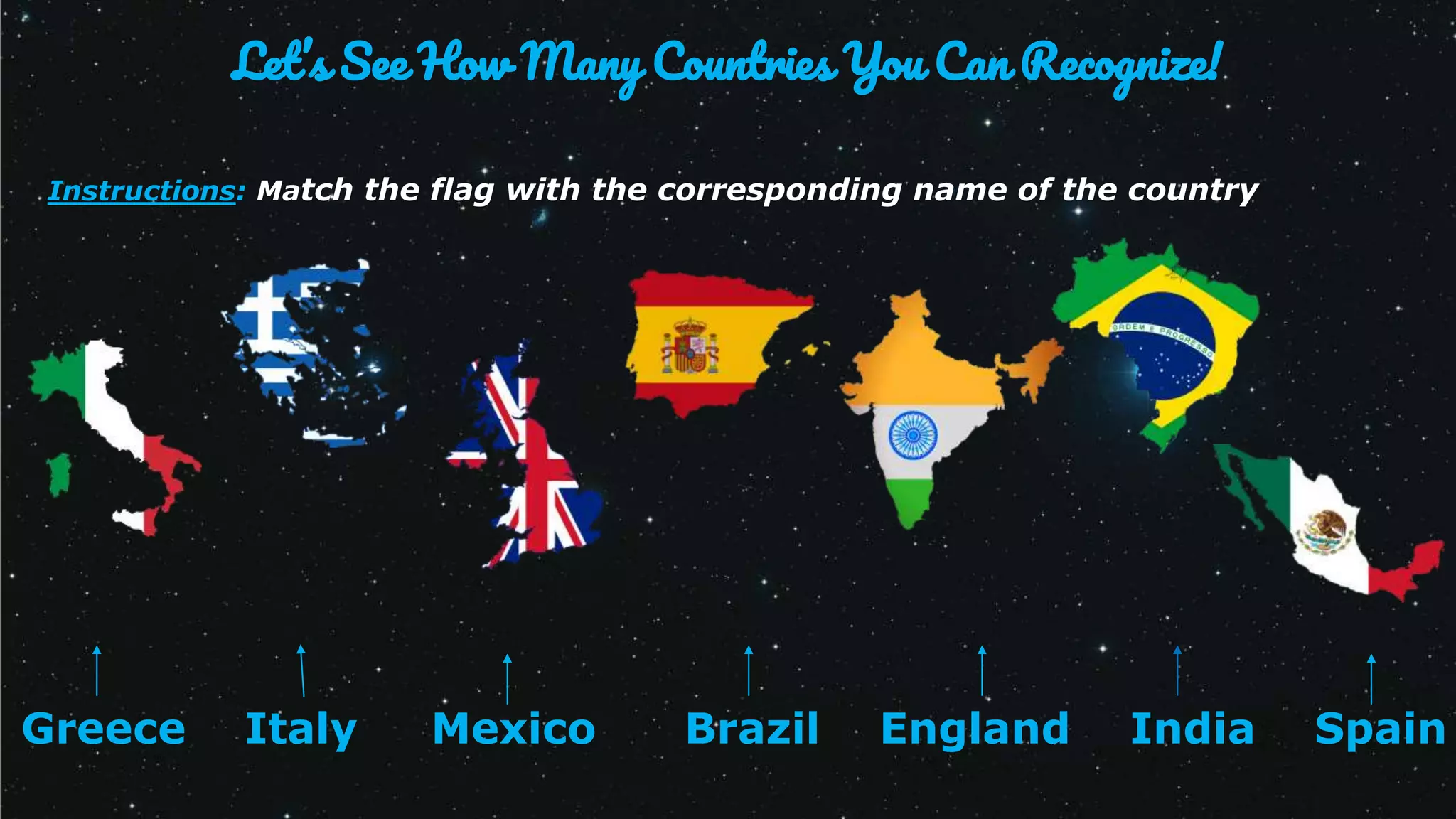
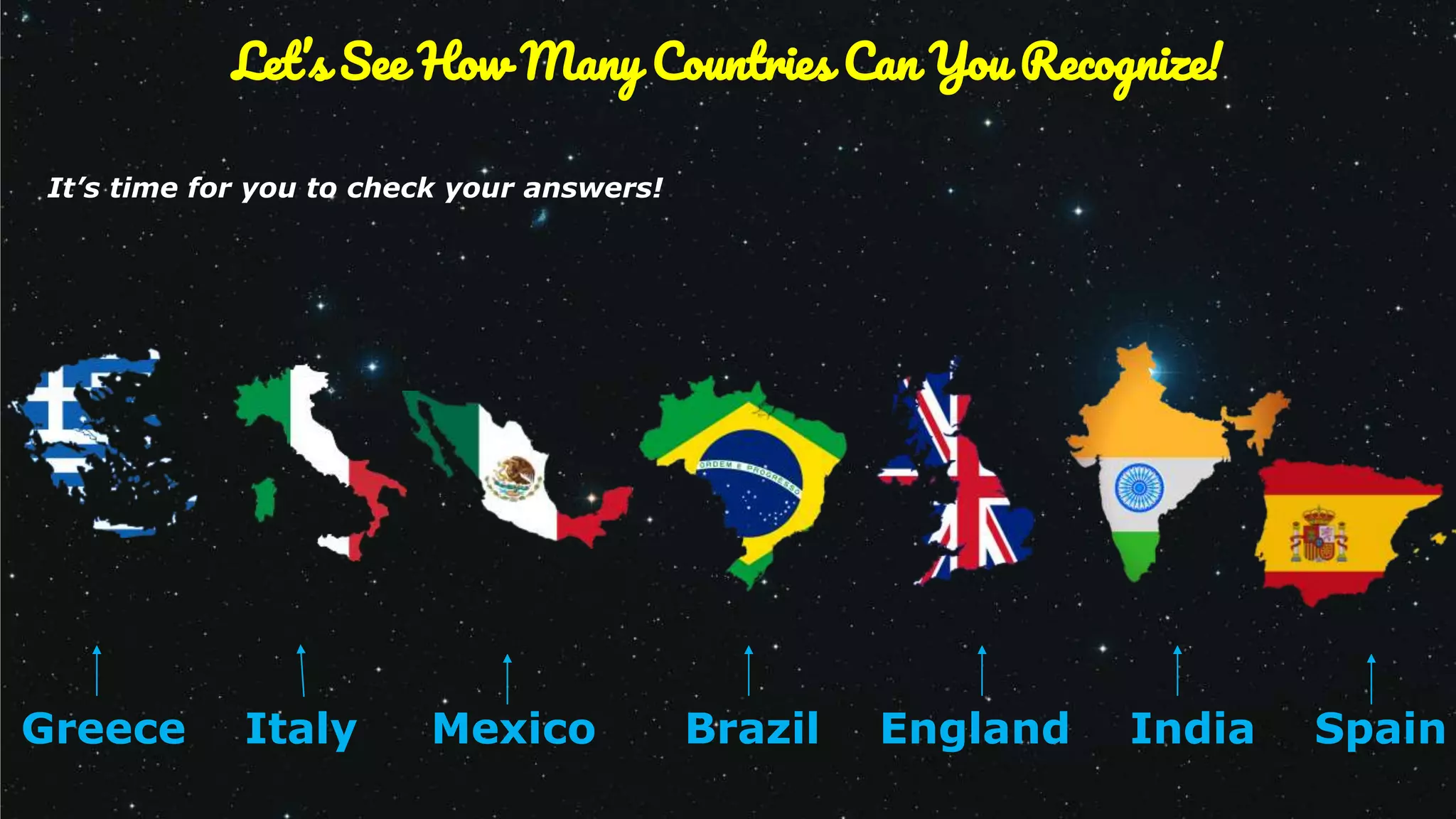
Greece Italy Mexico Brazil England India Spain
Instructions: Match the flag with the corresponding name of the country
Let’s See How Many Countries You Can Recognize!
Greece Italy Mexico Brazil England India Spain
It’s time for you to check your answers!
Let’s See How Many Countries Can You Recognize!
Vocabulary
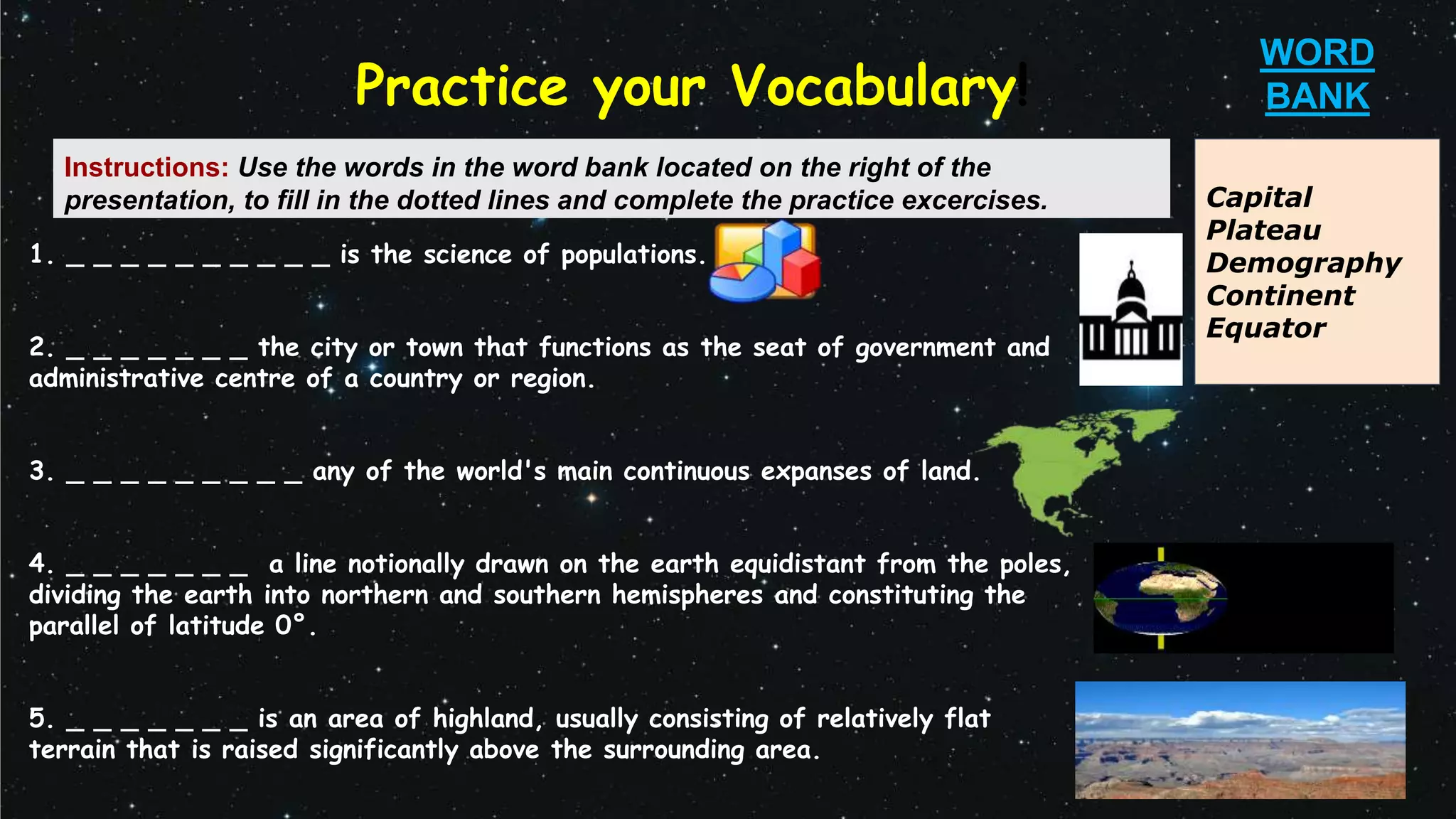
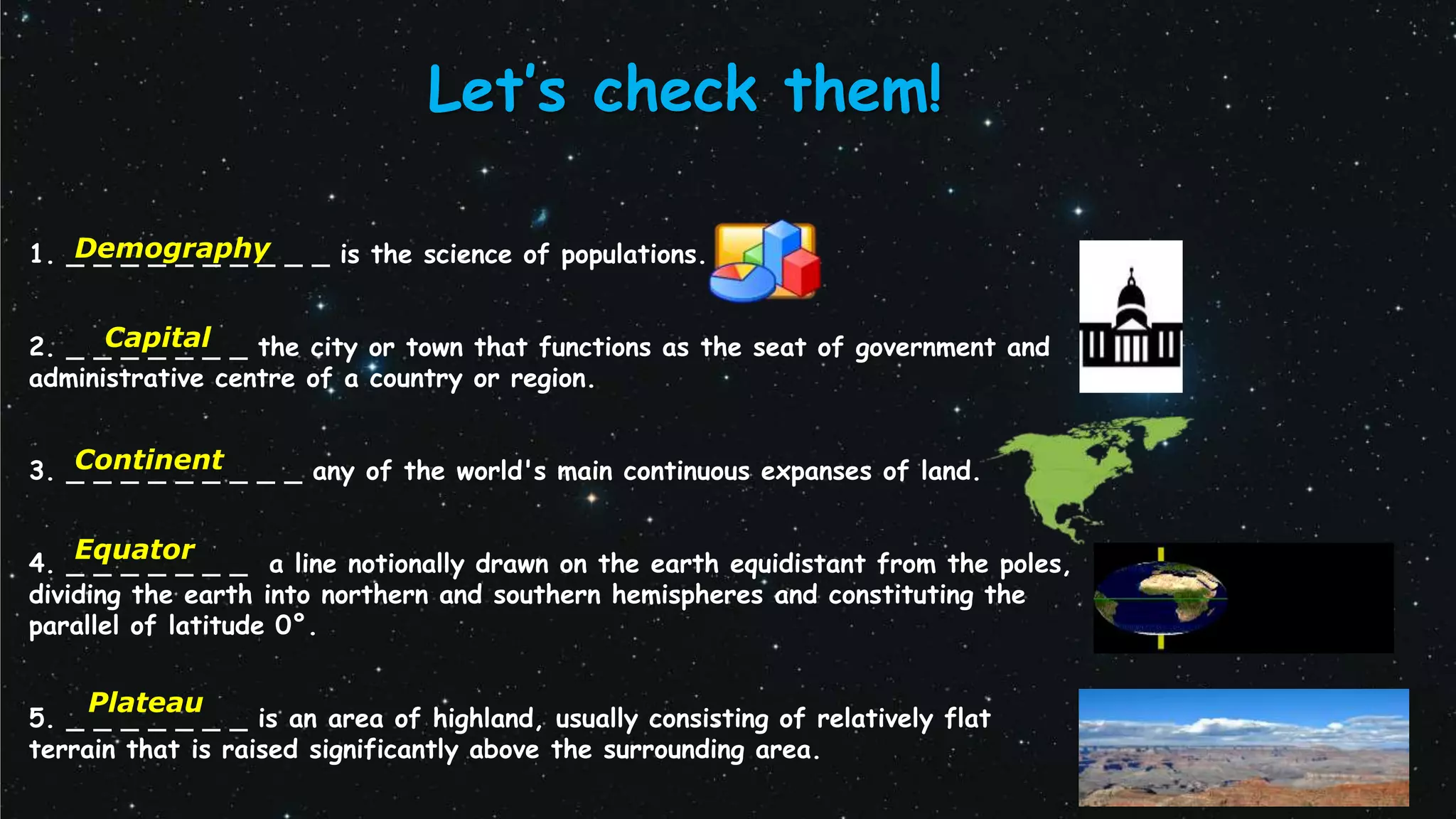
1. _ _ _ _ _ _ _ _ _ _ is the science of populations.
2. _ _ _ _ _ _ _ the city or town that functions as the seat of government and
administrative centre of a country or region.
3. _ _ _ _ _ _ _ _ _ any of the world's main continuous expanses of land.
4. _ _ _ _ _ _ _ a line notionally drawn on the earth equidistant from the poles,
dividing the earth into northern and southern hemispheres and constituting the
parallel of latitude 0°.
5. _ _ _ _ _ _ _ is an area of highland, usually consisting of relatively flat
terrain that is raised significantly above the surrounding area.
Practice your Vocabulary!
Capital
Plateau
Demography
Continent
Equator
WORD
BANK
Instructions: Use the words in the word bank located on the right of the
presentation, to fill in the dotted lines and complete the practice excercises.
1. _ _ _ _ _ _ _ _ _ _ is the science of populations.
2. _ _ _ _ _ _ _ the city or town that functions as the seat of government and
administrative centre of a country or region.
3. _ _ _ _ _ _ _ _ _ any of the world's main continuous expanses of land.
4. _ _ _ _ _ _ _ a line notionally drawn on the earth equidistant from the poles,
dividing the earth into northern and southern hemispheres and constituting the
parallel of latitude 0°.
5. _ _ _ _ _ _ _ is an area of highland, usually consisting of relatively flat
terrain that is raised significantly above the surrounding area.
Let’s check them!
Continent
Demography
Equator
Plateau
Capital
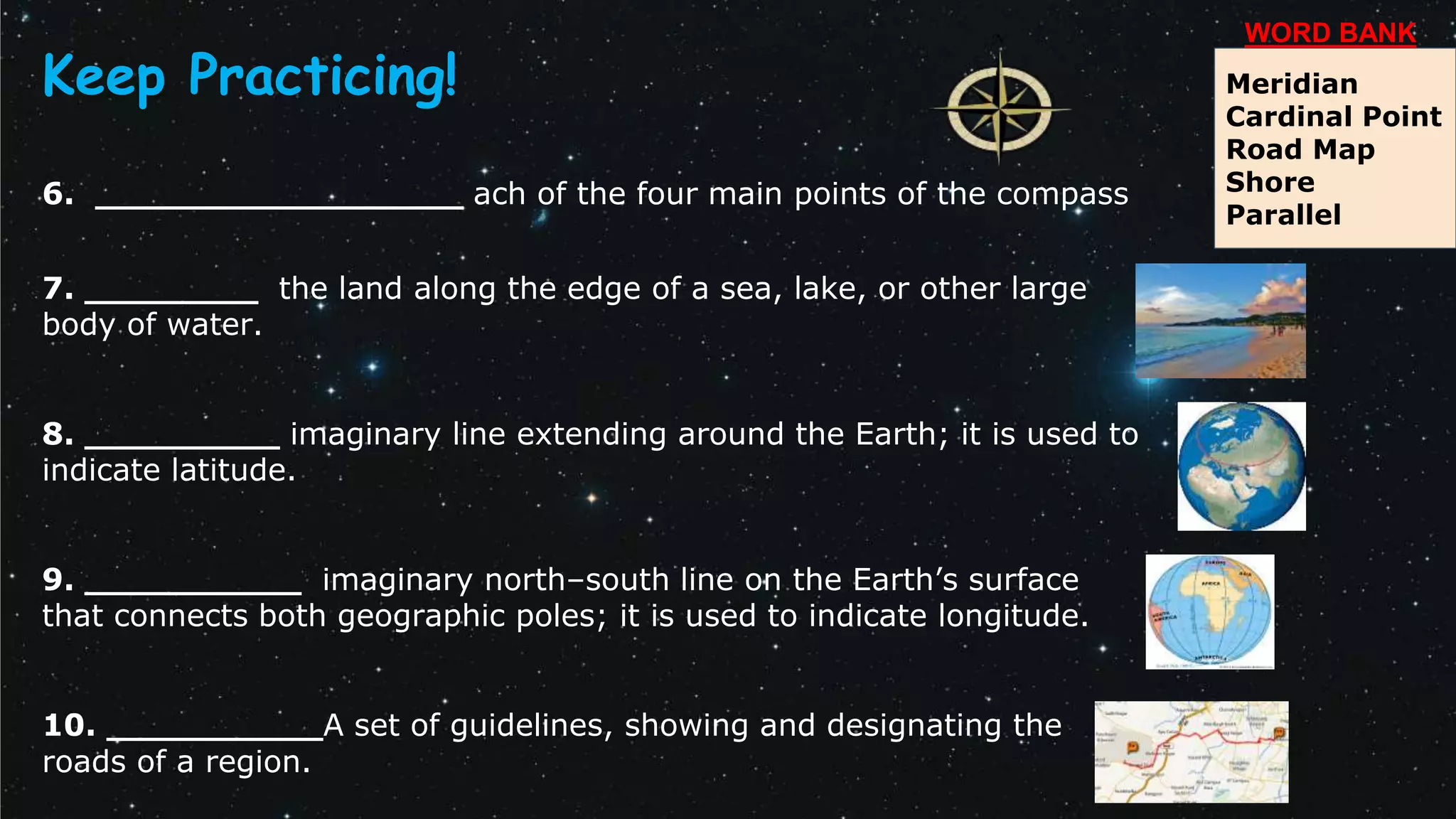
6. _________________ ach of the four main points of the compass
7. ________ the land along the edge of a sea, lake, or other large
body of water.
8. _________ imaginary line extending around the Earth; it is used to
indicate latitude.
9. __________ imaginary north–south line on the Earth’s surface
that connects both geographic poles; it is used to indicate longitude.
10. __________A set of guidelines, showing and designating the
roads of a region.
Meridian
Cardinal Point
Road Map
Shore
Parallel
WORD BANK
Keep Practicing!
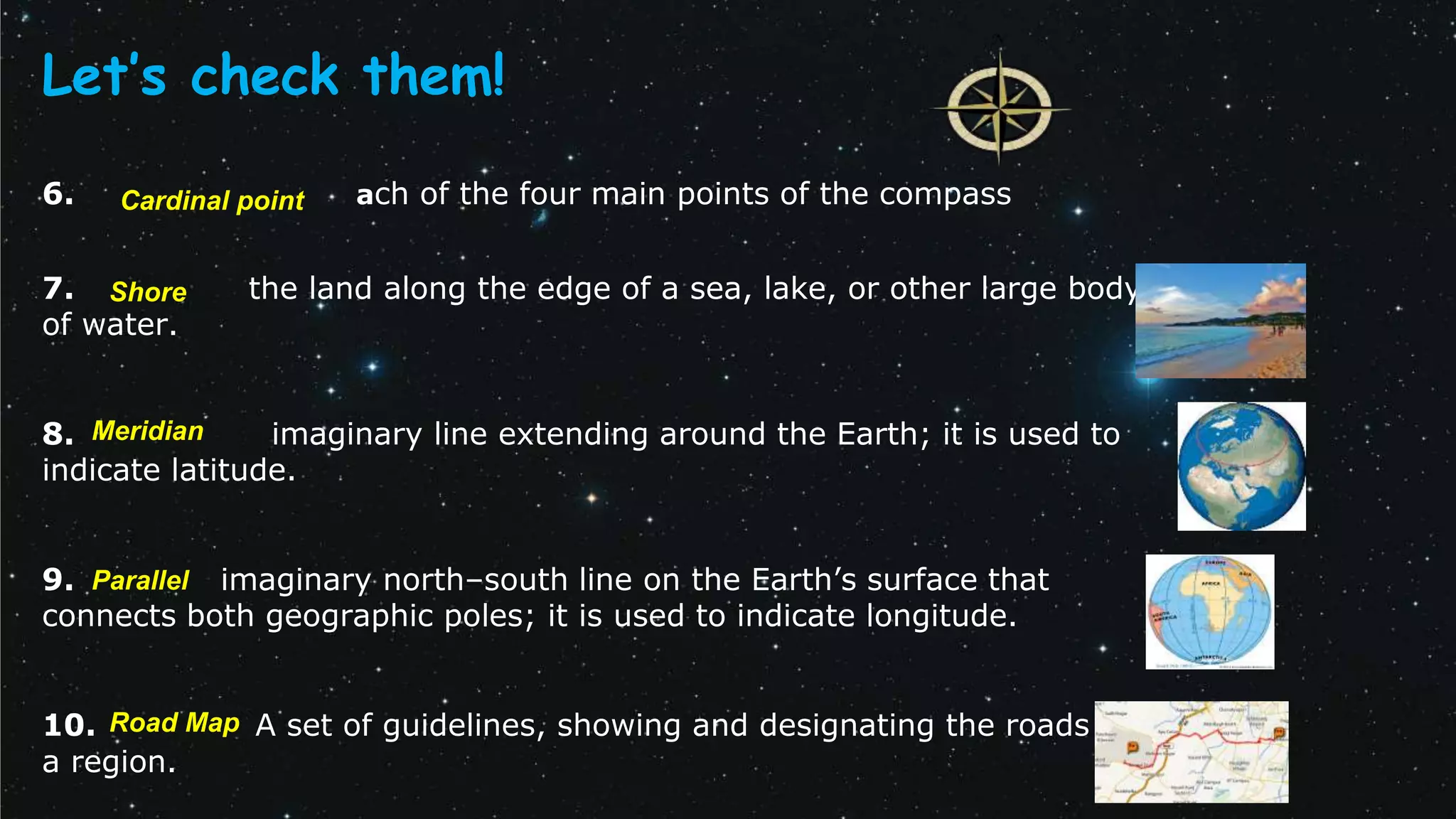
6. ach of the four main points of the compass
7. the land along the edge of a sea, lake, or other large body
of water.
8. imaginary line extending around the Earth; it is used to
indicate latitude.
9. imaginary north–south line on the Earth’s surface that
connects both geographic poles; it is used to indicate longitude.
10. A set of guidelines, showing and designating the roads of
a region.
Let’s check them!
Meridian
Cardinal point
Road Map
Shore
Parallel
Grammar
Buckle up, this is the grammar explanation!
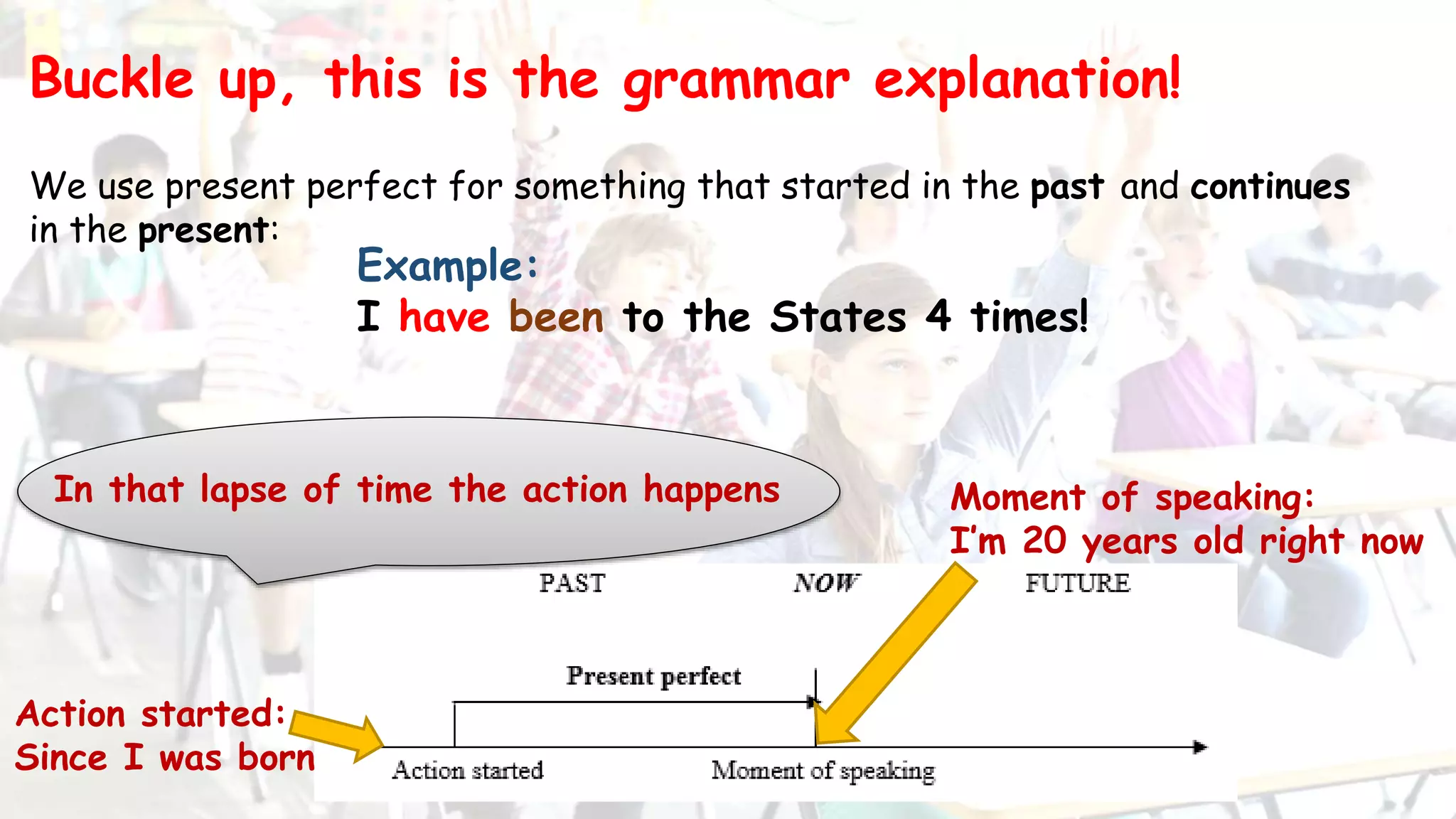
We use present perfect for something that started in the past and continues
in the present:
Example:
I have been to the States 4 times!
Action started:
Since I was born
Moment of speaking:
I’m 20 years old right now
In that lapse of time the action happens
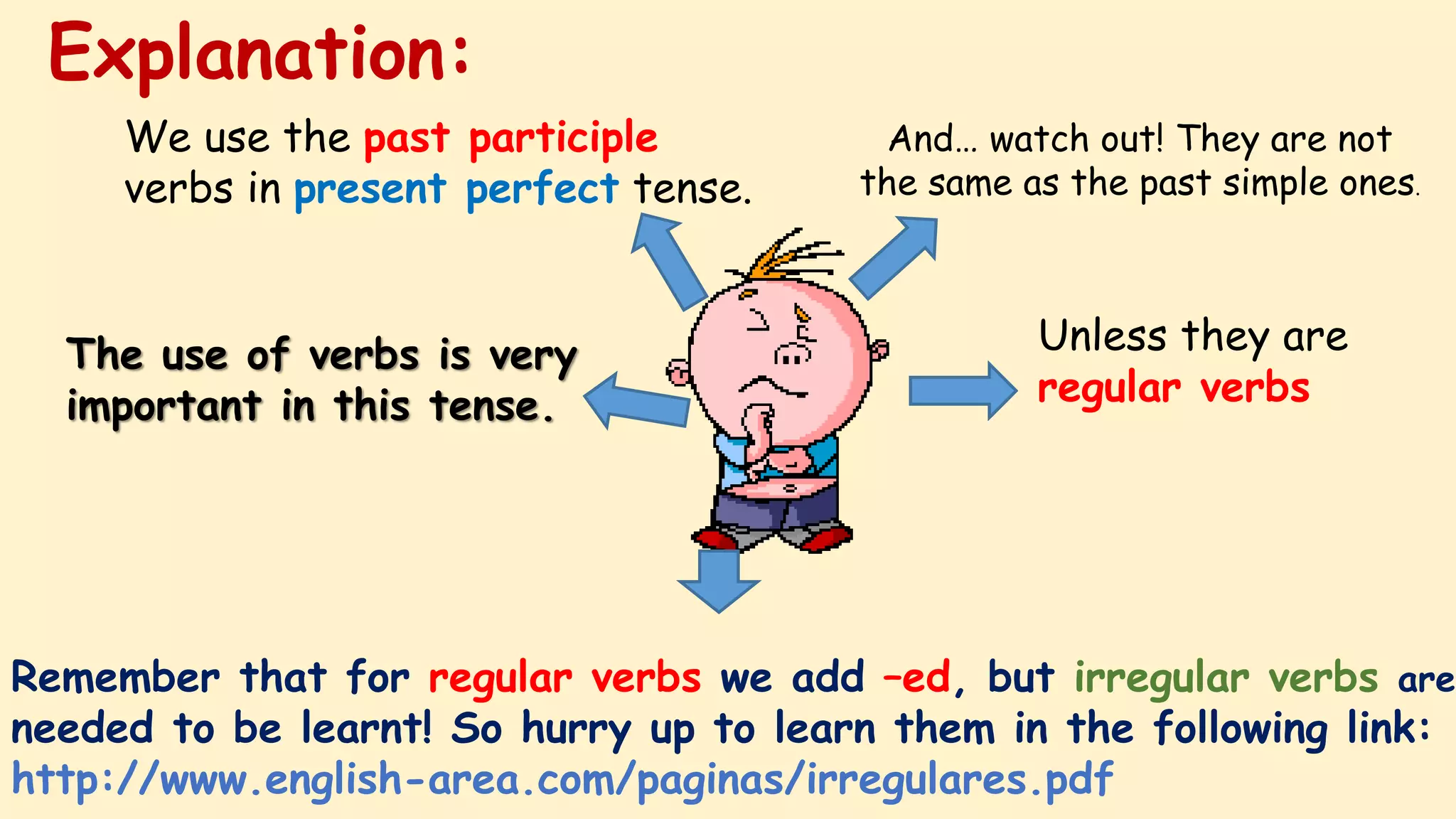
Remember that for regular verbs we add –ed, but irregular verbs are
needed to be learnt! So hurry up to learn them in the following link:
http://www.english-area.com/paginas/irregulares.pdf
The use of verbs is very
important in this tense.
We use the past participle
verbs in present perfect tense.
And… watch out! They are not
the same as the past simple ones.
Unless they are
regular verbs
Explanation:
Explanation:
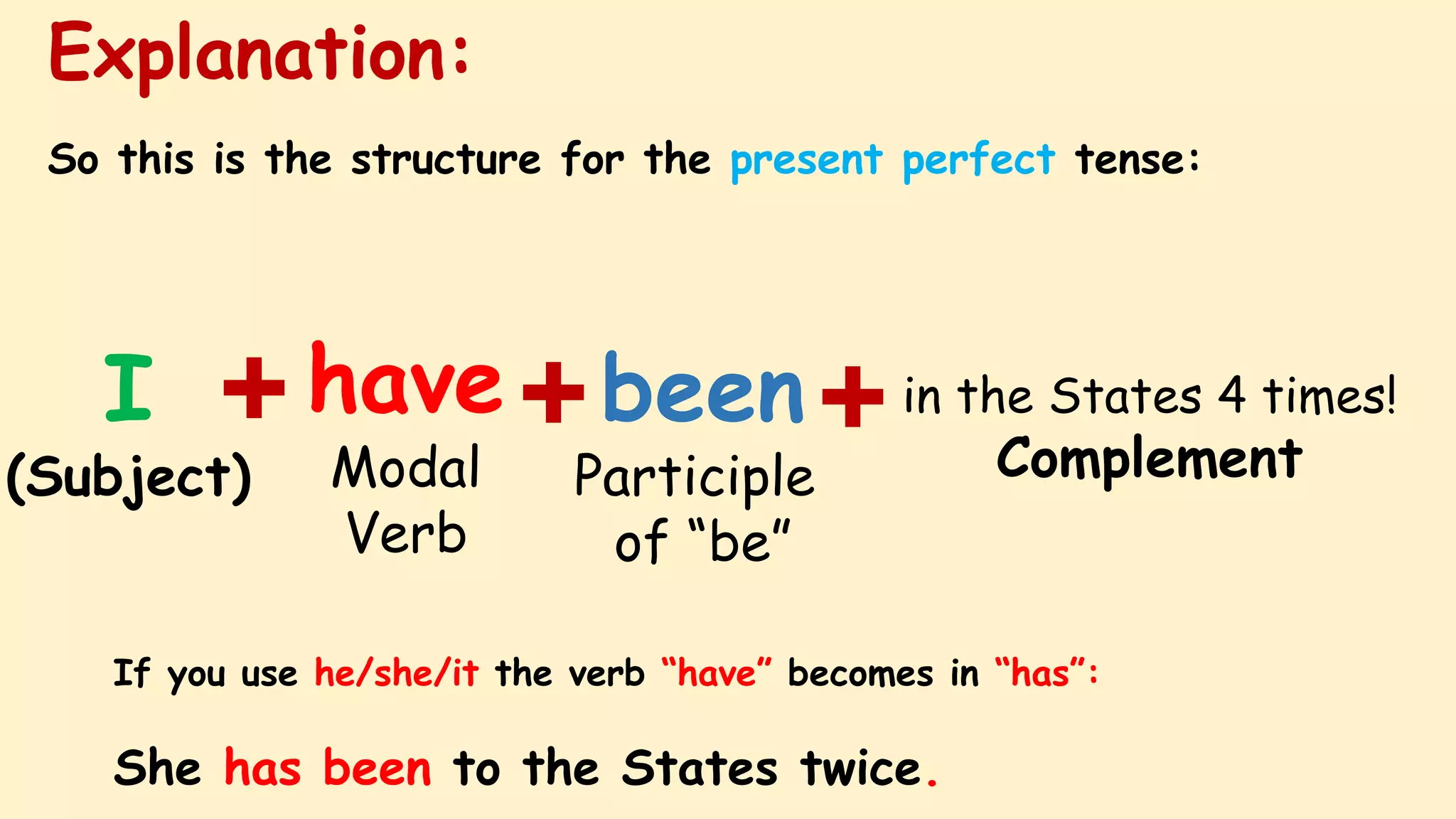
So this is the structure for the present perfect tense:
I
(Subject)
+have
Modal
Verb
+been
Participle
of “be”
+in the States 4 times!
Complement
If you use he/she/it the verb “have” becomes in “has”:
She has been to the States twice.
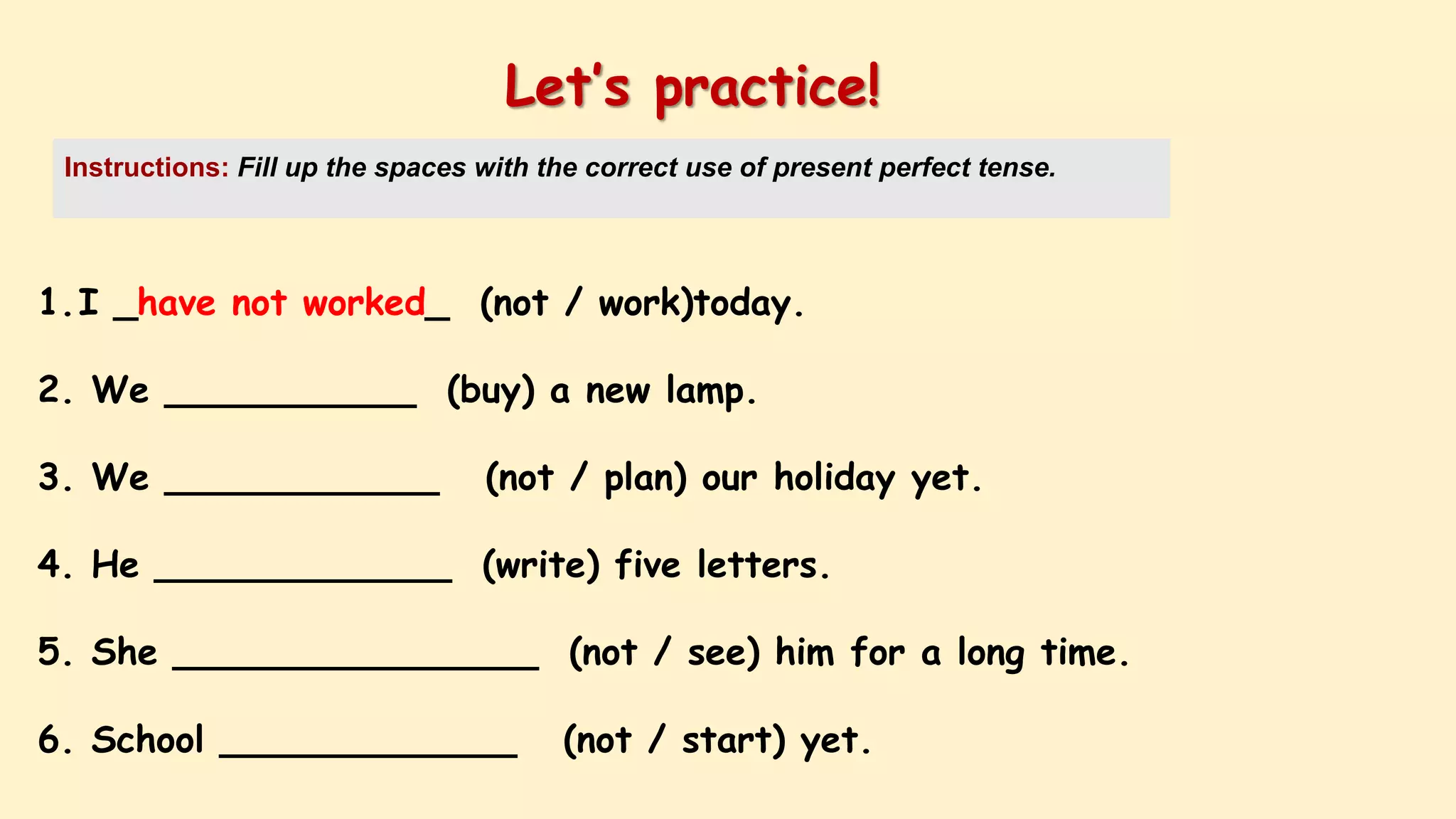
1.I _have not worked_ (not / work)today.
2. We ___________ (buy) a new lamp.
3. We ____________ (not / plan) our holiday yet.
4. He _____________ (write) five letters.
5. She ________________ (not / see) him for a long time.
6. School _____________ (not / start) yet.
Let’s practice!
Instructions: Fill up the spaces with the correct use of present perfect tense.
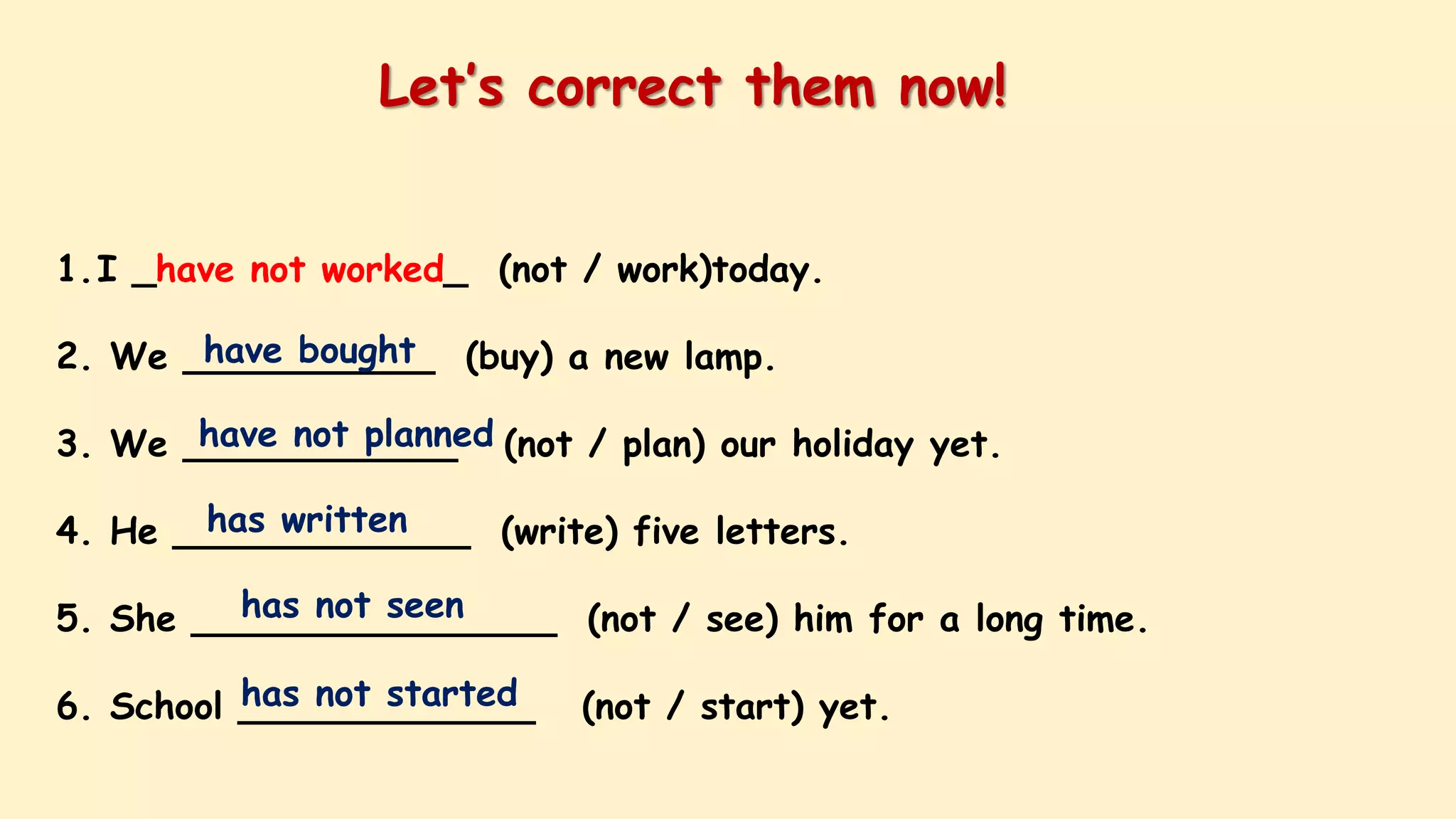
1.I _have not worked_ (not / work)today.
2. We ___________ (buy) a new lamp.
3. We ____________ (not / plan) our holiday yet.
4. He _____________ (write) five letters.
5. She ________________ (not / see) him for a long time.
6. School _____________ (not / start) yet.
Let’s correct them now!
have bought
have not planned
has written
has not seen
has not started
LISTENING
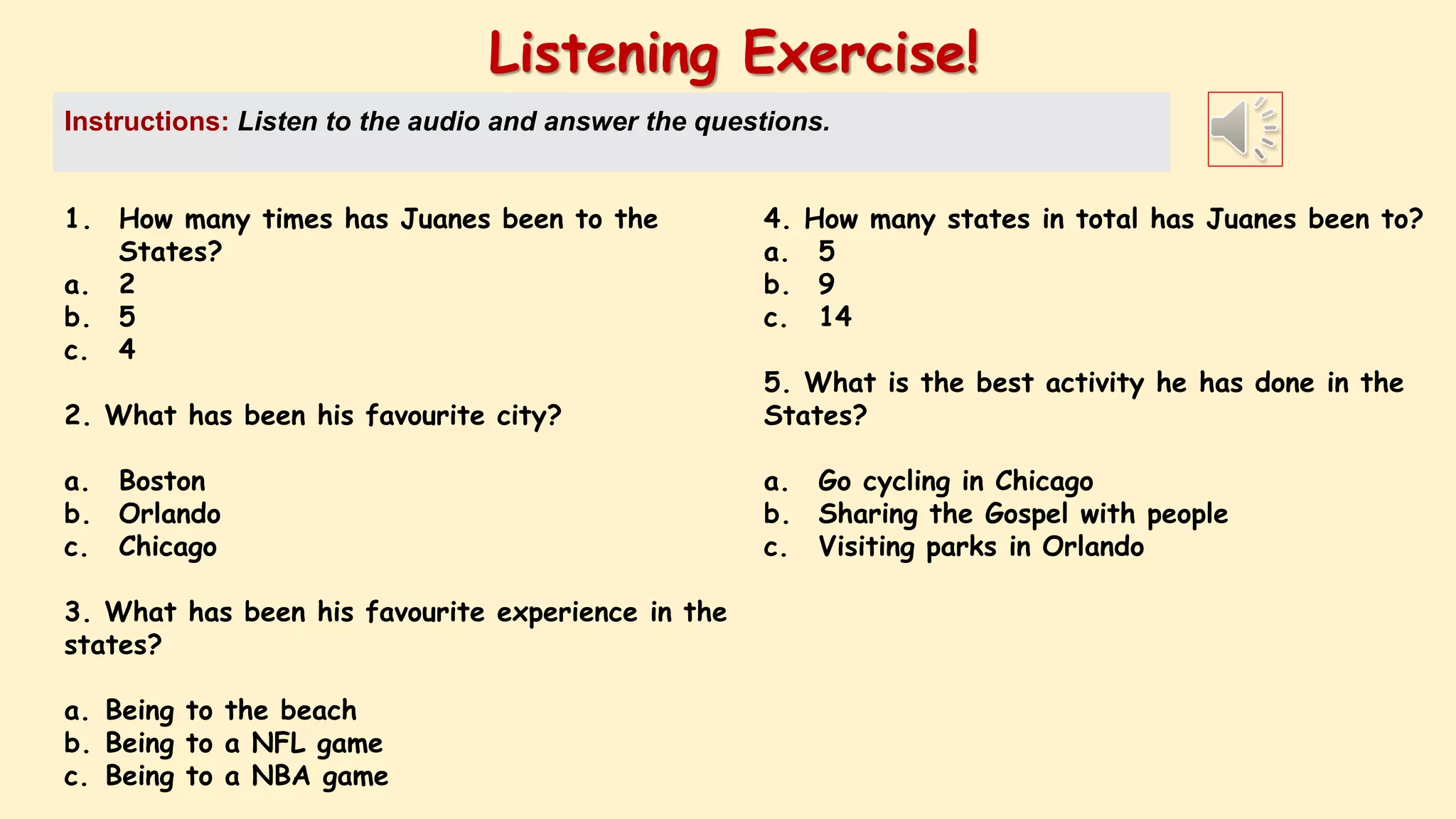
1. How many times has Juanes been to the
States?
a. 2
b. 5
c. 4
2. What has been his favourite city?
a. Boston
b. Orlando
c. Chicago
3. What has been his favourite experience in the
states?
a. Being to the beach
b. Being to a NFL game
c. Being to a NBA game
Listening Exercise!
Instructions: Listen to the audio and answer the questions.
4. How many states in total has Juanes been to?
a. 5
b. 9
c. 14
5. What is the best activity he has done in the
States?
a. Go cycling in Chicago
b. Sharing the Gospel with people
c. Visiting parks in Orlando
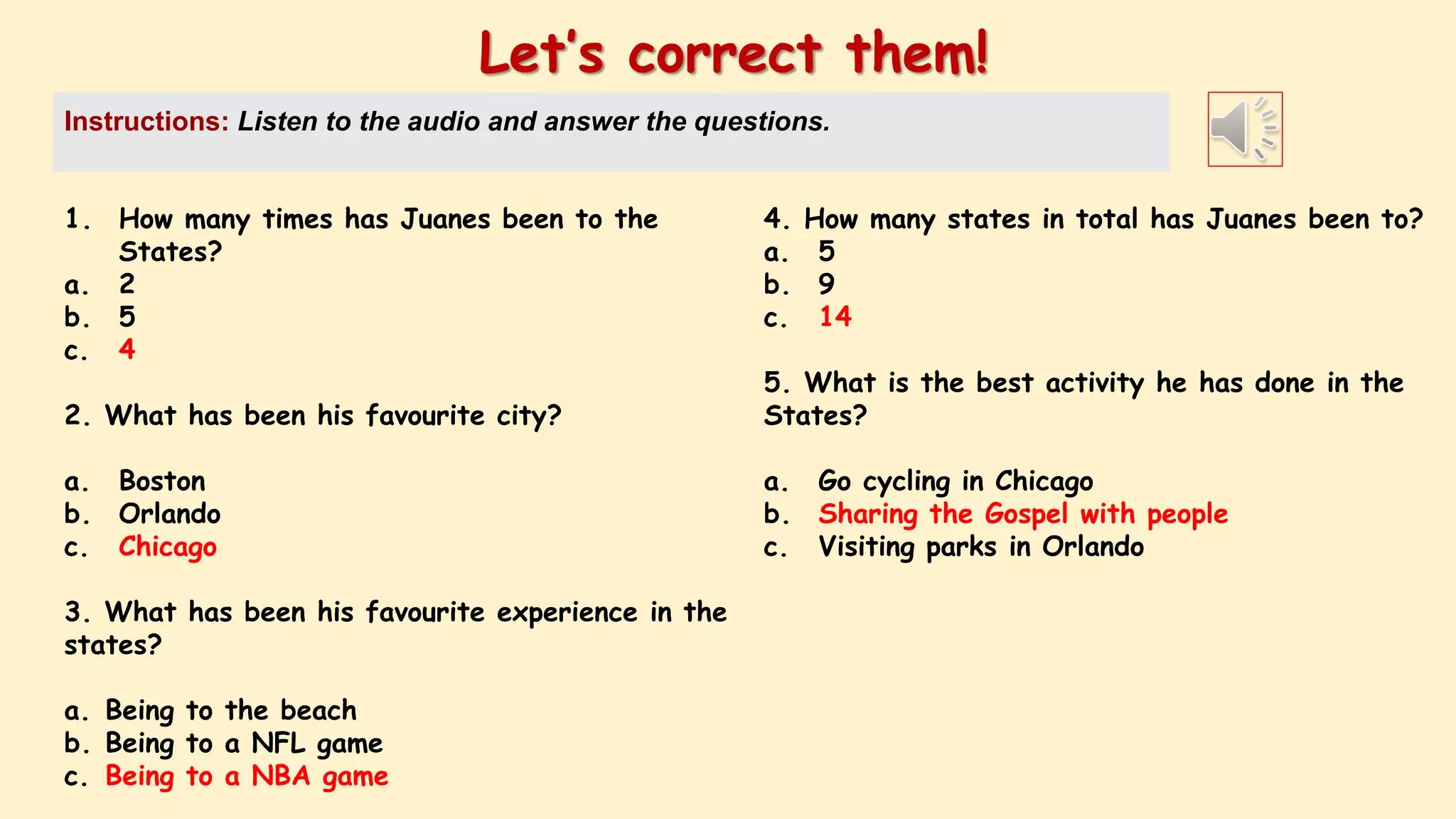
1. How many times has Juanes been to the
States?
a. 2
b. 5
c. 4
2. What has been his favourite city?
a. Boston
b. Orlando
c. Chicago
3. What has been his favourite experience in the
states?
a. Being to the beach
b. Being to a NFL game
c. Being to a NBA game
Let’s correct them!
Instructions: Listen to the audio and answer the questions.
4. How many states in total has Juanes been to?
a. 5
b. 9
c. 14
5. What is the best activity he has done in the
States?
a. Go cycling in Chicago
b. Sharing the Gospel with people
c. Visiting parks in Orlando
READING
Let’s read and practice!
The Story Of The Aral Sea
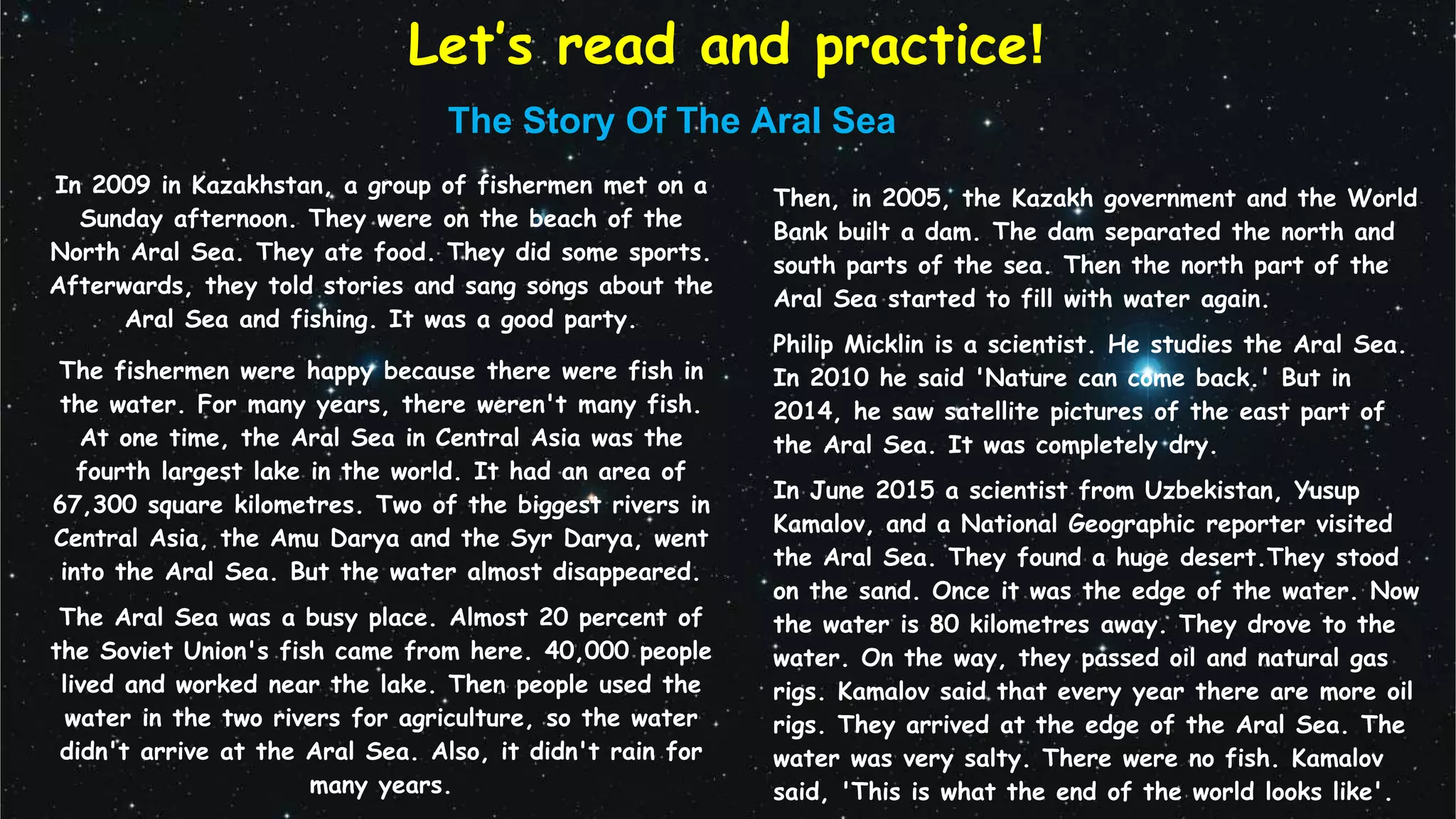
In 2009 in Kazakhstan, a group of fishermen met on a
Sunday afternoon. They were on the beach of the
North Aral Sea. They ate food. They did some sports.
Afterwards, they told stories and sang songs about the
Aral Sea and fishing. It was a good party.
The fishermen were happy because there were fish in
the water. For many years, there weren't many fish.
At one time, the Aral Sea in Central Asia was the
fourth largest lake in the world. It had an area of
67,300 square kilometres. Two of the biggest rivers in
Central Asia, the Amu Darya and the Syr Darya, went
into the Aral Sea. But the water almost disappeared.
The Aral Sea was a busy place. Almost 20 percent of
the Soviet Union's fish came from here. 40,000 people
lived and worked near the lake. Then people used the
water in the two rivers for agriculture, so the water
didn't arrive at the Aral Sea. Also, it didn't rain for
many years.
Then, in 2005, the Kazakh government and the World
Bank built a dam. The dam separated the north and
south parts of the sea. Then the north part of the
Aral Sea started to fill with water again.
Philip Micklin is a scientist. He studies the Aral Sea.
In 2010 he said 'Nature can come back.' But in
2014, he saw satellite pictures of the east part of
the Aral Sea. It was completely dry.
In June 2015 a scientist from Uzbekistan, Yusup
Kamalov, and a National Geographic reporter visited
the Aral Sea. They found a huge desert.They stood
on the sand. Once it was the edge of the water. Now
the water is 80 kilometres away. They drove to the
water. On the way, they passed oil and natural gas
rigs. Kamalov said that every year there are more oil
rigs. They arrived at the edge of the Aral Sea. The
water was very salty. There were no fish. Kamalov
said, 'This is what the end of the world looks like'.
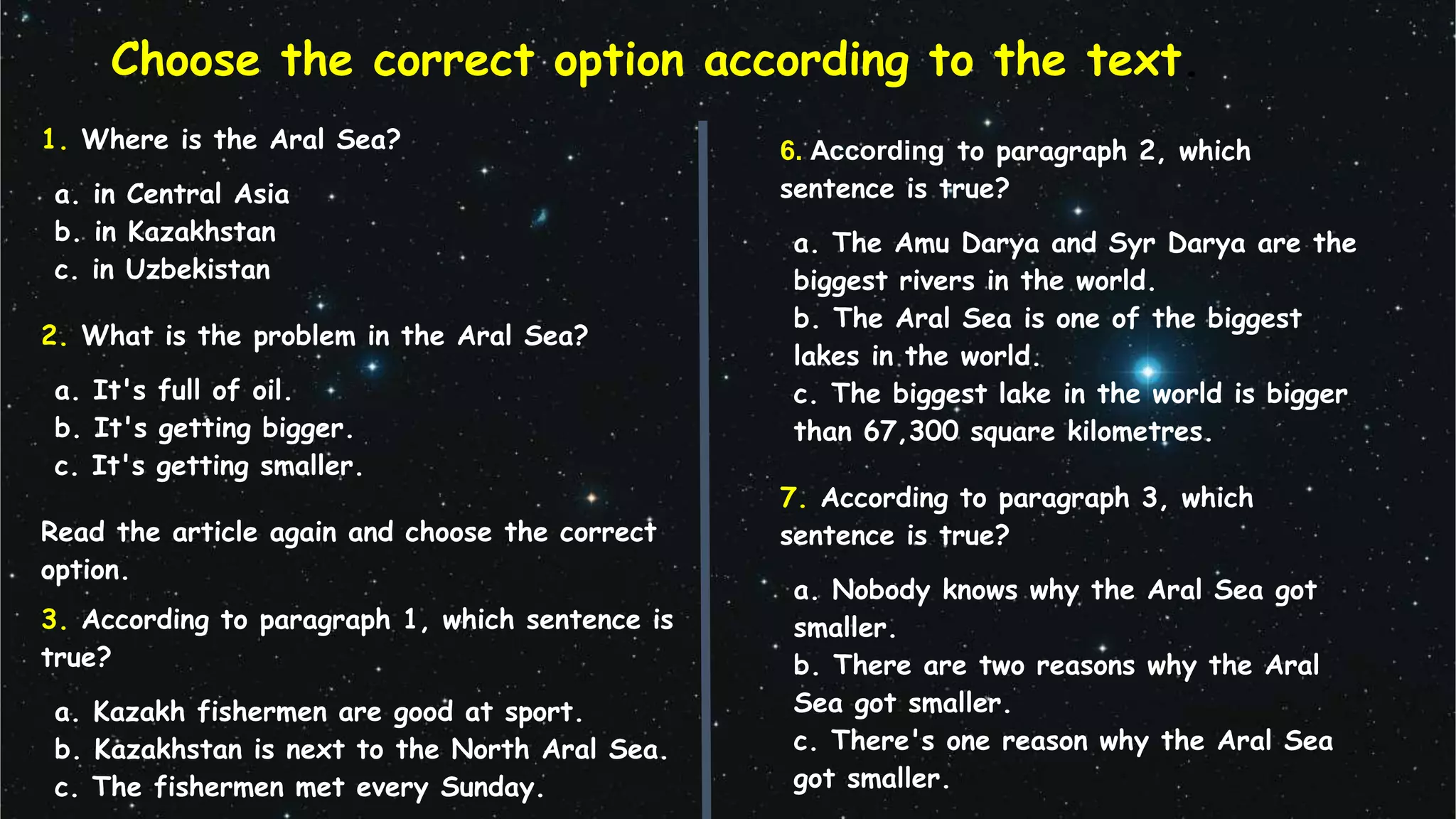
Choose the correct option according to the text.
1. Where is the Aral Sea?
a. in Central Asia
b. in Kazakhstan
c. in Uzbekistan
2. What is the problem in the Aral Sea?
a. It's full of oil.
b. It's getting bigger.
c. It's getting smaller.
Read the article again and choose the correct
option.
3. According to paragraph 1, which sentence is
true?
a. Kazakh fishermen are good at sport.
b. Kazakhstan is next to the North Aral Sea.
c. The fishermen met every Sunday.
6. According to paragraph 2, which
sentence is true?
a. The Amu Darya and Syr Darya are the
biggest rivers in the world.
b. The Aral Sea is one of the biggest
lakes in the world.
c. The biggest lake in the world is bigger
than 67,300 square kilometres.
7. According to paragraph 3, which
sentence is true?
a. Nobody knows why the Aral Sea got
smaller.
b. There are two reasons why the Aral
Sea got smaller.
c. There's one reason why the Aral Sea
got smaller.
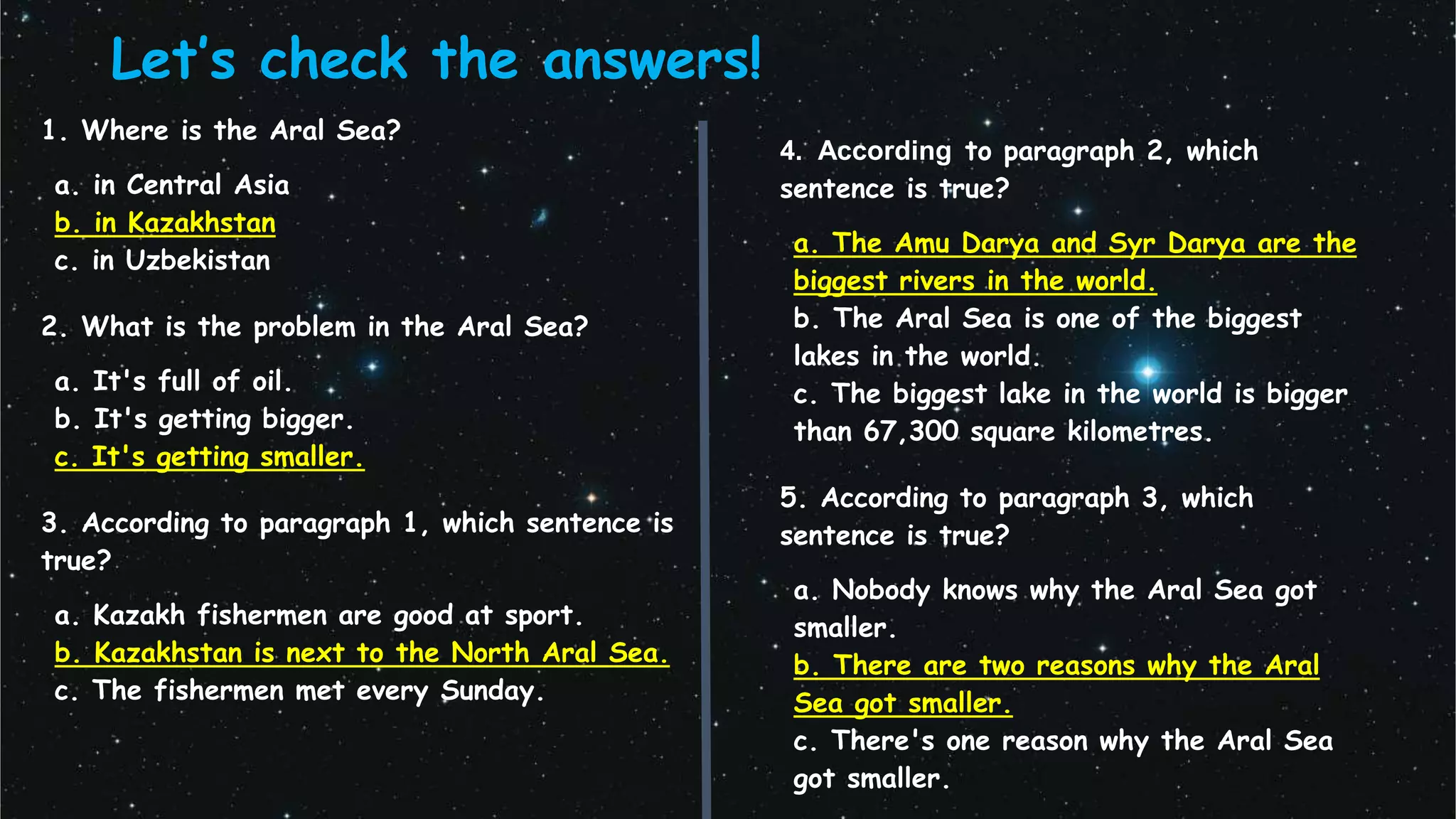
Let’s check the answers!
1. Where is the Aral Sea?
a. in Central Asia
b. in Kazakhstan
c. in Uzbekistan
2. What is the problem in the Aral Sea?
a. It's full of oil.
b. It's getting bigger.
c. It's getting smaller.
3. According to paragraph 1, which sentence is
true?
a. Kazakh fishermen are good at sport.
b. Kazakhstan is next to the North Aral Sea.
c. The fishermen met every Sunday.
4. According to paragraph 2, which
sentence is true?
a. The Amu Darya and Syr Darya are the
biggest rivers in the world.
b. The Aral Sea is one of the biggest
lakes in the world.
c. The biggest lake in the world is bigger
than 67,300 square kilometres.
5. According to paragraph 3, which
sentence is true?
a. Nobody knows why the Aral Sea got
smaller.
b. There are two reasons why the Aral
Sea got smaller.
c. There's one reason why the Aral Sea
got smaller.
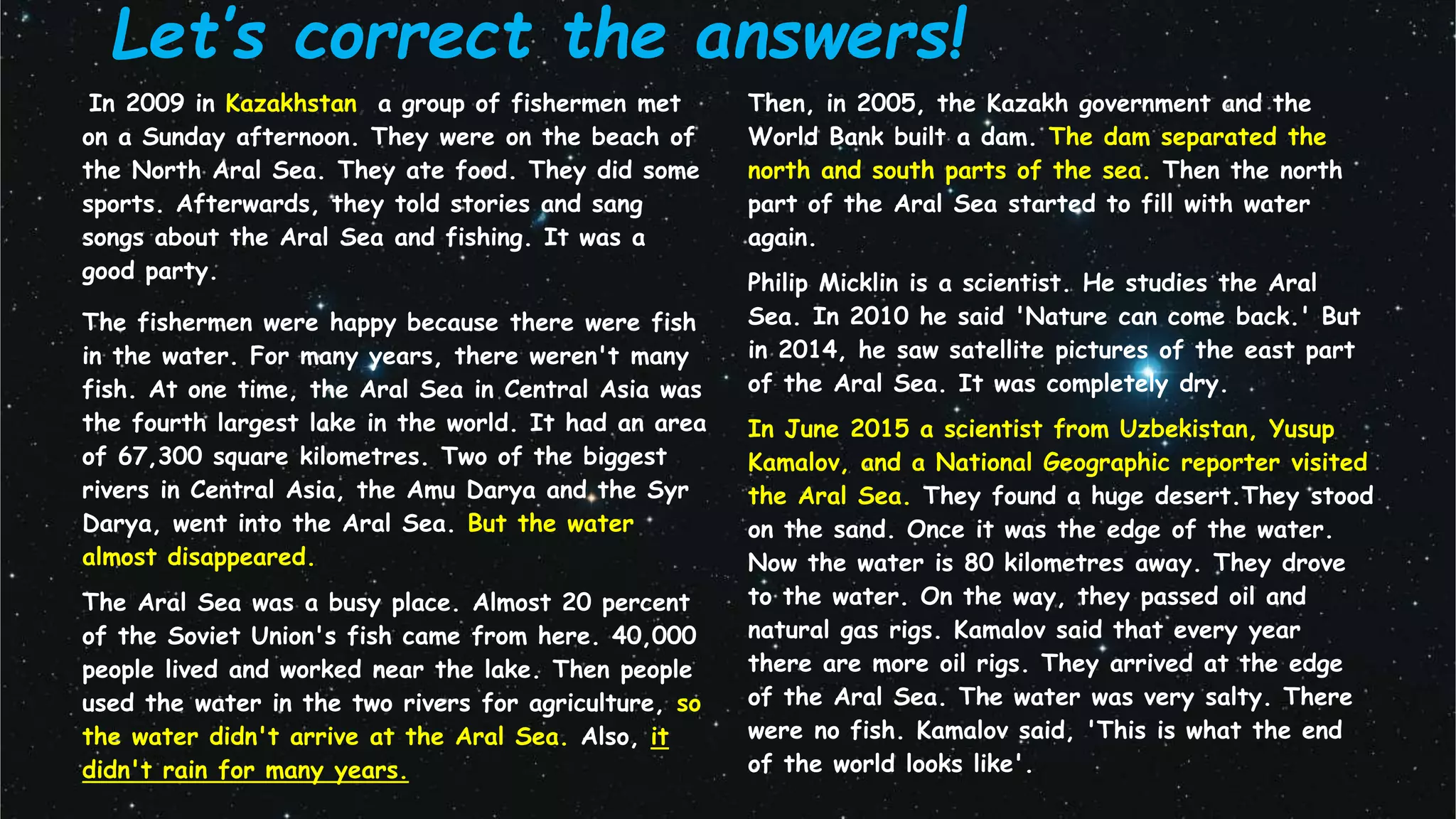
Let’s correct the answers!
In 2009 in Kazakhstan, a group of fishermen met
on a Sunday afternoon. They were on the beach of
the North Aral Sea. They ate food. They did some
sports. Afterwards, they told stories and sang
songs about the Aral Sea and fishing. It was a
good party.
The fishermen were happy because there were fish
in the water. For many years, there weren't many
fish. At one time, the Aral Sea in Central Asia was
the fourth largest lake in the world. It had an area
of 67,300 square kilometres. Two of the biggest
rivers in Central Asia, the Amu Darya and the Syr
Darya, went into the Aral Sea. But the water
almost disappeared.
The Aral Sea was a busy place. Almost 20 percent
of the Soviet Union's fish came from here. 40,000
people lived and worked near the lake. Then people
used the water in the two rivers for agriculture, so
the water didn't arrive at the Aral Sea. Also, it
didn't rain for many years.
Then, in 2005, the Kazakh government and the
World Bank built a dam. The dam separated the
north and south parts of the sea. Then the north
part of the Aral Sea started to fill with water
again.
Philip Micklin is a scientist. He studies the Aral
Sea. In 2010 he said 'Nature can come back.' But
in 2014, he saw satellite pictures of the east part
of the Aral Sea. It was completely dry.
In June 2015 a scientist from Uzbekistan, Yusup
Kamalov, and a National Geographic reporter visited
the Aral Sea. They found a huge desert.They stood
on the sand. Once it was the edge of the water.
Now the water is 80 kilometres away. They drove
to the water. On the way, they passed oil and
natural gas rigs. Kamalov said that every year
there are more oil rigs. They arrived at the edge
of the Aral Sea. The water was very salty. There
were no fish. Kamalov said, 'This is what the end
of the world looks like'.
Nationalgeographic (2018). What is Geography?. [online] Available at:
https://www.nationalgeographic.org/education/what-is-geography [Accessed 26 Feb.
2018].
Commons.wikimedia (2018). File:Flag map of Italy.svg - Wikimedia Commons. [online]
Available at: https://commons.wikimedia.org/wiki/File:Flag_map_of_Italy.svg
[Accessed 26 Feb. 2018].
Grammarmindmaps (2018). Mind Map for the Present Perfect Tense. [online] Available
at: http://www.grammarmindmaps.com/mind-map-the-present-perfect-tense/
[Accessed 26 Feb. 2018].
LearnEnglish - British Council. (2018). present perfect. [online] Available at:
https://learnenglish.britishcouncil.org/en/english-grammar/verbs/present-
tense/present-perfect [Accessed 6 Mar. 2018].
Ngllife (2018). The Story of the Aral Sea | NGL Life. [online] Available at:
http://www.ngllife.com/story-aral-sea [Accessed 6 Mar. 2018].
REFERENCES

E learning class final

  • 1.
    Teachers: Sara ValentinaOrtiz Alfonso Juan Esteban Pineda Guarin
  • 2.
    Geography is thestudy of places and the relationships between people and their environments.
  • 3.
    English Class Time! Let’slearn about our world! Everybody needs to learn geography, It’s common knowledge… And if you ever get lost you must learn how to find your way! As well as get ready to learn about Present Perfect Tense.
  • 4.
    Greece Italy MexicoBrazil England India Spain Instructions: Match the flag with the corresponding name of the country Let’s See How Many Countries You Can Recognize!
  • 5.
    Greece Italy MexicoBrazil England India Spain It’s time for you to check your answers! Let’s See How Many Countries Can You Recognize!
  • 6.
  • 7.
    1. _ __ _ _ _ _ _ _ _ is the science of populations. 2. _ _ _ _ _ _ _ the city or town that functions as the seat of government and administrative centre of a country or region. 3. _ _ _ _ _ _ _ _ _ any of the world's main continuous expanses of land. 4. _ _ _ _ _ _ _ a line notionally drawn on the earth equidistant from the poles, dividing the earth into northern and southern hemispheres and constituting the parallel of latitude 0°. 5. _ _ _ _ _ _ _ is an area of highland, usually consisting of relatively flat terrain that is raised significantly above the surrounding area. Practice your Vocabulary! Capital Plateau Demography Continent Equator WORD BANK Instructions: Use the words in the word bank located on the right of the presentation, to fill in the dotted lines and complete the practice excercises.
  • 8.
    1. _ __ _ _ _ _ _ _ _ is the science of populations. 2. _ _ _ _ _ _ _ the city or town that functions as the seat of government and administrative centre of a country or region. 3. _ _ _ _ _ _ _ _ _ any of the world's main continuous expanses of land. 4. _ _ _ _ _ _ _ a line notionally drawn on the earth equidistant from the poles, dividing the earth into northern and southern hemispheres and constituting the parallel of latitude 0°. 5. _ _ _ _ _ _ _ is an area of highland, usually consisting of relatively flat terrain that is raised significantly above the surrounding area. Let’s check them! Continent Demography Equator Plateau Capital
  • 9.
    6. _________________ achof the four main points of the compass 7. ________ the land along the edge of a sea, lake, or other large body of water. 8. _________ imaginary line extending around the Earth; it is used to indicate latitude. 9. __________ imaginary north–south line on the Earth’s surface that connects both geographic poles; it is used to indicate longitude. 10. __________A set of guidelines, showing and designating the roads of a region. Meridian Cardinal Point Road Map Shore Parallel WORD BANK Keep Practicing!
  • 10.
    6. ach ofthe four main points of the compass 7. the land along the edge of a sea, lake, or other large body of water. 8. imaginary line extending around the Earth; it is used to indicate latitude. 9. imaginary north–south line on the Earth’s surface that connects both geographic poles; it is used to indicate longitude. 10. A set of guidelines, showing and designating the roads of a region. Let’s check them! Meridian Cardinal point Road Map Shore Parallel
  • 11.
  • 12.
    Buckle up, thisis the grammar explanation! We use present perfect for something that started in the past and continues in the present: Example: I have been to the States 4 times! Action started: Since I was born Moment of speaking: I’m 20 years old right now In that lapse of time the action happens
  • 13.
    Remember that forregular verbs we add –ed, but irregular verbs are needed to be learnt! So hurry up to learn them in the following link: http://www.english-area.com/paginas/irregulares.pdf The use of verbs is very important in this tense. We use the past participle verbs in present perfect tense. And… watch out! They are not the same as the past simple ones. Unless they are regular verbs Explanation:
  • 14.
    Explanation: So this isthe structure for the present perfect tense: I (Subject) +have Modal Verb +been Participle of “be” +in the States 4 times! Complement If you use he/she/it the verb “have” becomes in “has”: She has been to the States twice.
  • 15.
    1.I _have notworked_ (not / work)today. 2. We ___________ (buy) a new lamp. 3. We ____________ (not / plan) our holiday yet. 4. He _____________ (write) five letters. 5. She ________________ (not / see) him for a long time. 6. School _____________ (not / start) yet. Let’s practice! Instructions: Fill up the spaces with the correct use of present perfect tense.
  • 16.
    1.I _have notworked_ (not / work)today. 2. We ___________ (buy) a new lamp. 3. We ____________ (not / plan) our holiday yet. 4. He _____________ (write) five letters. 5. She ________________ (not / see) him for a long time. 6. School _____________ (not / start) yet. Let’s correct them now! have bought have not planned has written has not seen has not started
  • 17.
  • 18.
    1. How manytimes has Juanes been to the States? a. 2 b. 5 c. 4 2. What has been his favourite city? a. Boston b. Orlando c. Chicago 3. What has been his favourite experience in the states? a. Being to the beach b. Being to a NFL game c. Being to a NBA game Listening Exercise! Instructions: Listen to the audio and answer the questions. 4. How many states in total has Juanes been to? a. 5 b. 9 c. 14 5. What is the best activity he has done in the States? a. Go cycling in Chicago b. Sharing the Gospel with people c. Visiting parks in Orlando
  • 19.
    1. How manytimes has Juanes been to the States? a. 2 b. 5 c. 4 2. What has been his favourite city? a. Boston b. Orlando c. Chicago 3. What has been his favourite experience in the states? a. Being to the beach b. Being to a NFL game c. Being to a NBA game Let’s correct them! Instructions: Listen to the audio and answer the questions. 4. How many states in total has Juanes been to? a. 5 b. 9 c. 14 5. What is the best activity he has done in the States? a. Go cycling in Chicago b. Sharing the Gospel with people c. Visiting parks in Orlando
  • 20.
  • 21.
    Let’s read andpractice! The Story Of The Aral Sea In 2009 in Kazakhstan, a group of fishermen met on a Sunday afternoon. They were on the beach of the North Aral Sea. They ate food. They did some sports. Afterwards, they told stories and sang songs about the Aral Sea and fishing. It was a good party. The fishermen were happy because there were fish in the water. For many years, there weren't many fish. At one time, the Aral Sea in Central Asia was the fourth largest lake in the world. It had an area of 67,300 square kilometres. Two of the biggest rivers in Central Asia, the Amu Darya and the Syr Darya, went into the Aral Sea. But the water almost disappeared. The Aral Sea was a busy place. Almost 20 percent of the Soviet Union's fish came from here. 40,000 people lived and worked near the lake. Then people used the water in the two rivers for agriculture, so the water didn't arrive at the Aral Sea. Also, it didn't rain for many years. Then, in 2005, the Kazakh government and the World Bank built a dam. The dam separated the north and south parts of the sea. Then the north part of the Aral Sea started to fill with water again. Philip Micklin is a scientist. He studies the Aral Sea. In 2010 he said 'Nature can come back.' But in 2014, he saw satellite pictures of the east part of the Aral Sea. It was completely dry. In June 2015 a scientist from Uzbekistan, Yusup Kamalov, and a National Geographic reporter visited the Aral Sea. They found a huge desert.They stood on the sand. Once it was the edge of the water. Now the water is 80 kilometres away. They drove to the water. On the way, they passed oil and natural gas rigs. Kamalov said that every year there are more oil rigs. They arrived at the edge of the Aral Sea. The water was very salty. There were no fish. Kamalov said, 'This is what the end of the world looks like'.
  • 22.
    Choose the correctoption according to the text. 1. Where is the Aral Sea? a. in Central Asia b. in Kazakhstan c. in Uzbekistan 2. What is the problem in the Aral Sea? a. It's full of oil. b. It's getting bigger. c. It's getting smaller. Read the article again and choose the correct option. 3. According to paragraph 1, which sentence is true? a. Kazakh fishermen are good at sport. b. Kazakhstan is next to the North Aral Sea. c. The fishermen met every Sunday. 6. According to paragraph 2, which sentence is true? a. The Amu Darya and Syr Darya are the biggest rivers in the world. b. The Aral Sea is one of the biggest lakes in the world. c. The biggest lake in the world is bigger than 67,300 square kilometres. 7. According to paragraph 3, which sentence is true? a. Nobody knows why the Aral Sea got smaller. b. There are two reasons why the Aral Sea got smaller. c. There's one reason why the Aral Sea got smaller.
  • 23.
    Let’s check theanswers! 1. Where is the Aral Sea? a. in Central Asia b. in Kazakhstan c. in Uzbekistan 2. What is the problem in the Aral Sea? a. It's full of oil. b. It's getting bigger. c. It's getting smaller. 3. According to paragraph 1, which sentence is true? a. Kazakh fishermen are good at sport. b. Kazakhstan is next to the North Aral Sea. c. The fishermen met every Sunday. 4. According to paragraph 2, which sentence is true? a. The Amu Darya and Syr Darya are the biggest rivers in the world. b. The Aral Sea is one of the biggest lakes in the world. c. The biggest lake in the world is bigger than 67,300 square kilometres. 5. According to paragraph 3, which sentence is true? a. Nobody knows why the Aral Sea got smaller. b. There are two reasons why the Aral Sea got smaller. c. There's one reason why the Aral Sea got smaller.
  • 24.
    Let’s correct theanswers! In 2009 in Kazakhstan, a group of fishermen met on a Sunday afternoon. They were on the beach of the North Aral Sea. They ate food. They did some sports. Afterwards, they told stories and sang songs about the Aral Sea and fishing. It was a good party. The fishermen were happy because there were fish in the water. For many years, there weren't many fish. At one time, the Aral Sea in Central Asia was the fourth largest lake in the world. It had an area of 67,300 square kilometres. Two of the biggest rivers in Central Asia, the Amu Darya and the Syr Darya, went into the Aral Sea. But the water almost disappeared. The Aral Sea was a busy place. Almost 20 percent of the Soviet Union's fish came from here. 40,000 people lived and worked near the lake. Then people used the water in the two rivers for agriculture, so the water didn't arrive at the Aral Sea. Also, it didn't rain for many years. Then, in 2005, the Kazakh government and the World Bank built a dam. The dam separated the north and south parts of the sea. Then the north part of the Aral Sea started to fill with water again. Philip Micklin is a scientist. He studies the Aral Sea. In 2010 he said 'Nature can come back.' But in 2014, he saw satellite pictures of the east part of the Aral Sea. It was completely dry. In June 2015 a scientist from Uzbekistan, Yusup Kamalov, and a National Geographic reporter visited the Aral Sea. They found a huge desert.They stood on the sand. Once it was the edge of the water. Now the water is 80 kilometres away. They drove to the water. On the way, they passed oil and natural gas rigs. Kamalov said that every year there are more oil rigs. They arrived at the edge of the Aral Sea. The water was very salty. There were no fish. Kamalov said, 'This is what the end of the world looks like'.
  • 25.
    Nationalgeographic (2018). Whatis Geography?. [online] Available at: https://www.nationalgeographic.org/education/what-is-geography [Accessed 26 Feb. 2018]. Commons.wikimedia (2018). File:Flag map of Italy.svg - Wikimedia Commons. [online] Available at: https://commons.wikimedia.org/wiki/File:Flag_map_of_Italy.svg [Accessed 26 Feb. 2018]. Grammarmindmaps (2018). Mind Map for the Present Perfect Tense. [online] Available at: http://www.grammarmindmaps.com/mind-map-the-present-perfect-tense/ [Accessed 26 Feb. 2018]. LearnEnglish - British Council. (2018). present perfect. [online] Available at: https://learnenglish.britishcouncil.org/en/english-grammar/verbs/present- tense/present-perfect [Accessed 6 Mar. 2018]. Ngllife (2018). The Story of the Aral Sea | NGL Life. [online] Available at: http://www.ngllife.com/story-aral-sea [Accessed 6 Mar. 2018]. REFERENCES