Some Mathematics of Sailing
 Margot Gerritsen


 Stanford Yacht Research
    
 Institute for Computational & Mathematical Engineering
The famous America's Cup
161 Year Old Tradition
1851 !      !    Royal Yacht Squadron gives cup for Isle of Wight race!
     !      !    Won by schooner America, donated to New York Yacht Club!!
     !      !   !
     !      !    Deed of Gift: cup for perpetual international competition!

till 1970   !Twenty successful defenses with always just one challenger!
!
1970 !      !Challenger selection series starts – the Louis Vuitton Cup!
!
1983 !      !Royal Perth Yacht Club steals trophy from NYYC (finally!)!
!
1987 !      !Dennis Connor (USA) takes revenge in Stars & Stripes in Perth!
!
1988 !      !   Surprise challenge by New Zealand (KZ1 90 ft "big boat")!
        !   !   Connor won with 45 ft cat. !
!
!
!     !   !!
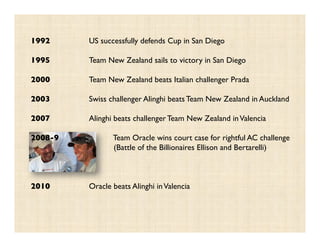
1992 !    !US successfully defends Cup in San Diego!
!
1995 !    !Team New Zealand sails to victory in San Diego!
!
2000 !    !Team New Zealand beats Italian challenger Prada!
!
2003 !    !Swiss challenger Alinghi beats Team New Zealand in Auckland!
!
2007 !    !Alinghi beats challenger Team New Zealand in Valencia!
!
2008-9!   !       Team Oracle wins court case for rightful AC challenge!
      !   !       (Battle of the Billionaires Ellison and Bertarelli)!
!
!
!
2010 !    !Oracle beats Alinghi in Valencia!
115ft long!
!
Swiss Alinghi skipper!
Brad Butterworth!
!
USA Oracle skipper!
Jimmy Spithill!
Captain Russell Coutts!
!
!
Oracle easily beats Alinghi
with metallic wing rather
than traditional sail!
!
!
!
!
America’s Cup World Series AC45
                      Wingsail catamaran by!
                      Mike Drummond/Oracle !
                      honeycombcore/carbonfiber!
                      44 ft; 2850 lb; 70 ft heigh!
                      !
                      !
2013 America’s Cup (number 34)

America’s Cup World Series !
Regular circuit of regattas with fleet and match racing in each event!
2011-2012       !completed!
2012-2013       !San Francisco, Aug 21-26 and Oct 2-7, 2012!
  !     !       !Venice, April 16-21, 2013!
  !     !       !Naples, May 14-19, 2013!
  !     !       !!
!
Louis Vuitton Cup        !San Francisco, July 4 – Sept 1, 2013!
!
America’s Cup Finals     !San Francisco, Sept 7 – 22, 2013!
!
ACWS 2011-2012 Results
Team New Zealand
AC72 Unveiled
72 ft length at waterline!
86 ft length overall!
131 ft heigh mast!
13,000 lb!
11 person crew!
Let’s go back to 2000
Typically *very* close races

          Time!      Delta in !
         Min:sec!    seconds!
Start!                        0!
  1!        26:11!           12!
  2!        24:14!          -34!

  3!        26:37!          -26!

  4!        22:43!          -14!   Three upwind, three downwind legs!
  5!        27:33!          -26!   Each 3 nautical miles!
                                   !
finish!      25:43!            7!
How to Maximize Performance?
Can Mathematics Help?

Balance forces and moments and maintain stability!

Make sure structural design limits are met!

Respect any race and design rules !

Take into account uncertainty in wind, waves and crew handling!

    !   !!

A *very* complex engineering problem!!!

!
The Main Design Rule in 2000/2003

( length + 1.25 x (sail area)1/2 – 9.8 x (displacement)1/3 ) / 0.679 = 24!
The international America’s Cup Class Rule!
!
Originally hoped to introduce difference designs!
!
!
But, two typical designs:!
!
Length overall !82 ft !               !79.5 ft!
Beam !            !14.1     !         !13.3 ft!
Sail area!        !3600 sq ft         !3600 sq ft!
!
!
Complex Horizontal Forces (Hull/Rig)
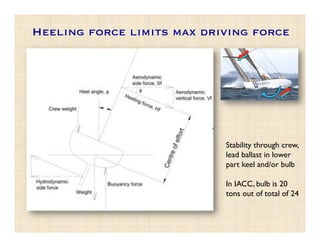
Heeling force limits max driving force 


      Vertical plane
                            aerodynamic
                            side foce
               heel angle

           crew
           weight

                                          Stability through crew,!
                                          lead ballast in lower!
                                          part keel and/or bulb!
                                          !
                                          In IACC, bulb is 20!
  hydrodynamic        buoyancy force
               weight
                                          tons out of total of 24!
  side force
Forces on rig and hull !


           Side view!      Front view!
Lowest vertical stays   !20 tons!
!
Diagonal stays !        !5 tons!
!
Compression mast        !45 tons!
!
Velocity Prediction Program (VPP)
Optimize Sails for Different Wind
Conditions
     Upwind     !     !Reaching   !   Fully downwind!


     Yacht!


  True!   Apparent!
Creating driving force
               Apparent!


   Lift = drive + heel!    Drag = drive!
   !
2D flow already challenging
3D adds a Literal Twist
Angle and strength apparent wind varies with height!

                       UT
                                    Twisted onset flow!
           US     UA
                                    Sails twisted!
                                    (to operate close to ideal angle)!
                                    !
                                    !
Wind tunnels in sail design
University of Auckland !
Twisted Flow Wind Tunnel!
CFD only option for upwind analysis


Flat sail (small camber)!

Possibly TE separation, LE bubble (re-attached)!

!

For AC upwind main+genoa!

•    Re O(106), L/D approximately 8-9!

•    Pressure drag approximately 10% of sail drag!
•    Induced drag up to 15% of total drag (high roach)!
Resolve Turbulent Flow Features


                             > ideal (22º)
                           Ideal angle (18º)
                              > ideal (26º)!


 Choice turbulence models non-trivial when separated!
Downwind CFD in Early Stage

Wind tunnel tests lead to 15% efficiency gain !
What improvement can we get with CFD?!
!


AC genneker operates at maximum lift (high-lift foil)!
Apparent Wind Angle 25°!
SST model!
3D Modeling Still Just a Flirt
3D Lamination (3DL)!
Sandwich of polyester film / kevlar yarns / polyester film!
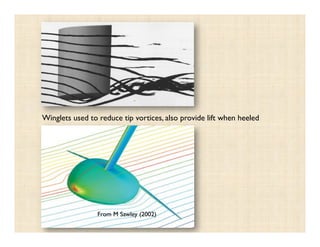
Winglets used to reduce tip vortices, also provide lift when heeled!


                 From M Sawley (2002)!
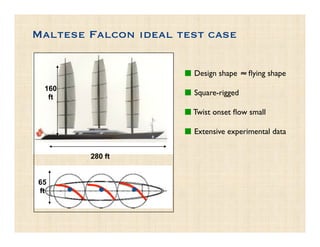
Maltese Falcon ideal test case

                      !
                            Design shape   ≈ flying shape !
 160
                            Square-rigged!
  ft

                           Twist onset flow small!

                            Extensive experimental data!

                      !
        280 ft


65
ft
Drive/heel leads to more open
              arrangement
                                            over-trimmed!
                                         leeward telltale lifting!
drive!


                                drive!
drive/heel!


                                drive/heel!
                  AWA 30!
                                                well-trimmed!
                                         telltales streaming back!

Some Mathematics of Sailing: Margot Gerritsen

  • 1.
    Some Mathematics ofSailing Margot Gerritsen Stanford Yacht Research Institute for Computational & Mathematical Engineering
  • 2.
  • 3.
    161 Year OldTradition 1851 ! ! Royal Yacht Squadron gives cup for Isle of Wight race! ! ! Won by schooner America, donated to New York Yacht Club!! ! ! ! ! ! Deed of Gift: cup for perpetual international competition! till 1970 !Twenty successful defenses with always just one challenger! ! 1970 ! !Challenger selection series starts – the Louis Vuitton Cup! ! 1983 ! !Royal Perth Yacht Club steals trophy from NYYC (finally!)! ! 1987 ! !Dennis Connor (USA) takes revenge in Stars & Stripes in Perth! ! 1988 ! ! Surprise challenge by New Zealand (KZ1 90 ft "big boat")! ! ! Connor won with 45 ft cat. ! !
  • 4.
    ! ! ! !! 1992 ! !US successfully defends Cup in San Diego! ! 1995 ! !Team New Zealand sails to victory in San Diego! ! 2000 ! !Team New Zealand beats Italian challenger Prada! ! 2003 ! !Swiss challenger Alinghi beats Team New Zealand in Auckland! ! 2007 ! !Alinghi beats challenger Team New Zealand in Valencia! ! 2008-9! ! Team Oracle wins court case for rightful AC challenge! ! ! (Battle of the Billionaires Ellison and Bertarelli)! ! ! ! 2010 ! !Oracle beats Alinghi in Valencia!
  • 5.
    115ft long! ! Swiss Alinghiskipper! Brad Butterworth! ! USA Oracle skipper! Jimmy Spithill! Captain Russell Coutts! ! ! Oracle easily beats Alinghi with metallic wing rather than traditional sail! ! ! ! !
  • 6.
    America’s Cup WorldSeries AC45 Wingsail catamaran by! Mike Drummond/Oracle ! honeycombcore/carbonfiber! 44 ft; 2850 lb; 70 ft heigh! ! !
  • 7.
    2013 America’s Cup(number 34) America’s Cup World Series ! Regular circuit of regattas with fleet and match racing in each event! 2011-2012 !completed! 2012-2013 !San Francisco, Aug 21-26 and Oct 2-7, 2012! ! ! !Venice, April 16-21, 2013! ! ! !Naples, May 14-19, 2013! ! ! !! ! Louis Vuitton Cup !San Francisco, July 4 – Sept 1, 2013! ! America’s Cup Finals !San Francisco, Sept 7 – 22, 2013! !
  • 8.
  • 9.
    Team New Zealand AC72Unveiled 72 ft length at waterline! 86 ft length overall! 131 ft heigh mast! 13,000 lb! 11 person crew!
  • 10.
  • 11.
    Typically *very* closeraces Time! Delta in ! Min:sec! seconds! Start! 0! 1! 26:11! 12! 2! 24:14! -34! 3! 26:37! -26! 4! 22:43! -14! Three upwind, three downwind legs! 5! 27:33! -26! Each 3 nautical miles! ! finish! 25:43! 7!
  • 12.
    How to MaximizePerformance? Can Mathematics Help? Balance forces and moments and maintain stability! Make sure structural design limits are met! Respect any race and design rules ! Take into account uncertainty in wind, waves and crew handling! ! !! A *very* complex engineering problem!!! !
  • 13.
    The Main DesignRule in 2000/2003 ( length + 1.25 x (sail area)1/2 – 9.8 x (displacement)1/3 ) / 0.679 = 24! The international America’s Cup Class Rule! ! Originally hoped to introduce difference designs! ! ! But, two typical designs:! ! Length overall !82 ft ! !79.5 ft! Beam ! !14.1 ! !13.3 ft! Sail area! !3600 sq ft !3600 sq ft! ! !
  • 14.
  • 15.
    Heeling force limitsmax driving force Vertical plane aerodynamic side foce heel angle crew weight Stability through crew,! lead ballast in lower! part keel and/or bulb! ! In IACC, bulb is 20! hydrodynamic buoyancy force weight tons out of total of 24! side force
  • 16.
    Forces on rigand hull ! Side view! Front view!
  • 17.
    Lowest vertical stays !20 tons! ! Diagonal stays ! !5 tons! ! Compression mast !45 tons! !
  • 18.
  • 19.
    Optimize Sails forDifferent Wind Conditions Upwind ! !Reaching ! Fully downwind! Yacht! True! Apparent!
  • 20.
    Creating driving force Apparent! Lift = drive + heel! Drag = drive! !
  • 21.
    2D flow alreadychallenging
  • 22.
    3D adds aLiteral Twist Angle and strength apparent wind varies with height! UT Twisted onset flow! US UA Sails twisted! (to operate close to ideal angle)! ! !
  • 23.
    Wind tunnels insail design University of Auckland ! Twisted Flow Wind Tunnel!
  • 24.
    CFD only optionfor upwind analysis Flat sail (small camber)! Possibly TE separation, LE bubble (re-attached)! ! For AC upwind main+genoa! •  Re O(106), L/D approximately 8-9! •  Pressure drag approximately 10% of sail drag! •  Induced drag up to 15% of total drag (high roach)!
  • 25.
    Resolve Turbulent FlowFeatures > ideal (22º) Ideal angle (18º) > ideal (26º)! Choice turbulence models non-trivial when separated!
  • 26.
    Downwind CFD inEarly Stage Wind tunnel tests lead to 15% efficiency gain ! What improvement can we get with CFD?! ! AC genneker operates at maximum lift (high-lift foil)!
  • 27.
    Apparent Wind Angle25°! SST model!
  • 28.
    3D Modeling StillJust a Flirt
  • 29.
    3D Lamination (3DL)! Sandwichof polyester film / kevlar yarns / polyester film!
  • 30.
    Winglets used toreduce tip vortices, also provide lift when heeled! From M Sawley (2002)!
  • 32.
    Maltese Falcon idealtest case !   Design shape ≈ flying shape ! 160   Square-rigged! ft  Twist onset flow small!   Extensive experimental data! ! 280 ft 65 ft
  • 33.
    Drive/heel leads tomore open arrangement over-trimmed! leeward telltale lifting! drive! drive! drive/heel! drive/heel! AWA 30! well-trimmed! telltales streaming back!