E-CONTENT ANALYSIS ON ELECTROMAGNETIC INDUCTION 
HOME 
1. www.electromagneticinduction /electronics tutorials 
2. www.allabout circutes.com-magnetism 
3. www.electrical 4u.com/faraday law of electromagnetic induction 
OBJECTIVE 
 To know the technological aspect of education 
 To identify different home address 
 To develop the knowledge of electromagnetic induction 
 To identify different terms related to the concept 
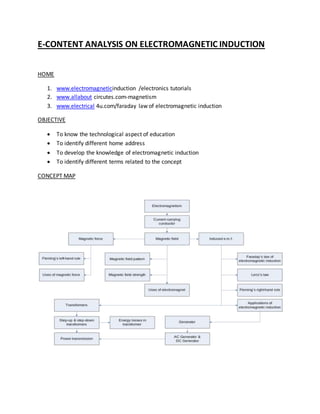
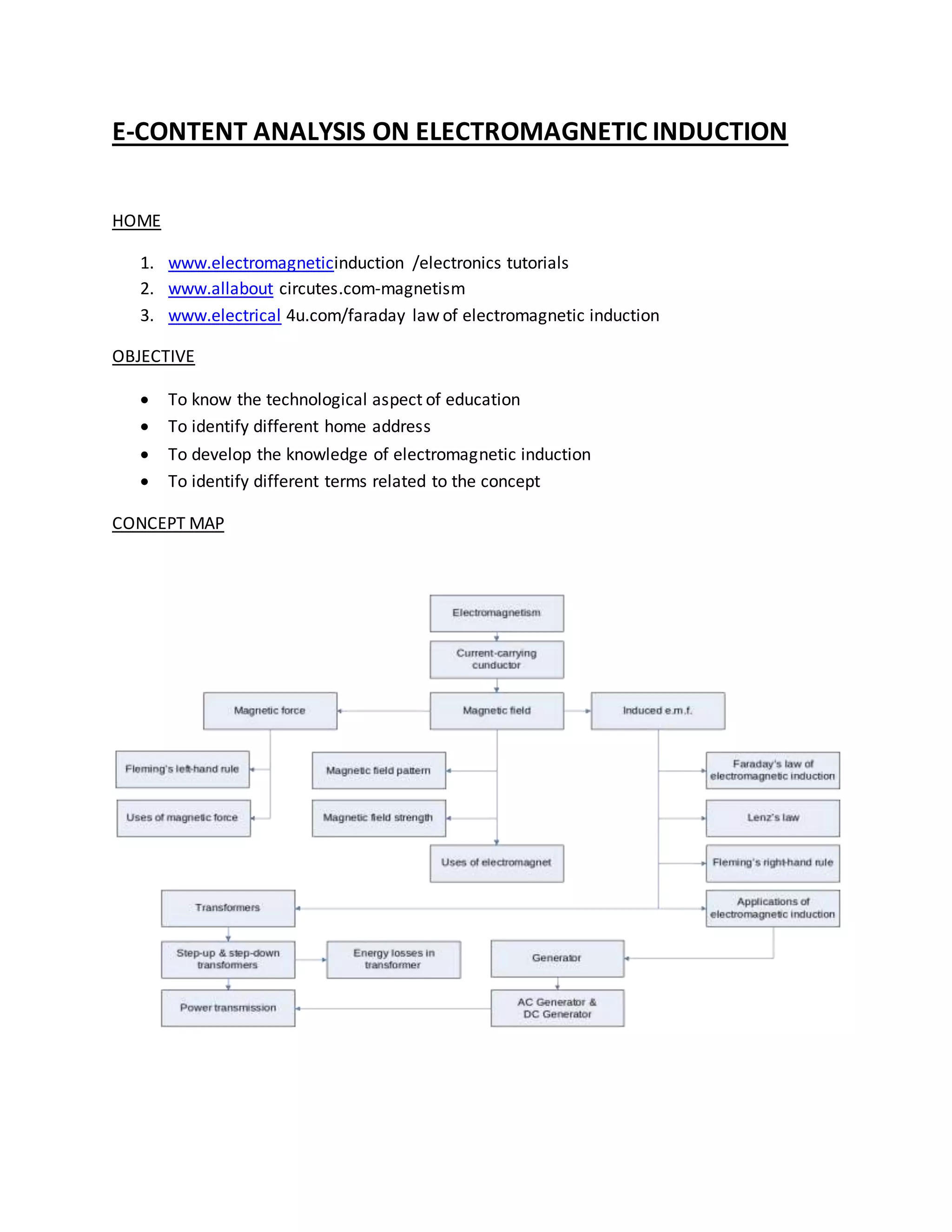
CONCEPT MAP
TERMS 
Electromagnetic induction, induced emf , alternating current, direct current, electric generator, 
self induction , mutual induction , magnetic flux 
FACTS 
 Magnetic flux is the product of the magnetic field and the area through which the 
magnetic field passes 
 Electromagnetic induction is the principle behind the electric generator 
 Electromotive force across a conductor when it is exposed to a varying magnetic field 
 Electromagnetic induction was discovered independently by Michel faraday and Joseph 
Henry in 1831 
 Electromagnetic induction is described mathematically by Faraday’s law of induction 
CONCEPT 
 Electromagnetic induction is the process by which an emf is produced in a wire by a 
changing magnetic flux 
 Alternating current is the electric current that rapidly reverses its direction 
 Induced current is the current produced by electromagnetic induction 
 Induced emf is the voltage produced by the electromagnetic induction 
 Magnetic flux it is the product of the magnetic field and the area through which the 
magnetic field lines pass 
 Electromagnetic induction is the production of an electro motive force across a 
conductor when it is exposed to a varying magnetic field 
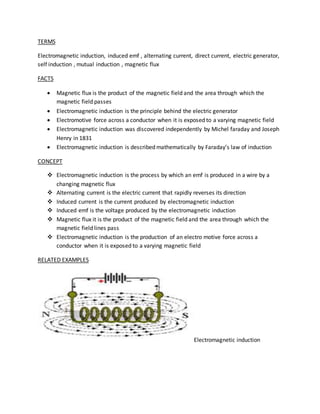
RELATED EXAMPLES 
Electromagnetic induction
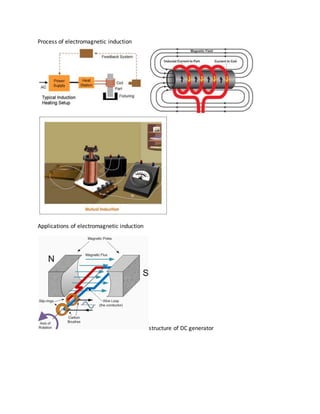
Process of electromagnetic induction 
Applications of electromagnetic induction 
structure of DC generator
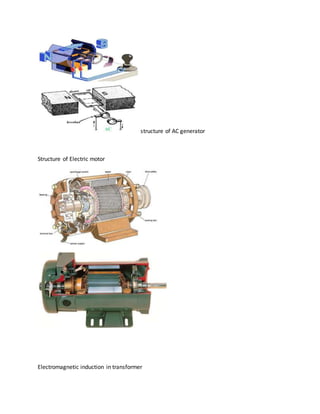
structure of AC generator 
Structure of Electric motor 
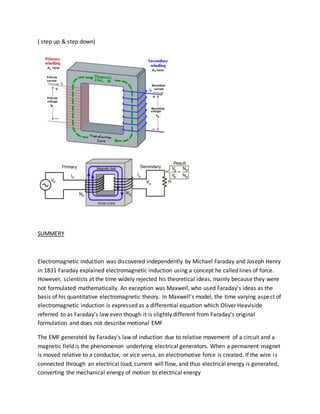
Electromagnetic induction in transformer
( step up & step down) 
SUMMERY 
Electromagnetic induction was discovered independently by Michael Faraday and Joseph Henry 
in 1831 Faraday explained electromagnetic induction using a concept he called lines of force. 
However, scientists at the time widely rejected his theoretical ideas, mainly because they were 
not formulated mathematically. An exception was Maxwell, who used Faraday's ideas as the 
basis of his quantitative electromagnetic theory. In Maxwell's model, the time varying aspect of 
electromagnetic induction is expressed as a differential equation which Oliver Heaviside 
referred to as Faraday's law even though it is slightly different from Faraday's original 
formulation and does not describe motional EMF 
The EMF generated by Faraday's law of induction due to relative movement of a circuit and a 
magnetic field is the phenomenon underlying electrical generators. When a permanent magnet 
is moved relative to a conductor, or vice versa, an electromotive force is created. If the wire i s 
connected through an electrical load, current will flow, and thus electrical energy is generated, 
converting the mechanical energy of motion to electrical energy

E contend

  • 1.
    E-CONTENT ANALYSIS ONELECTROMAGNETIC INDUCTION HOME 1. www.electromagneticinduction /electronics tutorials 2. www.allabout circutes.com-magnetism 3. www.electrical 4u.com/faraday law of electromagnetic induction OBJECTIVE  To know the technological aspect of education  To identify different home address  To develop the knowledge of electromagnetic induction  To identify different terms related to the concept CONCEPT MAP
  • 2.
    TERMS Electromagnetic induction,induced emf , alternating current, direct current, electric generator, self induction , mutual induction , magnetic flux FACTS  Magnetic flux is the product of the magnetic field and the area through which the magnetic field passes  Electromagnetic induction is the principle behind the electric generator  Electromotive force across a conductor when it is exposed to a varying magnetic field  Electromagnetic induction was discovered independently by Michel faraday and Joseph Henry in 1831  Electromagnetic induction is described mathematically by Faraday’s law of induction CONCEPT  Electromagnetic induction is the process by which an emf is produced in a wire by a changing magnetic flux  Alternating current is the electric current that rapidly reverses its direction  Induced current is the current produced by electromagnetic induction  Induced emf is the voltage produced by the electromagnetic induction  Magnetic flux it is the product of the magnetic field and the area through which the magnetic field lines pass  Electromagnetic induction is the production of an electro motive force across a conductor when it is exposed to a varying magnetic field RELATED EXAMPLES Electromagnetic induction
  • 3.
    Process of electromagneticinduction Applications of electromagnetic induction structure of DC generator
  • 4.
    structure of ACgenerator Structure of Electric motor Electromagnetic induction in transformer
  • 5.
    ( step up& step down) SUMMERY Electromagnetic induction was discovered independently by Michael Faraday and Joseph Henry in 1831 Faraday explained electromagnetic induction using a concept he called lines of force. However, scientists at the time widely rejected his theoretical ideas, mainly because they were not formulated mathematically. An exception was Maxwell, who used Faraday's ideas as the basis of his quantitative electromagnetic theory. In Maxwell's model, the time varying aspect of electromagnetic induction is expressed as a differential equation which Oliver Heaviside referred to as Faraday's law even though it is slightly different from Faraday's original formulation and does not describe motional EMF The EMF generated by Faraday's law of induction due to relative movement of a circuit and a magnetic field is the phenomenon underlying electrical generators. When a permanent magnet is moved relative to a conductor, or vice versa, an electromotive force is created. If the wire i s connected through an electrical load, current will flow, and thus electrical energy is generated, converting the mechanical energy of motion to electrical energy