Force
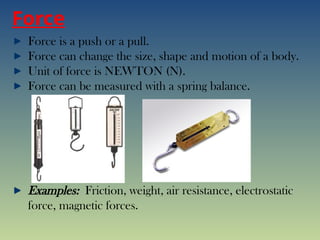
Force is a push or a pull.
Force can change the size, shape and motion of a body.
Unit of force is NEWTON (N).
Force can be measured with a spring balance.
Examples: Friction, weight, air resistance, electrostatic
force, magnetic forces.
Balanced forces
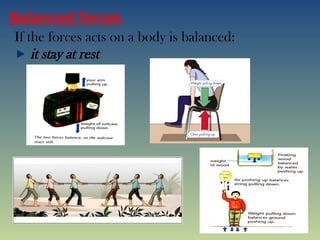
If the forces acts on a body is balanced:
it stay at rest
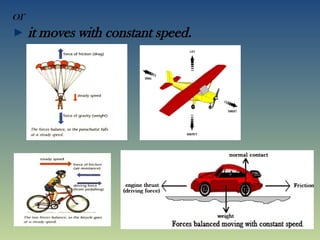
or
it moves with constant speed.
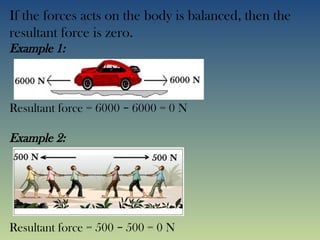
If the forces acts on the body is balanced, then the
resultant force is zero.
Example 1:
Resultant force = 6000 − 6000 = 0 N
Example 2:
Resultant force = 500 − 500 = 0 N
Newton’s first law of motion
If the forces acting on a body is balanced, then
If it is at rest, it will continue to stay at rest.
If it is moving, it will keep on moving at a constant
speed in a straight line.
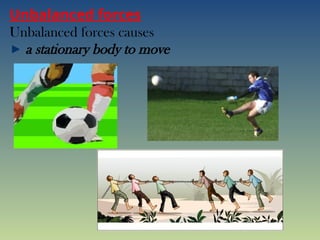
Unbalanced forces
Unbalanced forces causes
a stationary body to move
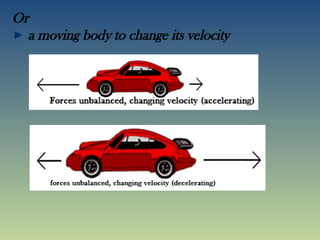
Or
a moving body to change its velocity
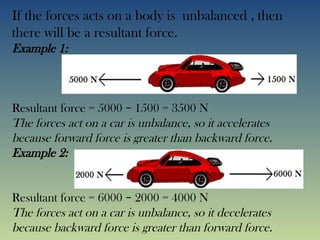
If the forces acts on a body is unbalanced , then
there will be a resultant force.
Example 1:
Resultant force = 5000 − 1500 = 3500 N
The forces act on a car is unbalance, so it accelerates
because forward force is greater than backward force.
Example 2:
Resultant force = 6000 − 2000 = 4000 N
The forces act on a car is unbalance, so it decelerates
because backward force is greater than forward force.
Newton’s second law of motion
The acceleration of the body is directly proportional to the
direction of force applied and inversely proportional to the
mass of the body.
The greater the mass of an object, the smaller acceleration it is
given by a particular force.
The force, mass and acceleration can be combined into
the following equation:
Force = mass × acceleration
F = ma
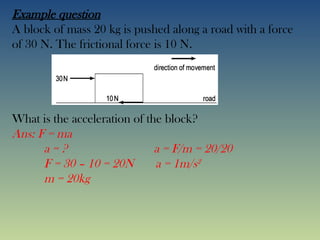
Example question
A block of mass 20 kg is pushed along a road with a force
of 30 N. The frictional force is 10 N.
What is the acceleration of the block?
Ans: F = ma
a = ? a = F/m = 20/20
F = 30 – 10 = 20N a = 1m/s2
m = 20kg
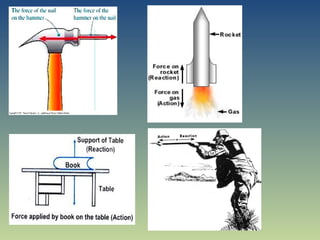
Newton’s third law of motion
To every action there is an equal but opposite
reaction.
i.e. If object A exerts a force on object B (action),
then object B will exert an equal but opposite force
on object A (reaction).
Examples: firing gun, hammering a nail, book kept
on a table and launching rocket.
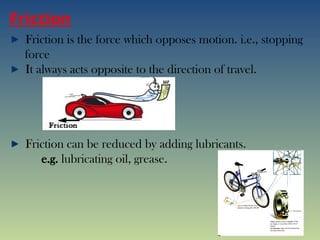
Friction
Friction is the force which opposes motion. i.e., stopping
force
It always acts opposite to the direction of travel.
Friction can be reduced by adding lubricants.
e.g. lubricating oil, grease.
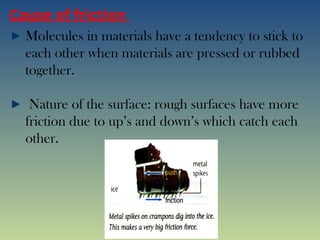
Cause of friction
Molecules in materials have a tendency to stick to
each other when materials are pressed or rubbed
together.
Nature of the surface: rough surfaces have more
friction due to up’s and down’s which catch each
other.
Advantages of friction
Friction helps us to walk
Friction helps us to hold the objects
Friction helps us to stop a moving object.
Disadvantages of friction
Machine parts rub together and become lose
Shoes and clothes wear and tear
It heats up the moving parts and some energy is
wasted in the form of heat.
Effects of friction on the motion of a
vehicle
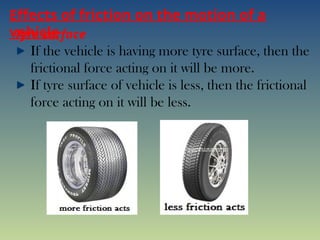
Tyre surface
If the vehicle is having more tyre surface, then the
frictional force acting on it will be more.
If tyre surface of vehicle is less, then the frictional
force acting on it will be less.
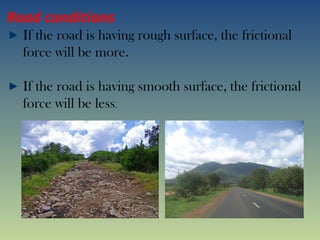
Road conditions
If the road is having rough surface, the frictional
force will be more.
If the road is having smooth surface, the frictional
force will be less.
Thinking distance (How far object travels just before
brake applied.)
If the vehicle is having more tyre surface, thinking
distance will be less.
If the vehicle is having less tyre surface, thinking distance
will be more.
If the road is having rough surface, thinking distance will
less.
If the road is having smooth surface, thinking distance
will be more.
If the vehicle has more mass or loaded, thinking distance
will be more.
If the vehicle has less mass, thinking distance will be less.
If the vehicle travels with high speed, thinking distance
will be more.
Braking distance (How far object travels after brake
applied.)
If the vehicle is having more tyre surface, braking distance
will be less.
If the vehicle is having less tyre surface, braking distance
will be more.
If the road is having rough surface, braking distance will
less.
If the road is having smooth surface, braking distance will
be more
If the vehicle has more mass or loaded, braking distance
will be more.
If the vehicle has less mass, braking distance will be less.
If the vehicle travels with high speed, braking distance will
be more.
Braking force (It is the amount of force applied to stop the
object.)
If the vehicle is having more tyre surface, we have to apply less
braking force to stop the vehicle.
If the vehicle is having less tyre surface, we have to apply more
braking force to stop the vehicle.
If the road is having rough surface, we have to apply less braking
force to stop the vehicle.
If the road is having smooth surface, we have to apply more braking
force to stop the vehicle.
If the vehicle has more mass or loaded, we have to apply more
braking force to stop the vehicle.
If the vehicle has less mass, we have to apply less braking force to
stop the vehicle.
If the vehicle travels with high speed, we have to apply more braking
force to stop the vehicle.
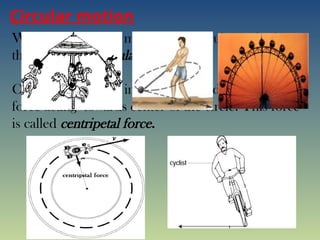
Circular motion
When any object is moving in a circular path, then
the object is in circular motion.
Objects are moving in circular path due to constant
force acting towards center of the circle. This force
is called centripetal force.
The centripetal force will increase:
If the mass of the object increased
If the speed of the object increased
If the radius of the circle reduced.
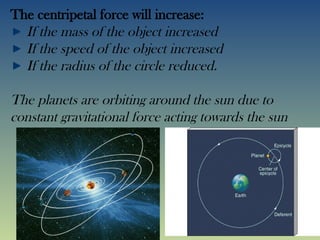
The planets are orbiting around the sun due to
constant gravitational force acting towards the sun
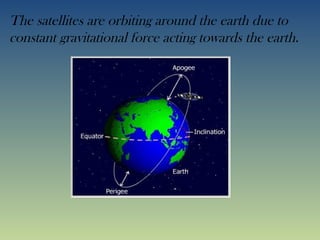
The satellites are orbiting around the earth due to
constant gravitational force acting towards the earth.
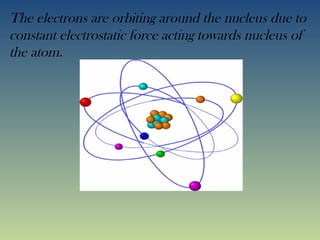
The electrons are orbiting around the nucleus due to
constant electrostatic force acting towards nucleus of
the atom.

Dynamics, Physics IGCSE slides for teaching

  • 2.
    Force Force is apush or a pull. Force can change the size, shape and motion of a body. Unit of force is NEWTON (N). Force can be measured with a spring balance. Examples: Friction, weight, air resistance, electrostatic force, magnetic forces.
  • 3.
    Balanced forces If theforces acts on a body is balanced: it stay at rest
  • 4.
    or it moves withconstant speed.
  • 5.
    If the forcesacts on the body is balanced, then the resultant force is zero. Example 1: Resultant force = 6000 − 6000 = 0 N Example 2: Resultant force = 500 − 500 = 0 N
  • 6.
    Newton’s first lawof motion If the forces acting on a body is balanced, then If it is at rest, it will continue to stay at rest. If it is moving, it will keep on moving at a constant speed in a straight line.
  • 7.
    Unbalanced forces Unbalanced forcescauses a stationary body to move
  • 8.
    Or a moving bodyto change its velocity
  • 9.
    If the forcesacts on a body is unbalanced , then there will be a resultant force. Example 1: Resultant force = 5000 − 1500 = 3500 N The forces act on a car is unbalance, so it accelerates because forward force is greater than backward force. Example 2: Resultant force = 6000 − 2000 = 4000 N The forces act on a car is unbalance, so it decelerates because backward force is greater than forward force.
  • 10.
    Newton’s second lawof motion The acceleration of the body is directly proportional to the direction of force applied and inversely proportional to the mass of the body. The greater the mass of an object, the smaller acceleration it is given by a particular force. The force, mass and acceleration can be combined into the following equation: Force = mass × acceleration F = ma
  • 11.
    Example question A blockof mass 20 kg is pushed along a road with a force of 30 N. The frictional force is 10 N. What is the acceleration of the block? Ans: F = ma a = ? a = F/m = 20/20 F = 30 – 10 = 20N a = 1m/s2 m = 20kg
  • 12.
    Newton’s third lawof motion To every action there is an equal but opposite reaction. i.e. If object A exerts a force on object B (action), then object B will exert an equal but opposite force on object A (reaction). Examples: firing gun, hammering a nail, book kept on a table and launching rocket.
  • 14.
    Friction Friction is theforce which opposes motion. i.e., stopping force It always acts opposite to the direction of travel. Friction can be reduced by adding lubricants. e.g. lubricating oil, grease.
  • 15.
    Cause of friction Moleculesin materials have a tendency to stick to each other when materials are pressed or rubbed together. Nature of the surface: rough surfaces have more friction due to up’s and down’s which catch each other.
  • 16.
    Advantages of friction Frictionhelps us to walk Friction helps us to hold the objects Friction helps us to stop a moving object. Disadvantages of friction Machine parts rub together and become lose Shoes and clothes wear and tear It heats up the moving parts and some energy is wasted in the form of heat.
  • 17.
    Effects of frictionon the motion of a vehicle Tyre surface If the vehicle is having more tyre surface, then the frictional force acting on it will be more. If tyre surface of vehicle is less, then the frictional force acting on it will be less.
  • 18.
    Road conditions If theroad is having rough surface, the frictional force will be more. If the road is having smooth surface, the frictional force will be less.
  • 19.
    Thinking distance (Howfar object travels just before brake applied.) If the vehicle is having more tyre surface, thinking distance will be less. If the vehicle is having less tyre surface, thinking distance will be more. If the road is having rough surface, thinking distance will less. If the road is having smooth surface, thinking distance will be more. If the vehicle has more mass or loaded, thinking distance will be more. If the vehicle has less mass, thinking distance will be less. If the vehicle travels with high speed, thinking distance will be more.
  • 20.
    Braking distance (Howfar object travels after brake applied.) If the vehicle is having more tyre surface, braking distance will be less. If the vehicle is having less tyre surface, braking distance will be more. If the road is having rough surface, braking distance will less. If the road is having smooth surface, braking distance will be more If the vehicle has more mass or loaded, braking distance will be more. If the vehicle has less mass, braking distance will be less. If the vehicle travels with high speed, braking distance will be more.
  • 21.
    Braking force (Itis the amount of force applied to stop the object.) If the vehicle is having more tyre surface, we have to apply less braking force to stop the vehicle. If the vehicle is having less tyre surface, we have to apply more braking force to stop the vehicle. If the road is having rough surface, we have to apply less braking force to stop the vehicle. If the road is having smooth surface, we have to apply more braking force to stop the vehicle. If the vehicle has more mass or loaded, we have to apply more braking force to stop the vehicle. If the vehicle has less mass, we have to apply less braking force to stop the vehicle. If the vehicle travels with high speed, we have to apply more braking force to stop the vehicle.
  • 22.
    Circular motion When anyobject is moving in a circular path, then the object is in circular motion. Objects are moving in circular path due to constant force acting towards center of the circle. This force is called centripetal force.
  • 23.
    The centripetal forcewill increase: If the mass of the object increased If the speed of the object increased If the radius of the circle reduced. The planets are orbiting around the sun due to constant gravitational force acting towards the sun
  • 24.
    The satellites areorbiting around the earth due to constant gravitational force acting towards the earth.
  • 25.
    The electrons areorbiting around the nucleus due to constant electrostatic force acting towards nucleus of the atom.