

Dynamic System
Development Method.
BS, Nisak
Ahamed
HND in CSD :-
Contents
 Introduction of DSDM
 Principles of DSDM
 Process overview
 Process lifecycle
 Techniques of DSDM
 Roles of DSDM
 When to use DSDM
 Advantages and Disadvantages of DSDM
 Conclusion
 References
Introduction of
DSDM
 The Dynamic Systems Development Method
(DSDM) is a framework of controls for the
development of Computer-based systems.
 A RAD approach to software development.
 Iterative and Incremental
 It is independent of any particular set of tools
and techniques.
 It can be applied to Information Systems
Development projects of any size.
 It is especially good for Information Systems
Development projects with very short
Principles of DSDM
1. Active user involvement.
2. Teams must be empowered to make their
own decisions.
3. Frequent releases more important than
maximizing quality.
4. Primary criteria for deliverables is meeting
business needs.
5. Iterative development is essential to reach
correct solution.
6. Any change during development can be
reversed.
Process
overview
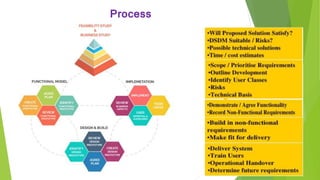
 Feasibility study
 Business study
 Functional model iteration
 Design and build iteration
 Implementation
Process
lifecycle
Techniques of
DSDM
 Prototyping
 Testing
 Modeling
 Configuration Management
 Workshops
 Time boxing
Roles
 Executive Sponsor
 Ambassador User
 Project Manager
 Technical Coordinator
 Team Leader
 Developer
 Tester
Role
Details
 Executive Sponsor
 Commits funding
 Final say in decision making
 Visionary
 Maximum knowledge and view
 Supervising project direction
When to use
DSDM
 Inappropriate projects
 real time
 safety critical
 have well defined requirements
 have no fixed end date
 re-usable components
 Appropriate projects
 Prioritisable requirements
 fixed end date
 cleared defined users
 can be broken down
Advantage
s
 Users are highly involved in the development
of the system.
 In this model basic functionality is delivered
quickly, with more functionality being delivered
at frequent intervals.
 This method provides an easy access by
developers to end-users.
 In this kind of development approach projects
are delivered on time and within a specific
budget.
Disadvantage
s
 The first thing is DSDM is costly to
implement.
 As it requires users and developers both to
be trained to employ it effectively.
 It may not be suitable for small organizations
or one time projects.
Conclusi
on
 DSDM is a one of the software creating
model.
 Can use any type and any size of systems.
 Each method is described in terms of
process, roles, responsibilities, practices,
adoption and experiences.
 Enables a selection criteria for comparing
methods and pointing out their differences.
Referenc
es
 [1] DSDM Public Version 4.2 Manual. (n.d.). DSDM
Consortium - Enabling Business Agility. Retrieved
March 24, 2010, from
http://www.dsdm.org/version4/2/public/default.asp
 [2] What Is DSDM? - CodeProject. (n.d.). Your
Development Resource - CodeProject. Retrieved
March 24, 2010, from http://www.codeproject.com/KB/
 [3] Davies, R. (2004, September 21). DSDN
Explained. Agile eXperience. Retrieved March 24,
2010, from
www.agilexp.com/presentations/DSDMexplained.pdf
 [4] Dynamic Systems Development Method -
Wikipedia, the free encyclopedia. (n.d.). Wikipedia,
Thanks for your watching
my presentation

Dynamic system development method

  • 1.
    Dynamic System Development Method. BS,Nisak Ahamed HND in CSD :-
  • 2.
    Contents  Introduction ofDSDM  Principles of DSDM  Process overview  Process lifecycle  Techniques of DSDM  Roles of DSDM  When to use DSDM  Advantages and Disadvantages of DSDM  Conclusion  References
  • 3.
    Introduction of DSDM  TheDynamic Systems Development Method (DSDM) is a framework of controls for the development of Computer-based systems.  A RAD approach to software development.  Iterative and Incremental  It is independent of any particular set of tools and techniques.  It can be applied to Information Systems Development projects of any size.  It is especially good for Information Systems Development projects with very short
  • 4.
    Principles of DSDM 1.Active user involvement. 2. Teams must be empowered to make their own decisions. 3. Frequent releases more important than maximizing quality. 4. Primary criteria for deliverables is meeting business needs. 5. Iterative development is essential to reach correct solution. 6. Any change during development can be reversed.
  • 5.
    Process overview  Feasibility study Business study  Functional model iteration  Design and build iteration  Implementation
  • 6.
  • 7.
    Techniques of DSDM  Prototyping Testing  Modeling  Configuration Management  Workshops  Time boxing
  • 8.
    Roles  Executive Sponsor Ambassador User  Project Manager  Technical Coordinator  Team Leader  Developer  Tester
  • 9.
    Role Details  Executive Sponsor Commits funding  Final say in decision making  Visionary  Maximum knowledge and view  Supervising project direction
  • 10.
    When to use DSDM Inappropriate projects  real time  safety critical  have well defined requirements  have no fixed end date  re-usable components  Appropriate projects  Prioritisable requirements  fixed end date  cleared defined users  can be broken down
  • 11.
    Advantage s  Users arehighly involved in the development of the system.  In this model basic functionality is delivered quickly, with more functionality being delivered at frequent intervals.  This method provides an easy access by developers to end-users.  In this kind of development approach projects are delivered on time and within a specific budget.
  • 12.
    Disadvantage s  The firstthing is DSDM is costly to implement.  As it requires users and developers both to be trained to employ it effectively.  It may not be suitable for small organizations or one time projects.
  • 13.
    Conclusi on  DSDM isa one of the software creating model.  Can use any type and any size of systems.  Each method is described in terms of process, roles, responsibilities, practices, adoption and experiences.  Enables a selection criteria for comparing methods and pointing out their differences.
  • 14.
    Referenc es  [1] DSDMPublic Version 4.2 Manual. (n.d.). DSDM Consortium - Enabling Business Agility. Retrieved March 24, 2010, from http://www.dsdm.org/version4/2/public/default.asp  [2] What Is DSDM? - CodeProject. (n.d.). Your Development Resource - CodeProject. Retrieved March 24, 2010, from http://www.codeproject.com/KB/  [3] Davies, R. (2004, September 21). DSDN Explained. Agile eXperience. Retrieved March 24, 2010, from www.agilexp.com/presentations/DSDMexplained.pdf  [4] Dynamic Systems Development Method - Wikipedia, the free encyclopedia. (n.d.). Wikipedia,
  • 15.
    Thanks for yourwatching my presentation

Editor's Notes

  • #4 It is used on Software or System development method. It is first released in 1994