• Federal law passed by Congress in 1996
• Regulations promulgated by the Dept of Health
  and Human Services
• Guidelines implemented in April, 2003
HIPAA regulations were designed to:
1) protect individuals’ rights to privacy and
   confidentiality
2) assure the security of electronic transfer of
   personal information
Health information is used by multiple agents in the
course of a single episode with a health problem.
Below are some of the agencies and individuals who
may handle health information. This is not all
inclusive:
• Admitting clerks          • Transport techs
• Caregivers from the       • Respiratory therapists
  ED to the morgue          • Billing clerks
• Physical therapists       • Insurance agents/clerks
• Nutritionists             • School teachers/nurses
• Lab personnel             • Home health personnel
• Receptionists in          • Medical records clerks
  MD offices                • Website managers
Objectives
 After completing this program you will be able to:
    Discuss the general concepts of HIPAA guidelines
    Adapt HIPAA guidelines for the various settings in
       which you might practice
      Discuss the seven patient/client rights regarding
       his/her health information
      Differentiate individuals who have a ‘need to know’
       from those who don’t. This determines those with
       whom you can discuss protected health information
      Discuss application of HIPAA to the student role
      List legal and professionalconsequences of violating
       HIPAA rules
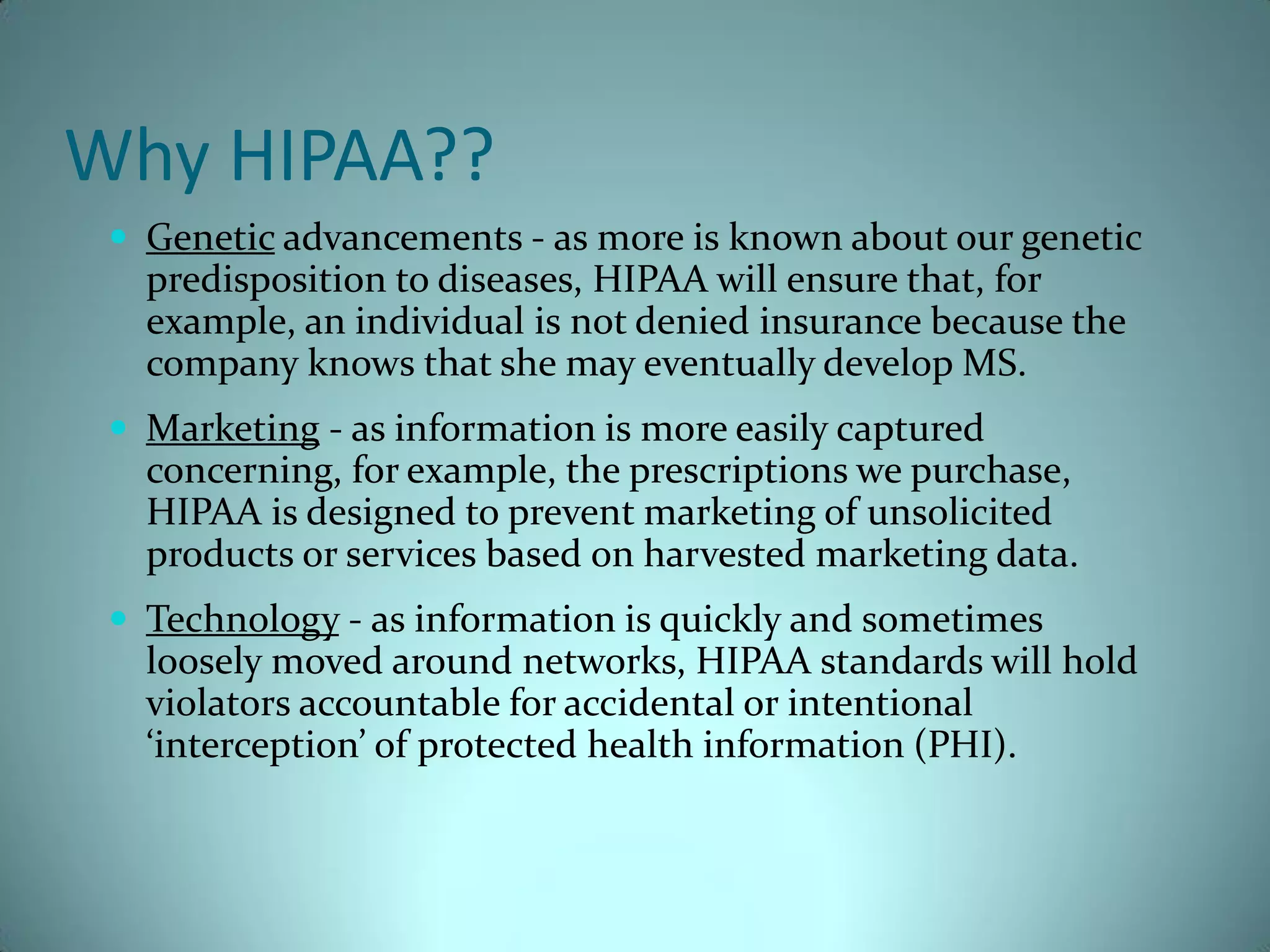
Why HIPAA??
  Genetic advancements - as more is known about our genetic
   predisposition to diseases, HIPAA will ensure that, for
   example, an individual is not denied insurance because the
   company knows that she may eventually develop MS.
  Marketing - as information is more easily captured
   concerning, for example, the prescriptions we purchase,
   HIPAA is designed to prevent marketing of unsolicited
   products or services based on harvested marketing data.
  Technology - as information is quickly and sometimes
   loosely moved around networks, HIPAA standards will hold
   violators accountable for accidental or intentional
   ‘interception’ of protected health information (PHI).
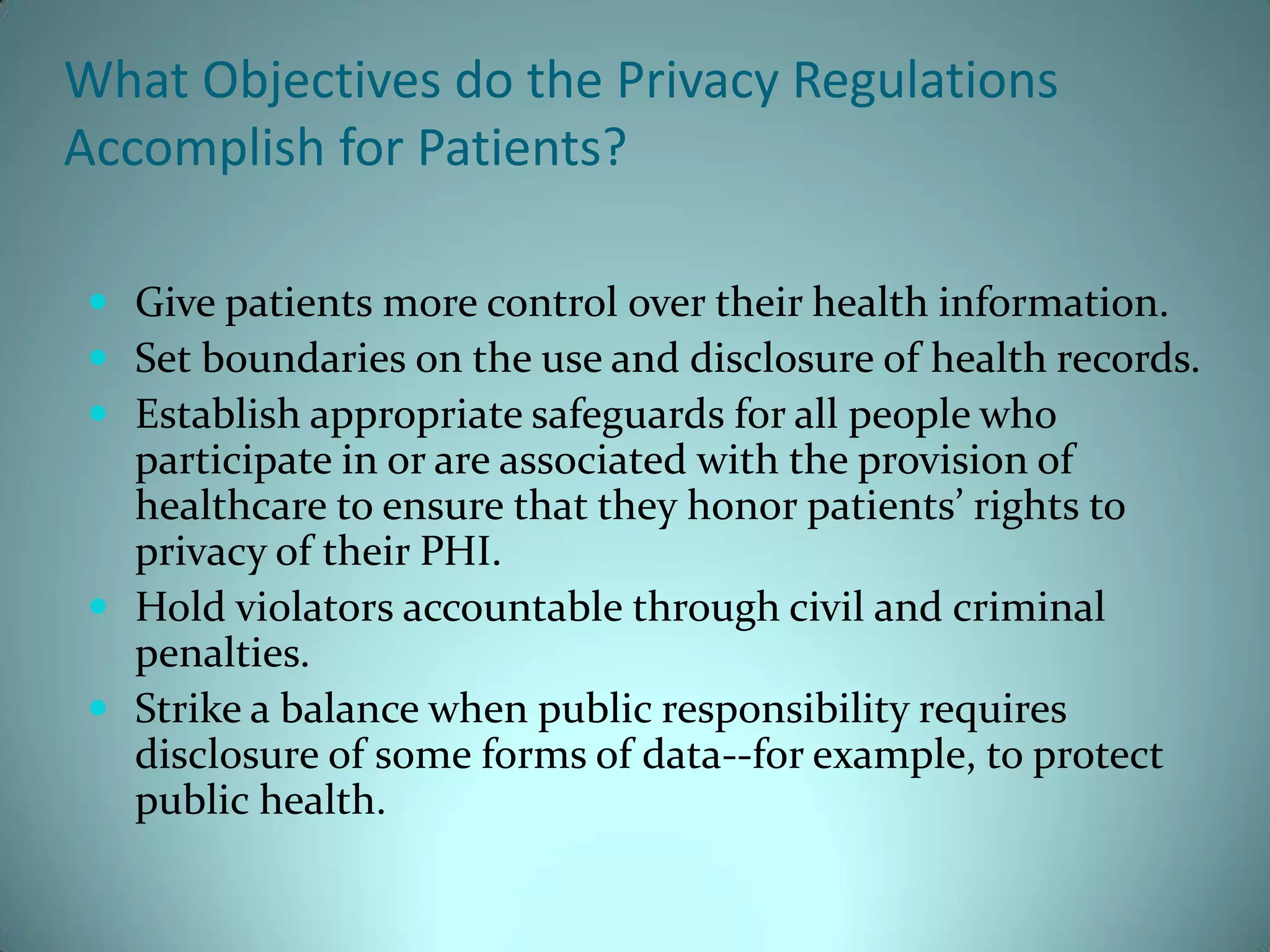
What Objectives do the Privacy Regulations
Accomplish for Patients?

 Give patients more control over their health information.
 Set boundaries on the use and disclosure of health records.
 Establish appropriate safeguards for all people who
  participate in or are associated with the provision of
  healthcare to ensure that they honor patients’ rights to
  privacy of their PHI.
 Hold violators accountable through civil and criminal
  penalties.
 Strike a balance when public responsibility requires
  disclosure of some forms of data--for example, to protect
  public health.
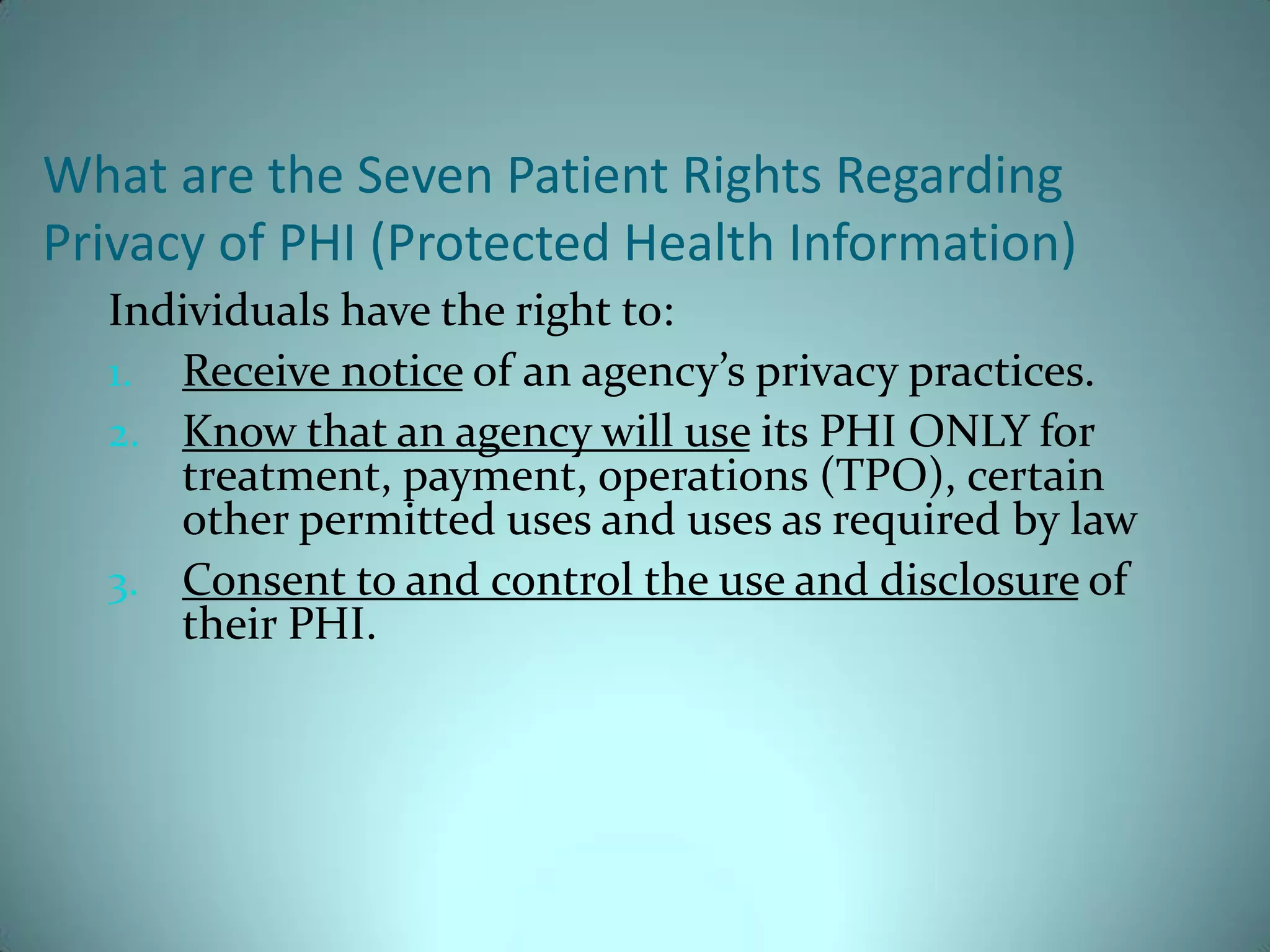
What are the Seven Patient Rights Regarding
Privacy of PHI (Protected Health Information)
  Individuals have the right to:
  1. Receive notice of an agency’s privacy practices.
  2. Know that an agency will use its PHI ONLY for
     treatment, payment, operations (TPO), certain
     other permitted uses and uses as required by law
  3. Consent to and control the use and disclosure of
     their PHI.
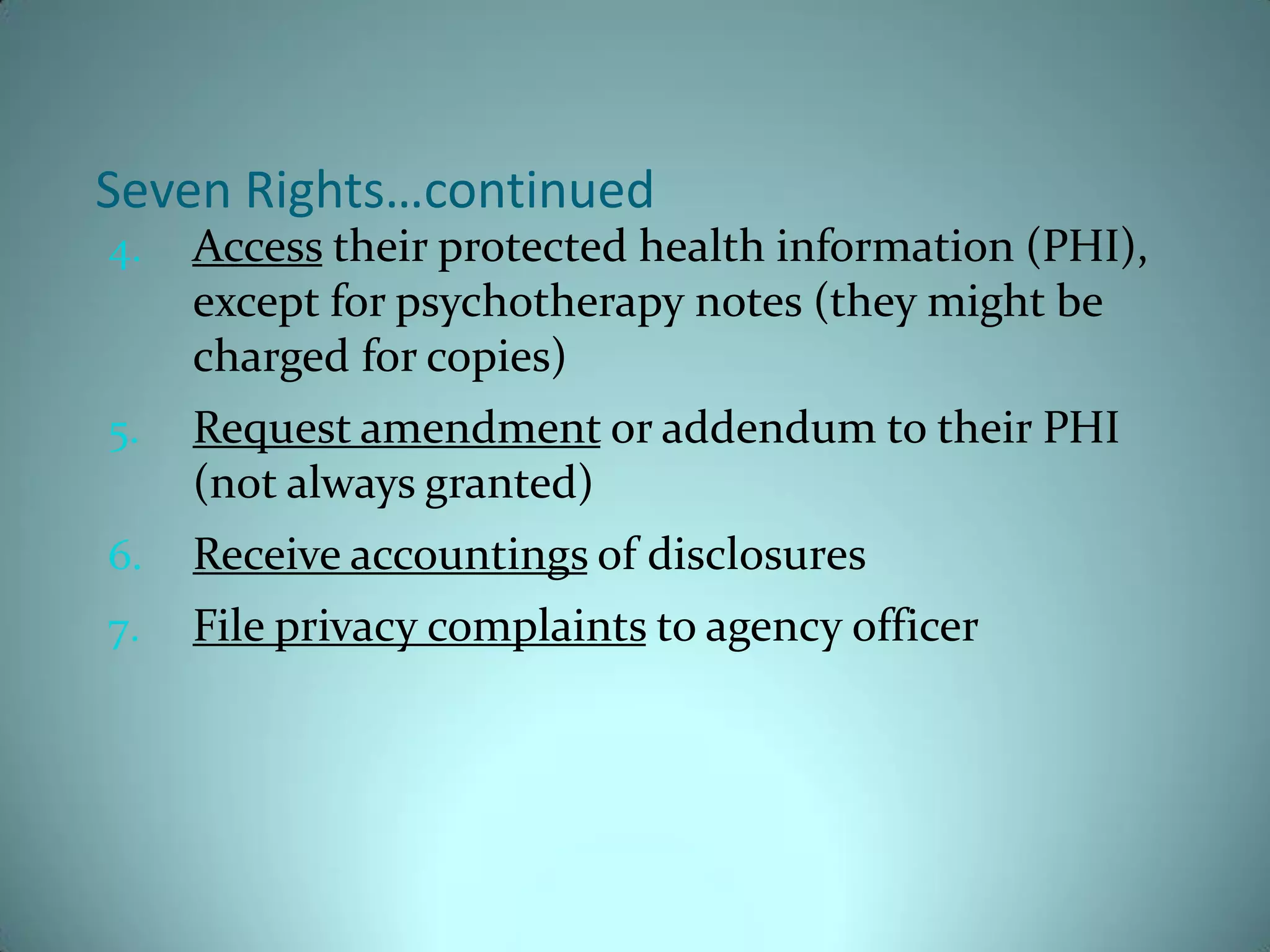
Seven Rights…continued
4.   Access their protected health information (PHI),
     except for psychotherapy notes (they might be
     charged for copies)
5.   Request amendment or addendum to their PHI
     (not always granted)
6.   Receive accountings of disclosures
7.   File privacy complaints to agency officer
HIPAA Restricts Sharing PHI
 Personal information cannot be released to individuals
 or companies interested in marketing ventures, without
 the patient’s written permission. For example:
     Names of patients with diabetes cannot be released to
      a company marketing nutritional products to lower
      blood glucose.
     Names and addresses of infants or their parents
      cannot be released to formula manufacturers.
     Contact information of previous patients cannot be
      used to raise money for any hospital campaign.
Who has Access to PHI?
The ‘Need-to-Know’ Principle
PHI should be shared with as few individuals as needed
  to ensure patient care and then only to the extent
  demanded by the individual’s role.
For example, the nursing assistant ‘needs to know’ only
  the facts concerning the patient’s current admission.
As a nurse or other professional, you will discuss PHI
  only as it applies to your practice or your patient’s care.
Protecting your patient’s PHI
 Take all reasonable steps to make sure that individuals
  without the ‘need to know’ do not overhear
  conversations about PHI.
 DO NOT conduct discussion about PHI in public areas
  to include but not limited to elevators or cafeterias.
 Do not let others see your computer screen while you
  are working. Be sure to log out when done with any
  computer file.
Protecting your patient’s PHI
When preparing care plans or other ancillary materials:


  • identify the patient/client by initials only
  • use other demographic data only to the extent necessary
    to identify the patient and his/her needs.
  • protect the computer screen, PDA, clip board, or notes
    from other individuals who don’t have a ‘need to know’
  • protect your printer output from others who don’t have a
    ‘need to know’
  • protect your floppy/zip/CD-ROM/PDA from loss
  • consider using Webspace to save your documents
Consequences of HIPAA Violations
In addition to federal laws, failure to comply with HIPAA
   also violates
 Nursing’s Code of Ethics
 Board of License
 Medical Boards
Potential Consequences of
HIPAA Violations
Legal consequences
 Criminal penalties up to imprisonment
 Civil penalties to include fines (up to $50,000 per
   individual with up to $1.5 million for institutions)
Professional consequences:
 Disciplinary action by the Board of Nurses
 Disciplinary action by employer
 Termination of employment
 Public Embarrassments
HIPAA Supplemental Training for Health Care Settings


                           Today’s Date:


                           Your Name Printed
I have completed this HIPAA training program. I understand the basic provisions
of the law and agree to do my part to ensure the patients’ rights of privacy and
confidentiality. Furthermore, I understand the consequences of failing to do so.


                            Your Signature
HIPPA (1996) The Health Insurance Portability and
Accountability Act of 1996 (HIPAA) Privacy and
security rules retrieved on April 28, 2011 from
http://www.hhs.gov/ocr/privacy/

Dustin HIPAA

  • 1.
    • Federal lawpassed by Congress in 1996 • Regulations promulgated by the Dept of Health and Human Services • Guidelines implemented in April, 2003
  • 2.
    HIPAA regulations weredesigned to: 1) protect individuals’ rights to privacy and confidentiality 2) assure the security of electronic transfer of personal information
  • 3.
    Health information isused by multiple agents in the course of a single episode with a health problem. Below are some of the agencies and individuals who may handle health information. This is not all inclusive: • Admitting clerks • Transport techs • Caregivers from the • Respiratory therapists ED to the morgue • Billing clerks • Physical therapists • Insurance agents/clerks • Nutritionists • School teachers/nurses • Lab personnel • Home health personnel • Receptionists in • Medical records clerks MD offices • Website managers
  • 4.
    Objectives  After completingthis program you will be able to:  Discuss the general concepts of HIPAA guidelines  Adapt HIPAA guidelines for the various settings in which you might practice  Discuss the seven patient/client rights regarding his/her health information  Differentiate individuals who have a ‘need to know’ from those who don’t. This determines those with whom you can discuss protected health information  Discuss application of HIPAA to the student role  List legal and professionalconsequences of violating HIPAA rules
  • 5.
    Why HIPAA?? Genetic advancements - as more is known about our genetic predisposition to diseases, HIPAA will ensure that, for example, an individual is not denied insurance because the company knows that she may eventually develop MS.  Marketing - as information is more easily captured concerning, for example, the prescriptions we purchase, HIPAA is designed to prevent marketing of unsolicited products or services based on harvested marketing data.  Technology - as information is quickly and sometimes loosely moved around networks, HIPAA standards will hold violators accountable for accidental or intentional ‘interception’ of protected health information (PHI).
  • 6.
    What Objectives dothe Privacy Regulations Accomplish for Patients?  Give patients more control over their health information.  Set boundaries on the use and disclosure of health records.  Establish appropriate safeguards for all people who participate in or are associated with the provision of healthcare to ensure that they honor patients’ rights to privacy of their PHI.  Hold violators accountable through civil and criminal penalties.  Strike a balance when public responsibility requires disclosure of some forms of data--for example, to protect public health.
  • 7.
    What are theSeven Patient Rights Regarding Privacy of PHI (Protected Health Information) Individuals have the right to: 1. Receive notice of an agency’s privacy practices. 2. Know that an agency will use its PHI ONLY for treatment, payment, operations (TPO), certain other permitted uses and uses as required by law 3. Consent to and control the use and disclosure of their PHI.
  • 8.
    Seven Rights…continued 4. Access their protected health information (PHI), except for psychotherapy notes (they might be charged for copies) 5. Request amendment or addendum to their PHI (not always granted) 6. Receive accountings of disclosures 7. File privacy complaints to agency officer
  • 9.
    HIPAA Restricts SharingPHI Personal information cannot be released to individuals or companies interested in marketing ventures, without the patient’s written permission. For example:  Names of patients with diabetes cannot be released to a company marketing nutritional products to lower blood glucose.  Names and addresses of infants or their parents cannot be released to formula manufacturers.  Contact information of previous patients cannot be used to raise money for any hospital campaign.
  • 10.
    Who has Accessto PHI? The ‘Need-to-Know’ Principle PHI should be shared with as few individuals as needed to ensure patient care and then only to the extent demanded by the individual’s role. For example, the nursing assistant ‘needs to know’ only the facts concerning the patient’s current admission. As a nurse or other professional, you will discuss PHI only as it applies to your practice or your patient’s care.
  • 11.
    Protecting your patient’sPHI  Take all reasonable steps to make sure that individuals without the ‘need to know’ do not overhear conversations about PHI.  DO NOT conduct discussion about PHI in public areas to include but not limited to elevators or cafeterias.  Do not let others see your computer screen while you are working. Be sure to log out when done with any computer file.
  • 12.
    Protecting your patient’sPHI When preparing care plans or other ancillary materials: • identify the patient/client by initials only • use other demographic data only to the extent necessary to identify the patient and his/her needs. • protect the computer screen, PDA, clip board, or notes from other individuals who don’t have a ‘need to know’ • protect your printer output from others who don’t have a ‘need to know’ • protect your floppy/zip/CD-ROM/PDA from loss • consider using Webspace to save your documents
  • 13.
    Consequences of HIPAAViolations In addition to federal laws, failure to comply with HIPAA also violates  Nursing’s Code of Ethics  Board of License  Medical Boards
  • 14.
    Potential Consequences of HIPAAViolations Legal consequences  Criminal penalties up to imprisonment  Civil penalties to include fines (up to $50,000 per individual with up to $1.5 million for institutions) Professional consequences:  Disciplinary action by the Board of Nurses  Disciplinary action by employer  Termination of employment  Public Embarrassments
  • 15.
    HIPAA Supplemental Trainingfor Health Care Settings Today’s Date: Your Name Printed I have completed this HIPAA training program. I understand the basic provisions of the law and agree to do my part to ensure the patients’ rights of privacy and confidentiality. Furthermore, I understand the consequences of failing to do so. Your Signature
  • 16.
    HIPPA (1996) TheHealth Insurance Portability and Accountability Act of 1996 (HIPAA) Privacy and security rules retrieved on April 28, 2011 from http://www.hhs.gov/ocr/privacy/