St05002068
MSc Finance MBA7006/Finance of International Business/Yr1 Page 1
CARDIFF SCHOOL OF MANAGEMENT: ASSIGNMENT FEEDBACK PROFORMA
STUDENT NAME: PROGRAMME: MBA/MSc Finance
STUDENT NUMBER: YEAR: 2013/14 GROUP: NA
Module Number: MBA7006 Term: 1 Module Title: Finance of International Business
Tutors Responsible For Marking This Assignment: Charles Larkin
Module Leader: Charles Larkin
Assignment Due Date: 9 December 2013 Hand In Date: 9 December 2013
ASSIGNMENT TITLE: Case Study Assignment
SECTION A: SELF ASSESSMENT (TO BE COMPLETED BY THE STUDENT)
In relation to each of the set assessment criteria, please identify the areas in which you feel you have strengths and
those in which you need to improve. Provide evidence to support your self-assessment with reference to the
content of your assignment.
STRENGTHS AREAS FOR IMPROVEMENT
I certify that this assignment is a result of my own work and that all sources have been acknowledged:
Signed:____________________________________ Date___________________
SECTION B: TUTOR FEEDBACK
(based on assignment criteria, key skills and where appropriate, reference to professional standards)
STRENGTHS AREAS FOR IMPROVEMENT AND TARGETS FOR
FUTURE ASSIGNMENTS
MARK/GRADE AWARDED DATE: SIGNED
It is anticipated that marked coursework with feed back will be available to candidates two weeks
(14 days) after submission. Notice of availability will be posted on blackboard.
St05002068
MSc Finance MBA7006/Finance of International Business/Yr1 Page 2
IMF Article IV-style
Report on the U.A.E.
2013
St05002068
MSc Finance MBA7006/Finance of International Business/Yr1 Page 3
Contents
Page 4: ---------------------------------------------------------------Introduction.
Pages 6-19:-------------------------------------------------------------Key Issues.
Pages 20-22: ---------------------------------------------------------Conclusions.
Pages 22-29: ----------------------------------------------------------------Tables.
Page 30-32: -----------------------------------------------------------References.
St05002068
MSc Finance MBA7006/Finance of International Business/Yr1 Page 4
The aim of this report is to look at the general overview of the economy from
the macro and micro perspective, but also to see what has happened recently
and where it may be heading and the risks it may face in doing so. In particular
looking at the following issues:
 Assess economic and financial developments.
 Exchange rate, monetary, and fiscal policies.
 Financial sector issues.
 Assessment of risks and vulnerabilities.
 Institutional and structural issues.
 Socio-political issues.
Introduction:
From 2000 to 2008 the UAE has been doing profoundly well with exceptional
growth, helped by increasing oil prices and growth in property markets (BBC,
2013). This has led to good returns which have been in turn invested in
infrastructure, education and health, but also a primary focus on efforts to
diversify its economy and reliance on oil as its major source of GDP, which so
far is looking positive. Unfortunately, while in the years leading up to the
global financial crisis, the country had a construction boom which led to a
massiveoverproduction of commercial and non-commercial projects, on top of
a somewhat artificially inflated house prices that led to the housing bubble
crash in 2008.
The real estate crisis in 2009: With the onset of the financial crisis of 2007–
2010, Dubai's real estate market declined after a six-year boom, in particular
the issue regarding the Debt default by Dubai World which had a knock on
effect on global equity markets. Shortly after concerns of this causing a
systematic failure of global financial markets; the initial drop in asset prices
bounced back due to the problem being contained (Arabian Business, 2013).
In response to this, ratings agencies downgraded the debt rating of various
GRE’s (Government Related Entities), but also restructuring of debts was put
into place to pay back its creditors to help to restore confidence.
In regards to the political instability in the wider region, the UAE has not been
affected; this is reflected in the buoyant tourism industry that continues to
St05002068
MSc Finance MBA7006/Finance of International Business/Yr1 Page 5
grow. The government, in response to the regional political movement known
as the “Arab Spring”; they initiated a $1.8Bn construction projects in the
poorer regions of the Emirates, but also increased the number of people
allowed to vote in the 2011 elections for the Federal National Council (Time
World, 2011). However, as highlighted in a recent article “UAE introduced
Internet restrictions in 2012 to hinder the use of social media to organise
protests, and imprisoned a large group of Islamists on charges to plotting a
coup in 2013” (BBC, 2013).
In regards to the economy, it is looking to grow at a rate of 5%, far lower than
the 13% pre-crisis. This will be helped by the fact that The UAE has been
chosen to hold the World Expo in 2020 and the government has plans to invest
billions into construction, particularly infrastructure. This will have a big
impact on the economy in terms of the construction and tourism. In addition,
the news that new construction projects are put in the pipeline until 2030, this
was highlighted in a recent news article that the “UAE is projected to spend
$329 billion on major construction projects by 2030, according to an EC Harris
study” (Gulf Business News, 2013). The article also indicated that because of
increased construction projects totalling over $1 trillion across the region, it is
likely to push up the prices of raw materials and also the demand for
construction workers will increase; this will in turn feed into inflation.
Capital Inflows have increased due to increased global liquidity in the financial
markets, but policymakers should pay attention to the composition of capital
inflows, since debt-related inflows may still undermine financial stability even
if they do not result in an overall current-account deficit.
Overall, within the economy consumer confidence has increased and has
resulted in increased spending also helped by the fact there is no income or
federal level tax, this is reflected in restaurants, auto, retail and hospitality
sales.
As the UAE has been a safehaven in regards to the global crisis, it has managed
to insulate itself from the worst. This has been seen as consumer spending
and unemployment have remained relatively stable, but it has still had some
issues to deal with.
St05002068
MSc Finance MBA7006/Finance of International Business/Yr1 Page 6
Key Issues:
Stock Market:
(Source: Bloomberg)
As the graph above shows that the Abu Dhabi and Dubai Indices have reached
new highs fuelling speculation that there might be an asset bubble due to
inflows of capital fuelled by increased global liquidity. Dubai and Abu Dhabi’s
stock markets are among the world’s top 10 fastest-growing indexes this year.
The positive sentiment of the growth within the UAE has been reflected in the
performance of the indices, particularly after recent news of the Expo and
construction projects. This has meant there has been a large amount of
foreign capital has been invested into these equity markets looking to gain
exposure of better returns.
But there is growing sentiment that the Dubai Expo is going to fuel another
asset bubble, therefore it may be prudent to increase government regulation
and easier procedures for starting new businesses this could potentially help
protect the economy from excessive speculation.
US$ Peg:
The monetary policy of the government continues to support the US$ peg
(which is held at 3.6725 Dirhams to the dollar), which has been quite beneficial
because the oil revenue which is in US$, but also it derives financial stability
from the US economy, if the currency where to be floating it would be
vulnerable to exchange rate fluctuations. But also the currency peg limits the
St05002068
MSc Finance MBA7006/Finance of International Business/Yr1 Page 7
central bank from using interest rates to target loan growth. As it is linked to
the stability of the US economy, any changes in growth or a possible crisis will
directly impact on its economy.
Oil:
Due to a plentiful supply of global oil, global demand is expected to remain
sluggish in the future. This may be of concern because the UAE derives a large
proportion of its income from oil exports, and any downward changes are
likely to affect its future income generated. As Abu Dhabi accounts for roughly
90% of the total oil production in the UAE, they are expecting to increase oil
production in the medium term to take advantage of high oil prices. As the
UAE is just below Iraq in terms of capacity, they plan on increasing supply to
3.5 Mbd by 2018.
(Source: OPEC)
Non-Oil Growth:
The non-oil economy is projected to expand by over 4 percent per annum in
the coming years on the back of Dubai’s strong core services sectors and Abu
Dhabi’s diversification efforts. As the UAE is a unique economy for the region,
because of its large reserves of oil combined with the fact that it has an open
export orientated non-oil sector in Dubai, it gives it a great opportunity to
maintain growth and continue to become a large net-exporter which will help
to increase its external current account surplus which is projected to remain
high at around 15%.
St05002068
MSc Finance MBA7006/Finance of International Business/Yr1 Page 8
The other sectors including: petrochemical, transportation & logistics,
industrial, aerospace & civil aviation, tourism, financial, renewable energy
sector contribute to GDP growth. As can be seen on tables 9 and 10, non-oil
sectors contribute to roughly 70% of GDP and since the crisis many of them
have seen a drop, but there has been resurgence since stability and confidence
has returned. In addition; as can be seen on table 6: non-oil exports have
increased from $44Bn to $73Bn (2007-2010), which is a positive sign that
exports will continue to grow and the UAE can position itself as a leading non-
oil exporter in the region. In addition imports have also increased from
$105Bn to $132Bn over the same period (table 7), indicating an increase in
demand of foreign goods.
Banking:
With the geopolitical issues currently ongoing within the region, it is having an
effect on the long term cost of capital from international credit markets (UAE
Interact, 2013).
The percentage of non-performing loans has increased; Dubai especially has
seen a large increase to 12% of total gross loans, also the credit growth within
the UAE is still significantly lower than that of the other GCC nations.
In order to reduce risk, the governmentis intending to introduce measurethat
mean banks mustnot lend more than 100 percentof their capital to local
governments and the same amountto government-related entities.
(Source: IMF Report 2013 pg. 8, see table 23)
The UAE banks are expecting modest loan growth; profitability is expected to
remain constrained by cautious loan growth and high provisioning as the
implementation of the new Basel regulations. But this is of no great concern
St05002068
MSc Finance MBA7006/Finance of International Business/Yr1 Page 9
as the capital adequacy ratios (see table 17) are generally well above the Basel
requirements, wherethere has been an increasefrom16.3% to 17.6 from2011
to 2012 on its tier 1 capital ratio and a total capital adequacy ratio of 21%.
There are also plans by the government to create an independent authority
which will supervise the country's Islamic finance industry; this could help it
become a global centre for Islamic business. This was highlighted in a recent
article that “the total foreign trade of the Muslim world is $4 trillion. This
shows the potential that is available for Dubai" (Reuters, 2013).
Real Estate:
Confidence has return to the residential housing market in Dubai, but Abu
Dhabi is still seeing sluggish growth (see graphs below). With prices increasing
21.4% from June 2012 to June 2013 for prime residential property (Knight
Frank, 2013); this makes it the fastest growing real estate market in the world.
To try and subdue the housing market from overheating and creating another
collapse, the proposed new mortgage rules that the central bank capped the
loan-to-value (LTV) limit at 80% for nationals and 75% for expatriates, this was
done in order to try an avoid a housing crisis but this has increased the amount
of people not able to take out a mortgage. Another rule implemented, was by
the Dubai Land Department’s decision to double the transfer fee on each sale
from 2 to 4 %.
But with sentiment at an all-time high with the news of the 2020 Expo,
demand will increase and the continuing prices will invariably increase, the
government’s measures to try and stem another collapse may not be enough
and this issue must be carefully monitored.
St05002068
MSc Finance MBA7006/Finance of International Business/Yr1 Page 10
House Prices (Source: REIDIN)
Rental Prices (Source: REIDIN)
(Source: Central Bank of the UAE, 2013)
St05002068
MSc Finance MBA7006/Finance of International Business/Yr1 Page 11
With interest rates linked to the US $, in 2008 when the Fed started cutting
rates the UAE central bank had to follow the same monetary policy which
resulted in high inflation of 12.9%. But as the monetary policy has started to
help the US economy grow, this has in turn benefitted the UAE economy.
Another important point is the political issue with regard to Iran, if there are
increased sanctions (one of Dubai’s largest trading partners), this could slow
the recovery of the trade sector and further impact the real estate sector since
Iranians are major real estate investors. According to the IMF bilateral trade
has decreased by 31 % in 2012.
Inflation:
Due to increasing rises in housing prices, inflation targets by the central bank
are projected to be 4.2% for 2014. Itis importantthat policy makers keep a
keen eye on this as inflationary pressures could seeit increase quite
dramatically in the foreseeablefuture.
(Source: IMF Report 2013, pg. 5)
Economy:
The government is looking at different macro-prudential policies to regulate
credit growth. As mentioned previously property prices are increasing
dramatically but they also account for proportion of the country’s GDP, this is
why they seek to temper the growth of the asset bubble. But it may not be
enough as the property and share prices have regained momentum and don’t
seem to be slowing down. Because of the heavy reliance on construction and
St05002068
MSc Finance MBA7006/Finance of International Business/Yr1 Page 12
property, the impact of any growth or collapse has a large impact on the wider
economy.
An important issue that still needs addressing is the sizable debts of the
government and of its GRE’s. In a recent news article, it was highlighted that
“the debt levels of the Government and state-owned companies remain large,
having grown by $13bn from the third quarter of last year to about $103bn
now, estimates Barclays” (The National, 2013). But as highlighted there are
many GRE’s that have upcoming maturities on their debts, some of them are
looking to refinance but others may be looking to take on more debt for the
run up to the Expo in 2020.
The central bank may need to use quantitative easing (QE) to devalue their
debts and pump inflation into their economies to stop nominal prices from
collapsing.
(Source: IMF Report 2013, pg. 5)
(Source: tradingeconomics.com, 2013)
St05002068
MSc Finance MBA7006/Finance of International Business/Yr1 Page 13
Since 2004 the GDP per capita PPP has decreased, whereas GDP per capita has
risen from $21,801 in 2000 to $66,625 in 2011, but overall the UAE is ranked
6th
in terms of both nominal and PPP bases, according to the IMF. The biggest
non-oil contributors to GDP are Trade; Construction; Real Estate and Business
Services; Manufacturing; Transport, Storage, and Communication; Finance and
Insurance; and Government.
(Source: tradingeconomics.com)
The government Debt to GDP has risen significantly since 2004-10,butis
starting to show signs of it been managed effectively by the government.
Although, due to the large debts that the some GRE’s still have, this will
continue to affect growth within the economy and the debt restructuring
should be of upmostimportance to the governmentso that these entities can
bring down the debt which will in turn have a positive effect.
In addition, with cheaper rates of interest the GRE’s, particularly Dubai Inc.
have taken this opportunity to restructureits debts, in addition the central
bank balance sheets look positivefor the first time in five years with bad loans
now fully written off and asset prices rising strongly.
Because of the large oil revenues, it has kept the governmentbudget in surplus
and public debt below 20 % of GDP. As can be seen in the graph below the
cost for the government to insureagainst debt default has been decreasing,
showing the confidence in the stability of its economy and the decreased
likelihood of a default.
St05002068
MSc Finance MBA7006/Finance of International Business/Yr1 Page 14
(Source: IMF Report 2013, pg. 7)
(Source: IMF Report 2013 pg. 15, see table 22)
St05002068
MSc Finance MBA7006/Finance of International Business/Yr1 Page 15
(Source: IMF Report 2013 pg. 16)
(Source: IMF Report 2013, pg. 13)
In a recent report carried out by HSBC (see table below), it indicated that trade
was going to increase. In particular, for the short term trade would be
conducted with other GCC members and also Asia, but in the long term fast
developing nations will become increasingly important to the UAE in terms of
bilateral trade.
St05002068
MSc Finance MBA7006/Finance of International Business/Yr1 Page 16
(Source: HSBC, 2013)
Labour Market:
(Source: tradingeconomics.com, 2013)
In a recent report by the Arab Thought Foundation (ATF), it highlighted the fact
that the accuracy of the statistics of the countries unemployment rate are
uncertain and is likely to be much higher. In a recent news article it highlighted
that “overall, the UAE had the highest rates of unemployment in the GCC
among each country’sown citizens, with 14 per cent last year, according to the
report– and 24 per cent in the age group of 19 to 25” (The National, 2013). In
addition the unemployment rate for females between the ages of 15 to 24
where 21.8% in 2008 (indexmundi, 2013).
St05002068
MSc Finance MBA7006/Finance of International Business/Yr1 Page 17
There are expectations that the benefit of gaining the Expo will, increase
employment within the UAE for both low level and professional level jobs, but
again this could have an effect on house prices.
It should also be noted that there are also concerns over the “kafala”
sponsorship system, which there have been numerous reports of abuse and
exploitation of economic migrants (Migrants Rights, 2013), but also the lack of
transparency and overly bureaucratic system which the system entails. These
issues need to be addressed by the government in order to attract foreign
workers; otherwise this policy is likely to have a negative impact on migrants
entering the country.
Another issue is the policy enacted by the government named “Emiratisation”,
which was enacted in order to address the unemployment issue of its local
population. This does not seem to be working due to various reasons,
predominantly because of the lack of skills the local population has in
comparison to ex-pats, this is especially true in regards to the saturated private
sector where the majority are foreign. In order to deal with this issue, the
government needs to address education standards at all levels in comparison
to developed nations, rather than just building schools.
Transparency:
It is important that government entities become more transparent, but the
UAE as a whole is improving in this regard and in the Transparency
International’s Corruption Perceptions Index it scored 69 (0 being most and
100 being the least), which has made it the least corrupt in the region
(Transparency International, 2013).
It is a matter of urgency that these GRE’s implement greater transparency in
order to gaugethe financial health and assessing risks, which may again lead to
systemic risk.
Education
In regards to innovation, the number of patents, articles in peer reviewed
academic journals or % of GDP spent on R&D the country lags behind
developed countries, therefore the government must increase spending on
education and R&D. In order to increase these measures it must have a
St05002068
MSc Finance MBA7006/Finance of International Business/Yr1 Page 18
strategy to diversify through innovation, but this comes from education, they
needs to improve education (investment), but also seek to improve the quality
of its education to meet certain standards.
Healthcare:
In a recent article it was highlighted that there may not be enough investment
in healthcare within the UAE, “while the health care market is set to expand
further, the UAE is already struggling to keep pace with the current demand,
According to a Colliers International report” (Gulf News, 21th
Nov 2013). The
report indicated that there needed to be substantial investment across the
Emirates, in order to deal with growing demand.
Index:
In the Doing Business report by the World Bank (see graph below), it has
ranked the UAE at number 23, moving up three places due to it improving
certain aspects such as; access to electricity, ability to register property and
regulations to protect investors. Overall it has been improving conditions to
allow the start-up of businesses and its environment is well above the other
countries in the region in this regard, but it still has areas to improve upon such
as resolving insolvency and enforcing contracts. There is also much room in
improving laws in regards to foreign ownership of property and business,
currently the law states that foreigner can only own 49% of a company (except
for free-trade zones), but also for property ownership laws are very stringent
and prevent outright ownership.
St05002068
MSc Finance MBA7006/Finance of International Business/Yr1 Page 19
In addition the Social Development Indicators (seeTable 23), measured by the
Basic Capabilities Index and the Human development Index, the UAE is ranked
30th
in the world (top of IDBmembers) in the HDI and a scoreof 96.9 by the
BCI. These scores and ranking put the UAE well above the rest of other MENA
and GCC members, according to the mostrecent UNDP report the "United
Arab Emirates’2012 HDI of 0.818 Isbelow the average of 0.905 for countriesin
the very high human developmentgroup and above the average of 0.652 for
countriesin Arab States” (Human Development Report, 2013). This shows that
the country has moved huge strides to improve the livelihood of its citizens; in
regards to the measurements of these indicators. The governmentprovides a
large amount of financial supportto help eradicate poverty, however in a
recent article it has highlighted that the “UAE has no official published research
regarding people living below the poverty line” (The National, 2011), this
indicates that there is very little data on poverty within the UAE and official
reports might underplay the true extent of this problemwithin the country,
especially since the recent crisis.
St05002068
MSc Finance MBA7006/Finance of International Business/Yr1 Page 20
Conclusions:
Overall, the outlook for the economy is positive especially since the housing
crisis of 2008. Theeconomy will grow at a good rate, but certainly not as much
pre-crisis. This may prove to be more beneficial; because gradual growth may
be more manageable and sustainable over a longer period, compared to the
double digit growth which it had pre-crisis which invariably turned out to be
unsustainable.
It is worth noting that because of the linked nature of the economy to the US,
a major risk of reduction in capital inflows which could affect the cost in
borrowing; this could happen if there is a change in monetary policy and a
reduction in QE in the US. In addition, if problems start to emerge again within
the global financial system or bubbles bursting, such as the issuewith regard to
a current bubble in asset prices in the US, this could have a direct impact on
the UAE.
But on the flip side, if there is continued growth in developed economies, this
will have a knock on effect on the global economies, but this will also keep oil
prices stable. In addition, the UAE has close ties with emerging markets, such
as one of its largest trading partners India, any slowdown in growth within
these countries will also impact on its growth prospects. An important issue is
that the UAE is still dependant on oil; any decline in the prices due to a
slowdown in consumption will again have a negative impact on its growth and
expose its weaknesses relating to debt levels of GRE’s. This is why they must
persevere in developing and maintaining a diversification strategy, so its
economy is not so dependent on external factors, such as developing new and
existing industries to minimise imbalances within its economy.
Conversely if there are increases in the price of oil, this will benefit the UAE, as
it will gain increased revenue and add to its current accountsurplus. Therefore
the UAE must maintain current production of oil and gas, as this will add to
stability but also help it to raise revenue to help its diversification efforts
within the economy.
Another factor which needs to be closely monitored is the geopolitical risks
within the region, such as any conflict within Iran or any destabilising political
St05002068
MSc Finance MBA7006/Finance of International Business/Yr1 Page 21
movements; because these will have a massive impact both economically but
also politically.
It should also endeavour to increase policies to minimise bubbles within
certain assets, such as the stock market and housing sector. This again seems
to be an issue that needs monitoring, otherwise these markets could see a
crash and impact on its medium to long term growth. There have been some
recent policy changes and time will tell if these help to curb past exuberances
which led to the previous asset bubble.
Overall, because of the improving situation in regards to its fiscal situation and
large foreign assets provides the UAE with a buffer against any short term
shocks within the system and will help protect it from any major crisis. In
addition the UAE banking system is stable and has a high level of capital
adequacy with high capital and liquidity.
Growth within the economy will be in single digits, compared with its double
digit growth seen before the crisis; this will be because of increased spending
by households and businesses outside the oil sector.
The major spending the government plans for the foreseeable future,
especially in regards to the World Expo in 2020 will certainly revitalise a boom,
but must be monitored as this might increase inflation and increase debt levels
substantially.
The government must be careful to learn from previous mistakes and should
be prudent in how much it is spending on projects and this will hopefully not
lead to a build-up such as it previously has, in particular looking at how much
debt GRE’s acquire. As the government has put a cap on borrowing limits, this
should allow for the problems that these entities not to be such a problem in
the future. Also there is some looming uncertainty with regards to how these
GRE’s will deal with its debt obligations in 2014.
In regards to Dubai, many of its GRE’s had their debts restructured, but the
government must keep a close eye on how it manages it debt obligation in the
future, especially since there is a planned expansion of construction across the
emirates. If fiscal mismanagement occurs again, this may raise previous
St05002068
MSc Finance MBA7006/Finance of International Business/Yr1 Page 22
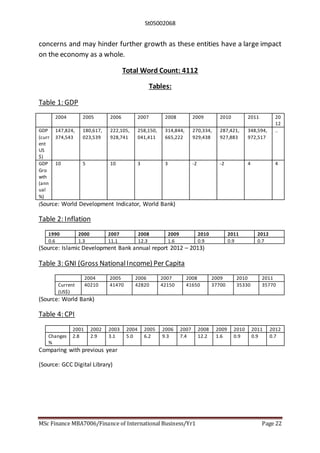
concerns and may hinder further growth as these entities have a large impact
on the economy as a whole.
Total Word Count: 4112
Tables:
Table 1: GDP
2004 2005 2006 2007 2008 2009 2010 2011 20
12
GDP
(curr
ent
US
$)
147,824,
374,543
180,617,
023,539
222,105,
928,741
258,150,
041,411
314,844,
665,222
270,334,
929,438
287,421,
927,883
348,594,
972,517
..
GDP
Gro
wth
(ann
ual
%)
10 5 10 3 3 -2 -2 4 4
(Source: World Development Indicator, World Bank)
Table 2: Inflation
1990 2000 2007 2008 2009 2010 2011 2012
0.6 1.3 11.1 12.3 1.6 0.9 0.9 0.7
(Source: Islamic Development Bank annual report 2012 – 2013)
Table 3: GNI (Gross NationalIncome) Per Capita
2004 2005 2006 2007 2008 2009 2010 2011
Current
(US$)
40210 41470 42820 42150 41650 37700 35330 35770
(Source: World Bank)
Table 4: CPI
2001 2002 2003 2004 2005 2006 2007 2008 2009 2010 2011 2012
Changes
%
2.8 2.9 3.1 5.0 6.2 9.3 7.4 12.2 1.6 0.9 0.9 0.7
Comparing with previous year
(Source: GCC Digital Library)
St05002068
MSc Finance MBA7006/Finance of International Business/Yr1 Page 23
Table 5: BOP
St05002068
MSc Finance MBA7006/Finance of International Business/Yr1 Page 24
(Source: UAE Central Bank, 2013)
Table 6: Export & Re-Export of GCC member, excluding oil.
2007 2008 2009 2010
Total (million $) 44819.8 60777.0 57991.1 73231.0
% 35.6 -4.6 26.3
Data from GCC Digital Library (pg. 126/221)
Table 7: Imports of GCC member
2007 2008 2009 2010
Total (million $) 105747.3 154042.2 121822.7 132175.3
% 45.7 -20.9 8.5
Data from GCC Digital Library (pg. 129/221)
St05002068
MSc Finance MBA7006/Finance of International Business/Yr1 Page 25
Table 8: Current Account
2007 2008 2009 2010
Total (million $) 19640.8 22278.2 7848.7 7241.3
% of GDP 7.6 7.1 2.9 2.5
Overall Balance
(million $)
(surplus/deficit)
49894.6 -46835.1 -6132.1 7333.4
Data from GCC Digital Library (pg. 139-140/221)
Table 9: GROSS DOMESTICPRODUCT(GDP) BYECONOMICACTIVITYAT
CURRENT PRICES - Relative Share (%)
2007 2008 2009 2010
Agriculture& Fishing 1.0 0.8 1.0 0.9
Mining& Quarrying
(Petroleum & Gas &
Mining)
33.9 37.1 29.1 31.6
Manufacturing 9.0 8.6 10.1 9.7
Electricity,Gas &
Water
1.8 1.8 2.4 2.6
Construction 10.0 10.6 11.8 11.6
Wholesale& Retail,
Hotels & Restaurants
15.8 14.6 15.5 14.9
Transport,
Communication &
Storage
8.0 7.7 9.3 9.1
Finance& Insurance
Services
7.2 6.3 7.2 6.8
Real Estate Services 11.7 10.9 10.7 9.9
Gov. Services 3.0 3.3 4.8 4.6
Other Services 2.1 2.2 2.7 2.8
Imputed Bank
Services
-3.6 -3.9 -4.7 -4.4
Data from GCC Digital Library (pg. 150-151/221)
Table 10: GROSS DOMESTICPRODUCTBYECONOMICACTIVITYATCURRENT
PRICES - Annual Growth (%)
2008 2009 2010
Agriculture& Fishing 3.6 0.0 0.1
Mining& Quarrying
(Petroleum & Gas &
Mining)
33.3 -32.7 19.7
Manufacturing 16.6 0.7 5.9
Electricity,Gas &
Water
18.3 15.7 17.5
Construction 29.1 -4.1 8.6
Wholesale& Retail,
Hotels & Restaurants
12.6 -8.7 5.7
Transport,
Communication &
16.7 4.1 7.0
St05002068
MSc Finance MBA7006/Finance of International Business/Yr1 Page 26
Storage
Finance& Insurance
Services
7.8 -1.8 3.4
Real Estate Services 13.1 -15.1 1.6
Gov. Services 36.2 23.4 1.3
Other Services 23.6 7.3 12.0
Imputed Bank
Services
-31.0 -3.2 -3.0
Data from GCC Digital Library (pg. 152-152/221)
Table 11: Petroleum & Mining Gross Output
2007 2008 2009 2010
(million $) 94251 120194 81923 98044
Data from GCC Digital Library (pg. 154/221)
Table 12: GDP Per Capita
2007 2008 2009 2010
$ 41510 38997 32968 36017
Data from GCC Digital Library (pg. 165/221)
Table 13: Total Public Revenues & Expenditures (DEFICIT)
(million $) 2007 2008 2009 2010
Total Revenues 62287 104543 63846 76793
Oil Revenues 47996 73335 33323 46230
Other Revenues 14291 31208 30523 30563
Total Expenditures 43492 75067 106408 93679
Investment
Expenditures
10459 23083 47727 25650
Current
Expenditures
33033 51984 58681 68029
Surplus/Deficit 18795 29476 -42562 -16886
Data from GCC Digital Library (pg. 167/221)
Table 14: Exchange Rate
2007 2008 2009 2010
$ 3.6725 3.6725 3.6725 3.6725
Data from GCC Digital Library (pg. 171/221)
Table 15: Oil Production & Reserves
2007 2008 2009 2010
Production (B/D
(000))
2529 2572.2 2241.6 2323.8
Reserves
(Billion/Year End)
97.8 97.8 97.8 97.8
Data from GCC Digital Library (pg. 183/221)
St05002068
MSc Finance MBA7006/Finance of International Business/Yr1 Page 27
Table 16: Natural Gas Production & Reserves
2007 2008 2009 2010
Production (million
Cu.Ft/Day)
1776.2 1774.5 1724.5 1810.8
Reserves (billion
Cu.Ft/Day (000))
214.5 215.1 215.1 215.1
Data from GCC Digital Library (pg. 184/221)
Table 17: Capital Adequacy Ratios
(Source: UAE Central Bank, 2013)
Table 18: Central Banks Foreign Currency Assets
(Source: UAE Central Bank, 2013)
St05002068
MSc Finance MBA7006/Finance of International Business/Yr1 Page 28
Table 19: Banking Indicators
(Source: UAE Central Bank, 2013)
Table 20: Central Banks Statement of Earnings
(Source: UAE Central Bank, 2013)
St05002068
MSc Finance MBA7006/Finance of International Business/Yr1 Page 29
Table 21: DubaiGovernment Debt Sustainability
(Source: IMF Report 2013 pg15)
Table 22: Bank Financial Soundness Indicators
(Source: IMF Report, 2013)
Table 23: Social Development Indicators of IDBMember Countries (pg. 93 of
201):
Human Development Index (HDI
2012)
Basic Capabilities Index (BCI)** Total
Expenditure
on Health
(% of GDP)
(2010)
Public
Expenditure
(% of GDP)
(Latest
available
year)
HDI Rank Index Status BCI (2000) BCI (2011) BCI Status
(2011)
30 0.846 Very High 92.1 96.9 Medium 3.7 1.1
** The Basic Capabilities Index (BCI) is an alternative way to monitor the situation of poverty
in the world. It is the average of three indicators: 1) mortality among children under 5, 2)
reproductive or maternal-child health, and 3) education (measured by a combination of
enrolment in primary education and the proportion of children reaching fifth grade).
St05002068
MSc Finance MBA7006/Finance of International Business/Yr1 Page 30
Columns 1, 2 & 3 data source: UNDP, Human Development Report, 2013.
Columns 4, 5 & 6 data source: Social Watch, Basic Capabilities Index.
Column 7 data source: WHOSIS online database, 3rd Feb 2013.
Column 8 data source: Institute of Statistics online database, 3rd Feb 2013.
(Data from Islamic Development Bank annual report 2012 – 2013)
References:
 Arabian Business, 30th July 2013, “IMF warns Dubaiover new realestate
bubble”, [Online, Accessed 8/12/13], http://www.arabianbusiness.com/imf-
warns-dubai-over-new-real-estate-bubble-511824.html.
 BBC, 26th October 2013, United Arab Emirates profile, [Online, Accessed
8/12/13], http://www.bbc.co.uk/news/world-middle-east-14703998.
 Doing Business, 2013, Doing Business Report: Economy ProfileUnited Arab
Emirates, [Online, Accessed: 5/12/13],
http://www.doingbusiness.org/reports/global-
reports/~/media/giawb/doing%20business/documents/profiles/country/AR
E.pdf.
 GCC Digital Library, 2012, StatisticalBulletin, [Online, Accessed: 5/12/13],
http://sites.gcc-sg.org/DLibrary/index-eng.php?action=ShowOne&BID=586.
 GCC Digital Library, 2013, [Online, Accessed: 5/12/13], http://sites.gcc-
sg.org/DLibrary/download.php?B=606.
 Gulf Business, M, Sophia. 19th
November, “UAE’s Construction Spend to
Reach $329bn in 2030”, [Online, accessed 7/12/13],
http://gulfbusiness.com/2013/11/uaes-construction-spend-to-reach-
329bn-in-2030/.
 Gulf News, November 21st
2013, C, Maceda. “The practical side of
Emiratisation”, [Online, Accessed 8/12/13],
http://gulfnews.com/business/general/uae-health-care-market-to-reach-
dh3-5b-in-2018-1.1258144.
 Heritage Foundation, 2013, Indexof Economic Freedom, [Online, Accessed:
5/12/13], http://www.heritage.org/index/country/unitedarabemirates.
 HSBC, October 2013, “UAETrade ForecastReport - HSBCGlobal
Connections”. [Online, Accessed 8/12/13],
St05002068
MSc Finance MBA7006/Finance of International Business/Yr1 Page 31
https://globalconnections.hsbc.com/global/en/tools-data/trade-
forecasts/ae.
 UNDP, Human Development Report, 2013, “TheRise of the South: Human
Progress in a DiverseWorld”, [Online, Accessed 8/12/13],
http://hdrstats.undp.org/images/explanations/ARE.pdf.
 IMF, 2013, ArticleIV consultation on the UAE, [Online, Accessed: 5/12/13],
http://www.imf.org/external/pubs/ft/scr/2013/cr13239.pdf.
 Indexmundi, 2013, United Arab Emirates Economy Profile 2013, [Online,
Accessed: 5/12/13],
http://www.indexmundi.com/united_arab_emirates/economy_profile.html
 Islamic Development Bank, Annual Report 2012 –2013, [Online, Accessed:
5/12/13],
http://www.isdb.org/irj/go/km/docs/documents/IDBDevelopments/Interne
t/English/IDB/CM/Publications/Annual_Reports/38th/AnnualReport38.pdf.
 Jones Llang LaSalle, October 2013, MENA HouseView, [Online, Accessed:
5/12/13], http://www.joneslanglasalle-
mena.com/ResearchLevel1/JLLMENAHouseView_October2013.pdf.
 Knight Frank, 2013, DubaiPrimeResidential Review, [Online, accessed
7/12/13],
http://resources.knightfrank.com/GetResearchResource.ashx?versionid=19
86&type=1.
 Migrants Rights, 2013, “End the Kafala System”, [Online, accessed 7/12/13],
http://www.migrant-rights.org/campaign/end-the-kafala-system.
 OPEC, 2013, OPECBasketPrice, [Online, Accessed: 5/12/13],
http://www.opec.org/opec_web/en/data_graphs/40.htm.
 REIDIN, 2013, Emerging MarketHousing Data, [Online, Accessed: 5/12/13],
http://www.reidin.com/CountryHome/index/?cnt=AE.
 Reuters, October 13th
2013, Torchia etal. “Dubai wants to be centre for
Islamic business”, [Online, Accessed 8/12/13],
http://www.reuters.com/article/2013/10/05/us-emirates-dubai-islamic-
idUSBRE99406620131005.
 Trading Economics, 2013, [Online, Accessed: 5/12/13],
http://www.tradingeconomics.com/united-arab-emirates/indicators.
 Transparency International, 2013, Corruption by Country, [Online, Accessed
8/12/13], http://www.transparency.org/country#ARE.
St05002068
MSc Finance MBA7006/Finance of International Business/Yr1 Page 32
 The National, November 30th
2013, T, Arnold. “DubaiExpo 2020: After
euphoria comes the question ‘how to pay for it?”, [Online, Accessed,
8/12/13], http://www.thenational.ae/business/industry-
insights/finance/dubai-expo-2020-after-euphoria-comes-the-question-how-
to-pay-for-it.
 The National, December 3rd
2013, M, Kahn. “Arabian Gulf nationals feel
unqualified for private-sector jobs, new reportshows”, [Online, Accessed
7/12/13], http://www.thenational.ae/uae/arabian-gulf-nationals-feel-
unqualified-for-private-sector-jobs-new-report-shows.
 The National, August6th
2011, F, Kamali, H, Bastaki. “Any poor Emiratis out
there?”, [Online, Accessed, 8/12/13],
http://www.thenational.ae/lifestyle/any-poor-emiratis-out-there.
 Time World, July 18th 2011, “Why theArab Spring Never Came to the
U.A.E.”, [Online, Accessed, 8/12/13],
http://content.time.com/time/world/article/0,8599,2083768,00.html.
 UAE Central Bank, AnnualReport 2012, [Online, Accessed: 5/12/13],
http://www.centralbank.ae/en/pdf/reports/CBUAEAnnualReport2012_Engl
ish3.pdf.
 UAE Interact, 26th
January 2013, “Dubaibond sale set to spur credit
markets”, [Online, Accessed: 5/12/13],
http://www.uaeinteract.com/docs/Dubai_bond_sale_set_to_spur_credit_
markets/53080.htm.
 World Bank, 2013, [Online, Accessed: 5/12/13],
http://data.worldbank.org/indicator/NY.GNP.PCAP.CD/countries/AE--
XR?page=1&display=default.
 World Development Indicator, 2013, World Bank, [Online, Accessed:
5/12/13],
http://databank.worldbank.org/data/views/reports/tableview.aspx.

IMF report on the UAE

  • 1.
    St05002068 MSc Finance MBA7006/Financeof International Business/Yr1 Page 1 CARDIFF SCHOOL OF MANAGEMENT: ASSIGNMENT FEEDBACK PROFORMA STUDENT NAME: PROGRAMME: MBA/MSc Finance STUDENT NUMBER: YEAR: 2013/14 GROUP: NA Module Number: MBA7006 Term: 1 Module Title: Finance of International Business Tutors Responsible For Marking This Assignment: Charles Larkin Module Leader: Charles Larkin Assignment Due Date: 9 December 2013 Hand In Date: 9 December 2013 ASSIGNMENT TITLE: Case Study Assignment SECTION A: SELF ASSESSMENT (TO BE COMPLETED BY THE STUDENT) In relation to each of the set assessment criteria, please identify the areas in which you feel you have strengths and those in which you need to improve. Provide evidence to support your self-assessment with reference to the content of your assignment. STRENGTHS AREAS FOR IMPROVEMENT I certify that this assignment is a result of my own work and that all sources have been acknowledged: Signed:____________________________________ Date___________________ SECTION B: TUTOR FEEDBACK (based on assignment criteria, key skills and where appropriate, reference to professional standards) STRENGTHS AREAS FOR IMPROVEMENT AND TARGETS FOR FUTURE ASSIGNMENTS MARK/GRADE AWARDED DATE: SIGNED It is anticipated that marked coursework with feed back will be available to candidates two weeks (14 days) after submission. Notice of availability will be posted on blackboard.
  • 2.
    St05002068 MSc Finance MBA7006/Financeof International Business/Yr1 Page 2 IMF Article IV-style Report on the U.A.E. 2013
  • 3.
    St05002068 MSc Finance MBA7006/Financeof International Business/Yr1 Page 3 Contents Page 4: ---------------------------------------------------------------Introduction. Pages 6-19:-------------------------------------------------------------Key Issues. Pages 20-22: ---------------------------------------------------------Conclusions. Pages 22-29: ----------------------------------------------------------------Tables. Page 30-32: -----------------------------------------------------------References.
  • 4.
    St05002068 MSc Finance MBA7006/Financeof International Business/Yr1 Page 4 The aim of this report is to look at the general overview of the economy from the macro and micro perspective, but also to see what has happened recently and where it may be heading and the risks it may face in doing so. In particular looking at the following issues:  Assess economic and financial developments.  Exchange rate, monetary, and fiscal policies.  Financial sector issues.  Assessment of risks and vulnerabilities.  Institutional and structural issues.  Socio-political issues. Introduction: From 2000 to 2008 the UAE has been doing profoundly well with exceptional growth, helped by increasing oil prices and growth in property markets (BBC, 2013). This has led to good returns which have been in turn invested in infrastructure, education and health, but also a primary focus on efforts to diversify its economy and reliance on oil as its major source of GDP, which so far is looking positive. Unfortunately, while in the years leading up to the global financial crisis, the country had a construction boom which led to a massiveoverproduction of commercial and non-commercial projects, on top of a somewhat artificially inflated house prices that led to the housing bubble crash in 2008. The real estate crisis in 2009: With the onset of the financial crisis of 2007– 2010, Dubai's real estate market declined after a six-year boom, in particular the issue regarding the Debt default by Dubai World which had a knock on effect on global equity markets. Shortly after concerns of this causing a systematic failure of global financial markets; the initial drop in asset prices bounced back due to the problem being contained (Arabian Business, 2013). In response to this, ratings agencies downgraded the debt rating of various GRE’s (Government Related Entities), but also restructuring of debts was put into place to pay back its creditors to help to restore confidence. In regards to the political instability in the wider region, the UAE has not been affected; this is reflected in the buoyant tourism industry that continues to
  • 5.
    St05002068 MSc Finance MBA7006/Financeof International Business/Yr1 Page 5 grow. The government, in response to the regional political movement known as the “Arab Spring”; they initiated a $1.8Bn construction projects in the poorer regions of the Emirates, but also increased the number of people allowed to vote in the 2011 elections for the Federal National Council (Time World, 2011). However, as highlighted in a recent article “UAE introduced Internet restrictions in 2012 to hinder the use of social media to organise protests, and imprisoned a large group of Islamists on charges to plotting a coup in 2013” (BBC, 2013). In regards to the economy, it is looking to grow at a rate of 5%, far lower than the 13% pre-crisis. This will be helped by the fact that The UAE has been chosen to hold the World Expo in 2020 and the government has plans to invest billions into construction, particularly infrastructure. This will have a big impact on the economy in terms of the construction and tourism. In addition, the news that new construction projects are put in the pipeline until 2030, this was highlighted in a recent news article that the “UAE is projected to spend $329 billion on major construction projects by 2030, according to an EC Harris study” (Gulf Business News, 2013). The article also indicated that because of increased construction projects totalling over $1 trillion across the region, it is likely to push up the prices of raw materials and also the demand for construction workers will increase; this will in turn feed into inflation. Capital Inflows have increased due to increased global liquidity in the financial markets, but policymakers should pay attention to the composition of capital inflows, since debt-related inflows may still undermine financial stability even if they do not result in an overall current-account deficit. Overall, within the economy consumer confidence has increased and has resulted in increased spending also helped by the fact there is no income or federal level tax, this is reflected in restaurants, auto, retail and hospitality sales. As the UAE has been a safehaven in regards to the global crisis, it has managed to insulate itself from the worst. This has been seen as consumer spending and unemployment have remained relatively stable, but it has still had some issues to deal with.
  • 6.
    St05002068 MSc Finance MBA7006/Financeof International Business/Yr1 Page 6 Key Issues: Stock Market: (Source: Bloomberg) As the graph above shows that the Abu Dhabi and Dubai Indices have reached new highs fuelling speculation that there might be an asset bubble due to inflows of capital fuelled by increased global liquidity. Dubai and Abu Dhabi’s stock markets are among the world’s top 10 fastest-growing indexes this year. The positive sentiment of the growth within the UAE has been reflected in the performance of the indices, particularly after recent news of the Expo and construction projects. This has meant there has been a large amount of foreign capital has been invested into these equity markets looking to gain exposure of better returns. But there is growing sentiment that the Dubai Expo is going to fuel another asset bubble, therefore it may be prudent to increase government regulation and easier procedures for starting new businesses this could potentially help protect the economy from excessive speculation. US$ Peg: The monetary policy of the government continues to support the US$ peg (which is held at 3.6725 Dirhams to the dollar), which has been quite beneficial because the oil revenue which is in US$, but also it derives financial stability from the US economy, if the currency where to be floating it would be vulnerable to exchange rate fluctuations. But also the currency peg limits the
  • 7.
    St05002068 MSc Finance MBA7006/Financeof International Business/Yr1 Page 7 central bank from using interest rates to target loan growth. As it is linked to the stability of the US economy, any changes in growth or a possible crisis will directly impact on its economy. Oil: Due to a plentiful supply of global oil, global demand is expected to remain sluggish in the future. This may be of concern because the UAE derives a large proportion of its income from oil exports, and any downward changes are likely to affect its future income generated. As Abu Dhabi accounts for roughly 90% of the total oil production in the UAE, they are expecting to increase oil production in the medium term to take advantage of high oil prices. As the UAE is just below Iraq in terms of capacity, they plan on increasing supply to 3.5 Mbd by 2018. (Source: OPEC) Non-Oil Growth: The non-oil economy is projected to expand by over 4 percent per annum in the coming years on the back of Dubai’s strong core services sectors and Abu Dhabi’s diversification efforts. As the UAE is a unique economy for the region, because of its large reserves of oil combined with the fact that it has an open export orientated non-oil sector in Dubai, it gives it a great opportunity to maintain growth and continue to become a large net-exporter which will help to increase its external current account surplus which is projected to remain high at around 15%.
  • 8.
    St05002068 MSc Finance MBA7006/Financeof International Business/Yr1 Page 8 The other sectors including: petrochemical, transportation & logistics, industrial, aerospace & civil aviation, tourism, financial, renewable energy sector contribute to GDP growth. As can be seen on tables 9 and 10, non-oil sectors contribute to roughly 70% of GDP and since the crisis many of them have seen a drop, but there has been resurgence since stability and confidence has returned. In addition; as can be seen on table 6: non-oil exports have increased from $44Bn to $73Bn (2007-2010), which is a positive sign that exports will continue to grow and the UAE can position itself as a leading non- oil exporter in the region. In addition imports have also increased from $105Bn to $132Bn over the same period (table 7), indicating an increase in demand of foreign goods. Banking: With the geopolitical issues currently ongoing within the region, it is having an effect on the long term cost of capital from international credit markets (UAE Interact, 2013). The percentage of non-performing loans has increased; Dubai especially has seen a large increase to 12% of total gross loans, also the credit growth within the UAE is still significantly lower than that of the other GCC nations. In order to reduce risk, the governmentis intending to introduce measurethat mean banks mustnot lend more than 100 percentof their capital to local governments and the same amountto government-related entities. (Source: IMF Report 2013 pg. 8, see table 23) The UAE banks are expecting modest loan growth; profitability is expected to remain constrained by cautious loan growth and high provisioning as the implementation of the new Basel regulations. But this is of no great concern
  • 9.
    St05002068 MSc Finance MBA7006/Financeof International Business/Yr1 Page 9 as the capital adequacy ratios (see table 17) are generally well above the Basel requirements, wherethere has been an increasefrom16.3% to 17.6 from2011 to 2012 on its tier 1 capital ratio and a total capital adequacy ratio of 21%. There are also plans by the government to create an independent authority which will supervise the country's Islamic finance industry; this could help it become a global centre for Islamic business. This was highlighted in a recent article that “the total foreign trade of the Muslim world is $4 trillion. This shows the potential that is available for Dubai" (Reuters, 2013). Real Estate: Confidence has return to the residential housing market in Dubai, but Abu Dhabi is still seeing sluggish growth (see graphs below). With prices increasing 21.4% from June 2012 to June 2013 for prime residential property (Knight Frank, 2013); this makes it the fastest growing real estate market in the world. To try and subdue the housing market from overheating and creating another collapse, the proposed new mortgage rules that the central bank capped the loan-to-value (LTV) limit at 80% for nationals and 75% for expatriates, this was done in order to try an avoid a housing crisis but this has increased the amount of people not able to take out a mortgage. Another rule implemented, was by the Dubai Land Department’s decision to double the transfer fee on each sale from 2 to 4 %. But with sentiment at an all-time high with the news of the 2020 Expo, demand will increase and the continuing prices will invariably increase, the government’s measures to try and stem another collapse may not be enough and this issue must be carefully monitored.
  • 10.
    St05002068 MSc Finance MBA7006/Financeof International Business/Yr1 Page 10 House Prices (Source: REIDIN) Rental Prices (Source: REIDIN) (Source: Central Bank of the UAE, 2013)
  • 11.
    St05002068 MSc Finance MBA7006/Financeof International Business/Yr1 Page 11 With interest rates linked to the US $, in 2008 when the Fed started cutting rates the UAE central bank had to follow the same monetary policy which resulted in high inflation of 12.9%. But as the monetary policy has started to help the US economy grow, this has in turn benefitted the UAE economy. Another important point is the political issue with regard to Iran, if there are increased sanctions (one of Dubai’s largest trading partners), this could slow the recovery of the trade sector and further impact the real estate sector since Iranians are major real estate investors. According to the IMF bilateral trade has decreased by 31 % in 2012. Inflation: Due to increasing rises in housing prices, inflation targets by the central bank are projected to be 4.2% for 2014. Itis importantthat policy makers keep a keen eye on this as inflationary pressures could seeit increase quite dramatically in the foreseeablefuture. (Source: IMF Report 2013, pg. 5) Economy: The government is looking at different macro-prudential policies to regulate credit growth. As mentioned previously property prices are increasing dramatically but they also account for proportion of the country’s GDP, this is why they seek to temper the growth of the asset bubble. But it may not be enough as the property and share prices have regained momentum and don’t seem to be slowing down. Because of the heavy reliance on construction and
  • 12.
    St05002068 MSc Finance MBA7006/Financeof International Business/Yr1 Page 12 property, the impact of any growth or collapse has a large impact on the wider economy. An important issue that still needs addressing is the sizable debts of the government and of its GRE’s. In a recent news article, it was highlighted that “the debt levels of the Government and state-owned companies remain large, having grown by $13bn from the third quarter of last year to about $103bn now, estimates Barclays” (The National, 2013). But as highlighted there are many GRE’s that have upcoming maturities on their debts, some of them are looking to refinance but others may be looking to take on more debt for the run up to the Expo in 2020. The central bank may need to use quantitative easing (QE) to devalue their debts and pump inflation into their economies to stop nominal prices from collapsing. (Source: IMF Report 2013, pg. 5) (Source: tradingeconomics.com, 2013)
  • 13.
    St05002068 MSc Finance MBA7006/Financeof International Business/Yr1 Page 13 Since 2004 the GDP per capita PPP has decreased, whereas GDP per capita has risen from $21,801 in 2000 to $66,625 in 2011, but overall the UAE is ranked 6th in terms of both nominal and PPP bases, according to the IMF. The biggest non-oil contributors to GDP are Trade; Construction; Real Estate and Business Services; Manufacturing; Transport, Storage, and Communication; Finance and Insurance; and Government. (Source: tradingeconomics.com) The government Debt to GDP has risen significantly since 2004-10,butis starting to show signs of it been managed effectively by the government. Although, due to the large debts that the some GRE’s still have, this will continue to affect growth within the economy and the debt restructuring should be of upmostimportance to the governmentso that these entities can bring down the debt which will in turn have a positive effect. In addition, with cheaper rates of interest the GRE’s, particularly Dubai Inc. have taken this opportunity to restructureits debts, in addition the central bank balance sheets look positivefor the first time in five years with bad loans now fully written off and asset prices rising strongly. Because of the large oil revenues, it has kept the governmentbudget in surplus and public debt below 20 % of GDP. As can be seen in the graph below the cost for the government to insureagainst debt default has been decreasing, showing the confidence in the stability of its economy and the decreased likelihood of a default.
  • 14.
    St05002068 MSc Finance MBA7006/Financeof International Business/Yr1 Page 14 (Source: IMF Report 2013, pg. 7) (Source: IMF Report 2013 pg. 15, see table 22)
  • 15.
    St05002068 MSc Finance MBA7006/Financeof International Business/Yr1 Page 15 (Source: IMF Report 2013 pg. 16) (Source: IMF Report 2013, pg. 13) In a recent report carried out by HSBC (see table below), it indicated that trade was going to increase. In particular, for the short term trade would be conducted with other GCC members and also Asia, but in the long term fast developing nations will become increasingly important to the UAE in terms of bilateral trade.
  • 16.
    St05002068 MSc Finance MBA7006/Financeof International Business/Yr1 Page 16 (Source: HSBC, 2013) Labour Market: (Source: tradingeconomics.com, 2013) In a recent report by the Arab Thought Foundation (ATF), it highlighted the fact that the accuracy of the statistics of the countries unemployment rate are uncertain and is likely to be much higher. In a recent news article it highlighted that “overall, the UAE had the highest rates of unemployment in the GCC among each country’sown citizens, with 14 per cent last year, according to the report– and 24 per cent in the age group of 19 to 25” (The National, 2013). In addition the unemployment rate for females between the ages of 15 to 24 where 21.8% in 2008 (indexmundi, 2013).
  • 17.
    St05002068 MSc Finance MBA7006/Financeof International Business/Yr1 Page 17 There are expectations that the benefit of gaining the Expo will, increase employment within the UAE for both low level and professional level jobs, but again this could have an effect on house prices. It should also be noted that there are also concerns over the “kafala” sponsorship system, which there have been numerous reports of abuse and exploitation of economic migrants (Migrants Rights, 2013), but also the lack of transparency and overly bureaucratic system which the system entails. These issues need to be addressed by the government in order to attract foreign workers; otherwise this policy is likely to have a negative impact on migrants entering the country. Another issue is the policy enacted by the government named “Emiratisation”, which was enacted in order to address the unemployment issue of its local population. This does not seem to be working due to various reasons, predominantly because of the lack of skills the local population has in comparison to ex-pats, this is especially true in regards to the saturated private sector where the majority are foreign. In order to deal with this issue, the government needs to address education standards at all levels in comparison to developed nations, rather than just building schools. Transparency: It is important that government entities become more transparent, but the UAE as a whole is improving in this regard and in the Transparency International’s Corruption Perceptions Index it scored 69 (0 being most and 100 being the least), which has made it the least corrupt in the region (Transparency International, 2013). It is a matter of urgency that these GRE’s implement greater transparency in order to gaugethe financial health and assessing risks, which may again lead to systemic risk. Education In regards to innovation, the number of patents, articles in peer reviewed academic journals or % of GDP spent on R&D the country lags behind developed countries, therefore the government must increase spending on education and R&D. In order to increase these measures it must have a
  • 18.
    St05002068 MSc Finance MBA7006/Financeof International Business/Yr1 Page 18 strategy to diversify through innovation, but this comes from education, they needs to improve education (investment), but also seek to improve the quality of its education to meet certain standards. Healthcare: In a recent article it was highlighted that there may not be enough investment in healthcare within the UAE, “while the health care market is set to expand further, the UAE is already struggling to keep pace with the current demand, According to a Colliers International report” (Gulf News, 21th Nov 2013). The report indicated that there needed to be substantial investment across the Emirates, in order to deal with growing demand. Index: In the Doing Business report by the World Bank (see graph below), it has ranked the UAE at number 23, moving up three places due to it improving certain aspects such as; access to electricity, ability to register property and regulations to protect investors. Overall it has been improving conditions to allow the start-up of businesses and its environment is well above the other countries in the region in this regard, but it still has areas to improve upon such as resolving insolvency and enforcing contracts. There is also much room in improving laws in regards to foreign ownership of property and business, currently the law states that foreigner can only own 49% of a company (except for free-trade zones), but also for property ownership laws are very stringent and prevent outright ownership.
  • 19.
    St05002068 MSc Finance MBA7006/Financeof International Business/Yr1 Page 19 In addition the Social Development Indicators (seeTable 23), measured by the Basic Capabilities Index and the Human development Index, the UAE is ranked 30th in the world (top of IDBmembers) in the HDI and a scoreof 96.9 by the BCI. These scores and ranking put the UAE well above the rest of other MENA and GCC members, according to the mostrecent UNDP report the "United Arab Emirates’2012 HDI of 0.818 Isbelow the average of 0.905 for countriesin the very high human developmentgroup and above the average of 0.652 for countriesin Arab States” (Human Development Report, 2013). This shows that the country has moved huge strides to improve the livelihood of its citizens; in regards to the measurements of these indicators. The governmentprovides a large amount of financial supportto help eradicate poverty, however in a recent article it has highlighted that the “UAE has no official published research regarding people living below the poverty line” (The National, 2011), this indicates that there is very little data on poverty within the UAE and official reports might underplay the true extent of this problemwithin the country, especially since the recent crisis.
  • 20.
    St05002068 MSc Finance MBA7006/Financeof International Business/Yr1 Page 20 Conclusions: Overall, the outlook for the economy is positive especially since the housing crisis of 2008. Theeconomy will grow at a good rate, but certainly not as much pre-crisis. This may prove to be more beneficial; because gradual growth may be more manageable and sustainable over a longer period, compared to the double digit growth which it had pre-crisis which invariably turned out to be unsustainable. It is worth noting that because of the linked nature of the economy to the US, a major risk of reduction in capital inflows which could affect the cost in borrowing; this could happen if there is a change in monetary policy and a reduction in QE in the US. In addition, if problems start to emerge again within the global financial system or bubbles bursting, such as the issuewith regard to a current bubble in asset prices in the US, this could have a direct impact on the UAE. But on the flip side, if there is continued growth in developed economies, this will have a knock on effect on the global economies, but this will also keep oil prices stable. In addition, the UAE has close ties with emerging markets, such as one of its largest trading partners India, any slowdown in growth within these countries will also impact on its growth prospects. An important issue is that the UAE is still dependant on oil; any decline in the prices due to a slowdown in consumption will again have a negative impact on its growth and expose its weaknesses relating to debt levels of GRE’s. This is why they must persevere in developing and maintaining a diversification strategy, so its economy is not so dependent on external factors, such as developing new and existing industries to minimise imbalances within its economy. Conversely if there are increases in the price of oil, this will benefit the UAE, as it will gain increased revenue and add to its current accountsurplus. Therefore the UAE must maintain current production of oil and gas, as this will add to stability but also help it to raise revenue to help its diversification efforts within the economy. Another factor which needs to be closely monitored is the geopolitical risks within the region, such as any conflict within Iran or any destabilising political
  • 21.
    St05002068 MSc Finance MBA7006/Financeof International Business/Yr1 Page 21 movements; because these will have a massive impact both economically but also politically. It should also endeavour to increase policies to minimise bubbles within certain assets, such as the stock market and housing sector. This again seems to be an issue that needs monitoring, otherwise these markets could see a crash and impact on its medium to long term growth. There have been some recent policy changes and time will tell if these help to curb past exuberances which led to the previous asset bubble. Overall, because of the improving situation in regards to its fiscal situation and large foreign assets provides the UAE with a buffer against any short term shocks within the system and will help protect it from any major crisis. In addition the UAE banking system is stable and has a high level of capital adequacy with high capital and liquidity. Growth within the economy will be in single digits, compared with its double digit growth seen before the crisis; this will be because of increased spending by households and businesses outside the oil sector. The major spending the government plans for the foreseeable future, especially in regards to the World Expo in 2020 will certainly revitalise a boom, but must be monitored as this might increase inflation and increase debt levels substantially. The government must be careful to learn from previous mistakes and should be prudent in how much it is spending on projects and this will hopefully not lead to a build-up such as it previously has, in particular looking at how much debt GRE’s acquire. As the government has put a cap on borrowing limits, this should allow for the problems that these entities not to be such a problem in the future. Also there is some looming uncertainty with regards to how these GRE’s will deal with its debt obligations in 2014. In regards to Dubai, many of its GRE’s had their debts restructured, but the government must keep a close eye on how it manages it debt obligation in the future, especially since there is a planned expansion of construction across the emirates. If fiscal mismanagement occurs again, this may raise previous
  • 22.
    St05002068 MSc Finance MBA7006/Financeof International Business/Yr1 Page 22 concerns and may hinder further growth as these entities have a large impact on the economy as a whole. Total Word Count: 4112 Tables: Table 1: GDP 2004 2005 2006 2007 2008 2009 2010 2011 20 12 GDP (curr ent US $) 147,824, 374,543 180,617, 023,539 222,105, 928,741 258,150, 041,411 314,844, 665,222 270,334, 929,438 287,421, 927,883 348,594, 972,517 .. GDP Gro wth (ann ual %) 10 5 10 3 3 -2 -2 4 4 (Source: World Development Indicator, World Bank) Table 2: Inflation 1990 2000 2007 2008 2009 2010 2011 2012 0.6 1.3 11.1 12.3 1.6 0.9 0.9 0.7 (Source: Islamic Development Bank annual report 2012 – 2013) Table 3: GNI (Gross NationalIncome) Per Capita 2004 2005 2006 2007 2008 2009 2010 2011 Current (US$) 40210 41470 42820 42150 41650 37700 35330 35770 (Source: World Bank) Table 4: CPI 2001 2002 2003 2004 2005 2006 2007 2008 2009 2010 2011 2012 Changes % 2.8 2.9 3.1 5.0 6.2 9.3 7.4 12.2 1.6 0.9 0.9 0.7 Comparing with previous year (Source: GCC Digital Library)
  • 23.
    St05002068 MSc Finance MBA7006/Financeof International Business/Yr1 Page 23 Table 5: BOP
  • 24.
    St05002068 MSc Finance MBA7006/Financeof International Business/Yr1 Page 24 (Source: UAE Central Bank, 2013) Table 6: Export & Re-Export of GCC member, excluding oil. 2007 2008 2009 2010 Total (million $) 44819.8 60777.0 57991.1 73231.0 % 35.6 -4.6 26.3 Data from GCC Digital Library (pg. 126/221) Table 7: Imports of GCC member 2007 2008 2009 2010 Total (million $) 105747.3 154042.2 121822.7 132175.3 % 45.7 -20.9 8.5 Data from GCC Digital Library (pg. 129/221)
  • 25.
    St05002068 MSc Finance MBA7006/Financeof International Business/Yr1 Page 25 Table 8: Current Account 2007 2008 2009 2010 Total (million $) 19640.8 22278.2 7848.7 7241.3 % of GDP 7.6 7.1 2.9 2.5 Overall Balance (million $) (surplus/deficit) 49894.6 -46835.1 -6132.1 7333.4 Data from GCC Digital Library (pg. 139-140/221) Table 9: GROSS DOMESTICPRODUCT(GDP) BYECONOMICACTIVITYAT CURRENT PRICES - Relative Share (%) 2007 2008 2009 2010 Agriculture& Fishing 1.0 0.8 1.0 0.9 Mining& Quarrying (Petroleum & Gas & Mining) 33.9 37.1 29.1 31.6 Manufacturing 9.0 8.6 10.1 9.7 Electricity,Gas & Water 1.8 1.8 2.4 2.6 Construction 10.0 10.6 11.8 11.6 Wholesale& Retail, Hotels & Restaurants 15.8 14.6 15.5 14.9 Transport, Communication & Storage 8.0 7.7 9.3 9.1 Finance& Insurance Services 7.2 6.3 7.2 6.8 Real Estate Services 11.7 10.9 10.7 9.9 Gov. Services 3.0 3.3 4.8 4.6 Other Services 2.1 2.2 2.7 2.8 Imputed Bank Services -3.6 -3.9 -4.7 -4.4 Data from GCC Digital Library (pg. 150-151/221) Table 10: GROSS DOMESTICPRODUCTBYECONOMICACTIVITYATCURRENT PRICES - Annual Growth (%) 2008 2009 2010 Agriculture& Fishing 3.6 0.0 0.1 Mining& Quarrying (Petroleum & Gas & Mining) 33.3 -32.7 19.7 Manufacturing 16.6 0.7 5.9 Electricity,Gas & Water 18.3 15.7 17.5 Construction 29.1 -4.1 8.6 Wholesale& Retail, Hotels & Restaurants 12.6 -8.7 5.7 Transport, Communication & 16.7 4.1 7.0
  • 26.
    St05002068 MSc Finance MBA7006/Financeof International Business/Yr1 Page 26 Storage Finance& Insurance Services 7.8 -1.8 3.4 Real Estate Services 13.1 -15.1 1.6 Gov. Services 36.2 23.4 1.3 Other Services 23.6 7.3 12.0 Imputed Bank Services -31.0 -3.2 -3.0 Data from GCC Digital Library (pg. 152-152/221) Table 11: Petroleum & Mining Gross Output 2007 2008 2009 2010 (million $) 94251 120194 81923 98044 Data from GCC Digital Library (pg. 154/221) Table 12: GDP Per Capita 2007 2008 2009 2010 $ 41510 38997 32968 36017 Data from GCC Digital Library (pg. 165/221) Table 13: Total Public Revenues & Expenditures (DEFICIT) (million $) 2007 2008 2009 2010 Total Revenues 62287 104543 63846 76793 Oil Revenues 47996 73335 33323 46230 Other Revenues 14291 31208 30523 30563 Total Expenditures 43492 75067 106408 93679 Investment Expenditures 10459 23083 47727 25650 Current Expenditures 33033 51984 58681 68029 Surplus/Deficit 18795 29476 -42562 -16886 Data from GCC Digital Library (pg. 167/221) Table 14: Exchange Rate 2007 2008 2009 2010 $ 3.6725 3.6725 3.6725 3.6725 Data from GCC Digital Library (pg. 171/221) Table 15: Oil Production & Reserves 2007 2008 2009 2010 Production (B/D (000)) 2529 2572.2 2241.6 2323.8 Reserves (Billion/Year End) 97.8 97.8 97.8 97.8 Data from GCC Digital Library (pg. 183/221)
  • 27.
    St05002068 MSc Finance MBA7006/Financeof International Business/Yr1 Page 27 Table 16: Natural Gas Production & Reserves 2007 2008 2009 2010 Production (million Cu.Ft/Day) 1776.2 1774.5 1724.5 1810.8 Reserves (billion Cu.Ft/Day (000)) 214.5 215.1 215.1 215.1 Data from GCC Digital Library (pg. 184/221) Table 17: Capital Adequacy Ratios (Source: UAE Central Bank, 2013) Table 18: Central Banks Foreign Currency Assets (Source: UAE Central Bank, 2013)
  • 28.
    St05002068 MSc Finance MBA7006/Financeof International Business/Yr1 Page 28 Table 19: Banking Indicators (Source: UAE Central Bank, 2013) Table 20: Central Banks Statement of Earnings (Source: UAE Central Bank, 2013)
  • 29.
    St05002068 MSc Finance MBA7006/Financeof International Business/Yr1 Page 29 Table 21: DubaiGovernment Debt Sustainability (Source: IMF Report 2013 pg15) Table 22: Bank Financial Soundness Indicators (Source: IMF Report, 2013) Table 23: Social Development Indicators of IDBMember Countries (pg. 93 of 201): Human Development Index (HDI 2012) Basic Capabilities Index (BCI)** Total Expenditure on Health (% of GDP) (2010) Public Expenditure (% of GDP) (Latest available year) HDI Rank Index Status BCI (2000) BCI (2011) BCI Status (2011) 30 0.846 Very High 92.1 96.9 Medium 3.7 1.1 ** The Basic Capabilities Index (BCI) is an alternative way to monitor the situation of poverty in the world. It is the average of three indicators: 1) mortality among children under 5, 2) reproductive or maternal-child health, and 3) education (measured by a combination of enrolment in primary education and the proportion of children reaching fifth grade).
  • 30.
    St05002068 MSc Finance MBA7006/Financeof International Business/Yr1 Page 30 Columns 1, 2 & 3 data source: UNDP, Human Development Report, 2013. Columns 4, 5 & 6 data source: Social Watch, Basic Capabilities Index. Column 7 data source: WHOSIS online database, 3rd Feb 2013. Column 8 data source: Institute of Statistics online database, 3rd Feb 2013. (Data from Islamic Development Bank annual report 2012 – 2013) References:  Arabian Business, 30th July 2013, “IMF warns Dubaiover new realestate bubble”, [Online, Accessed 8/12/13], http://www.arabianbusiness.com/imf- warns-dubai-over-new-real-estate-bubble-511824.html.  BBC, 26th October 2013, United Arab Emirates profile, [Online, Accessed 8/12/13], http://www.bbc.co.uk/news/world-middle-east-14703998.  Doing Business, 2013, Doing Business Report: Economy ProfileUnited Arab Emirates, [Online, Accessed: 5/12/13], http://www.doingbusiness.org/reports/global- reports/~/media/giawb/doing%20business/documents/profiles/country/AR E.pdf.  GCC Digital Library, 2012, StatisticalBulletin, [Online, Accessed: 5/12/13], http://sites.gcc-sg.org/DLibrary/index-eng.php?action=ShowOne&BID=586.  GCC Digital Library, 2013, [Online, Accessed: 5/12/13], http://sites.gcc- sg.org/DLibrary/download.php?B=606.  Gulf Business, M, Sophia. 19th November, “UAE’s Construction Spend to Reach $329bn in 2030”, [Online, accessed 7/12/13], http://gulfbusiness.com/2013/11/uaes-construction-spend-to-reach- 329bn-in-2030/.  Gulf News, November 21st 2013, C, Maceda. “The practical side of Emiratisation”, [Online, Accessed 8/12/13], http://gulfnews.com/business/general/uae-health-care-market-to-reach- dh3-5b-in-2018-1.1258144.  Heritage Foundation, 2013, Indexof Economic Freedom, [Online, Accessed: 5/12/13], http://www.heritage.org/index/country/unitedarabemirates.  HSBC, October 2013, “UAETrade ForecastReport - HSBCGlobal Connections”. [Online, Accessed 8/12/13],
  • 31.
    St05002068 MSc Finance MBA7006/Financeof International Business/Yr1 Page 31 https://globalconnections.hsbc.com/global/en/tools-data/trade- forecasts/ae.  UNDP, Human Development Report, 2013, “TheRise of the South: Human Progress in a DiverseWorld”, [Online, Accessed 8/12/13], http://hdrstats.undp.org/images/explanations/ARE.pdf.  IMF, 2013, ArticleIV consultation on the UAE, [Online, Accessed: 5/12/13], http://www.imf.org/external/pubs/ft/scr/2013/cr13239.pdf.  Indexmundi, 2013, United Arab Emirates Economy Profile 2013, [Online, Accessed: 5/12/13], http://www.indexmundi.com/united_arab_emirates/economy_profile.html  Islamic Development Bank, Annual Report 2012 –2013, [Online, Accessed: 5/12/13], http://www.isdb.org/irj/go/km/docs/documents/IDBDevelopments/Interne t/English/IDB/CM/Publications/Annual_Reports/38th/AnnualReport38.pdf.  Jones Llang LaSalle, October 2013, MENA HouseView, [Online, Accessed: 5/12/13], http://www.joneslanglasalle- mena.com/ResearchLevel1/JLLMENAHouseView_October2013.pdf.  Knight Frank, 2013, DubaiPrimeResidential Review, [Online, accessed 7/12/13], http://resources.knightfrank.com/GetResearchResource.ashx?versionid=19 86&type=1.  Migrants Rights, 2013, “End the Kafala System”, [Online, accessed 7/12/13], http://www.migrant-rights.org/campaign/end-the-kafala-system.  OPEC, 2013, OPECBasketPrice, [Online, Accessed: 5/12/13], http://www.opec.org/opec_web/en/data_graphs/40.htm.  REIDIN, 2013, Emerging MarketHousing Data, [Online, Accessed: 5/12/13], http://www.reidin.com/CountryHome/index/?cnt=AE.  Reuters, October 13th 2013, Torchia etal. “Dubai wants to be centre for Islamic business”, [Online, Accessed 8/12/13], http://www.reuters.com/article/2013/10/05/us-emirates-dubai-islamic- idUSBRE99406620131005.  Trading Economics, 2013, [Online, Accessed: 5/12/13], http://www.tradingeconomics.com/united-arab-emirates/indicators.  Transparency International, 2013, Corruption by Country, [Online, Accessed 8/12/13], http://www.transparency.org/country#ARE.
  • 32.
    St05002068 MSc Finance MBA7006/Financeof International Business/Yr1 Page 32  The National, November 30th 2013, T, Arnold. “DubaiExpo 2020: After euphoria comes the question ‘how to pay for it?”, [Online, Accessed, 8/12/13], http://www.thenational.ae/business/industry- insights/finance/dubai-expo-2020-after-euphoria-comes-the-question-how- to-pay-for-it.  The National, December 3rd 2013, M, Kahn. “Arabian Gulf nationals feel unqualified for private-sector jobs, new reportshows”, [Online, Accessed 7/12/13], http://www.thenational.ae/uae/arabian-gulf-nationals-feel- unqualified-for-private-sector-jobs-new-report-shows.  The National, August6th 2011, F, Kamali, H, Bastaki. “Any poor Emiratis out there?”, [Online, Accessed, 8/12/13], http://www.thenational.ae/lifestyle/any-poor-emiratis-out-there.  Time World, July 18th 2011, “Why theArab Spring Never Came to the U.A.E.”, [Online, Accessed, 8/12/13], http://content.time.com/time/world/article/0,8599,2083768,00.html.  UAE Central Bank, AnnualReport 2012, [Online, Accessed: 5/12/13], http://www.centralbank.ae/en/pdf/reports/CBUAEAnnualReport2012_Engl ish3.pdf.  UAE Interact, 26th January 2013, “Dubaibond sale set to spur credit markets”, [Online, Accessed: 5/12/13], http://www.uaeinteract.com/docs/Dubai_bond_sale_set_to_spur_credit_ markets/53080.htm.  World Bank, 2013, [Online, Accessed: 5/12/13], http://data.worldbank.org/indicator/NY.GNP.PCAP.CD/countries/AE-- XR?page=1&display=default.  World Development Indicator, 2013, World Bank, [Online, Accessed: 5/12/13], http://databank.worldbank.org/data/views/reports/tableview.aspx.