About the Presenter
Eranda	
  Sooriyabandara	
  is	
  a	
  member	
  of	
  the	
  
Governance	
  Registry	
  team	
  at	
  WSO2	
  
e-­‐mail	
  :	
  eranda@wso2.com	
  	
  
About	
  WSO2	
  
❏  Global	
  enterprise,	
  founded	
  in	
  2005	
  
by	
  acknowledged	
  leaders	
  in	
  XML,	
  
web	
  services	
  	
  technologies,	
  
standards	
  	
  and	
  open	
  source	
  
❏  Provides	
  only	
  open	
  source	
  plaGorm-­‐
as-­‐a-­‐service	
  for	
  private,	
  public	
  and	
  
hybrid	
  cloud	
  deployments	
  
❏  All	
  WSO2	
  products	
  are	
  100%	
  open	
  
source	
  and	
  released	
  under	
  the	
  
Apache	
  License	
  Version	
  2.0.	
  
❏  Is	
  an	
  AcNve	
  Member	
  of	
  OASIS,	
  Cloud	
  
Security	
  Alliance,	
  OSGi	
  Alliance,	
  
AMQP	
  Working	
  Group,	
  OpenID	
  
FoundaNon	
  and	
  W3C.	


❏  Driven	
  by	
  InnovaNon	
  
❏  Launched first open source API
Management solution in 2012
❏  Launched App Factory in 2Q
2013
❏  Launched Enterprise Store and
first open source Mobile
solution in 4Q 2013
	
  
Overview
❏  SOA Governance
❏  SOA Governance Phases
❏  Design Time Governance
❏  Runtime Governance
❏  WSO2 Governance Registry
❏  Governance Use Cases
❏  Demo
❏  WSO2 Governance Registry Governance Features
❏  Conclusion
SOA Governance
“Ensuring	
  and	
  validaNng	
  that	
  assets	
  and	
  
arNfacts	
  within	
  the	
  architecture	
  are	
  acNng	
  as	
  
expected	
  and	
  maintaining	
  a	
  certain	
  level	
  of	
  
quality”	
  -­‐	
  Gartner	
  
SOA Governance
In	
  a	
  nutshell,	
  SOA	
  governance	
  is	
  all	
  about	
  
making	
  sure	
  that	
  you're	
  building	
  the	
  right	
  
system	
  and	
  ensuring	
  it	
  operates	
  to	
  your	
  
expectaCons.	
  
SOA Governance
Activities that are often mentioned as being part of SOA governance
❏  Managing the portfolio of SOA artifacts
❏  Managing the SOA artifact lifecycle
❏  Using policies to restrict behavior
❏  Monitoring, analysing and presenting artifact data
❏  Managing how and by whom SOA artifacts are used
	
  
SOA Governance Phases
SOA governance can be broken into phases on their point of application
1.  Design Time SOA Governance
2.  Runtime SOA Governance
Design Time SOA Governance
o  Design	
  Nme	
  governance	
  refers	
  to	
  the	
  defining	
  and	
  
controlling	
  enterprise	
  services	
  creaNon.	


o  It	
  involves	
  crea-on	
  of	
  enterprise	
  policies	
  used	
  to	
  ensure	
  that	
  
enterprise	
  business	
  models	
  are	
  properly	
  funded	
  within	
  the	
  
enterprise.	
  
Runtime SOA Governance
o  RunNme	
  governance	
  refers	
  to	
  the	
  process	
  of	
  enforcing	
  the	
  
adherence	
  to	
  run-­‐Nme	
  service	
  policies.	


o  In	
  addiNon	
  to	
  policy	
  enforcement,	
  this	
  term	
  is	
  oXen	
  used	
  to	
  
include	
  aspects	
  of	
  SOA	
  management	
  as	
  it	
  relates	
  to	
  these	
  
policies.	


o  Also	
  include	
  real-­‐Nme	
  policy	
  compliance	
  monitoring,	
  
audi-ng	
  and	
  measuring,	
  as	
  well	
  as	
  collec-ng	
  result	
  
sta-s-cs.	
  	
  
WSO2 Governance Registry
❏  A	
   Service	
   Oriented	
   Architecture	
   (SOA)	
   integrated	
   registry	
  
repository	
  to	
  store,	
  manage	
  and	
  govern	
  service	
  arNfacts	
  
❏  Flexible	
  and	
  Extensible	
  
❏  Fully	
  open	
  source	
  
❏  Supports	
   numerous	
   standards	
   (JMX,	
   SCM,	
   UDDI,	
   WebDAV,	
  
WS-­‐Discovery	
  ,CMIS)	
  
❏  Licensed	
  under	
  Apache	
  License	
  Version	
  2.0	


Governance	
  Use	
  Cases	
  
Use Case 1 : Handling Policies
o  OrganizaNons	
  have	
  their	
  own	
  policies	
  which	
  can	
  be	
  hundred	
  to	
  thousands	
  in	
  numbers.	
  
o  When	
  developing	
  a	
  service	
  there’s	
  no	
  way	
  of	
  idenNfying	
  	
  what	
  policies	
  organizaNon	
  
already	
  have	
  and	
  what	
  policies	
  they	
  want	
  to	
  use	
  in	
  the	
  service.	
  (No	
  discovery	
  and	
  
reuse)	
  
o  If	
  different	
  systems	
  tries	
  to	
  keep	
  the	
  policies	
  with	
  them	
  then	
  when	
  there	
  is	
  an	
  update	
  
to	
  that	
  policy	
  system	
  admins	
  have	
  to	
  update	
  them	
  separately.	
  (No	
  centralizaNon)	
  
o  When	
  service	
  lifecycle	
  changes	
  then	
  moving	
  policies	
  to	
  different	
  environment	
  need	
  to	
  
be	
  done	
  manually.	
  (No	
  automaNon)	
  
o  If	
  a	
  policy	
  moved	
  to	
  a	
  different	
  lifecycle	
  state	
  then	
  there	
  is	
  no	
  way	
  of	
  knowing	
  it	
  for	
  
the	
  interested	
  party.	
  (No	
  noNficaNon)	
  
o  Eg.	
  If	
  lifecycle	
  state	
  changed	
  to	
  Development	
  to	
  QA	
  then	
  quality	
  assurance	
  
engineers	
  may	
  not	
  know	
  that	
  there	
  is	
  a	
  new	
  arNfact	
  in	
  QA	
  state	
  to	
  test.	
  
Policy Governance using G-Reg
Governance Space for
Production
Governance Space for
QA
Governance Space for
Development
Governance Space
Governance Space
Governance Space
Dev
QA
Promote
Promote Demote
Demote
Prod
Policy Governance using G-Reg
Creating XACML Policy
Policy Governance using G-Reg
Distributed PDP Management
Policy Governance using G-Reg
Reverse Lookup
Policy Governance using G-Reg
Governing Policies Across Lifecycle States
Policy Governance using G-Reg
Subscribing to Notification
Use Case 2 : Handling Endpoints
o  OrganizaNons	
  have	
  their	
  own	
  services	
  which	
  can	
  be	
  hundred	
  to	
  thousands	
  in	
  
numbers.	
  Also	
  there	
  can	
  be	
  service	
  which	
  they	
  are	
  using.	
  
o  When	
  developing	
  a	
  service	
  there’s	
  no	
  way	
  of	
  idenNfying	
  	
  what	
  services	
  organizaNon	
  
already	
  have	
  and	
  what	
  services	
  they	
  want	
  to	
  use	
  in	
  the	
  service.	
  (No	
  discovery	
  and	
  
reuse)	
  
o  If	
  different	
  systems	
  tries	
  to	
  keep	
  the	
  service	
  references	
  with	
  them	
  then	
  when	
  there	
  is	
  
an	
  update	
  to	
  that	
  service	
  system	
  admins	
  have	
  to	
  update	
  them	
  separately.	
  (No	
  
centralizaNon)	
  
o  When	
  service	
  lifecycle	
  changes	
  then	
  moving	
  services	
  with	
  all	
  the	
  related	
  arNfacts	
  to	
  
different	
  environment	
  need	
  to	
  be	
  done	
  manually.	
  (No	
  automaNon)	
  
o  If	
  a	
  service	
  moved	
  to	
  a	
  different	
  lifecycle	
  state	
  then	
  there	
  is	
  no	
  way	
  of	
  knowing	
  it	
  for	
  
the	
  interested	
  party.	
  (No	
  noNficaNon)	
  
o  Eg.	
  If	
  lifecycle	
  state	
  changed	
  to	
  Development	
  to	
  QA	
  then	
  quality	
  assurance	
  
engineers	
  may	
  not	
  know	
  that	
  there	
  is	
  a	
  new	
  arNfacts	
  in	
  QA	
  state	
  to	
  test.	
  	
  
Endpoints Governance using G-Reg
Governance Space
for Production
Governance Space
for QA
Governance Space
for Development
Governance
Space
Governance
Space
Governance
SpaceDev
QA
Prod
Promote
Promote Demote
Demote
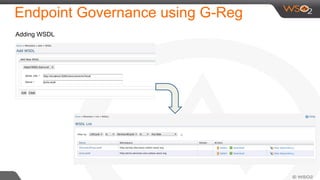
Endpoint Governance using G-Reg
Adding WSDL
Endpoint Governance using G-Reg
WSDL View
Endpoint Governance using G-Reg
Service View
Endpoint Governance using G-Reg
Creating Proxy Service Using the Service Endpoints
Endpoint Governance using G-Reg
Governing Service Across Lifecycle States
Endpoint Governance using G-Reg
Governing Service Across Lifecycle States
Endpoint Governance using G-Reg
Production….
Endpoint Governance using G-Reg
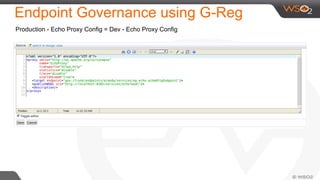
Production - Echo Proxy Config = Dev - Echo Proxy Config
G-Reg Governance Features
❏  Built-­‐in	
  SOA	
  arNfacts	
  support	
  
❏  Support	
  for	
  common	
  types	
  (Services,	
  WSDL,	
  Schema,	
  Policy,	
  APIs,	
  Providers,	
  
Documents,	
  URIs,	
  WADLs,	
  Endpoints,	
  Proxies,	
  Sequences)	
  
❏  ValidaNon	
  policies	
  -­‐	
  	
  e.g.	
  WSDL	
  ValidaNon,	
  WS-­‐I	
  ValidaNon,	
  and	
  Schema	
  
ValidaNon	
  
❏  Governance	
  Archive	
  (.gar)	
  for	
  uploading	
  arNfacts	
  with	
  imports	
  
❏  WSDL	
  Tool	
  to	
  import	
  service	
  informaNon	
  from	
  a	
  given	
  WSDL,	
  and	
  WSDL	
  
custom-­‐view	
  
❏  WS	
  API	
  for	
  built-­‐in	
  arNfacts	
  (CRUD	
  OperaNon	
  Support)	


G-Reg Governance Features (Cont.)
❏  Lifecycle	
  support	
  
❏  Built-­‐in	
  service	
  lifecycle	
  
❏  Advanced	
  lifecycle	
  management	
  	
  
❏  checklists	
  
❏  scripNng	
  support	
  
❏  transiNon	
  validaNon	
  
❏  transiNon	
  UI	
  
❏  Lifecycle	
  Workflow	
  IntegraNon	
  
❏  XML	
  editor	
  for	
  ediNng	
  lifecycle	
  
❏  Lifecycle	
  state	
  transiNon	
  through	
  governance	
  API	
  
❏  Approval	
  for	
  lifecycle	
  operaNons	
  
❏  Lifecycle	
  audit	


G-Reg Governance Features (Cont.)
❏  Governance	
  registry	
  extensions	
  
❏  Configurable	
  Governance	
  ArNfacts	
  (RXTs)	
  
❏  Various	
  field	
  support	
  (text,	
  text-­‐area,	
  opNons,	
  opNon-­‐text,	
  date)	
  
❏  Unbounded	
  field	
  support	
  
❏  Tool-­‐Np	
  feature	
  
❏  Reg-­‐ex	
  validaNon	
  support	
  
❏  Lifecycle	
  in	
  RXT	
  DefiniNon	
  
❏  API	
  to	
  govern	
  SOA	
  arNfacts	
  
❏  Pluggable	
  media	
  type	
  handlers	
  for	
  handling	
  custom	
  media	
  types	
  and	
  XML	
  
editor	
  for	
  ediNng	
  handler	
  
❏  WS	
  API	
  for	
  Governance	
  ArNfacts	
  (CRUD	
  OperaNon	
  Support)	


G-Reg Governance Features (Cont.)
❏  Miscellaneous	
  
❏  InternaNonalizaNon	
  
❏  Worklist	
  noNficaNons	
  
❏  Dependency	
  management	
  
❏  WS-­‐Discovery	
  support	


Conclusion
o  SOA	
  governance	
  plays	
  a	
  huge	
  role	
  in	
  an	
  enterprise	
  and	
  helps	
  the	
  industry	
  solve	
  
emerging	
  issues.	
  A	
  majority	
  of	
  the	
  SOA	
  industry	
  has	
  adopted,	
  or	
  is	
  in	
  the	
  process	
  
of	
   adopNng,	
   SOA	
   governance	
   into	
   their	
   systems	
   to	
   maximize	
   producNvity	
   and	
  
profitability	
  of	
  both	
  SOA	
  designs	
  and	
  SOA	
  producNon	
  systems.	
  
o  SOA	
   governance	
   can	
   be	
   categorized	
   into	
   two	
   major	
   phases:	
   Design	
   Time	
  
Governance	
  and	
  RunNme	
  Governance.	
  
o  WSO2	
  Governance	
  Registry	
  can	
  be	
  use	
  in	
  both	
  governance	
  phases	
  and	
  there	
  are	
  
numerous	
   OOTB	
   features	
   and	
   extension	
   points	
   to	
   implement	
   a	
   complete	
  
governance	
  story.	


Questions?
Business	
  Model	
  
More Information !
1.  hgp://wso2.com/products/governance-­‐registry/	
  
2.  hgp://docs.wso2.com/display/Governance460/Governing+External+References
+Across+Environments	
  
References
1.  Thomas	
  Erl	
  ...	
  [et	
  al.],	
  SOA	
  governance	
  :	
  governing	
  shared	
  services	
  on-­‐premise	
  
and	
  in	
  the	
  cloud	
  
Contact us !

Design Time and Run Time Governance

  • 1.
    About the Presenter Eranda  Sooriyabandara  is  a  member  of  the   Governance  Registry  team  at  WSO2   e-­‐mail  :  eranda@wso2.com    
  • 2.
    About  WSO2   ❏ Global  enterprise,  founded  in  2005   by  acknowledged  leaders  in  XML,   web  services    technologies,   standards    and  open  source   ❏  Provides  only  open  source  plaGorm-­‐ as-­‐a-­‐service  for  private,  public  and   hybrid  cloud  deployments   ❏  All  WSO2  products  are  100%  open   source  and  released  under  the   Apache  License  Version  2.0.   ❏  Is  an  AcNve  Member  of  OASIS,  Cloud   Security  Alliance,  OSGi  Alliance,   AMQP  Working  Group,  OpenID   FoundaNon  and  W3C.     ❏  Driven  by  InnovaNon   ❏  Launched first open source API Management solution in 2012 ❏  Launched App Factory in 2Q 2013 ❏  Launched Enterprise Store and first open source Mobile solution in 4Q 2013  
  • 4.
    Overview ❏  SOA Governance ❏ SOA Governance Phases ❏  Design Time Governance ❏  Runtime Governance ❏  WSO2 Governance Registry ❏  Governance Use Cases ❏  Demo ❏  WSO2 Governance Registry Governance Features ❏  Conclusion
  • 5.
    SOA Governance “Ensuring  and  validaNng  that  assets  and   arNfacts  within  the  architecture  are  acNng  as   expected  and  maintaining  a  certain  level  of   quality”  -­‐  Gartner  
  • 6.
    SOA Governance In  a  nutshell,  SOA  governance  is  all  about   making  sure  that  you're  building  the  right   system  and  ensuring  it  operates  to  your   expectaCons.  
  • 7.
    SOA Governance Activities thatare often mentioned as being part of SOA governance ❏  Managing the portfolio of SOA artifacts ❏  Managing the SOA artifact lifecycle ❏  Using policies to restrict behavior ❏  Monitoring, analysing and presenting artifact data ❏  Managing how and by whom SOA artifacts are used  
  • 8.
    SOA Governance Phases SOAgovernance can be broken into phases on their point of application 1.  Design Time SOA Governance 2.  Runtime SOA Governance
  • 9.
    Design Time SOAGovernance o  Design  Nme  governance  refers  to  the  defining  and   controlling  enterprise  services  creaNon.       o  It  involves  crea-on  of  enterprise  policies  used  to  ensure  that   enterprise  business  models  are  properly  funded  within  the   enterprise.  
  • 10.
    Runtime SOA Governance o RunNme  governance  refers  to  the  process  of  enforcing  the   adherence  to  run-­‐Nme  service  policies.       o  In  addiNon  to  policy  enforcement,  this  term  is  oXen  used  to   include  aspects  of  SOA  management  as  it  relates  to  these   policies.     o  Also  include  real-­‐Nme  policy  compliance  monitoring,   audi-ng  and  measuring,  as  well  as  collec-ng  result   sta-s-cs.    
  • 11.
    WSO2 Governance Registry ❏ A   Service   Oriented   Architecture   (SOA)   integrated   registry   repository  to  store,  manage  and  govern  service  arNfacts   ❏  Flexible  and  Extensible   ❏  Fully  open  source   ❏  Supports   numerous   standards   (JMX,   SCM,   UDDI,   WebDAV,   WS-­‐Discovery  ,CMIS)   ❏  Licensed  under  Apache  License  Version  2.0    
  • 12.
  • 13.
    Use Case 1: Handling Policies o  OrganizaNons  have  their  own  policies  which  can  be  hundred  to  thousands  in  numbers.   o  When  developing  a  service  there’s  no  way  of  idenNfying    what  policies  organizaNon   already  have  and  what  policies  they  want  to  use  in  the  service.  (No  discovery  and   reuse)   o  If  different  systems  tries  to  keep  the  policies  with  them  then  when  there  is  an  update   to  that  policy  system  admins  have  to  update  them  separately.  (No  centralizaNon)   o  When  service  lifecycle  changes  then  moving  policies  to  different  environment  need  to   be  done  manually.  (No  automaNon)   o  If  a  policy  moved  to  a  different  lifecycle  state  then  there  is  no  way  of  knowing  it  for   the  interested  party.  (No  noNficaNon)   o  Eg.  If  lifecycle  state  changed  to  Development  to  QA  then  quality  assurance   engineers  may  not  know  that  there  is  a  new  arNfact  in  QA  state  to  test.  
  • 14.
    Policy Governance usingG-Reg Governance Space for Production Governance Space for QA Governance Space for Development Governance Space Governance Space Governance Space Dev QA Promote Promote Demote Demote Prod
  • 15.
    Policy Governance usingG-Reg Creating XACML Policy
  • 16.
    Policy Governance usingG-Reg Distributed PDP Management
  • 17.
    Policy Governance usingG-Reg Reverse Lookup
  • 18.
    Policy Governance usingG-Reg Governing Policies Across Lifecycle States
  • 19.
    Policy Governance usingG-Reg Subscribing to Notification
  • 20.
    Use Case 2: Handling Endpoints o  OrganizaNons  have  their  own  services  which  can  be  hundred  to  thousands  in   numbers.  Also  there  can  be  service  which  they  are  using.   o  When  developing  a  service  there’s  no  way  of  idenNfying    what  services  organizaNon   already  have  and  what  services  they  want  to  use  in  the  service.  (No  discovery  and   reuse)   o  If  different  systems  tries  to  keep  the  service  references  with  them  then  when  there  is   an  update  to  that  service  system  admins  have  to  update  them  separately.  (No   centralizaNon)   o  When  service  lifecycle  changes  then  moving  services  with  all  the  related  arNfacts  to   different  environment  need  to  be  done  manually.  (No  automaNon)   o  If  a  service  moved  to  a  different  lifecycle  state  then  there  is  no  way  of  knowing  it  for   the  interested  party.  (No  noNficaNon)   o  Eg.  If  lifecycle  state  changed  to  Development  to  QA  then  quality  assurance   engineers  may  not  know  that  there  is  a  new  arNfacts  in  QA  state  to  test.    
  • 21.
    Endpoints Governance usingG-Reg Governance Space for Production Governance Space for QA Governance Space for Development Governance Space Governance Space Governance SpaceDev QA Prod Promote Promote Demote Demote
  • 22.
    Endpoint Governance usingG-Reg Adding WSDL
  • 23.
  • 24.
    Endpoint Governance usingG-Reg Service View
  • 25.
    Endpoint Governance usingG-Reg Creating Proxy Service Using the Service Endpoints
  • 26.
    Endpoint Governance usingG-Reg Governing Service Across Lifecycle States
  • 27.
    Endpoint Governance usingG-Reg Governing Service Across Lifecycle States
  • 28.
    Endpoint Governance usingG-Reg Production….
  • 29.
    Endpoint Governance usingG-Reg Production - Echo Proxy Config = Dev - Echo Proxy Config
  • 31.
    G-Reg Governance Features ❏ Built-­‐in  SOA  arNfacts  support   ❏  Support  for  common  types  (Services,  WSDL,  Schema,  Policy,  APIs,  Providers,   Documents,  URIs,  WADLs,  Endpoints,  Proxies,  Sequences)   ❏  ValidaNon  policies  -­‐    e.g.  WSDL  ValidaNon,  WS-­‐I  ValidaNon,  and  Schema   ValidaNon   ❏  Governance  Archive  (.gar)  for  uploading  arNfacts  with  imports   ❏  WSDL  Tool  to  import  service  informaNon  from  a  given  WSDL,  and  WSDL   custom-­‐view   ❏  WS  API  for  built-­‐in  arNfacts  (CRUD  OperaNon  Support)      
  • 32.
    G-Reg Governance Features(Cont.) ❏  Lifecycle  support   ❏  Built-­‐in  service  lifecycle   ❏  Advanced  lifecycle  management     ❏  checklists   ❏  scripNng  support   ❏  transiNon  validaNon   ❏  transiNon  UI   ❏  Lifecycle  Workflow  IntegraNon   ❏  XML  editor  for  ediNng  lifecycle   ❏  Lifecycle  state  transiNon  through  governance  API   ❏  Approval  for  lifecycle  operaNons   ❏  Lifecycle  audit    
  • 33.
    G-Reg Governance Features(Cont.) ❏  Governance  registry  extensions   ❏  Configurable  Governance  ArNfacts  (RXTs)   ❏  Various  field  support  (text,  text-­‐area,  opNons,  opNon-­‐text,  date)   ❏  Unbounded  field  support   ❏  Tool-­‐Np  feature   ❏  Reg-­‐ex  validaNon  support   ❏  Lifecycle  in  RXT  DefiniNon   ❏  API  to  govern  SOA  arNfacts   ❏  Pluggable  media  type  handlers  for  handling  custom  media  types  and  XML   editor  for  ediNng  handler   ❏  WS  API  for  Governance  ArNfacts  (CRUD  OperaNon  Support)      
  • 34.
    G-Reg Governance Features(Cont.) ❏  Miscellaneous   ❏  InternaNonalizaNon   ❏  Worklist  noNficaNons   ❏  Dependency  management   ❏  WS-­‐Discovery  support      
  • 35.
    Conclusion o  SOA  governance  plays  a  huge  role  in  an  enterprise  and  helps  the  industry  solve   emerging  issues.  A  majority  of  the  SOA  industry  has  adopted,  or  is  in  the  process   of   adopNng,   SOA   governance   into   their   systems   to   maximize   producNvity   and   profitability  of  both  SOA  designs  and  SOA  producNon  systems.   o  SOA   governance   can   be   categorized   into   two   major   phases:   Design   Time   Governance  and  RunNme  Governance.   o  WSO2  Governance  Registry  can  be  use  in  both  governance  phases  and  there  are   numerous   OOTB   features   and   extension   points   to   implement   a   complete   governance  story.      
  • 36.
  • 37.
  • 38.
    More Information ! 1. hgp://wso2.com/products/governance-­‐registry/   2.  hgp://docs.wso2.com/display/Governance460/Governing+External+References +Across+Environments  
  • 39.
    References 1.  Thomas  Erl  ...  [et  al.],  SOA  governance  :  governing  shared  services  on-­‐premise   and  in  the  cloud  
  • 40.