DISABILITY PERSPECTIVES
AND LAWS
NATIONAL COUNCIL ON DISABILITY AFFAIRS
Republic of the Philippines
“Empowering Persons with Disabilities through Responsive Policies, Programs, and Services”
NATIONAL COUNCIL ON DISABILITY AFFAIRS
Republic of the Philippines
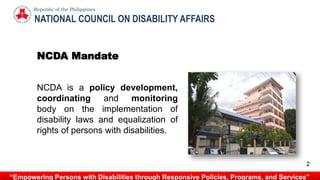
NCDA is a policy development,
coordinating and monitoring
body on the implementation of
disability laws and equalization of
rights of persons with disabilities.
NCDA Mandate
2
NATIONAL COUNCIL ON DISABILITY AFFAIRS
Republic of the Philippines
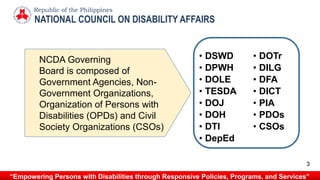
NCDA Governing
Board is composed of
Government Agencies, Non-
Government Organizations,
Organization of Persons with
Disabilities (OPDs) and Civil
Society Organizations (CSOs)
• DSWD
• DPWH
• DOLE
• TESDA
• DOJ
• DOH
• DTI
• DepEd
• DOTr
• DILG
• DFA
• DICT
• PIA
• PDOs
• CSOs
“Empowering Persons with Disabilities through Responsive Policies, Programs, and Services”
3
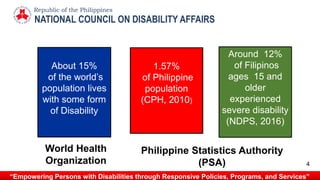
About 15%
of the world’s
population lives
with some form
of Disability
1.57%
of Philippine
population
(CPH, 2010)
World Health
Organization
Philippine Statistics Authority
(PSA)
NATIONAL COUNCIL ON DISABILITY AFFAIRS
Republic of the Philippines
“Empowering Persons with Disabilities through Responsive Policies, Programs, and Services”
Around 12%
of Filipinos
ages 15 and
older
experienced
severe disability
(NDPS, 2016)
4
NATIONAL COUNCIL ON DISABILITY AFFAIRS
Republic of the Philippines
“Empowering Persons with Disabilities through Responsive Policies, Programs, and Services”
Persons with disabilities
Include those who have long term physical, mental, intellectual and
sensory impairment which in interaction with various barriers may hinder
their full and effective participation in society on an equal basis with
others.
(UN Convention on the Rights of Persons with Disabilities (UNCRPD)
5
NATIONAL COUNCIL ON DISABILITY AFFAIRS
Republic of the Philippines
Who are Persons with Disabilities?
RA 7277, Magna Carta for Persons with Disabilities and other special
laws such as RA 11215 and RA 10747
 A person suffering from restriction or different abilities, as a result of a
mental, physical or sensory impairment, to perform an activity in a
manner or within the range considered normal for human being.
 Impairment – any loss, diminution or aberration of functions
“Empowering Persons with Disabilities through Responsive Policies, Programs, and Services”
6
Disability shall mean:
(1) a physical or mental impairment that substantially limits one or more
psychological, physiological or anatomical function of an individual or
activities of such individual;
(2) a record of such an impairment; or
(3) being regarded as having such an impairment; (e.g. Cancer, Rare
Diseases)
NATIONAL COUNCIL ON DISABILITY AFFAIRS
Republic of the Philippines
“Empowering Persons with Disabilities through Responsive Policies, Programs, and Services”
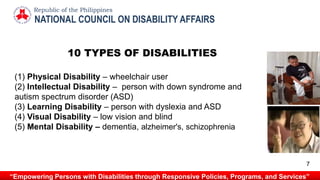
10 TYPES OF DISABILITIES
(1) Physical Disability – wheelchair user
(2) Intellectual Disability – person with down syndrome and
autism spectrum disorder (ASD)
(3) Learning Disability – person with dyslexia and ASD
(4) Visual Disability – low vision and blind
(5) Mental Disability – dementia, alzheimer's, schizophrenia
7
NATIONAL COUNCIL ON DISABILITY AFFAIRS
Republic of the Philippines
“Empowering Persons with Disabilities through Responsive Policies, Programs, and Services”
(6) Psychosocial Disability – bipolar, prolonged depression
(7) Deaf/Hard of Hearing
(8) Speech and Language impairment - stuttering, cleft palate
(9) Cancer (RA11215) – leukemia, lymphoma
(10) Rare Disease (RA 10747) – maple syrup urine disease, rett
syndrome
8
NATIONAL COUNCIL ON DISABILITY AFFAIRS
Republic of the Philippines
“Empowering Persons with Disabilities through Responsive Policies, Programs, and Services”
Persons with Disabilities face BARRIERS that hinder their full and
effective participation in society on an equal basis with others.
 Physical – non-compliant to structural standards
 Information and Communication – non-compliant to
accessibility standards
 Policy and System – discrimination in employment,
non-availability of reasonable accommodation
 Attitudinal – severe ridicule, biases and stereotypes
9
 Disability awareness activities - conduct Disability Sensitivity
Training
 Accessibility - follow accessibility standards
 Disability support services - provide sign language
interpretation, live assistance, assistive devices
 Reasonable accommodation - provide necessary and
appropriate modification and adjustments not imposing a
disproportionate or undue burden
NATIONAL COUNCIL ON DISABILITY AFFAIRS
Republic of the Philippines
“Empowering Persons with Disabilities through Responsive Policies, Programs, and Services”
10
How to Address the Barriers Encountered by
Persons with Disabilities?
Examples of Reasonable Accommodation:
 Physical accessibility in selection of meeting venues
 Use of simple and easy to understand instructions
 Use of captions, subtitles and sign language insets in
videos
 Accessible formats of information materials
NATIONAL COUNCIL ON DISABILITY AFFAIRS
Republic of the Philippines
“Empowering Persons with Disabilities through Responsive Policies, Programs, and Services”
11
NATIONAL COUNCIL ON DISABILITY AFFAIRS
Republic of the Philippines
“Empowering Persons with Disabilities through Responsive Policies, Programs, and Services”
 Person first language - all references to disabled
persons should be changed to persons with disability.
 “Deaf” not “deaf and mute”
 “Person with Intellectual Disability” not mentally retarded
 “Non-disabled” not “normal” to refer to people without
disabilities
Rights-based Disability Terminologies and
Etiquette
12
NATIONAL COUNCIL ON DISABILITY AFFAIRS
Republic of the Philippines
“Empowering Persons with Disabilities through Responsive Policies, Programs, and Services”
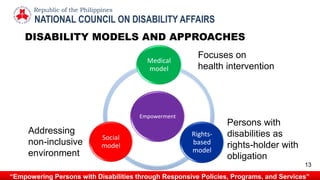
Empowerment
Medical
model
Rights-
based
model
Social
model
Focuses on
health intervention
Addressing
non-inclusive
environment
Persons with
disabilities as
rights-holder with
obligation
DISABILITY MODELS AND APPROACHES
13
Disability Laws
NATIONAL COUNCIL ON DISABILITY AFFAIRS
Republic of the Philippines
“Empowering Persons with Disabilities through Responsive Policies, Programs, and Services”
14
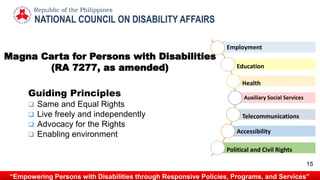
Employment
Education
Health
Auxiliary Social Services
Telecommunications
Accessibility
Political and Civil Rights
Guiding Principles
 Same and Equal Rights
 Live freely and independently
 Advocacy for the Rights
 Enabling environment
NATIONAL COUNCIL ON DISABILITY AFFAIRS
Republic of the Philippines
“Empowering Persons with Disabilities through Responsive Policies, Programs, and Services”
Magna Carta for Persons with Disabilities
(RA 7277, as amended)
15
Benefits And Privileges Of Persons With
Disability (RA 9442 and 10754)
 Entitled to 20% discounts and 12% VAT exemption if applicable,
on certain goods and services.
 5% discounts on purchase of basic and prime commodities (DA
and DTI)
 3% discounts for Non-VAT companies (still under further study)
 Express lanes
 Educational assistance through the provision of scholarship,
grants
NATIONAL COUNCIL ON DISABILITY AFFAIRS
Republic of the Philippines
“Empowering Persons with Disabilities through Responsive Policies, Programs, and Services”
16
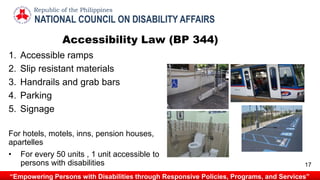
1. Accessible ramps
2. Slip resistant materials
3. Handrails and grab bars
4. Parking
5. Signage
For hotels, motels, inns, pension houses,
apartelles
• For every 50 units , 1 unit accessible to
persons with disabilities
Accessibility Law (BP 344)
NATIONAL COUNCIL ON DISABILITY AFFAIRS
Republic of the Philippines
“Empowering Persons with Disabilities through Responsive Policies, Programs, and Services”
17
PDAO Law (RA 10070)
Establishment of Persons with Disabilities Affairs Office
(PDAO) in every province, city and municipality
NATIONAL COUNCIL ON DISABILITY AFFAIRS
Republic of the Philippines
“Empowering Persons with Disabilities through Responsive Policies, Programs, and Services”
18
Accessible Polling Places (RA 10366)
 Ensure that persons with disabilities and senior citizens
are able to exercise their right to political participation
without discrimination or restrictions.
 The State shall design systems and procedures that will
enable persons with disabilities and senior citizens to
register and vote by themselves.
 Issuance of the COMELEC Resolution 10761
NATIONAL COUNCIL ON DISABILITY AFFAIRS
Republic of the Philippines
“Empowering Persons with Disabilities through Responsive Policies, Programs, and Services”
19
Equal Opportunity for Employment (RA 10524)
 No person with disability shall be denied access to
opportunities for suitable employment.
 A qualified employee with disability shall be subject to
the same terms and conditions of employment and the
same compensation, privileges, benefits, fringe benefits,
incentives or allowances as a qualified able bodied
person.
NATIONAL COUNCIL ON DISABILITY AFFAIRS
Republic of the Philippines
“Empowering Persons with Disabilities through Responsive Policies, Programs, and Services”
20
Filipino Sign Language Act (RA 11106)
Recognition of FSL as the national sign language of the
Philippines, without prejudice to the use of other forms of
communication depending on individual choice or
preference.
NATIONAL COUNCIL ON DISABILITY AFFAIRS
Republic of the Philippines
“Empowering Persons with Disabilities through Responsive Policies, Programs, and Services”
21
Mandatory PhilHealth Coverage (RA 11228)
 For unemployed, PhilHealth monthly premium contributions shall
be paid by the national government
 For employed, premium contributions shall be shared equally by
their employers and the national government
 Special packages to be developed exclusively for person with
disabilities such as assistive devices and rehabilitation services
NATIONAL COUNCIL ON DISABILITY AFFAIRS
Republic of the Philippines
“Empowering Persons with Disabilities through Responsive Policies, Programs, and Services”
22
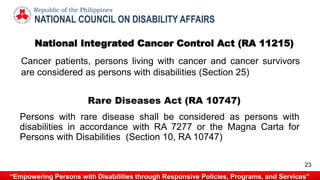
Persons with rare disease shall be considered as persons with
disabilities in accordance with RA 7277 or the Magna Carta for
Persons with Disabilities (Section 10, RA 10747)
Rare Diseases Act (RA 10747)
NATIONAL COUNCIL ON DISABILITY AFFAIRS
Republic of the Philippines
“Empowering Persons with Disabilities through Responsive Policies, Programs, and Services”
23
National Integrated Cancer Control Act (RA 11215)
Cancer patients, persons living with cancer and cancer survivors
are considered as persons with disabilities (Section 25)
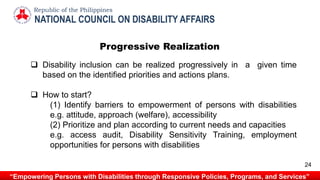
 Disability inclusion can be realized progressively in a given time
based on the identified priorities and actions plans.
 How to start?
(1) Identify barriers to empowerment of persons with disabilities
e.g. attitude, approach (welfare), accessibility
(2) Prioritize and plan according to current needs and capacities
e.g. access audit, Disability Sensitivity Training, employment
opportunities for persons with disabilities
NATIONAL COUNCIL ON DISABILITY AFFAIRS
Republic of the Philippines
“Empowering Persons with Disabilities through Responsive Policies, Programs, and Services”
24
Progressive Realization
Let us work together in empowering Persons with Disabilities
through responsive policies, programs and services.
25
“Empowering Persons with Disabilities through Responsive Policies, Programs, and Services”
NATIONAL COUNCIL ON DISABILITY AFFAIRS
Republic of the Philippines
ENGR. EMERITO L. ROJAS
Executive Director, NCDA
THANK YOU!
Tel. Nos: (02) 8932-6422; 8951-6033
Email:council@ncda.gov.ph
ncda.action.center@gmail.com
26

DST - Disability Perspectives & Laws - 05122022.pptx

  • 1.
    DISABILITY PERSPECTIVES AND LAWS NATIONALCOUNCIL ON DISABILITY AFFAIRS Republic of the Philippines
  • 2.
    “Empowering Persons withDisabilities through Responsive Policies, Programs, and Services” NATIONAL COUNCIL ON DISABILITY AFFAIRS Republic of the Philippines NCDA is a policy development, coordinating and monitoring body on the implementation of disability laws and equalization of rights of persons with disabilities. NCDA Mandate 2
  • 3.
    NATIONAL COUNCIL ONDISABILITY AFFAIRS Republic of the Philippines NCDA Governing Board is composed of Government Agencies, Non- Government Organizations, Organization of Persons with Disabilities (OPDs) and Civil Society Organizations (CSOs) • DSWD • DPWH • DOLE • TESDA • DOJ • DOH • DTI • DepEd • DOTr • DILG • DFA • DICT • PIA • PDOs • CSOs “Empowering Persons with Disabilities through Responsive Policies, Programs, and Services” 3
  • 4.
    About 15% of theworld’s population lives with some form of Disability 1.57% of Philippine population (CPH, 2010) World Health Organization Philippine Statistics Authority (PSA) NATIONAL COUNCIL ON DISABILITY AFFAIRS Republic of the Philippines “Empowering Persons with Disabilities through Responsive Policies, Programs, and Services” Around 12% of Filipinos ages 15 and older experienced severe disability (NDPS, 2016) 4
  • 5.
    NATIONAL COUNCIL ONDISABILITY AFFAIRS Republic of the Philippines “Empowering Persons with Disabilities through Responsive Policies, Programs, and Services” Persons with disabilities Include those who have long term physical, mental, intellectual and sensory impairment which in interaction with various barriers may hinder their full and effective participation in society on an equal basis with others. (UN Convention on the Rights of Persons with Disabilities (UNCRPD) 5
  • 6.
    NATIONAL COUNCIL ONDISABILITY AFFAIRS Republic of the Philippines Who are Persons with Disabilities? RA 7277, Magna Carta for Persons with Disabilities and other special laws such as RA 11215 and RA 10747  A person suffering from restriction or different abilities, as a result of a mental, physical or sensory impairment, to perform an activity in a manner or within the range considered normal for human being.  Impairment – any loss, diminution or aberration of functions “Empowering Persons with Disabilities through Responsive Policies, Programs, and Services” 6 Disability shall mean: (1) a physical or mental impairment that substantially limits one or more psychological, physiological or anatomical function of an individual or activities of such individual; (2) a record of such an impairment; or (3) being regarded as having such an impairment; (e.g. Cancer, Rare Diseases)
  • 7.
    NATIONAL COUNCIL ONDISABILITY AFFAIRS Republic of the Philippines “Empowering Persons with Disabilities through Responsive Policies, Programs, and Services” 10 TYPES OF DISABILITIES (1) Physical Disability – wheelchair user (2) Intellectual Disability – person with down syndrome and autism spectrum disorder (ASD) (3) Learning Disability – person with dyslexia and ASD (4) Visual Disability – low vision and blind (5) Mental Disability – dementia, alzheimer's, schizophrenia 7
  • 8.
    NATIONAL COUNCIL ONDISABILITY AFFAIRS Republic of the Philippines “Empowering Persons with Disabilities through Responsive Policies, Programs, and Services” (6) Psychosocial Disability – bipolar, prolonged depression (7) Deaf/Hard of Hearing (8) Speech and Language impairment - stuttering, cleft palate (9) Cancer (RA11215) – leukemia, lymphoma (10) Rare Disease (RA 10747) – maple syrup urine disease, rett syndrome 8
  • 9.
    NATIONAL COUNCIL ONDISABILITY AFFAIRS Republic of the Philippines “Empowering Persons with Disabilities through Responsive Policies, Programs, and Services” Persons with Disabilities face BARRIERS that hinder their full and effective participation in society on an equal basis with others.  Physical – non-compliant to structural standards  Information and Communication – non-compliant to accessibility standards  Policy and System – discrimination in employment, non-availability of reasonable accommodation  Attitudinal – severe ridicule, biases and stereotypes 9
  • 10.
     Disability awarenessactivities - conduct Disability Sensitivity Training  Accessibility - follow accessibility standards  Disability support services - provide sign language interpretation, live assistance, assistive devices  Reasonable accommodation - provide necessary and appropriate modification and adjustments not imposing a disproportionate or undue burden NATIONAL COUNCIL ON DISABILITY AFFAIRS Republic of the Philippines “Empowering Persons with Disabilities through Responsive Policies, Programs, and Services” 10 How to Address the Barriers Encountered by Persons with Disabilities?
  • 11.
    Examples of ReasonableAccommodation:  Physical accessibility in selection of meeting venues  Use of simple and easy to understand instructions  Use of captions, subtitles and sign language insets in videos  Accessible formats of information materials NATIONAL COUNCIL ON DISABILITY AFFAIRS Republic of the Philippines “Empowering Persons with Disabilities through Responsive Policies, Programs, and Services” 11
  • 12.
    NATIONAL COUNCIL ONDISABILITY AFFAIRS Republic of the Philippines “Empowering Persons with Disabilities through Responsive Policies, Programs, and Services”  Person first language - all references to disabled persons should be changed to persons with disability.  “Deaf” not “deaf and mute”  “Person with Intellectual Disability” not mentally retarded  “Non-disabled” not “normal” to refer to people without disabilities Rights-based Disability Terminologies and Etiquette 12
  • 13.
    NATIONAL COUNCIL ONDISABILITY AFFAIRS Republic of the Philippines “Empowering Persons with Disabilities through Responsive Policies, Programs, and Services” Empowerment Medical model Rights- based model Social model Focuses on health intervention Addressing non-inclusive environment Persons with disabilities as rights-holder with obligation DISABILITY MODELS AND APPROACHES 13
  • 14.
    Disability Laws NATIONAL COUNCILON DISABILITY AFFAIRS Republic of the Philippines “Empowering Persons with Disabilities through Responsive Policies, Programs, and Services” 14
  • 15.
    Employment Education Health Auxiliary Social Services Telecommunications Accessibility Politicaland Civil Rights Guiding Principles  Same and Equal Rights  Live freely and independently  Advocacy for the Rights  Enabling environment NATIONAL COUNCIL ON DISABILITY AFFAIRS Republic of the Philippines “Empowering Persons with Disabilities through Responsive Policies, Programs, and Services” Magna Carta for Persons with Disabilities (RA 7277, as amended) 15
  • 16.
    Benefits And PrivilegesOf Persons With Disability (RA 9442 and 10754)  Entitled to 20% discounts and 12% VAT exemption if applicable, on certain goods and services.  5% discounts on purchase of basic and prime commodities (DA and DTI)  3% discounts for Non-VAT companies (still under further study)  Express lanes  Educational assistance through the provision of scholarship, grants NATIONAL COUNCIL ON DISABILITY AFFAIRS Republic of the Philippines “Empowering Persons with Disabilities through Responsive Policies, Programs, and Services” 16
  • 17.
    1. Accessible ramps 2.Slip resistant materials 3. Handrails and grab bars 4. Parking 5. Signage For hotels, motels, inns, pension houses, apartelles • For every 50 units , 1 unit accessible to persons with disabilities Accessibility Law (BP 344) NATIONAL COUNCIL ON DISABILITY AFFAIRS Republic of the Philippines “Empowering Persons with Disabilities through Responsive Policies, Programs, and Services” 17
  • 18.
    PDAO Law (RA10070) Establishment of Persons with Disabilities Affairs Office (PDAO) in every province, city and municipality NATIONAL COUNCIL ON DISABILITY AFFAIRS Republic of the Philippines “Empowering Persons with Disabilities through Responsive Policies, Programs, and Services” 18
  • 19.
    Accessible Polling Places(RA 10366)  Ensure that persons with disabilities and senior citizens are able to exercise their right to political participation without discrimination or restrictions.  The State shall design systems and procedures that will enable persons with disabilities and senior citizens to register and vote by themselves.  Issuance of the COMELEC Resolution 10761 NATIONAL COUNCIL ON DISABILITY AFFAIRS Republic of the Philippines “Empowering Persons with Disabilities through Responsive Policies, Programs, and Services” 19
  • 20.
    Equal Opportunity forEmployment (RA 10524)  No person with disability shall be denied access to opportunities for suitable employment.  A qualified employee with disability shall be subject to the same terms and conditions of employment and the same compensation, privileges, benefits, fringe benefits, incentives or allowances as a qualified able bodied person. NATIONAL COUNCIL ON DISABILITY AFFAIRS Republic of the Philippines “Empowering Persons with Disabilities through Responsive Policies, Programs, and Services” 20
  • 21.
    Filipino Sign LanguageAct (RA 11106) Recognition of FSL as the national sign language of the Philippines, without prejudice to the use of other forms of communication depending on individual choice or preference. NATIONAL COUNCIL ON DISABILITY AFFAIRS Republic of the Philippines “Empowering Persons with Disabilities through Responsive Policies, Programs, and Services” 21
  • 22.
    Mandatory PhilHealth Coverage(RA 11228)  For unemployed, PhilHealth monthly premium contributions shall be paid by the national government  For employed, premium contributions shall be shared equally by their employers and the national government  Special packages to be developed exclusively for person with disabilities such as assistive devices and rehabilitation services NATIONAL COUNCIL ON DISABILITY AFFAIRS Republic of the Philippines “Empowering Persons with Disabilities through Responsive Policies, Programs, and Services” 22
  • 23.
    Persons with raredisease shall be considered as persons with disabilities in accordance with RA 7277 or the Magna Carta for Persons with Disabilities (Section 10, RA 10747) Rare Diseases Act (RA 10747) NATIONAL COUNCIL ON DISABILITY AFFAIRS Republic of the Philippines “Empowering Persons with Disabilities through Responsive Policies, Programs, and Services” 23 National Integrated Cancer Control Act (RA 11215) Cancer patients, persons living with cancer and cancer survivors are considered as persons with disabilities (Section 25)
  • 24.
     Disability inclusioncan be realized progressively in a given time based on the identified priorities and actions plans.  How to start? (1) Identify barriers to empowerment of persons with disabilities e.g. attitude, approach (welfare), accessibility (2) Prioritize and plan according to current needs and capacities e.g. access audit, Disability Sensitivity Training, employment opportunities for persons with disabilities NATIONAL COUNCIL ON DISABILITY AFFAIRS Republic of the Philippines “Empowering Persons with Disabilities through Responsive Policies, Programs, and Services” 24 Progressive Realization
  • 25.
    Let us worktogether in empowering Persons with Disabilities through responsive policies, programs and services. 25 “Empowering Persons with Disabilities through Responsive Policies, Programs, and Services” NATIONAL COUNCIL ON DISABILITY AFFAIRS Republic of the Philippines ENGR. EMERITO L. ROJAS Executive Director, NCDA
  • 26.
    THANK YOU! Tel. Nos:(02) 8932-6422; 8951-6033 Email:council@ncda.gov.ph ncda.action.center@gmail.com 26

Editor's Notes

  • #15 Good afternoon everyone, thank you for inviting the NCDA to part of the month-long celebration of the 39th NDPR week celebration. My task is to give a talk on the PWD ID system and RA 10754, in relation with this year’s theme, Karapatan at Prebeliheyo ng May Kapansanan: Isakatuparan at Ipaglaban”
  • #25 Reasonable accommodation recognizes the relevance of “impairment” - if one ignores the impact of an impairment, and treats a person with a disability in exactly the same way as one treats a person without a disability, a de facto situation of inequality will arise. The term disability supports refers to any good or service that helps a person overcome barriers that come with having a disability. These barriers may get in the way of carrying out activities of daily living, or cultural, political and social activities and economic participation. There is no fixed list or category of disability supports. Any good or service is “disability-related” when it is used to assist a person or persons in overcoming barriers and in independent living. To show the range of such goods and services, they include the following*: personal help/attendant care personal planning supports