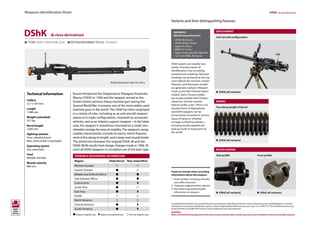
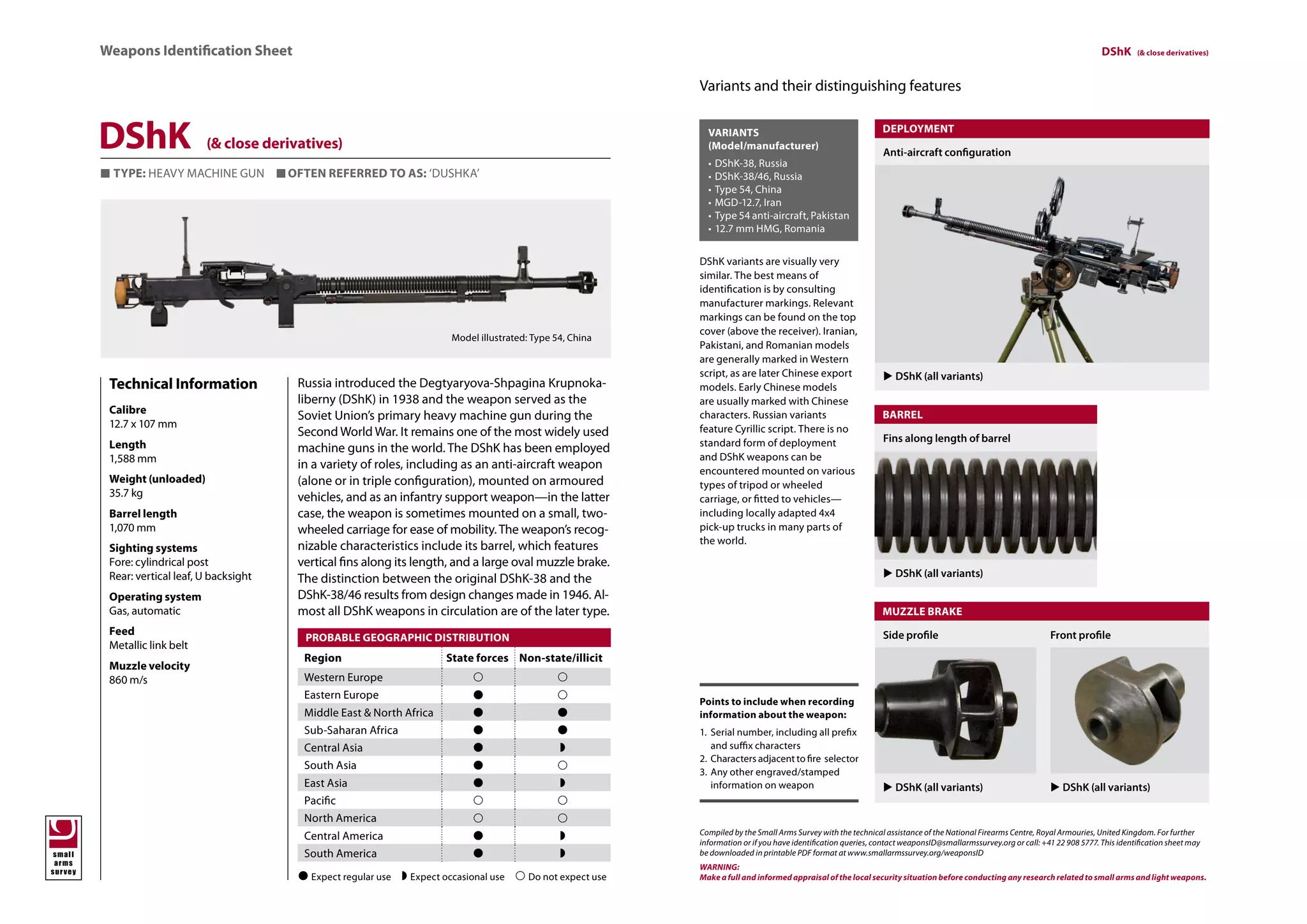
Model illustrated: Type 54, China
   Type: HEAVY MACHINE GUN   often referred to as: ‘Dushka’
Weapons Identification Sheet
DShK  (& close derivatives)
Technical Information
Calibre
12.7 x 107 mm
Length
1,588 mm
Weight (unloaded)
35.7 kg
Barrel length
1,070 mm
Sighting systems
Fore: cylindrical post
Rear: vertical leaf, U backsight
Operating system
Gas, automatic
Feed
Metallic link belt
Muzzle velocity
860 m/s
DShK variants are visually very
similar. The best means of
identification is by consulting
manufacturer markings. Relevant
markings can be found on the top
cover (above the receiver). Iranian,
Pakistani, and Romanian models
are generally marked in Western
script, as are later Chinese export
models. Early Chinese models
are usually marked with Chinese
characters. Russian variants
feature Cyrillic script. There is no
standard form of deployment
and DShK weapons can be
encountered mounted on various
types of tripod or wheeled
carriage, or fitted to vehicles—
including locally adapted 4x4
pick-up trucks in many parts of
the world.
Variants and their distinguishing features
VARIANTS
(Model/manufacturer)
•	DShK-38, Russia
•	DShK-38/46, Russia
•	Type 54, China
•	MGD-12.7, Iran
•	Type 54 anti-aircraft, Pakistan
•	12.7 mm HMG, Romania
Points to include when recording
information about the weapon:
1.	Serial number, including all prefix
and suffix characters
2.	Characters adjacent to fire selector
3.	Any other engraved/stamped
information on weapon
Region State forces Non-state/illicit
Western Europe  
Eastern Europe  
Middle East & North Africa  
Sub-Saharan Africa  
Central Asia  
South Asia  
East Asia  
Pacific  
North America  
Central America  
South America  
  Expect regular use     Expect occasional use     Do not expect use
PROBABLE GEOGRAPHIC DISTRIBUTION
Compiled by the Small Arms Survey with the technical assistance of the National Firearms Centre, Royal Armouries, United Kingdom. For further
information or if you have identification queries, contact weaponsID@smallarmssurvey.org or call: +41 22 908 5777. This identification sheet may
be downloaded in printable PDF format at www.smallarmssurvey.org/weaponsID
WARNING:
Make a full and informed appraisal of the local security situation before conducting any research related to small arms and light weapons.
Side profile
  DShK (all variants)
Front profile
  DShK (all variants)
Muzzle brake
Anti-aircraft configuration
  DShK (all variants)
Deployment
Fins along length of barrel
  DShK (all variants)
Barrel
Russia introduced the Degtyaryova-Shpagina Krupnoka-
liberny (DShK) in 1938 and the weapon served as the
Soviet Union’s primary heavy machine gun during the
Second World War. It remains one of the most widely used
machine guns in the world. The DShK has been employed
in a variety of roles, including as an anti-aircraft weapon
(alone or in triple configuration), mounted on armoured
vehicles, and as an infantry support weapon—in the latter
case, the weapon is sometimes mounted on a small, two-
wheeled carriage for ease of mobility.The weapon’s recog­-
nizable characteristics include its barrel, which features
vertical fins along its length, and a large oval muzzle brake.
The distinction between the original DShK-38 and the
DShK-38/46 results from design changes made in 1946. Al­-
most all DShK weapons in circulation are of the later type.

DShK Weapon Identification Sheet

  • 1.
    Model illustrated: Type54, China    Type: HEAVY MACHINE GUN   often referred to as: ‘Dushka’ Weapons Identification Sheet DShK  (& close derivatives) DShK  (& close derivatives) Technical Information Calibre 12.7 x 107 mm Length 1,588 mm Weight (unloaded) 35.7 kg Barrel length 1,070 mm Sighting systems Fore: cylindrical post Rear: vertical leaf, U backsight Operating system Gas, automatic Feed Metallic link belt Muzzle velocity 860 m/s DShK variants are visually very similar. The best means of identification is by consulting manufacturer markings. Relevant markings can be found on the top cover (above the receiver). Iranian, Pakistani, and Romanian models are generally marked in Western script, as are later Chinese export models. Early Chinese models are usually marked with Chinese characters. Russian variants feature Cyrillic script. There is no standard form of deployment and DShK weapons can be encountered mounted on various types of tripod or wheeled carriage, or fitted to vehicles— including locally adapted 4x4 pick-up trucks in many parts of the world. Variants and their distinguishing features VARIANTS (Model/manufacturer) • DShK-38, Russia • DShK-38/46, Russia • Type 54, China • MGD-12.7, Iran • Type 54 anti-aircraft, Pakistan • 12.7 mm HMG, Romania Points to include when recording information about the weapon: 1. Serial number, including all prefix and suffix characters 2. Characters adjacent to fire selector 3. Any other engraved/stamped information on weapon Region State forces Non-state/illicit Western Europe   Eastern Europe   Middle East & North Africa   Sub-Saharan Africa   Central Asia   South Asia   East Asia   Pacific   North America   Central America   South America     Expect regular use     Expect occasional use     Do not expect use PROBABLE GEOGRAPHIC DISTRIBUTION Compiled by the Small Arms Survey with the technical assistance of the National Firearms Centre, Royal Armouries, United Kingdom. For further information or if you have identification queries, contact weaponsID@smallarmssurvey.org or call: +41 22 908 5777. This identification sheet may be downloaded in printable PDF format at www.smallarmssurvey.org/weaponsID WARNING: Make a full and informed appraisal of the local security situation before conducting any research related to small arms and light weapons. Side profile   DShK (all variants) Front profile   DShK (all variants) Muzzle brake Anti-aircraft configuration   DShK (all variants) Deployment Fins along length of barrel   DShK (all variants) Barrel Russia introduced the Degtyaryova-Shpagina Krupnoka- liberny (DShK) in 1938 and the weapon served as the Soviet Union’s primary heavy machine gun during the Second World War. It remains one of the most widely used machine guns in the world. The DShK has been employed in a variety of roles, including as an anti-aircraft weapon (alone or in triple configuration), mounted on armoured vehicles, and as an infantry support weapon—in the latter case, the weapon is sometimes mounted on a small, two- wheeled carriage for ease of mobility.The weapon’s recog­- nizable characteristics include its barrel, which features vertical fins along its length, and a large oval muzzle brake. The distinction between the original DShK-38 and the DShK-38/46 results from design changes made in 1946. Al­- most all DShK weapons in circulation are of the later type.