Walchand College of Arts & Science, Solapur
Dr. S. N. Battin
(shankarbattin@gmail.com)
Associate Professor, Head, Dept. of Chemistry
Walchand College of Arts and Science, Solapur
(www.wcas.org)
Drugs and Their Classification
1
Walchand College of Arts & Science, Solapur
Learning Objectives
After this session, you will be able to explain-
• Meaning and qualities of a drug and
• Classification of Drugs on the basis of their medicinal
use.
2
Walchand College of Arts & Science, Solapur
Contents
• Meaning of a Drug
• Sources of Drug
• Testing of a chemical for its therapeutical value
• Qualities of an ideal drug
• Classification of Drugs
3
Walchand College of Arts & Science, Solapur
Meaning of a Drug
• WHO- A Chemical compound used to or intended to
be used for modifying physiological systems or
pathological states for the benefit of recipient
• Drug- Compound possessing therapeutical value
• Paul Ehrilch- Father of modern Chemotherapy
4
Walchand College of Arts & Science, Solapur
Sources of Drug
5
Source Examples
Plants Morphine, Quinine, Reserpine
Animals Insuline, Thyroid, Heparin
Minerals Mercury, Gold, Copper
Micro-organisms Penicillin, Bacitracin
Synthetic Aspirin, Procaine
Genetic Engineering Harmones
Walchand College of Arts & Science, Solapur
Steps in Testing of a Chemical
for its Therapeutical Value
1. In Vitro Testing
2. In Vivo Testing
3. Direct Testing
6
Walchand College of Arts & Science, Solapur
Qualities of an Ideal Drug
Drug action should be localised at the site where it is
desired to act
Should destroy the causative micro-organisms without
affecting the host tissues
Causative micro-organisms should not develop
resistance
Should not have any toxicity
Should have minimum side effects
7
Walchand College of Arts & Science, Solapur
Qualities of an Ideal Drug
 Bactericidal rather than bacteriostatic.
 Higher potency and specific action
 Should not be retained in the body for a longer period than
required
 Mode of application of drug must be easy
 Stable, safe and cost effective
8
Walchand College of Arts & Science, Solapur
Classification of Drugs
1. On the basis of Chemical structure
2. On the basis of Therapeutical action i.e. Medicinal use-
(A)Functional Drugs
(B)Chemotherapeutic agents
9
Walchand College of Arts & Science, Solapur
(A)Functional Drugs
• Modulate various physiological functions
• overcome the symptoms of discomforts.
Types of functional drugs-
1. Anesthetics-
e.g.Diethyl ether, Chloroform, Novacaine
2. Sedatives-
e.g.Lumanal
3. Hypnotics-
e.g. Veronal
10
Walchand College of Arts & Science, Solapur
(A)Functional Drugs
4. CNS stimulants-
e.g. Theobromine, Caffeine
5.Anticonvulsants-
e.g. Phenobarbitone, Thiopentone Sodium
11
Walchand College of Arts & Science, Solapur 12
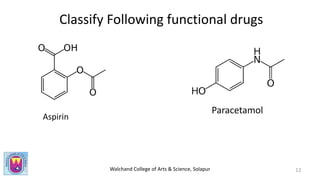
Classify Following functional drugs
Aspirin
Paracetamol
Walchand College of Arts & Science, Solapur 13
Drug Type Function
Aspirin Analgesic Relives body pains
Paracetamol Antipyretic Lowers body temperature
in fever
Answers
Walchand College of Arts & Science, Solapur
(A)Functional Drugs (continued)
6.Analgesics-
e.g. Morphine, Aspirine
7.Antipyretics-
e.g. Paracetomol, Phenacetin, Antipyrin
8.Anti-inflammatory agents-
e.g. Ibuprofen, Diclofenac
14
Walchand College of Arts & Science, Solapur
(A)Functional Drugs (continued)
9.Antihistamines-
e.g. Banadryl, Ranitidine
10.Antidiabetics-
e.g. Tolbutamide, Chlorpropamide
15
Walchand College of Arts & Science, Solapur
(B) Chemotherapeutic Agents
• used to cure the diseases caused by microbes
• Exhibit bactericidal or bacterostatic action
Types of Chemotherapeutic agents-
1. Antiseptics and Disinfectants-
e.g.Phenol, Crystal violet,Chloramine-T
2.Antimalerials-
e.g. Pamaquine, Paludrine, Chloroquine
16
Walchand College of Arts & Science, Solapur
(B) Chemotherapeutic Agents
3.Antitubercular
e.g. Isonizide, Ethambutol
4. Antileprotic agents-
e.g. Dapsone, Aminosalycylic acid
17
Walchand College of Arts & Science, Solapur
(B) Chemotherapeutic Agents (continued)
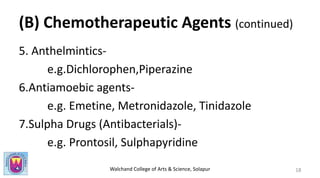
5. Anthelmintics-
e.g.Dichlorophen,Piperazine
6.Antiamoebic agents-
e.g. Emetine, Metronidazole, Tinidazole
7.Sulpha Drugs (Antibacterials)-
e.g. Prontosil, Sulphapyridine
18
Walchand College of Arts & Science, Solapur
(B) Chemotherapeutic Agents (continued)
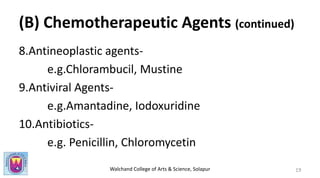
8.Antineoplastic agents-
e.g.Chlorambucil, Mustine
9.Antiviral Agents-
e.g.Amantadine, Iodoxuridine
10.Antibiotics-
e.g. Penicillin, Chloromycetin
19
Walchand College of Arts & Science, Solapur
References
1.Medicinal Chemistry by Burger
2. Medicinal Chemistry by Ashitosh Kar
3.Organic Chemistry Volume I and II by I.L. Finar,
ELBS,London
20
Walchand College of Arts & Science, Solapur
Thank you…
21

Drugs and their classification

  • 1.
    Walchand College ofArts & Science, Solapur Dr. S. N. Battin (shankarbattin@gmail.com) Associate Professor, Head, Dept. of Chemistry Walchand College of Arts and Science, Solapur (www.wcas.org) Drugs and Their Classification 1
  • 2.
    Walchand College ofArts & Science, Solapur Learning Objectives After this session, you will be able to explain- • Meaning and qualities of a drug and • Classification of Drugs on the basis of their medicinal use. 2
  • 3.
    Walchand College ofArts & Science, Solapur Contents • Meaning of a Drug • Sources of Drug • Testing of a chemical for its therapeutical value • Qualities of an ideal drug • Classification of Drugs 3
  • 4.
    Walchand College ofArts & Science, Solapur Meaning of a Drug • WHO- A Chemical compound used to or intended to be used for modifying physiological systems or pathological states for the benefit of recipient • Drug- Compound possessing therapeutical value • Paul Ehrilch- Father of modern Chemotherapy 4
  • 5.
    Walchand College ofArts & Science, Solapur Sources of Drug 5 Source Examples Plants Morphine, Quinine, Reserpine Animals Insuline, Thyroid, Heparin Minerals Mercury, Gold, Copper Micro-organisms Penicillin, Bacitracin Synthetic Aspirin, Procaine Genetic Engineering Harmones
  • 6.
    Walchand College ofArts & Science, Solapur Steps in Testing of a Chemical for its Therapeutical Value 1. In Vitro Testing 2. In Vivo Testing 3. Direct Testing 6
  • 7.
    Walchand College ofArts & Science, Solapur Qualities of an Ideal Drug Drug action should be localised at the site where it is desired to act Should destroy the causative micro-organisms without affecting the host tissues Causative micro-organisms should not develop resistance Should not have any toxicity Should have minimum side effects 7
  • 8.
    Walchand College ofArts & Science, Solapur Qualities of an Ideal Drug  Bactericidal rather than bacteriostatic.  Higher potency and specific action  Should not be retained in the body for a longer period than required  Mode of application of drug must be easy  Stable, safe and cost effective 8
  • 9.
    Walchand College ofArts & Science, Solapur Classification of Drugs 1. On the basis of Chemical structure 2. On the basis of Therapeutical action i.e. Medicinal use- (A)Functional Drugs (B)Chemotherapeutic agents 9
  • 10.
    Walchand College ofArts & Science, Solapur (A)Functional Drugs • Modulate various physiological functions • overcome the symptoms of discomforts. Types of functional drugs- 1. Anesthetics- e.g.Diethyl ether, Chloroform, Novacaine 2. Sedatives- e.g.Lumanal 3. Hypnotics- e.g. Veronal 10
  • 11.
    Walchand College ofArts & Science, Solapur (A)Functional Drugs 4. CNS stimulants- e.g. Theobromine, Caffeine 5.Anticonvulsants- e.g. Phenobarbitone, Thiopentone Sodium 11
  • 12.
    Walchand College ofArts & Science, Solapur 12 Classify Following functional drugs Aspirin Paracetamol
  • 13.
    Walchand College ofArts & Science, Solapur 13 Drug Type Function Aspirin Analgesic Relives body pains Paracetamol Antipyretic Lowers body temperature in fever Answers
  • 14.
    Walchand College ofArts & Science, Solapur (A)Functional Drugs (continued) 6.Analgesics- e.g. Morphine, Aspirine 7.Antipyretics- e.g. Paracetomol, Phenacetin, Antipyrin 8.Anti-inflammatory agents- e.g. Ibuprofen, Diclofenac 14
  • 15.
    Walchand College ofArts & Science, Solapur (A)Functional Drugs (continued) 9.Antihistamines- e.g. Banadryl, Ranitidine 10.Antidiabetics- e.g. Tolbutamide, Chlorpropamide 15
  • 16.
    Walchand College ofArts & Science, Solapur (B) Chemotherapeutic Agents • used to cure the diseases caused by microbes • Exhibit bactericidal or bacterostatic action Types of Chemotherapeutic agents- 1. Antiseptics and Disinfectants- e.g.Phenol, Crystal violet,Chloramine-T 2.Antimalerials- e.g. Pamaquine, Paludrine, Chloroquine 16
  • 17.
    Walchand College ofArts & Science, Solapur (B) Chemotherapeutic Agents 3.Antitubercular e.g. Isonizide, Ethambutol 4. Antileprotic agents- e.g. Dapsone, Aminosalycylic acid 17
  • 18.
    Walchand College ofArts & Science, Solapur (B) Chemotherapeutic Agents (continued) 5. Anthelmintics- e.g.Dichlorophen,Piperazine 6.Antiamoebic agents- e.g. Emetine, Metronidazole, Tinidazole 7.Sulpha Drugs (Antibacterials)- e.g. Prontosil, Sulphapyridine 18
  • 19.
    Walchand College ofArts & Science, Solapur (B) Chemotherapeutic Agents (continued) 8.Antineoplastic agents- e.g.Chlorambucil, Mustine 9.Antiviral Agents- e.g.Amantadine, Iodoxuridine 10.Antibiotics- e.g. Penicillin, Chloromycetin 19
  • 20.
    Walchand College ofArts & Science, Solapur References 1.Medicinal Chemistry by Burger 2. Medicinal Chemistry by Ashitosh Kar 3.Organic Chemistry Volume I and II by I.L. Finar, ELBS,London 20
  • 21.
    Walchand College ofArts & Science, Solapur Thank you… 21

Editor's Notes

  • #11 These drugs modulate various physiological functions like blood circulation, respiration, growth etc. and overcome the symptoms of discomforts due to changes in physiological activities. Types of functional drugs- 1. Anesthetics- e.g.Diethyl ether, Chloroform, Novacaine 2. Sedatives- e.g.Lumanal 3. Hypnotics- e.g. Veronal
  • #17 The drugs used to cure the diseases caused by microbes such as bacteria, viruses, protozoans etc. by their bacterial or bacterostatic action are called as Chemotherapeutic agents. Types of Chemotherapeutic agents- 1. Antiseptics and Disinfectants- e.g.Phenol, Crystal violet,Chloramine-T 2.Antimalerials- e.g. Pamaquine, Paludrine, Chloroquine