The Powers of Mind
Chapter 6
OBJECTIVES:
At the end of this module, you will be able to:
-Discuss that understanding the left and right brain
functions may help in improving one’s learning.
-Explore mind mapping techniques suited to right
brain or left brain dominant thinking styles, and
-Make a plan to improve learning using both and
right brain development.
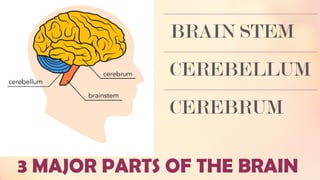
3 MAJOR PARTS OF THE BRAIN
BRAIN STEM
CEREBELLUM
CEREBRUM
BRAINSTEM
It connects the spinal cord and the
brain. Controls functions that keep people
alive such as breathing, heart rate, blood
pressure and food digestion.
CEREBELLUM
It controls voluntary movement. You may
form the thought and an area in the
cerebellum that translate your will into
action.
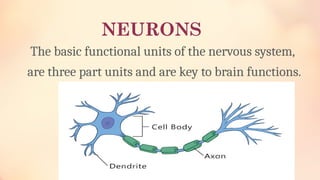
NEURONS
The basic functional units of the nervous system,
are three part units and are key to brain functions.
The signal jumps from the end of the dendrite
on one cell across the space called a
SYPNAPSE to the dendrite of another cell
with the help of chemicals called
NEUROTRANSMITTERS
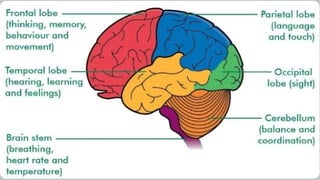
CEREBRUM
Largest of the three brain sections,
accounts for 85% of the brain’s weight
and has four lobes. The lobes-frontal,
parietal, temporal and occipital.
DRUG
DAMAGE
“The questions scientists can’t answer
now is if the damage is permanent”.
INHALANTS
Such as glue, paint, gasoline
and aerosols, destroys the outer lining
of nerve cells and make them unable
to communicate with one other.
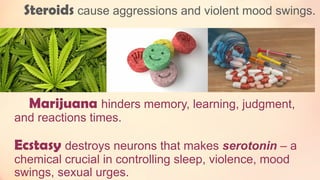
Marijuana hinders memory, learning, judgment,
and reactions times.
Ecstasy destroys neurons that makes serotonin – a
chemical crucial in controlling sleep, violence, mood
swings, sexual urges.
Steroids cause aggressions and violent mood swings.
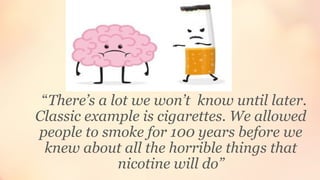
“There’s a lot we won’t know until later.
Classic example is cigarettes. We allowed
people to smoke for 100 years before we
knew about all the horrible things that
nicotine will do”
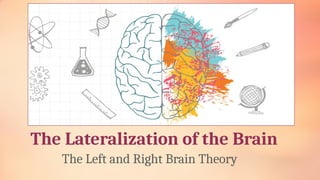
The Lateralization of the Brain
The Left and Right Brain Theory
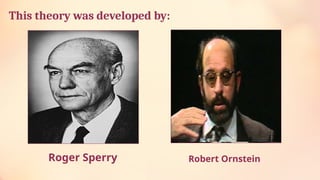
This theory was developed by:
Roger Sperry Robert Ornstein
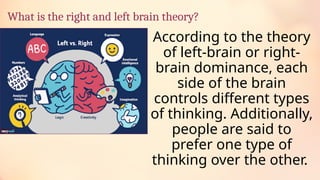
What is the right and left brain theory?
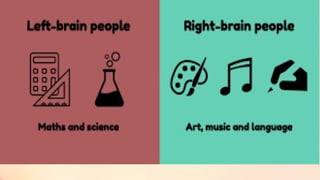
According to the theory
of left-brain or right-
brain dominance, each
side of the brain
controls different types
of thinking. Additionally,
people are said to
prefer one type of
thinking over the other.
The Right-brained Individual
The Left and Right Brain Theory
Right-brained Individual
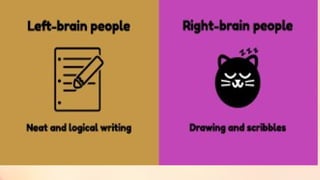
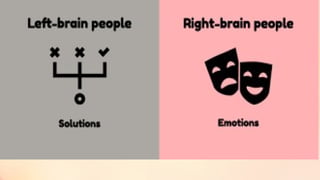
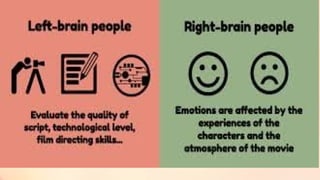
• Emotional
• Swayed by feelings.
• View things and events through feelings.
• Intuitive
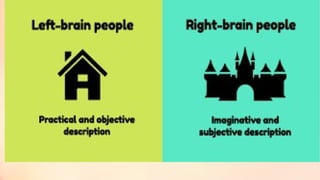
• Believers of imaginations and fantasies.
• Risk takers
• Creative
• Unpredictable
Left-brained Individual
• Organized
• Logical
• Detail-oriented
• Process ideas in methodical step-by-
step manner
• Commits less mistakes
• Favors rigid schedules and deadlines
• Auditory learners
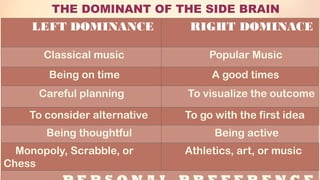
THE DOMINANT OF THE SIDE BRAIN
LEFT DOMINANCE RIGHT DOMINACE
Classical music Popular Music
Being on time A good times
Careful planning To visualize the outcome
To consider alternative To go with the first idea
Being thoughtful Being active
Monopoly, Scrabble, or
Chess
Athletics, art, or music
The Theory’s Advantages
and Disadvantages
The Left and Right Brain Theory
Advantages
• helps to improve one’s learning.
• it gives us a picture of how the two
hemispheres of the brain distinctly function.
• understanding of what areas an individual is
naturally good at and those on which he or she
needs to improve or focus.
•think of ways to boost strengths and
compensate for weaknesses
Disadvantages
• stereotyping
• creates self fulfilling prophecy.
• lowers self-esteem.
Self Fulfilling Prophecy – a prediction that
directly or indirectly causes itself to become
true, by terms of the prophecy itself due to
positive feedback between belief and
behavior.
MIND MAPS
Lecture 2
Mind Map
•A thinking technique used to visually organize
information. It is a creative and logical way of
organizing thoughts and ideas in your mind
through a diagram.
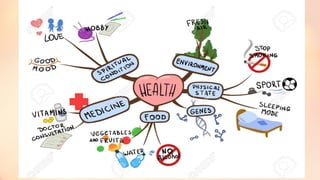
•Usually revolves around a central subject.
Major ideas are in a form of images and/or
words branch out from the main subject.
•Texts, colors, image and symbols may be used
to make mind maps.
2 Types of Mind Map
HANDWRITTEN
• Traditional mind maps made by using the
hands.
PROS:
• has personal touch, uniqueness and individuality.
• it requires only simple materials
• can be easily put down what’s on his/her mind.
2 Types of Mind Map
CONS:
•There is difficulty when one wishes to edit
or modify it.
• can be less presentable.
2 Types of Mind Map
DIGITAL/COMPUTERIZED
• Modern mind maps generated through
computers
PROS:
• can be easily modified, edited and updated
• Appears to be more presentable and formal
• it can be dne easily if one is knowledgeable in
computer.
STEPS IN MAKING
MIND MAPS
Lecture 2
•Decide on what type of mind map you will
create.
•Think of the main idea for your mind map.
•Add branches to the main idea.
•Supplement with keywords.
•Incorporate colors into branches.
•Attach image.

BB 2 - PerDev Theeeeee-Powers-of-Mind.pptx

  • 1.
    The Powers ofMind Chapter 6
  • 2.
    OBJECTIVES: At the endof this module, you will be able to: -Discuss that understanding the left and right brain functions may help in improving one’s learning. -Explore mind mapping techniques suited to right brain or left brain dominant thinking styles, and -Make a plan to improve learning using both and right brain development.
  • 3.
    3 MAJOR PARTSOF THE BRAIN BRAIN STEM CEREBELLUM CEREBRUM
  • 4.
    BRAINSTEM It connects thespinal cord and the brain. Controls functions that keep people alive such as breathing, heart rate, blood pressure and food digestion.
  • 5.
    CEREBELLUM It controls voluntarymovement. You may form the thought and an area in the cerebellum that translate your will into action.
  • 6.
    NEURONS The basic functionalunits of the nervous system, are three part units and are key to brain functions.
  • 7.
    The signal jumpsfrom the end of the dendrite on one cell across the space called a SYPNAPSE to the dendrite of another cell with the help of chemicals called NEUROTRANSMITTERS
  • 8.
    CEREBRUM Largest of thethree brain sections, accounts for 85% of the brain’s weight and has four lobes. The lobes-frontal, parietal, temporal and occipital.
  • 10.
  • 11.
    “The questions scientistscan’t answer now is if the damage is permanent”. INHALANTS Such as glue, paint, gasoline and aerosols, destroys the outer lining of nerve cells and make them unable to communicate with one other.
  • 12.
    Marijuana hinders memory,learning, judgment, and reactions times. Ecstasy destroys neurons that makes serotonin – a chemical crucial in controlling sleep, violence, mood swings, sexual urges. Steroids cause aggressions and violent mood swings.
  • 13.
    “There’s a lotwe won’t know until later. Classic example is cigarettes. We allowed people to smoke for 100 years before we knew about all the horrible things that nicotine will do”
  • 14.
    The Lateralization ofthe Brain The Left and Right Brain Theory
  • 15.
    This theory wasdeveloped by: Roger Sperry Robert Ornstein
  • 16.
    What is theright and left brain theory? According to the theory of left-brain or right- brain dominance, each side of the brain controls different types of thinking. Additionally, people are said to prefer one type of thinking over the other.
  • 17.
    The Right-brained Individual TheLeft and Right Brain Theory
  • 18.
    Right-brained Individual • Emotional •Swayed by feelings. • View things and events through feelings. • Intuitive • Believers of imaginations and fantasies. • Risk takers • Creative • Unpredictable
  • 19.
    Left-brained Individual • Organized •Logical • Detail-oriented • Process ideas in methodical step-by- step manner • Commits less mistakes • Favors rigid schedules and deadlines • Auditory learners
  • 20.
    THE DOMINANT OFTHE SIDE BRAIN LEFT DOMINANCE RIGHT DOMINACE Classical music Popular Music Being on time A good times Careful planning To visualize the outcome To consider alternative To go with the first idea Being thoughtful Being active Monopoly, Scrabble, or Chess Athletics, art, or music
  • 26.
    The Theory’s Advantages andDisadvantages The Left and Right Brain Theory
  • 27.
    Advantages • helps toimprove one’s learning. • it gives us a picture of how the two hemispheres of the brain distinctly function. • understanding of what areas an individual is naturally good at and those on which he or she needs to improve or focus. •think of ways to boost strengths and compensate for weaknesses
  • 28.
    Disadvantages • stereotyping • createsself fulfilling prophecy. • lowers self-esteem. Self Fulfilling Prophecy – a prediction that directly or indirectly causes itself to become true, by terms of the prophecy itself due to positive feedback between belief and behavior.
  • 29.
  • 30.
    Mind Map •A thinkingtechnique used to visually organize information. It is a creative and logical way of organizing thoughts and ideas in your mind through a diagram. •Usually revolves around a central subject. Major ideas are in a form of images and/or words branch out from the main subject. •Texts, colors, image and symbols may be used to make mind maps.
  • 32.
    2 Types ofMind Map HANDWRITTEN • Traditional mind maps made by using the hands. PROS: • has personal touch, uniqueness and individuality. • it requires only simple materials • can be easily put down what’s on his/her mind.
  • 33.
    2 Types ofMind Map CONS: •There is difficulty when one wishes to edit or modify it. • can be less presentable.
  • 34.
    2 Types ofMind Map DIGITAL/COMPUTERIZED • Modern mind maps generated through computers PROS: • can be easily modified, edited and updated • Appears to be more presentable and formal • it can be dne easily if one is knowledgeable in computer.
  • 35.
    STEPS IN MAKING MINDMAPS Lecture 2
  • 36.
    •Decide on whattype of mind map you will create. •Think of the main idea for your mind map. •Add branches to the main idea. •Supplement with keywords. •Incorporate colors into branches. •Attach image.