Drug Approval Process in India: Complete
Step-by-Step Guide
India isn’t just a pharma market. It’s the engine that powers global access to affordable
medicine.
The country supplies 20% of the world’s generic drugs and meets over 60% of global vaccine
demand. From small-molecule APIs to complex biologics, India manufactures and exports it
all — at unmatched scale and cost.
But no product reaches shelves without passing through the country’s strict regulatory
system. Every drug marketed in India must be approved by the Central Drugs Standard
Control Organization (CDSCO). This authority functions under the Ministry of Health and
Family Welfare.
Its mandate? To ensure every product is safe, effective, and manufactured under strict
compliance with Schedule Y of the Drugs and Cosmetics Act, 1940. Whether you're
launching a new molecule, importing a biologic, or submitting a generic — you’ll need to
navigate CDSCO’s step-by-step approval process.
In this guide, we break it all down — clearly and completely — so you can move faster, stay
compliant, and avoid costly rework.
What Is the Drug Approval Process in India?
Alt text: Drug Approval Process in India Infographic
Before a pharmaceutical product can enter the Indian market, it must pass through a strict
regulatory pipeline overseen by the Central Drugs Standard Control Organization (CDSCO).
This ensures the product’s safety, efficacy, and quality.
Below is a simplified, step-by-step breakdown of the drug approval process in India:
Step-by-Step Drug Approval Process
1. Identify Drug Type: Classify the product as a New Drug (ND), Subsequent New
Drug (SND), Fixed-Dose Combination (FDC), or Investigational New Drug (IND).
2. Prepare CTD Dossier and Documentation: Compile the application in Common
Technical Document (CTD) format, including data on quality, safety, efficacy, and
administrative details.
3. Submit Application via SUGAM Portal: File the application through CDSCO’s
online portal with Form 44, required attachments, and applicable fees.
4. Conduct Clinical Trials (Phases I–IV): Clinical trials must follow Schedule Y
guidelines. Some drugs may be eligible for trial waivers under Rule 122A.
5. CDSCO Technical Evaluation: A Subject Expert Committee (SEC) reviews the
submitted data for consistency, safety, and therapeutic value.
6. Manufacturing or Trial Site Inspection: The CDSCO may inspect facilities to
verify compliance with Good Manufacturing Practices (GMP) or trial protocols.
7. Marketing or Import License Granted: After successful review, the regulatory
authority issues a license to market or import the drug in India.
8. Post-Marketing Surveillance: Once approved, the product must be monitored
continuously for safety through pharmacovigilance activities.
What is the Drug Approval Process in India?
You can’t sell a drug in India until the regulator says yes. That regulator is the Central Drugs
Standard Control Organization (CDSCO).
Their job? Protect patients. Every drug must prove it’s safe, effective, and made under strict
controls. The law behind this is Schedule Y of the Drugs and Cosmetics Act, 1940.
It doesn’t matter where your product comes from. If it’s sold in India, it goes through this
process.
Applies to:
 New drugs
 Fixed-dose combinations
 Investigational compounds
 Biologics
Below is a detailed breakdown of the steps that are involved in the approval process of a drug
in India.
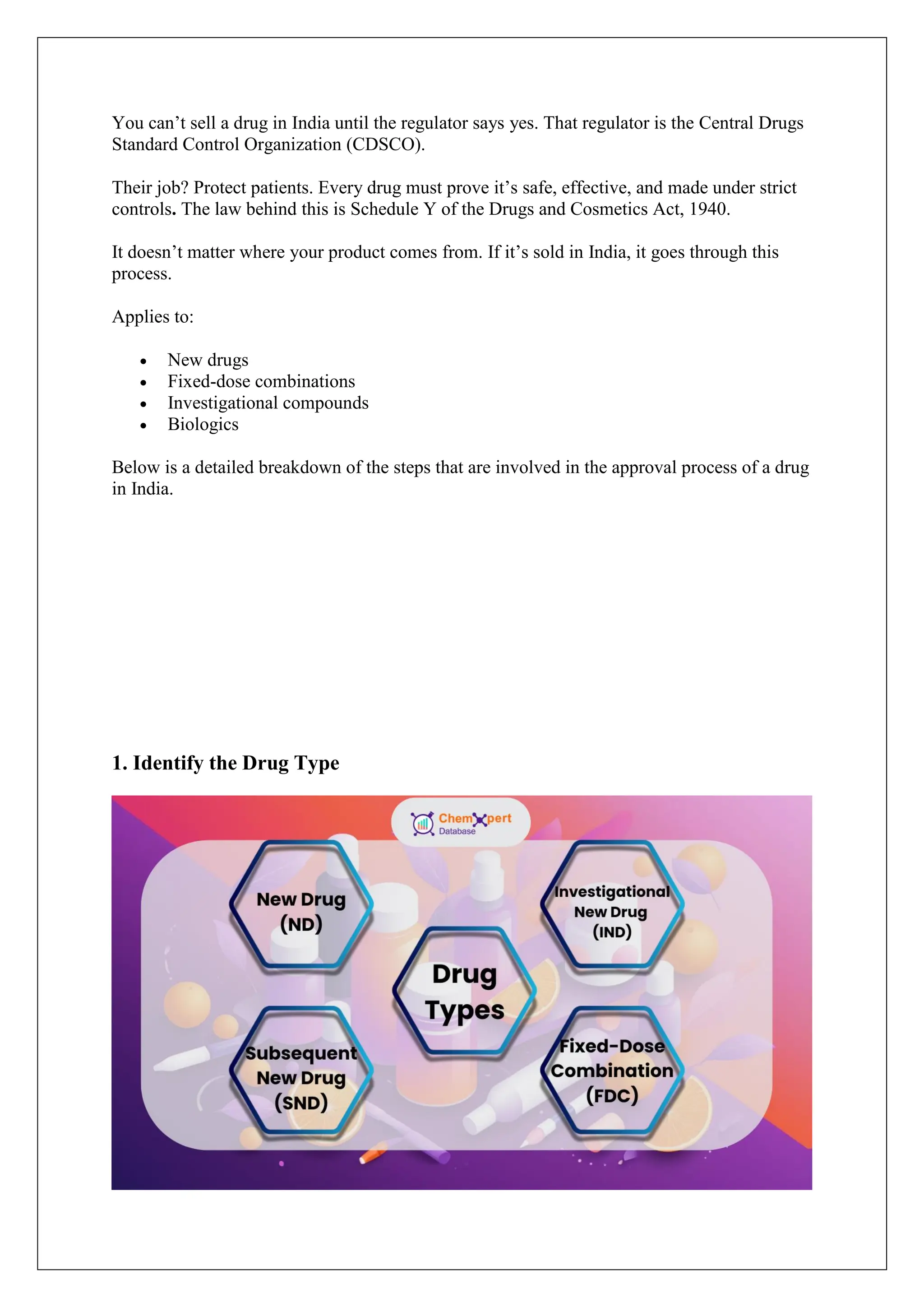
1. Identify the Drug Type
Alt Text: Types of Drugs
Before submitting anything to CDSCO, applicants must classify the drug into one of the
following regulatory categories:
 New Drug (ND): A molecule never marketed in India.
 Subsequent New Drug (SND): A new dosage form, route, or indication of an already
approved drug.
 Fixed-Dose Combination (FDC): A new combination of two or more drugs in a
fixed ratio.
 Investigational New Drug (IND): A molecule still under research or trial, not yet
approved for marketing.
Classification affects your approval pathway, trial requirements, and the documentation
format.
2. Prepare the CTD Dossier and Regulatory Documents
The Common Technical Document (CTD) is the international format accepted by CDSCO.
Your dossier must be complete, well-structured, and submitted with Form 44.
The CTD includes:
 Module 1: Administrative information (Form 44, undertaking, labeling)
 Module 2: Summaries (quality, non-clinical, clinical)
 Module 3: Quality documents (manufacturing process, control standards)
 Module 4: Non-clinical study reports (toxicology, PK/PD)
 Module 5: Clinical study reports (Phase I–IV trial data)
Incomplete or inconsistent dossiers are one of the leading causes of delays or rejections in
India.
3. Submit the Application via the SUGAM Portal
India has digitized its regulatory pipeline through the SUGAM Portal, managed by CDSCO.
Steps include:
 Registration of applicant/company
 Upload of the complete CTD
 Form 44 submission
 Online payment of fees
 Generation of reference number for tracking
All applications must comply with electronic submission protocols. Manual errors are flagged
quickly.
4. Co-nduct Clinical Trials (Phases I–IV)
Unless waived under Rule 122A, most drugs must undergo local clinical trials in India.
The typical trial pathway:
Phase Purpose Participants
Phase I Safety and dosage Healthy volunteers
Phase II Efficacy and side effects Small patient groups
Phase III Confirmatory data Large patient population
Phase IV Post-marketing surveillance Real-world settings
Trial protocols must be approved by an Ethics Committee and submitted to CDSCO for
clearance.
Drugs already approved in developed countries (US, EU, Japan) may qualify for partial or
full waivers.
5. CDSCO Technical Evaluation
Once submitted, your application is reviewed by a Subject Expert Committee (SEC).
Their responsibilities include:
 Evaluating clinical data, safety margins, and pharmacokinetics
 Verifying GMP compliance of manufacturing units
 Assessing the public health need for fast-tracking (especially during pandemics or
national shortage)
The SEC may also request clarifications or additional data, which can delay approval
timelines.
The better your dossier, the fewer rounds of questioning you'll face.
6. Site Inspection (If Applicable)
CDSCO may inspect your manufacturing facility or clinical trial site.
Inspections check for:
 GMP compliance
 Data integrity
 Batch consistency
 Equipment validation
 Ethical trial conduct (for clinical sites)
India often accepts GMP certifications from USFDA, EMA, MHRA — but reserves the right
to conduct fresh inspections, especially for products from low-cost regions.
7. Grant of Marketing or Import License
If the drug meets CDSCO’s requirements, a license is granted:
 Form 46 — Marketing Authorization for manufacturing in India
 Form 45 — Import License for foreign-made drugs
You can now legally market the drug in India.
8. Post-Marketing Surveillance
Approval is not the end — it’s the beginning of ongoing responsibility.
You must:
 Monitor real-world adverse events
 File periodic safety update reports (PSURs)
 Maintain pharmacovigilance systems
 Report any recalls, product variations, or safety warnings
Non-compliance can lead to suspension of your license or legal penalties.
Summary Table: Drug Approval Workflow
Stage Responsible Party Key Output
Identify Drug Applicant Classification (ND, SND, etc.)
Dossier Preparation Regulatory Affairs CTD Format Submission
Submission CDSCO/SUGAM Form 44 + Fee Receipt
Clinical Trials Sponsor/CRO Phase I–IV Data
Evaluation SEC/CDSCO Safety-Efficacy Report
Inspection CDSCO Inspectors GMP/Trial Compliance
Approval CDSCO License (Form 45/46)
Post-Approval MAH (you) PSURs, Safety Reports
What Documents Are Required for a Drug Application in India?
Regulatory approval is paperwork-heavy. You don’t just need data. You need it in the right
format, with the right structure, and zero room for error.
In India, that format is the Common Technical Document (CTD) — the global standard also
accepted by the US, EU, and Japan.
Every drug approval submission to CDSCO must follow this five-part CTD format.
If one module is missing or incomplete, your application gets flagged or delayed.
CTD Modules: Document Checklist for CDSCO Submission
CTD Module Contents
Module I Administrative and legal details. Includes: Form 44, cover letter, GMP
certificates, proposed labeling, import license copy (if applicable).
Module II High-level summaries. Covers pharma overview, non-clinical data, and
clinical trial summaries. Helps reviewers scan the full application
quickly.
Module III Quality and manufacturing data. Includes API details, excipient specs,
batch records, formulation process, and long-term stability studies.
Module IV Preclinical data. Includes animal studies, pharmacology, toxicology,
PK/PD profiles, and supporting literature.
Module V Clinical trial data (Phases I–IV). Includes study protocols, raw data,
analysis, adverse events, and investigator brochures.
Avoid These Common Mistakes
 Using non-CTD formats (PDF bundles won’t work)
 Missing summaries in Module II
 Unlabeled test methods in Module III
 Skipping trial narratives in Module V
 Submitting outdated GMP certificate
Conclusion
Getting regulatory approval in India isn’t just about following steps — it’s about getting them
right the first time. Missed documents. Wrong formats. Incomplete data. These are the top
reasons why applications get delayed or denied by CDSCO.
If you're serious about launching in India, you need more than just forms and flowcharts —
you need real-time, data-backed intelligence.
That’s where Chemxpert Database comes in.
 Track past approvals for similar drugs
 Benchmark clinical trial data and formats
 Access buyer and licensing records
 Avoid compliance mistakes before they cost you

Drug Approval Process in India: Complete Step-by-Step Guide

  • 1.
    Drug Approval Processin India: Complete Step-by-Step Guide India isn’t just a pharma market. It’s the engine that powers global access to affordable medicine. The country supplies 20% of the world’s generic drugs and meets over 60% of global vaccine demand. From small-molecule APIs to complex biologics, India manufactures and exports it all — at unmatched scale and cost. But no product reaches shelves without passing through the country’s strict regulatory system. Every drug marketed in India must be approved by the Central Drugs Standard Control Organization (CDSCO). This authority functions under the Ministry of Health and Family Welfare. Its mandate? To ensure every product is safe, effective, and manufactured under strict compliance with Schedule Y of the Drugs and Cosmetics Act, 1940. Whether you're launching a new molecule, importing a biologic, or submitting a generic — you’ll need to navigate CDSCO’s step-by-step approval process. In this guide, we break it all down — clearly and completely — so you can move faster, stay compliant, and avoid costly rework. What Is the Drug Approval Process in India?
  • 2.
    Alt text: DrugApproval Process in India Infographic Before a pharmaceutical product can enter the Indian market, it must pass through a strict regulatory pipeline overseen by the Central Drugs Standard Control Organization (CDSCO). This ensures the product’s safety, efficacy, and quality. Below is a simplified, step-by-step breakdown of the drug approval process in India: Step-by-Step Drug Approval Process 1. Identify Drug Type: Classify the product as a New Drug (ND), Subsequent New Drug (SND), Fixed-Dose Combination (FDC), or Investigational New Drug (IND). 2. Prepare CTD Dossier and Documentation: Compile the application in Common Technical Document (CTD) format, including data on quality, safety, efficacy, and administrative details. 3. Submit Application via SUGAM Portal: File the application through CDSCO’s online portal with Form 44, required attachments, and applicable fees. 4. Conduct Clinical Trials (Phases I–IV): Clinical trials must follow Schedule Y guidelines. Some drugs may be eligible for trial waivers under Rule 122A. 5. CDSCO Technical Evaluation: A Subject Expert Committee (SEC) reviews the submitted data for consistency, safety, and therapeutic value. 6. Manufacturing or Trial Site Inspection: The CDSCO may inspect facilities to verify compliance with Good Manufacturing Practices (GMP) or trial protocols. 7. Marketing or Import License Granted: After successful review, the regulatory authority issues a license to market or import the drug in India. 8. Post-Marketing Surveillance: Once approved, the product must be monitored continuously for safety through pharmacovigilance activities. What is the Drug Approval Process in India?
  • 3.
    You can’t sella drug in India until the regulator says yes. That regulator is the Central Drugs Standard Control Organization (CDSCO). Their job? Protect patients. Every drug must prove it’s safe, effective, and made under strict controls. The law behind this is Schedule Y of the Drugs and Cosmetics Act, 1940. It doesn’t matter where your product comes from. If it’s sold in India, it goes through this process. Applies to:  New drugs  Fixed-dose combinations  Investigational compounds  Biologics Below is a detailed breakdown of the steps that are involved in the approval process of a drug in India. 1. Identify the Drug Type
  • 4.
    Alt Text: Typesof Drugs Before submitting anything to CDSCO, applicants must classify the drug into one of the following regulatory categories:  New Drug (ND): A molecule never marketed in India.  Subsequent New Drug (SND): A new dosage form, route, or indication of an already approved drug.  Fixed-Dose Combination (FDC): A new combination of two or more drugs in a fixed ratio.  Investigational New Drug (IND): A molecule still under research or trial, not yet approved for marketing. Classification affects your approval pathway, trial requirements, and the documentation format. 2. Prepare the CTD Dossier and Regulatory Documents The Common Technical Document (CTD) is the international format accepted by CDSCO. Your dossier must be complete, well-structured, and submitted with Form 44. The CTD includes:  Module 1: Administrative information (Form 44, undertaking, labeling)  Module 2: Summaries (quality, non-clinical, clinical)  Module 3: Quality documents (manufacturing process, control standards)  Module 4: Non-clinical study reports (toxicology, PK/PD)  Module 5: Clinical study reports (Phase I–IV trial data) Incomplete or inconsistent dossiers are one of the leading causes of delays or rejections in India. 3. Submit the Application via the SUGAM Portal India has digitized its regulatory pipeline through the SUGAM Portal, managed by CDSCO. Steps include:  Registration of applicant/company  Upload of the complete CTD  Form 44 submission  Online payment of fees  Generation of reference number for tracking All applications must comply with electronic submission protocols. Manual errors are flagged quickly. 4. Co-nduct Clinical Trials (Phases I–IV)
  • 5.
    Unless waived underRule 122A, most drugs must undergo local clinical trials in India. The typical trial pathway: Phase Purpose Participants Phase I Safety and dosage Healthy volunteers Phase II Efficacy and side effects Small patient groups Phase III Confirmatory data Large patient population Phase IV Post-marketing surveillance Real-world settings Trial protocols must be approved by an Ethics Committee and submitted to CDSCO for clearance. Drugs already approved in developed countries (US, EU, Japan) may qualify for partial or full waivers. 5. CDSCO Technical Evaluation Once submitted, your application is reviewed by a Subject Expert Committee (SEC). Their responsibilities include:  Evaluating clinical data, safety margins, and pharmacokinetics  Verifying GMP compliance of manufacturing units  Assessing the public health need for fast-tracking (especially during pandemics or national shortage) The SEC may also request clarifications or additional data, which can delay approval timelines. The better your dossier, the fewer rounds of questioning you'll face. 6. Site Inspection (If Applicable) CDSCO may inspect your manufacturing facility or clinical trial site. Inspections check for:  GMP compliance  Data integrity  Batch consistency  Equipment validation  Ethical trial conduct (for clinical sites) India often accepts GMP certifications from USFDA, EMA, MHRA — but reserves the right to conduct fresh inspections, especially for products from low-cost regions. 7. Grant of Marketing or Import License
  • 6.
    If the drugmeets CDSCO’s requirements, a license is granted:  Form 46 — Marketing Authorization for manufacturing in India  Form 45 — Import License for foreign-made drugs You can now legally market the drug in India. 8. Post-Marketing Surveillance Approval is not the end — it’s the beginning of ongoing responsibility. You must:  Monitor real-world adverse events  File periodic safety update reports (PSURs)  Maintain pharmacovigilance systems  Report any recalls, product variations, or safety warnings Non-compliance can lead to suspension of your license or legal penalties. Summary Table: Drug Approval Workflow Stage Responsible Party Key Output Identify Drug Applicant Classification (ND, SND, etc.) Dossier Preparation Regulatory Affairs CTD Format Submission Submission CDSCO/SUGAM Form 44 + Fee Receipt Clinical Trials Sponsor/CRO Phase I–IV Data Evaluation SEC/CDSCO Safety-Efficacy Report Inspection CDSCO Inspectors GMP/Trial Compliance Approval CDSCO License (Form 45/46) Post-Approval MAH (you) PSURs, Safety Reports What Documents Are Required for a Drug Application in India? Regulatory approval is paperwork-heavy. You don’t just need data. You need it in the right format, with the right structure, and zero room for error. In India, that format is the Common Technical Document (CTD) — the global standard also accepted by the US, EU, and Japan. Every drug approval submission to CDSCO must follow this five-part CTD format. If one module is missing or incomplete, your application gets flagged or delayed. CTD Modules: Document Checklist for CDSCO Submission CTD Module Contents
  • 7.
    Module I Administrativeand legal details. Includes: Form 44, cover letter, GMP certificates, proposed labeling, import license copy (if applicable). Module II High-level summaries. Covers pharma overview, non-clinical data, and clinical trial summaries. Helps reviewers scan the full application quickly. Module III Quality and manufacturing data. Includes API details, excipient specs, batch records, formulation process, and long-term stability studies. Module IV Preclinical data. Includes animal studies, pharmacology, toxicology, PK/PD profiles, and supporting literature. Module V Clinical trial data (Phases I–IV). Includes study protocols, raw data, analysis, adverse events, and investigator brochures. Avoid These Common Mistakes  Using non-CTD formats (PDF bundles won’t work)  Missing summaries in Module II  Unlabeled test methods in Module III  Skipping trial narratives in Module V  Submitting outdated GMP certificate Conclusion Getting regulatory approval in India isn’t just about following steps — it’s about getting them right the first time. Missed documents. Wrong formats. Incomplete data. These are the top reasons why applications get delayed or denied by CDSCO. If you're serious about launching in India, you need more than just forms and flowcharts — you need real-time, data-backed intelligence. That’s where Chemxpert Database comes in.  Track past approvals for similar drugs  Benchmark clinical trial data and formats  Access buyer and licensing records  Avoid compliance mistakes before they cost you