Guidance & Answers of Drill 8
Complete sentences as the example.

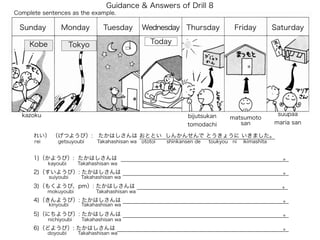
 Sunday          Monday           Tuesday        Wednesday Thursday               Friday           Saturday

     Kobe              Tokyo                        Today


  kazoku                                                         bijutsukan                         suupaa
                                                                                matsumoto
                                                                 tomodachi         san             maria san

      れい) (げつようび): たかはしさんは おととい しんかんせんで とうきょうに いきました。 
      rei       getsuyoubi      Takahashisan wa ototoi   shinkansen de   toukyou ni   ikimashita


      1)(かようび): たかはしさんは                                                                              。
            kayoubi      Takahashisan wa
      2)(すいようび): たかはしさんは                                                                             。
            suiyoubi      Takahashisan wa
      3)(もくようび、pm): たかはしさんは                                                                          。
            mokuyoubi          Takahashisan wa
      4)(きんようび): たかはしさんは                                                                             。
            kinyoubi      Takahashisan wa

      5)(にちようび): たかはしさんは                                                                             。
            nichiyoubi    Takahashisan wa
      6)(どようび): たかはしさんは                                                                              。
            doyoubi      Takahashisan wa
The chart below shows Mr. Takahashi s activities for a week.       This drill is to practice to describe his
activities by using information given for each day. Please note that we set Wednesday as today and we
need to convert each day of the week to different time expression as in the example below.


      Sunday      Monday           Tuesday       Wednesday Thursday               Friday       Saturday

        Kobe           Tokyo                       Today


      kazoku                                                    bijutsukan                       suupaa
                                                                                matsumoto
                                                                tomodachi          san          maria san

れい) (げつようび) たかはしさんは おととい しんかんせんで とうきょうに いきました。 
rei       getsuyoubi           Takahashisan wa    ototoi     shinkansen de        toukyou ni     ikimashita

Here in the example describes his activity on Monday (getsuyoubi). What you have in the chart on Monday
is a bullet train (shinkansen) heading to Tokyo. Please make sure that the time expression in the sentence
has been replaced from      げつようび (getsuyoubi / Monday)            to   おととい (ototoi / the day before
yesterday) . Therefore the translation of the answer sentence in Japanese becomes as below.
                Mr. Takahashi went to Tokyo by Shinkansen the day before yesterday.
Note that you also have to conjugate the verb to an appropriate tense.         In the case of the example, the
activity took place prior to Wednesday, so the verb should be in past tense.
Sunday         Monday        Tuesday       Wednesday Thursday                 Friday      Saturday

       Kobe         Tokyo                        Today


    kazoku                                                    bijutsukan                       suupaa
                                                                               matsumoto
                                                              tomodachi           san         maria san


       1) (かようび): たかはしさんは きのう ごご9じに うちに かえりました。 
               kayoubi        Takahashisan wa kinou      gogo ku-ji ni     uchi ni   kaerimashita


Here in #1 describes his activity on Tuesday (kayoubi). What you have in the chart on Tuesday is a clock
which shows 9 o clock, and Mr. Takahashi goes back to his house.     The time expression in the sentence
should be replaced from かようび (kayoubi / Tuesday) to きのう (kinou / yesterday) .                 Therefore the
translation of the answer sentence in Japanese becomes as below.
                             Mr. Takahashi went home at 9pm yesterday.
Note that you also have to conjugate the verb to the past tense because the activity took place prior to
Wednesday.
Sunday         Monday         Tuesday       Wednesday Thursday                Friday       Saturday

       Kobe           Tokyo                       Today


    kazoku                                                     bijutsukan                       suupaa
                                                                              matsumoto
                                                               tomodachi         san           maria san


 2) (すいようび): たかはしさんは きょう どこも いきません/いきませんでした。 
           suiyoubi        Takahashisan wa     kyou    doko mo ikimasen             ikimasen deshita


Here in #2 describes his activity on Wednesday (suiyoubi). What you have in the chart on Wednesday is
that Mr. Takahashi stays home.     That means he will/did not go anywhere.       The time expression in the
sentence should be replaced from       すいようび (suiyoubi / Wednesday)            to    きょう (kyou / today) .
Therefore the translation of the answer sentence in Japanese becomes as below.
                              Mr. Takahashi will/did not go anywhere today.
Since his activity is not designated on any particular time of the day, we can either describe it as his plan
(future) or as his completed activity (past) for the day. Also when you describe that a person does/will/did
not make any action to make travel, you use どこも + verb in negative.
Sunday        Monday          Tuesday       Wednesday Thursday               Friday       Saturday

       Kobe          Tokyo                         Today


    kazoku                                                      bijutsukan                      suupaa
                                                                               matsumoto
                                                                tomodachi         san          maria san


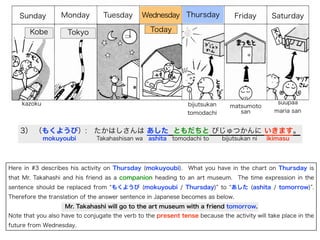
    3) (もくようび): たかはしさんは あした ともだちと びじゅつかんに いきます。 
             mokuyoubi        Takahashisan wa ashita tomodachi to            bijutsukan ni   ikimasu


Here in #3 describes his activity on Thursday (mokuyoubi).      What you have in the chart on Thursday is
that Mr. Takahashi and his friend as a companion heading to an art museum.        The time expression in the
sentence should be replaced from もくようび (mokuyoubi / Thursday) to あした (ashita / tomorrow) .
Therefore the translation of the answer sentence in Japanese becomes as below.
                    Mr. Takahashi will go to the art museum with a friend tomorrow.
Note that you also have to conjugate the verb to the present tense because the activity will take place in the
future from Wednesday.
Sunday        Monday          Tuesday       Wednesday Thursday               Friday       Saturday

       Kobe          Tokyo                         Today


    kazoku                                                      bijutsukan                      suupaa
                                                                               matsumoto
                                                                tomodachi         san          maria san


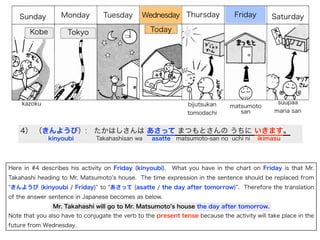
    4) (きんようび): たかはしさんは あさって まつもとさんの うちに いきます。 
              kinyoubi        Takahashisan wa      asatte matsumoto-san no uchi ni        ikimasu


Here in #4 describes his activity on Friday (kinyoubi).    What you have in the chart on Friday is that Mr.
Takahashi heading to Mr. Matsumoto s house. The time expression in the sentence should be replaced from
きんようび (kinyoubi / Friday) to あさって (asatte / the day after tomorrow) . Therefore the translation
of the answer sentence in Japanese becomes as below.
                Mr. Takahashi will go to Mr. Matsumoto s house the day after tomorrow.
Note that you also have to conjugate the verb to the present tense because the activity will take place in the
future from Wednesday.
Sunday            Monday       Tuesday          Wednesday Thursday           Friday        Saturday

         Kobe          Tokyo                          Today


       kazoku                                                     bijutsukan                    suupaa
                                                                                matsumoto
                                                                  tomodachi        san         maria san
                                              *
5) (にちようび): たかはしさんは さきおととい かぞくと くるまで こうべに いきました。 
         nichiyoubi         Takahashisan wa        sakiototoi   kazoku to kuruma de koube ni   ikimashita

   * You can also replace the time expression to こんしゅうの にちようび/konshuu no nichiyoube/ this

        Sunday instead of さきおととい(two days before yesterday).


Here in #5 describes his activity on Sunday (nichiyoubi). What you have in the chart on Sunday is that Mr.
Takahashi heading to Kobe with his family by car. The time expression in the sentence should be replaced
from    にちようび (nichiyoubi / Sunday)           to    さきおととい (sakiototoi / two days before yesterday) .
Therefore the translation of the answer sentence in Japanese becomes as below.
                Mr. Takahashi went to Kobe with his family by car two days before yesterday.
Note that you also have to conjugate the verb to the past tense because the activity took place prior to
Wednesday.
Sunday        Monday          Tuesday       Wednesday Thursday               Friday       Saturday

       Kobe            Tokyo                       Today


    kazoku                                                      bijutsukan                      suupaa
                                                                               matsumoto
                                                                tomodachi         san          maria san
                                         *
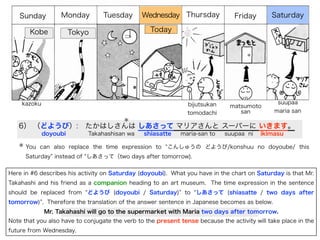
   6) (どようび): たかはしさんは しあさって マリアさんと スーパーに いきます。 
             doyoubi        Takahashisan wa     shiasatte    maria-san to    suupaa ni    ikimasu

   * You can also replace the time expression to         こんしゅうの どようび/konshuu no doyoube/ this
      Saturday instead of しあさって(two days after tomorrow).


Here in #6 describes his activity on Saturday (doyoubi). What you have in the chart on Saturday is that Mr.
Takahashi and his friend as a companion heading to an art museum. The time expression in the sentence
should be replaced from     どようび (doyoubi / Saturday)          to   しあさって (shiasatte / two days after
tomorrow) . Therefore the translation of the answer sentence in Japanese becomes as below.
             Mr. Takahashi will go to the supermarket with Maria two days after tomorrow.
Note that you also have to conjugate the verb to the present tense because the activity will take place in the
future from Wednesday.

Drill8 guidance

  • 1.
    Guidance & Answersof Drill 8 Complete sentences as the example. Sunday Monday Tuesday Wednesday Thursday Friday Saturday Kobe Tokyo Today kazoku bijutsukan suupaa matsumoto tomodachi san maria san れい) (げつようび): たかはしさんは おととい しんかんせんで とうきょうに いきました。  rei getsuyoubi Takahashisan wa ototoi shinkansen de toukyou ni ikimashita 1)(かようび): たかはしさんは    。 kayoubi Takahashisan wa 2)(すいようび): たかはしさんは 。 suiyoubi Takahashisan wa 3)(もくようび、pm): たかはしさんは 。 mokuyoubi Takahashisan wa 4)(きんようび): たかはしさんは 。 kinyoubi Takahashisan wa 5)(にちようび): たかはしさんは 。 nichiyoubi Takahashisan wa 6)(どようび): たかはしさんは   。 doyoubi Takahashisan wa
  • 2.
    The chart belowshows Mr. Takahashi s activities for a week. This drill is to practice to describe his activities by using information given for each day. Please note that we set Wednesday as today and we need to convert each day of the week to different time expression as in the example below. Sunday Monday Tuesday Wednesday Thursday Friday Saturday Kobe Tokyo Today kazoku bijutsukan suupaa matsumoto tomodachi san maria san れい) (げつようび) たかはしさんは おととい しんかんせんで とうきょうに いきました。  rei getsuyoubi Takahashisan wa ototoi shinkansen de toukyou ni ikimashita Here in the example describes his activity on Monday (getsuyoubi). What you have in the chart on Monday is a bullet train (shinkansen) heading to Tokyo. Please make sure that the time expression in the sentence has been replaced from げつようび (getsuyoubi / Monday) to おととい (ototoi / the day before yesterday) . Therefore the translation of the answer sentence in Japanese becomes as below. Mr. Takahashi went to Tokyo by Shinkansen the day before yesterday. Note that you also have to conjugate the verb to an appropriate tense. In the case of the example, the activity took place prior to Wednesday, so the verb should be in past tense.
  • 3.
    Sunday Monday Tuesday Wednesday Thursday Friday Saturday Kobe Tokyo Today kazoku bijutsukan suupaa matsumoto tomodachi san maria san 1) (かようび): たかはしさんは きのう ごご9じに うちに かえりました。  kayoubi  Takahashisan wa kinou gogo ku-ji ni uchi ni kaerimashita Here in #1 describes his activity on Tuesday (kayoubi). What you have in the chart on Tuesday is a clock which shows 9 o clock, and Mr. Takahashi goes back to his house. The time expression in the sentence should be replaced from かようび (kayoubi / Tuesday) to きのう (kinou / yesterday) . Therefore the translation of the answer sentence in Japanese becomes as below. Mr. Takahashi went home at 9pm yesterday. Note that you also have to conjugate the verb to the past tense because the activity took place prior to Wednesday.
  • 4.
    Sunday Monday Tuesday Wednesday Thursday Friday Saturday Kobe Tokyo Today kazoku bijutsukan suupaa matsumoto tomodachi san maria san 2) (すいようび): たかはしさんは きょう どこも いきません/いきませんでした。  suiyoubi   Takahashisan wa kyou doko mo ikimasen ikimasen deshita Here in #2 describes his activity on Wednesday (suiyoubi). What you have in the chart on Wednesday is that Mr. Takahashi stays home. That means he will/did not go anywhere. The time expression in the sentence should be replaced from すいようび (suiyoubi / Wednesday) to きょう (kyou / today) . Therefore the translation of the answer sentence in Japanese becomes as below. Mr. Takahashi will/did not go anywhere today. Since his activity is not designated on any particular time of the day, we can either describe it as his plan (future) or as his completed activity (past) for the day. Also when you describe that a person does/will/did not make any action to make travel, you use どこも + verb in negative.
  • 5.
    Sunday Monday Tuesday Wednesday Thursday Friday Saturday Kobe Tokyo Today kazoku bijutsukan suupaa matsumoto tomodachi san maria san 3) (もくようび): たかはしさんは あした ともだちと びじゅつかんに いきます。  mokuyoubi  Takahashisan wa ashita tomodachi to bijutsukan ni ikimasu Here in #3 describes his activity on Thursday (mokuyoubi). What you have in the chart on Thursday is that Mr. Takahashi and his friend as a companion heading to an art museum. The time expression in the sentence should be replaced from もくようび (mokuyoubi / Thursday) to あした (ashita / tomorrow) . Therefore the translation of the answer sentence in Japanese becomes as below. Mr. Takahashi will go to the art museum with a friend tomorrow. Note that you also have to conjugate the verb to the present tense because the activity will take place in the future from Wednesday.
  • 6.
    Sunday Monday Tuesday Wednesday Thursday Friday Saturday Kobe Tokyo Today kazoku bijutsukan suupaa matsumoto tomodachi san maria san 4) (きんようび): たかはしさんは あさって まつもとさんの うちに いきます。  kinyoubi   Takahashisan wa asatte matsumoto-san no uchi ni ikimasu Here in #4 describes his activity on Friday (kinyoubi). What you have in the chart on Friday is that Mr. Takahashi heading to Mr. Matsumoto s house. The time expression in the sentence should be replaced from きんようび (kinyoubi / Friday) to あさって (asatte / the day after tomorrow) . Therefore the translation of the answer sentence in Japanese becomes as below. Mr. Takahashi will go to Mr. Matsumoto s house the day after tomorrow. Note that you also have to conjugate the verb to the present tense because the activity will take place in the future from Wednesday.
  • 7.
    Sunday Monday Tuesday Wednesday Thursday Friday Saturday Kobe Tokyo Today kazoku bijutsukan suupaa matsumoto tomodachi san maria san * 5) (にちようび): たかはしさんは さきおととい かぞくと くるまで こうべに いきました。  nichiyoubi   Takahashisan wa sakiototoi kazoku to kuruma de koube ni ikimashita * You can also replace the time expression to こんしゅうの にちようび/konshuu no nichiyoube/ this Sunday instead of さきおととい(two days before yesterday). Here in #5 describes his activity on Sunday (nichiyoubi). What you have in the chart on Sunday is that Mr. Takahashi heading to Kobe with his family by car. The time expression in the sentence should be replaced from にちようび (nichiyoubi / Sunday) to さきおととい (sakiototoi / two days before yesterday) . Therefore the translation of the answer sentence in Japanese becomes as below. Mr. Takahashi went to Kobe with his family by car two days before yesterday. Note that you also have to conjugate the verb to the past tense because the activity took place prior to Wednesday.
  • 8.
    Sunday Monday Tuesday Wednesday Thursday Friday Saturday Kobe Tokyo Today kazoku bijutsukan suupaa matsumoto tomodachi san maria san * 6) (どようび): たかはしさんは しあさって マリアさんと スーパーに いきます。  doyoubi   Takahashisan wa shiasatte maria-san to suupaa ni ikimasu * You can also replace the time expression to こんしゅうの どようび/konshuu no doyoube/ this Saturday instead of しあさって(two days after tomorrow). Here in #6 describes his activity on Saturday (doyoubi). What you have in the chart on Saturday is that Mr. Takahashi and his friend as a companion heading to an art museum. The time expression in the sentence should be replaced from どようび (doyoubi / Saturday) to しあさって (shiasatte / two days after tomorrow) . Therefore the translation of the answer sentence in Japanese becomes as below. Mr. Takahashi will go to the supermarket with Maria two days after tomorrow. Note that you also have to conjugate the verb to the present tense because the activity will take place in the future from Wednesday.