Lesson Plan
▪ Title: Dreams by Langston Hughes
▪ Grade: Intermediate, Grade 10 - 11
▪ Lesson Focus: Power and necessity of dreams for both individuals and communities
▪ Objectives:
A. Determine the relevance and the truthfulness of the ideas presented in the picture
B. Analyze literature as a means of understanding unchanging values in a changing world
C. Relate text content to a particular social issues, concerns, or dispositions in real life
▪ Key Expressions:
Synthesizing, text features, vocabulary, interpreting text, reference, figurative language,
informational writing
▪ Materials: Anglo-American Literature Learner material, whiteboard, marker, pictures, crayons,
colored pencils, scissors, tape and stapler
Procedure Details
Presentation:
Introduction of
Content
Time: 5 minutes
Routinary Activities:
Greetings, checking of attendance, presentation of learning competencies
Review Lesson:
Ask learners to make a recap of the concepts of poetry elements
Establishing a purpose for the lesson (ENGAGE)
Starting out:
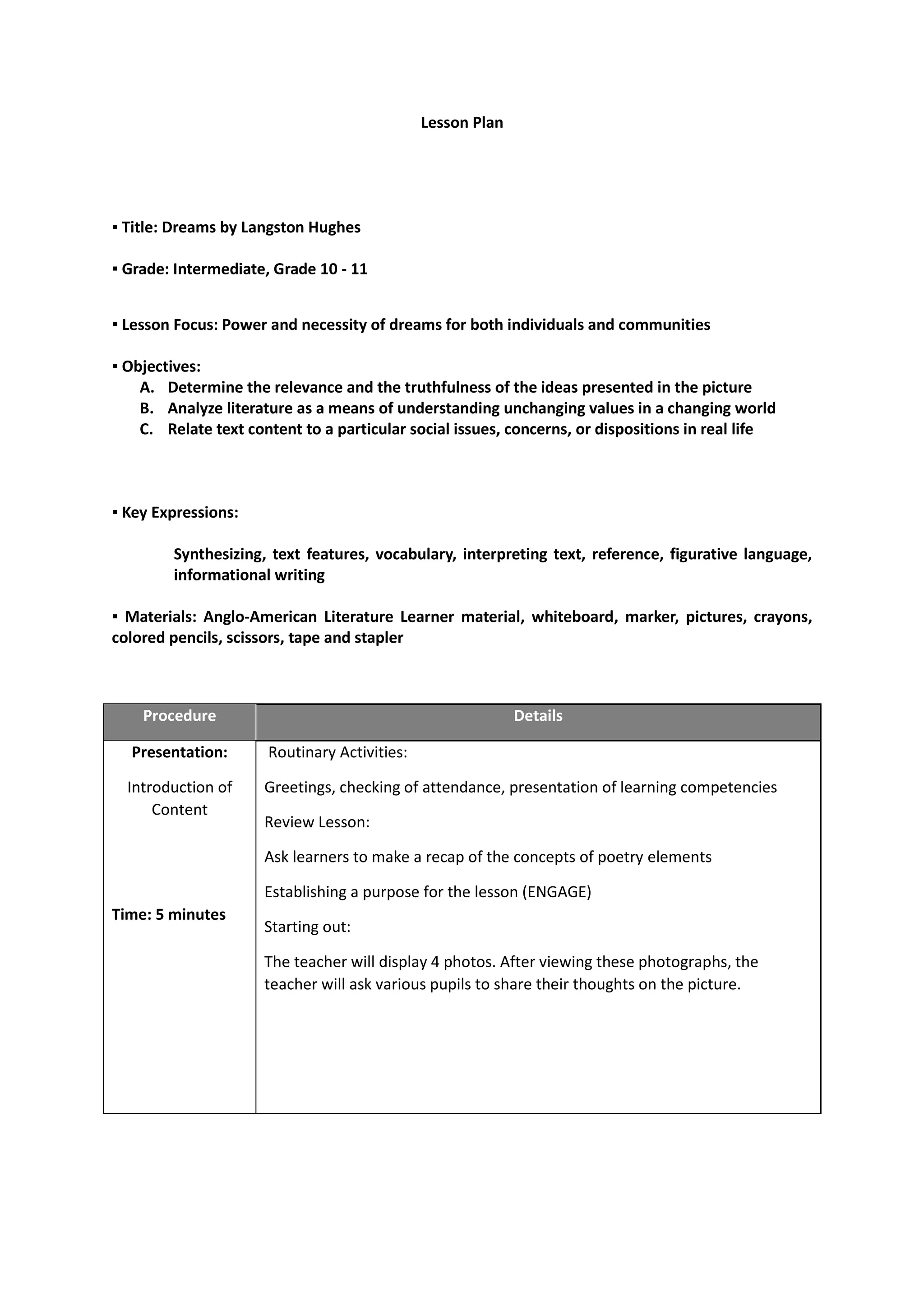
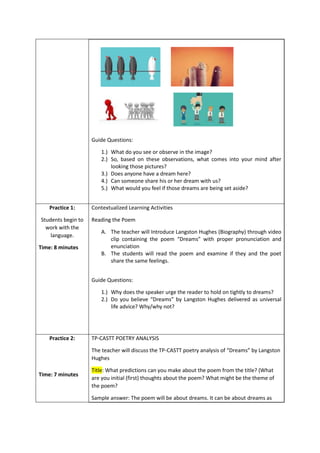
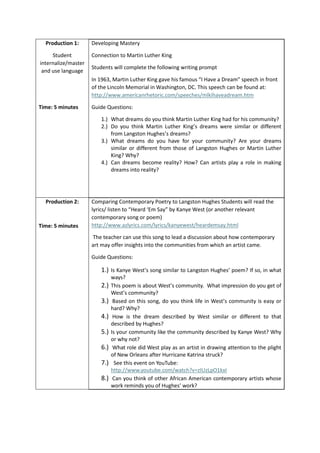
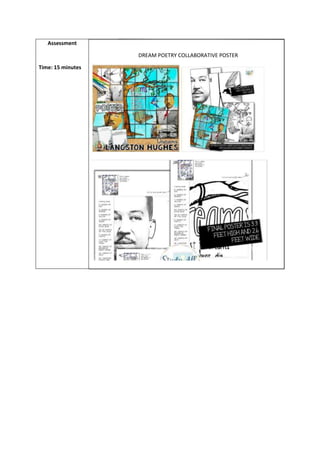
The teacher will display 4 photos. After viewing these photographs, the
teacher will ask various pupils to share their thoughts on the picture.
Guide Questions:
1.) What do you see or observe in the image?
2.) So, based on these observations, what comes into your mind after
looking those pictures?
3.) Does anyone have a dream here?
4.) Can someone share his or her dream with us?
5.) What would you feel if those dreams are being set aside?
Practice 1:
Students begin to
work with the
language.
Time: 8 minutes
Contextualized Learning Activities
Reading the Poem
A. The teacher will Introduce Langston Hughes (Biography) through video
clip containing the poem “Dreams” with proper pronunciation and
enunciation
B. The students will read the poem and examine if they and the poet
share the same feelings.
Guide Questions:
1.) Why does the speaker urge the reader to hold on tightly to dreams?
2.) Do you believe “Dreams” by Langston Hughes delivered as universal
life advice? Why/why not?
Practice 2:
Time: 7 minutes
TP-CASTT POETRY ANALYSIS
The teacher will discuss the TP-CASTT poetry analysis of “Dreams” by Langston
Hughes
Title: What predictions can you make about the poem from the title? (What
are you initial (first) thoughts about the poem? What might be the theme of
the poem?
Sample answer: The poem will be about dreams. It can be about dreams as
goals or about people having dreams when they sleep
Paraphrase: Describe what happens in the poem on your own words
Sample answer: You must hold on to dreams because if dreams die, they are
like a bird with a broken wing. Hold on to dreams because if you let your
dreams go, life is like a field with nothing in it that is frozen with snow.
Connotation: What might the poem mean beyond the literal level? Consider
the feelings that the words may give the reader
Sample answer:
Point of view: The speaker is speaking directly to the reader
Attitude: Describe the tone of the poem. What is the poet’s attitude toward
the subject of the poem? Find and list examples that illustrate the tone and
mood of the poem (these show attitude)
Sample answer:
The speaker sounds wise, so he/she knows what they are talking about. The
speaker’s tone is cautionary and somewhat melancholy. The poet’s attitude
seems to be one of sadness. He/she seems to have known what it’s like to
have lost a dream.
“dreams die” (line 2)
“broken-winged bird” (line 3)
“barren field” (line 7)
Shift: Is there a shift (a change) in the tone or speaker of the poem? Where
does the shift happen in the poem? What does it shift from and to?
Sample answer: This poem has only two sentences. There aren’t any shifts, but
the poem does end quickly with a strong image, a strong negative image
“frozen with snow” (line 8)
Title: Look at the title again. Have your original ideas about the poem
changed? How? What do you think the title means?
Sample answer: The poem is about dreams and continuing to dream. The
dreams are goals in life that people want to reach.
Theme: What is the overall theme of the poem? What insight, understanding,
lesson, or truth are we supposed to have after reading this poem?
Sample answer: This poem shows us the importance of dreams. The theme or
message in this poem shows us that a life without dreams will be an empty
life.
Production 1:
Student
internalize/master
and use language
Time: 5 minutes
Developing Mastery
Connection to Martin Luther King
Students will complete the following writing prompt
In 1963, Martin Luther King gave his famous “I Have a Dream” speech in front
of the Lincoln Memorial in Washington, DC. This speech can be found at:
http://www.americanrhetoric.com/speeches/mlkihaveadream.htm
Guide Questions:
1.) What dreams do you think Martin Luther King had for his community?
2.) Do you think Martin Luther King’s dreams were similar or different
from Langston Hughes’s dreams?
3.) What dreams do you have for your community? Are your dreams
similar or different from those of Langston Hughes or Martin Luther
King? Why?
4.) Can dreams become reality? How? Can artists play a role in making
dreams into reality?
Production 2:
Time: 5 minutes
Comparing Contemporary Poetry to Langston Hughes Students will read the
lyrics/ listen to “Heard ‘Em Say” by Kanye West (or another relevant
contemporary song or poem)
http://www.azlyrics.com/lyrics/kanyewest/heardemsay.html
The teacher can use this song to lead a discussion about how contemporary
art may offer insights into the communities from which an artist came.
Guide Questions:
1.) Is Kanye West’s song similar to Langston Hughes’ poem? If so, in what
ways?
2.) This poem is about West’s community. What impression do you get of
West’s community?
3.) Based on this song, do you think life in West’s community is easy or
hard? Why?
4.) How is the dream described by West similar or different to that
described by Hughes?
5.) Is your community like the community described by Kanye West? Why
or why not?
6.) What role did West play as an artist in drawing attention to the plight
of New Orleans after Hurricane Katrina struck?
7.) See this event on YouTube:
http://www.youtube.com/watch?v=zIUzLpO1kxI
8.) Can you think of other African American contemporary artists whose
work reminds you of Hughes’ work?
Assessment
Time: 15 minutes
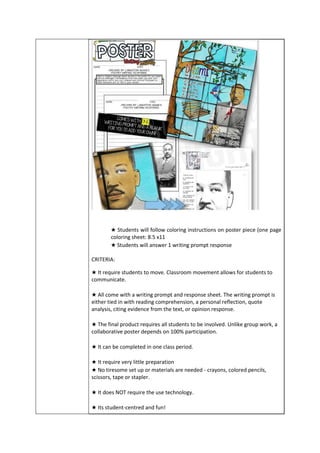
DREAM POETRY COLLABORATIVE POSTER
★ Students will follow coloring instructions on poster piece (one page
coloring sheet: 8.5 x11
★ Students will answer 1 writing prompt response
CRITERIA:
★ It require students to move. Classroom movement allows for students to
communicate.
★ All come with a writing prompt and response sheet. The writing prompt is
either tied in with reading comprehension, a personal reflection, quote
analysis, citing evidence from the text, or opinion response.
★ The final product requires all students to be involved. Unlike group work, a
collaborative poster depends on 100% participation.
★ It can be completed in one class period.
★ It require very little preparation
★ No tiresome set up or materials are needed - crayons, colored pencils,
scissors, tape or stapler.
★ It does NOT require the use technology.
★ Its student-centred and fun!
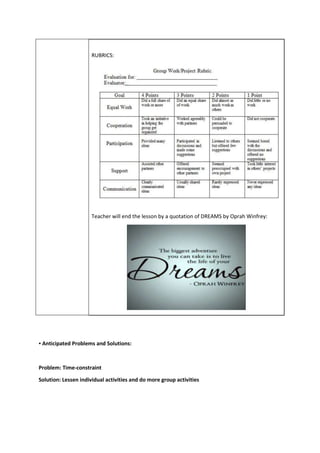
RUBRICS:
Teacher will end the lesson by a quotation of DREAMS by Oprah Winfrey:
▪ Anticipated Problems and Solutions:
Problem: Time-constraint
Solution: Lessen individual activities and do more group activities
DREAM LESSON PLAN_  TEACHING DEMONSTRATION (1).docx

DREAM LESSON PLAN_ TEACHING DEMONSTRATION (1).docx

  • 1.
    Lesson Plan ▪ Title:Dreams by Langston Hughes ▪ Grade: Intermediate, Grade 10 - 11 ▪ Lesson Focus: Power and necessity of dreams for both individuals and communities ▪ Objectives: A. Determine the relevance and the truthfulness of the ideas presented in the picture B. Analyze literature as a means of understanding unchanging values in a changing world C. Relate text content to a particular social issues, concerns, or dispositions in real life ▪ Key Expressions: Synthesizing, text features, vocabulary, interpreting text, reference, figurative language, informational writing ▪ Materials: Anglo-American Literature Learner material, whiteboard, marker, pictures, crayons, colored pencils, scissors, tape and stapler Procedure Details Presentation: Introduction of Content Time: 5 minutes Routinary Activities: Greetings, checking of attendance, presentation of learning competencies Review Lesson: Ask learners to make a recap of the concepts of poetry elements Establishing a purpose for the lesson (ENGAGE) Starting out: The teacher will display 4 photos. After viewing these photographs, the teacher will ask various pupils to share their thoughts on the picture.
  • 2.
    Guide Questions: 1.) Whatdo you see or observe in the image? 2.) So, based on these observations, what comes into your mind after looking those pictures? 3.) Does anyone have a dream here? 4.) Can someone share his or her dream with us? 5.) What would you feel if those dreams are being set aside? Practice 1: Students begin to work with the language. Time: 8 minutes Contextualized Learning Activities Reading the Poem A. The teacher will Introduce Langston Hughes (Biography) through video clip containing the poem “Dreams” with proper pronunciation and enunciation B. The students will read the poem and examine if they and the poet share the same feelings. Guide Questions: 1.) Why does the speaker urge the reader to hold on tightly to dreams? 2.) Do you believe “Dreams” by Langston Hughes delivered as universal life advice? Why/why not? Practice 2: Time: 7 minutes TP-CASTT POETRY ANALYSIS The teacher will discuss the TP-CASTT poetry analysis of “Dreams” by Langston Hughes Title: What predictions can you make about the poem from the title? (What are you initial (first) thoughts about the poem? What might be the theme of the poem? Sample answer: The poem will be about dreams. It can be about dreams as
  • 3.
    goals or aboutpeople having dreams when they sleep Paraphrase: Describe what happens in the poem on your own words Sample answer: You must hold on to dreams because if dreams die, they are like a bird with a broken wing. Hold on to dreams because if you let your dreams go, life is like a field with nothing in it that is frozen with snow. Connotation: What might the poem mean beyond the literal level? Consider the feelings that the words may give the reader Sample answer: Point of view: The speaker is speaking directly to the reader Attitude: Describe the tone of the poem. What is the poet’s attitude toward the subject of the poem? Find and list examples that illustrate the tone and mood of the poem (these show attitude) Sample answer: The speaker sounds wise, so he/she knows what they are talking about. The speaker’s tone is cautionary and somewhat melancholy. The poet’s attitude seems to be one of sadness. He/she seems to have known what it’s like to have lost a dream. “dreams die” (line 2) “broken-winged bird” (line 3) “barren field” (line 7) Shift: Is there a shift (a change) in the tone or speaker of the poem? Where does the shift happen in the poem? What does it shift from and to? Sample answer: This poem has only two sentences. There aren’t any shifts, but the poem does end quickly with a strong image, a strong negative image “frozen with snow” (line 8) Title: Look at the title again. Have your original ideas about the poem changed? How? What do you think the title means? Sample answer: The poem is about dreams and continuing to dream. The dreams are goals in life that people want to reach. Theme: What is the overall theme of the poem? What insight, understanding, lesson, or truth are we supposed to have after reading this poem? Sample answer: This poem shows us the importance of dreams. The theme or message in this poem shows us that a life without dreams will be an empty life.
  • 4.
    Production 1: Student internalize/master and uselanguage Time: 5 minutes Developing Mastery Connection to Martin Luther King Students will complete the following writing prompt In 1963, Martin Luther King gave his famous “I Have a Dream” speech in front of the Lincoln Memorial in Washington, DC. This speech can be found at: http://www.americanrhetoric.com/speeches/mlkihaveadream.htm Guide Questions: 1.) What dreams do you think Martin Luther King had for his community? 2.) Do you think Martin Luther King’s dreams were similar or different from Langston Hughes’s dreams? 3.) What dreams do you have for your community? Are your dreams similar or different from those of Langston Hughes or Martin Luther King? Why? 4.) Can dreams become reality? How? Can artists play a role in making dreams into reality? Production 2: Time: 5 minutes Comparing Contemporary Poetry to Langston Hughes Students will read the lyrics/ listen to “Heard ‘Em Say” by Kanye West (or another relevant contemporary song or poem) http://www.azlyrics.com/lyrics/kanyewest/heardemsay.html The teacher can use this song to lead a discussion about how contemporary art may offer insights into the communities from which an artist came. Guide Questions: 1.) Is Kanye West’s song similar to Langston Hughes’ poem? If so, in what ways? 2.) This poem is about West’s community. What impression do you get of West’s community? 3.) Based on this song, do you think life in West’s community is easy or hard? Why? 4.) How is the dream described by West similar or different to that described by Hughes? 5.) Is your community like the community described by Kanye West? Why or why not? 6.) What role did West play as an artist in drawing attention to the plight of New Orleans after Hurricane Katrina struck? 7.) See this event on YouTube: http://www.youtube.com/watch?v=zIUzLpO1kxI 8.) Can you think of other African American contemporary artists whose work reminds you of Hughes’ work?
  • 5.
    Assessment Time: 15 minutes DREAMPOETRY COLLABORATIVE POSTER
  • 6.
    ★ Students willfollow coloring instructions on poster piece (one page coloring sheet: 8.5 x11 ★ Students will answer 1 writing prompt response CRITERIA: ★ It require students to move. Classroom movement allows for students to communicate. ★ All come with a writing prompt and response sheet. The writing prompt is either tied in with reading comprehension, a personal reflection, quote analysis, citing evidence from the text, or opinion response. ★ The final product requires all students to be involved. Unlike group work, a collaborative poster depends on 100% participation. ★ It can be completed in one class period. ★ It require very little preparation ★ No tiresome set up or materials are needed - crayons, colored pencils, scissors, tape or stapler. ★ It does NOT require the use technology. ★ Its student-centred and fun!
  • 7.
    RUBRICS: Teacher will endthe lesson by a quotation of DREAMS by Oprah Winfrey: ▪ Anticipated Problems and Solutions: Problem: Time-constraint Solution: Lessen individual activities and do more group activities