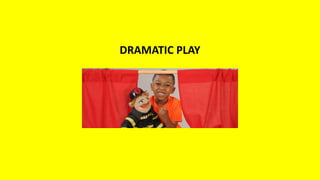
DRAMATIC PLAY
Diversity
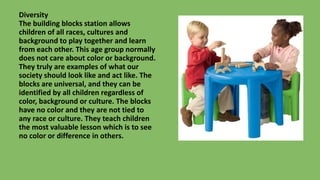
The building blocks station allows
children of all races, cultures and
background to play together and learn
from each other. This age group normally
does not care about color or background.
They truly are examples of what our
society should look like and act like. The
blocks are universal, and they can be
identified by all children regardless of
color, background or culture. The blocks
have no color and they are not tied to
any race or culture. They teach children
the most valuable lesson which is to see
no color or difference in others.
Skills and Abilities
The use of role playing as an
educational tool is very
important. The teacher can
allow the children to play the
role of an adult. By doing this,
we can teach the children basic
life skills such as counting,
cleaning, cooking, and being
responsible.
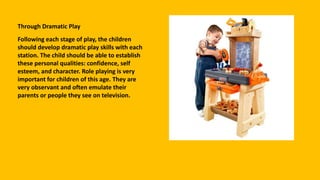
Through Dramatic Play
Following each stage of play, the children
should develop dramatic play skills with each
station. The child should be able to establish
these personal qualities: confidence, self
esteem, and character. Role playing is very
important for children of this age. They are
very observant and often emulate their
parents or people they see on television.
Inclusion
The Dramatic Play Stations must be accessible
and usable for all ages and for those children
with special needs. Infants are able to learn and
watch at the Muppet station. Toddlers can work
at the block station and take advantage of
wearing the costumes. Children with special
needs are also able to wear the costumes and
take part in the Muppet station. The children
with cultural differences can take advantage of
the life skills stations. These stations represent
the work force and lifestyles of their parents.
Teacher’s Role
The teacher’s role in the
dramatic play station is to allow
the children to be themselves
and discover what they like or
dislike about occupations. This is
the first step to a child learning
about careers and what these
different careers do. The teacher
is there to educate and give
examples of these careers
Social and emotional development
Social skills are developed through building stations and social activities.
Approaches to learning
Role playing is a huge part of learning.
Cited works
Dramatic Play Materials. (n.d.). Retrieved from https://www.kaplanco.com/shop/dramatic-play
(2014). Retrieved June/July, 2018, from http://va.gapitc.org/wp-
content/uploads/2014/03/Milestones_Revised2014.pdf

Dramatic Play

  • 1.
  • 2.
    Diversity The building blocksstation allows children of all races, cultures and background to play together and learn from each other. This age group normally does not care about color or background. They truly are examples of what our society should look like and act like. The blocks are universal, and they can be identified by all children regardless of color, background or culture. The blocks have no color and they are not tied to any race or culture. They teach children the most valuable lesson which is to see no color or difference in others.
  • 3.
    Skills and Abilities Theuse of role playing as an educational tool is very important. The teacher can allow the children to play the role of an adult. By doing this, we can teach the children basic life skills such as counting, cleaning, cooking, and being responsible.
  • 4.
    Through Dramatic Play Followingeach stage of play, the children should develop dramatic play skills with each station. The child should be able to establish these personal qualities: confidence, self esteem, and character. Role playing is very important for children of this age. They are very observant and often emulate their parents or people they see on television.
  • 5.
    Inclusion The Dramatic PlayStations must be accessible and usable for all ages and for those children with special needs. Infants are able to learn and watch at the Muppet station. Toddlers can work at the block station and take advantage of wearing the costumes. Children with special needs are also able to wear the costumes and take part in the Muppet station. The children with cultural differences can take advantage of the life skills stations. These stations represent the work force and lifestyles of their parents.
  • 6.
    Teacher’s Role The teacher’srole in the dramatic play station is to allow the children to be themselves and discover what they like or dislike about occupations. This is the first step to a child learning about careers and what these different careers do. The teacher is there to educate and give examples of these careers
  • 7.
    Social and emotionaldevelopment Social skills are developed through building stations and social activities. Approaches to learning Role playing is a huge part of learning.
  • 8.
    Cited works Dramatic PlayMaterials. (n.d.). Retrieved from https://www.kaplanco.com/shop/dramatic-play (2014). Retrieved June/July, 2018, from http://va.gapitc.org/wp- content/uploads/2014/03/Milestones_Revised2014.pdf