Draft as of 28 March 2014
Rules and Regulations Implementing
Republic Act No. 10175, Otherwise Known as the
Cybercrime Prevention Act Of 2012
Pursuant to the authority of the Department of Justice, Department of
Interior and Local Government and Department of Science and Technology under
Republic Act No. 10175, otherwise known as the “Cybercrime Prevention Act of
2012”, the following rules and regulations are hereby promulgated to implement
the provisions of said Act:
CHAPTER I
RULE 1
Preliminary Provisions
Section 1. Title. – These Rules shall be referred to as the Implementing Rules and
Regulations of Republic Act No. 10175 or the Cybercrime Prevention Act of 2012.
Section 2. Declaration of Policy. – The State recognizes the vital role of
information and communications industries such as content production,
telecommunications, broadcasting, electronic commerce, and data processing, in
the nation’s overall social and economic development. The State also recognizes
the importance of providing an environment conducive to the development,
acceleration, and rational application and exploitation of information and
communications technology to attain free, easy, and intelligible access to exchange
and/or delivery of information; and the need to protect and safeguard the integrity
of computer, computer and communications systems, networks, and databases, and
the confidentiality, integrity, and availability of information and data stored
therein, from all forms of misuse, abuse, and illegal access by making punishable
under the law such conduct or conducts. In this light, the State shall adopt
sufficient powers to effectively prevent and combat such offenses by facilitating
their detection, investigation, and prosecution at both the domestic and
international levels, and by providing arrangements for fast and reliable
international cooperation.
Section 3. Definition of Terms. – For purposes of this implementing rules and
regulations, the following terms are hereby defined as follows:
1
Draft as of 28 March 2014
a) Access refers to the instruction, communication with, storing data in,
retrieving data from, or otherwise making use of any resources of a
computer system or communication network.
b) Act refers to Republic Act No. 10175 or the Cybercrime Prevention Act of
2012.
c) Alteration refers to the modification or change, in form or substance, of an
existing computer data or program.
d) Bullying refers to the unlawful or prohibited acts defied and punishable by
Republic Act No. 10627 or the Anti-Bullying Act of 2013, committed
through the use of technology or any electronic means.
e) Child Pornography refers to the unlawful or prohibited acts defined and
punishable by Republic Act No. 9775 or the Anti-Child Pornography Act of
2009, committed through a computer system: Provided, that the penalty to
be imposed shall be one (1) degree higher than that provided for in Republic
Act No. 9775.
f) Collection refers to gathering and receiving information.
g) Communication refers to the transmission of information through ICT
media, including voice, video and other forms of data.
h) Competent Authority refers to the Cybercrime Investigation and
Coordinating Center or the DOJ – Office of Cybercrime.
i) Computer refers to an electronic, magnetic, optical, electrochemical, or
other data processing or communications device, or grouping of such
devices, capable of performing logical, arithmetic, routing, or storage
functions and which includes any storage facility or equipment or
communications facility or equipment directly related to or operating in
conjunction with such device. It covers any type of computer device
including devices with data processing capabilities like mobile phones,
2
Draft as of 28 March 2014
smart phones, computer networks and other devices connected to the
internet.
j) Computer data refers to any representation of facts, information, or concepts
in a form suitable for processing in a computer system including a program
suitable to cause a computer system to perform a function and includes
electronic documents and/or electronic data messages whether stored in local
computer systems or online.
k) Computer program refers to a set of instructions executed by the computer.
l) Computer system refers to any device or group of interconnected or related
devices, one or more of which, pursuant to a program, performs automated
processing of data. It covers any type of device with data processing
capabilities including, but not limited to, computers and mobile phones. The
device consisting of hardware and software may include input, output and
storage components which may stand alone or be connected in a network or
other similar devices. It also includes computer data storage devices or
media.
m) Critical infrastructure refers to the computer systems, and/or networks,
whether physical or virtual, and/or the computer programs, computer data
and/or traffic data so vital to this country that the incapacity or destruction of
or interference with such system and assets would have a debilitating impact
on security, national or economic security, national public health and safety,
or any combination of those matters.
n) Cybersecurity refers to the collection of tools, policies, risk management
approaches, actions, training, best practices, assurance and technologies that
can be used to protect the cyber environment and organization and user’s
assets.
o) National Cybersecurity Plan refers to a comprehensive plan of actions
designed to improve the security and enhance cyber resilience of
infrastructures and services. It is a top-down approach to cybersecurity that
contains broad policy statements and establishes a set of national objectives
and priorities that should be achieved in a specific timeframe.
3
Draft as of 28 March 2014
p) Cybersex refers to the willful engagement, maintenance, control, or
operation, directly or indirectly, of any lascivious exhibition of sexual
organs or sexual activity, with the aid of a computer system, for favor or
consideration.
q) Cyber refers to a computer or a computer network, the electronic medium in
which online communication takes place.
r) Database refers to a representation of information, knowledge, facts,
concepts, or instructions which are being prepared, processed or stored or
have been prepared, processed or stored in a formalized manner and which
are intended for use in a computer system.
s) Hash value refers to the mathematical algorithm produced against digital
information (a file, a physical disk, a logical disk) thereby creating a ‘digital
fingerprint’ or ‘digital DNA’ for that information. It is by purpose a one-way
algorithm and thus it is not possible to change digital evidence, without
changing the corresponding hash values.
t) Identifying information refers to any name or number that may be used
alone or in conjunction with any other information, to identify any specific
individual, including any:
1. Name, date of birth, driver’s license number, passport number or tax
identification number;
2. Unique biometric data, such as fingerprint or other unique physical
representation;
3. Unique electronic identification number, address, or routing code; and
4. Telecommunication identifying information or access device.
u) Interception refers to listening to, recording, monitoring or surveillance of
the content of communications, including procurement of the content of
data, either directly, through access and use of a computer system or
indirectly, through the use of electronic eavesdropping or tapping devices, at
the same time that the communication is occurring.
4
Draft as of 28 March 2014
v) Law enforcement authorities refers to the National Bureau of Investigation
(NBI) and the Philippine National Police (PNP) under Section 10 of the Act.
w) Original author refers to the person who created or is the origin of the
assailed electronic statement or post using the computer system.
x) Preservation refers to keeping data, which already exists in a stored form,
protected from anything that would cause its current quality or condition to
change or deteriorate. It is the activity that keeps that stored data secure and
safe.
y) Service Provider refers to:
1. any public or private entity that provides to users of its service the ability
to communicate by means of a computer system; and
2. any other entity that processes or stores computer data on behalf of such
communication service or users of such service.
z) Subscriber’s information refers to any information contained in the form of
computer data or any other form that is held by a service provider, relating to
subscribers of its services other than traffic or content data and by which can
be established:
1. The type of communication service used, the technical provisions taken
thereto and the period of service;
2. The subscriber’s identity, postal or geographic address, telephone and
other access number, any assigned network address, billing and payment
information available on the basis of the service agreement; or
3. Any other available information on the site of the installation of
communication equipment, available on the basis of the service
agreement or arrangement.
aa)Traffic Data or Non-Content Data refers to any computer data other than
the content of the communication, including but not limited to the
5
Draft as of 28 March 2014
communication’s origin, destination, route, time, date, size, duration, or type
of underlying service.
bb) Without Right refers to either: (i) conduct undertaken without or in excess
of authority; or (ii) conduct not covered by established legal defenses,
excuses, court orders, justifications, or relevant principles under the law.
CHAPTER II
RULE 2
Punishable Acts and Penalties
Part I
Core Cybercrimes
Section 4. Cybercrime Offenses. – The following acts constitute the offense of
core cybercrime punishable under the Act:
A. Offenses against the confidentiality, integrity and availability of computer
data and systems shall be punished with imprisonment of prision mayor or a
fine of at least Two hundred thousand pesos(Ph200,000.00) up to a
maximum amount commensurate to the damage incurred or both, except no.
5 herein:
1. Illegal Access – The access to the whole or any part of a computer
system without right.
2. Illegal Interception – The interception made by technical means without
right of any non-public transmission of computer data to, from, or within
a computer system including electromagnetic emissions from a computer
system carrying such computer data: Provided, however, That it shall not
be unlawful for an officer, employee, or agent of a service provider,
whose facilities are used in the transmission of communications, to
intercept, disclose, or use that communication in the normal course of
employment while engaged in any activity that is necessary to the
rendition of service or to the protection of the rights or property of the
service provider, except that the latter shall not utilize service observing
or random monitoring except for mechanical or service control quality
checks.
6
Draft as of 28 March 2014
3. Data Interference – The intentional or reckless alteration, damaging,
deletion or deterioration of computer data, electronic document, or
electronic data message, without right, including the introduction or
transmission of viruses.
4. System Interference – The intentional alteration or reckless hindering or
interference with the functioning of a computer or computer network by
inputting, transmitting, damaging, deleting, deteriorating, altering or
suppressing computer data or program, electronic document, or electronic
data message, without right or authority, including the introduction or
transmission of viruses.
5. Misuse of Devices shall be punished with imprisonment of prision mayor
or a fine of not more than Five hundred thousand pesos (P500,000.00) or
both:
i. The use, production, sale, procurement, importation, distribution or
otherwise making available intentionally and without right, of:
(aa) A device, including a computer program, designed or
adapted primarily for the purpose of committing any of the
offenses under this rules; or
(bb) A computer password, access code, or similar data by which
the whole or any part of a computer system is capable of
being accessed with the intent that it be used for the purpose
of committing any of the offenses under this rules;
ii. The possession of an item referred to in paragraphs 5(a)(i) or (ii)
above with the intent to use said devices for the purpose of
committing any of the offenses under this section.
Provided, That no criminal liability shall attach when the use, production,
sale, procurement, importation, distribution, or otherwise making
available, or possession of computer devices or data referred to in this
section is for the authorized testing of a computer system.
If any of the punishable acts enumerated in section 4(A) is committed
against critical infrastructure, the penalty of reclusion temporal or a fine of at least
7
Draft as of 28 March 2014
Five hundred thousand pesos (P500,000.00) up to maximum amount
commensurate to the damage incurred or both shall be imposed.
B. Computer-related Offenses shall be punished with imprisonment of prision
mayor or a fine of at least Two hundred thousand pesos(Ph200,000.00) up to
a maximum amount commensurate to the damage incurred or both:
1. Computer-related Forgery –
i. The input, alteration, or deletion of any computer data without right
resulting in inauthentic data with the intent that it be considered or
acted upon for legal purposes as if it were authentic, regardless
whether or not the data is directly readable and intelligible; or
ii. The act of knowingly using computer data which is the product of
computer-related forgery as defined herein, for the purpose of
perpetuating a fraudulent or dishonest design.
2. Computer-related Fraud – The unauthorized input, alteration, or deletion
of computer data or program or interference in the functioning of a
computer system, causing damage thereby with fraudulent intent:
Provided, That if no damage has yet been caused, the penalty imposable
shall be one (1) degree lower.
3. Computer-related Identity Theft – The intentional acquisition, use,
misuse, transfer, possession, alteration or deletion of identifying
information belonging to another, whether natural or juridical, without
right: Provided, That if no damage has yet been caused, the penalty
imposable shall be one (1) degree lower.
C. Content-related Offenses:
1. Any person found guilty of Child Pornography shall be punished with the
penalties as enumerated in Republic Act No. 9775 or the “Anti-Child
Pornography Act of 2009”: Provided, that the penalty to be imposed shall
be one (1) degree higher than that provided for in Republic Act No. 9775,
if committed through a computer system.
8
Draft as of 28 March 2014
Section 5. Other Offenses. – The following acts shall also constitute an offense
which shall be punished with imprisonment one (1) degree lower than that of the
prescribed penalty for the offense or a fine of at least One hundred thousand pesos
(PhP100,000.00) but not exceeding Five hundred thousand pesos (PhP500,000.00)
or both:
A. Aiding or Abetting in the Commission of Cybercrime. – Any person who
willfully abets, aids or financially benefits in the commission of any of the
offenses enumerated in the Act shall be held liable.
B. Attempt to Commit Cybercrime. – Any person who willfully attempts to
commit any of the offenses enumerated in the Act shall be held liable.
Provided, that this provision shall not apply in the crimes of (1) child pornography
as defined and punished by R.A. 9775 or the Anti-Child Pornography Act 2009;
(2) unsolicited commercial communications under Sec. 4(c)(3) of R.A. 10175; and
online libel under Sec. 4(c)(4) of R.A. 10175.
Punishable Acts and Penalties
Part II
Other Cybercrimes
Section 5. Other Offenses. – The following constitute other cybercrime offenses
punishable under the Act:
1. Cyber-squatting – The acquisition of a domain name over the internet in
bad faith to profit, mislead, destroy reputation, and deprive others from
registering the same, if such a domain name is:
a. Similar, identical, or confusingly similar to an existing trademark
registered with the appropriate government agency at the time of the
domain name registration;
b. Identical or in any way similar with the name of a person other than
the registrant, in case of a personal name; and
c. Acquired without right or with intellectual property interests in it.
9
Draft as of 28 March 2014
Cyber-squatting shall be punished with imprisonment of prision mayor or a
fine of at least Two hundred thousand pesos(Ph200,000.00) up to a maximum
amount commensurate to the damage incurred or both. Provided, if it is committed
against critical infrastructure, the penalty of reclusion temporal or a fine of at least
Five hundred thousand pesos (P500,000.00) up to maximum amount
commensurate to the damage incurred or both shall be imposed.
2. Cybersex – Any person found guilty cybersex shall be punished with
imprisonment of prision mayor or a fine of at least Two hundred
thousand pesos (P200,000.00) but not exceeding One million pesos
(P1,000,000.00) or both.
The maintenance, control, or operation of cybersex shall be punished
with the maximum penalty if it involves three or more offenders or
victims. Cybersex involving a child shall be punished in accordance to
the provision on child pornography of the Act.
3. Libel – The unlawful or prohibited act of libel as defined in Article 355
of the Revised Penal Code, as amended, committed through a computer
system or any other similar means which may be devised in the future
shall be punished with prision correccional in its maximum period to
prision mayor in its minimum period or a fine ranging from 6,000 pesos
up to the maximum amount determined by Court, or both, in addition to
the civil action which may be brought by the offended party.
Provided, that this provision applies only to the original author of the
post or online libel and not to others who simply receive the post and
react to it.
4. Cyber-Bullying – Any person found guilty of Bullying shall be
punished with the penalties as enumerated in Republic Act No. 10627
or the “Anti-Bullying Act of 2013”: Provided, that the penalty to be
imposed shall be one (1) degree higher than that provided for in
Republic Act No. 10627, if committed through a computer system.
5. Other offenses – The following acts shall also constitute an offense
which shall be punished with imprisonment one (1) degree lower than
that of the prescribed penalty for the offense or a fine of at least One
hundred thousand pesos (PhP100,000.00) but not exceeding Five
hundred thousand pesos (PhP500,000.00) or both:
10
Draft as of 28 March 2014
C. Aiding or Abetting in the Commission of Cybercrime. – Any person
who willfully abets, aids or financially benefits in the commission of
any of the offenses enumerated in the Act shall be held liable.
D. Attempt to Commit Cybercrime. – Any person who willfully
attempts to commit any of the offenses enumerated in the Act shall
be held liable.
Provided, that this provision shall not apply in the crimes of (1) child pornography
as defined and punished by R.A. 9775 or the Anti-Child Pornography Act 2009;
and online libel under Sec. 4(c)(4) of R.A. 10175.
Section 6. Corporate Liability. – When any of the punishable acts herein defined
are knowingly committed on behalf of or for the benefit of a juridical person, by a
natural person acting either individually or as part of an organ of the juridical
person, who has a leading position within, based on (a) a power of representation
of the juridical person, (b) an authority to take decisions on behalf of the juridical
person, or (c) an authority to exercise control within the juridical person, the
juridical person shall be held liable for a fine equivalent to at least double the fines
imposable in Section 7 up to a maximum of Ten million pesos (Php10,000,000.00).
If the commission of any of the punishable acts herein defined was made
possible due to the lack of supervision or control by a natural person referred to
and described in the preceding paragraph, for the benefit of that juridical person by
a natural person acting under its authority, the juridical person shall be held liable
for a fine equivalent to at least double the fines imposable in Section 7 up to a
maximum of Five million pesos (Php5,000,000.00).
The liability imposed on the juridical person shall be without prejudice to
the criminal liability of the natural person who has committed the offence.
Section 7. Violation of the Revised Penal Code as Amended Through and With
the Use of Information and Communication Technology. – All crimes defined
and penalized by the Revised Penal Code, as amended, and special criminal laws
committed by, through and with the use of information and communications
technologies shall be covered by the relevant provisions of the Act: Provided, That
the penalty to be imposed shall be one (1) degree higher than that provided for by
the Revised Penal Code, as amended, and special laws, as the case may be.
11
Draft as of 28 March 2014
Section 8. Liability under Other Laws. – A prosecution under the Act shall be
without prejudice to any liability for violation of any provision of the Revised
Penal Code, as amended, or special laws.
Provided, that this provision shall not apply to the prosecution of an offender under
(1) both Section 4(c)(4) of R.A. 10175 and Article 353 of the Revised Penal Code;
and both Section 4(c)(2) of R.A. 10175 and R.A. 9775 or the Anti-Child
Pornography Act of 2009.
CHAPTERIII
(Chapter IV of the Act)
RULE 3
Enforcement and Implementation
Section 9. Law Enforcement Authorities. – The National Bureau of Investigation
(NBI) and the Philippine National Police (PNP) shall be responsible for the
efficient and effective law enforcement of the provisions of the Act. The NBI and
the PNP shall organize a cybercrime division or unit to be manned by Special
Investigators to exclusively handle cases involving violations of the Act.
The NBI shall create a cybercrime division headed by a Head Agent. The PNP
shall create an anti-cybercrime unit headed by a Police Director.
The Office of Cybercrime (OOC) created under the Act shall coordinate the efforts
of the NBI and the PNP in enforcing the provisions of the Act.
Section 10. Powers and Functions of Law Enforcement Authorities. – The NBI
and PNP cybercrime unit or division shall have the following powers and
functions:
a. To investigate all cybercrimes where computer systems are involved;
b. To conduct data recovery and forensic analysis on computer systems and
other electronic evidence seized;
c. To formulate guidelines in investigation, forensic evidence recovery, and
forensic data analysis consistent with industry standard practices;
d. To provide technological support to investigating units within the PNP
and NBI including the search, seizure, evidence preservation, forensic
12
Draft as of 28 March 2014
recovery of data from crime scenes and systems used in crimes and to
provide testimonies;
e. To develop public, private sector, and law enforcement agency relations
in addressing cybercrimes;
f. To maintain necessary and relevant databases for statistical and/or
monitoring purposes;
g. To develop capacity within their organizations in order to perform such
duties necessary for the enforcement of the act;
h. To support the formulation and enforcement of the national cybersecurity
plan; and
i. To perform other functions as may be required by the Act.
Section 11. Duties of Law Enforcement Authorities. – To ensure that the
technical nature of cybercrime and its prevention is given focus and considering
the procedures involved for international cooperation, law enforcement authorities
specifically the computer or technology crime divisions or units responsible for the
investigation of cybercrimes are required to submit timely and regular reports
including pre-operation, post-operation and investigation results and such other
documents as may be required to the Department of Justice (DOJ) – Office of
Cybercrime for review and monitoring.
Law enforcement authorities should act in accordance with the guidelines,
advisories, and procedures issued and promulgated by the competent authority in
all matters related to cybercrime, and utilize the prescribed forms and templates
including but not limited to preservation orders, chain of custody, consent to
search, consent to assume account/online identity, request for computer forensic
examination.
Section 12. Preservation and Retention of Computer Data. – The integrity of
traffic data and subscriber information shall be kept, retained and preserved by a
service provider for a minimum period of six (6) months from the date of the
transaction. Content data shall be similarly preserved for six (6) months from the
date of receipt of the order from law enforcement authorities requiring its
preservation.
Law enforcement authorities may order a one-time extension for another six (6)
months provided that once computer data preserved, transmitted or stored by a
service provider is used as evidence in a case, the mere furnishing to such service
provider of the transmittal document to the Office of the Prosecutor, shall be
13
Draft as of 28 March 2014
deemed a notification to preserve the computer data until the termination of the
case.
The service provider ordered to preserve computer data shall keep the order and its
compliance confidential.
Section 13. Collection of Computer Data. Law enforcement authorities, with the
issuance of a court warrant, shall be authorized to collect or record by technical or
electronic means, and service providers are required to collect or record by
technical or electronic means, and/or to cooperate and assist in the collection or
recording of, computer data, associated with specified communications transmitted
by means of a computer system.
The court warrant required under this section shall be issued or granted upon
written application and the examination under oath or affirmation of the applicant
and the witnesses he may produce and the showing: (1) that there are reasonable
grounds to believe that any of the crimes enumerated hereinabove has been
committed, or is being committed or is about to be committed; (2) that there are
reasonable grounds to believe that evidence will be obtained is essential to the
conviction of any person for, or to the solution of, or to the prevention of, any such
crimes; and (3) that there are no other means readily available for obtaining such
evidence.
Section 14. Disclosure of Computer Data. – Law enforcement authorities, upon
securing a court warrant, shall issue an order requiring any person or service
provider to disclose or submit subscriber’s information, traffic data or relevant data
in his/its possession or control within seventy-two (72) hours from receipt of the
order in relation to a valid complaint officially docketed and assigned for
investigation and the disclosure is necessary and relevant for the purpose of
investigation.
Section 15. Search, Seizure, and Examination of Computer Data. – Where a
search and seizure warrant is properly issued, the law enforcement authorities shall
likewise have the following powers and duties:
Within the time period specified in the warrant, to conduct interception, as
defined in this Rules, and:
a. To search and seize computer data;
b. To secure a computer system or a computer data storage medium;
14
Draft as of 28 March 2014
c. To make and retain a copy of those computer data secured;
d. To maintain the integrity of the relevant stored computer data;
e. To conduct forensic analysis or examination of the computer data storage
medium; and
f. To render inaccessible or remove those computer data in the accessed
computer or computer and communications network.
Pursuant thereof, the law enforcement authorities may order any person who
has knowledge about the functioning of the computer system and the measures to
protect and preserve the computer data therein to provide, as is reasonable, the
necessary information, to enable the undertaking of the search, seizure and
examination.
Law enforcement authorities may request for an extension of time to
complete the examination of the computer data storage medium and to make a
return thereon but in no case for a period longer than thirty (30) days from date of
approval by the court.
Section 16. Custody of Computer Data. – All computer data, including content
and traffic data, examined under a proper warrant shall, within forty-eight (48)
hours after the expiration of the period fixed therein, be deposited with the court in
a sealed package, and shall be accompanied by an affidavit of the law enforcement
authority executing it stating the dates and times covered by the examination, and
the law enforcement authority who may access to the deposit, among other relevant
data. The law enforcement authority shall also certify that no duplicates or copies
of the whole or any part thereof have been made, or if made, that all such
duplicates or copies are included in the package deposited with the court. The
package so deposited shall not be opened, or the recordings replayed, or used in
evidence, or their contents revealed, except upon order of the court, which shall not
be granted except upon motion, with due notice and opportunity to be heard to the
person or persons whose conservation or communications have been recorded.
Section 17. Destruction of Computer Data. – Upon expiration of the periods as
provided in Sections 12 and 15 hereof, service providers and law enforcement
authorities, as the case may be, shall immediately and completely destroy the
computer data subject of a preservation and examination.
Section 18. Exclusionary Rule. – Any evidence obtained without a valid warrant
or beyond the authority of the same shall be inadmissible for any proceeding
before any court or tribunal.
15
Draft as of 28 March 2014
The Rules of Court shall have suppletory application in implementing the Act.
Section 19. Non-compliance. – Failure to comply with the provisions of Chapter
IV of the Act specifically the orders from law enforcement authorities shall be
punished as a violation of P.D. No. 1829 with imprisonment of prision
correccional in its maximum period or a fine of One hundred thousand pesos
(Php100,000.00) or both, for each and every noncompliance with an order issued
by law enforcement authorities.
CHAPTER IV
(Chapter V of the Act)
RULE 4
Jurisdiction
Section 20. Jurisdiction. – The Regional Trial Court shall have jurisdiction over
any violation of the provisions of the Act including any violation committed by a
Filipino national regardless of the place of commission. Jurisdiction shall lie if any
of the elements was committed within the Philippines or committed with the use of
any computer system wholly or partly situated in the country, or when by such
commission any damage is caused to a natural or juridical person who, at the time
the offense was committed, was in the Philippines.
There shall be designated special cybercrime courts manned by specially trained
judges to handle cybercrime cases.
Section 21. Designation of Special Prosecutors. – The Secretary of Justice shall
designate special prosecutors comprising the prosecution taskforce or division
under the DOJ-Office of Cybercrime to handle cybercrime cases in violation of the
Act.
CHAPTER V
(Chapter VI in the Act)
RULE 5
International Cooperation
16
Draft as of 28 March 2014
Section 22. International Cooperation. – All relevant international instruments on
international cooperation on criminal matters, arrangements agreed on the basis of
uniform or reciprocal legislation, and domestic laws, to the widest extent possible
for the purposes of investigations or proceedings concerning crimes related to
computer systems and data, or for the collection of electronic evidence of crimes
shall be given full force and effect.
The DOJ shall cooperate and render assistance to other nations, as well as request
assistance from foreign states, for purposes of detection, investigation and
prosecution of offenses referred to in the Act and in the collection of evidence in
electronic form in relation thereto. The principles contained in Presidential Decree
No. 1069 and other pertinent laws as well as existing extradition and mutual legal
assistance treaties shall apply. In this regard, the central authority shall:
a. Provide assistance to a requesting nation in the real-time collection of traffic
data associated with specified communications in the country transmitted by
means of a computer system, with respect to criminal offenses defined in the
Act for which real-time collection of traffic data would be available;
b. Provide assistance to a requesting nation in the real-time collection,
recording or interception of content data of specified communications
transmitted by means of a computer system;
c. Allow another nation to:
1. Access publicly available stored computer data, located in the country, or
elsewhere; or
2. Access or receive, through a computer system located in the country,
stored computer data located in another country, if the nation obtains the
lawful and voluntary consent of the person who has the lawful authority
to disclose the data to the nation through that computer system.
d. Receive a request of another nation for it to order or obtain the expeditious
preservation of data stored by means of a computer system, located within
the country, relative to which the requesting nation shall submit a request for
17
Draft as of 28 March 2014
mutual assistance for the search or similar access, seizure or similar
securing, or disclosure of the stored computer data:
1. A request for preservation of data under this section shall specify:
i. The authority seeking the preservation;
ii. The offense that is the subject of a criminal investigation or
proceedings and a brief summary of the related facts;
iii. The stored computer data to be preserved and its relationship to the
offense;
iv. The necessity of the preservation; and
v. That the requesting nation shall submit a request for mutual assistance
for the search or similar access, seizure or similar securing, or
disclosure of the stored computer data.
2. Upon receiving the request from another nation, the DOJ and law
enforcement agencies shall take all appropriate measures to preserve
expeditiously the specified data in accordance with the Act and other
pertinent laws. For the purposes of responding to a request, dual
criminality shall not be required as a condition to providing such
preservation;
3. A request for preservation may only be refused if:
i. The request concerns an offense which the government of the
Philippines considers as a political offense or an offense connected
with a political offense; or
ii. The government of the Philippines considers the execution of the
request will prejudice its sovereignty, security, public order or other
national interest.
4. Where the government of the Philippines believes that preservation will
not ensure the future availability of the data, or will threaten the
confidentiality of, or otherwise prejudice the requesting nation’s
investigation, it shall promptly so inform the requesting nation. The
requesting nation will determine whether its request should be executed;
and
18
Draft as of 28 March 2014
5. Any preservation effected in response to the request referred to in
paragraph (a) shall be for a period not less than sixty (60) days, in order
to enable the requesting nation to submit a request for the search or
similar access, seizure or similar securing, or disclosure of the data.
Following the receipt of such a request, the data shall continue to be
preserved pending a decision on that request.
e. Accommodate request from another nation to search, access, seize, secure,
or disclose data stored by means of a computer system located within the
country, including data that has been preserved under the previous
subsection.
The government of the Philippines shall respond to the request through the
proper application of international instruments, arrangements and laws:
1. The request shall be responded to on an expedited basis where:
i. There are grounds to believe that relevant data is particularly
vulnerable to loss or modification; or
ii. The instruments, arrangements and laws referred to in paragraph (b)
of this section otherwise provide for expedited cooperation.
2. The requesting nation must maintain the confidentiality of the fact or the
subject of request for assistance and cooperation. It may only use the
requested information subject to the conditions specified in the grant.
f. Make a request to any foreign state for assistance for purposes of detection,
investigation and prosecution of offenses referred to in the Act;
g. The criminal offenses described under Chapter II of the Act shall be deemed
to be included as extraditable offenses in any extradition treaty where the
Philippines is a party. Provided, that the offense is punishable under the laws
of both Parties concerned by deprivation of liberty for a maximum period of
at least one year or by a more severe penalty.
CHAPTER VI
(Chapter VII of the Act)
19
Draft as of 28 March 2014
RULE 6
Competent Authorities
Section 23. Cybercrime Investigation and Coordinating Center; Composition. –
The inter-agency body known as the Cybercrime Investigation and Coordinating
Center (CICC), under the administrative supervision of the Office of the President,
established for policy coordination among concerned agencies and for the
formulation and enforcement of the national cyber security plan, is headed by the
Executive Director of the Information and Communications Technology Office
under the Department of Science and Technology (ICTO-DOST) as Chairperson
with the Director of the NBI as Vice Chairperson; the Chief of the PNP; Head of
the DOJ Office of Cybercrime, and one (1) representative from the private sector
and academe, as members.
The DOJ-Office of Cybercrime, with representatives from NBI, PNP, and ICTO-
DOST, shall serve as the Secretariat for the CICC.
The DOJ – Office of Cybercrime shall also serve as the Operations Center of the
CICC and have the following agencies form part:
1. National Bureau of Investigation
2. Philippine National Police
3. DOJ – National Prosecution Service
4. Information and Communications Technology Office
5. Bureau of Immigration
6. Philippine Drug Enforcement Agency
7. Bureau of Customs
8. Anti – Money Laundering Council
9. National Law Enforcement Coordinating Council
Participation and representation in the Secretariat and/or Operations Center does
not require physical presence but may be done thru electronic modes such as email,
audio-visual conference calls, and the like.
Section 24. Powers and Functions. – The CICC shall have the following powers
and functions:
a. To formulate a national cybersecurity plan and extend immediate
assistance for the suppression of real-time commission of cybercrime
offenses through a computer emergency response team (CERT);
20
Draft as of 28 March 2014
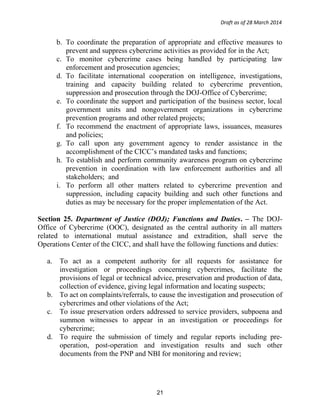
b. To coordinate the preparation of appropriate and effective measures to
prevent and suppress cybercrime activities as provided for in the Act;
c. To monitor cybercrime cases being handled by participating law
enforcement and prosecution agencies;
d. To facilitate international cooperation on intelligence, investigations,
training and capacity building related to cybercrime prevention,
suppression and prosecution through the DOJ-Office of Cybercrime;
e. To coordinate the support and participation of the business sector, local
government units and nongovernment organizations in cybercrime
prevention programs and other related projects;
f. To recommend the enactment of appropriate laws, issuances, measures
and policies;
g. To call upon any government agency to render assistance in the
accomplishment of the CICC’s mandated tasks and functions;
h. To establish and perform community awareness program on cybercrime
prevention in coordination with law enforcement authorities and all
stakeholders; and
i. To perform all other matters related to cybercrime prevention and
suppression, including capacity building and such other functions and
duties as may be necessary for the proper implementation of the Act.
Section 25. Department of Justice (DOJ); Functions and Duties. – The DOJ-
Office of Cybercrime (OOC), designated as the central authority in all matters
related to international mutual assistance and extradition, shall serve the
Operations Center of the CICC, and shall have the following functions and duties:
a. To act as a competent authority for all requests for assistance for
investigation or proceedings concerning cybercrimes, facilitate the
provisions of legal or technical advice, preservation and production of data,
collection of evidence, giving legal information and locating suspects;
b. To act on complaints/referrals, to cause the investigation and prosecution of
cybercrimes and other violations of the Act;
c. To issue preservation orders addressed to service providers, subpoena and
summon witnesses to appear in an investigation or proceedings for
cybercrime;
d. To require the submission of timely and regular reports including pre-
operation, post-operation and investigation results and such other
documents from the PNP and NBI for monitoring and review;
21
Draft as of 28 March 2014
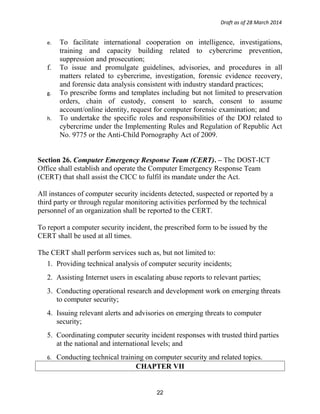
e. To facilitate international cooperation on intelligence, investigations,
training and capacity building related to cybercrime prevention,
suppression and prosecution;
f. To issue and promulgate guidelines, advisories, and procedures in all
matters related to cybercrime, investigation, forensic evidence recovery,
and forensic data analysis consistent with industry standard practices;
g. To prescribe forms and templates including but not limited to preservation
orders, chain of custody, consent to search, consent to assume
account/online identity, request for computer forensic examination; and
h. To undertake the specific roles and responsibilities of the DOJ related to
cybercrime under the Implementing Rules and Regulation of Republic Act
No. 9775 or the Anti-Child Pornography Act of 2009.
Section 26. Computer Emergency Response Team (CERT). – The DOST-ICT
Office shall establish and operate the Computer Emergency Response Team
(CERT) that shall assist the CICC to fulfil its mandate under the Act.
All instances of computer security incidents detected, suspected or reported by a
third party or through regular monitoring activities performed by the technical
personnel of an organization shall be reported to the CERT.
To report a computer security incident, the prescribed form to be issued by the
CERT shall be used at all times.
The CERT shall perform services such as, but not limited to:
1. Providing technical analysis of computer security incidents;
2. Assisting Internet users in escalating abuse reports to relevant parties;
3. Conducting operational research and development work on emerging threats
to computer security;
4. Issuing relevant alerts and advisories on emerging threats to computer
security;
5. Coordinating computer security incident responses with trusted third parties
at the national and international levels; and
6. Conducting technical training on computer security and related topics.
CHAPTER VII
22
Draft as of 28 March 2014
RULE 7
Service Providers
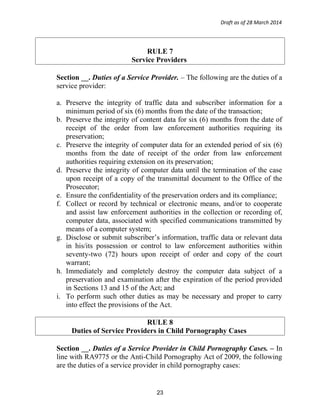
Section __. Duties of a Service Provider. – The following are the duties of a
service provider:
a. Preserve the integrity of traffic data and subscriber information for a
minimum period of six (6) months from the date of the transaction;
b. Preserve the integrity of content data for six (6) months from the date of
receipt of the order from law enforcement authorities requiring its
preservation;
c. Preserve the integrity of computer data for an extended period of six (6)
months from the date of receipt of the order from law enforcement
authorities requiring extension on its preservation;
d. Preserve the integrity of computer data until the termination of the case
upon receipt of a copy of the transmittal document to the Office of the
Prosecutor;
e. Ensure the confidentiality of the preservation orders and its compliance;
f. Collect or record by technical or electronic means, and/or to cooperate
and assist law enforcement authorities in the collection or recording of,
computer data, associated with specified communications transmitted by
means of a computer system;
g. Disclose or submit subscriber’s information, traffic data or relevant data
in his/its possession or control to law enforcement authorities within
seventy-two (72) hours upon receipt of order and copy of the court
warrant;
h. Immediately and completely destroy the computer data subject of a
preservation and examination after the expiration of the period provided
in Sections 13 and 15 of the Act; and
i. To perform such other duties as may be necessary and proper to carry
into effect the provisions of the Act.
RULE 8
Duties of Service Providers in Child Pornography Cases
Section __. Duties of a Service Provider in Child Pornography Cases. – In
line with RA9775 or the Anti-Child Pornography Act of 2009, the following
are the duties of a service provider in child pornography cases:
23
Draft as of 28 March 2014
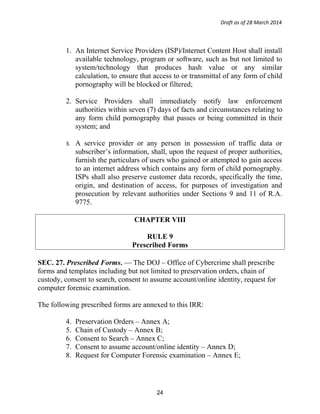
1. An Internet Service Providers (ISP)/Internet Content Host shall install
available technology, program or software, such as but not limited to
system/technology that produces hash value or any similar
calculation, to ensure that access to or transmittal of any form of child
pornography will be blocked or filtered;
2. Service Providers shall immediately notify law enforcement
authorities within seven (7) days of facts and circumstances relating to
any form child pornography that passes or being committed in their
system; and
3. A service provider or any person in possession of traffic data or
subscriber’s information, shall, upon the request of proper authorities,
furnish the particulars of users who gained or attempted to gain access
to an internet address which contains any form of child pornography.
ISPs shall also preserve customer data records, specifically the time,
origin, and destination of access, for purposes of investigation and
prosecution by relevant authorities under Sections 9 and 11 of R.A.
9775.
CHAPTER VIII
RULE 9
Prescribed Forms
SEC. 27. Prescribed Forms. — The DOJ – Office of Cybercrime shall prescribe
forms and templates including but not limited to preservation orders, chain of
custody, consent to search, consent to assume account/online identity, request for
computer forensic examination.
The following prescribed forms are annexed to this IRR:
4. Preservation Orders – Annex A;
5. Chain of Custody – Annex B;
6. Consent to Search – Annex C;
7. Consent to assume account/online identity – Annex D;
8. Request for Computer Forensic examination – Annex E;
24
Draft as of 28 March 2014
The DOJ – Office of Cybercrime shall prescribe additional, and/or update existing,
forms and templates as necessary, in consultation with CICC members, that are
consistent with international standard practices.
CHAPTER IX
(Chapter VIII of the Act)
RULE 10
Final Provisions
SEC. 27. Appropriations. — The amount of Fifty million pesos
(PhP50,000,000.00) shall be appropriated annually for the implementation of the
Act under the fiscal management of DOJ - Office of Cybercrime.
All proceeds derived from as well as the sale of properties used for the commission
of any violation of the Act shall accrue to the special account of the DOJ-OOC
which shall be used exclusively for the proper implementation of the Act.
Section 28. Separability Clause. – If any provision of these Rules is held invalid,
the other provisions not affected shall remain in full force and effect.
Section 29. Repealing Clause. – All rules and regulations inconsistent with these
Rules are hereby repealed or modified accordingly.
Section 30. Effectivity. – These rules and regulations shall take effect fifteen (15)
days after the completion of its publication in at least two (2) newspapers of
general circulation.
DONE in the City of Manila, this ____ of _______________ 2014.
HON. MANUEL A. ROXAS II
Secretary
Department of Interior and Local
Government
HON. MARIO G. MONTEJO
Secretary
Department of Science and Technology
HON. LEILA M. DE LIMA
Secretary
25
Draft as of 28 March 2014
Department of Justice
26

Draft Implementing Rules and Regulations (IRR) of the Cybercrime Law

  • 1.
    Draft as of28 March 2014 Rules and Regulations Implementing Republic Act No. 10175, Otherwise Known as the Cybercrime Prevention Act Of 2012 Pursuant to the authority of the Department of Justice, Department of Interior and Local Government and Department of Science and Technology under Republic Act No. 10175, otherwise known as the “Cybercrime Prevention Act of 2012”, the following rules and regulations are hereby promulgated to implement the provisions of said Act: CHAPTER I RULE 1 Preliminary Provisions Section 1. Title. – These Rules shall be referred to as the Implementing Rules and Regulations of Republic Act No. 10175 or the Cybercrime Prevention Act of 2012. Section 2. Declaration of Policy. – The State recognizes the vital role of information and communications industries such as content production, telecommunications, broadcasting, electronic commerce, and data processing, in the nation’s overall social and economic development. The State also recognizes the importance of providing an environment conducive to the development, acceleration, and rational application and exploitation of information and communications technology to attain free, easy, and intelligible access to exchange and/or delivery of information; and the need to protect and safeguard the integrity of computer, computer and communications systems, networks, and databases, and the confidentiality, integrity, and availability of information and data stored therein, from all forms of misuse, abuse, and illegal access by making punishable under the law such conduct or conducts. In this light, the State shall adopt sufficient powers to effectively prevent and combat such offenses by facilitating their detection, investigation, and prosecution at both the domestic and international levels, and by providing arrangements for fast and reliable international cooperation. Section 3. Definition of Terms. – For purposes of this implementing rules and regulations, the following terms are hereby defined as follows: 1
  • 2.
    Draft as of28 March 2014 a) Access refers to the instruction, communication with, storing data in, retrieving data from, or otherwise making use of any resources of a computer system or communication network. b) Act refers to Republic Act No. 10175 or the Cybercrime Prevention Act of 2012. c) Alteration refers to the modification or change, in form or substance, of an existing computer data or program. d) Bullying refers to the unlawful or prohibited acts defied and punishable by Republic Act No. 10627 or the Anti-Bullying Act of 2013, committed through the use of technology or any electronic means. e) Child Pornography refers to the unlawful or prohibited acts defined and punishable by Republic Act No. 9775 or the Anti-Child Pornography Act of 2009, committed through a computer system: Provided, that the penalty to be imposed shall be one (1) degree higher than that provided for in Republic Act No. 9775. f) Collection refers to gathering and receiving information. g) Communication refers to the transmission of information through ICT media, including voice, video and other forms of data. h) Competent Authority refers to the Cybercrime Investigation and Coordinating Center or the DOJ – Office of Cybercrime. i) Computer refers to an electronic, magnetic, optical, electrochemical, or other data processing or communications device, or grouping of such devices, capable of performing logical, arithmetic, routing, or storage functions and which includes any storage facility or equipment or communications facility or equipment directly related to or operating in conjunction with such device. It covers any type of computer device including devices with data processing capabilities like mobile phones, 2
  • 3.
    Draft as of28 March 2014 smart phones, computer networks and other devices connected to the internet. j) Computer data refers to any representation of facts, information, or concepts in a form suitable for processing in a computer system including a program suitable to cause a computer system to perform a function and includes electronic documents and/or electronic data messages whether stored in local computer systems or online. k) Computer program refers to a set of instructions executed by the computer. l) Computer system refers to any device or group of interconnected or related devices, one or more of which, pursuant to a program, performs automated processing of data. It covers any type of device with data processing capabilities including, but not limited to, computers and mobile phones. The device consisting of hardware and software may include input, output and storage components which may stand alone or be connected in a network or other similar devices. It also includes computer data storage devices or media. m) Critical infrastructure refers to the computer systems, and/or networks, whether physical or virtual, and/or the computer programs, computer data and/or traffic data so vital to this country that the incapacity or destruction of or interference with such system and assets would have a debilitating impact on security, national or economic security, national public health and safety, or any combination of those matters. n) Cybersecurity refers to the collection of tools, policies, risk management approaches, actions, training, best practices, assurance and technologies that can be used to protect the cyber environment and organization and user’s assets. o) National Cybersecurity Plan refers to a comprehensive plan of actions designed to improve the security and enhance cyber resilience of infrastructures and services. It is a top-down approach to cybersecurity that contains broad policy statements and establishes a set of national objectives and priorities that should be achieved in a specific timeframe. 3
  • 4.
    Draft as of28 March 2014 p) Cybersex refers to the willful engagement, maintenance, control, or operation, directly or indirectly, of any lascivious exhibition of sexual organs or sexual activity, with the aid of a computer system, for favor or consideration. q) Cyber refers to a computer or a computer network, the electronic medium in which online communication takes place. r) Database refers to a representation of information, knowledge, facts, concepts, or instructions which are being prepared, processed or stored or have been prepared, processed or stored in a formalized manner and which are intended for use in a computer system. s) Hash value refers to the mathematical algorithm produced against digital information (a file, a physical disk, a logical disk) thereby creating a ‘digital fingerprint’ or ‘digital DNA’ for that information. It is by purpose a one-way algorithm and thus it is not possible to change digital evidence, without changing the corresponding hash values. t) Identifying information refers to any name or number that may be used alone or in conjunction with any other information, to identify any specific individual, including any: 1. Name, date of birth, driver’s license number, passport number or tax identification number; 2. Unique biometric data, such as fingerprint or other unique physical representation; 3. Unique electronic identification number, address, or routing code; and 4. Telecommunication identifying information or access device. u) Interception refers to listening to, recording, monitoring or surveillance of the content of communications, including procurement of the content of data, either directly, through access and use of a computer system or indirectly, through the use of electronic eavesdropping or tapping devices, at the same time that the communication is occurring. 4
  • 5.
    Draft as of28 March 2014 v) Law enforcement authorities refers to the National Bureau of Investigation (NBI) and the Philippine National Police (PNP) under Section 10 of the Act. w) Original author refers to the person who created or is the origin of the assailed electronic statement or post using the computer system. x) Preservation refers to keeping data, which already exists in a stored form, protected from anything that would cause its current quality or condition to change or deteriorate. It is the activity that keeps that stored data secure and safe. y) Service Provider refers to: 1. any public or private entity that provides to users of its service the ability to communicate by means of a computer system; and 2. any other entity that processes or stores computer data on behalf of such communication service or users of such service. z) Subscriber’s information refers to any information contained in the form of computer data or any other form that is held by a service provider, relating to subscribers of its services other than traffic or content data and by which can be established: 1. The type of communication service used, the technical provisions taken thereto and the period of service; 2. The subscriber’s identity, postal or geographic address, telephone and other access number, any assigned network address, billing and payment information available on the basis of the service agreement; or 3. Any other available information on the site of the installation of communication equipment, available on the basis of the service agreement or arrangement. aa)Traffic Data or Non-Content Data refers to any computer data other than the content of the communication, including but not limited to the 5
  • 6.
    Draft as of28 March 2014 communication’s origin, destination, route, time, date, size, duration, or type of underlying service. bb) Without Right refers to either: (i) conduct undertaken without or in excess of authority; or (ii) conduct not covered by established legal defenses, excuses, court orders, justifications, or relevant principles under the law. CHAPTER II RULE 2 Punishable Acts and Penalties Part I Core Cybercrimes Section 4. Cybercrime Offenses. – The following acts constitute the offense of core cybercrime punishable under the Act: A. Offenses against the confidentiality, integrity and availability of computer data and systems shall be punished with imprisonment of prision mayor or a fine of at least Two hundred thousand pesos(Ph200,000.00) up to a maximum amount commensurate to the damage incurred or both, except no. 5 herein: 1. Illegal Access – The access to the whole or any part of a computer system without right. 2. Illegal Interception – The interception made by technical means without right of any non-public transmission of computer data to, from, or within a computer system including electromagnetic emissions from a computer system carrying such computer data: Provided, however, That it shall not be unlawful for an officer, employee, or agent of a service provider, whose facilities are used in the transmission of communications, to intercept, disclose, or use that communication in the normal course of employment while engaged in any activity that is necessary to the rendition of service or to the protection of the rights or property of the service provider, except that the latter shall not utilize service observing or random monitoring except for mechanical or service control quality checks. 6
  • 7.
    Draft as of28 March 2014 3. Data Interference – The intentional or reckless alteration, damaging, deletion or deterioration of computer data, electronic document, or electronic data message, without right, including the introduction or transmission of viruses. 4. System Interference – The intentional alteration or reckless hindering or interference with the functioning of a computer or computer network by inputting, transmitting, damaging, deleting, deteriorating, altering or suppressing computer data or program, electronic document, or electronic data message, without right or authority, including the introduction or transmission of viruses. 5. Misuse of Devices shall be punished with imprisonment of prision mayor or a fine of not more than Five hundred thousand pesos (P500,000.00) or both: i. The use, production, sale, procurement, importation, distribution or otherwise making available intentionally and without right, of: (aa) A device, including a computer program, designed or adapted primarily for the purpose of committing any of the offenses under this rules; or (bb) A computer password, access code, or similar data by which the whole or any part of a computer system is capable of being accessed with the intent that it be used for the purpose of committing any of the offenses under this rules; ii. The possession of an item referred to in paragraphs 5(a)(i) or (ii) above with the intent to use said devices for the purpose of committing any of the offenses under this section. Provided, That no criminal liability shall attach when the use, production, sale, procurement, importation, distribution, or otherwise making available, or possession of computer devices or data referred to in this section is for the authorized testing of a computer system. If any of the punishable acts enumerated in section 4(A) is committed against critical infrastructure, the penalty of reclusion temporal or a fine of at least 7
  • 8.
    Draft as of28 March 2014 Five hundred thousand pesos (P500,000.00) up to maximum amount commensurate to the damage incurred or both shall be imposed. B. Computer-related Offenses shall be punished with imprisonment of prision mayor or a fine of at least Two hundred thousand pesos(Ph200,000.00) up to a maximum amount commensurate to the damage incurred or both: 1. Computer-related Forgery – i. The input, alteration, or deletion of any computer data without right resulting in inauthentic data with the intent that it be considered or acted upon for legal purposes as if it were authentic, regardless whether or not the data is directly readable and intelligible; or ii. The act of knowingly using computer data which is the product of computer-related forgery as defined herein, for the purpose of perpetuating a fraudulent or dishonest design. 2. Computer-related Fraud – The unauthorized input, alteration, or deletion of computer data or program or interference in the functioning of a computer system, causing damage thereby with fraudulent intent: Provided, That if no damage has yet been caused, the penalty imposable shall be one (1) degree lower. 3. Computer-related Identity Theft – The intentional acquisition, use, misuse, transfer, possession, alteration or deletion of identifying information belonging to another, whether natural or juridical, without right: Provided, That if no damage has yet been caused, the penalty imposable shall be one (1) degree lower. C. Content-related Offenses: 1. Any person found guilty of Child Pornography shall be punished with the penalties as enumerated in Republic Act No. 9775 or the “Anti-Child Pornography Act of 2009”: Provided, that the penalty to be imposed shall be one (1) degree higher than that provided for in Republic Act No. 9775, if committed through a computer system. 8
  • 9.
    Draft as of28 March 2014 Section 5. Other Offenses. – The following acts shall also constitute an offense which shall be punished with imprisonment one (1) degree lower than that of the prescribed penalty for the offense or a fine of at least One hundred thousand pesos (PhP100,000.00) but not exceeding Five hundred thousand pesos (PhP500,000.00) or both: A. Aiding or Abetting in the Commission of Cybercrime. – Any person who willfully abets, aids or financially benefits in the commission of any of the offenses enumerated in the Act shall be held liable. B. Attempt to Commit Cybercrime. – Any person who willfully attempts to commit any of the offenses enumerated in the Act shall be held liable. Provided, that this provision shall not apply in the crimes of (1) child pornography as defined and punished by R.A. 9775 or the Anti-Child Pornography Act 2009; (2) unsolicited commercial communications under Sec. 4(c)(3) of R.A. 10175; and online libel under Sec. 4(c)(4) of R.A. 10175. Punishable Acts and Penalties Part II Other Cybercrimes Section 5. Other Offenses. – The following constitute other cybercrime offenses punishable under the Act: 1. Cyber-squatting – The acquisition of a domain name over the internet in bad faith to profit, mislead, destroy reputation, and deprive others from registering the same, if such a domain name is: a. Similar, identical, or confusingly similar to an existing trademark registered with the appropriate government agency at the time of the domain name registration; b. Identical or in any way similar with the name of a person other than the registrant, in case of a personal name; and c. Acquired without right or with intellectual property interests in it. 9
  • 10.
    Draft as of28 March 2014 Cyber-squatting shall be punished with imprisonment of prision mayor or a fine of at least Two hundred thousand pesos(Ph200,000.00) up to a maximum amount commensurate to the damage incurred or both. Provided, if it is committed against critical infrastructure, the penalty of reclusion temporal or a fine of at least Five hundred thousand pesos (P500,000.00) up to maximum amount commensurate to the damage incurred or both shall be imposed. 2. Cybersex – Any person found guilty cybersex shall be punished with imprisonment of prision mayor or a fine of at least Two hundred thousand pesos (P200,000.00) but not exceeding One million pesos (P1,000,000.00) or both. The maintenance, control, or operation of cybersex shall be punished with the maximum penalty if it involves three or more offenders or victims. Cybersex involving a child shall be punished in accordance to the provision on child pornography of the Act. 3. Libel – The unlawful or prohibited act of libel as defined in Article 355 of the Revised Penal Code, as amended, committed through a computer system or any other similar means which may be devised in the future shall be punished with prision correccional in its maximum period to prision mayor in its minimum period or a fine ranging from 6,000 pesos up to the maximum amount determined by Court, or both, in addition to the civil action which may be brought by the offended party. Provided, that this provision applies only to the original author of the post or online libel and not to others who simply receive the post and react to it. 4. Cyber-Bullying – Any person found guilty of Bullying shall be punished with the penalties as enumerated in Republic Act No. 10627 or the “Anti-Bullying Act of 2013”: Provided, that the penalty to be imposed shall be one (1) degree higher than that provided for in Republic Act No. 10627, if committed through a computer system. 5. Other offenses – The following acts shall also constitute an offense which shall be punished with imprisonment one (1) degree lower than that of the prescribed penalty for the offense or a fine of at least One hundred thousand pesos (PhP100,000.00) but not exceeding Five hundred thousand pesos (PhP500,000.00) or both: 10
  • 11.
    Draft as of28 March 2014 C. Aiding or Abetting in the Commission of Cybercrime. – Any person who willfully abets, aids or financially benefits in the commission of any of the offenses enumerated in the Act shall be held liable. D. Attempt to Commit Cybercrime. – Any person who willfully attempts to commit any of the offenses enumerated in the Act shall be held liable. Provided, that this provision shall not apply in the crimes of (1) child pornography as defined and punished by R.A. 9775 or the Anti-Child Pornography Act 2009; and online libel under Sec. 4(c)(4) of R.A. 10175. Section 6. Corporate Liability. – When any of the punishable acts herein defined are knowingly committed on behalf of or for the benefit of a juridical person, by a natural person acting either individually or as part of an organ of the juridical person, who has a leading position within, based on (a) a power of representation of the juridical person, (b) an authority to take decisions on behalf of the juridical person, or (c) an authority to exercise control within the juridical person, the juridical person shall be held liable for a fine equivalent to at least double the fines imposable in Section 7 up to a maximum of Ten million pesos (Php10,000,000.00). If the commission of any of the punishable acts herein defined was made possible due to the lack of supervision or control by a natural person referred to and described in the preceding paragraph, for the benefit of that juridical person by a natural person acting under its authority, the juridical person shall be held liable for a fine equivalent to at least double the fines imposable in Section 7 up to a maximum of Five million pesos (Php5,000,000.00). The liability imposed on the juridical person shall be without prejudice to the criminal liability of the natural person who has committed the offence. Section 7. Violation of the Revised Penal Code as Amended Through and With the Use of Information and Communication Technology. – All crimes defined and penalized by the Revised Penal Code, as amended, and special criminal laws committed by, through and with the use of information and communications technologies shall be covered by the relevant provisions of the Act: Provided, That the penalty to be imposed shall be one (1) degree higher than that provided for by the Revised Penal Code, as amended, and special laws, as the case may be. 11
  • 12.
    Draft as of28 March 2014 Section 8. Liability under Other Laws. – A prosecution under the Act shall be without prejudice to any liability for violation of any provision of the Revised Penal Code, as amended, or special laws. Provided, that this provision shall not apply to the prosecution of an offender under (1) both Section 4(c)(4) of R.A. 10175 and Article 353 of the Revised Penal Code; and both Section 4(c)(2) of R.A. 10175 and R.A. 9775 or the Anti-Child Pornography Act of 2009. CHAPTERIII (Chapter IV of the Act) RULE 3 Enforcement and Implementation Section 9. Law Enforcement Authorities. – The National Bureau of Investigation (NBI) and the Philippine National Police (PNP) shall be responsible for the efficient and effective law enforcement of the provisions of the Act. The NBI and the PNP shall organize a cybercrime division or unit to be manned by Special Investigators to exclusively handle cases involving violations of the Act. The NBI shall create a cybercrime division headed by a Head Agent. The PNP shall create an anti-cybercrime unit headed by a Police Director. The Office of Cybercrime (OOC) created under the Act shall coordinate the efforts of the NBI and the PNP in enforcing the provisions of the Act. Section 10. Powers and Functions of Law Enforcement Authorities. – The NBI and PNP cybercrime unit or division shall have the following powers and functions: a. To investigate all cybercrimes where computer systems are involved; b. To conduct data recovery and forensic analysis on computer systems and other electronic evidence seized; c. To formulate guidelines in investigation, forensic evidence recovery, and forensic data analysis consistent with industry standard practices; d. To provide technological support to investigating units within the PNP and NBI including the search, seizure, evidence preservation, forensic 12
  • 13.
    Draft as of28 March 2014 recovery of data from crime scenes and systems used in crimes and to provide testimonies; e. To develop public, private sector, and law enforcement agency relations in addressing cybercrimes; f. To maintain necessary and relevant databases for statistical and/or monitoring purposes; g. To develop capacity within their organizations in order to perform such duties necessary for the enforcement of the act; h. To support the formulation and enforcement of the national cybersecurity plan; and i. To perform other functions as may be required by the Act. Section 11. Duties of Law Enforcement Authorities. – To ensure that the technical nature of cybercrime and its prevention is given focus and considering the procedures involved for international cooperation, law enforcement authorities specifically the computer or technology crime divisions or units responsible for the investigation of cybercrimes are required to submit timely and regular reports including pre-operation, post-operation and investigation results and such other documents as may be required to the Department of Justice (DOJ) – Office of Cybercrime for review and monitoring. Law enforcement authorities should act in accordance with the guidelines, advisories, and procedures issued and promulgated by the competent authority in all matters related to cybercrime, and utilize the prescribed forms and templates including but not limited to preservation orders, chain of custody, consent to search, consent to assume account/online identity, request for computer forensic examination. Section 12. Preservation and Retention of Computer Data. – The integrity of traffic data and subscriber information shall be kept, retained and preserved by a service provider for a minimum period of six (6) months from the date of the transaction. Content data shall be similarly preserved for six (6) months from the date of receipt of the order from law enforcement authorities requiring its preservation. Law enforcement authorities may order a one-time extension for another six (6) months provided that once computer data preserved, transmitted or stored by a service provider is used as evidence in a case, the mere furnishing to such service provider of the transmittal document to the Office of the Prosecutor, shall be 13
  • 14.
    Draft as of28 March 2014 deemed a notification to preserve the computer data until the termination of the case. The service provider ordered to preserve computer data shall keep the order and its compliance confidential. Section 13. Collection of Computer Data. Law enforcement authorities, with the issuance of a court warrant, shall be authorized to collect or record by technical or electronic means, and service providers are required to collect or record by technical or electronic means, and/or to cooperate and assist in the collection or recording of, computer data, associated with specified communications transmitted by means of a computer system. The court warrant required under this section shall be issued or granted upon written application and the examination under oath or affirmation of the applicant and the witnesses he may produce and the showing: (1) that there are reasonable grounds to believe that any of the crimes enumerated hereinabove has been committed, or is being committed or is about to be committed; (2) that there are reasonable grounds to believe that evidence will be obtained is essential to the conviction of any person for, or to the solution of, or to the prevention of, any such crimes; and (3) that there are no other means readily available for obtaining such evidence. Section 14. Disclosure of Computer Data. – Law enforcement authorities, upon securing a court warrant, shall issue an order requiring any person or service provider to disclose or submit subscriber’s information, traffic data or relevant data in his/its possession or control within seventy-two (72) hours from receipt of the order in relation to a valid complaint officially docketed and assigned for investigation and the disclosure is necessary and relevant for the purpose of investigation. Section 15. Search, Seizure, and Examination of Computer Data. – Where a search and seizure warrant is properly issued, the law enforcement authorities shall likewise have the following powers and duties: Within the time period specified in the warrant, to conduct interception, as defined in this Rules, and: a. To search and seize computer data; b. To secure a computer system or a computer data storage medium; 14
  • 15.
    Draft as of28 March 2014 c. To make and retain a copy of those computer data secured; d. To maintain the integrity of the relevant stored computer data; e. To conduct forensic analysis or examination of the computer data storage medium; and f. To render inaccessible or remove those computer data in the accessed computer or computer and communications network. Pursuant thereof, the law enforcement authorities may order any person who has knowledge about the functioning of the computer system and the measures to protect and preserve the computer data therein to provide, as is reasonable, the necessary information, to enable the undertaking of the search, seizure and examination. Law enforcement authorities may request for an extension of time to complete the examination of the computer data storage medium and to make a return thereon but in no case for a period longer than thirty (30) days from date of approval by the court. Section 16. Custody of Computer Data. – All computer data, including content and traffic data, examined under a proper warrant shall, within forty-eight (48) hours after the expiration of the period fixed therein, be deposited with the court in a sealed package, and shall be accompanied by an affidavit of the law enforcement authority executing it stating the dates and times covered by the examination, and the law enforcement authority who may access to the deposit, among other relevant data. The law enforcement authority shall also certify that no duplicates or copies of the whole or any part thereof have been made, or if made, that all such duplicates or copies are included in the package deposited with the court. The package so deposited shall not be opened, or the recordings replayed, or used in evidence, or their contents revealed, except upon order of the court, which shall not be granted except upon motion, with due notice and opportunity to be heard to the person or persons whose conservation or communications have been recorded. Section 17. Destruction of Computer Data. – Upon expiration of the periods as provided in Sections 12 and 15 hereof, service providers and law enforcement authorities, as the case may be, shall immediately and completely destroy the computer data subject of a preservation and examination. Section 18. Exclusionary Rule. – Any evidence obtained without a valid warrant or beyond the authority of the same shall be inadmissible for any proceeding before any court or tribunal. 15
  • 16.
    Draft as of28 March 2014 The Rules of Court shall have suppletory application in implementing the Act. Section 19. Non-compliance. – Failure to comply with the provisions of Chapter IV of the Act specifically the orders from law enforcement authorities shall be punished as a violation of P.D. No. 1829 with imprisonment of prision correccional in its maximum period or a fine of One hundred thousand pesos (Php100,000.00) or both, for each and every noncompliance with an order issued by law enforcement authorities. CHAPTER IV (Chapter V of the Act) RULE 4 Jurisdiction Section 20. Jurisdiction. – The Regional Trial Court shall have jurisdiction over any violation of the provisions of the Act including any violation committed by a Filipino national regardless of the place of commission. Jurisdiction shall lie if any of the elements was committed within the Philippines or committed with the use of any computer system wholly or partly situated in the country, or when by such commission any damage is caused to a natural or juridical person who, at the time the offense was committed, was in the Philippines. There shall be designated special cybercrime courts manned by specially trained judges to handle cybercrime cases. Section 21. Designation of Special Prosecutors. – The Secretary of Justice shall designate special prosecutors comprising the prosecution taskforce or division under the DOJ-Office of Cybercrime to handle cybercrime cases in violation of the Act. CHAPTER V (Chapter VI in the Act) RULE 5 International Cooperation 16
  • 17.
    Draft as of28 March 2014 Section 22. International Cooperation. – All relevant international instruments on international cooperation on criminal matters, arrangements agreed on the basis of uniform or reciprocal legislation, and domestic laws, to the widest extent possible for the purposes of investigations or proceedings concerning crimes related to computer systems and data, or for the collection of electronic evidence of crimes shall be given full force and effect. The DOJ shall cooperate and render assistance to other nations, as well as request assistance from foreign states, for purposes of detection, investigation and prosecution of offenses referred to in the Act and in the collection of evidence in electronic form in relation thereto. The principles contained in Presidential Decree No. 1069 and other pertinent laws as well as existing extradition and mutual legal assistance treaties shall apply. In this regard, the central authority shall: a. Provide assistance to a requesting nation in the real-time collection of traffic data associated with specified communications in the country transmitted by means of a computer system, with respect to criminal offenses defined in the Act for which real-time collection of traffic data would be available; b. Provide assistance to a requesting nation in the real-time collection, recording or interception of content data of specified communications transmitted by means of a computer system; c. Allow another nation to: 1. Access publicly available stored computer data, located in the country, or elsewhere; or 2. Access or receive, through a computer system located in the country, stored computer data located in another country, if the nation obtains the lawful and voluntary consent of the person who has the lawful authority to disclose the data to the nation through that computer system. d. Receive a request of another nation for it to order or obtain the expeditious preservation of data stored by means of a computer system, located within the country, relative to which the requesting nation shall submit a request for 17
  • 18.
    Draft as of28 March 2014 mutual assistance for the search or similar access, seizure or similar securing, or disclosure of the stored computer data: 1. A request for preservation of data under this section shall specify: i. The authority seeking the preservation; ii. The offense that is the subject of a criminal investigation or proceedings and a brief summary of the related facts; iii. The stored computer data to be preserved and its relationship to the offense; iv. The necessity of the preservation; and v. That the requesting nation shall submit a request for mutual assistance for the search or similar access, seizure or similar securing, or disclosure of the stored computer data. 2. Upon receiving the request from another nation, the DOJ and law enforcement agencies shall take all appropriate measures to preserve expeditiously the specified data in accordance with the Act and other pertinent laws. For the purposes of responding to a request, dual criminality shall not be required as a condition to providing such preservation; 3. A request for preservation may only be refused if: i. The request concerns an offense which the government of the Philippines considers as a political offense or an offense connected with a political offense; or ii. The government of the Philippines considers the execution of the request will prejudice its sovereignty, security, public order or other national interest. 4. Where the government of the Philippines believes that preservation will not ensure the future availability of the data, or will threaten the confidentiality of, or otherwise prejudice the requesting nation’s investigation, it shall promptly so inform the requesting nation. The requesting nation will determine whether its request should be executed; and 18
  • 19.
    Draft as of28 March 2014 5. Any preservation effected in response to the request referred to in paragraph (a) shall be for a period not less than sixty (60) days, in order to enable the requesting nation to submit a request for the search or similar access, seizure or similar securing, or disclosure of the data. Following the receipt of such a request, the data shall continue to be preserved pending a decision on that request. e. Accommodate request from another nation to search, access, seize, secure, or disclose data stored by means of a computer system located within the country, including data that has been preserved under the previous subsection. The government of the Philippines shall respond to the request through the proper application of international instruments, arrangements and laws: 1. The request shall be responded to on an expedited basis where: i. There are grounds to believe that relevant data is particularly vulnerable to loss or modification; or ii. The instruments, arrangements and laws referred to in paragraph (b) of this section otherwise provide for expedited cooperation. 2. The requesting nation must maintain the confidentiality of the fact or the subject of request for assistance and cooperation. It may only use the requested information subject to the conditions specified in the grant. f. Make a request to any foreign state for assistance for purposes of detection, investigation and prosecution of offenses referred to in the Act; g. The criminal offenses described under Chapter II of the Act shall be deemed to be included as extraditable offenses in any extradition treaty where the Philippines is a party. Provided, that the offense is punishable under the laws of both Parties concerned by deprivation of liberty for a maximum period of at least one year or by a more severe penalty. CHAPTER VI (Chapter VII of the Act) 19
  • 20.
    Draft as of28 March 2014 RULE 6 Competent Authorities Section 23. Cybercrime Investigation and Coordinating Center; Composition. – The inter-agency body known as the Cybercrime Investigation and Coordinating Center (CICC), under the administrative supervision of the Office of the President, established for policy coordination among concerned agencies and for the formulation and enforcement of the national cyber security plan, is headed by the Executive Director of the Information and Communications Technology Office under the Department of Science and Technology (ICTO-DOST) as Chairperson with the Director of the NBI as Vice Chairperson; the Chief of the PNP; Head of the DOJ Office of Cybercrime, and one (1) representative from the private sector and academe, as members. The DOJ-Office of Cybercrime, with representatives from NBI, PNP, and ICTO- DOST, shall serve as the Secretariat for the CICC. The DOJ – Office of Cybercrime shall also serve as the Operations Center of the CICC and have the following agencies form part: 1. National Bureau of Investigation 2. Philippine National Police 3. DOJ – National Prosecution Service 4. Information and Communications Technology Office 5. Bureau of Immigration 6. Philippine Drug Enforcement Agency 7. Bureau of Customs 8. Anti – Money Laundering Council 9. National Law Enforcement Coordinating Council Participation and representation in the Secretariat and/or Operations Center does not require physical presence but may be done thru electronic modes such as email, audio-visual conference calls, and the like. Section 24. Powers and Functions. – The CICC shall have the following powers and functions: a. To formulate a national cybersecurity plan and extend immediate assistance for the suppression of real-time commission of cybercrime offenses through a computer emergency response team (CERT); 20
  • 21.
    Draft as of28 March 2014 b. To coordinate the preparation of appropriate and effective measures to prevent and suppress cybercrime activities as provided for in the Act; c. To monitor cybercrime cases being handled by participating law enforcement and prosecution agencies; d. To facilitate international cooperation on intelligence, investigations, training and capacity building related to cybercrime prevention, suppression and prosecution through the DOJ-Office of Cybercrime; e. To coordinate the support and participation of the business sector, local government units and nongovernment organizations in cybercrime prevention programs and other related projects; f. To recommend the enactment of appropriate laws, issuances, measures and policies; g. To call upon any government agency to render assistance in the accomplishment of the CICC’s mandated tasks and functions; h. To establish and perform community awareness program on cybercrime prevention in coordination with law enforcement authorities and all stakeholders; and i. To perform all other matters related to cybercrime prevention and suppression, including capacity building and such other functions and duties as may be necessary for the proper implementation of the Act. Section 25. Department of Justice (DOJ); Functions and Duties. – The DOJ- Office of Cybercrime (OOC), designated as the central authority in all matters related to international mutual assistance and extradition, shall serve the Operations Center of the CICC, and shall have the following functions and duties: a. To act as a competent authority for all requests for assistance for investigation or proceedings concerning cybercrimes, facilitate the provisions of legal or technical advice, preservation and production of data, collection of evidence, giving legal information and locating suspects; b. To act on complaints/referrals, to cause the investigation and prosecution of cybercrimes and other violations of the Act; c. To issue preservation orders addressed to service providers, subpoena and summon witnesses to appear in an investigation or proceedings for cybercrime; d. To require the submission of timely and regular reports including pre- operation, post-operation and investigation results and such other documents from the PNP and NBI for monitoring and review; 21
  • 22.
    Draft as of28 March 2014 e. To facilitate international cooperation on intelligence, investigations, training and capacity building related to cybercrime prevention, suppression and prosecution; f. To issue and promulgate guidelines, advisories, and procedures in all matters related to cybercrime, investigation, forensic evidence recovery, and forensic data analysis consistent with industry standard practices; g. To prescribe forms and templates including but not limited to preservation orders, chain of custody, consent to search, consent to assume account/online identity, request for computer forensic examination; and h. To undertake the specific roles and responsibilities of the DOJ related to cybercrime under the Implementing Rules and Regulation of Republic Act No. 9775 or the Anti-Child Pornography Act of 2009. Section 26. Computer Emergency Response Team (CERT). – The DOST-ICT Office shall establish and operate the Computer Emergency Response Team (CERT) that shall assist the CICC to fulfil its mandate under the Act. All instances of computer security incidents detected, suspected or reported by a third party or through regular monitoring activities performed by the technical personnel of an organization shall be reported to the CERT. To report a computer security incident, the prescribed form to be issued by the CERT shall be used at all times. The CERT shall perform services such as, but not limited to: 1. Providing technical analysis of computer security incidents; 2. Assisting Internet users in escalating abuse reports to relevant parties; 3. Conducting operational research and development work on emerging threats to computer security; 4. Issuing relevant alerts and advisories on emerging threats to computer security; 5. Coordinating computer security incident responses with trusted third parties at the national and international levels; and 6. Conducting technical training on computer security and related topics. CHAPTER VII 22
  • 23.
    Draft as of28 March 2014 RULE 7 Service Providers Section __. Duties of a Service Provider. – The following are the duties of a service provider: a. Preserve the integrity of traffic data and subscriber information for a minimum period of six (6) months from the date of the transaction; b. Preserve the integrity of content data for six (6) months from the date of receipt of the order from law enforcement authorities requiring its preservation; c. Preserve the integrity of computer data for an extended period of six (6) months from the date of receipt of the order from law enforcement authorities requiring extension on its preservation; d. Preserve the integrity of computer data until the termination of the case upon receipt of a copy of the transmittal document to the Office of the Prosecutor; e. Ensure the confidentiality of the preservation orders and its compliance; f. Collect or record by technical or electronic means, and/or to cooperate and assist law enforcement authorities in the collection or recording of, computer data, associated with specified communications transmitted by means of a computer system; g. Disclose or submit subscriber’s information, traffic data or relevant data in his/its possession or control to law enforcement authorities within seventy-two (72) hours upon receipt of order and copy of the court warrant; h. Immediately and completely destroy the computer data subject of a preservation and examination after the expiration of the period provided in Sections 13 and 15 of the Act; and i. To perform such other duties as may be necessary and proper to carry into effect the provisions of the Act. RULE 8 Duties of Service Providers in Child Pornography Cases Section __. Duties of a Service Provider in Child Pornography Cases. – In line with RA9775 or the Anti-Child Pornography Act of 2009, the following are the duties of a service provider in child pornography cases: 23
  • 24.
    Draft as of28 March 2014 1. An Internet Service Providers (ISP)/Internet Content Host shall install available technology, program or software, such as but not limited to system/technology that produces hash value or any similar calculation, to ensure that access to or transmittal of any form of child pornography will be blocked or filtered; 2. Service Providers shall immediately notify law enforcement authorities within seven (7) days of facts and circumstances relating to any form child pornography that passes or being committed in their system; and 3. A service provider or any person in possession of traffic data or subscriber’s information, shall, upon the request of proper authorities, furnish the particulars of users who gained or attempted to gain access to an internet address which contains any form of child pornography. ISPs shall also preserve customer data records, specifically the time, origin, and destination of access, for purposes of investigation and prosecution by relevant authorities under Sections 9 and 11 of R.A. 9775. CHAPTER VIII RULE 9 Prescribed Forms SEC. 27. Prescribed Forms. — The DOJ – Office of Cybercrime shall prescribe forms and templates including but not limited to preservation orders, chain of custody, consent to search, consent to assume account/online identity, request for computer forensic examination. The following prescribed forms are annexed to this IRR: 4. Preservation Orders – Annex A; 5. Chain of Custody – Annex B; 6. Consent to Search – Annex C; 7. Consent to assume account/online identity – Annex D; 8. Request for Computer Forensic examination – Annex E; 24
  • 25.
    Draft as of28 March 2014 The DOJ – Office of Cybercrime shall prescribe additional, and/or update existing, forms and templates as necessary, in consultation with CICC members, that are consistent with international standard practices. CHAPTER IX (Chapter VIII of the Act) RULE 10 Final Provisions SEC. 27. Appropriations. — The amount of Fifty million pesos (PhP50,000,000.00) shall be appropriated annually for the implementation of the Act under the fiscal management of DOJ - Office of Cybercrime. All proceeds derived from as well as the sale of properties used for the commission of any violation of the Act shall accrue to the special account of the DOJ-OOC which shall be used exclusively for the proper implementation of the Act. Section 28. Separability Clause. – If any provision of these Rules is held invalid, the other provisions not affected shall remain in full force and effect. Section 29. Repealing Clause. – All rules and regulations inconsistent with these Rules are hereby repealed or modified accordingly. Section 30. Effectivity. – These rules and regulations shall take effect fifteen (15) days after the completion of its publication in at least two (2) newspapers of general circulation. DONE in the City of Manila, this ____ of _______________ 2014. HON. MANUEL A. ROXAS II Secretary Department of Interior and Local Government HON. MARIO G. MONTEJO Secretary Department of Science and Technology HON. LEILA M. DE LIMA Secretary 25
  • 26.
    Draft as of28 March 2014 Department of Justice 26