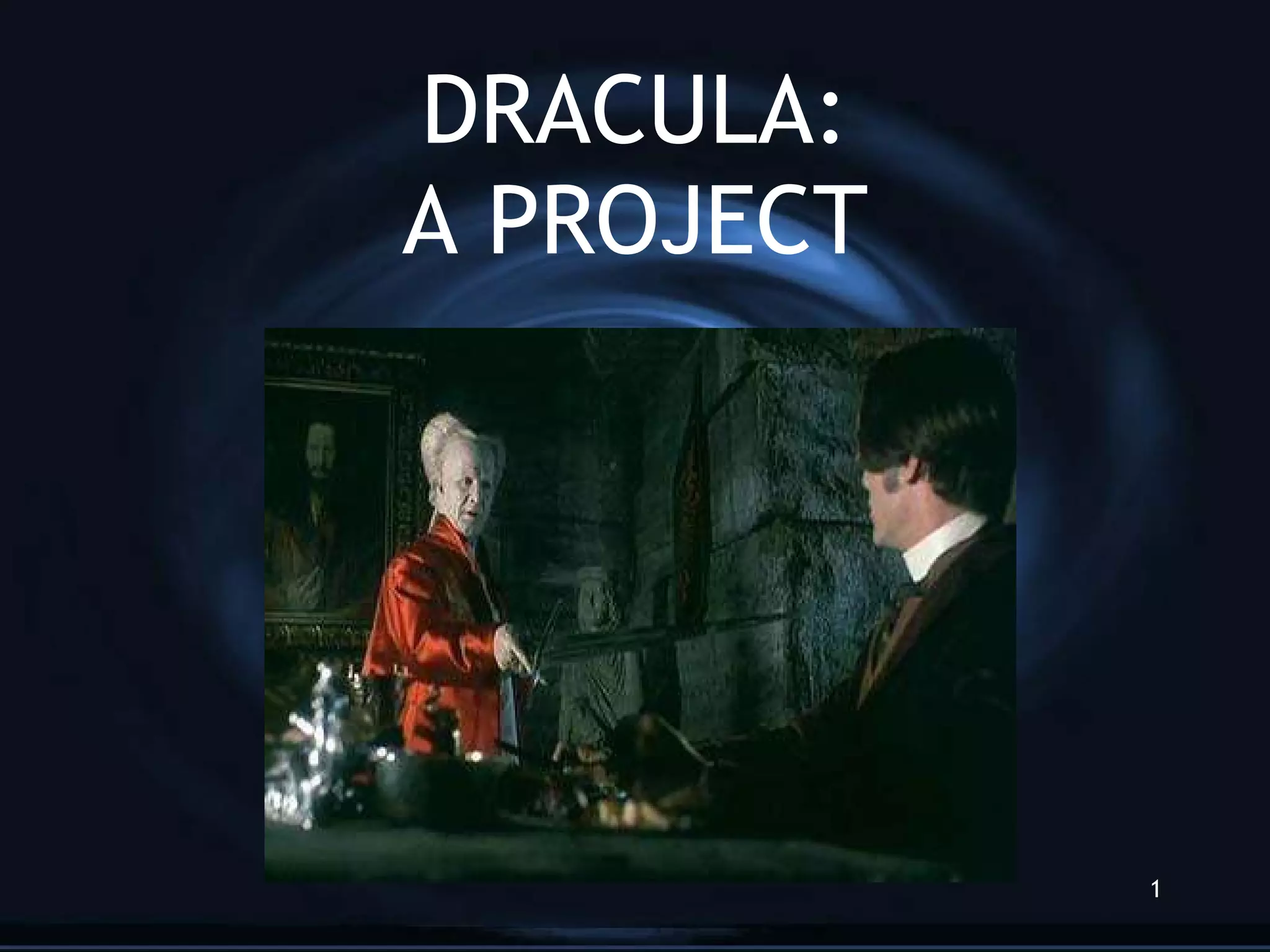
DRACULA: A PROJECT
INDEX 1. VAMPIRES: AN INTRODUCTION 1.1 Definition 1.2 Appearance and history  1.3 Vampire fiction 1.4 How is a vampire’s body? 1.5 Vampire characteristics
INDEX 2.  VAMPIRES IN HISTORY 2.1 Elizabeth Bathory 2.2 Peter K ürten 2.3 Vlad the Impaler
INDEX VAMPIRES IN CINEMA   3.1 Introduction 3.2 Francis Ford Coppola’s Dracula 3.3 Interview with the vampire 3.4 The Twilight Saga
INDEX 4. VAMPIRES IN LITERATURE: BRAM STOKER’S DRACULA (I) 4.1 Vlad Dracul vs Count Dracula 4.2 Bram Stoker: Life and works 4.3 Summary
INDEX 5. OUR READING BOOK: BRAM STOKER’S  DRACULA (II) 5.1 Character study 5.2 Vocabulary
GROUP 1: VAMPIRES, AN INTRODUCTION
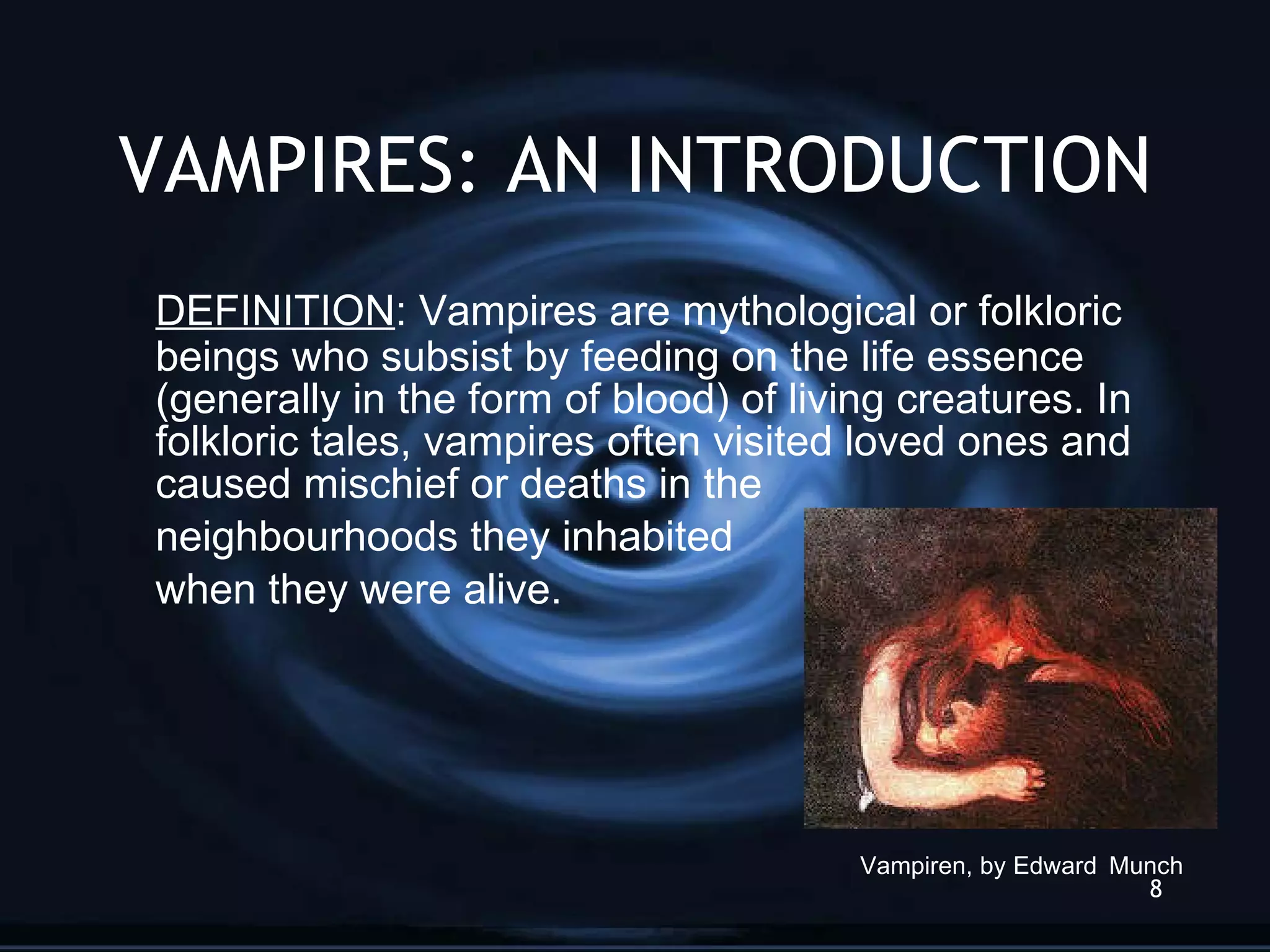
VAMPIRES: AN INTRODUCTION DEFINITION : Vampires are mythological or folkloric beings who subsist by feeding on the life essence (generally in the form of blood) of living creatures. In folkloric tales, vampires often visited loved ones and caused mischief or deaths in the  neighbourhoods they inhabited  when they were alive.  Vampiren, by Edward   Munch
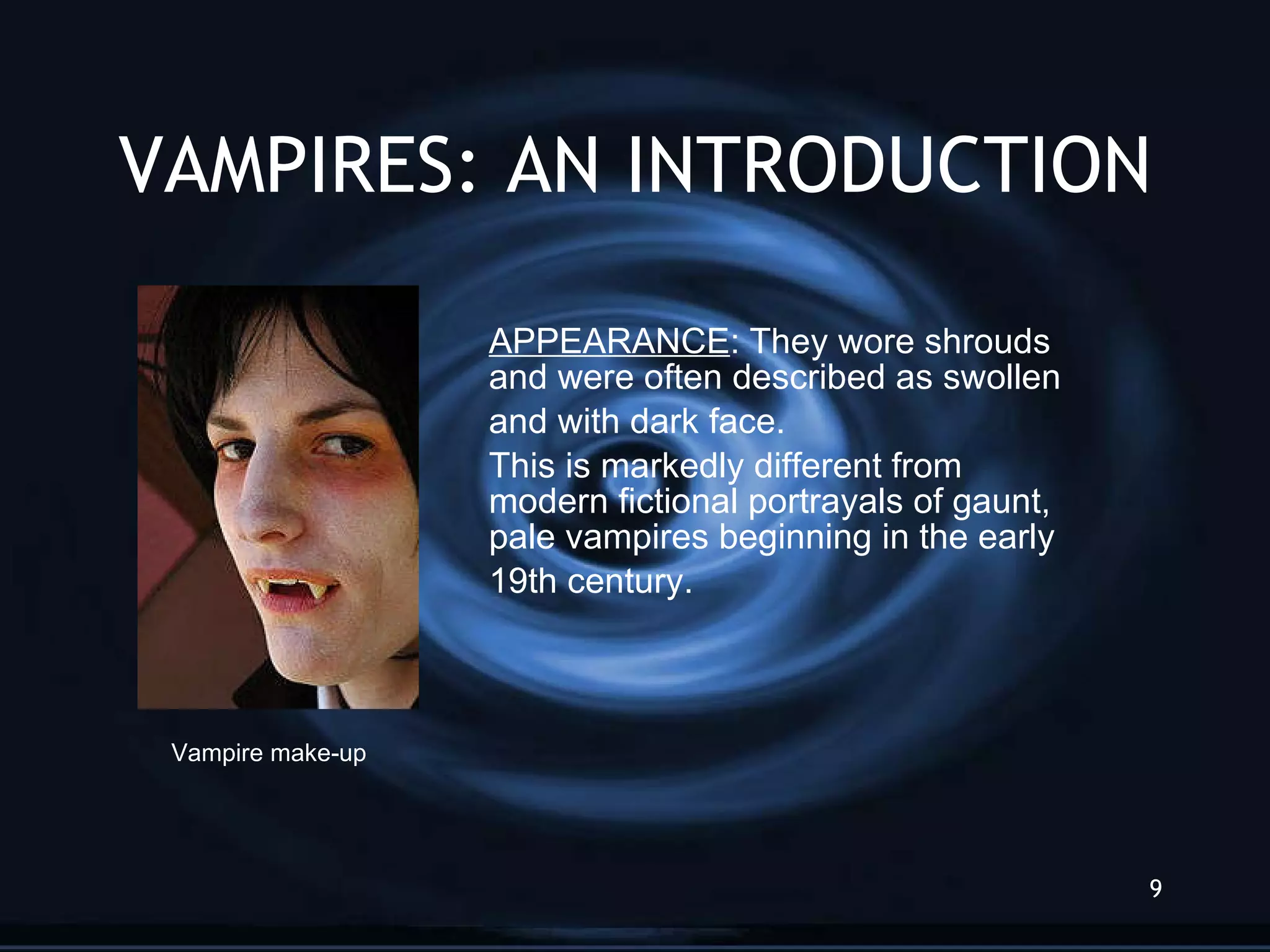
VAMPIRES: AN INTRODUCTION APPEARANCE : They wore shrouds  and were often described as swollen  and with dark face. This is markedly different from  modern fictional portrayals of gaunt,  pale vampires beginning in the early 19th century. Vampire make-up
VAMPIRES: AN INTRODUCTION HISTORY : Vampiric entities have been recorded in many cultures and the "belief in vampires and bloodsucking demons is as old as man himself".  However, the term  vampire  was not popularized until the early 18th century, after an influx of vampire superstition into Western Europe from areas where vampire legends were frequent, such as the Balkans and Eastern Europe,.  This increased level of vampire superstition in Europe led to mass hysteria and in some cases resulted in corpses actually being staked and people being accused of vampirism
VAMPIRES: AN INTRODUCTION VAMPIRE FICTION :  The charismatic and sophisticated vampire of modern fiction was born in 1819 with the publication of  The Vampyre  by John Polidori.It was the most influential vampire work of the early 19th century.  However, it is Bram Stoker's 1897 novel  Dracula   that is remembered  as the quintessential vampire novel and which provided the basis  of modern vampire fiction.  Dracula  drew on earlier mythologies of werewolves and similar imaginary demons and "was to voice the anxieties of an age", and the "fears of late Victorian patriarchy".  The success of this book spawned a distinctive vampire genre, still popular in the 21st century, with books, films, video games, and television shows. The vampire is adominant figure in the horror genre.
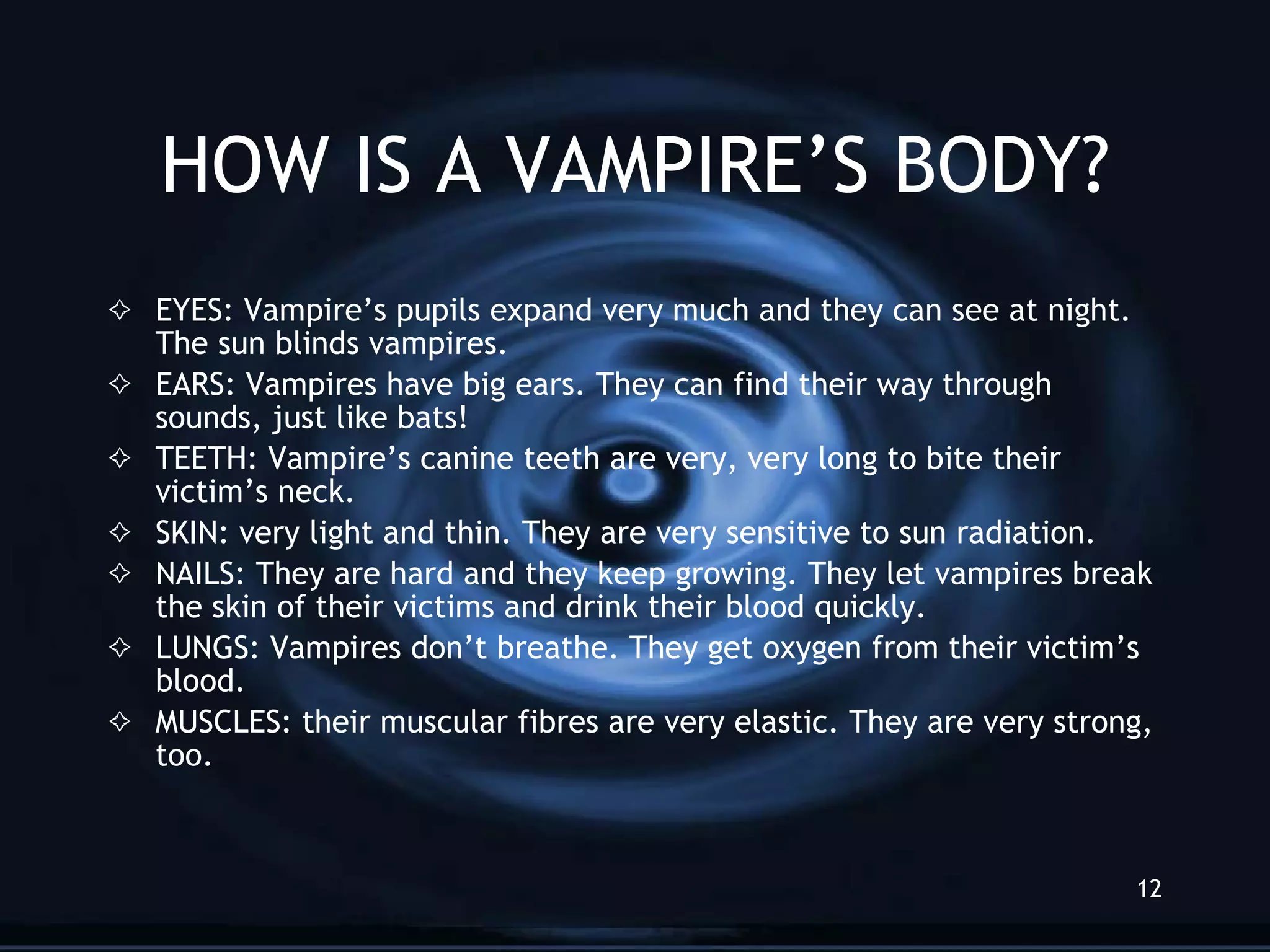
HOW IS A VAMPIRE’S BODY? EYES: Vampire’s pupils expand very much and they can see at night. The sun blinds vampires.  EARS: Vampires have big ears. They can find their way through sounds, just like bats!  TEETH: Vampire’s canine teeth are very, very long to bite their victim’s neck. SKIN: very light and thin. They are very sensitive to sun radiation.  NAILS: They are hard and they keep growing. They let vampires break the skin of their victims and drink their blood quickly. LUNGS: Vampires don’t breathe. They get oxygen from their victim’s blood.  MUSCLES: their muscular fibres are very elastic. They are very strong, too.
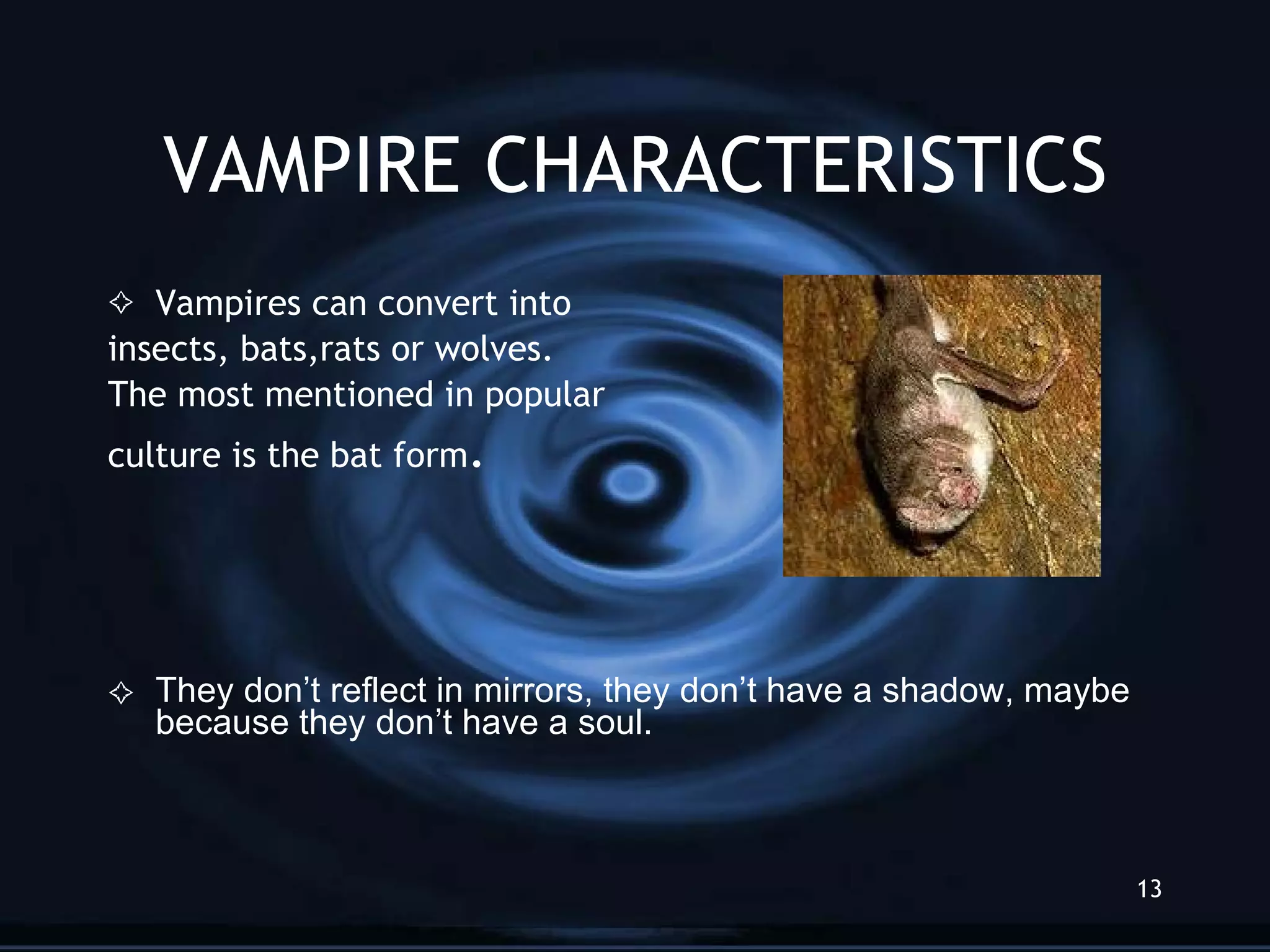
VAMPIRE CHARACTERISTICS Vampires can convert into  insects, bats,rats or wolves.  The most mentioned in popular culture is the bat form . They don’t reflect in mirrors, they don’t have a shadow, maybe because they don’t have a soul.
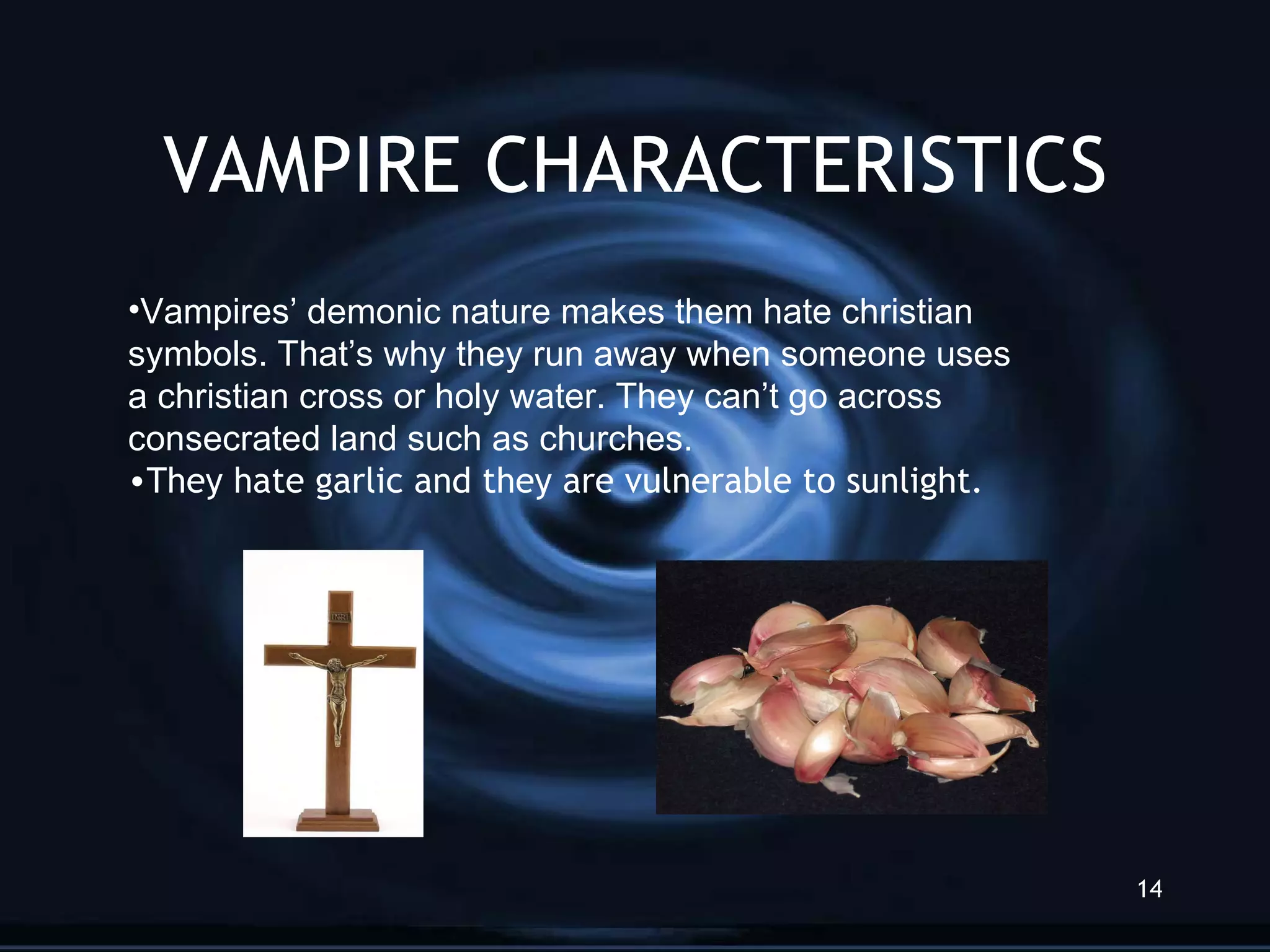
VAMPIRE CHARACTERISTICS Vampires’ demonic nature makes them hate christian  symbols. That’s why they run away when someone uses a christian cross or holy water. They can’t go across  consecrated land such as churches.  They hate garlic and they are vulnerable to sunlight.
VAMPIRE CHARACTERISTICS They are indestructible using common means and they are extremely strong and fast, but they weaken next to  water currents They have a natural affinity with magic, especially  with black magic and necromancy. They feed on their victims’ blood.
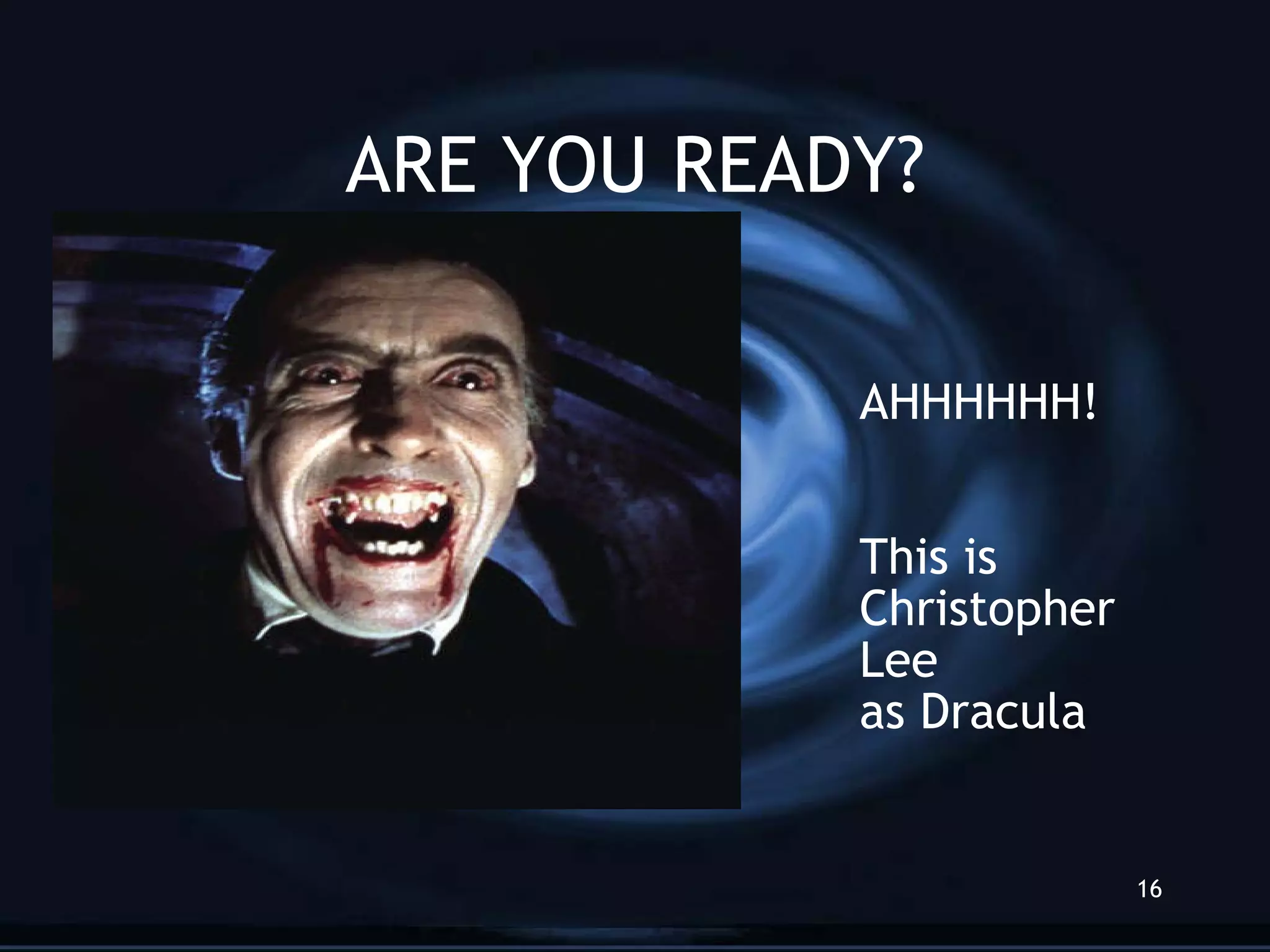
ARE YOU READY? AHHHHHH! This is Christopher  Lee  as Dracula
GROUP 2: VAMPIRES IN HISTORY
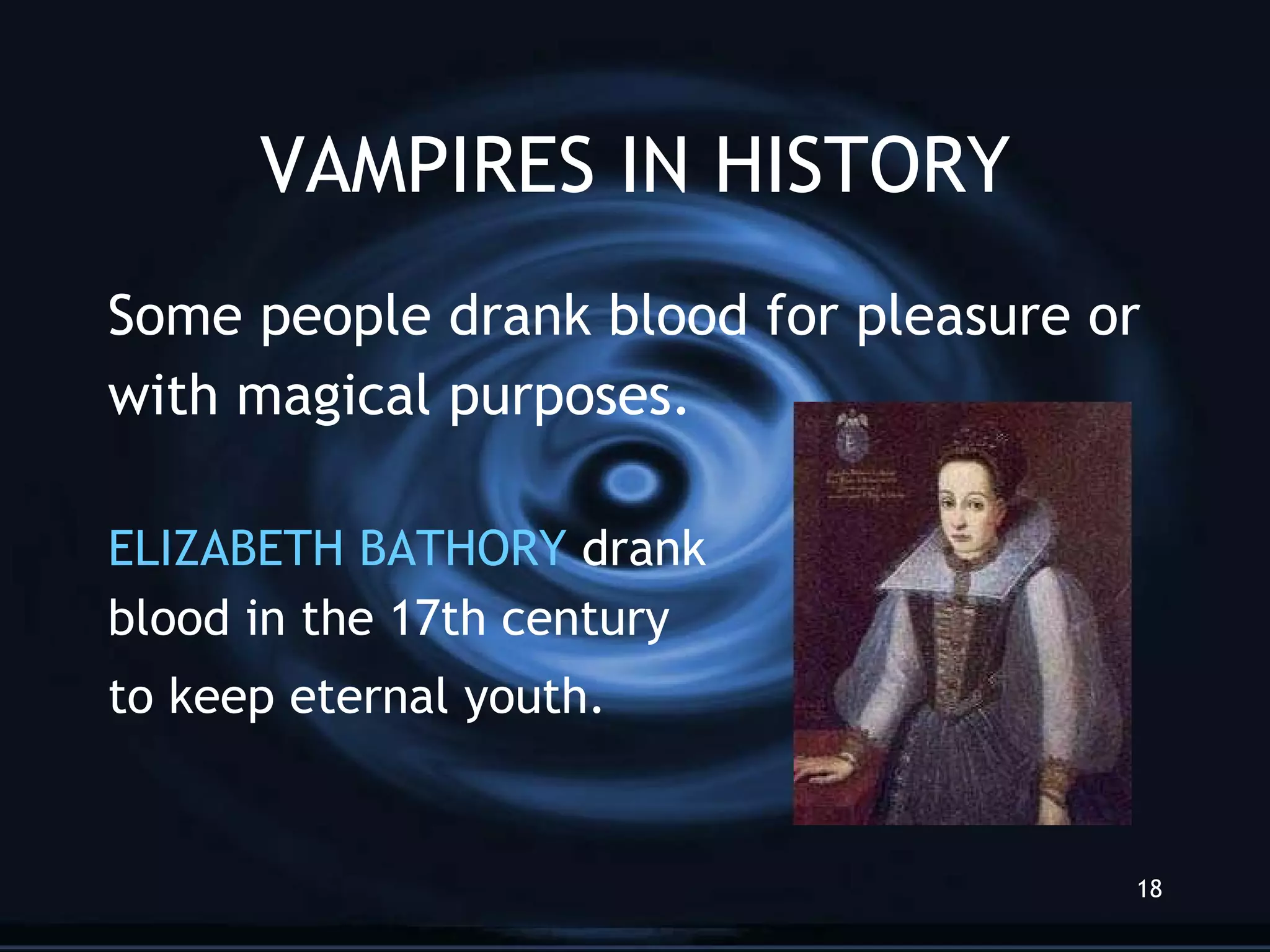
VAMPIRES IN HISTORY Some people drank blood for pleasure or with magical purposes. ELIZABETH BATHORY  drank  blood in the 17th century  to keep eternal youth.
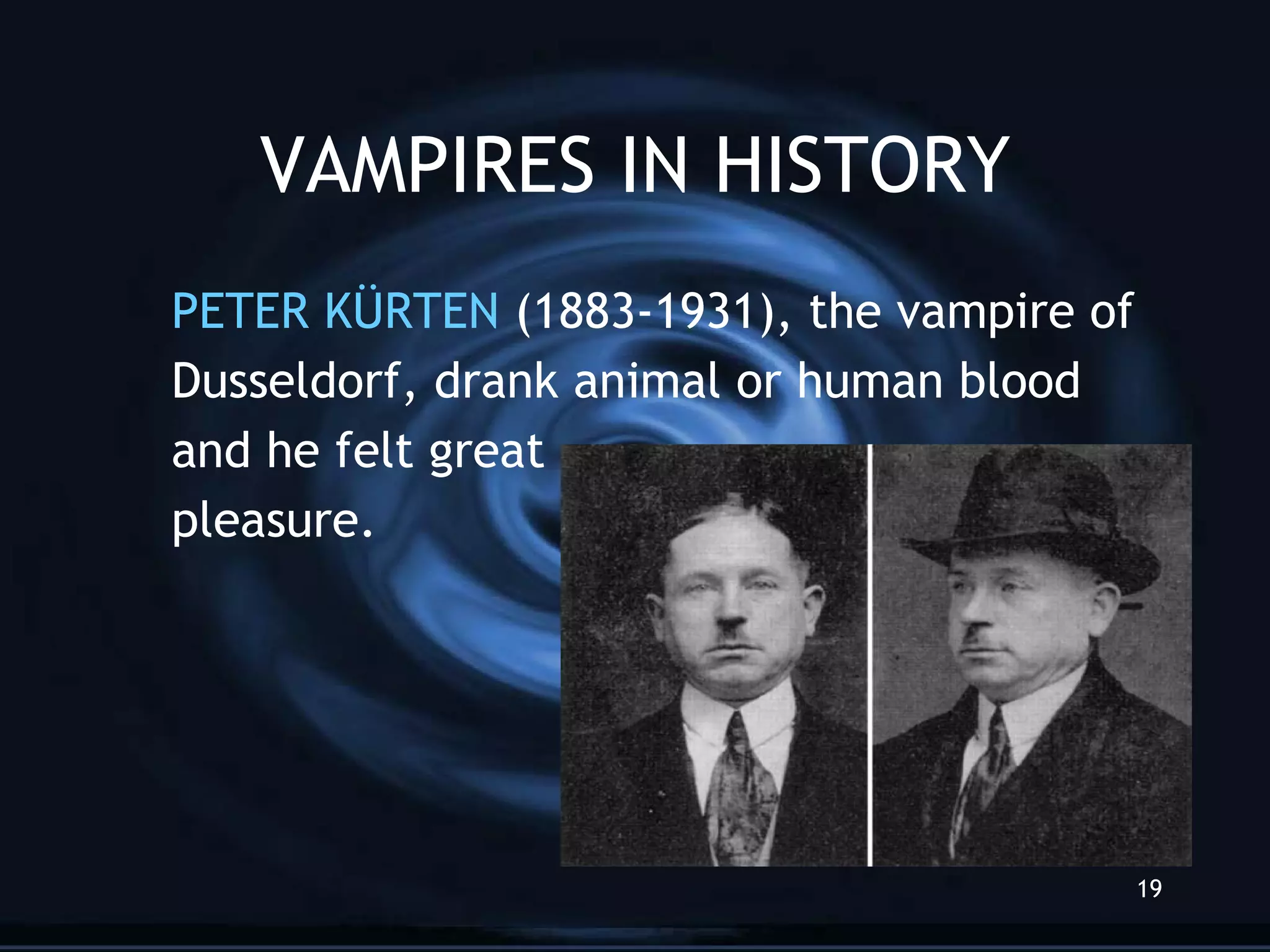
VAMPIRES IN HISTORY PETER K ÜRTEN  (1883-1931), the vampire of Dusseldorf, drank animal or human blood and he felt great  pleasure.
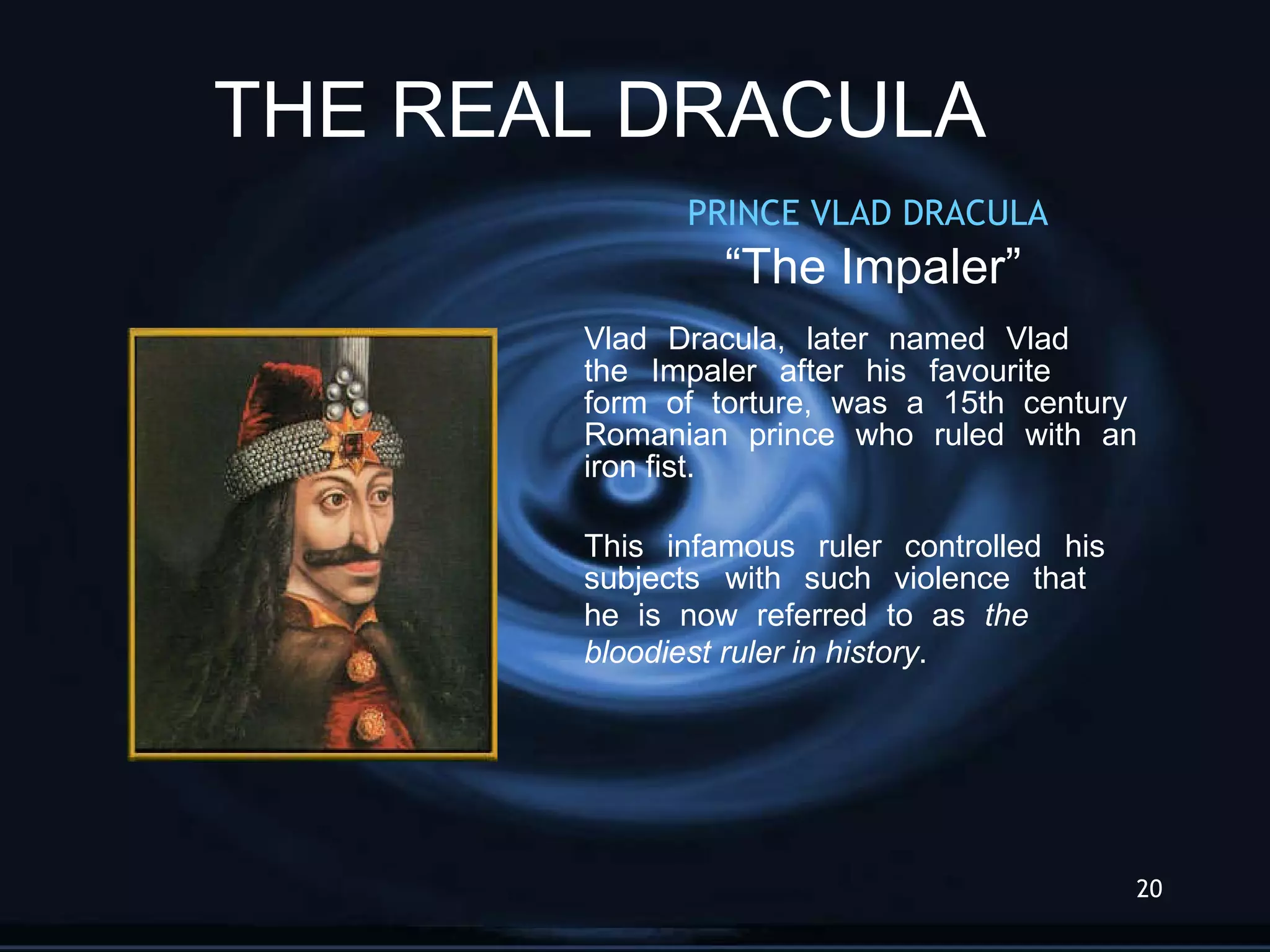
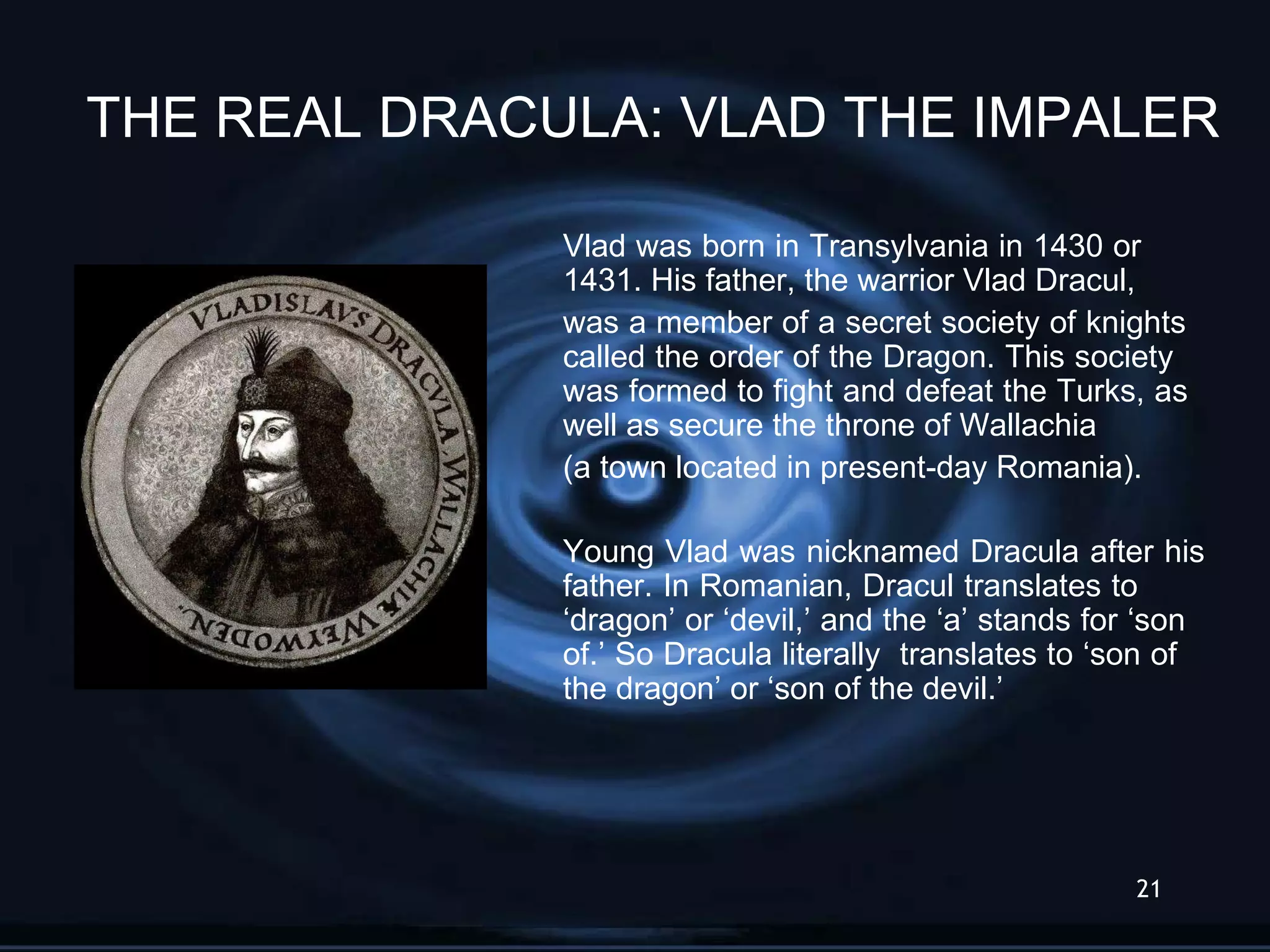
PRINCE VLAD DRACULA  “ The Impaler” Vlad Dracula, later named Vlad  the Impaler after his favourite  form of torture, was a 15th century  Romanian prince who ruled with an  iron fist. This infamous ruler controlled his  subjects  with such violence that  he is now referred to as  the  bloodiest ruler in history . THE REAL DRACULA
Vlad was born in Transylvania in 1430 or  1431. His father, the warrior Vlad Dracul, was a member of a secret society of knights  called the order of the Dragon. This society  was formed to fight and defeat the Turks, as  well as secure the throne of Wallachia  (a town located in present-day Romania). Young Vlad was nicknamed Dracula after his  father. In Romanian, Dracul translates to  ‘dragon’ or ‘devil,’ and the ‘a’ stands for ‘son  of.’ So Dracula literally  translates to ‘son of  the dragon’ or ‘son of the devil.’  THE REAL DRACULA: VLAD THE IMPALER
In 1444 Dracul was travelling with Dracula and his  youngest son across the Danube River when they  were captured by the Turks. Dracula was imprisoned for four years. These years are thought to be the  beginning of Vlad Dracula’s violent nature. It wasn’t  long before Dracul was assassinated and Dracula’s  brother was buried alive by the Ruler of Hungary,  Jamos Hunyadi. Fearful for his life, Dracula joined Hunyadi who taught him cunning and severe military  tactics that would soon secure  Dracula the throne of  Wallachia. THE REAL DRACULA: VLAD THE IMPALER
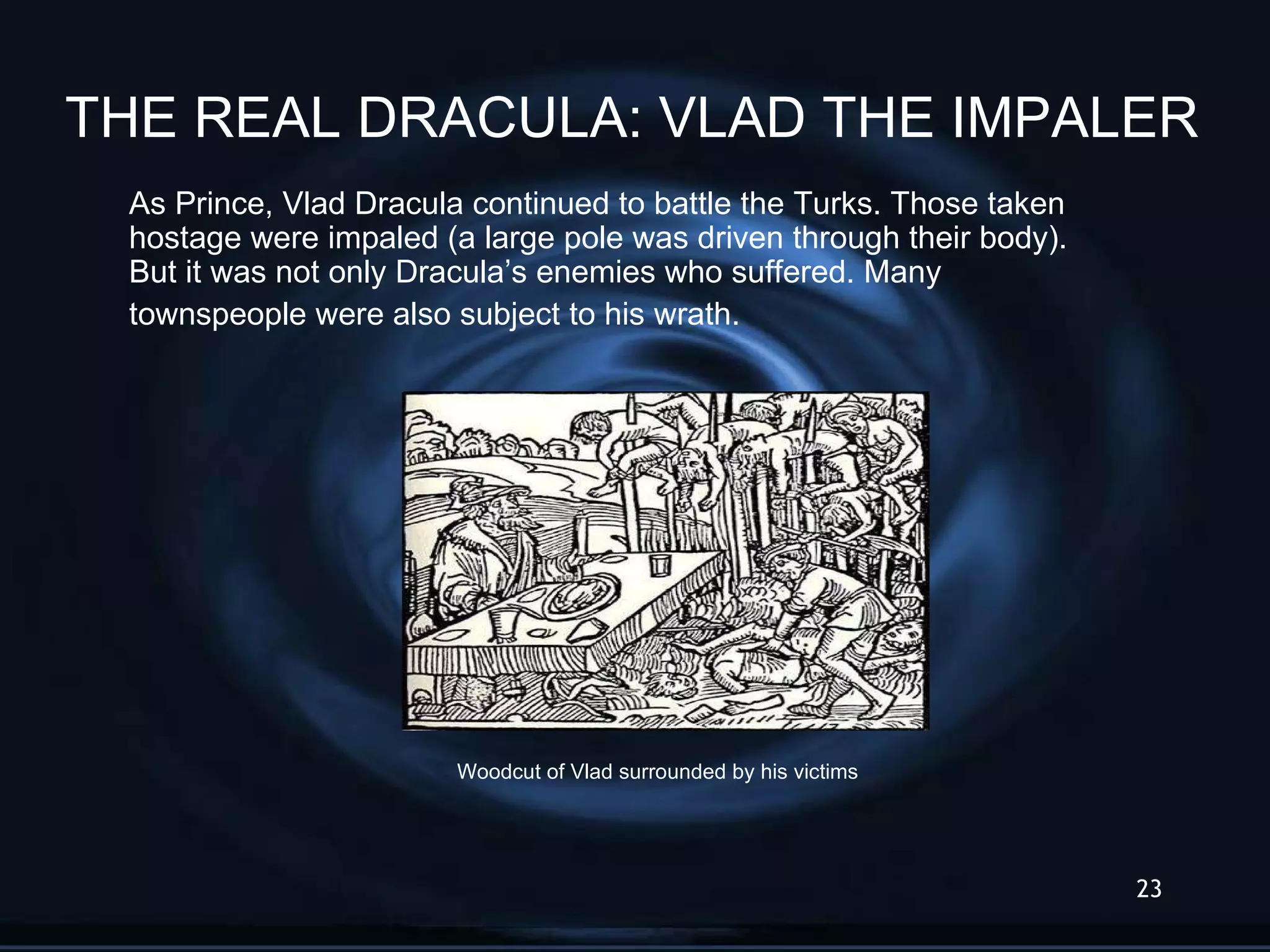
As Prince, Vlad Dracula continued to battle the Turks. Those taken hostage were impaled (a large pole was driven through their body). But it was not only Dracula’s enemies who suffered. Many townspeople were also subject to his wrath.  Woodcut of Vlad surrounded by his victims THE REAL DRACULA: VLAD THE IMPALER
One  story tells of Dracula noticing a peasant man  who was wearing a shirt that was too short. When  Dracula asked the man’s wife why the man was improperly dressed,she said she was too busy cooking and cleaning to sew. She was immediately impaled. Graciously, Dracula chose a new wife for  the man. He made sure to show the new wife what  had happened to the old so that she would not make the same mistake. THE REAL DRACULA: VLAD THE IMPALER
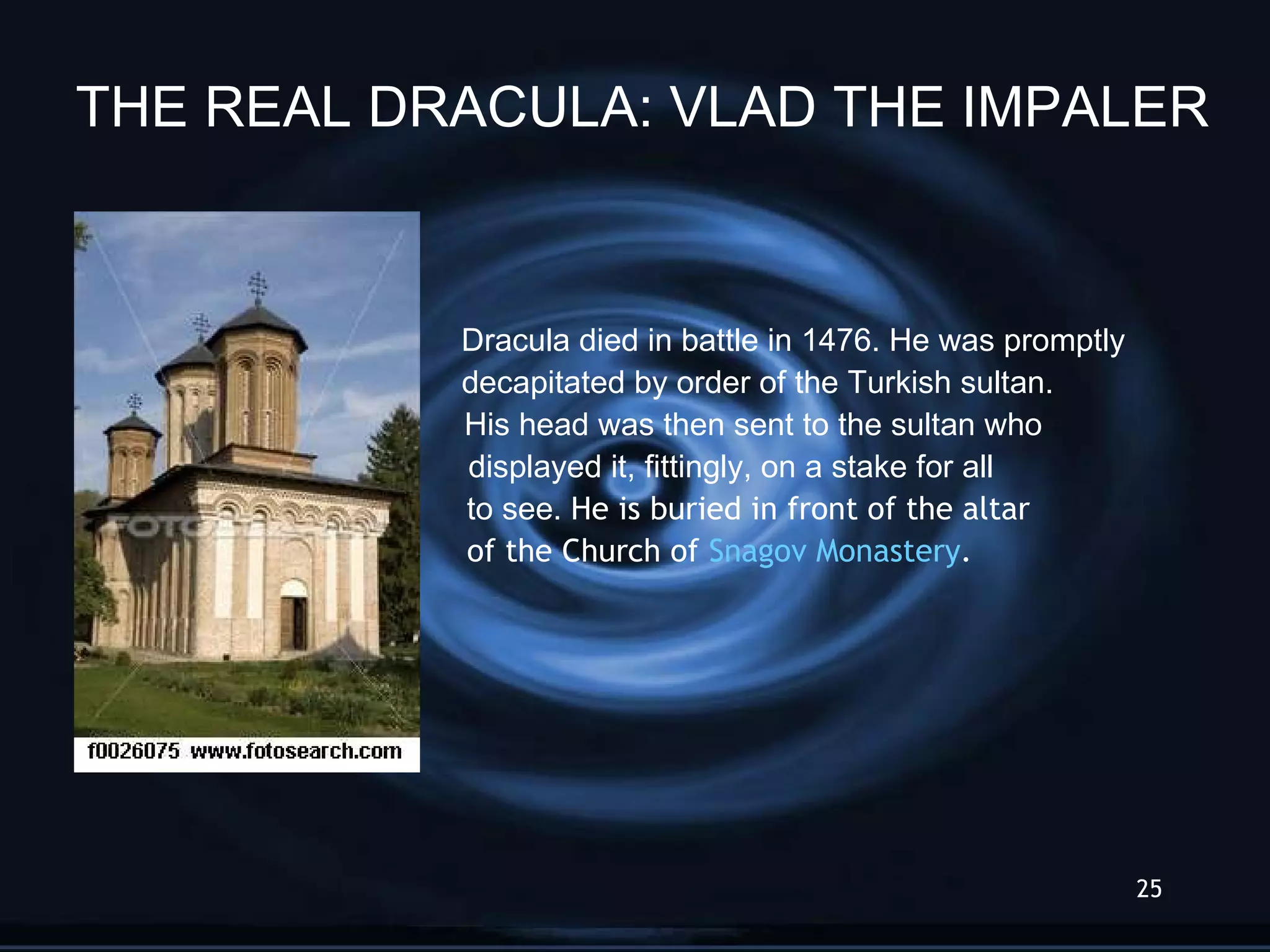
  Dracula died in battle in 1476. He was promptly    decapitated by order of the Turkish sultan.    His head was then sent to the sultan who  displayed it, fittingly, on a stake for all    to see.  He is buried in front of the altar  of the Church of  Snagov Monastery .  THE REAL DRACULA: VLAD THE IMPALER
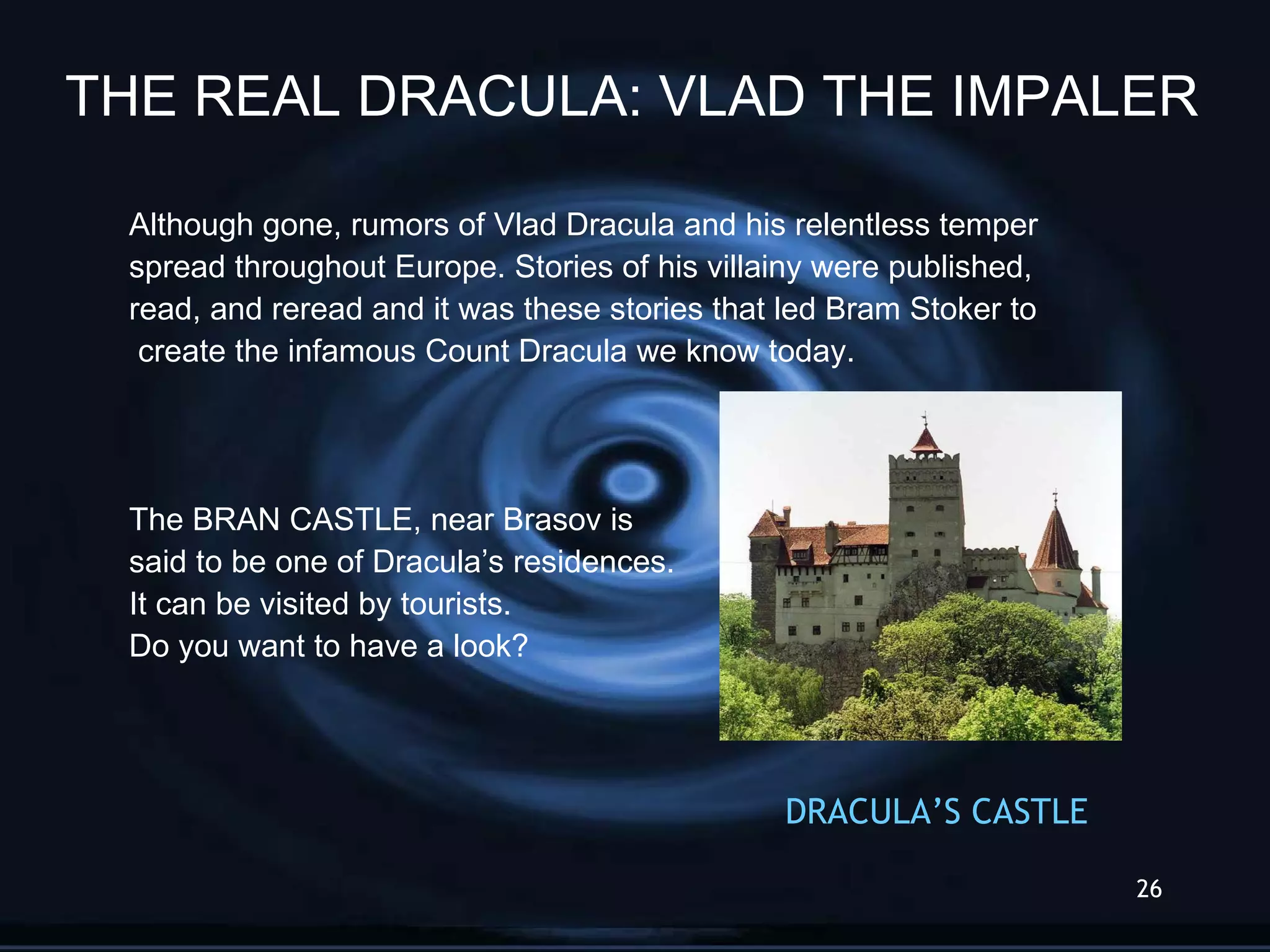
Although gone, rumors of Vlad Dracula and his relentless temper  spread throughout Europe. Stories of his villainy were published,  read, and reread and it was these stories that led Bram Stoker to create the infamous Count Dracula we know today. The BRAN CASTLE, near Brasov is  said to be one of Dracula’s residences.  It can be visited by tourists.  Do you want to have a look? DRACULA’S   CASTLE THE REAL DRACULA: VLAD THE IMPALER
GROUP 3: VAMPIRES IN CINEMA
VAMPIRES IN CINEMA
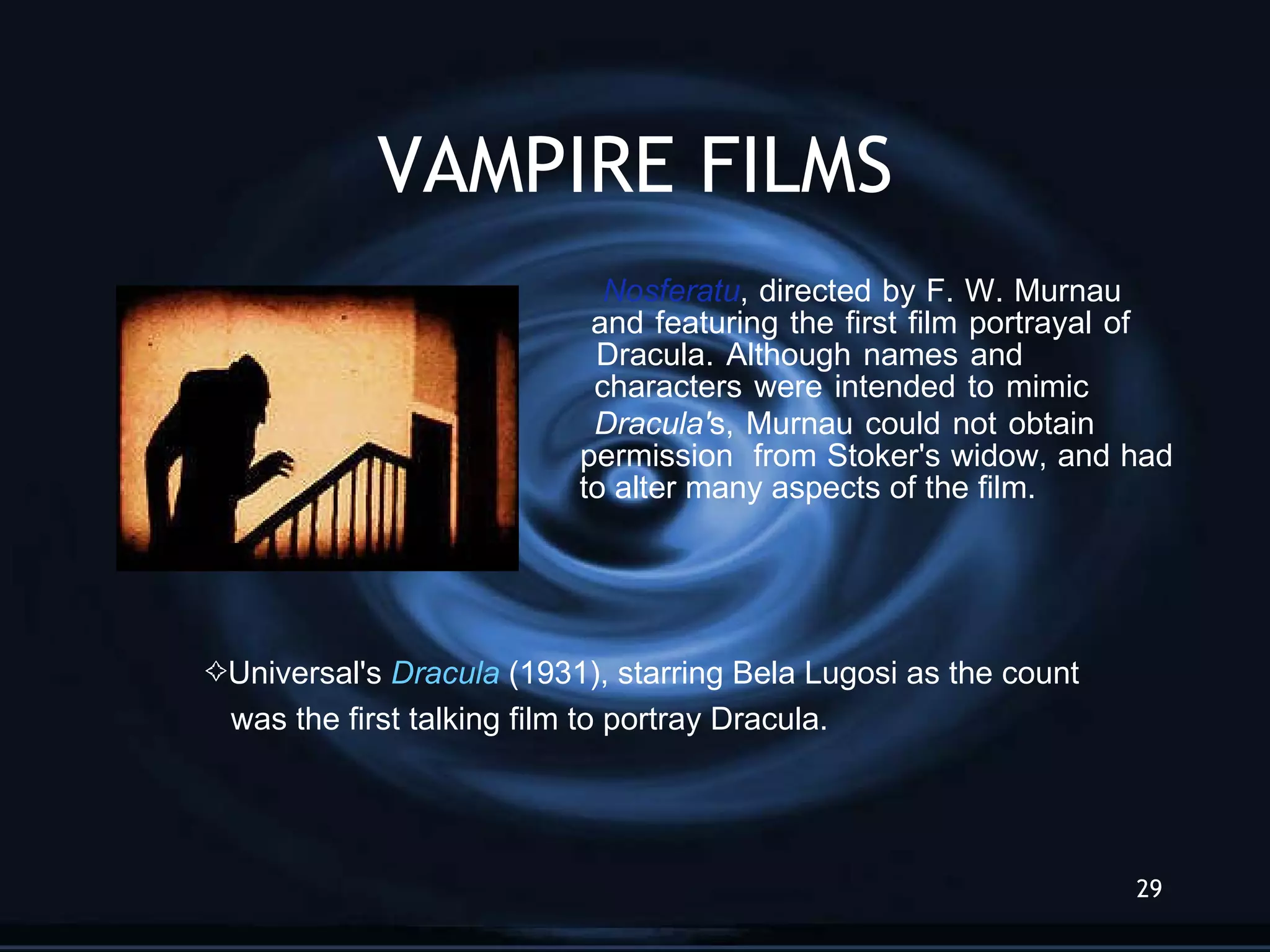
VAMPIRE FILMS   Nosferatu , directed by F. W. Murnau    and featuring the first film portrayal of    Dracula . Al though names and    characters were intended to mimic    Dracula' s, Murnau could not obtain    permission  from Stoker's widow, and had    to alter many aspects of the film.  Universal's  Dracula  (1931), starring Bel a  Lugosi as the count  was the first talking film to portray Dracula.
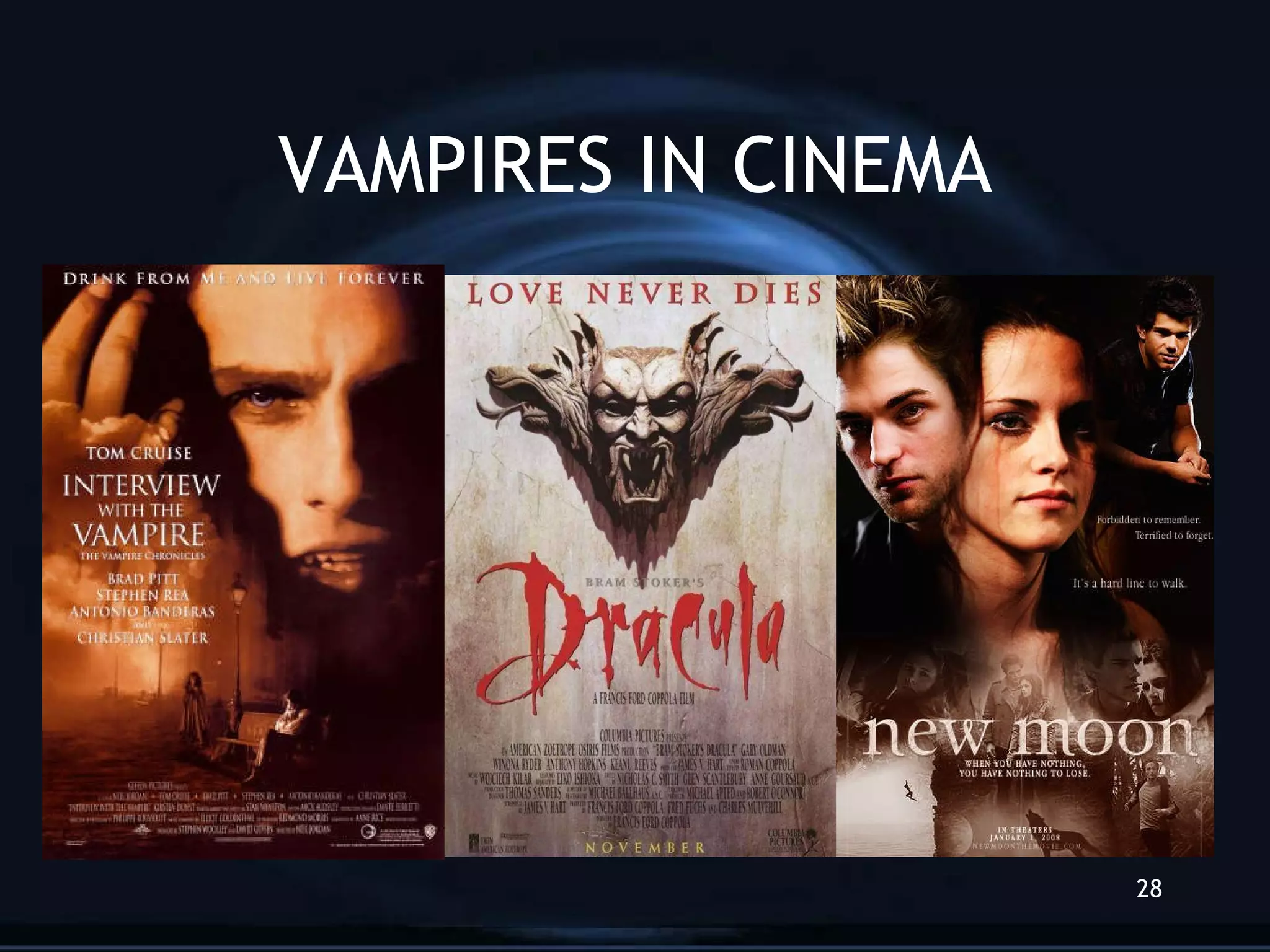
VAMPIRE FILMS The successful 1958  Dracula  starring Lee was followed by seven sequels. Lee returned as Dracula in all but two of these and became well known in the role.  Later films showed more diversity in plotline, with some focusing on the vampire-hunter such as  Blade. Buffy  the Vampire Slayer .  Buffy , released in 1992, foreshadowed a vampiric presence on television, with adaptation to a long-running hit TV series of the same name. Still others showed the vampire as protagonist such 1994's  Interview with  the Vampire : The   Vampire  Chronicles  and its indirect sequel  Queen of  the   Damned.   Bram  Stoker's   Dracula  was a noteworthy 1992 film which became the then highest grossing vampire film ever. This increase of interest in vampiric plotlines led to the vampire being depicted in movies such as  Van  Helsing ,
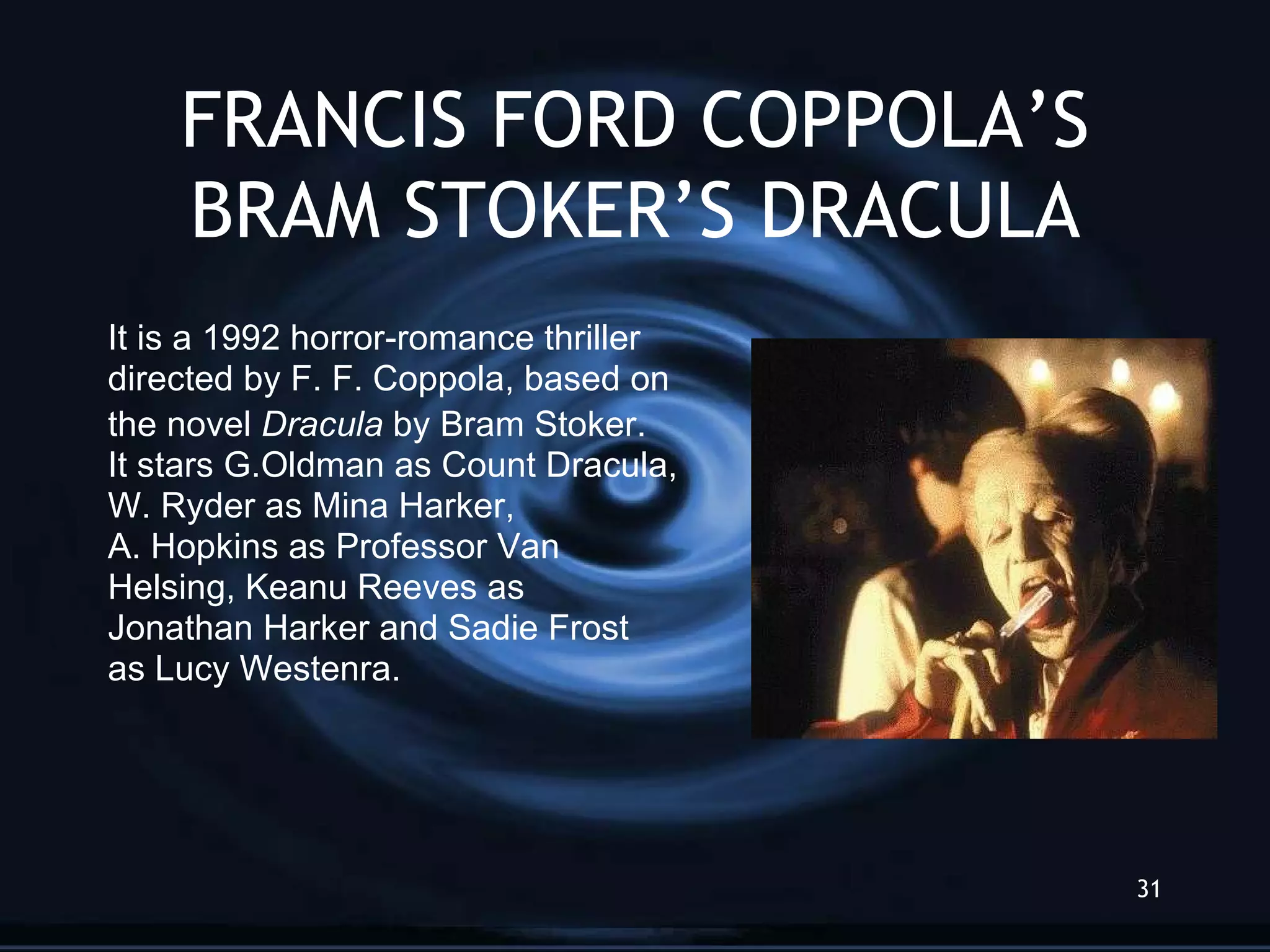
FRANCIS FORD COPPOLA’S BRAM STOKER’S DRACULA It is a 1992 horror-romance thriller directed by F. F. Coppola, based on the novel  Dracula  by Bram Stoker.  It stars G.Oldman as Count Dracula,  W. Ryder as Mina Harker, A. Hopkins as Professor Van Helsing, Keanu Reeves as  Jonathan Harker and Sadie Frost  as Lucy Westenra.
FRANCIS FORD COPPOLA’S BRAM STOKER’S DRACULA It had a  positive critical reception and was a box office hit.  It also had a significant cultural impact, spawning a video game, a board game, a comic book adaptation, collectible  cards and some action figures  and model sets.  The closing theme "Love Song  for a Vampire” was written  and performed by A. Lennox. See   film
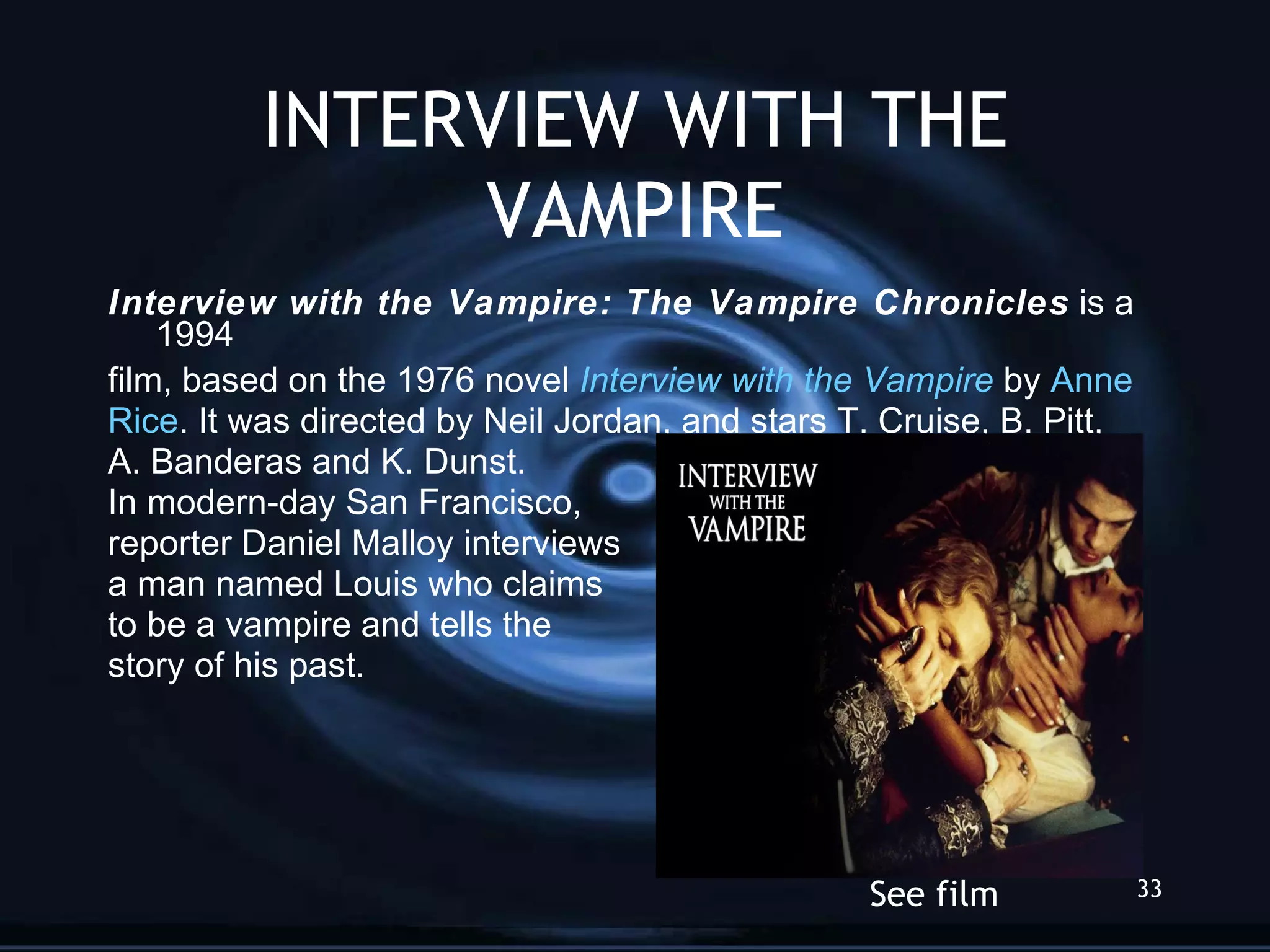
INTERVIEW WITH THE VAMPIRE Interview with the Vampire: The Vampire Chronicles  is a 1994 film, based on the 1976 novel  Interview with the Vampire  by  Anne Rice . It was directed by Neil Jordan, and stars T. Cruise, B. Pitt,  A. Banderas and K. Dunst.  In modern-day San Francisco,  reporter Daniel Malloy interviews  a man named Louis who claims to be a vampire and tells the  story of his past. See film
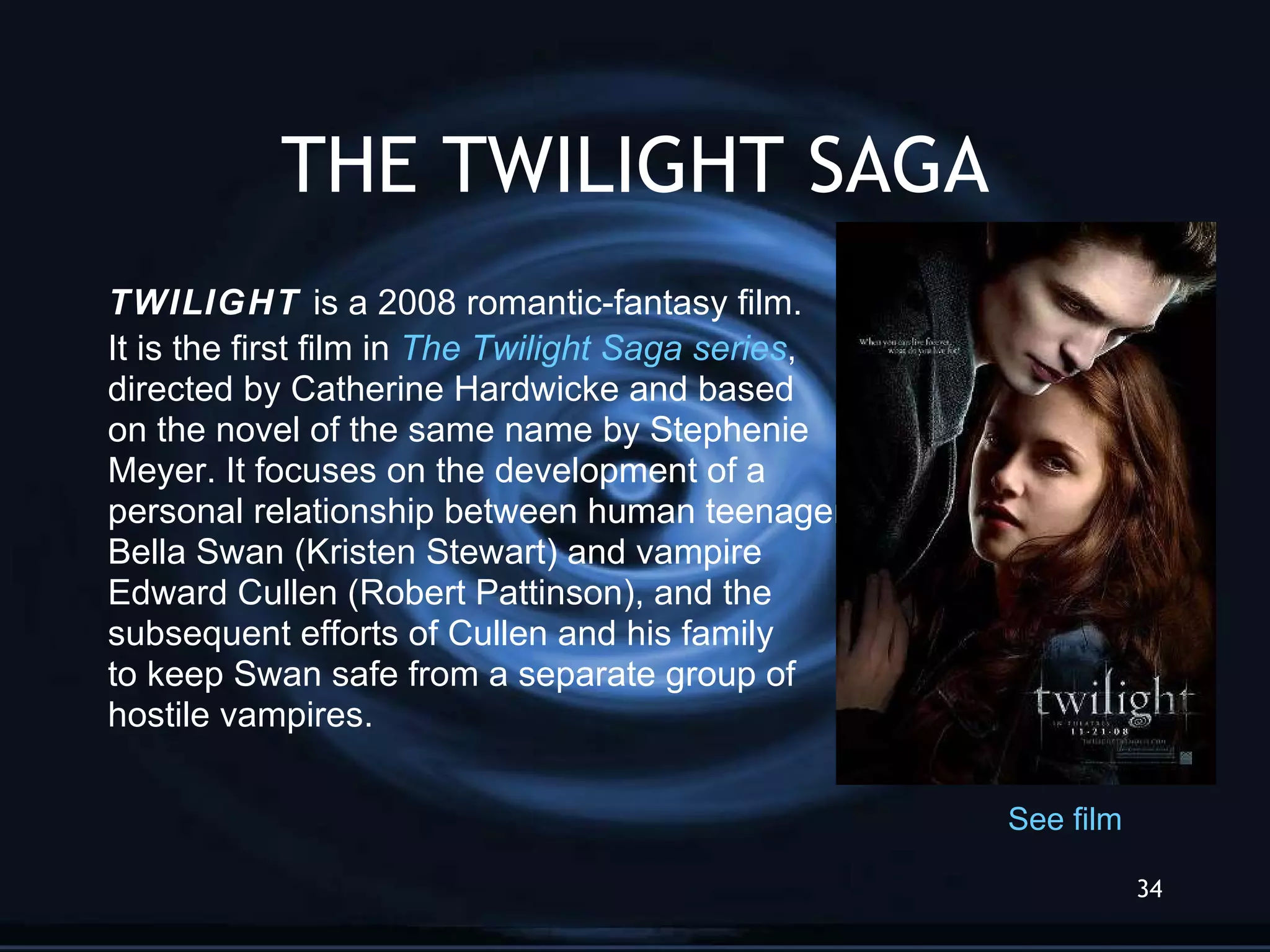
THE TWILIGHT SAGA TWILIGHT  is a 2008 romantic-fantasy film.  It is the first film in  The Twilight  Saga  series , directed by Catherine Hardwicke and based  on the novel of the same name by Stephenie  Meyer. It focuses on the development of a  personal relationship between human teenager Bella Swan (Kristen Stewart) and vampire  Edward Cullen (Robert Pattinson), and the  subsequent efforts of Cullen and his family  to keep Swan safe from a separate group of  hostile vampires. See   film
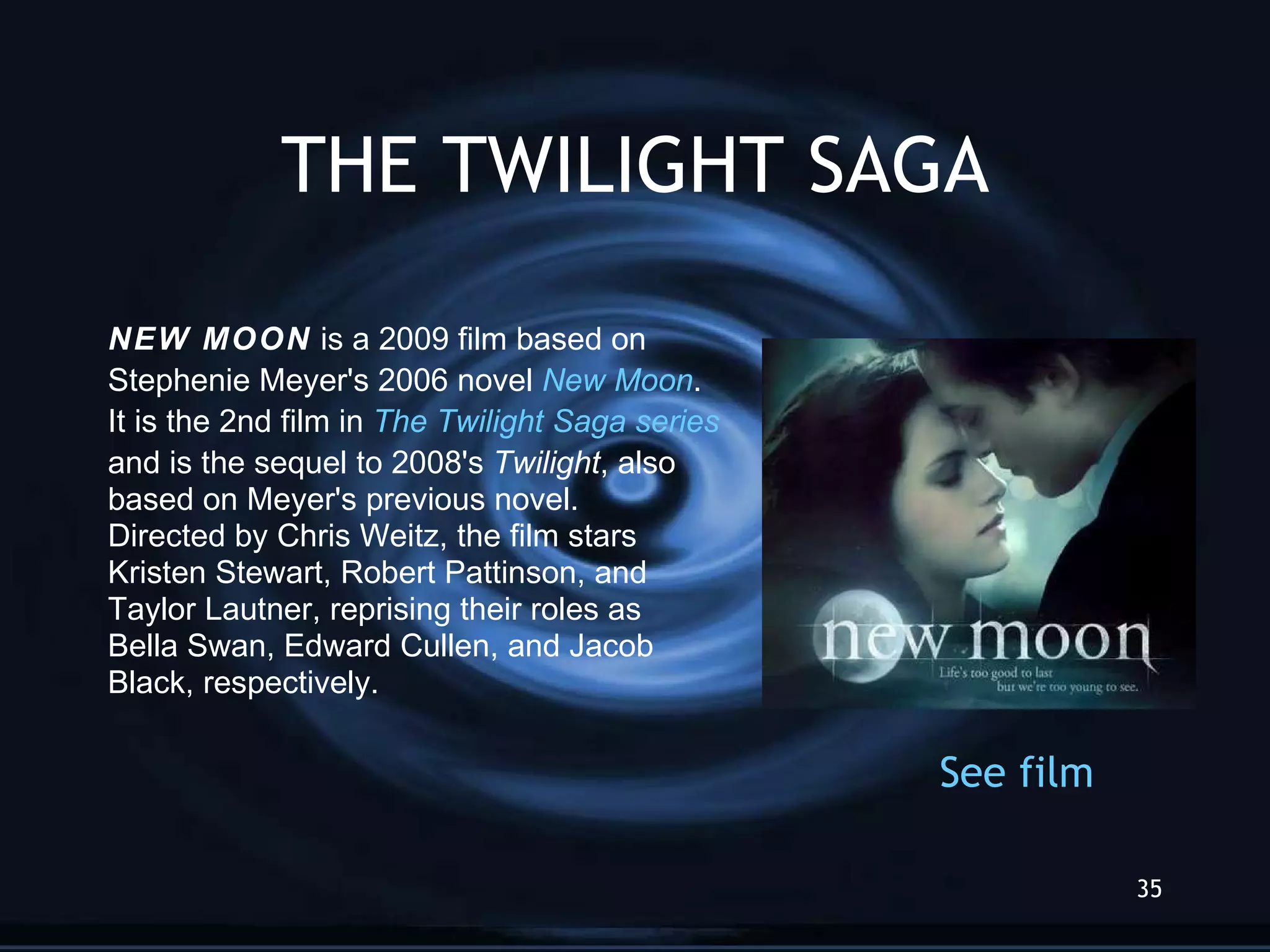
THE TWILIGHT SAGA NEW MOON  is a 2009 film   based on Stephenie Meyer's 2006 novel  New Moon .  It is the 2nd film in  The Twilight  Saga  series   and is the sequel to 2008's  Twilight , also  based on Meyer's previous novel.  Directed by Chris Weitz, the film stars Kristen Stewart, Robert Pattinson, and Taylor Lautner, reprising their roles as Bella Swan, Edward Cullen, and Jacob  Black, respectively.   See   film
GROUP 4 VAMPIRES IN LITERATURE:  BRAM STOKER’S DRACULA (I)
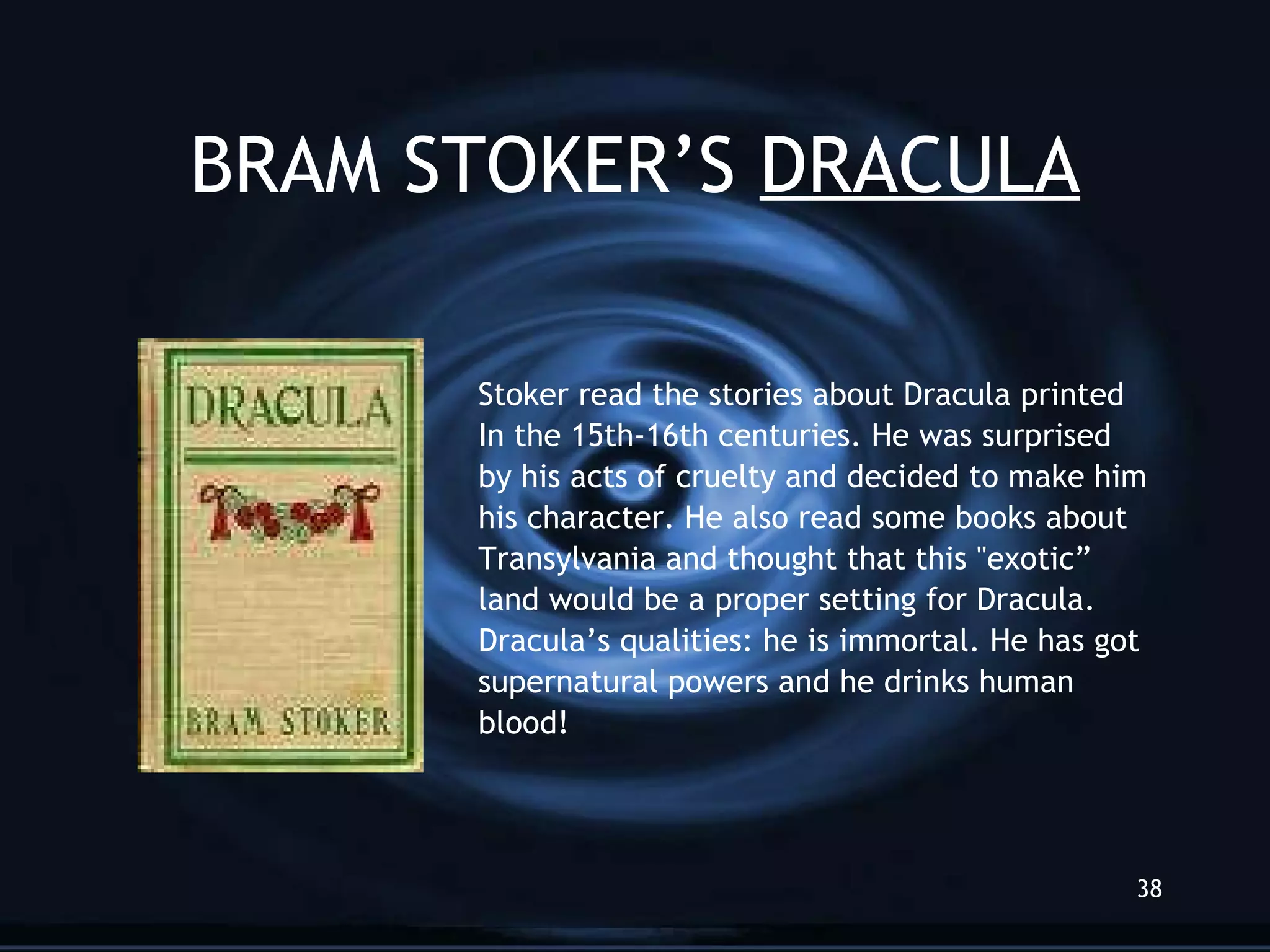
VAMPIRES IN LITERATURE: BRAM STOKER’S DRACULA The most famous vampire in  literature appeared in 1897.  That year the Irish writer  BRAM STOKER published  his novel  Dracula.  It made  Vlad the Impaler famous  worldwide.
BRAM STOKER’S  DRACULA Stoker read the stories about Dracula printed In the 15th-16th centuries. He was surprised  by his acts of cruelty and decided to make him his character. He also read some books about Transylvania and thought that this "exotic” land would be a proper setting for Dracula.  Dracula’s qualities: he is immortal. He has got supernatural powers and he drinks human blood!
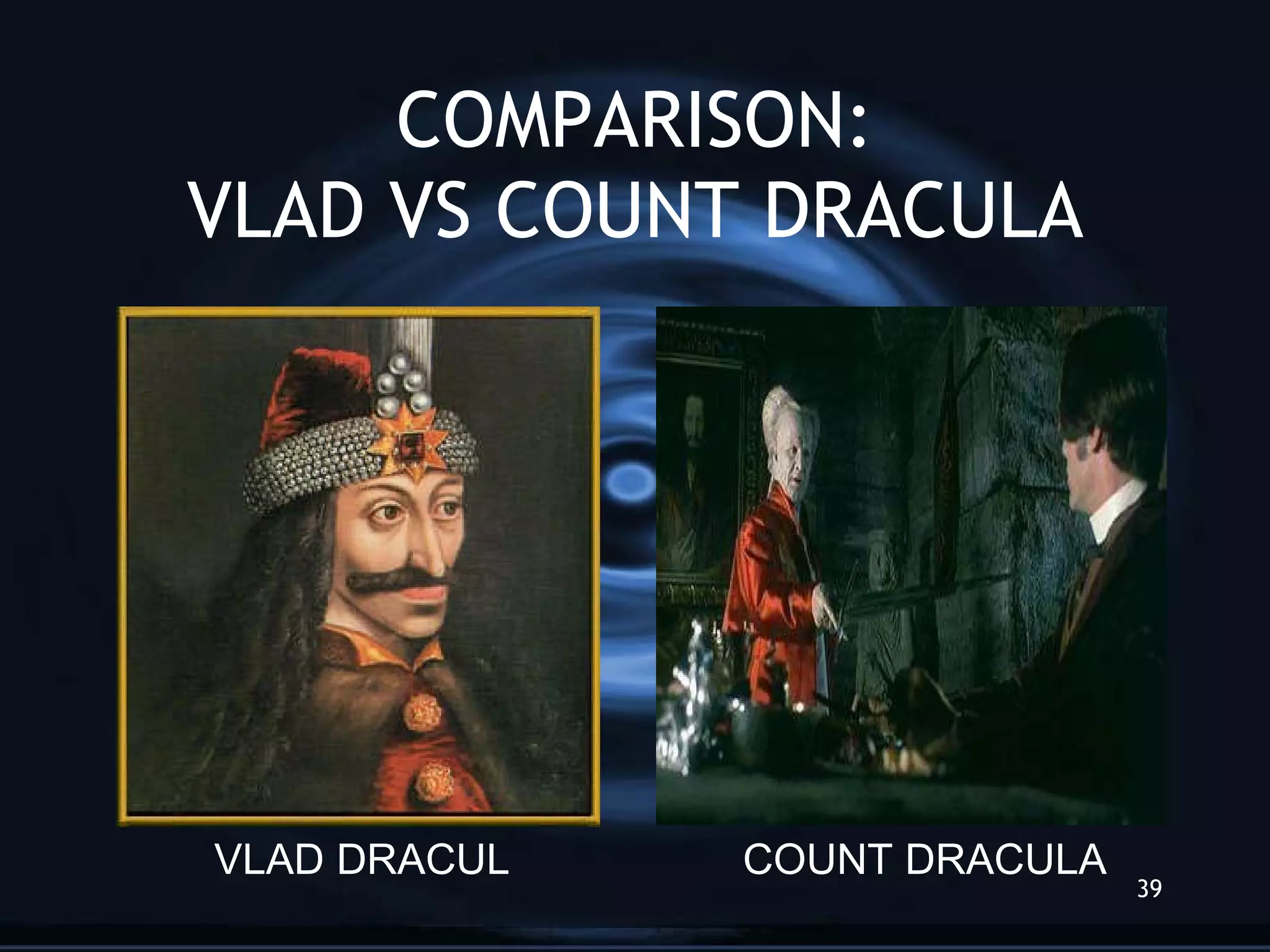
COMPARISON: VLAD VS COUNT DRACULA VLAD DRACUL COUNT DRACULA
COMPARISON: VLAD VS COUNT DRACULA Stoker used Vlad only as a source of inspiration. In his novel, Dracula is not prince Vlad the Impaler, but a Transylvanian count living in a mysterious castle where he lured his victims. His story takes place in the Bistritza area, and the castle lies near the Carpathian Mountains. As Stoker had never visited Transylvania, most places and happenings were pure fiction.
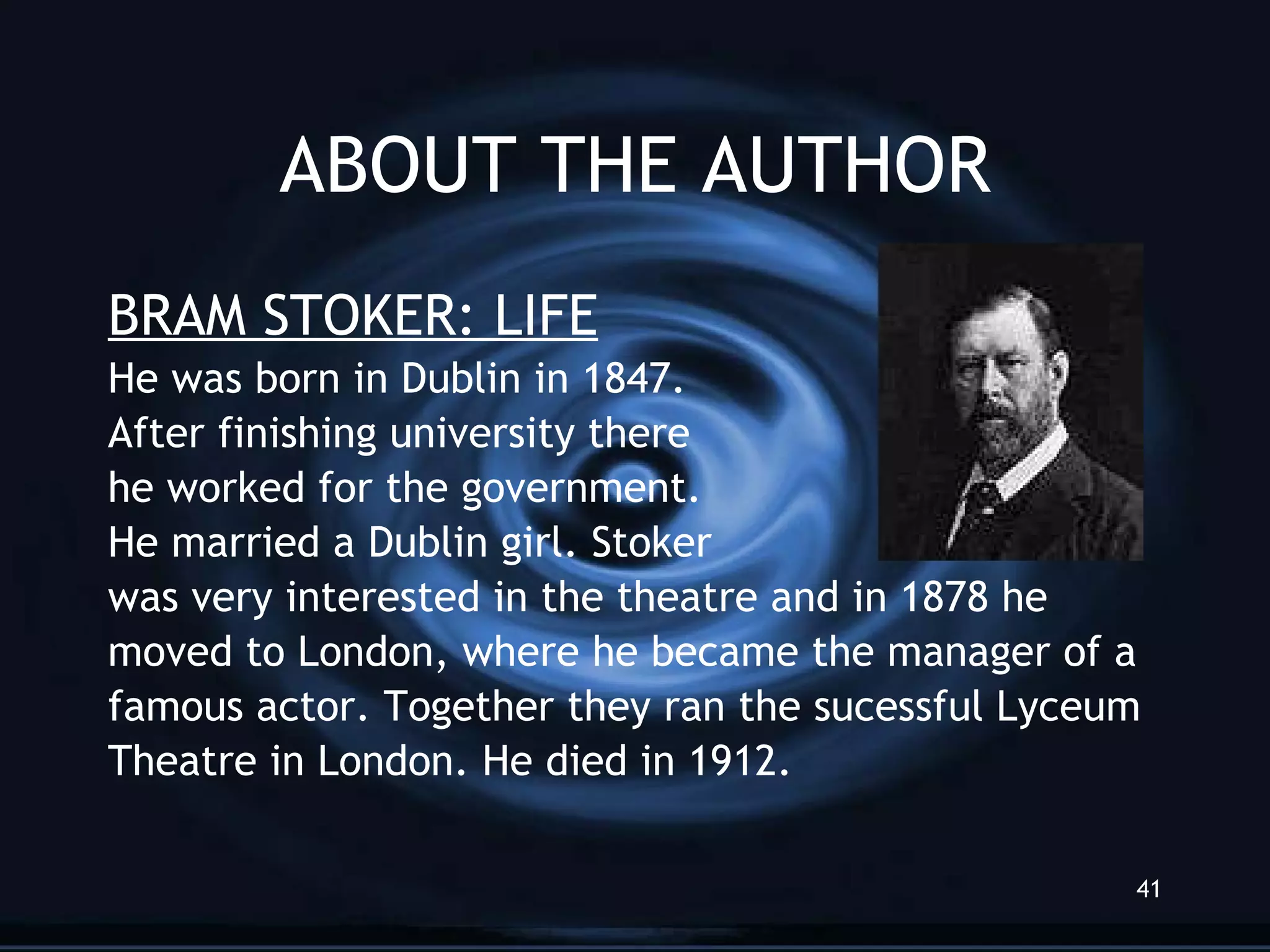
ABOUT THE AUTHOR BRAM STOKER: LIFE He was born in Dublin in 1847.  After finishing university there  he worked for the government.  He married a Dublin girl. Stoker was very interested in the theatre and in 1878 he moved to London, where he became the manager of a famous actor. Together they ran the sucessful Lyceum Theatre in London. He died in 1912.
BRAM STOKER BRAM STOKER: WORKS His novel Dracula was published in 1897. There have been stories about vampires in  Eastern Europe for a very long time. Stoker, who worked on his noveL for four years, probably knew about these stories. He said that the Dracula story came to him in a nightmare one night after a large dinner of crab meat.
BRAM STOKER BRAM STOKER: CONCLUSION Stoker is often called “the least-known author of the best-Known book”. He wrote many other books, but it is because of Dracula that we remember him today. There have been many films about Count Dracula and the book, which has never been out of print, is as popular today as it was a hundred years ago.
BRAM STOKER’S DRACULA  SYNOPSIS In the mountains of Transylvania there stands a castle . It is the home of Count Dracula - a dark, lonely place and at night the wolves howl around the walls. In the year 1875 Jonathan Harker comes from England to do business with the Count. But Jonathan does not feel comfortable at Dracula’s castle. Strange things happen at night and very soon he begins to feel afraid. And he is right to be afraid, because Count Dracula is  one of the Un-Dead - a vampire that drinks the blood of living people…
DRACULA: A SUMMARY In the spring of 1875, Jonathan Harker travels to Transylvania, on a business visit to the home of Count Dracula . Jonathan does not really want to go because in a few months’ time he is getting married to his beautiful Mina and he does not want to leave her.
DRACULA: A SUMMARY While he is staying in Castle Dracula , he keeps a diary. And every day he has more  and more terrible things to write. Why does he see Count Dracula only at night?  Why can’t he see the Count in the mirror?  And who are the three beautiful women, with their red mouths and long sharp teeth that come to his room at night? Listen to Jonathan’s diary 2. ”I am in danger”
DRACULA: A SUMMARY At home in England , Mina is staying with her friend Lucy in a town by the sea. She waits for Jonathan’s letters, but they do not come, and Mina is afraid. Perhaps Jonathan is ill, or in danger…
DRACULA: A SUMMARY Mina is not afraid for herself, of course, or for her friend Lucy. What  danger can there possibly be for two young women in a quiet English seaside town?
GROUP 5 VAMPIRES IN LITERATURE: BRAM STOKER’S DRACULA (II)
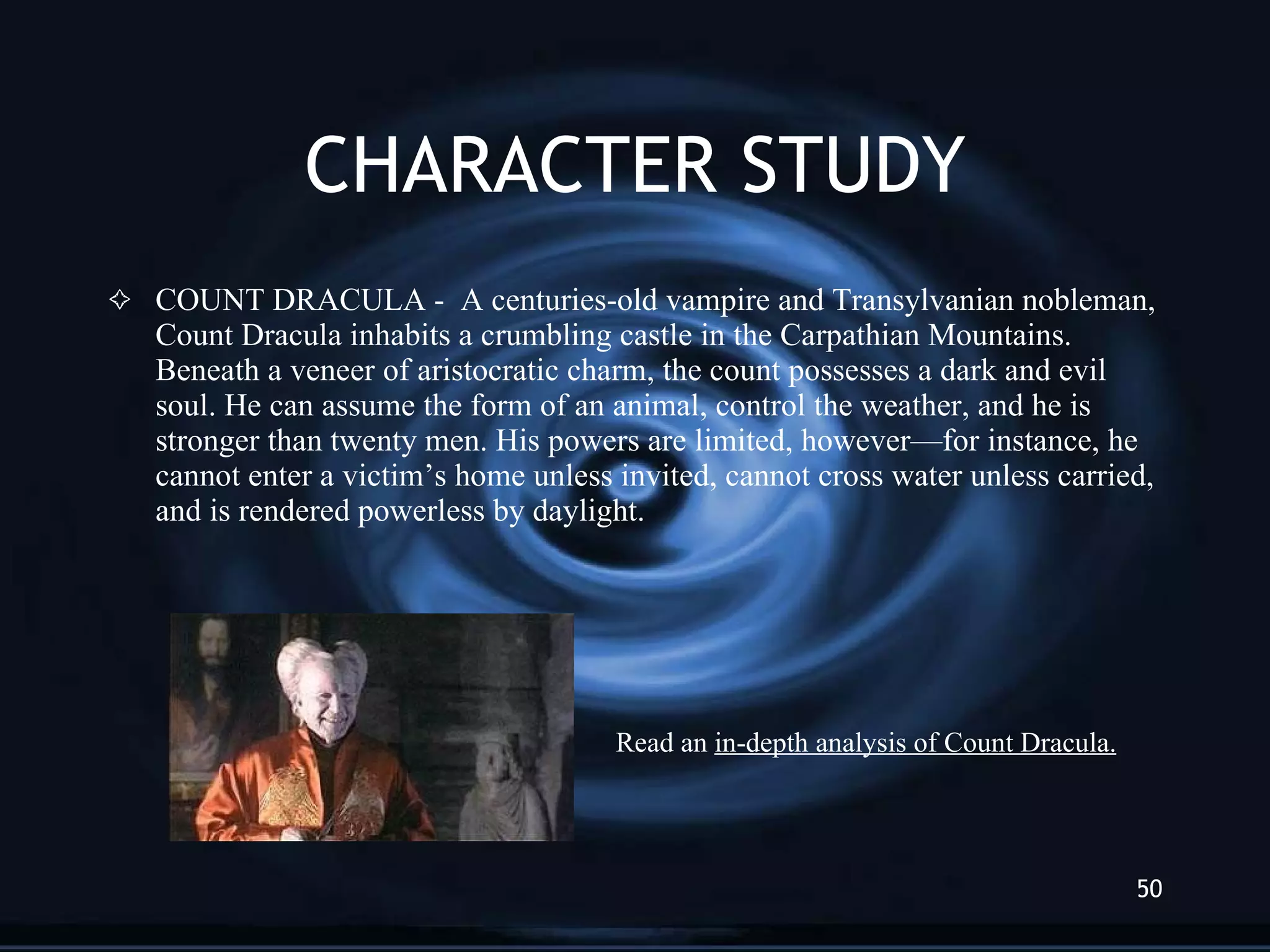
CHARACTER STUDY COUNT DRACULA -  A centuries-old vampire and Transylvanian nobleman, Count Dracula inhabits a crumbling castle in the Carpathian Mountains. Beneath a veneer of aristocratic charm, the count possesses a dark and evil soul. He can assume the form of an animal, control the weather, and he is stronger than twenty men. His powers are limited, however—for instance, he cannot enter a victim’s home unless invited, cannot cross water unless carried, and is rendered powerless by daylight. Read an  in-depth analysis of Count Dracula.
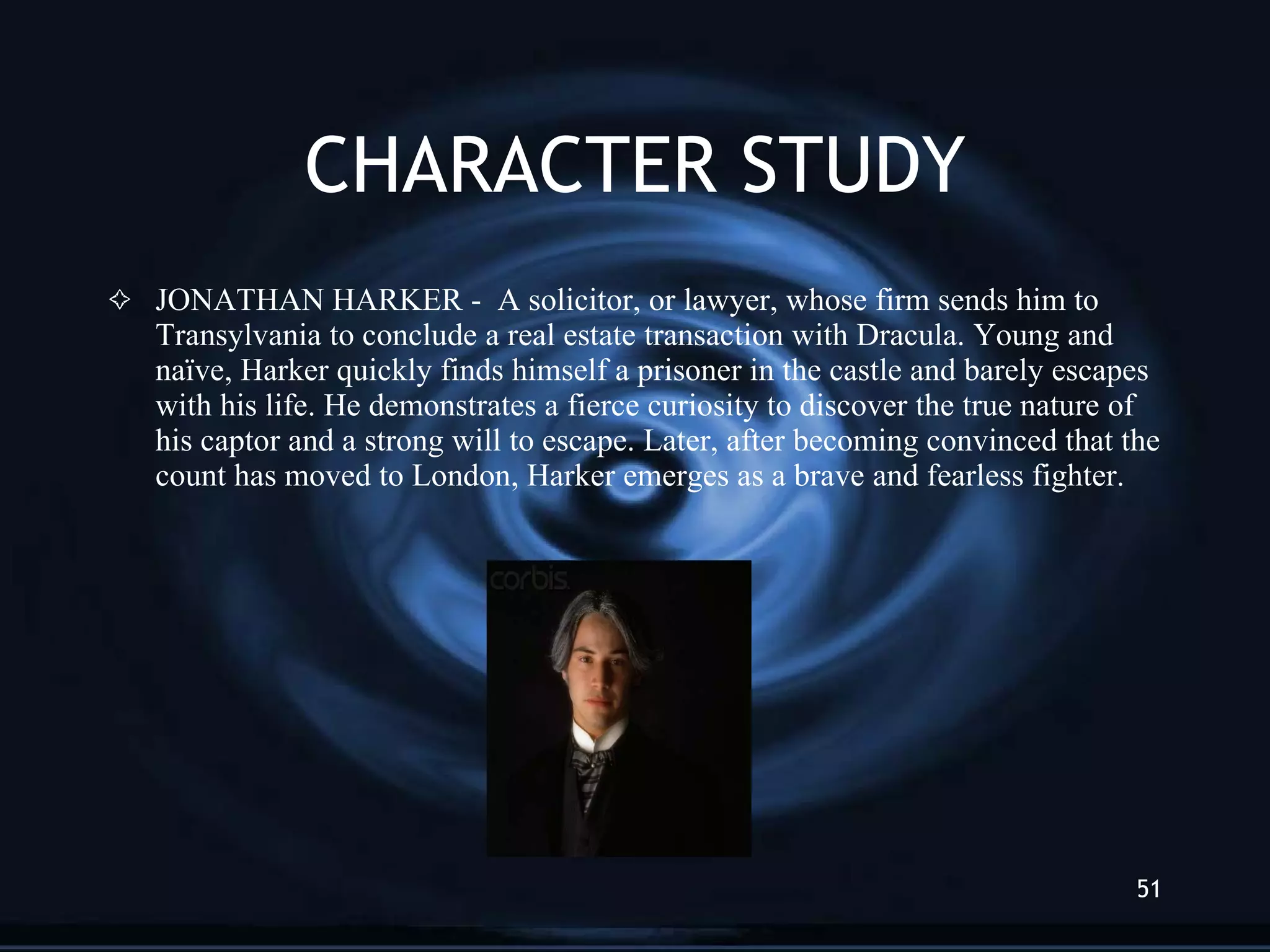
CHARACTER STUDY JONATHAN HARKER -  A solicitor, or lawyer, whose firm sends him to Transylvania to conclude a real estate transaction with Dracula. Young and naïve, Harker quickly finds himself a prisoner in the castle and barely escapes with his life. He demonstrates a fierce curiosity to discover the true nature of his captor and a strong will to escape. Later, after becoming convinced that the count has moved to London, Harker emerges as a brave and fearless fighter.
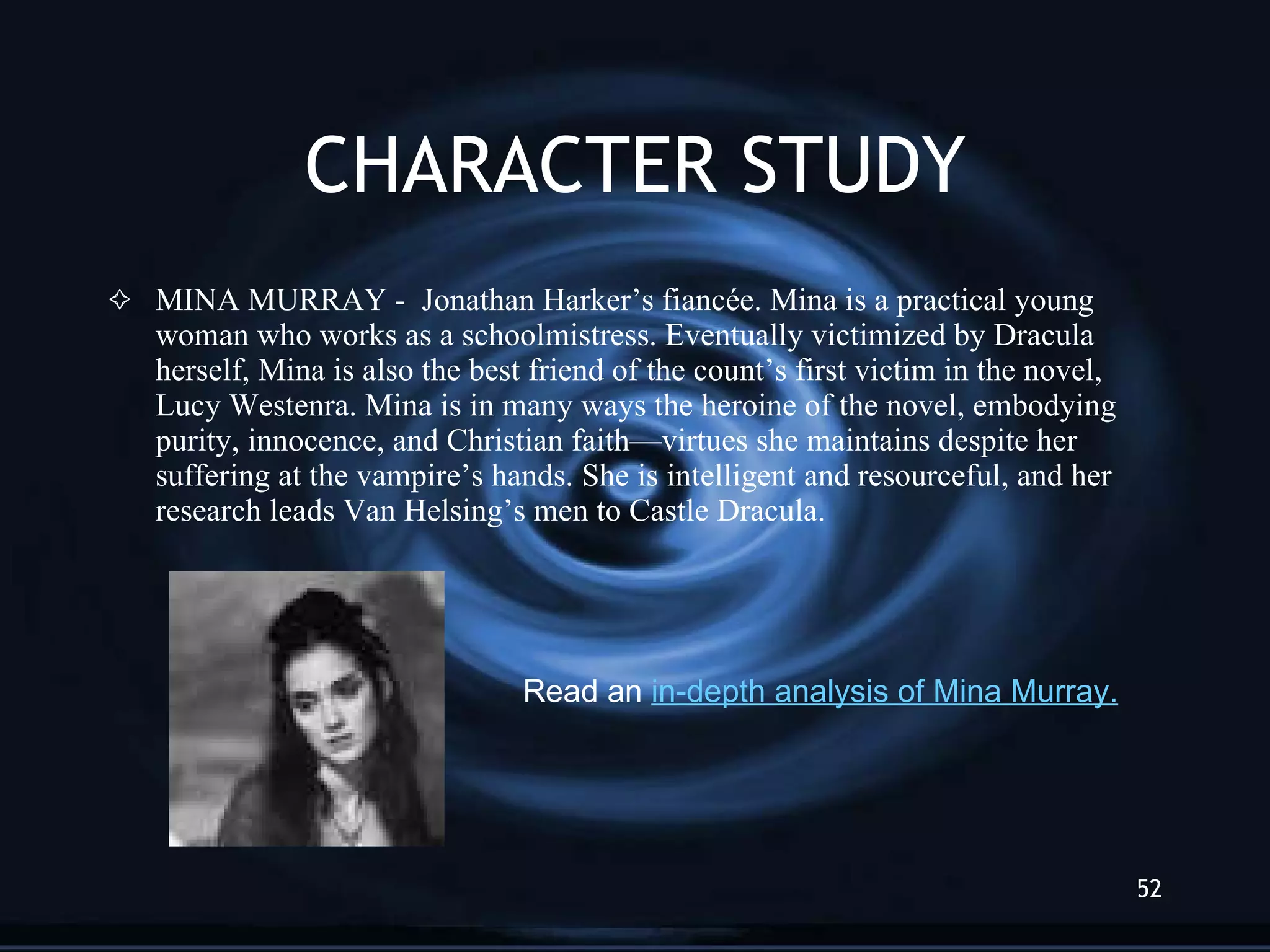
CHARACTER STUDY MINA MURRAY -  Jonathan Harker’s fiancée. Mina is a practical young woman who works as a schoolmistress. Eventually victimized by Dracula herself, Mina is also the best friend of the count’s first victim in the novel, Lucy Westenra. Mina is in many ways the heroine of the novel, embodying purity, innocence, and Christian faith—virtues she maintains despite her suffering at the vampire’s hands. She is intelligent and resourceful, and her research leads Van Helsing’s men to Castle Dracula. Read an  in-depth analysis of  Mina  Murray .
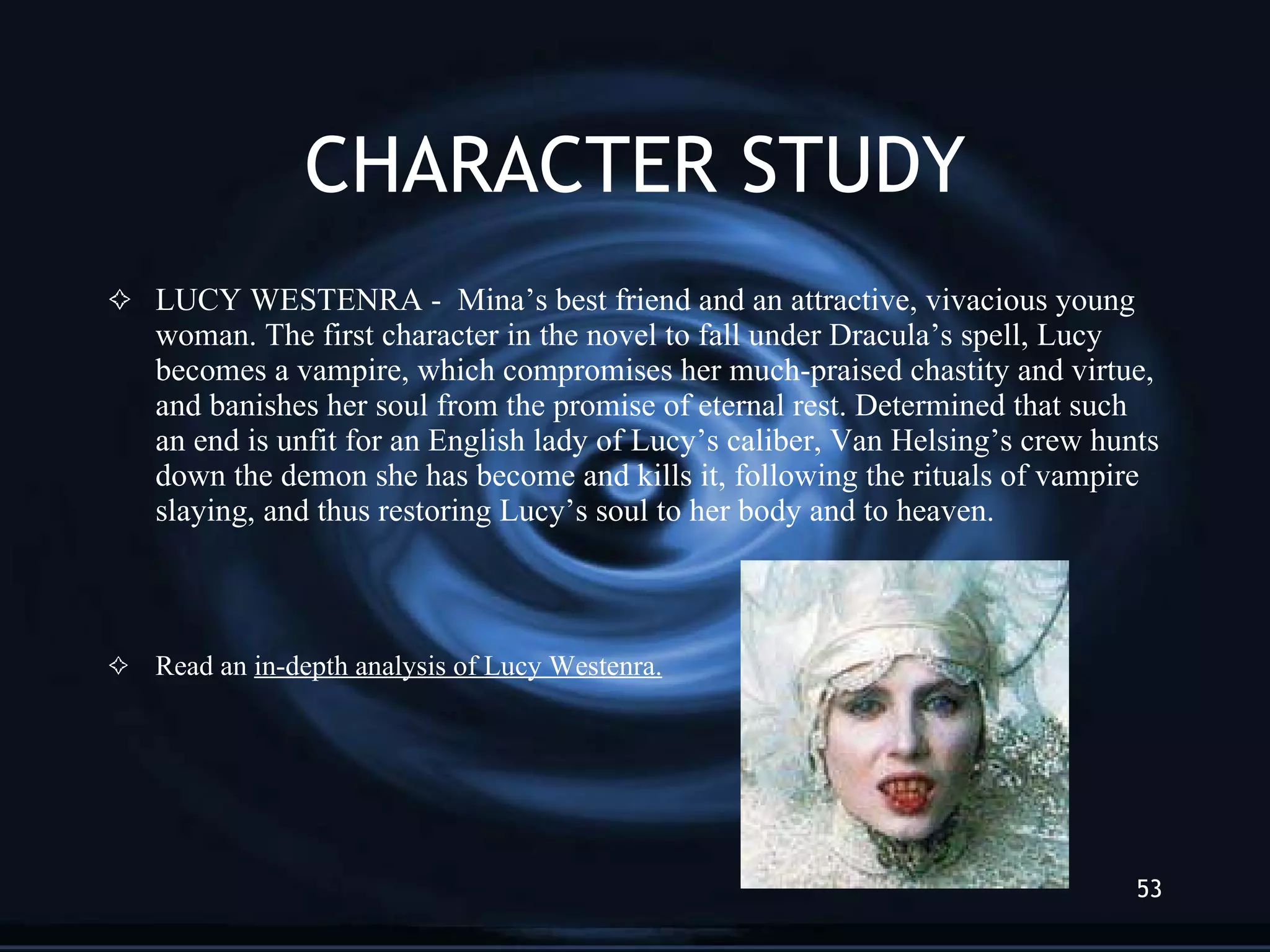
CHARACTER STUDY LUCY WESTENRA -  Mina’s best friend and an attractive, vivacious young woman. The first character in the novel to fall under Dracula’s spell, Lucy becomes a vampire, which compromises her much-praised chastity and virtue, and banishes her soul from the promise of eternal rest. Determined that such an end is unfit for an English lady of Lucy’s caliber, Van Helsing’s crew hunts down the demon she has become and kills it, following the rituals of vampire slaying, and thus restoring Lucy’s soul to her body and to heaven. Read an  in-depth analysis of Lucy Westenra.
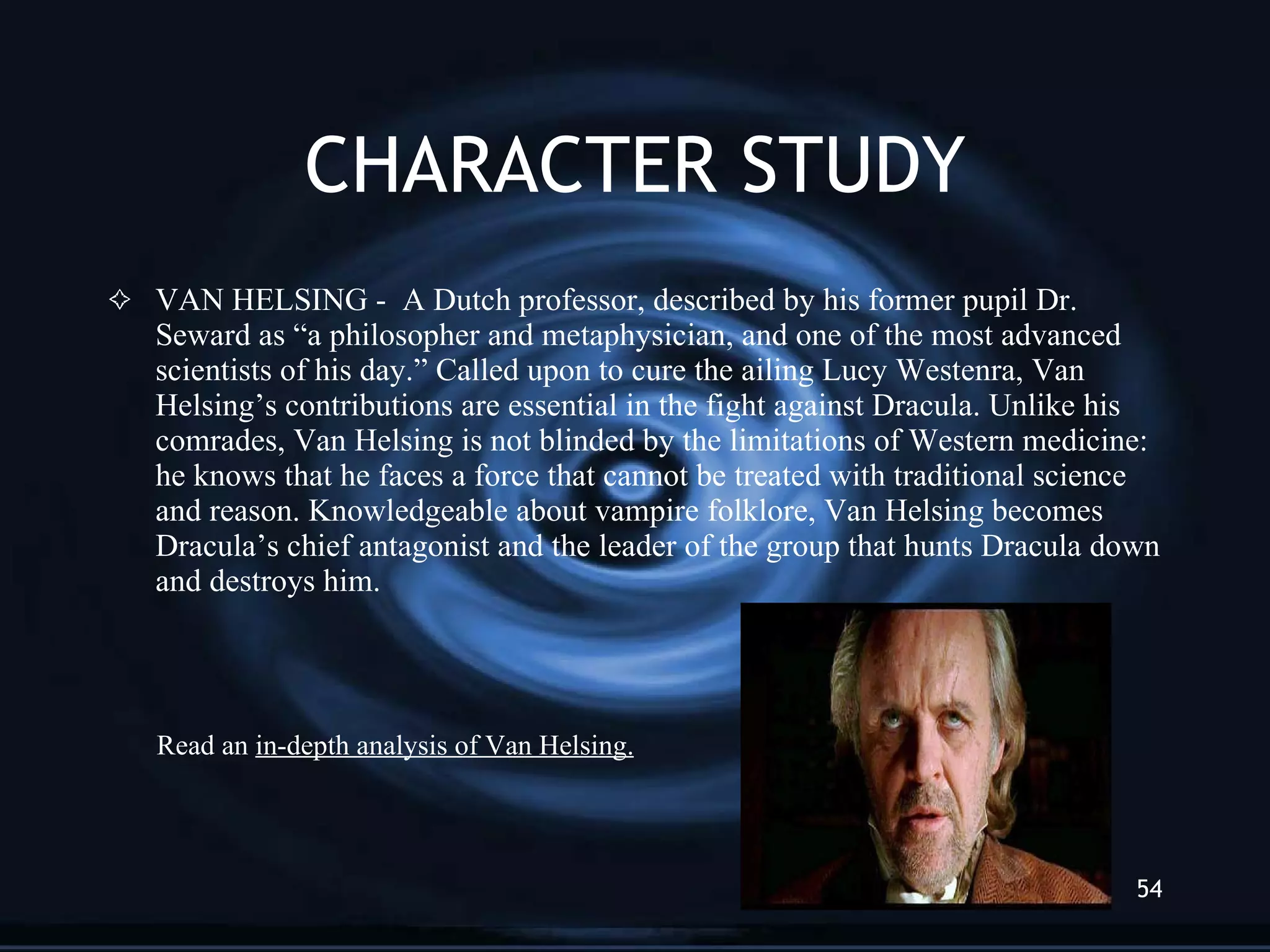
CHARACTER STUDY VAN HELSING -  A Dutch professor, described by his former pupil Dr. Seward as “a philosopher and metaphysician, and one of the most advanced scientists of his day.” Called upon to cure the ailing Lucy Westenra, Van Helsing’s contributions are essential in the fight against Dracula. Unlike his comrades, Van Helsing is not blinded by the limitations of Western medicine: he knows that he faces a force that cannot be treated with traditional science and reason. Knowledgeable about vampire folklore, Van Helsing becomes Dracula’s chief antagonist and the leader of the group that hunts Dracula down and destroys him. Read an  in-depth analysis of Van Helsing.
CHARACTER STUDY JOHN SEWARD -  A talented young doctor, formerly Van Helsing’s pupil. Seward is the administrator of an insane asylum not far from Dracula’s English home. Throughout the novel, Seward conducts ambitious interviews with one of his patients, Renfield, in order to understand better the nature of life-consuming psychosis. Although Lucy turns down Seward’s marriage proposal, his love for her remains, and he dedicates himself to her care when she suddenly takes ill. After her death, he remains dedicated to fighting the count.
CHARACTER STUDY ARTHUR HOLMWOOD -  Lucy’s fiancé and a friend of her other suitors. Arthur is the son of Lord Godalming and inherits that title upon his father’s death. In the course of his fight against Dracula’s dark powers, Arthur does whatever circumstances demand: he is the first to offer Lucy a blood transfusion, and he agrees to kill her demonic form.
VOCABULARY VERBS: BECOME:   to change and begin to be something new. Convertirse BELIEVE: to think that something is true.creer HOWL: to make a loud, crying sound. aullar KISS: to touch someone with your mouth to show love.besar SHAVE: to cut the hair off the face. afeitarse SHIVER: to shake with cold or fear. temblar
VOCABULARY NOUNS CARRIAGE: a kind of “car” pulled by horses, for carrying people. carruaje CART: a kind of open “car” pulled by horses, for carrying people or things. carro CASTLE: a big strong building that can keep enemies out. castillo CHURCHYARD: a place by a church where dead people lie under the ground. cementerio CLOAK: a big, loose coat with no sleeves for the arms. capa COACH: a large kind of “car” pulled by horses, for carrying people. carruaje COFFIN: a box in which a dead person lies. ataud
VOCABULARY COUNT: a title for a nobleman in some countries. conde CURTAIN: a piece of cloth that covers a window. cortina EARTH: dirt from the ground. tierra FEAR: you feel this way when you are afraid. miedo GARLIC: a plant with white flowers and a strong taste and smell which is used in cooking. ajo HAMMER: a heavy tool used for hitting things (e.g. Nails into a wall). martillo HATE: very strong dislike, opposite of “love”. odio HEART: the organ inside your chest that pushes the blood roung the body. coraz ón HELL: the place where bad people go after they are dead.infierno ICE: water that is hard because iti is frozen (very cold). hielo
VOCABULARY MIRROR: a piece of glass where you can see yourself. espejo PROFESSOR: an important teacher at university. profesor SERVANT: someone who works in another person’s home. sirviente THOUGHT: something that you think. pens amiento TOMB: a small stone building under or above the ground for a dead person. tumba VAMPIRE: the body of a dead person that comes alive at night and drinks the blood of living people.vampiro WOLF: a wild animal that looks like a dog. lobo WOUND:  a place on the body where something or somebody as cut or hurt you. herida
VOCABULARY ADJECTIVES: FRIGHTENED: very afraid. asustado HOLY: special because it is from the church. sagrado HORRIBLE: very bad, terrible, making you very afraid or unhappy. LOVELY: nice, beautiful. Bonito, agradable PALE: with little colour in the face. p álido SHARP: with an edge that cuts easily (e.g. A sharp knife). afilado WEAK: not strong. d ébil

Dracula Project

  • 1.
  • 2.
    INDEX 1. VAMPIRES:AN INTRODUCTION 1.1 Definition 1.2 Appearance and history 1.3 Vampire fiction 1.4 How is a vampire’s body? 1.5 Vampire characteristics
  • 3.
    INDEX 2. VAMPIRES IN HISTORY 2.1 Elizabeth Bathory 2.2 Peter K ürten 2.3 Vlad the Impaler
  • 4.
    INDEX VAMPIRES INCINEMA 3.1 Introduction 3.2 Francis Ford Coppola’s Dracula 3.3 Interview with the vampire 3.4 The Twilight Saga
  • 5.
    INDEX 4. VAMPIRESIN LITERATURE: BRAM STOKER’S DRACULA (I) 4.1 Vlad Dracul vs Count Dracula 4.2 Bram Stoker: Life and works 4.3 Summary
  • 6.
    INDEX 5. OURREADING BOOK: BRAM STOKER’S DRACULA (II) 5.1 Character study 5.2 Vocabulary
  • 7.
    GROUP 1: VAMPIRES,AN INTRODUCTION
  • 8.
    VAMPIRES: AN INTRODUCTIONDEFINITION : Vampires are mythological or folkloric beings who subsist by feeding on the life essence (generally in the form of blood) of living creatures. In folkloric tales, vampires often visited loved ones and caused mischief or deaths in the neighbourhoods they inhabited when they were alive. Vampiren, by Edward Munch
  • 9.
    VAMPIRES: AN INTRODUCTIONAPPEARANCE : They wore shrouds and were often described as swollen and with dark face. This is markedly different from modern fictional portrayals of gaunt, pale vampires beginning in the early 19th century. Vampire make-up
  • 10.
    VAMPIRES: AN INTRODUCTIONHISTORY : Vampiric entities have been recorded in many cultures and the "belief in vampires and bloodsucking demons is as old as man himself". However, the term vampire was not popularized until the early 18th century, after an influx of vampire superstition into Western Europe from areas where vampire legends were frequent, such as the Balkans and Eastern Europe,. This increased level of vampire superstition in Europe led to mass hysteria and in some cases resulted in corpses actually being staked and people being accused of vampirism
  • 11.
    VAMPIRES: AN INTRODUCTIONVAMPIRE FICTION : The charismatic and sophisticated vampire of modern fiction was born in 1819 with the publication of The Vampyre by John Polidori.It was the most influential vampire work of the early 19th century. However, it is Bram Stoker's 1897 novel Dracula that is remembered as the quintessential vampire novel and which provided the basis of modern vampire fiction. Dracula drew on earlier mythologies of werewolves and similar imaginary demons and "was to voice the anxieties of an age", and the "fears of late Victorian patriarchy". The success of this book spawned a distinctive vampire genre, still popular in the 21st century, with books, films, video games, and television shows. The vampire is adominant figure in the horror genre.
  • 12.
    HOW IS AVAMPIRE’S BODY? EYES: Vampire’s pupils expand very much and they can see at night. The sun blinds vampires. EARS: Vampires have big ears. They can find their way through sounds, just like bats! TEETH: Vampire’s canine teeth are very, very long to bite their victim’s neck. SKIN: very light and thin. They are very sensitive to sun radiation. NAILS: They are hard and they keep growing. They let vampires break the skin of their victims and drink their blood quickly. LUNGS: Vampires don’t breathe. They get oxygen from their victim’s blood. MUSCLES: their muscular fibres are very elastic. They are very strong, too.
  • 13.
    VAMPIRE CHARACTERISTICS Vampirescan convert into insects, bats,rats or wolves. The most mentioned in popular culture is the bat form . They don’t reflect in mirrors, they don’t have a shadow, maybe because they don’t have a soul.
  • 14.
    VAMPIRE CHARACTERISTICS Vampires’demonic nature makes them hate christian symbols. That’s why they run away when someone uses a christian cross or holy water. They can’t go across consecrated land such as churches. They hate garlic and they are vulnerable to sunlight.
  • 15.
    VAMPIRE CHARACTERISTICS Theyare indestructible using common means and they are extremely strong and fast, but they weaken next to water currents They have a natural affinity with magic, especially with black magic and necromancy. They feed on their victims’ blood.
  • 16.
    ARE YOU READY?AHHHHHH! This is Christopher Lee as Dracula
  • 17.
  • 18.
    VAMPIRES IN HISTORYSome people drank blood for pleasure or with magical purposes. ELIZABETH BATHORY drank blood in the 17th century to keep eternal youth.
  • 19.
    VAMPIRES IN HISTORYPETER K ÜRTEN (1883-1931), the vampire of Dusseldorf, drank animal or human blood and he felt great pleasure.
  • 20.
    PRINCE VLAD DRACULA “ The Impaler” Vlad Dracula, later named Vlad the Impaler after his favourite form of torture, was a 15th century Romanian prince who ruled with an iron fist. This infamous ruler controlled his subjects with such violence that he is now referred to as the bloodiest ruler in history . THE REAL DRACULA
  • 21.
    Vlad was bornin Transylvania in 1430 or 1431. His father, the warrior Vlad Dracul, was a member of a secret society of knights called the order of the Dragon. This society was formed to fight and defeat the Turks, as well as secure the throne of Wallachia (a town located in present-day Romania). Young Vlad was nicknamed Dracula after his father. In Romanian, Dracul translates to ‘dragon’ or ‘devil,’ and the ‘a’ stands for ‘son of.’ So Dracula literally translates to ‘son of the dragon’ or ‘son of the devil.’ THE REAL DRACULA: VLAD THE IMPALER
  • 22.
    In 1444 Draculwas travelling with Dracula and his youngest son across the Danube River when they were captured by the Turks. Dracula was imprisoned for four years. These years are thought to be the beginning of Vlad Dracula’s violent nature. It wasn’t long before Dracul was assassinated and Dracula’s brother was buried alive by the Ruler of Hungary, Jamos Hunyadi. Fearful for his life, Dracula joined Hunyadi who taught him cunning and severe military tactics that would soon secure Dracula the throne of Wallachia. THE REAL DRACULA: VLAD THE IMPALER
  • 23.
    As Prince, VladDracula continued to battle the Turks. Those taken hostage were impaled (a large pole was driven through their body). But it was not only Dracula’s enemies who suffered. Many townspeople were also subject to his wrath. Woodcut of Vlad surrounded by his victims THE REAL DRACULA: VLAD THE IMPALER
  • 24.
    One storytells of Dracula noticing a peasant man who was wearing a shirt that was too short. When Dracula asked the man’s wife why the man was improperly dressed,she said she was too busy cooking and cleaning to sew. She was immediately impaled. Graciously, Dracula chose a new wife for the man. He made sure to show the new wife what had happened to the old so that she would not make the same mistake. THE REAL DRACULA: VLAD THE IMPALER
  • 25.
    Draculadied in battle in 1476. He was promptly decapitated by order of the Turkish sultan. His head was then sent to the sultan who displayed it, fittingly, on a stake for all to see. He is buried in front of the altar of the Church of Snagov Monastery . THE REAL DRACULA: VLAD THE IMPALER
  • 26.
    Although gone, rumorsof Vlad Dracula and his relentless temper spread throughout Europe. Stories of his villainy were published, read, and reread and it was these stories that led Bram Stoker to create the infamous Count Dracula we know today. The BRAN CASTLE, near Brasov is said to be one of Dracula’s residences. It can be visited by tourists. Do you want to have a look? DRACULA’S CASTLE THE REAL DRACULA: VLAD THE IMPALER
  • 27.
  • 28.
  • 29.
    VAMPIRE FILMS Nosferatu , directed by F. W. Murnau and featuring the first film portrayal of Dracula . Al though names and characters were intended to mimic Dracula' s, Murnau could not obtain permission from Stoker's widow, and had to alter many aspects of the film. Universal's Dracula (1931), starring Bel a Lugosi as the count was the first talking film to portray Dracula.
  • 30.
    VAMPIRE FILMS Thesuccessful 1958 Dracula starring Lee was followed by seven sequels. Lee returned as Dracula in all but two of these and became well known in the role. Later films showed more diversity in plotline, with some focusing on the vampire-hunter such as Blade. Buffy the Vampire Slayer . Buffy , released in 1992, foreshadowed a vampiric presence on television, with adaptation to a long-running hit TV series of the same name. Still others showed the vampire as protagonist such 1994's Interview with the Vampire : The Vampire Chronicles and its indirect sequel Queen of the Damned. Bram Stoker's Dracula was a noteworthy 1992 film which became the then highest grossing vampire film ever. This increase of interest in vampiric plotlines led to the vampire being depicted in movies such as Van Helsing ,
  • 31.
    FRANCIS FORD COPPOLA’SBRAM STOKER’S DRACULA It is a 1992 horror-romance thriller directed by F. F. Coppola, based on the novel Dracula by Bram Stoker. It stars G.Oldman as Count Dracula, W. Ryder as Mina Harker, A. Hopkins as Professor Van Helsing, Keanu Reeves as Jonathan Harker and Sadie Frost as Lucy Westenra.
  • 32.
    FRANCIS FORD COPPOLA’SBRAM STOKER’S DRACULA It had a positive critical reception and was a box office hit. It also had a significant cultural impact, spawning a video game, a board game, a comic book adaptation, collectible cards and some action figures and model sets. The closing theme "Love Song for a Vampire” was written and performed by A. Lennox. See film
  • 33.
    INTERVIEW WITH THEVAMPIRE Interview with the Vampire: The Vampire Chronicles is a 1994 film, based on the 1976 novel Interview with the Vampire by Anne Rice . It was directed by Neil Jordan, and stars T. Cruise, B. Pitt, A. Banderas and K. Dunst. In modern-day San Francisco, reporter Daniel Malloy interviews a man named Louis who claims to be a vampire and tells the story of his past. See film
  • 34.
    THE TWILIGHT SAGATWILIGHT is a 2008 romantic-fantasy film. It is the first film in The Twilight Saga series , directed by Catherine Hardwicke and based on the novel of the same name by Stephenie Meyer. It focuses on the development of a personal relationship between human teenager Bella Swan (Kristen Stewart) and vampire Edward Cullen (Robert Pattinson), and the subsequent efforts of Cullen and his family to keep Swan safe from a separate group of hostile vampires. See film
  • 35.
    THE TWILIGHT SAGANEW MOON is a 2009 film based on Stephenie Meyer's 2006 novel New Moon . It is the 2nd film in The Twilight Saga series and is the sequel to 2008's Twilight , also based on Meyer's previous novel. Directed by Chris Weitz, the film stars Kristen Stewart, Robert Pattinson, and Taylor Lautner, reprising their roles as Bella Swan, Edward Cullen, and Jacob Black, respectively. See film
  • 36.
    GROUP 4 VAMPIRESIN LITERATURE: BRAM STOKER’S DRACULA (I)
  • 37.
    VAMPIRES IN LITERATURE:BRAM STOKER’S DRACULA The most famous vampire in literature appeared in 1897. That year the Irish writer BRAM STOKER published his novel Dracula. It made Vlad the Impaler famous worldwide.
  • 38.
    BRAM STOKER’S DRACULA Stoker read the stories about Dracula printed In the 15th-16th centuries. He was surprised by his acts of cruelty and decided to make him his character. He also read some books about Transylvania and thought that this "exotic” land would be a proper setting for Dracula. Dracula’s qualities: he is immortal. He has got supernatural powers and he drinks human blood!
  • 39.
    COMPARISON: VLAD VSCOUNT DRACULA VLAD DRACUL COUNT DRACULA
  • 40.
    COMPARISON: VLAD VSCOUNT DRACULA Stoker used Vlad only as a source of inspiration. In his novel, Dracula is not prince Vlad the Impaler, but a Transylvanian count living in a mysterious castle where he lured his victims. His story takes place in the Bistritza area, and the castle lies near the Carpathian Mountains. As Stoker had never visited Transylvania, most places and happenings were pure fiction.
  • 41.
    ABOUT THE AUTHORBRAM STOKER: LIFE He was born in Dublin in 1847. After finishing university there he worked for the government. He married a Dublin girl. Stoker was very interested in the theatre and in 1878 he moved to London, where he became the manager of a famous actor. Together they ran the sucessful Lyceum Theatre in London. He died in 1912.
  • 42.
    BRAM STOKER BRAMSTOKER: WORKS His novel Dracula was published in 1897. There have been stories about vampires in Eastern Europe for a very long time. Stoker, who worked on his noveL for four years, probably knew about these stories. He said that the Dracula story came to him in a nightmare one night after a large dinner of crab meat.
  • 43.
    BRAM STOKER BRAMSTOKER: CONCLUSION Stoker is often called “the least-known author of the best-Known book”. He wrote many other books, but it is because of Dracula that we remember him today. There have been many films about Count Dracula and the book, which has never been out of print, is as popular today as it was a hundred years ago.
  • 44.
    BRAM STOKER’S DRACULA SYNOPSIS In the mountains of Transylvania there stands a castle . It is the home of Count Dracula - a dark, lonely place and at night the wolves howl around the walls. In the year 1875 Jonathan Harker comes from England to do business with the Count. But Jonathan does not feel comfortable at Dracula’s castle. Strange things happen at night and very soon he begins to feel afraid. And he is right to be afraid, because Count Dracula is one of the Un-Dead - a vampire that drinks the blood of living people…
  • 45.
    DRACULA: A SUMMARYIn the spring of 1875, Jonathan Harker travels to Transylvania, on a business visit to the home of Count Dracula . Jonathan does not really want to go because in a few months’ time he is getting married to his beautiful Mina and he does not want to leave her.
  • 46.
    DRACULA: A SUMMARYWhile he is staying in Castle Dracula , he keeps a diary. And every day he has more and more terrible things to write. Why does he see Count Dracula only at night? Why can’t he see the Count in the mirror? And who are the three beautiful women, with their red mouths and long sharp teeth that come to his room at night? Listen to Jonathan’s diary 2. ”I am in danger”
  • 47.
    DRACULA: A SUMMARYAt home in England , Mina is staying with her friend Lucy in a town by the sea. She waits for Jonathan’s letters, but they do not come, and Mina is afraid. Perhaps Jonathan is ill, or in danger…
  • 48.
    DRACULA: A SUMMARYMina is not afraid for herself, of course, or for her friend Lucy. What danger can there possibly be for two young women in a quiet English seaside town?
  • 49.
    GROUP 5 VAMPIRESIN LITERATURE: BRAM STOKER’S DRACULA (II)
  • 50.
    CHARACTER STUDY COUNTDRACULA - A centuries-old vampire and Transylvanian nobleman, Count Dracula inhabits a crumbling castle in the Carpathian Mountains. Beneath a veneer of aristocratic charm, the count possesses a dark and evil soul. He can assume the form of an animal, control the weather, and he is stronger than twenty men. His powers are limited, however—for instance, he cannot enter a victim’s home unless invited, cannot cross water unless carried, and is rendered powerless by daylight. Read an in-depth analysis of Count Dracula.
  • 51.
    CHARACTER STUDY JONATHANHARKER - A solicitor, or lawyer, whose firm sends him to Transylvania to conclude a real estate transaction with Dracula. Young and naïve, Harker quickly finds himself a prisoner in the castle and barely escapes with his life. He demonstrates a fierce curiosity to discover the true nature of his captor and a strong will to escape. Later, after becoming convinced that the count has moved to London, Harker emerges as a brave and fearless fighter.
  • 52.
    CHARACTER STUDY MINAMURRAY - Jonathan Harker’s fiancée. Mina is a practical young woman who works as a schoolmistress. Eventually victimized by Dracula herself, Mina is also the best friend of the count’s first victim in the novel, Lucy Westenra. Mina is in many ways the heroine of the novel, embodying purity, innocence, and Christian faith—virtues she maintains despite her suffering at the vampire’s hands. She is intelligent and resourceful, and her research leads Van Helsing’s men to Castle Dracula. Read an in-depth analysis of Mina Murray .
  • 53.
    CHARACTER STUDY LUCYWESTENRA - Mina’s best friend and an attractive, vivacious young woman. The first character in the novel to fall under Dracula’s spell, Lucy becomes a vampire, which compromises her much-praised chastity and virtue, and banishes her soul from the promise of eternal rest. Determined that such an end is unfit for an English lady of Lucy’s caliber, Van Helsing’s crew hunts down the demon she has become and kills it, following the rituals of vampire slaying, and thus restoring Lucy’s soul to her body and to heaven. Read an in-depth analysis of Lucy Westenra.
  • 54.
    CHARACTER STUDY VANHELSING - A Dutch professor, described by his former pupil Dr. Seward as “a philosopher and metaphysician, and one of the most advanced scientists of his day.” Called upon to cure the ailing Lucy Westenra, Van Helsing’s contributions are essential in the fight against Dracula. Unlike his comrades, Van Helsing is not blinded by the limitations of Western medicine: he knows that he faces a force that cannot be treated with traditional science and reason. Knowledgeable about vampire folklore, Van Helsing becomes Dracula’s chief antagonist and the leader of the group that hunts Dracula down and destroys him. Read an in-depth analysis of Van Helsing.
  • 55.
    CHARACTER STUDY JOHNSEWARD - A talented young doctor, formerly Van Helsing’s pupil. Seward is the administrator of an insane asylum not far from Dracula’s English home. Throughout the novel, Seward conducts ambitious interviews with one of his patients, Renfield, in order to understand better the nature of life-consuming psychosis. Although Lucy turns down Seward’s marriage proposal, his love for her remains, and he dedicates himself to her care when she suddenly takes ill. After her death, he remains dedicated to fighting the count.
  • 56.
    CHARACTER STUDY ARTHURHOLMWOOD - Lucy’s fiancé and a friend of her other suitors. Arthur is the son of Lord Godalming and inherits that title upon his father’s death. In the course of his fight against Dracula’s dark powers, Arthur does whatever circumstances demand: he is the first to offer Lucy a blood transfusion, and he agrees to kill her demonic form.
  • 57.
    VOCABULARY VERBS: BECOME: to change and begin to be something new. Convertirse BELIEVE: to think that something is true.creer HOWL: to make a loud, crying sound. aullar KISS: to touch someone with your mouth to show love.besar SHAVE: to cut the hair off the face. afeitarse SHIVER: to shake with cold or fear. temblar
  • 58.
    VOCABULARY NOUNS CARRIAGE:a kind of “car” pulled by horses, for carrying people. carruaje CART: a kind of open “car” pulled by horses, for carrying people or things. carro CASTLE: a big strong building that can keep enemies out. castillo CHURCHYARD: a place by a church where dead people lie under the ground. cementerio CLOAK: a big, loose coat with no sleeves for the arms. capa COACH: a large kind of “car” pulled by horses, for carrying people. carruaje COFFIN: a box in which a dead person lies. ataud
  • 59.
    VOCABULARY COUNT: atitle for a nobleman in some countries. conde CURTAIN: a piece of cloth that covers a window. cortina EARTH: dirt from the ground. tierra FEAR: you feel this way when you are afraid. miedo GARLIC: a plant with white flowers and a strong taste and smell which is used in cooking. ajo HAMMER: a heavy tool used for hitting things (e.g. Nails into a wall). martillo HATE: very strong dislike, opposite of “love”. odio HEART: the organ inside your chest that pushes the blood roung the body. coraz ón HELL: the place where bad people go after they are dead.infierno ICE: water that is hard because iti is frozen (very cold). hielo
  • 60.
    VOCABULARY MIRROR: apiece of glass where you can see yourself. espejo PROFESSOR: an important teacher at university. profesor SERVANT: someone who works in another person’s home. sirviente THOUGHT: something that you think. pens amiento TOMB: a small stone building under or above the ground for a dead person. tumba VAMPIRE: the body of a dead person that comes alive at night and drinks the blood of living people.vampiro WOLF: a wild animal that looks like a dog. lobo WOUND: a place on the body where something or somebody as cut or hurt you. herida
  • 61.
    VOCABULARY ADJECTIVES: FRIGHTENED:very afraid. asustado HOLY: special because it is from the church. sagrado HORRIBLE: very bad, terrible, making you very afraid or unhappy. LOVELY: nice, beautiful. Bonito, agradable PALE: with little colour in the face. p álido SHARP: with an edge that cuts easily (e.g. A sharp knife). afilado WEAK: not strong. d ébil