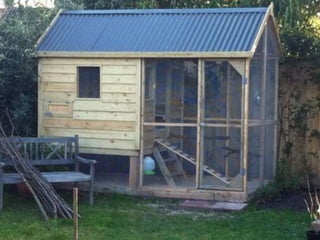
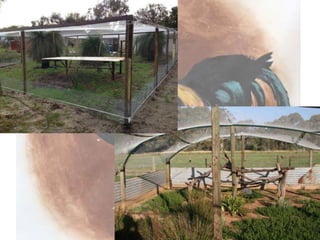
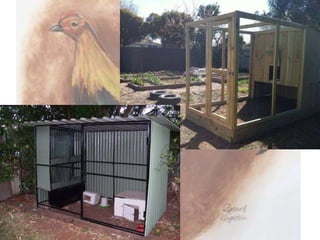
* Housing & Protection
• Food and Water
Summarised for Backyard and
Exhibition Poultry Keepers
Credit: Images taken from contributions by members to the
Backyard Poultry Gallery. http://gallery.backyardpoultry.com
www.backyardpoultry.com
• Readily accessible food and water to maintain
health and vigour:
• Freedom to move, stand, turn around, stretch sit
and lie down:
• Visual contact with other members of the
species:
• Accommodation which provides protection from
the weather and which neither harms nor causes
distress:
• Prevention of disease, injury and vice, and their
rapid treatment should they occur.
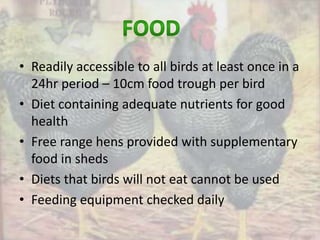
• Readily accessible to all birds at least once in a
24hr period – 10cm food trough per bird
• Diet containing adequate nutrients for good
health
• Free range hens provided with supplementary
food in sheds
• Diets that birds will not eat cannot be used
• Feeding equipment checked daily
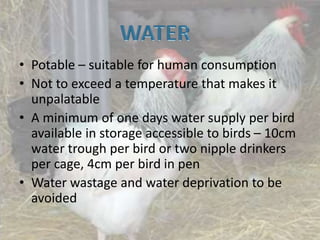
• Potable – suitable for human consumption
• Not to exceed a temperature that makes it
unpalatable
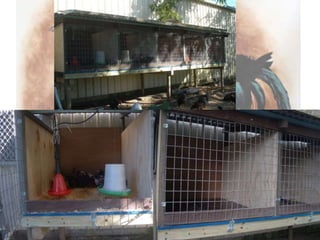
• A minimum of one days water supply per bird
available in storage accessible to birds – 10cm
water trough per bird or two nipple drinkers
per cage, 4cm per bird in pen
• Water wastage and water deprivation to be
avoided
• Be aware of your chickens nutritional
requirements at each stage of their
development. If you don’t know how to
provide a nutritionally balanced diet, use only
a commercially prepared complete food
source.
• Mixed grain and food scraps don’t provide all
the nutritional requirements your chickens
need
• Two basic feeding approaches
• Demand feeding – Chickens provided with a
variety of supplements e.g. shell grit, mineral
and vitamin concentrates that chickens access
as they need them ( Free range with
supplement)
• Controlled feeding – Chickens only provided
with diet providing 100% of daily
requirements
• Check your water is safe. Would you drink it?
• Monitor the amount of food and water that is
being consumed. If levels are too low, it may
be unpalatable or not adequately accessible
• Each bird drinks up to 500ml/day in summer
• Each bird eats up to 200g/day depending on
breed, age and size of pen
• Be aware of normal behaviour and monitor
any change in habits
• Know your birds – Don’t be afraid to ask Q’s.
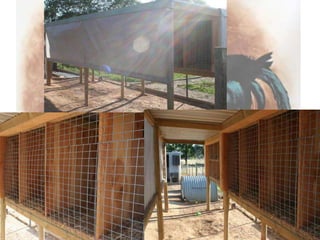
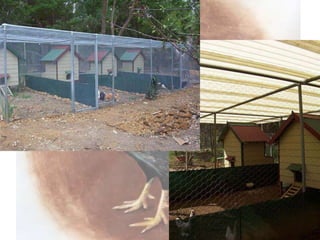
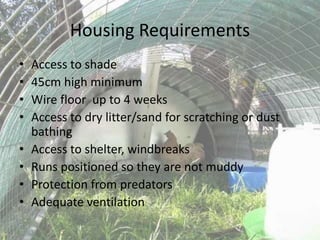
Housing Requirements
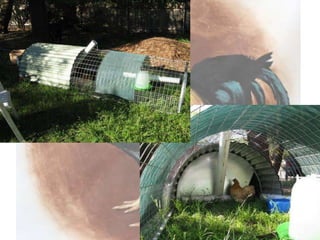
• Access to shade
• 45cm high minimum
• Wire floor up to 4 weeks
• Access to dry litter/sand for scratching or dust
bathing
• Access to shelter, windbreaks
• Runs positioned so they are not muddy
• Protection from predators
• Adequate ventilation
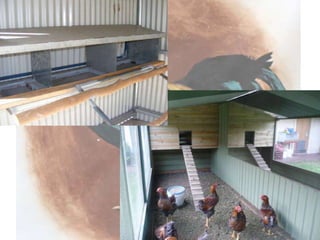
Minimum Housing Requirements
• Perching for each bird
– 20cm away from wall
– Between 30cm and 1m apart – not too high
– 15cm minimum perch per bird – 450cm2 i.e. 15x30
• Nest boxes
– 1 per 7 layers
– 1900cm2 per 5 breeders (50x38cm)
– Easily accessible but secluded
– Positioned and designed so they are not heat traps
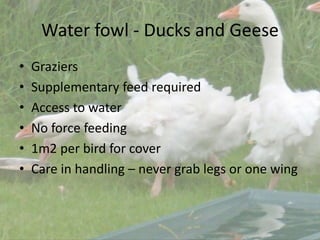
Water fowl - Ducks and Geese
• Graziers
• Supplementary feed required
• Access to water
• No force feeding
• 1m2 per bird for cover
• Care in handling – never grab legs or one wing
Other Requirements
• Hatchlings removed from incubator to
brooders within 48hrs
• Supplementary heat provided up to 5wks
• Twice daily inspections for birds in brooders
• Have an effective treatment plan for parasites
• Birds not to travel in boot of car
• Dispatch birds humanely – neck dislocation or
decapitation recommended
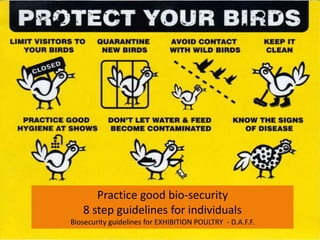
Practice good bio-security
8 step guidelines for individuals
Biosecurity guidelines for EXHIBITION POULTRY - D.A.F.F.

Dpi code of practice

  • 1.
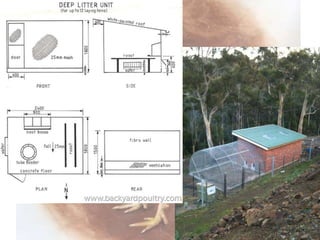
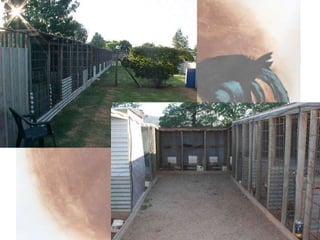
    * Housing &Protection • Food and Water Summarised for Backyard and Exhibition Poultry Keepers Credit: Images taken from contributions by members to the Backyard Poultry Gallery. http://gallery.backyardpoultry.com www.backyardpoultry.com
  • 2.
    • Readily accessiblefood and water to maintain health and vigour: • Freedom to move, stand, turn around, stretch sit and lie down: • Visual contact with other members of the species: • Accommodation which provides protection from the weather and which neither harms nor causes distress: • Prevention of disease, injury and vice, and their rapid treatment should they occur.
  • 5.
    • Readily accessibleto all birds at least once in a 24hr period – 10cm food trough per bird • Diet containing adequate nutrients for good health • Free range hens provided with supplementary food in sheds • Diets that birds will not eat cannot be used • Feeding equipment checked daily
  • 7.
    • Potable –suitable for human consumption • Not to exceed a temperature that makes it unpalatable • A minimum of one days water supply per bird available in storage accessible to birds – 10cm water trough per bird or two nipple drinkers per cage, 4cm per bird in pen • Water wastage and water deprivation to be avoided
  • 9.
    • Be awareof your chickens nutritional requirements at each stage of their development. If you don’t know how to provide a nutritionally balanced diet, use only a commercially prepared complete food source. • Mixed grain and food scraps don’t provide all the nutritional requirements your chickens need
  • 10.
    • Two basicfeeding approaches • Demand feeding – Chickens provided with a variety of supplements e.g. shell grit, mineral and vitamin concentrates that chickens access as they need them ( Free range with supplement) • Controlled feeding – Chickens only provided with diet providing 100% of daily requirements
  • 12.
    • Check yourwater is safe. Would you drink it? • Monitor the amount of food and water that is being consumed. If levels are too low, it may be unpalatable or not adequately accessible • Each bird drinks up to 500ml/day in summer • Each bird eats up to 200g/day depending on breed, age and size of pen • Be aware of normal behaviour and monitor any change in habits • Know your birds – Don’t be afraid to ask Q’s.
  • 14.
    Housing Requirements • Accessto shade • 45cm high minimum • Wire floor up to 4 weeks • Access to dry litter/sand for scratching or dust bathing • Access to shelter, windbreaks • Runs positioned so they are not muddy • Protection from predators • Adequate ventilation
  • 19.
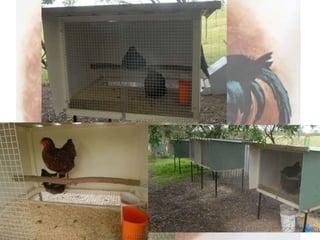
    Minimum Housing Requirements •Perching for each bird – 20cm away from wall – Between 30cm and 1m apart – not too high – 15cm minimum perch per bird – 450cm2 i.e. 15x30 • Nest boxes – 1 per 7 layers – 1900cm2 per 5 breeders (50x38cm) – Easily accessible but secluded – Positioned and designed so they are not heat traps
  • 22.
    Water fowl -Ducks and Geese • Graziers • Supplementary feed required • Access to water • No force feeding • 1m2 per bird for cover • Care in handling – never grab legs or one wing
  • 23.
    Other Requirements • Hatchlingsremoved from incubator to brooders within 48hrs • Supplementary heat provided up to 5wks • Twice daily inspections for birds in brooders • Have an effective treatment plan for parasites • Birds not to travel in boot of car • Dispatch birds humanely – neck dislocation or decapitation recommended
  • 24.
    Practice good bio-security 8step guidelines for individuals Biosecurity guidelines for EXHIBITION POULTRY - D.A.F.F.