Preparation for arrivalof chicks:
Cleaning the chicken house
What is the purpose? BIO SECURITY
What’s that?
Biosecurity can be defined as the actions taken to both reduce the risk
of infection entering the farm and to remove infection from the farm. It
is important to recognise that bio security is about bird health and
ultimately profits.
Bio security is about far more than just controlling food poisoning
organisms though, good bio security will also improve the performance
of the flock.
Diseases are spread through:
Movement of poultry, people, vehicles and equipment between and within farms;
The introduction of birds of low or unknown health status;
Contact with the neighbour’s flocks;
Using/sharing farm equipment and vehicles, which have not been effectively cleansed
and disinfected;
Contact with vermin and wild birds;
Birds drinking from contaminated water sources;
Birds eating contaminated feed; and unsatisfactory cleansing and disinfection of
vehicles, sheds, feeding troughs and other equipment.
7.
Consequences of not
followingbio security
practices
Poor biosecurity can:
Allow notifiable diseases like Avian Influenza or Newcastle Disease
to establish themselves, some of which can decimate your flock;
Result in disease outbreaks that require the entire flock to be
slaughtered;
Allow disease outbreaks to pose a significant threat to your
neighbours and the wider industry.
And this can lead to:
Increased disease risk,
Higher mortality,
Poor feed conversion ratios (FCRs) and
An increase in condemnations at the processing plant.
8.
WHAT BIOSECURITY MEASURES
CANYOU TAKE?
THREE MAJOR COMPONENTS:
Isolation- refers to the confinement of animals within a
controlled environment. A fence keeps your birds in, but
it also keeps other animals out. Isolation also applies to
the practice of separating birds by age group. Use the
all-in/all-out management.
Traffic Control - Control includes both the traffic onto
your farm and the traffic patterns within the farm.
Sanitation – chemically addresses the disinfection of
materials, people and equipment entering the farm and
the cleanliness of the personnel on the farm.
9.
PREPARING A CHICKENHOUSE
FOR DAY OLD CHICKENS
Cleaning and disinfecting the chicken
house:
Cleaning and disinfection are key components of
maintaining a healthy production cycle and healthy
chickens
Disinfection kills any disease/ organisms like:
virus
bacteria
Mold/fungi
protozoa
that might be present on a farm at the end of a production
cycle or after disease outbreak.
10.
How is cleaningand
disinfection done?
The physical removal of foreign materials like:
Dust
Soil
Organic material such as: droppings, blood, secretions which protect disease
agents.
THREE STEP PROCESS:
Step 1: Dry and wet cleaning
Take all the equipment out of the house; sweep the ceilings, walls and the
floor. Wash the whole house inside with soapy water
Using a hard broom scrub the walls and floor thoroughly. All dirt must be
entirely washed away.
If available, use a high-pressure pump or a knapsack sprayer to reach all the
corners where the dirt may not be visible or noticed.
Ensure to sweep out all the water from the house
Wet cleaning reduces the risk of airing of virus
11.
Step 2: Disinfecting
To disinfect means to kill all germs in the house. The disinfectant
can be a fluid or a dry powder that can be mixed in water.
NB Disinfectants are poisonous!!
Use a good strong disinfectant like Jeyes Fluid®
for this purpose.
Mix the disinfectant with the correct amount of water and
spray it all over the inside of the house using a knapsack
sprayer or a high-pressure pump if possible.
Again remove all the residual disinfectant and water and
allow the house to dry thoroughly.
The choice of disinfectant will depend on the following:
Cost
Type of disease agent/s to be destroyed
Amount of contamination by organic matters such as: droppings, blood
and manure left in the poultry house
Active ingredient the chemical compound and concentration that it
contains
12.
Step 3Resting the house
The empty house must not be used for about 7 days in order
for it to dry off completely as most germs and bacteria prefer
to live in moist conditions and will die when the house is dry.
This total cleaning operation will take about 10 days. After
this the house is ready to take another batch of day old
chickens.
Why rest the house?
Enables disinfectant with efficient contact time to work at its
maximum strength, the weaker the disinfectant, the more time
is needed for its activation.
To kill most germs and bacteria that prefer to live in moist conditions.
13.
Preparation for arrivalof chicks:
Preparing the brooding area
Brooding area material:
The brooder consists of strips of masonite, cardboard or even
roof sheeting approximately 400mm wide. This is placed on its
side to form a circle on the floor on which the chickens are
kept.
One brooder for every 100 to 500 birds will be sufficient. For
more than 500 chickens separate brooders must be built for
each group of 500 chickens.
The floor must be covered with a layer of bedding. This can be
wood shavings, sawdust, sunflower husks, groundnut husks or
even dry grass. The bedding must be about 50mm deep to
keep the chicks off the cold floor.
For 500 day-old chickens the diameter of the brooder guard
should be 3,5m and the total length16m. For 100 to 200
chickens the diameter should be 2m and the total length
about 9,5m.
14.
Preparing the broodingarea cont…
:
The heating systems
The heat source must be
placed in the middle of the
brooder. The heater usually
hangs from the roof on a
chain that can be adjusted
lower or higher as needed to
provide just the right amount
of warmth. Initial brooding
temperature, at the birds'
level, should be 35° Celcius
(C), and reduced by
approximately 3° C per week
until 21° C is reached.
After six weeks of age,
temperatures between 18°
and 21° C are desirable.
15.
Preparing the broodingarea
cont.
Some newspaper can be put on top of the shavings initially to
prevent the chickens from eating the wood. The movement of
the chickens will also be easier on the paper for the first few days
than on the shavings.
The drinkers and feeders must be placed in the brooder. For
every 100 chickens two drinkers and two feeders will be sufficient.
Place this equipment on the side of the brooder but not against
the wall. The chickens must be able to pass between the drinkers
and feeders and the brooder wall.
By the second day the chickens must be able to eat, drink and
use the feeders and drinkers on their own without any difficulty.
The chickens must never be crowded in the brooder, it puts them
under a great deal of stress. This makes it easy for them to get a
wide range of diseases. As the chickens grow the brooder guard
must be extended to form a larger circle to ensure sufficient
space and prevent overcrowding.
After ten days the brooder guard can be taken out and the
chickens can be allowed to use the entire house.
16.
The little chickfrom the egg in
the hatchery
The chick and its last day at the hatchery:
In the final stages of incubation and as a very new
hatchling, the chick receives all of its nutrients from the
egg yolk. Residual egg yolk provides the chick with a
protective store of antibodies and nutrients for the first
three days. Absorption of the yolk sac precedes the
initiation of growth and energy, therefore growth will be
minimal until the chick starts to eat feed. Once on the
farm, the chick is offered a Starter feed As soon as feed
enters the gut, the residual yolk within the chick is
mobilised, and, provided the chick is fed promptly after
hatch, it will receive a useful boost to growth from these
nutrients.
17.
The little chick
General description of the broiler chick:
Day Old Chicks often have a soft yellow fur and small yellow
beaks and yellowish orange feet; depending on the breed of
chicken some may have brown or black streaks across the
body.
The eyes are black and glossy.
They are small at about 10-15 cm in length, usually weighing in
at 40 -70 grams.
18.
General behavior of
chicks:
Day old chicks are fragile and are frightened easily,
under stress they tend to breath heavily and huddle
together. Chicks will “cheep” a lot when they are
hungry, thirsty or cold.
19.
Chick Management
Duringthe first ten days of life, the chicks’ environment
changes from that of the hatcher to that of the broiler house
Chicks must adapt to establish healthy feeding and drinking
to achieve their genetic potential for growth.
Factors such as:
Temperature
Feed and water supply
Nutrition
Health and vaccine status
Ventilation and stocking density
Light
All play a contribution to the well being and survival of your
chicks
20.
ARRIVAL OF CHICKS
Key points to remember:
Pre-heat the house and stabilize temperature and humidity prior to
arrival of chicks.
Unload chicks and place them quickly and gently into their brooding
area. (to cut down stress levels). The longer the chicks remain in the
boxes, the greater the degree of potential dehydration. This may result
in early mortality and reduced growth as indicated by seven day and
final live weight.
Leave chicks to settle for one to two hours with access to feed and
water.
Check feed, water, temperature and humidity after one to two hours
and adjust where necessary.
For the first seven days, provide 23 hours light with 30-40 lux intensity to
help the chick adapt to the new environment and encourage feed
and water intake.
Arrange equipment to enable the chicks to reach feed and water
easily. Position supplementary feeders and drinkers near the main
feeding and drinking systems.
21.
Water
If thechickens have been transported for some time they
will be tired and stressed when they reach the farm and
must be given some “stress pack” in the drinking water.
The “stress pack” contains certain minerals and vitamins
that will strengthen the chicken to overcome the shock of
being transported and being put in a strange place
amongst unfamiliar objects.
Ensure chicks drink before eating – The farmer should be
help the chicks to drink by dipping their beaks into the
water. The drinkers must be cleaned and filled at regular
intervals several times a day (every two hours) .Once they
have drunk for the first time they will in future drink by
themselves.
22.
Feed intake andwater consumption
It must be understood that feed is in directly correlated to
water intake. So NB# if chicks are not drinking water, they
wont eat either!! At normal temperatures, poultry consume at
least twice as much water as feed.
The function of water in development of chicks to adult
chickens:
Water is involved in every aspect of poultry metabolism. It plays
important roles in regulating body temperature. Chicks have no
sweat glands, water helps keep the chicks body cooler.
Digesting food. Allows for further breaking down of food and
transporting of essential nutrients to all the vital organs of the
body.
Eliminating body wastes. Waste that has accumulated from the
unused processed feed is passed through the digestive tract and
out to the body through the cloaca.
Water is essential for the growth rate in chicks, if too little water is
supplied, the chicks will get dehydrated and will not eat and thus
will not gain weight.
23.
Chick feed
Dayold chickens are fed on starter feed that is specially
mixed for young chickens.
Put some food on newspaper until they learn to eat and
then start to use the feeders.
Starter feed contains a high percentage of protein (22%)
that is necessary for the early, active growth of the young
chickens.
These feeds are available as crumbles as well as in the
meal or mash form. Well designed feeders must be used
to prevent wasting of feed.
Protein rich feeds are very expensive and any wastage
will increase the feed cost.
24.
Chick feed cont…..
When the chicks are introduced to feed for the first time,
they are hungry, which means that they should eat well
and fill their crops.
Check a sample of birds eight and 24 hours after arrival
on the farm to make sure that all the chicks have found
feed and water. To do this, samples of 30-40 chicks
should be collected at three or four different places in
the house. Each chick’s crop should be felt gently.
25.
Temperature
Temperature playsa vital role in the survival of the young
chick. The internal temperature of the chick is directly
influenced by the environmental temperature. Why?
Chicks cannot regulate its own temperature due to lack
of sweat glands (cant sweat if its too hot) and lack of
insulation (no feathers to keep them warm)
Temperature and humidity are also influential on the birds
core temperature
Temperature controls other functions of the chicken like
feeding and weight gain. If its excessively hot, more
drinking than feeding. If its cold, then more feeding and
less drinking occurs.
Chicks that become overheated or chilled will experience
problems such as pasting, stress and dehydration
Chick feed intake and weight gain will be reduced due to
feed going to keeping the chicken alive (shivering is
energy consuming)
26.
Temperature cont
Thingsto remember about temperature controlling:
Prevent extreme temperature fluctuations, not to hot and
not too cold
Record high and low temperatures daily
Record outside temperature
Prevent cold stress, especially during the first 21 days
Drafts and chilling should be avoided
Avoid overheating
Days
Temperature
°C
1 31-33
3 30-32
7 30-31
8-14 27-29
15-21 24-27
22-28 22-24
29-38 20-22
27.
Role of environmenton chicks
Early in life, the chick is poorly equipped to regulate its
metabolic processes to adequately control its body
temperature. This is because the chicks body is missing a
layer of fat in the subcutaneous (SKIN).As well as there
not being feathers on the body. The chick develops the
ability to regulate its body temperature around 12 to 14
days of age.
The body temperature of a day-old chick is
approximately 39° C, but by about five days of age body
temperature is 41.1° C, which is the same as the adult
As a result, the young chick is dependent on
environmental temperature to maintain optimal body
temperature. If the room temperature decreases, the
chick's body temperature will decrease and vice versa.
So NB# Extreme temperatures (high or low) often result in
chick mortality, but even mild chilling or overheating can
affect the performance of young chicks without causing
death.
28.
Role of environmenton chicks
cont…..
Optimal temperature and humidity are essential for
health and appetite development.
Allow sufficient air exchange to prevent the
accumulation of harmful gases such as carbon
monoxide (from oil/gas heaters placed inside the poultry
house), carbon dioxide and ammonia.
Young chicks are prone to wind-chill effects (get cold
quickly), ensure they are warm at all times.
Chick behavior is the best indicator of correct brooder
temperature. With spot brooding, correct temperature is
indicated by chicks being evenly spread throughout the
brooding area
29.
Environment cont……
Temperaturetoo high:
Chicks make no noise
Chicks pant, head and wings droop
Chicks away from brooder
Temperature correct
Chicks evenly spread
Noise level signifies contentment
Temperature too low:
Chicks crowd to brooder
Chicks noisy, distress-calling
30.
Light and lightingprograms
Why is lighting essential to bird growth and development :
A period of darkness is a natural requirement for all animals.
Energy is conserved during resting, leading to an
improvement in feed conversion.
Mortality is reduced, and skeletal defects are reduced.
The light/dark period increases melatonin production, which
is important in immune system development.
Bird uniformity is improved. Bird have equal chance of
resting, eating and development
Growth rate can be equal to or better than that of birds
reared on continuous light.
Chicken breeds-Indigenous
breeds
NakedNecks
Naked Neck chickens have 30% fewer feathers than fully feathered birds
The South African Naked Neck is thought to have originated in Malaysia.
These chickens have a variety of colour patterns. There are two types of
Naked Necks, one of which is purebred (completely naked neck and the
other, which is not purebred, has a tassel on the front part of the neck). They
have a variety of colour patterns.
They have 30% fewer feathers than fully feathered birds and can produce
the same body weight with less food.
They are more heat tolerant.
Breed and performance information
Averages Male Female Weight at 16 weeks 1.5 kg 1.1 kg Weight at 20 weeks
1.95 kg 1.4 kg Sexual maturity (days) 155
Average egg weight 55.1g
34.
Indigenous breeds cont…
Venda
While doing research in 1979, veterinarian, Dr Naas Coetzee,
noticed a distinctive new breed in Venda and named it after the
region. Similar chickens were later seen in the Southern Cape
and in Qwaqwa. The Vendas are multicoloured with white, black
and red as the predominant colours. Rose-coloured combs and
five-toed feet are not uncommon. It is fairly large and lays tinted
large eggs. The hens are broody and very good mothers.
Breed and performance information
Averages Male Female Weight at 16 weeks 1.57 kg 1.24 kg
Weight at 20 weeks 2.01 kg 1.4 kg Sexual maturity (days) 143 days
Average egg weight 52.7 g
35.
Indigenous breeds cont.
Ovambo
Ovambo chickens originated in the northern part of Namibia and Ovamboland
Ovambo hens come in a variety of colour compensations.
The Ovambo chickens originated in the northern part of Namibia and
Ovamboland. Unlike the Venda which have white feathers, the Ovambo is dark-
coloured. It is also smaller in size and it is these two differences which help to
camouflage the bird and protect it from raptors. The Ovambo is very aggressive
and agile. It has been known to catch and eat mice and young rats. This chicken
can fly and roosts in the top of trees to avoid predators.
Breed and performance information
Averages Male Female Weight at 16 weeks
1.74 kg 1.32 kg
Weight at 20 weeks
2.16 kg 1.54 kg
Sexual maturity (days) 143 days
Average egg weight 52.5 g
Egg production 129 eggs per year
36.
Indigenous breeds cont.
Potchefstroom Koekoek
The Koekoek chick's sex can be identified as the females are completely
black, while the males have a white spot on the head.
The term “Koekoek” describes the colour pattern. The Koekoek’s colouring is
present in as many as nine different breeds. The feather colouring is sex-
linked.If a black or red cock is crossed with a Koekoek hen, the sexes of the
offspring can be separated when the chicks are only a day old. Sexes can
be identified as the females are completely black, while the males have a
white spot on the head.
Breed and performance information
Averages Male Female Weight at 16 weeks
1.84 kg 1.4 kg
Weight at 20 weeks 2.4 kg 1.7 kg
Sexual maturity (days) 130 days
Average egg weight 55.7 g
Egg production 198 eggs per year
37.
Commercial breeds-broilers
Ross
The Ross chicken breed was developed early in South Africa for clients
who wanted chickens for roasting or broilers made for de-boning
purposes. The Ross chicken in known to be a robust chicken with good
body confirmation which enables it to have a good meat yield. They
have broad chests, yellow feet and good appetites which triggers
rapid growth. The breed groups used in production are mainly Ross 308
but Ross 708 and Ross PM3 are available too
Breed and performance information
Averages Male & Female Weight at 16 weeks 1.9 kg 1.75 kg
Weight at 20 weeks 2.6 kg 1.95 kg
Sexual maturity (days) 130 days
Average egg weight 54.2 g
Egg production 150 eggs per year
38.
Commercial breeds-broilers
Cobb
With the cobb being a hybrid, that has been developed over 30
years, it is known to feed on low cost feed and converting it into a
good meat yield. Lowest cost of live weight produced because of
good performance on lower cost feed rations. It is feed efficient and
promotes an excellent growth rate and is a competitive breeder
Just like the Ross breed it is characterised by white feathers and red
combs,difference being in the colour of the feet. Cobb have white to
silver feet
Breed and performance information
Averages Male & Female Weight at 16 weeks 1.9 kg 1.75 kg
Weight at 20 weeks 2.5 kg 1.95 kg
Sexual maturity (days) 130 days
Average egg weight 53.8 g
Egg production 130 eggs per year
Poultry health
Everychicken that dies = loss to the business and
reduces the profit of the farmer.
Diseases can be spread from other birds, chickens and
older poultry very easily. Other poultry, although they do
not get sick, can be the carriers and hosts of organisms
that cause diseases amongst chickens.
Diseases are caused by very small organisms that we
can only see under a microscope. These organisms that
cause diseases are called pathogens. Pathogens are
organisms like viruses, bacteria, protozoa and fungi.
48.
Health cont.
Whatis a vector?
Vectors is any agent (person, animal or microorganism)
that carries and transmits an infectious pathogen into
another living organism.
Most commonly known biological vectors are flies, lice,
ticks and mites but domestic animals and us humans too.
What are these vectors carrying? DISEASE
CAUSING PATHOGENS
Viruses cause diseases like Fowl pox, New
Castle disease, and Infectious Bronchitis. Can
survive outside the body but once they are in
the body of the bird, they multiply rapidly.
They are killed by direct sunlight, heat and
some disinfectants. Cannot be treated by
antibiotics
49.
Pathogen types
Bacteriacause Infectious Coryza and Salmonlliosis.
These are the tough type of diseases and can
survive outside the body if conditions are right
Protozoa causes Cocidiosis. These are parasitic
types of organisms and live on the contents of the
birds cells. It wont cause death but can survive and
live off the bird both inside and outside of the bird.
Fungi causes mould and yeasts. Fungi are primitive
plant life that survive in moist conditions like the wet
feed that makes the feed inedible and toxic to
chickens. They grow outside the bird and can be
ingested and inhaled by the birds and poison the
bird slowly.
50.
Parasites
There arealso parasites, both internal and
external. Internal parasites live inside the body,
mostly inside the digestive system like different
types of worms. External parasites live outside,
on the skin like ticks and lice.
Bear in mind it is hard to know exactly which
disease your birds are sick of, some diseases
cause respiratory disease, some cause nervous
symptoms and lameness, others diarrhoea and
worst is diseases that show all 3.
*NB* PREVENTION IS THE BEST CURE, AN IF ALL
ELSE FAILS ALWAYS CONSULT A VETERINARIAN
OR ANIMAL HEALTH TECHNICIAN
51.
Main diseases tobe aware of
RESPIRATORY DISEASES
Respiratory diseases affect the sinuses (an area in the head between
the eyes and the beak) as well as the windpipe and lungs
What are the causes?
Bacteria, viruses and fungi are responsible for respiratory diseases
Respiratory disease caused by virus – NEW CASTLE
Its highly infectious, the virus is present in the droppings of infected birds as
well as healthy birds which carry the disease (carriers) ,chickens can
become sick when they come into contact with droppings of affected
chickens or by breathing in airborne droplets that come from the sick and
carrier birds. Mortality rate could be as high as 70% of your flock.
the disease can be spread by the movement of poultry, people, equipment
and poultry products (the virus may be present on the clothing of
people,equipment, at markets, etc)
Signs in live chickens
Discharge from the nostrils, difficult breathing, extended neck when
breathing, sneezing, swollen sinuses and eye infection (conjunctivitis)
Signs in dead chickens
Red windpipe, mucous and plugs of pus in the windpipe and sinuses
Treatment
There is no treatment for viral diseases.
52.
New Castle diseasecont.
Prevention
Vaccinations should contain the B1 Strain. Antibiotics such as
tetracyclines can be used to treat secondary bacterial infections
which can complicate the viral disease
Control and prevention
Control movement of chickens in and out of the farm or yard
Do not buy chickens from unreliable dealers. Buy day-old
chicks that have been vaccinated against Newcastle disease
Vaccinate all your chickens according to a vaccination
programme
Slaughter all chickens infected with NCD
Cut down all the grass around the place where chickens are
housed to limit mosquitoes.
53.
Main diseases tobe aware of
Respiratory disease caused by virus- Infectious
Bronchitis Virus-IBV
It’s an acute highly contagious viral infection. Clinically the disease
can only be seen in chickens older than 3 weeks, it is often
characterized by mortality, immune suppression.
Signs in live chickens
Coughing, sneezing and gasping in young birds, loss of appetite
and wet litter. Feed intake decreases sharply and growth is
retarded. Mortality in young birds can be high (up to 30%),
however minimal mortality is experienced in older birds (> 5 weeks
old)
Treatment
There is no treatment for viral diseases .No specific treatment is
available. Antibiotic medication may be used to treat treat
secondary bacterial infections which can complicate the viral
disease
Prevention
Vaccinations should contain the IB Strain. Antibiotics such as
tetracyclines can be used to treat secondary bacterial infections
which can complicate the viral disease
54.
Main diseases tobe aware of
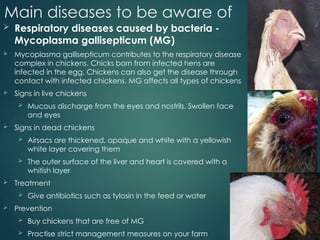
Respiratory diseases caused by bacteria -
Mycoplasma gallisepticum (MG)
Mycoplasma gallisepticum contributes to the respiratory disease
complex in chickens. Chicks born from infected hens are
infected in the egg. Chickens can also get the disease through
contact with infected chickens. MG affects all types of chickens
Signs in live chickens
Mucous discharge from the eyes and nostrils. Swollen face
and eyes
Signs in dead chickens
Airsacs are thickened, opaque and white with a yellowish
white layer covering them
The outer surface of the liver and heart is covered with a
whitish layer
Treatment
Give antibiotics such as tylosin in the feed or water
Prevention
Buy chickens that are free of MG
Practise strict management measures on your farm
55.
Main diseases tobe aware of
Respiratory diseases caused by bacteria -
Infectious coryza(IC)
This is a bacterial disease affecting layers, breeders and
broilers. The chickens get sick after contact with the bacteria,
for example, in drinking water or by breathing. It results in
swollen sinuses and a drop in egg production
Signs in live chickens
Swollen face, difficult and fast breathing, discharge from
the nose and mouth and nasal plugs
Signs in dead chickens
Swollen sinuses and sometimes a watery jelly layer under
the skin covering the head
Treatment
Give potentiated sulphonamides in the water or
tetracyclines in the feed to treat secondary bacterial
complications. Sulphonamide treatment may have to be
repeated
Prevention
There is a vaccine available. It must be given twice and
should preferably contain the C3 strain
56.
Main diseases tobe aware of
Respiratory disease caused by fungi - Aspergillosis
Chicks are infected when they breathe in spores from the
incubation machines at the hatchery and to a lesser extent
from the environment, contaminated feed and litter. This
infection is mostly seen in chickens kept in houses
Signs in live chickens
Difficulty breathing, fast breathing and open-mouth
breathing
Signs in dead chickens
White nodules in the lung
Treatment
None
Control
Buy chicks from reputable dealers
Avoid wet litter, mouldy and dusty feed
57.
Main diseases tobe aware of
DISEASE CAUSING DIARRHOEA
Diarrhoea (also known as scours or dirty vent). The stool or
droppings of the chickens are not firm but very loose, watery,
not of the normal colour and may contain blood.
Diarrhoea diseases- Coccidiosis
Coccidia are a microscopic parasitic organism that infect
poultry when ingested by the chicken. The parasites found in
the ground or bird faeces attaches itself to the lining in the gut,
multiplies and becomes an oocyst feeding in the digestive tract
which will make it bleed. It is fatal, but if your chicken survived
this disease it would be immune to future cocci infections.
Signs in live chickens
Weak and listless
Not eating and drinking much
Blood in droppings
May be sick one day and drop dead the next day
Signs in dead chickens
Intestinal damage and internal bleeding in the small and large
intestines
58.
Main diseases tobe aware of
Diseases affecting the immune system
Infectious Bursal Disease (IBD)-Gumboro
Is a highly contagious viral infection that is found in chicken flocks in most
countries. This disease affects the bursa of Fabricius which is an organ of
the immune system. The bursa is an epithelial and lymphoid organ found only
in birds. It is present in the cloaca.The virus can also be isolated from other
organs. The disease is shed in the faeces and spreads between birds or by
contact with a contaminated environment and is possibly also carried in
dust. The virus can be transferred from house to house
Signs in a live chicken
Rapid drop in feed and water consumption, mucoid (slimy)
diarrhoea with soiled vent feathers, ruffled feathers, listless chicks
with unsteady gait or sitting in hunched position, picking at own
vent and sleeping with beak touching the floor. Mortality is
usually low but has been reported to be as high as 20%.
Recovery from the disease usually occurs in less than a week,
however broiler weight gain is delayed by 3-5 days.
59.
Main diseases tobe aware of
Treatment- There is no treatment for IBD. Support therapies
such as vitamin and electrolyte supplements and
antibiotics can be used to treat any secondary bacterial
infections, may reduce the impact of the disease.
Control
Prevention is through good biosecurity and vaccination
60.
Prevention of disease
Vaccines, hygiene, good management, good fresh feed
and water can prevent most of the common chicken
diseases
The bedding of the chicken house must be kept dry at all
times to prevent sickness among the chicks. Any wet
spots that are observed must be immediately removed
and replaced with dry material. Chickens that get wet
will become cold, get sick and will soon die.
People working with chickens should not have contact
with older chickens or any other poultry. (Hire one person
to manage poultry housing.)
61.
Vaccination of chickens
WHY VACCINATE?
A good vaccination programme must be followed to prevent the
chickens from getting diseases.
Vaccinations help the chicken’s body fight against diseases.
Vaccines will only work if the chickens are healthy. If they are sick
they must be treated by giving them medicine before vaccination
can be done. Which will be costly.
There are two types of vaccines available Live and inactive (killed)
vaccines.
Live vaccines contain the live pathogen in a mild form. They act
quickly but their effect does not last long. They are relatively easy to
apply.
Killed (inactive) vaccines are oil-emulsion vaccines and have to be
injected into each bird, either in the muscle or under the skin. Only a
skilled person should do this. These vaccines last a long time so that it
is not necessary to re-vaccinate as often as with the dead vaccines.
62.
Live vaccine vs.killed
vaccine
Inactivated (killed) vaccines
Injection is the usual route for killed vaccines as these vaccines don’t
spread from bird to bird so one needs to be certain each bird gets its
own individual dose. These vaccines can be given under the skin
(subcutaneously) or into the leg or breast muscle (intramuscularly).
Vaccines are usually administered by well trained and highly skilled
vaccination personnel.
As this type of vaccination involves sticking a needle into the bird
and breaking the skin, it is imperative that the highest standards of
hygiene and cleanliness are observed during the vaccination
process.
Live vaccines
Live vaccines are, in many ways, easier to administer and are ideal
for mass administration to large flocks as they can be given via
drinking water or by spray or, in some cases, by individual eye drop.
Common examples of live vaccines include Infectious Bronchitis,
Newcastle Disease vaccine
63.
When will vaccinationwork?
For a vaccine to work properly you must keep the following in
mind:
Vaccines usually come in amounts for 500 or 1000 chickens. Make
sure to buy the correct dosage for the number of chicken’s you
want to vaccinate. Vaccines are quite cheap, so if you have
fewer than 500 chickens, still buy enough vaccine even if you
don’t use it all.
Vaccines need to be kept in a fridge. After buying the vaccine
place it in a cooler box with some ice to keep it cold on your way
home. Use the vaccine as soon as possible to be sure that it is
effective. Never let vaccines stand in direct sunlight as this will
render it ineffective.
Vaccinate the birds when they are at the correct age. Always
check the vaccination programme and the vaccination
instructions on the packaging.
Always check the expiry date of the vaccine when buying it. It is a
waste of money and time to use vaccines after their expiry date.
Most of the vaccines are applied with the drinking water. Use the
correct amount of water for the number of chickens when giving
the vaccine.
64.
Vaccination
Make surethat all the chickens receive the vaccine.
Make sure that the equipment used for applying the vaccine
is very clean.
When applying the vaccine, first mix it with purified water. If
it is not available use tap water or rainwater and add 10
teaspoons of skim milk powder to each 10 litres of water that
you are going to use. Use a clean container to measure out
the quantity of water. Open the bottle with the vaccine in it.
Pour a little of the purified water into the vaccine container,
replace the lid and mix well. Add the mixture to the rest of
the water. Rinse out the bottle a few times with more of the
water. Now mix the vaccine and the rest of the water
together in the container.
Do all mixing in the shade, as direct sunlight can destroy the
vaccine. After the vaccines are mixed it is only good for one
or two hours. Use it quickly, and dispose of what is left over.
65.
Vaccination methods
Vaccinationscan be done in five different ways:
Drinking water Method
Drinking water administration is an appropriate method of administration for most live
vaccines, particularly for diseases such as infectious bursal disease (Gumboro) and
where the target organ is the gut.
Live vaccines by their nature have a limited lifespan that must be taken into account
during administration. As a rough guide 1.5 to 2.0 hours is a typical period of time over
which live vaccines should be administered.
The aim should be to present the vaccine in the water to all the birds in the colony over
this 1.5 to 2.0 hour period.
One of the limitations of this method is that we must be sure that all the birds in the flock
will drink over the period of time over which the vaccine is presented to them. Various
means are available to encourage this situation such as controlled lighting, controlled
feeding or water deprivation.
The addition of skimmed milk powder to all water, which will come into contact with
vaccine, is a simple and effective way to overcome the detrimental effects of the
chlorine. The milk powder must be mixed at the correct rate of 2-2.5g/litre or 10g/gallon
and the powder should be mixed with the water at least 20 minutes prior to the vaccine
being added.
With a clean plastic bucket, some of the milk treated water should be removed from the
tank. Remove the metal caps from the vaccine vials and submerge each bottle in the
water before removing the rubber stopper, rinsing the entire contents of each vaccine
66.
Vaccination methods
SPRAY METHOD
Mix the vaccine and the correct quantity of purified
water and pour it into a spray, adjust the nozzle to
produce a fine spray, and spray over the birds. Make
sure that the head of each chicken is wet. This method is
usually used in hatcheries on day old chickens.
67.
VACCINATION METHODS
Eye DropAdministration
Eye drop administration is probably the most effective (but
labor intensive) means of administering live respiratory virus
vaccines to birds. Each bird is individually handled and
receives a full dose of vaccine. Eye drop diluent is
available from vaccine manufacturers for use with certain
vaccines and is presented in an easy to use bottle, which
usually contains a dye in order to assess birds that have
vaccines and not. Birds dosed effectively will show staining
at the nares shortly after vaccination.
Care must be taken over the process to ensure that the
fluid does not 'roll off' the eye due to the surface tension of
the droplets. Each bird should be held until it blinks after the
droplet is applied and the whole process must not be
rushed or birds will be missed.
68.
VACCINATION METHODS
Transfixation andScarification (Wing web method)
This method delivers the vaccine into the skin thickness and is the method
used exclusively for fowl pox vaccination, though avian encephalomyelitis is
often combined with the fowl pox vaccine.
The site most widely used for application is usually the skin of the wing
web ,though scarification of the skin of the thigh and the foot can also be
used.
It is very important to ensure that fowl pox vaccine does not come into
contact with the eyes or mouth of the birds. This can lead to lesions
appearing in these organs.
In practice the most common complication can occur if the vaccine is
applied to the skin under the wing where birds occasionally place their head
when sleeping. Birds can subsequently develop lesions on the head that may
be severe enough to affect the mouth and eyes with subsequent adverse
effects on food and water consumption.
Care must also be taken to remove all used vaccine vials
and
scarifying equipment from the shed after
vaccination as birds will peck at these items
which can also lead to oral lesions
69.
VACCINATION METHODS
Injection
Intramuscularor subcutaneous injection is the most common
route of administration employed for oil and aluminium
hydroxide mixed, vaccines and some live vaccines.
Vaccine is usually available in 500 or 1000 dose bottles, which
feed an automatic syringe at a preset dosage that facilitates
vaccination of large numbers of birds.
The site of administration is most commonly into the breast or
leg though the lower neck can also be used.
Accuracy of placement of the needle is critical as incorrect
placement can lead to granuloma formation, lameness, head
swelling or liver puncture depending on the injection site.
The method and care of handling birds during this procedure is
also important as this can contribute to lameness in birds.
A 12.5mm (1/2"), 19 gauge needle is suitable for use and
should be changed at least every 200 birds in order to avoid
spread of bacteria and viral contaminants
70.
Chicken housing
Basicrequirements to consider:
Safety from weather: Domestic birds must be shielded from the
cold, rain, sun and wind. Newly hatched chicks need a source of
warmth as a basic requirement to shield them against harsh
weather conditions.
Safety from predators: The chickens have many predators
including snakes, rodents, jackals, dogs and other animals. The
best way to solve this problem is to confine chickens in modern
structures. These are large installations with concrete floors,
electric fences, strong walls.
Adequate ventilation: Ventilation is needed to regulate
temperature and remove carbon dioxide, ammonia, other gases,
moisture, dust and odours.When planning poultry housing, keep
ventilation requirement in mind. A good flow and circulation of air
is an essential element in any chicken house. To achieve this goal,
it's imperative to consider the poultry production density.
71.
Chicken housing
Ventilationshould be adequate enough to supply numerous
birds with enough oxygen, thus a big enough space is
necessary to prevent poisonous gases such as ammonia,
carbon monoxide and carbon dioxide from harming the
birds.
Heat control: It is good to build poultry houses in such a way
that heat can be controlled. Too much heat could even kill
the birds especially when combined with high humidity. Heat
stress in poultry is a serious problem for the industry.
During most of the year when cold or warm conditions
prevail, a conventional natural or mechanical ventilation
system is employed to ventilate the poultry house. For hot
weather mechanical ventilation system is often needed to
achieve high air velocities and evaporative cooling
72.
Chicken housing
Evaporativecooling in mechanically-ventilated houses is provided by fogging,
misting, or cooling pads while in naturally-ventilated houses it can only be
provided by fogging or misting.
For cold weather, moisture removal is the primary design consideration for cold
weather ventilation. Excess moisture is often related to elevated levels of air
contaminants, such as ammonia.
The minimum ventilation rate refers to the quantity of fresh outside air which
should be moved through the building to absorb and remove moisture and
contaminants.
Humidity levels: As the farmer constructs the poultry houses, he or she must
consider the humidity factor. The birds do not have sweat glands like humans
hence their cooling system is via the beaks. When the humidity levels rise, this
natural cooling mechanism fails.
Space needs in chicken houses: Creating space happens to be the most
important poultry housing principle. Space determines the quantity of birds you
could keep. It also determines the kinds of poultry you could keep. Birds require
space so that they can move freely and work out. Space is essential for creating
chicken nests and perches too. When thinking of space creation, considering the
type of bird species, breeds and production system used is vital. Always make
sure that the chickens or any other domesticated birds are not congested in the
house units.
Density is usually calculated at 10- 12 chicks per square meter. Where square
meter is length x breadth of the house.
76.
Poultry feed
Ifchickens are kept for commercial purposes, as a business, they
must get the right feed. This means feeding them a balanced
feed purchased from a reputable animal feed supplier.
70% of the total cost goes towards feed, it is important that you
do not waste feed. Any contamination and wastage
of feed must be avoided.
Different feeds have different prices. Feeds for younger chicks
(starter) contain more protein and are therefore more
expensive. Feeds have been especially designed for the
particular needs of specific ages and types of chicken.
Feed intake is directly correlated to water intake, so if for any
reason chicks are unable to drink, they will also stop eating.
There are two times when feed intake is of particular
importance. The first of these is during the first week of life and
the second period is towards the end of the production cycle.
Feed is critically important for production and health of poultry.
Unbalanced feed can lead to poor growth and diseased
chickens.
77.
Poultry feed
Small-scalebroiler farmers usually use starter feed from
day-old until about three weeks of age then finisher feed
up until the age they are sold. Large-scale farmers use
three types of feed viz. starter, grower and finisher. Some
feed manufacturers also supply a post-finisher feed that is
used after five weeks of age.
Don’t be confused about feed for pullet grower mash
(raising layer chickens) This pullet grower feed should not
be fed to broiler chickens as it will make then grow more
slowly. Make sure that you read the labels on the feed
bags carefully and always ask which feed is required for
which type and age of chicken.
Broiler feed can be bought in the form of mash, crumbles
or as pellets. Crumbles and pellets cost a bit more but
they cause less wastage and lead to slightly faster
growth rates
78.
Feed intake andFeed
conversion ratio
Feed conversion ratio (FCR) is a measure of how well a flock
converts feed intake (feed usage) into live weight. This means
how much feed does it take to grow a kilogram of meat.
FCR is important because it allows for an estimate of the feed
that will be required in the growing cycle. Knowing how much
feed a farmer needs allows the farmer to determine the
profitability of the enterprise.
If you are spending too much money on feed but not getting the
required live weight, then you wont make money!
Commercial broilers have a feed conversion of about 1: 2. This
means that for every 2kg of feed eaten, the bird must produce a
kilogram of meat. By measuring the feed conversion ratio, the
efficiency of the broilers are measured. The lower the feed
conversion ratio the more profitable production will be.
Should intake of feed drop, for whatever reason, a greater
proportion of the nutrients and energy consumed will be used for
simply maintaining the birds (keeping them alive), rather than for
growth. Thus, if feed intake is restricted, it is realistic for us to
expect not only a decrease in growth, but also not so good
PROFITS.
79.
Calculating FCR
Tocalculate the feed conversion ratio, divide the
total amount of feed eaten by the group of birds
by their total weight at six weeks of age
For example, if a group of 100 broilers ate 400 kg
of feed at six weeks of age and together weigh a
total of 200 kg (2kg each bird x100 birds), the feed
conversion is 2. [ 400 ÷ 200 = 2]
FCR= 2kg feed = 2
1 kg meat
80.
Possible problems withFCR
Brooding: the brooding period is a critical time for gut development and
hence the efficiency of feed utilization. Proper management during this
time is therefore key.
Feeding management: inappropriate feeding and feeder management
will affect flock FCR through its affect on feed intake and feed spillage.
Feeding space, feeder height and the provision of good quality feed is
important.
Water management: the provision of adequate drinking space and a
source of clean water is essential. A reduction in water intake will lead to
a reduction in feed intake and an increase in FCR.
Mortality and disease: high mortality, especially late mortality, will result in
a significant increase in flock FCR. Causes of mortality should be rapidly
identified so that appropriate corrective actions can be put in place.
Temperature: maintaining the correct environmental temperature and
avoiding temperature fluctuations is important if FCR is to be optimized.
Biosecurity: a good biosecurity program is essential for maintaining bird
health and optimizing performance.
Solving, or preventing, FCR problems in a flock requires both good
planning and good management. The key to preventing FCR problems is
ensuring that throughout the brooding and grow-out period, good
management practices are in place so that bird performance is
optimized.
81.
Gut health andimpact of feed
on the gut.
A healthy existence of microflora in the gut is the first line
of defence against invading pathogens and therefore is
important for the animals ability to fight off infections in
the intestines..
If gut health is compromised, digestion and nutrient
absorption will be affected, and bird performance and
welfare will be compromised.
Gut Inhabitants
The gastrointestinal tract (GIT) consists of a diverse
community of mainly bacteria, fungi, protozoa, and
viruses (gut microbiota). There are over 400 to 500
different species. The development of this community
begins on hatching, and bacteria are picked up from the
environment, the feed, and the people handling the
chicks post-hatch.
82.
Factors affecting guthealth
The balance of the microbiota in the gut can be significantly
affected by bird management and environment.
Diet – feed changes, raw materials, and physical quality all influence
the balance of the gut microbiota.
Appropriate brooding conditions – the provision of optimal brooding
conditions is essential for ensuring optimal gut microbs development.
Birds receiving appropriate brooding develop a gut that performs
well and has a greater capacity to cope with the challenges of the
broiler shed. Early access to feed and water is essential.
Biosecurity – if clean-out and disinfection procedures are
inappropriate, pathogens will be introduced into the poultry shed,
exposure to these pathogens will influence gut health and
development.
Periods of high challenge - there are times during poultry
production when the bird will be challenged, for example during
feed change-overs or vaccination. During these periods, the gut
microbiota can fluctuate.
Environmental conditions - temperature and ventilation. Achieving
optimal environmental conditions will promote good gut health.
Mycotoxins and infections will also impact gut health.
83.
Feeding systems
Typeof feeding systems
Feeding systems most commonly used are:
Flat tray for chicks
Flat chain/auger
Pan feeders
Tube feeders
In most cases a farmer has to employ the
use of two of these feeding systems but it
is not a necessity. Choose the feeding
system that is most practical to your
enterprise.
84.
Flat trays forchicks
Feed should be provided in the form of sieved crumbs over the
first 2-3 days of life. It should be placed in flat trays or on paper
sheeting so that it is readily accessible to the chicks. At least 25%
of the floor should be covered with paper. The change to the
main feeding system should be made gradually over the first 2-3
days as chicks begin to show interest in the main feeding system
85.
Flat chain/auger
Heightof chain feeders is adjustable by winch.
Flat chain feeder should be adjusted to ensure minimum spillage and
optimum access for the birds. i.e. the base of the trough should be level
with the birds’ backs.
86.
Pan feeder system
Height of pan feeders may have to be adjusted by winch
or individually.
The pan feeders should be adjusted to ensure minimum
spillage and optimum access for the birds. i.e. the base
of the pans should be level with the birds’ backs.
HEIGHT OF FEEDERS
87.
Tube Feeder system
Height of tube feeders may have to be adjusted
individually.
Tube feeders should be adjusted to ensure minimum
spillage and optimum access for the birds. i.e. the base
of the pans should be level with the birds’ backs.
88.
Drinker systems
Watermust be available to broilers 24 hours per day.
Inadequate water supply, either in volume or in the number
of drinking points, will result in reduced growth rate.
To ensure that the flock is receiving sufficient water, the ratio
of water to feed consumed each day should be monitored.
Water requirement will vary with feed consumption.
Birds will drink more water at higher ambient temperatures
Very cold or very warm water will reduce water intake. In
hot weather, it is good practice to flush the drinker lines at
regular intervals to ensure that the water is as cool as
possible.
Adequate water storage must be provided on the farm, in
case of failure of the mains supply
Types of drinkers:
Nipple Drinkers
Bell Drinkers
Water founts
89.
Nipple drinkers (withand without
cups)
Nipple drinker system consists of water pipes, steel nipple
drinkers, a pressure regulator and electricity. The design of
your nipple drinkers depends on your needs but the basic
principles must be followed
Nipple drinkers should be installed at 12 birds per nipple
Water lines need to be managed daily during the flock to
obtain optimum performance.
A high drinker line water pressure can result in more water
wastage and wet litter. A low drinker line water pressure
can result in reduced water intake and a subsequent
reduction in feed intake.
Drinker line height should be started low at the beginning
of the flock and lifted higher as the birds get older. Drinker
lines that are too high can restrict bird water consumption
while water lines that are too low can result in wet litter
So NB# Pay attention to your drinkers at ALL TIMES
90.
Benefits ofusing nipple drinkers
Better hygiene
Better control of water
temperature
Minimum of water spillage;
The drinking system is easy to
clean, and flush by means of
incorporated manual or
optionally automatic flushing
system.
Easy access for birds to the
drinking water
Optimal dosing of medication
or other additives to the
drinking water
Better control of litter quality
(dry)
Lower humidity and less
ammonia in the poultry house
91.
Bell drinkers
Similarcomponents to the nipple drinkers but instead of a
nipple fount you have a bell drinker placed at the end of
the line.
At day-old, a minimum of six bell drinkers (40 cm
diameter) should be provided per 1,000 chicks;
additional sources of water in the form of six mini-drinkers
or plastic trays per 1,000 chicks should also be available.
As the broilers become older and the area of the house
in use is expanded, a minimum of eight bell drinkers can
be provided per 1,000 chicks. These should be placed
evenly throughout the house so that no broiler is more
than two metres from water.
Drinkers should be checked for height daily and adjusted
so that the base of each drinker is level with the broiler’s
back from day 18 onwards
92.
Benefits ofbell drinkers
Maintenance free plastic
product, suitable for broilers,
rearing pullets, layers and
breeders
• Design and choice of
material allow easy and
efficient cleaning
• Counter weight ballast
rings prevent water spillage
• Water easily accessible for
the birds
93.
Water founts
Atday old, a minimum of 6 ‘bell’ drinkers (40cm
diameter) should be provided per 1000 chicks;
additional sources of water in the form of 1 X 5 L
water fount per 60 chicks should also be
available. Water founts should be removed
gradually so that by 3-4 days all chicks are
drinking from the automatic drinkers.
Lighting of broilers
Lightingpatterns for broilers are aimed mainly at stimulating
and controlling feed intake.
There are other benefits to having a lighting program
Reduction in mortality due to ascites (water-belly) and
sudden death (flip overs)
Reduction in mortality due to leg disorders such as
valgus/varus,
Improves the immune system
Improved broiler performance
(see basic light program)
96.
Ventilation
Ventilation isone of the most neglected yet
most and yet is very important for the growth of
birds.
Minimum ventilation is the exchange of air in
the house to supply the birds oxygen
requirements whilst removing toxic gases and
moisture no matter what the temperature.
Not only is it important for the birds growth but it
also helps distribute heat throughout the house
and maintains good air quality. NB# Young
birds are more susceptible to air quality
problems than older birds so start ventilation
immediately when the birds arrive.
DO NOT sacrifice air quality for temperature
97.
Ventilation cont.
Theventilation system you use should be able to:
Provide enough air at all times to meet the birds oxygen
requirements
Remove ammonia and carbon dioxide
Distribute air evenly throughout the house without causing
draughts (cold air) onto the birds
Remove moisture from the house
Be able to regulate the temperature
Remove odours and waste gases.
For curtain sided houses the basic opening of curtain rules
apply :
On windy days, the curtain on the side of the house that has
the least wind movement should be opened 3 times more
wider than the side that has a high rate of incoming air. This will
allow for a low pressure inside the house so that air can blow in
easily. Air moves from a low pressure to a high pressure.
On slow moving or not windy days, both curtains should be
opened and must be level.
98.
Ventilation for temperature
control
As you know temperature is a very important aspect. If it
is too cold the birds eat feed in order keep their bodies
warm and not for weight gain..so money spent on feed is
wasted which could have gone towards growth.
So once again the rule of not sacrificing temperature for
ventilation exists because it will eat into your profits when
the birds experience cold and not eat for growth.
99.
Bird behaviour andassociated
problems
CANNIBALISM
Cannibalism is a problem that is associated with large poultry
flocks where the birds kept in close confinement peck at
associated birds. This can result in significant mortality within the
flock when a wound is generated and drop in production as the
hen pecked birds become stressed.
Some flocks of the same breed may be entirely free from
cannibalism, while others, under the same management, may
have a serious outbreak.
Cannibalism can also take a number of forms among the birds in
a flock and can be presented in the following ways:
A dominant bird pecking at a more submissive member of the
flock
Mutual pecking where birds in close proximity peck at each other
On rare occasions young chicks may peck their own toes
Feather pulling in older birds from the head, tail or body (Vent
picking) in older birds
100.
Causes of cannibalism
The problem may simply arise because of the normal
pecking behaviour of this type of animal when searching
for food or exploring an environment. The birds are kept
in barren, crowded conditions and may have little else to
peck besides their pen mates.
A lack or a deficiency of nutrients in a poultry ration may
result in the birds becoming irritated which can
subsequently lead to cannibalism in the flock. Usually
when diet formulation is involved in the outbreak the
imbalance is in the protein or the sodium level of the
ration. Deficiencies can also be caused by insufficient
feeding and water space.
An abrupt change in the palatability or form of a flock's
ration may also be a contributing factor in the onset of
cannibalism as the birds might impulsively seek
alternative sources of food.
101.
Causes cont.
Poorventilation, high temperature, low humidity,
excessive population density, and excess illumination are
all factors in the flock's environment that may precipitate
an outbreak of this behaviour.
For egg laying hens, the cloaca (body part where the
egg passes out) may become damaged especially with
the passage of large eggs and this protrusion of the vent
may be an attractant to other birds due to its stark colour
difference against the white body.
102.
Prevention of cannibalism
The onset of this vice can be prevented by
paying particular attention to the following:
Dietary factors (protein, sodium, and
palatability),
The environmental factors (ventilation,
temperature, humidity, population density, and
lighting)
Feeding and water space that is available for
each bird.
With highly intensive operations the light intensity
should be reduced, perhaps by changing to a
light which is of a red hue.
Other control methods include increasing feed
availability, reducing group size, adding litter,
and providing distractants such as straw bales.
103.
Prevention of cannibalism
cont.
The most common and cost effective mode of
prevention is the use of beak trimming. Beak
trimming is most commonly done for layer hens
and is done at 4-6 weeks of age and the
procedure requires that two thirds of the upper
mandible be removed.










![Calculating FCR
To calculate the feed conversion ratio, divide the
total amount of feed eaten by the group of birds
by their total weight at six weeks of age
For example, if a group of 100 broilers ate 400 kg
of feed at six weeks of age and together weigh a
total of 200 kg (2kg each bird x100 birds), the feed
conversion is 2. [ 400 ÷ 200 = 2]
FCR= 2kg feed = 2
1 kg meat](https://image.slidesharecdn.com/poultrycoursepresentation-250325064232-ecbc10d6/85/Poultry-course-presentation-for-producing-layers-and-broilers-79-320.jpg)


