DOPPL
Data Oriented Parallel Programming Language

Development Diary
Iteration #6

Covered Concepts:
String Concatenation Operator

Diego PERINI
Department of Computer Engineering
Istanbul Technical University, Turkey
2013-08-09

1
Abstract
This paper stands for Doppl language development iteration #6. In this paper, string
concatenation operator will be introduced.

1. Rationale
As a high level language, Doppl characters are also strings therefore there is no distinction
between string concatenation and character appending.

2. String Concatenation Operator
keyword

meaning

++

string concatenation

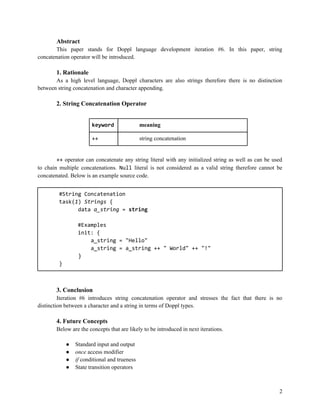
++ operator can concatenate any string literal with any initialized string as well as can be used
to chain multiple concatenations. Null literal is not considered as a valid string therefore cannot be
concatenated. Below is an example source code.
#String Concatenation
task(1) Strings {
data a_string = string
#Examples
init: {
a_string = "Hello"
a_string = a_string ++ " World" ++ "!"
}
}

3. Conclusion
Iteration #6 introduces string concatenation operator and stresses the fact that there is no
distinction between a character and a string in terms of Doppl types.

4. Future Concepts
Below are the concepts that are likely to be introduced in next iterations.
●
●
●
●

Standard input and output
once access modifier
if conditional and trueness
State transition operators

2
●
●
●
●
●
●
●
●

Primitive Collections and basic collection operators
Provision operators
Tasks as members
Task and data traits
Custom data types and defining traits
Built-in traits for primitive data types
Message passing
Exception states

5. License
CC BY-SA 3.0
http://creativecommons.org/licenses/by-sa/3.0/

3

Doppl development iteration #6

  • 1.
    DOPPL Data Oriented ParallelProgramming Language Development Diary Iteration #6 Covered Concepts: String Concatenation Operator Diego PERINI Department of Computer Engineering Istanbul Technical University, Turkey 2013-08-09 1
  • 2.
    Abstract This paper standsfor Doppl language development iteration #6. In this paper, string concatenation operator will be introduced. 1. Rationale As a high level language, Doppl characters are also strings therefore there is no distinction between string concatenation and character appending. 2. String Concatenation Operator keyword meaning ++ string concatenation ++ operator can concatenate any string literal with any initialized string as well as can be used to chain multiple concatenations. Null literal is not considered as a valid string therefore cannot be concatenated. Below is an example source code. #String Concatenation task(1) Strings { data a_string = string #Examples init: { a_string = "Hello" a_string = a_string ++ " World" ++ "!" } } 3. Conclusion Iteration #6 introduces string concatenation operator and stresses the fact that there is no distinction between a character and a string in terms of Doppl types. 4. Future Concepts Below are the concepts that are likely to be introduced in next iterations. ● ● ● ● Standard input and output once access modifier if conditional and trueness State transition operators 2
  • 3.
    ● ● ● ● ● ● ● ● Primitive Collections andbasic collection operators Provision operators Tasks as members Task and data traits Custom data types and defining traits Built-in traits for primitive data types Message passing Exception states 5. License CC BY-SA 3.0 http://creativecommons.org/licenses/by-sa/3.0/ 3