Don’t Stop the Music 
BY CLAUDIA O’HARA
Camera Work 
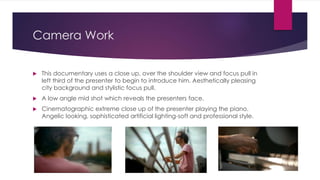
 This documentary uses a close up, over the shoulder view and focus pull in 
left third of the presenter to begin to introduce him. Aesthetically pleasing 
city background and stylistic focus pull. 
 A low angle mid shot which reveals the presenters face. 
 Cinematographic extreme close up of the presenter playing the piano. 
Angelic looking, sophisticated artificial lighting-soft and professional style.
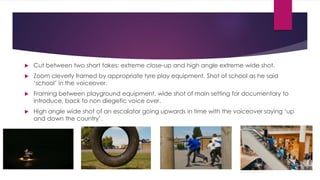
 Cut between two short takes: extreme close-up and high angle extreme wide shot. 
 Zoom cleverly framed by appropriate tyre play equipment. Shot of school as he said 
‘school’ in the voiceover. 
 Framing between playground equipment, wide shot of main setting for documentary to 
introduce, back to non diegetic voice over. 
 High angle wide shot of an escalator going upwards in time with the voiceover saying ‘up 
and down the country’.
Graphics 
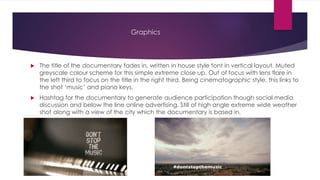
 The title of the documentary fades in, written in house style font in vertical layout. Muted 
greyscale colour scheme for this simple extreme close up. Out of focus with lens flare in 
the left third to focus on the title in the right third. Being cinematographic style, this links to 
the shot ‘music’ and piano keys. 
 Hashtag for the documentary to generate audience participation though social media 
discussion and below the line online advertising. Still of high angle extreme wide weather 
shot along with a view of the city which the documentary is based in.
Interviews 
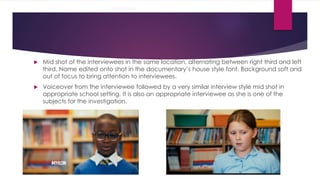
 Mid shot of the interviewees in the same location, alternating between right third and left 
third. Name edited onto shot in the documentary’s house style font. Background soft and 
out of focus to bring attention to interviewees. 
 Voiceover from the interviewee followed by a very similar interview style mid shot in 
appropriate school setting. It is also an appropriate interviewee as she is one of the 
subjects for the investigation.
 Capturing similar actions of opening and turning instrument cases using different angles 
tracking, mid shot, close ups. Which makes the documentary flow and the similar shot 
takes build tension by repetition. 
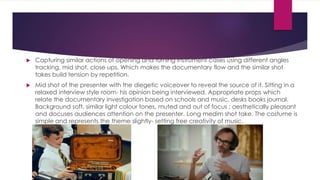
 Mid shot of the presenter with the diegetic voiceover to reveal the source of it. Sitting in a 
relaxed interview style room- his opinion being interviewed. Appropriate props which 
relate the documentary investigation based on schools and music, desks books journal. 
Background soft, similar light colour tones, muted and out of focus ; aesthetically pleasant 
and docuses audiences attention on the presenter. Long medim shot take. The costume is 
simple and represents the theme slightly- setting free creativity of music.
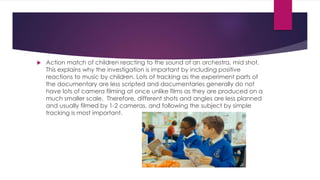
 Action match of children reacting to the sound of an orchestra, mid shot. 
This explains why the investigation is important by including positive 
reactions to music by children. Lots of tracking as the experiment parts of 
the documentary are less scripted and documentaries generally do not 
have lots of camera filming at once unlike films as they are produced on a 
much smaller scale. Therefore, different shots and angles are less planned 
and usually filmed by 1-2 cameras, and following the subject by simple 
tracking is most important.

Don’t

  • 1.
    Don’t Stop theMusic BY CLAUDIA O’HARA
  • 2.
    Camera Work This documentary uses a close up, over the shoulder view and focus pull in left third of the presenter to begin to introduce him. Aesthetically pleasing city background and stylistic focus pull.  A low angle mid shot which reveals the presenters face.  Cinematographic extreme close up of the presenter playing the piano. Angelic looking, sophisticated artificial lighting-soft and professional style.
  • 3.
     Cut betweentwo short takes: extreme close-up and high angle extreme wide shot.  Zoom cleverly framed by appropriate tyre play equipment. Shot of school as he said ‘school’ in the voiceover.  Framing between playground equipment, wide shot of main setting for documentary to introduce, back to non diegetic voice over.  High angle wide shot of an escalator going upwards in time with the voiceover saying ‘up and down the country’.
  • 4.
    Graphics  Thetitle of the documentary fades in, written in house style font in vertical layout. Muted greyscale colour scheme for this simple extreme close up. Out of focus with lens flare in the left third to focus on the title in the right third. Being cinematographic style, this links to the shot ‘music’ and piano keys.  Hashtag for the documentary to generate audience participation though social media discussion and below the line online advertising. Still of high angle extreme wide weather shot along with a view of the city which the documentary is based in.
  • 5.
    Interviews  Midshot of the interviewees in the same location, alternating between right third and left third. Name edited onto shot in the documentary’s house style font. Background soft and out of focus to bring attention to interviewees.  Voiceover from the interviewee followed by a very similar interview style mid shot in appropriate school setting. It is also an appropriate interviewee as she is one of the subjects for the investigation.
  • 6.
     Capturing similaractions of opening and turning instrument cases using different angles tracking, mid shot, close ups. Which makes the documentary flow and the similar shot takes build tension by repetition.  Mid shot of the presenter with the diegetic voiceover to reveal the source of it. Sitting in a relaxed interview style room- his opinion being interviewed. Appropriate props which relate the documentary investigation based on schools and music, desks books journal. Background soft, similar light colour tones, muted and out of focus ; aesthetically pleasant and docuses audiences attention on the presenter. Long medim shot take. The costume is simple and represents the theme slightly- setting free creativity of music.
  • 7.
     Action matchof children reacting to the sound of an orchestra, mid shot. This explains why the investigation is important by including positive reactions to music by children. Lots of tracking as the experiment parts of the documentary are less scripted and documentaries generally do not have lots of camera filming at once unlike films as they are produced on a much smaller scale. Therefore, different shots and angles are less planned and usually filmed by 1-2 cameras, and following the subject by simple tracking is most important.