Conventions of a documentary
Documentaries
• A documentary is to be truthful and non bias.
• It shall document reality.
• It shall report on something which has
happened, Using evidence.
• A reconstruction can be used as a substitute if
there is no primary footage.
• Documentaries are made from subjects
varying from political, historical, to religious
topics.
Genre
• Target audience used to schedule a documentary, and what
can be shown within the content.
• Furthermore what type of adverts will be used at the time.
• Josh Grierson first created the term documentary and
described it as the creativity of actuality
• In more creative documentaries the authenticity of the
content can be questioned.
• it’s impossible to capture real events as they are happening
as they are unexpected, so therefore reconstructions
become inevitable
• Film crew affects through the people watching them, the
situation is no longer real.
narrating
• A documentary can use a narrator.
• A narrator is a convention as it anchors the
meaning of a documentary.
• The usual style is role of god as the narrator
isn't involved and is all seeing and all knowing.
• A narrator can become involved in a
presenting capacity.
• This becomes a participation documentary.
Types of documentary
• A documentary can become fictisous around
an event.
• A documentary can be dramatized for effect.
• Fly on the wall is an example of a non narrated
documentary.
5 types of documentary
• 1 – observation contain invisible camera,
audience is an eye whiteness.
• 2 – interview set to the rule of thirds, a
spontaneous interview is called a vox pop
• 3 – dramatization, for effect or when no
footage is available
• 4 – mise – en – scene
• 5 – exposition, description and commentary
combined.
Types of documentary
• Fully narrated (off screen)
• Fly on the wall
• Mixed documentary
• Self reflexive, subjects acknowledge camera
• Docudrama / Docusoap
Disneyfication (Barnett's theory)
• Need to broadcast positive things
• clean instead of challenging society
• Dumbed down, safe for adverts, cheap T.V.
• Audiences are used to it
• They have traditional conventions of narrative
• Strong focus on conflict, characters, music,
sound effects
• Have defined beginning, middle and end
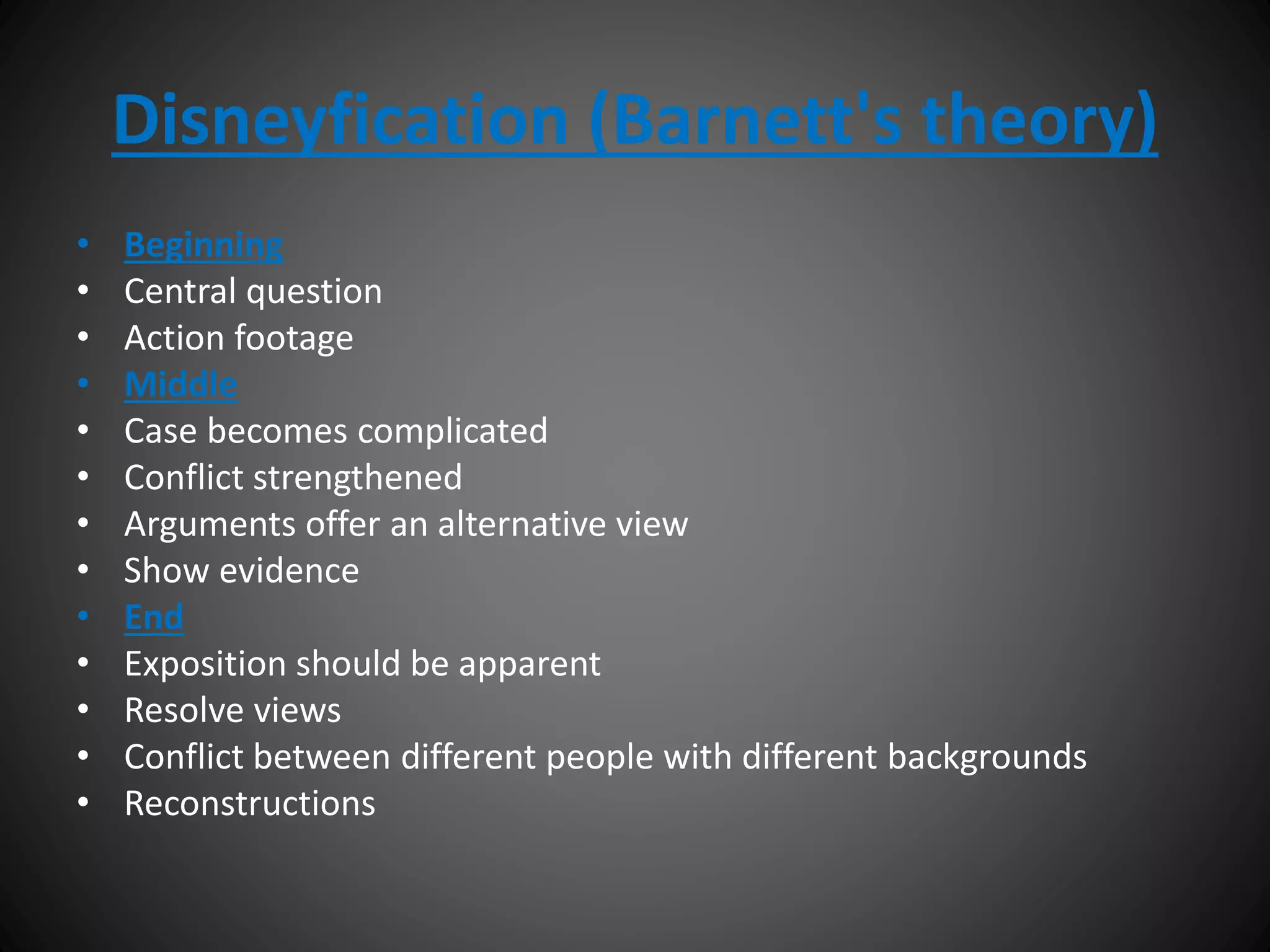
Disneyfication (Barnett's theory)
• Beginning
• Central question
• Action footage
• Middle
• Case becomes complicated
• Conflict strengthened
• Arguments offer an alternative view
• Show evidence
• End
• Exposition should be apparent
• Resolve views
• Conflict between different people with different backgrounds
• Reconstructions

Conventions of a documentary (A2 media studies)

  • 1.
    Conventions of adocumentary
  • 2.
    Documentaries • A documentaryis to be truthful and non bias. • It shall document reality. • It shall report on something which has happened, Using evidence. • A reconstruction can be used as a substitute if there is no primary footage. • Documentaries are made from subjects varying from political, historical, to religious topics.
  • 3.
    Genre • Target audienceused to schedule a documentary, and what can be shown within the content. • Furthermore what type of adverts will be used at the time. • Josh Grierson first created the term documentary and described it as the creativity of actuality • In more creative documentaries the authenticity of the content can be questioned. • it’s impossible to capture real events as they are happening as they are unexpected, so therefore reconstructions become inevitable • Film crew affects through the people watching them, the situation is no longer real.
  • 4.
    narrating • A documentarycan use a narrator. • A narrator is a convention as it anchors the meaning of a documentary. • The usual style is role of god as the narrator isn't involved and is all seeing and all knowing. • A narrator can become involved in a presenting capacity. • This becomes a participation documentary.
  • 5.
    Types of documentary •A documentary can become fictisous around an event. • A documentary can be dramatized for effect. • Fly on the wall is an example of a non narrated documentary.
  • 6.
    5 types ofdocumentary • 1 – observation contain invisible camera, audience is an eye whiteness. • 2 – interview set to the rule of thirds, a spontaneous interview is called a vox pop • 3 – dramatization, for effect or when no footage is available • 4 – mise – en – scene • 5 – exposition, description and commentary combined.
  • 7.
    Types of documentary •Fully narrated (off screen) • Fly on the wall • Mixed documentary • Self reflexive, subjects acknowledge camera • Docudrama / Docusoap
  • 8.
    Disneyfication (Barnett's theory) •Need to broadcast positive things • clean instead of challenging society • Dumbed down, safe for adverts, cheap T.V. • Audiences are used to it • They have traditional conventions of narrative • Strong focus on conflict, characters, music, sound effects • Have defined beginning, middle and end
  • 9.
    Disneyfication (Barnett's theory) •Beginning • Central question • Action footage • Middle • Case becomes complicated • Conflict strengthened • Arguments offer an alternative view • Show evidence • End • Exposition should be apparent • Resolve views • Conflict between different people with different backgrounds • Reconstructions