Introduction of
Christopher Marlowe
Born : 26 February 1564
Died : 30 may 1593
Join in School : 1578
BA : 1584
MA : 1587
The Tragical history of the life
and death of doctor faustus
Perform in 1588
Publish in 1604
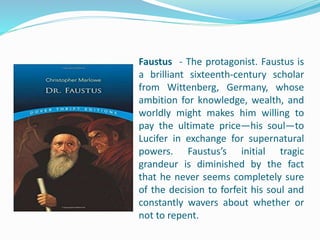
Faustus - The protagonist. Faustus is
a brilliant sixteenth-century scholar
from Wittenberg, Germany, whose
ambition for knowledge, wealth, and
worldly might makes him willing to
pay the ultimate price—his soul—to
Lucifer in exchange for supernatural
powers. Faustus’s initial tragic
grandeur is diminished by the fact
that he never seems completely sure
of the decision to forfeit his soul and
constantly wavers about whether or
not to repent.
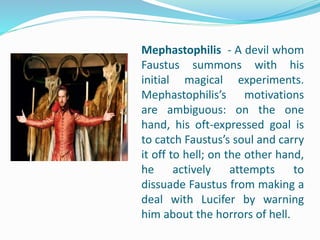
Mephastophilis - A devil whom
Faustus summons with his
initial magical experiments.
Mephastophilis’s motivations
are ambiguous: on the one
hand, his oft-expressed goal is
to catch Faustus’s soul and carry
it off to hell; on the other hand,
he actively attempts to
dissuade Faustus from making a
deal with Lucifer by warning
him about the horrors of hell.
Lucifer- Satan “ Lucifer” original
meant Venus, referring to the
planents brilliance. In christian lore,
lucifer is sometimes thought to be
another name of satan. Some
traditions say that lucifer was satans
name before the fall, while the
fathers of the catholic church held
that lucifer was not satans proper
name but as word showing the
brilliance and beauty of his station
before the fall.
Chorus - A character who stands outside the story,
providing narration and commentary. The Chorus
was customary in Greek tragedy.
Good Angel - A spirit that
urges Faustus to repent for his
pact with Lucifer and return to
God. Along with the old man
and the bad angel, the good
angel represents, in many
ways, Faustus’s conscience and
divided will between good and
evil.
Bad Angel - A spirit that
serves as the counterpart to
the good angel and provides
Faustus with reasons not to
repent for sins against God.
The evil angel represents
the evil half of Faustus’s
conscience.
Robin - An ostler, or innkeeper,
who, like the clown, provides a
comic contrast to Faustus. Robin
and his friend Rafe learn some
basic conjuring, demonstrating
that even the least scholarly can
possess skill in magic. Marlowe
includes Robin and Rafe to
illustrate Faustus’s degradation
as he submits to simple trickery
such as theirs.
Thank
you

Doctor Faustus

  • 2.
    Introduction of Christopher Marlowe Born: 26 February 1564 Died : 30 may 1593 Join in School : 1578 BA : 1584 MA : 1587
  • 3.
    The Tragical historyof the life and death of doctor faustus Perform in 1588 Publish in 1604
  • 4.
    Faustus - Theprotagonist. Faustus is a brilliant sixteenth-century scholar from Wittenberg, Germany, whose ambition for knowledge, wealth, and worldly might makes him willing to pay the ultimate price—his soul—to Lucifer in exchange for supernatural powers. Faustus’s initial tragic grandeur is diminished by the fact that he never seems completely sure of the decision to forfeit his soul and constantly wavers about whether or not to repent.
  • 5.
    Mephastophilis - Adevil whom Faustus summons with his initial magical experiments. Mephastophilis’s motivations are ambiguous: on the one hand, his oft-expressed goal is to catch Faustus’s soul and carry it off to hell; on the other hand, he actively attempts to dissuade Faustus from making a deal with Lucifer by warning him about the horrors of hell.
  • 6.
    Lucifer- Satan “Lucifer” original meant Venus, referring to the planents brilliance. In christian lore, lucifer is sometimes thought to be another name of satan. Some traditions say that lucifer was satans name before the fall, while the fathers of the catholic church held that lucifer was not satans proper name but as word showing the brilliance and beauty of his station before the fall.
  • 7.
    Chorus - Acharacter who stands outside the story, providing narration and commentary. The Chorus was customary in Greek tragedy.
  • 8.
    Good Angel -A spirit that urges Faustus to repent for his pact with Lucifer and return to God. Along with the old man and the bad angel, the good angel represents, in many ways, Faustus’s conscience and divided will between good and evil.
  • 9.
    Bad Angel -A spirit that serves as the counterpart to the good angel and provides Faustus with reasons not to repent for sins against God. The evil angel represents the evil half of Faustus’s conscience.
  • 10.
    Robin - Anostler, or innkeeper, who, like the clown, provides a comic contrast to Faustus. Robin and his friend Rafe learn some basic conjuring, demonstrating that even the least scholarly can possess skill in magic. Marlowe includes Robin and Rafe to illustrate Faustus’s degradation as he submits to simple trickery such as theirs.
  • 11.