Anticoagulants - a matter of heart!
Towards a bright future?
Sabine Eichinger
Dept. of Medicine I
Medical University of Vienna/Austria
Clinical issues – which drug for which patient
Conflicts of interest
Consultancies, member of advisory boards:
Boehringer-Ingelheim
Bayer
Daiichi-Sankyo
Bristol Myers Squibb
Pfizer
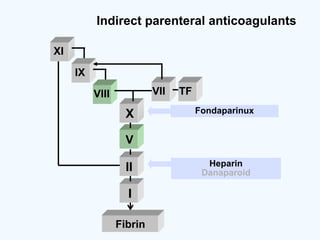
VIIVIII
IX
XI
II
V
X
I
Heparin
Danaparoid
TF
Indirect parenteral anticoagulants
Fondaparinux
Fibrin
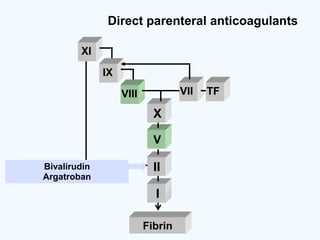
VIIVIII
IX
XI
II
V
X
I
TF
Direct parenteral anticoagulants
Bivalirudin
Argatroban
Fibrin
Fibrin
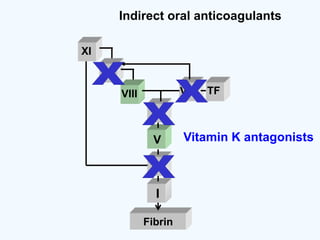
VIIVIII
IX
XI
II
V
X
I
TF
Indirect oral anticoagulants
Vitamin K antagonists
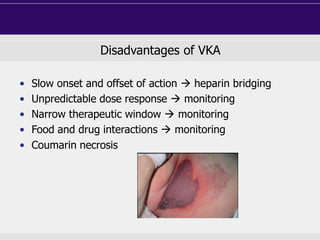
Disadvantages of VKA
• Slow onset and offset of action  heparin bridging
• Unpredictable dose response  monitoring
• Narrow therapeutic window  monitoring
• Food and drug interactions  monitoring
• Coumarin necrosis
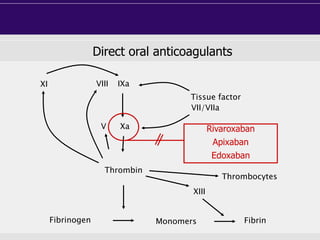
Thrombin
XaV
IXaVIIIXI
Tissue factor
VII/VIIa
Fibrinogen Monomers Fibrin
XIII
Rivaroxaban
Apixaban
Edoxaban
Thrombocytes
Direct oral anticoagulants
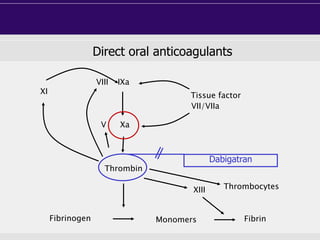
Thrombin
XaV
IXaVIII
XI Tissue factor
VII/VIIa
Fibrinogen Monomers Fibrin
XIII Thrombocytes
Dabigatran
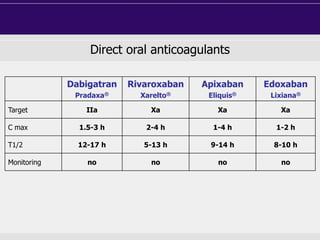
Direct oral anticoagulants
Dabigatran
Pradaxa®
Rivaroxaban
Xarelto®
Apixaban
Eliquis®
Edoxaban
Lixiana®
Target IIa Xa Xa Xa
C max 1.5-3 h 2-4 h 1-4 h 1-2 h
T1/2 12-17 h 5-13 h 9-14 h 8-10 h
Monitoring no no no no
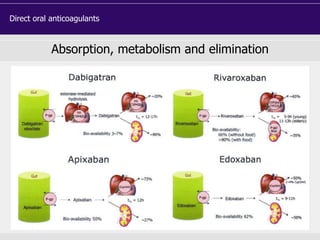
Direct oral anticoagulants
Absorption, metabolism and elimination
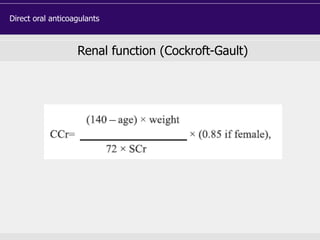
Renal function (Cockroft-Gault)
Direct oral anticoagulants
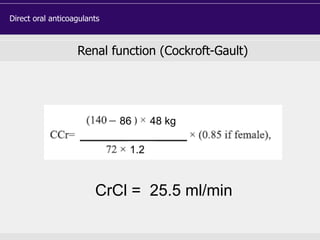
Renal function (Cockroft-Gault)
86 48 kg
1.2
CrCl = 25.5 ml/min
Direct oral anticoagulants
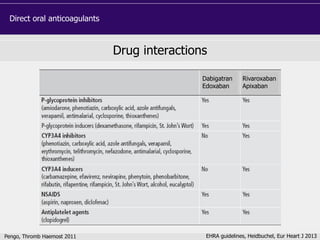
Drug interactions
Pengo, Thromb Haemost 2011
Direct oral anticoagulants
Rivaroxaban
Apixaban
Dabigatran
Edoxaban
EHRA guidelines, Heidbuchel, Eur Heart J 2013
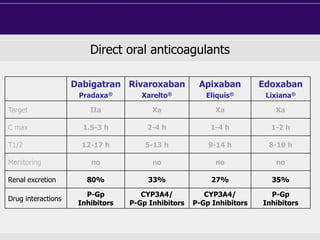
Direct oral anticoagulants
Dabigatran
Pradaxa®
Rivaroxaban
Xarelto®
Apixaban
Eliquis®
Edoxaban
Lixiana®
Target IIa Xa Xa Xa
C max 1.5-3 h 2-4 h 1-4 h 1-2 h
T1/2 12-17 h 5-13 h 9-14 h 8-10 h
Monitoring no no no no
Renal excretion 80% 33% 27% 35%
Drug interactions
P-Gp
Inhibitors
CYP3A4/
P-Gp Inhibitors
CYP3A4/
P-Gp Inhibitors
P-Gp
Inhibitors
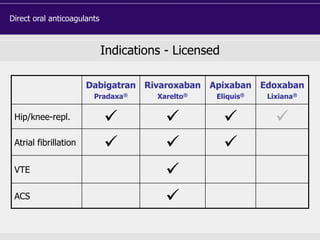
Indications - Licensed
Dabigatran
Pradaxa®
Rivaroxaban
Xarelto®
Apixaban
Eliquis®
Edoxaban
Lixiana®
Hip/knee-repl.    
Atrial fibrillation   
VTE 
ACS 
Direct oral anticoagulants
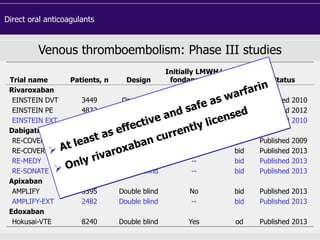
Venous thromboembolism: Phase III studies
Trial name Patients, n Design
Initially LMWH/
fondaparinux Dosing Status
Rivaroxaban
EINSTEIN DVT 3449 Open label No od Published 2010
EINSTEIN PE 4832 Open label No od Published 2012
EINSTEIN EXT 602 Double blind -- od Published 2010
Dabigatran
RE-COVER 2539 Double blind Yes bid Published 2009
RE-COVER II 2589 Double blind Yes bid Published 2013
RE-MEDY 2856 Double blind -- bid Published 2013
RE-SONATE 1343 Double blind -- bid Published 2013
Apixaban
AMPLIFY 5395 Double blind No bid Published 2013
AMPLIFY-EXT 2482 Double blind -- bid Published 2013
Edoxaban
Hokusai-VTE 8240 Double blind Yes od Published 2013
Direct oral anticoagulants
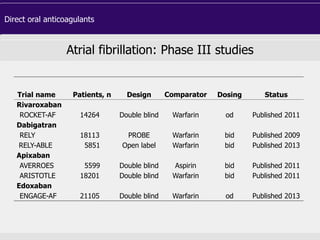
Trial name Patients, n Design Comparator Dosing Status
Rivaroxaban
ROCKET-AF 14264 Double blind Warfarin od Published 2011
Dabigatran
RELY 18113 PROBE Warfarin bid Published 2009
RELY-ABLE 5851 Open label Warfarin bid Published 2013
Apixaban
AVERROES 5599 Double blind Aspirin bid Published 2011
ARISTOTLE 18201 Double blind Warfarin bid Published 2011
Edoxaban
ENGAGE-AF 21105 Double blind Warfarin od Published 2013
Direct oral anticoagulants
Atrial fibrillation: Phase III studies
DOAC - atrial fibrillation
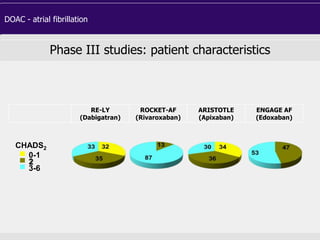
Phase III studies: patient characteristics
RE-LY
(Dabigatran)
ROCKET-AF
(Rivaroxaban)
ARISTOTLE
(Apixaban)
ENGAGE AF
(Edoxaban)
Randomized, n 18,113 14,264 18,201 21,105
Age, years 72 9 73 [65-78] 70 [63-76] 72 [64-78]
Female, % 37 40 35 38
CHADS2 score ≥3, % 32 87 30 53
Paroxysmal AF, % 32 18 15 25
Prior stroke/TIA, % 20 55 19 28
VKA naïve, % 50 38 43 41
Aspirin use, % 40 36 31 29
Median follow-up,
years
2.0 1.9 1.8 2.8
Median TTR, % 66 58 66 68
DOAC - atrial fibrillation
Phase III studies: patient characteristics
RE-LY
(Dabigatran)
ROCKET-AF
(Rivaroxaban)
ARISTOTLE
(Apixaban)
ENGAGE AF
(Edoxaban)
CHADS2
2
3-6
0-1
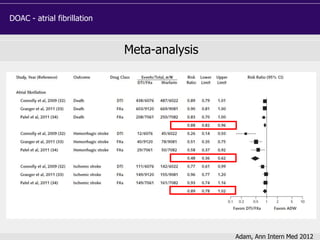
Meta-analysis
Adam, Ann Intern Med 2012
DOAC - atrial fibrillation
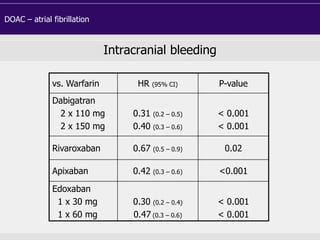
Intracranial bleeding
vs. Warfarin HR (95% CI) P-value
Dabigatran
2 x 110 mg
2 x 150 mg
0.31 (0.2 – 0.5)
0.40 (0.3 – 0.6)
< 0.001
< 0.001
Rivaroxaban 0.67 (0.5 – 0.9) 0.02
Apixaban 0.42 (0.3 – 0.6) <0.001
Edoxaban
1 x 30 mg
1 x 60 mg
0.30 (0.2 – 0.4)
0.47 (0.3 – 0.6)
< 0.001
< 0.001
DOAC – atrial fibrillation
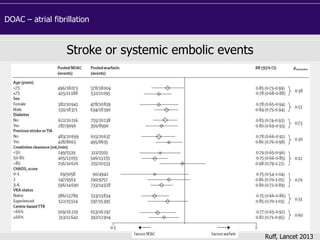
Stroke or systemic embolic events
Ruff, Lancet 2013
DOAC – atrial fibrillation
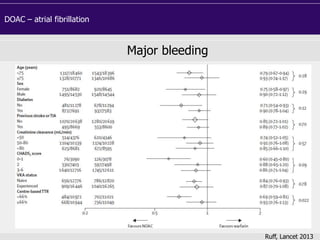
Ruff, Lancet 2013
Major bleeding
DOAC – atrial fibrillation
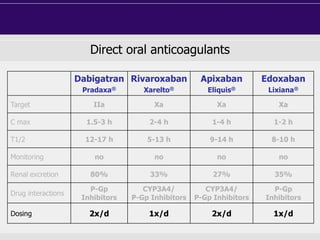
Direct oral anticoagulants
Dabigatran
Pradaxa®
Rivaroxaban
Xarelto®
Apixaban
Eliquis®
Edoxaban
Lixiana®
Target IIa Xa Xa Xa
C max 1.5-3 h 2-4 h 1-4 h 1-2 h
T1/2 12-17 h 5-13 h 9-14 h 8-10 h
Monitoring no no no no
Renal excretion 80% 33% 27% 35%
Drug interactions
P-Gp
Inhibitors
CYP3A4/
P-Gp Inhibitors
CYP3A4/
P-Gp Inhibitors
P-Gp
Inhibitors
Dosing 2x/d 1x/d 2x/d 1x/d
Weitz, Thromb Haemost 2010
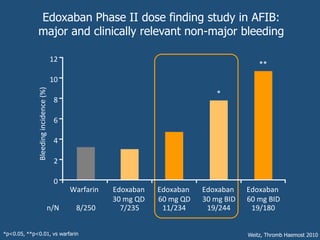
Edoxaban Phase II dose finding study in AFIB:
major and clinically relevant non-major bleeding
*p<0.05, **p<0.01, vs warfarin
0
2
8
10
12
Warfarin Edoxaban
30 mg QD
Edoxaban
60 mg QD
Edoxaban
30 mg BID
Edoxaban
60 mg BID
Bleedingincidence(%)
n/N 8/250 7/235 11/234 19/244 19/180
6
4
*
**
Weitz, Thromb Haemost 2010
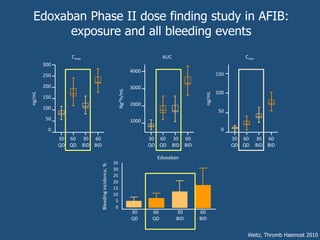
Edoxaban Phase II dose finding study in AFIB:
exposure and all bleeding events
300
250
200
150
100
50
0
ng/mL
30
QD
60
QD
30
BID
60
BID
Cmax
30
QD
60
QD
30
BID
60
BID
4000
3000
2000
1000Ng*h/mL
AUC
30
QD
60
QD
30
BID
60
BID
150
100
50
0
ng/mL
Cmin
35
30
25
20
15
10
5
0
Bleedingincidence,%
30
QD
60
QD
30
BID
60
BID
Edoxaban
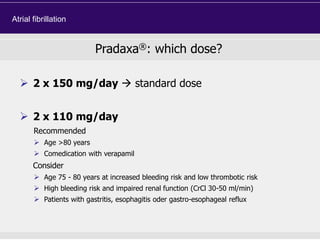
 2 x 150 mg/day  standard dose
 2 x 110 mg/day
Recommended
 Age >80 years
 Comedication with verapamil
Consider
 Age 75 - 80 years at increased bleeding risk and low thrombotic risk
 High bleeding risk and impaired renal function (CrCl 30-50 ml/min)
 Patients with gastritis, esophagitis oder gastro-esophageal reflux
Pradaxa®: which dose?
Atrial fibrillation
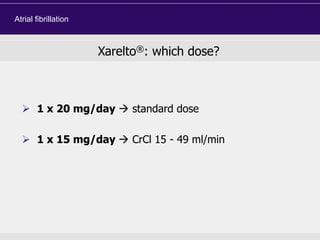
 1 x 20 mg/day  standard dose
 1 x 15 mg/day  CrCl 15 - 49 ml/min
Xarelto®: which dose?
Atrial fibrillation
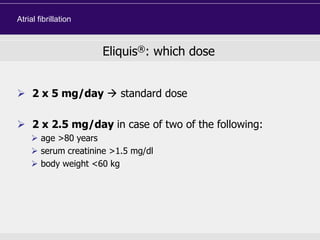
 2 x 5 mg/day  standard dose
 2 x 2.5 mg/day in case of two of the following:
 age >80 years
 serum creatinine >1.5 mg/dl
 body weight <60 kg
Eliquis®: which dose
Atrial fibrillation
Direct oral anticoagulants
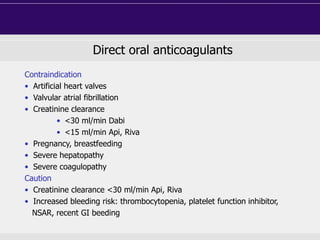
Contraindication
• Artificial heart valves
• Valvular atrial fibrillation
• Creatinine clearance
• <30 ml/min Dabi
• <15 ml/min Api, Riva
• Pregnancy, breastfeeding
• Severe hepatopathy
• Severe coagulopathy
Caution
• Creatinine clearance <30 ml/min Api, Riva
• Increased bleeding risk: thrombocytopenia, platelet function inhibitor,
NSAR, recent GI beeding
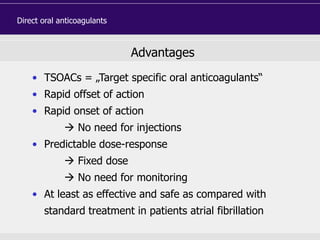
Advantages
• TSOACs = „Target specific oral anticoagulants“
• Rapid offset of action
• Rapid onset of action
 No need for injections
• Predictable dose-response
 Fixed dose
 No need for monitoring
• At least as effective and safe as compared with
standard treatment in patients atrial fibrillation
Direct oral anticoagulants
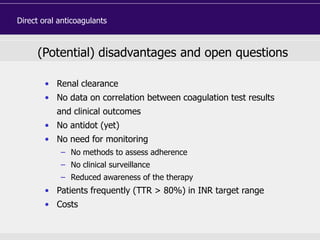
(Potential) disadvantages and open questions
• Renal clearance
• No data on correlation between coagulation test results
and clinical outcomes
• No antidot (yet)
• No need for monitoring
– No methods to assess adherence
– No clinical surveillance
– Reduced awareness of the therapy
• Patients frequently (TTR > 80%) in INR target range
• Costs
Direct oral anticoagulants

EAHP

  • 1.
    Anticoagulants - amatter of heart! Towards a bright future? Sabine Eichinger Dept. of Medicine I Medical University of Vienna/Austria Clinical issues – which drug for which patient
  • 2.
    Conflicts of interest Consultancies,member of advisory boards: Boehringer-Ingelheim Bayer Daiichi-Sankyo Bristol Myers Squibb Pfizer
  • 3.
  • 4.
  • 5.
  • 6.
    Disadvantages of VKA •Slow onset and offset of action  heparin bridging • Unpredictable dose response  monitoring • Narrow therapeutic window  monitoring • Food and drug interactions  monitoring • Coumarin necrosis
  • 7.
    Thrombin XaV IXaVIIIXI Tissue factor VII/VIIa Fibrinogen MonomersFibrin XIII Rivaroxaban Apixaban Edoxaban Thrombocytes Direct oral anticoagulants
  • 8.
    Thrombin XaV IXaVIII XI Tissue factor VII/VIIa FibrinogenMonomers Fibrin XIII Thrombocytes Dabigatran Direct oral anticoagulants
  • 9.
    Direct oral anticoagulants Dabigatran Pradaxa® Rivaroxaban Xarelto® Apixaban Eliquis® Edoxaban Lixiana® TargetIIa Xa Xa Xa C max 1.5-3 h 2-4 h 1-4 h 1-2 h T1/2 12-17 h 5-13 h 9-14 h 8-10 h Monitoring no no no no
  • 10.
    Direct oral anticoagulants Absorption,metabolism and elimination
  • 11.
  • 12.
    Renal function (Cockroft-Gault) 8648 kg 1.2 CrCl = 25.5 ml/min Direct oral anticoagulants
  • 13.
    Drug interactions Pengo, ThrombHaemost 2011 Direct oral anticoagulants Rivaroxaban Apixaban Dabigatran Edoxaban EHRA guidelines, Heidbuchel, Eur Heart J 2013
  • 14.
    Direct oral anticoagulants Dabigatran Pradaxa® Rivaroxaban Xarelto® Apixaban Eliquis® Edoxaban Lixiana® TargetIIa Xa Xa Xa C max 1.5-3 h 2-4 h 1-4 h 1-2 h T1/2 12-17 h 5-13 h 9-14 h 8-10 h Monitoring no no no no Renal excretion 80% 33% 27% 35% Drug interactions P-Gp Inhibitors CYP3A4/ P-Gp Inhibitors CYP3A4/ P-Gp Inhibitors P-Gp Inhibitors
  • 15.
    Indications - Licensed Dabigatran Pradaxa® Rivaroxaban Xarelto® Apixaban Eliquis® Edoxaban Lixiana® Hip/knee-repl.    Atrial fibrillation    VTE  ACS  Direct oral anticoagulants
  • 16.
    Venous thromboembolism: PhaseIII studies Trial name Patients, n Design Initially LMWH/ fondaparinux Dosing Status Rivaroxaban EINSTEIN DVT 3449 Open label No od Published 2010 EINSTEIN PE 4832 Open label No od Published 2012 EINSTEIN EXT 602 Double blind -- od Published 2010 Dabigatran RE-COVER 2539 Double blind Yes bid Published 2009 RE-COVER II 2589 Double blind Yes bid Published 2013 RE-MEDY 2856 Double blind -- bid Published 2013 RE-SONATE 1343 Double blind -- bid Published 2013 Apixaban AMPLIFY 5395 Double blind No bid Published 2013 AMPLIFY-EXT 2482 Double blind -- bid Published 2013 Edoxaban Hokusai-VTE 8240 Double blind Yes od Published 2013 Direct oral anticoagulants
  • 17.
    Trial name Patients,n Design Comparator Dosing Status Rivaroxaban ROCKET-AF 14264 Double blind Warfarin od Published 2011 Dabigatran RELY 18113 PROBE Warfarin bid Published 2009 RELY-ABLE 5851 Open label Warfarin bid Published 2013 Apixaban AVERROES 5599 Double blind Aspirin bid Published 2011 ARISTOTLE 18201 Double blind Warfarin bid Published 2011 Edoxaban ENGAGE-AF 21105 Double blind Warfarin od Published 2013 Direct oral anticoagulants Atrial fibrillation: Phase III studies
  • 18.
    DOAC - atrialfibrillation Phase III studies: patient characteristics RE-LY (Dabigatran) ROCKET-AF (Rivaroxaban) ARISTOTLE (Apixaban) ENGAGE AF (Edoxaban) Randomized, n 18,113 14,264 18,201 21,105 Age, years 72 9 73 [65-78] 70 [63-76] 72 [64-78] Female, % 37 40 35 38 CHADS2 score ≥3, % 32 87 30 53 Paroxysmal AF, % 32 18 15 25 Prior stroke/TIA, % 20 55 19 28 VKA naïve, % 50 38 43 41 Aspirin use, % 40 36 31 29 Median follow-up, years 2.0 1.9 1.8 2.8 Median TTR, % 66 58 66 68
  • 19.
    DOAC - atrialfibrillation Phase III studies: patient characteristics RE-LY (Dabigatran) ROCKET-AF (Rivaroxaban) ARISTOTLE (Apixaban) ENGAGE AF (Edoxaban) CHADS2 2 3-6 0-1
  • 20.
    Meta-analysis Adam, Ann InternMed 2012 DOAC - atrial fibrillation
  • 21.
    Intracranial bleeding vs. WarfarinHR (95% CI) P-value Dabigatran 2 x 110 mg 2 x 150 mg 0.31 (0.2 – 0.5) 0.40 (0.3 – 0.6) < 0.001 < 0.001 Rivaroxaban 0.67 (0.5 – 0.9) 0.02 Apixaban 0.42 (0.3 – 0.6) <0.001 Edoxaban 1 x 30 mg 1 x 60 mg 0.30 (0.2 – 0.4) 0.47 (0.3 – 0.6) < 0.001 < 0.001 DOAC – atrial fibrillation
  • 22.
    Stroke or systemicembolic events Ruff, Lancet 2013 DOAC – atrial fibrillation
  • 23.
    Ruff, Lancet 2013 Majorbleeding DOAC – atrial fibrillation
  • 24.
    Direct oral anticoagulants Dabigatran Pradaxa® Rivaroxaban Xarelto® Apixaban Eliquis® Edoxaban Lixiana® TargetIIa Xa Xa Xa C max 1.5-3 h 2-4 h 1-4 h 1-2 h T1/2 12-17 h 5-13 h 9-14 h 8-10 h Monitoring no no no no Renal excretion 80% 33% 27% 35% Drug interactions P-Gp Inhibitors CYP3A4/ P-Gp Inhibitors CYP3A4/ P-Gp Inhibitors P-Gp Inhibitors Dosing 2x/d 1x/d 2x/d 1x/d
  • 25.
    Weitz, Thromb Haemost2010 Edoxaban Phase II dose finding study in AFIB: major and clinically relevant non-major bleeding *p<0.05, **p<0.01, vs warfarin 0 2 8 10 12 Warfarin Edoxaban 30 mg QD Edoxaban 60 mg QD Edoxaban 30 mg BID Edoxaban 60 mg BID Bleedingincidence(%) n/N 8/250 7/235 11/234 19/244 19/180 6 4 * **
  • 26.
    Weitz, Thromb Haemost2010 Edoxaban Phase II dose finding study in AFIB: exposure and all bleeding events 300 250 200 150 100 50 0 ng/mL 30 QD 60 QD 30 BID 60 BID Cmax 30 QD 60 QD 30 BID 60 BID 4000 3000 2000 1000Ng*h/mL AUC 30 QD 60 QD 30 BID 60 BID 150 100 50 0 ng/mL Cmin 35 30 25 20 15 10 5 0 Bleedingincidence,% 30 QD 60 QD 30 BID 60 BID Edoxaban
  • 27.
     2 x150 mg/day  standard dose  2 x 110 mg/day Recommended  Age >80 years  Comedication with verapamil Consider  Age 75 - 80 years at increased bleeding risk and low thrombotic risk  High bleeding risk and impaired renal function (CrCl 30-50 ml/min)  Patients with gastritis, esophagitis oder gastro-esophageal reflux Pradaxa®: which dose? Atrial fibrillation
  • 28.
     1 x20 mg/day  standard dose  1 x 15 mg/day  CrCl 15 - 49 ml/min Xarelto®: which dose? Atrial fibrillation
  • 29.
     2 x5 mg/day  standard dose  2 x 2.5 mg/day in case of two of the following:  age >80 years  serum creatinine >1.5 mg/dl  body weight <60 kg Eliquis®: which dose Atrial fibrillation
  • 30.
    Direct oral anticoagulants Contraindication •Artificial heart valves • Valvular atrial fibrillation • Creatinine clearance • <30 ml/min Dabi • <15 ml/min Api, Riva • Pregnancy, breastfeeding • Severe hepatopathy • Severe coagulopathy Caution • Creatinine clearance <30 ml/min Api, Riva • Increased bleeding risk: thrombocytopenia, platelet function inhibitor, NSAR, recent GI beeding
  • 31.
    Advantages • TSOACs =„Target specific oral anticoagulants“ • Rapid offset of action • Rapid onset of action  No need for injections • Predictable dose-response  Fixed dose  No need for monitoring • At least as effective and safe as compared with standard treatment in patients atrial fibrillation Direct oral anticoagulants
  • 32.
    (Potential) disadvantages andopen questions • Renal clearance • No data on correlation between coagulation test results and clinical outcomes • No antidot (yet) • No need for monitoring – No methods to assess adherence – No clinical surveillance – Reduced awareness of the therapy • Patients frequently (TTR > 80%) in INR target range • Costs Direct oral anticoagulants