DNP Project
Proposal Defense Template
1
Build the presentation
Use the information from your DPI Project Proposal Template
document as the base.
Edit down your proposal presentation.
Summarize Chapters 1-3.
Include Appendix A.
Check…and Double Check
Timing: The Proposal Defense presentation should be no longer
than 30 minutes.
Be sure you have the approval of your DPI Chairperson and
Committee for everything in the presentation; if you are unsure
of something, clarify it prior to your defense call.
Practice multiple times.
Format
DO:
Use this GCU slide layout.
Use an easy to read font size.
Use figures and tables.
DO NOT:
Do not add slide transitions, animation, or sounds that are
distracting.
Do not crowd slides with excessive text.
Oral Presentation
Create notes in your presentation of the points you want to
cover in your oral presentation of each slide.
Except for specific content, such as clinical questions, do not
just read the slides. Paraphrase in a conversational, yet
professional manner (the result of practice, as per the prior
slide).
Your oral presentation should explain or expand upon what is
on the slides; it should not reiterate the content.
Title Page
Start with a title page that uses the title of the DPI Project
Investigator's Background
What qualifies you to do this project?
Credentials
Experience
Etc.
BE VERY BRIEF.
Topic Background
Why this topic?
History
Need
What needs(s) in practice does the research identify? What need
will your project address and implement?
You can use more than one slide to address each of the
categories.
Problem Statement
Your problem statement should clearly and explicitly state the
reasons you are doing your study.
The purpose of this study is to…
Importance of the project
How might your project impact the field of study or health care
outcomes?
How could it impact your work as a professional?
What else is significant?
Theoretical Foundation
If it is discussed in your project, include a slide on the
philosophical orientation.
For example: critical theory or social constructivism
clinical Questions
Number your questions to facilitate easy reference during
discussions with the committee members.
Methodology
Define which major category of methodol ogy you implemented
for your project.
Include your rationale as to why your chosen methodology is
appropriate to your clinical questions?
Cite relevant methodology literature in support of your choice
of methodology.
Specifics on Methodology
Depending on your choice of methods, you may need
to outline specifics such as (including but not limited to):
Variables—PICOT
Participants—number, how selected, IRB considerations,
demographics
Reliability and validity
Methods of data collection
Data analysis
Limitations
You may need multiple slides for these categories.
References
List only those cited in the DPI Project Proposal Defense
presentation.
One slide should be sufficient.
(Everything else is included in your manuscript.)
Thank You
Thank the members of the committee.
references
California State University, Fullerton, College of Education,
Educational Leadership. (n.d.). Preparing a PowerPoint for your
dissertation defense. Retrieved from
http://coeapps.fullerton.edu/ed/eddstudents/documents/Dissertat
ionDefense_ppt_guidelines11-28-10.ppt
Cascio, W. F., & Aguinis, H. (2019). Applied psychology in
talent management (8th ed.). Retrieved from
https://www.vitalsource.com
Chapter 16
16 TRAINING AND DEVELOPMENT IMPLEMENTATION
AND THE MEASUREMENT OF OUTCOMES
Wayne F. Cascio, Herman Aguinis
Learning Goals
By the end of this chapter, you will be able to do the following:
· 16.1 Classify training methods as presentation, hands-on,
group building, or technology based
· 16.2 Identify key principles of instructional design to
encourage active learner participation
· 16.3 List the essential elements for measuring training
outcomes
· 16.4 Explain the advantages and disadvantages of ROI and
utility analysis as methods for assessing the financial outcomes
of learning and development activities
· 16.5 Identify potential contaminants or threats to valid
interpretations of findings from field research
· 16.6 Distinguish experimental from quasi-experimental
designs
· 16.7 Describe the limitations of experimental and quasi-
experimental designs
· 16.8 In assessing the outcomes of training efforts, distinguish
statistically significant effects from practically significant
effects
Once we define what trainees should learn and what the
substantive content of training and development should be, the
critical question then becomes “How should we teach the
content and who should teach it?”
The literature on training and development techniques is
massive. Although many choices exist, evidence indicates that,
among U.S. companies that conduct training, few make any
systematic effort to assess their training needs before choosing
training methods (Arthur, Bennett, Edens, & Bell, 2003; Saari,
Johnson, McLaughlin, & Zimmerle, 1988). In a recent survey,
for example, only 15% of learning and development
professionals reported that they lack data and insights to
understand which solutions are effective (LinkedIn Learning,
2017). This implies that firms view hardware, software, and
techniques as more important than outcomes. They mistakenly
view the identification of what trainees should learn as
secondary to the choice of technique.
New training methods appear every year. Some of them are
deeply rooted in theoretical models of learning and behavior
change (e.g., behavior modeling, team-coordination training),
others seem to be the result of trial and error, and still others
(e.g., interactive multimedia, computer-based business games)
seem to be more the result of technological than of theoretical
developments. In 2016, 41% of learning hours used at the
average organization were delivered by technology-based
methods, which is nearly 10 percentage points higher than in
2008 and more than 15 percentage points higher than in 2003.
Technology-based learning can be delivered through online or
other live remote classrooms, self-paced online or
nonnetworked computer-based methods, mobile devices (such as
smartphones and tablets), or noncomputer technology (such as
DVDs) (Association for Talent Development, 2016).
We make no attempt to review specific training methods that are
or have been in use. Other sources are available for this purpose
(Goldstein & Ford, 2001; Noe, 2017; Wexley & Latham, 2002).
We only highlight some of the more popular techniques, with
special attention to technology-based training, and then present
a set of criteria for judging the adequacy of training methods.
Categories of Training and Development Methods
Following Noe (2017), training and development methods may
be classified into four categories: presentation, hands-on, group
building, and technology based.
Presentation Methods
With presentation methods, an audience typically receives one-
way communication from the trainer in one of two formats:
· Lectures
· Videos, usually used in conjunction with lectures to show
trainees real-life experiences and examples
Hands-On Methods
Hands-on methods include on-the-job training, self-directed
learning, apprenticeships, and simulations:
· On-the-job training: New or inexperienced employees learn in
the work setting and during work hours by observing peers or
managers performing a job and then trying to imitate their
behavior (Tyler, 2008). Examples include onboarding, job
rotation, understudy assignments (also known as “shadowing,”
in which an understudy relieves a senior executive of selected
responsibilities, thereby allowing him or her to learn certain
aspects of the executive’s job; see Dragoni, Park, Soltis, &
Forte-Trammell, 2014), and executive coaching. Executive
coaching is an individualized process of executive development
in which a skilled expert (coach) works with an individual who
is in a leadership or managerial role in an organization, to help
the individual to become more effective in his or her
organizational roles(s) and contexts (Vandaveer, 2017; see als o
Hollenbeck, 2002; Peterson, 2011; Underhill, McAnally, &
Koriath, 2008).
· Self-directed learning: Trainees take responsibility for all
aspects of learning, including when it is conducted and who will
be involved. Trainers may serve as facilitators, but trainees
master predetermined content at their own pace.
· Apprenticeship: This method constitutes a work-study training
regimen that includes both on-the-job and classroom training. It
typically lasts an average of four years.
· Simulations: These training methods represent real-life
situations, with trainees’ decisions resulting in outcomes that
reflect what would happen if they were on the job. Simulations
may assume a number of forms, including the following:
· In the case method, representative organizational situations
are presented in text form, usually to groups of trainees who
subsequently identify problems and offer solutions. Individuals
learn from each other and receive feedback on their own
performances.
· The incident method is similar to the case method, except that
trainees receive only a sketchy outline of a particular incident.
They have to question the trainer, and, when they think they
have enough information, they attempt a solution. At the end of
the session, the trainer reveals all the information he or she has,
and trainees compare their solutions to the one based on
complete information.
· Role playing includes multiple role-playing, in which a large
group breaks down into smaller groups and role plays the same
problem within each group without a trainer. All players then
reassemble and discuss with the trainer what happened in their
groups.
· Experiential exercises are simulations of experiences relevant
to organizational psychology. This is a hybrid technique that
may incorporate elements of the case method, multiple role-
playing, and team-coordination training. Trainees examine their
responses first as individuals, then with the members of their
own groups or teams, and finally with the larger group and with
the trainer.
· The task model has trainees construct a complex, but easily
built physical object, and a group of trainees must then
duplicate it, given the proper materials. Trainees use alternative
communication arrangements, and only certain trainees may
view the object. Trainees discuss communication problems as
they arise, and they reach solutions through group discussion.
· The in-basket technique (see Chapter 13).
· Business games (see Chapter 13).
· Assessment centers (see Chapter 13).
· Behavior or competency modeling (see Chapter 15).
Group-Building Methods
Group-building training methods are designed to improve group
or team effectiveness. They include the following types of
training:
· Adventure learning: This experiential learning method focuses
on the development of teamwork and leadership skills through
structured activities. These may include wilderness training,
outdoor training, improvisational activities, drum circles, even
cooking classes (Noe, 2017). Their purpose is to develop skills
related to group effectiveness, such as self-awareness, problem
solving, conflict management, and risk taking (Greenfield,
2015).
· Team training: This method is designed to improve
effectiveness within the many types of teams in organizations
(production teams, service teams, project teams, management
teams, and committees; see Chapter 15). It focuses on
improving knowledge (mental models that allow trainees to
function well in new situations); attitudes (beliefs about a
team’s task and feelings toward team members); and behavior
(actions that allow team members to communicate, coordinate,
adapt, and complete complex tasks to accomplish their
objective) (Salas, Burke, & Cannon-Bowers, 2002).
· Action learning: In this method, teams work on actual business
problems, commit to an action plan, and are responsible for
carrying out the plan (Malone, 2013; Pedler & Abbott, 2013). It
typically involves 6–30 employees and may include customers
or vendors as well as cross-functional representation. Teams are
asked to develop novel ideas and solutions in a short period of
time (e.g., two weeks to a month), and they are required to
present them to top-level executives.
· Organization development: This method involves systematic,
long-range programs of organizational improvement through
action research, which includes (a) preliminary diagnosis, (b)
data gathering from the client group, (c) data feedback to the
client group, (d) data exploration by the client group, (e) action
planning, and (f) action; the cycle then begins again. Although
action research may assume many forms (Austin & Bartunek,
2003), one of the most popular is survey feedback (Church,
Waclawski, & Kraut, 2001; Levinson, 2014; Wiley, 2010). The
process begins with a comprehensive assessment of the way the
organization is currently functioning—typically via the
administration of anonymous questionnaires to all employees.
Researchers tabulate responses at the level of individual work
groups and for the organization as a whole. Each manager
receives a summary of this information, based on the responses
of his or her immediate subordinates. Then a change agent (i.e.,
a person skilled in the methods of applied behavioral science)
meets privately with the manager recipient to maximize his or
her understanding of the survey results. Following this, the
change agent attends a meeting (face to face or virtual) of the
manager and subordinates, the purpose of which is to examine
the survey findings and to discuss implications for corrective
action. The role of the change agent is to help group members to
better understand the survey results, to set goals, and to
formulate action plans for the change effort.
Technology-Based Training
Instructor-led, face-to-face, classroom training still comprises
49% of available hours of training (down from 64% in 2008),
and if one considers all instructor-led delivery methods
(classroom, online, remote), that figure rises to 65% of all
learning hours available (Association for Talent Development,
2016). The use of technology-delivered training is expected to
increase dramatically, however, in the coming years as
technology improves, its cost decreases, the demand increases
for customized training, and organizations realize the potential
cost savings from training delivered via tablets, smartphones,
and social media. Currently, seven out of 10 organizations are
incorporating video-based online training into their learning
cultures, and 67% of people are learning on mobile devices
(LinkedIn Learning, 2017).
Technology-based training creates a dynamic learning
environment, it facilitates collaboration, and it
enables customization (in which programs can be adapted based
on learner characteristics) and learner control. That is, learners
have the option of self-pacing exercises, exploring links to
other material, chatting with other trainees and experts, and
choosing when and where to access the training (Noe, 2017).
There are at least 15 forms of technology-based training (Noe,
2017):
· E-learning, online learning, computer-based training, and
Web-based training
· Webcasts or webinars—live, Web-based delivery in dispersed
locations
· Podcasts—Web-based delivery of audio- and video-based files
· Mobile learning—through handheld devices such as tablets or
smartphones
· Blended learning—hybrid systems that combine classroom and
online learning
· Wikis—websites that allow many users to create, edit, and
update content and to share knowledge
· Distance learning—delivered to multiple locations online
through webcasts or virtual classrooms, often supported by chat,
e-mail, and online discussions
· Social media—online or mobile technology that allows the
creation and exchange of user-generated content; includes
wikis, blogs, networks (e.g., Facebook, LinkedIn), micro-
sharing sites (e.g., Twitter), and shared media (e.g., YouTube)
· Shared workspaces, such as Google Docs, hosted on a Web
server, where people can share information and documents
· RSS (real simple syndication) feeds—updated content sent to
subscribers automatically instead of by e-mail
· Blogs—Web pages where authors post entries and readers can
comment
· Micro-blogs or micro-sharing (e.g., Twitter)—software tools
that enable communications in short bursts of texts, links, and
multimedia
· Chat rooms and discussion boards—electronic message boards
through which learners can communicate at the same or
different times (a facilitator or instructor may moderate the
conversations)
· Massive, open, online courses (MOOCs)—designed to enroll
large numbers of learners (massive); free and accessible to
anyone with an Internet connection (open and online); using
videos of lectures, interactive coursework, including discussion
groups and wikis (online); with specific start and completion
dates, quizzes, assessments, and exams (courses)
· Adaptive training—customized content presented to learners
based on their needs
Is technology-based training more effective than instructor-led
training? Two meta-analyses have found no significant
differences in the formats, especially when both are used to
teach the same type of knowledge, declarative or procedural
(Sitzmann, Kraiger, Stewart, & Wisher, 2006; Zhao, Lei, Lai, &
Tan, 2005). Perhaps more important questions are these: How
does one determine the optimal mix of formats for a program
(e.g., blended learning), and does the sequencing of technology-
based and in-person instruction within a program make a
difference (Bell, Tannenbaum, Ford, Noe, & Kraiger, 2017)?
Does on-demand versus prescheduled training have any effect
on employee motivation to undertake the training? How do user
experiences and gamification affect performance in Internet-
based working environments (Thielsch & Niesenhaus, 2017)?
We know that poorly designed training will not stimulate and
support learning, regardless of the extent to which appealing or
expensive technology is used to deliver it (Brown & Ford, 2002;
Kozlowski & Bell, 2003). Hence, if technology-based training is
to be maximally effective, it must be designed to encourage
active learning in participants. To do so, consider incorporating
the following four principles into the instructional design
(Brown & Ford, 2002):
1. Design the information structure and presentation to reflect
both meaningful organization (or chunking) of material and ease
of use.
2. Balance the need for learner control with guidance to help
learners make better choices about content and process.
3. Provide opportunities for practice and constructive feedback.
4. Encourage learners to be mindful of their cognitive
processing and in control of their learning processes.
Technique Selection
A training method can be effective only if it is used
appropriately. Appropriate use, in this context, means rigid
adherence to a two-step sequence: first, define what trainees are
to learn, and only then choose a particular method that best fits
these requirements. Far too often, unfortunately, trainers choose
methods first and then force them to fit particular needs. This
“retrofit” approach not only is wrong but also is often extremely
wasteful of organizational resources—time, people, and money.
It should be banished.
A technique is adequate to the extent that it provides the
minimal conditions for effective learning to take place. To do
this, a technique should do the following:
· Motivate the trainee to improve his or her performance
· Clearly illustrate desired skills
· Provide for the learner’s active participation
· Provide an opportunity to practice
· Provide feedback on performance while the trainee learns
· Provide some means to reinforce the trainee while learning
(e.g., using chatbots, automated yet personalized conversations
between software and human users that may be used to provide
reminders, track goals, assess transfer, and support continued
performance; Han, 2017)
· Be structured from simple to complex tasks
· Be adaptable to specific problems
· Enable the trainee to transfer what is learned in training to
other situations
Designers of training can apply this checklist to all proposed
training techniques. If a particular technique appears to fit
training requirements, yet is deficient in one or more areas, then
either modify it to eliminate the deficiency or bolster it with
another technique. The next step is to conduct the training. A
checklist of the many logistical details involved is not
appropriate here, but implementation should not be a major
stumbling block if prior planning and design have been
thorough. The final step, of course, is to measure the effects of
training and their interaction with other organizational
subsystems. To this topic, we now turn.
Measuring Training and Development Outcomes
“Evaluation” of a training program implies a dichotomous
outcome (i.e., either a program has value or it does not). In
practice, matters are rarely so simple, for outcomes are usually
a matter of degree. To assess outcomes, we need to document
systematically how trainees actually behave back on their jobs
and the relevance of their behavior to the organization’s
objectives (Brown, 2017a; Machin, 2002; Snyder, Raben, &
Farr, 1980). Beyond that, it is important to consider the
intended purpose of the evaluation, as well as the needs and
sophistication of the intended audience (Aguinis & Kraiger,
2009).Why Measure Training Outcomes?
Evidence indicates that few companies assess the outcomes of
training activities with any procedure more rigorous than
participant reactions following the completion of training
programs (Association for Talent Development, 2016; Brown,
2005; LinkedIn Learning, 2017; Sugrue & Rivera, 2005;
Twitchell, Holton, & Trott, 2001). This is unfortunate because
there are numerous reasons to evaluate training (Brown, 2017a;
Noe, 2017; Sackett & Mullen, 1993):
· To make decisions about the future use of a training program
or technique (e.g., continue, modify, eliminate)
· To compare the costs and benefits of training versus
nontraining investments, such as work redesign or improved
staffing
· To do a comparative analysis of the costs and benefits of
alternative training programs
· To make decisions about individual trainees (e.g., certify as
competent, provide additional training)
· To contribute to a scientific understanding of the training
process
· To further political or public relations purposes (e.g., to
increase the credibility and visibility of the training function by
documenting success)
On a broader level, these reasons may be summarized as
decision making, feedback, and marketing (Kraiger, 2002).
Beyond these basic issues, we also would like to know whether
the techniques used are more efficient or more cost effective
than other available training methods. Finally, we would like to
be able to compare training with other approaches to developing
workforce capability, such as improving staffing procedures and
redesigning jobs. To do any of this, certain elements are
essential.Essential Elements of Measuring Training Outcomes
At the most basic level, the task of evaluation is counting—
counting new customers, counting interactions, counting
dollars, counting hours, and so forth. The most difficult tasks of
evaluation are deciding what things to count and developing
routine methods for counting them. As William Bryce Cameron
(1963) famously said, “Not everything that counts can be
counted, and not everything that can be counted counts” (p. 13).
In the context of training, here is what counts (Campbell,
Dunnette, Lawler, & Weick, 1970):
· Use of multiple criteria, not just for the sake of numbers, but
also for the purpose of more adequately reflecting the multiple
contributions of managers to the organization’s goals.
· Some attempt to study the criteria themselves—that is, their
relationships with each other and with other variables. The
relationship between internal and external criteria is especially
important.
· Enough experimental control to enable the causal arrow to be
pointed at the training program. How much is enough will
depend on the possibility of an interactive effect with the
criterion measure and the susceptibility of the training program
to the Hawthorne effect.
· Provision for saying something about the practical and
theoretical significance of the results.
· A thorough, logical analysis of the process and content of the
training.
· Some effort to deal with the “systems” aspects of training
impact—that is, how training effects are altered by interaction
with other organizational subsystems. For example, Kim and
Ployhart (2014) used more than 12 years of longitudinal data to
examine the effects of selective staffing and internal training on
the financial performance of 359 firms during pre- and post-
recessionary periods. They found a significant interaction
between selective staffing and internal training, such that firms
achieved consistent profit growth only when both were high.
Trainers must address these issues before they can conduct any
truly meaningful evaluation of training impact. The remainder
of this chapter treats each of these points more fully and
provides practical illustrations of their use.Criteria
As with any other HR program, the first step in judging the
value of training is to specify multiple criteria. Although we
covered the criterion problem already in Chapter 4, it is
important to emphasize that the assessment of training outcomes
requires multiple criteria because training is usually directed at
specific components of performance. Organizations deal with
multiple objectives, and training outcomes are
multidimensional. Training may contribute to movement toward
some objectives and away from others at the same time (Bass,
1983). Let’s examine criteria according to time, type, and
level.Time
The important question here is “When, relative to the actual
conduct of the training, should we obtain criterion data?” We
could do so prior to, during, immediately after, or much later
after the conclusion of training. To be sure, the timing of
criterion measurement can make a great deal of difference in the
interpretation of training effects (Sprangers & Hoogstraten,
1989). Thus, a study of 181 Korean workers (Lim & Morris,
2006) found that the relationship between perceived
applicability (utility of training) and perceived application to
the job (transfer) decreased as the time between training and
measurement increased.
Conclusions drawn from an analysis of changes in trainees from
before to immediately after training may differ drastically from
conclusions based on the same criterion measures 6–12 months
after training (Freeberg, 1976; Keil & Cortina, 2001; Steele-
Johnson, Osburn, & Pieper, 2000). Yet both measurements are
important. One review of 59 studies found, for example, that the
time span of measurement (the time between the first and last
observations) was one year or less for 26 studies, one to three
years for 27 studies, and more than three years for only six
studies (Nicholas & Katz, 1985). Comparisons of short- versus
long-term training effects may yield valuable information
concerning the interaction of training effects with other
organizational processes (e.g., norms, values, leadership styles).
Finally, it is not the absolute level of behavior (e.g., number of
grievances per month, number of accidents) that is crucial, but
rather the change in behavior from the beginning of training to
some time after its conclusion.Types of Criteria
It is important to distinguish internal from external criteria.
Internal criteria are those that are linked directly to
performance in the training situation. Examples of internal
criteria are attitude scales and objective achievement
examinations designed specifically to measure what the training
program is designed to teach. External criteria, by contrast, are
measures designed to assess actual changes in job behavior. For
example, an organization may conduct a two-day training
program in EEO law and its implications for talent management.
A written exam at the conclusion of training (designed to assess
mastery of the program’s content) would be an internal
criterion. Ratings by subordinates, peers, or supervisors and
documented evidence regarding the trainees’ on-the-job
application of EEO principles constitute external criteria. Both
internal and external criteria are necessary to evaluate the
relative payoffs of training and development programs, and
researchers need to understand the relationships among them in
order to draw meaningful conclusions about training effects.
Criteria also may be qualitative or quantitative. Qualitative
criteria are attitudinal and perceptual measures that usually are
obtained by interviewing or observing employees or by
administering written instruments. They are real-life examples
of what quantitative results represent (Eden, 2017). Quantitative
criteria also include measures of the outcomes of job behavior
and system performance, which are often contained in
employment, accounting, production, and sales records. These
outcomes include turnover, absenteeism, dollar volume of sales,
accident rates, and controllable rejects.
Both qualitative and quantitative criteria are important for a
thorough understanding of training effects. Traditionally,
researchers have preferred quantitative measures, except in
organization development research (Austin & Bartunek, 2003;
Nicholas, 1982; Nicholas & Katz, 1985). This may be a mistake,
since there is much more to interpreting the outcomes of
training than quantitative measures alone. By ignoring
qualitative (process) measures, we may miss the richness of
detail concerning how events occurred. Exclusive focus either
on quantitative or qualitative measures, however, is short
sighted and deficient. Thus, when learning and development
(L&D) professionals were asked recently, “What are the top
ways you measure the success of L&D at your company?” the
five most common responses were qualitative and the sixth had
nothing to do with outcomes of a specific type of training per
se. It was “length of time an employee stays at the company
after completing a training” (LinkedIn Learning, 2017). At best,
this offers an incomplete picture of the overall effects of
training.
Finally, consider formative versus summative criteria.
Formative criteria focus on evaluating training during program
design and development, often through pilot testing. Based
primarily on qualitative data such as opinions, beliefs, and
feedback about a program from subject matter experts and
sometimes customers, the purpose of formative evaluations is to
make a program better. In contrast, the purpose of summative
criteria is to determine if trainees have acquired the kinds of
outcomes specified in training objectives. These may include
knowledge, skills, attitudes, or new behaviors (Noe,
2017).Levels of Criteria
“Levels” of criteria may refer either to the organizational levels
from which we collect criterion data or to the relative level of
rigor we adopt in measuring training outcomes. With respect to
organizational levels, information from trainers, trainees,
subordinates, peers, supervisors, and the organization’s policy
makers (i.e., the training program’s sponsors) can be extremely
useful. In addition to individual sources, group sources (e.g.,
work units, teams, squads) can provide aggregate data regarding
morale, turnover, grievances, and various cost, error, and/or
profit measures that can be helpful in assessing training effects.
Kirkpatrick (1977, 1983, 1994) identified four levels of rigor in
the evaluation of training and development programs: reaction,
learning, behavior, and results. Note, however, that these levels
provide only a vocabulary and a rough taxonomy for criteria.
Higher levels do not necessarily provide more information than
lower levels do, and the levels need not be causally linked or
positively intercorrelated (Alliger & Janak, 1989). In general,
there are four important concerns with Kirkpatrick’s framework
(Alliger, Tannenbaum, Bennett, Traver, & Shortland, 1997;
Holton, 1996; Kraiger, 2002; Spitzer, 2005):
1. The framework is largely atheoretical; to the extent that it
may be theory based, it is founded on an outdated behavioral
perspective that ignores modern, cognitively based theories of
learning.
2. It is overly simplistic in that it treats constructs such as
trainee reactions and learning as unidimensional when, in fact,
they are multidimensional (Alliger et al., 1997; Brown, 2005;
Kraiger, Ford, & Salas, 1993; Morgan & Casper, 2001; Warr &
Bunce, 1995). For example, reactions include affect toward the
training as well as its perceived utility.
3. The framework makes assumptions about relationships
between training outcomes that either are not supported by
research (Bretz & Thompsett, 1992) or do not make sense
intuitively. For example, Kirkpatrick argued that trainees cannot
learn if they do not have positive reactions to the training. Yet a
meta-analysis by Alliger et al. (1997) found an overall average
correlation of only .07 between reactions of any type and
immediate learning. In short, reactions to training should not be
used blindly as a surrogate for the assessment of learning of
training content.
4. Finally, the approach does not take into account the purposes
for evaluation—decision making, feedback, and marketing
(Kraiger, 2002).
Does Kirkpatrick’s model suggest a causal chain across levels
(positive reactions lead to learning, which leads to behavioral
change, etc.), and do higher level evaluations provide the most
informative data? Current thinking and evidence do not support
these assumptions (Brown, 2017a). Rather, each level provides
different, not necessarily better, information. Depending on the
purpose of the evaluation, different outcomes will be more or
less useful.
Figure 16.1 An Integrative Model of Training Evaluation
Source: Republished with permission of John Wiley and Sons
Inc., from Kraiger, K. (2002). Decision-based evaluation. In K.
Kraiger (Ed.), Creating, implementing, and managing effective
training and development (p. 343).
Figure 16.1 presents an alternative measurement model
developed by Kraiger (2002), which attempts to overcome the
deficiencies of Kirkpatrick’s (1994) four-level model.
This approach clearly distinguishes evaluation targets (training
content and design, changes in learners, and organizational
payoffs) from data collection methods (e.g., with respect to
organizational payoffs, cost-benefit analyses, ratings, and
surveys). Targets and methods are linked through the options
available for measurement—that is, its focus (e.g., with respect
to changes in learners, the focus might be cognitive, affective,
or behavioral changes). Finally, targets, focus, and methods are
linked to evaluation purpose—feedback (to trainers or learners),
decision making, and marketing. Kraiger (2002) also provided
sample indicators for each of the three targets in Figure 16.1.
For example, with respect to organizational payoffs, the focus
might be on transfer of training (e.g., transfer climate,
opportunity to perform, on-the-job behavior change), on results
(performance effectiveness or tangible outcomes to a work
group or organization), or on financial performance as a result
of the training (e.g., through measures of return on investment
or utility analysis) (Sung & Choi, 2014).Additional
Considerations in Measuring Training Outcomes
Regardless of the measures used, our goal is to be able to make
meaningful inferences and to rule out alternative explanations
for results. To do so, it is important to administer the measures
according to some logical plan or procedure (experimental
design) (e.g., before and after training, as well as to a
comparable control group). Numerous experimental designs are
available for this purpose, and we consider them later in this
chapter.
In assessing on-the-job behavioral changes, allow a reasonable
period of time (e.g., at least three months) after the completion
of training before taking measures. This is especially important
for development programs that are designed to improve
decision-making skills or to change attitudes or leadership
styles. Such programs require at least three months before their
effects manifest themselves in measurable behavioral changes.
A large-scale meta-analysis reported an average interval of 133
days (almost 4.5 months) for the collection of outcome
measures in behavioral terms (Arthur et al., 2003). To detect the
changes, we need carefully developed techniques for systematic
observation and measurement. Examples include scripted, job-
related scenarios that use empirically derived scoring weights
(Ostroff, 1991), behaviorally anchored rating scales, self-
reports (supplemented by reports of subordinates, peers, and
supervisors), critical incidents, or comparisons of trained
behaviors with behaviors that were not trained (Frese, Beimel,
& Schoenborn, 2003).Strategies for Measuring Training
Outcomes in Terms of Financial Impact
There continue to be calls for establishing the return on
investment (ROI) for training, particularly as training activities
continue to be outsourced and as new forms of technology-
delivered instruction are marketed as cost effective (Association
for Talent Development, 2016; LinkedIn Learning, 2017). Let’s
begin by examining what ROI is.
ROI relates program profits to invested capital. It does so in
terms of a ratio in which the numerator expresses some measure
of profit related to a project, and the denominator represents the
initial investment in a program (Cascio, Boudreau, & Fink, in
press). Suppose, for example, an organization invests $80,000
to design and deliver a wellness program. The program provides
a total annual savings of $240,000 in terms of reduced sick days
and improved health. The ROI is therefore [($240,000 –
$80,000)/$80,000] × 100%, or 200%. Its net benefit per dollar
spent is therefore 2:1. At a broader level, ROI has both
advantages and disadvantages. Its major advantage is that it is
simple and widely accepted. It blends in one number all the
major ingredients of profitability, and it can be compared with
other investment opportunities. On the other hand, it suffers
from two major disadvantages. One, although the logic of ROI
analysis appears straightforward, there is much subjectivity in
determining the inflow of returns produced by an investment,
how the inflows and outflows occur in each future time period,
and how much what occurs in future time periods should be
“discounted” to reflect greater risk and price inflation
(Boudreau & Ramstad, 2006).
Two, typical ROI calculations focus on one HR investment at a
time and fail to consider how those investments work together
as a portfolio (Boudreau & Ramstad, 2007). Training may
produce value beyond its cost, but would that value be even
higher if it were combined with proper investments in
individual incentives related to the training outcomes? As a
general conclusion, ROI is best used when measurable outcomes
are available (e.g., reductions in errors, sick days, or accidents),
the training can be linked to an organizationwide strategy (e.g.,
cost reduction, improved customer service), it has
management’s interest, and it is attended by many employees
(Noe, 2017).
Alternatively, financial outcomes may be assessed in terms of
utility analysis (see Chapter 14). Such measurement is not easy,
but the technology to do it is available and well developed. In
fact, the basic formula for assessing the outcomes of training in
dollar terms (Schmidt, Hunter, & Pearlman, 1982) builds
directly on the general utility formula for assessing the payoff
from selection programs (Equation 14.7):
ΔU = (T)(N)(dt)(SDy) − (N)(C), (16.1)
where ∆U is the dollar value of the training program, T is the
number of years’ duration of the training effect on
performance, N is the number of persons trained, dt is the true
difference in job performance between the average trained
worker and the average untrained worker in standard z-score
units (see Equation 16.2), SDy is the variability (standard
deviation) of job performance in dollars of the untrained group,
and C is the per-person cost of the training.
If the training is not held during working hours, then C should
include only direct training costs. If training is held during
working hours, then C should include, in addition to direct
costs, all costs associated with having employees away from
their jobs during the training. Employee time, for example,
should include a full labor-cost multiplier (salary, benefits, and
overhead). That value is a proxy for the opportunity costs of the
lost value that employees or managers would be creating if they
were not in training (Cascio et al., in press).
The term dt is called the effect size. We begin with the
assumption that there is no difference in job performance
between trained workers (those in the experime ntal group) and
untrained workers (those in the control group). The effect size
tells us (a) if there is a difference between the two groups and
(b) how large it is. The formula for effect size is
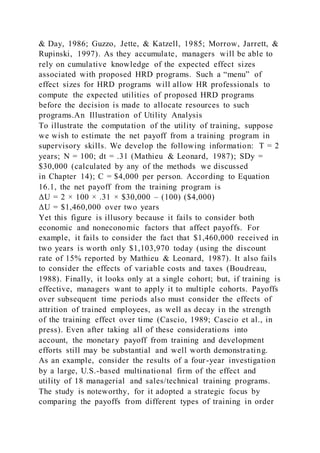
Other
(16.2)
dt=¯¯¯Xe−¯¯¯XcSD√ryydt=X¯e−X¯cSDryy
where ¯¯¯XeX¯e is the average job performance of the trained
workers (those in the experimental group), ¯¯¯XcX¯c is the
average job performance of the untrained workers (those in the
control group), SD is the standard deviation of the job
performance measure in the untrained group, and ryy is the
reliability of the job performance measure (e.g., the degree of
interrater agreement expressed as a correlation coefficient).
Equation 16.2 expresses effect size in standard-deviation units.
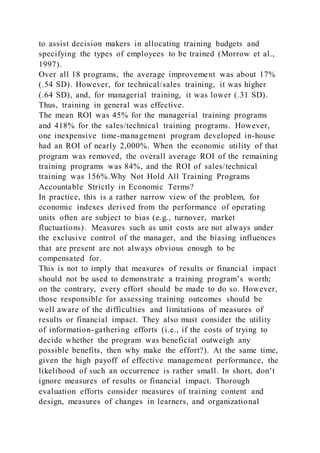
To express it as a percentage, change in performance (X), the
formula is
% change in X = dt × 100 × SDpretest/Meanpretest, (16.3)
where 100 × SDpretest/Meanpretest (the coefficient of
variation) is the ratio of the SD of pretest performance to its
mean, multiplied by 100, where performanc e is measured on a
ratio scale. Thus, to change dt into a change-in-output measure,
multiply dt by the coefficient of variation for the job in
question (Sackett, 1991).
When several studies are available, or when dt must be
estimated for a proposed human resource development (HRD)
program, dt is best estimated by the cumulated results of all
available studies, using the methods of meta-analysis. Such
studies are available in the literature (Arthur et al., 2003; Burke
& Day, 1986; Guzzo, Jette, & Katzell, 1985; Morrow, Jarrett, &
Rupinski, 1997). As they accumulate, managers will be able to
rely on cumulative knowledge of the expected effect sizes
associated with proposed HRD programs. Such a “menu” of
effect sizes for HRD programs will allow HR professionals to
compute the expected utilities of proposed HRD programs
before the decision is made to allocate resources to such
programs.An Illustration of Utility Analysis
To illustrate the computation of the utility of training, suppose
we wish to estimate the net payoff from a training program in
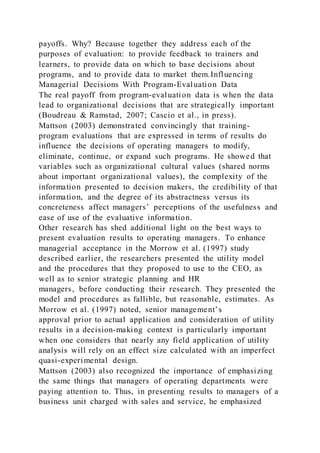
supervisory skills. We develop the following information: T = 2
years; N = 100; dt = .31 (Mathieu & Leonard, 1987); SDy =
$30,000 (calculated by any of the methods we discussed
in Chapter 14); C = $4,000 per person. According to Equation
16.1, the net payoff from the training program is
ΔU = 2 × 100 × .31 × $30,000 – (100) ($4,000)
ΔU = $1,460,000 over two years
Yet this figure is illusory because it fails to consider both
economic and noneconomic factors that affect payoffs. For
example, it fails to consider the fact that $1,460,000 received in
two years is worth only $1,103,970 today (using the discount
rate of 15% reported by Mathieu & Leonard, 1987). It also fails
to consider the effects of variable costs and taxes (Boudreau,
1988). Finally, it looks only at a single cohort; but, if training is
effective, managers want to apply it to multiple cohorts. Payoffs
over subsequent time periods also must consider the effects of
attrition of trained employees, as well as decay in the strength
of the training effect over time (Cascio, 1989; Cascio et al., in
press). Even after taking all of these considerations into
account, the monetary payoff from training and development
efforts still may be substantial and well worth demonstrating.
As an example, consider the results of a four-year investigation
by a large, U.S.-based multinational firm of the effect and
utility of 18 managerial and sales/technical training programs.
The study is noteworthy, for it adopted a strategic focus by
comparing the payoffs from different types of training in order
to assist decision makers in allocating training budgets and
specifying the types of employees to be trained (Morrow et al.,
1997).
Over all 18 programs, the average improvement was about 17%
(.54 SD). However, for technical/sales training, it was higher
(.64 SD), and, for managerial training, it was lower (.31 SD).
Thus, training in general was effective.
The mean ROI was 45% for the managerial training programs
and 418% for the sales/technical training programs. However,
one inexpensive time-management program developed in-house
had an ROI of nearly 2,000%. When the economic utility of that
program was removed, the overall average ROI of the remaining
training programs was 84%, and the ROI of sales/technical
training was 156%.Why Not Hold All Training Programs
Accountable Strictly in Economic Terms?
In practice, this is a rather narrow view of the problem, for
economic indexes derived from the performance of operating
units often are subject to bias (e.g., turnover, market
fluctuations). Measures such as unit costs are not always under
the exclusive control of the manager, and the biasing influences
that are present are not always obvious enough to be
compensated for.
This is not to imply that measures of results or financial impact
should not be used to demonstrate a training program’s worth;
on the contrary, every effort should be made to do so. However,
those responsible for assessing training outcomes should be
well aware of the difficulties and limitations of measures of
results or financial impact. They also must consider the utility
of information-gathering efforts (i.e., if the costs of trying to
decide whether the program was beneficial outweigh any
possible benefits, then why make the effort?). At the same time,
given the high payoff of effective management performance, the
likelihood of such an occurrence is rather small. In short, don’t
ignore measures of results or financial impact. Thorough
evaluation efforts consider measures of training content and
design, measures of changes in learners, and organizational
payoffs. Why? Because together they address each of the
purposes of evaluation: to provide feedback to trainers and
learners, to provide data on which to base decisions about
programs, and to provide data to market them.Influencing
Managerial Decisions With Program-Evaluation Data
The real payoff from program-evaluation data is when the data
lead to organizational decisions that are strategically important
(Boudreau & Ramstad, 2007; Cascio et al., in press).
Mattson (2003) demonstrated convincingly that training-
program evaluations that are expressed in terms of results do
influence the decisions of operating managers to modify,
eliminate, continue, or expand such programs. He showed that
variables such as organizational cultural values (shared norms
about important organizational values), the complexity of the
information presented to decision makers, the credibility of that
information, and the degree of its abstractness versus its
concreteness affect managers’ perceptions of the usefulness and
ease of use of the evaluative information.
Other research has shed additional light on the best ways to
present evaluation results to operating managers. To enhance
managerial acceptance in the Morrow et al. (1997) study
described earlier, the researchers presented the utility model
and the procedures that they proposed to use to the CEO, as
well as to senior strategic planning and HR
managers, before conducting their research. They presented the
model and procedures as fallible, but reasonable, estimates. As
Morrow et al. (1997) noted, senior management’s
approval prior to actual application and consideration of utility
results in a decision-making context is particularly important
when one considers that nearly any field application of utility
analysis will rely on an effect size calculated with an imperfect
quasi-experimental design.
Mattson (2003) also recognized the importance of emphasizing
the same things that managers of operating departments were
paying attention to. Thus, in presenting results to managers of a
business unit charged with sales and service, he emphasized
outcomes attributed to the training program in terms that were
important to those managers (volume of sales, employee-
retention figures, and improvement in customer service levels).
Clearly the “framing” of the message is critical and has a direct
effect on its ultimate acceptability.
The sections that follow cover different types of experimental
designs. This material is relevant and important for all readers,
regardless of background. Even if you are not the person who
conducts a study, but simply one who reads a report written by
someone else, the discussion of experimental designs will help
you to be a better informed, more critical, consumer of that
information.
Classical Experimental Designs
An experimental design is a plan, an outline for conceptualizing
the relations among the variables of a research study. It also
implies how to control the research situation and how to analyze
the data (Kerlinger & Lee, 2000; Mitchell & Jolley, 2013).
Experimental designs can be used with either internal or
external criteria. For example, researchers can collect “before”
measures on the job before training and collect “after” measur es
at the conclusion of training, as well as back on the job at some
time after training. Researchers use experimental designs so that
they can make causal inferences. That is, by ruling out
alternative plausible explanations for observed changes in the
outcome of interest, researchers want to be able to say that
training caused the changes.
Unfortunately, most experimental designs and most training
studies do not permit the causal arrow to point unequivocally
toward training (x) as the explanation for observed results (y)
(Eden, 2017). To do that, there are three necessary conditions
(see Shadish, Cook, & Campbell, 2002, for more on this). The
first requirement is that is that y did not occur until after x; the
second is that x and y are actually shown to be related; and the
third (and most difficult) is that other explanations of the
relationship between x and y can be eliminated as plausible
rival hypotheses.
To illustrate, consider a study by Batt (2002). The study
examined the relationship among HR practices, employee quit
rates, and organizational performance in the service sector. Quit
rates were lower in establishments that emphasized high-
involvement work systems. Batt (2002) showed that a range of
HR practices was beneficial. Does that mean that the
investments in training per se “caused” the changes in the quit
rates and sales growth? No, but Batt (2002) did not claim that
they did. Rather, she concluded that the entire set of HR
practices contributed to the positive outcomes. It was
impossible to identify the unique contribution of training alone.
In fact, Shadish et al. (2002) suggest numerous potential
contaminants or threats to valid interpretations of findings from
field research. The threats may affect the following:
· Statistical-conclusion validity—the validity of inferences
about the correlation (covariation) between treatment (e.g.,
training) and outcome
· Internal validity—the validity of inferences about whether
changes in one variable caused changes in another
· Construct validity—the validity of inferences from the
persons, settings, and cause-and-effect operations sampled
within a study to the constructs these samples represent
· External validity—the validity of inferences about the extent
to which results can be generalized across populations, settings,
and times
In the context of training, let’s consider 12 of these threats:
· History—specific events occurring between the “before” and
“after” measurements in addition to training
· Maturation—ongoing processes within the individual, such as
growing older or gaining job experience, which are a function
of the passage of time
· Testing—the effect of a pretest on posttest performance
· Instrumentation—the degree to which an instrument may
measure different attributes of an individual at two different
points in time (e.g., parallel forms of an attitude questionnaire
administered before and after training, or different raters rating
behavior before and after training)
· Statistical regression (also known as regression to the mean)—
changes in criterion scores resulting from selecting extreme
groups on a pretest
· Differential selection—using different procedures to select
individuals for experimental and control groups
· Attrition—differential loss of respondents from various groups
· Interaction of differential selection and maturation—that is,
assuming experimental and control groups were different to
begin with, the disparity between groups is compounded further
by maturational changes occurring during the training period
· Interaction of pretest with the experimental variable—during
the course of training, something reacts with the pretest in such
a way that the pretest has a greater effect on the trained group
than on the untrained group
· Interaction of differential selection with training—when more
than one group is trained, differential selection implies that the
groups are not equivalent on the criterion variable (e.g., skill in
using a computer) to begin with; therefore, they may react
differently to the training
· Reactive effects of the research situation—that is, the research
design itself so changes the trainees’ expectations and reactions
that one cannot generalize results to future applications of the
training
· Multiple-treatment interference—residual effects of previous
training experiences affect trainees differently (e.g., finance
managers and HR managers might not react comparably to a
human relations training program because of differences in their
previous training)
Table 16.1 presents examples of several experimental designs.
These designs are by no means exhaustive; they merely
illustrate the different kinds of inferences that researchers may
draw and, therefore, underline the importance of considering
experimental designs before training.
Design A
Design A, in which neither the experimental nor the control
group receives a pretest, has not been used widely in training
research. This is because the concept of the pretest is deeply
ingrained in the thinking of researchers, although it is not
essential to true experimental designs (Campbell & Stanley,
1963). We hesitate to give up “knowing for sure” that
experimental and control groups were, in fact, “equal” before
training, even though the most adequate all-purpose assurance
of lack of initial biases between groups is randomizatio n
(Highhouse, 2009). Within the limits of confidence stated by
tests of significance, randomization can suffice without the
pretest (Campbell & Stanley, 1963, p. 25).
Design A controls for testing as main effect and interaction, but
it does not measure them. Although such measurement is
tangential to the real question of whether training did or did not
produce an effect, the lack of pretest scores limits the ability to
generalize, since it is impossible to examine the possible
interaction of training with pretest ability level. In most
organizational settings, however, variables such as job
experience, age, or job performance are available either to use
as covariates or to “block” subjects—that is, to group them in
pairs matched on those variable(s) and then randomly to assign
one member of each pair to the experimental group and the
other to the control group. Both of these strategies increase
statistical precision and make posttest differences more
meaningful. In short, the main advantage of Design A is that it
avoids pretest bias and the “give-away” repetition of identical
or highly similar material (as in attitude-change studies), but
this advantage is not without costs. For example, it does not
prevent subjects from maturing or regressing; nor does it
prevent events other than treatment (such as history) from
occurring after the study begins (Shadish et al., 2002). That
said, when it is relatively costly to bring participants to an
evaluation and administration costs are particularly high, after -
only measurement of trained and untrained groups is best
(Kraiger, McLinden, & Casper, 2004).
Table 16.1 Experimental Designs Assessing Training and
Development Outcomes
A
B
C
D
After-Only (One Control Group)
Before–After (No Control Group)
Before–After
(One Control Group)
Solomon Four–Group Design
Before–After (Three Control Groups)
E
C
E
E
C
E C1 C2C3
Pretest
No
No
Yes
Yes
Yes
Yes Yes No No
Training
Yes
No
Yes
Yes
No
Yes No Yes No
Posttest
Yes
Yes
Yes
Yes
Yes
Yes Yes Yes Yes
Note: E refers to the experimental group. C refers to the control
group.
Design B
The defining characteristic of Design B is that it compares a
group with itself. In theory, there is no better comparison, since
all possible variables associated with characteristics of the
subjects are controlled. In practice, however, when the objective
is to measure change, Design B is fraught with difficulties, for
numerous plausible rival hypotheses might explain changes in
outcomes. History is one. If researchers administer pre- and
posttests on different days, then events in between may have
caused any difference in outcomes. Although the history effect
is trivial if researchers administer pre- and posttests within a
one- or two-hour period, it becomes more and more plausible as
an alternative explanation for change as the time between pre-
and posttests lengthens.
Aside from specific external events, various biological or
psychological processes that vary systematically with time (i.e.,
maturation) also may account for observed differences. Hence,
between pre- and posttests, trainees may have grown hungrier,
more fatigued, or bored. “Changes” in outcomes simply may
reflect these differences.
Moreover, the pretest itself may change that which is being
measured. Hence, just the administration of an attitude
questionnaire may change an individual’s attitude; a manager
who knows that his sales-meeting conduct is being observed and
rated may change the way he behaves. In general, expect this
reactive effect whenever the testing process is itself a stimulus
to change rather than a passive record of behavior. The lesson is
obvious: Use nonreactive measures whenever possible (cf.
Rosnow & Rosenthal, 2008; Webb, Campbell, Schwartz, &
Sechrest, 2000).
Instrumentation is yet a fourth uncontrolled rival hypothesis i n
Design B. If different raters do pre- and posttraining
observation and rating, this could account for observed
differences.
A fifth potential contaminant is statistical regression (i.e., less -
than-perfect pretest–posttest correlations) (Furby, 1973;
Kerlinger & Lee, 2000). This is a possibility whenever a
researcher selects a group for training because of its extremity
(e.g., all low scorers or all high scorers). Statistical regression
has misled many a researcher time and again. The way it works
is that lower scores on the pretest tend to be higher on the
posttest and higher scores tend to be lower on the posttest when,
in fact, no real change has taken place. This can deceive a
researcher into concluding erroneously that a training program
is effective (or ineffective). In fact, the higher and lower scores
of the two groups may be due to the regression effect.
A control group allows one to “control” for the regression
effect, since both the experimental and the control groups have
pretest and posttest scores. If the training program has had a
“real” effect, then it should be apparent over and above the
regression effect. That is, both groups should be affected by the
same regression and other influences, other things equal. So, if
the groups differ in the posttest, it should be due to the training
program (Kerlinger & Lee, 2000). The interaction effects
(selection and maturation, testing and training, and selection
and training) are likewise uncontrolled in Design B.
Despite all of the problems associated with Design B, it is still
better to use it to assess change (together with a careful
investigation into the plausibility of various threats), if that is
the best one can do, than to do no evaluation. After all,
organizations will make decisions about future training efforts
with or without evaluation data (Kraiger et al., 2004; Sackett &
Mullen, 1993). Moreover, if the objective is to measure
individual achievement (a targeted level of performance),
Design B can address that.
Design C
Design C (before–after measurement with a single control
group) is adequate for most purposes, assuming that the
experimental and control sessions are run simultaneously.
Control is indispensable to the experimental method (Eden,
2017) and this design controls history, maturation, and testing
insofar as events that might produce a pretest–posttest
difference for the experimental group should produce similar
effects in the control group. We can control instrumentation
either by assigning observers randomly to single sessions (when
the number of observers is large) or by using each observer for
both experimental and control sessions and ensuring that they
do not know which subjects are receiving which treatments.
Random assignment of individuals to treatments serves as an
adequate control for regression or selection effects. Moreover,
the data available for Design C enable a researcher to tell
whether experimental mortality is a plausible explanation for
pretest–posttest gain.
Information concerning interaction effects (involving training
and some other variable) is important because, when present,
interactions limit the ability to generalize results—for example,
the effects of the training program may be specific only to those
who have been “sensitized” by the pretest. In fact, when highly
unusual test procedures (e.g., certain attitude questionnaires or
personality measures) are used or when the testing procedure
involves deception, surprise, stress, and the like, designs having
groups that do not receive a pretest (e.g., Design A) are highly
desirable, if not essential (Campbell & Stanley, 1963; Rosnow
& Rosenthal, 2008). In general, however, successful
replication of pretest–posttest changes at different times and in
different settings increases our ability to generalize by making
interactions of training with selection, maturation,
instrumentation, history, and so forth less likely.
To compare experimental and control group results in Design C,
either use analysis of covariance with pretest scores as the
covariate, or analyze “change” scores for each group (Cascio &
Kurtines, 1977; Cronbach & Furby, 1970; Edwards, 2002).
Design D
The most elegant of experimental designs, the Solomon (1949)
four-group design (Design D), parallels Design C except that it
includes two additional control groups (lacking the pretest).
C2 receives training plus a posttest; C3receives only a posttest.
In this way, one can determine both the main effect of testing
and the interaction of testing with training. The four-group
design allows substantial increases in the ability to generalize,
and, when training does produce changes in criterion
performance, this effect is replicated in four different ways:
1. For the experimental group, posttest scores should be greater
than pretest scores.
2. For the experimental group, posttest scores should be greater
than C1 posttest scores.
3. C2 posttest scores should be greater than C3 posttest scores.
4. C2 posttest scores should be greater than C1 pretest scores.
If data analysis confirms these directional hypotheses, thi s
increases substantially the strength of inferences that can be
drawn on the basis of this design. Moreover, by comparing
C3 posttest scores with experimental-group pretest scores and
C1 pretest scores, one can evaluate the combined effect of
history and maturation.
Statistical analysis of the Solomon four-group design is not
straightforward, since there is no one statistical procedure that
makes use of all the data for all four groups simultaneously.
Since all groups do not receive a pretest, the use of analysis of
variance of gain scores (gain = posttest – pretest) is out of the
question. Instead, consider a simple 2 × 2 analysis of variance
of posttest scores (Solomon, 1949):
No Training
Training
Pretested
C1
E
Not Pretested
C3
C2
Estimate training main effects from column means, estimate
pretesting main effects from row means, and estimate
interactions of testing with training from cell means.
Despite its apparent advantages, the Solomon four-group design
is not without theoretical and practical problems (Bond, 1973;
Kerlinger & Lee, 2000). For example, it assumes that the simple
passage of time and training experiences affect all posttest
scores independently. However, some interaction between these
two factors is inevitable, thus jeopardizing the significance of
comparisons between posttest scores for C3 and pretest scores
for E and C1.
Serious practical problems also may emerge. The design
requires large numbers of persons in order to represent each
group adequately and to generate adequate statistical power. For
example, in order to have 30 individuals in each group, the
design requires 120 participants. This may be impractical or
unrealistic in many settings.
Here is a practical example of these constraints (Sprangers &
Hoogstraten, 1989). In two field studies of the impact of
pretesting on posttest responses, the researchers used
nonrandom assignment of 37 and 58 subjects in a Solomon four -
group design. Their trade-off of low statistical power for greater
experimental rigor illustrates the extreme difficulty of applying
this design in field settings.
A final difficulty lies in the application of the four-group
design. Solomon (1949) has suggested that, after the value of
the training is established using the four groups, the two control
groups that did not receive training then could be trained, and
two new groups could be selected to act as controls. In effect,
this would replicate the entire study—but would it? Sound
experimentation requires that conditions remain constant, but it
is quite possible that the first training program may have
changed the organization in some way, so that those who enter
the second training session already have been influenced.
Cascio (1976a) showed this empirically in an investigation of
the stability of factor structures in the measurement of attitudes.
The factor structure of a survey instrument designed to provide
a baseline measure of managerial attitudes toward African
Americans in the working environment did not remain constant
when compared across three different samples of managers from
the same company at three different time periods. During the
two-year period that the training program ran, increased societal
awareness of EEO, top management emphasis of it, and the fact
that over 2,200 managers completed the training program
probably altered participants’ attitudes and expectations even
before the training began.
Despite its limitations, when it is possible to apply the Solomon
four-group design realistically, to assign subjects randomly to
the four groups, and to maintain proper controls, this design
controls most of the sources of invalidity that it is possible to
control in one experimental design. Table 16.2 presents a
summary of the sources of invalidity for Designs A through D.
Limitations of Experimental Designs
Having illustrated some of the nuances of experimental design,
let’s pause for a moment to place design in its proper
perspective. First, exclusive emphasis on the design aspects of
measuring training outcomes is rather narrow in scope. An
experiment usually settles on a single criterion dimension, and
the whole effort depends on observations of that dimension
(Newstrom, 1978; Weiss & Rein, 1970). Hence, experimental
designs are quite limited in the amount of information they can
provide. There is no logical reason for investigators to consider
just a single criterion dimension, but this is usually what
happens. Ideally, an experiment should be part of a continuous
feedback process rather than just an isolated event or
demonstration (Shadish et al., 2002; Snyder et al., 1980).
Table 16.2 Source of Invalidity for Experimental Designs A
Through D
Note: A “+” indicates that the factor is controlled, a “-”
indicates that the factor is not controlled, a “?” indicates
possible source of concern, and a blank indicates that the factor
is not relevant. See text for appropriate qualifications regarding
each design.
Second, meta-analytic reviews have demonstrated that effect
sizes obtained from single-group pretest–posttest designs
(Design B) are systematically higher than those obtained from
control or comparison-group designs (Carlson & Schmidt, 1999;
Lipsey & Wilson, 1993). Type of experimental design therefore
moderates conclusions about the effectiveness of training
programs. Fortunately, corrections to mean effect sizes for data
subgrouped by type of dependent variable (differences are most
pronounced when the dependent variable is knowledge
assessment) and type of experimental design can account for
most such biasing effects (Carlson & Schmidt, 1999).
Third, it is important to ensure that any attempt to measure
training outcomes through the use of an experimental design has
adequate statistical power. Power is the probability of correctly
rejecting a null hypothesis when it is false (Murphy & Myors,
2003). Research indicates that the power of training-evaluation
designs is a complex issue, for it depends on the effect size
obtained, the reliability of the dependent measure, the
correlation between pre- and posttest scores, the sample size,
and the type of design used (Arvey, Cole, Hazucha, & Hartanto,
1985). Software that enables straightforward computation of
statistical power and confidence intervals (Power & Precision,
2000) should make power analysis a routine component of
training-evaluation efforts.
Finally, experiments often fail to focus on the real goals of an
organization. For example, experimental results may indicate
that job performance after treatment A is superior to
performance after treatment B or C. The really important
question, however, may not be whether treatment A is more
effective, but rather what levels of performance we can expect
from almost all trainees at an acceptable cost and the extent to
which improved performance through training “fits” the broader
strategic thrust of an organization. Box 16.1 is a practical
illustration of a true field experiment.Box 16.1 Practical
Illustration: A True Field Experiment With a Surprise Ending
The command teams of 18 logistics units in the Israel Defense
Forces were assigned randomly to experimental and control
conditions. Each command team included the commanding
officer of the unit plus subordinate officers, both commissioned
and noncommissioned. The command teams of the nine
experimental units underwent an intensive three-day team-
development workshop. The null hypothesis was that the
workshops had no effect on team or organizational functioning
(Eden, 1985).
The experimental design provided for three different tests of the
hypothesis, in ascending order of rigor. First, a Workshop
Evaluation Questionnaire was administered to team members
after the workshop to evaluate their subjective reactions to its
effectiveness.
Second, Eden (1985) assessed the before-and-after perceptions
of command team members in both the experimental and the
control groups by means of a Team Development Questionnaire,
which included ratings of the team leader, subordinates, team
functioning, and team efficiency. This is a true experimental
design (Design C), but its major weakness is that the outcomes
of interest were assessed in terms of responses from team
members who personally had participated in the workshops.
This might well lead to positive biases in the responses.
To overcome this problem, Eden used a third design. He
selected at random about 50 subordinates representing each
experimental and control unit to complete the Survey of
Organizations both before and after the team-development
workshops. This instrument measures organizational functioning
in terms of general management, leadership, coordination,
three-way communications, peer relations, and satisfaction.
Since subordinates had no knowledge of the team-development
workshops and therefore no ego involvement in them, this
design represents the most internally valid test of the
hypothesis. Moreover, since an average of 86% of the
subordinates drawn from the experimental-group units
completed the posttraining questionnaires, as did an average of
81% of those representing control groups, Eden could rule out
the effect of attrition as a threat to the internal validity of the
experiment. Rejection of the null hypothesis would imply that
the effects of the team-development effort really did affect the
rest of the organization.
To summarize: Comparison of the command team’s before-and-
after perceptions tests whether the workshop influenced the
team; comparison of the subordinates’ before-and-after
perceptions tests whether team development affected the
organization. In all, 147 command-team members and 600
subordinates completed usable questionnaires.
Results
Here’s the surprise: Only the weakest test of the hypothesis, the
postworkshop reactions of participants, indicated that the
training was effective. Neither of the two before-and-after
comparisons detected any effects, either on the team or on the
organization. Eden (1985) concluded:
The safest conclusion is that the intervention had no impact.
This disconfirmation by the true experimental designs bares the
frivolity of self-reported after-only perceptions of change. Rosy
testimonials by [trainees] may be self-serving, and their validity
is therefore suspect. (p. 98)
Quasi-Experimental Designs
In field settings, there often are major obstacles to conducting
true experiments. True experiments require the manipulation of
at least one independent variable, the random assignment of
participants to groups, and the random assignment of treatments
to groups (Kerlinger & Lee, 2000). Managers may disapprove of
the random assignment of people to conditions. Line managers
do not see their subordinates as interchangeable, like pawns on
a chessboard, and they often distrust randomness in
experimental design. Beyond that, some managers see training
evaluation as disruptive and expensive. Eden (2017) offered
eight strategies for overcoming deterrents to field
experimentation, including the avoidance of jargon,
explaining randomization to lay managers, transforming
proprietary data, and using emerging technologies, such as
experience sampling (Beal, 2015).
Despite calls for more rigor in training-evaluation designs
(Littrell, Salas, Hess, Paley, & Riedel, 2006; Shadish & Cook,
2009; Wang, 2002), some less-complete (i.e., quasi-
experimental) designs can provide useful data even though a
true experiment is not possible (Grant & Wall, 2009). What
makes them “quasi” is their lack of randomly created,
preexperimental equivalence, which degrades internal validity
(Eden, 2017). Shadish et al. (2002) offered a number of quasi -
experimental designs with the following rationale: The central
purpose of an experiment is to eliminate alternative hypotheses
that also might explain results. If a quasi-experimental design
can help eliminate some of these rival hypotheses, then it may
be worth the effort.
Because full experimental control is lacking in quasi-
experiments, it is important to know which specific variables
are uncontrolled in a particular design (cf. Tables
16.2 and 16.3). Investigators should, of course, design the very
best experiment possible, given their circumstances, but where
full control is not possible, they should use the most rigorous
design that is possible. For these reasons, we present four quasi-
experimental designs, together with their respective sources of
invalidity, in Table 16.3.
Table 16.3 Source of Invalidity for Four Quasi–Experimental
DesignsDesign E
The time-series design is especially relevant for assessing the
outcomes of training and development programs. It uses a single
group of individuals and requires that criterion data be collected
at several points in time, both before and after training.
Criterion measures obtained before the introduction of the
training experience then are compared to those obtained after
training. A curve relating criterion scores to time periods may
be plotted, and, in order for an effect to be demonstrated, there
should be a discontinuity or change in the series of measures,
corresponding to the training program, that does not occur at
any other point. This discontinuity may represent an abrupt
change either in the slope or in the intercept of the curve. The
time-series design is frequently used to evaluate training
programs that focus on improving readily observable outcomes,
such as accident rates, productivity, and absenteeism. By
incorporating a large number of observations pre- and
posttraining, it allows researchers to analyze the stability of
training outcomes over time. To rule out alternative
explanations for evaluation results, consider using comparison
groups or reversal (a time period where participants no longer
receive the intervention) (Noe, 2017).
Design F
Another makeshift experimental design, Design F, is
the nonequivalent control-group design. Although Design F
appears identical to Design C (before–after measurement with
one control group), there is a critical difference: In Design F,
individuals from a common population are not assigned
randomly to the experimental and control groups. This design is
common in applied settings where naturally occurring groups
must be used (e.g., work group A and work group B). Design F
is especially appropriate when Designs A and C are impossible
because even the addition of a nonequivalent control group
makes interpretation of the results much less ambiguous than in
Design B, the single-group pretest–posttest design. Needless to
say, the nonequivalent control group becomes much more
effective as an experimental control as the similarity between
experimental and control-group pretest scores increases. Box
16.2 illustrates the hazards of nonequivalent designs.
The major sources of invalidity in this design are the selection-
maturation interaction and the testing-training interaction. For
example, if the experimental group happens to consist of young,
inexperienced workers and the control group consists of older,
highly experienced workers who are tested and retested, a gain
in criterion scores that appears specific to the experimental
group might well be attributed to the effects of training when,
in fact, the gain would have occurred even without training.
Regression effects pose a further threat to unambiguous
inferences in Design F. This is certainly the case when
experimental and control groups are “matched” (which is no
substitute for randomization), yet the pretest means of the two
groups differ substantially. When this happens, changes in
criterion scores from pretest to posttest may well be due to
regression effects, not training. Despite these potential
contaminants, we encourage increased use of Design F,
especially in applied settings. Be aware of potential
contaminants that might make results equivocal, and attempt to
control them as much as possible. That said, do not assume that
statistical control after the experiment has been conducted can
substitute for random assignment to treatments (Carlson & Wu,
2012).
Box 16.2 Practical Illustration: The Hazards of Nonequivalent
Designs
The hazards of nonequivalent designs are illustrated neatly in
the evaluations of a training program designed to improve the
quality of group decisions by increasing the decision-making
capabilities of its members. A study by Bottger and Yetton
(1987) that demonstrated the effectiveness of this approach used
experimental and control groups whose pretest scores differed
significantly. When Ganster, Williams, and Poppler (1991)
replicated the study using a true experimental design (Design C)
with random assignment of subjects to groups, the effect
disappeared.
Design G
We noted earlier that many managers reject the notion of
random assignment of participants to training and no-training
(control) groups. A type of design that those same managers
may find useful is the nonequivalent dependent variable design
(Shadish et al., 2002) or “internal referencing” strategy
(Haccoun & Hamtieux, 1994). The design is based on a single
treatment group and compares two sets of dependent variables —
one that training should affect (experimental variables), and the
other that training should not affect (control variables). Design
G can be used whenever the evaluation is based on some kind of
performance test.
Perhaps the major advantage of this design is that it effectively
controls two important threats to internal validity: testing and
the Hawthorne effect (i.e., simply reflecting on one’s behavior
as a result of participating in training could produce changes in
behavior). Another advantage, especially over a nonequivalent
control-group design (Design F), is that there is no danger that
an unmeasured variable that differentiates the nonequivalent
control group from the trained group might interact with the
training. For example, it is possible that self-efficacy might be
higher in the nonequivalent control group because volunteers
for such a control group may perceive that they do not need the
training in question (Frese et al., 2003).
Design G does not control for history, maturation, and
regression effects, but its most serious potential disadvantage is
that the researcher is able to control how difficult or easy it is
to generate significant differences between the experimental and
control variables. The researcher can do this by choosing
variables that are very different from or similar to those that are
trained.
To avoid this problem, choose control variables that are
conceptually similar to, but distinct from, those that are trained.
For example, in a program designed to teach inspirational
communication of a vision as part of training in charismatic
leadership, Frese et al. (2003) included the following as part of
set of experimental (trained) items: variation of speed, variation
of loudness, and use of “we.” Control (untrained) items
included, among others, the following: combines serious/ factual
information with witty and comical, examples from practice,
and good organization, such as a, b, and c. The control items
were taken from descriptions of two training seminars on
presentation techniques. A different group of researchers
independently coded them for similarity to inspirational speech,
and the researchers chose items coded to be least similar.
Before–after coding of behavioral data indicated that
participants improved much more on the trained variables than
on the untrained variables (effect sizes of about 1.0 versus .3).
This suggests that training worked to improve the targeted
behaviors but did not systematically influence the untargeted
behaviors. At the same time, we do not know if there were long-
term, objective effects of the training on organizational
performance or on the commitment of subordinates.
Design H
A final quasi-experimental design, appropriate for cyclical
training programs, is known as the recurrent institutional cycle
design. It is Design H in Table 16.3. For example, a large
sales organization presented a management development
program, known as the State Manager Program, every two
months to small groups (12–15) of middle managers (state
managers). The one-week program focused on all aspects of
retail sales (e.g., new product development, production,
distribution, marketing, merchandising). The program was
scheduled so that all state managers (approximately 110) could
be trained over an 18-month period. This is precisely the type of
situation for which Design H is appropriate—that is, a large
number of persons will be trained, but not all at the same time.
Different cohorts are involved. Design H is actually a
combination of two (or more) before–after studies that occur at
different points in time. Group I receives a pretest at time 1,
then training, and then a posttest at time 2. At the same
chronological time (time 2), Group II receives a pretest,
training, and then a posttest at time 3. At time 2, therefore, an
experimental and a control group have, in effect, been created.
One can obtain even more information (and with quasi-
experimental designs, it is always wise to collect as much data
as possible or to demonstrate the effect of training in several
different ways) if it is possible to measure Group I again at time
3 and to give Group II a pretest at time 1. This controls the
effects of history. Moreover, the time 3 data for Groups I and II
and the posttests for all groups trained subsequently provide
information as to how the training program is interacting with
other organizational events to produce changes in the criterion
measure.
Several cross-sectional comparisons are possible with the cycle
design:
· Group I posttest scores at time 2 can be compared with Group
II pretest scores at time 2.
· Gains made in training for Group I (time 2 posttest scores) can
be compared with gains in training for Group II (time 3 posttest
scores).
· Group II posttest scores at time 3 can be compared with Group
I posttest scores at time 3 (i.e., gains in training versus gains
[or no gains] during the no-training period).
This design controls history and test–retest effects but not
differences in selection. One way to control for possible
differences in selection, however, is to split one of the groups
(assuming it is large enough) into two equated samples, one
measured both before and after training and the other measured
only after training:
Time 2
Time 3
Time 4
Group IIa
Measure
Train
Measure
Group IIb
—
Train
Measure
Comparison of the posttest scores of two carefully equated
groups (Groups IIa and IIb) is more precise than a similar
comparison of posttest scores of two unequated groups (Groups
I and II).
A final deficiency in the cycle design is the lack of adequate
control for the effects of maturation. This is not a serious
limitation if the training program is teaching specialized skills
or competencies, but it is a plausible rival hypothesis when the
objective of the training program is to change attitudes.
Campbell and Stanley (1963) expressed aptly the logic of these
makeshift designs:
[O]ne starts out with an inadequate design and then adds
specific features to control for one or another of the recurrent
sources of invalidity. The result is often an inelegant
accumulation of precautionary checks, which lacks the intrinsic
symmetry of the “true” experimental designs, but nonetheless
approaches experimentation. (p. 57)
Other quasi-experimental designs (cf. Grant & Wall, 2009;
Kerlinger & Lee, 2000; Shadish et al., 2002) are appropriate in
specialized situations, but the ones we have discussed seem well
suited to the types of problems that applied researchers are
likely to encounter.
Statistical, Practical, and Theoretical Significance
As in selection, the problem
of statistical versus practical significance is relevant for the
assessment of training outcomes. Demonstrations of statistically
significant change scores may mean little in a practical sense.
From a practical perspective, researchers must show that the
effects of training do make a difference to organizational
goals—in terms of lowered production costs, increased sales,
fewer grievances, and so on. Practical significance typically is
reflected in terms of effect sizes or measures of variance
accounted for (Grissom & Kim, 2014; Schmidt & Hunter, 2014).
A related issue concerns the relationship between practical and
theoretical significance. Training researchers frequently are
content to demonstrate only that a particular program “works”—
the prime concern being to sell the idea to top management or to
legitimize an existing (perhaps substantial) investment in a
particular development program. This is only half the story. The
real test is whether the new training program is superior to
previous or existing methods for accomplishing the same
objectives. To show this, firms need systematic research to
evaluate the effects of independent variables that are likely to
affect training outcomes—for example, different training
methods, different depths of training, or different types of
media for presenting training.
If researchers adopt this two-pronged approach to measuring
training outcomes and if they can map the effects of relevant
independent variables across different populations of trainees
and across different criteria, then the assessment takes on
theoretical significance. For example, using meta-analysis,
Arthur et al. (2003) found medium-to-large effect sizes for
organizational training (sample-weighted average effect sizes of
.60 for reaction criteria, .63 for measures of learning, and .62
for measures of behavior or results). Other organizations and
other investigators may use this knowledge to advantage in
planning their own programs. The concept of statistical
significance, while not trivial, in no sense guarantees practical
or theoretical significance—the major issues in outcome
measurement.
Logical Analysis
Experimental control is but one strategy for responding to
criticisms of the internal or statistical conclusion validity of a
research design (Eden, 2017; McLinden, 1995; Sackett &
Mullen, 1993). A logical analysis of the process and content of
training programs can further enhance our understanding
of why we obtained the results we did. As we noted earlier, both
qualitative and quantitative criteria are important for a thorough
understanding of training effects. Here are some qualitative
issues to consider:
· Were the goals of the training clear both to the organization
and to the trainees?
· Were the methods and content of the training relevant to the
goals?
· Were the proposed methods used and the proposed content
taught?
· Did it appear that learning was taking place?
· Does the training program conflict with any other program in
the organization?
· What kinds of criteria should be expected to show change as a
result of the training?
For every one of these questions, supplement the subjective
opinions of experts with objective data. For example, to provide
broader information regarding the second question, document
the linkage between training content and job content. A
quantitative method is available for doing this (Bownas,
Bosshardt, & Donnelly, 1985). It generates a list of tasks that
receive undue emphasis in training, those that are not being
trained, and those that instructors intend to train but that
graduates report being unable to perform. It proceeds as
follows:
1. Identify curriculum elements in the training program.
2. Identify tasks performed on the job.
3. Obtain ratings of the emphasis given to each task in training,
of how well it was learned, and of its corresponding importance
on the job.
4. Correlate the two sets of ratings—training emphasis and job
requirements—to arrive at an overall index of fit between
training and job content.
5. Use the ratings of training effectiveness to identify tasks that
appear to be over- or underemphasized in training.
Confront these kinds of questions during program
planning and evaluation. When integrated with responses to the
other issues presented earlier in this chapter, especially the
“systems” aspects of training impact, training outcomes become
much more meaningful. This is the ultimate payoff of the
measurement effort.
In Chapter 17, we continue our presentation by examining
emerging international issues in applied psychology and talent
management. We begin by considering the growth of HR
management issues across borders.
Evidence-Based Implications for Practice
· Numerous training methods and techniques are available, but
each one can be effective only if it is used appropriately. To do
that, first define what trainees are to learn, and only then
choose a particular method that best fits these requirements.
· In evaluating training outcomes, be clear about your purpose.
Three general purposes are to provide feedback to trainers and
learners, to provide data on which to base decisions about
programs, and to provide data to market them.
· Use quantitative as well as qualitative measures of training
outcomes. Each provides useful information.
· Regardless of the measures used, the overall goal is to be able
to make meaningful inferences and to rule out alternative
explanations for results. To do that, it is important to administer
the measures according to some logical plan or procedure
(experimental or quasi-experimental design). Be clear about
what threats to valid inference your design controls for and fails
to control for.
· No less important is a logical analysis of the process and
content of training programs, for it can enhance understanding
of why we obtained the results we did.
Company Background Packet
Proprietary & Confidential 2
Copyright © Real Time Cases

 05252018
All Rights Reserved. 

The content of this document and accompanying videos may not
be reproduced or distributed
without the express written consent of Real Time Cases Inc.
Users acknowledge that the
document and accompanying case videos, and all copyright and
other intellectual and
proprietary rights therein, are and at all times, shall remain the
property of Real Time Cases
Inc. and its licensors, and their respective assignees. Users
agree to respect and not to alter,
remove, or conceal any copyright, trademark, trade name, or
other proprietary marking that
appears in this document.
Proprietary & Confidential 3
COMPANY PROFILE
............................................................... 4
Leadership Team
.............................................................................4
About Chef José Andrés
..................................................................5
About ThinkFoodGroup
....................................................................5
About Beefsteak
...............................................................................5
History and Development
............................................................... 11
THE BUSINESS MODEL .......................................................
12
The Restaurant Industry: Fast-Casual Segment
............................ 13
Proprietary & Confidential 4
Company Profile
Company Name: Beefsteak LLC
Location: Washington, DC
Founded: March 2015
Website: Beefsteakveggies.com
Holding Type: Subsidiary of ThinkFoodGroup
Company Size: 5 Beefsteak locations
Estimated Valuation: N/A
Industry: Restaurant Industry, Fast-Casual Segment
Leadership Team
José Andrés
President, ThinkFoodGroup
Jim Biafore
Senior Director of Beefsteak
Kimberly Grant
CEO, ThinkFoodGroup
Michael Doneff
CMO, Beefsteak
Proprietary & Confidential 5
About Chef José Andrés1
Named to Time’s “100” Most Influential list and awarded
“Outstanding Chef” by the James
Beard Foundation, José Andrés is an internationally-recognized
culinary innovator, passionate
advocate for food and hunger issues, author, educator,
television personality and chef/owner
of ThinkFoodGroup. José and his TFG team are renowned for a
host of celebrated dining
concepts in Washington, DC, Las Vegas, Los Angeles, Miami
and Puerto Rico, including
minibar by José Andrés, Jaleo, Oyamel, Zaytinya and the Bazaar
by José Andrés at SLS
Hotels in Beverly Hills, Las Vegas and South Beach.2
Having fed millions of people in his restaurants over the past 20
years, José and his team are
always exploring the endless possibilities of what food —
amazing, delicious, fresh food — can
do for the world. Uniting that mission with his fervent passion
for vegetables, José conceived of
Beefsteak as a way to unleash their potential to feed many
millions more.
About ThinkFoodGroup
ThinkFoodGroup (TFG) is the innovative company of more than
1000 diverse individuals
behind José Andrés’ restaurants, hotels, food products, media,
educational initiatives and
philanthropy. Together with partner Rob Wilder, he pursues the
mission of changing the world
through the power of food. Since 1993, TFG restaurants reflect
the authentic roots of each
concept, and showcase José's passion for telling the stories of a
culture through food.
José Andrés is an internationally-recognized culinary innovator,
author, educator, television
personality, humanitarian and chef/owner of ThinkFoodGroup.
A pioneer of Spanish tapas in
the United States, he is also known for his groundbreaking
avant-garde cuisine. Andrés’
award-winning group of restaurants includes locations in
Washington D.C., Miami, Puerto
Rico, Las Vegas, and Los Angeles, as well as in Mexico City,
his first location outside the
United States. He is a committed advocate on food and hunger
issues and is known for
championing the role of chefs in the national debate on food
policy.3 See a historical timeline of
José’s remarkable career with TFG.
About Beefsteak
When Chef José Andrés contracted Brosmind to sketch the
thematic artwork4 to adorn the
walls of Beefsteak, a new fast-casual concept featuring veggies,
he clearly did not want to
mention the obvious boring facts about vegetables, i.e., healthy,
vegan and vegetarian, etc. As
José takes a first peek at the art concept, he says in a video5, “I
wanted to create a universe of
vegetables where they were happy, misbehaving, some of them
beautiful, some ugly; always
having fun, loving each other at times, crying, laughing,
attacking the meat world.” He wanted
to show that vegetables are sexy, even unbelievable, and we do
not understand enough about
them and our relationship with vegetables can be much more
meaningful. Beefsteak has
profound ambitions for José’s first foray into what Americans
call fast-casual. It seems José
1 http://www.joseandres.com/en_us/bio Biography. About José
Andrés
2 See more about José and a chronology of his TFG restaurant
launches: http://www.Joséandres.com/en_us/bio
3 http://www.joseandres.com/en_us/bio Biography. About José
Andrés
4 See Exhibit 1.
5 See José’s reaction to Brosmind’s artistic depiction of the
Beefsteak mission to rethink our relationship with vegetables
http://www.joseandres.com/en_us/bio
https://www.youtube.com/watch?v=KOdb0G-8wZY
http://www.joseandres.com/en_us/bio
Proprietary & Confidential 6
and the TFG team has managed to extend the brand to concepts
running the gamut from fast-
casual and even a Food Truck up to José’s high-end
establishments, such as the elite,
luxurious fine dining experience of José’s minibar.6
Single Concepts:
• Oyamel (contemporary Mexican cuisine)
• Zaytinya (a mezze-inspired menu)
• Minibar by José Andrés (molecular gastronomy at its highest
level)
• Barmini by José Andrés (a cutting-edge bar within minibar)
• Pepe, the Food Truck (featuring Spanish flauta sandwiches)
• Tres (bistro comfort food with a twist at the SLS Beverly Hills
Hotel)
• Saam (a multicourse tasting menu)
• China Poblano (a blend of Chinese and Mexican in The
Cosmopolitan of Las Vegas)
• e by José Andrés (Spanish avant-garde dishes at The
Cosmopolitan of Las Vegas)
• Hyde Beach (a nightlife experience for the elite)
• Mi Casa (Spanish and island flavors at the Ritz-Carlton
Reserve, Puerto Rico)
• America Eats Tavern (American classics in Tysons Corner,
VA)
Multiple locations:
• Jaleo (the flavors of Spain in Washington, DC, Bethesda, MD,
Crystal City, VA, Las Vegas)
• The Bazaar by José Andrés (reimagined Spanish cuisine at the
SLS Hotel in Beverly Hills and
Miami Beach)
• Beefsteak (Vegetables, unleashed. Launched at GWU in DC
reaching a total of five locations in
2016 around DC and Philadelphia)
Exhibit 1: Beefsteak theme artwork, by Brosmind.
Source: http://beefsteakveggies.com
6 https://www.youtube.com/watch?v=X0NOdsZlM1U
https://www.youtube.com/watch?v=X0NOdsZlM1U
Proprietary & Confidential 7
A Bold New Concept from Chef José Andrés
Beefsteak is fast, crave-worthy food
created by one of America’s most
respected chefs. The food brings the
culinary craft into the everyday, lovingly
cooked to order and tailor made for
today’s busy lifestyles. We’re not
vegetarian, but we put veggies center
stage, showcasing their complexity,
flavor, and natural, amazing
deliciousness.
Exhibit 2: Customers ordering inside Beefsteak
Source: http://beefsteakveggies.com/category/press/
Fresh, Market-Drive Vegetables Take Center Stage
Beefsteak celebrates the incredible, unsung power of
vegetables, showcasing the season’s
best and year-round favorites to create a hearty, oh-so-delicious
meal you can feel good
about. The name is a playful take on the power of vegetables —
because a tomato, or any
veggie, can be every bit as flavorful and robust as a cut of meat!
Try them and see.
Exhibit 3: Jose's favorite: Beefsteak tomato sandwich.
Source: http://www.wellandgood.com/good-food/who-will-be-
the-next-sweetgreen/slide/3/
http://www.wellandgood.com/good-food/who-will-be-the-next-
sweetgreen/slide/3/
Proprietary & Confidential 8
The Bounty of America in a Bowl
Countless combinations of flash-prepared vegetables, hearty
warm grains, freshly-made
sauces, crisp and fresh toppings and (if you want) a bit of meat
or protein. The result? A wildly
flavorful, nourishing meal in a bowl – composed just the way
you like it.
Exhibit 4: Beefsteak Bowls
Source: http://goop.com/specialty/washington-dc/dupont-
circle/beefsteak/
Beefsteak is America’s bounty in a bowl — offered in myriad
combinations and cooked to
perfection right in front of you. All brought to you by one of the
country’s leading chefs, José
Andrés. Beefsteak is not vegetarian, though the food proudly
celebrates the unsung power of
vegetables — as farm-fresh as possible, whether year-round
favorites or the best of each
season. Deliciously matched with hearty grains, freshly-made
sauces, crisp greens, and
flavorful toppings. And while it is certainly no steakhouse
either, if you want to add a bit of
something meaty to top off your bowl, they offer some delicious
choices. Vegetables are
undeniably the star here, unleashed to showcase their full
potential and create a wildly
flavorful, nourishing meal — composed just the way you like it.
Simple yet crave-worthy food
that fits your lifestyle and your wallet. This is real food, real
quick and really good — whether a
quick, hearty meal on the go or a relaxing place to unwind when
you’re off the clock.7
7 http://beefsteakveggies.com/who-we-are/
http://goop.com/specialty/washington-dc/dupont-
circle/beefsteak/
Proprietary & Confidential 9
The Menu8
Whether composing your own bowl or choosing from one of the
chef-inspired combinations,
you’ll find a world of delicious possibilities at Beefsteak — all
centered around the magic of
vegetables, flash-prepared right in front of you. Start with a
choice of grains, add a house-
made sauce, then your freshly cooked vegetables. Next? Perhaps
some meat! Then, a choice
of fresh and crunchy — from crisp greens to sesame seeds to
kimchi. And there you have it,
the sunshine and bounty of America in a bowl. See menu here.9
Exhibit 5: #howibeefsteak Social Media Campaign
Source: http://beefsteakveggies.com/
Social Media
On September 2, 2015 the company announced a reward
campaign for sharing
#HOWIBEEFSTEAK on social media through October 15th
2015. The official rules were posted
online as follows:
“With more than seven million combinations to create the
perfect Beefsteak bowl, we want you
to show us how YOU Beefsteak! Build your own custom
creation and tweet or Instagram a
photo of it using #howibeefsteak and tagging our handles,
@beefsteakveggies on Instagram or
@beefsteak on Twitter, for chances to win!
8 There are more than seven million combinations to create a
Beefsteak bowl.
9 http://beefsteakveggies.com/menu/
http://beefsteakveggies.com/menu/
http://beefsteakveggies.com/wp-
content/uploads/2015/09/Beefsteak-Rules_Final_9.9.15.pdf
Proprietary & Confidential 10
From now until October 15th, one winner each week will
receive a $25 gift card, and for the
grand prize, one lucky fan will win a Beefsteak party for up to
five friends. Now that’s VEGGIE
POWER to the people!
Need inspiration? We’ve invited some of our favorite DC
Instagrammers to kick things off!
Follow @Tallulahalexandra, @properkidprobs, @thisisjamesj,
@raisaaziz, and
@pandaheadmorgan to check out their featured #howibeefsteak
bowls.”1011
Exhibit 6: A Beefsteak meal & inside of a Beefsteak restaurant
Source: http://beefsteakveggies.com/
Critical Acclaim
Beefsteak was awarded the prize for the best veggie burger in
DC, although many fans would
claim it would hold its Beefsteak burger could hold its own
against beef from cows any day. In
fact, it made the top of this list of the best 21 burgers in DC, so
it is officially true; a vegetable
can be sexier than meat.
10 http://beefsteakveggies .com/category/press/
11 See Beefsteak’s Facebook page:
www.facebook.com/beefsteakveggies
https://www.facebook.com/beefsteakveggies/photos/a.35037281
5172366.1073741828.280434348832880/489346374608342/?typ
e=3&theater
Proprietary & Confidential 11
“Trust José Andrés to drastically
rethink what a meat-free burger
should be at his veg-obsessed fast-
casual concept Beefsteak. Instead of
making a patty out of produce, he
simply uses a generous slice of beet
marinated in red wine vinegar.
(Tomato is subbed in when it’s in
season.) The surprisingly substantial
disc comes on a bouncy brioche bun
with a generous swipe of slightly
spicy vegan chipotle mayo, pickled
red onions, and sprouts I could do
without (add avocado instead).
Though the flavors are drastically
different, it feels like you’re
chomping into a quarter pounder—
minus the guilt.”
—Nevin Martell12
Exhibit 8: The award-winning Beefsteak veggie burger
Source:
legacy.washingtoncitypaper.com/bestofdc/foodanddrink/2016/be
st-veggie-burger
Online Ordering and Loyalty App
The managers at Beefsteak are keen on utilizing technology in
ways that enhance the
customer experience. One way they offer greater convenience
for guests is through online
ordering and pre-payment to skip the line. Additionally, the
loyalty app can be used to earn
veggie rewards of $9 back on $99 spent. Management is keen to
innovate on loyalty app
ideas, and has not yet come to a determination of how a
reimagined app should look.
History and Development
Beefsteak was launched in March 2015 in Washington, DC on
the George Washington
University campus, followed by locations in Dupont Circle, then
Tenleytown and the campus of
University of Pennsylvania in 2016. The seeds were sown in the
mind of José years
beforehand. José noticed that Americans have been demanding
more and more vegetables,
12 Best Veggie Burger.
http://legacy.washingtoncitypaper.com/bestofdc/foodanddrink/2
016/best-veggie-burger
http://legacy.washingtoncitypaper.com/bestofdc/foodanddrink/2
016/best-veggie-burger
Proprietary & Confidential 12
and he had a vision that he could make people see the light; in a
genius bit of foreshadowing
in 2010, José tipped his hand in an interview with Anderson
Cooper by telling him vegetables
were “sexier than a piece of chicken.”13
In the development of Beefsteak, the José led the TFG creative
team to engineer a custom
designed steaming bath assembly line process to dunk and steam
any assortment of veggies
in 90 seconds. One trick of the trade the team developed is
cutting each vegetable to a specific
size and shape so that each item can cook through in proper
alignment. Given TFG’s ambition
to scale the chain, it is noteworthy that the physical storefront,
kitchen and interior design can
be constructed within 3 months of breaking ground.
Planning ahead for expansion, SEC filings document Chef José
Andrés raised $9.25 million in
growth capital for Beefsteak LLC, which lists Andrés, CEO
Kimberly Grant, and CFO Gary
Evans as principals, according to the December 2015 Securities
and Exchange Commission
filing. In a tweet, Andrés said he is humbled by the opportunity
the funding provides. "Success
or failure, at least we tried to bring better food to the people of
America," he tweeted.14
To fully understand how Beefsteak fits into the broader story of
ThinkFoodGroup, refer to the
history of TFG here and about José’s restaurants here, as well
as the JoseAndres.com site’s
calendar which, along with social and other media campaigns,
keeps fans informed of
upcoming events.
The Business Model
Beefsteak serves customers meals throughout the day from
10:30AM – 10PM, offering a
differentiated product of quality ingredients with value pricing.
Important metrics for any fast-
casual restaurant to manage include daily guests, revenue per
square foot, average order
price, and gross margin. Qualitatively, José’s reimagining of
vegetables may convert a
surprising number of people to become veggie lovers, although
significant segments of the
market may be wary to try it, tempted by substitutes and
competitive offerings, e.g., Chinese
food (Panda Express in mall food courts) or Pizza (Domino’s) in
particular on college
campuses. The Beefsteak Brand Manager, Stephanie Salvador,
thoughtfully considers
customer selection strategy, and the feasibility of convincing
otherwise non-veggie fans to give
Beefsteak a try. Below sections on the restaurant industry and
competitive analysis will help
inform understanding of Beefsteak’s position.
13 Lavanya Ramanathan. The Washington Post. With Beefsteak,
Jose Andres embraces fast food – and the humble vegetable.
October 14,
2014. https://www.washingtonpost.com/news/going-out-
guide/wp/2014/10/14/with-beefsteak-jose-andres-embraces-fast-
food-and-the-humble-
vegetable/?tid=a_inl
14 http://www.bizjournals.com/washington/blog/top-
shelf/2015/12/jos-andr-s-beefsteak-gets-a-big-cash-
infusion.html
http://www.thinkfoodgroup.com/
http://www.joseandres.com/en_us/bio
http://www.joseandres.com/en_us/events
https://www.washingtonpost.com/news/going-out-
guide/wp/2014/10/14/with-beefsteak-jose-andres-embraces-fast-
food-and-the-humble-vegetable/?tid=a_inl
https://www.washingtonpost.com/news/going-out-
guide/wp/2014/10/14/with-beefsteak-jose-andres-embraces-fast-
food-and-the-humble-vegetable/?tid=a_inl
Proprietary & Confidential 13
The Restaurant Industry: Fast-Casual Segment
A hybrid of fast food and casual
dining restaurants, fast-casual
restaurants offer minimal table
service, with generally limited
menus and moderate prices.
There are many public
companies listed on the US
stock market in this segment,
including Chipotle Mexican Grill,
Panera Bread, Shake Shack,
Noodles & Co, and Potbelly.
Many rapidly growing fast-
casual restaurants are held by
privately, including Cava Grill
and Sweetgreen.
Fast-casual fits into the broader
categorization in the restaurant
industry of limited service,
contributing 55% of the market
share in the US,15 including fast-food restaurants such as
McDonalds, Yum! Brands, and
Burger King; cafe’s such as Starbucks; Pizza chains Domino’s
and Papa Johns; and fast-
casual names like Chipotle and Panera, to name a few market
value leaders from each
segment.16
“Fast-Good”
Although he distinguishes the Beefsteak foray into the market
as “Fast-Good,” Andrés has
finally joined the trend of famous fine-dining restaurateurs
across the United States who have
launched fast-casual restaurants, e.g., Danny Meyer’s Shake
Shack, Bobby Flay’s Bobby’s
Burger Palace. While the market seems saturated with burrito’s,
pizza, burgers, sandwiches,
salads, and wraps, restaurateurs are eagerly attempting to model
the success of Chipotle or
Five Guys in nailing a concept that can scale mainstream. One
thing Andrés and TFG have in
their favor in this crowded, highly competitive space is the
focus on elevating the lowly
vegetable into a crave-worthy entrée in and of itself – this is
novel terrain.
Enter Beefsteak: Vegetables, unleashed. José is not the only
chef to envision vegetables as
the new bacon, although there is nothing quite like Beefsteak’s
mechanized process for freshly
steaming each hot bowl, or the flagship Beefsteak Burger where
a succulent, jumbo-thick
tomato slice sits between sprouts, delectable mayo, and a
masterpiece bun tastier than
anything a beef patty could ever dream of. While fast-casual
salad chains like Sweetgreen and
CHOPT are delivering on traditional salads, Beefsteak elevates
veggies to the next dimension
in the way Chipotle changed the way America viewed the
humble burrito.
15 http://marketrealist.com/2014/12/limited-service-restaurant/
16 Ib.
Exhibit 7: The Fast-Food Market
Source: https://marketrealist.imgix.net/uploads/2014/11/1-
Market-Cap-2014-11-
21.jpg?w=660&fit=max&auto=format
Proprietary & Confidential 14
Industry Peers
The restaurant industry is characterized as competitive and
fragmented (nearly 1 million
restaurants in the U.S.). Although consumers have to eat, a
plethora of substitutes exist to a
fast-casual offering. Discovering best practices, trends, and
other case study lessons on what
works from industry leaders like Chipotle can inform strategy.
Similarly, it is important to
analyze a peer group of comparable firms to benchmark against.
Beefsteak’s peer group of
young, growth stage fast-casual restaurants may include Cava
Grill, Sweetgreen, and Shake
Shack. However, note a key difference for these three peers is
that they lack a celebrity Chef.
Chipotle17
Pioneering fast-casual through Mexican burritos and a simple
assembly line, Chipotle (CMG) is
a force to be reckoned with. In 2015, sales were $4.5 billion and
earnings were 476 million.
Important management insight and industry information can be
found in Chipotle’s annual
report. As of Dec. 31, 2015, CMG operated 1,971 restaurants in
the U.S., with 59,330
employees. It also operated 13 Shophouse Southeast Asian and
3 fast casual pizza concept
restaurants. Founded by Steve Ells in Colorado in 1993, the
company’s growth trajectory must
have shocked even its one-time partner, McDonalds. In August
2016, it has been a year since
CMG suffered an E. coli outbreak resulting in many patrons
becoming ill and sales declining;
the recovery efforts are still struggling and the stock remains
down 50%. The market
capitalization of CMG stands at $11.3 billion.18
Cava Grill
The D.C.-based Cava Group raised $16 million in 2015 to
expand its fast-casual spinoff, Cava
Grill, launching next in L.A. In addition to more eateries
featuring Mediterranean wraps, the
funding will go towards expanding the Cava line of dips and
spreads like fresh hummus,
tzatziki, and harissa in Whole Foods and other markets.
Currently the offerings are sold in 250
grocery stores, and just entered the Midwestern market.19
Sweetgreen
The group of young Georgetown grads who started Sweetgreen
seem to have nailed the
formula for eco-chic salad and grain bowls, sourcing local
ingredients and promoting healthier,
more sustainable choices. They’ve avoided the trap of too-grand
ambitions and kept a narrow
focus: quality salad bowls and low-calorie frozen yogurt that is
not artificial. Their offbeat
salads seem to resonate more strongly with consumers than
competitors such as CHOPT or
Just Salad. Sweetgreen raised $18.5 million last year, attracting
big-name supporters
like Danny Meyer (Union Square Hospitality Group, Shake
Shack) and Daniel Boulud. They
also offer warm bowls, which resemble the steamed bowls from
Beefsteak more so than
anything else on the market in this segment.
17 SEC Filings - Form 10-Q: Chipotle Mexican Grill Inc,
7/22/2016
18 Amanda Schiavo. Chiptle (CMG) Still Struggling After E.
Coli Outbreak, Bloomberg TV Reports. August 19, 2016.
https://www.thestreet.com/story/13680576/2/chipotle-cmg-still-
struggling-after-e-coli-outbreak-bloomberg-tv-reports.html
19 Anna Spiegel. Cava Grill Receives $16 Million in Funding,
Expands to Los Angeles. April 1, 2015.
https://www.washingtonian.com/2015/04/01/cava-grill-receives-
16-million-in-funding-expands-to-los-angeles/
http://ir.chipotle.com/phoenix.zhtml?c =194775&p=irol-
SECText&TEXT=aHR0cDovL2FwaS50ZW5rd2l6YXJkLmNvbS
9maWxpbmcueG1sP2lwYWdlPTExMDQ3NDU3JkRTRVE9MCZ
TRVE9MCZTUURFU0M9U0VDVElPTl9FTlRJUkUmc3Vic2lkP
TU3
http://ir.chipotle.com/phoenix.zhtml?c=194775&p=irol-
SECText&TEXT=aHR0cDovL2FwaS50ZW5rd2l6YXJkLmNvbS
9maWxpbmcueG1sP2lwYWdlPTExMDQ3NDU3JkRTRVE9MCZ
TRVE9MCZTUURFU0M9U0VDVElPTl9FTlRJUkUmc3Vic2lkP
TU3
https://www.washingtonian.com/restaurantreviews/dirt-cheap-
eats-2009-sweetgreen-2.php
https://www.washingtonian.com/blogs/bestbites/food-restaurant-
news/shake-shack-tysons-opens-monday.php
http://ir.chipotle.com/phoenix.zhtml?c=194775&p=irol-
SECText&TEXT=aHR0cDovL2FwaS50ZW5rd2l6YXJkLmNvbS
9maWxpbmcueG1sP2lwYWdlPTExMDQ3NDU3JkRTRVE9MCZ
TRVE9MCZTUURFU0M9U0VDVElPTl9FTlRJUkUmc3Vic2lkP
TU3
https://www.thestreet.com/story/13680576/2/chipotle-cmg-still-
struggling-after-e-coli-outbreak-bloomberg-tv-reports.html
https://www.washingtonian.com/2015/04/01/cava-grill-receives-
16-million-in-funding-expands-to-los-angeles/
Proprietary & Confidential 15
Shake Shack2021
The SEC Filing Form 10-k for Shake Shack Inc. provides the
following business overview:
“Shake Shack is a modern day "roadside" burger stand serving a
classic American menu of
premium burgers, hot dogs, crispy chicken, frozen custard,
crinkle cut fries, shakes, beer, wine
and more. Originally, founded by Danny Meyer's Union Square
Hospitality Group ("USHG"),
which owns and operates some of New York City's most
acclaimed and popular restaurants—
Union Square Cafe, Gramercy Tavern, Blue Smoke, The Modern
at the Museum of Modern
Art, Maialino, North End Grill, Untitled and Marta—Shake
Shack originated as a hot dog cart in
2001 to support the rejuvenation of New York City's Madison
Square Park through its
Conservancy's first art installation, "I ♥ Taxi." The hot dog cart
was an instant success, with
lines forming daily throughout the summer months for the next
three years. In response, the
city's Department of Parks and Recreation awarded Shake Shack
a contract to create a kiosk
to help fund the park's future. In 2004, Shake Shack officially
opened and immediately became
a community gathering place for New Yorkers and visitors from
all over the world and has
since become a beloved New York City institution, garnering
significant media attention, critical
acclaim and a passionately-devoted following. Since its
inception, Shake Shack has grown
rapidly— with 84 Shacks, as of December 30, 2015, in 10
countries and 45 cities—and we
continue to expand outside our home market bringing our
classic menu to new customers
around the world. Shake Shack's fine dining heritage and
commitment to community building,
hospitality and the sourcing of premium ingredients have helped
us pioneer what we believe is
a new "fine casual" restaurant category. Fine casual couples the
ease, value and convenience
of fast casual concepts with the high standards of excellence
grounded in fine dining:
thoughtful ingredient sourcing and preparation, hospitality and
quality. As a pioneer in this new
category, we strive to maintain the culinary traditions of the
classic American burger stand,
while providing our guests with a menu of inspired food and
drinks, made with carefully
sourced and quality ingredients.”22
Danny Meyer’s Shake Shack is a fascinating case study of how
to succeed with a “better
burger.” The annual report contains a lot of valuable insights.
Their strategic response to
competition has parallels to Beefsteak:
“We specifically target guests that seek an engaging and
differentiated guest experience that
includes great food, unique and thoughtful integration with
local communities and high
standards of excellence and hospitality. We believe that we are
well positioned to continue to
grow our market position, as we believe consumers will
continue to trade up to higher quality
offerings given the increasing consumer focus on responsible
sourcing, ingredients and
preparation. Additionally, we believe that consumers will
continue to move away from the
added time commitment and cost of traditional casual dining.
We believe that many consumers
want to associate with brands whose ethos matches that of their
own, and that Shake Shack,
with our mission to Stand For Something Good and our culture
of Enlightened Hospitality, is a
distinct and differentiated global lifestyle brand.”23
20 investor.shakeshack.com
21 Shake Shack Inc. Form 10-k. 3/30/2016.
22 Shake Shack Inc. Form 10-k. 3/30/2016. Pg. 3.
23 Shake Shack Inc. Form 10-k. 3/30/2016. Pg. 11.
http://d1lge852tjjqow.cloudfront.net/CIK-
0001620533/502ef3a1-3f50-4d75-ac3b-9ad0b4846543.pdf
http://investor.shakeshack.com/investors-
overview/overview/default.aspx
http://d1lge852tjjqow.cloudfront.net/CIK-
0001620533/502ef3a1-3f50-4d75-ac3b-9ad0b4846543.pdf
http://d1lge852tjjqow.cloudfront.net/CIK-
0001620533/502ef3a1-3f50-4d75-ac3b-9ad0b4846543.pdf
http://d1lge852tjjqow.cloudfront.net/CIK-
0001620533/502ef3a1-3f50-4d75-ac3b-9ad0b4846543.pdf
Proprietary & Confidential 16
The Shake Shack annual report highlights growth strategies:
capitalizing on outsized brand
awareness, growing locations and same store sales, while
opportunistically increasing licensed
Shacks. A key theme is building a beloved lifestyle brand with
passionate fans, where social
media outlets have become vital to spread buzz. The annual
report takes inventory of social
media assets as follows: “166,000 Facebook fans, 231,000
Instagram followers, and 50,000
Twitter followers. We communicate with our fans in creative
and organic ways that both
strengthen our connection with them and increase brand
awareness. In June 2015, we ranked
#9 on Restaurant Social Media Index's top 250 restaurant
brands, which is measured on
influence, sentiment and engagement.”24
24 Shake Shack Inc. Form 10-k. 3/30/2016. Pg. 9.
http://d1lge852tjjqow.cloudfront.net/CIK-
0001620533/502ef3a1-3f50-4d75-ac3b-
9ad0b4846543.pdfCompany ProfileLeadership TeamAbout Chef
José AndrésAbout ThinkFoodGroupAbout BeefsteakA Bold
New Concept from Chef José AndrésFresh, Market-Drive
Vegetables Take Center StageThe Bounty of America in a
BowlThe MenuSocial MediaCritical AcclaimOnline Ordering
and Loyalty AppHistory and DevelopmentThe Business
ModelThe Restaurant Industry: Fast-Casual Segment“Fast-
Good”Industry PeersCava GrillSweetgreenShake Shack
73
Improving Medication Adherence among Type II Home
Healthcare Diabetic Patients
Submitted by
Bola Odusola-Stephen
Direct Practice Improvement Project Proposal
Doctor of Nursing Practice
Grand Canyon University
Phoenix, Arizona
May 12, 2021
GRAND CANYON UNIVERSITY
Improving Medication Adherence among Type II Home
Healthcare Diabetic Patients
by
Bola Odusola-Stephen
Proposed
May 12, 2021
DPI PROJECT COMMITTEE:
Maria Thomas, DNP, Manuscript Chair
Bamidele Jokodola, DNP, Committee Member
Abstract
Home healthcare programs are often effective since these
programs offer techniques for improving health outcomes
among diabetes patients. At the project site, although staff
consistently assesses for patient medication adherence (MA),
there is no standardized process for identifying and addressing
MA. Medication Adherence Project (MAP) resources have been
utilized in chronic disease management to improve MA. The
purpose of this quantitative quasi-experimental project is to
determine if or to what degree the implementation of
Medication Adherence Project (MAP) resources, which include
(1) the Questions to Ask Poster, (2) an Adherence Assessment
Pad, and (3) the My Medications List, will impact medication
adherence among type II diabetic home healthcare patients, ages
35 to 64 of a home healthcare organization located in urban
Texas over a period of four weeks. The theoretical frameworks
that will guide this direct practice improvement (DPI) project
include the social cognitive theory and the attachment theory.
MA rates will be abstracted from the project site’s EHR, based
on documentation provided by home health personnel, and will
be compared to baseline MA rates.
Keywords: home-based care, MAP resources, quantitative
approach, medication adherence, diabetes mellitus type II
Table of Contents
Chapter 1: Introduction to the Project 8
Background of the Project 9
Problem Statement 10
Purpose of the Project 14
Clinical Question 15
Advancing Scientific Knowledge 16
Significance of the Project 18
Rationale for Methodology 19
Nature of the Project Design 20
Definition of Terms 22
Assumptions, Limitations, Delimitations 23
Summary and Organization of the Remainder of the Project 25
Chapter 2: Literature Review 27
Theoretical Foundations 28
Review of the Literature 33
Strengthening the Relationships with Patients 35
Importance of Adhering to Medication Regimen 36
Tools/Support Strategies for Improving Self-Efficacy and
Medication Adherence 39
Diabetes Care Concepts 40
Patient-Centeredness 40
Diabetes Across the Life Span 41
Advocacy for Individuals with Diabetes. 42
Summary 42
Chapter 3: Methodology 45
Statement of the Problem 46
Clinical Question 47
Project Methodology 49
Project Design 50
Population and Sample Selection 51
Sources of Data 53
Validity 55
Reliability 56
Data Collection Procedures 56
Data Analysis Procedures 58
Potential Bias and Mitigation 59
Ethical Considerations 60
Limitations 61
Summary 62
References 64
Appendix A 73
Appendix B 80
5
Chapter 1: Introduction to the Project
According to the Centers for Disease Control and Prevention
(2020), diabetes impacts one in ten Americans. Furthermore, the
prevalence of diabetes continues to rise and is projected to
increase by 0.3% per year until 2030 (Lin et al., 2018). Two
types of diabetes plague a large proportion of Americans: Type
I diabetes and Type II diabetes. Type I diabetes is dependent on
insulin, whereby the pancreas produces minimal amounts of
insulin (Bellouet al., 2018). Type II diabetes is an impairment
related to the body’s ability to regulate glucose (Bellou et al.,
2018). There are ways to curtail the onset of Type II diabetes;
however, once individuals are diagnosed with diabetes, there is
no cure (Kvarnström et al., 2017).
Among individuals with Type II diabetes, proper and effective
medication adherence is critical (Kvarnström et al., 2017).
According to the World Health Organization (WHO, 2003),
“Increasing the effectiveness of adherence interventi ons may
have a far greater impact on the health of the population than
any improvements in specific medication treatment” (Brown &
Bussell, 2011, para. 1). Furthermore, Kvarnström et al. (2017)
stated that more than half of the population does not adhere to
prescribed medication regimens, resulting in various health-
related challenges. Health-related challenges associated with
poor medication adherence include limited knowledge of health-
related benefits, lack of proper technique for providing dosage,
lack of patient self-management, and lifestyle constraints
(Kvarnström et al., 2017). For individuals with Type II diabetes,
lacking medication adherence can mean the difference between
life and death (Rathish et al., 2019).
Various researchers have denoted the critical role that home
healthcare providers play in promoting enhanced medication
adherence (Bussell et al., 2017). Furthermore, the WHO, as
cited by Brown and Bussell (2011), explained that five factors
impact medication adherence, which include: (1) patient-related
factors, (2) socioeconomic factors, (3) therapy-related factors,
(4) condition-related factors, and (5) the health system/health
care team-related factors. For this project's purpose, the primary
investigator (PI) will examine the impact/role that healthcare
team members play in addressing patient-related factors that
affect medication adherence among home healthcare diabetic
patients. The health system/health care team-related factors.
The project was conducted to improve the patient’s adherence to
medication to increase their overall health and wellbeing as it
relates to diabetes mellitus. The primary investigator (PI) will
also examine the impact/role that healthcare team members play
in addressing patient-related factors that affect medication
adherence among home healthcare diabetic patients. When
diabetic patients do not adhere to their prescribed medication
regime, they tend to have poor outcomes (Kvarnström et al.,
2017).
Background of the Project Comment by Author: This
heading is tagged with APA Style Level 2 heading.
Home-based healthcare has existed since 1909 (Choi et al.,
2019). Since its inception, home-based healthcare has been
perceived as a more costly method of patient care than expenses
associated with hospitalization (Singletary, 2019). In the early
20th century, home-based healthcare was mainly practiced due
to financial disparities, specifically since many individuals
could not afford hospitalized care. Furthermore, home-based
healthcare was also practiced due to medical inaccessibility,
which often existed in African American communities due to
limited access to resources (Choi et al., 2019).
Present-day, home-based healthcare is often selected due to an
individual’s personal preferences. There are some situations in
which individuals prefer the comforts of their own home
compared to that of a hospital or group home (Bryant, 2018). As
older generations continue to age, they often prefer to remain in
their home for as long as possible. Given the needs of older
generations and the impact of advances in healthcare and
technology, the prevalence of home-based healthcare has
exponentially grown (Wong et al., 2020). While home-based
healthcare is not appropriate for all patients, Szanton et al.
(2016) noted that this care option is best when an individual’s
condition can be managed without admission to a hospital.
Patients who have diabetes or hypertension are often recipients
of home-based healthcare (Wong et al., 2020).
Home healthcare providers often visit patients and assess their
blood pressure, cognitive functioning, and adherence to
treatment proposals. During patient visits, home healthcare
providers are responsible for biological assessments of patients
(Wong et al., 2020). One of the vital functions of home
healthcare providers is to ensure that patients are adhering to
their medication regimen (Wong et al., 2020). According to
Wong et al. (2020), medication adherence is predicated on
medication understanding and education, which home healthcare
providers should convey.
Adhering to diabetes medication regimen requirements can be
complex. In fact, in a study by Raoufi et al. (2018), the
researchers noted that 10% of diabetic patients did not correctly
monitor their glucose levels, nor did they adhere to medication
requirements. Dr. Goldbach, who is the Chief Medical Officer
for Health Dialogue, stated, “There are programs that can be
based on things like texting people, but what we're highlighting
is the fact that – especially for people with chronic illness that
are facing challenges like depression, or transportation, or
complexity of medication regimens – that these interpersonal,
trusted interactions with a nurse tend to be very effective”
(Heath, 2018, para. 8). Patients with diabetes often express
difficulties in adhering to medication regimens, thereby
reinforcing the critical role of receiving education from home
healthcare providers (Wong et al., 2020). Comment by Author:
Paraphrase please, there should only be on quote per chapter
In a study by Wong et al. (2020), home healthcare patients
expressed that they did not have sufficient knowledge about the
requirements associated with diabetes treatment. Often, diabetic
home healthcare patients fail to practice medication adherence,
thereby resulting in health complications due to unmanaged
health conditions. Comment by Author: Need another
sentence to equal a paragraph
Problem Statement
It is not known if or to what degree the implementation of the
Medication Adherence Project (MAP) resources, which include
(1) the Questions to Ask Poster, (2) an Adherence Assessment
Pad, and (3) the My Medications List, will impact medication
adherence among type II diabetic home healthcare patients, ages
35 to 64 of a home healthcare organization located in urban
Texas over a period of four weeks. At the selected project site,
a home healthcare organization located in urban Texas, the
stakeholders have cited that medication adherence among
diabetic patients is lacking. In fact, according to data obtained
from the site’s electronic health record (EHR), home healthcare
providers have documented that 10% of diabetic home
healthcare patients are not adhering to their medication
regimen. Although this percentage is under 10 percent lower
than other percentages cited in the literature for medicati on
non-adherence, in terms of chronic disease management, various
researchers have noted the implications associated with lacking
adherence to medication regimens (Brown & Bussell, 2011;
Camacho et al., 2020; Hamrahian, 2020; Misquitta, 2020;
Wood, 2012). Lacking medication adherence is especially
troubling among diabetic patients. It can be due to inadequate
drug-related knowledge, medication costs, poor understanding
of medication regimen, etc., thereby reinforcing the need for
this direct practice improvement (DPI) project (Heath, 2019;
Sharma et al., 2020).
Kvarnström et al. (2017) emphasized healthcare providers play
a critical role in ensuring medication adherence. While there are
many reasons for lacking adherence among patients, for this
project, the WHO’s (2019) focus on the role of healthcare team
members in enhancing medication adherence will be addressed.
To promote medication adherence among patients of a home
healthcare facility, the primary investigator will use MAP
resources.
As previously noted, among diabetic patients at the project site,
medication non-adherence is 10%. While this level of
medication non-adherence seems exceptionally low, it is
essential to note that false reporting among patients may occur
(Tedla & Bautista, 2017). Tedla and Bautista (2017) explained
that “self-reported medication adherence is known to
overestimate true adherence.” Choo et al. (2001) demonstrated
that 21% of patients expressed non-adherence when in fact,
after measuring adherence with electronic cap bottles, non-
adherence rates were 42%. In-home healthcare settings, lacking
adherence to diabetic regimens is 14% (Ong et al., 2018). It is
important to note that the project site’s non-adherence rates
might be similar to that of the national average; however, often,
patients are wary about disclosing true non-adherence due to
embarrassment, forgetfulness, and lacking knowledge about the
importance of medication adherence. Comment by Author:
Divide into two sentences for clarity
44 words, a sentence has 24 to 30 words
To improve patient-related outcomes and reduce preventable
issues, home healthcare nursing staff members will utilize MAP
tools, which were created by Starr and Sacks (2010). The tools
utilized in this study, which are from Starr and Sacks’s (2010)
MAP Toolkit and Training Guide resources, include: (1) the
Questions to Ask Poster, (2) an Adherence Assessment Pad, and
(3) the My Medications List. Before implementing these tools,
the PI will provide a 30-minute information session on this
project’s purpose and significance and provide detailed
information about utilizing the MAP resources.
During the onset of this project, once home healthcare nursing
staff members have attended the educational training session,
the project will be implemented. Nursing staff members will
first provide patients with the Questions to Ask Poster. The
purpose of offering this poster to patients is to address the six
questions about medication, thereby improving patients'
knowledge regarding their medication regimen and reasons for
the regimen prescribed.
After addressing the six critical questions on the Questions to
Ask Poster, patients will be provided with the Adherence
Assessment Pad. The purpose of the Adherence Assessment Pad
is to explore barriers that impact one’s adherence to the
prescribed medication regimen. There are several factors, listed
on the pad, that affect one’s medication adherence (e.g., [1]
Makes me feel sick, [2] I cannot remember, [3] Too many pills,
[4] Costs, [5] Nothing, and [6] Other). To further understand
what might be preventing patients from adhering to their
medication regimen, this resource is necessary to utilize.
Once barriers associated with medication adherence are
identified, the nursing staff member will provide patients with
the My Medications List. This list is essential to give the
patients, as it allows providers and patients to converse about a
schedule for taking one’s medication and details, in a sheet,
when medication must be taken. According to Starr and Sacks
(2010), “Filling out the Medication List may seem time-
consuming. However, your initial investment will pay off, as
patients better understand their regimens and adherence
increases” (p. 17). In addition to the time-consuming nature of
filling out the My Medications List, nursing staff members and
patients might feel overwhelmed during this first session.
However, it is important to note that subsequent nurse-patient
home healthcare meetings will seem less intense after the first
session because the My Medications List is the only MAP
resource that will be consistently reviewed over the four weeks.
To evaluate the impact of the intervention, the PI will compare
pre-project implementation medication non-adherence rates to
post-project implementation medication non-adherence rates
after implementing the MAP resources. Project participants will
include Type II diabetes patients, ages 35-64, who are receiving
home health services at the project site. Medication adherence
data will be available through the project site’s EHR. This
project will take place over four weeks.
Purpose of the Project
The purpose of this quantitative quasi-experimental project is to
determine if or to what degree the implementation of the MAP
resources, which will be delivered by home healthcare nursing
staff members, will impact medication adherence when
compared to current practice among type II diabetic patients,
ages 35 to 64 of a home healthcare setting in urban Texas.
Medication adherence is the dependent variable explored in this
project and will be measured using data attained through the
project site’s EHR. The MAP resources, which serve as the
independent variables explored in this project, include (1) the
Questions to Ask Poster, (2) an Adherence Assessment Pad, and
(3) the My Medications List. Comment by Author: Spell out
1st time using
Each month, the selected project site, which is located in urban
Texas, serves an average of 100 patients. Of the total number of
patients, approximately 30 patients have Type II diabetes.
Patients with Type II diabetes, who are between the ages of 35
and 64 and are without cognitive or language deficits, will be
the target population for this project. Exclusion criteria
consists of age, gender, race, ethnicity, type of disease,
treatment history, and other medical conditions. The project is
significant since home-based healthcare services can enhance
treatment initiative outcomes. Wong et al. (2020) stated that
physicians visit patients to ensure proper status of patient’s
blood pressure, cognitive functioning, and adherence to
treatment proposals. Comment by Author: Complete this
please
Starr and Sacks (2010) explained that engagement with
healthcare providers is imperative, as these encounters can
enhance patient-related health outcomes. Physical and cognitive
assessments are conducted to ensure that patient-related home-
based treatment approaches are effectively implemented. The
project is vital as it may enhance positive healthcare outcomes,
through improving medication adherence among Type II
diabetic patients, using the MAP resources.
Clinical Question
The problem described above was used to create a clinical
question. The problem was it was unknown if or to what degree
the implementation of the MAP resources, which will be
delivered by home healthcare nursing staff members, will
impact medication adherence when compared to current practice
among type II diabetic patients, ages 35 to 64 of a home
healthcare setting in urban Texas. The clinical question results
will be determined using data collected on the diabeti c patient
self-reported documentation on their adherence to medication
administration as prescribed by their clinician. A clinical
question should be relevant to the problem being investigated
and formed to facilitate an answer (Leedy & Ormrod, 2013).
A well-developed clinical question must be related and relevant
to patient care. This helps the primary investigator search for
evidence-based answers. The clinical question that will direct
this quality improvement project is: To what degree does the
implementation of Medication Adherence Project resources,
which include the Questions to Ask Pad, the Questions to Ask
Poster, an Adherence Assessment Pad, and the My Medications
List impact medication adherence among Type II diabetic home
healthcare patients, ages 35 to 64 of a home healthcare
organization located in urban Texas over a period of four
weeks?
This project's independent variable was implementing the
Medication Adherence Project resources, which include the
Questions to Ask Pad, the Questions to Ask Poster, an
Adherence Assessment Pad, and the My Medications List impact
medication adherence. The dependent variable was the
Medication adherence attained through the project site’s EHR.
Medication adherence has the potential to decrease the
likelihood of complications related to diabetes. The adherence
to medication attained via the EHR will be counted and the use
of the MAP resource will be documented.
Chapter 2: Literature Review
Diabetes is a medical condition that is characterized by high
blood sugar levels, and is managed with drugs and insulin.
Blood sugar serves as the major producer of energy in the body,
therefore conditions/factors interfering with blood sugar levels
and mechanisms disrupt normal body activities. Optimal
diabetes control requires patient engagement in various types of
self-care activities, including adhering to the identified
medication regimens, adjusting to various lifestyle changes, and
monitoring blood glucose levels (Jajarmi, Ghanbari, & Baleanu,
2019).
Diabetes is a lifestyle disease, which can be prevented or
avoided by making lifestyle changes. Disease management can
also occur through adhering to one’s prescribed medication
regimen(s). Medication adherence is important since it can help
to reduce the likelihood of diabetes-related challenges and
complications.
One of the most problematic issues associated with home care
for diabetes patients is adherence to medications. According to
Bonney (2016), patients take their medication as prescribed
only 50% of the time. Further more, patients are often reluctant
to share medication compliance details, thereby resulting in
health-related complications. This project hopes to enhance
medication adherence, at the project site, which offers home-
based care to diabetes patients. This project will also analyze
the role of educating patients on medication adherence in
improving their medication adherence.
Chapter 2 provides a theoretical framework and an empirical
framework. Medication taking behaviors among home-based
healthcare diabetes patients is investigated. The chapter is
divided into theoretical and empirical sections. The theoretical
section reviews the two theories that will guide this project,
which include the attachment theory and social cognitive
behavior theory. In the empirical section, literature from peer-
reviewed studies and projects is explored. Furthermore,
literature gaps are identified.
The primary investigator (PI) utilized various databases to
conduct a thorough review of the literature. Specifically, the PI
systematically searched for reviews that reported various
aspects associated with medication adherence among diabetic
patients. Eighteen systematic reviews, scoping reviews, and
narratives were analyzed and are included in this chapter.
Overall, the literature review revealed six main sub-themes and
other sub-themes that promote the importance of this direct
practice improvement (DPI) project. Each of the key sub-themes
is comprehensively discussed and details about the importance
of these sub-themes, in terms of the project’s focus, are
explored. Theoretical Foundations
According to Liu and Butler (2016), medication adherence is
considered to be the largest challenge that healthcare workers
and patients encounter. Medication adherence is a critical issue
that requires more attention. Two key theories are explored
during this project, which attempts to explain the relationship
between medical non-adherence among patients and how
medication adherence can be enhanced among diabetic patients
through improved interventions.
Attachment theory. The first theory that will guide this project
is the attachment theory. Bowlby (1958) proposed that
attachment is adaptive as it improves the infant’s chance of
survival. The attachment theory is defined as being a
psychological, evolutionary, and ethological associated theory
concerning the aspects of relationships between individuals.
The attachment theory is famous and has been used in
healthcare practices for many years. The most vital tenet of the
attachment theory is that young children usually need to
develop a relationship with, at minimum, a single primary
caregiver. The child’s caregiver assists in offering social and
emotional support. Within this theory, the term “attachment” is
usually utilized to refer to an affection bond or tie that is
between a person and their attachment figure, who in this case
is considered to be the child’s caregiver (Liu & Butler, 2016).
In this project, the attachment figure is the patient’s home
healthcare provider, as providers can assist in creating the best
interventions for enhancing medication adherence among
diabetic patients.
The biological purpose for the use of attachment theory is the
facilitation of survival, while the psychological purpose of the
theory is to offer security, thus making it a suitable theory to
use. Attachment theory does not provide an exhaustive
description of human relationships. Furthermore, this theory is
not synonymous with feelings of love or affection. In child-
adult relationships, the child is usually referred to as the
attachment while the caregiver is usually defined as being the
reciprocal equivalent, who in this case is called to provide the
caregiving bond (Hunter & Maunder, 2016).
The modern attachment theory focuses on bonding, which is an
intrinsic human need that can assist in regulating emotions,
such as fear, which can result in improve vitality and can
promote development. Common attachment behaviors and
emotions are usually displayed in most social primates,
including humans, and are considered to be adaptive. The long-
term evolution of social primates has aided in identifying social
behaviors that enable people and groups to survive. The
commonly observed types of attachment behavior in toddlers,
such as staying near familiar individuals, are based on safety
advantages. According to Bretherton (1992), Bowlby and
Ainsworth perceived the environment associated with early
adaptation as similar to hunter-gatherer communities. There is a
survival advantage in the capacity to effectively sense
dangerous conditions, like the issue of unfamiliarity, loneliness,
and rapid approach, through guidance and support.
The advancement of attachment is considered to be a
transactional process. Particular attachment behaviors start as
predictable innate behaviors in the infancy stage of life. The
behaviors are altered with age in various ways that are
determined partly by experience, as well as the various sit-upon
elements. As the various attachments are altered throughout
life, they are shaped by relationships.
According to Hunter and Maunder (2016), there are two key
reasons why the attachment theory is considered effective for
the following DPI. First, the theory acts as a solid foundation
for the enhanced comprehension regarding the identified
development of ineffective coping techniques, as well as the
underlying dynamics associated with the emotional difficulties
of the person. Clinicians can help people who have attachment
anxiety and fail to comprehend past experiences. Through the
involvement of caregivers and/or significant others, individuals
can help to reshape their coping patterns.
Clinicians can help people who have attachment anxiety and
avoidance to find the best alternative way to meet their various
needs. Most of the individuals who seek help want to learn how
they can employ different strategies for coping with the
dysfunction in their daily lives. Furthermore, individuals often
express the desire to modify their dysfunctional and/or
inappropriate coping techniques. The desire to change/modify
techniques is an essential aspect needed to encourage
medication adherence. Before delivering appropriate and
patient-specific advice and interventions, to diabetic patients of
the selected project site, individuals may express that they
would like to adhere to their medication regimens. It is
important to note that for effective outcomes to be realized, it is
critical to ensure that all of a patient’s basic needs are
effectively met. Therefore, through understanding barriers and
challenges associated with medication adherence, strategies can
be created, which can result in effective patient-related
outcomes (Hunter & Maunder, 2016).
Social cognitive theory (SCT). The social cognitive theory
(SCT) is a critical theory that will be utilized during this DPI
project. The SCT is utilized to explain how human behavior is
associated with dynamic, reciprocal, and progressive types of
interactions that exist between the person and his/her given
surrounding (Bosworth, 2015). Therefore, the SCT is famous
because it often proposes that identified behavior aspects are an
outcome of the cognitive processes that individuals usually
develop. Cognitive processes are developed through social
knowledge acquisition.
According to Bosworth (2015), the SCT bases its focus on the
concept of behavioral capability, which states that before any
individual acting in a certain situation, the individual needs to
have knowledge on what they need to do and the manner in
which they need to do it. Bandura’s (1986) conceptual model
regarding reciprocal determinism is often utilized in addressing
all the personal determinants associated with health. Bandura
(1986) postulated people often engage in cognitive, vicarious,
self-reflective, and self-regulatory processes in hopes of
attaining a given goal. Individuals can often change by
identifying their actions and proactively engaging in their
change-related behaviors. When people exercise individual
control over their behaviors, thoughts, procedures, and
motivations, enhanced outcomes can be achieved (Bosworth,
2015).
Bandura (1986) asserted without having any kind of aspirations,
individuals usually course through life unmotivated and
uncertain regarding their specific capabilities. Nonetheless,
Bandura also stated that people who take part in health-
promoting behavior have self-belief, which enables them to
fully take control over their thoughts, feelings, and actions
(Badura, 1986). Bosworth (2015) explained that self-control
should get promoted since it improves the ability of individuals
to adopt healthy habits. According to Bandura (1986), although
the SCT acknowledges that patients must understand health-
associated risks and the benefits of treatment to effectively
perform health-associated behaviors, understanding, in itself, is
not adequate.
Self-influences can help an individual to achieve various
changes that will result in desired health-associated outcomes.
An individual’s belief in his/her ability to achieve certain
outcomes is a concept that is referred to as self-efficacy. The
two types of cognitive processes that are involved in
influencing behavior in the SCT are self-efficacy and outcome
expectations (Bosworth, 2015).
According to Hadler, Sutton, and Osterberg’s (2020) findings,
SCT is essential to encourage patient change. Healthcare
workers who counsel patients with chronic medical illnesses,
like HIV or diabetes, found that providing patients with vital
knowledge can enhance their likelihood of adhering to
health/lifestyle changes. Support groups can utilize the SCT to
empower patients to effectively approach and address various
issues associated with medication adherence. In addition,
supportive types of relationships can be established to
effectively strengthen the patient’s ability to adhere to his/her
prescribed medication regimen.
The two theories (i.e., the attachment theory and the SCT) are
associated with improved health-related adherence and
enhanced clinical results. Through education and support,
medication adherence can improve. The attachment theory and
the SCT will be used during this project to aid in improving
medication adherence among patients. Patients often need to be
educated, by a trusted medical provider, about the benefits of
medication adherence. Therefore, through using the MAP
resources, which encourage patient-provider conversation and
discussion, special interventions can occur, thereby improving
medication adherence. Healthcare providers, of the selected
project site, will encourage patients to make behavioral changes
and will offer support/rationale for these changes, thereby likely
improving medication adherence. Review of the Literature
Medication adherence is a major healthcare challenge that
impacts a patient’s quality of life. Researchers are constantly
exploring ways to minimize medication non-adherence and
continue to develop evidence-based strategies to improve
medication adherence among patients. Medication non-
adherence is a critical issue that deserves a higher level of
attention. Understanding medication adherence-related barriers,
addressing those barriers, and inspiring patients to change their
actions/beliefs is an important step in improving health among
patients.
At the selected project site, healthcare workers, who work
directly with diabetic patients, believe it is critical to ensure
medication adherence. Patients present with unique health-
related challenges, thereby reinforcing the importance of
minimizing health-related threats. Lacking medication
adherence can mean the difference between life and death
(Rathish et al., 2019). Adherence to antiretroviral therapy is
considered a predictor of effective clinical outcomes among
diabetic patients, which is one of the reasons why medication
adherence is essential.
Medication adherence. The term medication adherence refers to
the art of taking medication as prescribed by a patient’s
healthcare practitioners (Ahmed et al., 2018). Healthcare
practitioners must ensure that the prescriptions that are
provided to patients are suitable to the patient’s unique
condition(s). Ahmed et al. (2018) stated that the quality of
healthcare can be influenced by the ability of the body to
respond to treatment. It is important to conduct physical
assessments of patients so high-quality care is offered.
While medication adherence is important, there is a plethora of
literature available that expresses the prevalence of medication
non-adherence among patients. Various factors continue to
impact medication adherence, which includes, but are not
limited to, fear, costs, misunderstanding, too many medications,
lack of symptoms, mistrust, worry, and depression (American
Medical Association [AMA], 2020). To prevent medication non-
adherence, providers can seek to understand the needs of
patients and provide them with resources that can aid in
overcoming non-adherence.
Enhancing medication adherence. To handle the issue of
medication adherence among the diabetic patients who have had
an issue with adherence to medication needs to come up with a
variety of strategies that have been attained from scholarly
reviews as well as journals for purposes of well researched data
on the concept. Appropriate types of medications are usually
considered to be the identified cornerstone regarding the
prevention as well as disease treatment yet according to
numerous research carried out, there is solely about half of the
individual patients who adhere to the instructions of their
prescribed medication (Bosworth, 2015). This usually causes a
common as well as costly public health-associated challenge
especially for the healthcare system in the US.
Since the aspect and issue of inappropriate as well as inefficient
medication adherence are considered to be a complex change
with a variety of contributing causes, there is no universal
solution (Rodriguez-Saldana, 2019). The following theme
breaks down into three subcategories that form the basis of the
sub-themes associated with this theme. The sub-themes are used
to offer a comprehensive analysis of all the vital types of
interventions that are considered to be effective in enhancing
medication adherence among diabetic patients but are also
considered to be potentially scalable, that is they are easy to
implement in any given scenario and population (Bosworth,
2015). Key traits that make these interventions effective are
discussed throughout the DPI. The information offered under
each sub-theme is vital to explain, as it can result in enhanced
medication adherence through the implementation of
documented and cost-effective solutions. Strengthening the
Relationships with Patients
Patients usually consider their healthcare providers (HCPs) as
the most dependable source of data regarding their health
condition and treatment. Patients are highly likely to effectively
follow the treatment plan when they are involved in having a
good relationship with their HCP due to the confidence and
trust that has been built over time. Relationship building in
healthcare is considered to be a vital aspect in the day to day
lives of healthcare practitioners due to the nature of their job,
which necessitates that they maintain long-term relationships
with their patients for enhanced medication and treatment
outcomes (Heston, 2018).
Trust is critical to developing, specifically since patients can
experience improve health-related outcomes when they value
relationships with their HCPs. Patients who have trust in their
HCP often believe that their provider has a high level of
competence and truly cares about their health-related outcomes
(Heston, 2018). Mistrust develops when the patients attain
unrealistic, inconsiderate, or insensitive advice from their
HCPs, as well as feel some kind of emotional distance from
them. Importance of Adhering to Medication Regimen
Literacy is the ability to read and understand the different
information that is provided to a person. Researchers have and
continue to explore the impact of low literacy rates on patient
compliance with medication regimens and other health-related
advice (Glanz, Rimer, & Viswanath, 2015). An estimated 35%
of American adults are considered to possess basic or below
basic health literacy. Lacking literacy rates are a global concern
and impact an individual’s ability to comprehend and read what
is indicated on prescribed medicines or treatment sheets. Health
literacy has been considered to be a vital aspect in receiving any
kind of service. Health literacy helps diabetic patients
comprehend the details of their care or seek further clarification
if they do not understand the information (Glanz et al., 2015).
Given inadequate literacy rates, among members of the general
population, world practitioners continue to create unique
strategies that can be used to reduce lacking health adherence
among patients with diabetes. Improved literacy is a theme that
should be of the utmost priority, specifically since it creates the
foundation for long-term sustained profitability. Furthermore,
as patients can understand the importance of medication
compliance, adherence to medication regimens improves (Glanz
et al., 2015).
Using universally implemented and published resources that can
improve medication adherence is important. Tools and resources
can be utilized by HCPs to identify patients who are not taking
their prescribed medications. Prescriptions need to be taken
seriously for exceptional results and for the continued well -
being of patients who have critical illnesses like diabetes.
The use of simple language by HCPs, as well as by medication
manufacturers, can encourage providers to meet patients where
they are and utilize teach-back techniques to ensure a patient’s
understanding of his/her prescribed medication regimen. Teach-
back methods have been utilized to enhance medication
adherence among many types of non-adhering patients. Most of
the time people opt to not take their medication as they cannot
read all the instructions written on the medicine and are afraid
that they will die, especially in the cases that they mistake those
drugs for poison or some drug that may look like a famous
poison causing death. This is a key issue that has left most of
the people victims of non-adherence (National Academies of
Sciences, Engineering, and Medicine, 2018).
Reading instructions and making a patient understand what is
written on a medicine bottle or package should never be taken
for granted as it is key for determining how patients will
effectively or ineffectively adhere to the given drugs for
treatment and disease control purposes. For the medical
practitioner to be aware and sure that what they have explained
to the patients has been delivered safely and appropriately,
there is the need for a verification test. The patients as well as
their identified support individuals need to be asked to explain
in their own words stating what they have understood from
everything the practitioner has told them regarding their health,
along with drug management and intake. This teaching back
method is vital in offering additional data on the key topic of
interest; thus it should be used often.
Concerns associated with the issues of side effects can be
challenges to medication regimen adherence, especially when
the given advantages associated with taking the medication are
not properly comprehended. To minimize the potential concerns
that are associated with the side effects of drugs, since this can
be identified as one of the reasons why patients may opt to not
adhere to medications in fear that they will experience the side
effects and be greatly inconvenienced, there is the need for
HCPs to offer the relevant data regarding the common types of
side effects when they are in the prescription process.
There have been issues of people and patients dying or
experiencing very negative and disturbing side effects when it
comes to them taking the medication prescribed by their
doctors. These cases have always been used as examples to
explain the reason why people have been reluctant to take
medications for prolonged periods. When an individual has a
critical illness, it is not uncommon that he/she needs to take the
prescribed medication for a long period, as this can result in
improved medication efficiency. Lacking understanding of
medication-related details has caused patients to withdraw from
their prescribed medication regimen, which is due to lacking
knowledge and prolonged side effect issues that are associated
with their medication (Institute of Medicine [IOM], 2016). For
example, when offering metformin, to enable adherence to the
drug there is a need to inform patients that are suffering from
diarrhea during their time of prescription to anticipate that the
loose bowel issues will be over in about a week if the dr ug is
continued. It is also vital to offer brief explanations about
medication side effects and benefits due to time limitations. If a
patient cannot have additional time with his/her provider, then
other members of the health care team should aid in answering
their questions and provide additional education. Education can
be in the form of printed handouts, websites, or a teaching
module that should be readily available for use with the
identified patient.
In summary, among Americans, the level of medication
illiteracy is assumed to be high. This significantly contributes
to the difficulties faced by patients when they are required to
follow instructions. There is a need for practitioners to take
time and educate patients on the right measures to take.
Educated patients will have a better understanding of the
actions to take, which can positively impact their health-related
outcomes.Tools/Support Strategies for Improving Self-Efficacy
and Medication Adherence
Using tools and instruments that are considered effective and
appropriate is vital in supporting adherence in different ways
and in achieving self-efficacy among the various patients.
Positive family and social support are considered to be vital
aspects associated with adherence to the issue of diabetes
management (Rodríguez-Saldana, 2019). The engagement of
family members can enhance self-care activities for patients
suffering from diabetes, including eating effective and healthy
foods, keeping fit, monitoring blood glucose, and adhering to
medication.
A web-based portal is an innovative resource that can be used to
assist patients. This web-based portal can improve medication
reconciliation processes among patients and providers. The
web-based portal can help patients with various regimens
navigate challenges. Furthermore, this medication information,
available through the portal can help individuals understand
medication requirements, as the portal often helps to clarify and
verify inaccuracies. The web portal aims to enhance medication
adherence and prevent the improved use of the medication
(Forman & Shahidullah, 2018).
When patients can verify information in their electronic medical
records to ensure proper medication adherence, this can enhance
patient well-being. The EMR provides an accurate list of a
patient’s medications and provides detailed medication
information (e.g., type of drug, what the drug is used to treat,
frequency of drug use, etc.). Also, the use of screening tests is
vital in understanding how well patients are taking their drugs.
If there is no consistency in medication-taking then motivation
aspects should be utilized to enhance adherence (Eskola,
Waisanen, Viik, & Hyttinen, 2018).
In summary, the simultaneous utilization of tools and
instruments plays an essential role in upholding medication
adherence. Having a supportive and positive-minded family also
plays an essential role in supporting the self-efficacy of the
patients. Innovation should be incorporated in searching for
medications. This will be advantageous because of the
contemporary rapid advancement in technology.Diabetes Care
Concepts
When dealing with patients who are reluctant to take their
medications, various care concepts must be understood.
Through improving one’s literacy, knowledge about the
medication, and offering patient-specific details, enhanced
outcomes can occur. Improved medication adherence can result
in enhanced patient outcomes, thereby reinforcing positive
long-term health-related outcomes. The following themes noted
below, provided comprehensive knowledge, as well as in-depth
illustrations, about the distinct components associated with
clinical control for patients who have been diagnosed with
diabetes. The review offers effective clinical practice
guidelines, which must be considered, to enhance population
health. It is important to note that to ensure identified optimal
outcomes (discussed below), individualized patient care is
critical.
Patient-Centeredness. Patient-centeredness entails ensuring that
all the identified interventions described in the first theme are
focused on the individual patient who is being helped to
effectively adhere to the given medication during home care
settings. Patients who have been diagnosed with various critical
illnesses and have been asked to go home for home-based care
have been associated with poor adherence to the medications
they are given when they are discharged from the hospital
(Steinberg & Miller, 2015).
Practice recommendations, whether they are focused on
evidence or expert opinion, are intended to offer the desired
guidance on an overall approach to care (da Costa, van Mil, &
Alvarez-Risco, 2018). The science, as well as the art associated
with medicine, usually come together when the identified
clinician is experiencing or has experienced some sort of
situation whereby, they have to make treatment
recommendations for any patient who would be considered to
not have effectively met the eligibility criteria for the studies on
which the given guidelines were based.
Diabetes Across the Life Span. An increment in the identified
proportion associated with patients that suffer from diabetes is
usually considered to be mostly adults (Balogh, Miller, & Ball,
2015). For the less salutary reasons, the identified incidences
associated with type II diabetes are considered to be highly
increasing in the creating in the children as well as the young
adults. Patients that possess type II diabetes as well as those
that have type I diabetes are considered to have good lives even
in their older age, which is regarded as a stage of life whereby
there is minimal evidence from the identified clinical traits to
be used in the guidance of therapy (Bonney, 2016). All these
toes of demographic alterations are usually involved in
highlighting another key challenge to high-quality diabetic
patient care. In this case, the identified need is usually
considered to be the enhancement of the coordination between
clinical teams as well as patients in the effective transitioning
via the dysfunction phases enticed in life span (Corcora &
Roberts, 2015).
Advocacy for Individuals with Diabetes. Advocacy is a vital
aspect in healthcare since it addresses the needs of the patient
who need the utmost help and care, thereby allowing them to go
back to their previous health state (D’Onofrio, Sancarlo, &
Greco, 2018). Advocacy is an aspect that can be referred to as
active support, as well as engagement, that aims to effectively
develop a cause as well as a policy (Mollaoglu,
2018). Furthermore, advocacy is usually needed to enhance the
lives of individuals suffering from diabetes. The various issues
that diabetic patients experience, such as obesity, physical
inactivity, and societal challenges reinforce the need for
advocacy (Firstenberg & Stanislaw, 2017). Summary
The existence of chronic illnesses such as diabetes requires
studying affected persons to limit negative events. The proposed
intervention techniques should be studied to limit the
occurrence of diabetes-related issues like frequent urination,
fatigue, and thirst. The issues affect an individual’s capability
to function in life. Optimal adherence to prescribed medications
can be entailed in the decrement of complications, also
enhancing clinical outcomes and saving healthcare-associated
costs.
The DPI project has been constructed using careful techniques
that promote the development of patient initiatives. The purpose
of the project is to ensure that diabetic patient care techniques
get applied to enhance the validity of treatment proposals.
There are practical solutions to limiting the effects of diabetes,
which require careful adherence (Nunes, 2015).
Medication adherence is considered to be the largest challenge
that healthcare workers, as well as their patients, are facing in
their daily lives. It is often considered to be a critical issue that
deserves a higher level of attention. Inspiration along with the
act of supporting patients to take their identified medications as
prescribed can be a great issue, however, it is considered to
possess the capability to possess the highest effect on their
identified long term associated health as the well as on the
economic well-being regarding the healthcare system of the
nation.
Two theories will be used to guide this direct practice
improvement project, which includes: the attachment theory and
the SCT. The identified theories point to the possibility of
solving the problem of poor medication taking behaviors
through the use of attachment and social learning. The theories
reveal that medication taking is learned and can be enhanced
through the use of cognitive behavior change.
The empirical review points to the complications caused by lack
of medication adherence in diabetes patients. It also highlights
possible ways in which health care providers can help patients
better adhere to medication through strategies such as advocacy
and patient-centeredness. Overall, medication adherence is
important to the treatment and effective management of diabetes
in patients, and health care providers can play a vital role in
ensuring that diabetes patients learn the importance of
adherence.
Chapter 3: Methodology
Medication adherence is a critical aspect in minimizing the
impact of negative patient-related outcomes among those with
chronic illnesses. According to Ahmed et al. (2018), medication
adherence, for the purpose of this practice improvement project,
refers to the extent to which a home-based care patient can
correctly take his/her medication in the absence of health
practitioners. Medication adherence requires the patient to
adhere and comply with all the medical instructions given
(Bellou et al., 2018). Ahmed et al. (2018) noted that diabetes
impacts one in ten Americans. Furthermore, the prevalence of
diabetes continues to rise and is projected to increase each year
by 0.3% by 2030 (Lin et al., 2018). There are two types of
diabetes that plague a large proportion of Americans: type I
diabetes, which is insulin-dependent, and type II diabetes,
which is glucose related (Bellou et al., 2018). There are ways to
curtail the onset of type II diabetes; however, once individuals
are diagnosed with diabetes, there is no cure (Bellou et al.,
2018).
This chapter’s purpose aims to determine if the implementation
of the MAP resources, which will be delivered by home
healthcare nursing staff members, will impact medication
adherence.
The chapter is organized into sections. Chapter 3 details
information about the methodology that will be used during this
project. Information about the project’s design, selection of the
sample, instrumentation, validity, and reliability are presented.
Additionally, data collection procedures, data analysis
procedures, ethical considerations, and limitations are included
in this chapter.Statement of the Problem
It is not known if or to what degree the implementation of the
Medication Adherence Project (MAP) resources, which include
(1) the Questions to Ask Poster, (2) an Adherence Assessment
Pad, and (3) the My Medications List, will impact medication
adherence among type II diabetic home healthcare patients, ages
35 to 64 of a home healthcare organization located in urban
Texas over a period of four weeks. At the selected project site,
which is a home healthcare organization located in urban Texas,
the stakeholders have cited that medication adherence among
diabetic patients is lacking. In fact, according to data obtained
from the site’s EHR, home healthcare providers have
documented that 10% of diabetic home healthcare patients are
not adhering to their medication regimen. At the project site,
failure to adhere to the prescribed medication regimen has
resulted in the limited capability to deal with diabetes related
issues. Various researchers have noted the implications
associated with lacking adherence to medication regimens,
specifically among diabetic patients, thereby reinforcing the
need for this practice improvement project (Ahmed et al.,
2018).Clinical Question
Prior studies have demonstrated that medication adherence
among home-based care patients is lacking. Researchers have
explained that medication non-adherence is often due to a
variety of factors, which include lack of knowledge, trust, fear,
and inadequate monitoring. Wolff-Baker and Ordona (2019)
noted that there is usually nobody to remind patients to take
medication the right way. Furthermore, many patients do not
understand the importance of medication adherence, which is
another issue that healthcare providers can aid patients in
overcoming. The clinical question that will guide this direct
practice improvement project is:
Q1: Does using the MAP resources improve medication
adherence among home health diabetic patients?
Many researchers have explored ways to improve medication
adherence among patients. To enhance medication adherence
among home healthcare diabetic patients, a quantitative, quasi -
experimental design approach will be utilized. Specifically, the
PI will utilize the MAP Toolkit and Training Guide resources,
which include: (1) the Questions to Ask Poster, (2) an
Adherence Assessment Pad, and (3) the My Medications List.
The PI will evaluate how the use of the newly implemented
MAP protocol contributes to medication adherence among
patients over four weeks. Using the project site’s EHR, pre-
project data will be analyzed from April 1, 2021 to April 30,
2021. The purpose of examining this pre-implementation project
data is to determine if or to what degree the implementation of
Medication Adherence Project resources may enhance
medication adherence. Medication adherence among type II
diabetic home healthcare patients, ages 35 to 64, will be
explored by comparing pre-project implementation data to post-
project implementation data. Currently, nursing staff members,
of the selected project site, assess medication adherence by
conducting interviews.
Unfortunately, the method of assessing medication adherence
differs among nursing staff members. Furthermore, no tools or
resources that are highly cited and/or evidence-based are
utilized to assess medication adherence. Since there is no site -
specific patient protocol developed or utilized to encourage
medication adherence among patients, this project is necessary
to ensure process standardization and to ensure that any patient-
specific medication adherence barriers are properly addressed.
Medication adherence, which is the dependent variable explored
in this project, will be measured using data attained through the
project site’s EHR. The MAP resources, which serve as the
independent variables explored in this project, include (1) the
Questions to Ask Poster, (2) an Adherence Assessment Pad, and
(3) the My Medications List.
Table 1
Characteristics of Variables
Variable
Variable Type
Level of Measurement
MAP Resources
Independent
Nominal
Medication Adherence
Dependent
Nominal
Project Methodology
A quantitative methodology is appropriate for this project
because of the clinical question being answered. According to
Fain (2017), this research methodology focuses on objective
measurements and analyzes the data collected through
statistical, numerical, or mathematical analyses. Quantitative
methodology also uses computational techniques to manipulate
pre-existing statistical data. Usually, it is applied to test if
certain theories and assumptions are true or false. According to
Zaccagnini and Pechacek (2019), the two important
foundational aspects of projects that use quantitative
methodology are that they build on results and evidence from
past research and that they usually form the basis for future
research.
Specifically, the PI plans to analyze the impact of the change
initiative pre-and post-project implementation, in which data
from the project site’s EHR will be obtained. The project site
data, about medication adherence, is quantifiable and objective
data that is related to the clinical question and PICO question
being explored during this project. To assess the impact of the
intervention, numerical data will be analyzed using statistical
analyses.
A quantitative methodology is the preferred methodology to
utilize for this project, as compared to a qualitative
methodology because compliance with medication adherence
will be analyzed. If the PI wanted to learn more about common
themes or issues impacting medication non-adherence, then a
qualitative methodology, using interviews or focus groups, may
have been utilized. Qualitative methods do not allow for
numerical data to be compared. For this project, numerical data
will be collected pre-and post-project implementation. All
numerical results will be analyzed using statistical methods to
explore the impact of the MAP resources. Based upon the data
results, project-related conclusions will be made. Project Design
This quality improvement project will use a quasi-experimental
design as the principal evaluation method (Handley, Lyles,
McCulloch, & Cattamanchi, 2018). The purpose of a quasi-
experimental design is to compare data pre-and post-project
implementation to explore the impact of a specific intervention.
For this project, the impact of MAP resources as compared to
current practice at the project site will be assessed. The PI will
determine if the implementation of the intervention improved
medication adherence among diabetic patients.
Since this project aims are to compare current practice versus
the implementation of this project on enhancing medication
adherence, numerical data will be collected and analyzed.
Demographic data will also be collected during this project,
which will be extracted from the project site’s EHR.
Specifically, information about the gender and age of each
participant will be attained. At the project site, there are 100
patients of which 30 have been diagnosed with type II diabetes.
Using a G*power analysis, helps to determine the sample size
for the study, which will help with the probability of detecting a
"true" effect of comparing two different diets, A and B, for
diabetic patients. Therefore, a minimum sample of 20
participants will involve in this project to ensure constancy of
program design, implementation, and evaluation. It is important
to note that although 30 of the patients, at the project site, have
been diagnosed with type II diabetes, not all potential
participants will meet the eligibility criteria. As previously
noted, type II diabetes home healthcare patients must be
between the ages of 35 to 64 and must not have any cognitive
issues that would impair them from partaking in this project.
Pre-project implementation data and post-project
implementation data, which will be reported in the EHR, by
nursing staff members of the selected project site, will be
analyzed. SPSS version 25 will be utilized to determine the
impact of the intervention in improving medication adherence
among patients. Given the benefits of the MAP resources, in
enhancing medication adherence, it is the hope of the PI that
medication adherence will be improved at the selected project
site. Population and Sample Selection
The term population reflects that main group of focus that
possesses similar characteristics or traits. Therefore, the
population for this project is type II diabetes patients who
receive care through home healthcare organizations. Since the
PI cannot incorporate the involvement of all type II diabetes
patients who receive care through home healthcare
organizations, throughout the world, the PI is therefore relying
on a select sample. A sample refers to a subset of the
population. The sample is type II diabetes patients of a home
healthcare organization that is located in urban Texas.
The PI will use a non-probability sampling technique to carry
out this project. Specifically, a convenience sample will be used
because of ease of access to this particular group of individuals.
The purpose of convenience sampling is to obtain information
about the population of interest through accessing individuals
who are easy to reach. Home healthcare patients, of the selected
project site, will comprise the project’s sample.
Individuals who are eligible to participate in this project must
meet the following criteria: (1) have a type II diabetes
diagnosis, (2) be between the ages of 35 to 64, (3) be
cognitively capable of engaging in this project (i.e., no mental
impairments), and (4) be a home healthcare patient of the
selected project site. According to a Texas Medicaid and Texas
Diabetes Council report (2020), which provides the most up-to-
date information about hospital claims from diabetes patients in
2019, 82,708 outpatient hospital claims were made by diabetes
patients. Furthermore, 193,551 professional claims were made
by Medicaid clients in 2019 (Texas Diabetes Council, 2020).
The information reported by the Texas Diabetes Council (2020)
is significant because it reinforces the prevalence of diabetes in
the state of Texas where this project is to be carried out.
According to a study by the United Health Foundation (2019),
the prevalence of diabetes among residents of Texas continues
to increase. In the United States, according to the CDC (2019),
approximately 10.7% of adult females have diabetes. In the
state of Texas, 11.5% of females have diabetes. Furthermore,
the prevalence of diabetes among U.S. males is 11.4%, while
the prevalence of diabetes among Texan males is 13.0% (CDC,
2019). These findings reinforce the higher prevalence of
diabetes among Texas residents.
At the selected project site, which provides home healthcare to
100 individuals, approximately 30% have a type II diabetes
diagnosis. Of those individuals with a type II diabetes diagnosis
66% likely meet the inclusion criteria for participating in this
project. As noted above, to determine the estimated sample size
needed to encourage statistical significance, a power analysis
was conducted. Based upon the effect size, the sample size, and
the variability, it was determined that the ideal sample size for
this project is 20, this relates to the G*power
participants.Sources of Data
The tools utilized in this project, which are from Starr and
Sacks’s (2010) MAP Toolkit and Training Guide resources,
include: (1) the Questions to Ask Poster, (2) an Adherence
Assessment Pad, and (3) the My Medications List. The first
MAP tool that will be utilized is the Questions to Ask Poster.
The Questions to Ask Poster is a tool that encourages patients to
ask providers about their medication(s). The Questions to Ask
Poster will be presented by home health nursing staff members
and will be reviewed with type II diabetes patients. Home health
nursing staff members will address all of the six questions on
this poster, which include: (1) “Why do I need to take this
medicine?,” (2) “Is there a less expensive medicine that would
work as well?,” (3) “What are the side-effects and how can I
deal with them?,” (4) “Can I stop taking any of my other
medicines?,” (5) “Is it okay to take my medicine with over-the-
counter drugs, herbs, or vitamins?,” and (6) “How can I
remember to take my medicine?”
When barriers associated with medication adherence are
addressed, in terms of knowledge, expenses, side effects, etc.,
patients typically feel more empowered. Furthermore, according
to Starr and Sacks (2010), it is not uncommon for patients to
feel surprised that they can ask these questions. The researchers
noted that the Questions to Ask Poster aided individuals in
feeling empowered, provided them with a list of questions that
they normally would not ask, gave patients an idea of how to
ask certain questions and what questions would be meaningful
to them, and provided patient relief (Staff & Sack, 2010).
After discussing information and addressing all of the questions
on the Questions to Ask Poster, the Adherence Assessment Pad
will be given to all patients. The Adherence Assessment Pad
explores answers to the following question, “What gets in the
way of taking your medicine(s)?” The questions on the
Adherence Assessment Pad include: (1) Makes me feel sick, (2)
I cannot remember, (3) Too many pills, (4) Costs, (5) Nothing,
and (6) Other. Nursing staff members will be asked to assume
that individuals are not properly taking their medication.
Through making this assumption, nurses can gain stronger
insight into barriers that impact patients. For example, if cost-
related concerns were denoted by the patient, then the nurse
would likely go back to the patient’s primary care provider
(PCP) and discuss why costs are impacting medication
adherence. The process of exploring individual concerns with
the patient’s care team can result in collaboration and enhanced
patient-related outcomes.
It is important to note that if individuals cannot remember to
take their medication, appropriate resources will be provided.
According to Starr and Sacks (2010), “The question encourages
truthful discourse, validates a positive response” (p. 16).
Through encouraging truthfulness, individuals will feel
empowered to express their concerns, which will allow for
resources to be offered as appropriate based upon the patient’s
concerns.
The final tool that will be utilized is the My Medications List.
The My Medications List details information, in chart form,
which will be discussed by the nursing staff member and
patients. The purpose of the My Medications List is to
encourage medication adherence among patients. The nursing
staff provider and patients will discuss all of the categori es in
the chart, which include: (1) Name and Doses of My Medicine,
(2) This Medication is for My Diabetes, (3) When Do I Take
and How Much [options include: morning, noon, evening, and
bedtime], and (4) I Will Remember to Take My Medicine _____
[note: the blank will be filled in]. It can be time-consuming to
fill out this list, but it’s important to note that likely, once the
patient and the provider work on the list together, patients will
buy into the chart requirements and, therefore, improve their
medication adherence. After filling out this chart, unless
modifications are needed, subsequent visits will not require the
chart to be filled out again.
In addition to the aforementioned instruments that will be
utilized, it is important to note that information from the project
site’s EHR will be collected. As mentioned above, pre-and post-
project implementation data will be collected and analyze to
determine the impact of the MAP intervention. Specifically, the
PI will examine medication adherence rates from April 1, 2021
to April 30, 2021 to determine adherence rates before the
project was implemented and four weeks after the project’s
implementation. Validity
There are various types of validity which include face validity,
content validity, criterion validity, and discriminant validity. In
terms of the MAP toolkit, the resources that are utilized, at face
value, explore the topic of interest. For example, the researchers
noted the instrument had strong validity in terms of attaining
detailed feedback from participants regarding their lacking
adherence to their prescribed medication regimen. The
statements that were asked of participants, using the MAP
resources, had good face validity and seek to encourage
adherence to one’s medication regimen.
It is important to note that from 2007 to 2009, the MAP project
was developed and included a group of professionals from the
Fund for Public Health in New York and the New York City
Department of Public Health and Mental Hygiene. The
professionals developed and implemented a training course and
toolkit, based upon years of experience. Professionals who were
involved in this effort included physicians, pharmacists, nurses,
medical assistance, nutritionist, social workers, and health
workers (Starr & Sacks, 2010). In addition to making
improvements from 2008 to 2010, when the study was
published, about ways to strengthen the toolkit’s content, expert
guidance and support were offered from key stakeholders who
are knowledgeable in their field. Based upon expert feedback,
modifications to the MAP toolkit were made (Starr & Sacks,
2010). The recommendation set forth, in terms of toolkit
improvements, are aligned with best practices noted by the CDC
and other healthcare governing bodies.Reliability
The reliability of the instrument refers to its consistency of a
measure. Often times three different types of consistency are
explored, which include inter-rater reliability, internal
consistency, and test-retest reliability. For the purpose of the
MAP toolkit, inter-rater reliability was confirmed (Starr &
Sacks, 2010). Observers noted the same benefits associated with
utilizing the instrument, which was aligned with the findings in
the literature about the processes associated with collecting
information concerning medication adherence.
Over time, researchers have utilized the MAP toolkit and noted
its benefits. In fact, in a study published by Harrell (2017),
which was conducted over 90 days, weekly medication
adherence rates were assessed. Before the implementation of the
study, Harrell (2017) cited that 78% of patients did not adhere
to their prescribed medication regimen. After the three-month
implementation of this project, 56% of patients (those who
originally cited lacking adherence rates) noted improved
medication adherence, thereby reinforcing the benefits of this
toolkit. Data Collection Procedures
After obtaining approval from Grand Canyon University’s
Institutional Review Board, the PI will reach out to the
administrator and the Director of Nursing at the project site who
will assist in scheduling a time for the educational training
sessions to take place. Ideally, these training sessions will be
offered twice, so nursing staff members who work on weekends
will be able to participate. Once ideal times are determined, two
face-to-face training sessions will be conducted. During these
training sessions, the PI will provide information about current
medication adherence rates at the selected project site and will
compare these rates to the national average. Then, the PI will
explain details about the MAP resources. The PI will use a
PowerPoint presentation to conduct this training, which will be
provided to participants. In addition to providing participants
with the PowerPoint slides, the PI will also insert all relevant
MAP resource information into a binder. All training
participants, upon the completion of the training, will have a
binder to take with them.
The PI will also work with the Information Technology
Department, at the project site, to ensure that the three MAP
resources, which will be utilized during this project, are input
into the site’s EHR. Over four weeks, nursing staff members,
who engaged in the educational training session, will be
required to utilize the MAP resources. As noted above, the MAP
resources, at first, will take a bit longer to complete,
specifically since the following resources need to be explored
during Week 1: (1) the Questions to Ask Poster, (2) an
Adherence Assessment Pad, and (3) the My Medications List.
Furthermore, since providers will be educating individuals
about their medication adherence (i.e., using the Questions to
Ask Poster) and will be exploring barriers associated with
medication adherence (i.e., using an Adherence Assessment
Pad), this initial phase, during Week 1, will be time-consuming.
In subsequent weeks (Weeks 2-4), unless a huge revision is
made to one’s My Medications List, then the process of
examining medication adherence and answer questions will take
no longer than ten minutes.
Each week, nursing staff members will record medication
adherence information in the patient’s EHR. If the patient
expresses that he/she has not adhered to the medication
regiment, during the previous week, lacking adherence
information will be recorded in the system. Upon the
completion of the four-week project, all information, input by
nursing staff members into the EHR, will be assessed. The PI
will compare pre-project implementation medication adherence
rates to post-project implementation medication adherence
rates. In addition to exploring medication adherence rates after
the implementation of this project, pre-project implementation
adherence rates will be explored over four weeks from April 1,
2021 to April 30, 2021.
Once pre-project implementation data and post-project
implementation data are obtained, the results will be
statistically analyzed. The PI will work with a statistician, who
will assist in the data analysis process. Data will be compared
analyze using various statistical techniques. For more about
data analysis procedures, explore the heading below.Data
Analysis Procedures
For this project, data will be analyzed to explore if medication
adherence improved among type II diabetic patients after the
implementation of the MAP resources. The collected data, pre-
and post-project implementation, will be inserted into a
Microsoft Excel document, which will be provided to the PI by
___who____. Once information is inserted into the Microsoft
Excel spreadsheet, missing data, if applicable, will be coded or
excluded, depending on the recommendation set forth by the
PI’s statistician. The Microsoft Excel spreadsheet will then be
imported into SPSS version 28.
For this project, data will be analyzed to explore if medication
adherence improved among type II diabetic patients after the
implementation of the MAP resources. The collected data, pre-
and post-project implementation, will be inserted into a
Microsoft Excel document, which will be provided to the PI by
the secretary. Once information is inserted into the Microsoft
Excel spreadsheet, missing data, if applicable, will be coded or
excluded, depending on the recommendation set forth by the
PI’s statistician. The Microsoft Excel spreadsheet will then be
imported into SPSS version 28.
To explore the impact of the MAP resources on improving
medication adherence, a t-test will be used. For this project,
data will be provided in written format, as well as in tables and
figures. It is important to note that descriptive statistics will be
used to measure central tendency and standard deviations acr oss
the variable groups. T-test will be used to compare the means
between the two groups. The two groups that will be explored in
this project are the pre-project implementation group and the
post-project implementation group. It is important to note that
demographic data will also be explored to determine if certain
demographic variables impact medication adherence rates. A p-
value of 0.05 will be used to determine statistical
significance.Potential Bias and Mitigation
There is a number of sources of potential bias that may exist
throughout this project. While biases are present in most
projects, it is important to formulate a proactive solution about
how to mitigate biases. One potential source of bias is recall
bias, which references what happens when a person self-reports
information. Sometimes, self-reporting surveys are inaccurate,
as patients do not feel comfortable reporting the truth or forget
valuable details.
For the purpose of this project, diabetic patients will be
required to respond to MAP resources, which address
information about medication adherence. Based on the patient’s
memory, the information may or may not be accurate. To
improve the accuracy of the data obtained, the nursing staff
members will encourage patients to fill out documents (as
appropriate) daily and to determine a set time to report
information in these documents. Ethical Considerations
An authorization letter has been obtained from the project site
(Appendix B). The project has also been submitted to the
project site for Institutional Review Board (IRB) exemption
approval (Appendix B). The project will be submitted to Grand
Canyon University’s IRB for review (Appendix B).
Before this project is conducted, the PI will attain permission
from the project site’s IRB and GCU’s IRB. Once permission is
obtained, the project will begin. There are two groups of project
participants who will engage in this project. The first group of
participants is home healthcare nurses of the selected project
site. Considering the support by the project site, for this
initiative, all nursing staff members will be asked to implement
the newly implemented processes when interacting with eligible
participants. Therefore, participation among nursing staff
members is not voluntary as this is a sitewide effort, which is
supported by organizational stakeholders. The other group
involved in this project includes patient participants. Nursing
staff members will provide patient participants with information
about all aspects of the project.
Three MAP resources will be used during this project. The
purpose of using these three resources is to provide patient-
specific training and details about medication adherence. All
attained data will be gathered by nursing staff members,
whether in written or verbal then transcribed form, and will be
entered into the patient’s EHR. Considering that the EHR is
only available to individuals of the selected project site, who
have an account and password, no unique identifiers will be
used. Paper-based questionnaire information and verbal notes,
from patient-provider interactions, will be input into the EHR
by the end of the provider’s shift.
Data will be extracted from the EHR, after the four-week
project timeline, by the PI. It is important to note that the data
files, which will be presented to the PI pre-and post-project
implementation, will not include any patient identifiers. For
example, only relevant project-related data will be attained,
which is related to the patient’s age, race, and gender.
Furthermore, data regarding medication adherence among type
II patients will be obtained. The data files, which will be sent to
the PI via email, will be encrypted. Furthermore, the data files
will only be accessible to the PI using her work computer.
Aggregate data will only be shared, as needed, with individuals
who are directly impacted by the project’s implementation (e.g.,
organizational stakeholders and nursing staff members).
All project-related data will be maintained by the PI for a
period of three years, which is aligned with the requirements set
forth by GCU’s IRB. After the three-year timeframe is over, the
PI will dispose of project-related data. The PI’s work computer
will be scrubbed of these data files. Limitations
There are several limitations to this project, which must be
explored. First, it is important to note that the project’s
timeframe is short. Due to this four-week timeframe, it might be
difficult to assess the true impact of the intervention. The
second limitation is that the sample size set for this research
project is also relatively small. In March of 2021, the home
healthcare system serviced approximately 100 patients of which
30 were diagnosed with type II diabetes. While the sample size
as relevant to the project site’s patient population is large,
given the overall sample size (n = 30), it may be difficult to
generalize the results of this project.
It is important to note the only patients who will engage in this
project are those who have been diagnosed with type II diabetes
and are between the ages of 34 to 65, thereby further limiting
the project’s sample. While there is much merit in utilizing the
MAP tools, the overarching effectiveness of this tool might be
difficult to determine given eligibility requirements
This project is also limited by the data collection technique that
will be used. For example, since a lot of the data gathered is
self-reported, patients may overinflate information about
medication adherence. If incorrect information is provided by
patients the project’s overall results will be impacted (Brown,
Kaiser, & Allison, 2018).
Delimitations
The study had the following Delimitations:
1. Due to convenience and university policies, there will be a
small sample size of 20 participants. The consequence is that, it
might negatively influence the transferability of study findings
because of limited participants (Hesse et al., 2019). To
minimize the impact of the small sample size I will attempt to
reach saturation when no new topics are arising in new
interviews.
2. The participants that will be included in this study were
healthcare providers at the project site. As a result, this study
did not involve healthcare providers from other parts of the city.
The consequence is that it might not be transferable. To
minimize this the participants, their work environment will be
described to allow readers to assess if the findings transfer to
their context.
Summary
Medication adherence among patients with diabetes remains a
crucial determiner of their well-being. The purpose of this
quantitative quasi-experimental project is to determine if or to
what degree the implementation of MAP resources, which
include (1) the Questions to Ask Poster, (2) an Adherence
Assessment Pad, and (3) the My Medications List impact MA
among type II diabetic home healthcare patients, ages 35 to 64,
at a home healthcare organization located in urban Texas over
four weeks. The project’s design will explore the impact of the
MAP resources on improving medication adherence among type
II patients. As noted above, the validity and reliability of the
MAP resources have been established.
Medication adherence rates will be collected before the
implementation of the intervention and after the implementation
of the intervention. An analysis of the two sets of data will be
used to determine the impact of the independent variables on
the dependent variable. The data gathered will be compiled in
an Excel spreadsheet and transferred to SPSS for analysis.
To ensure that ethical research standards are upheld, the PI will
comply with the standards set forth by GCU’s IRB. Participant
anonymity and privacy will be maintained. This project is
limited by several factors, which include a small sample size,
the short project timeframe, and the use of self-reporting data
regarding medication adherence.
In Chapter 4, project results will be presented. Information in
Chapter 4 will be presented in a written and visual format.
Chapter 5 will provide project-related recommendations based
upon the data analyzed and will offer details about limitations.
References
Ahmed, I., Ahmad, N. S., Ali, S., Ali, S., George, A., Danish,
H. S., ... Darzi, A. (2018). Medication adherence apps: Review
and content analysis. JMIR mHealth and uHealth, 6(3), e62.
Retrieved from https://mhealth.jmir.org/2018/3/e62/
American Medication Association. (2020, December 2). 8
reasons patients don’t take their medications. Retrieved from
https://www.ama-assn.org/delivering-care/patient-support-
advocacy/8-reasons-patients-dont-take-their-medications
America’s Health Rankings. (2020). Diabetes. Retrieved from
https://www.americashealthrankings.org/explore/annual/measur
e/Diabetes/state/TX
Balogh, E. P., Miller, B. T. M., & Ball, J. R. (2015). Improving
diagnosis in health care. Retrieved from
https://www.worldcat.org/title/improving-diagnosis-in-health-
care/oclc/1001623571
Bandura, A. (1986).Social foundations of thought and action: A
social cognitive theory. Englewood Cliffs, NJ: Prentice-Hall.
Bellou, V., Belbasis, L., Tzoulaki, I., & Evangelou, E. (2018).
Risk factors for type 2 diabetes mellitus: An exposure-wide
umbrella review of meta-analyses. PLoS ONE, 13(3).
doi:10.1371/journal.pone.0194127
Bowlby, J. (1958). The nature of the childs tie to his
mother. International Journal of Psychoanalysis, 39, 350-371.
Bonney, W. (2016). Mobile health technologies - Theories and
applications. Retrieved from
https://www.worldcat.org/title/mobile-health-technologies-
theories-and-applications/oclc/965915046
Bosworth, H. B. (2015). Enhancing medication adherence: The
public health dilemma. Philadelphia, PA: Springer Healthcare.
Bretherton, I. (1992). The origins of attachment theory: John
Bowlby and Mary Ainsworth. Development Psychology, 28(5),
759-775.
Brown, A. W., Kaiser, K. A., & Allison, D. B. (2018). Issues
with data and analyses: Errors, underlying themes, and potential
solutions. Proceedings of the National Academy of Sciences of
the United States of America, 115(11), 2563-2570.
https://doi.org/10.1073/pnas.1708279115
Brown, M. T., & Bussell, J. K. (2011). Medication adherence:
WHO Cares? Mayo Clinic Proceedings, 86(4), 304-314.
Retrieved from https://doi.org/10.4065/mcp.2010.0575
Bryant, B. (2018, December 12). Home care remains seniors’
preference, but alternatives gaining steam. Home Health Care
News. Retrieved from
https://homehealthcarenews.com/2018/12/home-care-remains-
seniors-preference-but-alternatives-gaining-steam/
Bussell, J. K., Cha, E. S., Grant, Y. E., Schwartz, D. D., &
Young, L. A. (2017). Ways health care providers can promote
better medication adherence. Clinical Diabetes, 35(3), 171-177.
Camacho, G., Kalichman, S., & Katner, H. (2019). Anticipated
HIV-related stigma and HIV treatment adherence: The indirect
effect of medication concerns. AIDS and Behavior, 24, 185-191.
Centers for Disease Control and Prevention. (2020). National
diabetes statistics report, 2020. Retrieved from
https://www.cdc.gov/diabetes/library/features/diabetes-stat-
report.html#:~:text=34.2%20million%20Americans%E2%80%94
just%20over,1%20in%203%E2%80%94have%20prediabetes.
Choi, D., Choi, H., & Shon, D. (2019). Future changes to smart
home based on AAL healthcare service. Journal of Asian
Architecture and Building Engineering, 18(3), 190-199.
Choo, P. W., Rand, C. S., Inui, T. S., Lee, M. L., Canning, C.,
& Platt, R. (2001). A cohort study of possible risk factors for
over-reporting of antihypertensive adherence. BMC
Cardiovascular Disorders, 1(6).
Corcoran, K., & Roberts, A. R. (2015). Social workers' desk
reference (3rd ed.). England: Oxford University Press.
Creswell, J. W., & Creswell, J. D. (2017). Research design:
Qualitative, quantitative, and mixed methods approaches (5th
ed.). Newbury Park, CA: SAGE Publications, Inc.
da Costa, F. A., van Mil, J. W. F., & Alvarez-Risco, A.
(2018). The pharmacist guide to implementing pharmaceutical
care. Switzerland: Springer International Publishing.
D’Onofrio, G., Sancarlo, D., & Greco, A. (2018). Gerontology.
London, England: InTech Open Limited.
Eskola, H., Waisanen, O., Viik, J., & Hyttinen, J. (2018).
EMBEC & NBC 2017: Joint Conference of the European
Medical and Biological Engineering Conference (EMBEC) and
the Nordic-Baltic Conference on Biomedical Engineering and
Medical Physics (NBC), Tampere, Finland, June 2017.
Singapore: Springer International Publishing.
Fain, J. A. (2020). Reading, understanding, and applying
nursing research (5th ed.). Philadelphia, PA: FA Davis Co.
Firstenberg, M., & Stanislaw, P. S. (2017). Vignettes in patient
safety - Volume 1. London, England: InTech Open.
Forman, S. G., & Shahidullah, J. (2018). Handbook of pediatric
behavioral healthcare: An interdisciplinary collaborative
approach. Switzerland: Springer International Publishing.
Francis, H. M., Osborne-Crowley, K., & McDonald, S. (2017).
Validity and reliability of a questionnaire to assess social skills
in traumatic brain injury: A preliminary study. Brain
Injury, 31(3), 336-343.
Glanz, K., Rimer, B. K., & Viswanath, K. (2015). Health
behavior: Theory, research, and practice (5th ed.). San
Francisco, CA: Jossey-Bass.
Hadler, A., Sutton, S., & Osterberg, L. (2020). The Wiley
Handbook of healthcare treatment engagement: Theory,
research, and clinical practice. Hoboken, NJ: John Wiley &
Sons, Inc.
Hamrahian, S. M. (2020). Medication non-adherence: A major
cause of resistant hypertension. Current Cariology Reports, 22.
Retrieved from
https://link.springer.com/article/10.1007/s11886-020-01400-3
Handley, M. A., Lyles, C. R., McCulloch, C., & Cattamanchi,
A. (2018). Selecting and improving quasi-experimental designs
in effectiveness and implementation research. Annual Review of
Public Health, 39, 5-25. Retrieved from
https://www.annualreviews.org/doi/abs/10.1146/annurev-
publhealth-040617-014128
Heath, S. (2018). How health coaching improves medication
adherence, chronic care. Patient Access Care News. Retrieved
from https://patientengagementhit.com/news/how-health-
coaching-improves-medication-adherence-chronic-care
Heston, T. F. (2018). Ehealth: Making health care smarter.
London, England: InTech Open Limited.
Holecki, T., Romaniuk, P., Woźniak-Holecka, J., Szromek, A.
R., & Syrkiewicz-Świtała, M. (2018). Mapping health needs to
support health system management in Poland. Frontiers in
Public Health, 6, 82. https://doi.org/10.3389/fpubh.2018.00082
Holly, R. (2020, January 6). The top home health trends of
2020. Home Health Care News. Retrieved from
https://homehealthcarenews.com/2020/01/the-top-home-health-
trends-of-2020%EF%BB%BF/
Hunter, J., & Maunder, R. (2016). Improving patient treatment
with attachment theory: A guide for primary care practitioners
and specialists. Switzerland: Springer International Publishing.
Institute of Medicine (U.S.). (2016). A framework for educating
health professionals to address the social determinants of
health. Washington, DC: The National Academies Press.
Jajarmi, A., Ghanbari, B., & Baleanu, D. (2019). A new and
efficient numerical method for the fractional modeling and
optimal control of diabetes and tuberculosis co-existence.
Chaos, 29(9).
Kleinsinger, F. (2018). The unmet challenge of medication
nonadherence. The Permante Journal, 22, 18-33.
Kvarnström, K., Airaksinen, M., & Liira, H. (2017). Barriers
and facilitators to medication adherence: A qualitative study
with general practitioners. BMJ Open, 8(1). doi:10.1136/
bmjopen-2016-015332
Leedy, P., & Ormrod, J. (2013). Practical research: Planning
and design (11th ed.). Upper Saddle River, NJ: Pearson/Merrill
Prentice Hall.
Lincoln, Y. S., & Guba, E. G. (1985). Naturalistic inquiry.
Newbury Park, CA: SAGE Publications, Inc.
Lin, J., Thompson, T. J., Cheng, Y. J., Zhuo, X., Zang, P.,
Gregg, E., & Rolka, D. R. (2018). Projection of the future
diabetes burden in the United States through 2060. Population
Health Metrics, 16(9). https://doi.org/10.1186/s12963-018-
0166-4
Liu, M., & Butler, L. M. (2016). Patient communication for
pharmacy: A case-study approach on theory and practice (1st
ed.). Burlington, MA: Jones & Bartlett Learning.
Misquitta, C. (2020, December 11). Three challenges in
medication adherence that can be overcome by pharmacists.
Pharmacy Times. Retrieved from
https://www.pharmacytimes.com/view/three-challenges-in-
medication-adherence-that-can-be-overcome-by-pharmacists
Mollaoglu, M. (2018). Caregiving and home care. London,
England: InTech Open Limited.
National Academies of Sciences, Engineering, and Medicine
(U.S.). Committee on National Health Care Utilization and
Adults with Diabetes. (2018). Health-care utilization as a proxy
in disability determination. Washington, DC: The National
Academies Press.
Nunes, K. (2015). Major topics in type 1 diabetes. London,
England: InTech Open Limited.
Ong, S. E., Koh, J. J. K., Toh, S. A. E., Chia, K. S.,
Balabanova, D., McKee, M., … Legido-Quigley, H. (2018).
Assessing the influence of health systems on Type 2 Diabetes
Mellitus awareness, treatment, adherence, and control: A
systematic review. PLoS One, 13(3).
https://doi.org/10.1371/journal.pone.0195086
Polonsky, W. H., & Henry, R. R. (2016). Poor medication
adherence in type 2 diabetes: recognizing the scope of the
problem and its key contributors. Patient Preference and
Adherence, 10, 1299-1307.
https://doi.org/10.2147/PPA.S106821
Price, P. C., Jhangiani, R., Chiang, I. C. A., Leighton, D. C., &
Cuttler, C. (2017). Research methods in psychology (3rd ed.).
Open Book Publishing. Retrieved from
https://opentext.wsu.edu/carriecuttler/
Raoufi, A. M., Tang, X., Jing, Z., Zang, X., Xu, Q., & Zhou, C.
(2018). Blood glucose monitoring and diabetic patients: A
cross-sectional study in Shandong, China. Diabetes Therapy, 9,
2055-2066.
Rathish, D., Hemachandra, R., Premadasa, T., Ramanake, S.,
Rasangika, C., Roshiban, R., & Jayasumana, C. (2019).
Comparison of medication adherence between type 2 diabetes
mellitus patients who pay for their medications and those who
receive it free: A rural Asian experience. Journal of Health,
Population, and Nutrition, 38(1), 4.
Rodríguez-Saldana, J. (2019). The diabetes textbook: Clinical
principles, patient management and public health issues.
Switzerland: Springer International Publishing.
Schweizer, M. L., Braun, B. I., & Milstone, A. M. (2016).
Research methods in healthcare epidemiology and antimicrobial
stewardship – Quasi-experimental designs. Infection Control
and Hospital Epidemiology, 37(10), 1135-1140.
https://doi.org/10.1017/ice.2016.117
Sharma, S. K., Ravi, K., Sanjay, K., & Bishnoi, R. (2020).
Prevalence of primary non-adherence with insulin and barriers
to insulin initiation in patients with type 2 diabetes mellitus –
An exploratory study in a tertiary care teaching public hospital.
European Endocrinology, 16(2), 143-147.
Singletary, M. (2019). For seniors hoping to age in place, the
cost of in-home care just got a lot more expensive. Washington
Post. Retrieved from
https://www.washingtonpost.com/business/personal-finance/for-
seniors-hoping-to-age-in-place-the-cost-of-in-home-care-just-
got-a-lot-more-expensive/2019/10/29/7f9b63a4-fa4c-11e9-8190-
6be4deb56e01_story.html
Starr, B., & Sacks, R. (2010). Improving outcomes for patients
with chronic diseases: The Medication Adherence Project
(MAP). NYC Health. Retrieved from
https://www.hfproviders.org/documents/root/p df_9a3a46fa03.pd
f
Steinberg, M. P., & Miller, W. R. (2015). Motivational
interviewing in diabetes care (3rd ed.). New York, NY: Guilford
Press.
Szanton, S. L., Leff, B., Wolff, J. L., Roberts, L., & Gitlin, L.
A. (2016). Home-based care program reduces disability and
promotes aging in place. Health Affairs, 35(9).
Tedla, Y. G., & Bautista, L. E. (2017). Factors associated with
false-positive self-reported adherence to antihypertensive drugs.
Journal of Human Hypertension, 31(5), 320-326.
Texas Health and Human Services. (2017). Texas Medicaid and
Texas Diabetes Council Coordination. Retrieved from
https://hhs.texas.gov/reports/2018/09/texas-medicaid-texas-
diabetes-council-coordination
Verloo, H., Chiolero, A., Kiszio, B., Kampel, T., & Santschi, V.
(2017). Nurse interventions to improve medication adherence
among discharged older adults: A systematic review. Age and
Aging, 46(5), 747-754.
Voortman, T., Kiefte-de Jong, J., Ikram, M. A., Stricker, B. H.,
van Rooij, F. J. A., Lahousse, L., … Schoufour, J. D. (2017).
Adherence to the 2015 Dutch dietary guidelines and risk of non-
communicable diseases and mortality in the Rotterdam
Study. European Journal of Epidemiology, 32(11), 993-1005.
https://doi.org/10.1007/s10654-017-0295-2
Watson, R. (2015). Quantitative research. Nursing Standard,
29(31) 44-48.
Wolff-Baker, D., & Ordona, R. B. (2019). The expanding role
of nurse practitioners in home-based primary care:
Opportunities and challenges. Journal of Gerontological
Nursing, 45(6), 9-14. doi:10.3928/00989134-20190422-01
Wong, Z. S., Siy, B., Lopes, K. S., & Georgiou, A. (2020).
Improving patients’ medication adherence and outcomes in
nonhospital settings through eHealth: Systematic review of
randomized controlled trials. Journal of Medical Internet
Research, 22(8). doi:10.2196/17015.
Wood, B. (2012, April 23). Medication adherence: The real
problem when treating chronic conditions. U.S. Pharmacist.
Retrieved from
https://www.uspharmacist.com/article/medication-adherence-
the-real-problem-when-treating-chronic-conditions
Zaccagnini, M., & Pechacek, J. M. (2019). The Doctor of
Nursing practice essentials: A new model for advanced practice
nursing (4th ed.). Burlington, MA: Jones & Bartlett Learning.
Appendix A
10 Strategic Points
The 10 Strategic Points
Broad Topic Area
1. Broad Topic Area/Title of Project:
Improving Medication Adherence among Type II Diabetic Home
Healthcare Patients
Literature Review
2. Literature Review:
a. Background of the Problem/Gap:
· Medication adherence is defined as how well patients in home-
based care adhere to their medication regimen in the absence of
health practitioners.
· Medication adherence incorporates total adherence and
compliance with the medical instructions that patients are given.
· Proper medication adherence can significantly improve
patient-related healthcare outcomes.
· In the United States, alone, the number of patients who have
been diagnosed with type II diabetes cannot be accommodated
by hospital settings (Brown & Bussell, 2018). Therefore, to
prevent overflowing hospitals, home healthcare programs have
been created.
b. Theoretical Foundations (models and theories to be the
foundation for the project):
a. Attachment theory: In accordance with Hunter and Maunder
(2016), there are two key reasons why the attachment theory is
considered effective for the following DPI. First, the theory acts
as a solid foundation for the enhanced comprehension regarding
the identified development of ineffective coping techniques, as
well as the underlying dynamics associated with the emotional
difficulties of the person. Clinicians can help people who have
attachment anxiety and fail to comprehend past experiences.
Through the involvement of caregivers and/or significant
others, individuals can help to reshape their coping patter ns.
b. Social cognitive theory: The social cognitive theory (SCT) is
a critical theory that will be utilized during this DPI project.
The SCT is utilized to explain the manner in which human
behavior is associated with dynamic, reciprocal, and progressive
types of interactions that exist between the person and his/her
given surrounding (Bosworth, 2015). Therefore, the SCT is
famous because it often proposes that identified behavior
aspects are an outcome of the cognitive processes that
individuals usually develop. Cognitive processes are developed
through social knowledge acquisition.
c. Review of Literature with Key Organizing Themes and sub-
themes (Identify at least two themes, with three sub-themes per
theme)
a. Theme 1: Medication Adherence – To handle the issue of
medication adherence among the diabetic patients who have had
an issue with the adherence to medication needs, various
strategic should be utilized. The primary focus of this review of
literature is to ensure that drug adherence, though understanding
why lacking adherence occurs, is improved upon.
i. Drug Adherence: This is the art of sticking to the drug
prescription as being presented by the doctors. There are many
reasons why home care patients might fail to take drugs as
prescribed. For instance, when there is no person to remind
them of what is supposed to be taken and at what time (Brown
& Bussell, 2018). Some patients go ahead of suffering
conditions that make it difficult for them to progress in life.
b. Theme 2: Enhancing Adherence through Understanding
i. Patient-Centered Communication Approach: This approach
will incorporate the interests and preferences of the patients. It
will also serve to determine the possible barriers that patients
might be facing related to their medication adherence
(Voortman et al., 2017). To address components associated with
the patient-centered approach, the following MAP resources
will be used: Questions to Ask Poster and an Adherence
Assessment Pad.
ii. Chronic Care Models:It is important to understand that
patients need care when they are dealing with a chronic illness.
Therefore, to ensure that proper care resources are provided, the
My Medications List will be used.
c. Summary
i. Prior studies: Prior studies have revealed that medical
adherence among home healthcare-based patients is lacking and
has been a smooth process. In fact, up to 14% of diabetic
patients (nationally) do not adhere to their prescribed
medication regimen; however, other sources note that this
lacking adherence is much higher than 14%, thereby
contributing an issue that must be addressed.
ii. Quantitative application: The WHO reports numerical data
about medication adherence among home healthcare patients.
Furthermore, researchers have cited that medication adherence
is often impacted by lacking literacy, poor
understanding/knowledge about the importance of one’s
medication, etc., thereby resulting in inflated adherence rates.
iii. Significance: Using the MAP resources and providing
patient-specific care, medical adherence among type II diabetes
patients will likely improve, thereby resulting in enhanced
health-related outcomes.
Problem Statement
3. Problem Statement:
It is not known if or to what degree the implementation of the
Medication Adherence Project (MAP) resources, which include
(1) the Questions to Ask Poster, (2) an Adherence Assessment
Pad, and (3) the My Medications List, will impact medication
adherence among type II diabetic home healthcare patients, ages
35 to 64, of a home healthcare organization located in urban
Texas over a period of four weeks.
Clinical/
PICOT Questions
4. Clinical/PICOT Questions:
To what degree does the implementation of Medication
Adherence Project resources, which include the Questions to
Ask Pad, the Questions to Ask Poster, an Adherence Assessment
Pad, and the My Medications List impact medication adherence
among Type II diabetic home healthcare patients, ages 35 to 64,
of a home healthcare organization located in urban Texas over a
period of four weeks? The following clinical question will guide
this quantitative project:
Q1: Does using the MAP resources improve medication
adherence among home health diabetic patients?
Sample
5. Sample (and Location):
a. Location: The location of this project is in urban Texas. The
project site provides a larger percentage of patients with
healthcare services who reside in the urban area as compared to
the rural area.
b. At the selected project site, approximately 30 patients have
been diagnosed with type II diabetes, though this census
changes each month. Patients between the ages of 35 to 64, with
no cognitive limitation, who speak English, will be invited to
participate in this project.
c. Inclusion Criteria
i. 35 to 64 years of age
ii. Type II diabetes diagnosis
iii. English speakers
iv. Cognitively abled
d. Exclusion Criteria
· Younger than 35 and older than 64 years of age
· Not diagnosed with type II diabetes
· Non-English speakers
· Cognitively disabled/delayed
Define Variables
6. Define Variables and Level of Measurement:
a. Intervention: Use of the MAP resources, by nursing staff
members, which will be implemented upon the completion of an
educational training session. Starr and Sacks’s (2010) MAP
Toolkit and Training Guide resources, include: (1) the
Questions to Ask Poster, (2) an Adherence Assessment Pad, and
(3) the My Medications List.
b. Outcome: Enhanced medication adherence.
c. Variables: Medication adherence, which is the dependent
variable explored in this project, will be measured using data
attained through the project site’s EHR. The MAP resources,
which serve as the independent variables explored in this
project, include (1) the Questions to Ask Poster, (2) an
Adherence Assessment Pad, and (3) the My Medications List.
Methodology and Design
Methodology and Design:
A quantitative methodology, which employs a quasi-
experimental design, will be used to examine medication
adherence rates pre-project implementation and post-project
implementation. Statistical analyses will be used to compare
pre-and post-project data. Demographic data will be collected
because the prevalence of non-adherence is often high among
certain groups (e.g., impacted by socioeconomic status, gender,
age, etc.).
Purpose Statement
Purpose Statement:
The purpose of this quantitative quasi-experimental project is to
determine if or to what degree the implementation of the MAP
resources, which will be delivered by home healthcare nursing
staff members, will impact medication adherence when
compared to current practice among type II diabetic patients,
ages 35 to 64, of a home healthcare setting in urban Texas.
Data Collection Approach
Data Collection Approach:
Each week, nursing staff members will record medication
adherence information in the patient’s EHR. If the patient
expresses that he/she has not adhered to the medication
regiment, during the previous week, lacking adherence
information will be recorded in the system. Upon the
completion of the four-week project, all information, input by
nursing staff members into the EHR, will be assessed. The PI
will compare pre-project implementation medication adherence
rates to post-project implementation medication adherence
rates. In addition to exploring medication adherence rates after
the implementation of this project, pre-project implementation
adherence rates will be explored over four weeks from April 1,
2021 to April 30, 2021.
Once pre-project implementation data and post-project
implementation data are obtained, the results will be
statistically analyzed. The PI will work with a statistician, who
will assist in the data analysis process. Data will be compared
analyze using various statistical techniques.
Data Analysis Approach
Data Analysis Approach:
The data will be collected using the project site’s EHR and will
be presented to the PI by the secretary in a Microsoft Excel
document. Data will be input into SPSS version 28 and analyzed
using a t-test with a p-value of 0.05.
References
Bosworth, H. B. (2015). Enhancing medication adherence: The
public health dilemma. Philadelphia, PA: Springer Healthcare.
Brown, M. T., & Bussell, J. K. (2011). Medication adherence:
WHO Cares? Mayo Clinic Proceedings, 86(4), 304-314.
Retrieved from https://doi.org/10.4065/mcp.2010.0575
Hunter, J., & Maunder, R. (2016). Improving patient treatment
with attachment theory: A guide for primary care practitioners
and specialists. Switzerland: Springer International Publishing.
Starr, B., & Sacks, R. (2010). Improving outcomes for patients
with chronic diseases: The Medication Adherence Project
(MAP). NYC Health. Retrieved from
https://www.hfproviders.org/documents/root/pdf_9a3a46fa03.pd
f
Voortman, T., Kiefte-de Jong, J., Ikram, M. A., Stricker, B. H.,
van Rooij, F. J. A., Lahousse, L., … Schoufour, J. D. (2017).
Adherence to the 2015 Dutch dietary guidelines and risk of non-
communicable diseases and mortality in the Rotterdam
Study. European Journal of Epidemiology, 32(11), 993-1005.
https://doi.org/10.1007/s10654-017-0295-2
71
Appendix B
Site Authorization Letter
Nations Pioneer
Health Services Inc.
11224 Southwest Freeway, Suite 240, Houston, Texas 77031
Phone: (281) 498-6203. Fax: (281) 498-6206
www.nationspioneer.com
Office of Academic Research
Grand Canyon University
College of Doctoral Studies
3300 W. Camelback Road
Phoenix, AZ 85017
Phone: 602-639-7804
Dear IRB Members,
After reviewing the proposed study, Improving Medication
Adherence in Diabetic Patients in Home Health Care Settings,
presented by Bola Odusola-Stephen, I have granted
authorization for Bola Odusola-Stephento conduct her quality
improvement project at Nations Pioneer Health Services, Inc.
and Pioneer School of Health, Houston, Texas.
I understand the purpose of this Quality Improvement Project is
to determine if or to what degree the implementation of
Medication Adherence Project resources (MAP) that include the
Questions to Ask Pad, the Questions to Ask Poster, and the
Adherence Assessment Pad impact medication adherence among
Type II diabetic home healthcare patients, ages 35 to 64, in
home healthcare in urban Texas
I have indicated to Bola Odusola-Stephen that the Nations
Pioneer Health Services, Inc.and Pioneer School of Health,
Houston, Texas will allow the following Direct Practice
Improvement Project
· Provide staff an information session on the project and MAP
project resources.
· Collect pre and post implementation medication adherence
rates
The participants that will be in this Quality Improvement
Project must meet the following criteria:
Registered nurses from single department that will participate in
the informational session as well as diabetic patients ages 35-64
receiving home health services and are identified as having
diabetes type II.
Bola Odusola-Stephen has agreed to provide a copy of the
project results, in aggregate, to Nations Pioneer Health
Services, Inc. and Pioneer School of Health
If the IRB has any concerns about the permission being granted
by this letter, please contact me by (phone or email preference
of site granting permission).
Sincerely,
________________________________________
Bamidele Jokodola MSNEd, RN (Administrator)
Date
Office: (281) 498-6203 Cell: (281) 685-7280
Email: [email protected]
Bamidele Jokodola MSNEd, RN
Nations Pioneer Health Services, Inc.
Pioneer School of Health

DNP Project Proposal Defense Template1Buil

  • 1.
    DNP Project Proposal DefenseTemplate 1 Build the presentation Use the information from your DPI Project Proposal Template document as the base. Edit down your proposal presentation. Summarize Chapters 1-3. Include Appendix A. Check…and Double Check Timing: The Proposal Defense presentation should be no longer than 30 minutes. Be sure you have the approval of your DPI Chairperson and Committee for everything in the presentation; if you are unsure of something, clarify it prior to your defense call. Practice multiple times.
  • 2.
    Format DO: Use this GCUslide layout. Use an easy to read font size. Use figures and tables. DO NOT: Do not add slide transitions, animation, or sounds that are distracting. Do not crowd slides with excessive text. Oral Presentation Create notes in your presentation of the points you want to cover in your oral presentation of each slide. Except for specific content, such as clinical questions, do not just read the slides. Paraphrase in a conversational, yet professional manner (the result of practice, as per the prior slide). Your oral presentation should explain or expand upon what is on the slides; it should not reiterate the content. Title Page Start with a title page that uses the title of the DPI Project
  • 3.
    Investigator's Background What qualifiesyou to do this project? Credentials Experience Etc. BE VERY BRIEF. Topic Background Why this topic? History Need What needs(s) in practice does the research identify? What need will your project address and implement? You can use more than one slide to address each of the categories. Problem Statement Your problem statement should clearly and explicitly state the reasons you are doing your study. The purpose of this study is to… Importance of the project How might your project impact the field of study or health care
  • 4.
    outcomes? How could itimpact your work as a professional? What else is significant? Theoretical Foundation If it is discussed in your project, include a slide on the philosophical orientation. For example: critical theory or social constructivism clinical Questions Number your questions to facilitate easy reference during discussions with the committee members. Methodology Define which major category of methodol ogy you implemented for your project. Include your rationale as to why your chosen methodology is appropriate to your clinical questions? Cite relevant methodology literature in support of your choice of methodology. Specifics on Methodology
  • 5.
    Depending on yourchoice of methods, you may need to outline specifics such as (including but not limited to): Variables—PICOT Participants—number, how selected, IRB considerations, demographics Reliability and validity Methods of data collection Data analysis Limitations You may need multiple slides for these categories. References List only those cited in the DPI Project Proposal Defense presentation. One slide should be sufficient. (Everything else is included in your manuscript.) Thank You Thank the members of the committee.
  • 6.
    references California State University,Fullerton, College of Education, Educational Leadership. (n.d.). Preparing a PowerPoint for your dissertation defense. Retrieved from http://coeapps.fullerton.edu/ed/eddstudents/documents/Dissertat ionDefense_ppt_guidelines11-28-10.ppt Cascio, W. F., & Aguinis, H. (2019). Applied psychology in talent management (8th ed.). Retrieved from https://www.vitalsource.com Chapter 16 16 TRAINING AND DEVELOPMENT IMPLEMENTATION AND THE MEASUREMENT OF OUTCOMES Wayne F. Cascio, Herman Aguinis Learning Goals By the end of this chapter, you will be able to do the following: · 16.1 Classify training methods as presentation, hands-on, group building, or technology based · 16.2 Identify key principles of instructional design to encourage active learner participation · 16.3 List the essential elements for measuring training outcomes · 16.4 Explain the advantages and disadvantages of ROI and utility analysis as methods for assessing the financial outcomes of learning and development activities · 16.5 Identify potential contaminants or threats to valid interpretations of findings from field research · 16.6 Distinguish experimental from quasi-experimental designs
  • 7.
    · 16.7 Describethe limitations of experimental and quasi- experimental designs · 16.8 In assessing the outcomes of training efforts, distinguish statistically significant effects from practically significant effects Once we define what trainees should learn and what the substantive content of training and development should be, the critical question then becomes “How should we teach the content and who should teach it?” The literature on training and development techniques is massive. Although many choices exist, evidence indicates that, among U.S. companies that conduct training, few make any systematic effort to assess their training needs before choosing training methods (Arthur, Bennett, Edens, & Bell, 2003; Saari, Johnson, McLaughlin, & Zimmerle, 1988). In a recent survey, for example, only 15% of learning and development professionals reported that they lack data and insights to understand which solutions are effective (LinkedIn Learning, 2017). This implies that firms view hardware, software, and techniques as more important than outcomes. They mistakenly view the identification of what trainees should learn as secondary to the choice of technique. New training methods appear every year. Some of them are deeply rooted in theoretical models of learning and behavior change (e.g., behavior modeling, team-coordination training), others seem to be the result of trial and error, and still others (e.g., interactive multimedia, computer-based business games) seem to be more the result of technological than of theoretical developments. In 2016, 41% of learning hours used at the average organization were delivered by technology-based methods, which is nearly 10 percentage points higher than in 2008 and more than 15 percentage points higher than in 2003. Technology-based learning can be delivered through online or other live remote classrooms, self-paced online or nonnetworked computer-based methods, mobile devices (such as smartphones and tablets), or noncomputer technology (such as
  • 8.
    DVDs) (Association forTalent Development, 2016). We make no attempt to review specific training methods that are or have been in use. Other sources are available for this purpose (Goldstein & Ford, 2001; Noe, 2017; Wexley & Latham, 2002). We only highlight some of the more popular techniques, with special attention to technology-based training, and then present a set of criteria for judging the adequacy of training methods. Categories of Training and Development Methods Following Noe (2017), training and development methods may be classified into four categories: presentation, hands-on, group building, and technology based. Presentation Methods With presentation methods, an audience typically receives one- way communication from the trainer in one of two formats: · Lectures · Videos, usually used in conjunction with lectures to show trainees real-life experiences and examples Hands-On Methods Hands-on methods include on-the-job training, self-directed learning, apprenticeships, and simulations: · On-the-job training: New or inexperienced employees learn in the work setting and during work hours by observing peers or managers performing a job and then trying to imitate their behavior (Tyler, 2008). Examples include onboarding, job rotation, understudy assignments (also known as “shadowing,” in which an understudy relieves a senior executive of selected responsibilities, thereby allowing him or her to learn certain aspects of the executive’s job; see Dragoni, Park, Soltis, & Forte-Trammell, 2014), and executive coaching. Executive coaching is an individualized process of executive development in which a skilled expert (coach) works with an individual who is in a leadership or managerial role in an organization, to help the individual to become more effective in his or her organizational roles(s) and contexts (Vandaveer, 2017; see als o Hollenbeck, 2002; Peterson, 2011; Underhill, McAnally, & Koriath, 2008).
  • 9.
    · Self-directed learning:Trainees take responsibility for all aspects of learning, including when it is conducted and who will be involved. Trainers may serve as facilitators, but trainees master predetermined content at their own pace. · Apprenticeship: This method constitutes a work-study training regimen that includes both on-the-job and classroom training. It typically lasts an average of four years. · Simulations: These training methods represent real-life situations, with trainees’ decisions resulting in outcomes that reflect what would happen if they were on the job. Simulations may assume a number of forms, including the following: · In the case method, representative organizational situations are presented in text form, usually to groups of trainees who subsequently identify problems and offer solutions. Individuals learn from each other and receive feedback on their own performances. · The incident method is similar to the case method, except that trainees receive only a sketchy outline of a particular incident. They have to question the trainer, and, when they think they have enough information, they attempt a solution. At the end of the session, the trainer reveals all the information he or she has, and trainees compare their solutions to the one based on complete information. · Role playing includes multiple role-playing, in which a large group breaks down into smaller groups and role plays the same problem within each group without a trainer. All players then reassemble and discuss with the trainer what happened in their groups. · Experiential exercises are simulations of experiences relevant to organizational psychology. This is a hybrid technique that may incorporate elements of the case method, multiple role- playing, and team-coordination training. Trainees examine their responses first as individuals, then with the members of their own groups or teams, and finally with the larger group and with the trainer. · The task model has trainees construct a complex, but easily
  • 10.
    built physical object,and a group of trainees must then duplicate it, given the proper materials. Trainees use alternative communication arrangements, and only certain trainees may view the object. Trainees discuss communication problems as they arise, and they reach solutions through group discussion. · The in-basket technique (see Chapter 13). · Business games (see Chapter 13). · Assessment centers (see Chapter 13). · Behavior or competency modeling (see Chapter 15). Group-Building Methods Group-building training methods are designed to improve group or team effectiveness. They include the following types of training: · Adventure learning: This experiential learning method focuses on the development of teamwork and leadership skills through structured activities. These may include wilderness training, outdoor training, improvisational activities, drum circles, even cooking classes (Noe, 2017). Their purpose is to develop skills related to group effectiveness, such as self-awareness, problem solving, conflict management, and risk taking (Greenfield, 2015). · Team training: This method is designed to improve effectiveness within the many types of teams in organizations (production teams, service teams, project teams, management teams, and committees; see Chapter 15). It focuses on improving knowledge (mental models that allow trainees to function well in new situations); attitudes (beliefs about a team’s task and feelings toward team members); and behavior (actions that allow team members to communicate, coordinate, adapt, and complete complex tasks to accomplish their objective) (Salas, Burke, & Cannon-Bowers, 2002). · Action learning: In this method, teams work on actual business problems, commit to an action plan, and are responsible for carrying out the plan (Malone, 2013; Pedler & Abbott, 2013). It typically involves 6–30 employees and may include customers
  • 11.
    or vendors aswell as cross-functional representation. Teams are asked to develop novel ideas and solutions in a short period of time (e.g., two weeks to a month), and they are required to present them to top-level executives. · Organization development: This method involves systematic, long-range programs of organizational improvement through action research, which includes (a) preliminary diagnosis, (b) data gathering from the client group, (c) data feedback to the client group, (d) data exploration by the client group, (e) action planning, and (f) action; the cycle then begins again. Although action research may assume many forms (Austin & Bartunek, 2003), one of the most popular is survey feedback (Church, Waclawski, & Kraut, 2001; Levinson, 2014; Wiley, 2010). The process begins with a comprehensive assessment of the way the organization is currently functioning—typically via the administration of anonymous questionnaires to all employees. Researchers tabulate responses at the level of individual work groups and for the organization as a whole. Each manager receives a summary of this information, based on the responses of his or her immediate subordinates. Then a change agent (i.e., a person skilled in the methods of applied behavioral science) meets privately with the manager recipient to maximize his or her understanding of the survey results. Following this, the change agent attends a meeting (face to face or virtual) of the manager and subordinates, the purpose of which is to examine the survey findings and to discuss implications for corrective action. The role of the change agent is to help group members to better understand the survey results, to set goals, and to formulate action plans for the change effort. Technology-Based Training Instructor-led, face-to-face, classroom training still comprises 49% of available hours of training (down from 64% in 2008), and if one considers all instructor-led delivery methods (classroom, online, remote), that figure rises to 65% of all learning hours available (Association for Talent Development, 2016). The use of technology-delivered training is expected to
  • 12.
    increase dramatically, however,in the coming years as technology improves, its cost decreases, the demand increases for customized training, and organizations realize the potential cost savings from training delivered via tablets, smartphones, and social media. Currently, seven out of 10 organizations are incorporating video-based online training into their learning cultures, and 67% of people are learning on mobile devices (LinkedIn Learning, 2017). Technology-based training creates a dynamic learning environment, it facilitates collaboration, and it enables customization (in which programs can be adapted based on learner characteristics) and learner control. That is, learners have the option of self-pacing exercises, exploring links to other material, chatting with other trainees and experts, and choosing when and where to access the training (Noe, 2017). There are at least 15 forms of technology-based training (Noe, 2017): · E-learning, online learning, computer-based training, and Web-based training · Webcasts or webinars—live, Web-based delivery in dispersed locations · Podcasts—Web-based delivery of audio- and video-based files · Mobile learning—through handheld devices such as tablets or smartphones · Blended learning—hybrid systems that combine classroom and online learning · Wikis—websites that allow many users to create, edit, and update content and to share knowledge · Distance learning—delivered to multiple locations online through webcasts or virtual classrooms, often supported by chat, e-mail, and online discussions · Social media—online or mobile technology that allows the creation and exchange of user-generated content; includes wikis, blogs, networks (e.g., Facebook, LinkedIn), micro- sharing sites (e.g., Twitter), and shared media (e.g., YouTube) · Shared workspaces, such as Google Docs, hosted on a Web
  • 13.
    server, where peoplecan share information and documents · RSS (real simple syndication) feeds—updated content sent to subscribers automatically instead of by e-mail · Blogs—Web pages where authors post entries and readers can comment · Micro-blogs or micro-sharing (e.g., Twitter)—software tools that enable communications in short bursts of texts, links, and multimedia · Chat rooms and discussion boards—electronic message boards through which learners can communicate at the same or different times (a facilitator or instructor may moderate the conversations) · Massive, open, online courses (MOOCs)—designed to enroll large numbers of learners (massive); free and accessible to anyone with an Internet connection (open and online); using videos of lectures, interactive coursework, including discussion groups and wikis (online); with specific start and completion dates, quizzes, assessments, and exams (courses) · Adaptive training—customized content presented to learners based on their needs Is technology-based training more effective than instructor-led training? Two meta-analyses have found no significant differences in the formats, especially when both are used to teach the same type of knowledge, declarative or procedural (Sitzmann, Kraiger, Stewart, & Wisher, 2006; Zhao, Lei, Lai, & Tan, 2005). Perhaps more important questions are these: How does one determine the optimal mix of formats for a program (e.g., blended learning), and does the sequencing of technology- based and in-person instruction within a program make a difference (Bell, Tannenbaum, Ford, Noe, & Kraiger, 2017)? Does on-demand versus prescheduled training have any effect on employee motivation to undertake the training? How do user experiences and gamification affect performance in Internet- based working environments (Thielsch & Niesenhaus, 2017)? We know that poorly designed training will not stimulate and support learning, regardless of the extent to which appealing or
  • 14.
    expensive technology isused to deliver it (Brown & Ford, 2002; Kozlowski & Bell, 2003). Hence, if technology-based training is to be maximally effective, it must be designed to encourage active learning in participants. To do so, consider incorporating the following four principles into the instructional design (Brown & Ford, 2002): 1. Design the information structure and presentation to reflect both meaningful organization (or chunking) of material and ease of use. 2. Balance the need for learner control with guidance to help learners make better choices about content and process. 3. Provide opportunities for practice and constructive feedback. 4. Encourage learners to be mindful of their cognitive processing and in control of their learning processes. Technique Selection A training method can be effective only if it is used appropriately. Appropriate use, in this context, means rigid adherence to a two-step sequence: first, define what trainees are to learn, and only then choose a particular method that best fits these requirements. Far too often, unfortunately, trainers choose methods first and then force them to fit particular needs. This “retrofit” approach not only is wrong but also is often extremely wasteful of organizational resources—time, people, and money. It should be banished. A technique is adequate to the extent that it provides the minimal conditions for effective learning to take place. To do this, a technique should do the following: · Motivate the trainee to improve his or her performance · Clearly illustrate desired skills · Provide for the learner’s active participation · Provide an opportunity to practice · Provide feedback on performance while the trainee learns · Provide some means to reinforce the trainee while learning (e.g., using chatbots, automated yet personalized conversations between software and human users that may be used to provide reminders, track goals, assess transfer, and support continued
  • 15.
    performance; Han, 2017) ·Be structured from simple to complex tasks · Be adaptable to specific problems · Enable the trainee to transfer what is learned in training to other situations Designers of training can apply this checklist to all proposed training techniques. If a particular technique appears to fit training requirements, yet is deficient in one or more areas, then either modify it to eliminate the deficiency or bolster it with another technique. The next step is to conduct the training. A checklist of the many logistical details involved is not appropriate here, but implementation should not be a major stumbling block if prior planning and design have been thorough. The final step, of course, is to measure the effects of training and their interaction with other organizational subsystems. To this topic, we now turn. Measuring Training and Development Outcomes “Evaluation” of a training program implies a dichotomous outcome (i.e., either a program has value or it does not). In practice, matters are rarely so simple, for outcomes are usually a matter of degree. To assess outcomes, we need to document systematically how trainees actually behave back on their jobs and the relevance of their behavior to the organization’s objectives (Brown, 2017a; Machin, 2002; Snyder, Raben, & Farr, 1980). Beyond that, it is important to consider the intended purpose of the evaluation, as well as the needs and sophistication of the intended audience (Aguinis & Kraiger, 2009).Why Measure Training Outcomes? Evidence indicates that few companies assess the outcomes of training activities with any procedure more rigorous than participant reactions following the completion of training programs (Association for Talent Development, 2016; Brown, 2005; LinkedIn Learning, 2017; Sugrue & Rivera, 2005; Twitchell, Holton, & Trott, 2001). This is unfortunate because there are numerous reasons to evaluate training (Brown, 2017a;
  • 16.
    Noe, 2017; Sackett& Mullen, 1993): · To make decisions about the future use of a training program or technique (e.g., continue, modify, eliminate) · To compare the costs and benefits of training versus nontraining investments, such as work redesign or improved staffing · To do a comparative analysis of the costs and benefits of alternative training programs · To make decisions about individual trainees (e.g., certify as competent, provide additional training) · To contribute to a scientific understanding of the training process · To further political or public relations purposes (e.g., to increase the credibility and visibility of the training function by documenting success) On a broader level, these reasons may be summarized as decision making, feedback, and marketing (Kraiger, 2002). Beyond these basic issues, we also would like to know whether the techniques used are more efficient or more cost effective than other available training methods. Finally, we would like to be able to compare training with other approaches to developing workforce capability, such as improving staffing procedures and redesigning jobs. To do any of this, certain elements are essential.Essential Elements of Measuring Training Outcomes At the most basic level, the task of evaluation is counting— counting new customers, counting interactions, counting dollars, counting hours, and so forth. The most difficult tasks of evaluation are deciding what things to count and developing routine methods for counting them. As William Bryce Cameron (1963) famously said, “Not everything that counts can be counted, and not everything that can be counted counts” (p. 13). In the context of training, here is what counts (Campbell, Dunnette, Lawler, & Weick, 1970): · Use of multiple criteria, not just for the sake of numbers, but also for the purpose of more adequately reflecting the multiple contributions of managers to the organization’s goals.
  • 17.
    · Some attemptto study the criteria themselves—that is, their relationships with each other and with other variables. The relationship between internal and external criteria is especially important. · Enough experimental control to enable the causal arrow to be pointed at the training program. How much is enough will depend on the possibility of an interactive effect with the criterion measure and the susceptibility of the training program to the Hawthorne effect. · Provision for saying something about the practical and theoretical significance of the results. · A thorough, logical analysis of the process and content of the training. · Some effort to deal with the “systems” aspects of training impact—that is, how training effects are altered by interaction with other organizational subsystems. For example, Kim and Ployhart (2014) used more than 12 years of longitudinal data to examine the effects of selective staffing and internal training on the financial performance of 359 firms during pre- and post- recessionary periods. They found a significant interaction between selective staffing and internal training, such that firms achieved consistent profit growth only when both were high. Trainers must address these issues before they can conduct any truly meaningful evaluation of training impact. The remainder of this chapter treats each of these points more fully and provides practical illustrations of their use.Criteria As with any other HR program, the first step in judging the value of training is to specify multiple criteria. Although we covered the criterion problem already in Chapter 4, it is important to emphasize that the assessment of training outcomes requires multiple criteria because training is usually directed at specific components of performance. Organizations deal with multiple objectives, and training outcomes are multidimensional. Training may contribute to movement toward some objectives and away from others at the same time (Bass, 1983). Let’s examine criteria according to time, type, and
  • 18.
    level.Time The important questionhere is “When, relative to the actual conduct of the training, should we obtain criterion data?” We could do so prior to, during, immediately after, or much later after the conclusion of training. To be sure, the timing of criterion measurement can make a great deal of difference in the interpretation of training effects (Sprangers & Hoogstraten, 1989). Thus, a study of 181 Korean workers (Lim & Morris, 2006) found that the relationship between perceived applicability (utility of training) and perceived application to the job (transfer) decreased as the time between training and measurement increased. Conclusions drawn from an analysis of changes in trainees from before to immediately after training may differ drastically from conclusions based on the same criterion measures 6–12 months after training (Freeberg, 1976; Keil & Cortina, 2001; Steele- Johnson, Osburn, & Pieper, 2000). Yet both measurements are important. One review of 59 studies found, for example, that the time span of measurement (the time between the first and last observations) was one year or less for 26 studies, one to three years for 27 studies, and more than three years for only six studies (Nicholas & Katz, 1985). Comparisons of short- versus long-term training effects may yield valuable information concerning the interaction of training effects with other organizational processes (e.g., norms, values, leadership styles). Finally, it is not the absolute level of behavior (e.g., number of grievances per month, number of accidents) that is crucial, but rather the change in behavior from the beginning of training to some time after its conclusion.Types of Criteria It is important to distinguish internal from external criteria. Internal criteria are those that are linked directly to performance in the training situation. Examples of internal criteria are attitude scales and objective achievement examinations designed specifically to measure what the training program is designed to teach. External criteria, by contrast, are measures designed to assess actual changes in job behavior. For
  • 19.
    example, an organizationmay conduct a two-day training program in EEO law and its implications for talent management. A written exam at the conclusion of training (designed to assess mastery of the program’s content) would be an internal criterion. Ratings by subordinates, peers, or supervisors and documented evidence regarding the trainees’ on-the-job application of EEO principles constitute external criteria. Both internal and external criteria are necessary to evaluate the relative payoffs of training and development programs, and researchers need to understand the relationships among them in order to draw meaningful conclusions about training effects. Criteria also may be qualitative or quantitative. Qualitative criteria are attitudinal and perceptual measures that usually are obtained by interviewing or observing employees or by administering written instruments. They are real-life examples of what quantitative results represent (Eden, 2017). Quantitative criteria also include measures of the outcomes of job behavior and system performance, which are often contained in employment, accounting, production, and sales records. These outcomes include turnover, absenteeism, dollar volume of sales, accident rates, and controllable rejects. Both qualitative and quantitative criteria are important for a thorough understanding of training effects. Traditionally, researchers have preferred quantitative measures, except in organization development research (Austin & Bartunek, 2003; Nicholas, 1982; Nicholas & Katz, 1985). This may be a mistake, since there is much more to interpreting the outcomes of training than quantitative measures alone. By ignoring qualitative (process) measures, we may miss the richness of detail concerning how events occurred. Exclusive focus either on quantitative or qualitative measures, however, is short sighted and deficient. Thus, when learning and development (L&D) professionals were asked recently, “What are the top ways you measure the success of L&D at your company?” the five most common responses were qualitative and the sixth had nothing to do with outcomes of a specific type of training per
  • 20.
    se. It was“length of time an employee stays at the company after completing a training” (LinkedIn Learning, 2017). At best, this offers an incomplete picture of the overall effects of training. Finally, consider formative versus summative criteria. Formative criteria focus on evaluating training during program design and development, often through pilot testing. Based primarily on qualitative data such as opinions, beliefs, and feedback about a program from subject matter experts and sometimes customers, the purpose of formative evaluations is to make a program better. In contrast, the purpose of summative criteria is to determine if trainees have acquired the kinds of outcomes specified in training objectives. These may include knowledge, skills, attitudes, or new behaviors (Noe, 2017).Levels of Criteria “Levels” of criteria may refer either to the organizational levels from which we collect criterion data or to the relative level of rigor we adopt in measuring training outcomes. With respect to organizational levels, information from trainers, trainees, subordinates, peers, supervisors, and the organization’s policy makers (i.e., the training program’s sponsors) can be extremely useful. In addition to individual sources, group sources (e.g., work units, teams, squads) can provide aggregate data regarding morale, turnover, grievances, and various cost, error, and/or profit measures that can be helpful in assessing training effects. Kirkpatrick (1977, 1983, 1994) identified four levels of rigor in the evaluation of training and development programs: reaction, learning, behavior, and results. Note, however, that these levels provide only a vocabulary and a rough taxonomy for criteria. Higher levels do not necessarily provide more information than lower levels do, and the levels need not be causally linked or positively intercorrelated (Alliger & Janak, 1989). In general, there are four important concerns with Kirkpatrick’s framework (Alliger, Tannenbaum, Bennett, Traver, & Shortland, 1997; Holton, 1996; Kraiger, 2002; Spitzer, 2005): 1. The framework is largely atheoretical; to the extent that it
  • 21.
    may be theorybased, it is founded on an outdated behavioral perspective that ignores modern, cognitively based theories of learning. 2. It is overly simplistic in that it treats constructs such as trainee reactions and learning as unidimensional when, in fact, they are multidimensional (Alliger et al., 1997; Brown, 2005; Kraiger, Ford, & Salas, 1993; Morgan & Casper, 2001; Warr & Bunce, 1995). For example, reactions include affect toward the training as well as its perceived utility. 3. The framework makes assumptions about relationships between training outcomes that either are not supported by research (Bretz & Thompsett, 1992) or do not make sense intuitively. For example, Kirkpatrick argued that trainees cannot learn if they do not have positive reactions to the training. Yet a meta-analysis by Alliger et al. (1997) found an overall average correlation of only .07 between reactions of any type and immediate learning. In short, reactions to training should not be used blindly as a surrogate for the assessment of learning of training content. 4. Finally, the approach does not take into account the purposes for evaluation—decision making, feedback, and marketing (Kraiger, 2002). Does Kirkpatrick’s model suggest a causal chain across levels (positive reactions lead to learning, which leads to behavioral change, etc.), and do higher level evaluations provide the most informative data? Current thinking and evidence do not support these assumptions (Brown, 2017a). Rather, each level provides different, not necessarily better, information. Depending on the purpose of the evaluation, different outcomes will be more or less useful. Figure 16.1 An Integrative Model of Training Evaluation Source: Republished with permission of John Wiley and Sons Inc., from Kraiger, K. (2002). Decision-based evaluation. In K. Kraiger (Ed.), Creating, implementing, and managing effective training and development (p. 343).
  • 22.
    Figure 16.1 presentsan alternative measurement model developed by Kraiger (2002), which attempts to overcome the deficiencies of Kirkpatrick’s (1994) four-level model. This approach clearly distinguishes evaluation targets (training content and design, changes in learners, and organizational payoffs) from data collection methods (e.g., with respect to organizational payoffs, cost-benefit analyses, ratings, and surveys). Targets and methods are linked through the options available for measurement—that is, its focus (e.g., with respect to changes in learners, the focus might be cognitive, affective, or behavioral changes). Finally, targets, focus, and methods are linked to evaluation purpose—feedback (to trainers or learners), decision making, and marketing. Kraiger (2002) also provided sample indicators for each of the three targets in Figure 16.1. For example, with respect to organizational payoffs, the focus might be on transfer of training (e.g., transfer climate, opportunity to perform, on-the-job behavior change), on results (performance effectiveness or tangible outcomes to a work group or organization), or on financial performance as a result of the training (e.g., through measures of return on investment or utility analysis) (Sung & Choi, 2014).Additional Considerations in Measuring Training Outcomes Regardless of the measures used, our goal is to be able to make meaningful inferences and to rule out alternative explanations for results. To do so, it is important to administer the measures according to some logical plan or procedure (experimental design) (e.g., before and after training, as well as to a comparable control group). Numerous experimental designs are available for this purpose, and we consider them later in this chapter. In assessing on-the-job behavioral changes, allow a reasonable period of time (e.g., at least three months) after the completion of training before taking measures. This is especially important for development programs that are designed to improve decision-making skills or to change attitudes or leadership styles. Such programs require at least three months before their
  • 23.
    effects manifest themselvesin measurable behavioral changes. A large-scale meta-analysis reported an average interval of 133 days (almost 4.5 months) for the collection of outcome measures in behavioral terms (Arthur et al., 2003). To detect the changes, we need carefully developed techniques for systematic observation and measurement. Examples include scripted, job- related scenarios that use empirically derived scoring weights (Ostroff, 1991), behaviorally anchored rating scales, self- reports (supplemented by reports of subordinates, peers, and supervisors), critical incidents, or comparisons of trained behaviors with behaviors that were not trained (Frese, Beimel, & Schoenborn, 2003).Strategies for Measuring Training Outcomes in Terms of Financial Impact There continue to be calls for establishing the return on investment (ROI) for training, particularly as training activities continue to be outsourced and as new forms of technology- delivered instruction are marketed as cost effective (Association for Talent Development, 2016; LinkedIn Learning, 2017). Let’s begin by examining what ROI is. ROI relates program profits to invested capital. It does so in terms of a ratio in which the numerator expresses some measure of profit related to a project, and the denominator represents the initial investment in a program (Cascio, Boudreau, & Fink, in press). Suppose, for example, an organization invests $80,000 to design and deliver a wellness program. The program provides a total annual savings of $240,000 in terms of reduced sick days and improved health. The ROI is therefore [($240,000 – $80,000)/$80,000] × 100%, or 200%. Its net benefit per dollar spent is therefore 2:1. At a broader level, ROI has both advantages and disadvantages. Its major advantage is that it is simple and widely accepted. It blends in one number all the major ingredients of profitability, and it can be compared with other investment opportunities. On the other hand, it suffers from two major disadvantages. One, although the logic of ROI analysis appears straightforward, there is much subjectivity in determining the inflow of returns produced by an investment,
  • 24.
    how the inflowsand outflows occur in each future time period, and how much what occurs in future time periods should be “discounted” to reflect greater risk and price inflation (Boudreau & Ramstad, 2006). Two, typical ROI calculations focus on one HR investment at a time and fail to consider how those investments work together as a portfolio (Boudreau & Ramstad, 2007). Training may produce value beyond its cost, but would that value be even higher if it were combined with proper investments in individual incentives related to the training outcomes? As a general conclusion, ROI is best used when measurable outcomes are available (e.g., reductions in errors, sick days, or accidents), the training can be linked to an organizationwide strategy (e.g., cost reduction, improved customer service), it has management’s interest, and it is attended by many employees (Noe, 2017). Alternatively, financial outcomes may be assessed in terms of utility analysis (see Chapter 14). Such measurement is not easy, but the technology to do it is available and well developed. In fact, the basic formula for assessing the outcomes of training in dollar terms (Schmidt, Hunter, & Pearlman, 1982) builds directly on the general utility formula for assessing the payoff from selection programs (Equation 14.7): ΔU = (T)(N)(dt)(SDy) − (N)(C), (16.1) where ∆U is the dollar value of the training program, T is the number of years’ duration of the training effect on performance, N is the number of persons trained, dt is the true difference in job performance between the average trained worker and the average untrained worker in standard z-score units (see Equation 16.2), SDy is the variability (standard deviation) of job performance in dollars of the untrained group, and C is the per-person cost of the training. If the training is not held during working hours, then C should include only direct training costs. If training is held during working hours, then C should include, in addition to direct costs, all costs associated with having employees away from
  • 25.
    their jobs duringthe training. Employee time, for example, should include a full labor-cost multiplier (salary, benefits, and overhead). That value is a proxy for the opportunity costs of the lost value that employees or managers would be creating if they were not in training (Cascio et al., in press). The term dt is called the effect size. We begin with the assumption that there is no difference in job performance between trained workers (those in the experime ntal group) and untrained workers (those in the control group). The effect size tells us (a) if there is a difference between the two groups and (b) how large it is. The formula for effect size is Other (16.2) dt=¯¯¯Xe−¯¯¯XcSD√ryydt=X¯e−X¯cSDryy where ¯¯¯XeX¯e is the average job performance of the trained workers (those in the experimental group), ¯¯¯XcX¯c is the average job performance of the untrained workers (those in the control group), SD is the standard deviation of the job performance measure in the untrained group, and ryy is the reliability of the job performance measure (e.g., the degree of interrater agreement expressed as a correlation coefficient). Equation 16.2 expresses effect size in standard-deviation units. To express it as a percentage, change in performance (X), the formula is % change in X = dt × 100 × SDpretest/Meanpretest, (16.3) where 100 × SDpretest/Meanpretest (the coefficient of variation) is the ratio of the SD of pretest performance to its mean, multiplied by 100, where performanc e is measured on a ratio scale. Thus, to change dt into a change-in-output measure, multiply dt by the coefficient of variation for the job in question (Sackett, 1991). When several studies are available, or when dt must be estimated for a proposed human resource development (HRD) program, dt is best estimated by the cumulated results of all available studies, using the methods of meta-analysis. Such studies are available in the literature (Arthur et al., 2003; Burke
  • 26.
    & Day, 1986;Guzzo, Jette, & Katzell, 1985; Morrow, Jarrett, & Rupinski, 1997). As they accumulate, managers will be able to rely on cumulative knowledge of the expected effect sizes associated with proposed HRD programs. Such a “menu” of effect sizes for HRD programs will allow HR professionals to compute the expected utilities of proposed HRD programs before the decision is made to allocate resources to such programs.An Illustration of Utility Analysis To illustrate the computation of the utility of training, suppose we wish to estimate the net payoff from a training program in supervisory skills. We develop the following information: T = 2 years; N = 100; dt = .31 (Mathieu & Leonard, 1987); SDy = $30,000 (calculated by any of the methods we discussed in Chapter 14); C = $4,000 per person. According to Equation 16.1, the net payoff from the training program is ΔU = 2 × 100 × .31 × $30,000 – (100) ($4,000) ΔU = $1,460,000 over two years Yet this figure is illusory because it fails to consider both economic and noneconomic factors that affect payoffs. For example, it fails to consider the fact that $1,460,000 received in two years is worth only $1,103,970 today (using the discount rate of 15% reported by Mathieu & Leonard, 1987). It also fails to consider the effects of variable costs and taxes (Boudreau, 1988). Finally, it looks only at a single cohort; but, if training is effective, managers want to apply it to multiple cohorts. Payoffs over subsequent time periods also must consider the effects of attrition of trained employees, as well as decay in the strength of the training effect over time (Cascio, 1989; Cascio et al., in press). Even after taking all of these considerations into account, the monetary payoff from training and development efforts still may be substantial and well worth demonstrating. As an example, consider the results of a four-year investigation by a large, U.S.-based multinational firm of the effect and utility of 18 managerial and sales/technical training programs. The study is noteworthy, for it adopted a strategic focus by comparing the payoffs from different types of training in order
  • 27.
    to assist decisionmakers in allocating training budgets and specifying the types of employees to be trained (Morrow et al., 1997). Over all 18 programs, the average improvement was about 17% (.54 SD). However, for technical/sales training, it was higher (.64 SD), and, for managerial training, it was lower (.31 SD). Thus, training in general was effective. The mean ROI was 45% for the managerial training programs and 418% for the sales/technical training programs. However, one inexpensive time-management program developed in-house had an ROI of nearly 2,000%. When the economic utility of that program was removed, the overall average ROI of the remaining training programs was 84%, and the ROI of sales/technical training was 156%.Why Not Hold All Training Programs Accountable Strictly in Economic Terms? In practice, this is a rather narrow view of the problem, for economic indexes derived from the performance of operating units often are subject to bias (e.g., turnover, market fluctuations). Measures such as unit costs are not always under the exclusive control of the manager, and the biasing influences that are present are not always obvious enough to be compensated for. This is not to imply that measures of results or financial impact should not be used to demonstrate a training program’s worth; on the contrary, every effort should be made to do so. However, those responsible for assessing training outcomes should be well aware of the difficulties and limitations of measures of results or financial impact. They also must consider the utility of information-gathering efforts (i.e., if the costs of trying to decide whether the program was beneficial outweigh any possible benefits, then why make the effort?). At the same time, given the high payoff of effective management performance, the likelihood of such an occurrence is rather small. In short, don’t ignore measures of results or financial impact. Thorough evaluation efforts consider measures of training content and design, measures of changes in learners, and organizational
  • 28.
    payoffs. Why? Becausetogether they address each of the purposes of evaluation: to provide feedback to trainers and learners, to provide data on which to base decisions about programs, and to provide data to market them.Influencing Managerial Decisions With Program-Evaluation Data The real payoff from program-evaluation data is when the data lead to organizational decisions that are strategically important (Boudreau & Ramstad, 2007; Cascio et al., in press). Mattson (2003) demonstrated convincingly that training- program evaluations that are expressed in terms of results do influence the decisions of operating managers to modify, eliminate, continue, or expand such programs. He showed that variables such as organizational cultural values (shared norms about important organizational values), the complexity of the information presented to decision makers, the credibility of that information, and the degree of its abstractness versus its concreteness affect managers’ perceptions of the usefulness and ease of use of the evaluative information. Other research has shed additional light on the best ways to present evaluation results to operating managers. To enhance managerial acceptance in the Morrow et al. (1997) study described earlier, the researchers presented the utility model and the procedures that they proposed to use to the CEO, as well as to senior strategic planning and HR managers, before conducting their research. They presented the model and procedures as fallible, but reasonable, estimates. As Morrow et al. (1997) noted, senior management’s approval prior to actual application and consideration of utility results in a decision-making context is particularly important when one considers that nearly any field application of utility analysis will rely on an effect size calculated with an imperfect quasi-experimental design. Mattson (2003) also recognized the importance of emphasizing the same things that managers of operating departments were paying attention to. Thus, in presenting results to managers of a business unit charged with sales and service, he emphasized
  • 29.
    outcomes attributed tothe training program in terms that were important to those managers (volume of sales, employee- retention figures, and improvement in customer service levels). Clearly the “framing” of the message is critical and has a direct effect on its ultimate acceptability. The sections that follow cover different types of experimental designs. This material is relevant and important for all readers, regardless of background. Even if you are not the person who conducts a study, but simply one who reads a report written by someone else, the discussion of experimental designs will help you to be a better informed, more critical, consumer of that information. Classical Experimental Designs An experimental design is a plan, an outline for conceptualizing the relations among the variables of a research study. It also implies how to control the research situation and how to analyze the data (Kerlinger & Lee, 2000; Mitchell & Jolley, 2013). Experimental designs can be used with either internal or external criteria. For example, researchers can collect “before” measures on the job before training and collect “after” measur es at the conclusion of training, as well as back on the job at some time after training. Researchers use experimental designs so that they can make causal inferences. That is, by ruling out alternative plausible explanations for observed changes in the outcome of interest, researchers want to be able to say that training caused the changes. Unfortunately, most experimental designs and most training studies do not permit the causal arrow to point unequivocally toward training (x) as the explanation for observed results (y) (Eden, 2017). To do that, there are three necessary conditions (see Shadish, Cook, & Campbell, 2002, for more on this). The first requirement is that is that y did not occur until after x; the second is that x and y are actually shown to be related; and the third (and most difficult) is that other explanations of the relationship between x and y can be eliminated as plausible rival hypotheses.
  • 30.
    To illustrate, considera study by Batt (2002). The study examined the relationship among HR practices, employee quit rates, and organizational performance in the service sector. Quit rates were lower in establishments that emphasized high- involvement work systems. Batt (2002) showed that a range of HR practices was beneficial. Does that mean that the investments in training per se “caused” the changes in the quit rates and sales growth? No, but Batt (2002) did not claim that they did. Rather, she concluded that the entire set of HR practices contributed to the positive outcomes. It was impossible to identify the unique contribution of training alone. In fact, Shadish et al. (2002) suggest numerous potential contaminants or threats to valid interpretations of findings from field research. The threats may affect the following: · Statistical-conclusion validity—the validity of inferences about the correlation (covariation) between treatment (e.g., training) and outcome · Internal validity—the validity of inferences about whether changes in one variable caused changes in another · Construct validity—the validity of inferences from the persons, settings, and cause-and-effect operations sampled within a study to the constructs these samples represent · External validity—the validity of inferences about the extent to which results can be generalized across populations, settings, and times In the context of training, let’s consider 12 of these threats: · History—specific events occurring between the “before” and “after” measurements in addition to training · Maturation—ongoing processes within the individual, such as growing older or gaining job experience, which are a function of the passage of time · Testing—the effect of a pretest on posttest performance · Instrumentation—the degree to which an instrument may measure different attributes of an individual at two different points in time (e.g., parallel forms of an attitude questionnaire administered before and after training, or different raters rating
  • 31.
    behavior before andafter training) · Statistical regression (also known as regression to the mean)— changes in criterion scores resulting from selecting extreme groups on a pretest · Differential selection—using different procedures to select individuals for experimental and control groups · Attrition—differential loss of respondents from various groups · Interaction of differential selection and maturation—that is, assuming experimental and control groups were different to begin with, the disparity between groups is compounded further by maturational changes occurring during the training period · Interaction of pretest with the experimental variable—during the course of training, something reacts with the pretest in such a way that the pretest has a greater effect on the trained group than on the untrained group · Interaction of differential selection with training—when more than one group is trained, differential selection implies that the groups are not equivalent on the criterion variable (e.g., skill in using a computer) to begin with; therefore, they may react differently to the training · Reactive effects of the research situation—that is, the research design itself so changes the trainees’ expectations and reactions that one cannot generalize results to future applications of the training · Multiple-treatment interference—residual effects of previous training experiences affect trainees differently (e.g., finance managers and HR managers might not react comparably to a human relations training program because of differences in their previous training) Table 16.1 presents examples of several experimental designs. These designs are by no means exhaustive; they merely illustrate the different kinds of inferences that researchers may draw and, therefore, underline the importance of considering experimental designs before training. Design A Design A, in which neither the experimental nor the control
  • 32.
    group receives apretest, has not been used widely in training research. This is because the concept of the pretest is deeply ingrained in the thinking of researchers, although it is not essential to true experimental designs (Campbell & Stanley, 1963). We hesitate to give up “knowing for sure” that experimental and control groups were, in fact, “equal” before training, even though the most adequate all-purpose assurance of lack of initial biases between groups is randomizatio n (Highhouse, 2009). Within the limits of confidence stated by tests of significance, randomization can suffice without the pretest (Campbell & Stanley, 1963, p. 25). Design A controls for testing as main effect and interaction, but it does not measure them. Although such measurement is tangential to the real question of whether training did or did not produce an effect, the lack of pretest scores limits the ability to generalize, since it is impossible to examine the possible interaction of training with pretest ability level. In most organizational settings, however, variables such as job experience, age, or job performance are available either to use as covariates or to “block” subjects—that is, to group them in pairs matched on those variable(s) and then randomly to assign one member of each pair to the experimental group and the other to the control group. Both of these strategies increase statistical precision and make posttest differences more meaningful. In short, the main advantage of Design A is that it avoids pretest bias and the “give-away” repetition of identical or highly similar material (as in attitude-change studies), but this advantage is not without costs. For example, it does not prevent subjects from maturing or regressing; nor does it prevent events other than treatment (such as history) from occurring after the study begins (Shadish et al., 2002). That said, when it is relatively costly to bring participants to an evaluation and administration costs are particularly high, after - only measurement of trained and untrained groups is best (Kraiger, McLinden, & Casper, 2004). Table 16.1 Experimental Designs Assessing Training and
  • 33.
    Development Outcomes A B C D After-Only (OneControl Group) Before–After (No Control Group) Before–After (One Control Group) Solomon Four–Group Design Before–After (Three Control Groups) E C E E C E C1 C2C3 Pretest No No Yes Yes Yes Yes Yes No No Training Yes No Yes Yes No
  • 34.
    Yes No YesNo Posttest Yes Yes Yes Yes Yes Yes Yes Yes Yes Note: E refers to the experimental group. C refers to the control group. Design B The defining characteristic of Design B is that it compares a group with itself. In theory, there is no better comparison, since all possible variables associated with characteristics of the subjects are controlled. In practice, however, when the objective is to measure change, Design B is fraught with difficulties, for numerous plausible rival hypotheses might explain changes in outcomes. History is one. If researchers administer pre- and posttests on different days, then events in between may have caused any difference in outcomes. Although the history effect is trivial if researchers administer pre- and posttests within a one- or two-hour period, it becomes more and more plausible as an alternative explanation for change as the time between pre- and posttests lengthens. Aside from specific external events, various biological or psychological processes that vary systematically with time (i.e., maturation) also may account for observed differences. Hence, between pre- and posttests, trainees may have grown hungrier, more fatigued, or bored. “Changes” in outcomes simply may reflect these differences. Moreover, the pretest itself may change that which is being measured. Hence, just the administration of an attitude questionnaire may change an individual’s attitude; a manager who knows that his sales-meeting conduct is being observed and
  • 35.
    rated may changethe way he behaves. In general, expect this reactive effect whenever the testing process is itself a stimulus to change rather than a passive record of behavior. The lesson is obvious: Use nonreactive measures whenever possible (cf. Rosnow & Rosenthal, 2008; Webb, Campbell, Schwartz, & Sechrest, 2000). Instrumentation is yet a fourth uncontrolled rival hypothesis i n Design B. If different raters do pre- and posttraining observation and rating, this could account for observed differences. A fifth potential contaminant is statistical regression (i.e., less - than-perfect pretest–posttest correlations) (Furby, 1973; Kerlinger & Lee, 2000). This is a possibility whenever a researcher selects a group for training because of its extremity (e.g., all low scorers or all high scorers). Statistical regression has misled many a researcher time and again. The way it works is that lower scores on the pretest tend to be higher on the posttest and higher scores tend to be lower on the posttest when, in fact, no real change has taken place. This can deceive a researcher into concluding erroneously that a training program is effective (or ineffective). In fact, the higher and lower scores of the two groups may be due to the regression effect. A control group allows one to “control” for the regression effect, since both the experimental and the control groups have pretest and posttest scores. If the training program has had a “real” effect, then it should be apparent over and above the regression effect. That is, both groups should be affected by the same regression and other influences, other things equal. So, if the groups differ in the posttest, it should be due to the training program (Kerlinger & Lee, 2000). The interaction effects (selection and maturation, testing and training, and selection and training) are likewise uncontrolled in Design B. Despite all of the problems associated with Design B, it is still better to use it to assess change (together with a careful investigation into the plausibility of various threats), if that is the best one can do, than to do no evaluation. After all,
  • 36.
    organizations will makedecisions about future training efforts with or without evaluation data (Kraiger et al., 2004; Sackett & Mullen, 1993). Moreover, if the objective is to measure individual achievement (a targeted level of performance), Design B can address that. Design C Design C (before–after measurement with a single control group) is adequate for most purposes, assuming that the experimental and control sessions are run simultaneously. Control is indispensable to the experimental method (Eden, 2017) and this design controls history, maturation, and testing insofar as events that might produce a pretest–posttest difference for the experimental group should produce similar effects in the control group. We can control instrumentation either by assigning observers randomly to single sessions (when the number of observers is large) or by using each observer for both experimental and control sessions and ensuring that they do not know which subjects are receiving which treatments. Random assignment of individuals to treatments serves as an adequate control for regression or selection effects. Moreover, the data available for Design C enable a researcher to tell whether experimental mortality is a plausible explanation for pretest–posttest gain. Information concerning interaction effects (involving training and some other variable) is important because, when present, interactions limit the ability to generalize results—for example, the effects of the training program may be specific only to those who have been “sensitized” by the pretest. In fact, when highly unusual test procedures (e.g., certain attitude questionnaires or personality measures) are used or when the testing procedure involves deception, surprise, stress, and the like, designs having groups that do not receive a pretest (e.g., Design A) are highly desirable, if not essential (Campbell & Stanley, 1963; Rosnow & Rosenthal, 2008). In general, however, successful replication of pretest–posttest changes at different times and in different settings increases our ability to generalize by making
  • 37.
    interactions of trainingwith selection, maturation, instrumentation, history, and so forth less likely. To compare experimental and control group results in Design C, either use analysis of covariance with pretest scores as the covariate, or analyze “change” scores for each group (Cascio & Kurtines, 1977; Cronbach & Furby, 1970; Edwards, 2002). Design D The most elegant of experimental designs, the Solomon (1949) four-group design (Design D), parallels Design C except that it includes two additional control groups (lacking the pretest). C2 receives training plus a posttest; C3receives only a posttest. In this way, one can determine both the main effect of testing and the interaction of testing with training. The four-group design allows substantial increases in the ability to generalize, and, when training does produce changes in criterion performance, this effect is replicated in four different ways: 1. For the experimental group, posttest scores should be greater than pretest scores. 2. For the experimental group, posttest scores should be greater than C1 posttest scores. 3. C2 posttest scores should be greater than C3 posttest scores. 4. C2 posttest scores should be greater than C1 pretest scores. If data analysis confirms these directional hypotheses, thi s increases substantially the strength of inferences that can be drawn on the basis of this design. Moreover, by comparing C3 posttest scores with experimental-group pretest scores and C1 pretest scores, one can evaluate the combined effect of history and maturation. Statistical analysis of the Solomon four-group design is not straightforward, since there is no one statistical procedure that makes use of all the data for all four groups simultaneously. Since all groups do not receive a pretest, the use of analysis of variance of gain scores (gain = posttest – pretest) is out of the question. Instead, consider a simple 2 × 2 analysis of variance of posttest scores (Solomon, 1949):
  • 38.
    No Training Training Pretested C1 E Not Pretested C3 C2 Estimatetraining main effects from column means, estimate pretesting main effects from row means, and estimate interactions of testing with training from cell means. Despite its apparent advantages, the Solomon four-group design is not without theoretical and practical problems (Bond, 1973; Kerlinger & Lee, 2000). For example, it assumes that the simple passage of time and training experiences affect all posttest scores independently. However, some interaction between these two factors is inevitable, thus jeopardizing the significance of comparisons between posttest scores for C3 and pretest scores for E and C1. Serious practical problems also may emerge. The design requires large numbers of persons in order to represent each group adequately and to generate adequate statistical power. For example, in order to have 30 individuals in each group, the design requires 120 participants. This may be impractical or unrealistic in many settings. Here is a practical example of these constraints (Sprangers & Hoogstraten, 1989). In two field studies of the impact of pretesting on posttest responses, the researchers used nonrandom assignment of 37 and 58 subjects in a Solomon four - group design. Their trade-off of low statistical power for greater experimental rigor illustrates the extreme difficulty of applying this design in field settings. A final difficulty lies in the application of the four-group design. Solomon (1949) has suggested that, after the value of the training is established using the four groups, the two control groups that did not receive training then could be trained, and
  • 39.
    two new groupscould be selected to act as controls. In effect, this would replicate the entire study—but would it? Sound experimentation requires that conditions remain constant, but it is quite possible that the first training program may have changed the organization in some way, so that those who enter the second training session already have been influenced. Cascio (1976a) showed this empirically in an investigation of the stability of factor structures in the measurement of attitudes. The factor structure of a survey instrument designed to provide a baseline measure of managerial attitudes toward African Americans in the working environment did not remain constant when compared across three different samples of managers from the same company at three different time periods. During the two-year period that the training program ran, increased societal awareness of EEO, top management emphasis of it, and the fact that over 2,200 managers completed the training program probably altered participants’ attitudes and expectations even before the training began. Despite its limitations, when it is possible to apply the Solomon four-group design realistically, to assign subjects randomly to the four groups, and to maintain proper controls, this design controls most of the sources of invalidity that it is possible to control in one experimental design. Table 16.2 presents a summary of the sources of invalidity for Designs A through D. Limitations of Experimental Designs Having illustrated some of the nuances of experimental design, let’s pause for a moment to place design in its proper perspective. First, exclusive emphasis on the design aspects of measuring training outcomes is rather narrow in scope. An experiment usually settles on a single criterion dimension, and the whole effort depends on observations of that dimension (Newstrom, 1978; Weiss & Rein, 1970). Hence, experimental designs are quite limited in the amount of information they can provide. There is no logical reason for investigators to consider just a single criterion dimension, but this is usually what happens. Ideally, an experiment should be part of a continuous
  • 40.
    feedback process ratherthan just an isolated event or demonstration (Shadish et al., 2002; Snyder et al., 1980). Table 16.2 Source of Invalidity for Experimental Designs A Through D Note: A “+” indicates that the factor is controlled, a “-” indicates that the factor is not controlled, a “?” indicates possible source of concern, and a blank indicates that the factor is not relevant. See text for appropriate qualifications regarding each design. Second, meta-analytic reviews have demonstrated that effect sizes obtained from single-group pretest–posttest designs (Design B) are systematically higher than those obtained from control or comparison-group designs (Carlson & Schmidt, 1999; Lipsey & Wilson, 1993). Type of experimental design therefore moderates conclusions about the effectiveness of training programs. Fortunately, corrections to mean effect sizes for data subgrouped by type of dependent variable (differences are most pronounced when the dependent variable is knowledge assessment) and type of experimental design can account for most such biasing effects (Carlson & Schmidt, 1999). Third, it is important to ensure that any attempt to measure training outcomes through the use of an experimental design has adequate statistical power. Power is the probability of correctly rejecting a null hypothesis when it is false (Murphy & Myors, 2003). Research indicates that the power of training-evaluation designs is a complex issue, for it depends on the effect size obtained, the reliability of the dependent measure, the correlation between pre- and posttest scores, the sample size, and the type of design used (Arvey, Cole, Hazucha, & Hartanto, 1985). Software that enables straightforward computation of statistical power and confidence intervals (Power & Precision, 2000) should make power analysis a routine component of training-evaluation efforts. Finally, experiments often fail to focus on the real goals of an
  • 41.
    organization. For example,experimental results may indicate that job performance after treatment A is superior to performance after treatment B or C. The really important question, however, may not be whether treatment A is more effective, but rather what levels of performance we can expect from almost all trainees at an acceptable cost and the extent to which improved performance through training “fits” the broader strategic thrust of an organization. Box 16.1 is a practical illustration of a true field experiment.Box 16.1 Practical Illustration: A True Field Experiment With a Surprise Ending The command teams of 18 logistics units in the Israel Defense Forces were assigned randomly to experimental and control conditions. Each command team included the commanding officer of the unit plus subordinate officers, both commissioned and noncommissioned. The command teams of the nine experimental units underwent an intensive three-day team- development workshop. The null hypothesis was that the workshops had no effect on team or organizational functioning (Eden, 1985). The experimental design provided for three different tests of the hypothesis, in ascending order of rigor. First, a Workshop Evaluation Questionnaire was administered to team members after the workshop to evaluate their subjective reactions to its effectiveness. Second, Eden (1985) assessed the before-and-after perceptions of command team members in both the experimental and the control groups by means of a Team Development Questionnaire, which included ratings of the team leader, subordinates, team functioning, and team efficiency. This is a true experimental design (Design C), but its major weakness is that the outcomes of interest were assessed in terms of responses from team members who personally had participated in the workshops. This might well lead to positive biases in the responses. To overcome this problem, Eden used a third design. He selected at random about 50 subordinates representing each experimental and control unit to complete the Survey of
  • 42.
    Organizations both beforeand after the team-development workshops. This instrument measures organizational functioning in terms of general management, leadership, coordination, three-way communications, peer relations, and satisfaction. Since subordinates had no knowledge of the team-development workshops and therefore no ego involvement in them, this design represents the most internally valid test of the hypothesis. Moreover, since an average of 86% of the subordinates drawn from the experimental-group units completed the posttraining questionnaires, as did an average of 81% of those representing control groups, Eden could rule out the effect of attrition as a threat to the internal validity of the experiment. Rejection of the null hypothesis would imply that the effects of the team-development effort really did affect the rest of the organization. To summarize: Comparison of the command team’s before-and- after perceptions tests whether the workshop influenced the team; comparison of the subordinates’ before-and-after perceptions tests whether team development affected the organization. In all, 147 command-team members and 600 subordinates completed usable questionnaires. Results Here’s the surprise: Only the weakest test of the hypothesis, the postworkshop reactions of participants, indicated that the training was effective. Neither of the two before-and-after comparisons detected any effects, either on the team or on the organization. Eden (1985) concluded: The safest conclusion is that the intervention had no impact. This disconfirmation by the true experimental designs bares the frivolity of self-reported after-only perceptions of change. Rosy testimonials by [trainees] may be self-serving, and their validity is therefore suspect. (p. 98) Quasi-Experimental Designs In field settings, there often are major obstacles to conducting true experiments. True experiments require the manipulation of
  • 43.
    at least oneindependent variable, the random assignment of participants to groups, and the random assignment of treatments to groups (Kerlinger & Lee, 2000). Managers may disapprove of the random assignment of people to conditions. Line managers do not see their subordinates as interchangeable, like pawns on a chessboard, and they often distrust randomness in experimental design. Beyond that, some managers see training evaluation as disruptive and expensive. Eden (2017) offered eight strategies for overcoming deterrents to field experimentation, including the avoidance of jargon, explaining randomization to lay managers, transforming proprietary data, and using emerging technologies, such as experience sampling (Beal, 2015). Despite calls for more rigor in training-evaluation designs (Littrell, Salas, Hess, Paley, & Riedel, 2006; Shadish & Cook, 2009; Wang, 2002), some less-complete (i.e., quasi- experimental) designs can provide useful data even though a true experiment is not possible (Grant & Wall, 2009). What makes them “quasi” is their lack of randomly created, preexperimental equivalence, which degrades internal validity (Eden, 2017). Shadish et al. (2002) offered a number of quasi - experimental designs with the following rationale: The central purpose of an experiment is to eliminate alternative hypotheses that also might explain results. If a quasi-experimental design can help eliminate some of these rival hypotheses, then it may be worth the effort. Because full experimental control is lacking in quasi- experiments, it is important to know which specific variables are uncontrolled in a particular design (cf. Tables 16.2 and 16.3). Investigators should, of course, design the very best experiment possible, given their circumstances, but where full control is not possible, they should use the most rigorous design that is possible. For these reasons, we present four quasi- experimental designs, together with their respective sources of invalidity, in Table 16.3.
  • 44.
    Table 16.3 Sourceof Invalidity for Four Quasi–Experimental DesignsDesign E The time-series design is especially relevant for assessing the outcomes of training and development programs. It uses a single group of individuals and requires that criterion data be collected at several points in time, both before and after training. Criterion measures obtained before the introduction of the training experience then are compared to those obtained after training. A curve relating criterion scores to time periods may be plotted, and, in order for an effect to be demonstrated, there should be a discontinuity or change in the series of measures, corresponding to the training program, that does not occur at any other point. This discontinuity may represent an abrupt change either in the slope or in the intercept of the curve. The time-series design is frequently used to evaluate training programs that focus on improving readily observable outcomes, such as accident rates, productivity, and absenteeism. By incorporating a large number of observations pre- and posttraining, it allows researchers to analyze the stability of training outcomes over time. To rule out alternative explanations for evaluation results, consider using comparison groups or reversal (a time period where participants no longer receive the intervention) (Noe, 2017). Design F Another makeshift experimental design, Design F, is the nonequivalent control-group design. Although Design F appears identical to Design C (before–after measurement with one control group), there is a critical difference: In Design F, individuals from a common population are not assigned randomly to the experimental and control groups. This design is common in applied settings where naturally occurring groups must be used (e.g., work group A and work group B). Design F is especially appropriate when Designs A and C are impossible because even the addition of a nonequivalent control group makes interpretation of the results much less ambiguous than in Design B, the single-group pretest–posttest design. Needless to
  • 45.
    say, the nonequivalentcontrol group becomes much more effective as an experimental control as the similarity between experimental and control-group pretest scores increases. Box 16.2 illustrates the hazards of nonequivalent designs. The major sources of invalidity in this design are the selection- maturation interaction and the testing-training interaction. For example, if the experimental group happens to consist of young, inexperienced workers and the control group consists of older, highly experienced workers who are tested and retested, a gain in criterion scores that appears specific to the experimental group might well be attributed to the effects of training when, in fact, the gain would have occurred even without training. Regression effects pose a further threat to unambiguous inferences in Design F. This is certainly the case when experimental and control groups are “matched” (which is no substitute for randomization), yet the pretest means of the two groups differ substantially. When this happens, changes in criterion scores from pretest to posttest may well be due to regression effects, not training. Despite these potential contaminants, we encourage increased use of Design F, especially in applied settings. Be aware of potential contaminants that might make results equivocal, and attempt to control them as much as possible. That said, do not assume that statistical control after the experiment has been conducted can substitute for random assignment to treatments (Carlson & Wu, 2012). Box 16.2 Practical Illustration: The Hazards of Nonequivalent Designs The hazards of nonequivalent designs are illustrated neatly in the evaluations of a training program designed to improve the quality of group decisions by increasing the decision-making capabilities of its members. A study by Bottger and Yetton (1987) that demonstrated the effectiveness of this approach used experimental and control groups whose pretest scores differed significantly. When Ganster, Williams, and Poppler (1991) replicated the study using a true experimental design (Design C)
  • 46.
    with random assignmentof subjects to groups, the effect disappeared. Design G We noted earlier that many managers reject the notion of random assignment of participants to training and no-training (control) groups. A type of design that those same managers may find useful is the nonequivalent dependent variable design (Shadish et al., 2002) or “internal referencing” strategy (Haccoun & Hamtieux, 1994). The design is based on a single treatment group and compares two sets of dependent variables — one that training should affect (experimental variables), and the other that training should not affect (control variables). Design G can be used whenever the evaluation is based on some kind of performance test. Perhaps the major advantage of this design is that it effectively controls two important threats to internal validity: testing and the Hawthorne effect (i.e., simply reflecting on one’s behavior as a result of participating in training could produce changes in behavior). Another advantage, especially over a nonequivalent control-group design (Design F), is that there is no danger that an unmeasured variable that differentiates the nonequivalent control group from the trained group might interact with the training. For example, it is possible that self-efficacy might be higher in the nonequivalent control group because volunteers for such a control group may perceive that they do not need the training in question (Frese et al., 2003). Design G does not control for history, maturation, and regression effects, but its most serious potential disadvantage is that the researcher is able to control how difficult or easy it is to generate significant differences between the experimental and control variables. The researcher can do this by choosing variables that are very different from or similar to those that are trained. To avoid this problem, choose control variables that are conceptually similar to, but distinct from, those that are trained. For example, in a program designed to teach inspirational
  • 47.
    communication of avision as part of training in charismatic leadership, Frese et al. (2003) included the following as part of set of experimental (trained) items: variation of speed, variation of loudness, and use of “we.” Control (untrained) items included, among others, the following: combines serious/ factual information with witty and comical, examples from practice, and good organization, such as a, b, and c. The control items were taken from descriptions of two training seminars on presentation techniques. A different group of researchers independently coded them for similarity to inspirational speech, and the researchers chose items coded to be least similar. Before–after coding of behavioral data indicated that participants improved much more on the trained variables than on the untrained variables (effect sizes of about 1.0 versus .3). This suggests that training worked to improve the targeted behaviors but did not systematically influence the untargeted behaviors. At the same time, we do not know if there were long- term, objective effects of the training on organizational performance or on the commitment of subordinates. Design H A final quasi-experimental design, appropriate for cyclical training programs, is known as the recurrent institutional cycle design. It is Design H in Table 16.3. For example, a large sales organization presented a management development program, known as the State Manager Program, every two months to small groups (12–15) of middle managers (state managers). The one-week program focused on all aspects of retail sales (e.g., new product development, production, distribution, marketing, merchandising). The program was scheduled so that all state managers (approximately 110) could be trained over an 18-month period. This is precisely the type of situation for which Design H is appropriate—that is, a large number of persons will be trained, but not all at the same time. Different cohorts are involved. Design H is actually a combination of two (or more) before–after studies that occur at different points in time. Group I receives a pretest at time 1,
  • 48.
    then training, andthen a posttest at time 2. At the same chronological time (time 2), Group II receives a pretest, training, and then a posttest at time 3. At time 2, therefore, an experimental and a control group have, in effect, been created. One can obtain even more information (and with quasi- experimental designs, it is always wise to collect as much data as possible or to demonstrate the effect of training in several different ways) if it is possible to measure Group I again at time 3 and to give Group II a pretest at time 1. This controls the effects of history. Moreover, the time 3 data for Groups I and II and the posttests for all groups trained subsequently provide information as to how the training program is interacting with other organizational events to produce changes in the criterion measure. Several cross-sectional comparisons are possible with the cycle design: · Group I posttest scores at time 2 can be compared with Group II pretest scores at time 2. · Gains made in training for Group I (time 2 posttest scores) can be compared with gains in training for Group II (time 3 posttest scores). · Group II posttest scores at time 3 can be compared with Group I posttest scores at time 3 (i.e., gains in training versus gains [or no gains] during the no-training period). This design controls history and test–retest effects but not differences in selection. One way to control for possible differences in selection, however, is to split one of the groups (assuming it is large enough) into two equated samples, one measured both before and after training and the other measured only after training: Time 2 Time 3 Time 4 Group IIa Measure
  • 49.
    Train Measure Group IIb — Train Measure Comparison ofthe posttest scores of two carefully equated groups (Groups IIa and IIb) is more precise than a similar comparison of posttest scores of two unequated groups (Groups I and II). A final deficiency in the cycle design is the lack of adequate control for the effects of maturation. This is not a serious limitation if the training program is teaching specialized skills or competencies, but it is a plausible rival hypothesis when the objective of the training program is to change attitudes. Campbell and Stanley (1963) expressed aptly the logic of these makeshift designs: [O]ne starts out with an inadequate design and then adds specific features to control for one or another of the recurrent sources of invalidity. The result is often an inelegant accumulation of precautionary checks, which lacks the intrinsic symmetry of the “true” experimental designs, but nonetheless approaches experimentation. (p. 57) Other quasi-experimental designs (cf. Grant & Wall, 2009; Kerlinger & Lee, 2000; Shadish et al., 2002) are appropriate in specialized situations, but the ones we have discussed seem well suited to the types of problems that applied researchers are likely to encounter. Statistical, Practical, and Theoretical Significance As in selection, the problem of statistical versus practical significance is relevant for the assessment of training outcomes. Demonstrations of statistically significant change scores may mean little in a practical sense. From a practical perspective, researchers must show that the effects of training do make a difference to organizational goals—in terms of lowered production costs, increased sales,
  • 50.
    fewer grievances, andso on. Practical significance typically is reflected in terms of effect sizes or measures of variance accounted for (Grissom & Kim, 2014; Schmidt & Hunter, 2014). A related issue concerns the relationship between practical and theoretical significance. Training researchers frequently are content to demonstrate only that a particular program “works”— the prime concern being to sell the idea to top management or to legitimize an existing (perhaps substantial) investment in a particular development program. This is only half the story. The real test is whether the new training program is superior to previous or existing methods for accomplishing the same objectives. To show this, firms need systematic research to evaluate the effects of independent variables that are likely to affect training outcomes—for example, different training methods, different depths of training, or different types of media for presenting training. If researchers adopt this two-pronged approach to measuring training outcomes and if they can map the effects of relevant independent variables across different populations of trainees and across different criteria, then the assessment takes on theoretical significance. For example, using meta-analysis, Arthur et al. (2003) found medium-to-large effect sizes for organizational training (sample-weighted average effect sizes of .60 for reaction criteria, .63 for measures of learning, and .62 for measures of behavior or results). Other organizations and other investigators may use this knowledge to advantage in planning their own programs. The concept of statistical significance, while not trivial, in no sense guarantees practical or theoretical significance—the major issues in outcome measurement. Logical Analysis Experimental control is but one strategy for responding to criticisms of the internal or statistical conclusion validity of a research design (Eden, 2017; McLinden, 1995; Sackett & Mullen, 1993). A logical analysis of the process and content of training programs can further enhance our understanding
  • 51.
    of why weobtained the results we did. As we noted earlier, both qualitative and quantitative criteria are important for a thorough understanding of training effects. Here are some qualitative issues to consider: · Were the goals of the training clear both to the organization and to the trainees? · Were the methods and content of the training relevant to the goals? · Were the proposed methods used and the proposed content taught? · Did it appear that learning was taking place? · Does the training program conflict with any other program in the organization? · What kinds of criteria should be expected to show change as a result of the training? For every one of these questions, supplement the subjective opinions of experts with objective data. For example, to provide broader information regarding the second question, document the linkage between training content and job content. A quantitative method is available for doing this (Bownas, Bosshardt, & Donnelly, 1985). It generates a list of tasks that receive undue emphasis in training, those that are not being trained, and those that instructors intend to train but that graduates report being unable to perform. It proceeds as follows: 1. Identify curriculum elements in the training program. 2. Identify tasks performed on the job. 3. Obtain ratings of the emphasis given to each task in training, of how well it was learned, and of its corresponding importance on the job. 4. Correlate the two sets of ratings—training emphasis and job requirements—to arrive at an overall index of fit between training and job content. 5. Use the ratings of training effectiveness to identify tasks that appear to be over- or underemphasized in training. Confront these kinds of questions during program
  • 52.
    planning and evaluation.When integrated with responses to the other issues presented earlier in this chapter, especially the “systems” aspects of training impact, training outcomes become much more meaningful. This is the ultimate payoff of the measurement effort. In Chapter 17, we continue our presentation by examining emerging international issues in applied psychology and talent management. We begin by considering the growth of HR management issues across borders. Evidence-Based Implications for Practice · Numerous training methods and techniques are available, but each one can be effective only if it is used appropriately. To do that, first define what trainees are to learn, and only then choose a particular method that best fits these requirements. · In evaluating training outcomes, be clear about your purpose. Three general purposes are to provide feedback to trainers and learners, to provide data on which to base decisions about programs, and to provide data to market them. · Use quantitative as well as qualitative measures of training outcomes. Each provides useful information. · Regardless of the measures used, the overall goal is to be able to make meaningful inferences and to rule out alternative explanations for results. To do that, it is important to administer the measures according to some logical plan or procedure (experimental or quasi-experimental design). Be clear about what threats to valid inference your design controls for and fails to control for. · No less important is a logical analysis of the process and content of training programs, for it can enhance understanding of why we obtained the results we did.
  • 53.
    Company Background Packet Proprietary& Confidential 2 Copyright © Real Time Cases 
 05252018 All Rights Reserved. 
 The content of this document and accompanying videos may not be reproduced or distributed without the express written consent of Real Time Cases Inc. Users acknowledge that the document and accompanying case videos, and all copyright and other intellectual and proprietary rights therein, are and at all times, shall remain the property of Real Time Cases Inc. and its licensors, and their respective assignees. Users agree to respect and not to alter, remove, or conceal any copyright, trademark, trade name, or other proprietary marking that appears in this document.
  • 54.
    Proprietary & Confidential3 COMPANY PROFILE ............................................................... 4 Leadership Team .............................................................................4 About Chef José Andrés ..................................................................5 About ThinkFoodGroup ....................................................................5 About Beefsteak ...............................................................................5 History and Development ............................................................... 11 THE BUSINESS MODEL ....................................................... 12 The Restaurant Industry: Fast-Casual Segment ............................ 13
  • 55.
    Proprietary & Confidential4 Company Profile Company Name: Beefsteak LLC Location: Washington, DC Founded: March 2015 Website: Beefsteakveggies.com Holding Type: Subsidiary of ThinkFoodGroup Company Size: 5 Beefsteak locations Estimated Valuation: N/A Industry: Restaurant Industry, Fast-Casual Segment Leadership Team José Andrés President, ThinkFoodGroup Jim Biafore Senior Director of Beefsteak
  • 56.
    Kimberly Grant CEO, ThinkFoodGroup MichaelDoneff CMO, Beefsteak Proprietary & Confidential 5 About Chef José Andrés1 Named to Time’s “100” Most Influential list and awarded “Outstanding Chef” by the James Beard Foundation, José Andrés is an internationally-recognized culinary innovator, passionate advocate for food and hunger issues, author, educator, television personality and chef/owner of ThinkFoodGroup. José and his TFG team are renowned for a host of celebrated dining concepts in Washington, DC, Las Vegas, Los Angeles, Miami and Puerto Rico, including minibar by José Andrés, Jaleo, Oyamel, Zaytinya and the Bazaar by José Andrés at SLS Hotels in Beverly Hills, Las Vegas and South Beach.2
  • 57.
    Having fed millionsof people in his restaurants over the past 20 years, José and his team are always exploring the endless possibilities of what food — amazing, delicious, fresh food — can do for the world. Uniting that mission with his fervent passion for vegetables, José conceived of Beefsteak as a way to unleash their potential to feed many millions more. About ThinkFoodGroup ThinkFoodGroup (TFG) is the innovative company of more than 1000 diverse individuals behind José Andrés’ restaurants, hotels, food products, media, educational initiatives and philanthropy. Together with partner Rob Wilder, he pursues the mission of changing the world through the power of food. Since 1993, TFG restaurants reflect the authentic roots of each concept, and showcase José's passion for telling the stories of a culture through food. José Andrés is an internationally-recognized culinary innovator, author, educator, television personality, humanitarian and chef/owner of ThinkFoodGroup. A pioneer of Spanish tapas in the United States, he is also known for his groundbreaking avant-garde cuisine. Andrés’ award-winning group of restaurants includes locations in Washington D.C., Miami, Puerto Rico, Las Vegas, and Los Angeles, as well as in Mexico City, his first location outside the United States. He is a committed advocate on food and hunger issues and is known for championing the role of chefs in the national debate on food policy.3 See a historical timeline of
  • 58.
    José’s remarkable careerwith TFG. About Beefsteak When Chef José Andrés contracted Brosmind to sketch the thematic artwork4 to adorn the walls of Beefsteak, a new fast-casual concept featuring veggies, he clearly did not want to mention the obvious boring facts about vegetables, i.e., healthy, vegan and vegetarian, etc. As José takes a first peek at the art concept, he says in a video5, “I wanted to create a universe of vegetables where they were happy, misbehaving, some of them beautiful, some ugly; always having fun, loving each other at times, crying, laughing, attacking the meat world.” He wanted to show that vegetables are sexy, even unbelievable, and we do not understand enough about them and our relationship with vegetables can be much more meaningful. Beefsteak has profound ambitions for José’s first foray into what Americans call fast-casual. It seems José 1 http://www.joseandres.com/en_us/bio Biography. About José Andrés 2 See more about José and a chronology of his TFG restaurant launches: http://www.Joséandres.com/en_us/bio 3 http://www.joseandres.com/en_us/bio Biography. About José Andrés 4 See Exhibit 1. 5 See José’s reaction to Brosmind’s artistic depiction of the Beefsteak mission to rethink our relationship with vegetables http://www.joseandres.com/en_us/bio https://www.youtube.com/watch?v=KOdb0G-8wZY
  • 59.
    http://www.joseandres.com/en_us/bio http://www.joseandres.com/en_us/bio http://www.joseandres.com/en_us/bio Proprietary & Confidential6 and the TFG team has managed to extend the brand to concepts running the gamut from fast- casual and even a Food Truck up to José’s high-end establishments, such as the elite, luxurious fine dining experience of José’s minibar.6 Single Concepts: • Oyamel (contemporary Mexican cuisine) • Zaytinya (a mezze-inspired menu) • Minibar by José Andrés (molecular gastronomy at its highest level) • Barmini by José Andrés (a cutting-edge bar within minibar) • Pepe, the Food Truck (featuring Spanish flauta sandwiches) • Tres (bistro comfort food with a twist at the SLS Beverly Hills Hotel) • Saam (a multicourse tasting menu) • China Poblano (a blend of Chinese and Mexican in The Cosmopolitan of Las Vegas)
  • 60.
    • e byJosé Andrés (Spanish avant-garde dishes at The Cosmopolitan of Las Vegas) • Hyde Beach (a nightlife experience for the elite) • Mi Casa (Spanish and island flavors at the Ritz-Carlton Reserve, Puerto Rico) • America Eats Tavern (American classics in Tysons Corner, VA) Multiple locations: • Jaleo (the flavors of Spain in Washington, DC, Bethesda, MD, Crystal City, VA, Las Vegas) • The Bazaar by José Andrés (reimagined Spanish cuisine at the SLS Hotel in Beverly Hills and Miami Beach) • Beefsteak (Vegetables, unleashed. Launched at GWU in DC reaching a total of five locations in 2016 around DC and Philadelphia) Exhibit 1: Beefsteak theme artwork, by Brosmind. Source: http://beefsteakveggies.com 6 https://www.youtube.com/watch?v=X0NOdsZlM1U https://www.youtube.com/watch?v=X0NOdsZlM1U https://www.youtube.com/watch?v=X0NOdsZlM1U
  • 61.
    Proprietary & Confidential7 A Bold New Concept from Chef José Andrés Beefsteak is fast, crave-worthy food created by one of America’s most respected chefs. The food brings the culinary craft into the everyday, lovingly cooked to order and tailor made for today’s busy lifestyles. We’re not vegetarian, but we put veggies center stage, showcasing their complexity, flavor, and natural, amazing deliciousness. Exhibit 2: Customers ordering inside Beefsteak Source: http://beefsteakveggies.com/category/press/ Fresh, Market-Drive Vegetables Take Center Stage Beefsteak celebrates the incredible, unsung power of vegetables, showcasing the season’s best and year-round favorites to create a hearty, oh-so-delicious meal you can feel good about. The name is a playful take on the power of vegetables — because a tomato, or any veggie, can be every bit as flavorful and robust as a cut of meat! Try them and see.
  • 62.
    Exhibit 3: Jose'sfavorite: Beefsteak tomato sandwich. Source: http://www.wellandgood.com/good-food/who-will-be- the-next-sweetgreen/slide/3/ http://www.wellandgood.com/good-food/who-will-be-the-next- sweetgreen/slide/3/ Proprietary & Confidential 8 The Bounty of America in a Bowl Countless combinations of flash-prepared vegetables, hearty warm grains, freshly-made sauces, crisp and fresh toppings and (if you want) a bit of meat or protein. The result? A wildly flavorful, nourishing meal in a bowl – composed just the way you like it. Exhibit 4: Beefsteak Bowls Source: http://goop.com/specialty/washington-dc/dupont- circle/beefsteak/ Beefsteak is America’s bounty in a bowl — offered in myriad combinations and cooked to perfection right in front of you. All brought to you by one of the country’s leading chefs, José Andrés. Beefsteak is not vegetarian, though the food proudly celebrates the unsung power of vegetables — as farm-fresh as possible, whether year-round favorites or the best of each
  • 63.
    season. Deliciously matchedwith hearty grains, freshly-made sauces, crisp greens, and flavorful toppings. And while it is certainly no steakhouse either, if you want to add a bit of something meaty to top off your bowl, they offer some delicious choices. Vegetables are undeniably the star here, unleashed to showcase their full potential and create a wildly flavorful, nourishing meal — composed just the way you like it. Simple yet crave-worthy food that fits your lifestyle and your wallet. This is real food, real quick and really good — whether a quick, hearty meal on the go or a relaxing place to unwind when you’re off the clock.7 7 http://beefsteakveggies.com/who-we-are/ http://goop.com/specialty/washington-dc/dupont- circle/beefsteak/ Proprietary & Confidential 9 The Menu8 Whether composing your own bowl or choosing from one of the chef-inspired combinations, you’ll find a world of delicious possibilities at Beefsteak — all centered around the magic of vegetables, flash-prepared right in front of you. Start with a choice of grains, add a house- made sauce, then your freshly cooked vegetables. Next? Perhaps some meat! Then, a choice
  • 64.
    of fresh andcrunchy — from crisp greens to sesame seeds to kimchi. And there you have it, the sunshine and bounty of America in a bowl. See menu here.9 Exhibit 5: #howibeefsteak Social Media Campaign Source: http://beefsteakveggies.com/ Social Media On September 2, 2015 the company announced a reward campaign for sharing #HOWIBEEFSTEAK on social media through October 15th 2015. The official rules were posted online as follows: “With more than seven million combinations to create the perfect Beefsteak bowl, we want you to show us how YOU Beefsteak! Build your own custom creation and tweet or Instagram a photo of it using #howibeefsteak and tagging our handles, @beefsteakveggies on Instagram or @beefsteak on Twitter, for chances to win! 8 There are more than seven million combinations to create a Beefsteak bowl. 9 http://beefsteakveggies.com/menu/ http://beefsteakveggies.com/menu/ http://beefsteakveggies.com/wp- content/uploads/2015/09/Beefsteak-Rules_Final_9.9.15.pdf
  • 65.
    Proprietary & Confidential10 From now until October 15th, one winner each week will receive a $25 gift card, and for the grand prize, one lucky fan will win a Beefsteak party for up to five friends. Now that’s VEGGIE POWER to the people! Need inspiration? We’ve invited some of our favorite DC Instagrammers to kick things off! Follow @Tallulahalexandra, @properkidprobs, @thisisjamesj, @raisaaziz, and @pandaheadmorgan to check out their featured #howibeefsteak bowls.”1011 Exhibit 6: A Beefsteak meal & inside of a Beefsteak restaurant Source: http://beefsteakveggies.com/ Critical Acclaim Beefsteak was awarded the prize for the best veggie burger in DC, although many fans would claim it would hold its Beefsteak burger could hold its own against beef from cows any day. In fact, it made the top of this list of the best 21 burgers in DC, so it is officially true; a vegetable can be sexier than meat.
  • 66.
    10 http://beefsteakveggies .com/category/press/ 11See Beefsteak’s Facebook page: www.facebook.com/beefsteakveggies https://www.facebook.com/beefsteakveggies/photos/a.35037281 5172366.1073741828.280434348832880/489346374608342/?typ e=3&theater Proprietary & Confidential 11 “Trust José Andrés to drastically rethink what a meat-free burger should be at his veg-obsessed fast- casual concept Beefsteak. Instead of making a patty out of produce, he simply uses a generous slice of beet marinated in red wine vinegar. (Tomato is subbed in when it’s in season.) The surprisingly substantial disc comes on a bouncy brioche bun with a generous swipe of slightly spicy vegan chipotle mayo, pickled red onions, and sprouts I could do without (add avocado instead). Though the flavors are drastically different, it feels like you’re chomping into a quarter pounder— minus the guilt.” —Nevin Martell12
  • 67.
    Exhibit 8: Theaward-winning Beefsteak veggie burger Source: legacy.washingtoncitypaper.com/bestofdc/foodanddrink/2016/be st-veggie-burger Online Ordering and Loyalty App The managers at Beefsteak are keen on utilizing technology in ways that enhance the customer experience. One way they offer greater convenience for guests is through online ordering and pre-payment to skip the line. Additionally, the loyalty app can be used to earn veggie rewards of $9 back on $99 spent. Management is keen to innovate on loyalty app ideas, and has not yet come to a determination of how a reimagined app should look. History and Development Beefsteak was launched in March 2015 in Washington, DC on the George Washington University campus, followed by locations in Dupont Circle, then Tenleytown and the campus of University of Pennsylvania in 2016. The seeds were sown in the mind of José years beforehand. José noticed that Americans have been demanding more and more vegetables, 12 Best Veggie Burger. http://legacy.washingtoncitypaper.com/bestofdc/foodanddrink/2 016/best-veggie-burger http://legacy.washingtoncitypaper.com/bestofdc/foodanddrink/2 016/best-veggie-burger
  • 68.
    Proprietary & Confidential12 and he had a vision that he could make people see the light; in a genius bit of foreshadowing in 2010, José tipped his hand in an interview with Anderson Cooper by telling him vegetables were “sexier than a piece of chicken.”13 In the development of Beefsteak, the José led the TFG creative team to engineer a custom designed steaming bath assembly line process to dunk and steam any assortment of veggies in 90 seconds. One trick of the trade the team developed is cutting each vegetable to a specific size and shape so that each item can cook through in proper alignment. Given TFG’s ambition to scale the chain, it is noteworthy that the physical storefront, kitchen and interior design can be constructed within 3 months of breaking ground. Planning ahead for expansion, SEC filings document Chef José Andrés raised $9.25 million in growth capital for Beefsteak LLC, which lists Andrés, CEO Kimberly Grant, and CFO Gary Evans as principals, according to the December 2015 Securities and Exchange Commission filing. In a tweet, Andrés said he is humbled by the opportunity the funding provides. "Success or failure, at least we tried to bring better food to the people of America," he tweeted.14 To fully understand how Beefsteak fits into the broader story of
  • 69.
    ThinkFoodGroup, refer tothe history of TFG here and about José’s restaurants here, as well as the JoseAndres.com site’s calendar which, along with social and other media campaigns, keeps fans informed of upcoming events. The Business Model Beefsteak serves customers meals throughout the day from 10:30AM – 10PM, offering a differentiated product of quality ingredients with value pricing. Important metrics for any fast- casual restaurant to manage include daily guests, revenue per square foot, average order price, and gross margin. Qualitatively, José’s reimagining of vegetables may convert a surprising number of people to become veggie lovers, although significant segments of the market may be wary to try it, tempted by substitutes and competitive offerings, e.g., Chinese food (Panda Express in mall food courts) or Pizza (Domino’s) in particular on college campuses. The Beefsteak Brand Manager, Stephanie Salvador, thoughtfully considers customer selection strategy, and the feasibility of convincing otherwise non-veggie fans to give Beefsteak a try. Below sections on the restaurant industry and competitive analysis will help inform understanding of Beefsteak’s position. 13 Lavanya Ramanathan. The Washington Post. With Beefsteak, Jose Andres embraces fast food – and the humble vegetable. October 14,
  • 70.
    2014. https://www.washingtonpost.com/news/going-out- guide/wp/2014/10/14/with-beefsteak-jose-andres-embraces-fast- food-and-the-humble- vegetable/?tid=a_inl 14 http://www.bizjournals.com/washington/blog/top- shelf/2015/12/jos-andr-s-beefsteak-gets-a-big-cash- infusion.html http://www.thinkfoodgroup.com/ http://www.joseandres.com/en_us/bio http://www.joseandres.com/en_us/events https://www.washingtonpost.com/news/going-out- guide/wp/2014/10/14/with-beefsteak-jose-andres-embraces-fast- food-and-the-humble-vegetable/?tid=a_inl https://www.washingtonpost.com/news/going-out- guide/wp/2014/10/14/with-beefsteak-jose-andres-embraces-fast- food-and-the-humble-vegetable/?tid=a_inl Proprietary& Confidential 13 The Restaurant Industry: Fast-Casual Segment A hybrid of fast food and casual dining restaurants, fast-casual restaurants offer minimal table service, with generally limited menus and moderate prices. There are many public companies listed on the US stock market in this segment, including Chipotle Mexican Grill, Panera Bread, Shake Shack, Noodles & Co, and Potbelly. Many rapidly growing fast-
  • 71.
    casual restaurants areheld by privately, including Cava Grill and Sweetgreen. Fast-casual fits into the broader categorization in the restaurant industry of limited service, contributing 55% of the market share in the US,15 including fast-food restaurants such as McDonalds, Yum! Brands, and Burger King; cafe’s such as Starbucks; Pizza chains Domino’s and Papa Johns; and fast- casual names like Chipotle and Panera, to name a few market value leaders from each segment.16 “Fast-Good” Although he distinguishes the Beefsteak foray into the market as “Fast-Good,” Andrés has finally joined the trend of famous fine-dining restaurateurs across the United States who have launched fast-casual restaurants, e.g., Danny Meyer’s Shake Shack, Bobby Flay’s Bobby’s Burger Palace. While the market seems saturated with burrito’s, pizza, burgers, sandwiches, salads, and wraps, restaurateurs are eagerly attempting to model the success of Chipotle or Five Guys in nailing a concept that can scale mainstream. One thing Andrés and TFG have in their favor in this crowded, highly competitive space is the focus on elevating the lowly vegetable into a crave-worthy entrée in and of itself – this is novel terrain. Enter Beefsteak: Vegetables, unleashed. José is not the only
  • 72.
    chef to envisionvegetables as the new bacon, although there is nothing quite like Beefsteak’s mechanized process for freshly steaming each hot bowl, or the flagship Beefsteak Burger where a succulent, jumbo-thick tomato slice sits between sprouts, delectable mayo, and a masterpiece bun tastier than anything a beef patty could ever dream of. While fast-casual salad chains like Sweetgreen and CHOPT are delivering on traditional salads, Beefsteak elevates veggies to the next dimension in the way Chipotle changed the way America viewed the humble burrito. 15 http://marketrealist.com/2014/12/limited-service-restaurant/ 16 Ib. Exhibit 7: The Fast-Food Market Source: https://marketrealist.imgix.net/uploads/2014/11/1- Market-Cap-2014-11- 21.jpg?w=660&fit=max&auto=format Proprietary & Confidential 14 Industry Peers The restaurant industry is characterized as competitive and fragmented (nearly 1 million restaurants in the U.S.). Although consumers have to eat, a
  • 73.
    plethora of substitutesexist to a fast-casual offering. Discovering best practices, trends, and other case study lessons on what works from industry leaders like Chipotle can inform strategy. Similarly, it is important to analyze a peer group of comparable firms to benchmark against. Beefsteak’s peer group of young, growth stage fast-casual restaurants may include Cava Grill, Sweetgreen, and Shake Shack. However, note a key difference for these three peers is that they lack a celebrity Chef. Chipotle17 Pioneering fast-casual through Mexican burritos and a simple assembly line, Chipotle (CMG) is a force to be reckoned with. In 2015, sales were $4.5 billion and earnings were 476 million. Important management insight and industry information can be found in Chipotle’s annual report. As of Dec. 31, 2015, CMG operated 1,971 restaurants in the U.S., with 59,330 employees. It also operated 13 Shophouse Southeast Asian and 3 fast casual pizza concept restaurants. Founded by Steve Ells in Colorado in 1993, the company’s growth trajectory must have shocked even its one-time partner, McDonalds. In August 2016, it has been a year since CMG suffered an E. coli outbreak resulting in many patrons becoming ill and sales declining; the recovery efforts are still struggling and the stock remains down 50%. The market capitalization of CMG stands at $11.3 billion.18 Cava Grill
  • 74.
    The D.C.-based CavaGroup raised $16 million in 2015 to expand its fast-casual spinoff, Cava Grill, launching next in L.A. In addition to more eateries featuring Mediterranean wraps, the funding will go towards expanding the Cava line of dips and spreads like fresh hummus, tzatziki, and harissa in Whole Foods and other markets. Currently the offerings are sold in 250 grocery stores, and just entered the Midwestern market.19 Sweetgreen The group of young Georgetown grads who started Sweetgreen seem to have nailed the formula for eco-chic salad and grain bowls, sourcing local ingredients and promoting healthier, more sustainable choices. They’ve avoided the trap of too-grand ambitions and kept a narrow focus: quality salad bowls and low-calorie frozen yogurt that is not artificial. Their offbeat salads seem to resonate more strongly with consumers than competitors such as CHOPT or Just Salad. Sweetgreen raised $18.5 million last year, attracting big-name supporters like Danny Meyer (Union Square Hospitality Group, Shake Shack) and Daniel Boulud. They also offer warm bowls, which resemble the steamed bowls from Beefsteak more so than anything else on the market in this segment. 17 SEC Filings - Form 10-Q: Chipotle Mexican Grill Inc, 7/22/2016 18 Amanda Schiavo. Chiptle (CMG) Still Struggling After E. Coli Outbreak, Bloomberg TV Reports. August 19, 2016.
  • 75.
    https://www.thestreet.com/story/13680576/2/chipotle-cmg-still- struggling-after-e-coli-outbreak-bloomberg-tv-reports.html 19 Anna Spiegel.Cava Grill Receives $16 Million in Funding, Expands to Los Angeles. April 1, 2015. https://www.washingtonian.com/2015/04/01/cava-grill-receives- 16-million-in-funding-expands-to-los-angeles/ http://ir.chipotle.com/phoenix.zhtml?c =194775&p=irol- SECText&TEXT=aHR0cDovL2FwaS50ZW5rd2l6YXJkLmNvbS 9maWxpbmcueG1sP2lwYWdlPTExMDQ3NDU3JkRTRVE9MCZ TRVE9MCZTUURFU0M9U0VDVElPTl9FTlRJUkUmc3Vic2lkP TU3 http://ir.chipotle.com/phoenix.zhtml?c=194775&p=irol- SECText&TEXT=aHR0cDovL2FwaS50ZW5rd2l6YXJkLmNvbS 9maWxpbmcueG1sP2lwYWdlPTExMDQ3NDU3JkRTRVE9MCZ TRVE9MCZTUURFU0M9U0VDVElPTl9FTlRJUkUmc3Vic2lkP TU3 https://www.washingtonian.com/restaurantreviews/dirt-cheap- eats-2009-sweetgreen-2.php https://www.washingtonian.com/blogs/bestbites/food-restaurant- news/shake-shack-tysons-opens-monday.php http://ir.chipotle.com/phoenix.zhtml?c=194775&p=irol- SECText&TEXT=aHR0cDovL2FwaS50ZW5rd2l6YXJkLmNvbS 9maWxpbmcueG1sP2lwYWdlPTExMDQ3NDU3JkRTRVE9MCZ TRVE9MCZTUURFU0M9U0VDVElPTl9FTlRJUkUmc3Vic2lkP TU3 https://www.thestreet.com/story/13680576/2/chipotle-cmg-still- struggling-after-e-coli-outbreak-bloomberg-tv-reports.html https://www.washingtonian.com/2015/04/01/cava-grill-receives- 16-million-in-funding-expands-to-los-angeles/ Proprietary & Confidential 15
  • 76.
    Shake Shack2021 The SECFiling Form 10-k for Shake Shack Inc. provides the following business overview: “Shake Shack is a modern day "roadside" burger stand serving a classic American menu of premium burgers, hot dogs, crispy chicken, frozen custard, crinkle cut fries, shakes, beer, wine and more. Originally, founded by Danny Meyer's Union Square Hospitality Group ("USHG"), which owns and operates some of New York City's most acclaimed and popular restaurants— Union Square Cafe, Gramercy Tavern, Blue Smoke, The Modern at the Museum of Modern Art, Maialino, North End Grill, Untitled and Marta—Shake Shack originated as a hot dog cart in 2001 to support the rejuvenation of New York City's Madison Square Park through its Conservancy's first art installation, "I ♥ Taxi." The hot dog cart was an instant success, with lines forming daily throughout the summer months for the next three years. In response, the city's Department of Parks and Recreation awarded Shake Shack a contract to create a kiosk to help fund the park's future. In 2004, Shake Shack officially opened and immediately became a community gathering place for New Yorkers and visitors from all over the world and has since become a beloved New York City institution, garnering significant media attention, critical acclaim and a passionately-devoted following. Since its inception, Shake Shack has grown rapidly— with 84 Shacks, as of December 30, 2015, in 10 countries and 45 cities—and we continue to expand outside our home market bringing our classic menu to new customers around the world. Shake Shack's fine dining heritage and
  • 77.
    commitment to communitybuilding, hospitality and the sourcing of premium ingredients have helped us pioneer what we believe is a new "fine casual" restaurant category. Fine casual couples the ease, value and convenience of fast casual concepts with the high standards of excellence grounded in fine dining: thoughtful ingredient sourcing and preparation, hospitality and quality. As a pioneer in this new category, we strive to maintain the culinary traditions of the classic American burger stand, while providing our guests with a menu of inspired food and drinks, made with carefully sourced and quality ingredients.”22 Danny Meyer’s Shake Shack is a fascinating case study of how to succeed with a “better burger.” The annual report contains a lot of valuable insights. Their strategic response to competition has parallels to Beefsteak: “We specifically target guests that seek an engaging and differentiated guest experience that includes great food, unique and thoughtful integration with local communities and high standards of excellence and hospitality. We believe that we are well positioned to continue to grow our market position, as we believe consumers will continue to trade up to higher quality offerings given the increasing consumer focus on responsible sourcing, ingredients and preparation. Additionally, we believe that consumers will continue to move away from the added time commitment and cost of traditional casual dining. We believe that many consumers want to associate with brands whose ethos matches that of their
  • 78.
    own, and thatShake Shack, with our mission to Stand For Something Good and our culture of Enlightened Hospitality, is a distinct and differentiated global lifestyle brand.”23 20 investor.shakeshack.com 21 Shake Shack Inc. Form 10-k. 3/30/2016. 22 Shake Shack Inc. Form 10-k. 3/30/2016. Pg. 3. 23 Shake Shack Inc. Form 10-k. 3/30/2016. Pg. 11. http://d1lge852tjjqow.cloudfront.net/CIK- 0001620533/502ef3a1-3f50-4d75-ac3b-9ad0b4846543.pdf http://investor.shakeshack.com/investors- overview/overview/default.aspx http://d1lge852tjjqow.cloudfront.net/CIK- 0001620533/502ef3a1-3f50-4d75-ac3b-9ad0b4846543.pdf http://d1lge852tjjqow.cloudfront.net/CIK- 0001620533/502ef3a1-3f50-4d75-ac3b-9ad0b4846543.pdf http://d1lge852tjjqow.cloudfront.net/CIK- 0001620533/502ef3a1-3f50-4d75-ac3b-9ad0b4846543.pdf Proprietary & Confidential 16 The Shake Shack annual report highlights growth strategies: capitalizing on outsized brand awareness, growing locations and same store sales, while opportunistically increasing licensed Shacks. A key theme is building a beloved lifestyle brand with passionate fans, where social media outlets have become vital to spread buzz. The annual report takes inventory of social
  • 79.
    media assets asfollows: “166,000 Facebook fans, 231,000 Instagram followers, and 50,000 Twitter followers. We communicate with our fans in creative and organic ways that both strengthen our connection with them and increase brand awareness. In June 2015, we ranked #9 on Restaurant Social Media Index's top 250 restaurant brands, which is measured on influence, sentiment and engagement.”24 24 Shake Shack Inc. Form 10-k. 3/30/2016. Pg. 9. http://d1lge852tjjqow.cloudfront.net/CIK- 0001620533/502ef3a1-3f50-4d75-ac3b- 9ad0b4846543.pdfCompany ProfileLeadership TeamAbout Chef José AndrésAbout ThinkFoodGroupAbout BeefsteakA Bold New Concept from Chef José AndrésFresh, Market-Drive Vegetables Take Center StageThe Bounty of America in a BowlThe MenuSocial MediaCritical AcclaimOnline Ordering and Loyalty AppHistory and DevelopmentThe Business ModelThe Restaurant Industry: Fast-Casual Segment“Fast- Good”Industry PeersCava GrillSweetgreenShake Shack 73 Improving Medication Adherence among Type II Home Healthcare Diabetic Patients Submitted by Bola Odusola-Stephen
  • 80.
    Direct Practice ImprovementProject Proposal Doctor of Nursing Practice Grand Canyon University Phoenix, Arizona May 12, 2021 GRAND CANYON UNIVERSITY Improving Medication Adherence among Type II Home Healthcare Diabetic Patients by Bola Odusola-Stephen Proposed May 12, 2021
  • 81.
    DPI PROJECT COMMITTEE: MariaThomas, DNP, Manuscript Chair Bamidele Jokodola, DNP, Committee Member Abstract Home healthcare programs are often effective since these programs offer techniques for improving health outcomes among diabetes patients. At the project site, although staff consistently assesses for patient medication adherence (MA), there is no standardized process for identifying and addressing MA. Medication Adherence Project (MAP) resources have been utilized in chronic disease management to improve MA. The purpose of this quantitative quasi-experimental project is to determine if or to what degree the implementation of Medication Adherence Project (MAP) resources, which include (1) the Questions to Ask Poster, (2) an Adherence Assessment Pad, and (3) the My Medications List, will impact medication adherence among type II diabetic home healthcare patients, ages 35 to 64 of a home healthcare organization located in urban Texas over a period of four weeks. The theoretical frameworks that will guide this direct practice improvement (DPI) project include the social cognitive theory and the attachment theory. MA rates will be abstracted from the project site’s EHR, based on documentation provided by home health personnel, and will be compared to baseline MA rates. Keywords: home-based care, MAP resources, quantitative approach, medication adherence, diabetes mellitus type II Table of Contents Chapter 1: Introduction to the Project 8 Background of the Project 9 Problem Statement 10 Purpose of the Project 14 Clinical Question 15 Advancing Scientific Knowledge 16
  • 82.
    Significance of theProject 18 Rationale for Methodology 19 Nature of the Project Design 20 Definition of Terms 22 Assumptions, Limitations, Delimitations 23 Summary and Organization of the Remainder of the Project 25 Chapter 2: Literature Review 27 Theoretical Foundations 28 Review of the Literature 33 Strengthening the Relationships with Patients 35 Importance of Adhering to Medication Regimen 36 Tools/Support Strategies for Improving Self-Efficacy and Medication Adherence 39 Diabetes Care Concepts 40 Patient-Centeredness 40 Diabetes Across the Life Span 41 Advocacy for Individuals with Diabetes. 42 Summary 42 Chapter 3: Methodology 45 Statement of the Problem 46 Clinical Question 47 Project Methodology 49 Project Design 50 Population and Sample Selection 51 Sources of Data 53 Validity 55 Reliability 56 Data Collection Procedures 56 Data Analysis Procedures 58 Potential Bias and Mitigation 59 Ethical Considerations 60 Limitations 61 Summary 62 References 64 Appendix A 73 Appendix B 80
  • 83.
    5 Chapter 1: Introductionto the Project According to the Centers for Disease Control and Prevention (2020), diabetes impacts one in ten Americans. Furthermore, the prevalence of diabetes continues to rise and is projected to increase by 0.3% per year until 2030 (Lin et al., 2018). Two types of diabetes plague a large proportion of Americans: Type I diabetes and Type II diabetes. Type I diabetes is dependent on insulin, whereby the pancreas produces minimal amounts of insulin (Bellouet al., 2018). Type II diabetes is an impairment related to the body’s ability to regulate glucose (Bellou et al., 2018). There are ways to curtail the onset of Type II diabetes; however, once individuals are diagnosed with diabetes, there is no cure (Kvarnström et al., 2017). Among individuals with Type II diabetes, proper and effective medication adherence is critical (Kvarnström et al., 2017). According to the World Health Organization (WHO, 2003), “Increasing the effectiveness of adherence interventi ons may have a far greater impact on the health of the population than any improvements in specific medication treatment” (Brown & Bussell, 2011, para. 1). Furthermore, Kvarnström et al. (2017) stated that more than half of the population does not adhere to prescribed medication regimens, resulting in various health- related challenges. Health-related challenges associated with poor medication adherence include limited knowledge of health- related benefits, lack of proper technique for providing dosage, lack of patient self-management, and lifestyle constraints (Kvarnström et al., 2017). For individuals with Type II diabetes, lacking medication adherence can mean the difference between
  • 84.
    life and death(Rathish et al., 2019). Various researchers have denoted the critical role that home healthcare providers play in promoting enhanced medication adherence (Bussell et al., 2017). Furthermore, the WHO, as cited by Brown and Bussell (2011), explained that five factors impact medication adherence, which include: (1) patient-related factors, (2) socioeconomic factors, (3) therapy-related factors, (4) condition-related factors, and (5) the health system/health care team-related factors. For this project's purpose, the primary investigator (PI) will examine the impact/role that healthcare team members play in addressing patient-related factors that affect medication adherence among home healthcare diabetic patients. The health system/health care team-related factors. The project was conducted to improve the patient’s adherence to medication to increase their overall health and wellbeing as it relates to diabetes mellitus. The primary investigator (PI) will also examine the impact/role that healthcare team members play in addressing patient-related factors that affect medication adherence among home healthcare diabetic patients. When diabetic patients do not adhere to their prescribed medication regime, they tend to have poor outcomes (Kvarnström et al., 2017). Background of the Project Comment by Author: This heading is tagged with APA Style Level 2 heading. Home-based healthcare has existed since 1909 (Choi et al., 2019). Since its inception, home-based healthcare has been perceived as a more costly method of patient care than expenses associated with hospitalization (Singletary, 2019). In the early 20th century, home-based healthcare was mainly practiced due to financial disparities, specifically since many individuals could not afford hospitalized care. Furthermore, home-based healthcare was also practiced due to medical inaccessibility, which often existed in African American communities due to limited access to resources (Choi et al., 2019). Present-day, home-based healthcare is often selected due to an individual’s personal preferences. There are some situations in
  • 85.
    which individuals preferthe comforts of their own home compared to that of a hospital or group home (Bryant, 2018). As older generations continue to age, they often prefer to remain in their home for as long as possible. Given the needs of older generations and the impact of advances in healthcare and technology, the prevalence of home-based healthcare has exponentially grown (Wong et al., 2020). While home-based healthcare is not appropriate for all patients, Szanton et al. (2016) noted that this care option is best when an individual’s condition can be managed without admission to a hospital. Patients who have diabetes or hypertension are often recipients of home-based healthcare (Wong et al., 2020). Home healthcare providers often visit patients and assess their blood pressure, cognitive functioning, and adherence to treatment proposals. During patient visits, home healthcare providers are responsible for biological assessments of patients (Wong et al., 2020). One of the vital functions of home healthcare providers is to ensure that patients are adhering to their medication regimen (Wong et al., 2020). According to Wong et al. (2020), medication adherence is predicated on medication understanding and education, which home healthcare providers should convey. Adhering to diabetes medication regimen requirements can be complex. In fact, in a study by Raoufi et al. (2018), the researchers noted that 10% of diabetic patients did not correctly monitor their glucose levels, nor did they adhere to medication requirements. Dr. Goldbach, who is the Chief Medical Officer for Health Dialogue, stated, “There are programs that can be based on things like texting people, but what we're highlighting is the fact that – especially for people with chronic illness that are facing challenges like depression, or transportation, or complexity of medication regimens – that these interpersonal, trusted interactions with a nurse tend to be very effective” (Heath, 2018, para. 8). Patients with diabetes often express difficulties in adhering to medication regimens, thereby reinforcing the critical role of receiving education from home
  • 86.
    healthcare providers (Wonget al., 2020). Comment by Author: Paraphrase please, there should only be on quote per chapter In a study by Wong et al. (2020), home healthcare patients expressed that they did not have sufficient knowledge about the requirements associated with diabetes treatment. Often, diabetic home healthcare patients fail to practice medication adherence, thereby resulting in health complications due to unmanaged health conditions. Comment by Author: Need another sentence to equal a paragraph Problem Statement It is not known if or to what degree the implementation of the Medication Adherence Project (MAP) resources, which include (1) the Questions to Ask Poster, (2) an Adherence Assessment Pad, and (3) the My Medications List, will impact medication adherence among type II diabetic home healthcare patients, ages 35 to 64 of a home healthcare organization located in urban Texas over a period of four weeks. At the selected project site, a home healthcare organization located in urban Texas, the stakeholders have cited that medication adherence among diabetic patients is lacking. In fact, according to data obtained from the site’s electronic health record (EHR), home healthcare providers have documented that 10% of diabetic home healthcare patients are not adhering to their medication regimen. Although this percentage is under 10 percent lower than other percentages cited in the literature for medicati on non-adherence, in terms of chronic disease management, various researchers have noted the implications associated with lacking adherence to medication regimens (Brown & Bussell, 2011; Camacho et al., 2020; Hamrahian, 2020; Misquitta, 2020; Wood, 2012). Lacking medication adherence is especially troubling among diabetic patients. It can be due to inadequate drug-related knowledge, medication costs, poor understanding of medication regimen, etc., thereby reinforcing the need for this direct practice improvement (DPI) project (Heath, 2019; Sharma et al., 2020). Kvarnström et al. (2017) emphasized healthcare providers play
  • 87.
    a critical rolein ensuring medication adherence. While there are many reasons for lacking adherence among patients, for this project, the WHO’s (2019) focus on the role of healthcare team members in enhancing medication adherence will be addressed. To promote medication adherence among patients of a home healthcare facility, the primary investigator will use MAP resources. As previously noted, among diabetic patients at the project site, medication non-adherence is 10%. While this level of medication non-adherence seems exceptionally low, it is essential to note that false reporting among patients may occur (Tedla & Bautista, 2017). Tedla and Bautista (2017) explained that “self-reported medication adherence is known to overestimate true adherence.” Choo et al. (2001) demonstrated that 21% of patients expressed non-adherence when in fact, after measuring adherence with electronic cap bottles, non- adherence rates were 42%. In-home healthcare settings, lacking adherence to diabetic regimens is 14% (Ong et al., 2018). It is important to note that the project site’s non-adherence rates might be similar to that of the national average; however, often, patients are wary about disclosing true non-adherence due to embarrassment, forgetfulness, and lacking knowledge about the importance of medication adherence. Comment by Author: Divide into two sentences for clarity 44 words, a sentence has 24 to 30 words To improve patient-related outcomes and reduce preventable issues, home healthcare nursing staff members will utilize MAP tools, which were created by Starr and Sacks (2010). The tools utilized in this study, which are from Starr and Sacks’s (2010) MAP Toolkit and Training Guide resources, include: (1) the Questions to Ask Poster, (2) an Adherence Assessment Pad, and (3) the My Medications List. Before implementing these tools, the PI will provide a 30-minute information session on this project’s purpose and significance and provide detailed information about utilizing the MAP resources.
  • 88.
    During the onsetof this project, once home healthcare nursing staff members have attended the educational training session, the project will be implemented. Nursing staff members will first provide patients with the Questions to Ask Poster. The purpose of offering this poster to patients is to address the six questions about medication, thereby improving patients' knowledge regarding their medication regimen and reasons for the regimen prescribed. After addressing the six critical questions on the Questions to Ask Poster, patients will be provided with the Adherence Assessment Pad. The purpose of the Adherence Assessment Pad is to explore barriers that impact one’s adherence to the prescribed medication regimen. There are several factors, listed on the pad, that affect one’s medication adherence (e.g., [1] Makes me feel sick, [2] I cannot remember, [3] Too many pills, [4] Costs, [5] Nothing, and [6] Other). To further understand what might be preventing patients from adhering to their medication regimen, this resource is necessary to utilize. Once barriers associated with medication adherence are identified, the nursing staff member will provide patients with the My Medications List. This list is essential to give the patients, as it allows providers and patients to converse about a schedule for taking one’s medication and details, in a sheet, when medication must be taken. According to Starr and Sacks (2010), “Filling out the Medication List may seem time- consuming. However, your initial investment will pay off, as patients better understand their regimens and adherence increases” (p. 17). In addition to the time-consuming nature of filling out the My Medications List, nursing staff members and patients might feel overwhelmed during this first session. However, it is important to note that subsequent nurse-patient home healthcare meetings will seem less intense after the first session because the My Medications List is the only MAP resource that will be consistently reviewed over the four weeks. To evaluate the impact of the intervention, the PI will compare pre-project implementation medication non-adherence rates to
  • 89.
    post-project implementation medicationnon-adherence rates after implementing the MAP resources. Project participants will include Type II diabetes patients, ages 35-64, who are receiving home health services at the project site. Medication adherence data will be available through the project site’s EHR. This project will take place over four weeks. Purpose of the Project The purpose of this quantitative quasi-experimental project is to determine if or to what degree the implementation of the MAP resources, which will be delivered by home healthcare nursing staff members, will impact medication adherence when compared to current practice among type II diabetic patients, ages 35 to 64 of a home healthcare setting in urban Texas. Medication adherence is the dependent variable explored in this project and will be measured using data attained through the project site’s EHR. The MAP resources, which serve as the independent variables explored in this project, include (1) the Questions to Ask Poster, (2) an Adherence Assessment Pad, and (3) the My Medications List. Comment by Author: Spell out 1st time using Each month, the selected project site, which is located in urban Texas, serves an average of 100 patients. Of the total number of patients, approximately 30 patients have Type II diabetes. Patients with Type II diabetes, who are between the ages of 35 and 64 and are without cognitive or language deficits, will be the target population for this project. Exclusion criteria consists of age, gender, race, ethnicity, type of disease, treatment history, and other medical conditions. The project is significant since home-based healthcare services can enhance treatment initiative outcomes. Wong et al. (2020) stated that physicians visit patients to ensure proper status of patient’s blood pressure, cognitive functioning, and adherence to treatment proposals. Comment by Author: Complete this please Starr and Sacks (2010) explained that engagement with healthcare providers is imperative, as these encounters can
  • 90.
    enhance patient-related healthoutcomes. Physical and cognitive assessments are conducted to ensure that patient-related home- based treatment approaches are effectively implemented. The project is vital as it may enhance positive healthcare outcomes, through improving medication adherence among Type II diabetic patients, using the MAP resources. Clinical Question The problem described above was used to create a clinical question. The problem was it was unknown if or to what degree the implementation of the MAP resources, which will be delivered by home healthcare nursing staff members, will impact medication adherence when compared to current practice among type II diabetic patients, ages 35 to 64 of a home healthcare setting in urban Texas. The clinical question results will be determined using data collected on the diabeti c patient self-reported documentation on their adherence to medication administration as prescribed by their clinician. A clinical question should be relevant to the problem being investigated and formed to facilitate an answer (Leedy & Ormrod, 2013). A well-developed clinical question must be related and relevant to patient care. This helps the primary investigator search for evidence-based answers. The clinical question that will direct this quality improvement project is: To what degree does the implementation of Medication Adherence Project resources, which include the Questions to Ask Pad, the Questions to Ask Poster, an Adherence Assessment Pad, and the My Medications List impact medication adherence among Type II diabetic home healthcare patients, ages 35 to 64 of a home healthcare organization located in urban Texas over a period of four weeks? This project's independent variable was implementing the Medication Adherence Project resources, which include the Questions to Ask Pad, the Questions to Ask Poster, an Adherence Assessment Pad, and the My Medications List impact medication adherence. The dependent variable was the Medication adherence attained through the project site’s EHR.
  • 91.
    Medication adherence hasthe potential to decrease the likelihood of complications related to diabetes. The adherence to medication attained via the EHR will be counted and the use of the MAP resource will be documented. Chapter 2: Literature Review Diabetes is a medical condition that is characterized by high blood sugar levels, and is managed with drugs and insulin. Blood sugar serves as the major producer of energy in the body, therefore conditions/factors interfering with blood sugar levels and mechanisms disrupt normal body activities. Optimal diabetes control requires patient engagement in various types of self-care activities, including adhering to the identified medication regimens, adjusting to various lifestyle changes, and monitoring blood glucose levels (Jajarmi, Ghanbari, & Baleanu, 2019). Diabetes is a lifestyle disease, which can be prevented or avoided by making lifestyle changes. Disease management can also occur through adhering to one’s prescribed medication regimen(s). Medication adherence is important since it can help to reduce the likelihood of diabetes-related challenges and complications. One of the most problematic issues associated with home care for diabetes patients is adherence to medications. According to Bonney (2016), patients take their medication as prescribed only 50% of the time. Further more, patients are often reluctant to share medication compliance details, thereby resulting in health-related complications. This project hopes to enhance medication adherence, at the project site, which offers home- based care to diabetes patients. This project will also analyze the role of educating patients on medication adherence in improving their medication adherence. Chapter 2 provides a theoretical framework and an empirical framework. Medication taking behaviors among home-based healthcare diabetes patients is investigated. The chapter is divided into theoretical and empirical sections. The theoretical
  • 92.
    section reviews thetwo theories that will guide this project, which include the attachment theory and social cognitive behavior theory. In the empirical section, literature from peer- reviewed studies and projects is explored. Furthermore, literature gaps are identified. The primary investigator (PI) utilized various databases to conduct a thorough review of the literature. Specifically, the PI systematically searched for reviews that reported various aspects associated with medication adherence among diabetic patients. Eighteen systematic reviews, scoping reviews, and narratives were analyzed and are included in this chapter. Overall, the literature review revealed six main sub-themes and other sub-themes that promote the importance of this direct practice improvement (DPI) project. Each of the key sub-themes is comprehensively discussed and details about the importance of these sub-themes, in terms of the project’s focus, are explored. Theoretical Foundations According to Liu and Butler (2016), medication adherence is considered to be the largest challenge that healthcare workers and patients encounter. Medication adherence is a critical issue that requires more attention. Two key theories are explored during this project, which attempts to explain the relationship between medical non-adherence among patients and how medication adherence can be enhanced among diabetic patients through improved interventions. Attachment theory. The first theory that will guide this project is the attachment theory. Bowlby (1958) proposed that attachment is adaptive as it improves the infant’s chance of survival. The attachment theory is defined as being a psychological, evolutionary, and ethological associated theory concerning the aspects of relationships between individuals. The attachment theory is famous and has been used in healthcare practices for many years. The most vital tenet of the attachment theory is that young children usually need to develop a relationship with, at minimum, a single primary caregiver. The child’s caregiver assists in offering social and
  • 93.
    emotional support. Withinthis theory, the term “attachment” is usually utilized to refer to an affection bond or tie that is between a person and their attachment figure, who in this case is considered to be the child’s caregiver (Liu & Butler, 2016). In this project, the attachment figure is the patient’s home healthcare provider, as providers can assist in creating the best interventions for enhancing medication adherence among diabetic patients. The biological purpose for the use of attachment theory is the facilitation of survival, while the psychological purpose of the theory is to offer security, thus making it a suitable theory to use. Attachment theory does not provide an exhaustive description of human relationships. Furthermore, this theory is not synonymous with feelings of love or affection. In child- adult relationships, the child is usually referred to as the attachment while the caregiver is usually defined as being the reciprocal equivalent, who in this case is called to provide the caregiving bond (Hunter & Maunder, 2016). The modern attachment theory focuses on bonding, which is an intrinsic human need that can assist in regulating emotions, such as fear, which can result in improve vitality and can promote development. Common attachment behaviors and emotions are usually displayed in most social primates, including humans, and are considered to be adaptive. The long- term evolution of social primates has aided in identifying social behaviors that enable people and groups to survive. The commonly observed types of attachment behavior in toddlers, such as staying near familiar individuals, are based on safety advantages. According to Bretherton (1992), Bowlby and Ainsworth perceived the environment associated with early adaptation as similar to hunter-gatherer communities. There is a survival advantage in the capacity to effectively sense dangerous conditions, like the issue of unfamiliarity, loneliness, and rapid approach, through guidance and support. The advancement of attachment is considered to be a transactional process. Particular attachment behaviors start as
  • 94.
    predictable innate behaviorsin the infancy stage of life. The behaviors are altered with age in various ways that are determined partly by experience, as well as the various sit-upon elements. As the various attachments are altered throughout life, they are shaped by relationships. According to Hunter and Maunder (2016), there are two key reasons why the attachment theory is considered effective for the following DPI. First, the theory acts as a solid foundation for the enhanced comprehension regarding the identified development of ineffective coping techniques, as well as the underlying dynamics associated with the emotional difficulties of the person. Clinicians can help people who have attachment anxiety and fail to comprehend past experiences. Through the involvement of caregivers and/or significant others, individuals can help to reshape their coping patterns. Clinicians can help people who have attachment anxiety and avoidance to find the best alternative way to meet their various needs. Most of the individuals who seek help want to learn how they can employ different strategies for coping with the dysfunction in their daily lives. Furthermore, individuals often express the desire to modify their dysfunctional and/or inappropriate coping techniques. The desire to change/modify techniques is an essential aspect needed to encourage medication adherence. Before delivering appropriate and patient-specific advice and interventions, to diabetic patients of the selected project site, individuals may express that they would like to adhere to their medication regimens. It is important to note that for effective outcomes to be realized, it is critical to ensure that all of a patient’s basic needs are effectively met. Therefore, through understanding barriers and challenges associated with medication adherence, strategies can be created, which can result in effective patient-related outcomes (Hunter & Maunder, 2016). Social cognitive theory (SCT). The social cognitive theory (SCT) is a critical theory that will be utilized during this DPI project. The SCT is utilized to explain how human behavior is
  • 95.
    associated with dynamic,reciprocal, and progressive types of interactions that exist between the person and his/her given surrounding (Bosworth, 2015). Therefore, the SCT is famous because it often proposes that identified behavior aspects are an outcome of the cognitive processes that individuals usually develop. Cognitive processes are developed through social knowledge acquisition. According to Bosworth (2015), the SCT bases its focus on the concept of behavioral capability, which states that before any individual acting in a certain situation, the individual needs to have knowledge on what they need to do and the manner in which they need to do it. Bandura’s (1986) conceptual model regarding reciprocal determinism is often utilized in addressing all the personal determinants associated with health. Bandura (1986) postulated people often engage in cognitive, vicarious, self-reflective, and self-regulatory processes in hopes of attaining a given goal. Individuals can often change by identifying their actions and proactively engaging in their change-related behaviors. When people exercise individual control over their behaviors, thoughts, procedures, and motivations, enhanced outcomes can be achieved (Bosworth, 2015). Bandura (1986) asserted without having any kind of aspirations, individuals usually course through life unmotivated and uncertain regarding their specific capabilities. Nonetheless, Bandura also stated that people who take part in health- promoting behavior have self-belief, which enables them to fully take control over their thoughts, feelings, and actions (Badura, 1986). Bosworth (2015) explained that self-control should get promoted since it improves the ability of individuals to adopt healthy habits. According to Bandura (1986), although the SCT acknowledges that patients must understand health- associated risks and the benefits of treatment to effectively perform health-associated behaviors, understanding, in itself, is not adequate. Self-influences can help an individual to achieve various
  • 96.
    changes that willresult in desired health-associated outcomes. An individual’s belief in his/her ability to achieve certain outcomes is a concept that is referred to as self-efficacy. The two types of cognitive processes that are involved in influencing behavior in the SCT are self-efficacy and outcome expectations (Bosworth, 2015). According to Hadler, Sutton, and Osterberg’s (2020) findings, SCT is essential to encourage patient change. Healthcare workers who counsel patients with chronic medical illnesses, like HIV or diabetes, found that providing patients with vital knowledge can enhance their likelihood of adhering to health/lifestyle changes. Support groups can utilize the SCT to empower patients to effectively approach and address various issues associated with medication adherence. In addition, supportive types of relationships can be established to effectively strengthen the patient’s ability to adhere to his/her prescribed medication regimen. The two theories (i.e., the attachment theory and the SCT) are associated with improved health-related adherence and enhanced clinical results. Through education and support, medication adherence can improve. The attachment theory and the SCT will be used during this project to aid in improving medication adherence among patients. Patients often need to be educated, by a trusted medical provider, about the benefits of medication adherence. Therefore, through using the MAP resources, which encourage patient-provider conversation and discussion, special interventions can occur, thereby improving medication adherence. Healthcare providers, of the selected project site, will encourage patients to make behavioral changes and will offer support/rationale for these changes, thereby likely improving medication adherence. Review of the Literature Medication adherence is a major healthcare challenge that impacts a patient’s quality of life. Researchers are constantly exploring ways to minimize medication non-adherence and continue to develop evidence-based strategies to improve medication adherence among patients. Medication non-
  • 97.
    adherence is acritical issue that deserves a higher level of attention. Understanding medication adherence-related barriers, addressing those barriers, and inspiring patients to change their actions/beliefs is an important step in improving health among patients. At the selected project site, healthcare workers, who work directly with diabetic patients, believe it is critical to ensure medication adherence. Patients present with unique health- related challenges, thereby reinforcing the importance of minimizing health-related threats. Lacking medication adherence can mean the difference between life and death (Rathish et al., 2019). Adherence to antiretroviral therapy is considered a predictor of effective clinical outcomes among diabetic patients, which is one of the reasons why medication adherence is essential. Medication adherence. The term medication adherence refers to the art of taking medication as prescribed by a patient’s healthcare practitioners (Ahmed et al., 2018). Healthcare practitioners must ensure that the prescriptions that are provided to patients are suitable to the patient’s unique condition(s). Ahmed et al. (2018) stated that the quality of healthcare can be influenced by the ability of the body to respond to treatment. It is important to conduct physical assessments of patients so high-quality care is offered. While medication adherence is important, there is a plethora of literature available that expresses the prevalence of medication non-adherence among patients. Various factors continue to impact medication adherence, which includes, but are not limited to, fear, costs, misunderstanding, too many medications, lack of symptoms, mistrust, worry, and depression (American Medical Association [AMA], 2020). To prevent medication non- adherence, providers can seek to understand the needs of patients and provide them with resources that can aid in overcoming non-adherence. Enhancing medication adherence. To handle the issue of medication adherence among the diabetic patients who have had
  • 98.
    an issue withadherence to medication needs to come up with a variety of strategies that have been attained from scholarly reviews as well as journals for purposes of well researched data on the concept. Appropriate types of medications are usually considered to be the identified cornerstone regarding the prevention as well as disease treatment yet according to numerous research carried out, there is solely about half of the individual patients who adhere to the instructions of their prescribed medication (Bosworth, 2015). This usually causes a common as well as costly public health-associated challenge especially for the healthcare system in the US. Since the aspect and issue of inappropriate as well as inefficient medication adherence are considered to be a complex change with a variety of contributing causes, there is no universal solution (Rodriguez-Saldana, 2019). The following theme breaks down into three subcategories that form the basis of the sub-themes associated with this theme. The sub-themes are used to offer a comprehensive analysis of all the vital types of interventions that are considered to be effective in enhancing medication adherence among diabetic patients but are also considered to be potentially scalable, that is they are easy to implement in any given scenario and population (Bosworth, 2015). Key traits that make these interventions effective are discussed throughout the DPI. The information offered under each sub-theme is vital to explain, as it can result in enhanced medication adherence through the implementation of documented and cost-effective solutions. Strengthening the Relationships with Patients Patients usually consider their healthcare providers (HCPs) as the most dependable source of data regarding their health condition and treatment. Patients are highly likely to effectively follow the treatment plan when they are involved in having a good relationship with their HCP due to the confidence and trust that has been built over time. Relationship building in healthcare is considered to be a vital aspect in the day to day lives of healthcare practitioners due to the nature of their job,
  • 99.
    which necessitates thatthey maintain long-term relationships with their patients for enhanced medication and treatment outcomes (Heston, 2018). Trust is critical to developing, specifically since patients can experience improve health-related outcomes when they value relationships with their HCPs. Patients who have trust in their HCP often believe that their provider has a high level of competence and truly cares about their health-related outcomes (Heston, 2018). Mistrust develops when the patients attain unrealistic, inconsiderate, or insensitive advice from their HCPs, as well as feel some kind of emotional distance from them. Importance of Adhering to Medication Regimen Literacy is the ability to read and understand the different information that is provided to a person. Researchers have and continue to explore the impact of low literacy rates on patient compliance with medication regimens and other health-related advice (Glanz, Rimer, & Viswanath, 2015). An estimated 35% of American adults are considered to possess basic or below basic health literacy. Lacking literacy rates are a global concern and impact an individual’s ability to comprehend and read what is indicated on prescribed medicines or treatment sheets. Health literacy has been considered to be a vital aspect in receiving any kind of service. Health literacy helps diabetic patients comprehend the details of their care or seek further clarification if they do not understand the information (Glanz et al., 2015). Given inadequate literacy rates, among members of the general population, world practitioners continue to create unique strategies that can be used to reduce lacking health adherence among patients with diabetes. Improved literacy is a theme that should be of the utmost priority, specifically since it creates the foundation for long-term sustained profitability. Furthermore, as patients can understand the importance of medication compliance, adherence to medication regimens improves (Glanz et al., 2015). Using universally implemented and published resources that can improve medication adherence is important. Tools and resources
  • 100.
    can be utilizedby HCPs to identify patients who are not taking their prescribed medications. Prescriptions need to be taken seriously for exceptional results and for the continued well - being of patients who have critical illnesses like diabetes. The use of simple language by HCPs, as well as by medication manufacturers, can encourage providers to meet patients where they are and utilize teach-back techniques to ensure a patient’s understanding of his/her prescribed medication regimen. Teach- back methods have been utilized to enhance medication adherence among many types of non-adhering patients. Most of the time people opt to not take their medication as they cannot read all the instructions written on the medicine and are afraid that they will die, especially in the cases that they mistake those drugs for poison or some drug that may look like a famous poison causing death. This is a key issue that has left most of the people victims of non-adherence (National Academies of Sciences, Engineering, and Medicine, 2018). Reading instructions and making a patient understand what is written on a medicine bottle or package should never be taken for granted as it is key for determining how patients will effectively or ineffectively adhere to the given drugs for treatment and disease control purposes. For the medical practitioner to be aware and sure that what they have explained to the patients has been delivered safely and appropriately, there is the need for a verification test. The patients as well as their identified support individuals need to be asked to explain in their own words stating what they have understood from everything the practitioner has told them regarding their health, along with drug management and intake. This teaching back method is vital in offering additional data on the key topic of interest; thus it should be used often. Concerns associated with the issues of side effects can be challenges to medication regimen adherence, especially when the given advantages associated with taking the medication are not properly comprehended. To minimize the potential concerns that are associated with the side effects of drugs, since this can
  • 101.
    be identified asone of the reasons why patients may opt to not adhere to medications in fear that they will experience the side effects and be greatly inconvenienced, there is the need for HCPs to offer the relevant data regarding the common types of side effects when they are in the prescription process. There have been issues of people and patients dying or experiencing very negative and disturbing side effects when it comes to them taking the medication prescribed by their doctors. These cases have always been used as examples to explain the reason why people have been reluctant to take medications for prolonged periods. When an individual has a critical illness, it is not uncommon that he/she needs to take the prescribed medication for a long period, as this can result in improved medication efficiency. Lacking understanding of medication-related details has caused patients to withdraw from their prescribed medication regimen, which is due to lacking knowledge and prolonged side effect issues that are associated with their medication (Institute of Medicine [IOM], 2016). For example, when offering metformin, to enable adherence to the drug there is a need to inform patients that are suffering from diarrhea during their time of prescription to anticipate that the loose bowel issues will be over in about a week if the dr ug is continued. It is also vital to offer brief explanations about medication side effects and benefits due to time limitations. If a patient cannot have additional time with his/her provider, then other members of the health care team should aid in answering their questions and provide additional education. Education can be in the form of printed handouts, websites, or a teaching module that should be readily available for use with the identified patient. In summary, among Americans, the level of medication illiteracy is assumed to be high. This significantly contributes to the difficulties faced by patients when they are required to follow instructions. There is a need for practitioners to take time and educate patients on the right measures to take. Educated patients will have a better understanding of the
  • 102.
    actions to take,which can positively impact their health-related outcomes.Tools/Support Strategies for Improving Self-Efficacy and Medication Adherence Using tools and instruments that are considered effective and appropriate is vital in supporting adherence in different ways and in achieving self-efficacy among the various patients. Positive family and social support are considered to be vital aspects associated with adherence to the issue of diabetes management (Rodríguez-Saldana, 2019). The engagement of family members can enhance self-care activities for patients suffering from diabetes, including eating effective and healthy foods, keeping fit, monitoring blood glucose, and adhering to medication. A web-based portal is an innovative resource that can be used to assist patients. This web-based portal can improve medication reconciliation processes among patients and providers. The web-based portal can help patients with various regimens navigate challenges. Furthermore, this medication information, available through the portal can help individuals understand medication requirements, as the portal often helps to clarify and verify inaccuracies. The web portal aims to enhance medication adherence and prevent the improved use of the medication (Forman & Shahidullah, 2018). When patients can verify information in their electronic medical records to ensure proper medication adherence, this can enhance patient well-being. The EMR provides an accurate list of a patient’s medications and provides detailed medication information (e.g., type of drug, what the drug is used to treat, frequency of drug use, etc.). Also, the use of screening tests is vital in understanding how well patients are taking their drugs. If there is no consistency in medication-taking then motivation aspects should be utilized to enhance adherence (Eskola, Waisanen, Viik, & Hyttinen, 2018). In summary, the simultaneous utilization of tools and instruments plays an essential role in upholding medication adherence. Having a supportive and positive-minded family also
  • 103.
    plays an essentialrole in supporting the self-efficacy of the patients. Innovation should be incorporated in searching for medications. This will be advantageous because of the contemporary rapid advancement in technology.Diabetes Care Concepts When dealing with patients who are reluctant to take their medications, various care concepts must be understood. Through improving one’s literacy, knowledge about the medication, and offering patient-specific details, enhanced outcomes can occur. Improved medication adherence can result in enhanced patient outcomes, thereby reinforcing positive long-term health-related outcomes. The following themes noted below, provided comprehensive knowledge, as well as in-depth illustrations, about the distinct components associated with clinical control for patients who have been diagnosed with diabetes. The review offers effective clinical practice guidelines, which must be considered, to enhance population health. It is important to note that to ensure identified optimal outcomes (discussed below), individualized patient care is critical. Patient-Centeredness. Patient-centeredness entails ensuring that all the identified interventions described in the first theme are focused on the individual patient who is being helped to effectively adhere to the given medication during home care settings. Patients who have been diagnosed with various critical illnesses and have been asked to go home for home-based care have been associated with poor adherence to the medications they are given when they are discharged from the hospital (Steinberg & Miller, 2015). Practice recommendations, whether they are focused on evidence or expert opinion, are intended to offer the desired guidance on an overall approach to care (da Costa, van Mil, & Alvarez-Risco, 2018). The science, as well as the art associated with medicine, usually come together when the identified clinician is experiencing or has experienced some sort of situation whereby, they have to make treatment
  • 104.
    recommendations for anypatient who would be considered to not have effectively met the eligibility criteria for the studies on which the given guidelines were based. Diabetes Across the Life Span. An increment in the identified proportion associated with patients that suffer from diabetes is usually considered to be mostly adults (Balogh, Miller, & Ball, 2015). For the less salutary reasons, the identified incidences associated with type II diabetes are considered to be highly increasing in the creating in the children as well as the young adults. Patients that possess type II diabetes as well as those that have type I diabetes are considered to have good lives even in their older age, which is regarded as a stage of life whereby there is minimal evidence from the identified clinical traits to be used in the guidance of therapy (Bonney, 2016). All these toes of demographic alterations are usually involved in highlighting another key challenge to high-quality diabetic patient care. In this case, the identified need is usually considered to be the enhancement of the coordination between clinical teams as well as patients in the effective transitioning via the dysfunction phases enticed in life span (Corcora & Roberts, 2015). Advocacy for Individuals with Diabetes. Advocacy is a vital aspect in healthcare since it addresses the needs of the patient who need the utmost help and care, thereby allowing them to go back to their previous health state (D’Onofrio, Sancarlo, & Greco, 2018). Advocacy is an aspect that can be referred to as active support, as well as engagement, that aims to effectively develop a cause as well as a policy (Mollaoglu, 2018). Furthermore, advocacy is usually needed to enhance the lives of individuals suffering from diabetes. The various issues that diabetic patients experience, such as obesity, physical inactivity, and societal challenges reinforce the need for advocacy (Firstenberg & Stanislaw, 2017). Summary The existence of chronic illnesses such as diabetes requires studying affected persons to limit negative events. The proposed intervention techniques should be studied to limit the
  • 105.
    occurrence of diabetes-relatedissues like frequent urination, fatigue, and thirst. The issues affect an individual’s capability to function in life. Optimal adherence to prescribed medications can be entailed in the decrement of complications, also enhancing clinical outcomes and saving healthcare-associated costs. The DPI project has been constructed using careful techniques that promote the development of patient initiatives. The purpose of the project is to ensure that diabetic patient care techniques get applied to enhance the validity of treatment proposals. There are practical solutions to limiting the effects of diabetes, which require careful adherence (Nunes, 2015). Medication adherence is considered to be the largest challenge that healthcare workers, as well as their patients, are facing in their daily lives. It is often considered to be a critical issue that deserves a higher level of attention. Inspiration along with the act of supporting patients to take their identified medications as prescribed can be a great issue, however, it is considered to possess the capability to possess the highest effect on their identified long term associated health as the well as on the economic well-being regarding the healthcare system of the nation. Two theories will be used to guide this direct practice improvement project, which includes: the attachment theory and the SCT. The identified theories point to the possibility of solving the problem of poor medication taking behaviors through the use of attachment and social learning. The theories reveal that medication taking is learned and can be enhanced through the use of cognitive behavior change. The empirical review points to the complications caused by lack of medication adherence in diabetes patients. It also highlights possible ways in which health care providers can help patients better adhere to medication through strategies such as advocacy and patient-centeredness. Overall, medication adherence is important to the treatment and effective management of diabetes in patients, and health care providers can play a vital role in
  • 106.
    ensuring that diabetespatients learn the importance of adherence. Chapter 3: Methodology Medication adherence is a critical aspect in minimizing the impact of negative patient-related outcomes among those with chronic illnesses. According to Ahmed et al. (2018), medication adherence, for the purpose of this practice improvement project, refers to the extent to which a home-based care patient can correctly take his/her medication in the absence of health practitioners. Medication adherence requires the patient to adhere and comply with all the medical instructions given (Bellou et al., 2018). Ahmed et al. (2018) noted that diabetes impacts one in ten Americans. Furthermore, the prevalence of diabetes continues to rise and is projected to increase each year by 0.3% by 2030 (Lin et al., 2018). There are two types of diabetes that plague a large proportion of Americans: type I diabetes, which is insulin-dependent, and type II diabetes, which is glucose related (Bellou et al., 2018). There are ways to curtail the onset of type II diabetes; however, once individuals are diagnosed with diabetes, there is no cure (Bellou et al., 2018). This chapter’s purpose aims to determine if the implementation of the MAP resources, which will be delivered by home healthcare nursing staff members, will impact medication adherence. The chapter is organized into sections. Chapter 3 details information about the methodology that will be used during this project. Information about the project’s design, selection of the sample, instrumentation, validity, and reliability are presented. Additionally, data collection procedures, data analysis procedures, ethical considerations, and limitations are included in this chapter.Statement of the Problem It is not known if or to what degree the implementation of the Medication Adherence Project (MAP) resources, which include (1) the Questions to Ask Poster, (2) an Adherence Assessment Pad, and (3) the My Medications List, will impact medication
  • 107.
    adherence among typeII diabetic home healthcare patients, ages 35 to 64 of a home healthcare organization located in urban Texas over a period of four weeks. At the selected project site, which is a home healthcare organization located in urban Texas, the stakeholders have cited that medication adherence among diabetic patients is lacking. In fact, according to data obtained from the site’s EHR, home healthcare providers have documented that 10% of diabetic home healthcare patients are not adhering to their medication regimen. At the project site, failure to adhere to the prescribed medication regimen has resulted in the limited capability to deal with diabetes related issues. Various researchers have noted the implications associated with lacking adherence to medication regimens, specifically among diabetic patients, thereby reinforcing the need for this practice improvement project (Ahmed et al., 2018).Clinical Question Prior studies have demonstrated that medication adherence among home-based care patients is lacking. Researchers have explained that medication non-adherence is often due to a variety of factors, which include lack of knowledge, trust, fear, and inadequate monitoring. Wolff-Baker and Ordona (2019) noted that there is usually nobody to remind patients to take medication the right way. Furthermore, many patients do not understand the importance of medication adherence, which is another issue that healthcare providers can aid patients in overcoming. The clinical question that will guide this direct practice improvement project is: Q1: Does using the MAP resources improve medication adherence among home health diabetic patients? Many researchers have explored ways to improve medication adherence among patients. To enhance medication adherence among home healthcare diabetic patients, a quantitative, quasi - experimental design approach will be utilized. Specifically, the PI will utilize the MAP Toolkit and Training Guide resources, which include: (1) the Questions to Ask Poster, (2) an Adherence Assessment Pad, and (3) the My Medications List.
  • 108.
    The PI willevaluate how the use of the newly implemented MAP protocol contributes to medication adherence among patients over four weeks. Using the project site’s EHR, pre- project data will be analyzed from April 1, 2021 to April 30, 2021. The purpose of examining this pre-implementation project data is to determine if or to what degree the implementation of Medication Adherence Project resources may enhance medication adherence. Medication adherence among type II diabetic home healthcare patients, ages 35 to 64, will be explored by comparing pre-project implementation data to post- project implementation data. Currently, nursing staff members, of the selected project site, assess medication adherence by conducting interviews. Unfortunately, the method of assessing medication adherence differs among nursing staff members. Furthermore, no tools or resources that are highly cited and/or evidence-based are utilized to assess medication adherence. Since there is no site - specific patient protocol developed or utilized to encourage medication adherence among patients, this project is necessary to ensure process standardization and to ensure that any patient- specific medication adherence barriers are properly addressed. Medication adherence, which is the dependent variable explored in this project, will be measured using data attained through the project site’s EHR. The MAP resources, which serve as the independent variables explored in this project, include (1) the Questions to Ask Poster, (2) an Adherence Assessment Pad, and (3) the My Medications List. Table 1 Characteristics of Variables Variable Variable Type Level of Measurement MAP Resources Independent Nominal Medication Adherence
  • 109.
    Dependent Nominal Project Methodology A quantitativemethodology is appropriate for this project because of the clinical question being answered. According to Fain (2017), this research methodology focuses on objective measurements and analyzes the data collected through statistical, numerical, or mathematical analyses. Quantitative methodology also uses computational techniques to manipulate pre-existing statistical data. Usually, it is applied to test if certain theories and assumptions are true or false. According to Zaccagnini and Pechacek (2019), the two important foundational aspects of projects that use quantitative methodology are that they build on results and evidence from past research and that they usually form the basis for future research. Specifically, the PI plans to analyze the impact of the change initiative pre-and post-project implementation, in which data from the project site’s EHR will be obtained. The project site data, about medication adherence, is quantifiable and objective data that is related to the clinical question and PICO question being explored during this project. To assess the impact of the intervention, numerical data will be analyzed using statistical analyses. A quantitative methodology is the preferred methodology to utilize for this project, as compared to a qualitative methodology because compliance with medication adherence will be analyzed. If the PI wanted to learn more about common themes or issues impacting medication non-adherence, then a qualitative methodology, using interviews or focus groups, may have been utilized. Qualitative methods do not allow for numerical data to be compared. For this project, numerical data will be collected pre-and post-project implementation. All numerical results will be analyzed using statistical methods to explore the impact of the MAP resources. Based upon the data results, project-related conclusions will be made. Project Design
  • 110.
    This quality improvementproject will use a quasi-experimental design as the principal evaluation method (Handley, Lyles, McCulloch, & Cattamanchi, 2018). The purpose of a quasi- experimental design is to compare data pre-and post-project implementation to explore the impact of a specific intervention. For this project, the impact of MAP resources as compared to current practice at the project site will be assessed. The PI will determine if the implementation of the intervention improved medication adherence among diabetic patients. Since this project aims are to compare current practice versus the implementation of this project on enhancing medication adherence, numerical data will be collected and analyzed. Demographic data will also be collected during this project, which will be extracted from the project site’s EHR. Specifically, information about the gender and age of each participant will be attained. At the project site, there are 100 patients of which 30 have been diagnosed with type II diabetes. Using a G*power analysis, helps to determine the sample size for the study, which will help with the probability of detecting a "true" effect of comparing two different diets, A and B, for diabetic patients. Therefore, a minimum sample of 20 participants will involve in this project to ensure constancy of program design, implementation, and evaluation. It is important to note that although 30 of the patients, at the project site, have been diagnosed with type II diabetes, not all potential participants will meet the eligibility criteria. As previously noted, type II diabetes home healthcare patients must be between the ages of 35 to 64 and must not have any cognitive issues that would impair them from partaking in this project. Pre-project implementation data and post-project implementation data, which will be reported in the EHR, by nursing staff members of the selected project site, will be analyzed. SPSS version 25 will be utilized to determine the impact of the intervention in improving medication adherence among patients. Given the benefits of the MAP resources, in enhancing medication adherence, it is the hope of the PI that
  • 111.
    medication adherence willbe improved at the selected project site. Population and Sample Selection The term population reflects that main group of focus that possesses similar characteristics or traits. Therefore, the population for this project is type II diabetes patients who receive care through home healthcare organizations. Since the PI cannot incorporate the involvement of all type II diabetes patients who receive care through home healthcare organizations, throughout the world, the PI is therefore relying on a select sample. A sample refers to a subset of the population. The sample is type II diabetes patients of a home healthcare organization that is located in urban Texas. The PI will use a non-probability sampling technique to carry out this project. Specifically, a convenience sample will be used because of ease of access to this particular group of individuals. The purpose of convenience sampling is to obtain information about the population of interest through accessing individuals who are easy to reach. Home healthcare patients, of the selected project site, will comprise the project’s sample. Individuals who are eligible to participate in this project must meet the following criteria: (1) have a type II diabetes diagnosis, (2) be between the ages of 35 to 64, (3) be cognitively capable of engaging in this project (i.e., no mental impairments), and (4) be a home healthcare patient of the selected project site. According to a Texas Medicaid and Texas Diabetes Council report (2020), which provides the most up-to- date information about hospital claims from diabetes patients in 2019, 82,708 outpatient hospital claims were made by diabetes patients. Furthermore, 193,551 professional claims were made by Medicaid clients in 2019 (Texas Diabetes Council, 2020). The information reported by the Texas Diabetes Council (2020) is significant because it reinforces the prevalence of diabetes in the state of Texas where this project is to be carried out. According to a study by the United Health Foundation (2019), the prevalence of diabetes among residents of Texas continues to increase. In the United States, according to the CDC (2019),
  • 112.
    approximately 10.7% ofadult females have diabetes. In the state of Texas, 11.5% of females have diabetes. Furthermore, the prevalence of diabetes among U.S. males is 11.4%, while the prevalence of diabetes among Texan males is 13.0% (CDC, 2019). These findings reinforce the higher prevalence of diabetes among Texas residents. At the selected project site, which provides home healthcare to 100 individuals, approximately 30% have a type II diabetes diagnosis. Of those individuals with a type II diabetes diagnosis 66% likely meet the inclusion criteria for participating in this project. As noted above, to determine the estimated sample size needed to encourage statistical significance, a power analysis was conducted. Based upon the effect size, the sample size, and the variability, it was determined that the ideal sample size for this project is 20, this relates to the G*power participants.Sources of Data The tools utilized in this project, which are from Starr and Sacks’s (2010) MAP Toolkit and Training Guide resources, include: (1) the Questions to Ask Poster, (2) an Adherence Assessment Pad, and (3) the My Medications List. The first MAP tool that will be utilized is the Questions to Ask Poster. The Questions to Ask Poster is a tool that encourages patients to ask providers about their medication(s). The Questions to Ask Poster will be presented by home health nursing staff members and will be reviewed with type II diabetes patients. Home health nursing staff members will address all of the six questions on this poster, which include: (1) “Why do I need to take this medicine?,” (2) “Is there a less expensive medicine that would work as well?,” (3) “What are the side-effects and how can I deal with them?,” (4) “Can I stop taking any of my other medicines?,” (5) “Is it okay to take my medicine with over-the- counter drugs, herbs, or vitamins?,” and (6) “How can I remember to take my medicine?” When barriers associated with medication adherence are addressed, in terms of knowledge, expenses, side effects, etc., patients typically feel more empowered. Furthermore, according
  • 113.
    to Starr andSacks (2010), it is not uncommon for patients to feel surprised that they can ask these questions. The researchers noted that the Questions to Ask Poster aided individuals in feeling empowered, provided them with a list of questions that they normally would not ask, gave patients an idea of how to ask certain questions and what questions would be meaningful to them, and provided patient relief (Staff & Sack, 2010). After discussing information and addressing all of the questions on the Questions to Ask Poster, the Adherence Assessment Pad will be given to all patients. The Adherence Assessment Pad explores answers to the following question, “What gets in the way of taking your medicine(s)?” The questions on the Adherence Assessment Pad include: (1) Makes me feel sick, (2) I cannot remember, (3) Too many pills, (4) Costs, (5) Nothing, and (6) Other. Nursing staff members will be asked to assume that individuals are not properly taking their medication. Through making this assumption, nurses can gain stronger insight into barriers that impact patients. For example, if cost- related concerns were denoted by the patient, then the nurse would likely go back to the patient’s primary care provider (PCP) and discuss why costs are impacting medication adherence. The process of exploring individual concerns with the patient’s care team can result in collaboration and enhanced patient-related outcomes. It is important to note that if individuals cannot remember to take their medication, appropriate resources will be provided. According to Starr and Sacks (2010), “The question encourages truthful discourse, validates a positive response” (p. 16). Through encouraging truthfulness, individuals will feel empowered to express their concerns, which will allow for resources to be offered as appropriate based upon the patient’s concerns. The final tool that will be utilized is the My Medications List. The My Medications List details information, in chart form, which will be discussed by the nursing staff member and patients. The purpose of the My Medications List is to
  • 114.
    encourage medication adherenceamong patients. The nursing staff provider and patients will discuss all of the categori es in the chart, which include: (1) Name and Doses of My Medicine, (2) This Medication is for My Diabetes, (3) When Do I Take and How Much [options include: morning, noon, evening, and bedtime], and (4) I Will Remember to Take My Medicine _____ [note: the blank will be filled in]. It can be time-consuming to fill out this list, but it’s important to note that likely, once the patient and the provider work on the list together, patients will buy into the chart requirements and, therefore, improve their medication adherence. After filling out this chart, unless modifications are needed, subsequent visits will not require the chart to be filled out again. In addition to the aforementioned instruments that will be utilized, it is important to note that information from the project site’s EHR will be collected. As mentioned above, pre-and post- project implementation data will be collected and analyze to determine the impact of the MAP intervention. Specifically, the PI will examine medication adherence rates from April 1, 2021 to April 30, 2021 to determine adherence rates before the project was implemented and four weeks after the project’s implementation. Validity There are various types of validity which include face validity, content validity, criterion validity, and discriminant validity. In terms of the MAP toolkit, the resources that are utilized, at face value, explore the topic of interest. For example, the researchers noted the instrument had strong validity in terms of attaining detailed feedback from participants regarding their lacking adherence to their prescribed medication regimen. The statements that were asked of participants, using the MAP resources, had good face validity and seek to encourage adherence to one’s medication regimen. It is important to note that from 2007 to 2009, the MAP project was developed and included a group of professionals from the Fund for Public Health in New York and the New York City Department of Public Health and Mental Hygiene. The
  • 115.
    professionals developed andimplemented a training course and toolkit, based upon years of experience. Professionals who were involved in this effort included physicians, pharmacists, nurses, medical assistance, nutritionist, social workers, and health workers (Starr & Sacks, 2010). In addition to making improvements from 2008 to 2010, when the study was published, about ways to strengthen the toolkit’s content, expert guidance and support were offered from key stakeholders who are knowledgeable in their field. Based upon expert feedback, modifications to the MAP toolkit were made (Starr & Sacks, 2010). The recommendation set forth, in terms of toolkit improvements, are aligned with best practices noted by the CDC and other healthcare governing bodies.Reliability The reliability of the instrument refers to its consistency of a measure. Often times three different types of consistency are explored, which include inter-rater reliability, internal consistency, and test-retest reliability. For the purpose of the MAP toolkit, inter-rater reliability was confirmed (Starr & Sacks, 2010). Observers noted the same benefits associated with utilizing the instrument, which was aligned with the findings in the literature about the processes associated with collecting information concerning medication adherence. Over time, researchers have utilized the MAP toolkit and noted its benefits. In fact, in a study published by Harrell (2017), which was conducted over 90 days, weekly medication adherence rates were assessed. Before the implementation of the study, Harrell (2017) cited that 78% of patients did not adhere to their prescribed medication regimen. After the three-month implementation of this project, 56% of patients (those who originally cited lacking adherence rates) noted improved medication adherence, thereby reinforcing the benefits of this toolkit. Data Collection Procedures After obtaining approval from Grand Canyon University’s Institutional Review Board, the PI will reach out to the administrator and the Director of Nursing at the project site who will assist in scheduling a time for the educational training
  • 116.
    sessions to takeplace. Ideally, these training sessions will be offered twice, so nursing staff members who work on weekends will be able to participate. Once ideal times are determined, two face-to-face training sessions will be conducted. During these training sessions, the PI will provide information about current medication adherence rates at the selected project site and will compare these rates to the national average. Then, the PI will explain details about the MAP resources. The PI will use a PowerPoint presentation to conduct this training, which will be provided to participants. In addition to providing participants with the PowerPoint slides, the PI will also insert all relevant MAP resource information into a binder. All training participants, upon the completion of the training, will have a binder to take with them. The PI will also work with the Information Technology Department, at the project site, to ensure that the three MAP resources, which will be utilized during this project, are input into the site’s EHR. Over four weeks, nursing staff members, who engaged in the educational training session, will be required to utilize the MAP resources. As noted above, the MAP resources, at first, will take a bit longer to complete, specifically since the following resources need to be explored during Week 1: (1) the Questions to Ask Poster, (2) an Adherence Assessment Pad, and (3) the My Medications List. Furthermore, since providers will be educating individuals about their medication adherence (i.e., using the Questions to Ask Poster) and will be exploring barriers associated with medication adherence (i.e., using an Adherence Assessment Pad), this initial phase, during Week 1, will be time-consuming. In subsequent weeks (Weeks 2-4), unless a huge revision is made to one’s My Medications List, then the process of examining medication adherence and answer questions will take no longer than ten minutes. Each week, nursing staff members will record medication adherence information in the patient’s EHR. If the patient expresses that he/she has not adhered to the medication
  • 117.
    regiment, during theprevious week, lacking adherence information will be recorded in the system. Upon the completion of the four-week project, all information, input by nursing staff members into the EHR, will be assessed. The PI will compare pre-project implementation medication adherence rates to post-project implementation medication adherence rates. In addition to exploring medication adherence rates after the implementation of this project, pre-project implementation adherence rates will be explored over four weeks from April 1, 2021 to April 30, 2021. Once pre-project implementation data and post-project implementation data are obtained, the results will be statistically analyzed. The PI will work with a statistician, who will assist in the data analysis process. Data will be compared analyze using various statistical techniques. For more about data analysis procedures, explore the heading below.Data Analysis Procedures For this project, data will be analyzed to explore if medication adherence improved among type II diabetic patients after the implementation of the MAP resources. The collected data, pre- and post-project implementation, will be inserted into a Microsoft Excel document, which will be provided to the PI by ___who____. Once information is inserted into the Microsoft Excel spreadsheet, missing data, if applicable, will be coded or excluded, depending on the recommendation set forth by the PI’s statistician. The Microsoft Excel spreadsheet will then be imported into SPSS version 28. For this project, data will be analyzed to explore if medication adherence improved among type II diabetic patients after the implementation of the MAP resources. The collected data, pre- and post-project implementation, will be inserted into a Microsoft Excel document, which will be provided to the PI by the secretary. Once information is inserted into the Microsoft Excel spreadsheet, missing data, if applicable, will be coded or excluded, depending on the recommendation set forth by the PI’s statistician. The Microsoft Excel spreadsheet will then be
  • 118.
    imported into SPSSversion 28. To explore the impact of the MAP resources on improving medication adherence, a t-test will be used. For this project, data will be provided in written format, as well as in tables and figures. It is important to note that descriptive statistics will be used to measure central tendency and standard deviations acr oss the variable groups. T-test will be used to compare the means between the two groups. The two groups that will be explored in this project are the pre-project implementation group and the post-project implementation group. It is important to note that demographic data will also be explored to determine if certain demographic variables impact medication adherence rates. A p- value of 0.05 will be used to determine statistical significance.Potential Bias and Mitigation There is a number of sources of potential bias that may exist throughout this project. While biases are present in most projects, it is important to formulate a proactive solution about how to mitigate biases. One potential source of bias is recall bias, which references what happens when a person self-reports information. Sometimes, self-reporting surveys are inaccurate, as patients do not feel comfortable reporting the truth or forget valuable details. For the purpose of this project, diabetic patients will be required to respond to MAP resources, which address information about medication adherence. Based on the patient’s memory, the information may or may not be accurate. To improve the accuracy of the data obtained, the nursing staff members will encourage patients to fill out documents (as appropriate) daily and to determine a set time to report information in these documents. Ethical Considerations An authorization letter has been obtained from the project site (Appendix B). The project has also been submitted to the project site for Institutional Review Board (IRB) exemption approval (Appendix B). The project will be submitted to Grand Canyon University’s IRB for review (Appendix B). Before this project is conducted, the PI will attain permission
  • 119.
    from the projectsite’s IRB and GCU’s IRB. Once permission is obtained, the project will begin. There are two groups of project participants who will engage in this project. The first group of participants is home healthcare nurses of the selected project site. Considering the support by the project site, for this initiative, all nursing staff members will be asked to implement the newly implemented processes when interacting with eligible participants. Therefore, participation among nursing staff members is not voluntary as this is a sitewide effort, which is supported by organizational stakeholders. The other group involved in this project includes patient participants. Nursing staff members will provide patient participants with information about all aspects of the project. Three MAP resources will be used during this project. The purpose of using these three resources is to provide patient- specific training and details about medication adherence. All attained data will be gathered by nursing staff members, whether in written or verbal then transcribed form, and will be entered into the patient’s EHR. Considering that the EHR is only available to individuals of the selected project site, who have an account and password, no unique identifiers will be used. Paper-based questionnaire information and verbal notes, from patient-provider interactions, will be input into the EHR by the end of the provider’s shift. Data will be extracted from the EHR, after the four-week project timeline, by the PI. It is important to note that the data files, which will be presented to the PI pre-and post-project implementation, will not include any patient identifiers. For example, only relevant project-related data will be attained, which is related to the patient’s age, race, and gender. Furthermore, data regarding medication adherence among type II patients will be obtained. The data files, which will be sent to the PI via email, will be encrypted. Furthermore, the data files will only be accessible to the PI using her work computer. Aggregate data will only be shared, as needed, with individuals who are directly impacted by the project’s implementation (e.g.,
  • 120.
    organizational stakeholders andnursing staff members). All project-related data will be maintained by the PI for a period of three years, which is aligned with the requirements set forth by GCU’s IRB. After the three-year timeframe is over, the PI will dispose of project-related data. The PI’s work computer will be scrubbed of these data files. Limitations There are several limitations to this project, which must be explored. First, it is important to note that the project’s timeframe is short. Due to this four-week timeframe, it might be difficult to assess the true impact of the intervention. The second limitation is that the sample size set for this research project is also relatively small. In March of 2021, the home healthcare system serviced approximately 100 patients of which 30 were diagnosed with type II diabetes. While the sample size as relevant to the project site’s patient population is large, given the overall sample size (n = 30), it may be difficult to generalize the results of this project. It is important to note the only patients who will engage in this project are those who have been diagnosed with type II diabetes and are between the ages of 34 to 65, thereby further limiting the project’s sample. While there is much merit in utilizing the MAP tools, the overarching effectiveness of this tool might be difficult to determine given eligibility requirements This project is also limited by the data collection technique that will be used. For example, since a lot of the data gathered is self-reported, patients may overinflate information about medication adherence. If incorrect information is provided by patients the project’s overall results will be impacted (Brown, Kaiser, & Allison, 2018). Delimitations The study had the following Delimitations: 1. Due to convenience and university policies, there will be a small sample size of 20 participants. The consequence is that, it might negatively influence the transferability of study findings because of limited participants (Hesse et al., 2019). To minimize the impact of the small sample size I will attempt to
  • 121.
    reach saturation whenno new topics are arising in new interviews. 2. The participants that will be included in this study were healthcare providers at the project site. As a result, this study did not involve healthcare providers from other parts of the city. The consequence is that it might not be transferable. To minimize this the participants, their work environment will be described to allow readers to assess if the findings transfer to their context. Summary Medication adherence among patients with diabetes remains a crucial determiner of their well-being. The purpose of this quantitative quasi-experimental project is to determine if or to what degree the implementation of MAP resources, which include (1) the Questions to Ask Poster, (2) an Adherence Assessment Pad, and (3) the My Medications List impact MA among type II diabetic home healthcare patients, ages 35 to 64, at a home healthcare organization located in urban Texas over four weeks. The project’s design will explore the impact of the MAP resources on improving medication adherence among type II patients. As noted above, the validity and reliability of the MAP resources have been established. Medication adherence rates will be collected before the implementation of the intervention and after the implementation of the intervention. An analysis of the two sets of data will be used to determine the impact of the independent variables on the dependent variable. The data gathered will be compiled in an Excel spreadsheet and transferred to SPSS for analysis. To ensure that ethical research standards are upheld, the PI will comply with the standards set forth by GCU’s IRB. Participant anonymity and privacy will be maintained. This project is limited by several factors, which include a small sample size, the short project timeframe, and the use of self-reporting data regarding medication adherence. In Chapter 4, project results will be presented. Information in Chapter 4 will be presented in a written and visual format.
  • 122.
    Chapter 5 willprovide project-related recommendations based upon the data analyzed and will offer details about limitations. References Ahmed, I., Ahmad, N. S., Ali, S., Ali, S., George, A., Danish, H. S., ... Darzi, A. (2018). Medication adherence apps: Review and content analysis. JMIR mHealth and uHealth, 6(3), e62. Retrieved from https://mhealth.jmir.org/2018/3/e62/ American Medication Association. (2020, December 2). 8 reasons patients don’t take their medications. Retrieved from https://www.ama-assn.org/delivering-care/patient-support- advocacy/8-reasons-patients-dont-take-their-medications America’s Health Rankings. (2020). Diabetes. Retrieved from https://www.americashealthrankings.org/explore/annual/measur e/Diabetes/state/TX Balogh, E. P., Miller, B. T. M., & Ball, J. R. (2015). Improving diagnosis in health care. Retrieved from https://www.worldcat.org/title/improving-diagnosis-in-health- care/oclc/1001623571 Bandura, A. (1986).Social foundations of thought and action: A social cognitive theory. Englewood Cliffs, NJ: Prentice-Hall. Bellou, V., Belbasis, L., Tzoulaki, I., & Evangelou, E. (2018). Risk factors for type 2 diabetes mellitus: An exposure-wide umbrella review of meta-analyses. PLoS ONE, 13(3). doi:10.1371/journal.pone.0194127 Bowlby, J. (1958). The nature of the childs tie to his mother. International Journal of Psychoanalysis, 39, 350-371. Bonney, W. (2016). Mobile health technologies - Theories and applications. Retrieved from https://www.worldcat.org/title/mobile-health-technologies- theories-and-applications/oclc/965915046 Bosworth, H. B. (2015). Enhancing medication adherence: The public health dilemma. Philadelphia, PA: Springer Healthcare. Bretherton, I. (1992). The origins of attachment theory: John Bowlby and Mary Ainsworth. Development Psychology, 28(5), 759-775. Brown, A. W., Kaiser, K. A., & Allison, D. B. (2018). Issues
  • 123.
    with data andanalyses: Errors, underlying themes, and potential solutions. Proceedings of the National Academy of Sciences of the United States of America, 115(11), 2563-2570. https://doi.org/10.1073/pnas.1708279115 Brown, M. T., & Bussell, J. K. (2011). Medication adherence: WHO Cares? Mayo Clinic Proceedings, 86(4), 304-314. Retrieved from https://doi.org/10.4065/mcp.2010.0575 Bryant, B. (2018, December 12). Home care remains seniors’ preference, but alternatives gaining steam. Home Health Care News. Retrieved from https://homehealthcarenews.com/2018/12/home-care-remains- seniors-preference-but-alternatives-gaining-steam/ Bussell, J. K., Cha, E. S., Grant, Y. E., Schwartz, D. D., & Young, L. A. (2017). Ways health care providers can promote better medication adherence. Clinical Diabetes, 35(3), 171-177. Camacho, G., Kalichman, S., & Katner, H. (2019). Anticipated HIV-related stigma and HIV treatment adherence: The indirect effect of medication concerns. AIDS and Behavior, 24, 185-191. Centers for Disease Control and Prevention. (2020). National diabetes statistics report, 2020. Retrieved from https://www.cdc.gov/diabetes/library/features/diabetes-stat- report.html#:~:text=34.2%20million%20Americans%E2%80%94 just%20over,1%20in%203%E2%80%94have%20prediabetes. Choi, D., Choi, H., & Shon, D. (2019). Future changes to smart home based on AAL healthcare service. Journal of Asian Architecture and Building Engineering, 18(3), 190-199. Choo, P. W., Rand, C. S., Inui, T. S., Lee, M. L., Canning, C., & Platt, R. (2001). A cohort study of possible risk factors for over-reporting of antihypertensive adherence. BMC Cardiovascular Disorders, 1(6). Corcoran, K., & Roberts, A. R. (2015). Social workers' desk reference (3rd ed.). England: Oxford University Press. Creswell, J. W., & Creswell, J. D. (2017). Research design: Qualitative, quantitative, and mixed methods approaches (5th ed.). Newbury Park, CA: SAGE Publications, Inc. da Costa, F. A., van Mil, J. W. F., & Alvarez-Risco, A.
  • 124.
    (2018). The pharmacistguide to implementing pharmaceutical care. Switzerland: Springer International Publishing. D’Onofrio, G., Sancarlo, D., & Greco, A. (2018). Gerontology. London, England: InTech Open Limited. Eskola, H., Waisanen, O., Viik, J., & Hyttinen, J. (2018). EMBEC & NBC 2017: Joint Conference of the European Medical and Biological Engineering Conference (EMBEC) and the Nordic-Baltic Conference on Biomedical Engineering and Medical Physics (NBC), Tampere, Finland, June 2017. Singapore: Springer International Publishing. Fain, J. A. (2020). Reading, understanding, and applying nursing research (5th ed.). Philadelphia, PA: FA Davis Co. Firstenberg, M., & Stanislaw, P. S. (2017). Vignettes in patient safety - Volume 1. London, England: InTech Open. Forman, S. G., & Shahidullah, J. (2018). Handbook of pediatric behavioral healthcare: An interdisciplinary collaborative approach. Switzerland: Springer International Publishing. Francis, H. M., Osborne-Crowley, K., & McDonald, S. (2017). Validity and reliability of a questionnaire to assess social skills in traumatic brain injury: A preliminary study. Brain Injury, 31(3), 336-343. Glanz, K., Rimer, B. K., & Viswanath, K. (2015). Health behavior: Theory, research, and practice (5th ed.). San Francisco, CA: Jossey-Bass. Hadler, A., Sutton, S., & Osterberg, L. (2020). The Wiley Handbook of healthcare treatment engagement: Theory, research, and clinical practice. Hoboken, NJ: John Wiley & Sons, Inc. Hamrahian, S. M. (2020). Medication non-adherence: A major cause of resistant hypertension. Current Cariology Reports, 22. Retrieved from https://link.springer.com/article/10.1007/s11886-020-01400-3 Handley, M. A., Lyles, C. R., McCulloch, C., & Cattamanchi, A. (2018). Selecting and improving quasi-experimental designs in effectiveness and implementation research. Annual Review of Public Health, 39, 5-25. Retrieved from
  • 125.
    https://www.annualreviews.org/doi/abs/10.1146/annurev- publhealth-040617-014128 Heath, S. (2018).How health coaching improves medication adherence, chronic care. Patient Access Care News. Retrieved from https://patientengagementhit.com/news/how-health- coaching-improves-medication-adherence-chronic-care Heston, T. F. (2018). Ehealth: Making health care smarter. London, England: InTech Open Limited. Holecki, T., Romaniuk, P., Woźniak-Holecka, J., Szromek, A. R., & Syrkiewicz-Świtała, M. (2018). Mapping health needs to support health system management in Poland. Frontiers in Public Health, 6, 82. https://doi.org/10.3389/fpubh.2018.00082 Holly, R. (2020, January 6). The top home health trends of 2020. Home Health Care News. Retrieved from https://homehealthcarenews.com/2020/01/the-top-home-health- trends-of-2020%EF%BB%BF/ Hunter, J., & Maunder, R. (2016). Improving patient treatment with attachment theory: A guide for primary care practitioners and specialists. Switzerland: Springer International Publishing. Institute of Medicine (U.S.). (2016). A framework for educating health professionals to address the social determinants of health. Washington, DC: The National Academies Press. Jajarmi, A., Ghanbari, B., & Baleanu, D. (2019). A new and efficient numerical method for the fractional modeling and optimal control of diabetes and tuberculosis co-existence. Chaos, 29(9). Kleinsinger, F. (2018). The unmet challenge of medication nonadherence. The Permante Journal, 22, 18-33. Kvarnström, K., Airaksinen, M., & Liira, H. (2017). Barriers and facilitators to medication adherence: A qualitative study with general practitioners. BMJ Open, 8(1). doi:10.1136/ bmjopen-2016-015332 Leedy, P., & Ormrod, J. (2013). Practical research: Planning and design (11th ed.). Upper Saddle River, NJ: Pearson/Merrill Prentice Hall. Lincoln, Y. S., & Guba, E. G. (1985). Naturalistic inquiry.
  • 126.
    Newbury Park, CA:SAGE Publications, Inc. Lin, J., Thompson, T. J., Cheng, Y. J., Zhuo, X., Zang, P., Gregg, E., & Rolka, D. R. (2018). Projection of the future diabetes burden in the United States through 2060. Population Health Metrics, 16(9). https://doi.org/10.1186/s12963-018- 0166-4 Liu, M., & Butler, L. M. (2016). Patient communication for pharmacy: A case-study approach on theory and practice (1st ed.). Burlington, MA: Jones & Bartlett Learning. Misquitta, C. (2020, December 11). Three challenges in medication adherence that can be overcome by pharmacists. Pharmacy Times. Retrieved from https://www.pharmacytimes.com/view/three-challenges-in- medication-adherence-that-can-be-overcome-by-pharmacists Mollaoglu, M. (2018). Caregiving and home care. London, England: InTech Open Limited. National Academies of Sciences, Engineering, and Medicine (U.S.). Committee on National Health Care Utilization and Adults with Diabetes. (2018). Health-care utilization as a proxy in disability determination. Washington, DC: The National Academies Press. Nunes, K. (2015). Major topics in type 1 diabetes. London, England: InTech Open Limited. Ong, S. E., Koh, J. J. K., Toh, S. A. E., Chia, K. S., Balabanova, D., McKee, M., … Legido-Quigley, H. (2018). Assessing the influence of health systems on Type 2 Diabetes Mellitus awareness, treatment, adherence, and control: A systematic review. PLoS One, 13(3). https://doi.org/10.1371/journal.pone.0195086 Polonsky, W. H., & Henry, R. R. (2016). Poor medication adherence in type 2 diabetes: recognizing the scope of the problem and its key contributors. Patient Preference and Adherence, 10, 1299-1307. https://doi.org/10.2147/PPA.S106821 Price, P. C., Jhangiani, R., Chiang, I. C. A., Leighton, D. C., & Cuttler, C. (2017). Research methods in psychology (3rd ed.).
  • 127.
    Open Book Publishing.Retrieved from https://opentext.wsu.edu/carriecuttler/ Raoufi, A. M., Tang, X., Jing, Z., Zang, X., Xu, Q., & Zhou, C. (2018). Blood glucose monitoring and diabetic patients: A cross-sectional study in Shandong, China. Diabetes Therapy, 9, 2055-2066. Rathish, D., Hemachandra, R., Premadasa, T., Ramanake, S., Rasangika, C., Roshiban, R., & Jayasumana, C. (2019). Comparison of medication adherence between type 2 diabetes mellitus patients who pay for their medications and those who receive it free: A rural Asian experience. Journal of Health, Population, and Nutrition, 38(1), 4. Rodríguez-Saldana, J. (2019). The diabetes textbook: Clinical principles, patient management and public health issues. Switzerland: Springer International Publishing. Schweizer, M. L., Braun, B. I., & Milstone, A. M. (2016). Research methods in healthcare epidemiology and antimicrobial stewardship – Quasi-experimental designs. Infection Control and Hospital Epidemiology, 37(10), 1135-1140. https://doi.org/10.1017/ice.2016.117 Sharma, S. K., Ravi, K., Sanjay, K., & Bishnoi, R. (2020). Prevalence of primary non-adherence with insulin and barriers to insulin initiation in patients with type 2 diabetes mellitus – An exploratory study in a tertiary care teaching public hospital. European Endocrinology, 16(2), 143-147. Singletary, M. (2019). For seniors hoping to age in place, the cost of in-home care just got a lot more expensive. Washington Post. Retrieved from https://www.washingtonpost.com/business/personal-finance/for- seniors-hoping-to-age-in-place-the-cost-of-in-home-care-just- got-a-lot-more-expensive/2019/10/29/7f9b63a4-fa4c-11e9-8190- 6be4deb56e01_story.html Starr, B., & Sacks, R. (2010). Improving outcomes for patients with chronic diseases: The Medication Adherence Project (MAP). NYC Health. Retrieved from https://www.hfproviders.org/documents/root/p df_9a3a46fa03.pd
  • 128.
    f Steinberg, M. P.,& Miller, W. R. (2015). Motivational interviewing in diabetes care (3rd ed.). New York, NY: Guilford Press. Szanton, S. L., Leff, B., Wolff, J. L., Roberts, L., & Gitlin, L. A. (2016). Home-based care program reduces disability and promotes aging in place. Health Affairs, 35(9). Tedla, Y. G., & Bautista, L. E. (2017). Factors associated with false-positive self-reported adherence to antihypertensive drugs. Journal of Human Hypertension, 31(5), 320-326. Texas Health and Human Services. (2017). Texas Medicaid and Texas Diabetes Council Coordination. Retrieved from https://hhs.texas.gov/reports/2018/09/texas-medicaid-texas- diabetes-council-coordination Verloo, H., Chiolero, A., Kiszio, B., Kampel, T., & Santschi, V. (2017). Nurse interventions to improve medication adherence among discharged older adults: A systematic review. Age and Aging, 46(5), 747-754. Voortman, T., Kiefte-de Jong, J., Ikram, M. A., Stricker, B. H., van Rooij, F. J. A., Lahousse, L., … Schoufour, J. D. (2017). Adherence to the 2015 Dutch dietary guidelines and risk of non- communicable diseases and mortality in the Rotterdam Study. European Journal of Epidemiology, 32(11), 993-1005. https://doi.org/10.1007/s10654-017-0295-2 Watson, R. (2015). Quantitative research. Nursing Standard, 29(31) 44-48. Wolff-Baker, D., & Ordona, R. B. (2019). The expanding role of nurse practitioners in home-based primary care: Opportunities and challenges. Journal of Gerontological Nursing, 45(6), 9-14. doi:10.3928/00989134-20190422-01 Wong, Z. S., Siy, B., Lopes, K. S., & Georgiou, A. (2020). Improving patients’ medication adherence and outcomes in nonhospital settings through eHealth: Systematic review of randomized controlled trials. Journal of Medical Internet Research, 22(8). doi:10.2196/17015. Wood, B. (2012, April 23). Medication adherence: The real
  • 129.
    problem when treatingchronic conditions. U.S. Pharmacist. Retrieved from https://www.uspharmacist.com/article/medication-adherence- the-real-problem-when-treating-chronic-conditions Zaccagnini, M., & Pechacek, J. M. (2019). The Doctor of Nursing practice essentials: A new model for advanced practice nursing (4th ed.). Burlington, MA: Jones & Bartlett Learning. Appendix A 10 Strategic Points The 10 Strategic Points Broad Topic Area 1. Broad Topic Area/Title of Project: Improving Medication Adherence among Type II Diabetic Home Healthcare Patients Literature Review 2. Literature Review: a. Background of the Problem/Gap: · Medication adherence is defined as how well patients in home- based care adhere to their medication regimen in the absence of health practitioners. · Medication adherence incorporates total adherence and compliance with the medical instructions that patients are given. · Proper medication adherence can significantly improve patient-related healthcare outcomes. · In the United States, alone, the number of patients who have been diagnosed with type II diabetes cannot be accommodated by hospital settings (Brown & Bussell, 2018). Therefore, to prevent overflowing hospitals, home healthcare programs have been created. b. Theoretical Foundations (models and theories to be the foundation for the project): a. Attachment theory: In accordance with Hunter and Maunder
  • 130.
    (2016), there aretwo key reasons why the attachment theory is considered effective for the following DPI. First, the theory acts as a solid foundation for the enhanced comprehension regarding the identified development of ineffective coping techniques, as well as the underlying dynamics associated with the emotional difficulties of the person. Clinicians can help people who have attachment anxiety and fail to comprehend past experiences. Through the involvement of caregivers and/or significant others, individuals can help to reshape their coping patter ns. b. Social cognitive theory: The social cognitive theory (SCT) is a critical theory that will be utilized during this DPI project. The SCT is utilized to explain the manner in which human behavior is associated with dynamic, reciprocal, and progressive types of interactions that exist between the person and his/her given surrounding (Bosworth, 2015). Therefore, the SCT is famous because it often proposes that identified behavior aspects are an outcome of the cognitive processes that individuals usually develop. Cognitive processes are developed through social knowledge acquisition. c. Review of Literature with Key Organizing Themes and sub- themes (Identify at least two themes, with three sub-themes per theme) a. Theme 1: Medication Adherence – To handle the issue of medication adherence among the diabetic patients who have had an issue with the adherence to medication needs, various strategic should be utilized. The primary focus of this review of literature is to ensure that drug adherence, though understanding why lacking adherence occurs, is improved upon. i. Drug Adherence: This is the art of sticking to the drug prescription as being presented by the doctors. There are many reasons why home care patients might fail to take drugs as prescribed. For instance, when there is no person to remind them of what is supposed to be taken and at what time (Brown & Bussell, 2018). Some patients go ahead of suffering conditions that make it difficult for them to progress in life. b. Theme 2: Enhancing Adherence through Understanding
  • 131.
    i. Patient-Centered CommunicationApproach: This approach will incorporate the interests and preferences of the patients. It will also serve to determine the possible barriers that patients might be facing related to their medication adherence (Voortman et al., 2017). To address components associated with the patient-centered approach, the following MAP resources will be used: Questions to Ask Poster and an Adherence Assessment Pad. ii. Chronic Care Models:It is important to understand that patients need care when they are dealing with a chronic illness. Therefore, to ensure that proper care resources are provided, the My Medications List will be used. c. Summary i. Prior studies: Prior studies have revealed that medical adherence among home healthcare-based patients is lacking and has been a smooth process. In fact, up to 14% of diabetic patients (nationally) do not adhere to their prescribed medication regimen; however, other sources note that this lacking adherence is much higher than 14%, thereby contributing an issue that must be addressed. ii. Quantitative application: The WHO reports numerical data about medication adherence among home healthcare patients. Furthermore, researchers have cited that medication adherence is often impacted by lacking literacy, poor understanding/knowledge about the importance of one’s medication, etc., thereby resulting in inflated adherence rates. iii. Significance: Using the MAP resources and providing patient-specific care, medical adherence among type II diabetes patients will likely improve, thereby resulting in enhanced health-related outcomes. Problem Statement 3. Problem Statement: It is not known if or to what degree the implementation of the Medication Adherence Project (MAP) resources, which include (1) the Questions to Ask Poster, (2) an Adherence Assessment Pad, and (3) the My Medications List, will impact medication
  • 132.
    adherence among typeII diabetic home healthcare patients, ages 35 to 64, of a home healthcare organization located in urban Texas over a period of four weeks. Clinical/ PICOT Questions 4. Clinical/PICOT Questions: To what degree does the implementation of Medication Adherence Project resources, which include the Questions to Ask Pad, the Questions to Ask Poster, an Adherence Assessment Pad, and the My Medications List impact medication adherence among Type II diabetic home healthcare patients, ages 35 to 64, of a home healthcare organization located in urban Texas over a period of four weeks? The following clinical question will guide this quantitative project: Q1: Does using the MAP resources improve medication adherence among home health diabetic patients? Sample 5. Sample (and Location): a. Location: The location of this project is in urban Texas. The project site provides a larger percentage of patients with healthcare services who reside in the urban area as compared to the rural area. b. At the selected project site, approximately 30 patients have been diagnosed with type II diabetes, though this census changes each month. Patients between the ages of 35 to 64, with no cognitive limitation, who speak English, will be invited to participate in this project. c. Inclusion Criteria i. 35 to 64 years of age ii. Type II diabetes diagnosis iii. English speakers iv. Cognitively abled d. Exclusion Criteria · Younger than 35 and older than 64 years of age
  • 133.
    · Not diagnosedwith type II diabetes · Non-English speakers · Cognitively disabled/delayed Define Variables 6. Define Variables and Level of Measurement: a. Intervention: Use of the MAP resources, by nursing staff members, which will be implemented upon the completion of an educational training session. Starr and Sacks’s (2010) MAP Toolkit and Training Guide resources, include: (1) the Questions to Ask Poster, (2) an Adherence Assessment Pad, and (3) the My Medications List. b. Outcome: Enhanced medication adherence. c. Variables: Medication adherence, which is the dependent variable explored in this project, will be measured using data attained through the project site’s EHR. The MAP resources, which serve as the independent variables explored in this project, include (1) the Questions to Ask Poster, (2) an Adherence Assessment Pad, and (3) the My Medications List. Methodology and Design Methodology and Design: A quantitative methodology, which employs a quasi- experimental design, will be used to examine medication adherence rates pre-project implementation and post-project implementation. Statistical analyses will be used to compare pre-and post-project data. Demographic data will be collected because the prevalence of non-adherence is often high among certain groups (e.g., impacted by socioeconomic status, gender, age, etc.). Purpose Statement Purpose Statement: The purpose of this quantitative quasi-experimental project is to determine if or to what degree the implementation of the MAP resources, which will be delivered by home healthcare nursing
  • 134.
    staff members, willimpact medication adherence when compared to current practice among type II diabetic patients, ages 35 to 64, of a home healthcare setting in urban Texas. Data Collection Approach Data Collection Approach: Each week, nursing staff members will record medication adherence information in the patient’s EHR. If the patient expresses that he/she has not adhered to the medication regiment, during the previous week, lacking adherence information will be recorded in the system. Upon the completion of the four-week project, all information, input by nursing staff members into the EHR, will be assessed. The PI will compare pre-project implementation medication adherence rates to post-project implementation medication adherence rates. In addition to exploring medication adherence rates after the implementation of this project, pre-project implementation adherence rates will be explored over four weeks from April 1, 2021 to April 30, 2021. Once pre-project implementation data and post-project implementation data are obtained, the results will be statistically analyzed. The PI will work with a statistician, who will assist in the data analysis process. Data will be compared analyze using various statistical techniques. Data Analysis Approach Data Analysis Approach: The data will be collected using the project site’s EHR and will be presented to the PI by the secretary in a Microsoft Excel document. Data will be input into SPSS version 28 and analyzed using a t-test with a p-value of 0.05. References Bosworth, H. B. (2015). Enhancing medication adherence: The public health dilemma. Philadelphia, PA: Springer Healthcare.
  • 135.
    Brown, M. T.,& Bussell, J. K. (2011). Medication adherence: WHO Cares? Mayo Clinic Proceedings, 86(4), 304-314. Retrieved from https://doi.org/10.4065/mcp.2010.0575 Hunter, J., & Maunder, R. (2016). Improving patient treatment with attachment theory: A guide for primary care practitioners and specialists. Switzerland: Springer International Publishing. Starr, B., & Sacks, R. (2010). Improving outcomes for patients with chronic diseases: The Medication Adherence Project (MAP). NYC Health. Retrieved from https://www.hfproviders.org/documents/root/pdf_9a3a46fa03.pd f Voortman, T., Kiefte-de Jong, J., Ikram, M. A., Stricker, B. H., van Rooij, F. J. A., Lahousse, L., … Schoufour, J. D. (2017). Adherence to the 2015 Dutch dietary guidelines and risk of non- communicable diseases and mortality in the Rotterdam Study. European Journal of Epidemiology, 32(11), 993-1005. https://doi.org/10.1007/s10654-017-0295-2 71 Appendix B Site Authorization Letter Nations Pioneer Health Services Inc. 11224 Southwest Freeway, Suite 240, Houston, Texas 77031 Phone: (281) 498-6203. Fax: (281) 498-6206 www.nationspioneer.com Office of Academic Research Grand Canyon University College of Doctoral Studies 3300 W. Camelback Road Phoenix, AZ 85017 Phone: 602-639-7804
  • 136.
    Dear IRB Members, Afterreviewing the proposed study, Improving Medication Adherence in Diabetic Patients in Home Health Care Settings, presented by Bola Odusola-Stephen, I have granted authorization for Bola Odusola-Stephento conduct her quality improvement project at Nations Pioneer Health Services, Inc. and Pioneer School of Health, Houston, Texas. I understand the purpose of this Quality Improvement Project is to determine if or to what degree the implementation of Medication Adherence Project resources (MAP) that include the Questions to Ask Pad, the Questions to Ask Poster, and the Adherence Assessment Pad impact medication adherence among Type II diabetic home healthcare patients, ages 35 to 64, in home healthcare in urban Texas I have indicated to Bola Odusola-Stephen that the Nations Pioneer Health Services, Inc.and Pioneer School of Health, Houston, Texas will allow the following Direct Practice Improvement Project · Provide staff an information session on the project and MAP project resources. · Collect pre and post implementation medication adherence rates The participants that will be in this Quality Improvement Project must meet the following criteria: Registered nurses from single department that will participate in the informational session as well as diabetic patients ages 35-64 receiving home health services and are identified as having diabetes type II. Bola Odusola-Stephen has agreed to provide a copy of the project results, in aggregate, to Nations Pioneer Health Services, Inc. and Pioneer School of Health If the IRB has any concerns about the permission being granted
  • 137.
    by this letter,please contact me by (phone or email preference of site granting permission). Sincerely, ________________________________________ Bamidele Jokodola MSNEd, RN (Administrator) Date Office: (281) 498-6203 Cell: (281) 685-7280 Email: [email protected] Bamidele Jokodola MSNEd, RN Nations Pioneer Health Services, Inc. Pioneer School of Health