Presented by
Forms of Executive Compensation
Daniel N. Janich
Greensfelder, Hemker & Gale, P.C.
200 West Madison Street, Suite 2700
Chicago, IL 60606
312-345-5003 | dnj@greensfelder.com
2013 NCEO/Beyster Institute Employee
Ownership Conference
Seattle, Washington
April 23, 2013
Executive Compensation
for Privately-Held Companies
• Has increasingly grown more complex in
design and administration
• Sarbanes-Oxley
• §409A
• Federal & State Securities Laws
• §409(p)
• ESOP trustee responsibilities
• Heightened challenges to attracting,
retaining and motivating C-level
executives in the age of social media
• Experienced ESOP Legal Counsel
• Accountant & Tax Advisor
• Executive Compensation
Consultant/Surveys
• Valuation Expert
• Independent Trustee
Who Are Your Professional Advisors?
• Every company has one
• Influenced by company culture
• Market-Based – Use of Compensation Surveys
and/or Compensation Consultants
• Internal Equity
• How Much Compensation Should Be Fixed vs.
at Risk?
• Who is Final Arbiter? Independent
Compensation Committee?
Company Compensation Philosophy
• Types of Executive Compensation
• Decision Makers/Fiduciary Considerations
• Valuation Considerations
• §409A and §409(p) Considerations
An Overview of Executive Compensation
in ESOP Companies
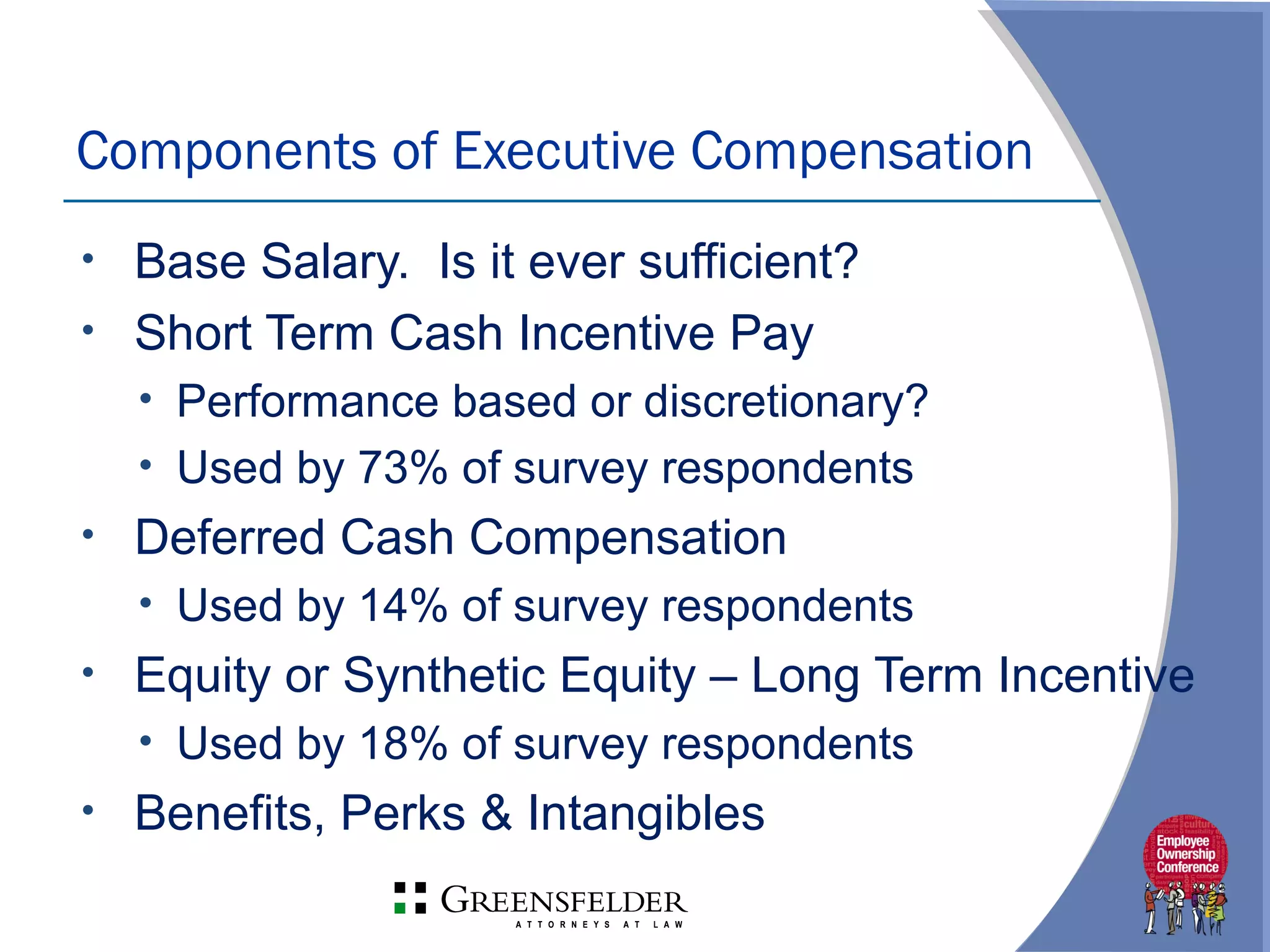
• Base Salary. Is it ever sufficient?
• Short Term Cash Incentive Pay
• Performance based or discretionary?
• Used by 73% of survey respondents
• Deferred Cash Compensation
• Used by 14% of survey respondents
• Equity or Synthetic Equity – Long Term Incentive
• Used by 18% of survey respondents
• Benefits, Perks & Intangibles
Components of Executive Compensation
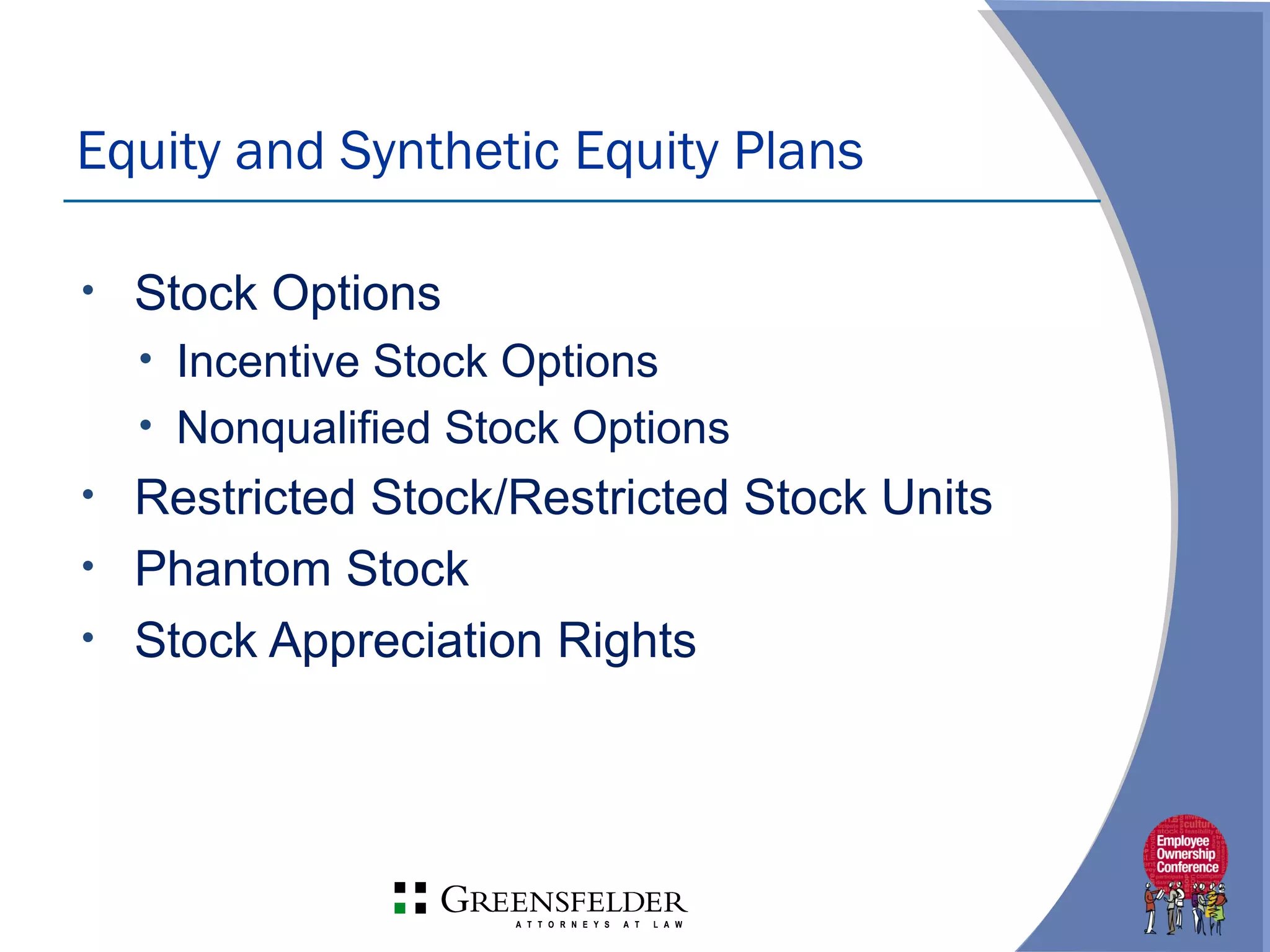
• Stock Options
• Incentive Stock Options
• Nonqualified Stock Options
• Restricted Stock/Restricted Stock Units
• Phantom Stock
• Stock Appreciation Rights
Equity and Synthetic Equity Plans
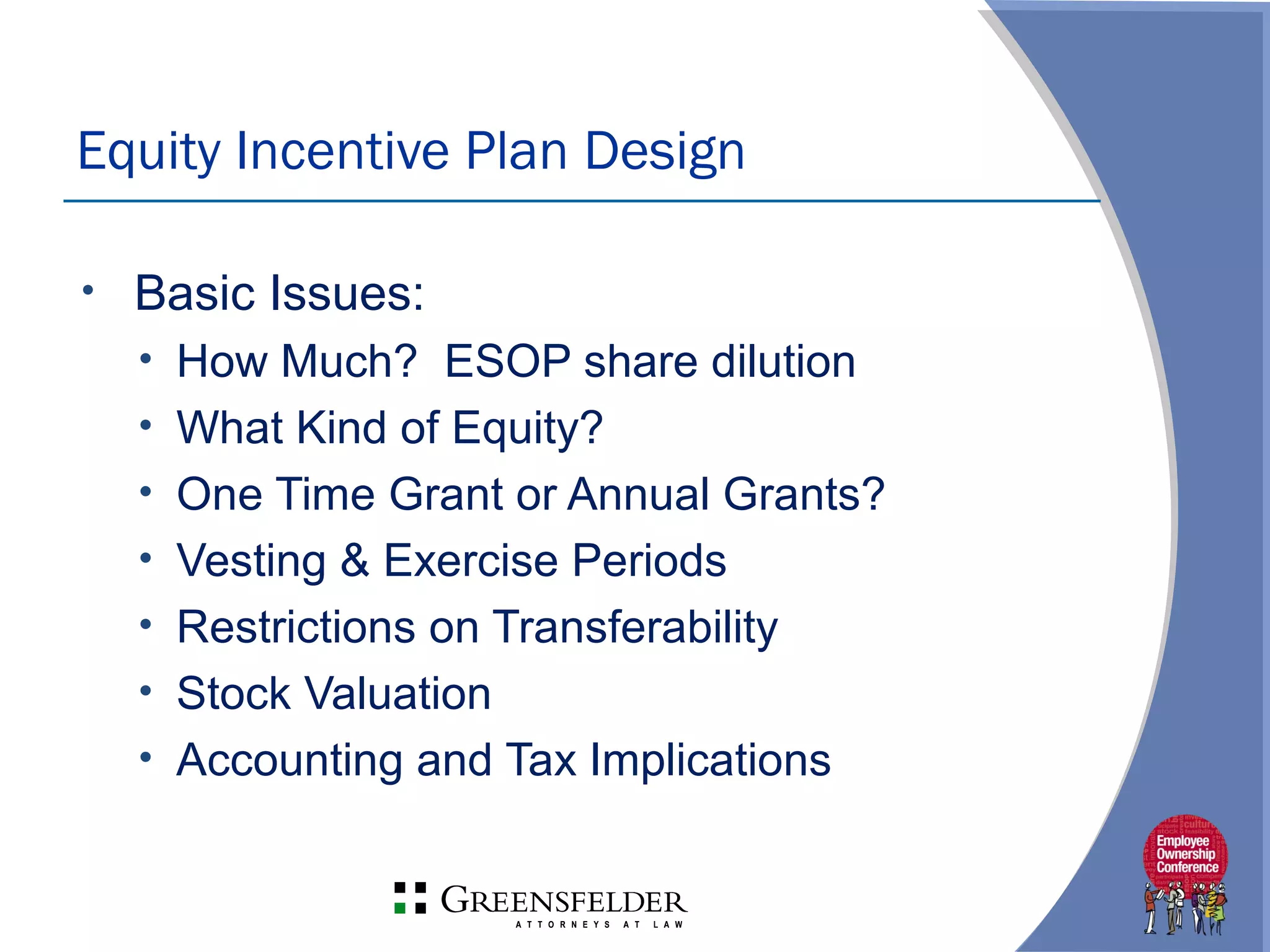
• Basic Issues:
• How Much? ESOP share dilution
• What Kind of Equity?
• One Time Grant or Annual Grants?
• Vesting & Exercise Periods
• Restrictions on Transferability
• Stock Valuation
• Accounting and Tax Implications
Equity Incentive Plan Design
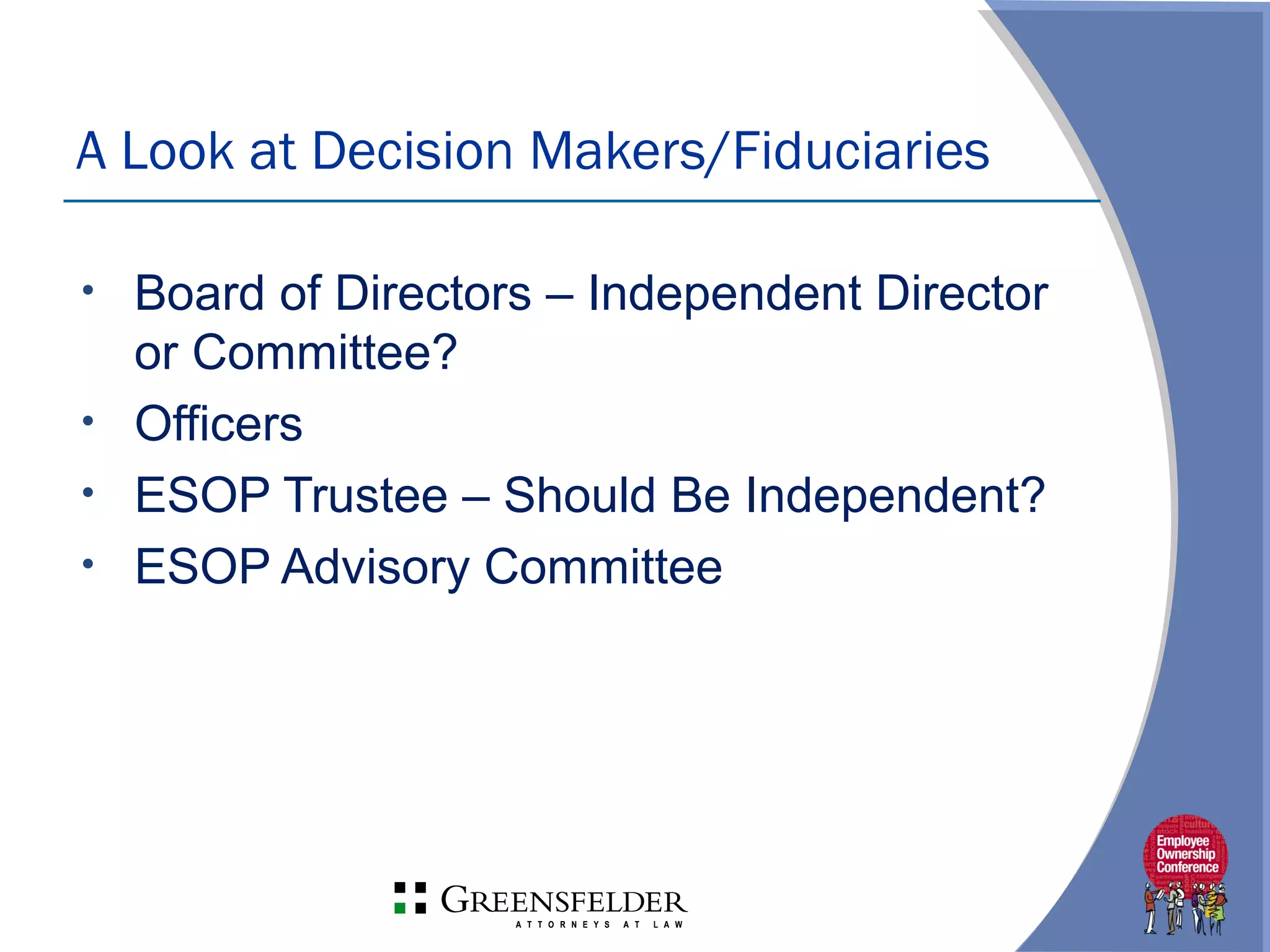
• Board of Directors – Independent Director
or Committee?
• Officers
• ESOP Trustee – Should Be Independent?
• ESOP Advisory Committee
A Look at Decision Makers/Fiduciaries
• Desirable to use ESOP valuation to value
stock for equity plans
• With ESOP trustee’s consent, equity plan
document is to provide that ESOP
valuation is to be used for administering
equity plan
• Economic dilution and impact upon
company financial statements will be
addressed elsewhere
Valuation Considerations
Deferred Compensation & §409A
• Applies to all deferred compensation
arrangements
• Plans that provide for payment of compensation
in later tax year
• Defines operational requirements for
distributions and elections
• Does not apply to short term deferrals or safe
harbor severance arrangements
Deferred Compensation & §409A
• §409A does not apply to:
• Incentive Stock Options
• Nonqualified Options or Stock Appreciation
Rights granted at FMV with no other deferral
features
• §423 Employee Stock Purchase Plans
• Restricted Stock or Restricted Stock Units
• Grandfathered arrangements, such as stock
rights granted and vested before December 31,
2004
Penalties for Violation of §409A
• Stock rights or other equity awards subject to
§409A must comply or else—
• Failure subjects award holder to income taxation
upon vesting, plus
• 20% penalty tax and interest
• Violation subjects company to potential tax
withholding penalties
S Corporation ESOP Anti-Abuse Rules Under §409(p)
• §409(p) designed to prevent S ESOPs from being used
primarily to benefit a few individuals
• §409(p) limits amount of synthetic equity or other
deferred pay an employee can receive in an S ESOP
• ESOP holding shares of S corporation is prohibited from
allocating employer securities to “disqualified
individuals” during any “nonallocation year”, i.e., year
where no allocation is permitted
S Corporation ESOP Anti-Abuse Rules Under §409(p)
• Who is a “disqualified person”?
• (1) owner of 10% or more of “deemed-owned
shares” of corporation, or
• (2) aggregate number of shares deemed owned by
person, together with shares deemed owned by
family members, equal at least 20% of total deemed-
owned shares
S Corporation ESOP Anti-Abuse Rules Under §409(p)
• What is “synthetic equity”?
• Any stock option, warrant, restricted stock, deferred
issuance stock right, or similar interest or right giving
holder right to receive S corporation stock in future
• Includes stock appreciation rights, phantom stock
units, and similar rights to future cash payments based
on value of stock
• Includes deferred compensation arrangements even if
not payable in stock nor calculated by reference to
value of stock
S Corporation ESOP Anti-Abuse Rules Under §409(p)
• What is “deemed ownership”?
• ESOP participant in S corporation is deemed to
own allocated and unallocated shares of his
ESOP account
• Holder of “synthetic equity” in S corporation is
deemed to own shares of stock on which the
synthetic equity is based
• Shares held outside the ESOP are not “deemed-
owned shares”
S Corporation ESOP Anti-Abuse Rules Under §409(p)
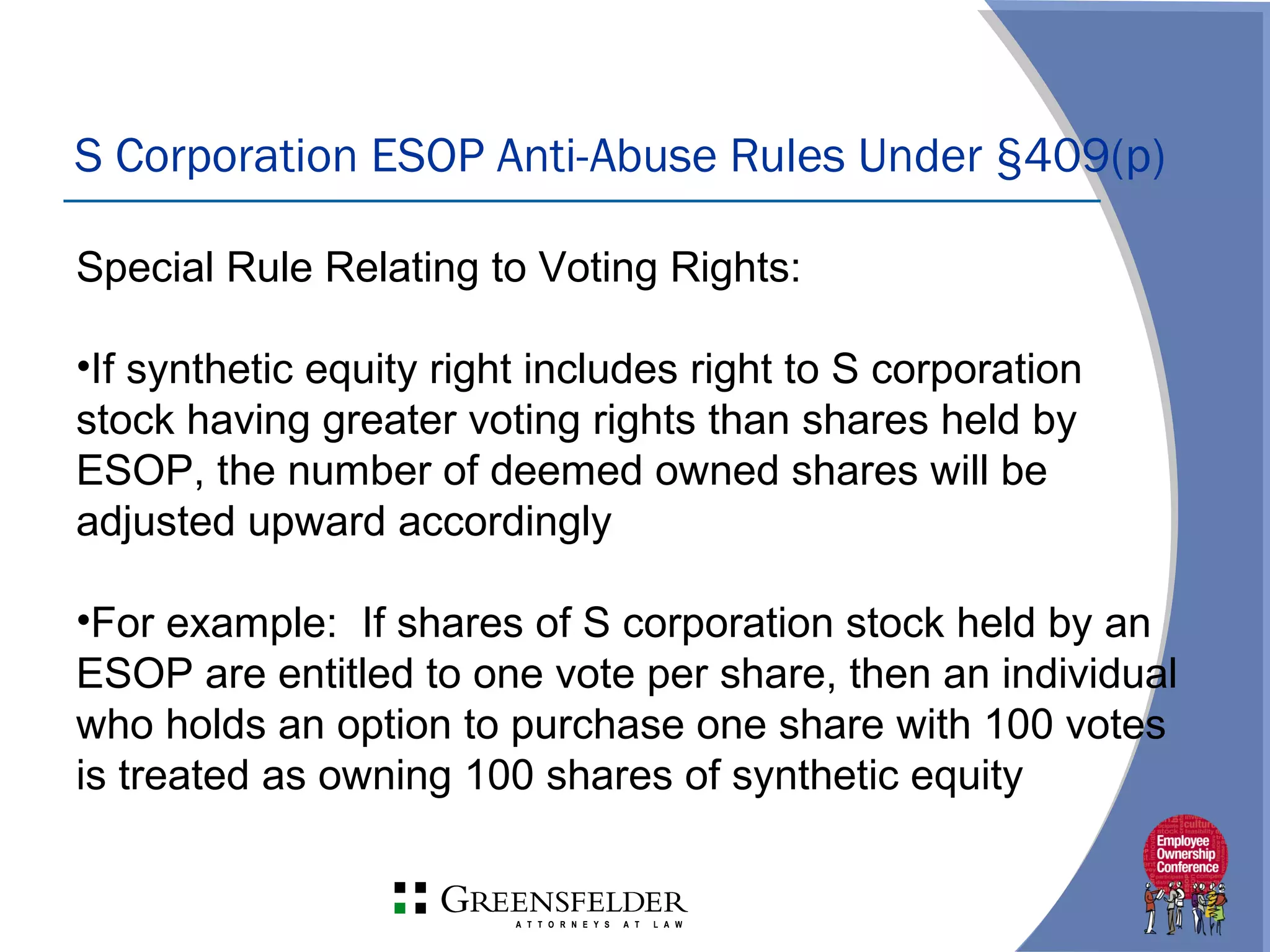
Special Rule Relating to Voting Rights:
•If synthetic equity right includes right to S corporation
stock having greater voting rights than shares held by
ESOP, the number of deemed owned shares will be
adjusted upward accordingly
•For example: If shares of S corporation stock held by an
ESOP are entitled to one vote per share, then an individual
who holds an option to purchase one share with 100 votes
is treated as owning 100 shares of synthetic equity
S Corporation ESOP Anti-Abuse Rules Under §409(p)
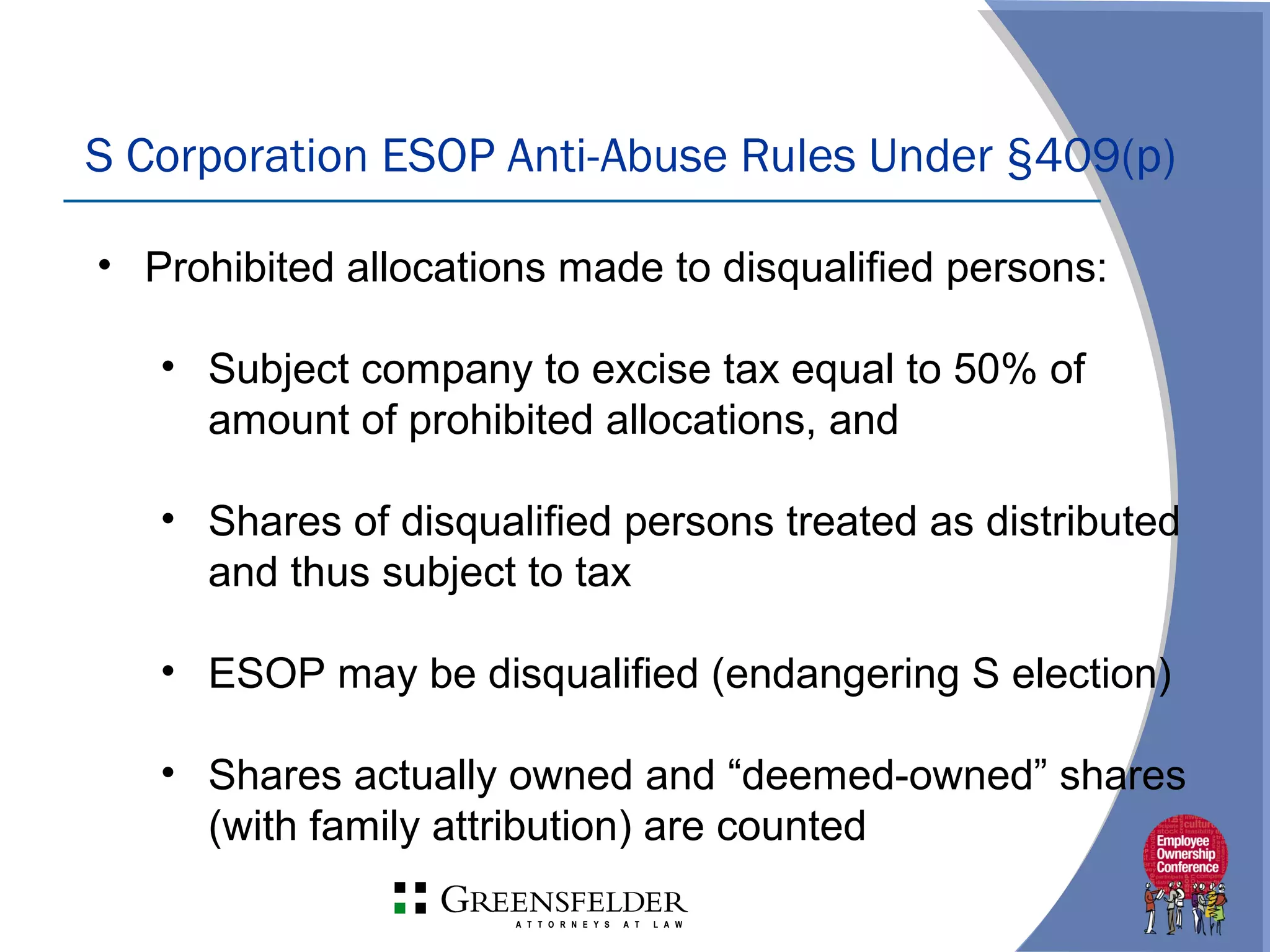
• Prohibited allocations made to disqualified persons:
• Subject company to excise tax equal to 50% of
amount of prohibited allocations, and
• Shares of disqualified persons treated as distributed
and thus subject to tax
• ESOP may be disqualified (endangering S election)
• Shares actually owned and “deemed-owned” shares
(with family attribution) are counted
S Corporation ESOP Anti-Abuse Rules Under §409(p)
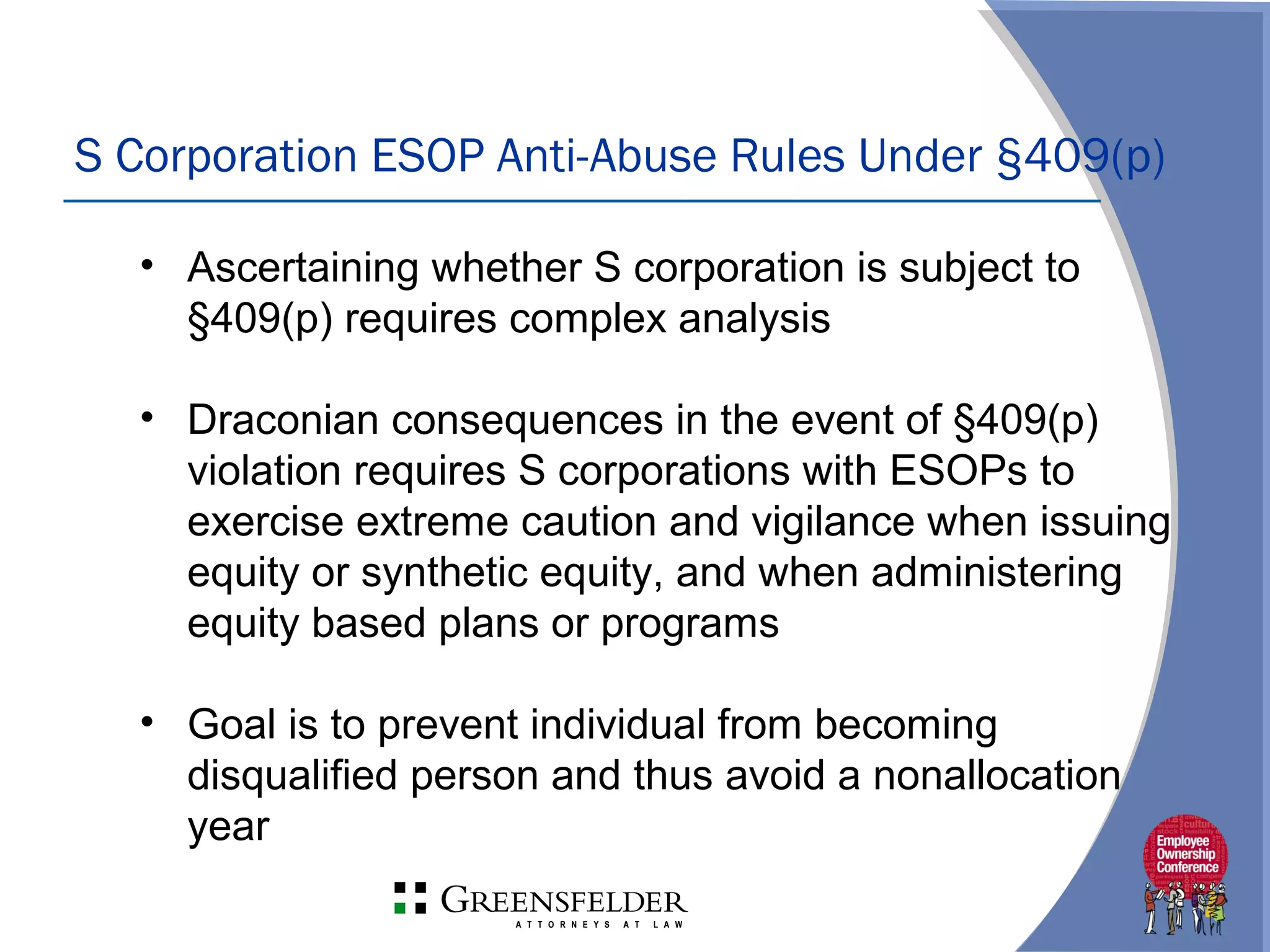
• Ascertaining whether S corporation is subject to
§409(p) requires complex analysis
• Draconian consequences in the event of §409(p)
violation requires S corporations with ESOPs to
exercise extreme caution and vigilance when issuing
equity or synthetic equity, and when administering
equity based plans or programs
• Goal is to prevent individual from becoming
disqualified person and thus avoid a nonallocation
year
Dan Janich is an Officer of Greensfelder, Hemker & Gale, P.C. in
Chicago whose law practice is in the areas of employee benefits
and executive compensation. His clients are businesses, including
ESOP companies, as well as executives and other professionals.
He has extensive experience designing and implementing equity
compensation plans, negotiating executive compensation
agreements, and litigating ERISA and other benefit and executive
compensation related claims.
Dan received his Bachelor of Arts degree from Marian University.
He earned a Juris Doctor degree from The John Marshall Law
School, and a Masters of Law in Taxation degree from DePaul
University. He is a past member of the Board of Directors of the
National Center for Employee Ownership. Further biographical
details are available at http://www.greensfelder.com.
Daniel N. Janich
To ensure compliance with requirements
imposed by the IRS, we inform you that any
U.S. federal tax advice contained in this
communication is not intended or written to
be used, and cannot be used, for the purpose
of (i) avoiding penalties under the Internal
Revenue Code or (ii) promoting, marketing or
recommending to another party any
transaction or matter addressed within.
IRS Circular 230 Disclosure

Dnj.exec.comp

  • 1.
    Presented by Forms ofExecutive Compensation Daniel N. Janich Greensfelder, Hemker & Gale, P.C. 200 West Madison Street, Suite 2700 Chicago, IL 60606 312-345-5003 | dnj@greensfelder.com 2013 NCEO/Beyster Institute Employee Ownership Conference Seattle, Washington April 23, 2013
  • 2.
    Executive Compensation for Privately-HeldCompanies • Has increasingly grown more complex in design and administration • Sarbanes-Oxley • §409A • Federal & State Securities Laws • §409(p) • ESOP trustee responsibilities • Heightened challenges to attracting, retaining and motivating C-level executives in the age of social media
  • 3.
    • Experienced ESOPLegal Counsel • Accountant & Tax Advisor • Executive Compensation Consultant/Surveys • Valuation Expert • Independent Trustee Who Are Your Professional Advisors?
  • 4.
    • Every companyhas one • Influenced by company culture • Market-Based – Use of Compensation Surveys and/or Compensation Consultants • Internal Equity • How Much Compensation Should Be Fixed vs. at Risk? • Who is Final Arbiter? Independent Compensation Committee? Company Compensation Philosophy
  • 5.
    • Types ofExecutive Compensation • Decision Makers/Fiduciary Considerations • Valuation Considerations • §409A and §409(p) Considerations An Overview of Executive Compensation in ESOP Companies
  • 6.
    • Base Salary.Is it ever sufficient? • Short Term Cash Incentive Pay • Performance based or discretionary? • Used by 73% of survey respondents • Deferred Cash Compensation • Used by 14% of survey respondents • Equity or Synthetic Equity – Long Term Incentive • Used by 18% of survey respondents • Benefits, Perks & Intangibles Components of Executive Compensation
  • 7.
    • Stock Options •Incentive Stock Options • Nonqualified Stock Options • Restricted Stock/Restricted Stock Units • Phantom Stock • Stock Appreciation Rights Equity and Synthetic Equity Plans
  • 8.
    • Basic Issues: •How Much? ESOP share dilution • What Kind of Equity? • One Time Grant or Annual Grants? • Vesting & Exercise Periods • Restrictions on Transferability • Stock Valuation • Accounting and Tax Implications Equity Incentive Plan Design
  • 9.
    • Board ofDirectors – Independent Director or Committee? • Officers • ESOP Trustee – Should Be Independent? • ESOP Advisory Committee A Look at Decision Makers/Fiduciaries
  • 10.
    • Desirable touse ESOP valuation to value stock for equity plans • With ESOP trustee’s consent, equity plan document is to provide that ESOP valuation is to be used for administering equity plan • Economic dilution and impact upon company financial statements will be addressed elsewhere Valuation Considerations
  • 11.
    Deferred Compensation &§409A • Applies to all deferred compensation arrangements • Plans that provide for payment of compensation in later tax year • Defines operational requirements for distributions and elections • Does not apply to short term deferrals or safe harbor severance arrangements
  • 12.
    Deferred Compensation &§409A • §409A does not apply to: • Incentive Stock Options • Nonqualified Options or Stock Appreciation Rights granted at FMV with no other deferral features • §423 Employee Stock Purchase Plans • Restricted Stock or Restricted Stock Units • Grandfathered arrangements, such as stock rights granted and vested before December 31, 2004
  • 13.
    Penalties for Violationof §409A • Stock rights or other equity awards subject to §409A must comply or else— • Failure subjects award holder to income taxation upon vesting, plus • 20% penalty tax and interest • Violation subjects company to potential tax withholding penalties
  • 14.
    S Corporation ESOPAnti-Abuse Rules Under §409(p) • §409(p) designed to prevent S ESOPs from being used primarily to benefit a few individuals • §409(p) limits amount of synthetic equity or other deferred pay an employee can receive in an S ESOP • ESOP holding shares of S corporation is prohibited from allocating employer securities to “disqualified individuals” during any “nonallocation year”, i.e., year where no allocation is permitted
  • 15.
    S Corporation ESOPAnti-Abuse Rules Under §409(p) • Who is a “disqualified person”? • (1) owner of 10% or more of “deemed-owned shares” of corporation, or • (2) aggregate number of shares deemed owned by person, together with shares deemed owned by family members, equal at least 20% of total deemed- owned shares
  • 16.
    S Corporation ESOPAnti-Abuse Rules Under §409(p) • What is “synthetic equity”? • Any stock option, warrant, restricted stock, deferred issuance stock right, or similar interest or right giving holder right to receive S corporation stock in future • Includes stock appreciation rights, phantom stock units, and similar rights to future cash payments based on value of stock • Includes deferred compensation arrangements even if not payable in stock nor calculated by reference to value of stock
  • 17.
    S Corporation ESOPAnti-Abuse Rules Under §409(p) • What is “deemed ownership”? • ESOP participant in S corporation is deemed to own allocated and unallocated shares of his ESOP account • Holder of “synthetic equity” in S corporation is deemed to own shares of stock on which the synthetic equity is based • Shares held outside the ESOP are not “deemed- owned shares”
  • 18.
    S Corporation ESOPAnti-Abuse Rules Under §409(p) Special Rule Relating to Voting Rights: •If synthetic equity right includes right to S corporation stock having greater voting rights than shares held by ESOP, the number of deemed owned shares will be adjusted upward accordingly •For example: If shares of S corporation stock held by an ESOP are entitled to one vote per share, then an individual who holds an option to purchase one share with 100 votes is treated as owning 100 shares of synthetic equity
  • 19.
    S Corporation ESOPAnti-Abuse Rules Under §409(p) • Prohibited allocations made to disqualified persons: • Subject company to excise tax equal to 50% of amount of prohibited allocations, and • Shares of disqualified persons treated as distributed and thus subject to tax • ESOP may be disqualified (endangering S election) • Shares actually owned and “deemed-owned” shares (with family attribution) are counted
  • 20.
    S Corporation ESOPAnti-Abuse Rules Under §409(p) • Ascertaining whether S corporation is subject to §409(p) requires complex analysis • Draconian consequences in the event of §409(p) violation requires S corporations with ESOPs to exercise extreme caution and vigilance when issuing equity or synthetic equity, and when administering equity based plans or programs • Goal is to prevent individual from becoming disqualified person and thus avoid a nonallocation year
  • 21.
    Dan Janich isan Officer of Greensfelder, Hemker & Gale, P.C. in Chicago whose law practice is in the areas of employee benefits and executive compensation. His clients are businesses, including ESOP companies, as well as executives and other professionals. He has extensive experience designing and implementing equity compensation plans, negotiating executive compensation agreements, and litigating ERISA and other benefit and executive compensation related claims. Dan received his Bachelor of Arts degree from Marian University. He earned a Juris Doctor degree from The John Marshall Law School, and a Masters of Law in Taxation degree from DePaul University. He is a past member of the Board of Directors of the National Center for Employee Ownership. Further biographical details are available at http://www.greensfelder.com. Daniel N. Janich
  • 22.
    To ensure compliancewith requirements imposed by the IRS, we inform you that any U.S. federal tax advice contained in this communication is not intended or written to be used, and cannot be used, for the purpose of (i) avoiding penalties under the Internal Revenue Code or (ii) promoting, marketing or recommending to another party any transaction or matter addressed within. IRS Circular 230 Disclosure