SHANTILAL SHAH
GOVERNMENT ENGINEERING
COLLEGE.
• BRANCH : PRODUCTION ENGINEERING
• SUBJECT : DESIGN OF MACHINE ELEMENTS
• TOPIC : Proportions of bevel gears , Design of bevel
gear
• NO. : ENROLLMENT NO. : NAME
 (1) 150430125078 : PANDYA PANKAJKUMAR M.
 (2) 150430125080 : PARMAR HIRENKUMAR A.
1
• BEVEL GEARS:
 Bevel gears are the gears where the axes of the two shafts
intersect and the tooth-bearing faces of the gears themselves
are conically shaped.
 Bevel gears are most often mounted on shafts that are 90
degrees apart, but can be designed to work at other angles as
well. The pitch surface of bevel gears is a cone.
 Mitre gears are a type of bevel gears that have equal
numbers of teeth. The shafts are positioned at right
angles from each other, and the gears have matching
pitch surfaces and angles, with a conically shaped pitch
surface.
2
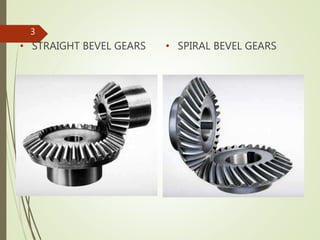
• STRAIGHT BEVEL GEARS • SPIRAL BEVEL GEARS
3
• APPLICATIONS OF BEVEL GEARS:
 Bevel gears are used in differential drives, which
can transmit power to two axles spinning at
different speeds, such as those on a cornering
automobile.
 Bevel gears are used as the main mechanism for
a hand drill. As the handle of the drill is turned in
a vertical direction, the bevel gears change the
rotation of the chuck to a horizontal rotation. The
bevel gears in a hand drill have the added
advantage of increasing the speed of rotation of
the chuck and this makes it possible to drill a
range of materials.
4
• ADVANTAGES:
• This gear makes it possible to
change the operating angle.
• Differing of the number of teeth
(effectively diameter) on each
wheel allows mechanical
advantage to be changed.
5
• DISADVANTAGES:
• One wheel of such gear is designed to
work with its complementary wheel and
no other.
• Must be precisely mounted.
• The shafts bearings must be capable of
supporting significant forces.
• DESIGN PROCEDURE FOR BEVEL
GEARS:
 From the requirements choose suitable materials for pinion
and gear, tooth profile and pressure angle are selected.
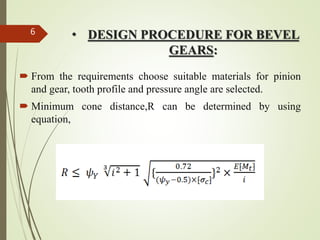
 Minimum cone distance,R can be determined by using
equation,
6
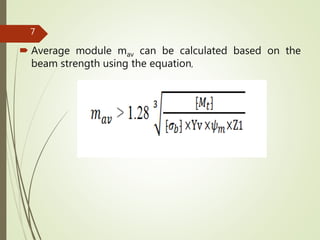
 Average module mav can be calculated based on the
beam strength using the equation,
7
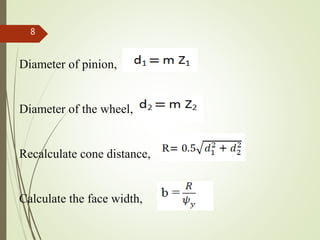
Diameter of pinion,
Diameter of the wheel,
Recalculate cone distance,
Calculate the face width,
8
Checking conditions:
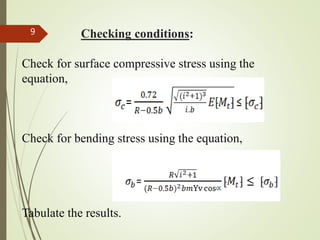
Check for surface compressive stress using the
equation,
Check for bending stress using the equation,
Tabulate the results.
9
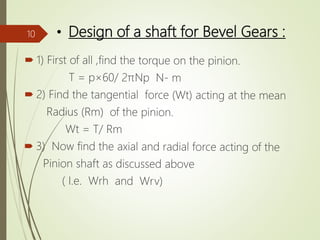
• Design of a shaft for Bevel Gears :10
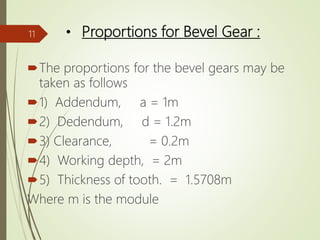
• Proportions for Bevel Gear :
The proportions for the bevel gears may be
taken as follows
1) Addendum, a = 1m
2) Dedendum, d = 1.2m
3) Clearance, = 0.2m
4) Working depth, = 2m
5) Thickness of tooth. = 1.5708m
Where m is the module
11
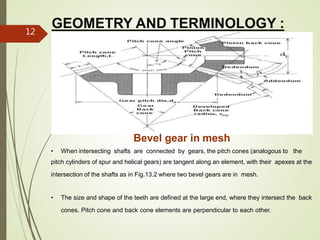
GEOMETRY AND TERMINOLOGY :
Bevel gear in mesh
• When intersecting shafts are connected by gears, the pitch cones (analogous to the
pitch cylinders of spur and helical gears) are tangent along an element, with their apexes at the
intersection of the shafts as in Fig.13.2 where two bevel gears are in mesh.
• The size and shape of the teeth are defined at the large end, where they intersect the back
cones. Pitch cone and back cone elements are perpendicular to each other.
12
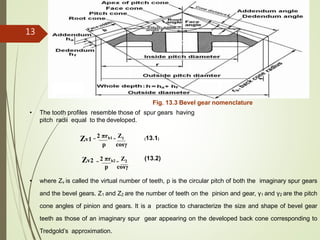
• The tooth profiles resemble those of spur gears having
pitch radii equal to the developed.
Fig. 13.3 Bevel gear nomenclature
Zv1 =
2 πrb1 =
Z1
p cosγ
(13.1)
(13.2)Zv2 =
2 πrb2 =
Z2
p cosγ
• where Zv is called the virtual number of teeth, p is the circular pitch of both the imaginary spur gears
and the bevel gears. Z1 and Z2 are the number of teeth on the pinion and gear, γ1 and γ2 are the pitch
cone angles of pinion and gears. It is a practice to characterize the size and shape of bevel gear
teeth as those of an imaginary spur gear appearing on the developed back cone corresponding to
Tredgold’s approximation.
13
a) Bevel gear teeth are inherently non - interchangeable.
b) The working depth of the teeth is usually 2m, the same as for standard spur and
helical gears, but the bevel pinion is designed with the larger addendum ( 0.7
working depth).
a) This avoids interference and results in stronger pinion teeth. It also increases the
contact ratio.
b) The gear addendum varies from 1m for a gear ratio of 1, to 0.54 m for ratios of
6.8 and greater.
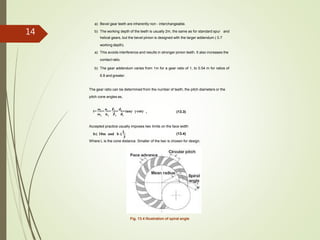
The gear ratio can be determined from the number of teeth, the pitch diameters or the
pitch cone angles as,
(13.3)2 1
2 2 1 1
i=
ω1
=
n1
=
Z2
=
d2
=tanγ =cotγ
ω n Z d
Accepted practice usually imposes two limits on the face width
(13.4)
Where L is the cone distance. Smaller of the two is chosen for design.
3
b 10m and b 
L
Fig. 13.4 Illustration of spiral angle
14
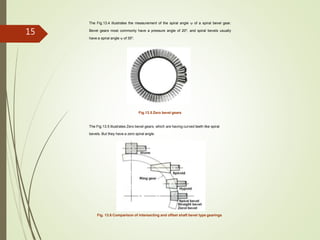
The Fig.13.4 illustrates the measurement of the spiral angle  of a spiral bevel gear.
Bevel gears most commonly have a pressure angle of 20o
, and spiral bevels usually
have a spiral angle  of 35o
.
Fig.13.5 Zero bevel gears
The Fig.13.5 illustrates Zero bevel gears, which are having curved teeth like spiral
bevels. But they have a zero spiral angle.
Fig. 13.6 Comparison of intersecting and offset shaft bevel type gearings
15
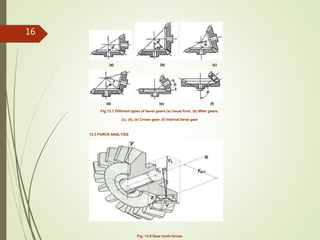
(a) (b) (c)
(d) (e) (f)
Fig.13.7 Different types of bevel gears (a) Usual form, (b) Miter gears,
(c), (d), (e) Crown gear, (f) Internal bevel gear
13.3 FORCE ANALYSIS
Fig. 13.8 Gear tooth forces
16
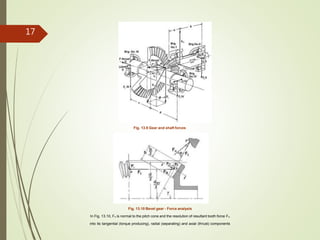
Fig. 13.9 Gear and shaft forces
Fig. 13.10 Bevel gear - Force analysis
In Fig. 13.10, Fn is normal to the pitch cone and the resolution of resultant tooth force Fn
into its tangential (torque producing), radial (separating) and axial (thrust) components
17
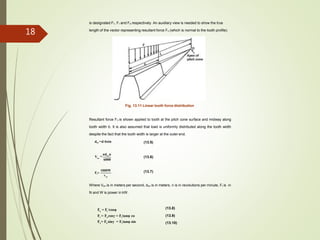
is designated Ft, Fr and Fa respectively. An auxiliary view is needed to show the true
length of the vector representing resultant force Fn (which is normal to the tooth profile).
Fig. 13.11 Linear tooth force distribution
Resultant force Fn is shown applied to tooth at the pitch cone surface and midway along
tooth width b. It is also assumed that load is uniformly distributed along the tooth width
despite the fact that the tooth width is larger at the outer end.
dav =d-bsin (13.5)
(13.6)avV =
πdavn
6000
(13.7)
av
1000W
Ft=
v
Where Vav is in meters per second, dav is in meters, n is in revolutions per minute, Ft is in
N and W is power in kW.
(13.8)
(13.9)
(13.10)
F = F /cosφn t
Fr = Fncosγ = Ft tanφ co
Fa= Fnsinγ = Ft tanφ sin
18
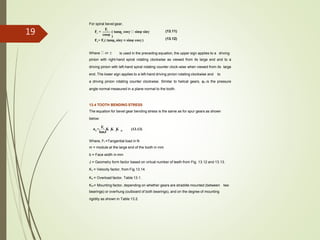
For spiral bevel gear,
(13.11)
(13.12)
r n
Ft
F =
cosψ
( tanφ cosγ sinψ sinγ
)
Fa= Ft( tanφn sinγ ± sinψ cosγ )
is used in the preceding equation, the upper sign applies to a drivingWhere or 
pinion with right-hand spiral rotating clockwise as viewed from its large end and to a
driving pinion with left-hand spiral rotating counter clock-wise when viewed from its large
end. The lower sign applies to a left-hand driving pinion rotating clockwise and to
a driving pinion rotating counter clockwise. Similar to helical gears, φn is the pressure
angle normal measured in a plane normal to the tooth.
13.4 TOOTH BENDING STRESS
The equation for bevel gear bending stress is the same as for spur gears as shown
below:
b v o mσ =
Ft
K K K (13.13)
bmJ
Where, Ft =Tangential load in N
m = module at the large end of the tooth in mm
b = Face width in mm
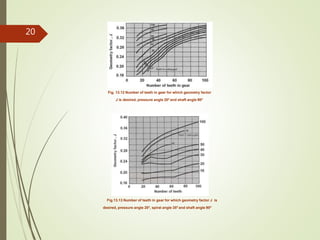
J = Geometry form factor based on virtual number of teeth from Fig. 13.12 and 13.13.
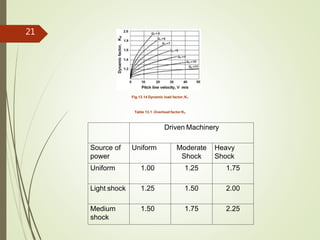
Kv = Velocity factor, from Fig.13.14.
Ko = Overload factor, Table 13.1.
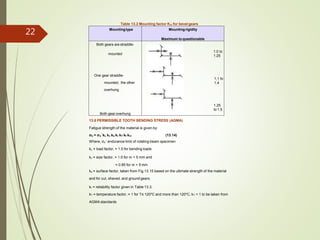
Km= Mounting factor, depending on whether gears are straddle mounted (between two
bearings) or overhung (outboard of both bearings), and on the degree of mounting
rigidity as shown in Table 13.2.
19
Fig. 13.12 Number of teeth in gear for which geometry factor
J is desired, pressure angle 20o
and shaft angle 90o
Fig.13.13 Number of teeth in gear for which geometry factor J is
desired, pressure angle 20o
, spiral angle 35o
and shaft angle 90o
20
Fig.13.14 Dynamic load factor, Kv
Table 13.1 -Overload factor Ko
Driven Machinery
Source of
power
Uniform Moderate
Shock
Heavy
Shock
Uniform 1.00 1.25 1.75
Light shock 1.25 1.50 2.00
Medium
shock
1.50 1.75 2.25
21
Table 13.2 Mounting factor Km for bevel gears
Mountingtype Mountingrigidity
Maximum to questionable
Both gears are straddle-
mounted
One gear straddle-
mounted; the other
overhung
Both gear overhung
1.0 to
1.25
1.1 to
1.4
1.25
to 1.5
13.6 PERMISSIBLE TOOTH BENDING STRESS (AGMA)
Fatigue strength of the material is given by:
σe = σe
’
kL kv ks kr kT kf km (13.14)
Where, σe’ endurance limit of rotating-beam specimen
kL = load factor, = 1.0 for bending loads
kv = size factor, = 1.0 for m < 5 mm and
= 0.85 for m > 5 mm
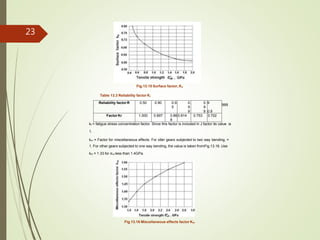
ks = surface factor, taken from Fig.13.15 based on the ultimate strength of the material
and for cut, shaved, and ground gears.
kr = reliability factor given in Table 13.3.
kT = temperature factor, = 1 for T≤ 120o
C and more than 120o
C, kT < 1 to be taken from
AGMA standards
22
Fig.13.15 Surface factor, Ks
Table 13.3 Reliability factor Kr
999
Reliability factor R 0.50 0.90 0.9
5
0.
9
9
0.
9
9
9
0.9
Factor Kr 1.000 0.897 0.86
8
0.814 0.753 0.702
kf = fatigue stress concentration factor. Since this factor is included in J factor its value is
1.
km = Factor for miscellaneous effects. For idler gears subjected to two way bending, =
1. For other gears subjected to one way bending, the value is taken fromFig.13.16. Use
km = 1.33 for σut less than 1.4GPa.
Fig.13.16 Miscellaneous effects factor Km
23
Permissible bending stress is given by
(13.15)b
[σ ]=
σe
s
Hence the design equation from bending consideration is,
σb ≤ [σb ] (13.16)
Bevel gear surface fatigue stress can be calculated as for spur gears, with only two
modifications.
H p V o m
Ft
σ =C K K K
bdI
(13.17)
13.7 CONTACT STRESS:
1.23 times the Cp values given in the Table13.4 are taken to account for a somewhat
more localized contact area than spur gears.
Table 13.4 Elastic Coefficient Cp for spur gears, in (MPa)0.5
s
Pinion Material
(µ = 0.3 in all cases)
Gear material
Steel
Ca
t iron Al Bronze Tin Bron ze
Steel,E=307GPa 191 166 162 1
5
8
Cast iron, E = 131GPa 166 149 149 1
4
5
Al Bronze, E = 121GPa 162 149 145 1
4
2
Tin Bronze, E = 110GPa 158 145 141 1
3
7
24
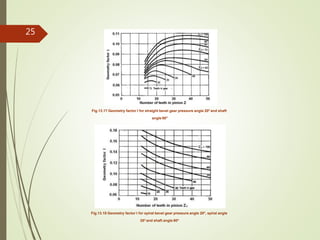
Fig.13.17 Geometry factor I for straight bevel gear pressure angle 20o
and shaft
angle 90o
Fig.13.18 Geometry factor I for spiral bevel gear pressure angle 20o
, spiral angle
35o
and shaft angle 90o
25
Surface fatigue strength of the material is given by,
σsf = σsf’ KL KH KR KT (13.18)
Where σsf’ = surface fatigue strength of the material given in Table 13.7
KL = Life factor given in Fig.13.19
Table 13.7 Surface fatigue strength σsf (MPa) for metallic spur gear,
(107
cycle life 99% reliability and temperature < 120o
C)
Material σsf (MPa)
Steel 2.8 (Bhn) – 69 MPa
Nodulariron 0.95 [ 2.8 (Bhn) – 69 MPa]
Cast iron, grade 20 379
Cast iron, grade 30 482
Cast iron, grade 40 551
Tin Bronze, AGMA 2C ( 11% Sn) 207
Aluminium Bronze (ASTM b 148 – 52) (Alloy 9C – H.T ) 448
Fig.13.19 Life factorKL
26
KH is hardness ratio factor, K the Brinell hardness of the pinion by Brinell hardness of
the gear as given in Fig. 13.20.
KH = 1.0 for K < 1.2
KR = Reliability factor, given in Table 13.3.
Fig.13.20 Hardness ratio factor, KH
KT = temperature factor,
= 1 for T≤ 120o
C based on lubricant temperature.
Above 120o
C, it is less than 1 to be taken from AGMA standards.
Allowable surface fatigue stress for design is given by
[σH ] = σSf / s (13.19)
Factor of safety s = 1.1 to 1.5
Hence Design equation is:
σH ≤ [ σH ] (13.20)
------------------
27
THANK YOU
28

Dme ppt

  • 1.
    SHANTILAL SHAH GOVERNMENT ENGINEERING COLLEGE. •BRANCH : PRODUCTION ENGINEERING • SUBJECT : DESIGN OF MACHINE ELEMENTS • TOPIC : Proportions of bevel gears , Design of bevel gear • NO. : ENROLLMENT NO. : NAME  (1) 150430125078 : PANDYA PANKAJKUMAR M.  (2) 150430125080 : PARMAR HIRENKUMAR A. 1
  • 2.
    • BEVEL GEARS: Bevel gears are the gears where the axes of the two shafts intersect and the tooth-bearing faces of the gears themselves are conically shaped.  Bevel gears are most often mounted on shafts that are 90 degrees apart, but can be designed to work at other angles as well. The pitch surface of bevel gears is a cone.  Mitre gears are a type of bevel gears that have equal numbers of teeth. The shafts are positioned at right angles from each other, and the gears have matching pitch surfaces and angles, with a conically shaped pitch surface. 2
  • 3.
    • STRAIGHT BEVELGEARS • SPIRAL BEVEL GEARS 3
  • 4.
    • APPLICATIONS OFBEVEL GEARS:  Bevel gears are used in differential drives, which can transmit power to two axles spinning at different speeds, such as those on a cornering automobile.  Bevel gears are used as the main mechanism for a hand drill. As the handle of the drill is turned in a vertical direction, the bevel gears change the rotation of the chuck to a horizontal rotation. The bevel gears in a hand drill have the added advantage of increasing the speed of rotation of the chuck and this makes it possible to drill a range of materials. 4
  • 5.
    • ADVANTAGES: • Thisgear makes it possible to change the operating angle. • Differing of the number of teeth (effectively diameter) on each wheel allows mechanical advantage to be changed. 5 • DISADVANTAGES: • One wheel of such gear is designed to work with its complementary wheel and no other. • Must be precisely mounted. • The shafts bearings must be capable of supporting significant forces.
  • 6.
    • DESIGN PROCEDUREFOR BEVEL GEARS:  From the requirements choose suitable materials for pinion and gear, tooth profile and pressure angle are selected.  Minimum cone distance,R can be determined by using equation, 6
  • 7.
     Average modulemav can be calculated based on the beam strength using the equation, 7
  • 8.
    Diameter of pinion, Diameterof the wheel, Recalculate cone distance, Calculate the face width, 8
  • 9.
    Checking conditions: Check forsurface compressive stress using the equation, Check for bending stress using the equation, Tabulate the results. 9
  • 10.
    • Design ofa shaft for Bevel Gears :10
  • 11.
    • Proportions forBevel Gear : The proportions for the bevel gears may be taken as follows 1) Addendum, a = 1m 2) Dedendum, d = 1.2m 3) Clearance, = 0.2m 4) Working depth, = 2m 5) Thickness of tooth. = 1.5708m Where m is the module 11
  • 12.
    GEOMETRY AND TERMINOLOGY: Bevel gear in mesh • When intersecting shafts are connected by gears, the pitch cones (analogous to the pitch cylinders of spur and helical gears) are tangent along an element, with their apexes at the intersection of the shafts as in Fig.13.2 where two bevel gears are in mesh. • The size and shape of the teeth are defined at the large end, where they intersect the back cones. Pitch cone and back cone elements are perpendicular to each other. 12
  • 13.
    • The toothprofiles resemble those of spur gears having pitch radii equal to the developed. Fig. 13.3 Bevel gear nomenclature Zv1 = 2 πrb1 = Z1 p cosγ (13.1) (13.2)Zv2 = 2 πrb2 = Z2 p cosγ • where Zv is called the virtual number of teeth, p is the circular pitch of both the imaginary spur gears and the bevel gears. Z1 and Z2 are the number of teeth on the pinion and gear, γ1 and γ2 are the pitch cone angles of pinion and gears. It is a practice to characterize the size and shape of bevel gear teeth as those of an imaginary spur gear appearing on the developed back cone corresponding to Tredgold’s approximation. 13
  • 14.
    a) Bevel gearteeth are inherently non - interchangeable. b) The working depth of the teeth is usually 2m, the same as for standard spur and helical gears, but the bevel pinion is designed with the larger addendum ( 0.7 working depth). a) This avoids interference and results in stronger pinion teeth. It also increases the contact ratio. b) The gear addendum varies from 1m for a gear ratio of 1, to 0.54 m for ratios of 6.8 and greater. The gear ratio can be determined from the number of teeth, the pitch diameters or the pitch cone angles as, (13.3)2 1 2 2 1 1 i= ω1 = n1 = Z2 = d2 =tanγ =cotγ ω n Z d Accepted practice usually imposes two limits on the face width (13.4) Where L is the cone distance. Smaller of the two is chosen for design. 3 b 10m and b  L Fig. 13.4 Illustration of spiral angle 14
  • 15.
    The Fig.13.4 illustratesthe measurement of the spiral angle  of a spiral bevel gear. Bevel gears most commonly have a pressure angle of 20o , and spiral bevels usually have a spiral angle  of 35o . Fig.13.5 Zero bevel gears The Fig.13.5 illustrates Zero bevel gears, which are having curved teeth like spiral bevels. But they have a zero spiral angle. Fig. 13.6 Comparison of intersecting and offset shaft bevel type gearings 15
  • 16.
    (a) (b) (c) (d)(e) (f) Fig.13.7 Different types of bevel gears (a) Usual form, (b) Miter gears, (c), (d), (e) Crown gear, (f) Internal bevel gear 13.3 FORCE ANALYSIS Fig. 13.8 Gear tooth forces 16
  • 17.
    Fig. 13.9 Gearand shaft forces Fig. 13.10 Bevel gear - Force analysis In Fig. 13.10, Fn is normal to the pitch cone and the resolution of resultant tooth force Fn into its tangential (torque producing), radial (separating) and axial (thrust) components 17
  • 18.
    is designated Ft,Fr and Fa respectively. An auxiliary view is needed to show the true length of the vector representing resultant force Fn (which is normal to the tooth profile). Fig. 13.11 Linear tooth force distribution Resultant force Fn is shown applied to tooth at the pitch cone surface and midway along tooth width b. It is also assumed that load is uniformly distributed along the tooth width despite the fact that the tooth width is larger at the outer end. dav =d-bsin (13.5) (13.6)avV = πdavn 6000 (13.7) av 1000W Ft= v Where Vav is in meters per second, dav is in meters, n is in revolutions per minute, Ft is in N and W is power in kW. (13.8) (13.9) (13.10) F = F /cosφn t Fr = Fncosγ = Ft tanφ co Fa= Fnsinγ = Ft tanφ sin 18
  • 19.
    For spiral bevelgear, (13.11) (13.12) r n Ft F = cosψ ( tanφ cosγ sinψ sinγ ) Fa= Ft( tanφn sinγ ± sinψ cosγ ) is used in the preceding equation, the upper sign applies to a drivingWhere or  pinion with right-hand spiral rotating clockwise as viewed from its large end and to a driving pinion with left-hand spiral rotating counter clock-wise when viewed from its large end. The lower sign applies to a left-hand driving pinion rotating clockwise and to a driving pinion rotating counter clockwise. Similar to helical gears, φn is the pressure angle normal measured in a plane normal to the tooth. 13.4 TOOTH BENDING STRESS The equation for bevel gear bending stress is the same as for spur gears as shown below: b v o mσ = Ft K K K (13.13) bmJ Where, Ft =Tangential load in N m = module at the large end of the tooth in mm b = Face width in mm J = Geometry form factor based on virtual number of teeth from Fig. 13.12 and 13.13. Kv = Velocity factor, from Fig.13.14. Ko = Overload factor, Table 13.1. Km= Mounting factor, depending on whether gears are straddle mounted (between two bearings) or overhung (outboard of both bearings), and on the degree of mounting rigidity as shown in Table 13.2. 19
  • 20.
    Fig. 13.12 Numberof teeth in gear for which geometry factor J is desired, pressure angle 20o and shaft angle 90o Fig.13.13 Number of teeth in gear for which geometry factor J is desired, pressure angle 20o , spiral angle 35o and shaft angle 90o 20
  • 21.
    Fig.13.14 Dynamic loadfactor, Kv Table 13.1 -Overload factor Ko Driven Machinery Source of power Uniform Moderate Shock Heavy Shock Uniform 1.00 1.25 1.75 Light shock 1.25 1.50 2.00 Medium shock 1.50 1.75 2.25 21
  • 22.
    Table 13.2 Mountingfactor Km for bevel gears Mountingtype Mountingrigidity Maximum to questionable Both gears are straddle- mounted One gear straddle- mounted; the other overhung Both gear overhung 1.0 to 1.25 1.1 to 1.4 1.25 to 1.5 13.6 PERMISSIBLE TOOTH BENDING STRESS (AGMA) Fatigue strength of the material is given by: σe = σe ’ kL kv ks kr kT kf km (13.14) Where, σe’ endurance limit of rotating-beam specimen kL = load factor, = 1.0 for bending loads kv = size factor, = 1.0 for m < 5 mm and = 0.85 for m > 5 mm ks = surface factor, taken from Fig.13.15 based on the ultimate strength of the material and for cut, shaved, and ground gears. kr = reliability factor given in Table 13.3. kT = temperature factor, = 1 for T≤ 120o C and more than 120o C, kT < 1 to be taken from AGMA standards 22
  • 23.
    Fig.13.15 Surface factor,Ks Table 13.3 Reliability factor Kr 999 Reliability factor R 0.50 0.90 0.9 5 0. 9 9 0. 9 9 9 0.9 Factor Kr 1.000 0.897 0.86 8 0.814 0.753 0.702 kf = fatigue stress concentration factor. Since this factor is included in J factor its value is 1. km = Factor for miscellaneous effects. For idler gears subjected to two way bending, = 1. For other gears subjected to one way bending, the value is taken fromFig.13.16. Use km = 1.33 for σut less than 1.4GPa. Fig.13.16 Miscellaneous effects factor Km 23
  • 24.
    Permissible bending stressis given by (13.15)b [σ ]= σe s Hence the design equation from bending consideration is, σb ≤ [σb ] (13.16) Bevel gear surface fatigue stress can be calculated as for spur gears, with only two modifications. H p V o m Ft σ =C K K K bdI (13.17) 13.7 CONTACT STRESS: 1.23 times the Cp values given in the Table13.4 are taken to account for a somewhat more localized contact area than spur gears. Table 13.4 Elastic Coefficient Cp for spur gears, in (MPa)0.5 s Pinion Material (µ = 0.3 in all cases) Gear material Steel Ca t iron Al Bronze Tin Bron ze Steel,E=307GPa 191 166 162 1 5 8 Cast iron, E = 131GPa 166 149 149 1 4 5 Al Bronze, E = 121GPa 162 149 145 1 4 2 Tin Bronze, E = 110GPa 158 145 141 1 3 7 24
  • 25.
    Fig.13.17 Geometry factorI for straight bevel gear pressure angle 20o and shaft angle 90o Fig.13.18 Geometry factor I for spiral bevel gear pressure angle 20o , spiral angle 35o and shaft angle 90o 25
  • 26.
    Surface fatigue strengthof the material is given by, σsf = σsf’ KL KH KR KT (13.18) Where σsf’ = surface fatigue strength of the material given in Table 13.7 KL = Life factor given in Fig.13.19 Table 13.7 Surface fatigue strength σsf (MPa) for metallic spur gear, (107 cycle life 99% reliability and temperature < 120o C) Material σsf (MPa) Steel 2.8 (Bhn) – 69 MPa Nodulariron 0.95 [ 2.8 (Bhn) – 69 MPa] Cast iron, grade 20 379 Cast iron, grade 30 482 Cast iron, grade 40 551 Tin Bronze, AGMA 2C ( 11% Sn) 207 Aluminium Bronze (ASTM b 148 – 52) (Alloy 9C – H.T ) 448 Fig.13.19 Life factorKL 26
  • 27.
    KH is hardnessratio factor, K the Brinell hardness of the pinion by Brinell hardness of the gear as given in Fig. 13.20. KH = 1.0 for K < 1.2 KR = Reliability factor, given in Table 13.3. Fig.13.20 Hardness ratio factor, KH KT = temperature factor, = 1 for T≤ 120o C based on lubricant temperature. Above 120o C, it is less than 1 to be taken from AGMA standards. Allowable surface fatigue stress for design is given by [σH ] = σSf / s (13.19) Factor of safety s = 1.1 to 1.5 Hence Design equation is: σH ≤ [ σH ] (13.20) ------------------ 27
  • 28.