Overview
• Boolean Algebra
o Axioms and Theorems
o Principle of Duality
o Boolean Operator Precedence
o Boolean Function Evaluation
29-Nov-22 CSE 225: Digital Logic Design 2
Boolean Algebra
 A branch of mathematics that deals with
operations (AND, OR, NOT) on logical values
with binary variables.
 Based on a set of rules derived from a small
number of basic assumptions - Axioms
29-Nov-22 CSE 225: Digital Logic Design
Axioms
29-Nov-22 CSE 225: Digital Logic Design
Single Variable Theorems
29-Nov-22 CSE 225: Digital Logic Design
Theorems
29-Nov-22 CSE 225: Digital Logic Design
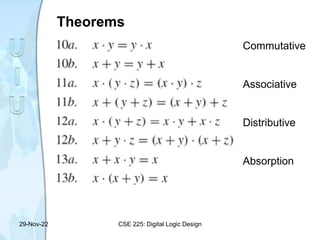
Commutative
Associative
Distributive
Absorption
Theorems
29-Nov-22 CSE 225: Digital Logic Design
Combining
DeMorgan’s
Theorem
Consensus
Proof of DeMorgan’s Theorems
29-Nov-22 CSE 225: Digital Logic Design
Principle of Duality
 The dual of an algebraic expression is
obtained by interchanging + and · and
interchanging 0’s and 1’s.
 The identities appear in dual pairs. When
there is only one identity on a line the identity
is self-dual, i. e., the dual expression = the
original expression.
 Unless it happens to be self-dual, the dual of
an expression does not equal the expression
itself.
29-Nov-22 9
CSE 225: Digital Logic Design
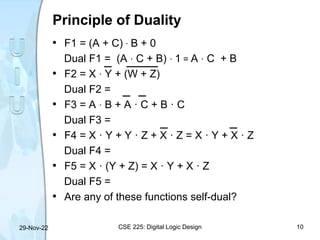
• F1 = (A + C) · B + 0
Dual F1 = (A · C + B) · 1 = A · C + B
• F2 = X · Y + (W + Z)
Dual F2 =
• F3 = A · B + A · C + B · C
Dual F3 =
• F4 = X · Y + Y · Z + X · Z = X · Y + X · Z
Dual F4 =
• F5 = X · (Y + Z) = X · Y + X · Z
Dual F5 =
• Are any of these functions self-dual?
Principle of Duality
29-Nov-22 10
CSE 225: Digital Logic Design
Boolean Operator Precedence
 The order of evaluation in a Boolean expression:
1. Parentheses
2. NOT
3. AND
4. OR
 Consequence: Parentheses appear around
OR expressions
 Example: F = A(B + C)(C + D)
29-Nov-22 11
CSE 225: Digital Logic Design
Problem 1
29-Nov-22 12
CSE 225: Digital Logic Design
Problem 2
29-Nov-22 13
CSE 225: Digital Logic Design
Problem 3
)
Z
X
(
X
Z
)
Y
X
( +
=
+
+ Y Y
29-Nov-22 14
CSE 225: Digital Logic Design
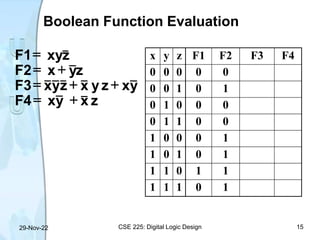
Boolean Function Evaluation
x y z F1 F2 F3 F4
0 0 0 0 0
0 0 1 0 1
0 1 0 0 0
0 1 1 0 0
1 0 0 0 1
1 0 1 0 1
1 1 0 1 1
1 1 1 0 1
z
x
y
x
F4
x
z
y
x
z
y
x
F3
x
F2
xy
F1
+
=
+
=
=
= z
yz
+
y
+
29-Nov-22 15
CSE 225: Digital Logic Design

DLD Lecture 4.pptx

  • 2.
    Overview • Boolean Algebra oAxioms and Theorems o Principle of Duality o Boolean Operator Precedence o Boolean Function Evaluation 29-Nov-22 CSE 225: Digital Logic Design 2
  • 3.
    Boolean Algebra  Abranch of mathematics that deals with operations (AND, OR, NOT) on logical values with binary variables.  Based on a set of rules derived from a small number of basic assumptions - Axioms 29-Nov-22 CSE 225: Digital Logic Design
  • 4.
    Axioms 29-Nov-22 CSE 225:Digital Logic Design
  • 5.
    Single Variable Theorems 29-Nov-22CSE 225: Digital Logic Design
  • 6.
    Theorems 29-Nov-22 CSE 225:Digital Logic Design Commutative Associative Distributive Absorption
  • 7.
    Theorems 29-Nov-22 CSE 225:Digital Logic Design Combining DeMorgan’s Theorem Consensus
  • 8.
    Proof of DeMorgan’sTheorems 29-Nov-22 CSE 225: Digital Logic Design
  • 9.
    Principle of Duality The dual of an algebraic expression is obtained by interchanging + and · and interchanging 0’s and 1’s.  The identities appear in dual pairs. When there is only one identity on a line the identity is self-dual, i. e., the dual expression = the original expression.  Unless it happens to be self-dual, the dual of an expression does not equal the expression itself. 29-Nov-22 9 CSE 225: Digital Logic Design
  • 10.
    • F1 =(A + C) · B + 0 Dual F1 = (A · C + B) · 1 = A · C + B • F2 = X · Y + (W + Z) Dual F2 = • F3 = A · B + A · C + B · C Dual F3 = • F4 = X · Y + Y · Z + X · Z = X · Y + X · Z Dual F4 = • F5 = X · (Y + Z) = X · Y + X · Z Dual F5 = • Are any of these functions self-dual? Principle of Duality 29-Nov-22 10 CSE 225: Digital Logic Design
  • 11.
    Boolean Operator Precedence The order of evaluation in a Boolean expression: 1. Parentheses 2. NOT 3. AND 4. OR  Consequence: Parentheses appear around OR expressions  Example: F = A(B + C)(C + D) 29-Nov-22 11 CSE 225: Digital Logic Design
  • 12.
    Problem 1 29-Nov-22 12 CSE225: Digital Logic Design
  • 13.
    Problem 2 29-Nov-22 13 CSE225: Digital Logic Design
  • 14.
    Problem 3 ) Z X ( X Z ) Y X ( + = + +Y Y 29-Nov-22 14 CSE 225: Digital Logic Design
  • 15.
    Boolean Function Evaluation xy z F1 F2 F3 F4 0 0 0 0 0 0 0 1 0 1 0 1 0 0 0 0 1 1 0 0 1 0 0 0 1 1 0 1 0 1 1 1 0 1 1 1 1 1 0 1 z x y x F4 x z y x z y x F3 x F2 xy F1 + = + = = = z yz + y + 29-Nov-22 15 CSE 225: Digital Logic Design