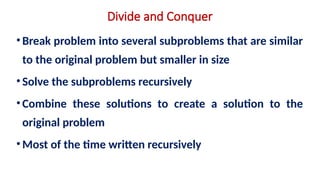
Divide and Conquer
•Breakproblem into several subproblems that are similar
to the original problem but smaller in size
•Solve the subproblems recursively
•Combine these solutions to create a solution to the
original problem
•Most of the time written recursively
3.
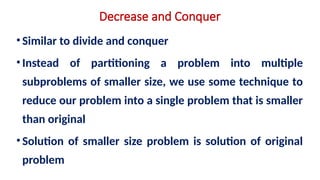
Decrease and Conquer
•Similarto divide and conquer
•Instead of partitioning a problem into multiple
subproblems of smaller size, we use some technique to
reduce our problem into a single problem that is smaller
than original
•Solution of smaller size problem is solution of original
problem
4.
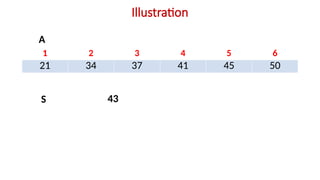
Binary Search
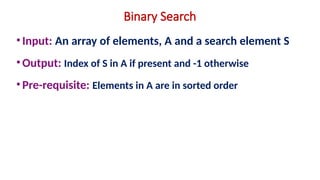
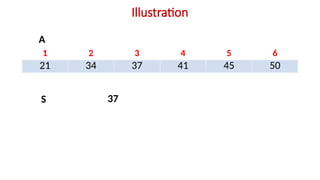
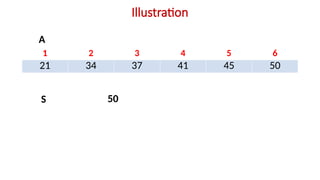
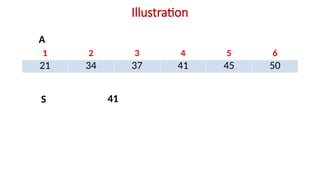
•Input: Anarray of elements, A and a search element S
•Output: Index of S in A if present and -1 otherwise
•Pre-requisite: Elements in A are in sorted order
Proof of Correctness
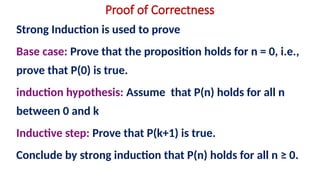
StrongInduction is used to prove
Base case: Prove that the proposition holds for n = 0, i.e.,
prove that P(0) is true.
induction hypothesis: Assume that P(n) holds for all n
between 0 and k
Inductive step: Prove that P(k+1) is true.
Conclude by strong induction that P(n) holds for all n ≥ 0.
11.
Proof of Correctness
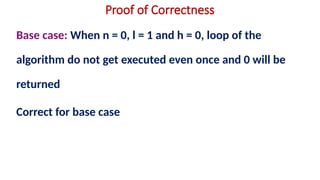
Basecase: When n = 0, l = 1 and h = 0, loop of the
algorithm do not get executed even once and 0 will be
returned
Correct for base case
12.
Proof of Correctness
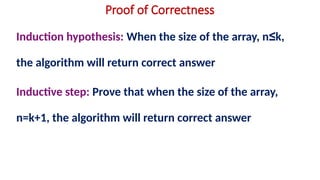
Inductionhypothesis: When the size of the array, n≤k,
the algorithm will return correct answer
Inductive step: Prove that when the size of the array,
n=k+1, the algorithm will return correct answer
13.
Proof of Correctness
Case1: When S = A[mid], algorithm will return mid
Case 2: When S < A[mid], since the array is sorted, S will
be present in the subarray from index 1 to mid-1, as per
induction hypothesis the algorithm will return correct
answer
Case 3: When S >A[mid], symmetrical case of case 2
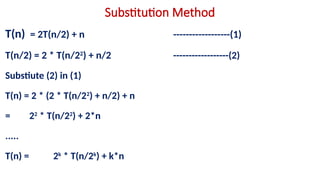
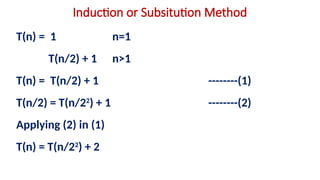
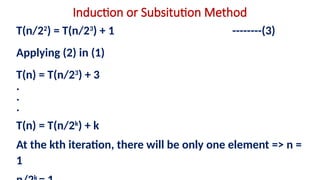
Induction or SubsitutionMethod
T(n/22
) = T(n/23
) + 1 --------(3)
Applying (2) in (1)
T(n) = T(n/23
) + 3
.
.
.
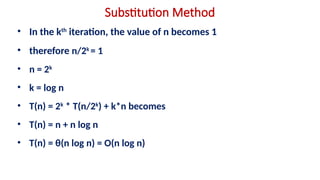
T(n) = T(n/2k
) + k
At the kth iteration, there will be only one element => n =
1
k
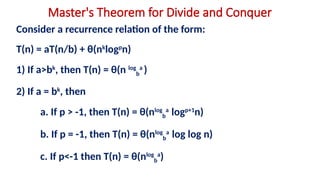
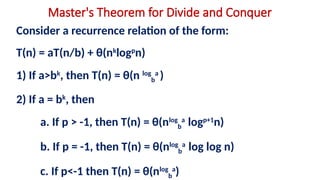
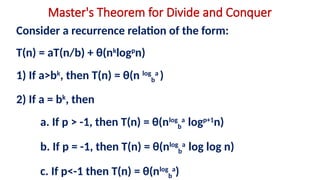
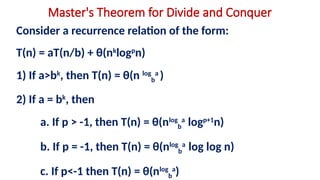
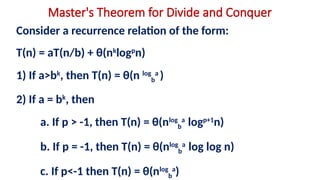
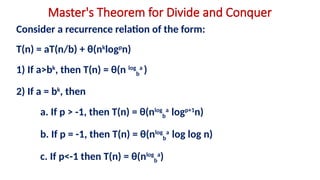
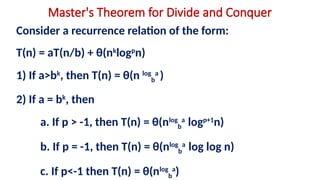
Master's Theorem forDivide and Conquer
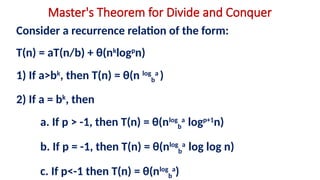
Consider a recurrence relation of the form:
T(n) = aT(n/b) + θ(nk
logp
n)
1) If a>bk
, then T(n) = θ(n log
b
a
)
2) If a = bk
, then
a. If p > -1, then T(n) = θ(nlog
b
a
logp+1
n)
b. If p = -1, then T(n) = θ(nlog
b
a
log log n)
c. If p<-1 then T(n) = θ(nlog
b
a
)
19.
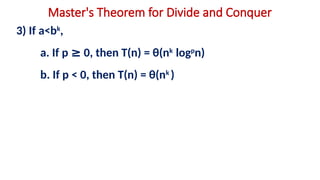
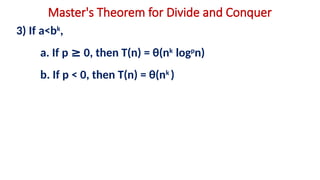
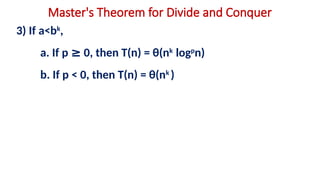
Master's Theorem forDivide and Conquer
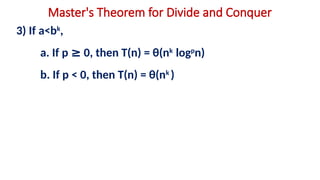
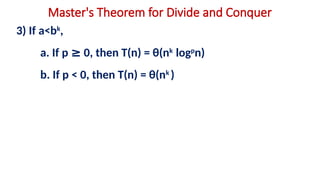
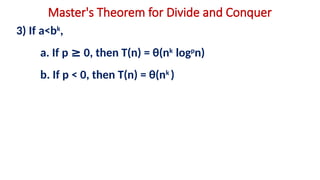
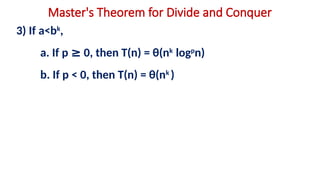
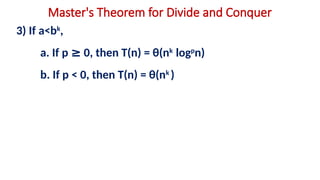
3) If a<bk
,
a. If p ≥ 0, then T(n) = θ(nk
logp
n)
b. If p < 0, then T(n) = θ(nk
)
20.
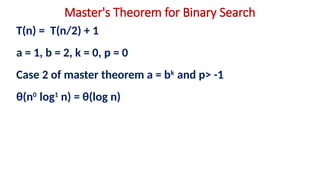
Master's Theorem forBinary Search
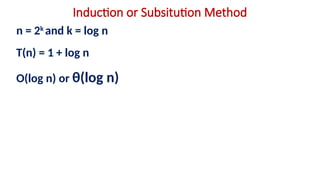
T(n) = T(n/2) + 1
a = 1, b = 2, k = 0, p = 0
Case 2 of master theorem a = bk
and p> -1
θ(n0
log1
n) = θ(log n)
21.
Master's Theorem forDivide and Conquer
Consider a recurrence relation of the form:
T(n) = aT(n/b) + θ(nk
logp
n)
1) If a>bk
, then T(n) = θ(n log
b
a
)
2) If a = bk
, then
a. If p > -1, then T(n) = θ(nlog
b
a
logp+1
n)
b. If p = -1, then T(n) = θ(nlog
b
a
log log n)
c. If p<-1 then T(n) = θ(nlog
b
a
)
22.
Master's Theorem forDivide and Conquer
3) If a<bk
,
a. If p ≥ 0, then T(n) = θ(nk
logp
n)
b. If p < 0, then T(n) = θ(nk
)
23.
Master's Theorem forDivide and Conquer
Consider a recurrence relation of the form:
T(n) = aT(n/b) + θ(nk
logp
n)
1) If a>bk
, then T(n) = θ(n log
b
a
)
2) If a = bk
, then
a. If p > -1, then T(n) = θ(nlog
b
a
logp+1
n)
b. If p = -1, then T(n) = θ(nlog
b
a
log log n)
c. If p<-1 then T(n) = θ(nlog
b
a
)
24.
Master's Theorem forDivide and Conquer
3) If a<bk
,
a. If p ≥ 0, then T(n) = θ(nk
logp
n)
b. If p < 0, then T(n) = θ(nk
)
25.
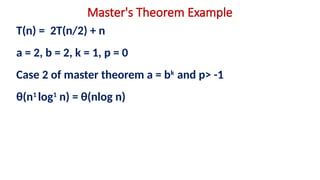
Master's Theorem Example
T(n)= 2T(n/2) + n
a = 2, b = 2, k = 1, p = 0
Case 2 of master theorem a = bk
and p> -1
θ(n1
log1
n) = θ(nlog n)
26.
Master's Theorem forDivide and Conquer
Consider a recurrence relation of the form:
T(n) = aT(n/b) + θ(nk
logp
n)
1) If a>bk
, then T(n) = θ(n log
b
a
)
2) If a = bk
, then
a. If p > -1, then T(n) = θ(nlog
b
a
logp+1
n)
b. If p = -1, then T(n) = θ(nlog
b
a
log log n)
c. If p<-1 then T(n) = θ(nlog
b
a
)
27.
Master's Theorem forDivide and Conquer
3) If a<bk
,
a. If p ≥ 0, then T(n) = θ(nk
logp
n)
b. If p < 0, then T(n) = θ(nk
)
28.
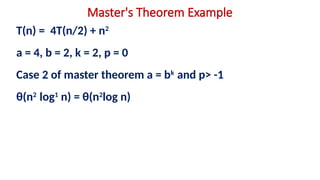
Master's Theorem Example
T(n)= 4T(n/2) + n2
a = 4, b = 2, k = 2, p = 0
Case 2 of master theorem a = bk
and p> -1
θ(n2
log1
n) = θ(n2
log n)
29.
Master's Theorem forDivide and Conquer
Consider a recurrence relation of the form:
T(n) = aT(n/b) + θ(nk
logp
n)
1) If a>bk
, then T(n) = θ(n log
b
a
)
2) If a = bk
, then
a. If p > -1, then T(n) = θ(nlog
b
a
logp+1
n)
b. If p = -1, then T(n) = θ(nlog
b
a
log log n)
c. If p<-1 then T(n) = θ(nlog
b
a
)
30.
Master's Theorem forDivide and Conquer
3) If a<bk
,
a. If p ≥ 0, then T(n) = θ(nk
logp
n)
b. If p < 0, then T(n) = θ(nk
)
31.
Master's Theorem Example
T(n)= 4T(n/2) + n2
logn
a = 4, b = 2, k = 2, p = 1
Case 2 of master theorem a = bk
and p> -1
θ(n2
log2
n)
32.
Master's Theorem forDivide and Conquer
Consider a recurrence relation of the form:
T(n) = aT(n/b) + θ(nk
logp
n)
1) If a>bk
, then T(n) = θ(n log
b
a
)
2) If a = bk
, then
a. If p > -1, then T(n) = θ(nlog
b
a
logp+1
n)
b. If p = -1, then T(n) = θ(nlog
b
a
log log n)
c. If p<-1 then T(n) = θ(nlog
b
a
)
33.
Master's Theorem forDivide and Conquer
3) If a<bk
,
a. If p ≥ 0, then T(n) = θ(nk
logp
n)
b. If p < 0, then T(n) = θ(nk
)
34.
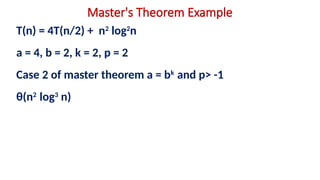
Master's Theorem Example
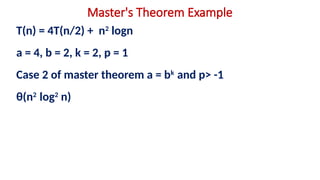
T(n)= 4T(n/2) + n2
log2
n
a = 4, b = 2, k = 2, p = 2
Case 2 of master theorem a = bk
and p> -1
θ(n2
log3
n)
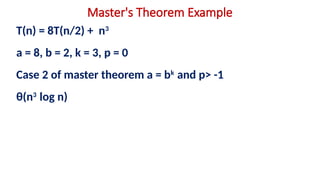
35.
Master's Theorem Example
T(n)= 8T(n/2) + n3
a = 8, b = 2, k = 3, p = 0
Case 2 of master theorem a = bk
and p> -1
θ(n3
log n)
36.
Master's Theorem forDivide and Conquer
Consider a recurrence relation of the form:
T(n) = aT(n/b) + θ(nk
logp
n)
1) If a>bk
, then T(n) = θ(n log
b
a
)
2) If a = bk
, then
a. If p > -1, then T(n) = θ(nlog
b
a
logp+1
n)
b. If p = -1, then T(n) = θ(nlog
b
a
log log n)
c. If p<-1 then T(n) = θ(nlog
b
a
)
37.
Master's Theorem forDivide and Conquer
3) If a<bk
,
a. If p ≥ 0, then T(n) = θ(nk
logp
n)
b. If p < 0, then T(n) = θ(nk
)
38.
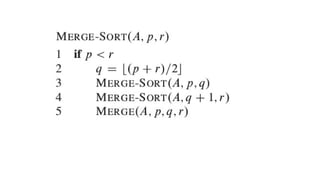
Merge Sort
Closely followsthe divide-and-conquer paradigm
Divide: Divide the n-element sequence to be sorted into two subsequences of
n/2 elements each
Conquer: Sort the two subsequences recursively using merge sort
Combine: Merge the two sorted subsequences to produce the sorted answer
39.
Merge Sort
• Recursionstops when sequence to be sorted has a length 1
• Since every sequence of length 1 is already in sorted order
• Key operation of merge sort algorithm is merging of two sorted sequences
in “combine” step
• Let us use an Auxiliary procedure MERGE to do the combine operation
40.
Merge Sort
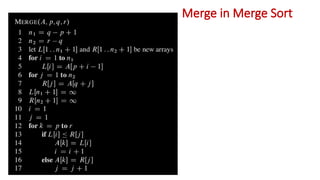
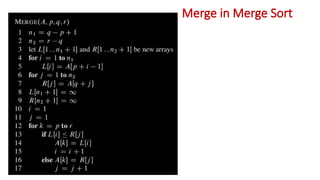
• MERGE(A, p, q, r), where A is an array and p, q, and r are indices into the
array such that p ≤ q < r
• Procedure assumes that the subarrays A[p..q] and A[q+1..r] are in sorted
order
• It merges them to form a single sorted subarray that replaces the current
subarray A[p..r]
41.
Merge in MergeSort
• MERGE procedure takes time θ(n), where n = r - p + 1 is the total number
of elements being merged
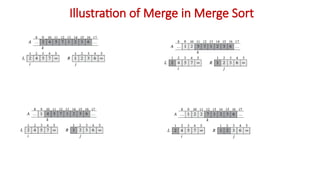
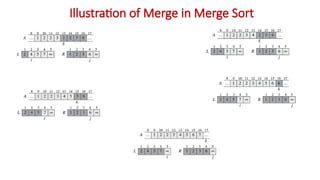
• Shall be illustrated with two piles of cards face up on a table
• Each pile is sorted, with the smallest cards on top
• We wish to merge the two piles into a single sorted output pile, which is to
be face down on the table
42.
Merge in MergeSort
Basic Step
(i) Choose the smaller of the two cards on top of the face-up piles,
removing it from its pile (which exposes a new top card),
(ii) Place this card face down onto the output pile
repeat this step until one input pile is empty then take the remaining input
pile and place it face down onto the output pile
43.
Merge in MergeSort
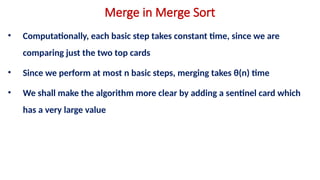
• Computationally, each basic step takes constant time, since we are
comparing just the two top cards
• Since we perform at most n basic steps, merging takes θ(n) time
• We shall make the algorithm more clear by adding a sentinel card which
has a very large value
Proof of Correctnessof Merge Operation
Lines 10–17, of the algorithm, perform the r -p + 1 basic steps by
maintaining the following loop invariants:
(i) At the start of each iteration of the for loop of lines 12–17, the subarray
A[p..k-1] contains k - p smallest elements of L[1..n1+ 1] and R[1..n2+ 1], in
sorted order.
(ii) Moreover, L[i] and R[j] are the smallest elements of their arrays that
have not been copied back into A.
49.
To Show
• Loopinvariant holds prior to first iteration of for loop
of lines 12–17
• Each iteration of the loop maintains the invariant
• Invariant provides a useful property to show
correctness when the loop terminates
50.
Initialization
• Prior tothe first iteration of the loop, we have k = p, so that
the subarray A[p..k-1] is empty
• This empty subarray contains the k - p = 0 smallest elements
of L and R, and since i = j = 1, both L[i] and R[j] are the smallest
elements of their arrays that have not been copied back into
A.
51.
Maintenance of LoopInvariant
• Let L[i] ≤ R[j], then L[i] is the smallest element not yet
copied back into A
• Because A[p..k-1] contains the k - p smallest elements,
after line 14 copies L[i] into A[k], the subarray A[p .. k]
will contain the k - p + 1 smallest elements
52.
Termination of LoopInvariant
• At termination, k = r + 1. By the loop invariant, the
subarray A[p..k-1], which is A[p..r], contains the k - p = r
- p + 1 smallest elements of L[1..n1 +1] and R[1..n2+1],
in sorted order
• The arrays L and R together contain n1 + n2 + 2 = r - p + 3
elements
53.
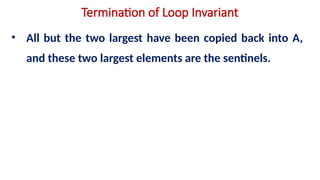
Termination of LoopInvariant
• All but the two largest have been copied back into A,
and these two largest elements are the sentinels.
Time Complexity ofMerge Operation
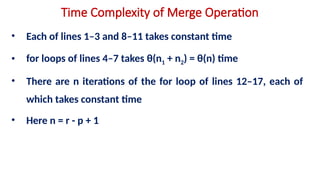
• Each of lines 1–3 and 8–11 takes constant time
• for loops of lines 4–7 takes θ(n1 + n2) = θ(n) time
• There are n iterations of the for loop of lines 12–17, each of
which takes constant time
• Here n = r - p + 1
56.
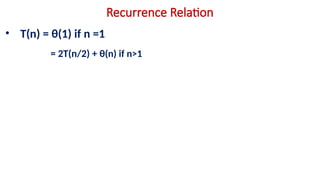
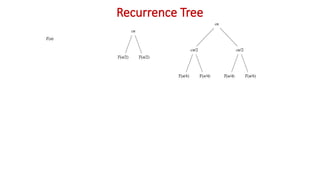
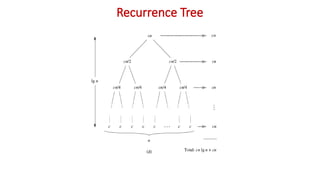
Forming Recurrence Relation
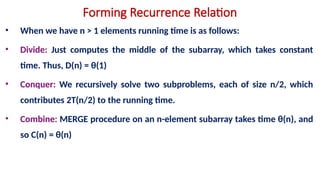
•When we have n > 1 elements running time is as follows:
• Divide: Just computes the middle of the subarray, which takes constant
time. Thus, D(n) = θ(1)
• Conquer: We recursively solve two subproblems, each of size n/2, which
contributes 2T(n/2) to the running time.
• Combine: MERGE procedure on an n-element subarray takes time θ(n), and
so C(n) = θ(n)
Master's Theorem forDivide and Conquer
Consider a recurrence relation of the form:
T(n) = aT(n/b) + θ(nk
logp
n)
1) If a>bk
, then T(n) = θ(n log
b
a
)
2) If a = bk
, then
a. If p > -1, then T(n) = θ(nlog
b
a
logp+1
n)
b. If p = -1, then T(n) = θ(nlog
b
a
log log n)
c. If p<-1 then T(n) = θ(nlog
b
a
)
65.
Master's Theorem forDivide and Conquer
3) If a<bk
,
a. If p ≥ 0, then T(n) = θ(nk
logp
n)
b. If p < 0, then T(n) = θ(nk
)

![Algorithm
int Binary_Search(A,n,Key):
l = 1; h = n
while (l<=h):
mid = (l+h)/2
if (key==A[mid])
return mid
if (key<A[mid])
h = mid-1
else
l = mid+1
return 0](https://image.slidesharecdn.com/divideandconquerbinarysearchmergesort-250720174319-ad85a9ff/85/Divide-and-Conquer_Binary_Search_Merge_Sort-pptx-9-320.jpg)
![Proof of Correctness
Case 1: When S = A[mid], algorithm will return mid
Case 2: When S < A[mid], since the array is sorted, S will
be present in the subarray from index 1 to mid-1, as per
induction hypothesis the algorithm will return correct
answer
Case 3: When S >A[mid], symmetrical case of case 2](https://image.slidesharecdn.com/divideandconquerbinarysearchmergesort-250720174319-ad85a9ff/85/Divide-and-Conquer_Binary_Search_Merge_Sort-pptx-13-320.jpg)
![Merge Sort
• MERGE (A, p, q, r), where A is an array and p, q, and r are indices into the
array such that p ≤ q < r
• Procedure assumes that the subarrays A[p..q] and A[q+1..r] are in sorted
order
• It merges them to form a single sorted subarray that replaces the current
subarray A[p..r]](https://image.slidesharecdn.com/divideandconquerbinarysearchmergesort-250720174319-ad85a9ff/85/Divide-and-Conquer_Binary_Search_Merge_Sort-pptx-40-320.jpg)

![Proof of Correctness of Merge Operation
Lines 10–17, of the algorithm, perform the r -p + 1 basic steps by
maintaining the following loop invariants:
(i) At the start of each iteration of the for loop of lines 12–17, the subarray
A[p..k-1] contains k - p smallest elements of L[1..n1+ 1] and R[1..n2+ 1], in
sorted order.
(ii) Moreover, L[i] and R[j] are the smallest elements of their arrays that
have not been copied back into A.](https://image.slidesharecdn.com/divideandconquerbinarysearchmergesort-250720174319-ad85a9ff/85/Divide-and-Conquer_Binary_Search_Merge_Sort-pptx-48-320.jpg)
![Initialization
• Prior to the first iteration of the loop, we have k = p, so that
the subarray A[p..k-1] is empty
• This empty subarray contains the k - p = 0 smallest elements
of L and R, and since i = j = 1, both L[i] and R[j] are the smallest
elements of their arrays that have not been copied back into
A.](https://image.slidesharecdn.com/divideandconquerbinarysearchmergesort-250720174319-ad85a9ff/85/Divide-and-Conquer_Binary_Search_Merge_Sort-pptx-50-320.jpg)
![Maintenance of Loop Invariant
• Let L[i] ≤ R[j], then L[i] is the smallest element not yet
copied back into A
• Because A[p..k-1] contains the k - p smallest elements,
after line 14 copies L[i] into A[k], the subarray A[p .. k]
will contain the k - p + 1 smallest elements](https://image.slidesharecdn.com/divideandconquerbinarysearchmergesort-250720174319-ad85a9ff/85/Divide-and-Conquer_Binary_Search_Merge_Sort-pptx-51-320.jpg)
![Termination of Loop Invariant
• At termination, k = r + 1. By the loop invariant, the
subarray A[p..k-1], which is A[p..r], contains the k - p = r
- p + 1 smallest elements of L[1..n1 +1] and R[1..n2+1],
in sorted order
• The arrays L and R together contain n1 + n2 + 2 = r - p + 3
elements](https://image.slidesharecdn.com/divideandconquerbinarysearchmergesort-250720174319-ad85a9ff/85/Divide-and-Conquer_Binary_Search_Merge_Sort-pptx-52-320.jpg)