Diuretics
Avina Kharat
PG Resident
MGMMC Indore
Contents
• Introduction
• Physiology
• Loop diuretic- MOA, effects, clinical application, side-effects, toxicities/interaction
• Thiazide diuretic – MOA, effects, clinical application, side-effects, toxicities/interaction
• Osmotic diuretic- MOA, effects, clinical application, side-effects, toxicities/interaction
Diuretics
H2O
very
high
H2O
high
H2O
low
H2O
low
H2O
vary
65 % Na+
, K+
, Cl-
, and Ca2+
,
Mg2+
85% NaHCO3,
100% glucose and amino
acid
15-25% Na+
,
K+
, Cl-
, and
Ca2+
, Mg2+
4-8 % Na+
, Cl-
,
and Ca2+ (parathyroid
hormone)
2-5% Na+
, K+
, H+
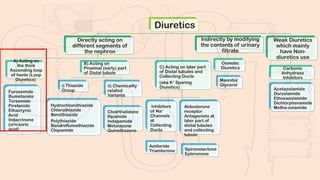
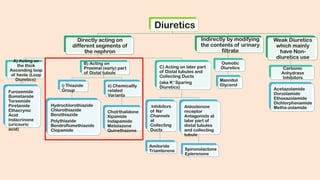
Diuretics
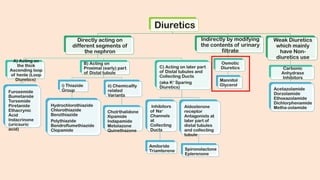
Directly acting on
different segments of
the nephron
A) Acting on
the thick
Ascending loop
of henle (Loop
Diuretics)
Furosemide
Bumetanide
Torsemide
Piretanide
Ethacrynic
Acid
Indacrinone
(uricsuric
acid)
B) Acting on
Proximal (early) part
of Distal tubule
i) Thiazide
Group
Hydrochlorothiazide
Chlorothiazide
Benzthiazide
Polythiazide
Bendroflumethiazide
Clopamide
ii) Chemicallly
related
Variants
Cholrthalidone
Xipamide
Indapamide
Metolazone
Quinethazone
C) Acting on later part
of Distal tubules and
Collecting Ducts
(aka K+
Sparing
Diuretics)
Inhibitors
of Na+
Channels
at
Collecting
Ducts
Amiloride
Triamterene
Aldosterone
receptor
Antagonists at
later part of
distal tubules
and collecting
tubule
Spironolactone
Eplerenone
Indirectly by modifying
the contents of urinary
filtrate
Osmotic
Diuretics
Mannitol
Glycerol
Weak Diuretics
which mainly
have Non-
diuretics use
Carbonic
Anhydrase
Inhibitors
Acetazolamide
Dorzolamide
Ethoxazolamide
Dichlorphenamide
Metha-zolamide
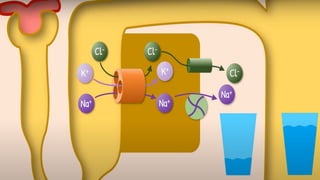
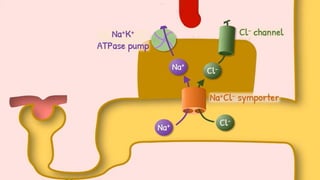
Na+
Cl-
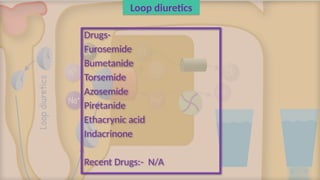
Loop diuretics
Drugs-
Furosemide
Bumetanide
Torsemide
Azosemide
Piretanide
Ethacrynic acid
Indacrinone
Recent Drugs:- N/A
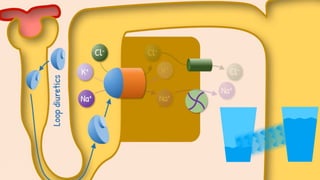
Loop diuretics
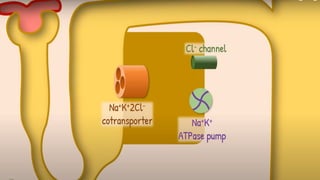
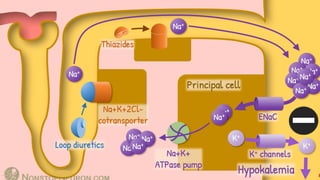
•MOA- inhibiting Na+
K+
/Cl-
Cotransporter
•Clinical Application-
• Edematous conditions associated with congestive heart
failure, cirrhosis of the liver, and renal disease including
nephrotic syndrome.
• Can be Hypertension (though thiazides preferred) esp. if it is
complicated by renal impairment
• Acute renal failure
• Br-, I- or F- toxicity
• Mild hyperkalemia
• Non diuretic use – mild to mod hypercalcemia
Loop diuretics
Side-effects –
• Hyperuricemia - precipitates the attacks of Gout
• Hypercalciuria and hypomagnesemia – chronic use
• Hypokalemia (Hypokalemic metabolic alkalosis) – reverse by K+ replacement.
• Ototoxicity (a)
• Hyperglycemia
• Hypersensitivity reactions
• Others- GIT disturbances, Hepatotoxicity, pancreatitis with ethacrynic acid,
Myalgia- bumetanide & piretanide
Interaction-
• May enhance digitalis toxicity  cardiac irregularities
• Serum lithium levels may rise
• Indomethacin and NSAIDS
Diuretics
Directly acting on
different segments of
the nephron
A) Acting on
the thick
Ascending loop
of henle (Loop
Diuretics)
Furosemide
Bumetanide
Torsemide
Piretanide
Ethacrynic
Acid
Indacrinone
(uricsuric
acid)
B) Acting on
Proximal (early) part
of Distal tubule
i) Thiazide
Group
Hydrochlorothiazide
Chlorothiazide
Benzthiazide
Polythiazide
Bendroflumethiazide
Clopamide
ii) Chemicallly
related
Variants
Cholrthalidone
Xipamide
Indapamide
Metolazone
Quinethazone
C) Acting on later part
of Distal tubules and
Collecting Ducts
(aka K+
Sparing
Diuretics)
Inhibitors
of Na+
Channels
at
Collecting
Ducts
Amiloride
Triamterene
Aldosterone
receptor
Antagonists at
later part of
distal tubules
and collecting
tubule
Spironolactone
Eplerenone
Indirectly by modifying
the contents of urinary
filtrate
Osmotic
Diuretics
Mannitol
Glycerol
Weak Diuretics
which mainly
have Non-
diuretics use
Carbonic
Anhydrase
Inhibitors
Acetazolamide
Dorzolamide
Ethoxazolamide
Dichlorphenamide
Metha-zolamide
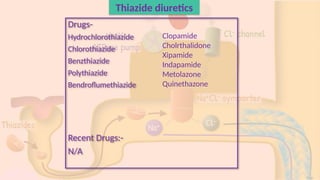
Thiazide diuretics
Drugs-
Hydrochlorothiazide
Chlorothiazide
Benzthiazide
Polythiazide
Bendroflumethiazide
Recent Drugs:-
N/A
Clopamide
Cholrthalidone
Xipamide
Indapamide
Metolazone
Quinethazone
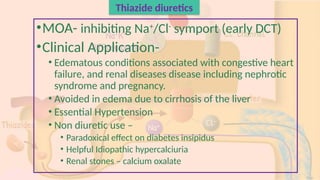
Thiazide diuretics
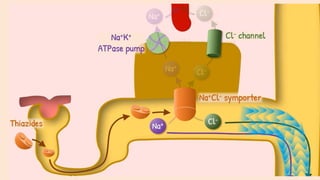
•MOA- inhibiting Na+
/Cl-
symport (early DCT)
•Clinical Application-
• Edematous conditions associated with congestive heart
failure, and renal diseases disease including nephrotic
syndrome and pregnancy.
• Avoided in edema due to cirrhosis of the liver
• Essential Hypertension
• Non diuretic use –
• Paradoxical effect on diabetes insipidus
• Helpful Idiopathic hypercalciuria
• Renal stones – calcium oxalate
Thiazide diuretics
Side-effects –
• Hyperuricemia - precipitates the attacks of Gout
• Hypercalcemia
• Hypokalemia – given with K+
supplement / K+
Sparing
• Hyperglycemia, Hyperlipidemia
• Hypersensitivity reactions (patients allergic to sulfonamide- skin rashes, blood
dyscrasias, and rarely pancreatitis)
• Erectile Dysfunction in males- normalize after stopping.
Interaction-
• Digitalis
• Lithium
Diuretics
Directly acting on
different segments of
the nephron
A) Acting on
the thick
Ascending loop
of henle (Loop
Diuretics)
Furosemide
Bumetanide
Torsemide
Piretanide
Ethacrynic
Acid
Indacrinone
(uricsuric
acid)
B) Acting on
Proximal (early) part
of Distal tubule
i) Thiazide
Group
Hydrochlorothiazide
Chlorothiazide
Benzthiazide
Polythiazide
Bendroflumethiazide
Clopamide
ii) Chemicallly
related
Variants
Cholrthalidone
Xipamide
Indapamide
Metolazone
Quinethazone
C) Acting on later part
of Distal tubules and
Collecting Ducts
(aka K+
Sparing
Diuretics)
Inhibitors
of Na+
Channels
at
Collecting
Ducts
Amiloride
Triamterene
Aldosterone
receptor
Antagonists at
later part of
distal tubules
and collecting
tubule
Spironolactone
Eplerenone
Indirectly by modifying
the contents of urinary
filtrate
Osmotic
Diuretics
Mannitol
Glycerol
Weak Diuretics
which mainly
have Non-
diuretics use
Carbonic
Anhydrase
Inhibitors
Acetazolamide
Dorzolamide
Ethoxazolamide
Dichlorphenamide
Metha-zolamide
Drugs-
Mannitol
Glycerol
Isosorbide
Recent Drugs:-
N/A
Osmotic diuretics
rarely used
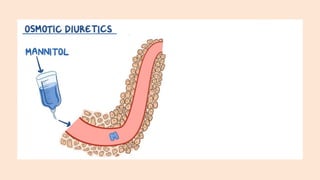
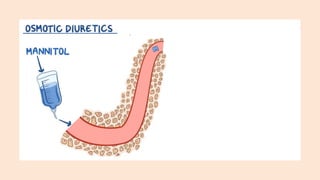
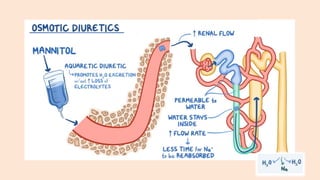
•MOA- passive reabsorption H2O is reduced and
excreted with small amount of sodium.(Aquaretic)
•Clinical Application-
• To treat oliguria state in shock or crush injury- to prevent renal
failure
• Non diuretic use-
• Cerebral Edema and glaucoma.
Osmotic diuretics
Side-effects –
• May worsen the condition of cardiac failure or
pulmonary edema.
• Orally- may cause osmotic diarrhea -
Osmotic diuretics
Diuretic combinations
• Loop & thiazide diuretics
• Potassium-sparing diuretics & Proximal tubule diuretics agents (loop or
thiazides)
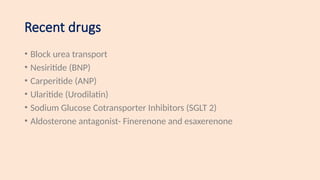
Recent drugs
• Block urea transport
• Nesiritide (BNP)
• Carperitide (ANP)
• Ularitide (Urodilatin)
• Sodium Glucose Cotransporter Inhibitors (SGLT 2)
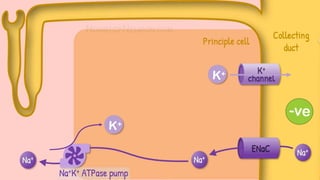
• Aldosterone antagonist- Finerenone and esaxerenone
-ve
K+
K+
Diuretics power point presentation .pptx

Diuretics power point presentation .pptx

  • 1.
  • 2.
    Contents • Introduction • Physiology •Loop diuretic- MOA, effects, clinical application, side-effects, toxicities/interaction • Thiazide diuretic – MOA, effects, clinical application, side-effects, toxicities/interaction • Osmotic diuretic- MOA, effects, clinical application, side-effects, toxicities/interaction
  • 3.
  • 4.
    H2O very high H2O high H2O low H2O low H2O vary 65 % Na+ ,K+ , Cl- , and Ca2+ , Mg2+ 85% NaHCO3, 100% glucose and amino acid 15-25% Na+ , K+ , Cl- , and Ca2+ , Mg2+ 4-8 % Na+ , Cl- , and Ca2+ (parathyroid hormone) 2-5% Na+ , K+ , H+
  • 5.
    Diuretics Directly acting on differentsegments of the nephron A) Acting on the thick Ascending loop of henle (Loop Diuretics) Furosemide Bumetanide Torsemide Piretanide Ethacrynic Acid Indacrinone (uricsuric acid) B) Acting on Proximal (early) part of Distal tubule i) Thiazide Group Hydrochlorothiazide Chlorothiazide Benzthiazide Polythiazide Bendroflumethiazide Clopamide ii) Chemicallly related Variants Cholrthalidone Xipamide Indapamide Metolazone Quinethazone C) Acting on later part of Distal tubules and Collecting Ducts (aka K+ Sparing Diuretics) Inhibitors of Na+ Channels at Collecting Ducts Amiloride Triamterene Aldosterone receptor Antagonists at later part of distal tubules and collecting tubule Spironolactone Eplerenone Indirectly by modifying the contents of urinary filtrate Osmotic Diuretics Mannitol Glycerol Weak Diuretics which mainly have Non- diuretics use Carbonic Anhydrase Inhibitors Acetazolamide Dorzolamide Ethoxazolamide Dichlorphenamide Metha-zolamide
  • 8.
  • 14.
  • 15.
    Loop diuretics •MOA- inhibitingNa+ K+ /Cl- Cotransporter •Clinical Application- • Edematous conditions associated with congestive heart failure, cirrhosis of the liver, and renal disease including nephrotic syndrome. • Can be Hypertension (though thiazides preferred) esp. if it is complicated by renal impairment • Acute renal failure • Br-, I- or F- toxicity • Mild hyperkalemia • Non diuretic use – mild to mod hypercalcemia
  • 16.
    Loop diuretics Side-effects – •Hyperuricemia - precipitates the attacks of Gout • Hypercalciuria and hypomagnesemia – chronic use • Hypokalemia (Hypokalemic metabolic alkalosis) – reverse by K+ replacement. • Ototoxicity (a) • Hyperglycemia • Hypersensitivity reactions • Others- GIT disturbances, Hepatotoxicity, pancreatitis with ethacrynic acid, Myalgia- bumetanide & piretanide Interaction- • May enhance digitalis toxicity  cardiac irregularities • Serum lithium levels may rise • Indomethacin and NSAIDS
  • 17.
    Diuretics Directly acting on differentsegments of the nephron A) Acting on the thick Ascending loop of henle (Loop Diuretics) Furosemide Bumetanide Torsemide Piretanide Ethacrynic Acid Indacrinone (uricsuric acid) B) Acting on Proximal (early) part of Distal tubule i) Thiazide Group Hydrochlorothiazide Chlorothiazide Benzthiazide Polythiazide Bendroflumethiazide Clopamide ii) Chemicallly related Variants Cholrthalidone Xipamide Indapamide Metolazone Quinethazone C) Acting on later part of Distal tubules and Collecting Ducts (aka K+ Sparing Diuretics) Inhibitors of Na+ Channels at Collecting Ducts Amiloride Triamterene Aldosterone receptor Antagonists at later part of distal tubules and collecting tubule Spironolactone Eplerenone Indirectly by modifying the contents of urinary filtrate Osmotic Diuretics Mannitol Glycerol Weak Diuretics which mainly have Non- diuretics use Carbonic Anhydrase Inhibitors Acetazolamide Dorzolamide Ethoxazolamide Dichlorphenamide Metha-zolamide
  • 24.
  • 25.
    Thiazide diuretics •MOA- inhibitingNa+ /Cl- symport (early DCT) •Clinical Application- • Edematous conditions associated with congestive heart failure, and renal diseases disease including nephrotic syndrome and pregnancy. • Avoided in edema due to cirrhosis of the liver • Essential Hypertension • Non diuretic use – • Paradoxical effect on diabetes insipidus • Helpful Idiopathic hypercalciuria • Renal stones – calcium oxalate
  • 26.
    Thiazide diuretics Side-effects – •Hyperuricemia - precipitates the attacks of Gout • Hypercalcemia • Hypokalemia – given with K+ supplement / K+ Sparing • Hyperglycemia, Hyperlipidemia • Hypersensitivity reactions (patients allergic to sulfonamide- skin rashes, blood dyscrasias, and rarely pancreatitis) • Erectile Dysfunction in males- normalize after stopping. Interaction- • Digitalis • Lithium
  • 27.
    Diuretics Directly acting on differentsegments of the nephron A) Acting on the thick Ascending loop of henle (Loop Diuretics) Furosemide Bumetanide Torsemide Piretanide Ethacrynic Acid Indacrinone (uricsuric acid) B) Acting on Proximal (early) part of Distal tubule i) Thiazide Group Hydrochlorothiazide Chlorothiazide Benzthiazide Polythiazide Bendroflumethiazide Clopamide ii) Chemicallly related Variants Cholrthalidone Xipamide Indapamide Metolazone Quinethazone C) Acting on later part of Distal tubules and Collecting Ducts (aka K+ Sparing Diuretics) Inhibitors of Na+ Channels at Collecting Ducts Amiloride Triamterene Aldosterone receptor Antagonists at later part of distal tubules and collecting tubule Spironolactone Eplerenone Indirectly by modifying the contents of urinary filtrate Osmotic Diuretics Mannitol Glycerol Weak Diuretics which mainly have Non- diuretics use Carbonic Anhydrase Inhibitors Acetazolamide Dorzolamide Ethoxazolamide Dichlorphenamide Metha-zolamide
  • 28.
  • 35.
    •MOA- passive reabsorptionH2O is reduced and excreted with small amount of sodium.(Aquaretic) •Clinical Application- • To treat oliguria state in shock or crush injury- to prevent renal failure • Non diuretic use- • Cerebral Edema and glaucoma. Osmotic diuretics
  • 36.
    Side-effects – • Mayworsen the condition of cardiac failure or pulmonary edema. • Orally- may cause osmotic diarrhea - Osmotic diuretics
  • 38.
    Diuretic combinations • Loop& thiazide diuretics • Potassium-sparing diuretics & Proximal tubule diuretics agents (loop or thiazides)
  • 39.
    Recent drugs • Blockurea transport • Nesiritide (BNP) • Carperitide (ANP) • Ularitide (Urodilatin) • Sodium Glucose Cotransporter Inhibitors (SGLT 2) • Aldosterone antagonist- Finerenone and esaxerenone
  • 43.