Distributed Systems
Prof. Rajiv Misra
Department of Computer Science and Engineering
Indian Institute of Technology, Patna
Lecture - 01
Introduction to Distributed Systems
So this is the first lecture Introduction to the Distributed Systems.
(Refer Slide Time: 00:21)
In this particular distributed system lecture introduction, we are going to discuss about the
different requirements of a distributed computing systems and we are going to discuss, what
are the different topics we are going to cover the textbooks and so on so forth.
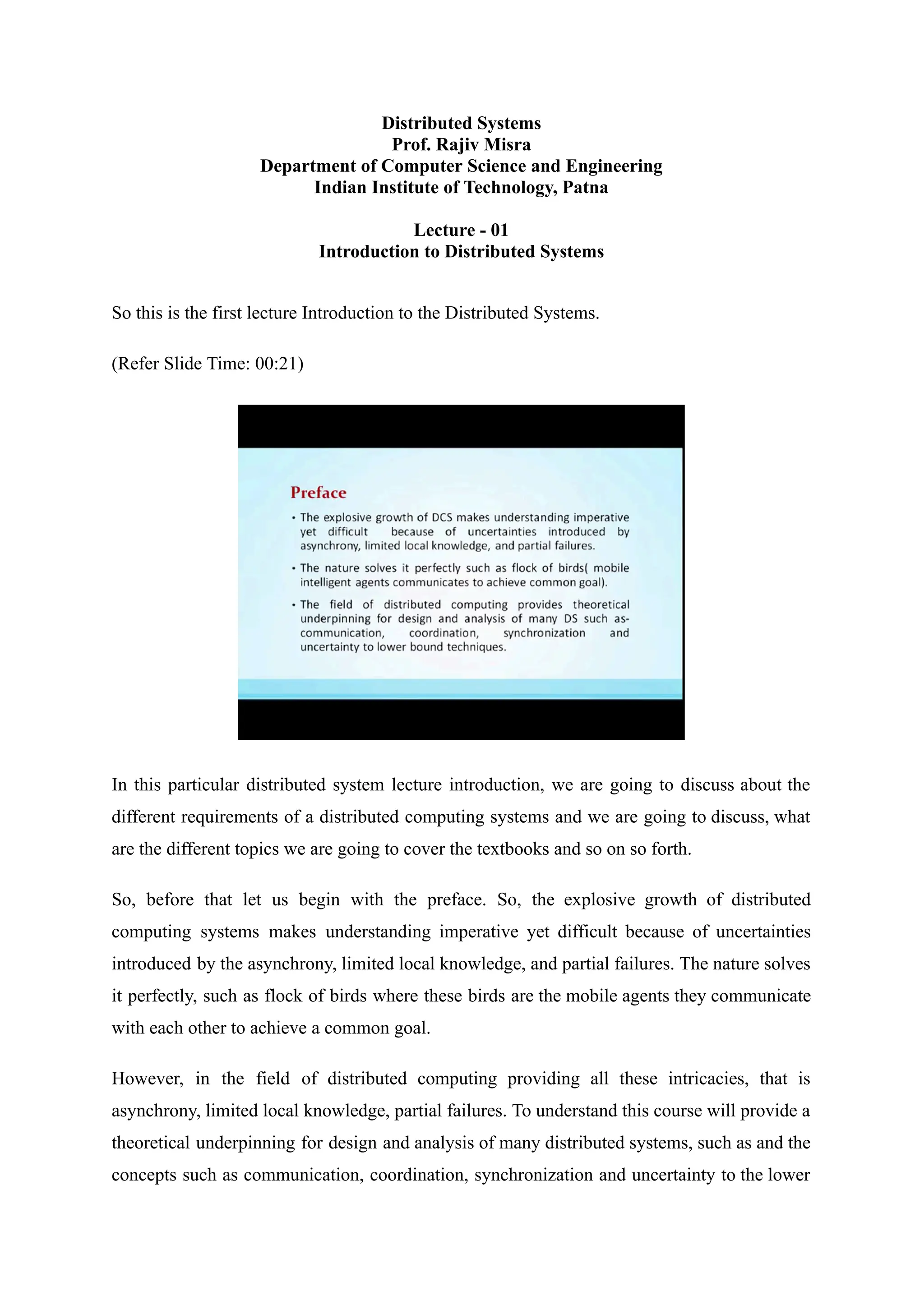
So, before that let us begin with the preface. So, the explosive growth of distributed
computing systems makes understanding imperative yet difficult because of uncertainties
introduced by the asynchrony, limited local knowledge, and partial failures. The nature solves
it perfectly, such as flock of birds where these birds are the mobile agents they communicate
with each other to achieve a common goal.
However, in the field of distributed computing providing all these intricacies, that is
asynchrony, limited local knowledge, partial failures. To understand this course will provide a
theoretical underpinning for design and analysis of many distributed systems, such as and the
concepts such as communication, coordination, synchronization and uncertainty to the lower
bounds techniques. These together will be discussed in the part of the course. And this
particular course will be quite useful as far as the different applications are concerned.
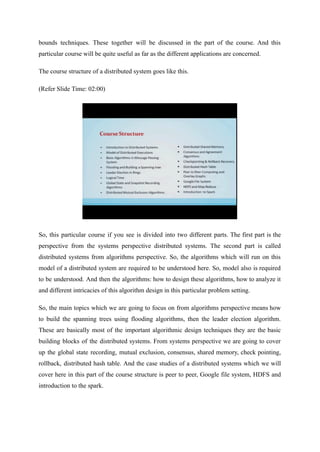
The course structure of a distributed system goes like this.
(Refer Slide Time: 02:00)
So, this particular course if you see is divided into two different parts. The first part is the
perspective from the systems perspective distributed systems. The second part is called
distributed systems from algorithms perspective. So, the algorithms which will run on this
model of a distributed system are required to be understood here. So, model also is required
to be understood. And then the algorithms: how to design these algorithms, how to analyze it
and different intricacies of this algorithm design in this particular problem setting.
So, the main topics which we are going to focus on from algorithms perspective means how
to build the spanning trees using flooding algorithms, then the leader election algorithm.
These are basically most of the important algorithmic design techniques they are the basic
building blocks of the distributed systems. From systems perspective we are going to cover
up the global state recording, mutual exclusion, consensus, shared memory, check pointing,
rollback, distributed hash table. And the case studies of a distributed systems which we will
cover here in this part of the course structure is peer to peer, Google file system, HDFS and
introduction to the spark.
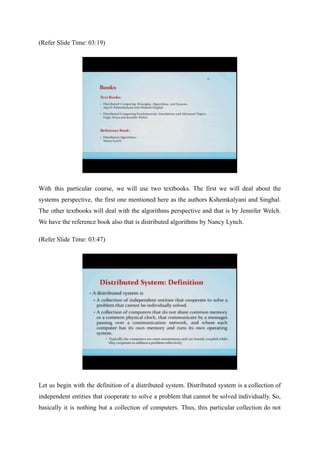
(Refer Slide Time: 03:19)
With this particular course, we will use two textbooks. The first we will deal about the
systems perspective, the first one mentioned here as the authors Kshemkalyani and Singhal.
The other textbooks will deal with the algorithms perspective and that is by Jennifer Welch.
We have the reference book also that is distributed algorithms by Nancy Lynch.
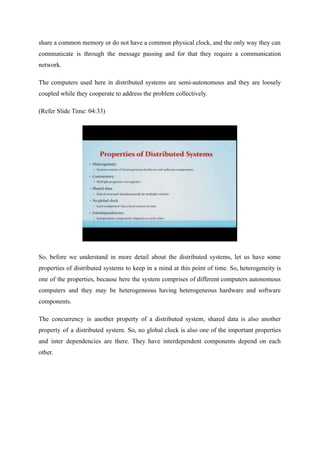
(Refer Slide Time: 03:47)
Let us begin with the definition of a distributed system. Distributed system is a collection of
independent entities that cooperate to solve a problem that cannot be solved individually. So,
basically it is nothing but a collection of computers. Thus, this particular collection do not
share a common memory or do not have a common physical clock, and the only way they can
communicate is through the message passing and for that they require a communication
network.
The computers used here in distributed systems are semi-autonomous and they are loosely
coupled while they cooperate to address the problem collectively.
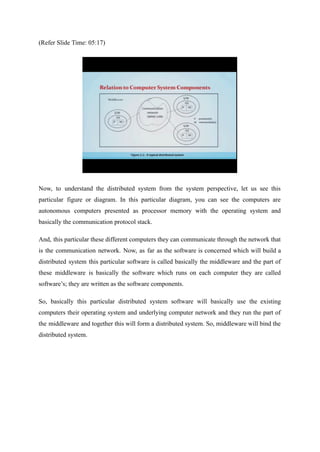
(Refer Slide Time: 04:33)
So, before we understand in more detail about the distributed systems, let us have some
properties of distributed systems to keep in a mind at this point of time. So, heterogeneity is
one of the properties, because here the system comprises of different computers autonomous
computers and they may be heterogeneous having heterogeneous hardware and software
components.
The concurrency is another property of a distributed system, shared data is also another
property of a distributed system. So, no global clock is also one of the important properties
and inter dependencies are there. They have interdependent components depend on each
other.
(Refer Slide Time: 05:17)
Now, to understand the distributed system from the system perspective, let us see this
particular figure or diagram. In this particular diagram, you can see the computers are
autonomous computers presented as processor memory with the operating system and
basically the communication protocol stack.
And, this particular these different computers they can communicate through the network that
is the communication network. Now, as far as the software is concerned which will build a
distributed system this particular software is called basically the middleware and the part of
these middleware is basically the software which runs on each computer they are called
software’s; they are written as the software components.
So, basically this particular distributed system software will basically use the existing
computers their operating system and underlying computer network and they run the part of
the middleware and together this will form a distributed system. So, middleware will bind the
distributed system.
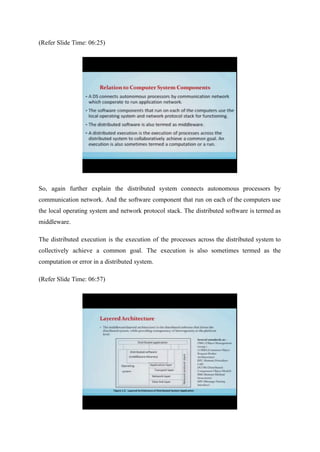
(Refer Slide Time: 06:25)
So, again further explain the distributed system connects autonomous processors by
communication network. And the software component that run on each of the computers use
the local operating system and network protocol stack. The distributed software is termed as
middleware.
The distributed execution is the execution of the processes across the distributed system to
collectively achieve a common goal. The execution is also sometimes termed as the
computation or error in a distributed system.
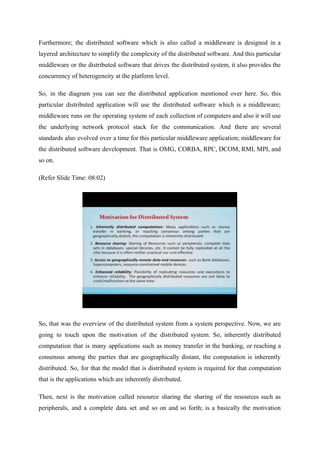
(Refer Slide Time: 06:57)
Furthermore; the distributed software which is also called a middleware is designed in a
layered architecture to simplify the complexity of the distributed software. And this particular
middleware or the distributed software that drives the distributed system, it also provides the
concurrency of heterogeneity at the platform level.
So, in the diagram you can see the distributed application mentioned over here. So, this
particular distributed application will use the distributed software which is a middleware;
middleware runs on the operating system of each collection of computers and also it will use
the underlying network protocol stack for the communication. And there are several
standards also evolved over a time for this particular middleware application; middleware for
the distributed software development. That is OMG, CORBA, RPC, DCOM, RMI, MPI, and
so on.
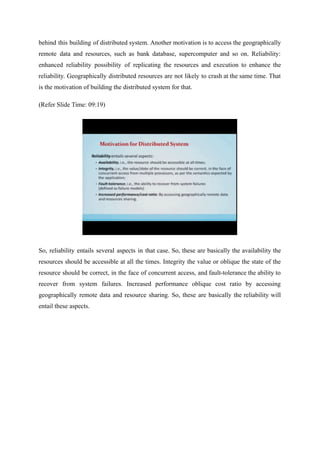
(Refer Slide Time: 08:02)
So, that was the overview of the distributed system from a system perspective. Now, we are
going to touch upon the motivation of the distributed system. So, inherently distributed
computation that is many applications such as money transfer in the banking, or reaching a
consensus among the parties that are geographically distant, the computation is inherently
distributed. So, for that the model that is distributed system is required for that computation
that is the applications which are inherently distributed.
Then, next is the motivation called resource sharing the sharing of the resources such as
peripherals, and a complete data set and so on and so forth; is a basically the motivation
behind this building of distributed system. Another motivation is to access the geographically
remote data and resources, such as bank database, supercomputer and so on. Reliability:
enhanced reliability possibility of replicating the resources and execution to enhance the
reliability. Geographically distributed resources are not likely to crash at the same time. That
is the motivation of building the distributed system for that.
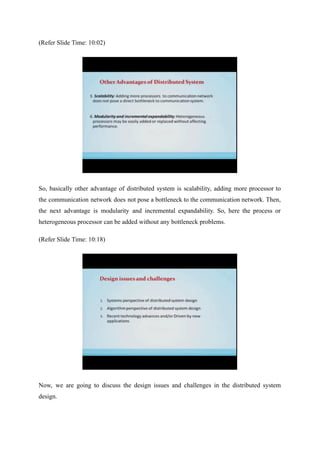
(Refer Slide Time: 09:19)
So, reliability entails several aspects in that case. So, these are basically the availability the
resources should be accessible at all the times. Integrity the value or oblique the state of the
resource should be correct, in the face of concurrent access, and fault-tolerance the ability to
recover from system failures. Increased performance oblique cost ratio by accessing
geographically remote data and resource sharing. So, these are basically the reliability will
entail these aspects.
(Refer Slide Time: 10:02)
So, basically other advantage of distributed system is scalability, adding more processor to
the communication network does not pose a bottleneck to the communication network. Then,
the next advantage is modularity and incremental expandability. So, here the process or
heterogeneous processor can be added without any bottleneck problems.
(Refer Slide Time: 10:18)
Now, we are going to discuss the design issues and challenges in the distributed system
design.
So, from system perspective of a distributed system design, we are going to see; what are the
intricacies and we have to understand the theoretical basis for this design. Another thing is
algorithmic perspective of it in distributed system design. The next design issues and
challenges are based on the recent technology advances and also driven by the new
applications and which will basically be the motivation or be the design issues. And also
becoming challenges in evolving the distributed systems.
So firstly, we are going to look upon the design challenges from system perspective of
distributed systems.
(Refer Slide Time: 11:14)
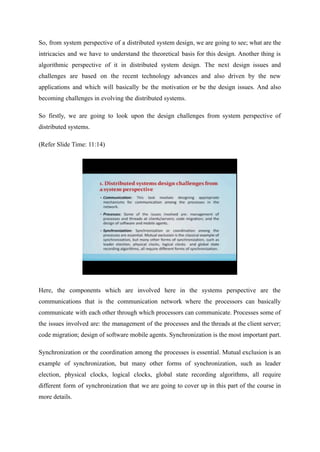
Here, the components which are involved here in the systems perspective are the
communications that is the communication network where the processors can basically
communicate with each other through which processors can communicate. Processes some of
the issues involved are: the management of the processes and the threads at the client server;
code migration; design of software mobile agents. Synchronization is the most important part.
Synchronization or the coordination among the processes is essential. Mutual exclusion is an
example of synchronization, but many other forms of synchronization, such as leader
election, physical clocks, logical clocks, global state recording algorithms, all require
different form of synchronization that we are going to cover up in this part of the course in
more details.
(Refer Slide Time: 11:59)
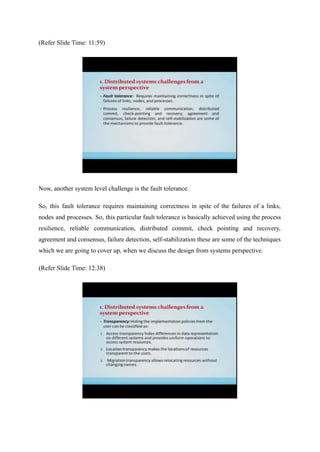
Now, another system level challenge is the fault tolerance.
So, this fault tolerance requires maintaining correctness in spite of the failures of a links,
nodes and processes. So, this particular fault tolerance is basically achieved using the process
resilience, reliable communication, distributed commit, check pointing and recovery,
agreement and consensus, failure detection, self-stabilization these are some of the techniques
which we are going to cover up, when we discuss the design from systems perspective.
(Refer Slide Time: 12:38)
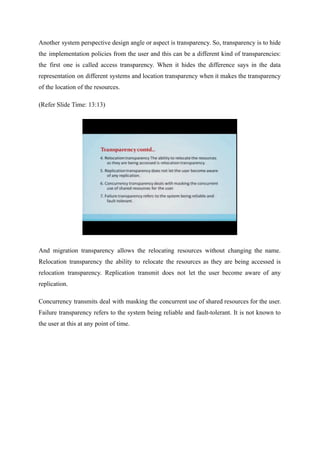
Another system perspective design angle or aspect is transparency. So, transparency is to hide
the implementation policies from the user and this can be a different kind of transparencies:
the first one is called access transparency. When it hides the difference says in the data
representation on different systems and location transparency when it makes the transparency
of the location of the resources.
(Refer Slide Time: 13:13)
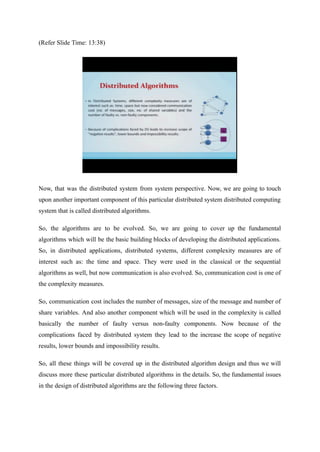
And migration transparency allows the relocating resources without changing the name.
Relocation transparency the ability to relocate the resources as they are being accessed is
relocation transparency. Replication transmit does not let the user become aware of any
replication.
Concurrency transmits deal with masking the concurrent use of shared resources for the user.
Failure transparency refers to the system being reliable and fault-tolerant. It is not known to
the user at this at any point of time.
(Refer Slide Time: 13:38)
Now, that was the distributed system from system perspective. Now, we are going to touch
upon another important component of this particular distributed system distributed computing
system that is called distributed algorithms.
So, the algorithms are to be evolved. So, we are going to cover up the fundamental
algorithms which will be the basic building blocks of developing the distributed applications.
So, in distributed applications, distributed systems, different complexity measures are of
interest such as: the time and space. They were used in the classical or the sequential
algorithms as well, but now communication is also evolved. So, communication cost is one of
the complexity measures.
So, communication cost includes the number of messages, size of the message and number of
share variables. And also another component which will be used in the complexity is called
basically the number of faulty versus non-faulty components. Now because of the
complications faced by distributed system they lead to the increase the scope of negative
results, lower bounds and impossibility results.
So, all these things will be covered up in the distributed algorithm design and thus we will
discuss more these particular distributed algorithms in the details. So, the fundamental issues
in the design of distributed algorithms are the following three factors.
(Refer Slide Time: 15:22)
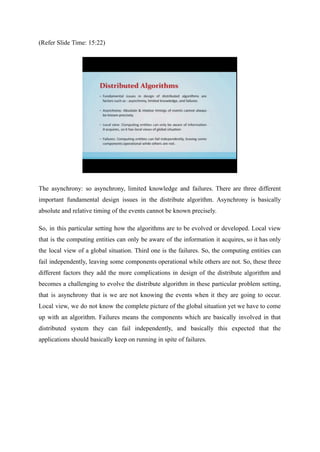
The asynchrony: so asynchrony, limited knowledge and failures. There are three different
important fundamental design issues in the distribute algorithm. Asynchrony is basically
absolute and relative timing of the events cannot be known precisely.
So, in this particular setting how the algorithms are to be evolved or developed. Local view
that is the computing entities can only be aware of the information it acquires, so it has only
the local view of a global situation. Third one is the failures. So, the computing entities can
fail independently, leaving some components operational while others are not. So, these three
different factors they add the more complications in design of the distribute algorithm and
becomes a challenging to evolve the distribute algorithm in these particular problem setting,
that is asynchrony that is we are not knowing the events when it they are going to occur.
Local view, we do not know the complete picture of the global situation yet we have to come
up with an algorithm. Failures means the components which are basically involved in that
distributed system they can fail independently, and basically this expected that the
applications should basically keep on running in spite of failures.
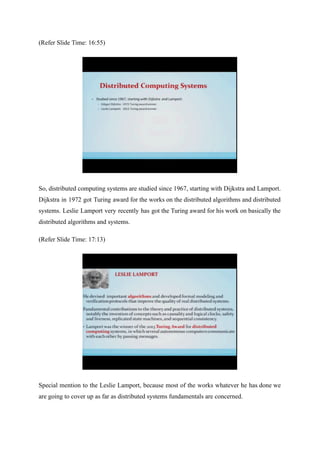
(Refer Slide Time: 16:55)
So, distributed computing systems are studied since 1967, starting with Dijkstra and Lamport.
Dijkstra in 1972 got Turing award for the works on the distributed algorithms and distributed
systems. Leslie Lamport very recently has got the Turing award for his work on basically the
distributed algorithms and systems.
(Refer Slide Time: 17:13)
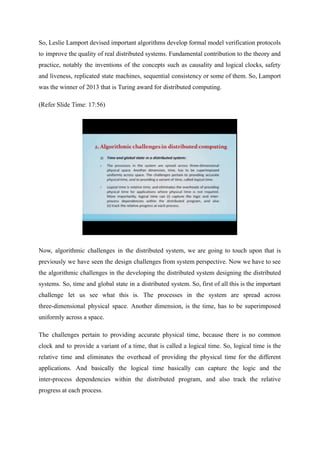
Special mention to the Leslie Lamport, because most of the works whatever he has done we
are going to cover up as far as distributed systems fundamentals are concerned.
So, Leslie Lamport devised important algorithms develop formal model verification protocols
to improve the quality of real distributed systems. Fundamental contribution to the theory and
practice, notably the inventions of the concepts such as causality and logical clocks, safety
and liveness, replicated state machines, sequential consistency or some of them. So, Lamport
was the winner of 2013 that is Turing award for distributed computing.
(Refer Slide Time: 17:56)
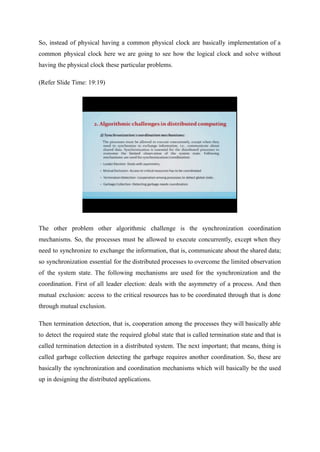
Now, algorithmic challenges in the distributed system, we are going to touch upon that is
previously we have seen the design challenges from system perspective. Now we have to see
the algorithmic challenges in the developing the distributed system designing the distributed
systems. So, time and global state in a distributed system. So, first of all this is the important
challenge let us see what this is. The processes in the system are spread across
three-dimensional physical space. Another dimension, is the time, has to be superimposed
uniformly across a space.
The challenges pertain to providing accurate physical time, because there is no common
clock and to provide a variant of a time, that is called a logical time. So, logical time is the
relative time and eliminates the overhead of providing the physical time for the different
applications. And basically the logical time basically can capture the logic and the
inter-process dependencies within the distributed program, and also track the relative
progress at each process.
So, instead of physical having a common physical clock are basically implementation of a
common physical clock here we are going to see how the logical clock and solve without
having the physical clock these particular problems.
(Refer Slide Time: 19:19)
The other problem other algorithmic challenge is the synchronization coordination
mechanisms. So, the processes must be allowed to execute concurrently, except when they
need to synchronize to exchange the information, that is, communicate about the shared data;
so synchronization essential for the distributed processes to overcome the limited observation
of the system state. The following mechanisms are used for the synchronization and the
coordination. First of all leader election: deals with the asymmetry of a process. And then
mutual exclusion: access to the critical resources has to be coordinated through that is done
through mutual exclusion.
Then termination detection, that is, cooperation among the processes they will basically able
to detect the required state the required global state that is called termination state and that is
called termination detection in a distributed system. The next important; that means, thing is
called garbage collection detecting the garbage requires another coordination. So, these are
basically the synchronization and coordination mechanisms which will basically be the used
up in designing the distributed applications.
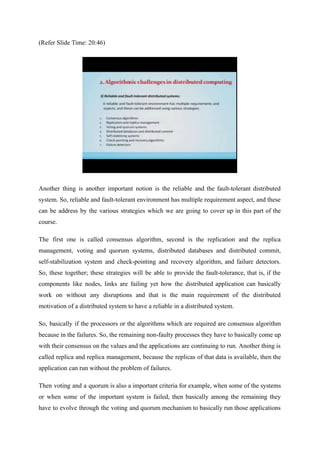
(Refer Slide Time: 20:46)
Another thing is another important notion is the reliable and the fault-tolerant distributed
system. So, reliable and fault-tolerant environment has multiple requirement aspect, and these
can be address by the various strategies which we are going to cover up in this part of the
course.
The first one is called consensus algorithm, second is the replication and the replica
management, voting and quorum systems, distributed databases and distributed commit,
self-stabilization system and check-pointing and recovery algorithm, and failure detectors.
So, these together; these strategies will be able to provide the fault-tolerance, that is, if the
components like nodes, links are failing yet how the distributed application can basically
work on without any disruptions and that is the main requirement of the distributed
motivation of a distributed system to have a reliable in a distributed system.
So, basically if the processors or the algorithms which are required are consensus algorithm
because in the failures. So, the remaining non-faulty processes they have to basically come up
with their consensus on the values and the applications are continuing to run. Another thing is
called replica and replica management, because the replicas of that data is available, then the
application can run without the problem of failures.
Then voting and a quorum is also a important criteria for example, when some of the systems
or when some of the important system is failed, then basically among the remaining they
have to evolve through the voting and quorum mechanism to basically run those applications
and distributed databases and distributed commit is also basically one of the important
applications where they have to decide among discussion with each other they have among
the synchronization to see whether the commit which is taking place has to be done or has to
be aborted by taking the decisions.
Then, self-stabilization system means if the components are failing then how the system
evolves and how much time it takes to stabilize itself. So, that is self-stabilization systems
that we are going to also cover up briefly in this part of the course. Check-pointing and
recovery systems are very important as far as the fault-tolerant is concerned fault-tolerant
means if there is a failure how basically the operations which are done has to be basically
with the minimal loss has to basically resume their operations. So, check-pointing and
rollback recovery algorithms, we are going to cover up in this part of the course. Then failure
detectors are also very important if how to detect that the nodes or the links are basically not
working or failed.
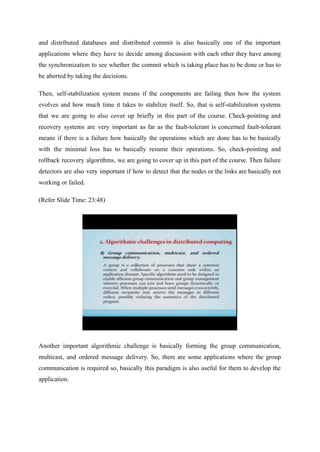
(Refer Slide Time: 23:48)
Another important algorithmic challenge is basically forming the group communication,
multicast, and ordered message delivery. So, there are some applications where the group
communication is required so, basically this paradigm is also useful for them to develop the
application.
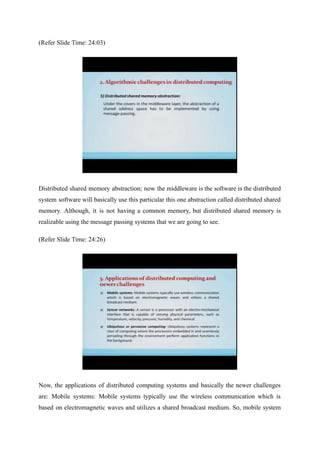
(Refer Slide Time: 24:03)
Distributed shared memory abstraction; now the middleware is the software is the distributed
system software will basically use this particular this one abstraction called distributed shared
memory. Although, it is not having a common memory, but distributed shared memory is
realizable using the message passing systems that we are going to see.
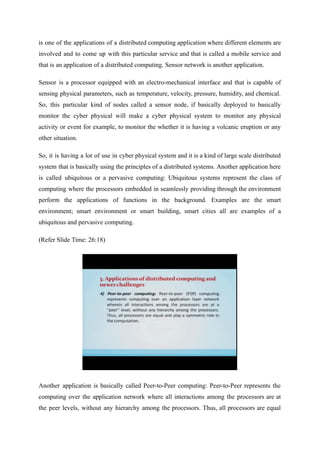
(Refer Slide Time: 24:26)
Now, the applications of distributed computing systems and basically the newer challenges
are: Mobile systems: Mobile systems typically use the wireless communication which is
based on electromagnetic waves and utilizes a shared broadcast medium. So, mobile system
is one of the applications of a distributed computing application where different elements are
involved and to come up with this particular service and that is called a mobile service and
that is an application of a distributed computing. Sensor network is another application.
Sensor is a processor equipped with an electro-mechanical interface and that is capable of
sensing physical parameters, such as temperature, velocity, pressure, humidity, and chemical.
So, this particular kind of nodes called a sensor node, if basically deployed to basically
monitor the cyber physical will make a cyber physical system to monitor any physical
activity or event for example, to monitor the whether it is having a volcanic eruption or any
other situation.
So, it is having a lot of use in cyber physical system and it is a kind of large scale distributed
system that is basically using the principles of a distributed systems. Another application here
is called ubiquitous or a pervasive computing: Ubiquitous systems represent the class of
computing where the processors embedded in seamlessly providing through the environment
perform the applications of functions in the background. Examples are the smart
environment; smart environment or smart building, smart cities all are examples of a
ubiquitous and pervasive computing.
(Refer Slide Time: 26:18)
Another application is basically called Peer-to-Peer computing: Peer-to-Peer represents the
computing over the application network where all interactions among the processors are at
the peer levels, without any hierarchy among the processors. Thus, all processors are equal
and play a symmetrical role in the computation. So, peer-to-peer network systems are used in
providing the resources and services. The peer-to-peer networking is now basically a very
challenging as far as developing distributed applications are concerned. Technically also it is
quite difficult and, but the simpler model like client server paradigm which is not purely a
peer-to-peer it is not purely distributed, this is used by the different applications because
industry feels comfortable with client server model.
Peer-to-peer computing models for different applications are evolving an over a period of
time the recent application which is added is called bitcoin and bitcoin is based on peer to
peer distributed computing design. We are going to touch upon later on in this part of the
course.
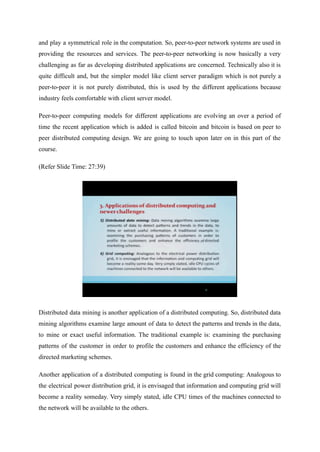
(Refer Slide Time: 27:39)
Distributed data mining is another application of a distributed computing. So, distributed data
mining algorithms examine large amount of data to detect the patterns and trends in the data,
to mine or exact useful information. The traditional example is: examining the purchasing
patterns of the customer in order to profile the customers and enhance the efficiency of the
directed marketing schemes.
Another application of a distributed computing is found in the grid computing: Analogous to
the electrical power distribution grid, it is envisaged that information and computing grid will
become a reality someday. Very simply stated, idle CPU times of the machines connected to
the network will be available to the others.
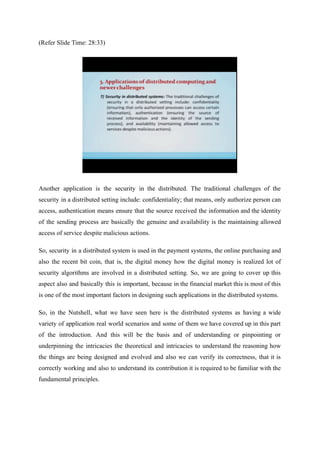
(Refer Slide Time: 28:33)
Another application is the security in the distributed. The traditional challenges of the
security in a distributed setting include: confidentiality; that means, only authorize person can
access, authentication means ensure that the source received the information and the identity
of the sending process are basically the genuine and availability is the maintaining allowed
access of service despite malicious actions.
So, security in a distributed system is used in the payment systems, the online purchasing and
also the recent bit coin, that is, the digital money how the digital money is realized lot of
security algorithms are involved in a distributed setting. So, we are going to cover up this
aspect also and basically this is important, because in the financial market this is most of this
is one of the most important factors in designing such applications in the distributed systems.
So, in the Nutshell, what we have seen here is the distributed systems as having a wide
variety of application real world scenarios and some of them we have covered up in this part
of the introduction. And this will be the basis and of understanding or pinpointing or
underpinning the intricacies the theoretical and intricacies to understand the reasoning how
the things are being designed and evolved and also we can verify its correctness, that it is
correctly working and also to understand its contribution it is required to be familiar with the
fundamental principles.
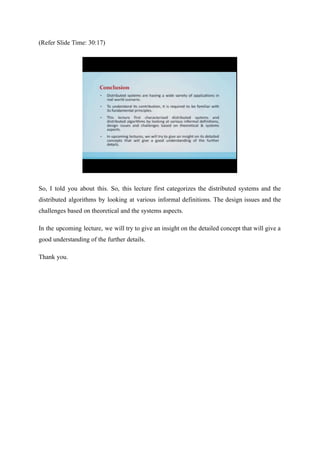
(Refer Slide Time: 30:17)
So, I told you about this. So, this lecture first categorizes the distributed systems and the
distributed algorithms by looking at various informal definitions. The design issues and the
challenges based on theoretical and the systems aspects.
In the upcoming lecture, we will try to give an insight on the detailed concept that will give a
good understanding of the further details.
Thank you.
Distributed systems NPTEL lecture slide notes

  • 1.
    Distributed Systems Prof. RajivMisra Department of Computer Science and Engineering Indian Institute of Technology, Patna Lecture - 01 Introduction to Distributed Systems So this is the first lecture Introduction to the Distributed Systems. (Refer Slide Time: 00:21) In this particular distributed system lecture introduction, we are going to discuss about the different requirements of a distributed computing systems and we are going to discuss, what are the different topics we are going to cover the textbooks and so on so forth. So, before that let us begin with the preface. So, the explosive growth of distributed computing systems makes understanding imperative yet difficult because of uncertainties introduced by the asynchrony, limited local knowledge, and partial failures. The nature solves it perfectly, such as flock of birds where these birds are the mobile agents they communicate with each other to achieve a common goal. However, in the field of distributed computing providing all these intricacies, that is asynchrony, limited local knowledge, partial failures. To understand this course will provide a theoretical underpinning for design and analysis of many distributed systems, such as and the concepts such as communication, coordination, synchronization and uncertainty to the lower
  • 2.
    bounds techniques. Thesetogether will be discussed in the part of the course. And this particular course will be quite useful as far as the different applications are concerned. The course structure of a distributed system goes like this. (Refer Slide Time: 02:00) So, this particular course if you see is divided into two different parts. The first part is the perspective from the systems perspective distributed systems. The second part is called distributed systems from algorithms perspective. So, the algorithms which will run on this model of a distributed system are required to be understood here. So, model also is required to be understood. And then the algorithms: how to design these algorithms, how to analyze it and different intricacies of this algorithm design in this particular problem setting. So, the main topics which we are going to focus on from algorithms perspective means how to build the spanning trees using flooding algorithms, then the leader election algorithm. These are basically most of the important algorithmic design techniques they are the basic building blocks of the distributed systems. From systems perspective we are going to cover up the global state recording, mutual exclusion, consensus, shared memory, check pointing, rollback, distributed hash table. And the case studies of a distributed systems which we will cover here in this part of the course structure is peer to peer, Google file system, HDFS and introduction to the spark.
  • 3.
    (Refer Slide Time:03:19) With this particular course, we will use two textbooks. The first we will deal about the systems perspective, the first one mentioned here as the authors Kshemkalyani and Singhal. The other textbooks will deal with the algorithms perspective and that is by Jennifer Welch. We have the reference book also that is distributed algorithms by Nancy Lynch. (Refer Slide Time: 03:47) Let us begin with the definition of a distributed system. Distributed system is a collection of independent entities that cooperate to solve a problem that cannot be solved individually. So, basically it is nothing but a collection of computers. Thus, this particular collection do not
  • 4.
    share a commonmemory or do not have a common physical clock, and the only way they can communicate is through the message passing and for that they require a communication network. The computers used here in distributed systems are semi-autonomous and they are loosely coupled while they cooperate to address the problem collectively. (Refer Slide Time: 04:33) So, before we understand in more detail about the distributed systems, let us have some properties of distributed systems to keep in a mind at this point of time. So, heterogeneity is one of the properties, because here the system comprises of different computers autonomous computers and they may be heterogeneous having heterogeneous hardware and software components. The concurrency is another property of a distributed system, shared data is also another property of a distributed system. So, no global clock is also one of the important properties and inter dependencies are there. They have interdependent components depend on each other.
  • 5.
    (Refer Slide Time:05:17) Now, to understand the distributed system from the system perspective, let us see this particular figure or diagram. In this particular diagram, you can see the computers are autonomous computers presented as processor memory with the operating system and basically the communication protocol stack. And, this particular these different computers they can communicate through the network that is the communication network. Now, as far as the software is concerned which will build a distributed system this particular software is called basically the middleware and the part of these middleware is basically the software which runs on each computer they are called software’s; they are written as the software components. So, basically this particular distributed system software will basically use the existing computers their operating system and underlying computer network and they run the part of the middleware and together this will form a distributed system. So, middleware will bind the distributed system.
  • 6.
    (Refer Slide Time:06:25) So, again further explain the distributed system connects autonomous processors by communication network. And the software component that run on each of the computers use the local operating system and network protocol stack. The distributed software is termed as middleware. The distributed execution is the execution of the processes across the distributed system to collectively achieve a common goal. The execution is also sometimes termed as the computation or error in a distributed system. (Refer Slide Time: 06:57)
  • 7.
    Furthermore; the distributedsoftware which is also called a middleware is designed in a layered architecture to simplify the complexity of the distributed software. And this particular middleware or the distributed software that drives the distributed system, it also provides the concurrency of heterogeneity at the platform level. So, in the diagram you can see the distributed application mentioned over here. So, this particular distributed application will use the distributed software which is a middleware; middleware runs on the operating system of each collection of computers and also it will use the underlying network protocol stack for the communication. And there are several standards also evolved over a time for this particular middleware application; middleware for the distributed software development. That is OMG, CORBA, RPC, DCOM, RMI, MPI, and so on. (Refer Slide Time: 08:02) So, that was the overview of the distributed system from a system perspective. Now, we are going to touch upon the motivation of the distributed system. So, inherently distributed computation that is many applications such as money transfer in the banking, or reaching a consensus among the parties that are geographically distant, the computation is inherently distributed. So, for that the model that is distributed system is required for that computation that is the applications which are inherently distributed. Then, next is the motivation called resource sharing the sharing of the resources such as peripherals, and a complete data set and so on and so forth; is a basically the motivation
  • 8.
    behind this buildingof distributed system. Another motivation is to access the geographically remote data and resources, such as bank database, supercomputer and so on. Reliability: enhanced reliability possibility of replicating the resources and execution to enhance the reliability. Geographically distributed resources are not likely to crash at the same time. That is the motivation of building the distributed system for that. (Refer Slide Time: 09:19) So, reliability entails several aspects in that case. So, these are basically the availability the resources should be accessible at all the times. Integrity the value or oblique the state of the resource should be correct, in the face of concurrent access, and fault-tolerance the ability to recover from system failures. Increased performance oblique cost ratio by accessing geographically remote data and resource sharing. So, these are basically the reliability will entail these aspects.
  • 9.
    (Refer Slide Time:10:02) So, basically other advantage of distributed system is scalability, adding more processor to the communication network does not pose a bottleneck to the communication network. Then, the next advantage is modularity and incremental expandability. So, here the process or heterogeneous processor can be added without any bottleneck problems. (Refer Slide Time: 10:18) Now, we are going to discuss the design issues and challenges in the distributed system design.
  • 10.
    So, from systemperspective of a distributed system design, we are going to see; what are the intricacies and we have to understand the theoretical basis for this design. Another thing is algorithmic perspective of it in distributed system design. The next design issues and challenges are based on the recent technology advances and also driven by the new applications and which will basically be the motivation or be the design issues. And also becoming challenges in evolving the distributed systems. So firstly, we are going to look upon the design challenges from system perspective of distributed systems. (Refer Slide Time: 11:14) Here, the components which are involved here in the systems perspective are the communications that is the communication network where the processors can basically communicate with each other through which processors can communicate. Processes some of the issues involved are: the management of the processes and the threads at the client server; code migration; design of software mobile agents. Synchronization is the most important part. Synchronization or the coordination among the processes is essential. Mutual exclusion is an example of synchronization, but many other forms of synchronization, such as leader election, physical clocks, logical clocks, global state recording algorithms, all require different form of synchronization that we are going to cover up in this part of the course in more details.
  • 11.
    (Refer Slide Time:11:59) Now, another system level challenge is the fault tolerance. So, this fault tolerance requires maintaining correctness in spite of the failures of a links, nodes and processes. So, this particular fault tolerance is basically achieved using the process resilience, reliable communication, distributed commit, check pointing and recovery, agreement and consensus, failure detection, self-stabilization these are some of the techniques which we are going to cover up, when we discuss the design from systems perspective. (Refer Slide Time: 12:38)
  • 12.
    Another system perspectivedesign angle or aspect is transparency. So, transparency is to hide the implementation policies from the user and this can be a different kind of transparencies: the first one is called access transparency. When it hides the difference says in the data representation on different systems and location transparency when it makes the transparency of the location of the resources. (Refer Slide Time: 13:13) And migration transparency allows the relocating resources without changing the name. Relocation transparency the ability to relocate the resources as they are being accessed is relocation transparency. Replication transmit does not let the user become aware of any replication. Concurrency transmits deal with masking the concurrent use of shared resources for the user. Failure transparency refers to the system being reliable and fault-tolerant. It is not known to the user at this at any point of time.
  • 13.
    (Refer Slide Time:13:38) Now, that was the distributed system from system perspective. Now, we are going to touch upon another important component of this particular distributed system distributed computing system that is called distributed algorithms. So, the algorithms are to be evolved. So, we are going to cover up the fundamental algorithms which will be the basic building blocks of developing the distributed applications. So, in distributed applications, distributed systems, different complexity measures are of interest such as: the time and space. They were used in the classical or the sequential algorithms as well, but now communication is also evolved. So, communication cost is one of the complexity measures. So, communication cost includes the number of messages, size of the message and number of share variables. And also another component which will be used in the complexity is called basically the number of faulty versus non-faulty components. Now because of the complications faced by distributed system they lead to the increase the scope of negative results, lower bounds and impossibility results. So, all these things will be covered up in the distributed algorithm design and thus we will discuss more these particular distributed algorithms in the details. So, the fundamental issues in the design of distributed algorithms are the following three factors.
  • 14.
    (Refer Slide Time:15:22) The asynchrony: so asynchrony, limited knowledge and failures. There are three different important fundamental design issues in the distribute algorithm. Asynchrony is basically absolute and relative timing of the events cannot be known precisely. So, in this particular setting how the algorithms are to be evolved or developed. Local view that is the computing entities can only be aware of the information it acquires, so it has only the local view of a global situation. Third one is the failures. So, the computing entities can fail independently, leaving some components operational while others are not. So, these three different factors they add the more complications in design of the distribute algorithm and becomes a challenging to evolve the distribute algorithm in these particular problem setting, that is asynchrony that is we are not knowing the events when it they are going to occur. Local view, we do not know the complete picture of the global situation yet we have to come up with an algorithm. Failures means the components which are basically involved in that distributed system they can fail independently, and basically this expected that the applications should basically keep on running in spite of failures.
  • 15.
    (Refer Slide Time:16:55) So, distributed computing systems are studied since 1967, starting with Dijkstra and Lamport. Dijkstra in 1972 got Turing award for the works on the distributed algorithms and distributed systems. Leslie Lamport very recently has got the Turing award for his work on basically the distributed algorithms and systems. (Refer Slide Time: 17:13) Special mention to the Leslie Lamport, because most of the works whatever he has done we are going to cover up as far as distributed systems fundamentals are concerned.
  • 16.
    So, Leslie Lamportdevised important algorithms develop formal model verification protocols to improve the quality of real distributed systems. Fundamental contribution to the theory and practice, notably the inventions of the concepts such as causality and logical clocks, safety and liveness, replicated state machines, sequential consistency or some of them. So, Lamport was the winner of 2013 that is Turing award for distributed computing. (Refer Slide Time: 17:56) Now, algorithmic challenges in the distributed system, we are going to touch upon that is previously we have seen the design challenges from system perspective. Now we have to see the algorithmic challenges in the developing the distributed system designing the distributed systems. So, time and global state in a distributed system. So, first of all this is the important challenge let us see what this is. The processes in the system are spread across three-dimensional physical space. Another dimension, is the time, has to be superimposed uniformly across a space. The challenges pertain to providing accurate physical time, because there is no common clock and to provide a variant of a time, that is called a logical time. So, logical time is the relative time and eliminates the overhead of providing the physical time for the different applications. And basically the logical time basically can capture the logic and the inter-process dependencies within the distributed program, and also track the relative progress at each process.
  • 17.
    So, instead ofphysical having a common physical clock are basically implementation of a common physical clock here we are going to see how the logical clock and solve without having the physical clock these particular problems. (Refer Slide Time: 19:19) The other problem other algorithmic challenge is the synchronization coordination mechanisms. So, the processes must be allowed to execute concurrently, except when they need to synchronize to exchange the information, that is, communicate about the shared data; so synchronization essential for the distributed processes to overcome the limited observation of the system state. The following mechanisms are used for the synchronization and the coordination. First of all leader election: deals with the asymmetry of a process. And then mutual exclusion: access to the critical resources has to be coordinated through that is done through mutual exclusion. Then termination detection, that is, cooperation among the processes they will basically able to detect the required state the required global state that is called termination state and that is called termination detection in a distributed system. The next important; that means, thing is called garbage collection detecting the garbage requires another coordination. So, these are basically the synchronization and coordination mechanisms which will basically be the used up in designing the distributed applications.
  • 18.
    (Refer Slide Time:20:46) Another thing is another important notion is the reliable and the fault-tolerant distributed system. So, reliable and fault-tolerant environment has multiple requirement aspect, and these can be address by the various strategies which we are going to cover up in this part of the course. The first one is called consensus algorithm, second is the replication and the replica management, voting and quorum systems, distributed databases and distributed commit, self-stabilization system and check-pointing and recovery algorithm, and failure detectors. So, these together; these strategies will be able to provide the fault-tolerance, that is, if the components like nodes, links are failing yet how the distributed application can basically work on without any disruptions and that is the main requirement of the distributed motivation of a distributed system to have a reliable in a distributed system. So, basically if the processors or the algorithms which are required are consensus algorithm because in the failures. So, the remaining non-faulty processes they have to basically come up with their consensus on the values and the applications are continuing to run. Another thing is called replica and replica management, because the replicas of that data is available, then the application can run without the problem of failures. Then voting and a quorum is also a important criteria for example, when some of the systems or when some of the important system is failed, then basically among the remaining they have to evolve through the voting and quorum mechanism to basically run those applications
  • 19.
    and distributed databasesand distributed commit is also basically one of the important applications where they have to decide among discussion with each other they have among the synchronization to see whether the commit which is taking place has to be done or has to be aborted by taking the decisions. Then, self-stabilization system means if the components are failing then how the system evolves and how much time it takes to stabilize itself. So, that is self-stabilization systems that we are going to also cover up briefly in this part of the course. Check-pointing and recovery systems are very important as far as the fault-tolerant is concerned fault-tolerant means if there is a failure how basically the operations which are done has to be basically with the minimal loss has to basically resume their operations. So, check-pointing and rollback recovery algorithms, we are going to cover up in this part of the course. Then failure detectors are also very important if how to detect that the nodes or the links are basically not working or failed. (Refer Slide Time: 23:48) Another important algorithmic challenge is basically forming the group communication, multicast, and ordered message delivery. So, there are some applications where the group communication is required so, basically this paradigm is also useful for them to develop the application.
  • 20.
    (Refer Slide Time:24:03) Distributed shared memory abstraction; now the middleware is the software is the distributed system software will basically use this particular this one abstraction called distributed shared memory. Although, it is not having a common memory, but distributed shared memory is realizable using the message passing systems that we are going to see. (Refer Slide Time: 24:26) Now, the applications of distributed computing systems and basically the newer challenges are: Mobile systems: Mobile systems typically use the wireless communication which is based on electromagnetic waves and utilizes a shared broadcast medium. So, mobile system
  • 21.
    is one ofthe applications of a distributed computing application where different elements are involved and to come up with this particular service and that is called a mobile service and that is an application of a distributed computing. Sensor network is another application. Sensor is a processor equipped with an electro-mechanical interface and that is capable of sensing physical parameters, such as temperature, velocity, pressure, humidity, and chemical. So, this particular kind of nodes called a sensor node, if basically deployed to basically monitor the cyber physical will make a cyber physical system to monitor any physical activity or event for example, to monitor the whether it is having a volcanic eruption or any other situation. So, it is having a lot of use in cyber physical system and it is a kind of large scale distributed system that is basically using the principles of a distributed systems. Another application here is called ubiquitous or a pervasive computing: Ubiquitous systems represent the class of computing where the processors embedded in seamlessly providing through the environment perform the applications of functions in the background. Examples are the smart environment; smart environment or smart building, smart cities all are examples of a ubiquitous and pervasive computing. (Refer Slide Time: 26:18) Another application is basically called Peer-to-Peer computing: Peer-to-Peer represents the computing over the application network where all interactions among the processors are at the peer levels, without any hierarchy among the processors. Thus, all processors are equal
  • 22.
    and play asymmetrical role in the computation. So, peer-to-peer network systems are used in providing the resources and services. The peer-to-peer networking is now basically a very challenging as far as developing distributed applications are concerned. Technically also it is quite difficult and, but the simpler model like client server paradigm which is not purely a peer-to-peer it is not purely distributed, this is used by the different applications because industry feels comfortable with client server model. Peer-to-peer computing models for different applications are evolving an over a period of time the recent application which is added is called bitcoin and bitcoin is based on peer to peer distributed computing design. We are going to touch upon later on in this part of the course. (Refer Slide Time: 27:39) Distributed data mining is another application of a distributed computing. So, distributed data mining algorithms examine large amount of data to detect the patterns and trends in the data, to mine or exact useful information. The traditional example is: examining the purchasing patterns of the customer in order to profile the customers and enhance the efficiency of the directed marketing schemes. Another application of a distributed computing is found in the grid computing: Analogous to the electrical power distribution grid, it is envisaged that information and computing grid will become a reality someday. Very simply stated, idle CPU times of the machines connected to the network will be available to the others.
  • 23.
    (Refer Slide Time:28:33) Another application is the security in the distributed. The traditional challenges of the security in a distributed setting include: confidentiality; that means, only authorize person can access, authentication means ensure that the source received the information and the identity of the sending process are basically the genuine and availability is the maintaining allowed access of service despite malicious actions. So, security in a distributed system is used in the payment systems, the online purchasing and also the recent bit coin, that is, the digital money how the digital money is realized lot of security algorithms are involved in a distributed setting. So, we are going to cover up this aspect also and basically this is important, because in the financial market this is most of this is one of the most important factors in designing such applications in the distributed systems. So, in the Nutshell, what we have seen here is the distributed systems as having a wide variety of application real world scenarios and some of them we have covered up in this part of the introduction. And this will be the basis and of understanding or pinpointing or underpinning the intricacies the theoretical and intricacies to understand the reasoning how the things are being designed and evolved and also we can verify its correctness, that it is correctly working and also to understand its contribution it is required to be familiar with the fundamental principles.
  • 24.
    (Refer Slide Time:30:17) So, I told you about this. So, this lecture first categorizes the distributed systems and the distributed algorithms by looking at various informal definitions. The design issues and the challenges based on theoretical and the systems aspects. In the upcoming lecture, we will try to give an insight on the detailed concept that will give a good understanding of the further details. Thank you.