Load Balancing Techniques
in Distributed Systems
Exploring Challenges and Solutions
Abdulaziz Awwad 44108981
Abdulrahman Alhababi 44152204
Faisal Althubaity 44008941
Khalid Altamimi 44106881
Abdullah Alharthi 44102462
Supervised by
Dr. Alwaleed Alharbi
Distributed Systems - 483
December 1, 2024 2
Outlines
 Introduction
 Importance of Load Balancing
 Challenges in Load Balancing
 Common Techniques
 Advanced Techniques
 Future Trends
 Conclusion
December 1, 2024 3
Introduction
What is Load Balancing?
 Distributes workloads across servers to
prevent overload.
 Ensures efficiency, reliability, and scalability.
Why is it important?
 Prevents slow performance.
 Handles dynamic demands.
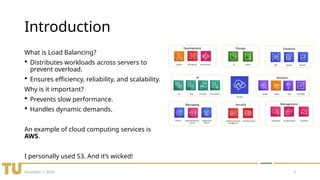
An example of cloud computing services is
AWS.
I personally used S3. And it’s wicked!
December 1, 2024 4
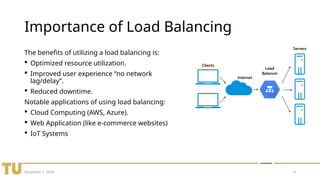
Importance of Load Balancing
The benefits of utilizing a load balancing is:
 Optimized resource utilization.
 Improved user experience “no network
lag/delay”.
 Reduced downtime.
Notable applications of using load balancing:
 Cloud Computing (AWS, Azure).
 Web Application (like e-commerce websites)
 IoT Systems
December 1, 2024 5
Challenges in Load Balancing
 Dynamic Workloads
 Traffic spikes during peak hours.
 Scalability
 Managing more nodes as systems grow.
 Fault Tolerance
 Handling server failures efficiently.
 Resource Differences
 Balancing tasks for servers with varying capacities.
 Geographical Distribution (CDNs)
 Minimizing latency in global system.
December 1, 2024 6
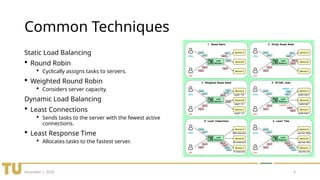
Common Techniques
Static Load Balancing
 Round Robin
 Cyclically assigns tasks to servers.
 Weighted Round Robin
 Considers server capacity.
Dynamic Load Balancing
 Least Connections
 Sends tasks to the server with the fewest active
connections.
 Least Response Time
 Allocates tasks to the fastest server.
December 1, 2024 7
Advanced Techniques
 Consistent Hashing: Maps tasks to nodes efficiently, minimizes disruption when
servers are added/removed.
 AI/ML-Based: Predicts traffic and optimizes allocation.
 Geographical Load Balancing: Routes tasks to the nearest server.
December 1, 2024 8
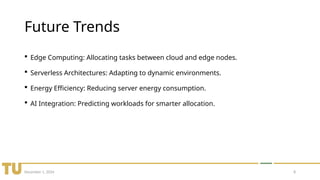
Future Trends
 Edge Computing: Allocating tasks between cloud and edge nodes.
 Serverless Architectures: Adapting to dynamic environments.
 Energy Efficiency: Reducing server energy consumption.
 AI Integration: Predicting workloads for smarter allocation.
December 1, 2024 9
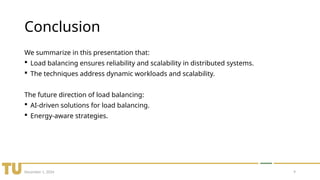
Conclusion
We summarize in this presentation that:
 Load balancing ensures reliability and scalability in distributed systems.
 The techniques address dynamic workloads and scalability.
The future direction of load balancing:
 AI-driven solutions for load balancing.
 Energy-aware strategies.

Distributed Systems: Load Balancing Techniques

  • 1.
    Load Balancing Techniques inDistributed Systems Exploring Challenges and Solutions Abdulaziz Awwad 44108981 Abdulrahman Alhababi 44152204 Faisal Althubaity 44008941 Khalid Altamimi 44106881 Abdullah Alharthi 44102462 Supervised by Dr. Alwaleed Alharbi Distributed Systems - 483
  • 2.
    December 1, 20242 Outlines  Introduction  Importance of Load Balancing  Challenges in Load Balancing  Common Techniques  Advanced Techniques  Future Trends  Conclusion
  • 3.
    December 1, 20243 Introduction What is Load Balancing?  Distributes workloads across servers to prevent overload.  Ensures efficiency, reliability, and scalability. Why is it important?  Prevents slow performance.  Handles dynamic demands. An example of cloud computing services is AWS. I personally used S3. And it’s wicked!
  • 4.
    December 1, 20244 Importance of Load Balancing The benefits of utilizing a load balancing is:  Optimized resource utilization.  Improved user experience “no network lag/delay”.  Reduced downtime. Notable applications of using load balancing:  Cloud Computing (AWS, Azure).  Web Application (like e-commerce websites)  IoT Systems
  • 5.
    December 1, 20245 Challenges in Load Balancing  Dynamic Workloads  Traffic spikes during peak hours.  Scalability  Managing more nodes as systems grow.  Fault Tolerance  Handling server failures efficiently.  Resource Differences  Balancing tasks for servers with varying capacities.  Geographical Distribution (CDNs)  Minimizing latency in global system.
  • 6.
    December 1, 20246 Common Techniques Static Load Balancing  Round Robin  Cyclically assigns tasks to servers.  Weighted Round Robin  Considers server capacity. Dynamic Load Balancing  Least Connections  Sends tasks to the server with the fewest active connections.  Least Response Time  Allocates tasks to the fastest server.
  • 7.
    December 1, 20247 Advanced Techniques  Consistent Hashing: Maps tasks to nodes efficiently, minimizes disruption when servers are added/removed.  AI/ML-Based: Predicts traffic and optimizes allocation.  Geographical Load Balancing: Routes tasks to the nearest server.
  • 8.
    December 1, 20248 Future Trends  Edge Computing: Allocating tasks between cloud and edge nodes.  Serverless Architectures: Adapting to dynamic environments.  Energy Efficiency: Reducing server energy consumption.  AI Integration: Predicting workloads for smarter allocation.
  • 9.
    December 1, 20249 Conclusion We summarize in this presentation that:  Load balancing ensures reliability and scalability in distributed systems.  The techniques address dynamic workloads and scalability. The future direction of load balancing:  AI-driven solutions for load balancing.  Energy-aware strategies.

Editor's Notes

  • #1 Made by Abdulaziz Awwad Contact: me@aziz.is
  • #2 Made by Abdulaziz Awwad Contact: me@aziz.is
  • #3 Made by Abdulaziz Awwad Contact: me@aziz.is
  • #4 Made by Abdulaziz Awwad Contact: me@aziz.is
  • #5 Made by Abdulaziz Awwad Contact: me@aziz.is
  • #6 Made by Abdulaziz Awwad Contact: me@aziz.is
  • #7 Made by Abdulaziz Awwad Contact: me@aziz.is
  • #8 Made by Abdulaziz Awwad Contact: me@aziz.is
  • #9 Made by Abdulaziz Awwad Contact: me@aziz.is