Distributed Programming with Ruby 1st Edition Mark Bates
Distributed Programming with Ruby 1st Edition Mark Bates
Distributed Programming with Ruby 1st Edition Mark Bates
Distributed Programming with Ruby 1st Edition Mark Bates
Distributed Programming with Ruby 1st Edition Mark Bates
1.
Distributed Programming withRuby 1st Edition
Mark Bates pdf download
https://ebookfinal.com/download/distributed-programming-with-
ruby-1st-edition-mark-bates/
Explore and download more ebooks or textbooks
at ebookfinal.com
2.
We believe theseproducts will be a great fit for you. Click
the link to download now, or visit ebookfinal
to discover even more!
Learn Game Programming with Ruby Bring Your Ideas to Life
with Gosu Mark Sobkowicz
https://ebookfinal.com/download/learn-game-programming-with-ruby-
bring-your-ideas-to-life-with-gosu-mark-sobkowicz/
Ruby Programming 1st Edition Jerry Lee Ford
https://ebookfinal.com/download/ruby-programming-1st-edition-jerry-
lee-ford/
Programming Python with CD 2nd Edition Mark Lutz
https://ebookfinal.com/download/programming-python-with-cd-2nd-
edition-mark-lutz/
Distributed NET Programming in VB NET 1st Edition Tom
Barnaby (Auth.)
https://ebookfinal.com/download/distributed-net-programming-in-vb-
net-1st-edition-tom-barnaby-auth/
3.
Scripted GUI Testingwith Ruby 1st Edition Ian Dees
https://ebookfinal.com/download/scripted-gui-testing-with-ruby-1st-
edition-ian-dees/
NET Wireless Programming 1st Edition Mark Ridgeway
https://ebookfinal.com/download/net-wireless-programming-1st-edition-
mark-ridgeway/
Raven Scripting Java Builds with Ruby 1st Edition Matthieu
Riou
https://ebookfinal.com/download/raven-scripting-java-builds-with-
ruby-1st-edition-matthieu-riou/
Building Distributed Applications with Visual Basic NET
Dan Fox
https://ebookfinal.com/download/building-distributed-applications-
with-visual-basic-net-dan-fox/
From Ruby to Elixir Unleash the Full Potential of
Functional Programming 1st Edition Stephen Bussey
https://ebookfinal.com/download/from-ruby-to-elixir-unleash-the-full-
potential-of-functional-programming-1st-edition-stephen-bussey/
5.
Distributed Programming withRuby 1st Edition Mark
Bates Digital Instant Download
Author(s): Mark Bates
ISBN(s): 9780321638366, 0321638360
Edition: 1
File Details: PDF, 14.46 MB
Year: 2009
Language: english
6.
DISTRIBUTED PROGRAMMING
WITH RUBY
MarkBates
AAddison-Wesley
Upper Saddle River, NJ • Boston • Indianapolis • San Francisco
New York • Toronto • Montreal • London • Munich • Paris • Madrid
Capetown • Sydney • Tokyo • Singapore • Mexico City
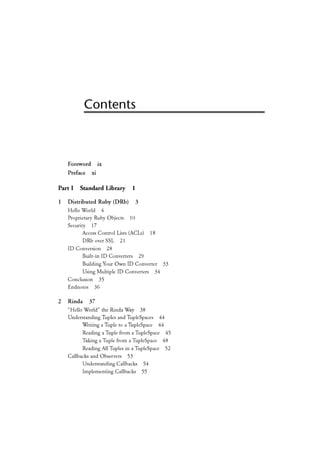
Contents
Foreword ix
Preface xi
PartI Standard Library 1
1 Distributed Ruby (DRb) 3
Hello World 4
Proprietary Ruby Objects 10
Security 17
Access Control Lists (ACLs) 18
DRb over SSL 21
ID Conversion 28
Built-in ID Converters 29
Building Your Own ID Converter 33
Using Multiple ID Converters 34
Conclusion 35
Endnotes 36
2 Rinda 37
"Hello World" the Rinda Way 38
Understanding Tuples and TupleSpaces 44
Writing a Tuple to a TupleSpace 44
Reading a Tuple from a TupleSpace 45
Taking a Tuple from a TupleSpace 48
Reading All Tuples in a TupleSpace 52
Callbacks and Observers 53
Understanding Callbacks 54
Implementing Callbacks 55
9.
Security with Rinda59
Access Control Lists (ACLs) 59
Using Rinda over SSL 61
Selecting a RingServer 63
Renewing Rinda Services 70
Using a Numeric to Renew a Service 71
Using nil to Renew a Service 72
Using the SimpleRenewer Class 72
Custom Renewers 73
Conclusion 75
Endnotes 76
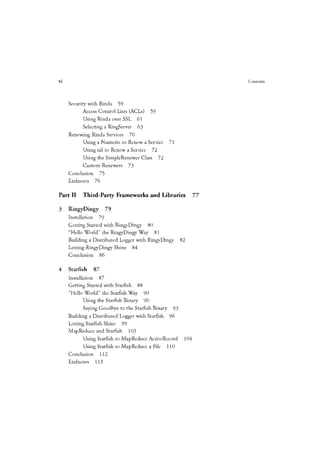
Part II Third-Party Frameworks and Libraries
3 RingyDingy 79
Installation 79
Getting Started with RingyDingy 80
"Hello World" the RingyDingy Way 81
Building a Distributed Logger with RingyDingy 82
Letting RingyDingy Shine 84
Conclusion 86
4 Starfish 87
Installation 87
Getting Started with Starfish 88
"Hello World" the Starfish Way 90
Using the Starfish Binary 90
Saying Goodbye to the Starfish Binary 93
Building a Distributed Logger with Starfish 96
Letting Starfish Shine 99
MapReduce and Starfish 103
Using Starfish to MapReduce ActiveRecord 1
Using Starfish to MapReduce a File 110
Conclusion 112
Endnotes 113
10.
Contents vii
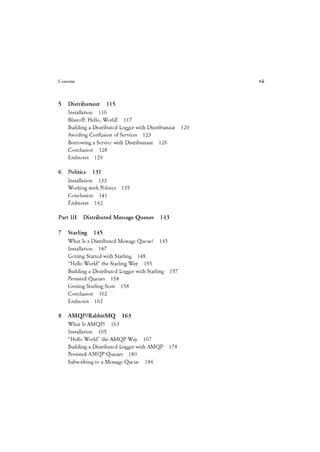
5 Distribunaut115
Installation 116
Blastoff: Hello, World! 117
Building a Distributed Logger with Distribunaut 120
Avoiding Confusion of Services 123
Borrowing a Service with Distribunaut 126
Conclusion 128
Endnotes 129
6 Politics 131
Installation 133
Working with Politics 135
Conclusion 141
Endnotes 142
Part III Distributed Message Queues 143
7 Starling 145
What Is a Distributed Message Queue? 145
Installation 147
Getting Started with Starling 148
"Hello World" the Starling Way 155
Building a Distributed Logger with Starling 157
Persisted Queues 158
Getting Starling Stats 158
Conclusion 162
Endnotes 162
8 AMQP/RabbitMQ 163
What Is AMQP? 163
Installation 165
"Hello World" the AMQP Way 167
Building a Distributed Logger with AMQP 178
Persisted AMQP Queues 180
Subscribing to a Message Queue 184
11.
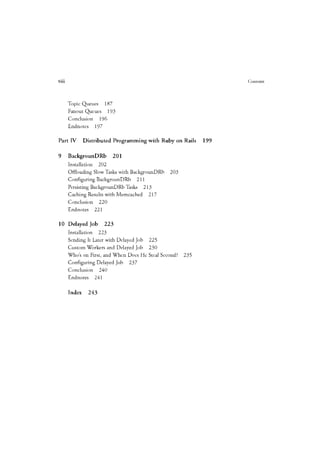
viii Contents
Topic Queues187
Fanout Queues 193
Conclusion 196
Endnotes 197
Part IV Distributed Programming with Ruby on Rails 199
9 BackgrounDRb 201
Installation 202
Offloading Slow Tasks with BackgrounDRb 203
Configuring BackgrounDRb 211
Persisting BackgrounDRb Tasks 213
Caching Results with Memcached 217
Conclusion 220
Endnotes 221
10 Delayed Job 223
Installation 223
Sending It Later with Delayed Job 225
Custom Workers and Delayed Job 230
Who's on First, and When Does He Steal Second? 235
Configuring Delayed Job 237
Conclusion 240
Endnotes 241
Index 243
12.
Foreword
Mark's career inprogramming parallels mine to a certain degree. We both started developing
web applications in 1996 and both did hard time in the Java world before discovering Ruby
and Rails in 2005, and never looking back.
At RubyConf 2008 in Orlando, I toasted Mark on his successful talk as we sipped Pina
Coladas and enjoyed the "fourth track" of that conference—the lazy river and hot tub. The
topic of our conversation? Adding a title to the Professional Ruby Series in which Mark would
draw from his experience building Mack, a distributed web framework, as well as his long
career doing distributed programming. But most important, he would let his enthusiasm for
the potentially dry subject draw in the reader while being educational. I sensed a winner, but
not only as far at finding the right author. The timing was right, too.
Rails developers around the world are progressing steadily beyond basic web program-
ming as they take on large, complex systems that traditionally would be done on Java or
Microsoft platforms. As a system grows in scale and complexity, one of the first things you
need to do is to break it into smaller, manageable chunks. Hence all the interest in web serv-
ices. Your initial effort might involve cron jobs and batch processing. Or you might imple-
ment some sort of distributed job framework, before finally going with a full-blown
messaging solution.
Of course, you don't want to reinvent anything you don't need to, but Ruby's distributed
programming landscape can be confusing. In the foreground is Ruby's DRb technology, part
of the standard library and relatively straightforward to use—especially for those of us famil-
iar with parallel technologies in other languages, such as Java's RMI. But does that approach
scale? And is it reliable? If DRb is not suitable for your production use, what is? If we cast our
view further along the landscape, we might ask: "What about newer technologies like AMQP
and Rabbit MQ? And how do we tie it all together with Rails in ways that make sense?"
Mark answers all those questions in this book. He starts with some of the deepest docu-
mentation on DRb and Rinda that anyone has ever read. He then follows with coverage of
the various Ruby libraries that depend on those building blocks, always keeping in mind the
13.
X Foreword
practical applicationsof all of them. He covers assembling cloud-based servers to handle
background processing, one of today's hottest topics in systems architecture. Finally, he cov-
ers the Rails-specific libraries BackgrounDRb and Delayed Job and teaches you when and
how to use each.
Ultimately, one of my most pleasant surprises and one of the reasons that I think Mark
is an up-and-coming superstar of the Ruby community is the hard work, productivity, and
fastidiousness that he demonstrated while writing this book. Over the course of the spring
and summer of this year, Mark delivered chapters and revisions week after week with clock-
work regularity. All with the utmost attention to detail and quality. All packed with knowl-
edge. And most important, all packed with strong doses of his winning personality. It is my
honor to present to you the latest addition to our series, Distributed Programming with Ruby.
Obie Fernandez, Series Editor
September 30, 2009
14.
Preface
I first founda need for distributed programming back in 2001. I was looking for a way to
increase the performance of an application I was working on. The project was a web-based
email client, and I was struggling with a few performance issues. I wanted to keep the email
engine separate from the client front end. That way, I could have a beefier box handle all the
processing of the incoming email and have a farm of smaller application servers handling the
front end of it. That seems pretty easy and straightforward, doesn't it? Well, the language I was
using at the time was Java, and the distributed interface was RMI (remote method invocation).
Easy and straightforward are not words I would use to describe my experiences with RMI.
Years later I was working on a completely different project, but I had a not-too-dissimilar
problem—performance. The application this time was a large user-generated content site
built using Ruby on Rails. When a user wrote, edited, or deleted an article for the site, it
needed to be indexed by our search engine, our site map needed to be rebuilt, and the article
needed to be injected into the top of our rating engine system. As you can imagine, none of
this was quick and simple. You can also probably guess that our CEO wanted all of this to
happen as close to real time as possible, but without the end user's having to wait for every-
thing to get done. To further complicate matters, we had limited system resources and mil-
lions of articles that needed to be processed.
I didn't want to burden our already-overworked applications server boxes with these
tasks, so I had to offload the processing to another machine. The question came to be how I
could best offload this work. The first idea was to use the database as the transfer mechanism.
I could store all the information in the database that these systems would need. Then the
machine that was to do the processing could poll the database at a regular interval, find any
pending tasks, pull them out of the database, create the same heavy objects I already had, and
then start processing them. The problem, as you most likely already know, is that I'm now
placing more load on the database. I would be polling it continually, regardless of whether it
contained any tasks. If it did have tasks, I would have to pull those records out of the database
xi
15.
xii Preface
and usemore system resources transforming the records back into those same heavy Ruby
objects I already had.
What I really wanted to do was just send the fully formed Ruby objects I had already cre-
ated to the other machine and let it do the processing. This would lessen the burden all
around. In addition to the lighter load on the database, memory, and system resources, the
machine doing the processing would work only when it was told to, and it wouldn't waste
recourses by continually polling the database. Plus, without polling, the parts of the applica-
tion the CEO wanted updated in near real time would get updated faster.
After I realized that what I wanted to do was to use some sort of distributed mechanism,
that's when I decided to see what sort of RMI-esque features Ruby had. I was already
impressed with Ruby for being a terse language, but when I found the DRb (Distributed Ruby,
also known as dRuby) package, I became a believer. I found that writing distributed applica-
tions in Ruby could be simple, and dare I say fun.
Who Is This Book For?
This book is quite simply written for the intermediate to advanced Ruby developer who
wants to start developing distributed applications. This book assumes that you have good
knowledge of Ruby, at least at the intermediate developer level. Although we will touch on
some parts of the Ruby language—particularly those that might be confusing when dealing
with distributed applications—we will not be going into the language in depth.
Although you should know Ruby, this book assumes that you probably do not under-
stand distributed programming and that this is your first venture into this world. If you have
done distributed programming before, this book will help you quickly understand how to do
it in Ruby. If you haven't, this book will help you understand what distributed programming
is and isn't.
How Is This Book Organized?
This book is split into four parts. Part I examines what ships with the standard library in
Ruby 1.8.x and beyond. We look, in depth, at understanding how DRb (dRuby or Distrib-
uted Ruby) and Rinda work. We will build some simple applications in a variety of ways and
use those examples to talk about the libraries. We examine the pros and cons of DRb and
Rinda. By the end of Part I, "Standard Library," you should feel comfortable and ready to
build your distributed applications using these libraries.
Part II, "Third-Party Frameworks and Libraries," looks at a variety of third-party tools,
libraries, and frameworks designed to make distributed programming in Ruby easy, fun, and
16.
Preface xiii
robust. Someof these libraries build on the DRb and Rinda libraries we learned about in Part
I, and others don't. Some are based on executing arbitrary code on another machine. Others
are based on running code in the background to elevate performance.
Part III, "Distributed Message Queues," takes a close look at some of the leading dis-
tributed message queues available to the Ruby community. These queues can help facilitate
communication and tasks between your applications. Distributed message queues can help
increase your applications' performance by queuing up work to be done at a later date instead
of at runtime.
Finally, Part IV, "Distributed Programming with Ruby on Rails," looks at a few libraries
that are designed to work exclusively with the Ruby on Rails web framework. These libraries
might already be familiar to you if you have been using Ruby on Rails for several years. But
there is always something to be learned, and that's what the chapters in this part of this book
will help you with.
During the course of the book, we will examine a breadth of different technologies; how-
ever, this book is not necessarily a how-to guide. Instead, you will use these different tech-
nologies to help understand the complex problems associated with distributed programming
and several different ways you can solve these problems. You'll use these technologies to learn
about RMI, message queues, and MapReduce, among others.
How to Run the Examples
I have tried to make this book as easy to use and follow as possible. When a new technology
is referenced or introduced, I give you a link to find out more about it and/or its developer(s).
When you see a code sample, unless otherwise stated, I present that sample in its entirety. I
have also taken extra effort to make sure that you can easily run each of those code samples
as is. Unless otherwise stated, you should be able to take any code sample, copy it into a Ruby
file, and run it using the ruby command, like this:
$ ruby foo.rb
There are times when a file needs to be named something specific or has to be run with
a special command. In particular, Chapter 4, "Starfish," covers this issue. At that time I will
call your attention to these details so that you can run the examples without hassle.
In some chapters, such as Chapters 2, "Rinda," and 8, "AMQP/RabbitMQ," background
servers need to be run for the examples to run correctly. It is highly recommended that you
restart these background servers between each set of examples that are presented in these
chapters. A lot of these chapters iteratively build on a piece of software, and restarting the
servers between runs helps eliminate potentially confusing results.
17.
Acknowledgments
Writing a bookisn't easy. I know that's an obvious statement, but sometimes I think people
just don't quite get what goes into writing a book. I didn't think it would be this difficult.
Thankfully, though, I have somehow made it out the other side. I'm a little (more like a lot)
battered, bruised, and very tired, but it was definitely worth it.
However, I couldn't have done this without a lot of help from a lot of different people.
As with a good Oscar speech, I'll try to keep this brief, and I'm sure, as with an Oscar speech,
I'll leave out some people. If I've left you out, I apologize. Now, let's see if I can get through
this before the orchestra plays me off.
First, and foremost, I have to thank my family. Rachel, my beautiful wife, has been so
supportive and understanding, not just with this book, but with everything I do. I know that
she would've loved to have had me spend my weekend afternoons going for walks with her.
Or to have me do the stuff around the house that needs to get done. Instead, she let me hide
away in my office/studio, diligently (sometimes) working on my book. The same goes for
Dylan, my son. I'm sure he would've preferred to have Daddy playing with him all day. I'm
all yours now, little buddy. And to little Leo: This book and you share a very similar
timeline—only two days separate your birth and this book going to print. Welcome, son!
Your mother and big brother will tell you this hasn't been easy, and you're better for having
slept through the whole thing.
Before I get off the subject of family, I would like to thank my parents. The reasons are
obvious. They brought me into this world. (And, from what I've been told, they can take me
out as well.) They have always supported me and have made me the man I am today. Because
of them I am not afraid to take risks. I'm not afraid to fail. In general, I'm not afraid. Except
for dogs. I'm afraid of dogs, but I don't think that's my parents' fault.
I would also like to quickly thank the rest of my friends, family, and coworkers. Mostly
I'm thanking them for not telling me to shut up whenever I started talking about my book,
which, let me tell you, was a lot. Even I got tired of hearing about it!
xiv
18.
Acknowledgments XV
In November2008, I gave a presentation titled "Building Distributed Applications" at
RubyConf in Florida. After my presentation I was approached by a couple of gentlemen
telling me how much they enjoyed my talk. They wanted to know where they could find out
more about DRb and Rinda. I told them that unfortunately very little documentation on the
subject existed—just a few blog posts here and there, and the code itself. They told me I
should write a book about distributed programming with Ruby, adding that they would order
it in a heartbeat. I thought it was a great idea. Shortly before I sent my manuscript to the pub-
lisher, I received an email from one of these gentlemen, Ali Rizvi. He had stumbled across
one of my blog posts on a completely unrelated subject (the iPhone), and he realized who I
was and that I was writing this book. He dropped me a quick note to say hi and that he was
looking forward to reading the book. So Ali, now that I know your name, thank you for the
idea!
At that same conference I found myself having a few drinks in the hot tub with none
other than Obie Fernandez, the Professional Ruby Series editor for Addison-Wesley. He told
me how much he enjoyed my presentation earlier that day. I used the opportunity to pitch
him my book idea—the one I'd had only an hour before. He loved the idea and told me he
thought it would be a great book, and he would love to be a part of it. A few weeks later I
received an email from Debra Williams Cauley at Addison-Wesley, wanting to talk to me
about the book. The rest, as they say, is history.
Obie and Debra have been my guiding light with this book. Obie has given me great
advice and guidance on writing it. His direction as a series editor has been invaluable. Thank
you, Obie, for your mentoring, and thank you for helping me get this opportunity.
Debra, thank you. Thank you so much. Debra managed this book. She answered all my
questions (some good, some bad); she was always there with an answer. She never told me a
request was too outrageous. She helped guide me through the treacherous waters of book
writing, and it's because of her that I managed to make it through to the other end mostly
unscathed. I can't say enough great things about Debra, and I know I can never thank her as
much as she deserves to be thanked in regards to this book. Thank you, Debra.
I would like to thank Songlin Qiu. Songlin's amazing technical editing is, quite frankly,
what made this book readable. She constantly kept me on my toes and made sure not only
that the book was consistent, but also that it was well written and worth reading. I'm pretty
sure she also fixed a million misuses of the "its" that appeared in the book. Thank you,
Songlin.
Gayle Johnson also deserves a thank you here for her copy editing. She is the one who
turned my words into poetry. Well, maybe poetry is an exaggeration, but trust me—this book
19.
xvi Acknowledgments
is alot more enjoyable to read because of her. She turned my Guinness soaked ramblings into
coherent English. Thank you, Gayle.
Lori was my project editor on this book. She helped to guide me through the murky
waters that are the copy editing/pre-production phase of writing a book. Thank you, Lori, for
helping me take my book to the printer.
I would like to acknowledge another group of people—technical reviewers. They read the
book and told me all the things they don't like about it. Just kidding—sort of. They are my
peers. Their job is to read the book and give me feedback on what they liked, disliked, and
were indifferent to. Their comments ranged from "Why didn't you talk about such-and-
such?" to "I like how you flow from this subject to that one." Some of these people I came to
absolutely love, either because they offered me great advice or because they liked what I had
done. Others I came to be frustrated with, either because I didn't like their comments or
because they were right, and I don't like being wrong. Either way, all the feedback was
extremely helpful. So with that said, here is a list of those people, in no particular order:
Gregg Pollack, Robert P.J. Day, Jennifer Lindner, and Ilya Grigorik. Thank you all so very
much.
I want to thank everyone at Addison-Wesley who worked on this book. Thank you to
those who dedicated their time to making my dream into a reality. I know there are people
who are working hard in the background that I am unaware of, from the cover art, to the
technical editing, to the page layout, to the technical reviewers, to the person who corrects
my spelling, thank you.
Finally, thank you. Thank you for spending your time and your money on this book. I
appreciate it very, very much.
20.
About the Author
MarkBates has been developing web applications of one kind or another since 1996. He has
spent an ungodly amount of time programming Java, but thankfully he discovered Ruby in
late 2005, and life has been much nicer since.
Since discovering Ruby, Mark has become a prominent member of the community. He
has developed various open-source projects, such as Configatron, Cachetastic, Genosaurus,
APN on Rails, and the Mack Framework, just to name a few. The Mack Framework brought
Mark to the forefront of distributed programming in the Ruby community. Mack was a web
framework designed from the ground up to aid in the development of distributed applications.
Mark has taught classes on both Ruby and Ruby on Rails. He has spoken at several
Ruby gatherings, including 2008s RubyConf, where he spoke about building distributed
applications.
Mark has an honors degree in music from the Liverpool Institute for Performing Arts.
He still likes to rock out on the weekends, but set times are now 10 p.m., not 2 a.m.
He lives just outside of Boston with his wife Rachel and their son Dylan, both of whom
he missed very much when writing this book.
Mark can be found at http://www.markbates.com and http://github.com/markbates.
xvii
21.
PART I
Standard Library
Thefirst part of this book takes a deep dive into the two main libraries that ship with
the Ruby standard library that are meant for use with distributed programming. Those
two libraries are DRb (often referred to as dRuby) and Rinda.
Although these libraries have been included with Ruby for many years now, they
have received little or no attention (or documentation). This has led to a lot of FUD
(fear, uncertainty, and doubt) about what these libraries can and cannot do, and when
they are appropriate to use (if at all).
During our deep, sometimes very deep, dive into these two libraries, we will dis-
cuss the pros and cons of using the libraries, the good and bad decisions made during
their architecture, and finally, how you can use them—to much success, might I
add—in your programs. Don't worry; we will also talk about when you should not use
these libraries. There are times that you definitely shouldn't use them, to avoid per-
formance and security issues.
This book does not profess to be the ultimate reference material for these libraries,
but it certainly is the most documentation ever assembled on DRb and Rinda, outside
of the source code itself. It is my hope that this part of the book will lead you in the
right direction when you're trying to architect your distributed application. I also hope
it will help you steer clear of some of the pitfalls of these libraries and also help you
find the gems hidden in there, too.
22.
2
Part II looksat a handful of libraries and frameworks that are designed to either
augment, improve, or just plain replace the DRb and Rinda libraries. Although it
might be tempting to jump straight into those libraries, it is important that you first
understand how DRb and Rinda work, because they are the underlying technologies
in some of these third-party tools. Also, understanding DRb and Rinda will help you
appreciate, and evaluate, these third-party libraries.
23.
CHAPTER 1
Distributed Ruby(DRb)
The standard Ruby library ships with a package known as DRb. You will sometimes see
this package referred to as dRuby. No matter what you call the package, they both
mean the same thing, Distributed Ruby. DRb is an incredibly easy package to learn and
use. It has the benefits of being written completely in Ruby and using core libraries.
It also offers advantages such as automatic selection of object transmission (either pass
by value or pass by reference), reasonable speed, and the ability to run on any operat-
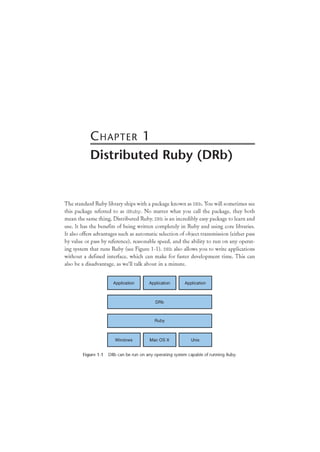
ing system that runs Ruby (see Figure 1-1). DRb also allows you to write applications
without a defined interface, which can make for faster development time. This can
also be a disadvantage, as we'll talk about in a minute.
Application Application Application
DRb
Ruby
Windows Mac OS X Unix
Figure 1-1 DRb can be run on any operating system capable of running Ruby.
24.
4 1. DistributedRuby (DRb)
Although DRb has its advantages, it also has disadvantages. DRb can prove to be
unreliable under heavy loads. While it has reasonable speed, thanks to the underlying
marshaling, socket, and thread classes, that speed can quickly degrade when placed
under considerable load. Finally, DRb can tightly couple applications, because you are
not calling a defined API but rather methods on objects that may or may not change
over time. So although DRb might be the perfect solution for connecting a set of
smaller applications, it might be unsuitable in large-scale, high-volume production
environments.
With that said, it's important to discuss DRb, because it lays a nice foundation for
distributed programming with Ruby, and it can definitely be useful in certain envi-
ronments.
Here is what the documentation says when introducing DRb:
dRuby is a distributed object system for Ruby. It alloivs an object in one Ruby
process to invoke methods on an object in another Ruby process on the same or
a different machine.
This is Ruby's equivalent of Java's RMI package. The DRb package is the basis for most
of the distributed programming done in Ruby. This chapter explores the DRb package.
You'll start by getting your feet wet, and by the end of the chapter you will be able to
write robust, secure, and interactive applications using DRb.
Hello World
To help you get a feel for any language, framework, or package, the obligatory "Hello
World" example has held up well. So why should our journey into distributed pro-
gramming with Ruby be any different?
Let's start by taking a quick look at how things are done using another language's
framework for distributed programming. In the introduction to this book I spoke of
my past experiences using Java's RMI package, so let's use that to help us compare and
contrast a bit. I promise you this will be a very brief look into the past. It will help
illustrate how writing distributed applications with Ruby is quite simple.
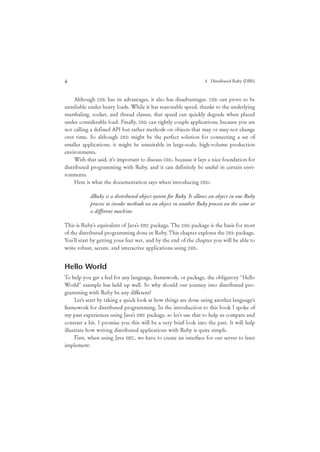
First, when using Java RMI, we have to create an interface for our server to later
implement:
25.
Hello World 5
packageexample.hello ;
import java.rmi.Remote ;
import j ava.rmi.RemoteException;
public interface Hello extends Remote {
String sayHelloO throws RemoteException;
}
We're saying that our Hello interface will extend the j ava. rmi .Remote class.
We are also saying that any class that implements our Hello interface will need to pro-
vide a sayHello method that returns a String. Now that we have our interface, we
can write our "Hello World" server class:
package example.hello ;
import j ava.rmi.registry.Registry;
import j ava.rmi.registry.LocateRegistry;
import j ava.rmi.RemoteException;
import j ava.rmi.server.UnicastRemoteObj ect;
public class Server implements Hello {
public Server!) {}
public String sayHello() {
return "Hello, world!";
}
public static void main(String args[]) {
try {
Server obj = new Server();
Hello stub = (Hello) UnicastRemoteObject.exportObject(obj , 0) ;
// Bind the remote object's stub in the registry
Registry registry = LocateRegistry.getRegistry();
registry.bind("Hello", stub);
System.out.printIn("Server ready")
} catch (Exception e) {
This ebook isfor the use of anyone anywhere in the United States
and most other parts of the world at no cost and with almost no
restrictions whatsoever. You may copy it, give it away or re-use it
under the terms of the Project Gutenberg License included with this
ebook or online at www.gutenberg.org. If you are not located in the
United States, you will have to check the laws of the country where
you are located before using this eBook.
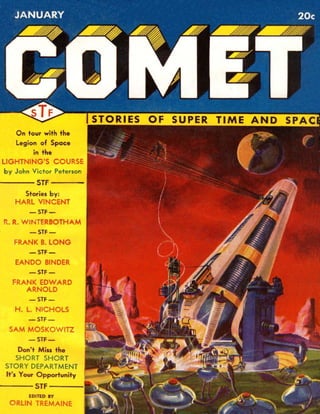
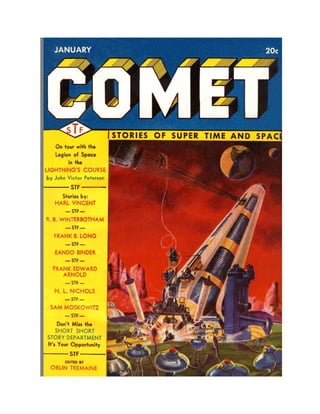
Title: A Green Cloud Came
Author: Robert W. Lowndes
Illustrator: John Giunta
Release date: March 14, 2021 [eBook #64816]
Most recently updated: October 18, 2024
Language: English
Credits: Greg Weeks, Mary Meehan and the Online Distributed
Proofreading Team at http://www.pgdp.net
*** START OF THE PROJECT GUTENBERG EBOOK A GREEN CLOUD
CAME ***
33.
A GREEN CLOUDCAME
by ROBERT W. LOWNDES
[Transcriber's Note: This etext was produced from
Comet January 41.
Extensive research did not uncover any evidence that
the U.S. copyright on this publication was renewed.]
34.
Her fingers lightlycaressed a button on the long table as she half-
turned toward him. At this moment, she was glad they still wore the
semi-barbaric accoutrements donned for last night's festivities,
commemorating the conclusion of the final war—weird, fantastic
trappings, selected more for adornment than for approximations of
ancient military dress—for he would not notice that she was
trembling. When at last she spoke, her voice was steady.
"Please go now, quickly."
His hand made as if to clasp her arm, then dropped to his side. For
an instant he stood there, words welling to his lips, then, with a half
shrug he turned away. She did not move as he strode toward the
doorway, glanced out the window; her back was a picture of
composure.
"Natalla!" It was not a command, or yet a call, but a cry of
astonishment blended with horror. Gone was her carefully built-up
poise as she whirled, then gasped as she saw the look in his eyes.
Swiftly she hurried toward the window, but he stood in front of her,
blocking her view.
"What is it, Eric?"
"Don't look," he gasped. For a moment she felt fear coursing through
her, fear that at this moment he would wilt, give way to terror. She
bit her lips, telling herself she couldn't endure the sight of it. But, an
instant later, the panic had left him; she could see rugged
determination flowing back into his being. Almost faint with
thankfulness for the strength of him, she relaxed against his body,
permitted him to lead her across the room to a sofa.
"Do you remember Greer?" His voice was analytically thoughtful. "He
was the little astronomer who made those startlingly radical
predictions about a year ago. Remember how we all checked his
data? No one could find anything of the sort, even though we
checked and re-checked a dozen times. The conclusion was the only
one that could be drawn under such circumstances; Greer was
35.
suffering from delusions.So he was cured by the psychiatry
department."
Her nose wrinkled in concentration. "Greer? Wasn't he the one who
claimed to have discovered a sort of gaseous cloud in space? Our
system was supposed to be approaching it; when it reached our
atmosphere, it would prove a deadly poison to all life-forms on this
planet."
"Yes—that's it. Well, it seems he was right. It's come—the green
cloud. All I could see out that window was the nauseous swirls of it,
and the people where they'd fallen in the streets. Neither of us can
leave this building." He snapped on the tele-screen. It lit up; he could
hear the faint hum of the machinery, but no images appeared.
"Dead!"
36.
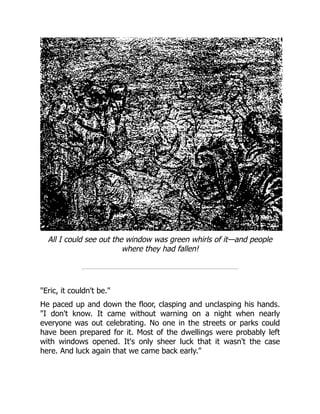
All I couldsee out the window was green whirls of it—and people
where they had fallen!
"Eric, it couldn't be."
He paced up and down the floor, clasping and unclasping his hands.
"I don't know. It came without warning on a night when nearly
everyone was out celebrating. No one in the streets or parks could
have been prepared for it. Most of the dwellings were probably left
with windows opened. It's only sheer luck that it wasn't the case
here. And luck again that we came back early."
37.
"Please sit down,"she begged. He looked at her a moment, then
shrugged, came over to the sofa, and sat beside her. "There must
have been some, Eric," she said.
"The law of averages would seem to indicate that. There might be
some who are naturally immune to whatever brand of poison this is;
some who escaped as did we; some who were underground, or in
forests. But until we learn differently, we must assume that we are
the only humans alive."
His eyes were haunted. "How could we have missed it?" he
whispered. "We checked and re-checked all the data, and put it to
the calculating machines. The answer was the same each time: no
such cloud existed."
"Perhaps there were some factors that only Greer himself knew.
Some small items concerning his calculations which he overlooked in
presenting data, not realizing that it had influenced him. If one factor
were missing, known only to Greer, then all the machines in the world
might well give a negative result."
He shook his head. "It's fantastic—yet, what can we think? If your
idea of a missing factor is correct, we'll never know. Even if Greer is
still alive. He was cured of his delusion."
She was silent for a moment, then she slipped off her gloves, laid a
hand on his arm. "Eric," she whispered. "I'm sorry it had to happen
at a time like this. It may be that Sandra escaped, too. I know what
she means to you. If we find her, later, I shan't stand in the way."
He chewed his lips. "That's all over, now. The first thing we must do
is to check up on the food, water, and sanitation system. Just how
long the machines will run without human supervision is questionable
—not long, at any rate. The robots cannot do everything alone,
either."
Her eyes were calm and clear, her voice a breath of cool air in the
heat of his anguish. "Then let's do it the same way, Eric. Nothing is
going to happen for awhile. Let's tackle the problem after we're
refreshed." She moved to free herself from him; he had,
38.
automatically, slipped hisarm around her waist, drawn her to him.
"You—you can use the lab for your quarters. Good night, Eric."
He held her back. "Natalla."
"Let me go," she murmured.
"Natalla, wait. I didn't tell you all I saw. It was more than—the
cloud." He fell silent, breathing rapidly.
"Well?" she said.
"I was reading some of the old books yesterday. Some of them
centuries old. The people then, most of them, didn't live as well as
we do but they were very much like us in some other ways.
"They—well, sometimes a man would think he had fallen out of
harmony with his mate. In this book, the man thought he'd found
another woman more suitable to his psyche. He was about to obtain
a release—divorce I think they used to call it—when she was injured
in an accident. His mate, I mean. The medical experts did not think
she could live.
"He realized then, when it seemed to be too late, that there could
never be any other mate for him. They didn't have psychoadjusters in
those days, so, if she died, he would be affected for many years. The
only way emotional upsets could wear off was through the primitive
process of letting time wear them down, little by little. It all ended
well, however, because medical experts discovered that it was only
her psyche that made the injury seem fatal; when she found that he
still wanted her to be his mate, she recovered."
"Eric, what are you trying to tell me?"
"That I don't want to be released from you ever. Even if this had
never happened, if what I saw out there was only my imagination.
"I know now that I was only deceiving myself when I sought release
from you. Sandra? Well, I rather like her, but she could never take
your place. I still wish to be your mate, Natalla."
Her eyes answered him, he thought.
39.
"You're tired, Eric.But perhaps you'd better not spend the night in
the lab after all."
He reached down, picked her up in his arms. "In the old days," he
said, "it was considered particularly fine form for a man to carry his
mate to their sleeping quarters."
She smiled and buried her face against his shoulder. No need to tell
him that she, too, had read the old books. Or that she'd rigged up a
z-special screen outside that window, projected a carefully-made film
on it. After all, she hadn't seen the green cloud. He'd held her back.
And hadn't he mentioned something about it being his imagination.
She wouldn't be too harsh on him, of course, tomorrow morning
when all was discovered to be well. And she was positive that he
hadn't noticed her fingers slide over the button as she leaned against
the table a moment ago, the button summoning a robot, pre-
instructed to dismantle the apparatus.
24th Century or no 24th Century, men were still such dear fools.
40.
*** END OFTHE PROJECT GUTENBERG EBOOK A GREEN CLOUD
CAME ***
Updated editions will replace the previous one—the old editions will
be renamed.
Creating the works from print editions not protected by U.S.
copyright law means that no one owns a United States copyright in
these works, so the Foundation (and you!) can copy and distribute it
in the United States without permission and without paying
copyright royalties. Special rules, set forth in the General Terms of
Use part of this license, apply to copying and distributing Project
Gutenberg™ electronic works to protect the PROJECT GUTENBERG™
concept and trademark. Project Gutenberg is a registered trademark,
and may not be used if you charge for an eBook, except by following
the terms of the trademark license, including paying royalties for use
of the Project Gutenberg trademark. If you do not charge anything
for copies of this eBook, complying with the trademark license is
very easy. You may use this eBook for nearly any purpose such as
creation of derivative works, reports, performances and research.
Project Gutenberg eBooks may be modified and printed and given
away—you may do practically ANYTHING in the United States with
eBooks not protected by U.S. copyright law. Redistribution is subject
to the trademark license, especially commercial redistribution.
START: FULL LICENSE
PLEASE READ THISBEFORE YOU DISTRIBUTE OR USE THIS WORK
To protect the Project Gutenberg™ mission of promoting the free
distribution of electronic works, by using or distributing this work (or
any other work associated in any way with the phrase “Project
Gutenberg”), you agree to comply with all the terms of the Full
Project Gutenberg™ License available with this file or online at
www.gutenberg.org/license.
Section 1. General Terms of Use and
Redistributing Project Gutenberg™
electronic works
1.A. By reading or using any part of this Project Gutenberg™
electronic work, you indicate that you have read, understand, agree
to and accept all the terms of this license and intellectual property
(trademark/copyright) agreement. If you do not agree to abide by all
the terms of this agreement, you must cease using and return or
destroy all copies of Project Gutenberg™ electronic works in your
possession. If you paid a fee for obtaining a copy of or access to a
Project Gutenberg™ electronic work and you do not agree to be
bound by the terms of this agreement, you may obtain a refund
from the person or entity to whom you paid the fee as set forth in
paragraph 1.E.8.
1.B. “Project Gutenberg” is a registered trademark. It may only be
used on or associated in any way with an electronic work by people
who agree to be bound by the terms of this agreement. There are a
few things that you can do with most Project Gutenberg™ electronic
works even without complying with the full terms of this agreement.
See paragraph 1.C below. There are a lot of things you can do with
Project Gutenberg™ electronic works if you follow the terms of this
agreement and help preserve free future access to Project
Gutenberg™ electronic works. See paragraph 1.E below.
43.
1.C. The ProjectGutenberg Literary Archive Foundation (“the
Foundation” or PGLAF), owns a compilation copyright in the
collection of Project Gutenberg™ electronic works. Nearly all the
individual works in the collection are in the public domain in the
United States. If an individual work is unprotected by copyright law
in the United States and you are located in the United States, we do
not claim a right to prevent you from copying, distributing,
performing, displaying or creating derivative works based on the
work as long as all references to Project Gutenberg are removed. Of
course, we hope that you will support the Project Gutenberg™
mission of promoting free access to electronic works by freely
sharing Project Gutenberg™ works in compliance with the terms of
this agreement for keeping the Project Gutenberg™ name associated
with the work. You can easily comply with the terms of this
agreement by keeping this work in the same format with its attached
full Project Gutenberg™ License when you share it without charge
with others.
1.D. The copyright laws of the place where you are located also
govern what you can do with this work. Copyright laws in most
countries are in a constant state of change. If you are outside the
United States, check the laws of your country in addition to the
terms of this agreement before downloading, copying, displaying,
performing, distributing or creating derivative works based on this
work or any other Project Gutenberg™ work. The Foundation makes
no representations concerning the copyright status of any work in
any country other than the United States.
1.E. Unless you have removed all references to Project Gutenberg:
1.E.1. The following sentence, with active links to, or other
immediate access to, the full Project Gutenberg™ License must
appear prominently whenever any copy of a Project Gutenberg™
work (any work on which the phrase “Project Gutenberg” appears,
or with which the phrase “Project Gutenberg” is associated) is
accessed, displayed, performed, viewed, copied or distributed:
44.
This eBook isfor the use of anyone anywhere in the United
States and most other parts of the world at no cost and with
almost no restrictions whatsoever. You may copy it, give it away
or re-use it under the terms of the Project Gutenberg License
included with this eBook or online at www.gutenberg.org. If you
are not located in the United States, you will have to check the
laws of the country where you are located before using this
eBook.
1.E.2. If an individual Project Gutenberg™ electronic work is derived
from texts not protected by U.S. copyright law (does not contain a
notice indicating that it is posted with permission of the copyright
holder), the work can be copied and distributed to anyone in the
United States without paying any fees or charges. If you are
redistributing or providing access to a work with the phrase “Project
Gutenberg” associated with or appearing on the work, you must
comply either with the requirements of paragraphs 1.E.1 through
1.E.7 or obtain permission for the use of the work and the Project
Gutenberg™ trademark as set forth in paragraphs 1.E.8 or 1.E.9.
1.E.3. If an individual Project Gutenberg™ electronic work is posted
with the permission of the copyright holder, your use and distribution
must comply with both paragraphs 1.E.1 through 1.E.7 and any
additional terms imposed by the copyright holder. Additional terms
will be linked to the Project Gutenberg™ License for all works posted
with the permission of the copyright holder found at the beginning
of this work.
1.E.4. Do not unlink or detach or remove the full Project
Gutenberg™ License terms from this work, or any files containing a
part of this work or any other work associated with Project
Gutenberg™.
1.E.5. Do not copy, display, perform, distribute or redistribute this
electronic work, or any part of this electronic work, without
prominently displaying the sentence set forth in paragraph 1.E.1
45.
with active linksor immediate access to the full terms of the Project
Gutenberg™ License.
1.E.6. You may convert to and distribute this work in any binary,
compressed, marked up, nonproprietary or proprietary form,
including any word processing or hypertext form. However, if you
provide access to or distribute copies of a Project Gutenberg™ work
in a format other than “Plain Vanilla ASCII” or other format used in
the official version posted on the official Project Gutenberg™ website
(www.gutenberg.org), you must, at no additional cost, fee or
expense to the user, provide a copy, a means of exporting a copy, or
a means of obtaining a copy upon request, of the work in its original
“Plain Vanilla ASCII” or other form. Any alternate format must
include the full Project Gutenberg™ License as specified in
paragraph 1.E.1.
1.E.7. Do not charge a fee for access to, viewing, displaying,
performing, copying or distributing any Project Gutenberg™ works
unless you comply with paragraph 1.E.8 or 1.E.9.
1.E.8. You may charge a reasonable fee for copies of or providing
access to or distributing Project Gutenberg™ electronic works
provided that:
• You pay a royalty fee of 20% of the gross profits you derive
from the use of Project Gutenberg™ works calculated using the
method you already use to calculate your applicable taxes. The
fee is owed to the owner of the Project Gutenberg™ trademark,
but he has agreed to donate royalties under this paragraph to
the Project Gutenberg Literary Archive Foundation. Royalty
payments must be paid within 60 days following each date on
which you prepare (or are legally required to prepare) your
periodic tax returns. Royalty payments should be clearly marked
as such and sent to the Project Gutenberg Literary Archive
Foundation at the address specified in Section 4, “Information
46.
about donations tothe Project Gutenberg Literary Archive
Foundation.”
• You provide a full refund of any money paid by a user who
notifies you in writing (or by e-mail) within 30 days of receipt
that s/he does not agree to the terms of the full Project
Gutenberg™ License. You must require such a user to return or
destroy all copies of the works possessed in a physical medium
and discontinue all use of and all access to other copies of
Project Gutenberg™ works.
• You provide, in accordance with paragraph 1.F.3, a full refund of
any money paid for a work or a replacement copy, if a defect in
the electronic work is discovered and reported to you within 90
days of receipt of the work.
• You comply with all other terms of this agreement for free
distribution of Project Gutenberg™ works.
1.E.9. If you wish to charge a fee or distribute a Project Gutenberg™
electronic work or group of works on different terms than are set
forth in this agreement, you must obtain permission in writing from
the Project Gutenberg Literary Archive Foundation, the manager of
the Project Gutenberg™ trademark. Contact the Foundation as set
forth in Section 3 below.
1.F.
1.F.1. Project Gutenberg volunteers and employees expend
considerable effort to identify, do copyright research on, transcribe
and proofread works not protected by U.S. copyright law in creating
the Project Gutenberg™ collection. Despite these efforts, Project
Gutenberg™ electronic works, and the medium on which they may
be stored, may contain “Defects,” such as, but not limited to,
incomplete, inaccurate or corrupt data, transcription errors, a
copyright or other intellectual property infringement, a defective or
47.
damaged disk orother medium, a computer virus, or computer
codes that damage or cannot be read by your equipment.
1.F.2. LIMITED WARRANTY, DISCLAIMER OF DAMAGES - Except for
the “Right of Replacement or Refund” described in paragraph 1.F.3,
the Project Gutenberg Literary Archive Foundation, the owner of the
Project Gutenberg™ trademark, and any other party distributing a
Project Gutenberg™ electronic work under this agreement, disclaim
all liability to you for damages, costs and expenses, including legal
fees. YOU AGREE THAT YOU HAVE NO REMEDIES FOR
NEGLIGENCE, STRICT LIABILITY, BREACH OF WARRANTY OR
BREACH OF CONTRACT EXCEPT THOSE PROVIDED IN PARAGRAPH
1.F.3. YOU AGREE THAT THE FOUNDATION, THE TRADEMARK
OWNER, AND ANY DISTRIBUTOR UNDER THIS AGREEMENT WILL
NOT BE LIABLE TO YOU FOR ACTUAL, DIRECT, INDIRECT,
CONSEQUENTIAL, PUNITIVE OR INCIDENTAL DAMAGES EVEN IF
YOU GIVE NOTICE OF THE POSSIBILITY OF SUCH DAMAGE.
1.F.3. LIMITED RIGHT OF REPLACEMENT OR REFUND - If you
discover a defect in this electronic work within 90 days of receiving
it, you can receive a refund of the money (if any) you paid for it by
sending a written explanation to the person you received the work
from. If you received the work on a physical medium, you must
return the medium with your written explanation. The person or
entity that provided you with the defective work may elect to provide
a replacement copy in lieu of a refund. If you received the work
electronically, the person or entity providing it to you may choose to
give you a second opportunity to receive the work electronically in
lieu of a refund. If the second copy is also defective, you may
demand a refund in writing without further opportunities to fix the
problem.
1.F.4. Except for the limited right of replacement or refund set forth
in paragraph 1.F.3, this work is provided to you ‘AS-IS’, WITH NO
OTHER WARRANTIES OF ANY KIND, EXPRESS OR IMPLIED,
48.
INCLUDING BUT NOTLIMITED TO WARRANTIES OF
MERCHANTABILITY OR FITNESS FOR ANY PURPOSE.
1.F.5. Some states do not allow disclaimers of certain implied
warranties or the exclusion or limitation of certain types of damages.
If any disclaimer or limitation set forth in this agreement violates the
law of the state applicable to this agreement, the agreement shall be
interpreted to make the maximum disclaimer or limitation permitted
by the applicable state law. The invalidity or unenforceability of any
provision of this agreement shall not void the remaining provisions.
1.F.6. INDEMNITY - You agree to indemnify and hold the Foundation,
the trademark owner, any agent or employee of the Foundation,
anyone providing copies of Project Gutenberg™ electronic works in
accordance with this agreement, and any volunteers associated with
the production, promotion and distribution of Project Gutenberg™
electronic works, harmless from all liability, costs and expenses,
including legal fees, that arise directly or indirectly from any of the
following which you do or cause to occur: (a) distribution of this or
any Project Gutenberg™ work, (b) alteration, modification, or
additions or deletions to any Project Gutenberg™ work, and (c) any
Defect you cause.
Section 2. Information about the Mission
of Project Gutenberg™
Project Gutenberg™ is synonymous with the free distribution of
electronic works in formats readable by the widest variety of
computers including obsolete, old, middle-aged and new computers.
It exists because of the efforts of hundreds of volunteers and
donations from people in all walks of life.
Volunteers and financial support to provide volunteers with the
assistance they need are critical to reaching Project Gutenberg™’s
goals and ensuring that the Project Gutenberg™ collection will
49.
remain freely availablefor generations to come. In 2001, the Project
Gutenberg Literary Archive Foundation was created to provide a
secure and permanent future for Project Gutenberg™ and future
generations. To learn more about the Project Gutenberg Literary
Archive Foundation and how your efforts and donations can help,
see Sections 3 and 4 and the Foundation information page at
www.gutenberg.org.
Section 3. Information about the Project
Gutenberg Literary Archive Foundation
The Project Gutenberg Literary Archive Foundation is a non-profit
501(c)(3) educational corporation organized under the laws of the
state of Mississippi and granted tax exempt status by the Internal
Revenue Service. The Foundation’s EIN or federal tax identification
number is 64-6221541. Contributions to the Project Gutenberg
Literary Archive Foundation are tax deductible to the full extent
permitted by U.S. federal laws and your state’s laws.
The Foundation’s business office is located at 809 North 1500 West,
Salt Lake City, UT 84116, (801) 596-1887. Email contact links and up
to date contact information can be found at the Foundation’s website
and official page at www.gutenberg.org/contact
Section 4. Information about Donations to
the Project Gutenberg Literary Archive
Foundation
Project Gutenberg™ depends upon and cannot survive without
widespread public support and donations to carry out its mission of
increasing the number of public domain and licensed works that can
be freely distributed in machine-readable form accessible by the
widest array of equipment including outdated equipment. Many
50.
small donations ($1to $5,000) are particularly important to
maintaining tax exempt status with the IRS.
The Foundation is committed to complying with the laws regulating
charities and charitable donations in all 50 states of the United
States. Compliance requirements are not uniform and it takes a
considerable effort, much paperwork and many fees to meet and
keep up with these requirements. We do not solicit donations in
locations where we have not received written confirmation of
compliance. To SEND DONATIONS or determine the status of
compliance for any particular state visit www.gutenberg.org/donate.
While we cannot and do not solicit contributions from states where
we have not met the solicitation requirements, we know of no
prohibition against accepting unsolicited donations from donors in
such states who approach us with offers to donate.
International donations are gratefully accepted, but we cannot make
any statements concerning tax treatment of donations received from
outside the United States. U.S. laws alone swamp our small staff.
Please check the Project Gutenberg web pages for current donation
methods and addresses. Donations are accepted in a number of
other ways including checks, online payments and credit card
donations. To donate, please visit: www.gutenberg.org/donate.
Section 5. General Information About
Project Gutenberg™ electronic works
Professor Michael S. Hart was the originator of the Project
Gutenberg™ concept of a library of electronic works that could be
freely shared with anyone. For forty years, he produced and
distributed Project Gutenberg™ eBooks with only a loose network of
volunteer support.
51.
Project Gutenberg™ eBooksare often created from several printed
editions, all of which are confirmed as not protected by copyright in
the U.S. unless a copyright notice is included. Thus, we do not
necessarily keep eBooks in compliance with any particular paper
edition.
Most people start at our website which has the main PG search
facility: www.gutenberg.org.
This website includes information about Project Gutenberg™,
including how to make donations to the Project Gutenberg Literary
Archive Foundation, how to help produce our new eBooks, and how
to subscribe to our email newsletter to hear about new eBooks.
52.
Welcome to ourwebsite – the ideal destination for book lovers and
knowledge seekers. With a mission to inspire endlessly, we offer a
vast collection of books, ranging from classic literary works to
specialized publications, self-development books, and children's
literature. Each book is a new journey of discovery, expanding
knowledge and enriching the soul of the reade
Our website is not just a platform for buying books, but a bridge
connecting readers to the timeless values of culture and wisdom. With
an elegant, user-friendly interface and an intelligent search system,
we are committed to providing a quick and convenient shopping
experience. Additionally, our special promotions and home delivery
services ensure that you save time and fully enjoy the joy of reading.
Let us accompany you on the journey of exploring knowledge and
personal growth!
ebookfinal.com

![Hello World 5
package example.hello ;
import java.rmi.Remote ;
import j ava.rmi.RemoteException;
public interface Hello extends Remote {
String sayHelloO throws RemoteException;
}
We're saying that our Hello interface will extend the j ava. rmi .Remote class.
We are also saying that any class that implements our Hello interface will need to pro-
vide a sayHello method that returns a String. Now that we have our interface, we
can write our "Hello World" server class:
package example.hello ;
import j ava.rmi.registry.Registry;
import j ava.rmi.registry.LocateRegistry;
import j ava.rmi.RemoteException;
import j ava.rmi.server.UnicastRemoteObj ect;
public class Server implements Hello {
public Server!) {}
public String sayHello() {
return "Hello, world!";
}
public static void main(String args[]) {
try {
Server obj = new Server();
Hello stub = (Hello) UnicastRemoteObject.exportObject(obj , 0) ;
// Bind the remote object's stub in the registry
Registry registry = LocateRegistry.getRegistry();
registry.bind("Hello", stub);
System.out.printIn("Server ready")
} catch (Exception e) {](https://image.slidesharecdn.com/37462-250414141257-7b0c0020/85/Distributed-Programming-with-Ruby-1st-Edition-Mark-Bates-25-320.jpg)


![This ebook is for the use of anyone anywhere in the United States
and most other parts of the world at no cost and with almost no
restrictions whatsoever. You may copy it, give it away or re-use it
under the terms of the Project Gutenberg License included with this
ebook or online at www.gutenberg.org. If you are not located in the
United States, you will have to check the laws of the country where
you are located before using this eBook.
Title: A Green Cloud Came
Author: Robert W. Lowndes
Illustrator: John Giunta
Release date: March 14, 2021 [eBook #64816]
Most recently updated: October 18, 2024
Language: English
Credits: Greg Weeks, Mary Meehan and the Online Distributed
Proofreading Team at http://www.pgdp.net
*** START OF THE PROJECT GUTENBERG EBOOK A GREEN CLOUD
CAME ***](https://image.slidesharecdn.com/37462-250414141257-7b0c0020/85/Distributed-Programming-with-Ruby-1st-Edition-Mark-Bates-31-320.jpg)

![A GREEN CLOUD CAME
by ROBERT W. LOWNDES
[Transcriber's Note: This etext was produced from
Comet January 41.
Extensive research did not uncover any evidence that
the U.S. copyright on this publication was renewed.]](https://image.slidesharecdn.com/37462-250414141257-7b0c0020/85/Distributed-Programming-with-Ruby-1st-Edition-Mark-Bates-33-320.jpg)