Distributed Computing: Unleashing
Collaborative Computing Power
Computer Engineering
DJMIT Mogar Anand
Rutvik Pagi
Introduction to distributed computing
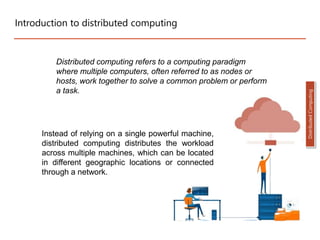
Distributed computing refers to a computing paradigm
where multiple computers, often referred to as nodes or
hosts, work together to solve a common problem or perform
a task.
Distributed
Computing
Instead of relying on a single powerful machine,
distributed computing distributes the workload
across multiple machines, which can be located
in different geographic locations or connected
through a network.
Characteristics of Distributed Computing
• Concurrency: Concurrency enables parallelism, allowing the
system to handle multiple tasks concurrently for improved
performance.
• Decentralization: They consist of multiple autonomous nodes
that collaborate to achieve a common goal without the need for
central coordination.
• Fault Tolerance: Distributed computing systems employ
redundancy, replication, and error recovery mechanisms to
ensure that the system can continue operating even if individual
components fail or become unavailable.
• Scalability: Scalability allows distributed systems to handle
growing data volumes and user traffic effectively.
• Loose Coupling: Loose coupling enables flexibility,
interoperability, and easier maintenance of distributed systems.
Distributed
Computing
Characteristics of Distributed Computing
• Resource Sharing: Distributed computing systems facilitate
the sharing of computational resources, data, and services
among multiple users or applications.
• Security: Distributed computing systems employ various
security measures, such as authentication, encryption, access
control, and auditing, to protect data, resources, and
communication channels from unauthorized access and
malicious attacks.
• Consistency and Coherence: Techniques such as distributed
transactions, replication consistency models, and distributed
consensus algorithms are used to achieve consistency and
coherence in distributed environments.
• Communication Overhead: Techniques such as message
batching, compression, and efficient protocols are used to
reduce communication overhead.
Distributed
Computing
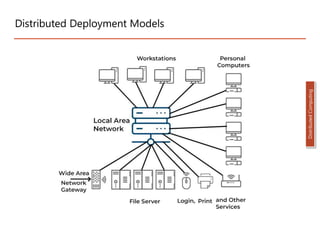
Distributed Deployment Models
Distributed
Computing
Advantages of Distributed Computing
• Scalability: Distributed computing systems can easily scale by adding more
machines, enabling seamless expansion to accommodate growing
computational demands.
• Fault Tolerance: The decentralized nature of distributed computing ensures
that if one node fails, the system can continue to operate using the remaining
nodes, enhancing reliability.
• Resource Utilization: It optimizes resource utilization by distributing workloads
across multiple machines, preventing bottlenecks and ensuring efficient use of
computing resources.
• Enhanced Performance: By distributing workloads across multiple machines,
distributed computing systems can achieve higher performance and faster
processing speeds.
• Cost Efficiency: It offers cost savings by utilizing existing hardware resources
more effectively and enabling organizations to scale their computing
infrastructure as needed.
• Flexibility: Distributed computing provides flexibility in resource allocation,
allowing organizations to adapt to changing computational requirements
without overprovisioning.
Distributed
Computing
Disadvantages of Distributed Computing
• Complexity: Implementing and managing a distributed computing
system can be complex, requiring specialized knowledge and tools to
ensure proper coordination and communication between nodes.
• Security Challenges: The distributed nature of the system introduces
security vulnerabilities, requiring robust measures to protect data and
ensure secure communication between nodes.
• Consistency and Coordination: Maintaining consistency and
coordination across distributed nodes can be challenging, leading to
potential issues with data synchronization and transaction
management.
• Data Consistency: Ensuring data consistency and integrity across
distributed nodes can be challenging, requiring careful design and
implementation of data synchronization mechanisms.
• Network Dependencies: The performance of distributed computing
systems is heavily dependent on network connectivity, making them
susceptible to network-related issues.
Distributed
Computing
Cloud Computing
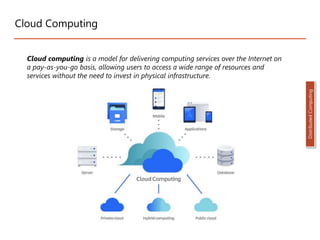
Cloud computing is a model for delivering computing services over the Internet on
a pay-as-you-go basis, allowing users to access a wide range of resources and
services without the need to invest in physical infrastructure.
Distributed
Computing
Characteristics of Cloud Computing
• On-demand Self-service: Users can provision computing resources,
such as virtual machines, storage, and databases, as needed without
requiring human intervention from the service provider. This allows for
flexibility and agility in deploying applications and services.
• Broad Network Access: Cloud services are accessible over the Internet
from a variety of devices, such as laptops, smartphones, and tablets,
using standard protocols and APIs. Users can access cloud resources
from anywhere with an Internet connection.
• Resource Pooling: Cloud providers pool and share computing
resources across multiple users and applications to achieve economies
of scale. This allows users to access resources without needing to invest
in and maintain their own physical infrastructure.
• Rapid Elasticity: Cloud resources can be rapidly provisioned and scaled
up or down to accommodate changing workloads and demand. This
elasticity allows users to scale resources dynamically as needed, paying
only for the resources they consume.
Distributed
Computing
Characteristics of Cloud Computing
Distributed
Computing
• Distributed computing is a transformative paradigm that has
revolutionized how we approach complex computing tasks. Through the
distribution of resources, data, and computation across multiple nodes,
distributed computing enables scalability, fault tolerance, and high
performance. It empowers organizations to tackle large-scale problems
efficiently and effectively, leveraging the collective power of
interconnected machines. As we continue to embrace distributed
computing principles, we unlock new possibilities for innovation and
advancement in fields such as scientific research, big data analytics, cloud
computing, and beyond. In the ever-evolving landscape of technology,
distributed computing stands as a cornerstone, driving progress and
shaping the future of computing.
• Hence, distributed computing provides greater control and customization,
it requires manual scalability and infrastructure management. Where,
cloud computing offers automated scalability, standardized services, and
outsourced infrastructure management, catering to diverse organizational
needs.
Conclusion
THANK YOU

distributed computing: Unleashing collaborative computing power.ppt

  • 1.
    Distributed Computing: Unleashing CollaborativeComputing Power Computer Engineering DJMIT Mogar Anand Rutvik Pagi
  • 2.
    Introduction to distributedcomputing Distributed computing refers to a computing paradigm where multiple computers, often referred to as nodes or hosts, work together to solve a common problem or perform a task. Distributed Computing Instead of relying on a single powerful machine, distributed computing distributes the workload across multiple machines, which can be located in different geographic locations or connected through a network.
  • 3.
    Characteristics of DistributedComputing • Concurrency: Concurrency enables parallelism, allowing the system to handle multiple tasks concurrently for improved performance. • Decentralization: They consist of multiple autonomous nodes that collaborate to achieve a common goal without the need for central coordination. • Fault Tolerance: Distributed computing systems employ redundancy, replication, and error recovery mechanisms to ensure that the system can continue operating even if individual components fail or become unavailable. • Scalability: Scalability allows distributed systems to handle growing data volumes and user traffic effectively. • Loose Coupling: Loose coupling enables flexibility, interoperability, and easier maintenance of distributed systems. Distributed Computing
  • 4.
    Characteristics of DistributedComputing • Resource Sharing: Distributed computing systems facilitate the sharing of computational resources, data, and services among multiple users or applications. • Security: Distributed computing systems employ various security measures, such as authentication, encryption, access control, and auditing, to protect data, resources, and communication channels from unauthorized access and malicious attacks. • Consistency and Coherence: Techniques such as distributed transactions, replication consistency models, and distributed consensus algorithms are used to achieve consistency and coherence in distributed environments. • Communication Overhead: Techniques such as message batching, compression, and efficient protocols are used to reduce communication overhead. Distributed Computing
  • 5.
  • 6.
    Advantages of DistributedComputing • Scalability: Distributed computing systems can easily scale by adding more machines, enabling seamless expansion to accommodate growing computational demands. • Fault Tolerance: The decentralized nature of distributed computing ensures that if one node fails, the system can continue to operate using the remaining nodes, enhancing reliability. • Resource Utilization: It optimizes resource utilization by distributing workloads across multiple machines, preventing bottlenecks and ensuring efficient use of computing resources. • Enhanced Performance: By distributing workloads across multiple machines, distributed computing systems can achieve higher performance and faster processing speeds. • Cost Efficiency: It offers cost savings by utilizing existing hardware resources more effectively and enabling organizations to scale their computing infrastructure as needed. • Flexibility: Distributed computing provides flexibility in resource allocation, allowing organizations to adapt to changing computational requirements without overprovisioning. Distributed Computing
  • 7.
    Disadvantages of DistributedComputing • Complexity: Implementing and managing a distributed computing system can be complex, requiring specialized knowledge and tools to ensure proper coordination and communication between nodes. • Security Challenges: The distributed nature of the system introduces security vulnerabilities, requiring robust measures to protect data and ensure secure communication between nodes. • Consistency and Coordination: Maintaining consistency and coordination across distributed nodes can be challenging, leading to potential issues with data synchronization and transaction management. • Data Consistency: Ensuring data consistency and integrity across distributed nodes can be challenging, requiring careful design and implementation of data synchronization mechanisms. • Network Dependencies: The performance of distributed computing systems is heavily dependent on network connectivity, making them susceptible to network-related issues. Distributed Computing
  • 8.
    Cloud Computing Cloud computingis a model for delivering computing services over the Internet on a pay-as-you-go basis, allowing users to access a wide range of resources and services without the need to invest in physical infrastructure. Distributed Computing
  • 9.
    Characteristics of CloudComputing • On-demand Self-service: Users can provision computing resources, such as virtual machines, storage, and databases, as needed without requiring human intervention from the service provider. This allows for flexibility and agility in deploying applications and services. • Broad Network Access: Cloud services are accessible over the Internet from a variety of devices, such as laptops, smartphones, and tablets, using standard protocols and APIs. Users can access cloud resources from anywhere with an Internet connection. • Resource Pooling: Cloud providers pool and share computing resources across multiple users and applications to achieve economies of scale. This allows users to access resources without needing to invest in and maintain their own physical infrastructure. • Rapid Elasticity: Cloud resources can be rapidly provisioned and scaled up or down to accommodate changing workloads and demand. This elasticity allows users to scale resources dynamically as needed, paying only for the resources they consume. Distributed Computing
  • 10.
    Characteristics of CloudComputing Distributed Computing
  • 11.
    • Distributed computingis a transformative paradigm that has revolutionized how we approach complex computing tasks. Through the distribution of resources, data, and computation across multiple nodes, distributed computing enables scalability, fault tolerance, and high performance. It empowers organizations to tackle large-scale problems efficiently and effectively, leveraging the collective power of interconnected machines. As we continue to embrace distributed computing principles, we unlock new possibilities for innovation and advancement in fields such as scientific research, big data analytics, cloud computing, and beyond. In the ever-evolving landscape of technology, distributed computing stands as a cornerstone, driving progress and shaping the future of computing. • Hence, distributed computing provides greater control and customization, it requires manual scalability and infrastructure management. Where, cloud computing offers automated scalability, standardized services, and outsourced infrastructure management, catering to diverse organizational needs. Conclusion
  • 12.