Download to read offline
![Samizdat
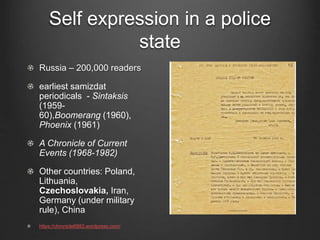
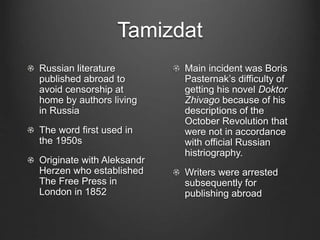
“Samizdat (Russian:
самизда́т; IPA:
[səmɨzˈdat]) was a key
form of dissident activity
across the Soviet bloc in
which individuals
reproduced censored and
underground publications
by hand and passed the
documents from reader to
reader.”
Self publishing
Genres included literary,
political, rellgious,
nationalist
Pasternak’s (1957) Dr
Zhivago
Solzhenitsyn’s (1962) One
Day in the Life of Ivan
Denisovich
Bulgakov’s (1967) The
Master & Margarita
Havel’s (1987) The Power
of the Powerless (how the
communist regime creates
dissidents of its ordinary
citizens)
Charter 77 – Manifesto of
dissent for Czechoslovakia](https://image.slidesharecdn.com/dissidentthought-170305232327/85/Dissident-thought-7-320.jpg)



![History of Dissidence
The term dissidence is most often associated with Russian,
Central and East European movements opposing the regime in
the Soviet Union, beginning in the 1960s and culminating,
perhaps, in the statement by Vaclav Havel (1985: 23):
[Dissent] is a natural and inevitable consequence of the present
historical phase of the [Communist] system it is haunting. It was
born at a time, when this system, for a thousand reasons, can
no longer base itself on the unadulterated, brutal, and arbitrary
application of power, eliminating all expressions of
nonconformity. What is more, the system has become so
ossified politically that there is practically no way for such
nonconformity to be implemented within its official structures](https://image.slidesharecdn.com/dissidentthought-170305232327/85/Dissident-thought-24-320.jpg)

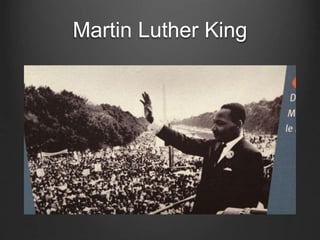
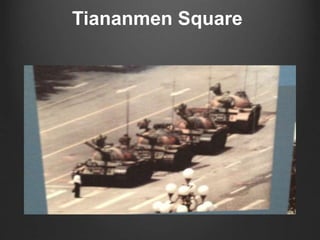




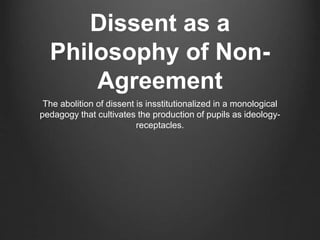
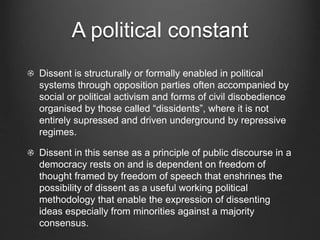


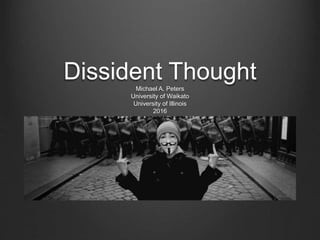
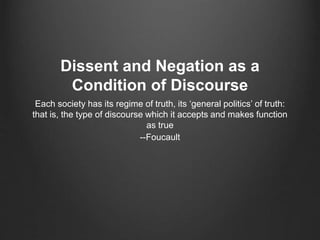
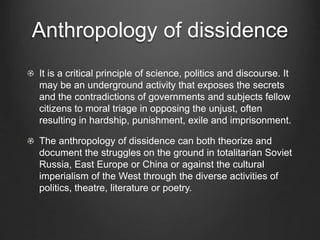
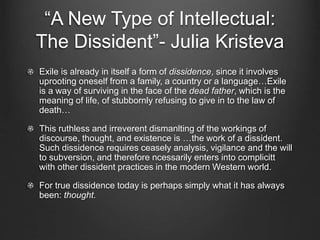
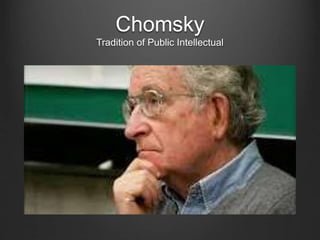
Dissident thought takes many forms in opposition to dominance and consensus to promote social good. It includes challenging established doctrines through civil disobedience, protest, or subversive acts. In the Soviet Union, samizdat involved hand copying and distributing censored publications. Dissidence also occurs through public intellectualism and critique of power structures. It has a long history dating back to Russian nihilism and takes inspiration from philosophers like Nietzsche who disrupted traditional Western thought. Dissident thought is enabled by disagreement and negation as a condition of discourse.


