The Parts of the Film That Make the Cut
(The New York Times Article)
http://www.nytimes.com/interactive/2013
/02/19/movies/awardsseason/oscar-
trailers.html?_r=1&
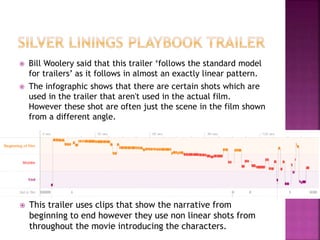
 Bill Woolery said that this trailer ‘follows the standard model
for trailers’ as it follows in almost an exactly linear pattern.
 The infographic shows that there are certain shots which are
used in the trailer that aren't used in the actual film.
However these shot are often just the scene in the film shown
from a different angle.
 This trailer uses clips that show the narrative from
beginning to end however they use non linear shots from
throughout the movie introducing the characters.
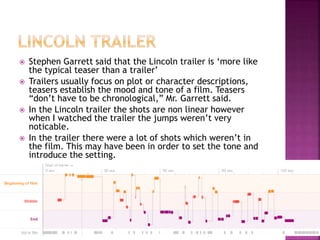
 Stephen Garrett said that the Lincoln trailer is ‘more like
the typical teaser than a trailer’
 Trailers usually focus on plot or character descriptions,
teasers establish the mood and tone of a film. Teasers
“don’t have to be chronological,” Mr. Garrett said.
 In the Lincoln trailer the shots are non linear however
when I watched the trailer the jumps weren’t very
noticable.
 In the trailer there were a lot of shots which weren’t in
the film. This may have been in order to set the tone and
introduce the setting.
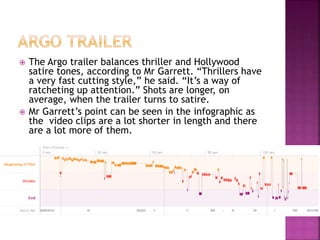
 The Argo trailer balances thriller and Hollywood
satire tones, according to Mr Garrett. “Thrillers have
a very fast cutting style,” he said. “It’s a way of
ratcheting up attention.” Shots are longer, on
average, when the trailer turns to satire.
 Mr Garrett’s point can be seen in the infographic as
the video clips are a lot shorter in length and there
are a lot more of them.

Dissecting a trailer with infographics

  • 1.
    The Parts ofthe Film That Make the Cut (The New York Times Article) http://www.nytimes.com/interactive/2013 /02/19/movies/awardsseason/oscar- trailers.html?_r=1&
  • 2.
     Bill Woolerysaid that this trailer ‘follows the standard model for trailers’ as it follows in almost an exactly linear pattern.  The infographic shows that there are certain shots which are used in the trailer that aren't used in the actual film. However these shot are often just the scene in the film shown from a different angle.  This trailer uses clips that show the narrative from beginning to end however they use non linear shots from throughout the movie introducing the characters.
  • 3.
     Stephen Garrettsaid that the Lincoln trailer is ‘more like the typical teaser than a trailer’  Trailers usually focus on plot or character descriptions, teasers establish the mood and tone of a film. Teasers “don’t have to be chronological,” Mr. Garrett said.  In the Lincoln trailer the shots are non linear however when I watched the trailer the jumps weren’t very noticable.  In the trailer there were a lot of shots which weren’t in the film. This may have been in order to set the tone and introduce the setting.
  • 4.
     The Argotrailer balances thriller and Hollywood satire tones, according to Mr Garrett. “Thrillers have a very fast cutting style,” he said. “It’s a way of ratcheting up attention.” Shots are longer, on average, when the trailer turns to satire.  Mr Garrett’s point can be seen in the infographic as the video clips are a lot shorter in length and there are a lot more of them.