Disease Control-
Health Program in
Nepal
Presented By: Group 07
Rahul Yadav
Srijana Kumari Sah
Pradeep Kumar Chaudhary
Susmita Dahal
4th Batch, General Medicine
COMP-NAIHS
Disease Control
The disease control describes ongoing operations
aimed at reducing;
‱ The incidence of disease
‱ The duration of disease and consequently the risk
of transmission
‱ The effects of infection, including both the physical
and psychosocial complications
‱ The financial burden to the community
Current burden of Major infectious
diseases in Nepal
‱ Tuberculosis
‱ HIV/AIDS
‱ Dengue
‱ Leprosy
‱ Scrub Typhus
‱ Lymphatic Filariasis
‱ Malaria
‱ Kala-azar
‱ Cholera outbreak
‱ Zoonotic Disease
Tuberculosis
Nepal Stop TB Strategy
Vision:
Nepal free of TB
Goal:
To reduce the mortality, morbidity and transmission of
tuberculosis until it is no longer a public health Problem in Nepal.
Objectives:
‱ Achieve universal access to high quality diagnosis and patient
centered treatment
‱ Reduce the human suffering and socio-economic burden
associated with TB
‱ Protect poor and vulnerable populations from TB, TB/HIV and
MDR-TB
‱ Support the development of new tools and enable their
timely and effective use.
Targets :
‱ By 2005, detect at least 70% of new sputum smear-positive
TB cases and cure at least 85% of these cases
‱ By 2015, reduce prevalence of and death due to TB by 50%
relative to 1990
‱ By 2050, eliminate TB as a public health problem (<1 case
per million population.)
STRATIGIES:
‱ GOVERNMENT STEWARDSHIP AND ACCOUNTABILITY ,
with monitoring and evaluation
‱ Strong coalitions with civil society organizations and
communities
‱ The protection and promotions of human rights,
ethnics and equity
‱ The adaption of the strategy and target at country
levels , with goals collaborations.
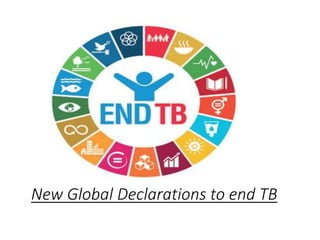
New Global Declarations to end TB
HIV/AIDS
HIV/AIDS Programme:
Nepal HIV/AIDS programme are launched by NCASC which
was established in 1993.
The National HIV/AIDS Strategy, 2006-2011
The National HIV/AIDS Strategy, 2006-2011 has envisioned the
following strategic components:
‱ Prevention
‱ Treatment care and support
‱ Advocacy, policy and legal reform
‱ Leadership and Management
‱ Strategic information (Surveillance, Monitoring and
Evaluation)
‱ Finance and resource mobilization
Objectives:
‱ By 2011, HIV program coverage will be 70-80% among the
ARPs and reduction of a new HIV infection among general
population
‱ By 2011, ensure universal access to quality treatment,
diagnostics, care and support services for infected, affected
and vulnerable groups in Nepal within a context of a
comprehensive response to HIV and AIDS
‱ By 2011, comprehensive and well implemented legal
framework on HIV/AIDS promoting human rights and
establishing HIV/AIDS as a development agenda
‱ Enhance leadership and management at national and local
levels for effective response to HIV/AIDS
‱ Strategic information to guide an effective response
improved and use for planning and implementation
‱ By 2011, sustainable financing and effective utilization of
funds
Recently Nepal has expressed its high level political commitment to
Political Declaration on HIV/AIDS: Intensifying our Efforts to Eliminate
HIV/AIDS June 2011. The 2011 declaration builds on two previous
political declarations: the 2001 Declaration of Commitment on
HIV/AIDS and the 2006 Political Declaration on HIV/AIDS. At UNGASS,
in 2001, Member States unanimously adopted the Declaration of
Commitment on HIV/AIDS. This declaration reflected global
consensus on a comprehensive framework to achieve Millennium
Development Goal Six-: halting and beginning to reverse the HIV
epidemic by 2015. Thus, to ensure the effective response to the HIV
epidemic in Nepal and so to fulfil the accountability of the response,
Nepal has already implemented three rounds national HIV/AIDS
strategic plan. The recent National HIV/AIDS Strategy 2011-2016 has
laid a concrete road map in planning, programming and reviewing of
the national response to the epidemic.
Vision:
Nepal will become a place where new HIV infection are rare and
when they do occur, every person will have access to high quality,
life extending care without any form of discrimination.
Goal:
To achieve universal access to HIV prevention, treatment, care and
support.
Objectives:
‱ Reduce new HIV infections by 50 percent by 2016, compared to
2010;
‱ Reduce HIV-related deaths by 25 percent by 2016 (compared with
a 2010 baseline) through universal access on treatment and care
services; and
‱ Reduce new HIV infections in children by 90 percent by 2016
(compared with a 2010 baseline)
Dengue
Goal:
To reduce the morbidity and mortality due to dengue fever, Dengue
Hemorrhagic Fever (DHF) and Dengue Shock Syndrome (DSS).
Objectives:
‱ To develop an integrated vector management (IVM) approach for
prevention and control.
‱ To develop capacity on diagnosis and case management of dengue
fever, DHF and DSS.
‱ To intensify health education and IEC activities.
‱ To strengthen the surveillance system for prediction, early detection,
preparedness and early response to dengue outbreaks.
Strategies:
‱ Early case detection, diagnosis, management and
reporting of dengue fever.
‱ Regular monitoring of dengue fever surveillance through
the EWARS.
‱ Mosquito vector surveillance in municipalities.
‱ The integrated vector control approach where a
combination of several approaches are directed towards
containment and source reduction
Major activities in 2078-79
‱ Trained physicians, nurses, paramedics and laboratory technicians
on dengue case detection, diagnosis, management and reporting;
‱ Orientated municipality stakeholders on dengue prevention and
management;
‱ Supplied rapid diagnostic test kits (IgM);
‱ Dengue case monitoring and vector surveillance;
‱ Search and destruction of dengue vector larvae in different local
levels;
‱ Developed IEC materials and disseminated health education
messages engaging various stakeholders including the media and
youth;
‱ Distribution of nets.
Leprosy
Scrub typhus
Introduction:
Scrub Typhus is an acute, febrile, infectious disease that is
caused by Orientia (formerly Rickettsia) tsutsugamushi. It is
also known as tsutsugamushi disease. It is an obligate
intracellular gram negative bacterium from the Rickettsiaceae
family.
Control Measures:
1. Bath regularly & change in to clean clothes at least once
week
2. Wash louse infested clothing at least once a week.
3. Don't share clothing, beds, bedding or towels with a person
who has Body lice or infected with it.
4. Treat bedding, uniforms of other clothing with 0.5% Chlorine.
Lymphatic filariasis
Goal:
‱ The people of Nepal no longer suffer from Lymphatic
Filariasis.
Objective:
‱ To eliminate Lymphatic Filariasis as a public health
problem by 2020.
‱ To interrupt the transmission of Lymphatic Filariasis
‱ To reduce and prevent morbidity.
‱ To provide deworming through Albendazole to
endemic communities especially to children.
‱ To reduce mosquito vectors by the application of
suitable available vector control measures .
Strategies:
‱ Interrupt transmission by yearly mass drug
administration using two drug regimens
(diethylcarbamazine citrate and albendazole) for six
years.
‱ Morbidity management by self-care and support using
intensive simple, effective and local hygienic techniques.
MDA related major activities
‱ Implementation unit and local level activities:
Planning meetings, training of health workers,
advocacy, social mobilization, IEC/BCC, monitoring
and supervision, interactions with the media,
interactions with multi-sector stakeholders
including newly elected local body and logistics
supply.
‱ Community level activities: Volunteer’s orientations,
advocacy, social mobilization, IEC/BCC, implementation of
MDA activities and monitoring and supervision.
‱ Social mobilization activities: The production of
revised IEC materials, checklists, reporting.
Malaria
Vision:
Malaria Elimination in Nepal by 2025.
Mission:
Ensure universal access to quality assured malaria
services for prevention, diagnosis, treatment and
prompt response in outbreak.
Goal:
‱ Reduce the indigenous malaria cases to zero by
2022 and thereafter sustain zero malaria mortality.
‱ To receive WHO certification of malaria free status
by 2025.
Objectives:
To ensure proportional and equitable access to
quality assured diagnosis and treatment in health
facilities as per federal structure and implement
effective preventive measures to achieve malaria
elimination.
The updated NMSP (2014-2025) will attain the
elimination goals through the implementation of
following five strategies:
‱ Strengthen surveillance and information system on
malaria for effective decision making.
‱ Ensure effective coverage of vector control
interventions in malaria risk areas to reduce
transmission.
‱ Ensure universal access to quality assured diagnosis
and effective treatment for malaria.
‱ Ensure government committed leadership and
engage community for malaria elimination.
‱ Strengthen technical and managerial capacities
towards malaria elimination.
Kala-azar
Goal:
Contribute to the mitigation of poverty in kala-azar
endemic districts of Nepal by reducing the morbidity
and mortality of the disease and assisting in the
development of equitable health systems.
Objective:
‱ Reduce the incidence of kala-azar in endemic
communities with special emphasis on poor,
vulnerable and unreached populations.
‱ Reduce case fatality rates from primary Kala-azar to
ZERO
‱ Detect and treat PKDL to reduce the parasite reservoir.
‱ Prevent and manage Kala-azar HIV-TB co-infections.
Strategies
‱ Early diagnosis and complete treatment
‱ Integrated Vector Management
‱ Effective disease and vector surveillance
‱ Social mobilization and partnership
‱ Improve program management
‱ Clinical, implementation and operational research
Current interventions of Kala-azar:
1. Early Diagnosis and Treatment
‱ Free diagnosis of Kala-azar cases using RDT (rK39) and
provision of free treatment with Liposomal Amphotericin B
(LAmB).
‱ Diagnosis services are provided from the PHC level of
government health facilities.
‱ Treatment services are provided from selected three
hospitals (1. Bheri Hospital Nepalgunj, 2. Lumbini Provincial
Hospital Butwal, 3.United mission hospital Palpa of Lumbini
province.
‱ Provision of NPR 2000 per patient for travel during the
discharge time of treatment.
‱ Provision of NPR 5000 per patient to the hospital for
treatment.
2. Surveillance System Strengthening
‱ Kala-azar surveillance system strengthening along with
the introduction of online DHIS2/EWARS based
reporting.
3. Indoor residual spraying
‱ IRS activities ongoing in selected districts as per the
need.
4. Active case detection
‱ Social mobilization and partnership
‱ Develop and distribute IEC/BCC
‱ Training /orientation /symposium
Outbreak=CHOLERA
‱ Transmitted through drinking water and food
contaminated with cholera bacteria,
‱ Cardinal sign=rice water stool, diarrhea
‱ On 18th Ashoj 2078, >100 cases of acute diarrhea
from krishnanagar municipality in Shivraj hospital in
Kapilvastu district.
‱ By the end of month more than 1300 cases were
reported including 6 death.
‱ Vibrio cholerae 01 Ogawa seotye was confirmed in
stool sample of the patient.
Early interventions:
‱ Managed additional 15 beds in the hospital for the treatment of
Cholera patients.
‱ Managed additional human resource from outside the outbreak area
(paramedics and nursing from health post, 3 Doctor from Kapilvastu
hospital and 2 Doctor from Lumbini
Provincial hospital.)
‱ Conducted awareness rising program at outbreak and prone areas,
also mobilized Nepal police for miking to disseminate useful messages
for disease prevention and control.
‱ Conducted focus group discussion in different places and distributed
ORS in community
by health workers
‱ Conducted discussion meeting with political leaders of Sukrampur
for community
awareness and sensitization
‱ Conducted water testing Program in different places of the affected
municipalities
Further Intervention:
‱ Expanded 40 beds in Ram Gorkha High school, nearby
hospital
‱ Conducted home visit program by health worker and
distributed Piyush and chlorine tab for water purification and
filled Outbreak investigation form
‱ Requested private sector for the proper record of Diarrhea
cases and hotels for the sanitation
‱ Continued awareness raising interventions, including miking
and community sensitization activities
‱ Conducted water investigation and purification program in
affected communities
‱ Conducted discussion meetings at different levels for
resource generation and overall outbreak management
Zoonotic Disease
Rabies:
Activities and achievements in 2077/78 in Rabies control
Programme. The following activities were carried out in 2077/78 for
the control of rabies cases:
‱ Awareness programs about Rabies for school students and
general public.
‱ Celebration of Work Rabies day on 28th September and co-
ordination with province and local level health officials for its
effective implementations.
‱ Epidemiological study on the active dog bites cases.
‱ Surveillance about Rabies on outbreak area.
‱ Orientation program about the benefit of Intradermal (ID)
delivery of Anti Rabies Vaccine (ARV) for health workers.
‱ Orientation on application of immunoglobulin for provincial level
health facilities.
‱ Procurement of cell culture ARV vaccine and immunoglobulin.
Poisonous Snake Bites:
The free distribution of anti-snake venom serum (ASVS) began in
1999/2000. Indian quadrivalent ASVS is being used now. There are
88 snake bite treatment centres are in the country for snakebite
management in collaboration with Nepal army, Nepal Red Cross
Society, community members. In addition to these, other hospitals
in Kathmandu valley has been getting ASVS on basis of cases they
manage. The following activities were carried out in 2077/78 for the
control and management of poisonous snake bites:
‱ Formation of Standards on Snakebite treatment centres in Nepal.
‱ On site coaching for Snakebite treatment centres.
‱ Orientation program to Medical officers, nurses and paramedics
was conducted on the proper use of Anti snake venom
‱ Procurement and supply of ASVS for respective centres.
In 2077/78, altogether 7,902 snake bite cases were reported at
national level. A total of 967 cases were poisonous
References:
1. Annual Health Report 2077-78; Chapter 5; Epidemiology &
Disease Control
2. MOHP https://mohp.gov.np/program/malaria-control-
programme/en
3. DoHS https://dohs.gov.np/centers/hivaids-and-sti/
4. EDCD https://www.edcd.gov.np/news/cholera-outbreak-in-
kathmandu-valley-5-sep
ANY QUERIES?
Disease control by gr 07.pptx

Disease control by gr 07.pptx

  • 1.
    Disease Control- Health Programin Nepal Presented By: Group 07 Rahul Yadav Srijana Kumari Sah Pradeep Kumar Chaudhary Susmita Dahal 4th Batch, General Medicine COMP-NAIHS
  • 2.
    Disease Control The diseasecontrol describes ongoing operations aimed at reducing; ‱ The incidence of disease ‱ The duration of disease and consequently the risk of transmission ‱ The effects of infection, including both the physical and psychosocial complications ‱ The financial burden to the community
  • 3.
    Current burden ofMajor infectious diseases in Nepal ‱ Tuberculosis ‱ HIV/AIDS ‱ Dengue ‱ Leprosy ‱ Scrub Typhus ‱ Lymphatic Filariasis ‱ Malaria ‱ Kala-azar ‱ Cholera outbreak ‱ Zoonotic Disease
  • 4.
    Tuberculosis Nepal Stop TBStrategy Vision: Nepal free of TB Goal: To reduce the mortality, morbidity and transmission of tuberculosis until it is no longer a public health Problem in Nepal. Objectives: ‱ Achieve universal access to high quality diagnosis and patient centered treatment ‱ Reduce the human suffering and socio-economic burden associated with TB ‱ Protect poor and vulnerable populations from TB, TB/HIV and MDR-TB ‱ Support the development of new tools and enable their timely and effective use.
  • 5.
    Targets : ‱ By2005, detect at least 70% of new sputum smear-positive TB cases and cure at least 85% of these cases ‱ By 2015, reduce prevalence of and death due to TB by 50% relative to 1990 ‱ By 2050, eliminate TB as a public health problem (<1 case per million population.)
  • 6.
    STRATIGIES: ‱ GOVERNMENT STEWARDSHIPAND ACCOUNTABILITY , with monitoring and evaluation ‱ Strong coalitions with civil society organizations and communities ‱ The protection and promotions of human rights, ethnics and equity ‱ The adaption of the strategy and target at country levels , with goals collaborations.
  • 7.
  • 8.
    HIV/AIDS HIV/AIDS Programme: Nepal HIV/AIDSprogramme are launched by NCASC which was established in 1993. The National HIV/AIDS Strategy, 2006-2011 The National HIV/AIDS Strategy, 2006-2011 has envisioned the following strategic components: ‱ Prevention ‱ Treatment care and support ‱ Advocacy, policy and legal reform ‱ Leadership and Management ‱ Strategic information (Surveillance, Monitoring and Evaluation) ‱ Finance and resource mobilization
  • 9.
    Objectives: ‱ By 2011,HIV program coverage will be 70-80% among the ARPs and reduction of a new HIV infection among general population ‱ By 2011, ensure universal access to quality treatment, diagnostics, care and support services for infected, affected and vulnerable groups in Nepal within a context of a comprehensive response to HIV and AIDS ‱ By 2011, comprehensive and well implemented legal framework on HIV/AIDS promoting human rights and establishing HIV/AIDS as a development agenda ‱ Enhance leadership and management at national and local levels for effective response to HIV/AIDS ‱ Strategic information to guide an effective response improved and use for planning and implementation ‱ By 2011, sustainable financing and effective utilization of funds
  • 10.
    Recently Nepal hasexpressed its high level political commitment to Political Declaration on HIV/AIDS: Intensifying our Efforts to Eliminate HIV/AIDS June 2011. The 2011 declaration builds on two previous political declarations: the 2001 Declaration of Commitment on HIV/AIDS and the 2006 Political Declaration on HIV/AIDS. At UNGASS, in 2001, Member States unanimously adopted the Declaration of Commitment on HIV/AIDS. This declaration reflected global consensus on a comprehensive framework to achieve Millennium Development Goal Six-: halting and beginning to reverse the HIV epidemic by 2015. Thus, to ensure the effective response to the HIV epidemic in Nepal and so to fulfil the accountability of the response, Nepal has already implemented three rounds national HIV/AIDS strategic plan. The recent National HIV/AIDS Strategy 2011-2016 has laid a concrete road map in planning, programming and reviewing of the national response to the epidemic.
  • 11.
    Vision: Nepal will becomea place where new HIV infection are rare and when they do occur, every person will have access to high quality, life extending care without any form of discrimination. Goal: To achieve universal access to HIV prevention, treatment, care and support. Objectives: ‱ Reduce new HIV infections by 50 percent by 2016, compared to 2010; ‱ Reduce HIV-related deaths by 25 percent by 2016 (compared with a 2010 baseline) through universal access on treatment and care services; and ‱ Reduce new HIV infections in children by 90 percent by 2016 (compared with a 2010 baseline)
  • 12.
    Dengue Goal: To reduce themorbidity and mortality due to dengue fever, Dengue Hemorrhagic Fever (DHF) and Dengue Shock Syndrome (DSS). Objectives: ‱ To develop an integrated vector management (IVM) approach for prevention and control. ‱ To develop capacity on diagnosis and case management of dengue fever, DHF and DSS. ‱ To intensify health education and IEC activities. ‱ To strengthen the surveillance system for prediction, early detection, preparedness and early response to dengue outbreaks.
  • 13.
    Strategies: ‱ Early casedetection, diagnosis, management and reporting of dengue fever. ‱ Regular monitoring of dengue fever surveillance through the EWARS. ‱ Mosquito vector surveillance in municipalities. ‱ The integrated vector control approach where a combination of several approaches are directed towards containment and source reduction
  • 14.
    Major activities in2078-79 ‱ Trained physicians, nurses, paramedics and laboratory technicians on dengue case detection, diagnosis, management and reporting; ‱ Orientated municipality stakeholders on dengue prevention and management; ‱ Supplied rapid diagnostic test kits (IgM); ‱ Dengue case monitoring and vector surveillance; ‱ Search and destruction of dengue vector larvae in different local levels; ‱ Developed IEC materials and disseminated health education messages engaging various stakeholders including the media and youth; ‱ Distribution of nets.
  • 15.
  • 16.
    Scrub typhus Introduction: Scrub Typhusis an acute, febrile, infectious disease that is caused by Orientia (formerly Rickettsia) tsutsugamushi. It is also known as tsutsugamushi disease. It is an obligate intracellular gram negative bacterium from the Rickettsiaceae family.
  • 17.
    Control Measures: 1. Bathregularly & change in to clean clothes at least once week 2. Wash louse infested clothing at least once a week. 3. Don't share clothing, beds, bedding or towels with a person who has Body lice or infected with it. 4. Treat bedding, uniforms of other clothing with 0.5% Chlorine.
  • 18.
    Lymphatic filariasis Goal: ‱ Thepeople of Nepal no longer suffer from Lymphatic Filariasis. Objective: ‱ To eliminate Lymphatic Filariasis as a public health problem by 2020. ‱ To interrupt the transmission of Lymphatic Filariasis ‱ To reduce and prevent morbidity. ‱ To provide deworming through Albendazole to endemic communities especially to children. ‱ To reduce mosquito vectors by the application of suitable available vector control measures .
  • 19.
    Strategies: ‱ Interrupt transmissionby yearly mass drug administration using two drug regimens (diethylcarbamazine citrate and albendazole) for six years. ‱ Morbidity management by self-care and support using intensive simple, effective and local hygienic techniques.
  • 20.
    MDA related majoractivities ‱ Implementation unit and local level activities: Planning meetings, training of health workers, advocacy, social mobilization, IEC/BCC, monitoring and supervision, interactions with the media, interactions with multi-sector stakeholders including newly elected local body and logistics supply. ‱ Community level activities: Volunteer’s orientations, advocacy, social mobilization, IEC/BCC, implementation of MDA activities and monitoring and supervision. ‱ Social mobilization activities: The production of revised IEC materials, checklists, reporting.
  • 21.
    Malaria Vision: Malaria Elimination inNepal by 2025. Mission: Ensure universal access to quality assured malaria services for prevention, diagnosis, treatment and prompt response in outbreak. Goal: ‱ Reduce the indigenous malaria cases to zero by 2022 and thereafter sustain zero malaria mortality. ‱ To receive WHO certification of malaria free status by 2025.
  • 22.
    Objectives: To ensure proportionaland equitable access to quality assured diagnosis and treatment in health facilities as per federal structure and implement effective preventive measures to achieve malaria elimination.
  • 23.
    The updated NMSP(2014-2025) will attain the elimination goals through the implementation of following five strategies: ‱ Strengthen surveillance and information system on malaria for effective decision making. ‱ Ensure effective coverage of vector control interventions in malaria risk areas to reduce transmission. ‱ Ensure universal access to quality assured diagnosis and effective treatment for malaria. ‱ Ensure government committed leadership and engage community for malaria elimination. ‱ Strengthen technical and managerial capacities towards malaria elimination.
  • 24.
    Kala-azar Goal: Contribute to themitigation of poverty in kala-azar endemic districts of Nepal by reducing the morbidity and mortality of the disease and assisting in the development of equitable health systems. Objective: ‱ Reduce the incidence of kala-azar in endemic communities with special emphasis on poor, vulnerable and unreached populations. ‱ Reduce case fatality rates from primary Kala-azar to ZERO ‱ Detect and treat PKDL to reduce the parasite reservoir. ‱ Prevent and manage Kala-azar HIV-TB co-infections.
  • 25.
    Strategies ‱ Early diagnosisand complete treatment ‱ Integrated Vector Management ‱ Effective disease and vector surveillance ‱ Social mobilization and partnership ‱ Improve program management ‱ Clinical, implementation and operational research
  • 26.
    Current interventions ofKala-azar: 1. Early Diagnosis and Treatment ‱ Free diagnosis of Kala-azar cases using RDT (rK39) and provision of free treatment with Liposomal Amphotericin B (LAmB). ‱ Diagnosis services are provided from the PHC level of government health facilities. ‱ Treatment services are provided from selected three hospitals (1. Bheri Hospital Nepalgunj, 2. Lumbini Provincial Hospital Butwal, 3.United mission hospital Palpa of Lumbini province. ‱ Provision of NPR 2000 per patient for travel during the discharge time of treatment. ‱ Provision of NPR 5000 per patient to the hospital for treatment.
  • 27.
    2. Surveillance SystemStrengthening ‱ Kala-azar surveillance system strengthening along with the introduction of online DHIS2/EWARS based reporting. 3. Indoor residual spraying ‱ IRS activities ongoing in selected districts as per the need. 4. Active case detection ‱ Social mobilization and partnership ‱ Develop and distribute IEC/BCC ‱ Training /orientation /symposium
  • 28.
    Outbreak=CHOLERA ‱ Transmitted throughdrinking water and food contaminated with cholera bacteria, ‱ Cardinal sign=rice water stool, diarrhea ‱ On 18th Ashoj 2078, >100 cases of acute diarrhea from krishnanagar municipality in Shivraj hospital in Kapilvastu district. ‱ By the end of month more than 1300 cases were reported including 6 death. ‱ Vibrio cholerae 01 Ogawa seotye was confirmed in stool sample of the patient.
  • 29.
    Early interventions: ‱ Managedadditional 15 beds in the hospital for the treatment of Cholera patients. ‱ Managed additional human resource from outside the outbreak area (paramedics and nursing from health post, 3 Doctor from Kapilvastu hospital and 2 Doctor from Lumbini Provincial hospital.) ‱ Conducted awareness rising program at outbreak and prone areas, also mobilized Nepal police for miking to disseminate useful messages for disease prevention and control. ‱ Conducted focus group discussion in different places and distributed ORS in community by health workers ‱ Conducted discussion meeting with political leaders of Sukrampur for community awareness and sensitization ‱ Conducted water testing Program in different places of the affected municipalities
  • 30.
    Further Intervention: ‱ Expanded40 beds in Ram Gorkha High school, nearby hospital ‱ Conducted home visit program by health worker and distributed Piyush and chlorine tab for water purification and filled Outbreak investigation form ‱ Requested private sector for the proper record of Diarrhea cases and hotels for the sanitation ‱ Continued awareness raising interventions, including miking and community sensitization activities ‱ Conducted water investigation and purification program in affected communities ‱ Conducted discussion meetings at different levels for resource generation and overall outbreak management
  • 31.
    Zoonotic Disease Rabies: Activities andachievements in 2077/78 in Rabies control Programme. The following activities were carried out in 2077/78 for the control of rabies cases: ‱ Awareness programs about Rabies for school students and general public. ‱ Celebration of Work Rabies day on 28th September and co- ordination with province and local level health officials for its effective implementations. ‱ Epidemiological study on the active dog bites cases. ‱ Surveillance about Rabies on outbreak area. ‱ Orientation program about the benefit of Intradermal (ID) delivery of Anti Rabies Vaccine (ARV) for health workers. ‱ Orientation on application of immunoglobulin for provincial level health facilities. ‱ Procurement of cell culture ARV vaccine and immunoglobulin.
  • 32.
    Poisonous Snake Bites: Thefree distribution of anti-snake venom serum (ASVS) began in 1999/2000. Indian quadrivalent ASVS is being used now. There are 88 snake bite treatment centres are in the country for snakebite management in collaboration with Nepal army, Nepal Red Cross Society, community members. In addition to these, other hospitals in Kathmandu valley has been getting ASVS on basis of cases they manage. The following activities were carried out in 2077/78 for the control and management of poisonous snake bites: ‱ Formation of Standards on Snakebite treatment centres in Nepal. ‱ On site coaching for Snakebite treatment centres. ‱ Orientation program to Medical officers, nurses and paramedics was conducted on the proper use of Anti snake venom ‱ Procurement and supply of ASVS for respective centres. In 2077/78, altogether 7,902 snake bite cases were reported at national level. A total of 967 cases were poisonous
  • 33.
    References: 1. Annual HealthReport 2077-78; Chapter 5; Epidemiology & Disease Control 2. MOHP https://mohp.gov.np/program/malaria-control- programme/en 3. DoHS https://dohs.gov.np/centers/hivaids-and-sti/ 4. EDCD https://www.edcd.gov.np/news/cholera-outbreak-in- kathmandu-valley-5-sep
  • 34.