Lord, true source of light
and wisdom, give me keen
sense of understanding, a
retentive memory and a
capacity to grasp things
correctly.
Grant me the grace to
be accurate in my
expositions and the skill
to express myself with
thoroughness and clarity.
Be with me at the start of
my work, guide its
progress and bring it to
completion.
Grant, this through Christ,
our Lord. Amen
Good morning 
GOOD AFTERNOON 
Even if we failed
yesterday, we can try
again today.
-Anonymous
In this lesson, learners will able you to :
• Describe the two types of lenses.
• Explain how images are formed in
different types of lenses.
• Perform ray diagramming in lenses.
Objectives:
In the previous lesson, you explored about the
qualitative characteristics of images formed by
mirrors both plane and curved mirrors. In this
module, you now learn about basic
information about lenses and how they work.
Just like in mirrors, you will also explore the
qualitative characteristics of images formed by
lenses.
Introduction:
Well the most apparent distinction between
mirrors and lenses are: mirrors reflect light
rays (light bounces back) while light rays
are refracted (pass-through) through a
lens. A mirror has only one focal point. A
lens has two focal points each on either
side.
Refraction of Light in Lenses
You learned in Grade 8 that Refraction is the
bending of light when it travels from one medium to
another of different optical densities. The ancient
Greeks used the concept of light refraction in their
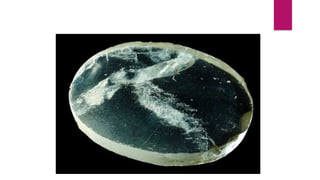
living like using a lens to focus light rays. A lens is a
transparent material made of glass or plastic that
refracts light rays and focuses (or appear to focus)
them at a point.
Development:
A lens works by refraction of light. Light rays
bend as they pass through the lens resulting to
a change in direction. This means the rays
seem to come from a point that's closer or
further away from where they actually originate
and that's what makes objects seen through a
lens seem either bigger or smaller than they
really are.
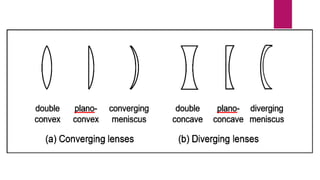
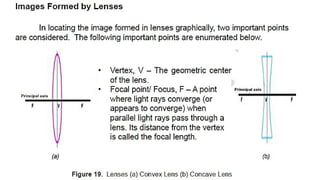
Lenses are made of transparent substance like
glass or plastic which can bend light rays. Lenses
are of two kinds: Types of Lenses
1. Convex Lens
It is thicker in the center than edges. It forms real
images and virtual images depending on position of
the object. It is also called Converging Lens
because the light that passes through it tends to
converge at a particular point called the focal point.
2. Concave Lens
It is thicker at the edges and thinner in
the center. It forms upright and reduced
images. It is also called Diverging Lens
because the light that passes through it
tends to diverge at a particular point
called the focal point.
Characteristics of Optical Images
Formed in Lenses
Lenses, just like curved mirrors can form images
that are real or virtual. Real images formed by
lenses are inverted images that can be seen by
projecting it on a screen. While virtual images are
upright images that are seen directly. Spherical
lenses usually have two centers of curvature
which are the centers of the intersecting spheres
which form the lens surfaces.
In lenses, the focus is not midway between
the lens and the center of curvature as we
found to be in spherical mirrors. Its position on
the principal axis depends on the index of
refraction of the lens. With a double convex
lens of crown glass, the principal focus almost
coincides with the centers of curvature, thus
the radius of curvature and the focal length
are almost equal.
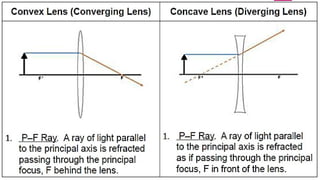
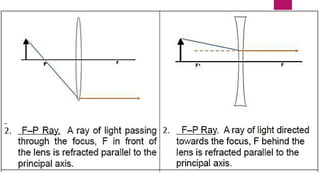
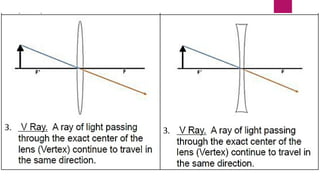
The ‘Three Most Useful Rays’ in Lenses
Images formed in a lens can be
located and described through ray
diagramming. The following three most
useful rays for convex and concave
lenses are presented below.
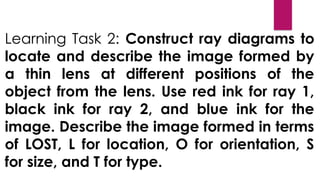
Learning Task 2: Construct ray diagrams to
locate and describe the image formed by
a thin lens at different positions of the
object from the lens. Use red ink for ray 1,
black ink for ray 2, and blue ink for the
image. Describe the image formed in terms
of LOST, L for location, O for orientation, S
for size, and T for type.
Discussion about Lens and its different uses

Discussion about Lens and its different uses

  • 1.
    Lord, true sourceof light and wisdom, give me keen sense of understanding, a retentive memory and a capacity to grasp things correctly.
  • 2.
    Grant me thegrace to be accurate in my expositions and the skill to express myself with thoroughness and clarity.
  • 3.
    Be with meat the start of my work, guide its progress and bring it to completion. Grant, this through Christ, our Lord. Amen
  • 4.
    Good morning  GOODAFTERNOON 
  • 5.
    Even if wefailed yesterday, we can try again today. -Anonymous
  • 6.
    In this lesson,learners will able you to : • Describe the two types of lenses. • Explain how images are formed in different types of lenses. • Perform ray diagramming in lenses. Objectives:
  • 7.
    In the previouslesson, you explored about the qualitative characteristics of images formed by mirrors both plane and curved mirrors. In this module, you now learn about basic information about lenses and how they work. Just like in mirrors, you will also explore the qualitative characteristics of images formed by lenses. Introduction:
  • 8.
    Well the mostapparent distinction between mirrors and lenses are: mirrors reflect light rays (light bounces back) while light rays are refracted (pass-through) through a lens. A mirror has only one focal point. A lens has two focal points each on either side.
  • 10.
    Refraction of Lightin Lenses You learned in Grade 8 that Refraction is the bending of light when it travels from one medium to another of different optical densities. The ancient Greeks used the concept of light refraction in their living like using a lens to focus light rays. A lens is a transparent material made of glass or plastic that refracts light rays and focuses (or appear to focus) them at a point. Development:
  • 11.
    A lens worksby refraction of light. Light rays bend as they pass through the lens resulting to a change in direction. This means the rays seem to come from a point that's closer or further away from where they actually originate and that's what makes objects seen through a lens seem either bigger or smaller than they really are.
  • 13.
    Lenses are madeof transparent substance like glass or plastic which can bend light rays. Lenses are of two kinds: Types of Lenses 1. Convex Lens It is thicker in the center than edges. It forms real images and virtual images depending on position of the object. It is also called Converging Lens because the light that passes through it tends to converge at a particular point called the focal point.
  • 14.
    2. Concave Lens Itis thicker at the edges and thinner in the center. It forms upright and reduced images. It is also called Diverging Lens because the light that passes through it tends to diverge at a particular point called the focal point.
  • 17.
    Characteristics of OpticalImages Formed in Lenses Lenses, just like curved mirrors can form images that are real or virtual. Real images formed by lenses are inverted images that can be seen by projecting it on a screen. While virtual images are upright images that are seen directly. Spherical lenses usually have two centers of curvature which are the centers of the intersecting spheres which form the lens surfaces.
  • 18.
    In lenses, thefocus is not midway between the lens and the center of curvature as we found to be in spherical mirrors. Its position on the principal axis depends on the index of refraction of the lens. With a double convex lens of crown glass, the principal focus almost coincides with the centers of curvature, thus the radius of curvature and the focal length are almost equal.
  • 20.
    The ‘Three MostUseful Rays’ in Lenses Images formed in a lens can be located and described through ray diagramming. The following three most useful rays for convex and concave lenses are presented below.
  • 24.
    Learning Task 2:Construct ray diagrams to locate and describe the image formed by a thin lens at different positions of the object from the lens. Use red ink for ray 1, black ink for ray 2, and blue ink for the image. Describe the image formed in terms of LOST, L for location, O for orientation, S for size, and T for type.