The
Discursive
Essay
MR M. ACKERMAN
The Discursive
Essay
THE PURPOSE
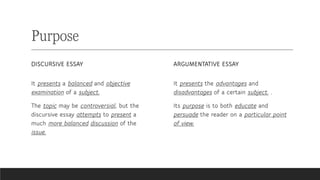
Purpose
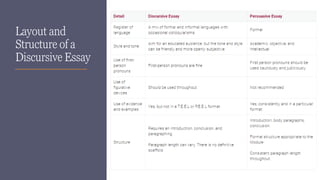
DISCURSIVE ESSAY
It presents a balanced and objective
examination of a subject.
The topic may be controversial, but the
discursive essay attempts to present a
much more balanced discussion of the
issue.
ARGUMENTATIVE ESSAY
It presents the advantages and
disadvantages of a certain subject. .
Its purpose is to both educate and
persuade the reader on a particular point
of view.
The Discursive
Essay
THE STYLE
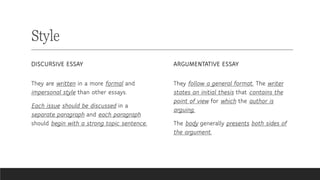
Style
DISCURSIVE ESSAY
They are written in a more formal and
impersonal style than other essays.
Each issue should be discussed in a
separate paragraph and each paragraph
should begin with a strong topic sentence.
ARGUMENTATIVE ESSAY
They follow a general format. The writer
states an initial thesis that contains the
point of view for which the author is
arguing.
The body generally presents both sides of
the argument.
The Discursive
Essay
THE PLAN
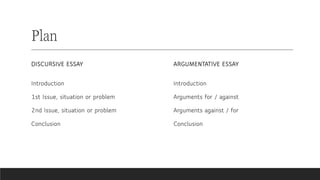
Plan
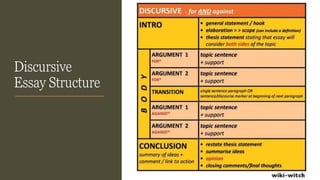
DISCURSIVE ESSAY
Introduction
1st Issue, situation or problem
2nd Issue, situation or problem
Conclusion
ARGUMENTATIVE ESSAY
Introduction
Arguments for / against
Arguments against / for
Conclusion
The Discursive
Essay
WHAT A GOOD DISCURSIVE ESSAY
HAS
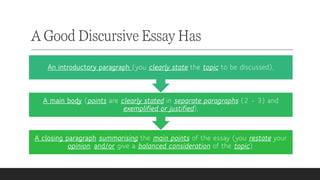
A Good Discursive Essay Has
A closing paragraph summarising the main points of the essay (you restate your
opinion, and/or give a balanced consideration of the topic).
A main body (points are clearly stated in separate paragraphs (2 - 3) and
exemplified or justified),
An introductory paragraph (you clearly state the topic to be discussed),
The Discursive
Essay
THE STYLE
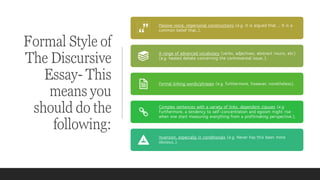
Formal Style of
The Discursive
Essay- This
means you
should do the
following:
Passive voice, impersonal constructions (e.g. It is argued that...; It is a
common belief that…),
A range of advanced vocabulary (verbs, adjectives, abstract nouns, etc)
(e.g. heated debate concerning the controversial issue…),
Formal linking words/phrases (e.g. furthermore, however, nonetheless),
Complex sentences with a variety of links, dependent clauses (e.g.
Furthermore, a tendency to self-concentration and egoism might rise
when one start measuring everything from a profitmaking perspective.),
Inversion, especially in conditionals (e.g. Never has this been more
obvious…).
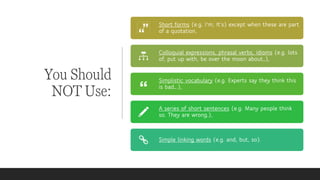
You Should
NOT Use:
Short forms (e.g. I'm; It’s) except when these are part
of a quotation,
Colloquial expressions, phrasal verbs, idioms (e.g. lots
of, put up with, be over the moon about…),
Simplistic vocabulary (e.g. Experts say they think this
is bad….),
A series of short sentences (e.g. Many people think
so. They are wrong.),
Simple linking words (e.g. and, but, so).
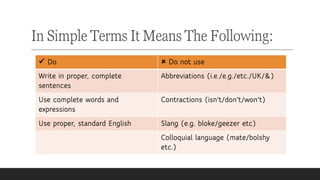
In Simple Terms It Means The Following:
✓ Do  Do not use
Write in proper, complete
sentences
Abbreviations (i.e./e.g./etc./UK/&)
Use complete words and
expressions
Contractions (isn't/don't/won't)
Use proper, standard English Slang (e.g. bloke/geezer etc)
Colloquial language (mate/bolshy
etc.)
The
Discursive
Essay
LINKING WORDS
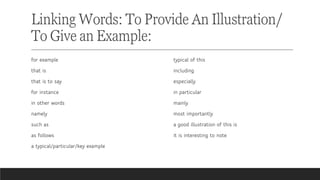
Linking Words: To Provide An Illustration/
To Give an Example:
for example
that is
that is to say
for instance
in other words
namely
such as
as follows
a typical/particular/key example
typical of this
including
especially
in particular
mainly
most importantly
a good illustration of this is
it is interesting to note
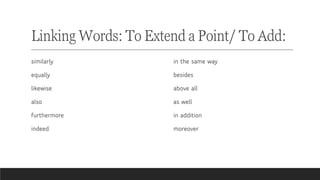
Linking Words: To Extend a Point/ To Add:
similarly
equally
likewise
also
furthermore
indeed
in the same way
besides
above all
as well
in addition
moreover
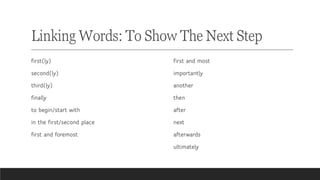
Linking Words: To Show The Next Step
first(ly)
second(ly)
third(ly)
finally
to begin/start with
in the first/second place
first and foremost
first and most
importantly
another
then
after
next
afterwards
ultimately
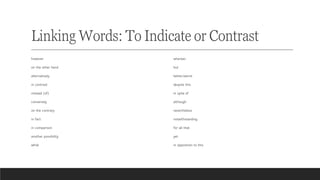
Linking Words: To Indicate or Contrast
however
on the other hand
alternatively
in contrast
instead (of)
conversely
on the contrary
in fact
in comparison
another possibility
while
whereas
but
better/worst
despite this
in spite of
although
nevertheless
notwithstanding
for all that
yet
in opposition to this
Linking Words: To Show Cause and Effect
so
therefore
accordingly
hence
as a result/consequence
resulting from
in consequence of this
consequently
because of this/that
for this reason
owing to/due to the fact
this demonstrates
it follows that
this suggests that
accepting/assuming
this
Linking Words: To Conclude
in conclusion
it can be concluded
this implies
in short
to conclude
to sum up
all in all
in brief
all things
considered
taking everything into account
The Discursive
Essay
AN EXAMPLE
The Role Of Marriage In Today’s Society
If there is one thing that virtually all the world’s cultures have in common, it is marriage. Beliefs, diet and
languages vary greatly, but the desire people have to share their lives with another seems universal.
Why, then, is marriage so popular? Psychologists have said that people have a deep need for the
emotional security which marriage provide. Knowing that one has a partner in life makes it easier to
cope with the problems of daily life. On the other hand, the fact that many single people are content to
live alone suggests that the “emotional need” theory is incomplete.
British novelist Fay Weldon once stated, “Marriage has nothing to do with emotion and everything to do
with property.” According to the supporters of this view, people marry in order to increase their wealth,
either by marrying a rich partner or because, as the saying goes, “two can live cheaply as one.” It is true
that financial considerations are often the primary reason that people marry. However, there are
countless examples of people “marrying for love”, regardless of their mate’s lack of money.
All in all, marriage continues to be extremely popular in many societies. Most of us have a need for
love and support and want to have children at some point in our lives. Fully understanding the reason
why people marry, though, may be as difficult as understanding the human mind itself.
The Discursive Essay
THE PARAGRAPH PLAN
Paragraph Plan
Paragraph 1: state topic (why is marriage so popular?)
Paragraph 2: ‘emotional’ need for a partner; comparison between single/married people
Paragraph 3: why people marry – for love/money
Paragraph 4: make general comments (difficult to fully understand reason why people marry)
The Discursive
Essay
THE LAYOUT AND STRUCTURE
Layout and
Structure of a
Discursive Essay
Discursive
Essay Structure
Sources
Slideshare
Matrix Education
Pinterest

Discursive and argumentative essay writing

  • 1.
  • 2.
  • 3.
    Purpose DISCURSIVE ESSAY It presentsa balanced and objective examination of a subject. The topic may be controversial, but the discursive essay attempts to present a much more balanced discussion of the issue. ARGUMENTATIVE ESSAY It presents the advantages and disadvantages of a certain subject. . Its purpose is to both educate and persuade the reader on a particular point of view.
  • 4.
  • 5.
    Style DISCURSIVE ESSAY They arewritten in a more formal and impersonal style than other essays. Each issue should be discussed in a separate paragraph and each paragraph should begin with a strong topic sentence. ARGUMENTATIVE ESSAY They follow a general format. The writer states an initial thesis that contains the point of view for which the author is arguing. The body generally presents both sides of the argument.
  • 6.
  • 7.
    Plan DISCURSIVE ESSAY Introduction 1st Issue,situation or problem 2nd Issue, situation or problem Conclusion ARGUMENTATIVE ESSAY Introduction Arguments for / against Arguments against / for Conclusion
  • 8.
    The Discursive Essay WHAT AGOOD DISCURSIVE ESSAY HAS
  • 9.
    A Good DiscursiveEssay Has A closing paragraph summarising the main points of the essay (you restate your opinion, and/or give a balanced consideration of the topic). A main body (points are clearly stated in separate paragraphs (2 - 3) and exemplified or justified), An introductory paragraph (you clearly state the topic to be discussed),
  • 10.
  • 11.
    Formal Style of TheDiscursive Essay- This means you should do the following: Passive voice, impersonal constructions (e.g. It is argued that...; It is a common belief that…), A range of advanced vocabulary (verbs, adjectives, abstract nouns, etc) (e.g. heated debate concerning the controversial issue…), Formal linking words/phrases (e.g. furthermore, however, nonetheless), Complex sentences with a variety of links, dependent clauses (e.g. Furthermore, a tendency to self-concentration and egoism might rise when one start measuring everything from a profitmaking perspective.), Inversion, especially in conditionals (e.g. Never has this been more obvious…).
  • 12.
    You Should NOT Use: Shortforms (e.g. I'm; It’s) except when these are part of a quotation, Colloquial expressions, phrasal verbs, idioms (e.g. lots of, put up with, be over the moon about…), Simplistic vocabulary (e.g. Experts say they think this is bad….), A series of short sentences (e.g. Many people think so. They are wrong.), Simple linking words (e.g. and, but, so).
  • 13.
    In Simple TermsIt Means The Following: ✓ Do  Do not use Write in proper, complete sentences Abbreviations (i.e./e.g./etc./UK/&) Use complete words and expressions Contractions (isn't/don't/won't) Use proper, standard English Slang (e.g. bloke/geezer etc) Colloquial language (mate/bolshy etc.)
  • 14.
  • 15.
    Linking Words: ToProvide An Illustration/ To Give an Example: for example that is that is to say for instance in other words namely such as as follows a typical/particular/key example typical of this including especially in particular mainly most importantly a good illustration of this is it is interesting to note
  • 16.
    Linking Words: ToExtend a Point/ To Add: similarly equally likewise also furthermore indeed in the same way besides above all as well in addition moreover
  • 17.
    Linking Words: ToShow The Next Step first(ly) second(ly) third(ly) finally to begin/start with in the first/second place first and foremost first and most importantly another then after next afterwards ultimately
  • 18.
    Linking Words: ToIndicate or Contrast however on the other hand alternatively in contrast instead (of) conversely on the contrary in fact in comparison another possibility while whereas but better/worst despite this in spite of although nevertheless notwithstanding for all that yet in opposition to this
  • 19.
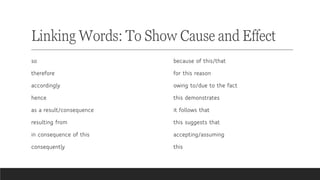
    Linking Words: ToShow Cause and Effect so therefore accordingly hence as a result/consequence resulting from in consequence of this consequently because of this/that for this reason owing to/due to the fact this demonstrates it follows that this suggests that accepting/assuming this
  • 20.
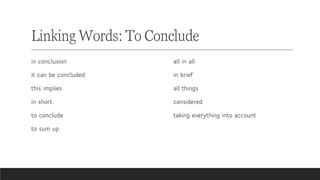
    Linking Words: ToConclude in conclusion it can be concluded this implies in short to conclude to sum up all in all in brief all things considered taking everything into account
  • 21.
  • 22.
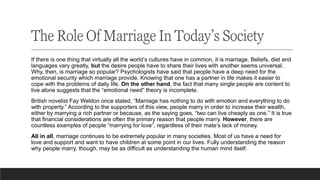
    The Role OfMarriage In Today’s Society If there is one thing that virtually all the world’s cultures have in common, it is marriage. Beliefs, diet and languages vary greatly, but the desire people have to share their lives with another seems universal. Why, then, is marriage so popular? Psychologists have said that people have a deep need for the emotional security which marriage provide. Knowing that one has a partner in life makes it easier to cope with the problems of daily life. On the other hand, the fact that many single people are content to live alone suggests that the “emotional need” theory is incomplete. British novelist Fay Weldon once stated, “Marriage has nothing to do with emotion and everything to do with property.” According to the supporters of this view, people marry in order to increase their wealth, either by marrying a rich partner or because, as the saying goes, “two can live cheaply as one.” It is true that financial considerations are often the primary reason that people marry. However, there are countless examples of people “marrying for love”, regardless of their mate’s lack of money. All in all, marriage continues to be extremely popular in many societies. Most of us have a need for love and support and want to have children at some point in our lives. Fully understanding the reason why people marry, though, may be as difficult as understanding the human mind itself.
  • 23.
  • 24.
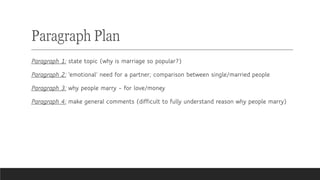
    Paragraph Plan Paragraph 1:state topic (why is marriage so popular?) Paragraph 2: ‘emotional’ need for a partner; comparison between single/married people Paragraph 3: why people marry – for love/money Paragraph 4: make general comments (difficult to fully understand reason why people marry)
  • 25.
  • 26.
    Layout and Structure ofa Discursive Essay
  • 27.
  • 28.