Discrete Mathematics
Lecture:01
1) Definition of discrete mathematics.
2) Benefits of discrete mathematics.
3) Distinguish between mathematics & logic.
4) What is proposition? Example
5) Truth tables of the followings.
I. Negation(NOT)
II. Conjunction(AND)
III. Disjunction(OR)
IV. Executive OR
V. Bioconditional
VI. Implication.
6) Converse, Contra positive, & inverse?
Lecture:02
1) Translating English sentences into logical expression & translating logical
expression into English sentences.
I. Example
II. Class practice
2) Logical equivalence
I. Definition
*How to provelogical equivalence.
II. Class practice
III. Home work
Lecture:03
1) Tautology, contradiction, & contingency
I. Example
II. Class practice
Lecture:04
1) Universal quantifiers
2) Existential quantifiers
I. Example
II. Class practice
Lecture:05
1) Function: Definition & uses
2) Types of function
I. One to one (not onto)
II. Onto (notone to one)
III. One to one & onto
IV. Neither one to one not onto
V. Not a function.
3) Composition of function
I. Definition
II. Class practice
New Chapter:
1) Integers & divisions
2) Division algorithm
I. if a ǀ b & a ǀ c, then a ǀ (b+c)
II. if a ǀ b, then a ǀ bc for all integer c
III. if a ǀ b & b ǀ c then a ǀ c
(1)Definition (2) Equal set (3) Empty set (4) Sub set ( 5) proper set (6) power set
(7) what is the power set of an empty set (8) Cartesian product(9) Venn-diagram
(10) Complement of a set (11) Disjointset (12) Rules of set.
Lecture:06
1) Prime number
I. definition
2) Prime factorization
II. Example
3) Greatest common divisor (GCD)
LowestCommon Multiple (LCM)
III. Example
IV. Home work
4) Cryptology
I. Encryption
II. Decryption
New chapter:
1) Productrule
I. Definition & class example
2) Sum rule
II. Definition & class example
Lecture:07
1) Combination of productrule & sumrule.
I. Class practice
2) Inclusion-Exclusion principle
II. Definition
III. Class practice
3) Permutation & combination.
I. Class practice

Discrete mathematics (topic)

  • 1.
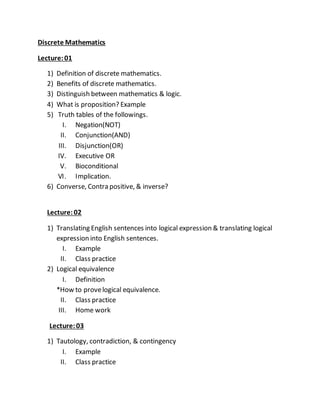
    Discrete Mathematics Lecture:01 1) Definitionof discrete mathematics. 2) Benefits of discrete mathematics. 3) Distinguish between mathematics & logic. 4) What is proposition? Example 5) Truth tables of the followings. I. Negation(NOT) II. Conjunction(AND) III. Disjunction(OR) IV. Executive OR V. Bioconditional VI. Implication. 6) Converse, Contra positive, & inverse? Lecture:02 1) Translating English sentences into logical expression & translating logical expression into English sentences. I. Example II. Class practice 2) Logical equivalence I. Definition *How to provelogical equivalence. II. Class practice III. Home work Lecture:03 1) Tautology, contradiction, & contingency I. Example II. Class practice
  • 2.
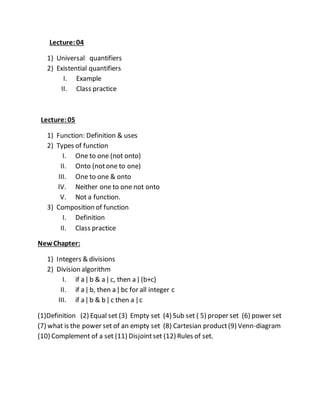
    Lecture:04 1) Universal quantifiers 2)Existential quantifiers I. Example II. Class practice Lecture:05 1) Function: Definition & uses 2) Types of function I. One to one (not onto) II. Onto (notone to one) III. One to one & onto IV. Neither one to one not onto V. Not a function. 3) Composition of function I. Definition II. Class practice New Chapter: 1) Integers & divisions 2) Division algorithm I. if a ǀ b & a ǀ c, then a ǀ (b+c) II. if a ǀ b, then a ǀ bc for all integer c III. if a ǀ b & b ǀ c then a ǀ c (1)Definition (2) Equal set (3) Empty set (4) Sub set ( 5) proper set (6) power set (7) what is the power set of an empty set (8) Cartesian product(9) Venn-diagram (10) Complement of a set (11) Disjointset (12) Rules of set.
  • 3.
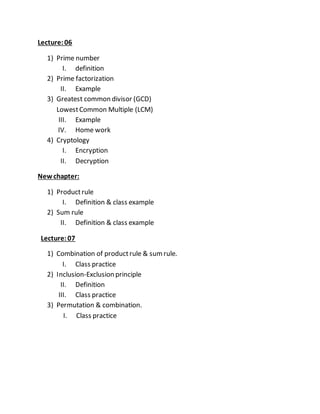
    Lecture:06 1) Prime number I.definition 2) Prime factorization II. Example 3) Greatest common divisor (GCD) LowestCommon Multiple (LCM) III. Example IV. Home work 4) Cryptology I. Encryption II. Decryption New chapter: 1) Productrule I. Definition & class example 2) Sum rule II. Definition & class example Lecture:07 1) Combination of productrule & sumrule. I. Class practice 2) Inclusion-Exclusion principle II. Definition III. Class practice 3) Permutation & combination. I. Class practice